EP4559328A2 - Maschine zur behandlung von lebensmittelprodukten pflanzlichen ursprungs zur herstellung von saft und zugehöriges verfahren zur behandlung - Google Patents
Maschine zur behandlung von lebensmittelprodukten pflanzlichen ursprungs zur herstellung von saft und zugehöriges verfahren zur behandlung Download PDFInfo
- Publication number
- EP4559328A2 EP4559328A2 EP25170224.7A EP25170224A EP4559328A2 EP 4559328 A2 EP4559328 A2 EP 4559328A2 EP 25170224 A EP25170224 A EP 25170224A EP 4559328 A2 EP4559328 A2 EP 4559328A2
- Authority
- EP
- European Patent Office
- Prior art keywords
- rotor
- machine
- hollow body
- product
- vegetable origin
- Prior art date
- Legal status (The legal status is an assumption and is not a legal conclusion. Google has not performed a legal analysis and makes no representation as to the accuracy of the status listed.)
- Pending
Links
Images




Classifications
-
- A—HUMAN NECESSITIES
- A23—FOODS OR FOODSTUFFS; TREATMENT THEREOF, NOT COVERED BY OTHER CLASSES
- A23N—MACHINES OR APPARATUS FOR TREATING HARVESTED FRUIT, VEGETABLES OR FLOWER BULBS IN BULK, NOT OTHERWISE PROVIDED FOR; PEELING VEGETABLES OR FRUIT IN BULK; APPARATUS FOR PREPARING ANIMAL FEEDING- STUFFS
- A23N1/00—Machines or apparatus for extracting juice
- A23N1/02—Machines or apparatus for extracting juice combined with disintegrating or cutting
-
- A—HUMAN NECESSITIES
- A23—FOODS OR FOODSTUFFS; TREATMENT THEREOF, NOT COVERED BY OTHER CLASSES
- A23L—FOODS, FOODSTUFFS OR NON-ALCOHOLIC BEVERAGES, NOT OTHERWISE PROVIDED FOR; PREPARATION OR TREATMENT THEREOF
- A23L2/00—Non-alcoholic beverages; Dry compositions or concentrates therefor; Preparation or treatment thereof
- A23L2/02—Non-alcoholic beverages; Dry compositions or concentrates therefor; Preparation or treatment thereof containing fruit or vegetable juices
- A23L2/04—Extraction of juices
Definitions
- the invention relates, furthermore, to a method for treating food products of vegetable origin and to a method for producing juice starting from such food products.
- the product is subject to a series of pulses in quick succession, obtained by a cylindrical, or conical, body having protruding portions at the internal surface, and by a rotor provided with blades, which rotates within the fixed body and applies a centrifugal force on the pulps pushing them against the protruding portions, generating the pulses, which cause the softening.
- a series of pulses in quick succession obtained by a cylindrical, or conical, body having protruding portions at the internal surface, and by a rotor provided with blades, which rotates within the fixed body and applies a centrifugal force on the pulps pushing them against the protruding portions, generating the pulses, which cause the softening.
- the ground, or softened, product is radially pushed owing to the centrifugal force against the sieve.
- the main product i.e. the puree and the liquid fraction, i.e. the juice
- the parts which do not pass through the sieve instead, move axially along the sieve and are conveyed to another outlet, which is positioned at the opposite side with respect to the inlet, where they are discharged from the machine.
- An example of extractor machine having these characteristics is described in US4643085 .
- US2389862 a machine is described for extracting juice and puree food products.
- the machine comprises a rotor, which rotates within a stator and is operated by a motor to cause the processed food product to be ground.
- the puree which is, for example, obtained by extraction carried out in the aforementioned extractor machine, or alternatively, the ground product obtained upstream of the same, is added with enzymes, which are able to break the cell structure causing the liquid to exit outside. Then, the liquid is divided from the residues of puree, and waste, in case this is present, such as seeds and skins, by separating by sieves, or specific membranes, or by centrifugation.
- Another process for maximizing the yield in juice provides, instead, to subject the product to a slow mechanical compression carried out by hydraulic, or pneumatic, presses, or filter belt presses, where the pressure breaks the cells and the liquid product is filtered through belts, or membrane filters.
- the process for producing juice provides to use both the aforementioned treatments, that means at first before enzyme treatment and then the mechanical compression.
- a machine for treating a food product of vegetable origin, said machine comprising a treatment section provided with an inlet for feeding said food product of vegetable origin to be treated and with at least an inlet for discharging a treated product, said treatment section being equipped with a fixed hollow body, cylindrical, or conical, shaped, with a rotor substantially cylindrical shaped having a predetermined diameter ⁇ r, or substantially conical shaped with a predetermined minimum diameter ⁇ r, and mounted within said fixed hollow body, said rotor being provided with a plurality of blades, said rotor being operatively connected to said motor group configured to cause said rotor to rotate about a rotation axis at a predetermined rotation speed vr expressed in r.p.m., whose main characteristic is that the rotor is operatively connected to a motor shaft of said motor group by a connection group and that hydraulic sealing elements are, furthermore, provided arranged between the connection group and a connection flange which is arranged to
- the motor group is configured to cause said rotation in such a way that the product of the diameter, or the minimum diameter, ⁇ r and the rotation speed vr of the rotor, i.e . ⁇ r ⁇ vr, is greater than 700000 r.p.m ⁇ mm, whereby the food product of vegetable origin is subject to a dynamic compression force, which causes the cellular structure to be broken and, therefore, the liquid fraction, or juice, which is contained in the same to exit outside the solid fraction.
- the solution according to the present invention provides to cause a series of collisions of the processed food product of vegetable origin against the internal surface of the fixed hollow body.
- the internal surface of the fixed hollow body has a hardness higher than the hardness of the cellular structure of the vegetable pulp, therefore, the collisions, i.e. the violent and many dynamic compressions, which occur, cause a gradual breaking of the containment part, or membrane, of the cellular structure of the food product of vegetable origin and, therefore, the liquid fraction of the same to exit outside.
- the present invention is directed to provide a very high quantity of motion to the particles of the food product of vegetable origin in such a way to force them to hit against the internal surface of the fixed hollow body, that gradually causes the containment membrane of the liquid fraction to be broken.
- the internal surface of the fixed hollow body provides a plurality of impact surfaces connected by a plurality of connection surfaces. In this way, the aforementioned technical effect is obtained by a plurality of collisions obtained by causing by the blades of the rotor a succession of violent collisions of the processed product against the aforementioned plurality of impact surfaces.
- a method for treating a food product of vegetable origin comprises the steps of:
- the treated product exiting the treatment section can be subject to an extraction step within an extraction section to divide the treated product in a first portion more liquid from a second portion more solid.
- the extraction section can be equipped with:
- the first portion of product exiting the extraction section is subject to a deaeration step up to reach a predetermined vacuum degree.
- the deaerated product can be then subject to a thermal treatment in a thermal treatment section.
- the aforementioned thermal treatment can be selected from the group comprising:
- the product exiting the aforementioned treatment section, or the first portion of the product exiting the extraction section, or the thermally treated product exiting the thermal treatment section, depending on the embodiment of the method that is used can be subject to a dividing step to divide a lighter part, in particular the liquid fraction of said product, from a heavier part, in particular the solid fraction of said product.
- the dividing step can be selected from the group comprising:
- a plant for producing juice starting from a food product of vegetable origin can comprise at least a machine for treating as described above and at least a machine for dividing the treated product exiting the machine for treating in a main part constituted from juice, and a secondary part, constituted from puree, skins, and seeds.
- a machine for treating a food product of vegetable origin can comprise a treatment section provided with an inlet for introducing the food product of vegetable origin to be treated and at least an outlet for discharging a treated product.
- the aforementioned treatment section can be equipped with a fixed hollow body, cylindrical, or conical, shaped, and with a rotor substantially cylindrical shaped, or substantially conical shaped, mounted within of the fixed hollow body, preferably providing a plurality of blades.
- the rotor can be operatively connected to a motor group configured to cause the rotor to rotate about a rotation axis at a predetermined rotation speed.
- the aforementioned fixed hollow body can have an internal surface comprising a plurality of impact surfaces against which said plurality of blades of said rotor is arranged to push said treated food product of vegetable origin in such a way to subject the same to a succession of collisions and, thus, to cause the containing part of the food product of vegetable origin to be broken, and the liquid fraction to exit outside.
- the aforementioned plurality of impact surfaces is connected by a plurality of connection surfaces.
- each impact surface can be oriented, in such a way that the rotor blades have a impact angle ⁇ , which can change during rotation of rotor 30.
- the aforementioned impact angle changes during rotation of rotor with respect to the impact surface between 0° and 45°.
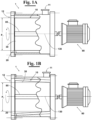
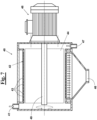
- FIGS. 1A and 1B are diagrammatically shown as an example two possible embodiments of a machine 1 for treating a original food product of vegetable origin 100, or pre-treated.
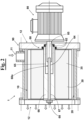
- the machine 1 provides, in particular, a treatment section 10 provided with a fixed hollow body 20 cylindrical shaped ( figure 1 ), or conical shaped ( figure 2 ), and a rotor 30, also this cylindrical shaped, or substantially cylindrical shaped, and having a predetermined diameter ⁇ r, or conical, or substantially conical, and having a predetermined minimum diameter ⁇ r.
- the rotor 30 provides a predetermined number of blades and is mounted within the fixed hollow body 20.
- the rotor 30 is configured to rotate within the fixed hollow body 20 about a rotation axis 130.
- the rotor 30 has a conical shape, with diameter ⁇ r this is to be intended to be the minimum diameter of the same (see figure 2 ). If the rotor 30 has a cylindrical shape the diameter, or the aforementioned minimum diameter, ⁇ r will be constant along the length of the same. In particular, the aforementioned diameter, or minimum diameter, ⁇ r of rotor 30 can be set between 250 mm and 1000 mm.
- the machine 1 provides, furthermore, a motor group 80 operatively connected to rotor 30 by a motor shaft 85 arranged to cause the aforementioned rotation of rotor 30 about the rotation axis 130 at a predetermined rotation speed vr, for example expressed in r.p.m.
- the motor group 80 is configured to cause the aforementioned rotation of rotor 30 in such a way that the product of diameter ⁇ r and rotation speed vr, i.e. ⁇ r ⁇ vr is greater than 700000 r.p.m ⁇ mm.
- the particular operative solution provided by the present invention allows to generate a dynamic compression force on the fibres and on the single cells of the food products of vegetable origin.
- the present invention allows to obtain an analogous effect to that obtained by complex processes of prior art, which provide the use of enzymes, or technical solutions with low yields that provide to carry out a slow mechanical compression.
- the present invention allows, furthermore, to maximize the yield in liquid fraction, i.e. juice, of the machine for treating 1, by subjecting the starting food product of vegetable origin to an energetic treatment, without, anyway, compromise the organoleptic properties of the final product.
- liquid fraction i.e. juice
- the fixed hollow body 20 can provide a first surface 21 and the rotor 30 can provide a second surface 31, respectively, providing a plurality of protruding portions 22, 32, alternating with a plurality of recessed portions 23, 33, in such a way to subject, in use, the treated food product of vegetable origin 100 to a series of compression stresses in rapid succession. Therefore, in this case, the machine for treating, from a structural point of view, is similar to a softening machine of the type, for example, described in EP0511174 .
- each protruding portion 22 can be set between 0.5 mm and 20 mm, for example between 2 mm and 4 mm.
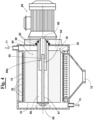
- the fixed hollow body 20 of the treatment section 10 is, advantageously, provided with a plurality of holes 25 of a predetermined diameter.
- the rotor 30 is configured to rotate at the aforementioned rotation speed vr within the fixed hollow body 20, to cause, as described above, the food product of vegetable origin to be broken and the liquid fraction of the same to exit outside and, furthermore, to apply a centrifugal force on the treated food product of vegetable origin against the fixed hollow body 20.
- the food product of vegetable origin is divided into a first portion, more liquid, which passes through the holes 25 of sieve 20 and is discharged through a first outlet 12, and a second portion, more solid, which, instead, does not pass through the holes 22 of sieve 20 and is discharged through a second outlet 13.
- the first portion contains the juice of the processed food product of vegetable origin
- the second portion contains the waste, that means the skins, the seeds, of the product but also the puree of the food product of vegetable origin, or anyway, the more solid fraction of the same.
- the rotor 30 can be connected to the motor shaft 85 by a connection group 60.
- a connection group 60 can comprise, in particular, a hub 65 mounted on the motor shaft 85, for example connected to the same by a key, or tongue.
- the connection group 60 can comprise, furthermore, a hollow connection member 66 mounted on the hub 65. More in detail, the hollow connection member 66 provides a housing 67 arranged to house a connection shaft 68 arranged to engage at an end 68a a seat 64 of the hub 65 to make the hollow connection member 66 integral in rotation with hub 65.
- the hollow connection member 66 is, furthermore, peripherally provided with a plurality of blades 35 of the rotor 30, to which is fixed, for example, by welding. Furthermore, hydraulic sealing elements 82 are provided positioned between the connection group 60 and a connection flange 90 arranged to connect the motor group 80 to the treatment section 10. More in particular, first sealing elements 82a are provided positioned between the hub 65 and the connection flange 90 and second sealing elements 82b positioned between the hollow connection member 66 and the connection flange 90. In this way, the necessary sealing conditions for machine 1 are guaranteed. In fact, in order to cause the breaking of the cells of food product of vegetable origin and the liquid fraction to exit outside, it is necessary that motor group 80 operates at high speeds, considerably increasing the risk that the liquid fraction, i.e. the juice product, during the treatment, can infiltrate among the moving organs, i.e. the motor shaft and the other parts of the machine 1 with the possibility that can exit towards outside and to cause short circuits to the motor group 80.
- the liquid fraction i
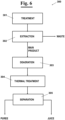
- the method provides to treat the original, or pre-treated food product of vegetable origin, within the treatment section 10 that is shown in the figures 2 and 3 , where the fixed body 20 does not provide holes 25 and, therefore, all the treated product is discharged through a single outlet, block 301.
- the treated food product of vegetable origin is subject to an extraction step, block 302, for example carried out by an extractor machine of the type described in US4643085 . More in particular, the extraction step can be carried out in the extraction section 40 diagrammatically shown in figure 7 , where the treated product is introduced thorough an inlet 41.
- a fixed sieve 42 cylindrical, or conical, shaped, can be installed that is provided with a plurality of holes 43 having a predetermined diameter, and a rotor 44 configured to rotate within the aforementioned sieve 42 operated by a motor 48 to which is connected by a motor shaft 49.
- the rotor 44 is arranged to apply a centrifugal force on the treated food product of vegetable origin against the sieve 42, in such a way to divide the aforementioned food product of vegetable origin in a first portion which passes through the holes 43 of the sieve 42 and is discharged through a first outlet 46, and a second portion which, instead, does not pass through the holes of the sieve 42 and is discharged through a second outlet 47.
- the first portion of the product which contains mainly juice, i.e. the liquid fraction, but also a determined quantity of solid fraction, i.e. puree of the food product of vegetable origin, discharged from the extraction section through the first outlet 46, can be subject to a dividing step, block 305 for example a static, or dynamic, sedimentation step, or a centrifugation step, to divide the lighter part of the product, in particular the liquid fraction of the product, i.e. the juice, from the heavier part, in particular the solid fraction of the product same, i.e. the puree.
- a dividing step block 305 for example a static, or dynamic, sedimentation step, or a centrifugation step, to divide the lighter part of the product, in particular the liquid fraction of the product, i.e. the juice, from the heavier part, in particular the solid fraction of the product same, i.e. the puree.
- the method 300 after the treatment and the extraction steps, blocks 301 and 302, described above with reference to figure 5 , provides to subject the first portion discharged from the extraction section 40 through the first outlet 46, to a deaeration step, block 303, to subject the same, for example within a reservoir, to a predetermined vacuum degree to eliminate the air that is present in the same.
- the deaerated product is, then, subject to a thermal treatment, block 304.
- the thermal treatment can be, for example, a step of activation temperature, in this case the product is heated up to a temperature Tatt comprised between 50°C and 60°C, or a step of inactivation temperature, in this case, the product is, instead, heated up a temperature Tina comprised between 85°C and 95°C.
- a dividing step, block 305 is provided analogous to that one described with reference to the figures showing the division of the juice from puree.
- the treatment step, block 401, of the method 400 is carried out by the embodiment of the machine 1 described above with reference to figure 4 .
- the treatment step also provides a first division of the treated food product of vegetable origin in a main product, mainly the liquid fraction of the starting food product of vegetable origin, i.e. the juice, and a secondary product.
- This is subject to a secondary extraction step within a secondary extraction section, for example defined into an extractor as described above with reference to figure 7 , to divide the secondary product in a more solid fraction, which does not pass through the holes of the sieve and is discharged as waste through the second outlet, and a less solid fraction still having a certain food value, in particular the puree of the starting food product of vegetable origin, which is discharged through the first outlet.
- a secondary extraction step within a secondary extraction section, for example defined into an extractor as described above with reference to figure 7 , to divide the secondary product in a more solid fraction, which does not pass through the holes of the sieve and is discharged as waste through the second outlet, and a less solid fraction still having a certain food value, in particular the puree of the starting food product of vegetable origin, which is discharged through the first outlet.
- the method 400 provides to subject the main product obtained in the treatment step 401, i.e. the juice, to a dividing step, block 403, analogous to that one described above with reference to figures 6 and 7 , in order to divide the juice from a more solid fraction which has passed through the holes 25 of the machine for treating together with the juice and that is essentially constituted from a determined quantity of puree.
- a mixing step can be advantageously provided for mixing the puree deriving from the aforementioned secondary extraction step, with the puree coming from the dividing step block 404.
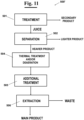
- a starting treatment step is provided, block 501, as described above.
- the juice obtained in the treatment step is, then, subject to a dividing step, block 502, for example carried out in a centrifuge, or a decanter, to divide the juice in a heavier product (mainly skins and seeds) and a lighter product (mainly juice).
- An extraction step, block 503, follows of the heavier part exiting the dividing step obtaining a main product, juice and/or puree, and a waste product.
- the main product is, then, subject to a deaeration step and/or a thermal treatment step, in particular an inactivation temperature, block 504.
- the heavier product is subject, at first, to a deaeration step and/or a thermal treatment, in particular an inactivation temperature, block 504, and, then, an additional treatment is provided, advantageously a treatment with presses, or enzymes, block 505, and the successive extraction step, block 506.
- a plant for producing juice starting from a food product of vegetable origin comprises at least a machine for treating as described above with reference to the figures from 1 to 5, and at least a machine for carrying out one of the aforementioned steps according to the methods for producing juice described above with reference to figure 5 to 6 and 8 to 11 , in particular at least an extraction machine positioned downstream of the machine for treating and/or a secondary extraction machine if within the machine for treating 1 a fixed body 20 is provided having holes 25, and/or a machine for carrying out deaeration, and/or a machine for the aforementioned thermal treatment, and/or a division machine, in particular a centrifuge, or a decanter and/or a press and/or a machine for the treatment with enzymes.
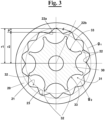
- the fixed hollow body 20 can comprise a plurality of protruding portions 22, whose bottoms are arranged to lay on a first circumference ⁇ 1 having a first radius r1, alternating with a plurality of recessed portions 23, the tops of which are arranged to lay on a second circumference ⁇ 2 having a second radius r2, with r2 ⁇ r1.
- the difference between the first and the second radius r2 is equal to a predetermined value ⁇ r.
- the aforementioned value ⁇ r can be set between 0.3 mm and 3 mm.
- the motor group 80 can be configured to cause the rotor 30 to rotate, in such a way that the product of the diameter ⁇ r, of the rotation speed vr of the rotor 30, and said predetermined value ⁇ r, i.e. ⁇ r ⁇ vr ⁇ r, can be set between 240000 and 1500000 rounds ⁇ mm 2 /min.
- the aforementioned difference of radius ⁇ r between the two circumferences ⁇ 1 and ⁇ 2 can be equal to 0.3 mm. Therefore, the aforementioned product can be equal to 240000 rounds ⁇ mm 2 /min.
- the aforementioned speed of the rotor 30 can be set between 1800 and 2500 rounds/min.
- the aforementioned diameter of the fixed hollow body 20 can be set between 200 and 1000 mm, advantageously set between 300 and 500 mm.
- the fixed hollow body 20 can be provided with an internal surface 21 and the rotor 30 can be provided with an external surface 31 arranged to face one another.
- the internal surface 21 of the fixed hollow body 20, and the external surface 31 of the rotor 30 can be configured in such a way to cause at least an inversion of direction, in particular from a centrifugal direction to a centripetal direction, or vice versa, of the treated product at each predetermined number of rounds, for example at each round, of the rotor 30 about its rotation axis.
- the distance between le blades of the rotor 30 and the internal surface 21 of the fixed hollow body 20 can be set between 0.1 mm and 5 mm. More in particular, if the internal surface 21 of the fixed hollow body 20 is not provided with the aforementioned protruding portions 22 alternating with the aforementioned recessed portions 23, the aforementioned interspace is, advantageously, set between 0.1 mm and 0.6 mm, preferably between 0.2 mm and 0.5 mm.
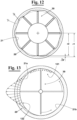
- the aforementioned result can be, for example, obtained providing a particular geometry of the internal surface 21 of the fixed hollow body 20 comprising at least a first portion 21a, for example half of the internal surface 21, of elliptical, or oval, shape and, for example, a second portion 21b of circular shape.
- the whole internal surface 21 of the fixed hollow body can be of elliptical, or oval, shape.
- FIG 13 are diagrammatically depicted the pressure lines generated on the particles of the treated product due to the particular geometry described above of the internal surface 21 of the fixed hollow body 20.
- figure 13 qualitatively shows the profile of the pressures generated on the treated product after a round of the rotor 30, and in particular the passage from a substantially centripetal direction of the pressure lines 121, to a substantially centrifugal direction of the pressure lines 122.
- the fixed hollow body 20 can be provided with an internal surface 21 comprising a plurality of impact surfaces 24 against which the plurality of blades 35 of the rotor 30 is arranged to push the treated food product in such a way to subject the same to a succession of collisions and, therefore, to cause the containment part of the food product to be broken, and the liquid fraction to exit.
- two successive impact surfaces 24 of the aforementioned plurality of impact surfaces 24 are connected by a connection surface 26, in particular defining a recess portion with respect to the impact surfaces 24.
- each impact surface 24 can be oriented, in such a way to define, with each blade 35 of the rotor 30, a predetermined impact angle ⁇ . This can be advantageously set between 0° (case diagrammatically shown in figure 14A ) and 45°.
- the aforementioned product of the diameter ⁇ r and the rotation speed vr ( ⁇ r ⁇ vr) of the rotor 30 can be set between 700000 and 3000000 r.p.m ⁇ mm, advantageously set between 700000 and 2500000 r.p.m ⁇ mm.
- the aforementioned product of the diameter ⁇ r and the rotation speed vr ( ⁇ r ⁇ vr) of the rotor 30 can be set between 750000 and 1300000.
- the aforementioned product of the diameter ⁇ r and the rotation speed vr ( ⁇ r ⁇ vr) of the rotor 30 can be set between 1000000 and 3000000 r.p.m ⁇ mm, advantageously between 1200000 and 1300000 r.p.m ⁇ mm.
- the aforementioned product of the diameter ⁇ r and the rotation speed vr ( ⁇ r ⁇ vr) of the rotor 30 can be set between 700000 and 1500000 r.p.m ⁇ mm, advantageously between 750000 and 1200000 r.p.m ⁇ mm.
- any protruding portion is not present, i.e. the protruding portions alternating with recessed portions, will be necessary to operate at speeds higher than the case in which the internal surface 21 of the fixed body 20 is not provided with the same.
- the blades 35 of the rotor 30 can comprise a base portion 35a, which is closer to the motor shaft 85, and an end portion 35b, which is farther from motor shaft and closer to the internal surface 21 of the fixed hollow body 20. More in particular, the base portion 35a of the blades 35 can be substantially positioned along a radial direction, whilst the end portion 35b can be positioned along a direction, which forms the aforementioned impact angle ⁇ with respect to the impact surfaces 24.
Landscapes
- Life Sciences & Earth Sciences (AREA)
- Chemical & Material Sciences (AREA)
- Engineering & Computer Science (AREA)
- Food Science & Technology (AREA)
- Polymers & Plastics (AREA)
- Health & Medical Sciences (AREA)
- Nutrition Science (AREA)
- Non-Alcoholic Beverages (AREA)
- Apparatuses For Bulk Treatment Of Fruits And Vegetables And Apparatuses For Preparing Feeds (AREA)
- Preparation Of Fruits And Vegetables (AREA)
Applications Claiming Priority (3)
| Application Number | Priority Date | Filing Date | Title |
|---|---|---|---|
| IT201900008622 | 2019-06-11 | ||
| PCT/IB2020/055422 WO2020250132A1 (en) | 2019-06-11 | 2020-06-09 | Machine for treating food products of vegetable origin for producing juice and related method for treating |
| EP20737279.8A EP3982758B1 (de) | 2019-06-11 | 2020-06-09 | Maschine zur verarbeitung von lebensmittelprodukten auf pflanzlicher oder tierischer basis zur herstellung von saft oder püree und entsprechendes verfahren |
Related Parent Applications (1)
| Application Number | Title | Priority Date | Filing Date |
|---|---|---|---|
| EP20737279.8A Division EP3982758B1 (de) | 2019-06-11 | 2020-06-09 | Maschine zur verarbeitung von lebensmittelprodukten auf pflanzlicher oder tierischer basis zur herstellung von saft oder püree und entsprechendes verfahren |
Publications (2)
| Publication Number | Publication Date |
|---|---|
| EP4559328A2 true EP4559328A2 (de) | 2025-05-28 |
| EP4559328A3 EP4559328A3 (de) | 2025-07-23 |
Family
ID=68073097
Family Applications (3)
| Application Number | Title | Priority Date | Filing Date |
|---|---|---|---|
| EP20737279.8A Active EP3982758B1 (de) | 2019-06-11 | 2020-06-09 | Maschine zur verarbeitung von lebensmittelprodukten auf pflanzlicher oder tierischer basis zur herstellung von saft oder püree und entsprechendes verfahren |
| EP25168634.1A Pending EP4555872A3 (de) | 2019-06-11 | 2020-06-09 | Maschine zur behandlung von lebensmittelprodukten pflanzlichen ursprungs zur herstellung von saft und zugehöriges verfahren zur behandlung |
| EP25170224.7A Pending EP4559328A3 (de) | 2019-06-11 | 2020-06-09 | Maschine zur behandlung von lebensmittelprodukten pflanzlichen ursprungs zur herstellung von saft und zugehöriges verfahren zur behandlung |
Family Applications Before (2)
| Application Number | Title | Priority Date | Filing Date |
|---|---|---|---|
| EP20737279.8A Active EP3982758B1 (de) | 2019-06-11 | 2020-06-09 | Maschine zur verarbeitung von lebensmittelprodukten auf pflanzlicher oder tierischer basis zur herstellung von saft oder püree und entsprechendes verfahren |
| EP25168634.1A Pending EP4555872A3 (de) | 2019-06-11 | 2020-06-09 | Maschine zur behandlung von lebensmittelprodukten pflanzlichen ursprungs zur herstellung von saft und zugehöriges verfahren zur behandlung |
Country Status (3)
| Country | Link |
|---|---|
| US (1) | US12369613B2 (de) |
| EP (3) | EP3982758B1 (de) |
| WO (1) | WO2020250132A1 (de) |
Families Citing this family (2)
| Publication number | Priority date | Publication date | Assignee | Title |
|---|---|---|---|---|
| IT201900019148A1 (it) * | 2019-10-17 | 2021-04-17 | Alessandro Bertocchi | Impianto e processo per la produzione di purea e/o succo ad elevata viscosita’ a partire da un prodotto alimentare di origine vegetale |
| DK202200066A1 (en) * | 2022-01-24 | 2023-11-03 | Stecao Aps | Apparatus and process for manufacturing protein product from green leaved material |
Citations (5)
| Publication number | Priority date | Publication date | Assignee | Title |
|---|---|---|---|---|
| US2389862A (en) | 1941-07-07 | 1945-11-27 | Schwarz Engineering Company In | Extractor |
| US4643085A (en) | 1984-04-06 | 1987-02-17 | Primo Bertocchi | Rotary machine for extraction of juice and puree from tomatoes, fruit and other produce |
| EP0511174A1 (de) | 1991-03-22 | 1992-10-28 | Primo Bertocchi | Verfahren zur Herstellung von Gemüsepulpe für die Gewinnung von Saft und Püree und eine Vorrichtung zur Durchführung des Verfahrens |
| WO2009063309A2 (en) | 2007-11-16 | 2009-05-22 | Bertocchi S.R.L. | Extraction method and apparatus of juice and/or puree, in particular from partially or completely frozen vegetables |
| US20160353790A1 (en) | 2003-10-21 | 2016-12-08 | Alessandro Bertocchi | Process and apparatus for extraction at room temperature of juice and puree from food products |
Family Cites Families (17)
| Publication number | Priority date | Publication date | Assignee | Title |
|---|---|---|---|---|
| US2345683A (en) * | 1941-11-07 | 1944-04-04 | Susan Jane Owens | Juice extracting machine |
| US2360964A (en) * | 1944-04-26 | 1944-10-24 | Moroni Laurence | Juice separator |
| US2541264A (en) * | 1948-02-10 | 1951-02-13 | King Sales & Engineering Co | Juice extractor |
| US4104414A (en) * | 1972-07-07 | 1978-08-01 | The United States Of America As Represented By The Secretary Of The Army | Process of making dehydrated fruit juice |
| US4301183A (en) * | 1978-05-26 | 1981-11-17 | Cereal Enterprises, Inc. | Method and apparatus for degerminating a grain kernel by impelling the kernels along a guide vane into an impact surface |
| US5906154A (en) * | 1997-11-25 | 1999-05-25 | Dong-A Engineering Co., Ltd. | Juice extractor |
| ITPR20030029A1 (it) * | 2003-04-16 | 2004-10-17 | Sig Technology Ltd | Apparato e procedimento per la distribuzione ordinata di |
| ITPR20040070A1 (it) * | 2004-10-05 | 2005-01-05 | Ro Snc Di Notari Roberto E Pia | Sistema di distribuzione e trattamento per macchine passatrici e raffinatrici di prodotti alimentari. |
| US8474374B2 (en) * | 2007-09-06 | 2013-07-02 | Russell T. Trovinger | Juicer with alternate cutters |
| IT1393260B1 (it) * | 2009-03-09 | 2012-04-12 | Bertocchi | Struttura di rotore per macchine per l'estrazione di succo e purea da alimenti di origine vegetale, o animale e macchina ad alta efficienza e basso consumo energetico cosi' ottenuta |
| US8807022B2 (en) * | 2009-10-12 | 2014-08-19 | Alan Backus | Devices and methods to disintegrate foods |
| IT1402099B1 (it) * | 2010-09-01 | 2013-08-28 | Bertocchi | Processo per l'inattivazione enzimatica di purea, o succo, ottenuta da alimenti di origine vegetale, o animale ed apparecchiatura che attua tale processo |
| CN106455840B (zh) * | 2014-06-06 | 2019-10-15 | 皇家飞利浦有限公司 | 离心式榨汁机 |
| EP3277104B1 (de) * | 2015-04-02 | 2024-02-07 | Alessandro Bertocchi | Behandlungsmethode für pflanzliche produkte, die zur herstellung von püree oder saft bestimmt sind, und maschine um solch eine methode auszuführen |
| CN105495627B (zh) * | 2015-12-01 | 2017-12-12 | 江南大学 | 一种水果破碎制浆灭酶一体化装置 |
| IT201900003313A1 (it) * | 2019-03-07 | 2020-09-07 | Alessandro Bertocchi | Macchina per l’estrazione di purea, o succo, da prodotti alimentari di origine vegetale e relativo metodo di produzione |
| IT201900019148A1 (it) * | 2019-10-17 | 2021-04-17 | Alessandro Bertocchi | Impianto e processo per la produzione di purea e/o succo ad elevata viscosita’ a partire da un prodotto alimentare di origine vegetale |
-
2020
- 2020-06-09 WO PCT/IB2020/055422 patent/WO2020250132A1/en not_active Ceased
- 2020-06-09 EP EP20737279.8A patent/EP3982758B1/de active Active
- 2020-06-09 US US17/618,455 patent/US12369613B2/en active Active
- 2020-06-09 EP EP25168634.1A patent/EP4555872A3/de active Pending
- 2020-06-09 EP EP25170224.7A patent/EP4559328A3/de active Pending
Patent Citations (5)
| Publication number | Priority date | Publication date | Assignee | Title |
|---|---|---|---|---|
| US2389862A (en) | 1941-07-07 | 1945-11-27 | Schwarz Engineering Company In | Extractor |
| US4643085A (en) | 1984-04-06 | 1987-02-17 | Primo Bertocchi | Rotary machine for extraction of juice and puree from tomatoes, fruit and other produce |
| EP0511174A1 (de) | 1991-03-22 | 1992-10-28 | Primo Bertocchi | Verfahren zur Herstellung von Gemüsepulpe für die Gewinnung von Saft und Püree und eine Vorrichtung zur Durchführung des Verfahrens |
| US20160353790A1 (en) | 2003-10-21 | 2016-12-08 | Alessandro Bertocchi | Process and apparatus for extraction at room temperature of juice and puree from food products |
| WO2009063309A2 (en) | 2007-11-16 | 2009-05-22 | Bertocchi S.R.L. | Extraction method and apparatus of juice and/or puree, in particular from partially or completely frozen vegetables |
Also Published As
| Publication number | Publication date |
|---|---|
| EP3982758A1 (de) | 2022-04-20 |
| WO2020250132A1 (en) | 2020-12-17 |
| EP4559328A3 (de) | 2025-07-23 |
| US20220312820A1 (en) | 2022-10-06 |
| EP3982758C0 (de) | 2025-04-23 |
| EP3982758B1 (de) | 2025-04-23 |
| EP4555872A3 (de) | 2025-07-23 |
| EP4555872A2 (de) | 2025-05-21 |
| US12369613B2 (en) | 2025-07-29 |
Similar Documents
| Publication | Publication Date | Title |
|---|---|---|
| US11304430B2 (en) | Process and apparatus for extraction at room temperature of juice and puree from food products | |
| EP3982758B1 (de) | Maschine zur verarbeitung von lebensmittelprodukten auf pflanzlicher oder tierischer basis zur herstellung von saft oder püree und entsprechendes verfahren | |
| US11044934B2 (en) | Method for treating food products of vegetable origin destined to be used for extracting puree, or juice, and machine for carrying out such method | |
| EP0511174B1 (de) | Verfahren zur Herstellung von Gemüsepulpe für die Gewinnung von Saft und Püree und eine Vorrichtung zur Durchführung des Verfahrens | |
| US12550926B2 (en) | Plant and process for producing puree and/or juice at high viscosity from a food product of vegetable origin | |
| EP2361021B1 (de) | Verfahren zur beseitiung von abfallprodukten aus einem saftpress- oder pürierverfahren aus pflanzlichem oder tierischem ausgangsmaterial und gerät dafür | |
| US12178232B2 (en) | Machine for extracting puree, or juice, from food products of vegetable origin and related production method | |
| WO1981003111A1 (en) | Grape crusher and de-stemmer | |
| EP2810568B1 (de) | Extraktionsmaschinen für Lebensmittelprodukte | |
| EP4228438B1 (de) | Vorrichtung und verfahren zur herstellung von püree und/oder saft mit hoher viskosität aus lebensmitteln pflanzlicher herkunft | |
| US10486169B2 (en) | Method and device for separating two phases | |
| US20030188640A1 (en) | Rotor for blades for food processing machines and related process | |
| US2858079A (en) | Machine for pulping sugar beets | |
| US2738922A (en) | Centrifugal separator | |
| SU656632A1 (ru) | Роторный пленочный испаритель | |
| WO2004045318A2 (en) | Method and apparatus for distributing juice and puree extracted by rotating machines |
Legal Events
| Date | Code | Title | Description |
|---|---|---|---|
| PUAI | Public reference made under article 153(3) epc to a published international application that has entered the european phase |
Free format text: ORIGINAL CODE: 0009012 |
|
| STAA | Information on the status of an ep patent application or granted ep patent |
Free format text: STATUS: THE APPLICATION HAS BEEN PUBLISHED |
|
| AC | Divisional application: reference to earlier application |
Ref document number: 3982758 Country of ref document: EP Kind code of ref document: P |
|
| AK | Designated contracting states |
Kind code of ref document: A2 Designated state(s): AL AT BE BG CH CY CZ DE DK EE ES FI FR GB GR HR HU IE IS IT LI LT LU LV MC MK MT NL NO PL PT RO RS SE SI SK SM TR |
|
| PUAL | Search report despatched |
Free format text: ORIGINAL CODE: 0009013 |
|
| AK | Designated contracting states |
Kind code of ref document: A3 Designated state(s): AL AT BE BG CH CY CZ DE DK EE ES FI FR GB GR HR HU IE IS IT LI LT LU LV MC MK MT NL NO PL PT RO RS SE SI SK SM TR |
|
| RIC1 | Information provided on ipc code assigned before grant |
Ipc: A23N 1/02 20060101AFI20250618BHEP |
|
| STAA | Information on the status of an ep patent application or granted ep patent |
Free format text: STATUS: REQUEST FOR EXAMINATION WAS MADE |
|
| 17P | Request for examination filed |
Effective date: 20260116 |