EP4557771A2 - Verfahren zur selbstkalibrierung eines hörgeräts und zugehörige hörgeräte - Google Patents
Verfahren zur selbstkalibrierung eines hörgeräts und zugehörige hörgeräte Download PDFInfo
- Publication number
- EP4557771A2 EP4557771A2 EP25169543.3A EP25169543A EP4557771A2 EP 4557771 A2 EP4557771 A2 EP 4557771A2 EP 25169543 A EP25169543 A EP 25169543A EP 4557771 A2 EP4557771 A2 EP 4557771A2
- Authority
- EP
- European Patent Office
- Prior art keywords
- ear canal
- ear
- output signal
- hearing device
- difference
- Prior art date
- Legal status (The legal status is an assumption and is not a legal conclusion. Google has not performed a legal analysis and makes no representation as to the accuracy of the status listed.)
- Pending
Links
Images


Classifications
-
- H—ELECTRICITY
- H04—ELECTRIC COMMUNICATION TECHNIQUE
- H04R—LOUDSPEAKERS, MICROPHONES, GRAMOPHONE PICK-UPS OR LIKE ACOUSTIC ELECTROMECHANICAL TRANSDUCERS; ELECTRIC HEARING AIDS; PUBLIC ADDRESS SYSTEMS
- H04R25/00—Electric hearing aids
- H04R25/70—Adaptation of deaf aid to hearing loss, e.g. initial electronic fitting
-
- H—ELECTRICITY
- H04—ELECTRIC COMMUNICATION TECHNIQUE
- H04R—LOUDSPEAKERS, MICROPHONES, GRAMOPHONE PICK-UPS OR LIKE ACOUSTIC ELECTROMECHANICAL TRANSDUCERS; ELECTRIC HEARING AIDS; PUBLIC ADDRESS SYSTEMS
- H04R25/00—Electric hearing aids
- H04R25/30—Monitoring or testing of hearing aids, e.g. functioning, settings, battery power
-
- H—ELECTRICITY
- H04—ELECTRIC COMMUNICATION TECHNIQUE
- H04R—LOUDSPEAKERS, MICROPHONES, GRAMOPHONE PICK-UPS OR LIKE ACOUSTIC ELECTROMECHANICAL TRANSDUCERS; ELECTRIC HEARING AIDS; PUBLIC ADDRESS SYSTEMS
- H04R25/00—Electric hearing aids
- H04R25/30—Monitoring or testing of hearing aids, e.g. functioning, settings, battery power
- H04R25/305—Self-monitoring or self-testing
-
- H—ELECTRICITY
- H04—ELECTRIC COMMUNICATION TECHNIQUE
- H04R—LOUDSPEAKERS, MICROPHONES, GRAMOPHONE PICK-UPS OR LIKE ACOUSTIC ELECTROMECHANICAL TRANSDUCERS; ELECTRIC HEARING AIDS; PUBLIC ADDRESS SYSTEMS
- H04R25/00—Electric hearing aids
- H04R25/40—Arrangements for obtaining a desired directivity characteristic
- H04R25/407—Circuits for combining signals of a plurality of transducers
-
- H—ELECTRICITY
- H04—ELECTRIC COMMUNICATION TECHNIQUE
- H04R—LOUDSPEAKERS, MICROPHONES, GRAMOPHONE PICK-UPS OR LIKE ACOUSTIC ELECTROMECHANICAL TRANSDUCERS; ELECTRIC HEARING AIDS; PUBLIC ADDRESS SYSTEMS
- H04R25/00—Electric hearing aids
- H04R25/50—Customised settings for obtaining desired overall acoustical characteristics
-
- H—ELECTRICITY
- H04—ELECTRIC COMMUNICATION TECHNIQUE
- H04R—LOUDSPEAKERS, MICROPHONES, GRAMOPHONE PICK-UPS OR LIKE ACOUSTIC ELECTROMECHANICAL TRANSDUCERS; ELECTRIC HEARING AIDS; PUBLIC ADDRESS SYSTEMS
- H04R29/00—Monitoring arrangements; Testing arrangements
-
- A—HUMAN NECESSITIES
- A61—MEDICAL OR VETERINARY SCIENCE; HYGIENE
- A61B—DIAGNOSIS; SURGERY; IDENTIFICATION
- A61B5/00—Measuring for diagnostic purposes; Identification of persons
- A61B5/12—Audiometering
- A61B5/121—Audiometering evaluating hearing capacity
Definitions
- the present disclosure relates to methods of self-calibrating of a hearing device and related hearing devices.
- a method for self-calibrating of a hearing device comprises an ear canal microphone, an external microphone and a receiver.
- the method comprises: obtaining an input signal with the external microphone; providing, such as transmitting or outputting, an output signal with the receiver; measuring the output signal using the ear canal microphone.
- the method may comprise predicting an output response based on a gain setting or gain settings and determining a difference between the predicted output response and the measured output signal.
- the method comprises calibrating the hearing device by controlling a gain parameter based on the difference.
- a hearing device comprising: a receiver for providing an output signal; a set of microphones comprising an external microphone for provision of an input signal, and an ear canal microphone for measuring the output signal; and a processor for providing a processed output signal based on the input signal; wherein the hearing device is configured to predict an output response based on a gain setting, determine a difference between the predicted output response and the measured output signal, and calibrate the hearing device by controlling a gain parameter based on the difference.
- a hearing device comprising: a set of microphones comprising an external microphone for provision of an input signal, and an ear canal microphone for measuring an output signal; a processor for processing input signals and providing a processed output signal based on input signals; and a receiver for transmission of an output signal.
- the hearing device may comprise a controller configured to control hearing device settings.
- the hearing device is configured to predict an output response based on gain settings; determine a difference between the predicted output response and the measured output signal; and calibrate the hearing device by controlling the gain parameter based on the difference.
- the present disclosure may achieve gains closer to target without use of probe tube measurements.
- a method for self-calibrating of a hearing device (which includes an ear canal microphone, an external microphone, and a receiver) includes: obtaining an input signal with the external microphone; providing an output signal with the receiver; measuring the output signal using the ear canal microphone; predicting an output response based on a gain setting; determining a difference between the predicted output response and the measured output signal; and calibrating the hearing device by controlling a gain parameter based on the difference.
- the act of obtaining the input signal comprises determining one or more characteristics of the input signal.
- the act of obtaining the input signal comprises determining one or more characteristics of the input signal in one or more frequency bands.
- the act of measuring the output signal comprises determining a forward pressure level of the output signal.
- the act of controlling the gain parameter comprises adjusting a band gain in one or more frequency bands.
- the act of controlling the gain parameter comprises determining a gain by reducing or minimizing the difference between the predicted output response and the measured output signal.
- the act of determining the difference between the predicted output response and the measured output signal is performed based on one or more hearing device configuration parameters.
- the act of determining the difference between the predicted output response and the measured output signal is performed based on an initial hearing device calibration setting.
- the act of determining the difference between the predicted output response and the measured output signal is performed based on one or more algorithm parameters.
- the act of determining the difference between the predicted output response and the measured output signal comprises estimating an ear geometry.
- the act of estimating the ear geometry comprises determining one or more ear canal parameters.
- the act of estimating the ear geometry comprises categorizing an ear.
- the one or more ear canal parameters comprises an ear canal length, an ear canal width, a conicity of an ear canal, an ear volume, an insertion depth, or any combination of the foregoing.
- the act of determining the one or more ear canal parameters is performed based on an estimate of real-ear unaided gain, a user input, an acoustic measurement, or any combination of the foregoing.
- the act of predicting the output response is performed based on the initial hearing device calibration setting.
- the receiver is in an ear canal part of the hearing device.
- the act of obtaining the input signal comprises obtaining a measurement signal from an external device.
- a hearing device includes: a receiver for providing an output signal; a set of microphones comprising an external microphone for provision of an input signal, and an ear canal microphone for measuring the output signal; and a processor for providing a processed output signal based on the input signal; wherein the hearing device is configured to predict an output response based on a gain setting, determine a difference between the predicted output response and the measured output signal, and calibrate the hearing device by controlling a gain parameter based on the difference.
- pinna is responsible for most of the variations in insertion-gain (& directional cues) across individuals, and an ear canal microphone (placed in the ear canal) actually captures most of these variations. Residual variance is due to the length resonance of the ear canal which is direction- independent and varies less across individuals.
- the present disclosure permits to find a good approximation of these individual resonances (i.e., looking at the feedback path), and thereby obtain a much better and more customized estimation of the insertion gain. It is an advantage of the present disclosure that a flat insertion gain is obtained for the disclosed hearing devices without further measurements (i.e. without any real-ear measurements).
- a method for self-calibrating of a hearing device comprises an ear canal microphone, an external microphone and a receiver.
- the method is performed at the hearing device.
- the method relates to self-calibration by the hearing device.
- the method comprises obtaining an input signal with the external microphone.
- obtaining an input signal with the external microphone comprises measuring the input signal using the external microphone.
- obtaining an input signal with the external microphone comprises measuring the input signal using the external microphone and analysing the input signal.
- the method comprises transmitting an output signal with the receiver and measuring the output signal using the ear canal microphone.
- the hearing device may comprise one or more ear canal microphones and measuring the output signal may be performed using the one or more ear canal microphones.
- the output signal may be a specific measurement signal and/or an environmental signal.
- the measured output signal may be denoted as an ear canal microphone input signal indicative of the output signal as the measured output signal relates the output signal as measured and taken as input in the ear canal microphone.
- the measured output signal may be seen as the output signal affected by the ear canal properties.
- the present disclosure allows quantifying the transformation of the output signal transmitted based on the measure output signal (or ear canal microphone input signal indicative thereof), which in turn results in estimation of the ear geometry, leading to a self-calibration of the hearing device.
- the method may comprise predicting an output response based on gain settings and determining a difference between the predicted output response and the measured output signal.
- predicting the output response may be performed based on gain settings of the hearing device and/or device calibration of the hearing device (such as factory or default device calibration). Such a device calibration is performed during design / manufacturing, based on an ear simulator and/or average ear.
- Device calibration may include a coupler response for flat-insertion gain (CORFIG), which is a correction that is applied to the output of a hearing-aid in order to provide a flat gain when the hearing device is inserted.
- CORFIG flat-insertion gain
- a standard CORFIG may be based on an average ear and thus may represent a standard measure that does not account for individual differences in ear canal geometry.
- determining a difference between the predicted output response and the measured output signal comprises determining a difference between the predicted output magnitude spectrum and the measured output magnitude spectrum.
- Predicting the output response may be performed using the output signal at the receiver. It is an advantage of this disclosure that the output response may be predicted despite the fact that the reference for measuring insertion gain, i.e. Real Ear Unaided Response (REUR), is unknown. Predicting the output response may be influenced by near-field effects when the ear canal or external microphone and receiver are in very close proximity to each other. It is seen as an advantage of the present disclosure that near-field effects are accounted for because the present disclosure allows the physical ear geometry to be estimated.
- REUR Real Ear Unaided Response
- determining a difference between the predicted output response and the measured output signal comprises comparing the input signal received at the external microphone and the measured output signal received (i.e. forming an ear canal microphone input signal) at the ear canal microphone. If the receiver and the ear canal microphone responses are known, the natural resonance of the open ear canal or the effect of occluding the ear can be accounted for. Alternatively, or additionally, the ear canal microphone response can be assumed as flat and the receiver response can be assumed as approximating the open ear response. With the disclosed method, the measured transducer response (receiver to ear canal microphone) approximates the real ear unaided response (REUR).
- REUR real ear unaided response
- determining the difference may comprise predicting an insertion gain by comparing the signals at the external microphone and at the ear canal microphone, and subtracting the measured transducer response (receiver to ear canal microphone).
- the method comprises calibrating the hearing device by controlling a gain parameter based on the difference.
- the gain parameter may be an insertion gain, which is the difference between the sound pressure level measured near the ear drum with a hearing device in place, and the sound pressure level measured in the unaided ear.
- obtaining the input signal comprises determining one or more characteristics of the input signal.
- a characteristic may comprise a distortion and/or a spectrum, such as an amplitude (e.g. maximum amplitude) and/or a phase.
- obtaining the input signal comprises determining one or more characteristics of the input signal in one or more frequency bands. For example, the one or more characteristics of the input signal are measured or determined for each frequency band separately.
- measuring the output signal comprises determining a forward pressure level of the measured output signal. Sound pressure measured by an ear canal microphone can be decomposed into forward pressure level and reflected pressure level.
- controlling the gain parameter comprises adjusting a band gain in one or more frequency bands.
- controlling the gain parameter comprises determining the gain by minimizing the difference between the predicted output response and the measured output signal.
- determining the difference between the predicted output response and the measured output is based on one or more hearing device configuration parameters.
- one or more hearing device configuration parameters may comprise a receiver placement, a receiver response, an external microphone placement, an external microphone response, an ear canal microphone placement, an ear canal microphone response, a presence of venting (opening or not), placement of opening if any, a dome and/or vent size, a dome and/or vent placement, and/or an expected device insertion depth.
- determining the difference between the predicted output response and the measured output is based on an initial hearing device calibration setting.
- determining the difference between the predicted output response and the measured output is based on one or more algorithm parameters.
- the one or more algorithm parameters may be indicative of characteristics of the algorithm, such as interaction of spectral bands, non-linearity.
- determining the difference between the predicted output response and the measured output signal comprises estimating an ear geometry.
- the ear geometry may refer to an ear shape, ear canal dimensions, and/or properties the ear or ear canal in space.
- determining the difference between the predicted output response and the measured output signal may comprise estimating other parameters of the ear canal, such as one or more tympanic membrane properties. Determining the difference between the predicted output response and the measured output signal may take into account hearing device configurations.
- estimating the ear geometry comprises determining one or more ear canal parameters.
- the one or more ear canal parameters comprise one or more of an ear canal length, an ear canal width, a conicity of the ear canal, an ear volume and/or an insertion depth of the ear canal microphone and/or of the receiver.
- estimating the ear geometry comprises categorizing an ear, such as categorizing an ear canal.
- categorizing an ear such as categorizing an ear canal.
- one or more categories may be predetermined.
- a plurality of categories may lead to more accuracy in estimating the ear geometry.
- Categorizing an ear or an ear canal may be performed based on the ear canal parameter.
- Categorizing an ear or an ear canal may comprise identifying an ear canal type indicative of the present ear or ear canal under test. It may also be seen that categorizing an ear or an ear canal comprises estimating the ear geometry.
- determining the ear canal parameter is based on an estimate of real-ear unaided gain, user input and/or acoustic measurement. For example, determining the ear canal parameter may be based on an analysis of the measured output signal and the predicted output signal. For example, the input and output signals (measured by the two microphones) may be compared to estimate ear canal parameters. In determining the difference between the predicted output response and the measured output signal, the inventors have determined that a length resonance often results in a spectral notch in the output response at the ear canal microphone, and the frequency of this notch varies with the residual ear canal length. The ear canal length can thereby be determined.
- a canal length that is expected to result in a notch at this frequency is determined using the category.
- An appropriate real-ear insertion gain (REIG) correction for this ear canal may be determined based on an expected spectral difference between the locations of the ear canal microphone and the tympanic membrane.
- the method may comprise applying the inverse of the predicted real-ear insertion gain (assuming target gain is 0dB). It may be envisaged that as predictions are not perfect, a fraction of the predicted real-ear insertion gain may be used as a conservative correction.
- predicting the output response is based on the initial hearing device calibration setting.
- the receiver is placed in an ear canal part of the hearing device.
- the hearing device comprises an ear canal microphone and an ear canal receiver, where the ear canal microphone and the receiver are placed in the ear canal part of the hearing device.
- REIG real-ear insertion gain
- determining a difference between the predicted output response and the measured output signal may comprise measuring the difference in transfer function from the receiver to the open-ear (REUR) and from the receiver to the external microphone (L-mic, Lateral Microphone).
- REAR denotes real-ear aided response, i.e. the response when the hearing device is inserted in the ear canal of the user.
- obtaining the input signal comprises obtaining a specific measurement signal from an external device.
- the input signal may be denoted an external microphone input signal.
- the disclosed may be performed when explicitly requested (e.g. by putting the hearing device in a calibration mode), and/or each time the device is turned on, and/or continuously.
- a hearing device is disclosed.
- the hearing device may be a hearing aid, wherein the processor is configured to compensate for a hearing loss of a user.
- the hearing device may be of the behind-the-ear (BTE) type, in-the-ear (ITE) type, in-the-canal (ITC) type, receiver-in-canal (RIC) type or receiver-in-the-ear (RITE) type.
- BTE behind-the-ear
- ITE in-the-ear
- ITC in-the-canal
- RIC receiver-in-canal
- RITE receiver-in-the-ear
- the hearing device may be a binaural hearing aid.
- the hearing device may comprise a first earpiece and a second earpiece, wherein the first earpiece and/or the second earpiece is an earpiece as disclosed herein.
- the hearing device may comprise an antenna for converting one or more wireless input signals, e.g. a first wireless input signal and/or a second wireless input signal, to an antenna output signal.
- the wireless input signal(s) origin from external source(s), such as spouse microphone device(s), wireless TV audio transmitter, and/or a distributed microphone array associated with a wireless transmitter.
- the hearing device may comprise a transceiver, which may comprise a radio transceiver coupled to the antenna for converting the antenna output signal to a transceiver input signal.
- Wireless signals from different external sources may be multiplexed in the radio transceiver to a transceiver input signal or provided as separate transceiver input signals on separate transceiver output terminals of the radio transceiver.
- the hearing device may comprise a plurality of antennas and/or an antenna may be configured to be operate in one or a plurality of antenna modes.
- the transceiver input signal comprises a first transceiver input signal representative of the first wireless signal from a first external source.
- the hearing device comprises a set of microphones.
- the set of microphones may comprise one or more microphones.
- the set of microphones comprises an external microphone for provision of an input signal, and an ear canal microphone for measuring an output signal transmitted by a receiver and received at the ear canal microphone.
- the ear canal microphone is configured to measure the output signal as an ear canal microphone input signal.
- the set of microphones may comprise one or more external microphones.
- the set of microphones may comprise one or more ear canal microphones.
- the set of microphones may comprise N microphones for provision of N microphone signals, wherein N is an integer in the range from 1 to 10. In one or more exemplary hearing devices, the number N of microphones is two, three, four, five or more.
- the set of microphones may comprise a third microphone for provision of a third microphone input signal.
- the ear canal microphone may be positioned on the internal side of the hearing device (directed into the ear canal and facing the ear drum) and the external microphone may be positioned on the external side of the hearing device (capturing the environment). It is an advantage of the present disclosure to use these microphones, rather than a probe microphone, to measure the response inside the ear canal.
- the term “external microphone” refers to any microphone that is for receiving, sensing, detecting, or capturing sound in an environment, such as external sound in an environment outside a user of the hearing device. Accordingly, the word “external” in the term “external microphone” does not indicate the position of the external microphone with respect to the hearing device.
- the external microphone may be located inside or outside the hearing device.
- the hearing device comprises a processor for processing input signals and for providing a processed output signal based on input signals.
- the hearing device comprises a receiver for transmission of an output signal and a controller configured to control hearing device settings.
- the hearing device is configured to predict an output response based on gain settings.
- the hearing device is configured to determine a difference between the predicted output response and the measured output signal; and calibrate the hearing device by controlling the gain parameter based on the difference.
- the hearing device comprises a processing unit including the processor and the controller.
- the present disclosure relates to a hearing device comprising an ear canal part (i.e. a part of the hearing device inserted in the ear canal of the ear) and an ear canal receiver and an ear canal microphone, which are placed in the ear canal part and are configured to achieve a flat insertion gain.
- an ear canal part i.e. a part of the hearing device inserted in the ear canal of the ear
- an ear canal receiver and an ear canal microphone which are placed in the ear canal part and are configured to achieve a flat insertion gain.
- the present disclosure relates to a hearing-device receiver comprising a microphone-and-receiver-in-the-ear module, wherein the microphone-and-receiver in-the-ear module comprises an ear canal receiver and an ear canal microphone.
- Fig. 1 is a block diagram of an exemplary hearing device according to the disclosure.
- the hearing device 2 comprises a receiver 16 for transmission of an output signal 15.
- the receiver 16 may be configured to emit an audio output signal 11 based on the output signal 15.
- a receiver 16 is configured to emit an audio output signal 11, e.g. to be directed towards an eardrum of the hearing device user.
- the hearing device 2 may comprise an antenna 4 for converting a first wireless input signal 5 of a first external source (not shown in Fig. 1 ) to an antenna output signal.
- the hearing device 2 may comprise comprises a transceiver 7 for provision of a transceiver input signal 3, which may comprise a radio transceiver coupled to the antenna 4 for converting the antenna output signal to one or more transceiver input signals.
- the hearing device comprises a set of microphones comprising an external microphone 8 for obtaining an input signal 9 (i.e. an external microphone input signal).
- the external microphone 8 may be configured to provide based on the received audio input signal 18 an input signal 9 to other modules of the hearing device 2.
- the set of microphones comprises an ear canal microphone 10 for receiving an audio output signal 11A from a receiver 16, and for taking the received audio output signal 11A as an input signal.
- the ear canal microphone 10 is configured to measure the output signal 11B based on the audio output signal 11A received from the receiver 16 because the ear canal microphone 10 provides an ear canal microphone input signal 11B based on the output signal 11B which is based on the audio output signal 11A transformed by the ear canal properties.
- the audio output signal 11A received as input at the ear canal microphone 10 is affected by the ear canal properties.
- the output signal 11B i.e. ear canal microphone input signal 11B measured in this disclosure relates to the audio output signal 11A as received in the ear canal microphone, the audio output signal 11 as emitted by the receiver 16, and the output signal 15 as provided to the receiver 16.
- the hearing device 2 comprises a controller 12 configured to control hearing device settings.
- the hearing device 2 comprises a processor 14 connected to the controller 12 for receiving and processing signals.
- the processor 14 is configured to compensate for a hearing loss of a user and to provide an electrical output signal 15 based on input signals.
- the hearing device 2 or the processor 14 is configured to predict an output response based on gain settings.
- the hearing device 2 or the processor 14 is configured to determine a difference between the predicted output response and the measured output signal.
- the hearing device 2 comprises a processing unit 13 including the processor 14 and the controller 12.
- the processing unit 13 is configured to control hearing device parameters, to compensate for hearing loss
- the hearing device 2 may comprise an ear canal part and another part towards the opening of the ear.
- the ear canal microphone 10 is positioned in the ear canal part of the hearing device 2, i.e. the part facing the ear drum or tympanic membrane) and the external microphone 8 is positioned on the part of the hearing device 2 that faces the opening of the ear (capturing the environment).
- the processing unit 13 is configured to predict an output response based on gain settings of the hearing device and to determine a difference between the predicted output response and the measured output signal.
- determining a difference between the predicted output response and the measured output signal comprises comparing the input signal received at the external microphone and the output signal measured at the ear canal microphone as ear canal microphone input signal.
- the hearing device 2 may be configured to determine the difference between the predicted output response and the measured output signal by estimating an ear parameter such as the ear canal length. As a length resonance results in a spectral notch in the output response at the ear canal microphone 8, and the frequency of this notch varies with the residual ear canal length, the hearing device 2 determines the ear canal length based on identification of the frequency of the notch and categorization of the frequency.
- the hearing device 2 may determine an appropriate real-ear insertion gain (REIG) correction for the ear canal based on an expected spectral difference between the locations of the ear canal microphone and the tympanic membrane.
- REIG real-ear insertion gain
- the hearing device 2 is configured to calibrate the hearing device by controlling the gain parameter based on the difference.
- the hearing device may apply the inverse of the predicted real-ear insertion gain, such as applying half of the predicted real-ear insertion gain.
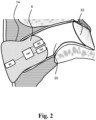
- Fig. 2 is a cross-section of a user's ear having an exemplary hearing device 2A, such as hearing device 2, partly inserted in the ear canal 20 of the ear according to the disclosure.
- the hearing device 2A is an in-the-ear hearing device.
- the hearing device 2A comprises a housing 6, a receiver 16A, an external microphone 8A for obtaining an input signal and an ear canal microphone 10A.
- the receiver 16A is placed in an ear canal part of the hearing device 2A, and thereby called an ear canal receiver 16A.
- the hearing device 2A comprises the ear canal microphone 10A and the ear canal receiver 16A, which are placed facing the ear drum or tympanic membrane 22.
- the hearing device 2A comprises a processor 14A configured to compensate for a hearing loss of a user.
- the receiver 16A is configured to transmit an output signal to be directed towards an eardrum of the hearing device user.
- the ear canal microphone 10A is configured to measure the output signal emitted by the receiver 16A because the ear canal microphone 10A receives the output signal from the receiver 16A as an ear canal microphone input signal.
- the output signal received as input at the ear canal microphone 10A is affected by the ear canal properties.
- the processor 14A is configured to predict an output response based on gain settings.
- the processor 14A is configured to determine a difference between the predicted output response and the measured output signal. In one or more exemplary hearing devices, determining a difference between the predicted output response and the measured output signal comprises comparing the input signal received at the external microphone and the output signal received at the ear canal microphone (for forming an input signal to the ear canal microphone).
- Fig. 3 shows a flow diagram of an exemplary method of self-calibrating of a hearing device according to some embodiments.
- the hearing device comprises an ear canal microphone, an external microphone and a receiver.
- the method comprises obtaining 102 an input signal with the external microphone.
- obtaining 102 an input signal with the external microphone comprises measuring 102a the input signal using the external microphone, e.g. using the external microphone and analysing the input signal.
- the method 100 comprises transmitting 104 an output signal with the receiver and measuring 105 the output signal using the ear canal microphone.
- output signal may be a specific measurement signal and/or an environmental signal.
- the method 100 comprises predicting 106 an output response based on gain settings, and/or optionally device calibration (such as factory or default device calibration).
- the method 100 comprises determining 108 a difference between the predicted output response and the measured output signal.
- determining 108 a difference between the predicted output response and the measured output signal comprises determining a difference between the predicted output magnitude spectrum and the measured output magnitude spectrum. Predicting 106 the output response may be performed using the output signal as transmitted by the receiver.
- determining 108 a difference between the predicted output response and the measured output signal comprises comparing the input signal received at the external microphone and the output signal received as an ear canal microphone input signal at the ear canal microphone. If the receiver and the ear canal microphone responses are known, the natural resonance of the open ear canal or the effect of occluding the ear can be accounted for. Alternatively, or additionally, the ear canal microphone response can be assumed as flat and the receiver response can be assumed as approximating the open ear response. With the disclosed method, the measured transducer response (receiver to ear canal microphone) approximates the real ear unaided response (REUR).
- REUR real ear unaided response
- determining 108 the difference may comprise determining an insertion gain by comparing the signals at the external microphone and at the ear canal microphone, and subtracting the measured transducer response (receiver to ear canal microphone).
- the method comprises calibrating 110 the hearing device by controlling a gain parameter based on the difference.
- controlling the gain parameter comprises adjusting a band gain in one or more frequency bands.
- controlling the gain parameter comprises determining the gain by minimizing the difference between the predicted output response and the measured output signal.
- obtaining 102 the input signal comprises determining 102b one or more characteristics of the input signal, such as in one or more frequency bands.
- a characteristic may comprise a distortion and/or a spectrum, such as an amplitude (e.g. maximum amplitude) and/or a phase.
- measuring 105 the output signal comprises determining a forward pressure level of the measured output signal.
- Sound pressure measured by an ear canal microphone can be decomposed into forward pressure level and reflected pressure level.
- the present disclosure relates to determining the forward pressure level of the measure output signal.
- determining 108 the difference between the predicted output response and the measured output is based on one or more hearing device configuration parameters.
- determining 108 the difference between the predicted output response and the measured output is based on an initial hearing device calibration setting.
- determining 108 the difference between the predicted output response and the measured output is based on one or more algorithm parameters.
- the one or more algorithm parameters may be indicative of characteristics of the algorithm, such as interaction of spectral bands, non-linearity.
- determining 108 the difference between the predicted output response and the measured output signal comprises estimating 108a an ear geometry.
- estimating 108a the ear geometry comprises determining 108b an ear canal parameter.
- the ear canal parameter may comprise an ear canal size and/or an ear canal length.
- estimating 108a the ear geometry comprises categorizing 108c an ear.
- one or more categories may be predetermined. A plurality of categories may lead to more accuracy in estimating the ear geometry. Categorizing an ear may be performed based on the ear canal parameter. It may also be seen that categorizing an ear comprises estimating the ear geometry.
- determining 108b the ear canal parameter is based on an estimate of real-ear unaided gain, user input and/or acoustic measurement.
- the inventors In determining the difference between the predicted output response and the measured output signal, the inventors have determined that a length resonance often results in a spectral notch in the output response at the ear canal microphone, and the frequency of this notch varies with the residual ear canal length. The ear canal length can thereby be determined. Once the frequency of the notch of the output response at the ear canal microphone is identified, a canal length that is expected to result in a notch at this frequency is determined using the category.
- An appropriate real-ear insertion gain (REIG) correction for this ear canal may be determined based on an expected spectral difference between the locations of the ear canal microphone and the tympanic membrane.
- the method may comprise applying the inverse of the predicted real-ear insertion gain (assuming target gain is 0dB). Because predictions may not be perfect, a fraction of the predicted real-ear insertion gain may be used as a conservative correction. If the target gain is not a flat (e.g. 0dB at all frequencies), the target gain may be subtracted from the predicted gain before using it as a correction factor.
- predicting 106 the output response is based on the initial hearing device calibration setting.
- obtaining 102 the input signal comprises obtaining a specific measurement signal from an external device.
- first, second, third and fourth do not imply any order, but are included to identify individual elements.
- first, second, etc. does not denote any order or importance, but rather the terms first, second, etc. are used to distinguish one element from another.
- first and second are used here and elsewhere for labelling purposes only and are not intended to denote any specific spatial or temporal ordering.
- labelling of a first element does not imply the presence of a second element and vice versa.
Landscapes
- Health & Medical Sciences (AREA)
- General Health & Medical Sciences (AREA)
- Otolaryngology (AREA)
- Physics & Mathematics (AREA)
- Engineering & Computer Science (AREA)
- Acoustics & Sound (AREA)
- Signal Processing (AREA)
- Neurosurgery (AREA)
- Headphones And Earphones (AREA)
- Circuit For Audible Band Transducer (AREA)
- Measurement Of The Respiration, Hearing Ability, Form, And Blood Characteristics Of Living Organisms (AREA)
Applications Claiming Priority (3)
| Application Number | Priority Date | Filing Date | Title |
|---|---|---|---|
| US15/703,708 US11202159B2 (en) | 2017-09-13 | 2017-09-13 | Methods of self-calibrating of a hearing device and related hearing devices |
| EP18191597.6A EP3457715B1 (de) | 2017-09-13 | 2018-08-30 | Verfahren zur selbstkalibrierung eines hörgeräts und zugehörige hörgeräte |
| EP20200192.1A EP3793219A1 (de) | 2017-09-13 | 2018-08-30 | Verfahren zur selbstkalibrierung eines hörgeräts und zugehörige hörgeräte |
Related Parent Applications (2)
| Application Number | Title | Priority Date | Filing Date |
|---|---|---|---|
| EP20200192.1A Division EP3793219A1 (de) | 2017-09-13 | 2018-08-30 | Verfahren zur selbstkalibrierung eines hörgeräts und zugehörige hörgeräte |
| EP18191597.6A Division EP3457715B1 (de) | 2017-09-13 | 2018-08-30 | Verfahren zur selbstkalibrierung eines hörgeräts und zugehörige hörgeräte |
Publications (2)
| Publication Number | Publication Date |
|---|---|
| EP4557771A2 true EP4557771A2 (de) | 2025-05-21 |
| EP4557771A3 EP4557771A3 (de) | 2025-07-30 |
Family
ID=63449309
Family Applications (3)
| Application Number | Title | Priority Date | Filing Date |
|---|---|---|---|
| EP18191597.6A Active EP3457715B1 (de) | 2017-09-13 | 2018-08-30 | Verfahren zur selbstkalibrierung eines hörgeräts und zugehörige hörgeräte |
| EP20200192.1A Ceased EP3793219A1 (de) | 2017-09-13 | 2018-08-30 | Verfahren zur selbstkalibrierung eines hörgeräts und zugehörige hörgeräte |
| EP25169543.3A Pending EP4557771A3 (de) | 2017-09-13 | 2018-08-30 | Verfahren zur selbstkalibrierung eines hörgeräts und zugehörige hörgeräte |
Family Applications Before (2)
| Application Number | Title | Priority Date | Filing Date |
|---|---|---|---|
| EP18191597.6A Active EP3457715B1 (de) | 2017-09-13 | 2018-08-30 | Verfahren zur selbstkalibrierung eines hörgeräts und zugehörige hörgeräte |
| EP20200192.1A Ceased EP3793219A1 (de) | 2017-09-13 | 2018-08-30 | Verfahren zur selbstkalibrierung eines hörgeräts und zugehörige hörgeräte |
Country Status (5)
| Country | Link |
|---|---|
| US (1) | US11202159B2 (de) |
| EP (3) | EP3457715B1 (de) |
| JP (1) | JP7068964B2 (de) |
| CN (1) | CN109495833B (de) |
| DK (1) | DK3457715T3 (de) |
Families Citing this family (12)
| Publication number | Priority date | Publication date | Assignee | Title |
|---|---|---|---|---|
| EP3457714A1 (de) * | 2017-09-13 | 2019-03-20 | GN Hearing A/S | Verfahren zur schätzung der ohrgeometrie und entsprechende hörgeräte |
| TWI690214B (zh) * | 2018-11-02 | 2020-04-01 | 美商音美得股份有限公司 | 結合式頻譜增益適配模組及其方法、音訊處理系統及其施行方法 |
| WO2020131963A1 (en) | 2018-12-21 | 2020-06-25 | Nura Holdings Pty Ltd | Modular ear-cup and ear-bud and power management of the modular ear-cup and ear-bud |
| WO2020180499A1 (en) | 2019-03-01 | 2020-09-10 | Nura Holdings Pty Ltd | Headphones with timing capability and enhanced security |
| CN111447539B (zh) | 2020-03-25 | 2021-06-18 | 北京聆通科技有限公司 | 一种用于听力耳机的验配方法和装置 |
| US11422392B2 (en) * | 2020-10-05 | 2022-08-23 | Meta Platforms Technologies, Llc | Ultraminiature dynamic speaker for a fully in-ear monitor |
| WO2022115154A1 (en) | 2020-11-24 | 2022-06-02 | Starkey Laboratories, Inc. | Apparatus and method for estimation of eardrum sound pressure based on secondary path measurement |
| US11917372B2 (en) * | 2021-07-09 | 2024-02-27 | Starkey Laboratories, Inc. | Eardrum acoustic pressure estimation using feedback canceller |
| US12041418B2 (en) | 2021-07-09 | 2024-07-16 | Starkey Laboratories, Inc. | Method and apparatus for automatic correction of real ear measurements |
| CN114143691B (zh) * | 2021-11-26 | 2023-01-24 | 歌尔科技有限公司 | 辅听耳机的校准方法、系统、装置和计算机可读存储介质 |
| WO2026018285A1 (en) * | 2024-02-21 | 2026-01-22 | Al Shalash Taha Kais Taha | Hearing aid built-in real ear measurement |
| WO2025238549A1 (en) | 2024-05-13 | 2025-11-20 | 3M Innovative Properties Company | Method, system, and microphone device for monitoring acoustic transducer health in a microphone |
Family Cites Families (27)
| Publication number | Priority date | Publication date | Assignee | Title |
|---|---|---|---|---|
| JPH10126893A (ja) * | 1996-10-18 | 1998-05-15 | Matsushita Electric Ind Co Ltd | 補聴器 |
| US6792114B1 (en) | 1998-10-06 | 2004-09-14 | Gn Resound A/S | Integrated hearing aid performance measurement and initialization system |
| EP1594344A3 (de) | 2005-08-03 | 2006-03-15 | Phonak Ag | Verfahren zum Erlangen akustischer Eigenschaften, Hörgerät und dessen Herstellungsverfahren |
| US20070036377A1 (en) * | 2005-08-03 | 2007-02-15 | Alfred Stirnemann | Method of obtaining a characteristic, and hearing instrument |
| ATE459213T1 (de) * | 2005-10-17 | 2010-03-15 | Widex As | Verfahren und system zum anpassen eines hörgeräts |
| JP4359599B2 (ja) * | 2006-02-28 | 2009-11-04 | リオン株式会社 | 補聴器 |
| US8045737B2 (en) * | 2006-03-01 | 2011-10-25 | Phonak Ag | Method of obtaining settings of a hearing instrument, and a hearing instrument |
| WO2008095167A2 (en) * | 2007-02-01 | 2008-08-07 | Personics Holdings Inc. | Method and device for audio recording |
| EP2088802B1 (de) * | 2008-02-07 | 2013-07-10 | Oticon A/S | Verfahren zur Schätzung der Gewichtungsfunktion von Audiosignalen in einem Hörgerät |
| DK2200347T3 (da) * | 2008-12-22 | 2013-04-15 | Oticon As | Fremgangsmåde til drift af et høreinstrument baseret på en estimering af den aktuelle kognitive belastning af en bruger og et høreapparatsystem og tilsvarende anordning |
| US9107015B2 (en) | 2009-03-27 | 2015-08-11 | Starkey Laboratories, Inc. | System for automatic fitting using real ear measurement |
| US9271666B2 (en) * | 2011-11-22 | 2016-03-01 | Sonova Ag | Method of processing a signal in a hearing instrument, and hearing instrument |
| DK2613566T3 (en) * | 2012-01-03 | 2016-10-17 | Oticon As | A listening device and method for monitoring the placement of an earplug for a listening device |
| WO2014032726A1 (en) | 2012-08-31 | 2014-03-06 | Widex A/S | Method of fitting a hearing aid and a hearing aid |
| US9008325B2 (en) | 2012-12-11 | 2015-04-14 | Siemens Medical Instruments Pte. Ltd. | Method for determining the sound pressure level at the eardrum of an occluded ear |
| EP3005731B2 (de) * | 2013-06-03 | 2020-07-15 | Sonova AG | Verfahren für den betrieb eines hörgeräts und hörgerät |
| WO2014208085A1 (ja) * | 2013-06-26 | 2014-12-31 | 京セラ株式会社 | 測定装置及び測定システム |
| US9031247B2 (en) * | 2013-07-16 | 2015-05-12 | iHear Medical, Inc. | Hearing aid fitting systems and methods using sound segments representing relevant soundscape |
| DK2846559T3 (en) * | 2013-09-05 | 2019-01-21 | Oticon As | Method of performing a RECD measurement using a hearing aid device |
| US9712908B2 (en) * | 2013-11-05 | 2017-07-18 | Gn Hearing A/S | Adaptive residual feedback suppression |
| US9949043B2 (en) * | 2014-04-28 | 2018-04-17 | Linear Srl | Method and apparatus for preserving the spectral clues of an audio signal altered by the physical presence of a digital hearing aid and tuning thereafter |
| US10013992B2 (en) * | 2014-07-11 | 2018-07-03 | Arizona Board Of Regents On Behalf Of Arizona State University | Fast computation of excitation pattern, auditory pattern and loudness |
| EP3169396B1 (de) * | 2014-07-14 | 2021-04-21 | Earlens Corporation | Gleitende vorspannung und spitzenunterdrückung für optische hörgeräte |
| EP3038384A1 (de) * | 2014-12-23 | 2016-06-29 | Oticon A/s | Hörgerät zur schätzung eines gegenwärtigen tatsächlichen ohr-zu-koppler-unterschieds |
| CN205987370U (zh) * | 2016-09-08 | 2017-02-22 | 佛山博智医疗科技有限公司 | 快速助听器验配装置 |
| CN106686507B (zh) * | 2017-02-06 | 2019-08-30 | 张德明 | 一种基于移动终端的助听器验配方法 |
| CN106658324A (zh) * | 2017-03-10 | 2017-05-10 | 深圳市吸铁石科技有限公司 | 一种带校验功能助听器及校验方法 |
-
2017
- 2017-09-13 US US15/703,708 patent/US11202159B2/en active Active
-
2018
- 2018-08-17 JP JP2018153673A patent/JP7068964B2/ja active Active
- 2018-08-30 EP EP18191597.6A patent/EP3457715B1/de active Active
- 2018-08-30 EP EP20200192.1A patent/EP3793219A1/de not_active Ceased
- 2018-08-30 DK DK18191597.6T patent/DK3457715T3/da active
- 2018-08-30 EP EP25169543.3A patent/EP4557771A3/de active Pending
- 2018-09-11 CN CN201811056225.3A patent/CN109495833B/zh active Active
Also Published As
| Publication number | Publication date |
|---|---|
| EP3457715B1 (de) | 2021-05-05 |
| DK3457715T3 (da) | 2021-08-02 |
| CN109495833B (zh) | 2021-11-16 |
| JP7068964B2 (ja) | 2022-05-17 |
| CN109495833A (zh) | 2019-03-19 |
| EP3457715A1 (de) | 2019-03-20 |
| US11202159B2 (en) | 2021-12-14 |
| US20190082278A1 (en) | 2019-03-14 |
| JP2019075777A (ja) | 2019-05-16 |
| EP3793219A1 (de) | 2021-03-17 |
| EP4557771A3 (de) | 2025-07-30 |
Similar Documents
| Publication | Publication Date | Title |
|---|---|---|
| EP3457715B1 (de) | Verfahren zur selbstkalibrierung eines hörgeräts und zugehörige hörgeräte | |
| US11558700B2 (en) | Methods of estimating ear geometry and related hearing devices | |
| US9107015B2 (en) | System for automatic fitting using real ear measurement | |
| AU2010200103B2 (en) | System to estimate the sound pressure level at eardrum using measurements away from the eardrum | |
| EP2783522B1 (de) | Verfahren zur abschätzung einer akustischen übertragungsgrösse durch ein hörgerät und hörgerät dafür | |
| US7756283B2 (en) | System and method for measuring vent effects in a hearing aid | |
| US20070036377A1 (en) | Method of obtaining a characteristic, and hearing instrument | |
| US9226082B2 (en) | Hearing aid with means for estimating the ear plug fitting | |
| EP1594344A2 (de) | Verfahren zur Erlangen der Eigenschaften, und Hörgerät | |
| US20100098262A1 (en) | Method and hearing device for parameter adaptation by determining a speech intelligibility threshold | |
| US20090238387A1 (en) | Method for actively reducing occlusion comprising plausibility check and corresponding hearing apparatus | |
| US20120076313A1 (en) | Method for adjusting a hearing device with in-situ audiometry and hearing device | |
| US20240334136A1 (en) | Method and apparatus for automatic correction of real ear measurements | |
| US8036392B2 (en) | Method and device for determining an effective vent | |
| EP1830602B1 (de) | Methode zur Erwerbung von Einstellungsparameter eines Hörgerätes, und ein Hörgerät | |
| US9538294B2 (en) | Method and device for analyzing hearing aid settings |
Legal Events
| Date | Code | Title | Description |
|---|---|---|---|
| PUAI | Public reference made under article 153(3) epc to a published international application that has entered the european phase |
Free format text: ORIGINAL CODE: 0009012 |
|
| STAA | Information on the status of an ep patent application or granted ep patent |
Free format text: STATUS: THE APPLICATION HAS BEEN PUBLISHED |
|
| AC | Divisional application: reference to earlier application |
Ref document number: 3457715 Country of ref document: EP Kind code of ref document: P Ref document number: 3793219 Country of ref document: EP Kind code of ref document: P |
|
| AK | Designated contracting states |
Kind code of ref document: A2 Designated state(s): AL AT BE BG CH CY CZ DE DK EE ES FI FR GB GR HR HU IE IS IT LI LT LU LV MC MK MT NL NO PL PT RO RS SE SI SK SM TR |
|
| PUAL | Search report despatched |
Free format text: ORIGINAL CODE: 0009013 |
|
| AK | Designated contracting states |
Kind code of ref document: A3 Designated state(s): AL AT BE BG CH CY CZ DE DK EE ES FI FR GB GR HR HU IE IS IT LI LT LU LV MC MK MT NL NO PL PT RO RS SE SI SK SM TR |
|
| RIC1 | Information provided on ipc code assigned before grant |
Ipc: H04R 25/00 20060101AFI20250624BHEP |
|
| STAA | Information on the status of an ep patent application or granted ep patent |
Free format text: STATUS: REQUEST FOR EXAMINATION WAS MADE |
|
| 17P | Request for examination filed |
Effective date: 20260122 |