EP4557127A1 - Information processing method, information processing device, and computer program - Google Patents
Information processing method, information processing device, and computer program Download PDFInfo
- Publication number
- EP4557127A1 EP4557127A1 EP23839558.6A EP23839558A EP4557127A1 EP 4557127 A1 EP4557127 A1 EP 4557127A1 EP 23839558 A EP23839558 A EP 23839558A EP 4557127 A1 EP4557127 A1 EP 4557127A1
- Authority
- EP
- European Patent Office
- Prior art keywords
- data
- word
- moving image
- character string
- information processing
- Prior art date
- Legal status (The legal status is an assumption and is not a legal conclusion. Google has not performed a legal analysis and makes no representation as to the accuracy of the status listed.)
- Pending
Links
Images







Classifications
-
- G—PHYSICS
- G06—COMPUTING OR CALCULATING; COUNTING
- G06F—ELECTRIC DIGITAL DATA PROCESSING
- G06F16/00—Information retrieval; Database structures therefor; File system structures therefor
- G06F16/70—Information retrieval; Database structures therefor; File system structures therefor of video data
- G06F16/78—Retrieval characterised by using metadata, e.g. metadata not derived from the content or metadata generated manually
- G06F16/783—Retrieval characterised by using metadata, e.g. metadata not derived from the content or metadata generated manually using metadata automatically derived from the content
- G06F16/7844—Retrieval characterised by using metadata, e.g. metadata not derived from the content or metadata generated manually using metadata automatically derived from the content using original textual content or text extracted from visual content or transcript of audio data
-
- G—PHYSICS
- G10—MUSICAL INSTRUMENTS; ACOUSTICS
- G10L—SPEECH ANALYSIS TECHNIQUES OR SPEECH SYNTHESIS; SPEECH RECOGNITION; SPEECH OR VOICE PROCESSING TECHNIQUES; SPEECH OR AUDIO CODING OR DECODING
- G10L15/00—Speech recognition
- G10L15/26—Speech to text systems
-
- G—PHYSICS
- G06—COMPUTING OR CALCULATING; COUNTING
- G06F—ELECTRIC DIGITAL DATA PROCESSING
- G06F16/00—Information retrieval; Database structures therefor; File system structures therefor
- G06F16/30—Information retrieval; Database structures therefor; File system structures therefor of unstructured textual data
- G06F16/33—Querying
- G06F16/332—Query formulation
- G06F16/3329—Natural language query formulation
- G06F16/33295—Natural language query formulation in dialogue systems
-
- G—PHYSICS
- G06—COMPUTING OR CALCULATING; COUNTING
- G06F—ELECTRIC DIGITAL DATA PROCESSING
- G06F16/00—Information retrieval; Database structures therefor; File system structures therefor
- G06F16/70—Information retrieval; Database structures therefor; File system structures therefor of video data
- G06F16/71—Indexing; Data structures therefor; Storage structures
-
- G—PHYSICS
- G06—COMPUTING OR CALCULATING; COUNTING
- G06F—ELECTRIC DIGITAL DATA PROCESSING
- G06F16/00—Information retrieval; Database structures therefor; File system structures therefor
- G06F16/70—Information retrieval; Database structures therefor; File system structures therefor of video data
- G06F16/78—Retrieval characterised by using metadata, e.g. metadata not derived from the content or metadata generated manually
- G06F16/783—Retrieval characterised by using metadata, e.g. metadata not derived from the content or metadata generated manually using metadata automatically derived from the content
- G06F16/7834—Retrieval characterised by using metadata, e.g. metadata not derived from the content or metadata generated manually using metadata automatically derived from the content using audio features
-
- G—PHYSICS
- G06—COMPUTING OR CALCULATING; COUNTING
- G06F—ELECTRIC DIGITAL DATA PROCESSING
- G06F40/00—Handling natural language data
- G06F40/20—Natural language analysis
-
- G—PHYSICS
- G06—COMPUTING OR CALCULATING; COUNTING
- G06F—ELECTRIC DIGITAL DATA PROCESSING
- G06F40/00—Handling natural language data
- G06F40/30—Semantic analysis
-
- G—PHYSICS
- G06—COMPUTING OR CALCULATING; COUNTING
- G06F—ELECTRIC DIGITAL DATA PROCESSING
- G06F40/00—Handling natural language data
- G06F40/40—Processing or translation of natural language
- G06F40/55—Rule-based translation
- G06F40/56—Natural language generation
-
- G—PHYSICS
- G06—COMPUTING OR CALCULATING; COUNTING
- G06N—COMPUTING ARRANGEMENTS BASED ON SPECIFIC COMPUTATIONAL MODELS
- G06N20/00—Machine learning
-
- G—PHYSICS
- G06—COMPUTING OR CALCULATING; COUNTING
- G06N—COMPUTING ARRANGEMENTS BASED ON SPECIFIC COMPUTATIONAL MODELS
- G06N3/00—Computing arrangements based on biological models
- G06N3/02—Neural networks
- G06N3/04—Architecture, e.g. interconnection topology
- G06N3/044—Recurrent networks, e.g. Hopfield networks
-
- G—PHYSICS
- G06—COMPUTING OR CALCULATING; COUNTING
- G06N—COMPUTING ARRANGEMENTS BASED ON SPECIFIC COMPUTATIONAL MODELS
- G06N3/00—Computing arrangements based on biological models
- G06N3/02—Neural networks
- G06N3/04—Architecture, e.g. interconnection topology
- G06N3/045—Combinations of networks
-
- G—PHYSICS
- G06—COMPUTING OR CALCULATING; COUNTING
- G06N—COMPUTING ARRANGEMENTS BASED ON SPECIFIC COMPUTATIONAL MODELS
- G06N3/00—Computing arrangements based on biological models
- G06N3/02—Neural networks
- G06N3/08—Learning methods
Definitions
- the present disclosure relates to an information processing method, an information processing apparatus, and a computer program.
- PTL 1 discloses a technique of, with an image capturing unit, a recording unit, and a conversion unit that converts voice included in recorded data into a character string, extracting a noun from a character string, acquiring a related word associated with the extracted noun from a dictionary unit, and storing captured image data, the noun, and the related word in association with each other.
- PTL 1 involves a technical problem in that the noun simply extracted from the character string of the voice and the related word do not necessarily accurately represent the content of the recorded data.
- the present disclosure proposes an information processing method, an information processing apparatus, and a computer program with which a captured or recorded moving image or voice data can be associated with index information accurately representing the content of the data.
- An information processing method includes: converting voice data into character string data; extracting a second word from the character string data by using question data including a first word; and storing the voice data, the first word, and the second word in association with each other.
- An information processing method is the information processing method according to the first aspect preferably configured in such a manner that the extracting the second word from the character string data is performed by inputting the character string data and the question data to a trained language learning model configured to output, when the character string data and the question data are input, a word corresponding to an answer to the question data from the character string data.
- An information processing method is the information processing method according to the first or second aspect preferably configured in such a manner that the question data is generated by extracting the first word from the character string data.
- An information processing method is the information processing method according to the third aspect preferably configured in such a manner that the first word is a verb or an adjective, and the second word is a noun.
- An information processing method is the information processing method according to the third or fourth aspect preferably configured in such a manner that the question data is generated by extracting, as the first word, a word in dictionary data that stores a predetermined word among a plurality of verb or adjective words included in the character string data.
- An information processing method is the information processing method according to any one of the first to fifth aspects preferably configured in such a manner that a plurality of the first words and a plurality of the second words are provided.
- An information processing method is the information processing method according to any one of the first to sixth aspects preferably configured in such a manner that the voice data is sectionalized into a plurality of scenes, the second word is extracted from the character string data of each section, and the first word and the second word are stored in association with each section.
- An information processing method is the information processing method according to the seventh aspect preferably configured in such a manner that the second word is extracted from entire character string data in the voice data, and the first word and the second word are stored in association with a file of the voice data.
- An information processing method is the information processing method according to any one of the first to eighth aspects preferably configured in such a manner that the question data is generated by extracting the first word from a template of a report including characters, the second word extracted from the character string data is input to the template, and report data in which the second word is input to the template is stored in association with the voice data.
- An information processing method is the information processing method according to any one of the first to ninth aspects, preferably configured in such a manner that moving image data captured and recorded at a site of maintenance and inspection of equipment is acquired, voice data included in the acquired moving image data is converted into character string data, the second word is extracted from the character string data using the question data including the first word, and the moving image data, the first word, and the second word are stored in association with each other.
- An information processing method is the information processing method according to the tenth aspect preferably configured in such a manner that the first word and the second word related to a moving image of the moving image data are superimposed.
- An information processing method is the information processing method according to any one of the first to tenth aspect preferably configured in such a manner that a search request including a character is received, and from a plurality of pieces of the voice data stored in a database, the voice data associated with the first word and the second word related to the character in the search request is detected.
- An information processing method includes: converting voice data included in moving image data into character string data; extracting a second word from the character string data by using question data including a first word; and outputting the question data including the first word and the second word together with the moving image data.
- An information processing apparatus includes: a processing unit configured to convert voice data into character string data and extract a second word from the character string data by using question data including a first word; and a storage unit configured to store the voice data, the first word, and the second word in association with each other.
- An information processing apparatus includes: a processing unit configured to convert voice data included in moving image data into character string data and extract a second word from the character string data by using question data including a first word; and an output unit configured to output the question data including the first word and the second word together with the moving image data.
- a computer program causes a computer to execute processing of: converting voice data into character string data; extracting a second word from the character string data using question data including a first word; and storing the voice data, the first word, and the second word in association with each other.
- a computer program causes a computer to execute processing of: converting voice data included in moving image data into character string data; extracting a second word from the character string data by using question data including a first word; and outputting the question data including the first word and the second word together with the moving image data.
- One possible method for supporting the work for an unskilled worker includes collecting and accumulating moving image data obtained by capturing the work performed by a skilled worker and providing the accumulated moving image data to the unskilled worker. Appropriate index information needs to be assigned to the moving image data to enable moving image data required by the unskilled worker to be searched for in the accumulated moving image data.
- the present disclosure proposes an information processing method, an information processing apparatus, and a computer program (program product) with which captured or recorded moving image or voice data can be associated with index information accurately representing the content of the data.
- Fig. 1 is a schematic view illustrating an overview of an information processing system according to a first embodiment.
- the information processing system according to the first embodiment includes a server apparatus (an information processing apparatus or a computer) 1, a headset 2, and a terminal device 3.
- the server apparatus 1 is communicatively connected to the headset 2 and the terminal device 3 via a wired or wireless communication network such as a mobile phone communication network, a wireless local area network (LAN), and the Internet.
- a wired or wireless communication network such as a mobile phone communication network, a wireless local area network (LAN), and the Internet.
- the headset 2 is a device that is worn on the head of a worker who performs work such as maintenance and inspection, repair, or installation for an air conditioner unit A, in particular, a skilled worker B.
- the headset 2 includes a camera 2a, a microphone 2b, headphones, and the like, and captures an image and collects sound showing how the skilled worker B performs work.
- Moving image data is assumed to include voice data obtained by collecting sound using the microphone 2b.
- the headset 2 is an example of a device that captures an image and collects sound showing how the skilled worker B performs the work, and may be another wearable device or a mobile terminal having an image capturing function and a sound collecting function.
- the camera 2a and the microphone 2b installed around the air conditioner unit A and the skilled worker B may be adopted.
- the moving image data obtained by the image capturing and the sound collection is provided to the server apparatus 1.
- the headset 2 transmits the moving image data to the server apparatus 1 by wired or wireless communication.
- the headset 2 may be configured to transmit the moving image data to the server apparatus 1 via a communication terminal such as a personal computer (PC) or a smartphone.
- the headset 2 does not have a communication circuit, the headset 2 records the moving image data in a recording device such as a memory card or an optical disk.
- the moving image data is provided from the headset 2 to the server apparatus 1 via the recording device.
- the method of providing the moving image data from the headset 2 to the server apparatus 1 described above is an example, and any known method may be adopted.
- the server apparatus 1 acquires the moving image data provided from the headset 2 and accumulates the acquired moving image data in a moving image DB 12b.
- the terminal device 3 is a general-purpose communication terminal such as a smartphone or a PC used by an unskilled worker C who learns and performs work such as maintenance and inspection, repair, or installation for the air conditioner unit A.
- the terminal device 3 accesses the server apparatus 1 and requests a search for moving image data desired by the unskilled worker C.
- the server apparatus 1 searches for moving image data in response to a request from the terminal device 3, and transmits the required moving image data to the terminal device 3.
- the terminal device 3 receives the moving image data transmitted in response to the request.
- the terminal device 3 plays the received moving image data to display a moving image in which how the skilled worker B performs the work is recorded.
- the unskilled worker C can learn the technique of the skilled worker B using the moving image displayed on the terminal device 3.
- Fig. 2 is a block diagram illustrating a configuration of the server apparatus 1 according to the first embodiment.
- the server apparatus 1 according to the first embodiment includes a control unit 11, a storage unit (storage) 12, and a communication unit (transceiver) 13.
- the control unit 11 includes a calculation processing device such as a central processing unit (CPU), a micro-processing unit (MPU), a graphics processing unit (GPU), or a quantum processor, a read only memory (ROM), a random access memory (RAM), and the like.
- the control unit 11 reads and executes a server program (computer program) 12a stored in the storage unit 12, thereby executing processing of assigning index information to the accumulated moving image data.
- the index information is information indicating the content of the moving image data using a plurality of words.
- the control unit 11 executes processing such as searching for required moving image data with reference to the index information and transmitting the moving image data to the terminal device 3.
- the control unit 11 functions as a voice recognition unit 11a, a natural language processing unit 11b, an AI processing unit 11c, a tokenizer 11d, and a moving image processing unit 11e.
- the functional units may each be realized by software with the control unit 11 reading and executing the server program 12a, or some or all of the functional units may be realized by hardware using a circuit. The overview of each functional unit is as follows.
- the voice recognition unit 11a is a component that converts the voice data included in the moving image data into uttered sentence data (character string data).
- the uttered sentence data is character string data obtained by converting the uttered content of the skilled worker B into text.
- the natural language processing unit 11b is a component that divides a character string represented by the uttered sentence data into morphemes through morphological analysis to extract a first word (verb or adjective), and generates question sentence data by using the extracted first word.
- the natural language processing unit 11b is a component that executes rule-based processing without using a language learning model 12c obtained by machine learning.
- the question sentence data is data for extracting a meaningful noun from the uttered sentence data.
- the AI processing unit 11c is a component that inputs the question sentence data and the uttered sentence data to the language learning model 12c that has been trained, and makes the model output answer data corresponding to an answer to the question sentence from the uttered sentence data.
- the answer data includes a second word that is a noun.
- the tokenizer 11d is a lexical analyzer, and functions as an encoder for encoding the question sentence data and the uttered sentence data described above into data processable by the language learning model 12c.
- the tokenizer 11d encodes the question sentence data and the uttered sentence data into embedded tensor data. Specifically, the tokenizer 11d divides the question sentence data and the uttered sentence data into tokens (terms) each of which is a minimum unit of a word, and converts each of the tokens into tensor data of a token string in which token IDs are arranged.
- the tokenizer 11d inserts a special token [CLS] at the beginning of the sentence, and embeds a special token [SEP] between the token string of the question sentence data and the token string of the uttered sentence data.
- the tokenizer 11d adds, to the tensor data of a token string, segment information for identification for determining whether each token is a token corresponding to a question sentence or a token corresponding to an uttered sentence.
- the tokenizer 11d adds, to the tensor data of the token string, position information indicating the arrangement order of a plurality of tokens corresponding to the question sentence and the uttered sentence.
- the tokenizer 11d also functions as a decoder for decoding the tensor data output from the language learning model 12c into character string data.
- the moving image processing unit 11e is a component that, for example, executes processing such as analyzing moving image data and dividing the moving image data, which is a single file, into a plurality of scenes.
- processing such as analyzing moving image data and dividing the moving image data, which is a single file, into a plurality of scenes.
- index information is added to moving image data, which is a single file, will be described below.
- a method of adding index information to each of a plurality of divided scenes will be described in a second embodiment.
- the storage unit 12 is, for example, a large-capacity storage device such as a hard disk.
- the storage unit 12 stores the server program 12a to be executed by the control unit 11, and various types of data required by the control unit 11 to execute the processing.
- the storage unit 12 forms a moving image database (DB) 12b in which moving image data obtained by image capturing and sound collection using the camera 2a and the microphone 2b is accumulated.
- the storage unit 12 stores the language learning model 12c for generating the index information to be given to moving image data.
- the storage unit 12 may be an external storage device connected to the server apparatus 1.
- the server program 12a may be recorded in a recording medium 10 in a computer-readable manner.
- the storage unit 12 stores the server program 12a read from the recording medium 10 by a reading device.
- the recording medium 10 is a semiconductor memory, an optical disk, a magnetic disk, a magneto-optical disk, or the like.
- the server apparatus 1 may download the server program 12a according to the first embodiment from an external server connected to a network N and store the server program 12a in the storage unit 12.
- Fig. 3 is a conceptual diagram illustrating an example of the moving image DB 12b.
- the moving image DB 12b is a database that stores moving image data obtained by image capturing and sound collection using the camera 2a and the microphone 2b, date and time of the image capturing, and index information generated by the information processing method according to the first embodiment in association with each other.
- the index information is information including a first word and a second word to be described below.
- Fig. 4 is a block diagram illustrating a configuration of the language learning model 12c according to the first embodiment.
- the language learning model 12c is a trained machine learning model that outputs answer data corresponding to an answer to a question represented by question sentence data from uttered sentence data, when the question sentence data and the uttered sentence data are input.
- the language learning model 12c is configured using, for example, a deep neural network.
- the configuration of the language learning model 12c is not limited, but BERT is suitable. In the following description, it is assumed that the language learning model 12c is configured by BERT.
- Fig. 5 is a block diagram illustrating a configuration of BERT as an example of the language learning model 12c according to the first embodiment.
- the language learning model 12c configured by BERT includes a plurality of connected transformer encoders (Trm) 12d.
- the transformer encoder 12d at the first stage corresponding to the input layer includes a plurality of nodes to which the element values of the tensor data of the question sentence data and the uttered sentence data are input.
- “Tok1" to "TokN" represent the token IDs of the question sentence data
- “Tok1" to “TokM” represent the token IDs of the uttered sentence data
- "CLS" and "SEP" represent the special tokens.
- Each of the plurality of transformer encoders 12d corresponding to the intermediate layers executes calculation processing corresponding to a required task on the value output from the node of the transformer encoder 12d at the previous stage, and outputs a result to the transformer encoder 12d at the subsequent stage.
- BERT according to the first embodiment executes calculation processing for extracting a token corresponding to an answer to a question sentence.
- the transformer encoders 12d at the final stage corresponding to the output layer have the same number of nodes as the transformer encoders 12d at the first stage, and output the tensor data of the answer sentence.
- the "Tok1", “Tok2", ... on the upper side represent the token IDs of the answer data.
- the language learning model 12c which is BERT, can be trained by pre-learning and fine-tuning.
- the pre-learning is performed using unlabeled learning data.
- a neural network is trained by word prediction learning (masked LM (MLM)) and next sentence prediction (NSP) learning.
- word prediction learning a part of a token string, which is an input sentence of the learning data is masked, and the weight coefficient of the transformer encoder 12d is optimized so that the masked token can be predicted.
- the weight coefficient of the transformer encoder 12d is optimized so that whether a first character string and a second character string are sequential character strings.
- the weight coefficient of the transformer encoder 12d is finely corrected so that the tensor data of desired answer data is output when the tensor data of the question sentence data and the uttered sentence data are input.
- the language learning model 12c may perform the fine tuning for BERT by using the question sentence data and the uttered sentence data that are actually used, or BERT fine tuned by using general character string data may be used.
- the communication unit 13 communicates with the headset 2 and the terminal device 3 via the network N including a mobile phone communication network, a wireless LAN, the Internet, and the like.
- the communication unit 13 transmits data given from the control unit 11 to the headset 2 or the terminal device 3, and gives data received from the headset 2 or the terminal device 3 to the control unit 11.
- server apparatus 1 While an example in which the server apparatus 1 is configured by one computer device has been described, the server apparatus 1 may alternatively be a multi-computer that includes a plurality of computers and executes distributed processing.
- the server apparatus 1 may be a virtual machine virtually constructed by software.
- Fig. 6 is a block diagram illustrating a configuration of the terminal device 3 according to the first embodiment.
- the terminal device 3 includes a control unit 31, a storage unit 32, a communication unit (transceiver) 33, a display unit (display) 34, and an operation unit 35.
- the control unit 31 includes a calculation processing unit such as a CPU or an MPU, a ROM, and the like.
- the control unit 31 reads and executes a terminal program 32a stored in the storage unit 32 to execute search request processing for moving image data accumulated in the moving image DB 12b of the server apparatus 1 and play processing (display processing) for moving image data provided from the server apparatus 1.
- the terminal program 32a may be a dedicated program related to the information processing method according to the first embodiment, or may be a general-purpose program such as an Internet browser or a web browser.
- the storage unit 32 is, for example, a nonvolatile memory element such as a flash memory or a storage device such as a hard disk.
- the storage unit 32 stores the terminal program 32a to be executed by the control unit 31, and various types of data required by the control unit 31 to execute the processing.
- the terminal program and data may be recorded in a recording medium 30 in a computer-readable manner.
- the storage unit 32 stores the terminal program 32a read from the recording medium 30 by the reading device.
- the recording medium 30 is a semiconductor memory, an optical disk, a magnetic disk, a magneto-optical disk, or the like.
- the terminal device 3 may download the terminal program 32a according to the first embodiment from an external server connected to the network N and store the terminal program in the storage unit 12.
- the communication unit 33 communicates with the server apparatus 1 via the network N.
- the communication unit 33 transmits data given from the control unit 31 to the server apparatus 1, and gives data received from the server apparatus 1 to the control unit 31.
- the display unit 34 is a liquid crystal panel, an organic EL display, or the like.
- the display unit 34 displays a moving image, a still image, characters, and the like according to data given from the control unit 31.
- the operation unit 35 is an input device such as a touch panel, a soft key, a hard key, a keyboard, or a mouse.
- the operation unit 35 receives, for example, an operation of the unskilled worker C and notifies the control unit 31 of the received operation.
- the server apparatus 1 can generate the index information accurately representing the content of the moving image data obtained by capturing an image showing how the skilled worker B performs work such as maintenance and inspection, repair, or installation for the air conditioner unit A.
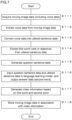
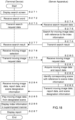
- Fig. 7 is a flowchart illustrating an index information generation processing procedure according to the first embodiment
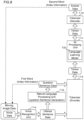
- Fig. 8 is a conceptual diagram illustrating an index information generation processing method according to the first embodiment.
- the control unit 11 of the server apparatus 1 acquires the moving image data (step S111).
- the server apparatus 1 acquires the moving image data by receiving the moving image data transmitted from the headset 2 through the communication unit 13.
- the moving image data is obtained by capturing an image and collecting sound showing how the skilled worker B performs the work, and includes voice data.
- the server apparatus 1 may acquire the moving image data by reading the moving image data stored in the storage unit 12 or an external storage device.
- the control unit 11 extracts voice data from the acquired moving image data (step S112).
- the control unit 11 or the voice recognition unit 11a executes voice recognition processing to convert the extracted voice data into the uttered sentence data in a text format (step S113).
- the control unit 11 or the natural language processing unit 11b divides the uttered sentence data into morphemes through morphological analysis processing, and extracts one or a plurality of first words that are verbs or adjectives (step S114).
- the first words may be verbs such as "repair” or "replace", or adjectives such as "hot” or "slow”.
- the control unit 11 may extract all verbs and adjectives included in the uttered sentence data as the first words, or may extract a predetermined number of verbs and adjectives as the first words.
- the control unit 11 may randomly extract a predetermined number of verbs and adjectives as the first words.
- the control unit 11 may extract a predetermined number of verbs and adjectives as the first words so that the variance of the degree of similarity is large.
- the control unit 11 may extract the first words such that the running time varies.
- the control unit 11 may extract, as the first words, a verb and an adjective with an application frequency in a predetermined range, for example, in a range of 1 ⁇ .
- the control unit 11 or the natural language processing unit 11b generates one or a plurality of pieces of question sentence data based on one or a plurality of first words (step S115). For example, the control unit 11 may use a first word “repair” to generate question sentence data "What was repaired?" For example, the control unit 11 may use a first word "replace” to generate question sentence data "What has been replaced?"
- a plurality of pieces of question sentence data may be generated based on one first word.
- the control unit 11 may generate question sentence data "What was repaired?", "What was used for repair?", and "How was it repaired?"
- the storage unit 12 may be configured to store a related-word dictionary.
- the control unit 11 When the storage unit 12 stores the related-word dictionary, the control unit 11 generates question sentence data by using words related to "repair". For example, when the words related to "repair” include “problem”, “part”, “error code”, or the like, question sentence data “What is the problem?", “What is the part?", and “What is the error code?” are generated.
- the storage unit 12 may be configured to store fixed-phrase question sentence data.
- the control unit 11 may add the fixed-phrase question sentence data read from the storage unit 12 to the generated question sentence data. For example, question sentence data "What is the model number of the equipment?" may be added as a fixed-phrase question.
- the control unit 11 inputs the question sentence data and the uttered sentence data to the language learning model 12c, and makes the model output answer data (step S116).
- the answer data includes a second word, which is a noun.
- the tokenizer 11d encodes the question sentence data and the uttered sentence data into tensor data.
- the control unit 11 inputs the encoded tensor data to the language learning model 12c, and makes the model output the tensor data associated with an answer sentence.
- the tokenizer 11d decodes the tensor data output from the language learning model 12c into answer data.
- the control unit 11 generates index information based on the first word and the second word (step S117).
- the index information is data in which the first word and the second word are arranged.
- the control unit 11 stores the moving image data in association with the generated index information in the storage unit 12 (step S118). Specifically, the control unit 11 stores the moving image data and the index information in the moving image DB 12b.
- the unskilled worker C can search for and view the moving image data accumulated in the moving image DB 12b of the server apparatus 1 by using the terminal device 3.
- Fig. 9 is a flowchart illustrating a moving image search processing procedure according to the first embodiment.
- the control unit 31 of the terminal device 3 makes a search screen for searching for moving image data stored in the moving image DB 12b of the server apparatus 1 displayed on the display unit 34 (step S171).
- the control unit 31 receives a search word through the operation unit 35 (step S172).
- the control unit 31 transmits search request data that includes the received search word, and is used for requesting for a search for the moving image data, to the server apparatus 1 through the communication unit 33 (step S173).
- the server apparatus 1 receives the search request data transmitted from the terminal device 3 through the communication unit 13 (step S174).
- the control unit 11 of the server apparatus 1 that has received the search request data searches for moving image data that matches a search word included in the search request data by referring to the index information stored in the moving image DB 12b using the search word as a key (step S175).
- the control unit 11 transmits the result of the search in step S175 to the terminal device 3 that has transmitted the search request, through the communication unit 13 (step S176).
- the search result includes a file name, a thumbnail image, captured date and time, running time, index information, and the like of the moving image data.
- the control unit 31 of the terminal device 3 receives the search result transmitted from the server apparatus 1, through the communication unit 33 (step S177).
- the control unit 31 makes the information of the search result displayed on the display unit 34, and the operation unit 35 receives the selection of a moving image to be played (step S178).
- the control unit 31 transmits moving image request data that includes information indicating the selected moving image an example of which is the file name of the moving image data, and serves as a request for the moving image data, to the server apparatus 1 through the communication unit 33 (step S179).
- the control unit 11 of the server apparatus 1 receives the moving image request data transmitted from the terminal device 3 through the communication unit 13 (step S180).
- the control unit 11 acquires the moving image data and index information indicated by the moving image request data from the moving image DB 12b (step S181).
- the control unit 11 transmits the read moving image data and index information to the terminal device 3 that has requested the moving image through the communication unit 13 (step S182).
- the control unit 31 of the terminal device 3 receives the moving image data and index information transmitted from the server apparatus 1 through the communication unit 33 (step S183).
- the control unit 31 plays the received moving image data and makes it displayed on the display unit 34 (step S184).
- the control unit 31 makes the index information displayed in a superimposed manner on the moving image (step S185).
- Fig. 10 is a schematic view illustrating an example of a moving image play screen 34a according to the first embodiment.
- the terminal device 3 displays, for example, the moving image play screen 34a on the display unit 34.
- the terminal device 3 displays a moving image based on the moving image data received from the server apparatus 1, at the center of the moving image play screen 34a.
- the terminal device 3 displays the index information in a superimposed manner on the upper part or the lower part of the moving image.
- the terminal device 3 displays operation buttons such as a play button, a pause button, a stop button, a fast-forward button, a fast-rewind button, and the like at the lower part of the moving image play screen 34a, and displays the operation buttons on the moving image displayed at the center of the screen of the display unit 34.
- the control unit 31 controls the playing of the moving image according to the operated button.
- the moving image data in the moving image DB 12b in association with the index information that accurately represents the content of the moving image. Since the second word is extracted from the uttered sentence data using the question sentence data including the first word, the second word includes information corresponding to the question sentence data and having a meaning in terms of content.
- the first word and the second word are information accurately representing the content of the moving image data, and the first word and the second word can be associated with the moving image data as the index information.
- the language learning model 12c which is a machine learning model, it is possible to extract the second word more accurately representing the content of the uttered sentence data.
- the second word which is more meaningful in terms of content, can be extracted from the uttered sentence data.
- the question sentence data is generated using the first word extracted from the uttered sentence data, it is possible to extract the second word more accurately representing the content of the uttered sentence data. Since the first word is information included in the uttered sentence data of the moving image data, it is possible to obtain the question sentence data according to the content of the moving image data.
- the first word in the question sentence data is a verb or an adjective, it is possible to generate the question sentence data suitable for extracting the second word, which is a noun, related to the verb or the adjective.
- the first word and the second word of the index information associated with the moving image data captured and recorded at the site of maintenance and inspection for the equipment represent the content of the moving image data.
- the content of the moving image data can be checked by referring to the first word and the second word of the index information.
- the index information including the first word and the second word may be displayed on the moving image of the moving image data.
- desired moving image data can be searched for.
- the moving image data obtained by capturing an image and collecting sound showing how the work for the air conditioner unit A is performed is described as an example, a work target such as maintenance and inspection, repair, or installation is not limited.
- the information processing method and the like according to the first embodiment may be applied to moving image data obtained by capturing an image and collecting sound showing how maintenance and inspection is performed for a chemical plant and other various facilities.
- the information processing method and the like according to the first embodiment may be applied to moving image data or voice data captured or recorded for call center support, business support, or employee training.
- the information processing method according to the first embodiment may be applied to voice data. That is, the index information generated by the information processing method or the like according to the first embodiment may be stored in association with the voice data.
- An information processing apparatus is different from that in the first embodiment in that moving image data is divided into a plurality of scenes, and index information is added to each scene.
- the information processing apparatus according to the second embodiment is different from that in the first embodiment in that a work report is automatically generated for moving image data obtained by capturing an image showing how work such as maintenance and inspection is performed for the air conditioner unit A.
- the information processing apparatus according to the second embodiment is different from that in the first embodiment in a method of playing moving image data. Since the other configurations and processing of the information processing system are the same as those of the information processing system according to the first embodiment, the same components are denoted by the same reference numerals, and detailed description thereof will be omitted.
- Fig. 11 is a flowchart illustrating an information processing procedure according to the second embodiment.
- the control unit 11 of the server apparatus 1 acquires the moving image data (step S211).
- the control unit 11 or the moving image processing unit 11e analyzes the moving image data and divides the moving image data, which is a single file, into a plurality of scenes (step S212). For example, the moving image processing unit 11e divides the content of the moving image into a plurality of scenes based on a change in the brightness of each frame image of the moving image, a change in the feature amount of an object, and the like.
- the control unit 11 stores, in the moving image DB 12b in association with the moving image data, scene data including information such as a scene number for identifying each scene, the number of an end frame of each scene, the running time indicating a start point and an end point of each scene as information indicating a plurality of scenes (see Fig. 17 ).
- the control unit 11 extracts voice data from the acquired moving image data (step S213).
- the control unit 11 or the voice recognition unit 11a executes voice recognition processing to convert the extracted voice data into uttered sentence data in a text format (step S214). Specifically, the control unit 11 or the voice recognition unit 11a converts the voice data into the uttered sentence data in a text format, based on each of the breaks of the utterance.
- the control unit 11 or the voice recognition unit 11a temporarily stores, in the storage unit 12, an uttered sentence data group including the numbers for identifying a plurality of pieces of uttered sentence data, the running time indicating a play start point and an end point of each piece of uttered sentence data, and the uttered sentence data.
- the control unit 11 executes processing of generating the index information based on the uttered sentence data of a plurality of scenes (step S215).
- the index information generated based on the uttered sentence data of each scene is referred to as scene index information.
- Fig. 12 is a flowchart illustrating a procedure for generating the scene index information.
- the control unit 11 performs matching between each scene of moving image data and uttered sentence data (step S231).
- Fig. 13 is a conceptual diagram illustrating a method of the matching between a scene of a moving image and uttered sentence data.
- the control unit 11 refers to scene data, and compares the start point and the end point of each scene with the start point and the end point of each of the plurality of pieces of uttered sentence data obtained by the conversion in step S214.
- the control unit 11 identifies uttered sentence data with a start point close to the start point of the scene.
- the control unit 11 identifies uttered sentence data with an end point close to the end point.
- the control unit 11 integrates the uttered sentence data with the start point of the scene identified, the uttered sentence data between the start point and the end point, and the uttered sentence data at the end point of the scene.
- the start point and the end point of the scene with scene number 1 are respectively 00:00 and 00:12.
- the uttered sentence data corresponding to the start point to the end point of the scene are uttered sentence data pieces No. 1 to No. 3, and thus the control unit 11 integrates the uttered sentence data pieces No. 1 to No. 3.
- the start point and the end point of the scene with scene number 2 are respectively 00:12 and 00:23.
- the uttered sentence data corresponding to the start point to the end point of the scene are uttered sentence data pieces No. 4 to No. 7, and thus the control unit 11 integrates the uttered sentence data pieces No. 4 to No. 7.
- the control unit 11 or the natural language processing unit 11b divides the uttered sentence data of one scene into morphemes through the morphological analysis processing, and extracts one or a plurality of first words, which are verbs or adjectives (step S232).
- the control unit 11 or the natural language processing unit 11b generates one or a plurality of pieces of question sentence data based on the one or a plurality of first words (step S233).
- the control unit 11 inputs the question sentence data and the uttered sentence data to the language learning model 12c, and makes the model output answer data (step S234). When there are a plurality of pieces of question sentence data, a plurality of pieces of corresponding answer data are obtained.
- the answer data includes a second word, which is a noun.
- the control unit 11 generates scene index information based on the first word and the second word (step S235).
- the control unit 11 determines whether the processing of generating the scene index information has been completed for all the scenes (step S236). When it is determined that there is a scene for which scene index information has not been generated (step S236: NO), the control unit 11 returns the processing to step S232. When it is determined that the scene index information has been generated for all the scenes (step S236: YES), the processing of generating the index information of the scenes ends.
- control unit 11 executes processing of generating index information based on moving image data, which is a single file (step S216).
- index information generated based on moving image data, which is a single file is referred to as file index information.
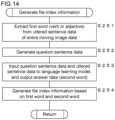
- Fig. 14 is a flowchart illustrating a generation processing procedure of the file index information.
- the control unit 11 or the natural language processing unit 11b divides the uttered sentence data (entire character string data) of the entire moving image data into morphemes through the morphological analysis processing, and extracts one or a plurality of first words, which are verbs or adjectives (step S251).
- the control unit 11 or the natural language processing unit 11b generates one or a plurality of pieces of question sentence data based on the one or a plurality of first words (step S252).
- the control unit 11 inputs the question sentence data and the uttered sentence data to the language learning model 12c, and makes the model output answer data (step S253).
- the answer data includes a second word, which is a noun.
- the control unit 11 generates file index information based on the first word and the second word (step S254), and ends the file index information generation processing.
- the control unit 11 generates a report based on the uttered sentence data (step S217).
- the report includes information on work such as maintenance and inspection for the air conditioner unit A.
- Fig. 15 is a flowchart illustrating a report generation procedure according to the second embodiment.
- the storage unit 12 of the server apparatus 1 stores a report template, and the control unit 11 of the server apparatus 1 acquires the report template from the storage unit 12 (step S271).
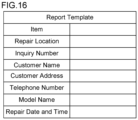
- Fig. 16 is a schematic view illustrating an example of the report template.
- the report template includes a plurality of input item characters representing items for which information is to be input.
- the input item characters are, for example, "item”, “repair location”, “inquiry number”, “customer name”, “customer address”, “telephone number”, “model name”, “repair date and time”, and the like.
- the control unit 11 extracts a plurality of first words, that is, a plurality of input item characters from the acquired report template (step S272).
- the control unit 11 or the natural language processing unit 11b generates a plurality of pieces of question sentence data based on the plurality of first words (step S273).
- the control unit 11 inputs the question sentence data and the uttered sentence data to the language learning model 12c, and makes the model output answer data (step S274).
- the answer data includes a second word, which is a noun.
- the second word is information to be input to the item indicated by the input item characters.
- the control unit 11 generates report data with the answer data input to the report template (step S275), and ends the report generation processing.
- the format of the report data is not limited, and the report data is, for example, array data in which the input item characters of the report template are associated with the answer data corresponding to the item.
- the report data may be image data in which the answer data is displayed in each item of the report template.
- control unit 11 stores the scene index information, the file index information, and the report data generated, in the storage unit 12 in association with the moving image data (step S218).
- Fig. 17 is a conceptual diagram illustrating an example of the moving image DB 12b according to the second embodiment.
- the control unit 11 associates file index information with moving image data, which is a single file.
- the control unit 11 associates scene index information with each of a plurality of scenes.
- moving image data is associated with information indicating a scene number, an end frame number, and running time indicating a start point and an end point of each of a plurality of scenes.
- the control unit 11 stores, in the moving image DB 12b in association with each scene number, the scene index information corresponding to the scene.
- the control unit 11 associates the report data with the moving image data.
- Fig. 18 is a flowchart illustrating a moving image search processing procedure according to the second embodiment.
- the control unit 31 of the terminal device 3 and the control unit 11 of the server apparatus 1 execute the processing that is the same as that in steps S171 to S180 described in the first embodiment, and the server apparatus 1 receives the moving image request data through the communication unit 13 (steps S271 to S280).
- the control unit 11 refers to the file index information associated with the moving image data to search for the moving image data.
- the content of the processing is the same as that in the first embodiment.
- the control unit 11 of the server apparatus 1 acquires the moving image data, the file index information, and the report data indicated by the moving image request data (step S281).
- the control unit 11 refers to the scene index information using the search word included in the search request data as a key, thereby identifying a scene matching the search word (step S282).
- the control unit 11 transmits the acquired moving image data, file index information, scene data, and scene designation information designating the scene identified in step S282 to the terminal device 3 that has requested the moving image through the communication unit 13 (step S283).
- the control unit 31 of the terminal device 3 receives the moving image data, the file index information, the scene data, the scene index information, and the scene designation information transmitted from the server apparatus 1 through the communication unit 33 (step S284).
- the control unit 31 plays the received moving image data on the display unit 34 from the scene indicated by the scene designation information (step S285).
- the control unit 31 makes the file index information and the index information of the scene corresponding to the scene currently being played, displayed in a superimposed manner on the moving image (step S286). Specifically, by referring to the scene data, the control unit 31 identifies the scene currently being played and the scene index information corresponding to the scene.
- the control unit 31 makes the file index information and the index information of the identified scene displayed in a superimposed manner on the moving image.
- the control unit 31 makes the received report data displayed on the display unit 34 (step S287).
- the control unit 31 may be configured to make the report data in response to the operation displayed on the operation unit 35.
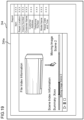
- Fig. 19 is a schematic view illustrating an example of the moving image play screen 34a according to the second embodiment.
- the terminal device 3 displays, for example, the moving image play screen 34a on the display unit 34.
- the terminal device 3 displays a moving image based on the moving image data received from the server apparatus 1, at the center of the moving image play screen 34a.
- the control unit 31 of the terminal device 3 makes the file index information and the scene index information displayed in a superimposed manner respectively on the upper part and the lower part of the moving image.
- the control unit 31 makes the scene number displayed in a superimposed manner on the lower right part of the moving image.
- the control unit 31 may be configured to make a character string obtained by summarizing the uttered sentence data of the moving image data by a known technique, displayed in a superimposed manner on the moving image.
- the file index information, the scene index information, the scene number, and the display position of the summary are examples.
- the control unit 31 makes the report displayed on the moving image play screen 34a based on the report data. For example, the control unit 31 makes the report data displayed side by side with the moving image.
- the scene index information accurately representing the content of each of a plurality of scenes obtained by dividing moving image data can be stored in the moving image DB 12b in association with the scenes.
- the scene index information accurately representing the content of a file of the moving image data not divided can be stored in the moving image DB 12b in association with the file.
- the moving image data can be played automatically from the scene associated with the search word.
- a report of work such as maintenance and inspection for the air conditioner unit A can be automatically generated.
- the first word is extracted from the report template to generate the question sentence data.
- the first word indicates the item to be input to the report.
- the second word extracted from the uttered sentence data using the question sentence data is information corresponding to the item.
- the terminal device 3 can display the report and play the moving image data.
- An information processing apparatus is different from those of the first and the second embodiments in that the question sentence data is generated with the first word extracted from the uttered sentence data by using dictionary data 312d. Since the other configurations and processing of the information processing system are the same as those of the information processing system according to the first and the second embodiments, the same components are denoted by the same reference numerals, and detailed description thereof will be omitted.
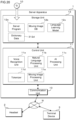
- Fig. 20 is a block diagram illustrating a configuration of the server apparatus 1 according to the third embodiment.
- the storage unit 12 of the server apparatus 1 according to the third embodiment stores the dictionary data 312d.
- the dictionary data 312d stores a verb and an adjective (predetermined word) suitable for generating question sentence data, and a verb and an adjective unsuitable for generating question data.
- the control unit 11 selects the dictionary data 312d, and makes a selection. For example, the control unit 11 determines whether a verb or an adjective extracted from the uttered sentence data matches a verb or an adjective stored in the dictionary data 312d as a verb and an adjective suitable for generating the question sentence data, and extracts the verb or the adjective as the first word upon determining that they match. The control unit 11 determines whether a verb or an adjective extracted from the uttered sentence data matches a verb or an adjective stored in the dictionary data 312d as a verb and an adjective unsuitable for generating the question sentence data, and does not extract the verb or the adjective as the first word upon determining that they match. The control unit 11 may extract as the first word, a verb or an adjective that is extracted from the uttered sentence data and not listed in the dictionary data 312d.
- the processing after the first word extraction is the same as that in the first embodiment and the second embodiment, and the question sentence data is generated, the answer data is acquired from uttered sentence data, and the index information is generated.
- the server apparatus 1 can generate more accurate question sentence data.
- the language learning model 12c By inputting appropriate question sentence data and uttered sentence data to the language learning model 12c, it is possible to output more accurate answer data (second data). Therefore, it is possible to generate index information more accurately representing the content of the moving image data and associate the index information with the moving image data.
- the information processing apparatus is different from those of the first to the third embodiments in that the generated index information is output to the outside. Since the other configurations and processing of the information processing system are the same as those of the information processing system according to the first to the third embodiments, the same components are denoted by the same reference numerals, and detailed description thereof will be omitted.
- Fig. 21 is a flowchart illustrating an index information generation processing procedure according to the fourth embodiment.
- the control unit 11 of the server apparatus 1 executes the processing that is the same as that in steps S111 to S116 described in the first embodiment, and the server apparatus 1 obtains the first word representing the content of the moving image data and the answer data (second word) (steps S411 to S416).
- the control unit 11 outputs to the outside the question sentence data including the first word and the answer data (second word) together with the moving image data (step S417).
- the control unit 11 plays the moving image data and makes the question sentence data and the answer data displayed on an external display device.
- the control unit 11 may output or transmit the moving image data, the question sentence data, and the answer data to an external computer.
- the control unit 11 that executes the processing in step S417 functions as an output unit that outputs the question data including the first word and the second word together with the moving image data.
- the index information accurately representing the content of moving image can be output to the outside together with the moving image data.
Landscapes
- Engineering & Computer Science (AREA)
- Theoretical Computer Science (AREA)
- Physics & Mathematics (AREA)
- General Engineering & Computer Science (AREA)
- General Physics & Mathematics (AREA)
- Data Mining & Analysis (AREA)
- Computational Linguistics (AREA)
- Artificial Intelligence (AREA)
- Health & Medical Sciences (AREA)
- Multimedia (AREA)
- Mathematical Physics (AREA)
- General Health & Medical Sciences (AREA)
- Software Systems (AREA)
- Databases & Information Systems (AREA)
- Library & Information Science (AREA)
- Audiology, Speech & Language Pathology (AREA)
- Evolutionary Computation (AREA)
- Computing Systems (AREA)
- Life Sciences & Earth Sciences (AREA)
- Biomedical Technology (AREA)
- Biophysics (AREA)
- Molecular Biology (AREA)
- Human Computer Interaction (AREA)
- Acoustics & Sound (AREA)
- Computer Vision & Pattern Recognition (AREA)
- Medical Informatics (AREA)
- Information Retrieval, Db Structures And Fs Structures Therefor (AREA)
- Electrically Operated Instructional Devices (AREA)
Abstract
Description
- The present disclosure relates to an information processing method, an information processing apparatus, and a computer program.
-
PTL 1 discloses a technique of, with an image capturing unit, a recording unit, and a conversion unit that converts voice included in recorded data into a character string, extracting a noun from a character string, acquiring a related word associated with the extracted noun from a dictionary unit, and storing captured image data, the noun, and the related word in association with each other. - PTL 1:
Japanese Unexamined Patent Application Publication No. 2016-170654 -
PTL 1 involves a technical problem in that the noun simply extracted from the character string of the voice and the related word do not necessarily accurately represent the content of the recorded data. - The present disclosure proposes an information processing method, an information processing apparatus, and a computer program with which a captured or recorded moving image or voice data can be associated with index information accurately representing the content of the data.
- An information processing method according to a first aspect of the present disclosure includes: converting voice data into character string data; extracting a second word from the character string data by using question data including a first word; and storing the voice data, the first word, and the second word in association with each other.
- An information processing method according to a second aspect of the present disclosure is the information processing method according to the first aspect preferably configured in such a manner that the extracting the second word from the character string data is performed by inputting the character string data and the question data to a trained language learning model configured to output, when the character string data and the question data are input, a word corresponding to an answer to the question data from the character string data.
- An information processing method according to a third aspect of the present disclosure is the information processing method according to the first or second aspect preferably configured in such a manner that the question data is generated by extracting the first word from the character string data.
- An information processing method according to a fourth aspect of the present disclosure is the information processing method according to the third aspect preferably configured in such a manner that the first word is a verb or an adjective, and the second word is a noun.
- An information processing method according to a fifth aspect of the present disclosure is the information processing method according to the third or fourth aspect preferably configured in such a manner that the question data is generated by extracting, as the first word, a word in dictionary data that stores a predetermined word among a plurality of verb or adjective words included in the character string data.
- An information processing method according to a sixth aspect of the present disclosure is the information processing method according to any one of the first to fifth aspects preferably configured in such a manner that a plurality of the first words and a plurality of the second words are provided.
- An information processing method according to a seventh aspect of the present disclosure is the information processing method according to any one of the first to sixth aspects preferably configured in such a manner that the voice data is sectionalized into a plurality of scenes, the second word is extracted from the character string data of each section, and the first word and the second word are stored in association with each section.
- An information processing method according to an eighth aspect of the present disclosure is the information processing method according to the seventh aspect preferably configured in such a manner that the second word is extracted from entire character string data in the voice data, and the first word and the second word are stored in association with a file of the voice data.
- An information processing method according to a ninth aspect of the present disclosure is the information processing method according to any one of the first to eighth aspects preferably configured in such a manner that the question data is generated by extracting the first word from a template of a report including characters, the second word extracted from the character string data is input to the template, and report data in which the second word is input to the template is stored in association with the voice data.
- An information processing method according to a tenth aspect of the present disclosure is the information processing method according to any one of the first to ninth aspects, preferably configured in such a manner that moving image data captured and recorded at a site of maintenance and inspection of equipment is acquired, voice data included in the acquired moving image data is converted into character string data, the second word is extracted from the character string data using the question data including the first word, and the moving image data, the first word, and the second word are stored in association with each other.
- An information processing method according to an eleventh aspect of the present disclosure is the information processing method according to the tenth aspect preferably configured in such a manner that the first word and the second word related to a moving image of the moving image data are superimposed.
- An information processing method according to a twelfth aspect of the present disclosure is the information processing method according to any one of the first to tenth aspect preferably configured in such a manner that a search request including a character is received, and from a plurality of pieces of the voice data stored in a database, the voice data associated with the first word and the second word related to the character in the search request is detected.
- An information processing method according to a thirteenth aspect of the present disclosure includes: converting voice data included in moving image data into character string data; extracting a second word from the character string data by using question data including a first word; and outputting the question data including the first word and the second word together with the moving image data.
- An information processing apparatus according to a fourteenth aspect of the present disclosure includes: a processing unit configured to convert voice data into character string data and extract a second word from the character string data by using question data including a first word; and a storage unit configured to store the voice data, the first word, and the second word in association with each other.
- An information processing apparatus according to a fifteenth aspect of the present disclosure includes: a processing unit configured to convert voice data included in moving image data into character string data and extract a second word from the character string data by using question data including a first word; and an output unit configured to output the question data including the first word and the second word together with the moving image data.
- A computer program according to a sixteenth aspect of the present disclosure causes a computer to execute processing of: converting voice data into character string data; extracting a second word from the character string data using question data including a first word; and storing the voice data, the first word, and the second word in association with each other.
- A computer program according to a seventeenth aspect of the present disclosure causes a computer to execute processing of: converting voice data included in moving image data into character string data; extracting a second word from the character string data by using question data including a first word; and outputting the question data including the first word and the second word together with the moving image data.
-
- [
Fig. 1] Fig. 1 is a schematic view illustrating an overview of an information processing system according to a first embodiment. - [
Fig. 2] Fig. 2 is a block diagram illustrating a configuration of a server apparatus according to the first embodiment. - [
Fig. 3] Fig. 3 is a conceptual diagram illustrating an example of a moving image DB according to the first embodiment. - [
Fig. 4] Fig. 4 is a block diagram illustrating a configuration of a language learning model according to the first embodiment. - [
Fig. 5] Fig. 5 is a block diagram illustrating a configuration of BERT as an example of the language learning model according to the first embodiment. - [
Fig. 6] Fig. 6 is a block diagram illustrating a configuration of a terminal device according to the first embodiment. - [
Fig. 7] Fig. 7 is a flowchart illustrating an index information generation processing procedure according to the first embodiment. - [
Fig. 8] Fig. 8 is a conceptual diagram illustrating an index information generation processing method according to the first embodiment. - [
Fig. 9] Fig. 9 is a flowchart illustrating a moving image search processing procedure according to the first embodiment. - [
Fig. 10] Fig. 10 is a schematic view illustrating an example of a moving image play screen according to the first embodiment. - [
Fig. 11] Fig. 11 is a flowchart illustrating an information processing procedure according to a second embodiment. - [
Fig. 12] Fig. 12 is a flowchart illustrating a procedure for generating scene index information. - [
Fig. 13] Fig. 13 is a conceptual diagram illustrating a method of matching between a scene of a moving image and uttered sentence data. - [
Fig. 14] Fig. 14 is a flowchart illustrating a generation processing procedure of file index information. - [
Fig. 15] Fig. 15 is a flowchart illustrating a report generation procedure according to the second embodiment. - [
Fig. 16] Fig. 16 is a schematic view illustrating an example of a report template. - [
Fig. 17] Fig. 17 is a conceptual diagram illustrating an example of a moving image DB according to the second embodiment. - [
Fig. 18] Fig. 18 is a flowchart illustrating a moving image search processing procedure according to the second embodiment. - [
Fig. 19] Fig. 19 is a schematic view illustrating an example of a moving image play screen according to the second embodiment. - [
Fig. 20] Fig. 20 is a block diagram illustrating a configuration of a server apparatus according to a third embodiment. - [
Fig. 21] Fig. 21 is a flowchart illustrating an index information generation processing procedure according to a fourth embodiment. - Hereinafter, an information processing method, an information processing apparatus, and a computer program according to the present disclosure will be described in detail based on the drawings illustrating embodiments thereof.
- Work such as maintenance and inspection, repair, or installation for various facilities such as air conditioner units and chemical plants requires technical skill, and the work efficiency greatly varies depending on the level of the skill of workers. One possible method for supporting the work for an unskilled worker includes collecting and accumulating moving image data obtained by capturing the work performed by a skilled worker and providing the accumulated moving image data to the unskilled worker. Appropriate index information needs to be assigned to the moving image data to enable moving image data required by the unskilled worker to be searched for in the accumulated moving image data.
- The present disclosure proposes an information processing method, an information processing apparatus, and a computer program (program product) with which captured or recorded moving image or voice data can be associated with index information accurately representing the content of the data.
-
Fig. 1 is a schematic view illustrating an overview of an information processing system according to a first embodiment. The information processing system according to the first embodiment includes a server apparatus (an information processing apparatus or a computer) 1, aheadset 2, and aterminal device 3. Theserver apparatus 1 is communicatively connected to theheadset 2 and theterminal device 3 via a wired or wireless communication network such as a mobile phone communication network, a wireless local area network (LAN), and the Internet. - The
headset 2 is a device that is worn on the head of a worker who performs work such as maintenance and inspection, repair, or installation for an air conditioner unit A, in particular, a skilled worker B. Theheadset 2 includes acamera 2a, amicrophone 2b, headphones, and the like, and captures an image and collects sound showing how the skilled worker B performs work. Moving image data is assumed to include voice data obtained by collecting sound using themicrophone 2b. - The
headset 2 is an example of a device that captures an image and collects sound showing how the skilled worker B performs the work, and may be another wearable device or a mobile terminal having an image capturing function and a sound collecting function. Instead of theheadset 2, thecamera 2a and themicrophone 2b installed around the air conditioner unit A and the skilled worker B may be adopted. - The moving image data obtained by the image capturing and the sound collection is provided to the
server apparatus 1. For example, when theheadset 2 includes a communication circuit, theheadset 2 transmits the moving image data to theserver apparatus 1 by wired or wireless communication. Theheadset 2 may be configured to transmit the moving image data to theserver apparatus 1 via a communication terminal such as a personal computer (PC) or a smartphone. When theheadset 2 does not have a communication circuit, theheadset 2 records the moving image data in a recording device such as a memory card or an optical disk. The moving image data is provided from theheadset 2 to theserver apparatus 1 via the recording device. - The method of providing the moving image data from the
headset 2 to theserver apparatus 1 described above is an example, and any known method may be adopted. - The
server apparatus 1 acquires the moving image data provided from theheadset 2 and accumulates the acquired moving image data in a movingimage DB 12b. Theterminal device 3 is a general-purpose communication terminal such as a smartphone or a PC used by an unskilled worker C who learns and performs work such as maintenance and inspection, repair, or installation for the air conditioner unit A. Theterminal device 3 accesses theserver apparatus 1 and requests a search for moving image data desired by the unskilled worker C. Theserver apparatus 1 searches for moving image data in response to a request from theterminal device 3, and transmits the required moving image data to theterminal device 3. Theterminal device 3 receives the moving image data transmitted in response to the request. Theterminal device 3 plays the received moving image data to display a moving image in which how the skilled worker B performs the work is recorded. The unskilled worker C can learn the technique of the skilled worker B using the moving image displayed on theterminal device 3. -
Fig. 2 is a block diagram illustrating a configuration of theserver apparatus 1 according to the first embodiment. Theserver apparatus 1 according to the first embodiment includes acontrol unit 11, a storage unit (storage) 12, and a communication unit (transceiver) 13. - The
control unit 11 includes a calculation processing device such as a central processing unit (CPU), a micro-processing unit (MPU), a graphics processing unit (GPU), or a quantum processor, a read only memory (ROM), a random access memory (RAM), and the like. Thecontrol unit 11 reads and executes a server program (computer program) 12a stored in thestorage unit 12, thereby executing processing of assigning index information to the accumulated moving image data. The index information is information indicating the content of the moving image data using a plurality of words. Thecontrol unit 11 executes processing such as searching for required moving image data with reference to the index information and transmitting the moving image data to theterminal device 3. - The
control unit 11 functions as avoice recognition unit 11a, a naturallanguage processing unit 11b, anAI processing unit 11c, atokenizer 11d, and a movingimage processing unit 11e. The functional units may each be realized by software with thecontrol unit 11 reading and executing theserver program 12a, or some or all of the functional units may be realized by hardware using a circuit. The overview of each functional unit is as follows. - The
voice recognition unit 11a is a component that converts the voice data included in the moving image data into uttered sentence data (character string data). The uttered sentence data is character string data obtained by converting the uttered content of the skilled worker B into text. - The natural
language processing unit 11b is a component that divides a character string represented by the uttered sentence data into morphemes through morphological analysis to extract a first word (verb or adjective), and generates question sentence data by using the extracted first word. The naturallanguage processing unit 11b is a component that executes rule-based processing without using alanguage learning model 12c obtained by machine learning. The question sentence data is data for extracting a meaningful noun from the uttered sentence data. - The
AI processing unit 11c is a component that inputs the question sentence data and the uttered sentence data to thelanguage learning model 12c that has been trained, and makes the model output answer data corresponding to an answer to the question sentence from the uttered sentence data. The answer data includes a second word that is a noun. - The
tokenizer 11d is a lexical analyzer, and functions as an encoder for encoding the question sentence data and the uttered sentence data described above into data processable by thelanguage learning model 12c. When BERT is used as thelanguage learning model 12c, thetokenizer 11d encodes the question sentence data and the uttered sentence data into embedded tensor data. Specifically, thetokenizer 11d divides the question sentence data and the uttered sentence data into tokens (terms) each of which is a minimum unit of a word, and converts each of the tokens into tensor data of a token string in which token IDs are arranged. Thetokenizer 11d inserts a special token [CLS] at the beginning of the sentence, and embeds a special token [SEP] between the token string of the question sentence data and the token string of the uttered sentence data. Thetokenizer 11d adds, to the tensor data of a token string, segment information for identification for determining whether each token is a token corresponding to a question sentence or a token corresponding to an uttered sentence. Thetokenizer 11d adds, to the tensor data of the token string, position information indicating the arrangement order of a plurality of tokens corresponding to the question sentence and the uttered sentence. - The
tokenizer 11d also functions as a decoder for decoding the tensor data output from thelanguage learning model 12c into character string data. - The moving
image processing unit 11e is a component that, for example, executes processing such as analyzing moving image data and dividing the moving image data, which is a single file, into a plurality of scenes. In the first embodiment, an example in which index information is added to moving image data, which is a single file, will be described below. A method of adding index information to each of a plurality of divided scenes will be described in a second embodiment. - The
storage unit 12 is, for example, a large-capacity storage device such as a hard disk. Thestorage unit 12 stores theserver program 12a to be executed by thecontrol unit 11, and various types of data required by thecontrol unit 11 to execute the processing. Thestorage unit 12 forms a moving image database (DB) 12b in which moving image data obtained by image capturing and sound collection using thecamera 2a and themicrophone 2b is accumulated. Thestorage unit 12 stores thelanguage learning model 12c for generating the index information to be given to moving image data. Thestorage unit 12 may be an external storage device connected to theserver apparatus 1. - The
server program 12a may be recorded in arecording medium 10 in a computer-readable manner. Thestorage unit 12 stores theserver program 12a read from therecording medium 10 by a reading device. Therecording medium 10 is a semiconductor memory, an optical disk, a magnetic disk, a magneto-optical disk, or the like. Theserver apparatus 1 may download theserver program 12a according to the first embodiment from an external server connected to a network N and store theserver program 12a in thestorage unit 12. -
Fig. 3 is a conceptual diagram illustrating an example of the movingimage DB 12b. The movingimage DB 12b is a database that stores moving image data obtained by image capturing and sound collection using thecamera 2a and themicrophone 2b, date and time of the image capturing, and index information generated by the information processing method according to the first embodiment in association with each other. The index information is information including a first word and a second word to be described below. -
Fig. 4 is a block diagram illustrating a configuration of thelanguage learning model 12c according to the first embodiment. Thelanguage learning model 12c is a trained machine learning model that outputs answer data corresponding to an answer to a question represented by question sentence data from uttered sentence data, when the question sentence data and the uttered sentence data are input. Thelanguage learning model 12c is configured using, for example, a deep neural network. The configuration of thelanguage learning model 12c is not limited, but BERT is suitable. In the following description, it is assumed that thelanguage learning model 12c is configured by BERT. -
Fig. 5 is a block diagram illustrating a configuration of BERT as an example of thelanguage learning model 12c according to the first embodiment. Thelanguage learning model 12c configured by BERT includes a plurality of connected transformer encoders (Trm) 12d. Thetransformer encoder 12d at the first stage corresponding to the input layer includes a plurality of nodes to which the element values of the tensor data of the question sentence data and the uttered sentence data are input. On the lower side inFig. 5 , "Tok1" to "TokN" represent the token IDs of the question sentence data, "Tok1" to "TokM" represent the token IDs of the uttered sentence data, and "CLS" and "SEP" represent the special tokens. Each of the plurality oftransformer encoders 12d corresponding to the intermediate layers executes calculation processing corresponding to a required task on the value output from the node of thetransformer encoder 12d at the previous stage, and outputs a result to thetransformer encoder 12d at the subsequent stage. BERT according to the first embodiment executes calculation processing for extracting a token corresponding to an answer to a question sentence. Thetransformer encoders 12d at the final stage corresponding to the output layer have the same number of nodes as thetransformer encoders 12d at the first stage, and output the tensor data of the answer sentence. InFig. 5 , the "Tok1", "Tok2", ... on the upper side represent the token IDs of the answer data. - The
language learning model 12c, which is BERT, can be trained by pre-learning and fine-tuning. The pre-learning is performed using unlabeled learning data. Specifically, a neural network is trained by word prediction learning (masked LM (MLM)) and next sentence prediction (NSP) learning. With the word prediction learning, a part of a token string, which is an input sentence of the learning data is masked, and the weight coefficient of thetransformer encoder 12d is optimized so that the masked token can be predicted. With the next sentence prediction learning, the weight coefficient of thetransformer encoder 12d is optimized so that whether a first character string and a second character string are sequential character strings. - With the fine tuning, the weight coefficient of the
transformer encoder 12d is finely corrected so that the tensor data of desired answer data is output when the tensor data of the question sentence data and the uttered sentence data are input. - The
language learning model 12c may perform the fine tuning for BERT by using the question sentence data and the uttered sentence data that are actually used, or BERT fine tuned by using general character string data may be used. - The
communication unit 13 communicates with theheadset 2 and theterminal device 3 via the network N including a mobile phone communication network, a wireless LAN, the Internet, and the like. Thecommunication unit 13 transmits data given from thecontrol unit 11 to theheadset 2 or theterminal device 3, and gives data received from theheadset 2 or theterminal device 3 to thecontrol unit 11. - While an example in which the
server apparatus 1 is configured by one computer device has been described, theserver apparatus 1 may alternatively be a multi-computer that includes a plurality of computers and executes distributed processing. Theserver apparatus 1 may be a virtual machine virtually constructed by software. -
Fig. 6 is a block diagram illustrating a configuration of theterminal device 3 according to the first embodiment. Theterminal device 3 includes acontrol unit 31, astorage unit 32, a communication unit (transceiver) 33, a display unit (display) 34, and anoperation unit 35. - The
control unit 31 includes a calculation processing unit such as a CPU or an MPU, a ROM, and the like. Thecontrol unit 31 reads and executes aterminal program 32a stored in thestorage unit 32 to execute search request processing for moving image data accumulated in the movingimage DB 12b of theserver apparatus 1 and play processing (display processing) for moving image data provided from theserver apparatus 1. Theterminal program 32a may be a dedicated program related to the information processing method according to the first embodiment, or may be a general-purpose program such as an Internet browser or a web browser. - The
storage unit 32 is, for example, a nonvolatile memory element such as a flash memory or a storage device such as a hard disk. Thestorage unit 32 stores theterminal program 32a to be executed by thecontrol unit 31, and various types of data required by thecontrol unit 31 to execute the processing. The terminal program and data may be recorded in arecording medium 30 in a computer-readable manner. Thestorage unit 32 stores theterminal program 32a read from therecording medium 30 by the reading device. Therecording medium 30 is a semiconductor memory, an optical disk, a magnetic disk, a magneto-optical disk, or the like. Theterminal device 3 may download theterminal program 32a according to the first embodiment from an external server connected to the network N and store the terminal program in thestorage unit 12. - The
communication unit 33 communicates with theserver apparatus 1 via the network N. Thecommunication unit 33 transmits data given from thecontrol unit 31 to theserver apparatus 1, and gives data received from theserver apparatus 1 to thecontrol unit 31. - The
display unit 34 is a liquid crystal panel, an organic EL display, or the like. Thedisplay unit 34 displays a moving image, a still image, characters, and the like according to data given from thecontrol unit 31. - The
operation unit 35 is an input device such as a touch panel, a soft key, a hard key, a keyboard, or a mouse. Theoperation unit 35 receives, for example, an operation of the unskilled worker C and notifies thecontrol unit 31 of the received operation. - The
server apparatus 1 can generate the index information accurately representing the content of the moving image data obtained by capturing an image showing how the skilled worker B performs work such as maintenance and inspection, repair, or installation for the air conditioner unit A. -
Fig. 7 is a flowchart illustrating an index information generation processing procedure according to the first embodiment, andFig. 8 is a conceptual diagram illustrating an index information generation processing method according to the first embodiment. Thecontrol unit 11 of theserver apparatus 1 acquires the moving image data (step S111). For example, theserver apparatus 1 acquires the moving image data by receiving the moving image data transmitted from theheadset 2 through thecommunication unit 13. The moving image data is obtained by capturing an image and collecting sound showing how the skilled worker B performs the work, and includes voice data. Theserver apparatus 1 may acquire the moving image data by reading the moving image data stored in thestorage unit 12 or an external storage device. - The
control unit 11 extracts voice data from the acquired moving image data (step S112). Thecontrol unit 11 or thevoice recognition unit 11a executes voice recognition processing to convert the extracted voice data into the uttered sentence data in a text format (step S113). Thecontrol unit 11 or the naturallanguage processing unit 11b divides the uttered sentence data into morphemes through morphological analysis processing, and extracts one or a plurality of first words that are verbs or adjectives (step S114). For example, the first words may be verbs such as "repair" or "replace", or adjectives such as "hot" or "slow". Thecontrol unit 11 may extract all verbs and adjectives included in the uttered sentence data as the first words, or may extract a predetermined number of verbs and adjectives as the first words. Thecontrol unit 11 may randomly extract a predetermined number of verbs and adjectives as the first words. Thecontrol unit 11 may extract a predetermined number of verbs and adjectives as the first words so that the variance of the degree of similarity is large. Thecontrol unit 11 may extract the first words such that the running time varies. Thecontrol unit 11 may extract, as the first words, a verb and an adjective with an application frequency in a predetermined range, for example, in a range of 1σ. - The
control unit 11 or the naturallanguage processing unit 11b generates one or a plurality of pieces of question sentence data based on one or a plurality of first words (step S115). For example, thecontrol unit 11 may use a first word "repair" to generate question sentence data "What was repaired?" For example, thecontrol unit 11 may use a first word "replace" to generate question sentence data "What has been replaced?" - A plurality of pieces of question sentence data may be generated based on one first word. For example, the
control unit 11 may generate question sentence data "What was repaired?", "What was used for repair?", and "How was it repaired?" - The
storage unit 12 may be configured to store a related-word dictionary. When thestorage unit 12 stores the related-word dictionary, thecontrol unit 11 generates question sentence data by using words related to "repair". For example, when the words related to "repair" include "problem", "part", "error code", or the like, question sentence data "What is the problem?", "What is the part?", and "What is the error code?" are generated. - The
storage unit 12 may be configured to store fixed-phrase question sentence data. Thecontrol unit 11 may add the fixed-phrase question sentence data read from thestorage unit 12 to the generated question sentence data. For example, question sentence data "What is the model number of the equipment?" may be added as a fixed-phrase question. - The
control unit 11 inputs the question sentence data and the uttered sentence data to thelanguage learning model 12c, and makes the model output answer data (step S116). When there are a plurality of pieces of question sentence data, a plurality of pieces of corresponding answer data are obtained. The answer data includes a second word, which is a noun. Specifically, thetokenizer 11d encodes the question sentence data and the uttered sentence data into tensor data. Thecontrol unit 11 inputs the encoded tensor data to thelanguage learning model 12c, and makes the model output the tensor data associated with an answer sentence. Thetokenizer 11d decodes the tensor data output from thelanguage learning model 12c into answer data. - The
control unit 11 generates index information based on the first word and the second word (step S117). For example, the index information is data in which the first word and the second word are arranged. - The
control unit 11 stores the moving image data in association with the generated index information in the storage unit 12 (step S118). Specifically, thecontrol unit 11 stores the moving image data and the index information in the movingimage DB 12b. - <Moving image search processing>
- The unskilled worker C can search for and view the moving image data accumulated in the moving
image DB 12b of theserver apparatus 1 by using theterminal device 3. -
Fig. 9 is a flowchart illustrating a moving image search processing procedure according to the first embodiment. Thecontrol unit 31 of theterminal device 3 makes a search screen for searching for moving image data stored in the movingimage DB 12b of theserver apparatus 1 displayed on the display unit 34 (step S171). Thecontrol unit 31 receives a search word through the operation unit 35 (step S172). Thecontrol unit 31 transmits search request data that includes the received search word, and is used for requesting for a search for the moving image data, to theserver apparatus 1 through the communication unit 33 (step S173). - The
server apparatus 1 receives the search request data transmitted from theterminal device 3 through the communication unit 13 (step S174). Thecontrol unit 11 of theserver apparatus 1 that has received the search request data searches for moving image data that matches a search word included in the search request data by referring to the index information stored in the movingimage DB 12b using the search word as a key (step S175). Thecontrol unit 11 transmits the result of the search in step S175 to theterminal device 3 that has transmitted the search request, through the communication unit 13 (step S176). The search result includes a file name, a thumbnail image, captured date and time, running time, index information, and the like of the moving image data. - The
control unit 31 of theterminal device 3 receives the search result transmitted from theserver apparatus 1, through the communication unit 33 (step S177). Thecontrol unit 31 makes the information of the search result displayed on thedisplay unit 34, and theoperation unit 35 receives the selection of a moving image to be played (step S178). - The
control unit 31 transmits moving image request data that includes information indicating the selected moving image an example of which is the file name of the moving image data, and serves as a request for the moving image data, to theserver apparatus 1 through the communication unit 33 (step S179). - The
control unit 11 of theserver apparatus 1 receives the moving image request data transmitted from theterminal device 3 through the communication unit 13 (step S180). Thecontrol unit 11 acquires the moving image data and index information indicated by the moving image request data from the movingimage DB 12b (step S181). Thecontrol unit 11 transmits the read moving image data and index information to theterminal device 3 that has requested the moving image through the communication unit 13 (step S182). - The
control unit 31 of theterminal device 3 receives the moving image data and index information transmitted from theserver apparatus 1 through the communication unit 33 (step S183). Thecontrol unit 31 plays the received moving image data and makes it displayed on the display unit 34 (step S184). Thecontrol unit 31 makes the index information displayed in a superimposed manner on the moving image (step S185). -
Fig. 10 is a schematic view illustrating an example of a movingimage play screen 34a according to the first embodiment. Theterminal device 3 displays, for example, the movingimage play screen 34a on thedisplay unit 34. Theterminal device 3 displays a moving image based on the moving image data received from theserver apparatus 1, at the center of the movingimage play screen 34a. Theterminal device 3 displays the index information in a superimposed manner on the upper part or the lower part of the moving image. Theterminal device 3 displays operation buttons such as a play button, a pause button, a stop button, a fast-forward button, a fast-rewind button, and the like at the lower part of the movingimage play screen 34a, and displays the operation buttons on the moving image displayed at the center of the screen of thedisplay unit 34. When any of the buttons is operated, thecontrol unit 31 controls the playing of the moving image according to the operated button. - With the information processing system and the like according to the first embodiment, it is possible to store the moving image data in the moving
image DB 12b in association with the index information that accurately represents the content of the moving image. Since the second word is extracted from the uttered sentence data using the question sentence data including the first word, the second word includes information corresponding to the question sentence data and having a meaning in terms of content. The first word and the second word are information accurately representing the content of the moving image data, and the first word and the second word can be associated with the moving image data as the index information. - By using the
language learning model 12c, which is a machine learning model, it is possible to extract the second word more accurately representing the content of the uttered sentence data. In particular, by using BERT, the second word, which is more meaningful in terms of content, can be extracted from the uttered sentence data. - Since the question sentence data is generated using the first word extracted from the uttered sentence data, it is possible to extract the second word more accurately representing the content of the uttered sentence data. Since the first word is information included in the uttered sentence data of the moving image data, it is possible to obtain the question sentence data according to the content of the moving image data.
- Since the first word in the question sentence data is a verb or an adjective, it is possible to generate the question sentence data suitable for extracting the second word, which is a noun, related to the verb or the adjective.
- Since there are a plurality of first words and second words associated with the moving image data, it is possible to generate index information that more specifically represents the content of the moving image data.
- The first word and the second word of the index information associated with the moving image data captured and recorded at the site of maintenance and inspection for the equipment represent the content of the moving image data. The content of the moving image data can be checked by referring to the first word and the second word of the index information.
- The index information including the first word and the second word may be displayed on the moving image of the moving image data.
- By referring to the index information, desired moving image data can be searched for.
- In the first embodiment, while the moving image data obtained by capturing an image and collecting sound showing how the work for the air conditioner unit A is performed is described as an example, a work target such as maintenance and inspection, repair, or installation is not limited. The information processing method and the like according to the first embodiment may be applied to moving image data obtained by capturing an image and collecting sound showing how maintenance and inspection is performed for a chemical plant and other various facilities.
- The information processing method and the like according to the first embodiment may be applied to moving image data or voice data captured or recorded for call center support, business support, or employee training.
- While in the first embodiment, an example in which the index information is associated with moving image data is described, the information processing method according to the first embodiment may be applied to voice data. That is, the index information generated by the information processing method or the like according to the first embodiment may be stored in association with the voice data.
- An information processing apparatus according to a second embodiment is different from that in the first embodiment in that moving image data is divided into a plurality of scenes, and index information is added to each scene. The information processing apparatus according to the second embodiment is different from that in the first embodiment in that a work report is automatically generated for moving image data obtained by capturing an image showing how work such as maintenance and inspection is performed for the air conditioner unit A. The information processing apparatus according to the second embodiment is different from that in the first embodiment in a method of playing moving image data. Since the other configurations and processing of the information processing system are the same as those of the information processing system according to the first embodiment, the same components are denoted by the same reference numerals, and detailed description thereof will be omitted.
-
Fig. 11 is a flowchart illustrating an information processing procedure according to the second embodiment. Thecontrol unit 11 of theserver apparatus 1 acquires the moving image data (step S211). Thecontrol unit 11 or the movingimage processing unit 11e analyzes the moving image data and divides the moving image data, which is a single file, into a plurality of scenes (step S212). For example, the movingimage processing unit 11e divides the content of the moving image into a plurality of scenes based on a change in the brightness of each frame image of the moving image, a change in the feature amount of an object, and the like. Thecontrol unit 11 stores, in the movingimage DB 12b in association with the moving image data, scene data including information such as a scene number for identifying each scene, the number of an end frame of each scene, the running time indicating a start point and an end point of each scene as information indicating a plurality of scenes (seeFig. 17 ). - The
control unit 11 extracts voice data from the acquired moving image data (step S213). Thecontrol unit 11 or thevoice recognition unit 11a executes voice recognition processing to convert the extracted voice data into uttered sentence data in a text format (step S214). Specifically, thecontrol unit 11 or thevoice recognition unit 11a converts the voice data into the uttered sentence data in a text format, based on each of the breaks of the utterance. Thecontrol unit 11 or thevoice recognition unit 11a temporarily stores, in thestorage unit 12, an uttered sentence data group including the numbers for identifying a plurality of pieces of uttered sentence data, the running time indicating a play start point and an end point of each piece of uttered sentence data, and the uttered sentence data. - The
control unit 11 executes processing of generating the index information based on the uttered sentence data of a plurality of scenes (step S215). Hereinafter, the index information generated based on the uttered sentence data of each scene is referred to as scene index information. -
Fig. 12 is a flowchart illustrating a procedure for generating the scene index information. Thecontrol unit 11 performs matching between each scene of moving image data and uttered sentence data (step S231). -
Fig. 13 is a conceptual diagram illustrating a method of the matching between a scene of a moving image and uttered sentence data. As illustrated inFig. 13 , thecontrol unit 11 refers to scene data, and compares the start point and the end point of each scene with the start point and the end point of each of the plurality of pieces of uttered sentence data obtained by the conversion in step S214. Thecontrol unit 11 identifies uttered sentence data with a start point close to the start point of the scene. Thecontrol unit 11 identifies uttered sentence data with an end point close to the end point. Thecontrol unit 11 integrates the uttered sentence data with the start point of the scene identified, the uttered sentence data between the start point and the end point, and the uttered sentence data at the end point of the scene. - For example, the start point and the end point of the scene with
scene number 1 are respectively 00:00 and 00:12. The uttered sentence data corresponding to the start point to the end point of the scene are uttered sentence data pieces No. 1 to No. 3, and thus thecontrol unit 11 integrates the uttered sentence data pieces No. 1 to No. 3. Similarly, the start point and the end point of the scene withscene number 2 are respectively 00:12 and 00:23. The uttered sentence data corresponding to the start point to the end point of the scene are uttered sentence data pieces No. 4 to No. 7, and thus thecontrol unit 11 integrates the uttered sentence data pieces No. 4 to No. 7. - The
control unit 11 or the naturallanguage processing unit 11b divides the uttered sentence data of one scene into morphemes through the morphological analysis processing, and extracts one or a plurality of first words, which are verbs or adjectives (step S232). Thecontrol unit 11 or the naturallanguage processing unit 11b generates one or a plurality of pieces of question sentence data based on the one or a plurality of first words (step S233). Thecontrol unit 11 inputs the question sentence data and the uttered sentence data to thelanguage learning model 12c, and makes the model output answer data (step S234). When there are a plurality of pieces of question sentence data, a plurality of pieces of corresponding answer data are obtained. The answer data includes a second word, which is a noun. Thecontrol unit 11 generates scene index information based on the first word and the second word (step S235). - The
control unit 11 determines whether the processing of generating the scene index information has been completed for all the scenes (step S236). When it is determined that there is a scene for which scene index information has not been generated (step S236: NO), thecontrol unit 11 returns the processing to step S232. When it is determined that the scene index information has been generated for all the scenes (step S236: YES), the processing of generating the index information of the scenes ends. - Referring back to
Fig. 11 , thecontrol unit 11 executes processing of generating index information based on moving image data, which is a single file (step S216). Hereinafter, index information generated based on moving image data, which is a single file, is referred to as file index information. -
Fig. 14 is a flowchart illustrating a generation processing procedure of the file index information. Thecontrol unit 11 or the naturallanguage processing unit 11b divides the uttered sentence data (entire character string data) of the entire moving image data into morphemes through the morphological analysis processing, and extracts one or a plurality of first words, which are verbs or adjectives (step S251). Thecontrol unit 11 or the naturallanguage processing unit 11b generates one or a plurality of pieces of question sentence data based on the one or a plurality of first words (step S252). Thecontrol unit 11 inputs the question sentence data and the uttered sentence data to thelanguage learning model 12c, and makes the model output answer data (step S253). The answer data includes a second word, which is a noun. Thecontrol unit 11 generates file index information based on the first word and the second word (step S254), and ends the file index information generation processing. - Referring back to
Fig. 11 , thecontrol unit 11 generates a report based on the uttered sentence data (step S217). The report includes information on work such as maintenance and inspection for the air conditioner unit A. -
Fig. 15 is a flowchart illustrating a report generation procedure according to the second embodiment. Thestorage unit 12 of theserver apparatus 1 stores a report template, and thecontrol unit 11 of theserver apparatus 1 acquires the report template from the storage unit 12 (step S271). -
Fig. 16 is a schematic view illustrating an example of the report template. The report template includes a plurality of input item characters representing items for which information is to be input. The input item characters are, for example, "item", "repair location", "inquiry number", "customer name", "customer address", "telephone number", "model name", "repair date and time", and the like. - The
control unit 11 extracts a plurality of first words, that is, a plurality of input item characters from the acquired report template (step S272). Thecontrol unit 11 or the naturallanguage processing unit 11b generates a plurality of pieces of question sentence data based on the plurality of first words (step S273). Thecontrol unit 11 inputs the question sentence data and the uttered sentence data to thelanguage learning model 12c, and makes the model output answer data (step S274). The answer data includes a second word, which is a noun. The second word is information to be input to the item indicated by the input item characters. Thecontrol unit 11 generates report data with the answer data input to the report template (step S275), and ends the report generation processing. The format of the report data is not limited, and the report data is, for example, array data in which the input item characters of the report template are associated with the answer data corresponding to the item. The report data may be image data in which the answer data is displayed in each item of the report template. - Referring back to
Fig. 11 , thecontrol unit 11 stores the scene index information, the file index information, and the report data generated, in thestorage unit 12 in association with the moving image data (step S218). -
Fig. 17 is a conceptual diagram illustrating an example of the movingimage DB 12b according to the second embodiment. As illustrated inFig. 17 , thecontrol unit 11 associates file index information with moving image data, which is a single file. Thecontrol unit 11 associates scene index information with each of a plurality of scenes. Specifically, moving image data is associated with information indicating a scene number, an end frame number, and running time indicating a start point and an end point of each of a plurality of scenes. Thecontrol unit 11 stores, in the movingimage DB 12b in association with each scene number, the scene index information corresponding to the scene. Thecontrol unit 11 associates the report data with the moving image data. -
Fig. 18 is a flowchart illustrating a moving image search processing procedure according to the second embodiment. Thecontrol unit 31 of theterminal device 3 and thecontrol unit 11 of theserver apparatus 1 execute the processing that is the same as that in steps S171 to S180 described in the first embodiment, and theserver apparatus 1 receives the moving image request data through the communication unit 13 (steps S271 to S280). In step S275, thecontrol unit 11 refers to the file index information associated with the moving image data to search for the moving image data. The content of the processing is the same as that in the first embodiment. - The
control unit 11 of theserver apparatus 1 acquires the moving image data, the file index information, and the report data indicated by the moving image request data (step S281). Thecontrol unit 11 refers to the scene index information using the search word included in the search request data as a key, thereby identifying a scene matching the search word (step S282). - The
control unit 11 transmits the acquired moving image data, file index information, scene data, and scene designation information designating the scene identified in step S282 to theterminal device 3 that has requested the moving image through the communication unit 13 (step S283). - The
control unit 31 of theterminal device 3 receives the moving image data, the file index information, the scene data, the scene index information, and the scene designation information transmitted from theserver apparatus 1 through the communication unit 33 (step S284). Thecontrol unit 31 plays the received moving image data on thedisplay unit 34 from the scene indicated by the scene designation information (step S285). Thecontrol unit 31 makes the file index information and the index information of the scene corresponding to the scene currently being played, displayed in a superimposed manner on the moving image (step S286). Specifically, by referring to the scene data, thecontrol unit 31 identifies the scene currently being played and the scene index information corresponding to the scene. Thecontrol unit 31 makes the file index information and the index information of the identified scene displayed in a superimposed manner on the moving image. - The
control unit 31 makes the received report data displayed on the display unit 34 (step S287). Thecontrol unit 31 may be configured to make the report data in response to the operation displayed on theoperation unit 35. -
Fig. 19 is a schematic view illustrating an example of the movingimage play screen 34a according to the second embodiment. Theterminal device 3 displays, for example, the movingimage play screen 34a on thedisplay unit 34. Theterminal device 3 displays a moving image based on the moving image data received from theserver apparatus 1, at the center of the movingimage play screen 34a. Thecontrol unit 31 of theterminal device 3 makes the file index information and the scene index information displayed in a superimposed manner respectively on the upper part and the lower part of the moving image. Thecontrol unit 31 makes the scene number displayed in a superimposed manner on the lower right part of the moving image. Thecontrol unit 31 may be configured to make a character string obtained by summarizing the uttered sentence data of the moving image data by a known technique, displayed in a superimposed manner on the moving image. The file index information, the scene index information, the scene number, and the display position of the summary are examples. - The
control unit 31 makes the report displayed on the movingimage play screen 34a based on the report data. For example, thecontrol unit 31 makes the report data displayed side by side with the moving image. - With the information processing system and the like according to the second embodiment, the scene index information accurately representing the content of each of a plurality of scenes obtained by dividing moving image data can be stored in the moving
image DB 12b in association with the scenes. - The scene index information accurately representing the content of a file of the moving image data not divided can be stored in the moving
image DB 12b in association with the file. - The moving image data can be played automatically from the scene associated with the search word.
- Based on the moving image data, a report of work such as maintenance and inspection for the air conditioner unit A can be automatically generated. The first word is extracted from the report template to generate the question sentence data. The first word indicates the item to be input to the report. The second word extracted from the uttered sentence data using the question sentence data is information corresponding to the item. By inputting the second word to the template, report data representing the content of the moving image data can be generated.
- The
terminal device 3 can display the report and play the moving image data. - An information processing apparatus according to a third embodiment is different from those of the first and the second embodiments in that the question sentence data is generated with the first word extracted from the uttered sentence data by using
dictionary data 312d. Since the other configurations and processing of the information processing system are the same as those of the information processing system according to the first and the second embodiments, the same components are denoted by the same reference numerals, and detailed description thereof will be omitted. -
Fig. 20 is a block diagram illustrating a configuration of theserver apparatus 1 according to the third embodiment. Thestorage unit 12 of theserver apparatus 1 according to the third embodiment stores thedictionary data 312d. Thedictionary data 312d stores a verb and an adjective (predetermined word) suitable for generating question sentence data, and a verb and an adjective unsuitable for generating question data. - When extracting the first word from the uttered sentence data, the
control unit 11 selects thedictionary data 312d, and makes a selection. For example, thecontrol unit 11 determines whether a verb or an adjective extracted from the uttered sentence data matches a verb or an adjective stored in thedictionary data 312d as a verb and an adjective suitable for generating the question sentence data, and extracts the verb or the adjective as the first word upon determining that they match. Thecontrol unit 11 determines whether a verb or an adjective extracted from the uttered sentence data matches a verb or an adjective stored in thedictionary data 312d as a verb and an adjective unsuitable for generating the question sentence data, and does not extract the verb or the adjective as the first word upon determining that they match. Thecontrol unit 11 may extract as the first word, a verb or an adjective that is extracted from the uttered sentence data and not listed in thedictionary data 312d. - The processing after the first word extraction is the same as that in the first embodiment and the second embodiment, and the question sentence data is generated, the answer data is acquired from uttered sentence data, and the index information is generated.
- According to the third embodiment, the
server apparatus 1 can generate more accurate question sentence data. By inputting appropriate question sentence data and uttered sentence data to thelanguage learning model 12c, it is possible to output more accurate answer data (second data). Therefore, it is possible to generate index information more accurately representing the content of the moving image data and associate the index information with the moving image data. - The information processing apparatus according to a fourth embodiment is different from those of the first to the third embodiments in that the generated index information is output to the outside. Since the other configurations and processing of the information processing system are the same as those of the information processing system according to the first to the third embodiments, the same components are denoted by the same reference numerals, and detailed description thereof will be omitted.
-
Fig. 21 is a flowchart illustrating an index information generation processing procedure according to the fourth embodiment. Thecontrol unit 11 of theserver apparatus 1 executes the processing that is the same as that in steps S111 to S116 described in the first embodiment, and theserver apparatus 1 obtains the first word representing the content of the moving image data and the answer data (second word) (steps S411 to S416). Thecontrol unit 11 outputs to the outside the question sentence data including the first word and the answer data (second word) together with the moving image data (step S417). For example, thecontrol unit 11 plays the moving image data and makes the question sentence data and the answer data displayed on an external display device. Thecontrol unit 11 may output or transmit the moving image data, the question sentence data, and the answer data to an external computer. - The
control unit 11 that executes the processing in step S417 functions as an output unit that outputs the question data including the first word and the second word together with the moving image data. - According to the fourth embodiment, the index information accurately representing the content of moving image can be output to the outside together with the moving image data.
- While embodiments have been described above, the present invention is not limited to these examples. It should be understood that various changes in mode and detail may be made without departing from the spirit and scope of the claims. Further, at least parts of the above-described embodiments may be arbitrarily combined.
-
- 1 Server apparatus (information processing apparatus, computer)
- 2 Headset
- 2a Camera
- 2b Microphone
- 3 Terminal device
- 11 Control unit
- 11a Voice recognition unit
- 11b Natural language processing unit
- 11c AI processing unit
- 11d Tokenizer
- 11e Moving image processing unit
- 12 Storage unit
- 12a Server program (computer program)
- 12b Moving image DB
- 12c Language learning model
- 12d Transformer encoder
- 312d Dictionary data
- 13 Communication unit
- 31 Control unit
- 32 Storage unit
- 32a Terminal program
- 33 Communication unit
- 34 Display unit
- 34a Moving image play screen
- 35 Operation unit
- 10, 30 Recording medium
- A Air conditioner unit
- B Skilled worker
- C Unskilled worker
- N Network
Claims (17)
- An information processing method comprising:converting voice data into character string data;extracting a second word from the character string data by using question data including a first word; andstoring the voice data, the first word, and the second word in association with each other.
- The information processing method according to claim 1, wherein the extracting the second word from the character string data is performed by inputting the character string data and the question data to a trained language learning model configured to output, when the character string data and the question data are input, a word corresponding to an answer to the question data from the character string data.
- The information processing method according to claim 1 or 2, wherein the question data is generated by extracting the first word from the character string data.
- The information processing method according to claim 3, whereinthe first word is a verb or an adjective, andthe second word is a noun.
- The information processing method according to claim 3, wherein the question data is generated by extracting, as the first word, a word in dictionary data that stores a predetermined word among a plurality of verb or adjective words included in the character string data.
- The information processing method according to claim 1 or 2, wherein a plurality of the first words and a plurality of the second words are provided.
- The information processing method according to claim 1 or 2, whereinthe voice data is sectionalized into a plurality of scenes,the second word is extracted from the character string data of each section, andthe first word and the second word are stored in association with each section.
- The information processing method according to claim 7, whereinthe second word is extracted from entire character string data in the voice data, andthe first word and the second word are stored in association with a file of the voice data.
- The information processing method according to claim 1 or 2, whereinthe question data is generated by extracting the first word from a template of a report including characters,the second word extracted from the character string data is input to the template, andreport data in which the second word is input to the template is stored in association with the voice data.
- The information processing method according to claim 1 or 2, whereinmoving image data captured and recorded at a site of maintenance and inspection of equipment is acquired,voice data included in the acquired moving image data is converted into character string data,the second word is extracted from the character string data using the question data including the first word, andthe moving image data, the first word, and the second word are stored in association with each other.
- The information processing method according to claim 10, wherein the first word and the second word related to a moving image of the moving image data are superimposed.
- The information processing method according to claim 1 or 2, whereina search request including a character is received, and from a plurality of pieces of the voice data stored in a database,the voice data associated with the first word and the second word related to the character in the search request is detected.
- An information processing method comprising:converting voice data included in moving image data into character string data;extracting a second word from the character string data by using question data including a first word; andoutputting the question data including the first word and the second word together with the moving image data.
- An information processing apparatus comprising:a processing unit configured to convert voice data into character string data and extract a second word from the character string data by using question data including a first word; anda storage unit configured to store the voice data, the first word, and the second word in association with each other.
- An information processing apparatus comprising:a processing unit configured to convert voice data included in moving image data into character string data and extract a second word from the character string data by using question data including a first word; andan output unit configured to output the question data including the first word and the second word together with the moving image data.
- A computer program causing a computer to execute processing of:converting voice data into character string data;extracting a second word from the character string data using question data including a first word; andstoring the voice data, the first word, and the second word in association with each other.
- A computer program causing a computer to execute processing of:converting voice data included in moving image data into character string data;extracting a second word from the character string data by using question data including a first word; andoutputting the question data including the first word and the second word together with the moving image data.
Applications Claiming Priority (2)
| Application Number | Priority Date | Filing Date | Title |
|---|---|---|---|
| JP2022112563A JP7455338B2 (en) | 2022-07-13 | 2022-07-13 | Information processing method, information processing device and computer program |
| PCT/JP2023/025079 WO2024014386A1 (en) | 2022-07-13 | 2023-07-06 | Information processing method, information processing device, and computer program |
Publications (2)
| Publication Number | Publication Date |
|---|---|
| EP4557127A1 true EP4557127A1 (en) | 2025-05-21 |
| EP4557127A4 EP4557127A4 (en) | 2025-10-22 |
Family
ID=89536700
Family Applications (1)
| Application Number | Title | Priority Date | Filing Date |
|---|---|---|---|
| EP23839558.6A Pending EP4557127A4 (en) | 2022-07-13 | 2023-07-06 | INFORMATION PROCESSING METHOD, INFORMATION PROCESSING DEVICE AND COMPUTER PROGRAM |
Country Status (5)
| Country | Link |
|---|---|
| US (1) | US12537006B2 (en) |
| EP (1) | EP4557127A4 (en) |
| JP (1) | JP7455338B2 (en) |
| CN (1) | CN119585724A (en) |
| WO (1) | WO2024014386A1 (en) |
Family Cites Families (20)
| Publication number | Priority date | Publication date | Assignee | Title |
|---|---|---|---|---|
| US5835667A (en) | 1994-10-14 | 1998-11-10 | Carnegie Mellon University | Method and apparatus for creating a searchable digital video library and a system and method of using such a library |
| US6076059A (en) * | 1997-08-29 | 2000-06-13 | Digital Equipment Corporation | Method for aligning text with audio signals |
| US8090402B1 (en) * | 2003-09-26 | 2012-01-03 | Iwao Fujisaki | Communication device |
| US20070106685A1 (en) * | 2005-11-09 | 2007-05-10 | Podzinger Corp. | Method and apparatus for updating speech recognition databases and reindexing audio and video content using the same |
| CN101261865B (en) * | 2007-04-20 | 2012-07-04 | 炬力集成电路设计有限公司 | Making method, device, playing device and method for media electronic file |
| US20110162004A1 (en) * | 2009-12-30 | 2011-06-30 | Cevat Yerli | Sensor device for a computer-controlled video entertainment system |
| US9819843B2 (en) * | 2012-09-20 | 2017-11-14 | Zeriscope Inc. | Head-mounted systems and methods for providing inspection, evaluation or assessment of an event or location |
| US9535990B2 (en) * | 2014-05-20 | 2017-01-03 | Google Inc. | Systems and methods for generating video program extracts based on search queries |
| JP6074820B2 (en) | 2015-01-23 | 2017-02-08 | 国立研究開発法人情報通信研究機構 | Annotation auxiliary device and computer program therefor |
| JP2016170654A (en) | 2015-03-13 | 2016-09-23 | 株式会社リコー | Information processing terminal, information processing method, program and information processing unit |
| US10768704B2 (en) * | 2015-03-17 | 2020-09-08 | Whirlwind VR, Inc. | System and method for modulating a peripheral device based on an unscripted feed using computer vision |
| KR20180018211A (en) * | 2016-08-12 | 2018-02-21 | 엘지전자 주식회사 | Self-learning robot |
| ES1175583Y (en) * | 2016-10-31 | 2017-04-24 | Fermax Design & Dev S L U | ACCESSIBLE ELECTRONIC PORTER. |
| US10331402B1 (en) * | 2017-05-30 | 2019-06-25 | Amazon Technologies, Inc. | Search and knowledge base question answering for a voice user interface |
| EP3506258B1 (en) * | 2018-01-02 | 2023-10-25 | Getac Holdings Corporation | Information capturing device and voice control method |
| US20190236976A1 (en) * | 2018-01-31 | 2019-08-01 | Rnd64 Limited | Intelligent personal assistant device |
| JP7483532B2 (en) * | 2020-07-03 | 2024-05-15 | 日本放送協会 | KEYWORD EXTRACTION DEVICE, KEYWORD EXTRACTION METHOD, AND KEYWORD EXTRACTION PROGRAM |
| CN112509690B (en) * | 2020-11-30 | 2023-08-04 | 北京百度网讯科技有限公司 | Method, apparatus, device and storage medium for controlling quality |
| JP7689842B2 (en) * | 2021-03-15 | 2025-06-09 | パラマウントベッド株式会社 | Information processing device and information processing method |
| US20230251721A1 (en) * | 2022-01-17 | 2023-08-10 | Vipin Singh | Gesture-Based and Video Feedback Machine |
-
2022
- 2022-07-13 JP JP2022112563A patent/JP7455338B2/en active Active
-
2023
- 2023-07-06 US US18/993,502 patent/US12537006B2/en active Active
- 2023-07-06 EP EP23839558.6A patent/EP4557127A4/en active Pending
- 2023-07-06 CN CN202380053122.4A patent/CN119585724A/en active Pending
- 2023-07-06 WO PCT/JP2023/025079 patent/WO2024014386A1/en not_active Ceased
Also Published As
| Publication number | Publication date |
|---|---|
| US20250266044A1 (en) | 2025-08-21 |
| JP7455338B2 (en) | 2024-03-26 |
| US12537006B2 (en) | 2026-01-27 |
| JP2024010943A (en) | 2024-01-25 |
| EP4557127A4 (en) | 2025-10-22 |
| CN119585724A (en) | 2025-03-07 |
| WO2024014386A1 (en) | 2024-01-18 |
Similar Documents
| Publication | Publication Date | Title |
|---|---|---|
| US20220248091A1 (en) | Sensitivity assessment for media production using artificial intelligence | |
| WO2023108980A1 (en) | Information push method and device based on text adversarial sample | |
| US7853582B2 (en) | Method and system for providing information services related to multimodal inputs | |
| WO2021253904A1 (en) | Test case set generation method, apparatus and device, and computer readable storage medium | |
| WO2020232861A1 (en) | Named entity recognition method, electronic device and storage medium | |
| CN110582762A (en) | Automatic response server device, terminal device, response system, response method and program | |
| US8370323B2 (en) | Providing information services related to multimodal inputs | |
| CN118916499B (en) | A query method integrating AI big model and knowledge graph | |
| CN109783624A (en) | Answer generation method, device and the intelligent conversational system in knowledge based library | |
| CN119336172B (en) | Virtual digital human interaction management method and system based on artificial intelligence | |
| JP2016153931A (en) | Information processing method, information processing device, and information processing program | |
| KR20240014027A (en) | Voice and text data generation system | |
| CN120725157B (en) | Model training and information replying method, device, storage medium and program product | |
| CN117195864A (en) | A question generation system based on answer awareness | |
| CN119293201A (en) | Text review method | |
| KR20240082170A (en) | Method and appratus for determining travel sensibility feature of travel destination based on artificial intelligence | |
| CN118798134A (en) | Content generation method, device, electronic device and readable storage medium | |
| KR20180009408A (en) | Placeness Extraction and Inference System based on Social Network Analysis and Ontology | |
| CN112699217A (en) | Behavior abnormal user identification method based on user text data and communication data | |
| CN114444509B (en) | Method, device and equipment for testing named entity recognition model and storage medium | |
| US20250238445A1 (en) | Information processing apparatus, information processing method, and non-transitory computer readable storage medium | |
| JP7455338B2 (en) | Information processing method, information processing device and computer program | |
| CN118734815A (en) | A universal wizard-style form intelligent filling method and system | |
| JP2025169853A (en) | Information processing system, information processing device, information processing method and program | |
| CN114399821B (en) | Policy recommendation method, device and storage medium |
Legal Events
| Date | Code | Title | Description |
|---|---|---|---|
| STAA | Information on the status of an ep patent application or granted ep patent |
Free format text: STATUS: THE INTERNATIONAL PUBLICATION HAS BEEN MADE |
|
| PUAI | Public reference made under article 153(3) epc to a published international application that has entered the european phase |
Free format text: ORIGINAL CODE: 0009012 |
|
| STAA | Information on the status of an ep patent application or granted ep patent |
Free format text: STATUS: REQUEST FOR EXAMINATION WAS MADE |
|
| 17P | Request for examination filed |
Effective date: 20250110 |
|
| AK | Designated contracting states |
Kind code of ref document: A1 Designated state(s): AL AT BE BG CH CY CZ DE DK EE ES FI FR GB GR HR HU IE IS IT LI LT LU LV MC ME MK MT NL NO PL PT RO RS SE SI SK SM TR |
|
| REG | Reference to a national code |
Ref country code: DE Ref legal event code: R079 Free format text: PREVIOUS MAIN CLASS: G06F0016783000 Ipc: G06F0016710000 |
|
| A4 | Supplementary search report drawn up and despatched |
Effective date: 20250924 |
|
| DAV | Request for validation of the european patent (deleted) | ||
| DAX | Request for extension of the european patent (deleted) | ||
| RIC1 | Information provided on ipc code assigned before grant |
Ipc: G06F 16/71 20190101AFI20250918BHEP Ipc: G06F 16/783 20190101ALI20250918BHEP Ipc: G06F 40/20 20200101ALI20250918BHEP Ipc: G06F 40/30 20200101ALI20250918BHEP Ipc: G06F 40/56 20200101ALI20250918BHEP Ipc: G06N 3/044 20230101ALI20250918BHEP Ipc: G06N 3/045 20230101ALI20250918BHEP Ipc: G06N 3/08 20230101ALI20250918BHEP Ipc: G06N 20/00 20190101ALI20250918BHEP |
|
| STAA | Information on the status of an ep patent application or granted ep patent |
Free format text: STATUS: EXAMINATION IS IN PROGRESS |
|
| 17Q | First examination report despatched |
Effective date: 20260520 |