EP4555968A2 - Verfahren und system zur aktualisierung eines betriebspfades für eine roboterarmanordnung. - Google Patents
Verfahren und system zur aktualisierung eines betriebspfades für eine roboterarmanordnung. Download PDFInfo
- Publication number
- EP4555968A2 EP4555968A2 EP25169017.8A EP25169017A EP4555968A2 EP 4555968 A2 EP4555968 A2 EP 4555968A2 EP 25169017 A EP25169017 A EP 25169017A EP 4555968 A2 EP4555968 A2 EP 4555968A2
- Authority
- EP
- European Patent Office
- Prior art keywords
- point
- image
- point image
- patient
- tag
- Prior art date
- Legal status (The legal status is an assumption and is not a legal conclusion. Google has not performed a legal analysis and makes no representation as to the accuracy of the status listed.)
- Pending
Links
Images



Classifications
-
- A—HUMAN NECESSITIES
- A61—MEDICAL OR VETERINARY SCIENCE; HYGIENE
- A61B—DIAGNOSIS; SURGERY; IDENTIFICATION
- A61B34/00—Computer-aided surgery; Manipulators or robots specially adapted for use in surgery
- A61B34/20—Surgical navigation systems; Devices for tracking or guiding surgical instruments, e.g. for frameless stereotaxis
-
- A—HUMAN NECESSITIES
- A61—MEDICAL OR VETERINARY SCIENCE; HYGIENE
- A61B—DIAGNOSIS; SURGERY; IDENTIFICATION
- A61B34/00—Computer-aided surgery; Manipulators or robots specially adapted for use in surgery
- A61B34/10—Computer-aided planning, simulation or modelling of surgical operations
-
- A—HUMAN NECESSITIES
- A61—MEDICAL OR VETERINARY SCIENCE; HYGIENE
- A61B—DIAGNOSIS; SURGERY; IDENTIFICATION
- A61B34/00—Computer-aided surgery; Manipulators or robots specially adapted for use in surgery
- A61B34/30—Surgical robots
-
- A—HUMAN NECESSITIES
- A61—MEDICAL OR VETERINARY SCIENCE; HYGIENE
- A61B—DIAGNOSIS; SURGERY; IDENTIFICATION
- A61B90/00—Instruments, implements or accessories specially adapted for surgery or diagnosis and not covered by any of the groups A61B1/00 - A61B50/00, e.g. for luxation treatment or for protecting wound edges
- A61B90/36—Image-producing devices or illumination devices not otherwise provided for
-
- A—HUMAN NECESSITIES
- A61—MEDICAL OR VETERINARY SCIENCE; HYGIENE
- A61B—DIAGNOSIS; SURGERY; IDENTIFICATION
- A61B90/00—Instruments, implements or accessories specially adapted for surgery or diagnosis and not covered by any of the groups A61B1/00 - A61B50/00, e.g. for luxation treatment or for protecting wound edges
- A61B90/36—Image-producing devices or illumination devices not otherwise provided for
- A61B90/361—Image-producing devices, e.g. surgical cameras
-
- A—HUMAN NECESSITIES
- A61—MEDICAL OR VETERINARY SCIENCE; HYGIENE
- A61B—DIAGNOSIS; SURGERY; IDENTIFICATION
- A61B90/00—Instruments, implements or accessories specially adapted for surgery or diagnosis and not covered by any of the groups A61B1/00 - A61B50/00, e.g. for luxation treatment or for protecting wound edges
- A61B90/39—Markers, e.g. radio-opaque or breast lesions markers
-
- A—HUMAN NECESSITIES
- A61—MEDICAL OR VETERINARY SCIENCE; HYGIENE
- A61B—DIAGNOSIS; SURGERY; IDENTIFICATION
- A61B17/00—Surgical instruments, devices or methods
- A61B2017/00681—Aspects not otherwise provided for
- A61B2017/00694—Aspects not otherwise provided for with means correcting for movement of or for synchronisation with the body
-
- A—HUMAN NECESSITIES
- A61—MEDICAL OR VETERINARY SCIENCE; HYGIENE
- A61B—DIAGNOSIS; SURGERY; IDENTIFICATION
- A61B34/00—Computer-aided surgery; Manipulators or robots specially adapted for use in surgery
- A61B34/10—Computer-aided planning, simulation or modelling of surgical operations
- A61B2034/107—Visualisation of planned trajectories or target regions
-
- A—HUMAN NECESSITIES
- A61—MEDICAL OR VETERINARY SCIENCE; HYGIENE
- A61B—DIAGNOSIS; SURGERY; IDENTIFICATION
- A61B34/00—Computer-aided surgery; Manipulators or robots specially adapted for use in surgery
- A61B34/20—Surgical navigation systems; Devices for tracking or guiding surgical instruments, e.g. for frameless stereotaxis
- A61B2034/2046—Tracking techniques
- A61B2034/2055—Optical tracking systems
-
- A—HUMAN NECESSITIES
- A61—MEDICAL OR VETERINARY SCIENCE; HYGIENE
- A61B—DIAGNOSIS; SURGERY; IDENTIFICATION
- A61B34/00—Computer-aided surgery; Manipulators or robots specially adapted for use in surgery
- A61B34/20—Surgical navigation systems; Devices for tracking or guiding surgical instruments, e.g. for frameless stereotaxis
- A61B2034/2046—Tracking techniques
- A61B2034/2065—Tracking using image or pattern recognition
-
- A—HUMAN NECESSITIES
- A61—MEDICAL OR VETERINARY SCIENCE; HYGIENE
- A61B—DIAGNOSIS; SURGERY; IDENTIFICATION
- A61B90/00—Instruments, implements or accessories specially adapted for surgery or diagnosis and not covered by any of the groups A61B1/00 - A61B50/00, e.g. for luxation treatment or for protecting wound edges
- A61B90/36—Image-producing devices or illumination devices not otherwise provided for
- A61B2090/364—Correlation of different images or relation of image positions in respect to the body
-
- A—HUMAN NECESSITIES
- A61—MEDICAL OR VETERINARY SCIENCE; HYGIENE
- A61B—DIAGNOSIS; SURGERY; IDENTIFICATION
- A61B90/00—Instruments, implements or accessories specially adapted for surgery or diagnosis and not covered by any of the groups A61B1/00 - A61B50/00, e.g. for luxation treatment or for protecting wound edges
- A61B90/39—Markers, e.g. radio-opaque or breast lesions markers
- A61B2090/3983—Reference marker arrangements for use with image guided surgery
Definitions
- Embodiments of the present invention relate generally to methods and systems of tracking a position or an orientation of a patient in an operation.
- Robotic operation may offer a precise control of the operation pathway.
- patient is subjected to a medical scan (e.g., CT or MRI).
- the operation pathway to the desired anatomical region is planned based on the medical scan.
- Artificial intelligence may be employed to suggest the surgeon with optimal routes that incur the least amount of damages.
- the position of the patient may be matched to the perspective of the medical scan to accurate perform the operation along the planned operation pathway.
- the position of the patient may be moved. Accordingly, the planned operation pathway may not be applicable in view of the moved position of the patient and may be updated in response to the moved position of the patient.
- Fig. 1 is an example figure showing operation system 100 configured to perform an operation on patient 101, arranged in accordance with some embodiments of the present disclosure.
- operation system 100 includes frame 120, operating table 130 and robotic arm assembly 140.
- frame 120 is configured to support and attach to an operation target (e.g., patient's head 103) of patient 110.
- frame 120 is also configured to attach to operating table 130.
- frame 120 further includes tag 121.
- Tag 121 is fixed or integrally formed with frame 120. Therefore, patient's head 103, operating table 130, frame 120 and tag 121 together may form a predetermined spatial relationship. In other words, in response to a first movement of patient's head 103, tag 121 also has a corresponding second movement based on the predetermined spatial relationship. Accordingly, the movement of tag 121 may also be used to determine whether the patient's head has moved.
- frame 121 may include more than one tags. Each tag may include a unique identification pattern from each other. Accordingly, operating system 100 may process different requirements based on these tags.
- robotic arm assembly 140 may include surgical instrument 141, optical apparatus 143, first arm 147, second arm 148 and third arm 149.
- optical apparatus 143 is an IR camera capable of capturing images of tag 121 at different times. These captured images are processed to identify whether a movement of tag 121 exceeds a threshold.
- a processor (not shown) associated with robotic arm assembly 140 may determine that patient 110 has moved based on the predetermined spatial relationship set forth above and issue a command to robotic arm assembly 140 to stop the operation and move to a safety point which will not cause harms to patient 110.
- the processor may calculate a new operation pathway and issue a command to robotic arm assembly 140 to move from the safety point along the new operation pathway.
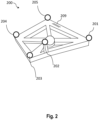
- Fig. 2 is an example figure showing tag 200, arranged in accordance with some embodiments of the present disclosure.
- Tag 200 may correspond to tag 121 of Fig. 1 .
- tag 200 includes point 201, point 202, point 203, point 204, point 205 and identification pattern 209.
- Points 201, 202, 203, 204, 205 and identification pattern 209 may emit lights having specific wavelengths which can be captured by an optical apparatus (e.g., optical apparatus 143). On the contrary, other parts of tag 200 emit very few such lights and therefore may be barely captured by the optical apparatus.
- an optical apparatus e.g., optical apparatus 143
- points 201, 202, 203, 204, 205 and identification pattern 209 may reflect lights generated by a light source having specific wavelengths which can be captured by an optical apparatus (e.g., optical apparatus 143). Other parts of tag 200 may absorb such lights and therefore may be barely captured by the optical apparatus.
- optical apparatus e.g., optical apparatus 143
- Fig. 3A is an example image 300 of a tag captured by an optical apparatus, arranged in accordance with some embodiments of the present disclosure.
- Image 300 may include point images 301, 302, 303, 304 and 305, bar image 306 between points images 304 and 305 and identification image 309. It has been a challenge to associate point images 301, 302, 303, 304 and 305 to points 201, 202, 203, 204 and 205 efficiently and correctly.
- point image 301 may correspond to an image of point 201.
- point image 302 may correspond to an image of point 202
- point image 303 may correspond to an image of point 203
- point image 304 may correspond to an image of point 204
- point image 305 may correspond to an image of point 205.
- Bar image 306 may correspond to parts of tag 200 between points 204 and 205.
- Identification image 309 may correspond to identification pattern 209.
- Fig. 3B is an example processed image 300' of a tag captured by an optical apparatus
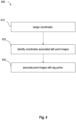
- Fig. 4 is a flow diagram illustrating an example process 400 to process a two-dimensional image associated with a tag, all arranged in accordance with some embodiments of the present disclosure.
- Process 400 may include one or more operations, functions, or actions as illustrated by blocks 410, 420 and/or 430, which may be performed by hardware, software and/or firmware.
- the various blocks are not intended to be limiting to the described embodiments.
- the outlined steps and operations are only provided as examples, and some of the steps and operations may be optional, combined into fewer steps and operations, or expanded into additional steps and operations without detracting from the essence of the disclosed embodiments.
- the blocks are illustrated in a sequential order, these blocks may also be performed in parallel, and/or in a different order than those described herein.
- Fig. 4 will be further described in details below.
- Image 300 is a two-dimensional image associated with tag 200.
- image 300' may be a processed image 300.
- a two-dimensional coordinate system is assigned to image 300'.
- the upper left corner 307 is assigned as the origin point (0, 0) of the two-dimensional coordinate system.
- the two-dimensional coordinate system may be based on pixels of image 300. Therefore, point images 301, 302, 303, 304 and 305 on image 300 may be described by the two-dimensional coordinate system.
- Block 410 may be followed by block 420 "identify coordinates associated with point images.”
- thresholding techniques may be applied. For example, image 300' is first processed with blocks including many pixels. In some embodiments, blocks not including any pixel having an intensity greater than a threshold (e.g., region 310 or bar image 306) are discarded from further processing to save the computation resources. Blocks including pixels having an intensity greater than the threshold (e.g., region 320) are then further processed on a pixel basis.
- a threshold e.g., region 310 or bar image 306
- region 320 may be enlarged with an enlargement factor. Therefore, point images 301, 302, 303, 304 and 305 may be also enlarged with the enlargement factor.
- additional thresholding techniques may be applied to pixels of the enlarged point images to identify one or more pixels that have a greater intensity. Image associated with the identified pixels may be shrunk back to the two-dimensional system based on a shrinkage factor (e.g., reciprocal of the enlargement factor). Therefore, new point images 301', 302', 303', 304' and 305' with higher intensity may be identified on image 300 and coordinates of the two-dimensional coordinate system may be assigned to point images 301', 302', 303', 304' and 305'.
- a shrinkage factor e.g., reciprocal of the enlargement factor
- Block 420 may be followed by block 430 "associate point images with tag points.”
- point images 301', 302', 303', 304' and 305' are associated with points 201, 202, 203, 204 and 205.
- coordinates of point images 301', 302', 303', 304' and 305' on the two-dimensional coordinate system and coordinates of points 201, 202, 203, 204 and 205 of tag 121 on a three-dimensional coordinate system which describes the spatial relationship among optical apparatus 143, robotic arm assembly 140 and surgical instrument 141 a conversion matrix describing a relationship between a point image in image 300' and its associated point at tag 200 may be established.
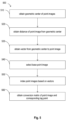
- Fig. 5 is a flow diagram illustrating an example process 500 to associate point images with points of a tag, arranged in accordance with some embodiments of the present disclosure.
- Process 500 may include one or more operations, functions, or actions as illustrated by blocks 510, 520, 530, 540, 550 and/or 560, which may be performed by hardware, software and/or firmware.
- the various blocks are not intended to be limiting to the described embodiments.
- the outlined steps and operations are only provided as examples, and some of the steps and operations may be optional, combined into fewer steps and operations, or expanded into additional steps and operations without detracting from the essence of the disclosed embodiments.
- the blocks are illustrated in a sequential order, these blocks may also be performed in parallel, and/or in a different order than those described herein.
- Process 500 may begin at block 510, "obtain geometric center of point images.”
- point images 301', 302', 303', 304' and 305' have coordinates (X 301' , Y 301' ), (X 302' , Y 302' ), (X 303' , Y 303' ), (X 304' , Y 304' ) and (X 305' , Y 305' ), respectively.
- a sequence of point images 301', 302', 303', 304' and 305' along the clockwise direction may be determined. For example, in response to the first angle is smaller than the second angle, point image 302' is determined to be closer to point image 301' along the clockwise direction than point 303'. After the sequence is determined, point images 301', 302', 303', 304' and 305' may be indexed according to the sequence.
- Block 550 may be followed by block 560, "obtain conversion matrix of point image and corresponding tag point.”
- a conversion matrix which describes a mathematical relationship between coordinates of points of tag 200 (e.g., 201, 202, 203, 204 and 205) in a three-dimensional coordinate system and their corresponding point image (e.g., 301', 302', 303', 304' and 305') may be established.
- the three-dimensional coordinate system may describe the spatial relationship among optical apparatus 143, robotic arm assembly 140 and surgical instrument 141.
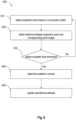
- Fig. 6 is a flow diagram illustrating an example process 600 to update an operation pathway in response to a movement of a patient based on a plurality of conversion matrices, arranged in accordance with some embodiments of the present disclosure.
- Process 600 may include one or more operations, functions, or actions as illustrated by blocks 610, 620, 630, 640 and/or 650, which may be performed by hardware, software and/or firmware.
- the various blocks are not intended to be limiting to the described embodiments.
- the outlined steps and operations are only provided as examples, and some of the steps and operations may be optional, combined into fewer steps and operations, or expanded into additional steps and operations without detracting from the essence of the disclosed embodiments.
- the blocks are illustrated in a sequential order, these blocks may also be performed in parallel, and/or in a different order than those described herein.
- a second projection point of point 202, a third projection point of point 203, a fourth projection point of point 204 and a fifth projection point of point 205 may also be obtained and has coordinates (X 302" , Y 302" ), (X 303" , Y 303" ), (X 304" , Y 304" ) and (X 305" , Y 305" ) in the two-dimensional coordinate system, respectively.
- Block 610 may be followed by block 620, "obtain distance between projection point and corresponding point image.”
- a first distance between the first projection point having coordinates (X 301" , Y 301" ) and point image 301' having coordinates (X 301' , Y 301' ) is calculated.
- Block 620 may be followed by block 630, "distance greater than threshold?"
- block 630 in response to a sum of the first distance, the second distance, the third distance, the fourth distance and the fifth distance is greater than a threshold, block 630 may be followed by block 640, "determine patient is moved.”
- block 630 in response to a sum of the first distance, the second distance, the third distance, the fourth distance and the fifth distance not greater than a threshold, block 630 may be followed by block 610, "obtain projection point based on conversion matrix.” After obtaining another conversion matrix associated with image 300/300' captured at a second time, another set of projection points having coordinates in the two-dimensional coordinate system of points 201, 202, 203, 204 and 205 may be obtained according to another conversion matrix.
- Block 640 may be followed by block 650, "update operation pathway.”
- robotic arm assembly 140 may move to a safety point which will not cause harms to patient 110.
- a new operation pathway may be updated in response to the movement of patient 110 and robotic arm assembly 140 is then configured to move from the safety point along the updated operation pathway.
- the updated operation pathway may be verified so that the updated operation pathway will not cause a collision between surgical instrument 141 and robotic arm assembly 140.
- the updated operation pathway may be verified so that the updated operation pathway will not cause a collision among first arm 147, second arm 148 and third arm 149 of robotic arm assembly 140.
- the updated operation pathway In response to the updated operation pathway is verified to cause a collision of robotic arm assembly 140, the updated operation pathway will be abandoned and a new updated operation pathway will be calculated.
- Examples of a signal bearing medium include, but are not limited to, the following: a recordable type medium such as a floppy disk, a hard disk drive, a Compact Disc (CD), a Digital Versatile Disk (DVD), a digital tape, a computer memory, etc.; and a transmission type medium such as a digital and/or an analog communication medium (e.g., a fiber optic cable, a waveguide, a wired communications link, a wireless communication link, etc.).
Landscapes
- Health & Medical Sciences (AREA)
- Surgery (AREA)
- Life Sciences & Earth Sciences (AREA)
- Engineering & Computer Science (AREA)
- Animal Behavior & Ethology (AREA)
- General Health & Medical Sciences (AREA)
- Biomedical Technology (AREA)
- Heart & Thoracic Surgery (AREA)
- Medical Informatics (AREA)
- Molecular Biology (AREA)
- Nuclear Medicine, Radiotherapy & Molecular Imaging (AREA)
- Veterinary Medicine (AREA)
- Public Health (AREA)
- Robotics (AREA)
- Oral & Maxillofacial Surgery (AREA)
- Pathology (AREA)
- Apparatus For Radiation Diagnosis (AREA)
- Manipulator (AREA)
- Image Processing (AREA)
- Image Analysis (AREA)
Applications Claiming Priority (4)
| Application Number | Priority Date | Filing Date | Title |
|---|---|---|---|
| US201862713522P | 2018-08-01 | 2018-08-01 | |
| US201962820804P | 2019-03-19 | 2019-03-19 | |
| EP19844408.5A EP3829476B1 (de) | 2018-08-01 | 2019-07-31 | Verfahren und system zum aktualisieren eines betriebswegs für eine roboterarmbaugruppe. |
| PCT/CN2019/098706 WO2020025001A1 (en) | 2018-08-01 | 2019-07-31 | Method and system of tracking patient position in operation |
Related Parent Applications (1)
| Application Number | Title | Priority Date | Filing Date |
|---|---|---|---|
| EP19844408.5A Division EP3829476B1 (de) | 2018-08-01 | 2019-07-31 | Verfahren und system zum aktualisieren eines betriebswegs für eine roboterarmbaugruppe. |
Publications (2)
| Publication Number | Publication Date |
|---|---|
| EP4555968A2 true EP4555968A2 (de) | 2025-05-21 |
| EP4555968A3 EP4555968A3 (de) | 2025-08-13 |
Family
ID=69231442
Family Applications (2)
| Application Number | Title | Priority Date | Filing Date |
|---|---|---|---|
| EP19844408.5A Active EP3829476B1 (de) | 2018-08-01 | 2019-07-31 | Verfahren und system zum aktualisieren eines betriebswegs für eine roboterarmbaugruppe. |
| EP25169017.8A Pending EP4555968A3 (de) | 2018-08-01 | 2019-07-31 | Verfahren und system zur aktualisierung eines betriebspfades für eine roboterarmanordnung. |
Family Applications Before (1)
| Application Number | Title | Priority Date | Filing Date |
|---|---|---|---|
| EP19844408.5A Active EP3829476B1 (de) | 2018-08-01 | 2019-07-31 | Verfahren und system zum aktualisieren eines betriebswegs für eine roboterarmbaugruppe. |
Country Status (8)
| Country | Link |
|---|---|
| US (1) | US11998279B2 (de) |
| EP (2) | EP3829476B1 (de) |
| JP (1) | JP7457692B2 (de) |
| KR (1) | KR102488901B1 (de) |
| CN (1) | CN112770686B (de) |
| CA (1) | CA3107892C (de) |
| TW (1) | TWI733151B (de) |
| WO (1) | WO2020025001A1 (de) |
Families Citing this family (2)
| Publication number | Priority date | Publication date | Assignee | Title |
|---|---|---|---|---|
| CN114429214B (zh) | 2020-10-29 | 2025-08-01 | 阿里巴巴集团控股有限公司 | 运算单元、相关装置和方法 |
| CN117243699B (zh) * | 2023-11-14 | 2024-03-15 | 杭州三坛医疗科技有限公司 | 一种移位检测方法及装置 |
Family Cites Families (33)
| Publication number | Priority date | Publication date | Assignee | Title |
|---|---|---|---|---|
| US6973202B2 (en) * | 1998-10-23 | 2005-12-06 | Varian Medical Systems Technologies, Inc. | Single-camera tracking of an object |
| US9867669B2 (en) * | 2008-12-31 | 2018-01-16 | Intuitive Surgical Operations, Inc. | Configuration marker design and detection for instrument tracking |
| US9782229B2 (en) * | 2007-02-16 | 2017-10-10 | Globus Medical, Inc. | Surgical robot platform |
| CN101467887B (zh) * | 2007-12-29 | 2011-04-27 | 复旦大学 | 一种手术导航系统中x射线透视图像标定方法 |
| CN101697869B (zh) * | 2009-10-19 | 2011-06-15 | 沈国芳 | 手术导航用固定支架 |
| US20130072784A1 (en) * | 2010-11-10 | 2013-03-21 | Gnanasekar Velusamy | Systems and methods for planning image-guided interventional procedures |
| FR2983059B1 (fr) | 2011-11-30 | 2014-11-28 | Medtech | Procede assiste par robotique de positionnement d'instrument chirurgical par rapport au corps d'un patient et dispositif de mise en oeuvre. |
| CN102551892A (zh) * | 2012-01-17 | 2012-07-11 | 王旭东 | 一种用于颅颌面外科手术的定位方法 |
| JP6262216B2 (ja) * | 2012-06-01 | 2018-01-17 | インテュイティブ サージカル オペレーションズ, インコーポレイテッド | 零空間を使用して操作アーム間の衝突を回避するためのシステム及び方法 |
| US20190000569A1 (en) * | 2012-06-21 | 2019-01-03 | Globus Medical, Inc. | Controlling a surgical robot to avoid robotic arm collision |
| US11116576B2 (en) * | 2012-06-21 | 2021-09-14 | Globus Medical Inc. | Dynamic reference arrays and methods of use |
| KR101993384B1 (ko) * | 2012-10-24 | 2019-06-26 | 삼성전자주식회사 | 환자의 자세 변화에 따른 의료 영상을 보정하는 방법, 장치 및 시스템 |
| KR101446173B1 (ko) * | 2013-02-21 | 2014-10-01 | 주식회사 고영테크놀러지 | 트랙킹 시스템 및 이를 이용한 트랙킹 방법 |
| US11278353B2 (en) * | 2016-03-16 | 2022-03-22 | Synaptive Medical Inc. | Trajectory alignment system and methods |
| BR112015023547B8 (pt) * | 2013-03-15 | 2022-09-27 | Synaptive Medical Inc | Montagem de braço automatizado para uso usado durante um procedimento médico sobre uma parte anatômica |
| US9993222B2 (en) * | 2014-02-05 | 2018-06-12 | Intuitive Surgical Operations, Inc. | System and method for dynamic virtual collision objects |
| CN104083217B (zh) | 2014-07-03 | 2016-08-17 | 北京天智航医疗科技股份有限公司 | 一种手术定位装置以及机器人手术系统 |
| US9950194B2 (en) * | 2014-09-09 | 2018-04-24 | Mevion Medical Systems, Inc. | Patient positioning system |
| CA2964512C (en) * | 2014-10-14 | 2018-04-24 | Synaptive Medical (Barbados) Inc. | Patient reference tool |
| US10413377B2 (en) * | 2015-03-19 | 2019-09-17 | Medtronic Navigation, Inc. | Flexible skin based patient tracker for optical navigation |
| US10143523B2 (en) * | 2015-03-31 | 2018-12-04 | 7D Surgical Inc. | Systems, methods and devices for tracking and calibration of flexible instruments |
| KR102371053B1 (ko) * | 2015-06-04 | 2022-03-10 | 큐렉소 주식회사 | 수술로봇 시스템 |
| EP3145420B8 (de) * | 2015-06-05 | 2020-12-30 | Brain Navi Biotechnology Co., Ltd. | Intraoperatives verfolgungsverfahren |
| CN108472095B (zh) * | 2015-12-29 | 2021-11-02 | 皇家飞利浦有限公司 | 用于机器人外科手术的使用虚拟现实设备的系统、控制器和方法 |
| CN107468350B (zh) * | 2016-06-08 | 2020-12-08 | 北京天智航医疗科技股份有限公司 | 一种三维图像专用标定器、手术定位系统及定位方法 |
| CN107468351A (zh) * | 2016-06-08 | 2017-12-15 | 北京天智航医疗科技股份有限公司 | 一种手术定位装置、定位系统及定位方法 |
| KR101861176B1 (ko) * | 2016-08-16 | 2018-05-28 | 주식회사 고영테크놀러지 | 정위수술용 수술로봇 및 정위수술용 수술로봇의 제어방법 |
| CN106236258B (zh) | 2016-08-17 | 2019-03-12 | 北京柏惠维康科技有限公司 | 腹腔微创手术穿刺路径的规划方法及装置 |
| EP3375399B1 (de) * | 2016-10-05 | 2022-05-25 | NuVasive, Inc. | Chirurgisches navigationssystem |
| FR3057757B1 (fr) * | 2016-10-21 | 2021-04-16 | Medtech | Dispositif et procede de recalage automatique pour des images intra operatoires 3d |
| US11751948B2 (en) * | 2016-10-25 | 2023-09-12 | Mobius Imaging, Llc | Methods and systems for robot-assisted surgery |
| CN106890025B (zh) | 2017-03-03 | 2020-02-28 | 浙江大学 | 一种微创手术导航系统和导航方法 |
| GB2577718B (en) * | 2018-10-03 | 2022-08-24 | Cmr Surgical Ltd | Feature identification |
-
2019
- 2019-07-31 KR KR1020217006130A patent/KR102488901B1/ko active Active
- 2019-07-31 CA CA3107892A patent/CA3107892C/en active Active
- 2019-07-31 EP EP19844408.5A patent/EP3829476B1/de active Active
- 2019-07-31 US US17/263,855 patent/US11998279B2/en active Active
- 2019-07-31 WO PCT/CN2019/098706 patent/WO2020025001A1/en not_active Ceased
- 2019-07-31 EP EP25169017.8A patent/EP4555968A3/de active Pending
- 2019-07-31 TW TW108127112A patent/TWI733151B/zh active
- 2019-07-31 JP JP2021505301A patent/JP7457692B2/ja active Active
- 2019-07-31 CN CN201980051025.5A patent/CN112770686B/zh active Active
Also Published As
| Publication number | Publication date |
|---|---|
| KR20210057724A (ko) | 2021-05-21 |
| EP3829476C0 (de) | 2025-04-09 |
| JP7457692B2 (ja) | 2024-03-28 |
| JP2021532882A (ja) | 2021-12-02 |
| CN112770686A (zh) | 2021-05-07 |
| CN112770686B (zh) | 2024-08-02 |
| EP3829476A1 (de) | 2021-06-09 |
| KR102488901B1 (ko) | 2023-01-17 |
| TWI733151B (zh) | 2021-07-11 |
| CA3107892A1 (en) | 2020-02-06 |
| EP4555968A3 (de) | 2025-08-13 |
| TW202023488A (zh) | 2020-07-01 |
| US11998279B2 (en) | 2024-06-04 |
| CA3107892C (en) | 2023-09-05 |
| WO2020025001A1 (en) | 2020-02-06 |
| US20210307832A1 (en) | 2021-10-07 |
| EP3829476A4 (de) | 2022-04-20 |
| EP3829476B1 (de) | 2025-04-09 |
Similar Documents
| Publication | Publication Date | Title |
|---|---|---|
| JP2021516817A (ja) | 目標対象の運動の向きを予測するための方法、車両制御方法及び装置 | |
| JP2011523742A (ja) | Rgb及び奥行き計測ハイブリッドカメラセンサを使用する長方形テーブル検知 | |
| AU2018220008B2 (en) | Imaging-based sensor calibration | |
| US20200008892A1 (en) | Method and system of determining one or more points on operation pathway | |
| KR102587994B1 (ko) | 카메라 포즈 회귀를 위한 적대적 장면 적응 | |
| US20170243052A1 (en) | Book detection apparatus and book detection method | |
| CN107742304A (zh) | 移动轨迹的确定方法及装置、移动机器人及存储介质 | |
| EP4555968A2 (de) | Verfahren und system zur aktualisierung eines betriebspfades für eine roboterarmanordnung. | |
| US20190195622A1 (en) | Image processing apparatus, image processing system, and program therefor | |
| CN109840463B (zh) | 一种车道线识别方法和装置 | |
| JP2019055756A (ja) | 車両用認知支援装置 | |
| US20160042524A1 (en) | Improving symmetry in brain scans | |
| KR102164800B1 (ko) | 어라운드 뷰 모니터링 시스템을 이용한 인공지능 기반의 자율 주행 차량용 이동 경로 생성 장치 및 그 동작 방법 | |
| US20070183665A1 (en) | Face feature point detecting device and method | |
| CN113597288B (zh) | 基于影像匹配确定手术路径的方法与系统 | |
| US11657506B2 (en) | Systems and methods for autonomous robot navigation | |
| CN114998386B (zh) | 神经外科手术机器人中内镜适配器的位姿跟踪方法及装置 | |
| CN112258494A (zh) | 一种病灶位置确定方法、装置及电子设备 | |
| JP7812552B2 (ja) | 複数の撮影条件下における認識対象物のマルチモーダル画像を用いた画像認識学習システム、画像認識学習方法および画像認識学習プログラム | |
| Lüdtke et al. | Calibration of galvanometric laser scanners using statistical learning methods | |
| GB2567544A (en) | Imaging-based sensor calibration | |
| US11676245B2 (en) | Information processing apparatus and method for processing information | |
| Ganesan | Deep Q-Learning for Lane Localization: Exploring Reinforcement Learning for Accurate Lane Detection | |
| CN117711077A (zh) | 一种视频散斑活体检测方法、系统、设备及存储介质 | |
| KR20260004870A (ko) | 2d카메라 및 깊이카메라 기반의 험지 회피용 이동 로봇 |
Legal Events
| Date | Code | Title | Description |
|---|---|---|---|
| PUAI | Public reference made under article 153(3) epc to a published international application that has entered the european phase |
Free format text: ORIGINAL CODE: 0009012 |
|
| STAA | Information on the status of an ep patent application or granted ep patent |
Free format text: STATUS: THE APPLICATION HAS BEEN PUBLISHED |
|
| AC | Divisional application: reference to earlier application |
Ref document number: 3829476 Country of ref document: EP Kind code of ref document: P |
|
| AK | Designated contracting states |
Kind code of ref document: A2 Designated state(s): AL AT BE BG CH CY CZ DE DK EE ES FI FR GB GR HR HU IE IS IT LI LT LU LV MC MK MT NL NO PL PT RO RS SE SI SK SM TR |
|
| RIN1 | Information on inventor provided before grant (corrected) |
Inventor name: WANG, KUAN JU Inventor name: CHEN, CHIEH HSIAO |
|
| REG | Reference to a national code |
Ref country code: DE Ref legal event code: R079 Free format text: PREVIOUS MAIN CLASS: A61B0090000000 Ipc: A61B0034200000 |
|
| PUAL | Search report despatched |
Free format text: ORIGINAL CODE: 0009013 |
|
| AK | Designated contracting states |
Kind code of ref document: A3 Designated state(s): AL AT BE BG CH CY CZ DE DK EE ES FI FR GB GR HR HU IE IS IT LI LT LU LV MC MK MT NL NO PL PT RO RS SE SI SK SM TR |
|
| RIC1 | Information provided on ipc code assigned before grant |
Ipc: A61B 34/20 20160101AFI20250707BHEP Ipc: A61B 34/00 20160101ALI20250707BHEP Ipc: A61B 34/30 20160101ALI20250707BHEP Ipc: A61B 17/00 20060101ALI20250707BHEP Ipc: A61B 90/00 20160101ALI20250707BHEP |
|
| STAA | Information on the status of an ep patent application or granted ep patent |
Free format text: STATUS: REQUEST FOR EXAMINATION WAS MADE |
|
| 17P | Request for examination filed |
Effective date: 20260206 |