EP4555902A1 - Seat pad - Google Patents
Seat pad Download PDFInfo
- Publication number
- EP4555902A1 EP4555902A1 EP23877271.9A EP23877271A EP4555902A1 EP 4555902 A1 EP4555902 A1 EP 4555902A1 EP 23877271 A EP23877271 A EP 23877271A EP 4555902 A1 EP4555902 A1 EP 4555902A1
- Authority
- EP
- European Patent Office
- Prior art keywords
- polyurethane foam
- less
- polyether polyol
- seat pad
- functional groups
- Prior art date
- Legal status (The legal status is an assumption and is not a legal conclusion. Google has not performed a legal analysis and makes no representation as to the accuracy of the status listed.)
- Pending
Links
Images
Classifications
-
- C—CHEMISTRY; METALLURGY
- C08—ORGANIC MACROMOLECULAR COMPOUNDS; THEIR PREPARATION OR CHEMICAL WORKING-UP; COMPOSITIONS BASED THEREON
- C08G—MACROMOLECULAR COMPOUNDS OBTAINED OTHERWISE THAN BY REACTIONS ONLY INVOLVING UNSATURATED CARBON-TO-CARBON BONDS
- C08G18/00—Polymeric products of isocyanates or isothiocyanates
- C08G18/06—Polymeric products of isocyanates or isothiocyanates with compounds having active hydrogen
- C08G18/08—Processes
- C08G18/16—Catalysts
- C08G18/18—Catalysts containing secondary or tertiary amines or salts thereof
- C08G18/20—Heterocyclic amines; Salts thereof
- C08G18/2045—Heterocyclic amines; Salts thereof containing condensed heterocyclic rings
- C08G18/2063—Heterocyclic amines; Salts thereof containing condensed heterocyclic rings having two nitrogen atoms in the condensed ring system
-
- B—PERFORMING OPERATIONS; TRANSPORTING
- B60—VEHICLES IN GENERAL
- B60N—SEATS SPECIALLY ADAPTED FOR VEHICLES; VEHICLE PASSENGER ACCOMMODATION NOT OTHERWISE PROVIDED FOR
- B60N2/00—Seats specially adapted for vehicles; Arrangement or mounting of seats in vehicles
- B60N2/70—Upholstery springs ; Upholstery
-
- C—CHEMISTRY; METALLURGY
- C08—ORGANIC MACROMOLECULAR COMPOUNDS; THEIR PREPARATION OR CHEMICAL WORKING-UP; COMPOSITIONS BASED THEREON
- C08G—MACROMOLECULAR COMPOUNDS OBTAINED OTHERWISE THAN BY REACTIONS ONLY INVOLVING UNSATURATED CARBON-TO-CARBON BONDS
- C08G18/00—Polymeric products of isocyanates or isothiocyanates
- C08G18/06—Polymeric products of isocyanates or isothiocyanates with compounds having active hydrogen
- C08G18/28—Polymeric products of isocyanates or isothiocyanates with compounds having active hydrogen characterised by the compounds used containing active hydrogen
- C08G18/30—Low-molecular-weight compounds
- C08G18/32—Polyhydroxy compounds; Polyamines; Hydroxyamines
- C08G18/3203—Polyhydroxy compounds
-
- C—CHEMISTRY; METALLURGY
- C08—ORGANIC MACROMOLECULAR COMPOUNDS; THEIR PREPARATION OR CHEMICAL WORKING-UP; COMPOSITIONS BASED THEREON
- C08G—MACROMOLECULAR COMPOUNDS OBTAINED OTHERWISE THAN BY REACTIONS ONLY INVOLVING UNSATURATED CARBON-TO-CARBON BONDS
- C08G18/00—Polymeric products of isocyanates or isothiocyanates
- C08G18/06—Polymeric products of isocyanates or isothiocyanates with compounds having active hydrogen
- C08G18/28—Polymeric products of isocyanates or isothiocyanates with compounds having active hydrogen characterised by the compounds used containing active hydrogen
- C08G18/40—High-molecular-weight compounds
- C08G18/48—Polyethers
- C08G18/4804—Two or more polyethers of different physical or chemical nature
- C08G18/4808—Mixtures of two or more polyetherdiols
-
- C—CHEMISTRY; METALLURGY
- C08—ORGANIC MACROMOLECULAR COMPOUNDS; THEIR PREPARATION OR CHEMICAL WORKING-UP; COMPOSITIONS BASED THEREON
- C08G—MACROMOLECULAR COMPOUNDS OBTAINED OTHERWISE THAN BY REACTIONS ONLY INVOLVING UNSATURATED CARBON-TO-CARBON BONDS
- C08G18/00—Polymeric products of isocyanates or isothiocyanates
- C08G18/06—Polymeric products of isocyanates or isothiocyanates with compounds having active hydrogen
- C08G18/28—Polymeric products of isocyanates or isothiocyanates with compounds having active hydrogen characterised by the compounds used containing active hydrogen
- C08G18/40—High-molecular-weight compounds
- C08G18/48—Polyethers
- C08G18/4804—Two or more polyethers of different physical or chemical nature
- C08G18/4812—Mixtures of polyetherdiols with polyetherpolyols having at least three hydroxy groups
-
- C—CHEMISTRY; METALLURGY
- C08—ORGANIC MACROMOLECULAR COMPOUNDS; THEIR PREPARATION OR CHEMICAL WORKING-UP; COMPOSITIONS BASED THEREON
- C08G—MACROMOLECULAR COMPOUNDS OBTAINED OTHERWISE THAN BY REACTIONS ONLY INVOLVING UNSATURATED CARBON-TO-CARBON BONDS
- C08G18/00—Polymeric products of isocyanates or isothiocyanates
- C08G18/06—Polymeric products of isocyanates or isothiocyanates with compounds having active hydrogen
- C08G18/28—Polymeric products of isocyanates or isothiocyanates with compounds having active hydrogen characterised by the compounds used containing active hydrogen
- C08G18/40—High-molecular-weight compounds
- C08G18/48—Polyethers
- C08G18/4833—Polyethers containing oxyethylene units
- C08G18/4837—Polyethers containing oxyethylene units and other oxyalkylene units
-
- C—CHEMISTRY; METALLURGY
- C08—ORGANIC MACROMOLECULAR COMPOUNDS; THEIR PREPARATION OR CHEMICAL WORKING-UP; COMPOSITIONS BASED THEREON
- C08G—MACROMOLECULAR COMPOUNDS OBTAINED OTHERWISE THAN BY REACTIONS ONLY INVOLVING UNSATURATED CARBON-TO-CARBON BONDS
- C08G18/00—Polymeric products of isocyanates or isothiocyanates
- C08G18/06—Polymeric products of isocyanates or isothiocyanates with compounds having active hydrogen
- C08G18/28—Polymeric products of isocyanates or isothiocyanates with compounds having active hydrogen characterised by the compounds used containing active hydrogen
- C08G18/65—Low-molecular-weight compounds having active hydrogen with high-molecular-weight compounds having active hydrogen
- C08G18/66—Compounds of groups C08G18/42, C08G18/48, or C08G18/52
- C08G18/6666—Compounds of group C08G18/48 or C08G18/52
- C08G18/667—Compounds of group C08G18/48 or C08G18/52 with compounds of group C08G18/32 or polyamines of C08G18/38
- C08G18/6674—Compounds of group C08G18/48 or C08G18/52 with compounds of group C08G18/32 or polyamines of C08G18/38 with compounds of group C08G18/3203
-
- C—CHEMISTRY; METALLURGY
- C08—ORGANIC MACROMOLECULAR COMPOUNDS; THEIR PREPARATION OR CHEMICAL WORKING-UP; COMPOSITIONS BASED THEREON
- C08G—MACROMOLECULAR COMPOUNDS OBTAINED OTHERWISE THAN BY REACTIONS ONLY INVOLVING UNSATURATED CARBON-TO-CARBON BONDS
- C08G18/00—Polymeric products of isocyanates or isothiocyanates
- C08G18/06—Polymeric products of isocyanates or isothiocyanates with compounds having active hydrogen
- C08G18/70—Polymeric products of isocyanates or isothiocyanates with compounds having active hydrogen characterised by the isocyanates or isothiocyanates used
- C08G18/72—Polyisocyanates or polyisothiocyanates
- C08G18/74—Polyisocyanates or polyisothiocyanates cyclic
- C08G18/76—Polyisocyanates or polyisothiocyanates cyclic aromatic
- C08G18/7657—Polyisocyanates or polyisothiocyanates cyclic aromatic containing two or more aromatic rings
- C08G18/7664—Polyisocyanates or polyisothiocyanates cyclic aromatic containing two or more aromatic rings containing alkylene polyphenyl groups
-
- C—CHEMISTRY; METALLURGY
- C08—ORGANIC MACROMOLECULAR COMPOUNDS; THEIR PREPARATION OR CHEMICAL WORKING-UP; COMPOSITIONS BASED THEREON
- C08G—MACROMOLECULAR COMPOUNDS OBTAINED OTHERWISE THAN BY REACTIONS ONLY INVOLVING UNSATURATED CARBON-TO-CARBON BONDS
- C08G18/00—Polymeric products of isocyanates or isothiocyanates
- C08G18/06—Polymeric products of isocyanates or isothiocyanates with compounds having active hydrogen
- C08G18/70—Polymeric products of isocyanates or isothiocyanates with compounds having active hydrogen characterised by the isocyanates or isothiocyanates used
- C08G18/72—Polyisocyanates or polyisothiocyanates
- C08G18/77—Polyisocyanates or polyisothiocyanates having heteroatoms in addition to the isocyanate or isothiocyanate nitrogen and oxygen or sulfur
- C08G18/78—Nitrogen
- C08G18/79—Nitrogen characterised by the polyisocyanates used, these having groups formed by oligomerisation of isocyanates or isothiocyanates
- C08G18/797—Nitrogen characterised by the polyisocyanates used, these having groups formed by oligomerisation of isocyanates or isothiocyanates containing carbodiimide and/or uretone-imine groups
-
- B—PERFORMING OPERATIONS; TRANSPORTING
- B29—WORKING OF PLASTICS; WORKING OF SUBSTANCES IN A PLASTIC STATE IN GENERAL
- B29C—SHAPING OR JOINING OF PLASTICS; SHAPING OF MATERIAL IN A PLASTIC STATE, NOT OTHERWISE PROVIDED FOR; AFTER-TREATMENT OF THE SHAPED PRODUCTS, e.g. REPAIRING
- B29C44/00—Shaping by internal pressure generated in the material, e.g. swelling or foaming ; Producing porous or cellular expanded plastics articles
- B29C44/20—Shaping by internal pressure generated in the material, e.g. swelling or foaming ; Producing porous or cellular expanded plastics articles for articles of indefinite length
- B29C44/28—Expanding the moulding material on continuous moving surfaces without restricting the upwards growth of the foam
-
- B—PERFORMING OPERATIONS; TRANSPORTING
- B29—WORKING OF PLASTICS; WORKING OF SUBSTANCES IN A PLASTIC STATE IN GENERAL
- B29C—SHAPING OR JOINING OF PLASTICS; SHAPING OF MATERIAL IN A PLASTIC STATE, NOT OTHERWISE PROVIDED FOR; AFTER-TREATMENT OF THE SHAPED PRODUCTS, e.g. REPAIRING
- B29C44/00—Shaping by internal pressure generated in the material, e.g. swelling or foaming ; Producing porous or cellular expanded plastics articles
- B29C44/34—Auxiliary operations
- B29C44/36—Feeding the material to be shaped
- B29C44/38—Feeding the material to be shaped into a closed space, i.e. to make articles of definite length
- B29C44/42—Feeding the material to be shaped into a closed space, i.e. to make articles of definite length using pressure difference, e.g. by injection or by vacuum
-
- B—PERFORMING OPERATIONS; TRANSPORTING
- B29—WORKING OF PLASTICS; WORKING OF SUBSTANCES IN A PLASTIC STATE IN GENERAL
- B29C—SHAPING OR JOINING OF PLASTICS; SHAPING OF MATERIAL IN A PLASTIC STATE, NOT OTHERWISE PROVIDED FOR; AFTER-TREATMENT OF THE SHAPED PRODUCTS, e.g. REPAIRING
- B29C44/00—Shaping by internal pressure generated in the material, e.g. swelling or foaming ; Producing porous or cellular expanded plastics articles
- B29C44/34—Auxiliary operations
- B29C44/36—Feeding the material to be shaped
- B29C44/46—Feeding the material to be shaped into an open space or onto moving surfaces, i.e. to make articles of indefinite length
-
- B—PERFORMING OPERATIONS; TRANSPORTING
- B29—WORKING OF PLASTICS; WORKING OF SUBSTANCES IN A PLASTIC STATE IN GENERAL
- B29K—INDEXING SCHEME ASSOCIATED WITH SUBCLASSES B29B, B29C OR B29D, RELATING TO MOULDING MATERIALS OR TO MATERIALS FOR MOULDS, REINFORCEMENTS, FILLERS OR PREFORMED PARTS, e.g. INSERTS
- B29K2075/00—Use of PU, i.e. polyureas or polyurethanes or derivatives thereof, as moulding material
-
- B—PERFORMING OPERATIONS; TRANSPORTING
- B29—WORKING OF PLASTICS; WORKING OF SUBSTANCES IN A PLASTIC STATE IN GENERAL
- B29L—INDEXING SCHEME ASSOCIATED WITH SUBCLASS B29C, RELATING TO PARTICULAR ARTICLES
- B29L2031/00—Other particular articles
- B29L2031/58—Upholstery or cushions, e.g. vehicle upholstery or interior padding
-
- B—PERFORMING OPERATIONS; TRANSPORTING
- B29—WORKING OF PLASTICS; WORKING OF SUBSTANCES IN A PLASTIC STATE IN GENERAL
- B29L—INDEXING SCHEME ASSOCIATED WITH SUBCLASS B29C, RELATING TO PARTICULAR ARTICLES
- B29L2031/00—Other particular articles
- B29L2031/771—Seats
-
- C—CHEMISTRY; METALLURGY
- C08—ORGANIC MACROMOLECULAR COMPOUNDS; THEIR PREPARATION OR CHEMICAL WORKING-UP; COMPOSITIONS BASED THEREON
- C08G—MACROMOLECULAR COMPOUNDS OBTAINED OTHERWISE THAN BY REACTIONS ONLY INVOLVING UNSATURATED CARBON-TO-CARBON BONDS
- C08G2110/00—Foam properties
- C08G2110/0008—Foam properties flexible
-
- C—CHEMISTRY; METALLURGY
- C08—ORGANIC MACROMOLECULAR COMPOUNDS; THEIR PREPARATION OR CHEMICAL WORKING-UP; COMPOSITIONS BASED THEREON
- C08G—MACROMOLECULAR COMPOUNDS OBTAINED OTHERWISE THAN BY REACTIONS ONLY INVOLVING UNSATURATED CARBON-TO-CARBON BONDS
- C08G2110/00—Foam properties
- C08G2110/0041—Foam properties having specified density
- C08G2110/0058—≥50 and <150kg/m3
-
- C—CHEMISTRY; METALLURGY
- C08—ORGANIC MACROMOLECULAR COMPOUNDS; THEIR PREPARATION OR CHEMICAL WORKING-UP; COMPOSITIONS BASED THEREON
- C08G—MACROMOLECULAR COMPOUNDS OBTAINED OTHERWISE THAN BY REACTIONS ONLY INVOLVING UNSATURATED CARBON-TO-CARBON BONDS
- C08G2110/00—Foam properties
- C08G2110/0083—Foam properties prepared using water as the sole blowing agent
-
- C—CHEMISTRY; METALLURGY
- C08—ORGANIC MACROMOLECULAR COMPOUNDS; THEIR PREPARATION OR CHEMICAL WORKING-UP; COMPOSITIONS BASED THEREON
- C08G—MACROMOLECULAR COMPOUNDS OBTAINED OTHERWISE THAN BY REACTIONS ONLY INVOLVING UNSATURATED CARBON-TO-CARBON BONDS
- C08G2350/00—Acoustic or vibration damping material
Definitions
- the present invention relates to a seat pad, and more particularly to a seat pad including a polyurethane foam having a small deflection coefficient and a high displacement rate.
- Seats for an automobile are classified into a type in which a seat cushion (seat surface portion) and a seat back (back surface portion) are separated from each other and a type in which they are integrated with each other.
- the seat for an automobile generally includes:
- a polyurethane foam is generally used in the seat pad.
- Patent Literature 1 discloses a soft polyurethane foam for an automobile seat, which is obtained by reacting a raw material containing:
- Patent Literature 1 describes that:
- Patent Literature 2 discloses a seat pad including:
- Patent Literature 2 describes that when the low air permeable foam is integrally provided on the bottom surface of the cushion body, vibration that deteriorates riding comfort can be absorbed.
- Patent Literature 3 discloses a polyurethane foam obtained by reacting a raw material containing:
- Patent Literature 3 describes that such a method can provide a polyurethane foam that is less likely to cause bottoming even when it is thinner than a conventional one and has high air permeability.
- Patent Literature 4 discloses a deformation analysis technique of simulating a non-linear viscoelastic behavior of a compressible material that is not a seat pad but has a non-linear viscoelastic behavior.
- Patent Literature 4 describes that when a model including, in parallel, a linear viscoelastic portion according to a generalized Maxwell model and a compressible elastoplastic portion having a yield conditional expression depending on hydrostatic stress is used, the damping behavior when a urethane foam is slowly pushed can be analyzed with high accuracy.
- Patent Literature 5 discloses a seat for an automobile obtained by
- Patent Literature 5 describes that
- the hardness and elasticity of the seat pad affect the seating comfort at the time of sitting.
- the seat pad is more greatly deflected in a high load range, i.e., preferably has a small deflection coefficient.
- a high displacement rate is preferable.
- a seat pad achieving both a small deflection coefficient and a high displacement rate has been proposed.
- An object of the present invention is to provide a seat pad composed of a polyurethane foam and having a small deflection coefficient and a high displacement rate.
- a seat pad according to the present invention includes
- the polyurethane foam is obtained by reacting a raw material mixture containing a polyol component and a polyisocyanate component,
- a raw material mixture containing the polyether polyol A which satisfies predetermined conditions and the carbodiimide-modified MDI provides a polyurethane foam having a deflection coefficient of 2.8 or less and a displacement rate of 30% or more.
- the deflection coefficient is 2.8 or less because the use of the polyether polyol A having a high EO content rate relatively decreases the number of side chains contained in a polymer chain, resulting in less entanglement between the polymer chains, and because the molecular chain is thus likely to be expanded/contracted, thereby imparting elasticity to the polyurethane foam.
- the displacement rate is 30% or more due to the use of the polyether polyol A having a large weight average molecular weight.
- the seat pad according to the present invention is composed of a polyurethane foam obtained by reacting a raw material mixture containing a polyol component and a polyisocyanate component.
- the raw material mixture further contains a crosslinking agent, a foaming agent, and a catalyst.
- the polyurethane foam constituting the seat pad is obtained by foaming and reacting a raw material mixture satisfying predetermined conditions. Details of a method for manufacturing the polyurethane foam will be described later.
- the polyurethane foam according to the present invention uses a polyether polyol A having a high EO content rate as one of raw materials.
- the use of the polyether polyol A having a high EO content rate relatively decreases the deflection coefficient of the polyurethane foam. This is considered to be because the use of the polyether polyol A having a high EO content rate relatively decreases the number of side chains contained in a polymer chain, resulting in less entanglement between the polymer chains, and because the molecular chain is thus likely to be expanded/contracted, thereby imparting elasticity to the polyurethane foam.
- the deflection coefficient is smaller, the polyurethane foam is more greatly deflected in a high load range, so that the cushioning feeling is increased.
- the deflection coefficient of the polyurethane foam needs to be 2.8 or less.
- the deflection coefficient is 2.7 or less, 2.6 or less, or 2.5 or less.
- the deflection coefficient is preferably 2.0 or more.
- the deflection coefficient is more preferably 2.1 or more, or 2.2 or more.
- the displacement rate depends on the thickness t 0 of the flat plate sample.
- the displacement rate depends on the thickness t 0 of the flat plate sample.
- the displacement rate In general, as the displacement rate is larger, the cushioning property at the time of sitting increases. In order to obtain such an effect, the displacement rate needs to be 30% or more.
- the displacement rate is preferably 35% or more, 40% or more, 45% or more, 50% or more, or 55% or more.
- the polyurethane foam constituting the seat pad is obtained by:
- the raw material mixture further contains a crosslinking agent, a foaming agent, and a catalyst.
- the polyol component is one of the main raw materials for the polyurethane foam.
- the polyol component contains a polyether polyol A having
- the polyol component may contain one kind of polyether polyol A satisfying such conditions, or may contain two or more kinds of polyether polyols A satisfying such conditions.
- the polyol component may further contain a polyether polyol B having
- the polyol component may contain one kind of polyether polyol B satisfying such conditions, or may contain two or more kinds of polyether polyols B satisfying such conditions.
- the "EO content rate (mol%)" of the polyether polyol A refers to a proportion of the number of moles of an ethylene oxide (EO) unit to the total number of moles of alkylene oxide units contained in the polyether polyol A.
- the polyether polyol A may contain an alkylene oxide unit other than the EO unit.
- the kind of alkylene oxide unit other than the EO unit is not particularly limited, but is preferably a propylene oxide (PO) unit.
- the EO content rate of the polyether polyol A mainly affects the deflection coefficient.
- the deflection coefficient decreases. This is considered to be because, as the EO content rate is higher, the number of side chains (-CH 3 ) contained in a polymer chain relatively decreases, resulting in less entanglement between the polymer chains, and because the molecular chain is thus likely to be expanded/contracted, thereby imparting elasticity to the polyurethane foam.
- the EO content rate of the polyether polyol A is preferably 50.0 mol% or more.
- the EO content rate is more preferably 60.0 mol% or more, 70.0 mol% or more, 80.0 mol% or more, or 90.0 mol% or more.
- the EO content rate of the polyether polyol A may be 100.0 mol%.
- the number of functional groups of the polyether polyol A affects the deflection coefficient. In general, as the number of functional groups of the polyether polyol A is larger, the rigidity of the polyurethane foam increases, and the compressive residual strain decreases. In order to obtain such an effect, the number of functional groups of the polyether polyol A is preferably 2.0 or more. The number of functional groups is more preferably 2.1 or more, or 2.2 or more.
- an excessive number of functional groups of the polyether polyol A may excessively increase the hardness of the polyurethane foam and increase the deflection coefficient. Therefore, the number of functional groups of the polyether polyol A is preferably 3.0 or less. The number of functional groups is more preferably 2.9 or less, or 2.8 or less.
- the weight average molecular weight of the polyether polyol A is larger, the hardness of the polyurethane foam decreases and the polyurethane foam is likely to be deflected.
- the weight average molecular weight of the polyether polyol A is preferably more than 3500.
- the weight average molecular weight is more preferably 4000 or more, or 5000 or more.
- the weight average molecular weight of the polyether polyol A may excessively increase the viscosity of the raw material mixture, leading to deterioration in manufacturability.
- the reactivity of the raw material mixture may be reduced, and the tear strength of the polyurethane foam may be reduced. Therefore, the weight average molecular weight is preferably 12000 or less.
- the weight average molecular weight is more preferably 10000 or less, or 8000 or less.
- the hydroxyl value is preferably 70 mgKOH/g or less.
- the hydroxyl value is more preferably 60 mgKOH/g or less, or 55 mgKOH/g or less.
- the hydroxyl value is preferably 10 mgKOH/g or more.
- the hydroxyl value is more preferably 15 mgKOH/g or more, or 20 mgKOH/g or more.
- the "EO content rate (mol%)" of the polyether polyol B refers to a proportion of the number of moles of an ethylene oxide (EO) unit to the total number of moles of alkylene oxide units contained in the polyether polyol B.
- the polyether polyol B may contain an alkylene oxide unit other than the EO unit.
- the kind of alkylene oxide unit other than the EO unit is not particularly limited, but is preferably a propylene oxide (PO) unit.
- Too high an EO content rate of the polyether polyol B may reduce the reactivity of the raw material mixture.
- the foam state and the air permeability of the foam may deteriorate. Therefore, the EO content rate is preferably 30 mol% or less.
- the EO content rate is more preferably 20 mol% or less, 10 mol% or less, or 5 mol% or less.
- the EO content rate may be zero.
- the number of functional groups of the polyether polyol B has only to be 2.0 or more.
- the number of functional groups of the polyether polyol B may reduce elongation of the polyurethane foam. Therefore, the number of functional groups is preferably 4.0 or less. The number of functional groups is more preferably 3.8 or less, or 3.6 or less.
- the weight average molecular weight of the polyether polyol B is not particularly limited, and an optimum value can be selected according to the purpose. In general, too small a weight average molecular weight of the polyether polyol B may impair the elongation percentage and flexibility of the polyurethane foam. Therefore, the weight average molecular weight is preferably 1000 or more. The weight average molecular weight is more preferably 2000 or more, or 3000 or more.
- the weight average molecular weight is preferably 12000 or less.
- the weight average molecular weight is more preferably 10000 or less, or 8000 or less.
- the polyisocyanate component is the other one of the main raw materials for the polyurethane foam.
- the polyisocyanate component contains at least carbodiimide-modified MDI.
- the polyisocyanate component may contain only carbodiimide-modified MDI, or may further contain a polyisocyanate (hereinafter, this is also referred to as "polyisocyanate B") other than the carbodiimide-modified MDI.
- the use of the carbodiimide-modified MDI as the polyisocyanate component increases the elasticity of the polyurethane foam, resulting in an increased amount of deflection in a high load range.
- the type of polyisocyanate B is not particularly limited, and an optimum polyisocyanate B can be selected according to the purpose.
- polyisocyanate B examples include bifunctional aromatic isocyanates, bifunctional alicyclic isocyanates, bifunctional aliphatic isocyanates, and isocyanates having a number of functional groups of more than 2.
- the raw material mixture may contain any one of these polyisocyanates B, or may contain two or more thereof.
- bifunctional aromatic isocyanate examples include
- bifunctional alicyclic isocyanate examples include
- bifunctional aliphatic isocyanate examples include
- Examples of the isocyanate having a number of functional groups of more than 2 include
- NCO group content rate refers to a proportion of the mass of NCO groups to a total mass of the polyisocyanate component.
- the NCO% of the polyisocyanate component is preferably less than 35%, more preferably less than 30%, and still more preferably 29.5% or less.
- the raw material mixture may contain a crosslinking agent.
- the crosslinking agent is preferably a compound having a number of functional groups of at least 3 or more and containing a functional group having an active hydrogen atom (for example, a hydroxyl group, an amino group, or the like).
- the crosslinking agent may be composed only of a compound having a number of functional groups of 3 or more, or may further contain a compound having a number of functional groups of 2 in addition to the compound having a number of functional groups of 3 or more.
- the number of functional groups of the crosslinking agent affects the compressive residual strain.
- the number of functional groups of the crosslinking agent is preferably 3 or more.
- the number of functional groups of the crosslinking agent is preferably 6 or less.
- the molecular weight of the crosslinking agent is not particularly limited, and an optimum value can be selected according to the purpose.
- the molecular weight of the crosslinking agent is preferably 1000 or less, 700 or less, or 500 or less.
- the molecular weight of the crosslinking agent is preferably 60 or more, 90 or more, or 120 or more.
- crosslinking agent examples include glycerin, diethanolamine (DEA), and polyfunctional polyol.
- the raw material mixture may contain any one of these crosslinking agents, or may contain two or more thereof.
- the “foaming agent” refers to an additive for generating bubbles in the raw material mixture in the process of resinizing the liquid raw material mixture.
- the foaming agent may be either
- Examples of the physical foaming agent include
- Examples of the chemical foaming agent include
- the raw material mixture may contain any one of these foaming agents, or may contain two or more thereof.
- the foaming agent is preferably water.
- CO 2 gas generated by reaction between water and an isocyanate group promotes foaming.
- the heat of reaction between water and an isocyanate group accelerates curing of the resin.
- the "catalyst” refers to a catalyst having a large action of accelerating the resinification reaction and/or a catalyst having a large action of accelerating the foaming reaction.
- the catalyst examples include an amine-based catalyst and a metal catalyst.
- the amine-based catalyst is a catalyst having a large action of accelerating both the resinification reaction and the foaming reaction.
- the metal catalyst is a catalyst having a large action of accelerating the resinification reaction.
- the raw material mixture may contain any one of these catalysts, or may contain two or more thereof.
- Examples of the amine-based catalyst include
- metal catalyst examples include
- the raw material mixture may further contain one or more of the following sub-raw materials in addition to the main raw materials described above.
- Specific examples of the sub-raw material are as follows.
- the “foam stabilizer” refers to an additive having an action of uniformizing the size and distribution of bubbles.
- the addition of the foam stabilizer to the raw material mixture can provide a polyurethane foam having bubbles uniform in size and distribution.
- foam stabilizer include silicone-based foam stabilizers, fluorine-containing compound-based foam stabilizers, and known surfactants.
- the "flame retardant” refers to an additive having an action of making the polyurethane foam flame-retardant.
- Examples of the flame retardant include halogen-based flame retardants, phosphorus-based flame retardants, metal hydroxide-based flame retardants, and antimony-based flame retardants.
- the "blending amount (parts by mass) of the polyether polyol A" refers to a total mass of the polyether polyol A in the polyol component when the total mass of the polyol component is 100.
- the blending amount of the polyether polyol A is preferably 50 parts by mass or more.
- the blending amount is more preferably 60 parts by mass or more, or 70 parts by mass or more.
- the blending amount of the polyether polyol A may be 100 parts by mass. However, an excessive blending amount of the polyether polyol A may deteriorate moldability of the foam. Therefore, the blending amount of the polyether polyol A is preferably 90 parts by mass or less.
- the “content (mass%) of the carbodiimide-modified MDI” refers to a proportion of the mass of the carbodiimide-modified MDI to the total mass of the polyisocyanate component.
- the content of the carbodiimide-modified MDI is preferably 50 mass% or more.
- the content is more preferably 60 mass% or more, or 70 mass% or more.
- the content of the carbodiimide-modified MDI may be 100 mass%.
- the content of the carbodiimide-modified MDI is preferably 90 mass% or less, or 80 mass% or less.
- An NCO content rate of the carbodiimide-modified MDI is preferably 40% or less, 35% or less, or 32% or less, and particularly preferably 30% or less.
- the NCO content rate is preferably 15% or more, 20% or more, 25% or more, or 27% or more.
- the "blending amount (parts by mass) of the crosslinking agent” refers to a mass of the crosslinking agent when the total mass of the polyol components is 100.
- the blending amount of the crosslinking agent is preferably more than 0 parts by mass.
- the blending amount is more preferably 1 part by mass or more, or 2 parts by mass or more.
- the blending amount of the crosslinking agent is preferably 10 parts by mass or less.
- the blending amount is more preferably 8 parts by mass or less, or 6 parts by mass or less.
- the "blending amount (parts by mass) of the polyether polyol B" refers to a mass of the polyether polyol B in the polyol component when the total mass of the polyol component is 100.
- an excessive blending amount of the polyether polyol B relatively decreases the blending amount of the polyether polyol A.
- the deflection coefficient of the polyurethane foam may increase, or the displacement rate may decrease. Therefore, the blending amount of the polyether polyol B is preferably less than 50 parts by mass.
- the blending amount is more preferably 40 parts by mass or less, or 30 parts by mass or less.
- the "isocyanate index” refers to a value obtained by multiplying a ratio of an equivalent of an isocyanate group of the polyisocyanate in the raw material mixture to an equivalent of an active hydrogen group in the raw material mixture by 100.
- the isocyanate index is not particularly limited, and an optimum value can be selected according to the purpose. In general, as the isocyanate index is larger, the compressive residual strain decreases. In order to obtain such an effect, the isocyanate index is preferably 90 or more. The isocyanate index is more preferably 95 or more.
- the isocyanate index is preferably 115 or less.
- the blending amount of the sub-raw material is not particularly limited, and an optimum content can be selected according to the purpose.
- foaming in the method for producing a polyurethane foam according to the present invention either slab foaming or mold foaming can be employed.
- the slab foaming is a method in which a composition for producing a polyurethane foam (raw materials for a polyurethane foam) is mixed, discharged onto a belt conveyor, and foamed at normal temperature under atmospheric pressure.
- the mold foaming is a method in which raw materials for producing a polyurethane foam (raw materials for a polyurethane foam) are mixed and injected into a cavity of a mold (die), and foamed into a cavity shape.
- the mold foaming is preferable in that a polyurethane foam having a shape close to the shape of the seat pad is obtained.
- the polyisocyanate preferably has a low viscosity, and, for example, a prepolymer type polyisocyanate is not preferable.
- a raw material mixture containing the polyether polyol A which satisfies predetermined conditions and the carbodiimide-modified MDI provides a polyurethane foam having a deflection coefficient of 2.8 or less and a displacement rate of 30% or more.
- the seat pad When such a polyurethane foam is used as a seat pad, the seat pad has an excellent deflection coefficient even when it is thin (for example, 50 mm or less), and has an excellent deflection amount (displacement rate) in a damping characteristic.
- the deflection coefficient is 2.8 or less because the use of the polyether polyol A having a high EO content rate relatively decreases the number of side chains contained in a polymer chain, resulting in less entanglement between the polymer chains, and because the molecular chain is thus likely to be expanded/contracted, thereby imparting elasticity to the polyurethane foam.
- the displacement rate is 30% or more due to the use of the polyether polyol A having a large weight average molecular weight.
- a polyether polyol, a crosslinking agent, a foaming agent, a catalyst, and a foam stabilizer were blended at a predetermined ratio to obtain a mixed liquid (hereinafter, also referred to as "component A").
- Table 1 shows the compositions of the component A and the component B.
- Example 1 is an example in which only polyether polyol 2 (molecular weight: 4000, number of functional groups: 2, EO content rate: 80 mol%) was used as the polyether polyol A.
- Examples 2 and 3 are examples in which a mixture of
- Example 4 is an example in which only polyether polyol 3 was used as the polyether polyol A.
- [Table 1] ⁇ Composition (parts by mass) of polyol-side component A> Raw material Molecular weight f EO rate OHV Example 1
- Example 2 Example 3
- Example 4 Comparative Example 1 Comparative Example 2
- Polyether polyol 1 4000 2 20 28 20 20 20 20 20
- 30 Polyether polyol 3 5000 3 80 35 30 50 80 3.4 Polyether polyol 4 3500 3 75 51 70 Polyether polyol 5 5000 3 15 34 30 30
- Polymer polyol 5000 3 15 24 40 ⁇ Manufacturer, product name, etc.>
- Crosslinking agent 1 Asahi Glass EL-980 polyfunctional polyol 3.0 3.0 3.0 3.0 3.0 3.0 Foaming agent Water 2.3 2.3 2.4 2.4 2.5 2.85
- the obtained raw material mixture was injected into a die of 400 mm ⁇ 400 mm ⁇ 100 mm, and foamed and cured at a die temperature of about 60°C.
- the curing time was set to 5 minutes.
- a skin layer was removed from the obtained foam to prepare a sample for core density measurement.
- the obtained sample was used to measure the core density in accordance with JIS K 7222.
- the 25% hardness was measured in accordance with JIS K 6400-2 Method D.
- the hysteresis loss was measured in accordance with JIS K 6400-2 Method E.
- the deflection coefficient was measured in accordance with JIS K 6400-2 Method E.
- the deflection coefficient was determined by dividing 65% compressive load by 25% compressive load.
- the stress relaxation was determined in accordance with JIS K 6400-4.
- the load was set to 196 N, and the pressurization time was set to 5 minutes.
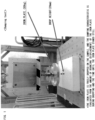
- FIG. 1 shows a schematic diagram of a damping tester.
- An iron plate having a mass of 50 kg was disposed at a position 20 mm above the sample. From that position, the iron plate was freely dropped towards the sample. A vibration characteristic of the sample was evaluated from the displacement of the iron plate after dropping and the time until the vibration stopped.
- Table 2 also shows the test piece size and the evaluation test method of each physical property value.
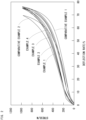
- FIG. 2 shows FS curves of polyurethane foams obtained in Examples 1 to 4 and Comparative Examples 1 and 2.
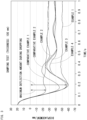
- FIG. 3 shows results of a damping test of the polyurethane foams (thickness: 100 mm) obtained in Examples 1 to 4 and Comparative Examples 1 and 2.
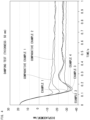
- FIG. 4 shows results of a damping test of the polyurethane foams (thickness: 50 mm) obtained in Examples 1 to 4 and Comparative Examples 1 and 2. The following matters are seen from Table 2 and FIGS. 2 to 4 .
- the seat pad according to the present invention can be used as a seat pad for seats of automobiles, aircraft, and railway vehicles, a sofa, a mattress, and cushioning materials therefor.
Landscapes
- Chemical & Material Sciences (AREA)
- Organic Chemistry (AREA)
- Health & Medical Sciences (AREA)
- Chemical Kinetics & Catalysis (AREA)
- Medicinal Chemistry (AREA)
- Polymers & Plastics (AREA)
- Engineering & Computer Science (AREA)
- Transportation (AREA)
- Mechanical Engineering (AREA)
- Aviation & Aerospace Engineering (AREA)
- Polyurethanes Or Polyureas (AREA)
- Chair Legs, Seat Parts, And Backrests (AREA)
- Mattresses And Other Support Structures For Chairs And Beds (AREA)
Abstract
Description
- The present invention relates to a seat pad, and more particularly to a seat pad including a polyurethane foam having a small deflection coefficient and a high displacement rate.
- Seats for an automobile are classified into a type in which a seat cushion (seat surface portion) and a seat back (back surface portion) are separated from each other and a type in which they are integrated with each other.
- Further, the seat for an automobile generally includes:
- (a) a seat pad for receiving a load of an occupant when the occupant sits;
- (b) a frame for supporting a seat pad; and
- (c) a trim cover covering an outer surface of the seat pad.
- A polyurethane foam is generally used in the seat pad.
- When an occupant sits on a seat for an automobile including a seat pad, the seat pad is compressed in a load direction in proportion to a magnitude of a load applied to the seat pad. The magnitude of the load applied to the seat pad varies depending on the shape of the seat for an automobile, the inclination of the seat back, the part of the human body in contact with the seat for an automobile, the posture of the occupant, the uneven state of the road surface on which the automobile travels, and the like. Therefore, inappropriate deflection coefficient and deflection amount (or displacement rate) of the seat pad may result in a seat having poor seating comfort.
- In order to solve this problem, various proposals have conventionally been made.
- For example,
Patent Literature 1 discloses a soft polyurethane foam for an automobile seat, which is obtained by reacting a raw material containing: - (a) 60 parts by mass of a polyol A obtained by reacting an ethylene oxide/propylene oxide mixture containing 8 mass% of ethylene oxide with a compound (initiator 1) having a hydroxyl value of 168 mgKOH/g and obtained by adding propylene oxide to glycerin;
- (b) 40 parts by mass of a polyol K in which polymer particles are dispersed in a polyol G5 obtained by reacting propylene oxide with the
initiator 1; and - (c) TDI-80 (NOC content: 44.8 mass%) in an amount corresponding to an isocyanate index of 105.
-
Patent Literature 1 describes that: - (A) such a method provides a soft polyurethane foam having an X value (= static spring constant at load of 883 N/static spring constant at load of 98 N) of 2.94; and
- (B) when such a soft polyurethane foam is applied to a seat for an automobile, the bottom touch feeling after sitting down is eliminated.
-
Patent Literature 2 discloses a seat pad including: - a cushion body constituting a seating portion; and
- a low air permeable foam integrally provided on a bottom surface of the cushion body.
-
Patent Literature 2 describes that when the low air permeable foam is integrally provided on the bottom surface of the cushion body, vibration that deteriorates riding comfort can be absorbed. -
Patent Literature 3 discloses a polyurethane foam obtained by reacting a raw material containing: - (a) 90 parts by weight of a polyether polyol having a number average molecular weight of 7000, an average number of functional groups of 3, and a hydroxyl value of 26 mgKOH/g;
- (b) 10 parts by weight of a polymer polyol having a number average molecular weight of 5000, an average number of functional groups of 3, a hydroxyl value of 25 mgKOH/g, and a solid content of 30%;
- (c) 0.5 parts by weight of a linear silicone-based foam stabilizer having a viscosity of 7280 mPa·s (25°C) and a surface tension of 20.08 mN/m (25°C); and
- (d) a mixture of TDI (80 wt.%) and MDI (20 wt.%) (NCO = 44.8%) in an amount corresponding to an isocyanate index of 100.
-
Patent Literature 3 describes that such a method can provide a polyurethane foam that is less likely to cause bottoming even when it is thinner than a conventional one and has high air permeability. -
Patent Literature 4 discloses a deformation analysis technique of simulating a non-linear viscoelastic behavior of a compressible material that is not a seat pad but has a non-linear viscoelastic behavior. -
Patent Literature 4 describes that when a model including, in parallel, a linear viscoelastic portion according to a generalized Maxwell model and a compressible elastoplastic portion having a yield conditional expression depending on hydrostatic stress is used, the damping behavior when a urethane foam is slowly pushed can be analyzed with high accuracy. - Patent Literature 5 discloses a seat for an automobile obtained by
- (a) disposing a net member having a three-dimensional structure in a die and foaming polyurethane in the die, thereby molding a seat back portion in which the net member having a three-dimensional structure is incorporated in a cushion material made of a polyurethane foam, and
- (b) fixing the net member onto a frame in a state where tension is applied to the net member protruding to both side portions of the seat back portion.
- Patent Literature 5 describes that
- (A) such a method provides a seat back portion in which a net member having a three-dimensional structure is integrally incorporated in a cushion material made of a polyurethane foam, and
- (B) the portion of the net member impregnated with the polyurethane has high surface rigidity, so that impact can be damped when the impact is applied from the rear of an occupant.
- The hardness and elasticity of the seat pad affect the seating comfort at the time of sitting. In order to further increase the cushioning feeling, the seat pad is more greatly deflected in a high load range, i.e., preferably has a small deflection coefficient. In addition, in order to reduce the bottom touch feeling at the time of sitting, a high displacement rate is preferable. However, there is no conventional example in which a seat pad achieving both a small deflection coefficient and a high displacement rate has been proposed.
-
- [Patent Literature 1]
JP 2003-119240 A - [Patent Literature 2]
JP 2005-177171 A - [Patent Literature 3]
JP 2019-194321 A - [Patent Literature 4]
JP 2020-094980 A - [Patent Literature 5]
JP 2002-102008 A - An object of the present invention is to provide a seat pad composed of a polyurethane foam and having a small deflection coefficient and a high displacement rate.
- In order to achieve the objects, a seat pad according to the present invention includes
- a polyurethane foam, and
- the polyurethane foam has
- a deflection coefficient of 2.8 or less, and
- a displacement rate represented by the following equation (1) of 30% or more:

- t0 is a thickness of a flat plate sample cut out from the polyurethane foam, and
- t1 is a maximum value of a displacement amount (sinking amount) of an iron plate when a damping characteristic is measured in accordance with JASO B408 using the flat plate sample.
- Preferably, the polyurethane foam is obtained by reacting a raw material mixture containing a polyol component and a polyisocyanate component,
- the polyol component contains one or more polyether polyols A having
- (a) an EO content rate of 50 mol% or more,
- (b) a number of functional groups of 2.0 or more and 3.0 or less, and
- (c) a weight average molecular weight of more than 3500, and
- the polyisocyanate component contains carbodiimide-modified MDI.
- In the case of manufacturing a polyurethane foam, the use of a raw material mixture containing the polyether polyol A which satisfies predetermined conditions and the carbodiimide-modified MDI provides a polyurethane foam having a deflection coefficient of 2.8 or less and a displacement rate of 30% or more.
- It is considered that the deflection coefficient is 2.8 or less because the use of the polyether polyol A having a high EO content rate relatively decreases the number of side chains contained in a polymer chain, resulting in less entanglement between the polymer chains, and because the molecular chain is thus likely to be expanded/contracted, thereby imparting elasticity to the polyurethane foam.
- It is considered that the displacement rate is 30% or more due to the use of the polyether polyol A having a large weight average molecular weight.
-
-
FIG. 1 is a schematic diagram of a damping tester; -
FIG. 2 is FS curves of polyurethane foams obtained in Examples 1 to 4 and Comparative Examples 1 and 2; -
FIG. 3 is results of a damping test of the polyurethane foams (thickness: 100 mm) obtained in Examples 1 to 4 and Comparative Examples 1 and 2; and -
FIG. 4 is results of a damping test of the polyurethane foams (thickness: 50 mm) obtained in Examples 1 to 4 and Comparative Examples 1 and 2. - Hereinafter, embodiments of the present invention will be described in detail.
- The seat pad according to the present invention is composed of a polyurethane foam obtained by reacting a raw material mixture containing a polyol component and a polyisocyanate component. Usually, the raw material mixture further contains a crosslinking agent, a foaming agent, and a catalyst.
- The polyurethane foam constituting the seat pad is obtained by foaming and reacting a raw material mixture satisfying predetermined conditions. Details of a method for manufacturing the polyurethane foam will be described later.
- The "deflection coefficient" refers to a value as measured in accordance with JIS K 6400-2:2012. Specifically, the "deflection coefficient" refers to a value (= F65%/F25%) obtained by dividing a force (F65%) at 65% compression by a force (F25%) at 25% compression when compression is performed, at a constant speed, up to 75% after 75% preliminary compression.
- As will be described later, the polyurethane foam according to the present invention uses a polyether polyol A having a high EO content rate as one of raw materials. The use of the polyether polyol A having a high EO content rate relatively decreases the deflection coefficient of the polyurethane foam. This is considered to be because the use of the polyether polyol A having a high EO content rate relatively decreases the number of side chains contained in a polymer chain, resulting in less entanglement between the polymer chains, and because the molecular chain is thus likely to be expanded/contracted, thereby imparting elasticity to the polyurethane foam. In general, as the deflection coefficient is smaller, the polyurethane foam is more greatly deflected in a high load range, so that the cushioning feeling is increased.
- In order to increase the cushioning feeling, the deflection coefficient of the polyurethane foam needs to be 2.8 or less. When the manufacturing conditions are optimized, the deflection coefficient is 2.7 or less, 2.6 or less, or 2.5 or less.
- On the other hand, too small a deflection coefficient may excessively increase the deflection amount, resulting in large bottom touch feeling. Therefore, the deflection coefficient is preferably 2.0 or more. The deflection coefficient is more preferably 2.1 or more, or 2.2 or more.
- The "displacement rate" refers to a value represented by the following equation (1).

- t0 is a thickness of a flat plate sample cut out from the polyurethane foam, and
- t1 is a maximum value of a displacement amount (sinking amount) of an iron plate when a damping characteristic is measured in accordance with JASO B408 using the flat plate sample.
- Strictly speaking, the displacement rate depends on the thickness t0 of the flat plate sample. For the polyurethane foam according to the present invention, when a plurality of displacement rates are measured using a plurality of flat plate samples having different thicknesses t0, at least one displacement rate has only to satisfy the following condition.
- In general, as the displacement rate is larger, the cushioning property at the time of sitting increases. In order to obtain such an effect, the displacement rate needs to be 30% or more. The displacement rate is preferably 35% or more, 40% or more, 45% or more, 50% or more, or 55% or more.
- In the polyurethane foam according to the present invention, when the manufacturing conditions are optimized, the displacement rate when t0 = 50 mm is 45% or more. When the manufacturing conditions are further optimized, the displacement rate when t0 = 50 mm is 55%, 60% or more, or 65% or more.
- Similarly, in the polyurethane foam according to the present invention, when the manufacturing conditions are optimized, the displacement rate when t0 = 100 mm is 50% or more. When the manufacturing conditions are further optimized, the displacement rate when t0 = 100 mm is 55% or more.
- The polyurethane foam constituting the seat pad is obtained by
- (a) preparing a raw material mixture containing a polyol component and a polyisocyanate component; and
- (b) reacting the raw material mixture.
- Usually, the raw material mixture further contains a crosslinking agent, a foaming agent, and a catalyst.
- The polyol component is one of the main raw materials for the polyurethane foam.
- In the present invention, the polyol component contains a polyether polyol A having
- (a) an EO content rate of 50 mol% or more,
- (b) a number of functional groups of 2.0 or more and 3.0 or less, and
- (c) a weight average molecular weight of more than 3500.
- The polyol component may contain one kind of polyether polyol A satisfying such conditions, or may contain two or more kinds of polyether polyols A satisfying such conditions.
- The polyol component may further contain a polyether polyol B having
- (a) an EO content rate of 30 mol% or less, and
- (b) a number of functional groups of 2.0 or more.
- The polyol component may contain one kind of polyether polyol B satisfying such conditions, or may contain two or more kinds of polyether polyols B satisfying such conditions.
- The "EO content rate (mol%)" of the polyether polyol A refers to a proportion of the number of moles of an ethylene oxide (EO) unit to the total number of moles of alkylene oxide units contained in the polyether polyol A.
- The polyether polyol A may contain an alkylene oxide unit other than the EO unit. In this case, the kind of alkylene oxide unit other than the EO unit is not particularly limited, but is preferably a propylene oxide (PO) unit.
- The EO content rate of the polyether polyol A mainly affects the deflection coefficient. In general, as the EO content rate of the polyether polyol A is higher, the deflection coefficient decreases. This is considered to be because, as the EO content rate is higher, the number of side chains (-CH3) contained in a polymer chain relatively decreases, resulting in less entanglement between the polymer chains, and because the molecular chain is thus likely to be expanded/contracted, thereby imparting elasticity to the polyurethane foam.
- In order to obtain such an effect, the EO content rate of the polyether polyol A is preferably 50.0 mol% or more. The EO content rate is more preferably 60.0 mol% or more, 70.0 mol% or more, 80.0 mol% or more, or 90.0 mol% or more. The EO content rate of the polyether polyol A may be 100.0 mol%.
- The number of functional groups of the polyether polyol A affects the deflection coefficient. In general, as the number of functional groups of the polyether polyol A is larger, the rigidity of the polyurethane foam increases, and the compressive residual strain decreases. In order to obtain such an effect, the number of functional groups of the polyether polyol A is preferably 2.0 or more. The number of functional groups is more preferably 2.1 or more, or 2.2 or more.
- On the other hand, an excessive number of functional groups of the polyether polyol A may excessively increase the hardness of the polyurethane foam and increase the deflection coefficient. Therefore, the number of functional groups of the polyether polyol A is preferably 3.0 or less. The number of functional groups is more preferably 2.9 or less, or 2.8 or less.
- As the weight average molecular weight of the polyether polyol A is larger, the hardness of the polyurethane foam decreases and the polyurethane foam is likely to be deflected. In order to obtain such an effect, the weight average molecular weight of the polyether polyol A is preferably more than 3500. The weight average molecular weight is more preferably 4000 or more, or 5000 or more.
- On the other hand, too large a weight average molecular weight of the polyether polyol A may excessively increase the viscosity of the raw material mixture, leading to deterioration in manufacturability. In addition, the reactivity of the raw material mixture may be reduced, and the tear strength of the polyurethane foam may be reduced. Therefore, the weight average molecular weight is preferably 12000 or less. The weight average molecular weight is more preferably 10000 or less, or 8000 or less.
- Too large a hydroxyl value of the polyether polyol A may deteriorate seating comfort of a seat pad. Therefore, the hydroxyl value is preferably 70 mgKOH/g or less. The hydroxyl value is more preferably 60 mgKOH/g or less, or 55 mgKOH/g or less.
- On the other hand, too small a hydroxyl value of the polyether polyol A may excessively harden the polyurethane foam, thereby making it impossible to maintain good seating comfort when the polyurethane foam is used as a seat pad. Therefore, the hydroxyl value is preferably 10 mgKOH/g or more. The hydroxyl value is more preferably 15 mgKOH/g or more, or 20 mgKOH/g or more.
- The "EO content rate (mol%)" of the polyether polyol B refers to a proportion of the number of moles of an ethylene oxide (EO) unit to the total number of moles of alkylene oxide units contained in the polyether polyol B.
- The polyether polyol B may contain an alkylene oxide unit other than the EO unit. In this case, the kind of alkylene oxide unit other than the EO unit is not particularly limited, but is preferably a propylene oxide (PO) unit.
- Too high an EO content rate of the polyether polyol B may reduce the reactivity of the raw material mixture. In addition, the foam state and the air permeability of the foam may deteriorate. Therefore, the EO content rate is preferably 30 mol% or less. The EO content rate is more preferably 20 mol% or less, 10 mol% or less, or 5 mol% or less. The EO content rate may be zero.
- The number of functional groups of the polyether polyol B has only to be 2.0 or more.
- However, too large the number of functional groups of the polyether polyol B may reduce elongation of the polyurethane foam. Therefore, the number of functional groups is preferably 4.0 or less. The number of functional groups is more preferably 3.8 or less, or 3.6 or less.
- The weight average molecular weight of the polyether polyol B is not particularly limited, and an optimum value can be selected according to the purpose. In general, too small a weight average molecular weight of the polyether polyol B may impair the elongation percentage and flexibility of the polyurethane foam. Therefore, the weight average molecular weight is preferably 1000 or more. The weight average molecular weight is more preferably 2000 or more, or 3000 or more.
- On the other hand, too large a weight average molecular weight of the polyether polyol B may excessively increase the viscosity of the raw material mixture, leading to deterioration in manufacturability. Therefore, the weight average molecular weight is preferably 12000 or less. The weight average molecular weight is more preferably 10000 or less, or 8000 or less.
- The polyisocyanate component is the other one of the main raw materials for the polyurethane foam.
- In the present invention, the polyisocyanate component contains at least carbodiimide-modified MDI. The polyisocyanate component may contain only carbodiimide-modified MDI, or may further contain a polyisocyanate (hereinafter, this is also referred to as "polyisocyanate B") other than the carbodiimide-modified MDI.
- The carbodiimide (-N=C=N-)-modified MDI is composed of a product produced by condensation, with CO2 generation, between -NCO groups of diphenylmethane diisocyanate (MDI) in the presence of a catalyst.
- The use of the carbodiimide-modified MDI as the polyisocyanate component increases the elasticity of the polyurethane foam, resulting in an increased amount of deflection in a high load range.
- In the present invention, the type of polyisocyanate B is not particularly limited, and an optimum polyisocyanate B can be selected according to the purpose.
- Specific examples of the polyisocyanate B include bifunctional aromatic isocyanates, bifunctional alicyclic isocyanates, bifunctional aliphatic isocyanates, and isocyanates having a number of functional groups of more than 2. The raw material mixture may contain any one of these polyisocyanates B, or may contain two or more thereof.
- Examples of the bifunctional aromatic isocyanate include
- 2,4-tolylene diisocyanate, 2,6-tolylene diisocyanate, m-phenylene diisocyanate, p-phenylene diisocyanate,
- 4,4'-diphenylmethane diisocyanate (4,4'-MDI),
- 2,4'-diphenylmethane diisocyanate (2,4'-MDI),
- 2,2'-diphenylmethane diisocyanate (2,2'-MDI), xylylene diisocyanate,
- 3,3'-dimethyl-4,4'-biphenylene diisocyanate, and
- 3,3'-dimethoxy-4,4'-biphenylene diisocyanate, and a mixture thereof may be used.
- Examples of the bifunctional alicyclic isocyanate include
- cyclohexane-1,4-diisocyanate, isophorone diisocyanate,
- dicyclohexylmethane-4,4'-diisocyanate, and
- methylcyclohexane diisocyanate.
- Examples of the bifunctional aliphatic isocyanate include
- butane-1,4-diisocyanate, hexamethylene diisocyanate,
- isopropylene diisocyanate, methylene diisocyanate, and lysine isocyanate. Examples of the bi- or higher functional isocyanate include polymeric MDI and tri- or higher functional isocyanate.
- Examples of the isocyanate having a number of functional groups of more than 2 include
- 1-methylbenzol-2,4,6-triisocyanate,
- 1,3,5-trimethylbenzol-2,4,6-triisocyanate,
- biphenyl-2,4,4'-triisocyanate,
- diphenylmethane-2,4,4'-triisocyanate,
- methyldiphenylmethane-4,6,4'-triisocyanate,
- 4,4'-dimethyldiphenylmethane-2,2',5,5'tetraisocyanate, and
- triphenylmethane-4,4',4"-triisocyanate.
- The "NCO group content rate (NCO%)" refers to a proportion of the mass of NCO groups to a total mass of the polyisocyanate component.
- The NCO% of the polyisocyanate component is preferably less than 35%, more preferably less than 30%, and still more preferably 29.5% or less.
- The raw material mixture may contain a crosslinking agent. The crosslinking agent is preferably a compound having a number of functional groups of at least 3 or more and containing a functional group having an active hydrogen atom (for example, a hydroxyl group, an amino group, or the like). The crosslinking agent may be composed only of a compound having a number of functional groups of 3 or more, or may further contain a compound having a number of functional groups of 2 in addition to the compound having a number of functional groups of 3 or more.
- The number of functional groups of the crosslinking agent affects the compressive residual strain. In order to obtain a polyurethane foam having a small compressive residual strain, the number of functional groups of the crosslinking agent is preferably 3 or more.
- On the other hand, an excessively large number of functional groups of the crosslinking agent may excessively increase the hardness of the polyurethane foam. Therefore, the number of functional groups of the crosslinking agent is preferably 6 or less.
- The molecular weight of the crosslinking agent is not particularly limited, and an optimum value can be selected according to the purpose. The molecular weight of the crosslinking agent is preferably 1000 or less, 700 or less, or 500 or less.
- The molecular weight of the crosslinking agent is preferably 60 or more, 90 or more, or 120 or more.
- Examples of the crosslinking agent include glycerin, diethanolamine (DEA), and polyfunctional polyol.
- The raw material mixture may contain any one of these crosslinking agents, or may contain two or more thereof.
- The "foaming agent" refers to an additive for generating bubbles in the raw material mixture in the process of resinizing the liquid raw material mixture.
- In the present invention, the foaming agent may be either
- (a) a physical foaming agent that generates a gas by pressure reduction or heating; or
- (b) a chemical foaming agent that generates a gas by thermal decomposition or chemical reaction.
- Examples of the physical foaming agent include
- (a) hydrocarbons such as cyclopentane, isopentane, and normal pentane, and
- (b) halogen-based compounds such as methylene chloride, trichlorofluoromethane, dichlorodifluoromethane, nonafluorobutyl methyl ether, pentafluoroethyl methyl ether, and pentafluoroisopropyl methyl ether.
- Examples of the chemical foaming agent include
- (a) water that reacts with an isocyanate group to generate CO2, and
- (b) azodicarbonamide that generates nitrogen, carbon monoxide, carbon dioxide, or ammonia gas by thermal decomposition.
- The raw material mixture may contain any one of these foaming agents, or may contain two or more thereof.
- Among them, the foaming agent is preferably water. When water is used as the foaming agent, CO2 gas generated by reaction between water and an isocyanate group promotes foaming. The heat of reaction between water and an isocyanate group accelerates curing of the resin.
- The "catalyst" refers to a catalyst having a large action of accelerating the resinification reaction and/or a catalyst having a large action of accelerating the foaming reaction.
- When a chemical foaming agent (water) is not used as the foaming agent, it is preferable to use a catalyst having a large action of accelerating the resinification reaction.
- Examples of the catalyst include an amine-based catalyst and a metal catalyst. The amine-based catalyst is a catalyst having a large action of accelerating both the resinification reaction and the foaming reaction. The metal catalyst is a catalyst having a large action of accelerating the resinification reaction. The raw material mixture may contain any one of these catalysts, or may contain two or more thereof.
- Examples of the amine-based catalyst include
- N,N-dimethylcyclohexylamine, N,N-dimethylbenzylamine,
- N,N-dimethylaminoethanol,
- N,N',N'-trimethylaminoethylpiperazine, and triethylenediamine.
- Examples of the metal catalyst include
- (a) tin catalysts such as stannous octoate and dibutyltin dilaurate,
- (b) mercury catalysts such as phenylmercuric propionate, and
- (c) lead catalysts such as lead octenate.
- The raw material mixture may further contain one or more of the following sub-raw materials in addition to the main raw materials described above. Specific examples of the sub-raw material are as follows.
- The "foam stabilizer" refers to an additive having an action of uniformizing the size and distribution of bubbles.
- The addition of the foam stabilizer to the raw material mixture can provide a polyurethane foam having bubbles uniform in size and distribution. Examples of the foam stabilizer include silicone-based foam stabilizers, fluorine-containing compound-based foam stabilizers, and known surfactants.
- The "flame retardant" refers to an additive having an action of making the polyurethane foam flame-retardant.
- Examples of the flame retardant include halogen-based flame retardants, phosphorus-based flame retardants, metal hydroxide-based flame retardants, and antimony-based flame retardants.
- The "blending amount (parts by mass) of the polyether polyol A" refers to a total mass of the polyether polyol A in the polyol component when the total mass of the polyol component is 100.
- In general, as the blending amount of the polyether polyol A is larger, the deflection coefficient of the polyurethane foam decreases. In order to obtain such an effect, the blending amount of the polyether polyol A is preferably 50 parts by mass or more. The blending amount is more preferably 60 parts by mass or more, or 70 parts by mass or more.
- The blending amount of the polyether polyol A may be 100 parts by mass. However, an excessive blending amount of the polyether polyol A may deteriorate moldability of the foam. Therefore, the blending amount of the polyether polyol A is preferably 90 parts by mass or less.
- The "content (mass%) of the carbodiimide-modified MDI" refers to a proportion of the mass of the carbodiimide-modified MDI to the total mass of the polyisocyanate component.
- In general, as the content of the carbodiimide-modified MDI is higher, the deflection coefficient of the polyurethane foam decreases and the displacement rate increases. In order to obtain such an effect, the content of the carbodiimide-modified MDI is preferably 50 mass% or more. The content is more preferably 60 mass% or more, or 70 mass% or more.
- The content of the carbodiimide-modified MDI may be 100 mass%. The content of the carbodiimide-modified MDI is preferably 90 mass% or less, or 80 mass% or less.
- An NCO content rate of the carbodiimide-modified MDI is preferably 40% or less, 35% or less, or 32% or less, and particularly preferably 30% or less. The NCO content rate is preferably 15% or more, 20% or more, 25% or more, or 27% or more.
- The "blending amount (parts by mass) of the crosslinking agent" refers to a mass of the crosslinking agent when the total mass of the polyol components is 100.
- In general, as the blending amount of the crosslinking agent is higher, the compressive residual strain of the polyurethane foam decreases. In order to obtain such an effect, the blending amount of the crosslinking agent is preferably more than 0 parts by mass. The blending amount is more preferably 1 part by mass or more, or 2 parts by mass or more.
- On the other hand, an excessive blending amount of the crosslinking agent may excessively increase the hardness of the polyurethane foam. Therefore, the blending amount of the crosslinking agent is preferably 10 parts by mass or less. The blending amount is more preferably 8 parts by mass or less, or 6 parts by mass or less.
- The "blending amount (parts by mass) of the polyether polyol B" refers to a mass of the polyether polyol B in the polyol component when the total mass of the polyol component is 100.
- In general, an excessive blending amount of the polyether polyol B relatively decreases the blending amount of the polyether polyol A. As a result, the deflection coefficient of the polyurethane foam may increase, or the displacement rate may decrease. Therefore, the blending amount of the polyether polyol B is preferably less than 50 parts by mass. The blending amount is more preferably 40 parts by mass or less, or 30 parts by mass or less.
- The "isocyanate index" refers to a value obtained by multiplying a ratio of an equivalent of an isocyanate group of the polyisocyanate in the raw material mixture to an equivalent of an active hydrogen group in the raw material mixture by 100.
- In the present invention, the isocyanate index is not particularly limited, and an optimum value can be selected according to the purpose. In general, as the isocyanate index is larger, the compressive residual strain decreases. In order to obtain such an effect, the isocyanate index is preferably 90 or more. The isocyanate index is more preferably 95 or more.
- On the other hand, too large an isocyanate index may excessively increase the hardness of the polyurethane foam. Therefore, the isocyanate index is preferably 115 or less.
- In the present invention, the blending amount of the sub-raw material is not particularly limited, and an optimum content can be selected according to the purpose.
- As the foaming in the method for producing a polyurethane foam according to the present invention, either slab foaming or mold foaming can be employed.
- The slab foaming is a method in which a composition for producing a polyurethane foam (raw materials for a polyurethane foam) is mixed, discharged onto a belt conveyor, and foamed at normal temperature under atmospheric pressure.
- On the other hand, the mold foaming is a method in which raw materials for producing a polyurethane foam (raw materials for a polyurethane foam) are mixed and injected into a cavity of a mold (die), and foamed into a cavity shape. The mold foaming is preferable in that a polyurethane foam having a shape close to the shape of the seat pad is obtained.
- In the case of mold molding, the polyisocyanate preferably has a low viscosity, and, for example, a prepolymer type polyisocyanate is not preferable.
- In the case of manufacturing a polyurethane foam, the use of a raw material mixture containing the polyether polyol A which satisfies predetermined conditions and the carbodiimide-modified MDI provides a polyurethane foam having a deflection coefficient of 2.8 or less and a displacement rate of 30% or more.
- When such a polyurethane foam is used as a seat pad, the seat pad has an excellent deflection coefficient even when it is thin (for example, 50 mm or less), and has an excellent deflection amount (displacement rate) in a damping characteristic.
- It is considered that the deflection coefficient is 2.8 or less because the use of the polyether polyol A having a high EO content rate relatively decreases the number of side chains contained in a polymer chain, resulting in less entanglement between the polymer chains, and because the molecular chain is thus likely to be expanded/contracted, thereby imparting elasticity to the polyurethane foam.
- It is considered that the displacement rate is 30% or more due to the use of the polyether polyol A having a large weight average molecular weight.
- A polyether polyol, a crosslinking agent, a foaming agent, a catalyst, and a foam stabilizer were blended at a predetermined ratio to obtain a mixed liquid (hereinafter, also referred to as "component A").
- In addition, polymeric MDI, MDI (NCO content rate: 29%, carbodiimide-modified MDI content: 75 mass%) containing carbodiimide-modified MDI, and an MDI prepolymer (NCO content rate: 28.5%) were blended at a predetermined ratio to obtain a mixed liquid (hereinafter, also referred to as "component B").
- Further, the component A and the component B were mixed so that the isocyanate index reached a predetermined value to obtain a raw material mixture. Table 1 shows the compositions of the component A and the component B.
- Example 1 is an example in which only polyether polyol 2 (molecular weight: 4000, number of functional groups: 2, EO content rate: 80 mol%) was used as the polyether polyol A.
- Examples 2 and 3 are examples in which a mixture of
- (a) polyether polyol 2 (molecular weight: 4000, number of functional groups: 2, EO content rate: 80 mol%) and
- (b) polyether polyol 3 (molecular weight: 5000, number of functional groups: 3, EO content rate: 80 mol%) was used as the polyether polyol A.
- Example 4 is an example in which only polyether
polyol 3 was used as the polyether polyol A.[Table 1] <Composition (parts by mass) of polyol-side component A> Raw material Molecular weight f EO rate OHV Example 1 Example 2 Example 3 Example 4 Comparative Example 1 Comparative Example 2 Polyether polyol 14000 2 20 28 20 20 20 20 Polyether polyol 24000 2 80 28 80 50 30 Polyether polyol 35000 3 80 35 30 50 80 3.4 Polyether polyol 43500 3 75 51 70 Polyether polyol 5 5000 3 15 34 30 30 Polyether polyol 6 7000 3 15 24 30 Polymer polyol 5000 3 15 24 40 <Manufacturer, product name, etc.> Crosslinking agent 1Asahi Glass EL-980 polyfunctional polyol 3.0 3.0 3.0 3.0 3.0 Foaming agent Water 2.3 2.3 2.4 2.4 2.5 2.85 Catalys Evonik 33LSI 0.5 0.5 0.5 0.6 0.8 0.8 Silicone foam stabilizer 1Momentive L3184J 0.2 0.5 Silicone foam stabilizer 2Evonik B8715 LF 0.2 0.2 0.2 Crosslinking agent 2NOF Glycerin Flame retardant Daihachi Chemical CR5401 Silicone foam stabilizer 3Evonik B8738LF2 0.5 Foaming catalyst 2Momentive BL - 19 Total 106.0 106.0 106.1 106.2 106.8 107.6 <Composition (parts by mass) of isocyanate-side component B> Example 1 Example 2 Example 3 Example 4 Comparative Example 1 Comparative Example 2 Isocyanate Polymeric MDI 5 5 5 5 5 MDI containing carbodiimide-modified MDI 95 95 95 95 95 MDI prepolymer (NCO %: 28.5%) *1 100 Total of isocyanate- side component B 100 100 100 100 100 100 *1) Prepolymer of MDI (MDI mixture having a binuclear form ratio of 70% or more) and polyether polyol Example 1 Example 2 Example 3 Example 4 Comparative Example 1 Comparative Example 2 Index [-] 105 106 103 105 105 95 Use amount [g] of component B with respect to 100 g of component 48.4 49.5 49.9 51.6 56.6 49.6 - The obtained raw material mixture was injected into a die of 400 mm × 400 mm × 100 mm, and foamed and cured at a die temperature of about 60°C. The curing time was set to 5 minutes.
- A skin layer was removed from the obtained foam to prepare a sample for core density measurement. The obtained sample was used to measure the core density in accordance with JIS K 7222.
- The 25% hardness was measured in accordance with JIS K 6400-2 Method D.
- The hysteresis loss was measured in accordance with JIS K 6400-2 Method E.
- The deflection coefficient was measured in accordance with JIS K 6400-2 Method E. The deflection coefficient was determined by dividing 65% compressive load by 25% compressive load.
- The stress relaxation was determined in accordance with JIS K 6400-4. The load was set to 196 N, and the pressurization time was set to 5 minutes.
-
FIG. 1 shows a schematic diagram of a damping tester. An iron plate having a mass of 50 kg was disposed at aposition 20 mm above the sample. From that position, the iron plate was freely dropped towards the sample. A vibration characteristic of the sample was evaluated from the displacement of the iron plate after dropping and the time until the vibration stopped. - The results are shown in Table 2. Table 2 also shows the test piece size and the evaluation test method of each physical property value.
FIG. 2 shows FS curves of polyurethane foams obtained in Examples 1 to 4 and Comparative Examples 1 and 2.FIG. 3 shows results of a damping test of the polyurethane foams (thickness: 100 mm) obtained in Examples 1 to 4 and Comparative Examples 1 and 2.FIG. 4 shows results of a damping test of the polyurethane foams (thickness: 50 mm) obtained in Examples 1 to 4 and Comparative Examples 1 and 2. The following matters are seen from Table 2 andFIGS. 2 to 4 . - (1) Comparative Example 1 showed both a displacement rate at t0 = 50 mm and a displacement rate at t0 = 100 mm of less than 30%. This is considered to be because the polyether polyol A having a weight average molecular weight of more than 3500 is not contained.
- (2) Comparative Example 2 showed a high displacement rate but a deflection coefficient of more than 2.8. This is considered to be because the content of the polyether polyol A is excessively low.
- (3) All of Examples 1 to 4 showed a deflection coefficient of 2.8 or less. In addition, regardless of the thickness t0 of the sample, the displacement rate was 50% or more in all Examples.
- Although the embodiments of the present invention have been described in detail above, the present invention is not limited to the above embodiments at all, and various modifications can be made without departing from the gist of the present invention.
- The seat pad according to the present invention can be used as a seat pad for seats of automobiles, aircraft, and railway vehicles, a sofa, a mattress, and cushioning materials therefor.
| Test item | Unit | Example 1 | Example 2 | Example 3 | Example 4 | Comparative Example 1 | Comparative Example 2 | ||
| Test piece size (length × width × thickness) | mm | 400×400×100 | 400×400×100 | 400×400×100 | 400×400×100 | 400×400×100 | 400×400×100 | ||
| Core density | kg/m3 | 64.8 | 64.6 | 65.0 | 64.8 | 64.8 | 60.1 | ||
| 25% Hardness | N | 257 | 256 | 251 | 244 | 227 | 255 | ||
| Hysteresis loss | % | 16.8 | 16.7 | 17.5 | 18.3 | 27.7 | 26.5 | ||
| Deflection coefficient | - | 2.44 | 2.50 | 2.54 | 2.53 | 2.41 | 2.83 | ||
| Stress relaxation | % | 7.4 | 7.7 | 8.2 | 11.1 | 16.3 | 14.4 | ||
| Damping characteristi | Evaluation item | Thickness | |||||||
| Displacement amount during dropping | 100mm | mm | -58.0 | -59.3 | -59.4 | -56.5 | -23.9 | -45.6 | |
| 50mm | mm | -29.9 | -34.6 | -33.1 | -32.2 | -14.2 | -21.4 | ||
| Displacement rate during dropping | 100mm | % | 58.0 | 59.3 | 59.4 | 56.5 | 23.9 | 45.6 | |
| 50mm | % | 59.8 | 69.2 | 66.3 | 66.4 | 28.4 | 42.9 | ||
| Item | Standard | Others/details |
| Core density | JIS K 7222 | Measured in core portion from which skin layer has been removed |
| 25% Hardness | JIS K 6400-2, | 400×400×100 |
| Hysteresis loss | JIS K 6400-2, Method E | 200Φ, 50mm/min |
| Deflection coefficient | JIS K 6400-2, Method E | Value obtained by dividing 65% compression load by 25% compression load. Compression deflection coefficient |
| Stress relaxation | JIS K 6400-2 | Load of 196 N, 5 min |
| Damping test | JASO B408 | Iron plate, load of 50 kg, drop height of 20 mm |
Claims (5)
- A seat pad comprising a polyurethane foam,the polyurethane foam havinga deflection coefficient of 2.8 or less, anda displacement rate represented by the following equation (1) of 30% or more:
 t0 is a thickness of a flat plate sample cut out from the polyurethane foam, andt1 is a maximum value of a displacement amount (sinking amount) of an iron plate when a damping characteristic is measured in accordance with JASO B408 using the flat plate sample.
 - The seat pad according to claim 1, wherein the displacement rate when t0 = 50 mm is 45% or more.
- The seat pad according to claim 1, wherein the displacement rate when t0 = 100 mm is 50% or more.
- The seat pad according to claim 1, wherein the polyurethane foam is obtained by reacting a raw material mixture comprising a polyol component and a polyisocyanate component,the polyol component comprises one or more polyether polyols A having(a) an EO content rate of 50 mol% or more,(b) a number of functional groups of 2.0 or more and 3.0 or less, and(c) a weight average molecular weight of more than 3500, andthe polyisocyanate component comprises carbodiimide-modified MDI.
- The seat pad according to claim 4, wherein the polyol component further comprises one or more polyether polyols B having(a) an EO content rate of 30 mol% or less, and(b) an average number of functional groups of 2.0 or more.
Applications Claiming Priority (3)
| Application Number | Priority Date | Filing Date | Title |
|---|---|---|---|
| JP2022165099 | 2022-10-13 | ||
| JP2023020616 | 2023-02-14 | ||
| PCT/JP2023/036683 WO2024080268A1 (en) | 2022-10-13 | 2023-10-10 | Seat pad |
Publications (2)
| Publication Number | Publication Date |
|---|---|
| EP4555902A1 true EP4555902A1 (en) | 2025-05-21 |
| EP4555902A4 EP4555902A4 (en) | 2025-10-22 |
Family
ID=90669590
Family Applications (1)
| Application Number | Title | Priority Date | Filing Date |
|---|---|---|---|
| EP23877271.9A Pending EP4555902A4 (en) | 2022-10-13 | 2023-10-10 | SEAT CUSHIONS |
Country Status (5)
| Country | Link |
|---|---|
| EP (1) | EP4555902A4 (en) |
| JP (1) | JPWO2024080268A1 (en) |
| CN (1) | CN119923210A (en) |
| CA (1) | CA3259879A1 (en) |
| WO (1) | WO2024080268A1 (en) |
Family Cites Families (10)
| Publication number | Priority date | Publication date | Assignee | Title |
|---|---|---|---|---|
| JP2002102008A (en) | 2000-09-27 | 2002-04-09 | Delta Tooling Co Ltd | Seat structure and method for manufacturing seat |
| EP1234843A1 (en) * | 2001-02-26 | 2002-08-28 | Huntsman International Llc | Process for preparing a flexible polyurethane foam |
| JP4601894B2 (en) | 2001-08-06 | 2010-12-22 | 旭硝子株式会社 | Flexible polyurethane foam for automobile seats |
| JP4504809B2 (en) * | 2002-08-02 | 2010-07-14 | ハンツマン・インターナショナル・エルエルシー | Prepolymers, polyol compositions and methods for producing flexible foams |
| ATE521651T1 (en) * | 2003-06-12 | 2011-09-15 | Huntsman Int Llc | METHOD FOR PRODUCING A POLYISOCYANURATE POLYURETHANE MATERIAL |
| JP4344599B2 (en) | 2003-12-19 | 2009-10-14 | 株式会社イノアックコーポレーション | Seat pad |
| BRPI0610831B1 (en) * | 2005-04-25 | 2018-04-10 | Cargill, Incorporated | Polyurethane Foams Understanding Oligomeric Polyols and Methods of Manufacturing Polyurethane Molded Foam Article and SLABSTOCK Polyurethane Foam Article |
| EP3555162B1 (en) * | 2016-12-15 | 2021-05-19 | Dow Global Technologies LLC | Polyurethane product with sulfur-containing polyol |
| JP7368102B2 (en) | 2018-04-27 | 2023-10-24 | 株式会社イノアックコーポレーション | Polyurethane foam and its manufacturing method |
| JP2020094980A (en) | 2018-12-14 | 2020-06-18 | 株式会社ブリヂストン | Deformation analysis method for compressible material |
-
2023
- 2023-10-10 EP EP23877271.9A patent/EP4555902A4/en active Pending
- 2023-10-10 CA CA3259879A patent/CA3259879A1/en active Pending
- 2023-10-10 WO PCT/JP2023/036683 patent/WO2024080268A1/en not_active Ceased
- 2023-10-10 JP JP2024551684A patent/JPWO2024080268A1/ja active Pending
- 2023-10-10 CN CN202380062072.6A patent/CN119923210A/en active Pending
Also Published As
| Publication number | Publication date |
|---|---|
| CN119923210A (en) | 2025-05-02 |
| CA3259879A1 (en) | 2025-04-01 |
| EP4555902A4 (en) | 2025-10-22 |
| JPWO2024080268A1 (en) | 2024-04-18 |
| WO2024080268A1 (en) | 2024-04-18 |
Similar Documents
| Publication | Publication Date | Title |
|---|---|---|
| EP2977259B1 (en) | Cushion pad | |
| CA2790042C (en) | Cushion pad and method for manufacturing the same | |
| US10035440B2 (en) | Cushion pad that reduces compressive stress and tensile stress | |
| US8097659B2 (en) | Flexible polyurethane foam and a method of producing the same | |
| JP7368102B2 (en) | Polyurethane foam and its manufacturing method | |
| JP2011046907A (en) | Flexible polyurethane foam and method for manufacturing the same | |
| EP3391784A1 (en) | Seat pad | |
| EP3643731B1 (en) | Composition for soft polyurethane foam, soft polyurethane foam, and vehicle seat pad | |
| EP4555902A1 (en) | Seat pad | |
| EP4552534A1 (en) | Seat pad | |
| EP1602675B1 (en) | Flexible polyurethane foam | |
| JP7847932B2 (en) | seat pad | |
| JP7220009B2 (en) | Method for producing low-resilience polyurethane foam, composition for low-resilience polyurethane foam, and low-resilience polyurethane foam | |
| JP4154726B2 (en) | Method for producing viscoelastic polyurethane foam | |
| JP3937811B2 (en) | Method for producing flexible polyurethane foam | |
| JP2024058539A (en) | Seat pad | |
| EP4292475A1 (en) | Polyurethane foam and seat pad | |
| KR102270004B1 (en) | Flexible polyurethane composition, flexible polyurethane foam for cushioning material and automotive seat having the same | |
| US20250361352A1 (en) | Composition for flexible polyurethane foam, flexible polyurethane foam, and automotive seat pad | |
| JP2022001258A (en) | Vehicle seat base material and vehicle seat | |
| JP2022001466A (en) | Vehicular seat base material and vehicular seat | |
| WO2020009239A1 (en) | Polyurethane foam for seat pads, automobile seat pad, and production method for polyurethane foam for seat pads | |
| JP2020012095A (en) | Polyurethane foam for seat pad, automotive seat pad, and method for producing polyurethane foam for seat pad | |
| JP2004346196A (en) | Flexible polyurethane foam molding and method for producing the same |
Legal Events
| Date | Code | Title | Description |
|---|---|---|---|
| STAA | Information on the status of an ep patent application or granted ep patent |
Free format text: STATUS: THE INTERNATIONAL PUBLICATION HAS BEEN MADE |
|
| PUAI | Public reference made under article 153(3) epc to a published international application that has entered the european phase |
Free format text: ORIGINAL CODE: 0009012 |
|
| STAA | Information on the status of an ep patent application or granted ep patent |
Free format text: STATUS: REQUEST FOR EXAMINATION WAS MADE |
|
| 17P | Request for examination filed |
Effective date: 20250213 |
|
| AK | Designated contracting states |
Kind code of ref document: A1 Designated state(s): AL AT BE BG CH CY CZ DE DK EE ES FI FR GB GR HR HU IE IS IT LI LT LU LV MC ME MK MT NL NO PL PT RO RS SE SI SK SM TR |
|
| A4 | Supplementary search report drawn up and despatched |
Effective date: 20250922 |
|
| RIC1 | Information provided on ipc code assigned before grant |
Ipc: A47C 27/14 20060101AFI20250916BHEP Ipc: B29C 39/24 20060101ALI20250916BHEP Ipc: B29C 44/00 20060101ALI20250916BHEP Ipc: B29C 44/36 20060101ALI20250916BHEP Ipc: B60N 2/90 20180101ALI20250916BHEP Ipc: C08G 18/00 20060101ALI20250916BHEP Ipc: C08G 18/10 20060101ALI20250916BHEP Ipc: C08G 18/48 20060101ALI20250916BHEP Ipc: C08G 18/79 20060101ALI20250916BHEP Ipc: C08G 101/00 20060101ALI20250916BHEP Ipc: B60N 2/70 20060101ALI20250916BHEP Ipc: C08G 18/20 20060101ALI20250916BHEP Ipc: C08G 18/32 20060101ALI20250916BHEP Ipc: C08G 18/66 20060101ALI20250916BHEP Ipc: C08G 18/76 20060101ALI20250916BHEP |
|
| DAV | Request for validation of the european patent (deleted) | ||
| DAX | Request for extension of the european patent (deleted) | ||
| GRAP | Despatch of communication of intention to grant a patent |
Free format text: ORIGINAL CODE: EPIDOSNIGR1 |
|
| STAA | Information on the status of an ep patent application or granted ep patent |
Free format text: STATUS: GRANT OF PATENT IS INTENDED |
|
| RIC1 | Information provided on ipc code assigned before grant |
Ipc: A47C 27/14 20060101AFI20260325BHEP Ipc: B29C 39/24 20060101ALI20260325BHEP Ipc: B29C 44/00 20060101ALI20260325BHEP Ipc: B29C 44/36 20060101ALI20260325BHEP Ipc: B60N 2/90 20180101ALI20260325BHEP Ipc: C08G 18/00 20060101ALI20260325BHEP Ipc: C08G 18/10 20060101ALI20260325BHEP Ipc: C08G 18/48 20060101ALI20260325BHEP Ipc: C08G 18/79 20060101ALI20260325BHEP Ipc: C08G 101/00 20060101ALI20260325BHEP Ipc: B60N 2/70 20060101ALI20260325BHEP Ipc: C08G 18/20 20060101ALI20260325BHEP Ipc: C08G 18/32 20060101ALI20260325BHEP Ipc: C08G 18/66 20060101ALI20260325BHEP Ipc: C08G 18/76 20060101ALI20260325BHEP |