EP4554256A2 - Audiosignalverteilung zur thermischen optimierung von lautsprechern - Google Patents
Audiosignalverteilung zur thermischen optimierung von lautsprechern Download PDFInfo
- Publication number
- EP4554256A2 EP4554256A2 EP24211384.3A EP24211384A EP4554256A2 EP 4554256 A2 EP4554256 A2 EP 4554256A2 EP 24211384 A EP24211384 A EP 24211384A EP 4554256 A2 EP4554256 A2 EP 4554256A2
- Authority
- EP
- European Patent Office
- Prior art keywords
- channel
- audio
- audio signal
- temperature
- primary
- Prior art date
- Legal status (The legal status is an assumption and is not a legal conclusion. Google has not performed a legal analysis and makes no representation as to the accuracy of the status listed.)
- Pending
Links
Images






Classifications
-
- H—ELECTRICITY
- H04—ELECTRIC COMMUNICATION TECHNIQUE
- H04R—LOUDSPEAKERS, MICROPHONES, GRAMOPHONE PICK-UPS OR LIKE ACOUSTIC ELECTROMECHANICAL TRANSDUCERS; DEAF-AID SETS; PUBLIC ADDRESS SYSTEMS
- H04R29/00—Monitoring arrangements; Testing arrangements
- H04R29/001—Monitoring arrangements; Testing arrangements for loudspeakers
-
- H—ELECTRICITY
- H04—ELECTRIC COMMUNICATION TECHNIQUE
- H04H—BROADCAST COMMUNICATION
- H04H20/00—Arrangements for broadcast or for distribution combined with broadcast
- H04H20/86—Arrangements characterised by the broadcast information itself
- H04H20/88—Stereophonic broadcast systems
- H04H20/89—Stereophonic broadcast systems using three or more audio channels, e.g. triphonic or quadraphonic
-
- H—ELECTRICITY
- H04—ELECTRIC COMMUNICATION TECHNIQUE
- H04R—LOUDSPEAKERS, MICROPHONES, GRAMOPHONE PICK-UPS OR LIKE ACOUSTIC ELECTROMECHANICAL TRANSDUCERS; DEAF-AID SETS; PUBLIC ADDRESS SYSTEMS
- H04R29/00—Monitoring arrangements; Testing arrangements
- H04R29/001—Monitoring arrangements; Testing arrangements for loudspeakers
- H04R29/002—Loudspeaker arrays
-
- H—ELECTRICITY
- H04—ELECTRIC COMMUNICATION TECHNIQUE
- H04S—STEREOPHONIC SYSTEMS
- H04S7/00—Indicating arrangements; Control arrangements, e.g. balance control
- H04S7/30—Control circuits for electronic adaptation of the sound field
-
- H—ELECTRICITY
- H04—ELECTRIC COMMUNICATION TECHNIQUE
- H04R—LOUDSPEAKERS, MICROPHONES, GRAMOPHONE PICK-UPS OR LIKE ACOUSTIC ELECTROMECHANICAL TRANSDUCERS; DEAF-AID SETS; PUBLIC ADDRESS SYSTEMS
- H04R3/00—Circuits for transducers, loudspeakers or microphones
- H04R3/007—Protection circuits for transducers
-
- H—ELECTRICITY
- H04—ELECTRIC COMMUNICATION TECHNIQUE
- H04R—LOUDSPEAKERS, MICROPHONES, GRAMOPHONE PICK-UPS OR LIKE ACOUSTIC ELECTROMECHANICAL TRANSDUCERS; DEAF-AID SETS; PUBLIC ADDRESS SYSTEMS
- H04R3/00—Circuits for transducers, loudspeakers or microphones
- H04R3/12—Circuits for transducers, loudspeakers or microphones for distributing signals to two or more loudspeakers
- H04R3/14—Cross-over networks
-
- H—ELECTRICITY
- H04—ELECTRIC COMMUNICATION TECHNIQUE
- H04S—STEREOPHONIC SYSTEMS
- H04S2400/00—Details of stereophonic systems covered by H04S but not provided for in its groups
- H04S2400/05—Generation or adaptation of centre channel in multi-channel audio systems
-
- H—ELECTRICITY
- H04—ELECTRIC COMMUNICATION TECHNIQUE
- H04S—STEREOPHONIC SYSTEMS
- H04S2400/00—Details of stereophonic systems covered by H04S but not provided for in its groups
- H04S2400/13—Aspects of volume control, not necessarily automatic, in stereophonic sound systems
Definitions
- Some recent set-top boxes incorporate one or more speakers.
- the speaker(s) can be used in a voice assistant function, or even to implement a multi-channel audio system.
- a known solution is to control the power sent to the speaker after the amplifier based on temperature.
- This solution therefore requires an analog-to-digital converter to measure and digitize the signal at the amplifier output, as well as a sensor measuring the temperature of the speaker to be protected. The signal is attenuated if the measured temperature exceeds a limit defined by the manufacturer.
- Another known solution is to connect a resistive circuit to the magnet of the speaker to be protected.
- the resistance of this circuit varies with the temperature of the magnet.
- the resistance is then measured, and the temperature is deduced.
- the information is transmitted to a signal limiter.
- the audio signal is attenuated if the estimated temperature exceeds a limit set by the manufacturer.
- the temperature of the loudspeakers can be assessed without adding a temperature sensor to the electrical equipment.
- the implementation of the diffusion process therefore requires no (or very few) additional electronic components (hardware) and is therefore simple and inexpensive to implement.
- modifying the primary distribution comprises the step of applying at least a portion of an overall level of the particular primary audio signal to at least one other audio channel.
- the plurality of audio channels comprising a center channel and two side channels, the particular audio channel being the center channel, at least a portion of the overall level of the particular primary audio signal being applied to the two side channels.
- the plurality of audio channels comprising a center channel, two front side channels and two rear side channels, the particular audio channel being a particular side channel, at least a portion of the overall level of the particular primary audio signal being applied to the center channel and to another side channel on the same side as said particular side channel.
- a broadcasting method is further provided as previously described, the plurality of audio channels comprising two front side channels and two rear side channels, the particular audio channel being a front (or rear) side channel, at least a portion of the overall level of the particular primary audio signal being applied to another side channel on the same side as said particular side channel, and to the other front (or rear) side channel.
- modifying the primary distribution comprises the step of applying at least a portion of frequency components of the particular primary audio signal to at least one other audio channel.
- a broadcasting method is further provided as previously described, the plurality of audio channels comprising a low frequency channel and at least one other audio channel, the particular audio channel being one of the at least one other audio channels, frequency components of frequencies lower than a predefined frequency threshold of the particular primary audio signal being applied to the low frequency channel.
- a diffusion method as previously described, comprising the step of applying an ADSR envelope to the temperature in real time to obtain the operational temperature.
- a diffusion method is further proposed as previously described, in which the evaluation of the operational temperature is carried out from a past temperature and a current temperature.
- a broadcasting method as previously described, comprising the step of implementing a servo controller, which receives as input a setpoint and a measurement, and which produces as output a command, the setpoint being a maximum temperature, the measurement being the evaluation of the operational temperature, and the command being a part of the particular primary audio signal to be applied to the at least one other audio channel.
- the decoder box integrates at least one loudspeaker of the plurality of audio channels.
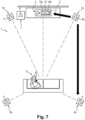
- a multi-channel audio system 1 is integrated into an audio-video reproduction system comprising a television 2 and a decoder box 3.
- front we mean the side channels closest to the television 2 and by “rear” we mean the side channels closest to the ideal listening location, also called the sweet spot, of the listener 8.
- the front right channel 5a corresponds to the right channel
- the front left channel 5b to the left channel
- the center channel 4 to the center channel
- the rear right channel 6a to the right rear and side surround channel
- left rear channel 6b to the left rear and side surround channel
- low frequency channel 7 to the LFE channel (for Low Frequency Effects ).
- the center channel 4 is integrated into the decoder box 3.
- the side channels 5a, 5b, 6a, 6b are each integrated into connected speakers (therefore four connected speakers).
- the low-frequency channel 7 is integrated into a subwoofer.
- the decoder box 3 therefore integrates at least one loudspeaker 9. All the loudspeakers 9 of the different channels are “midrange” type loudspeakers (or medium, medial), except the loudspeaker of the low frequency channel 7 which is a bass loudspeaker, also called “ boomer” or “ woofer”.
- midrange speakers is optimized for the reproduction of medium and high frequencies (frequencies between 500 Hz and 5 kHz, for example).
- the design of the woofer speaker is optimized for the reproduction of low frequencies (frequencies between 50 Hz and 500 Hz, for example).
- the invention can be implemented in a multi-channel audio system different from that of the Figure 1
- the invention applies to any type of multi-channel audio system. It would be possible in particular to integrate several or even all of the audio channels (and therefore all of the loudspeakers 9) into the decoder box 3.
- the decoder box 3 comprises a processing unit 10 (electronic and software).
- the processing unit 10 comprises at least one processing component 10a, which is for example a “generalist” processor, a processor specialized in signal processing (or DSP, for Digital Signal Processor), a processor specialized for artificial intelligence algorithms (of the NPU type, for Neural Processing Unit), a microcontroller, or a programmable logic circuit such as an FPGA (for Field Programmable Gate Arrays) or an ASIC (for Application Specified Integrated Circuit).
- the processing unit 10 also comprises one or more memories 10b, connected to or integrated in the processing component 10a. At least one of these memories 10b forms a computer-readable recording medium, on which is recorded at least one computer program comprising instructions which cause the processing component 10a to execute at least some of the steps of the broadcasting method which will be described.
- the broadcasting method is a method of broadcasting a multi-channel audio signal.
- the multi-channel audio signal comes for example (but not necessarily) from an audio-video stream, the video signal being broadcast by TV 2.
- the processing unit 10 of the set-top box 3 normally broadcasts the multi-channel audio signal using a primary distribution of the multi-channel audio signal, which defines a primary (distinct) audio signal for each audio channel.
- the processing unit 10 applies said primary audio signals to the audio channels.
- the processing unit 10 modifies this primary distribution to reduce the temperature of said one or more loudspeakers 9.
- the processing unit 10 therefore evaluates an operational temperature of at least one particular loudspeaker 9 belonging to a particular audio channel.
- the processing unit 10 evaluates the operational temperature of each loudspeaker 9 of the multi-channel audio system 1.
- the processing unit 10 modifies the primary distribution to obtain an optimized distribution of the multi-channel audio signal, in which the particular primary audio signal of the particular audio channel is applied at least partially to at least one other audio channel.
- the first predefined temperature threshold may be different depending on the audio channels and the loudspeakers 9.
- the optimized distribution thus defines an optimized (distinct) audio signal for each audio channel.
- the processing unit 10 distributes the multi-channel audio signal by applying the optimized audio signals to the audio channels until the operational temperature of the particular loudspeaker 9 becomes lower than a second predefined temperature threshold.
- the second predefined temperature threshold may be equal to the first predefined temperature threshold, but not necessarily.
- the second predefined temperature threshold may be different depending on the audio channels and the loudspeakers 9.
- the evaluation of the temperature of said loudspeaker 9 is carried out here without a temperature sensor.
- the operational temperature is assessed according to a temperature assessment method described below.
- the operational temperature is the current temperature, i.e. the temperature at the present time. It is noted that the temperature evaluation method can also make it possible to evaluate the temperature at a future time (this is then referred to as a “future temperature”).
- the initial temperature of the speaker Temp init (equal to 25 °C for example) is also known because its value is based on the ambient temperature of the equipment and on the thermal evolution of the system according to the two laws previously formulated, including the application time of the signal also known.
- the rise in the speaker's temperature depends on the frequency of the audio signal applied to its terminals. This is explained by the fact that the impedance of a loudspeaker (mounted in an enclosure or not) depends on the frequency of the audio signal.
- the processing unit 10 here performs an FFT ( Fast Fourier Transform) calculation to determine the frequency distribution of the audio signal.
- the processing unit 10 therefore determines frequency components, each associated with a power level.
- the processing unit 10 determines the temperature rise of the loudspeaker 9 resulting from the contributions of each of these frequency components, using the mathematical laws described earlier.
- the processing unit 10 For each loudspeaker 9, the processing unit 10 therefore carries out a frequency analysis of the audio signal primary applied to the audio channel comprising said loudspeaker 9 to evaluate levels of different frequency components of the primary audio signal, then evaluates a real-time temperature of the loudspeaker 9 as a function of said levels (and the ambient temperature, the initial temperature and the signal application time).
- the processing unit 10 therefore constantly knows the real-time temperature of each loudspeaker 9 at time t.
- Some dynamic algorithms such as audio compressors for example, incorporate solutions to prevent these oscillation effects.
- the maximum operating temperature of the loudspeaker 9 is usually around 80°C (this value being indicated precisely on the technical sheet of the loudspeaker 9, and of course depends on the model of the loudspeaker 9).
- a safe temperature threshold can be 15°C below this threshold to ensure that the critical temperature is not reached.
- This value corresponds to the thermal stabilization of the system for a simple, constant-level signal.
- Stabilization is determined dynamically by integrating the instantaneous level of the signal and its frequency distribution, smoothed by an envelope coefficient.
- the processing unit 10 therefore applies an ADSR envelope to the temperature in real time to obtain the current temperature.
- the processing unit 10 knows the current temperature of said loudspeaker 9 and therefore the margin relative to the limit temperature of use of said loudspeaker 9, using the thermal feedback based on the predictive calculation described previously.
- the unit of processing 10 distributes its particular primary audio signal to one or more other audio channels, dynamically and in a balanced manner, thereby reducing the temperature of the particular speaker without lowering the overall sound level or degrading the user experience.
- the first predefined threshold is, for example, equal to 65°C (i.e. 15°C below the “dangerous” temperature of 80°C).
- the processing unit 10 therefore modifies the primary distribution to obtain an optimized distribution of the multi-channel audio signal.
- the optimized audio signals are applied to the audio channels until the current temperature of the particular “overheated” loudspeaker 9 becomes lower than a second predefined temperature threshold.
- the second predefined temperature threshold is for example (but not necessarily) also equal to 65°C.
- the first scenario is applicable for an audio system comprising a center channel and two (at least) side channels.
- the particular audio channel comprising the particular overheated loudspeaker 9, is here the center channel 4.
- at least a part of the overall level of the particular primary audio signal is applied to the two side channels.
- all level we mean here a level corresponding to the sum of the acoustic energy provided by all the frequency components of the signal.
- the particular loudspeaker 9p whose operational temperature becomes higher than the first predefined temperature threshold is therefore the loudspeaker of the center channel 4.
- the primary audio signal of said central channel 4 is for example applied to the two front side channels (front right channel 5a and front left channel 5b).
- the primary audio signal of the center channel 4 continues to be applied partially to the center channel 4 by being progressively attenuated (for one minute for example), until the operational temperature of the loudspeaker 9p of the center channel 4 becomes lower than the second predefined temperature threshold and thus until a recovery of the temperature which will secure the loudspeaker 9p after stabilization.
- “partially” is understood as a part of the overall level of the primary audio signal.
- the primary audio signal removed from the center channel 4 will be transferred identically to the loudspeakers 9 of the front right 5a and front left 5b channels, to create a virtual center channel, thus relieving the loudspeaker 9 of the center channel 4 without any degradation of either the spatialization or the overall sound level.
- the second scenario is applicable for an audio system comprising a center channel, two side channels front and two rear side channels (at least).
- the particular audio channel, including the particular overheating speaker, is a particular side channel.
- At least a portion of the overall level of the particular primary audio signal is applied to the center channel 4 and to another side channel on the same side as said particular side channel.
- the particular loudspeaker 9p whose operational temperature becomes higher than the first predefined temperature threshold is the loudspeaker of a particular side channel, which is for example here the right front channel 5a.
- the primary audio signal from the front right channel 5a is applied to the center channel 4 and to the rear right channel 6a.
- the primary audio signal of the front right channel 5a continues to be applied partially to the front right channel 5a by being progressively attenuated (for one minute for example), until the operational temperature of the loudspeaker 9p of the front right channel 5a becomes lower than the second predefined temperature threshold and thus until a recovery of the temperature which will secure the loudspeaker after stabilization.
- "partially” is understood as a part of the overall level of the primary audio signal.
- the primary audio signal removed from the front right channel 5a will be transferred identically to the loudspeaker 9 of the rear right channel 6a and to the loudspeaker 9 of the central channel 4, to create a virtual side channel, thus relieving the loudspeaker 9p of the front right channel 5a without any degradation of either the spatialization or the overall sound level.
- This scenario can apply to another side lane: right rear, left front, left rear.
- the third scenario is applicable for an audio system comprising two front side channels and two rear side channels.
- the particular audio channel comprising the particular overheating 9p speaker, is a front (or rear) side channel.
- At least a portion of the overall level of the particular primary audio signal is applied to another side channel on the same side as said particular side channel, and to the other front (or rear) side channel.
- the particular loudspeaker 9p whose operational temperature becomes higher than the first predefined temperature threshold is the right rear channel loudspeaker 6a.
- the primary audio signal from the right rear channel 6a is therefore applied to the left rear channel 6b and to the right front channel 5a.
- the primary audio signal of the right rear channel 6a will be gradually attenuated (for one minute for example), until the temperature is restored which will secure the speaker 9p after stabilization.
- the primary audio signal of the right rear channel 6a therefore continues to be partially applied to the channel rear right channel 6a by being gradually attenuated (for one minute for example), until the operational temperature of the loudspeaker 9p of the rear right channel 6a becomes lower than the second predefined temperature threshold and thus until a recovery of the temperature which will secure the loudspeaker after stabilization.
- “partially” is understood as a part of the overall level of the primary audio signal.
- This scenario can apply to another side lane: front right, front left, rear left.
- the fourth scenario is applicable for an audio system comprising a low-frequency channel and at least one other audio channel.
- the particular audio channel comprising the particular overheating speaker, is one of the at least one other audio channel.
- frequency components of frequencies lower than a predefined frequency threshold of the particular primary audio signal are applied to the low frequency channel 7.
- the predefined frequency threshold is for example equal to 100 Hz.
- a number of particular loudspeakers 9, whose operational temperature becomes higher than the first predefined threshold must be greater than a predefined number, for this scenario to apply (i.e. a situation in which there are too many loudspeakers overheating).
- the predefined number is for example equal to 3.
- the low frequency components are then applied to the low frequency channel 7.
- the low frequencies of the primary audio signals of the front right 5a, rear right 6a, front left 5b and rear left 6b channels will be gradually attenuated (for one minute for example), until the temperature is restored which will secure the 9p speakers after stabilization.
- the low frequencies of the primary audio signals of the front right 5a, rear right 6a, front left 5b and rear left 6b channels therefore continue to be applied partially (for one minute for example), until the operational temperature of the loudspeakers 9p becomes lower than the second predefined temperature threshold and thus until a temperature recovery that will secure the loudspeakers after stabilization.
- "partially” is understood as a part of the frequency components.
- Modifying the primary distribution may involve applying at least one portion of an overall level of the particular primary audio signal to at least one other audio channel. We therefore adjust the attenuation or gain level in each channel independently.
- the primary signal subtracted from the loudspeaker to be secured is distributed to the loudspeakers of other audio channels according to the following logic.
- the fundamental acoustic properties we can evaluate the signal level to be injected into each loudspeaker to ensure a stable level and tonal balance.
- the processing unit 10 subtracts N dB from the primary signal of the center channel loudspeaker 4 and reinjects N2a and N2b on the front right 5a and front left 5b side channels.
- the processing unit 10 subtracts respectively N1, N2, ..., Ni dB from the sources at risk and reinjects Nc dB into the low frequency channel 7.
- Nc ⁇ 20 ⁇ log 10 N 1 10 + 10 N 2 10 + .. + 10 Ni 10 i + 1
- This model is an approach to possible distribution and can be adapted according to the physical capabilities of the enclosures considered.
- the spatialization applied will be optimized for an ideal listening location, also called sweet spot.
- the implementation of the diffusion process allows the viability of the sweet spot to be maintained, whatever it may be, since the adaptation of the distribution of the multi-channel audio signal ensures that the spatial and tonal balance of the sound transmitted in the listening area is maintained.
- the spatial balance may be degraded when the correction algorithm is applied.
- a listener who is, for example, near a side speaker, to which an audio signal is being transferred, may feel the increase in the level on the channel.
- the notion of sweet spot is much broader because the speakers in the system are very close together. Changing the distribution, in the event of a speaker overheating, will be much less noticeable, because the listener is a similar distance away for each speaker.
- the distribution of the multi-channel audio signal across the various audio channels is defined by mixing matrices dedicated to spatial sound processing. These mixing matrices are presented in the form of input/output connections with variable dimensions depending on requirements.
- the mixing matrix 15 is for example intended to process a mono audio signal 16 (of type 1.0) or stereo (of type 2.0), or a multi-channel audio signal 17 of type Dolby 5.1, Dolby 7.1, DTS 5.1, etc.
- the mixing matrix 15 generates a multi-channel audio signal 18 depending on the audio system which reproduces the signal.
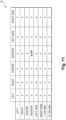
- FIG. 11 represents a first mixing matrix 19 used by Dolby, processing audio formats up to 7.1 format as input, and generating audio signals in 5.1 format as output.
- This first mixing matrix 19 corresponds to the primary multi-channel audio distribution used by the processing unit 10 to distribute the multi-channel audio signal.
- the processing unit 10 adapts the mixing matrix to adjust the level on one or more speakers 9 of the system at the same time, while respecting the broadcast content.
- the level of the left and right channels has increased, but the creation of the virtual center channel compensates for this level change.
- modifying the primary distribution can consist of applying at least part of the overall level of the particular primary audio signal to at least one other audio channel.
- a loudspeaker can indeed be relieved by attenuating the audio signal transmitted to it, but also by changing the frequency distribution of its signal.
- Distributing part of the spectrum to one or more other 9 speakers allows to relieve the particular 9p speaker whose temperature is too high, without applying a static gain on its entire signal.
- curve C8 is the curve of loudspeaker 9 of the central channel 4
- curve C9 is that of loudspeaker 9 of the low-frequency channel 7.
- the modification of the primary distribution, by a different distribution of the frequency components, would allow, for example, in the frequency band 22, to send part of the low frequency signal from the central channel 4 to the low frequency channel 7.
- Changing the primary distribution involves changing (in this case increasing) the cut-off frequency of the crossover filter that distributes the frequencies between the different audio channels. This increases the spectrum reproduced by the low-frequency channel and reduces the spectrum reproduced by the other channels.
- the processing unit 10 evaluates the real-time temperature Tr of said loudspeaker 9 from the levels of the frequency components of the primary audio signal applied to the audio channel comprising said loudspeaker 9: step E1.
- the processing unit 10 then applies the ADSR envelope to obtain the operational temperature To of said loudspeaker 9: step E2.
- the processing unit 10 compares the operational temperature To with the first predefined temperature threshold T1: step E3.
- the processing unit 10 does not modify the mixing matrix (step E4) nor the settings (cutoff frequency) of the crossover filter (step E5).
- the processing unit 10 broadcasts the multi-channel audio signal using the current coefficients of the mixing matrix (step E6) and the current settings of the crossover filter (step E7).
- the processing unit 10 then broadcasts the multi-channel audio signal using the current coefficients of the mixing matrix, which have just been modified (step E6).
- step E3 if the operational temperature of at least one particular loudspeaker 9p is higher than the first predefined temperature threshold, the processing unit 10 checks the number of loudspeakers whose operational temperature is higher than the first predefined temperature threshold: step E9.
- the processing unit 10 modifies the primary distribution by applying the low-frequency frequency components of the particular primary audio signals to at least one audio channel whose loudspeaker does not heat up (preferably to the low-frequency channel 7).
- the processing unit 10 modifies the cut-off frequency of the crossover filter for this purpose: step E10.
- the processing unit 10 broadcasts the multi-channel audio signal using the current settings of the crossover filter, which have just been modified (step E7).
- step E3 if the number is less than the predefined number (here less than or equal), the processing unit 10 does not modify the settings (cutoff frequency) of the crossover filter (step E5).
- the processing unit 10 broadcasts the multi-channel audio signal using the current settings of the crossover filter, unmodified (step E7).
- the main tests for determining the model's action therefore assess whether the temperatures of the various loudspeakers exceed the first predefined temperature threshold. From then on, the level distribution in the various audio channels is calculated and translated into mixing matrix coefficients. In addition, the number of speakers concerned is taken into account to activate or not the frequency distribution. A calculation will then be carried out to increase the frequency of the crossover(s) in order to help the speakers lower their temperature.
- the thermal simulation model 30 analyzes the primary audio signals Sap applied to the input of the loudspeakers 9.
- the processing unit 10 evaluates the temperature in real time and then the operational temperature.
- the distribution model 31 is implemented.
- the distribution by level results in an adaptation of the mixing matrix 32.
- the frequency distribution results in a modification of the crossover filter 33.
- the multi-channel audio signal Sam is applied to the input of the mixing matrix 32 then to the crossover filter 33.
- the primary audio signals Sap (if no loudspeaker is overheating) or the optimized audio signals Sao (if at least one loudspeaker is overheating) are processed and shaped by a processing module 34 then amplified by the amplifiers 35 and applied to the input of the loudspeakers 9 which broadcast the sound signal Ss corresponding to the multi-channel audio signal Sam.
- the primary audio signals Sap analyzed by the thermal simulation model 30, can be the input or output signals of the amplifiers 35.
- the diffusion process therefore does not allow one to completely do without one or more sources, but rather to optimize their use and longevity by pushing back the limit conditions of the loudspeakers.
- the diffusion process includes the step of increasing the gain applied to one or more loudspeakers. Consequently, the risk of saturation and damage to the equipment may increase with the action of the diffusion process.
- the protection devices usually used to limit the voltage level sent to the loudspeakers, and for example one or more dynamic limiters. Properly dimensioned (in particular by a set of ADSR parameters seen earlier), they allow a signal to be attenuated when it exceeds a certain threshold (70 °C for example). This attenuation will be very rapid if the threshold is close to the physical limit of the speaker considered (80°C for example).
- the cut-off frequency will correspond to that of the hardware components used.
- the diffusion method consists of evaluating the operational temperature of at least one loudspeaker and, if this becomes too high, applying the particular primary audio signal at least partially to at least one other audio channel.
- the operational temperature is not necessarily a current temperature, that is to say a temperature at the present time, but can be a temperature at a future time (we then speak of "future temperature").
- Estimating the future temperature, and therefore applying the correction in advance allows the process to react more quickly and thus be able to simply apply a smaller, and therefore less audible, correction. Rather than estimating the future temperature, the process can also use a feedback loop.
- the particular "future" primary audio signal is known, for example because the processing unit 10 is playing a local file and the entire file is available.
- the processing unit 10 can therefore apply the method already described on this future signal to estimate the temperature.
- the evaluation of the operational temperature is therefore based on an analysis of the particular primary audio signal carried out prior to its broadcast.
- the processing unit determines that a correction is necessary, the signal actually played will be different from the future signal used to estimate the temperature, since the signal actually played will integrate the correction.
- the future temperature is estimated based on the current (present) temperature and the evolution of the temperature in the near past (and therefore based on a “past temperature”).
- T f t T c t + T c t ⁇ T c t ⁇ 1 .
- the processing unit 10 implements a servo controller (or corrector).
- the servo controller is a module which receives an input instruction and a measurement, and which produces an output command which, when applied to a system, tends to bring the measurement closer to the instruction.
- the setpoint here is the desired maximum temperature T max , set a little below the limit not to be exceeded since the usual controllers tend to oscillate around the setpoint, and therefore to exceed it a little.
- the measurement is the current temperature estimated by the temperature evaluation method described earlier.
- the command represents the portion G c (t) of the particular primary audio signal to be redistributed to other loudspeakers when it is negative (in decibels).
- the processing unit 10 first estimates the current temperature T c (t).
- I c t I c t ⁇ 1 + I ⁇ ⁇ t
- I c t clamp I c t ⁇ 1 + I ⁇ ⁇ t , I min , I max , with I min ⁇ 0 and I max > 0 and predetermined.
- this embodiment is a generalization of the embodiment mentioned earlier and consisting of estimating the future temperature as a function of the current temperature and the past temperature.
- P c (t) corresponds to the use of the current temperature
- D c (t) adds the consideration of the future temperature
- the broadcast process does not necessarily include monitoring the temperature of all speakers. It is possible to monitor only one or more "at risk” speakers.
- the diffusion method can be implemented regardless of the multi-channel audio system.
- the speakers can be integrated into any number of devices, and even into a single device, which can be a set-top box, a sound bar, a speaker, etc.
- the equipment in question may therefore in particular be a decoder box.
- the decoder box can integrate at least one speaker from the plurality of audio channels used in implementing the broadcasting method.
- the set-top box can thus integrate all the speakers used.
- the set-top box integrates the processing unit, the audio amplifiers and at least two speakers, and for example four speakers forming four audio channels (left, right, center and bass).
- the decoder box can also integrate one or more speakers, the other speakers used (for example those of the rear channels) being remote.
- All speakers can also be positioned outside the set-top box.
- the processing unit in which the broadcasting method is implemented, can be integrated into one or more devices belonging or not to the multi-channel audio system (the broadcasting method could be implemented remotely, on a cloud server for example).
Landscapes
- Engineering & Computer Science (AREA)
- Signal Processing (AREA)
- Physics & Mathematics (AREA)
- Acoustics & Sound (AREA)
- Health & Medical Sciences (AREA)
- General Health & Medical Sciences (AREA)
- Otolaryngology (AREA)
- Multimedia (AREA)
- Stereophonic System (AREA)
Applications Claiming Priority (1)
| Application Number | Priority Date | Filing Date | Title |
|---|---|---|---|
| FR2312068A FR3149456A1 (fr) | 2023-11-07 | 2023-11-07 | Répartition des signaux audio pour l’optimisation thermique des haut-parleurs |
Publications (2)
| Publication Number | Publication Date |
|---|---|
| EP4554256A2 true EP4554256A2 (de) | 2025-05-14 |
| EP4554256A3 EP4554256A3 (de) | 2025-08-20 |
Family
ID=89426819
Family Applications (1)
| Application Number | Title | Priority Date | Filing Date |
|---|---|---|---|
| EP24211384.3A Pending EP4554256A3 (de) | 2023-11-07 | 2024-11-07 | Audiosignalverteilung zur thermischen optimierung von lautsprechern |
Country Status (3)
| Country | Link |
|---|---|
| US (1) | US20250150188A1 (de) |
| EP (1) | EP4554256A3 (de) |
| FR (1) | FR3149456A1 (de) |
Family Cites Families (7)
| Publication number | Priority date | Publication date | Assignee | Title |
|---|---|---|---|---|
| US9154877B2 (en) * | 2012-11-28 | 2015-10-06 | Qualcomm Incorporated | Collaborative sound system |
| GB2534950B (en) * | 2015-02-02 | 2017-05-10 | Cirrus Logic Int Semiconductor Ltd | Loudspeaker protection |
| GB2559204A (en) * | 2017-01-25 | 2018-08-01 | Cirrus Logic Int Semiconductor Ltd | Loudspeaker protection systems and methods |
| US10536774B2 (en) * | 2017-12-21 | 2020-01-14 | Harman International Industries, Incorporated | Constrained nonlinear parameter estimation for robust nonlinear loudspeaker modeling for the purpose of smart limiting |
| CN114223218B (zh) * | 2019-08-14 | 2025-01-07 | 杜比实验室特许公司 | 用于监测和报告扬声器健康状况的方法和系统 |
| WO2021195658A1 (en) * | 2020-03-25 | 2021-09-30 | Sonos, Inc. | Thermal control of audio playback devices |
| FR3125912A1 (fr) * | 2021-12-21 | 2023-02-03 | Sagemcom Broadband Sas | Dissipation thermique grâce à un haut-parleur |
-
2023
- 2023-11-07 FR FR2312068A patent/FR3149456A1/fr not_active Ceased
-
2024
- 2024-11-07 EP EP24211384.3A patent/EP4554256A3/de active Pending
- 2024-11-07 US US18/940,758 patent/US20250150188A1/en active Pending
Also Published As
| Publication number | Publication date |
|---|---|
| FR3149456A1 (fr) | 2024-12-06 |
| US20250150188A1 (en) | 2025-05-08 |
| EP4554256A3 (de) | 2025-08-20 |
Similar Documents
| Publication | Publication Date | Title |
|---|---|---|
| KR102473598B1 (ko) | 왜곡 감지, 방지, 및 왜곡-인지 베이스 강화 | |
| EP2571286B1 (de) | Verfahren zur Verstärkung der tiefen Frequenzen in einem digitalen Audiosignal | |
| CN108365827B (zh) | 具有动态阈值的频带压缩 | |
| JP2008504783A (ja) | 音声信号のラウドネスを自動的に調整する方法及びシステム | |
| CN104798301A (zh) | 音频响度控制系统 | |
| EP2113913B1 (de) | Verfahren und System zur Wiederherstellung von Niedrigfrequenzen in einem Audiosignal | |
| EP3248285B1 (de) | Vorrichtung zur steuerung eines lautsprechers mit strombegrenzung | |
| EP3815395A1 (de) | Verfahren zur raumklangwiedergabe eines in einem teilbereich einer fläche selektiv hörbaren klangfeldes | |
| CN114303391B (zh) | 音量相关的音频补偿 | |
| FR3031853A1 (fr) | Procede d'adaptation du gain de volume pour la limitation de puissance d'un amplificateur et amplificateur | |
| EP4554256A2 (de) | Audiosignalverteilung zur thermischen optimierung von lautsprechern | |
| WO2018073542A1 (fr) | Procede et dispositif d'optimisation de la puissance radiofrequence d'un emetteur de radiodiffusion fm | |
| US10389323B2 (en) | Context-aware loudness control | |
| CN117119358B (zh) | 一种声像偏侧的补偿方法、装置、电子设备及存储设备 | |
| US20230029841A1 (en) | Perceptual bass extension with loudness management and artificial intelligence (ai) | |
| FR2989859A1 (fr) | Procede de protection thermique d'un haut-parleur et dispositif de protection thermique d'un haut-parleur associe | |
| CN114128307B (zh) | 用于个人听取设备中的自适应声音均衡的系统和方法 | |
| WO2012066265A1 (fr) | Systeme de correction de spectre destine notamment a une salle de spectacle | |
| WO2026032789A1 (fr) | Methode d'optimisation de la reponse en frequence d'au moins deux enceintes placees dans un environnement specifique | |
| WO2026035570A1 (en) | A method for adaptive speech enhancement based on speech experience | |
| EP4297425A1 (de) | Lichtabhängige audioparameter | |
| CA3163814A1 (fr) | Procede et dispositif associe pour transformer des caracteristiques d'un signal audio | |
| HK40060254A (en) | System and method for adaptive sound equalization in personal hearing devices | |
| FR2954655A1 (fr) | Procede de selection d'un ensemble de filtres applicables a des haut-parleurs, dispositif et programme d'ordinateur associes | |
| FR3087075A1 (fr) | Dispositif de compensation des differences de perception des frequences d'un signal audio en fonction du niveau sonore de restitution du signal |
Legal Events
| Date | Code | Title | Description |
|---|---|---|---|
| PUAI | Public reference made under article 153(3) epc to a published international application that has entered the european phase |
Free format text: ORIGINAL CODE: 0009012 |
|
| STAA | Information on the status of an ep patent application or granted ep patent |
Free format text: STATUS: REQUEST FOR EXAMINATION WAS MADE |
|
| 17P | Request for examination filed |
Effective date: 20241107 |
|
| AK | Designated contracting states |
Kind code of ref document: A2 Designated state(s): AL AT BE BG CH CY CZ DE DK EE ES FI FR GB GR HR HU IE IS IT LI LT LU LV MC ME MK MT NL NO PL PT RO RS SE SI SK SM TR |
|
| PUAL | Search report despatched |
Free format text: ORIGINAL CODE: 0009013 |
|
| STAA | Information on the status of an ep patent application or granted ep patent |
Free format text: STATUS: EXAMINATION IS IN PROGRESS |
|
| AK | Designated contracting states |
Kind code of ref document: A3 Designated state(s): AL AT BE BG CH CY CZ DE DK EE ES FI FR GB GR HR HU IE IS IT LI LT LU LV MC ME MK MT NL NO PL PT RO RS SE SI SK SM TR |
|
| RIC1 | Information provided on ipc code assigned before grant |
Ipc: H04S 7/00 20060101AFI20250711BHEP Ipc: H04R 29/00 20060101ALI20250711BHEP Ipc: H04R 3/00 20060101ALN20250711BHEP Ipc: H04R 3/14 20060101ALN20250711BHEP |
|
| 17Q | First examination report despatched |
Effective date: 20250729 |