EP4550482A1 - Katalysatorelektrode, verfahren zur herstellung einer katalysatorelektrode und membranelektrodenanordnung - Google Patents
Katalysatorelektrode, verfahren zur herstellung einer katalysatorelektrode und membranelektrodenanordnung Download PDFInfo
- Publication number
- EP4550482A1 EP4550482A1 EP24205980.6A EP24205980A EP4550482A1 EP 4550482 A1 EP4550482 A1 EP 4550482A1 EP 24205980 A EP24205980 A EP 24205980A EP 4550482 A1 EP4550482 A1 EP 4550482A1
- Authority
- EP
- European Patent Office
- Prior art keywords
- layer
- silver
- iridium
- metal
- catalyst
- Prior art date
- Legal status (The legal status is an assumption and is not a legal conclusion. Google has not performed a legal analysis and makes no representation as to the accuracy of the status listed.)
- Pending
Links
Images





Classifications
-
- H—ELECTRICITY
- H01—ELECTRIC ELEMENTS
- H01M—PROCESSES OR MEANS, e.g. BATTERIES, FOR THE DIRECT CONVERSION OF CHEMICAL ENERGY INTO ELECTRICAL ENERGY
- H01M4/00—Electrodes
- H01M4/86—Inert electrodes with catalytic activity, e.g. for fuel cells
- H01M4/90—Selection of catalytic material
- H01M4/92—Metals of platinum group
- H01M4/921—Alloys or mixtures with metallic elements
-
- C—CHEMISTRY; METALLURGY
- C25—ELECTROLYTIC OR ELECTROPHORETIC PROCESSES; APPARATUS THEREFOR
- C25B—ELECTROLYTIC OR ELECTROPHORETIC PROCESSES FOR THE PRODUCTION OF COMPOUNDS OR NON-METALS; APPARATUS THEREFOR
- C25B11/00—Electrodes; Manufacture thereof not otherwise provided for
- C25B11/04—Electrodes; Manufacture thereof not otherwise provided for characterised by the material
- C25B11/051—Electrodes formed of electrocatalysts on a substrate or carrier
- C25B11/052—Electrodes comprising one or more electrocatalytic coatings on a substrate
-
- H—ELECTRICITY
- H01—ELECTRIC ELEMENTS
- H01M—PROCESSES OR MEANS, e.g. BATTERIES, FOR THE DIRECT CONVERSION OF CHEMICAL ENERGY INTO ELECTRICAL ENERGY
- H01M4/00—Electrodes
- H01M4/86—Inert electrodes with catalytic activity, e.g. for fuel cells
- H01M4/90—Selection of catalytic material
- H01M4/92—Metals of platinum group
- H01M4/925—Metals of platinum group supported on carriers, e.g. powder carriers
-
- B—PERFORMING OPERATIONS; TRANSPORTING
- B01—PHYSICAL OR CHEMICAL PROCESSES OR APPARATUS IN GENERAL
- B01J—CHEMICAL OR PHYSICAL PROCESSES, e.g. CATALYSIS OR COLLOID CHEMISTRY; THEIR RELEVANT APPARATUS
- B01J23/00—Catalysts comprising metals or metal oxides or hydroxides, not provided for in group B01J21/00
- B01J23/38—Catalysts comprising metals or metal oxides or hydroxides, not provided for in group B01J21/00 of noble metals
- B01J23/40—Catalysts comprising metals or metal oxides or hydroxides, not provided for in group B01J21/00 of noble metals of the platinum group metals
- B01J23/46—Ruthenium, rhodium, osmium or iridium
- B01J23/468—Iridium
-
- B—PERFORMING OPERATIONS; TRANSPORTING
- B01—PHYSICAL OR CHEMICAL PROCESSES OR APPARATUS IN GENERAL
- B01J—CHEMICAL OR PHYSICAL PROCESSES, e.g. CATALYSIS OR COLLOID CHEMISTRY; THEIR RELEVANT APPARATUS
- B01J23/00—Catalysts comprising metals or metal oxides or hydroxides, not provided for in group B01J21/00
- B01J23/38—Catalysts comprising metals or metal oxides or hydroxides, not provided for in group B01J21/00 of noble metals
- B01J23/48—Silver or gold
- B01J23/50—Silver
-
- B—PERFORMING OPERATIONS; TRANSPORTING
- B01—PHYSICAL OR CHEMICAL PROCESSES OR APPARATUS IN GENERAL
- B01J—CHEMICAL OR PHYSICAL PROCESSES, e.g. CATALYSIS OR COLLOID CHEMISTRY; THEIR RELEVANT APPARATUS
- B01J37/00—Processes, in general, for preparing catalysts; Processes, in general, for activation of catalysts
- B01J37/02—Impregnation, coating or precipitation
- B01J37/0215—Coating
- B01J37/0217—Pretreatment of the substrate before coating
-
- B—PERFORMING OPERATIONS; TRANSPORTING
- B01—PHYSICAL OR CHEMICAL PROCESSES OR APPARATUS IN GENERAL
- B01J—CHEMICAL OR PHYSICAL PROCESSES, e.g. CATALYSIS OR COLLOID CHEMISTRY; THEIR RELEVANT APPARATUS
- B01J37/00—Processes, in general, for preparing catalysts; Processes, in general, for activation of catalysts
- B01J37/02—Impregnation, coating or precipitation
- B01J37/0215—Coating
- B01J37/0225—Coating of metal substrates
-
- B—PERFORMING OPERATIONS; TRANSPORTING
- B01—PHYSICAL OR CHEMICAL PROCESSES OR APPARATUS IN GENERAL
- B01J—CHEMICAL OR PHYSICAL PROCESSES, e.g. CATALYSIS OR COLLOID CHEMISTRY; THEIR RELEVANT APPARATUS
- B01J37/00—Processes, in general, for preparing catalysts; Processes, in general, for activation of catalysts
- B01J37/02—Impregnation, coating or precipitation
- B01J37/0215—Coating
- B01J37/0228—Coating in several steps
-
- B—PERFORMING OPERATIONS; TRANSPORTING
- B01—PHYSICAL OR CHEMICAL PROCESSES OR APPARATUS IN GENERAL
- B01J—CHEMICAL OR PHYSICAL PROCESSES, e.g. CATALYSIS OR COLLOID CHEMISTRY; THEIR RELEVANT APPARATUS
- B01J37/00—Processes, in general, for preparing catalysts; Processes, in general, for activation of catalysts
- B01J37/08—Heat treatment
-
- B—PERFORMING OPERATIONS; TRANSPORTING
- B32—LAYERED PRODUCTS
- B32B—LAYERED PRODUCTS, i.e. PRODUCTS BUILT-UP OF STRATA OF FLAT OR NON-FLAT, e.g. CELLULAR OR HONEYCOMB, FORM
- B32B15/00—Layered products comprising a layer of metal
- B32B15/01—Layered products comprising a layer of metal all layers being exclusively metallic
-
- B—PERFORMING OPERATIONS; TRANSPORTING
- B32—LAYERED PRODUCTS
- B32B—LAYERED PRODUCTS, i.e. PRODUCTS BUILT-UP OF STRATA OF FLAT OR NON-FLAT, e.g. CELLULAR OR HONEYCOMB, FORM
- B32B15/00—Layered products comprising a layer of metal
- B32B15/01—Layered products comprising a layer of metal all layers being exclusively metallic
- B32B15/018—Layered products comprising a layer of metal all layers being exclusively metallic one layer being formed of a noble metal or a noble metal alloy
-
- C—CHEMISTRY; METALLURGY
- C23—COATING METALLIC MATERIAL; COATING MATERIAL WITH METALLIC MATERIAL; CHEMICAL SURFACE TREATMENT; DIFFUSION TREATMENT OF METALLIC MATERIAL; COATING BY VACUUM EVAPORATION, BY SPUTTERING, BY ION IMPLANTATION OR BY CHEMICAL VAPOUR DEPOSITION, IN GENERAL; INHIBITING CORROSION OF METALLIC MATERIAL OR INCRUSTATION IN GENERAL
- C23C—COATING METALLIC MATERIAL; COATING MATERIAL WITH METALLIC MATERIAL; SURFACE TREATMENT OF METALLIC MATERIAL BY DIFFUSION INTO THE SURFACE, BY CHEMICAL CONVERSION OR SUBSTITUTION; COATING BY VACUUM EVAPORATION, BY SPUTTERING, BY ION IMPLANTATION OR BY CHEMICAL VAPOUR DEPOSITION, IN GENERAL
- C23C18/00—Chemical coating by decomposition of either liquid compounds or solutions of the coating forming compounds, without leaving reaction products of surface material in the coating; Contact plating
- C23C18/02—Chemical coating by decomposition of either liquid compounds or solutions of the coating forming compounds, without leaving reaction products of surface material in the coating; Contact plating by thermal decomposition
- C23C18/04—Pretreatment of the material to be coated
-
- C—CHEMISTRY; METALLURGY
- C23—COATING METALLIC MATERIAL; COATING MATERIAL WITH METALLIC MATERIAL; CHEMICAL SURFACE TREATMENT; DIFFUSION TREATMENT OF METALLIC MATERIAL; COATING BY VACUUM EVAPORATION, BY SPUTTERING, BY ION IMPLANTATION OR BY CHEMICAL VAPOUR DEPOSITION, IN GENERAL; INHIBITING CORROSION OF METALLIC MATERIAL OR INCRUSTATION IN GENERAL
- C23C—COATING METALLIC MATERIAL; COATING MATERIAL WITH METALLIC MATERIAL; SURFACE TREATMENT OF METALLIC MATERIAL BY DIFFUSION INTO THE SURFACE, BY CHEMICAL CONVERSION OR SUBSTITUTION; COATING BY VACUUM EVAPORATION, BY SPUTTERING, BY ION IMPLANTATION OR BY CHEMICAL VAPOUR DEPOSITION, IN GENERAL
- C23C18/00—Chemical coating by decomposition of either liquid compounds or solutions of the coating forming compounds, without leaving reaction products of surface material in the coating; Contact plating
- C23C18/02—Chemical coating by decomposition of either liquid compounds or solutions of the coating forming compounds, without leaving reaction products of surface material in the coating; Contact plating by thermal decomposition
- C23C18/08—Chemical coating by decomposition of either liquid compounds or solutions of the coating forming compounds, without leaving reaction products of surface material in the coating; Contact plating by thermal decomposition characterised by the deposition of metallic material
-
- C—CHEMISTRY; METALLURGY
- C23—COATING METALLIC MATERIAL; COATING MATERIAL WITH METALLIC MATERIAL; CHEMICAL SURFACE TREATMENT; DIFFUSION TREATMENT OF METALLIC MATERIAL; COATING BY VACUUM EVAPORATION, BY SPUTTERING, BY ION IMPLANTATION OR BY CHEMICAL VAPOUR DEPOSITION, IN GENERAL; INHIBITING CORROSION OF METALLIC MATERIAL OR INCRUSTATION IN GENERAL
- C23G—CLEANING OR DE-GREASING OF METALLIC MATERIAL BY CHEMICAL METHODS OTHER THAN ELECTROLYSIS
- C23G1/00—Cleaning or pickling metallic material with solutions or molten salts
- C23G1/02—Cleaning or pickling metallic material with solutions or molten salts with acid solutions
-
- C—CHEMISTRY; METALLURGY
- C25—ELECTROLYTIC OR ELECTROPHORETIC PROCESSES; APPARATUS THEREFOR
- C25B—ELECTROLYTIC OR ELECTROPHORETIC PROCESSES FOR THE PRODUCTION OF COMPOUNDS OR NON-METALS; APPARATUS THEREFOR
- C25B1/00—Electrolytic production of inorganic compounds or non-metals
- C25B1/01—Products
- C25B1/02—Hydrogen or oxygen
- C25B1/04—Hydrogen or oxygen by electrolysis of water
-
- C—CHEMISTRY; METALLURGY
- C25—ELECTROLYTIC OR ELECTROPHORETIC PROCESSES; APPARATUS THEREFOR
- C25B—ELECTROLYTIC OR ELECTROPHORETIC PROCESSES FOR THE PRODUCTION OF COMPOUNDS OR NON-METALS; APPARATUS THEREFOR
- C25B11/00—Electrodes; Manufacture thereof not otherwise provided for
- C25B11/02—Electrodes; Manufacture thereof not otherwise provided for characterised by shape or form
- C25B11/03—Electrodes; Manufacture thereof not otherwise provided for characterised by shape or form perforated or foraminous
-
- C—CHEMISTRY; METALLURGY
- C25—ELECTROLYTIC OR ELECTROPHORETIC PROCESSES; APPARATUS THEREFOR
- C25B—ELECTROLYTIC OR ELECTROPHORETIC PROCESSES FOR THE PRODUCTION OF COMPOUNDS OR NON-METALS; APPARATUS THEREFOR
- C25B11/00—Electrodes; Manufacture thereof not otherwise provided for
- C25B11/02—Electrodes; Manufacture thereof not otherwise provided for characterised by shape or form
- C25B11/03—Electrodes; Manufacture thereof not otherwise provided for characterised by shape or form perforated or foraminous
- C25B11/031—Porous electrodes
-
- C—CHEMISTRY; METALLURGY
- C25—ELECTROLYTIC OR ELECTROPHORETIC PROCESSES; APPARATUS THEREFOR
- C25B—ELECTROLYTIC OR ELECTROPHORETIC PROCESSES FOR THE PRODUCTION OF COMPOUNDS OR NON-METALS; APPARATUS THEREFOR
- C25B11/00—Electrodes; Manufacture thereof not otherwise provided for
- C25B11/04—Electrodes; Manufacture thereof not otherwise provided for characterised by the material
- C25B11/051—Electrodes formed of electrocatalysts on a substrate or carrier
- C25B11/052—Electrodes comprising one or more electrocatalytic coatings on a substrate
- C25B11/053—Electrodes comprising one or more electrocatalytic coatings on a substrate characterised by multilayer electrocatalytic coatings
-
- C—CHEMISTRY; METALLURGY
- C25—ELECTROLYTIC OR ELECTROPHORETIC PROCESSES; APPARATUS THEREFOR
- C25B—ELECTROLYTIC OR ELECTROPHORETIC PROCESSES FOR THE PRODUCTION OF COMPOUNDS OR NON-METALS; APPARATUS THEREFOR
- C25B11/00—Electrodes; Manufacture thereof not otherwise provided for
- C25B11/04—Electrodes; Manufacture thereof not otherwise provided for characterised by the material
- C25B11/051—Electrodes formed of electrocatalysts on a substrate or carrier
- C25B11/055—Electrodes formed of electrocatalysts on a substrate or carrier characterised by the substrate or carrier material
- C25B11/057—Electrodes formed of electrocatalysts on a substrate or carrier characterised by the substrate or carrier material consisting of a single element or compound
- C25B11/061—Metal or alloy
-
- C—CHEMISTRY; METALLURGY
- C25—ELECTROLYTIC OR ELECTROPHORETIC PROCESSES; APPARATUS THEREFOR
- C25B—ELECTROLYTIC OR ELECTROPHORETIC PROCESSES FOR THE PRODUCTION OF COMPOUNDS OR NON-METALS; APPARATUS THEREFOR
- C25B11/00—Electrodes; Manufacture thereof not otherwise provided for
- C25B11/04—Electrodes; Manufacture thereof not otherwise provided for characterised by the material
- C25B11/051—Electrodes formed of electrocatalysts on a substrate or carrier
- C25B11/055—Electrodes formed of electrocatalysts on a substrate or carrier characterised by the substrate or carrier material
- C25B11/057—Electrodes formed of electrocatalysts on a substrate or carrier characterised by the substrate or carrier material consisting of a single element or compound
- C25B11/061—Metal or alloy
- C25B11/063—Valve metal, e.g. titanium
-
- C—CHEMISTRY; METALLURGY
- C25—ELECTROLYTIC OR ELECTROPHORETIC PROCESSES; APPARATUS THEREFOR
- C25B—ELECTROLYTIC OR ELECTROPHORETIC PROCESSES FOR THE PRODUCTION OF COMPOUNDS OR NON-METALS; APPARATUS THEREFOR
- C25B11/00—Electrodes; Manufacture thereof not otherwise provided for
- C25B11/04—Electrodes; Manufacture thereof not otherwise provided for characterised by the material
- C25B11/051—Electrodes formed of electrocatalysts on a substrate or carrier
- C25B11/073—Electrodes formed of electrocatalysts on a substrate or carrier characterised by the electrocatalyst material
- C25B11/075—Electrodes formed of electrocatalysts on a substrate or carrier characterised by the electrocatalyst material consisting of a single catalytic element or catalytic compound
- C25B11/081—Electrodes formed of electrocatalysts on a substrate or carrier characterised by the electrocatalyst material consisting of a single catalytic element or catalytic compound the element being a noble metal
-
- C—CHEMISTRY; METALLURGY
- C25—ELECTROLYTIC OR ELECTROPHORETIC PROCESSES; APPARATUS THEREFOR
- C25B—ELECTROLYTIC OR ELECTROPHORETIC PROCESSES FOR THE PRODUCTION OF COMPOUNDS OR NON-METALS; APPARATUS THEREFOR
- C25B11/00—Electrodes; Manufacture thereof not otherwise provided for
- C25B11/04—Electrodes; Manufacture thereof not otherwise provided for characterised by the material
- C25B11/051—Electrodes formed of electrocatalysts on a substrate or carrier
- C25B11/073—Electrodes formed of electrocatalysts on a substrate or carrier characterised by the electrocatalyst material
- C25B11/075—Electrodes formed of electrocatalysts on a substrate or carrier characterised by the electrocatalyst material consisting of a single catalytic element or catalytic compound
- C25B11/089—Alloys
-
- C—CHEMISTRY; METALLURGY
- C25—ELECTROLYTIC OR ELECTROPHORETIC PROCESSES; APPARATUS THEREFOR
- C25B—ELECTROLYTIC OR ELECTROPHORETIC PROCESSES FOR THE PRODUCTION OF COMPOUNDS OR NON-METALS; APPARATUS THEREFOR
- C25B11/00—Electrodes; Manufacture thereof not otherwise provided for
- C25B11/04—Electrodes; Manufacture thereof not otherwise provided for characterised by the material
- C25B11/051—Electrodes formed of electrocatalysts on a substrate or carrier
- C25B11/073—Electrodes formed of electrocatalysts on a substrate or carrier characterised by the electrocatalyst material
- C25B11/091—Electrodes formed of electrocatalysts on a substrate or carrier characterised by the electrocatalyst material consisting of at least one catalytic element and at least one catalytic compound; consisting of two or more catalytic elements or catalytic compounds
-
- C—CHEMISTRY; METALLURGY
- C25—ELECTROLYTIC OR ELECTROPHORETIC PROCESSES; APPARATUS THEREFOR
- C25B—ELECTROLYTIC OR ELECTROPHORETIC PROCESSES FOR THE PRODUCTION OF COMPOUNDS OR NON-METALS; APPARATUS THEREFOR
- C25B11/00—Electrodes; Manufacture thereof not otherwise provided for
- C25B11/04—Electrodes; Manufacture thereof not otherwise provided for characterised by the material
- C25B11/051—Electrodes formed of electrocatalysts on a substrate or carrier
- C25B11/073—Electrodes formed of electrocatalysts on a substrate or carrier characterised by the electrocatalyst material
- C25B11/091—Electrodes formed of electrocatalysts on a substrate or carrier characterised by the electrocatalyst material consisting of at least one catalytic element and at least one catalytic compound; consisting of two or more catalytic elements or catalytic compounds
- C25B11/097—Electrodes formed of electrocatalysts on a substrate or carrier characterised by the electrocatalyst material consisting of at least one catalytic element and at least one catalytic compound; consisting of two or more catalytic elements or catalytic compounds comprising two or more noble metals or noble metal alloys
-
- C—CHEMISTRY; METALLURGY
- C25—ELECTROLYTIC OR ELECTROPHORETIC PROCESSES; APPARATUS THEREFOR
- C25B—ELECTROLYTIC OR ELECTROPHORETIC PROCESSES FOR THE PRODUCTION OF COMPOUNDS OR NON-METALS; APPARATUS THEREFOR
- C25B9/00—Cells or assemblies of cells; Constructional parts of cells; Assemblies of constructional parts, e.g. electrode-diaphragm assemblies; Process-related cell features
- C25B9/17—Cells comprising dimensionally-stable non-movable electrodes; Assemblies of constructional parts thereof
- C25B9/19—Cells comprising dimensionally-stable non-movable electrodes; Assemblies of constructional parts thereof with diaphragms
-
- H—ELECTRICITY
- H01—ELECTRIC ELEMENTS
- H01M—PROCESSES OR MEANS, e.g. BATTERIES, FOR THE DIRECT CONVERSION OF CHEMICAL ENERGY INTO ELECTRICAL ENERGY
- H01M4/00—Electrodes
- H01M4/86—Inert electrodes with catalytic activity, e.g. for fuel cells
- H01M4/88—Processes of manufacture
- H01M4/8825—Methods for deposition of the catalytic active composition
- H01M4/8842—Coating using a catalyst salt precursor in solution followed by evaporation and reduction of the precursor
-
- H—ELECTRICITY
- H01—ELECTRIC ELEMENTS
- H01M—PROCESSES OR MEANS, e.g. BATTERIES, FOR THE DIRECT CONVERSION OF CHEMICAL ENERGY INTO ELECTRICAL ENERGY
- H01M4/00—Electrodes
- H01M4/86—Inert electrodes with catalytic activity, e.g. for fuel cells
- H01M4/88—Processes of manufacture
- H01M4/8878—Treatment steps after deposition of the catalytic active composition or after shaping of the electrode being free-standing body
- H01M4/8882—Heat treatment, e.g. drying, baking
-
- H—ELECTRICITY
- H01—ELECTRIC ELEMENTS
- H01M—PROCESSES OR MEANS, e.g. BATTERIES, FOR THE DIRECT CONVERSION OF CHEMICAL ENERGY INTO ELECTRICAL ENERGY
- H01M8/00—Fuel cells; Manufacture thereof
- H01M8/10—Fuel cells with solid electrolytes
- H01M8/1004—Fuel cells with solid electrolytes characterised by membrane-electrode assemblies [MEA]
-
- Y—GENERAL TAGGING OF NEW TECHNOLOGICAL DEVELOPMENTS; GENERAL TAGGING OF CROSS-SECTIONAL TECHNOLOGIES SPANNING OVER SEVERAL SECTIONS OF THE IPC; TECHNICAL SUBJECTS COVERED BY FORMER USPC CROSS-REFERENCE ART COLLECTIONS [XRACs] AND DIGESTS
- Y02—TECHNOLOGIES OR APPLICATIONS FOR MITIGATION OR ADAPTATION AGAINST CLIMATE CHANGE
- Y02E—REDUCTION OF GREENHOUSE GAS [GHG] EMISSIONS, RELATED TO ENERGY GENERATION, TRANSMISSION OR DISTRIBUTION
- Y02E60/00—Enabling technologies; Technologies with a potential or indirect contribution to GHG emissions mitigation
- Y02E60/30—Hydrogen technology
- Y02E60/36—Hydrogen production from non-carbon containing sources, e.g. by water electrolysis
-
- Y—GENERAL TAGGING OF NEW TECHNOLOGICAL DEVELOPMENTS; GENERAL TAGGING OF CROSS-SECTIONAL TECHNOLOGIES SPANNING OVER SEVERAL SECTIONS OF THE IPC; TECHNICAL SUBJECTS COVERED BY FORMER USPC CROSS-REFERENCE ART COLLECTIONS [XRACs] AND DIGESTS
- Y02—TECHNOLOGIES OR APPLICATIONS FOR MITIGATION OR ADAPTATION AGAINST CLIMATE CHANGE
- Y02E—REDUCTION OF GREENHOUSE GAS [GHG] EMISSIONS, RELATED TO ENERGY GENERATION, TRANSMISSION OR DISTRIBUTION
- Y02E60/00—Enabling technologies; Technologies with a potential or indirect contribution to GHG emissions mitigation
- Y02E60/30—Hydrogen technology
- Y02E60/50—Fuel cells
-
- Y—GENERAL TAGGING OF NEW TECHNOLOGICAL DEVELOPMENTS; GENERAL TAGGING OF CROSS-SECTIONAL TECHNOLOGIES SPANNING OVER SEVERAL SECTIONS OF THE IPC; TECHNICAL SUBJECTS COVERED BY FORMER USPC CROSS-REFERENCE ART COLLECTIONS [XRACs] AND DIGESTS
- Y02—TECHNOLOGIES OR APPLICATIONS FOR MITIGATION OR ADAPTATION AGAINST CLIMATE CHANGE
- Y02P—CLIMATE CHANGE MITIGATION TECHNOLOGIES IN THE PRODUCTION OR PROCESSING OF GOODS
- Y02P70/00—Climate change mitigation technologies in the production process for final industrial or consumer products
- Y02P70/50—Manufacturing or production processes characterised by the final manufactured product
Definitions
- the present disclosure relate to a catalyst electrode, a method for manufacturing the catalyst electrode, and a membrane electrode assembly.
- Hydrogen energy is clean energy and is attracting attention as one of the promising forms of alternative energy to solve energy problems in the long term.
- the water electrolysis method which uses electrical energy to separate water into hydrogen and oxygen and which does not emit carbon dioxide, is receiving much attention because it is eco-friendly, and is expected to greatly contribute to the achievement of carbon neutrality.
- water electrolysis reactions comprise the oxygen evolution reaction (OER) and the hydrogen evolution reaction (HER), wherein the OER occurs at the oxygen evolution electrode and the HER occurs at the hydrogen evolution electrode.
- OER oxygen evolution reaction
- HER hydrogen evolution reaction
- the OER and the HER are shown in Formula 1 below.
- Oxygen evolution reaction 2H 2 O ⁇ 4H + +O 2 +4e -
- Hydrogen evolution reaction 4H + + 4e - ⁇ 2H 2
- Embodiments of the present disclosure may provide a catalyst electrode with improved OER performance, a method for manufacturing the catalyst electrode, and a membrane electrode assembly.
- a catalyst electrode according to an embodiment of the present disclosure comprises a metal layer; and a catalyst layer formed on the metal layer, wherein the catalyst layer comprises silver and iridium.
- the catalyst electrode contains iridium in the catalyst layer at a loading amount ranging from 0.02 mg/cm 2 to 0.8 mg/cm 2 .
- At least a part of the silver and iridium comprised in the catalyst layer may be chemically bonded with each other.
- the metal layer may comprise one or more selected from the group consisting of a metal mesh, metal foam, metal foil, metal felt, and metal fiber.
- the metal layer may comprise one or more metal or metal alloy selected from the group consisting of titanium, nickel, and stainless steel.
- the catalyst layer may comprise: a first layer comprising the silver and in contact with the metal layer; and a second layer comprising the iridium and formed on the first layer.
- At least a part of the silver comprised in the first layer is chemically bonded with a metal of the metal layer.
- the catalyst layer may not comprise a binder.
- a method for manufacturing a catalyst electrode according to an embodiment of the present disclosure comprises a step of coating a metal substrate with silver and iridium.
- the step of coating a metal substrate with silver and iridium may comprise: a step of forming a first layer comprising silver on the metal substrate by inputting the metal substrate to a silver precursor solution comprising a silver ion; and a step of forming a second layer comprising iridium on the first layer by inputting the metal substrate on which the first layer is formed to an iridium precursor solution comprising an iridium ion.
- the step of forming a first layer may comprise a step of heat-treating the substrate coated with the first layer.
- the step of heat-treating the substrate coated with the first layer is carried out at a temperature of 100 °C to 900 °C for 10 minutes to 10 hours.
- the step of forming a second layer may comprise a step of heat-treating the substrate coated with the second layer.
- the step of heat-treating the substrate coated with the second layer is carried out at a temperature of 100 °C to 900 °C for 10 minutes to 10 hours.
- the method for manufacturing a catalyst electrode may further comprise a step of acid-treating the metal substrate before the step of coating a metal substrate with silver and iridium.
- the silver precursor solution contains a silver precursor of one or more selected from the group consisting of silver nitrate, silver acetate, silver sulfate, silver perchlorate, silver acetylacetonate, and silver methanesulfonate; and/or the iridium precursor solution contains an iridium precursor of one or more selected from the group consisting of iridium chloride, an iridium chloride hydrate, iridium bromide, iridium acetylacetonate, hexachloroiridic acid, sodium hexachloroiridate, and potassium hexachloroiridate, preferably iridium chloride hydrate.
- a membrane electrode assembly comprises: an electrolyte membrane; an anode positioned on one surface of the electrolyte membrane; and a cathode positioned on the other surface of the electrolyte membrane, wherein the anode comprises: a metal layer; and a catalyst layer formed on the metal layer and comprising silver and iridium.
- the present disclosure further provides a use of the catalyst electrode for being comprised in a water electrolysis device or in a fuel cell.
- a catalyst electrode with improved OER performance a method for manufacturing the catalyst electrode, and a membrane electrode assembly can be provided.
- the numerical range used in the present disclosure comprises all values within the range comprising the lower limit and the upper limit, increments logically derived in a form and spanning in a defined range, all double limited values, and all possible combinations of the upper limit and the lower limit in the numerical range defined in different forms.
- a content of a composition is 10% to 80% or 20% to 50%
- a numerical range of 10% to 50% or 50% to 80% is also described in the specification of the present disclosure.
- values which may be outside a numerical range due to experimental error or rounding off of a value are also comprised in the defined numerical range.
- a catalyst electrode comprising a metal layer; and a catalyst layer formed on the metal layer, wherein the catalyst layer comprises sliver and iridium.
- FIG. 1 shows a diagram for explaining a catalyst electrode according to one embodiment of the present disclosure.
- a catalyst electrode according to an embodiment of the present disclosure will be described with reference to FIG. 1 .
- a catalyst electrode 100 comprises a metal layer 10 and a catalyst layer 20.
- the metal layer 10 may function as a metal substrate on which a catalyst metal is deposited, and in one embodiment, the metal of the metal layer 10 may comprise one or more selected from the group consisting of a metal mesh, metal foam, metal foil, metal felt, and metal fiber, which respectively is made of an appropriate metal or metal alloy. In addition, in one embodiment, the metal of the metal layer 10 may comprise one or more metal or metal alloy selected from the group consisting of titanium, nickel, and stainless steel. For example, the metal layer may comprise a titanium mesh, but is not limited thereto.
- a catalyst layer 20 is formed on a metal layer 10 and comprises silver and iridium.
- the catalyst layer 20 may comprise silver and iridium in one layer, or the catalyst layer 20 may comprise silver and iridium in separate layers, respectively, as further described later.
- a metal layer 10 may be first coated with silver and then coated with iridium.
- a catalyst layer 20 may comprise a first layer comprising silver and being in contact with a metal layer 10; and a second layer comprising iridium and formed on the first layer.
- at least a part of silver comprised in a first layer may be chemically boded to the metal of the metal layer, and accordingly, electron transfer performance and durability of a catalyst electrode 100 may be improved.
- the chemical bond between the silver and the metal of the metal layer may be a metallic bond.
- At least a part of the silver and iridium comprised in a catalyst layer 20 may be chemically bonded to each other.
- the chemical bond between the silver and the iridium may be a metallic bond.
- the electronic structure of at least a part of the silver and iridium comprised in the catalyst layer 20 may be changed.
- the activity of the catalyst electrode 100 for oxygen evolution reaction (OER) may be improved, and as a result, the OER performance of the catalyst electrode 100 may be improved.
- OER oxygen evolution reaction
- the catalyst layer 20 may not comprise a binder.
- the metal layer 10 may be directly coated with silver and iridium, and a chemical bond may be formed between the metal layer 10 and the catalyst layer 20, so the catalyst layer 20 may be formed on the metal layer 10 even without using a separate binder.
- the commonly used Nafion binder is a PFAS(Per- and polyfluoroalkyl substances), which can cause environmental issues, and there is a ploblem of reduced activity and reduced durability due to degradation of the Nafion binder during the electrode reaction.
- the catalyst layer 20 can be directly deposited on the current collector(metal layer 10) without the use of a binder, which increases the chemical bonding between the current collector(metal layer 10) and the catalyst layer 20, thereby improving electron-transferability and durability.
- the catalyst electrode 100 may have oxygen evolution performance equal to or even better than that of a conventional noble metal catalyst electrode, with only a small metal loading amount compared to a conventionally used noble metal catalyst electrode.
- a catalyst electrode 100 according to an embodiment of the present disclosure may be comprised in a water electrolysis device or may be comprised in a fuel cell, but the use of a catalyst electrode 100 is not limited thereto.
- a method for manufacturing a catalyst electrode comprising a step of coating a metal substrate with silver and iridium.
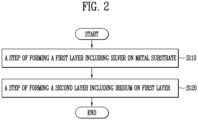
- FIG. 2 shows a flowchart for explaining a method for manufacturing a catalyst electrode according to one embodiment of the present disclosure.
- a method for manufacturing a catalyst electrode according to an embodiment of the present disclosure will be described with reference to FIG. 2 .
- a method for manufacturing a catalyst electrode according to an embodiment of the present disclosure comprises a step of coating a metal substrate with silver and iridium.
- a method for manufacturing a catalyst electrode according to an embodiment of the present disclosure may further comprise a step of acid-treating a metal substrate before the step of coating a metal substrate with silver and iridium.
- a metal substrate may be a feature that is identical to the above-described metal layer, and accordingly, in an embodiment, a metal layer 10 may comprise one or more selected from the group consisting of a metal mesh, metal foam, metal foil, metal felt, and metal fiber, and in one embodiment, the metal layer may comprise one or more metal or metal alloy selected from the group consisting of titanium, nickel, and stainless steel.
- the step of coating a metal substrate with silver and iridium may comprise a step of forming a first layer comprising silver on a metal substrate (step S110); and a step of forming a second layer comprising iridium on the first layer (step S120).
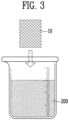
- Step S110 may be performed by inputting a metal substrate 10 to a silver precursor solution 200 comprising a silver ion ( FIG. 3 ).
- step S120 may be performed through dip coating.
- a metal substrate may be uniformly coated with silver, which has high ionization energy.
- a silver precursor solution may comprise a silver salt.
- a silver precursor solution may comprise one or more selected from the group consisting of silver nitrate, silver acetate, silver sulfate, silver perchlorate, silver acetylacetonate, and silver methanesulfonate, but is not limited to.
- a silver precursor solution may comprise water, ethanol, or the like as a solvent, but is not limited to a specific example. In terms of deposition efficiency, a mixed solvent of water and ethanol may be used for the silver precursor solution 200.
- Step S110 may further comprise heat-treating a substrate coated with a first layer.
- the heat-treating step of may be performed at a temperature of 100 °C to 900 °C for 10 minutes to 10 hours. Accordingly, the silver in the first layer coated on the metal substrate may have a stable metal phase, and impurities on the metal substrate may be removed.
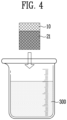
- Step S120 may be performed by adding the metal substrate 10 on which the first layer 21 is formed to an iridium precursor solution 300 comprising an iridium ion ( FIG. 4 ).
- an iridium precursor solution may comprise an iridium salt.
- an iridium precursor solution may comprise one or more selected from the group consisting of iridium chloride, an iridium chloride hydrate, iridium bromide, iridium acetylacetonate, hexachloroiridic acid, sodium hexachloroiridate, and potassium hexachloroiridate, but is not limited thereto.
- an iridium precursor solution may comprise water, ethanol, or the like as a solvent, but is not limited to a specific example.
- a mixed solvent of water and ethanol may be used for the iridium precursor solution 300.
- Step S120 may further comprise heat-treating a substrate coated with a second layer.
- the heat-treating step of may be performed at a temperature of 100 °C to 900 °C for 10 minutes to 10 hours. Accordingly, the iridium in a second layer coated on a first layer may have a stable metal phase.
- a catalyst electrode 100 in which a catalyst layer 20 comprising a first layer 21 and a second layer 22 is formed on a metal layer 10 may be manufactured.
- a catalyst electrode 100 in which a catalyst layer 20 comprising a first layer 21 and a second layer 22 is formed on a metal layer 10 may be manufactured.
- a membrane electrode assembly comprising an electrolyte membrane; an anode positioned on one surface of the electrolyte membrane; and a cathode positioned on the other surface of the electrolyte membrane, wherein the anode comprises: a metal layer; and a catalyst layer formed on the metal layer and comprising silver and iridium.
- the membrane electrode assembly provided in such other aspect of the present disclosure may comprise the above-described catalyst electrode as an anode.
- an anode may comprise the metal layer; and the catalyst layer formed on the metal layer and comprising silver and iridium.
- a membrane electrode assembly provided in such other aspect of the present disclosure may comprise a cathode comprising a cathode catalyst
- the cathode catalyst may be a material commonly used in the art.
- a cathode catalyst one single substance or a mixture of two or more substances selected the group consisting of platinum, ruthenium, iridium, osmium, palladium, platinum-ruthenium alloys, platinum-osmium alloys, platinum-palladium alloys, and oxides thereof may be used, but is not limited thereto.
- a membrane electrode assembly provided in another aspect of the present disclosure may comprise an electrolyte membrane disposed between the anode and the cathode.
- an electrolyte membrane may be a polymer electrolyte membrane comprising a fluorine-based polymer or a hydrocarbon-based polymer, but is not limited thereto.
- a membrane electrode assembly provided in another aspect of the present disclosure may be comprised in a water electrolysis device or a fuel cell.
- Silver nitrate (Sigma) was added to a mixed solution of distilled water/ethanol (volume ratio 1:1), and sonicated and stirred until it was completely dissolved to prepare a silver precursor solution with a concentration of 100 mM.
- a titanium mesh having been acid-treated with oxalic acid (10 wt%) was dip-coated by adding it to the silver precursor solution prepared in this way and dried at 80 °C on a hot plate, and this process was repeated three times. Afterwards, a silver-coated titanium electrode was manufactured through a process of heat-treating at 300 °C for one hour.
- iridium chloride hydrate (Sigma) was added to a mixed solvent of distilled water/ethanol (volume ratio 1:1), and then sonicated and stirred until it was completely dissolved to prepare an iridium precursor solution with a concentration of 6.7 mM.
- the silver-coated titanium electrode was dip-coated by adding it to the iridium precursor solution prepared in this way and dried at 80 °C on a hot plate, and this process was repeated three times. Afterwards, an Ir-Ag/Ti electrode coated with silver and iridium was manufactured through a process of heat-treating at 300 °C for one hour.
- An electrode was manufactured in the same manner as in Example 1, except that the process of adding the titanium mesh to a silver precursor solution was not performed.
- An electrode was manufactured in the same manner as in Example 1, except that the process of adding the titanium mesh to an iridium precursor solution was not performed.
- IrO 2 black (100% by weight, manufactured by Alfa Aesar), a commercial anode catalyst, was prepared.
- Example 1 Morphology analysis of electrode of Example 1
- EDS mapping analysis results for the electrode of Example 1 were obtained, and the results are shown in FIG. 6 .
- both iridium and silver were present on the titanium mesh of the electrode of Example 1, and both iridium and silver were deposited uniformly throughout the titanium mesh.
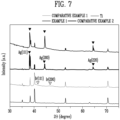
- the metal crystal planes of the electrodes of Example 1, Comparative Example 1, and Comparative Example 2 were confirmed using X-ray diffraction (XRD manufactured by PANalytical). At this time, the measurement was performed at 40 kV and 100 mA using Cu K ⁇ radiation in a range of 10° to 80° at a scan speed of 6° per minute at intervals of 0.01°, and the results are shown in FIG. 7 .
- XRD X-ray diffraction
- Example 1 the content of iridium (% by weight) present in the catalyst layer of each of the manufactured electrodes was obtained using inductively coupled plasma atomic emission spectroscopy (ICP-AES, NexlON 300X), and the results are shown in FIG. 9 .
- ICP-AES inductively coupled plasma atomic emission spectroscopy
- the content of iridium present in the catalyst layer of the electrode of Example 1 was at the level of 0.1 mg/cm 2 , confirming that the loading amount of iridium, an active metal, was significantly less compared to the electrode of Comparative Example 3, which has an iridium content of 1.7 mg/cm 2 .
- the electrode of Example 1 may have superior activity compared to the electrode of Comparative Example 3, as will be described later.
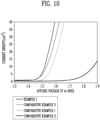
- Example 1 The electrodes of Example 1, Comparative Example 1, Comparative Example 2, and Comparative Example 3 were used as a working electrode, Ag/AgCI (sat. 3 M KCI) was used as a reference electrode, and a graphite rod was used as a counter electrode to measure the polarization of the OER for the electrodes of Example 1, Comparative Example 1, Comparative Example 2, and Comparative Example 3.
- Ag/AgCI sin. 3 M KCI
- a graphite rod was used as a counter electrode to measure the polarization of the OER for the electrodes of Example 1, Comparative Example 1, Comparative Example 2, and Comparative Example 3.
- Each electrode was put into a 0.5 M H 2 SO 4 acid solution, and OER was performed at a scan rate of 10 mV/s and room temperature.
- Example 1 Comparative Example 3
- Comparative Example 2 Comparative Example 2.
- Example 1 an overpotential of only 287 mV was required to obtain a current density value of 10 mAcm -2 , which is a value 15 mV smaller than that of Comparative Example 3 and 53 mV smaller than that of Comparative Example 1.
- Example 1 had a significantly lower catalyst metal loading amount than that of Comparative Example 3, the OER performance of Example 1 was superior to Comparative Example 3.
Landscapes
- Chemical & Material Sciences (AREA)
- Engineering & Computer Science (AREA)
- Chemical Kinetics & Catalysis (AREA)
- Materials Engineering (AREA)
- Organic Chemistry (AREA)
- Electrochemistry (AREA)
- Metallurgy (AREA)
- General Chemical & Material Sciences (AREA)
- Thermal Sciences (AREA)
- Physics & Mathematics (AREA)
- Mechanical Engineering (AREA)
- Manufacturing & Machinery (AREA)
- Inorganic Chemistry (AREA)
- Life Sciences & Earth Sciences (AREA)
- Sustainable Development (AREA)
- Sustainable Energy (AREA)
- Catalysts (AREA)
- Electrodes For Compound Or Non-Metal Manufacture (AREA)
- Electrolytic Production Of Non-Metals, Compounds, Apparatuses Therefor (AREA)
- Inert Electrodes (AREA)
- Fuel Cell (AREA)
Applications Claiming Priority (1)
| Application Number | Priority Date | Filing Date | Title |
|---|---|---|---|
| KR1020230136656A KR102941984B1 (ko) | 2023-10-13 | 2023-10-13 | 촉매 전극, 촉매 전극의 제조방법 및 막전극접합체 |
Publications (1)
| Publication Number | Publication Date |
|---|---|
| EP4550482A1 true EP4550482A1 (de) | 2025-05-07 |
Family
ID=93099772
Family Applications (1)
| Application Number | Title | Priority Date | Filing Date |
|---|---|---|---|
| EP24205980.6A Pending EP4550482A1 (de) | 2023-10-13 | 2024-10-10 | Katalysatorelektrode, verfahren zur herstellung einer katalysatorelektrode und membranelektrodenanordnung |
Country Status (4)
| Country | Link |
|---|---|
| US (1) | US20250125380A1 (de) |
| EP (1) | EP4550482A1 (de) |
| JP (1) | JP7842832B2 (de) |
| KR (1) | KR102941984B1 (de) |
Citations (4)
| Publication number | Priority date | Publication date | Assignee | Title |
|---|---|---|---|---|
| WO2014141071A1 (en) * | 2013-03-12 | 2014-09-18 | Jaber Innovation S.R.L. | Electrodeposition on metal foams |
| US20190329234A1 (en) * | 2016-12-01 | 2019-10-31 | Basf Corporation | Catalytic metal fiber felt and articles made therefrom |
| CN113279006B (zh) * | 2021-04-27 | 2022-05-31 | 大连理工大学 | 一种气体扩散电极、制备方法及其应用 |
| KR20220111791A (ko) * | 2021-02-02 | 2022-08-10 | 성균관대학교산학협력단 | 수전해용 전극 촉매 및 이의 제조 방법 |
Family Cites Families (5)
| Publication number | Priority date | Publication date | Assignee | Title |
|---|---|---|---|---|
| JP2019510885A (ja) * | 2016-04-07 | 2019-04-18 | コベストロ、ドイチュラント、アクチエンゲゼルシャフトCovestro Deutschland Ag | クロルアルカリ電気分解用の二機能性電極および電気分解デバイス |
| JP2019151870A (ja) * | 2018-03-01 | 2019-09-12 | 株式会社豊田中央研究所 | 酸素発生電極、酸素発生デバイス及び酸素発生電極の製造方法 |
| WO2020116651A1 (ja) | 2018-12-07 | 2020-06-11 | Agc株式会社 | ペルフルオロポリマー、液状組成物、固体高分子電解質膜、膜電極接合体および固体高分子形水電解装置 |
| AU2022368391A1 (en) * | 2021-10-20 | 2024-05-02 | Toray Industries, Inc. | Membrane electrode assembly, and water electrolysis device |
| CN114457368B (zh) * | 2022-03-08 | 2023-11-21 | 昆明冶金研究院有限公司 | 一种锌电积用涂层钛阳极及其制备方法 |
-
2023
- 2023-10-13 KR KR1020230136656A patent/KR102941984B1/ko active Active
-
2024
- 2024-10-10 JP JP2024178362A patent/JP7842832B2/ja active Active
- 2024-10-10 EP EP24205980.6A patent/EP4550482A1/de active Pending
- 2024-10-11 US US18/912,719 patent/US20250125380A1/en active Pending
Patent Citations (4)
| Publication number | Priority date | Publication date | Assignee | Title |
|---|---|---|---|---|
| WO2014141071A1 (en) * | 2013-03-12 | 2014-09-18 | Jaber Innovation S.R.L. | Electrodeposition on metal foams |
| US20190329234A1 (en) * | 2016-12-01 | 2019-10-31 | Basf Corporation | Catalytic metal fiber felt and articles made therefrom |
| KR20220111791A (ko) * | 2021-02-02 | 2022-08-10 | 성균관대학교산학협력단 | 수전해용 전극 촉매 및 이의 제조 방법 |
| CN113279006B (zh) * | 2021-04-27 | 2022-05-31 | 大连理工大学 | 一种气体扩散电极、制备方法及其应用 |
Also Published As
| Publication number | Publication date |
|---|---|
| JP2025067872A (ja) | 2025-04-24 |
| JP7842832B2 (ja) | 2026-04-08 |
| US20250125380A1 (en) | 2025-04-17 |
| KR20250054253A (ko) | 2025-04-23 |
| KR102941984B1 (ko) | 2026-03-23 |
Similar Documents
| Publication | Publication Date | Title |
|---|---|---|
| US20130087461A1 (en) | Catalyst coating and process for producing it | |
| KR101926354B1 (ko) | 직접 포름산 연료전지용 단일원자 백금 촉매 및 이의 제조방법 | |
| EP4374435B1 (de) | Sauerstoffentwicklungs-reaktionskatalysator | |
| DE102013202143A1 (de) | Katalysatorbeschichtung und Verfahren zu ihrer Herstellung | |
| JP5679639B2 (ja) | ガス拡散電極およびその製法 | |
| GB2478981A (en) | Fuel cell comprising a Pd-Bi catalyst | |
| US20060249378A1 (en) | Process for the production of a gas diffusion electrode | |
| EP4550482A1 (de) | Katalysatorelektrode, verfahren zur herstellung einer katalysatorelektrode und membranelektrodenanordnung | |
| US20250116019A1 (en) | Mixed metal iridium ruthenium molybdenum electrocatalysts | |
| JP7659138B1 (ja) | 酸素発生電極触媒を含む電極 | |
| KR102203645B1 (ko) | 이리듐 착물, 이의 제조방법, 이를 포함한 수전해용 전극, 상기 수전해용 전극을 포함한 막-전극 접합체 및 상기 막-전극 접합체를 포함하는 수전해 셀 | |
| US20250125381A1 (en) | Catalyst Electrode and Method for Manufacturing Catalyst Electrode | |
| JP5484120B2 (ja) | ガス拡散電極、ガス拡散電極の製造方法、燃料電池および食塩電解セル | |
| KR20250141126A (ko) | 산화백금으로 장식된 산화루테늄 및 산소 발생 반응용 전극 | |
| US20260117404A1 (en) | Water electrolysis electrode, manufacturing method of water electrolysis electrode, and water electrolysis device | |
| Malek et al. | Effect of deposition time on structural and catalytic properties of Pt films electrodeposited on Ti substrate | |
| US20240254639A1 (en) | Catalyst, method for producing catalyst, and intermediate product | |
| RU2813184C1 (ru) | Способ приготовления электрода-катализатора для электрохимического получения водорода | |
| US20250382714A1 (en) | Niobium (nb)-based atomically distributed electrocatalysts for water electrolysis | |
| US20250341008A1 (en) | Electrocatalysts and methods of making and using same | |
| KR20260063358A (ko) | 수전해 전극, 수전해 전극의 제조방법 및 수전해 장치 | |
| WO2025098664A1 (de) | Ruthenium-iridium-mischoxidkatalysatoren für die wasserelektrolyse | |
| Xiong et al. | ZnO x-modified IrO 2–Ta 2 O 5 electrocatalyst with high electrochemical chlorine evolution selectivity in a wide range of pH and electrolyte concentrations | |
| EP4717353A1 (de) | Elektrodenkatalysator, kathode und elektrochemische zelle | |
| WO2025150537A1 (ja) | イリジウムクラスター、イリジウムクラスターの製造方法、酸素発生電極、水電解装置及び水の電気分解方法 |
Legal Events
| Date | Code | Title | Description |
|---|---|---|---|
| PUAI | Public reference made under article 153(3) epc to a published international application that has entered the european phase |
Free format text: ORIGINAL CODE: 0009012 |
|
| STAA | Information on the status of an ep patent application or granted ep patent |
Free format text: STATUS: REQUEST FOR EXAMINATION WAS MADE |
|
| 17P | Request for examination filed |
Effective date: 20241010 |
|
| AK | Designated contracting states |
Kind code of ref document: A1 Designated state(s): AL AT BE BG CH CY CZ DE DK EE ES FI FR GB GR HR HU IE IS IT LI LT LU LV MC ME MK MT NL NO PL PT RO RS SE SI SK SM TR |