EP4550480A2 - Einatomiger katalysator und verfahren zu seiner herstellung - Google Patents
Einatomiger katalysator und verfahren zu seiner herstellung Download PDFInfo
- Publication number
- EP4550480A2 EP4550480A2 EP24210735.7A EP24210735A EP4550480A2 EP 4550480 A2 EP4550480 A2 EP 4550480A2 EP 24210735 A EP24210735 A EP 24210735A EP 4550480 A2 EP4550480 A2 EP 4550480A2
- Authority
- EP
- European Patent Office
- Prior art keywords
- atom
- catalyst
- nitrogen
- ncb
- metal
- Prior art date
- Legal status (The legal status is an assumption and is not a legal conclusion. Google has not performed a legal analysis and makes no representation as to the accuracy of the status listed.)
- Pending
Links
Images










Classifications
-
- H—ELECTRICITY
- H01—ELECTRIC ELEMENTS
- H01M—PROCESSES OR MEANS, e.g. BATTERIES, FOR THE DIRECT CONVERSION OF CHEMICAL ENERGY INTO ELECTRICAL ENERGY
- H01M4/00—Electrodes
- H01M4/86—Inert electrodes with catalytic activity, e.g. for fuel cells
- H01M4/90—Selection of catalytic material
-
- C—CHEMISTRY; METALLURGY
- C25—ELECTROLYTIC OR ELECTROPHORETIC PROCESSES; APPARATUS THEREFOR
- C25B—ELECTROLYTIC OR ELECTROPHORETIC PROCESSES FOR THE PRODUCTION OF COMPOUNDS OR NON-METALS; APPARATUS THEREFOR
- C25B11/00—Electrodes; Manufacture thereof not otherwise provided for
- C25B11/04—Electrodes; Manufacture thereof not otherwise provided for characterised by the material
- C25B11/051—Electrodes formed of electrocatalysts on a substrate or carrier
- C25B11/073—Electrodes formed of electrocatalysts on a substrate or carrier characterised by the electrocatalyst material
- C25B11/075—Electrodes formed of electrocatalysts on a substrate or carrier characterised by the electrocatalyst material consisting of a single catalytic element or catalytic compound
-
- C—CHEMISTRY; METALLURGY
- C25—ELECTROLYTIC OR ELECTROPHORETIC PROCESSES; APPARATUS THEREFOR
- C25B—ELECTROLYTIC OR ELECTROPHORETIC PROCESSES FOR THE PRODUCTION OF COMPOUNDS OR NON-METALS; APPARATUS THEREFOR
- C25B11/00—Electrodes; Manufacture thereof not otherwise provided for
- C25B11/04—Electrodes; Manufacture thereof not otherwise provided for characterised by the material
- C25B11/051—Electrodes formed of electrocatalysts on a substrate or carrier
- C25B11/052—Electrodes comprising one or more electrocatalytic coatings on a substrate
-
- C—CHEMISTRY; METALLURGY
- C25—ELECTROLYTIC OR ELECTROPHORETIC PROCESSES; APPARATUS THEREFOR
- C25B—ELECTROLYTIC OR ELECTROPHORETIC PROCESSES FOR THE PRODUCTION OF COMPOUNDS OR NON-METALS; APPARATUS THEREFOR
- C25B11/00—Electrodes; Manufacture thereof not otherwise provided for
- C25B11/04—Electrodes; Manufacture thereof not otherwise provided for characterised by the material
- C25B11/051—Electrodes formed of electrocatalysts on a substrate or carrier
- C25B11/055—Electrodes formed of electrocatalysts on a substrate or carrier characterised by the substrate or carrier material
- C25B11/057—Electrodes formed of electrocatalysts on a substrate or carrier characterised by the substrate or carrier material consisting of a single element or compound
- C25B11/061—Metal or alloy
-
- H—ELECTRICITY
- H01—ELECTRIC ELEMENTS
- H01M—PROCESSES OR MEANS, e.g. BATTERIES, FOR THE DIRECT CONVERSION OF CHEMICAL ENERGY INTO ELECTRICAL ENERGY
- H01M4/00—Electrodes
- H01M4/02—Electrodes composed of, or comprising, active material
- H01M4/64—Carriers or collectors
- H01M4/66—Selection of materials
- H01M4/661—Metal or alloys, e.g. alloy coatings
-
- H—ELECTRICITY
- H01—ELECTRIC ELEMENTS
- H01M—PROCESSES OR MEANS, e.g. BATTERIES, FOR THE DIRECT CONVERSION OF CHEMICAL ENERGY INTO ELECTRICAL ENERGY
- H01M4/00—Electrodes
- H01M4/86—Inert electrodes with catalytic activity, e.g. for fuel cells
- H01M4/88—Processes of manufacture
- H01M4/8803—Supports for the deposition of the catalytic active composition
-
- H—ELECTRICITY
- H01—ELECTRIC ELEMENTS
- H01M—PROCESSES OR MEANS, e.g. BATTERIES, FOR THE DIRECT CONVERSION OF CHEMICAL ENERGY INTO ELECTRICAL ENERGY
- H01M4/00—Electrodes
- H01M4/86—Inert electrodes with catalytic activity, e.g. for fuel cells
- H01M4/88—Processes of manufacture
- H01M4/8825—Methods for deposition of the catalytic active composition
- H01M4/8828—Coating with slurry or ink
-
- Y—GENERAL TAGGING OF NEW TECHNOLOGICAL DEVELOPMENTS; GENERAL TAGGING OF CROSS-SECTIONAL TECHNOLOGIES SPANNING OVER SEVERAL SECTIONS OF THE IPC; TECHNICAL SUBJECTS COVERED BY FORMER USPC CROSS-REFERENCE ART COLLECTIONS [XRACs] AND DIGESTS
- Y02—TECHNOLOGIES OR APPLICATIONS FOR MITIGATION OR ADAPTATION AGAINST CLIMATE CHANGE
- Y02E—REDUCTION OF GREENHOUSE GAS [GHG] EMISSIONS, RELATED TO ENERGY GENERATION, TRANSMISSION OR DISTRIBUTION
- Y02E60/00—Enabling technologies; Technologies with a potential or indirect contribution to GHG emissions mitigation
- Y02E60/30—Hydrogen technology
- Y02E60/50—Fuel cells
Definitions
- SAC single-atom catalyst
- Electrochemical advanced oxidation processes are highly efficient, use renewable energy, and are likely to enable modularization in decentralized systems, which have led to a growing interest in such electrochemical advanced oxidation processes in the water treatment field.
- Electrochemical advanced oxidation processes involve the generation of hydroxyl radicals ( ⁇ OH) in anodes and the use thereof for the oxidation of non-degradable organic contaminants in wastewater.
- Cathodes allow hydrogen peroxide (H 2 O 2 ), a precursor of hydroxyl radicals, to be generated through selective oxygen reduction.
- Patent Document 1 KR 10-2342524 B1
- a single-atom catalyst capable of extending the optimal pH range of electrochemical advanced oxidation and preventing the adsorption of hydroxyl radicals to an electrode can be provided.
- a single-atom catalyst which includes a nitrogen-doped carbon structure and a single-atom metal, wherein the single-atom metal forms a coordination bond with a nitrogen atom of the nitrogen-doped carbon structure.
- the nitrogen-doped carbon structure may be carbon black.
- the single-atom metal may be cobalt (Co).
- the single-atom metal in the single-atom catalyst may have a content of greater than 0 wt% and less than 3 wt%.
- a method of preparing a single-atom catalyst which includes the following steps: preparing a mixed solution by mixing a single-atom metal precursor and a nitrogen dopant precursor in a solvent; preparing a suspension by mixing a carbon structure powder in the mixed solution; preparing a single-atom catalyst precursor by shaking and drying the suspension; and preparing a single-atom catalyst by calcining the single-atom catalyst precursor.
- an electrode which includes a substrate and a catalyst layer applied on the substrate through coating, wherein the catalyst layer includes the single-atom catalyst described above.
- the substrate may include stainless steel.
- a thickness ratio of the substrate to the catalyst layer may be in the range of 10:1 to 1000:1.
- an electrochemical cell including the electrode described above as a cathode and an anode.
- an electrochemical water treatment method using the electrochemical cell described above provided is an electrochemical water treatment method using the electrochemical cell described above.
- an electrochemical advanced oxidation process can be performed under various pH conditions, and the organic compound removal efficiency from wastewater by the electrochemical advanced oxidation process can increase.
- a "single-atom catalyst” refers to a catalyst in which a metal is dispersed on a support at a single-atomic size.
- a single-atom catalyst is a type of catalyst where individual metal atoms are dispersed on a support material, rather than forming larger clusters or nanoparticles. This unique structure maximizes the efficiency of the metal atoms, as each metal atom is exposed and available for catalytic reactions.
- a single-atom catalyst includes a nitrogen-doped carbon structure and a single-atom metal, and the single-atom metal forms a coordination bond with a nitrogen atom of the nitrogen-doped carbon structure.
- the nitrogen-doped carbon structure is a carbon material that has been modified by incorporating nitrogen atoms into its structure.
- the nitrogen-doped carbon structure performs a role as a support where the metal of the single-atom catalyst is dispersed.
- the nitrogen atom contained in the carbon structure forms a coordination bond with the metal so that the metal is immobilized on the carbon structure at a single-atomic size.
- hydroxyl radicals ( ⁇ OH) generated during electrochemical advanced oxidation processes may be adsorbed onto the surface of the metal oxide, so the water treatment efficiency by electrochemical advanced oxidation may be reduced.
- the carbon structure does not allow hydroxyl radicals to be adsorbed, which is advantageous.
- the nitrogen doping method of the nitrogen-doped carbon structure and the type of carbon structure are not particularly limited as long as the metal is allowed to be dispersed at a single-atomic size.
- the nitrogen-doped carbon structure may be obtained by using a suitable nitrogen dopant precursor which includes a compound or material that provides nitrogen serving as a dopant of the nitrogen-doped carbon structure of the single-atom catalyst.
- a suitable nitrogen dopant precursor is, for instance, 1,10-phenantrolin, but it is not limited thereto; suitable other nitrogen dopant precursors may be other structures where the single-atom metal can form one or more coordination bond(s) with one or more nitrogen atom(s) of the nitrogen-doped carbon structure.
- the carbon structure may be carbon black.
- graphene, graphene oxide, carbon nanotubes (CNTs), graphite, and the like are usable as the carbon structure, the carbon structure is preferably carbon black in terms of costs and ease of mass production.
- the single-atom metal of the single-atom catalyst corresponds to a reaction site of the catalyst.
- the single-atom metal forms a coordination bond with the nitrogen atom of the nitrogen-doped carbon structure and thus is immobilized on the nitrogen-doped carbon structure in the form of a single atom.
- the single-atom metal is advantageous in providing a large reaction active site compared to the case where metal atoms form clusters.
- transition metals such as, but not limited to, Co, Zn, V, Cr, Fe, Ni, Cu, Zr, Nb, and Mo are usable as the single-atom metal of the single-atom catalyst of the present disclosure.
- the single-atom metal may be cobalt (Co).
- cobalt (Co) is advantageous when using the single-atom catalyst in electrochemical advanced oxidation because both activities for hydroxyl radical generation through a water oxidation reaction in an anode and for hydrogen peroxide generation through a selective oxygen reduction reaction in a cathode are high.
- the single-atom metal in the single-atom catalyst may have a content of greater than 0 wt% and less than 3 wt%.
- the excess single-atom metal may form metal oxides.
- the single-atom metal in the single-atom catalyst may specifically have a content of greater than 0 wt% and 2 wt% or less, which may more specifically be 0.5 wt% or greater and 1 wt% or less.
- a method of preparing a single-atom catalyst which includes the following steps: preparing a mixed solution by mixing a single-atom metal precursor and a nitrogen dopant precursor in a solvent; preparing a suspension by mixing a carbon structure powder in the mixed solution; preparing a single-atom catalyst precursor by shaking and drying the suspension; and preparing a single-atom catalyst by calcining the single-atom catalyst precursor.
- the solvent is not only required to be polar so that the single-atom metal precursor and the nitrogen dopant precursor are allowed to be well-dissolved but also required to be volatilized with ease in the step involving drying.
- the solvent is preferably an alcohol, preferably ethanol, in terms of reducing manufacturing costs.
- the single-atom metal precursor may be a material containing the single-atom metal of the single-atom catalyst.
- the single-atom metal when the single-atom metal is cobalt (Co), the single-atom metal precursor may be a cobalt chloride hydrate.
- the nitrogen dopant precursor includes a material that provides nitrogen serving as a dopant of the nitrogen-doped carbon structure of the single-atom catalyst.
- the single-atom metal precursor and the nitrogen dopant precursor are mixed in a predetermined molar ratio at a predetermined temperature to form the mixed solution.
- the carbon structure powder is introduced into the mixed solution in a predetermined molar ratio with respect to the nitrogen dopant precursor, thereby obtaining the suspension.
- the carbon structure powder may be introduced in a weight ratio in the range of about 8:1 to 10:1 with respect to the dopant precursor.
- the suspension is shaken for 8 to 12 hours so that the carbon structure powder is allowed to be evenly dispersed in the suspension. Subsequently, the suspension is dried at a temperature in the range of about 80°C to 120°C to volatilize the solvent, thereby obtaining the single-atom catalyst precursor.
- the single-atom catalyst precursor is subjected to heat treatment for about 1 to 5 hours in an inert gas atmosphere.
- the calcining temperature may be kept constant or may increase from a low temperature at a predetermined heating rate.
- the calcining temperature can be in a temperature range of about 500 to 700 °C, and can be reached at a heating rate of about 5 °C/min to about 10 °C/min from room temperature.
- the calcining temperature can be specifically about 550 to 700 °C, and more specifically about 600 to 650 °C.
- the single-atom catalyst in which the metal atom is disposed on the carbon structure in the form of a single atom is obtained, and the obtained single-atom catalyst may be the single-atom catalyst mentioned above in the first aspect of the present disclosure.
- an electrode which includes: a substrate; and a catalyst layer applied on the substrate through coating, wherein the catalyst layer includes the single-atom catalyst described above.
- the substrate performs a role as a support for the catalyst layer and is directly connected to power to deliver supplied current to the catalyst layer when supplying power.
- the substrate is required to have high electrical conductivity and high adhesion to the catalyst layer.
- the substrate is required to have oxidation stability to maintain electrical conductivity during the electrochemical advanced oxidation process. Any material characterized as above is usable as the substrate without limitation.
- the substrate may include stainless steel.
- Stainless steel corresponds to a material having high electrical conductivity and adhesion to the catalyst layer described above.
- the catalyst layer includes the single-atom catalyst described above and is applied on the substrate through coating. There is no limitation in methods of applying the catalyst layer through coating.
- the single-atom metal site of the catalyst layer acts as a reaction site, conducting an oxidation or reduction reaction depending on polarity when a current is supplied through the substrate.
- a thickness ratio of the substrate to the catalyst layer may be in the range of 10:1 to 1000:1.
- the thickness ratio is less than 10:1 or greater than 1000:1, the electrical energy applied to the catalyst layer through the substrate may be reduced, which may inhibit the oxidation or reduction reaction of the catalyst.
- the thickness ratio of the substrate to the catalyst layer may be specifically in the range of 50:1 to 800:1, which may more specifically be in the range of 100:1 to 500:1.
- an electrochemical cell including the electrode described above as a cathode and/or an anode.
- the electrochemical cell is advantageous in terms of an electrochemical advanced oxidation process because both the cathode and the anode include the single-atom catalyst.
- the single-atom catalyst of the anode shows high activity for hydroxyl radical generation through the water oxidation reaction
- the single-atom catalyst of the cathode shows high activity for the selective oxygen reduction reaction to generate hydrogen peroxide serving as a hydroxyl radical precursor.
- the electrochemical cell may have high hydroxyl radical generation efficiency because both the cathode and anode include the single-atom catalyst. Hydroxyl radicals act as oxidants for organic contaminants. As a result, the electrochemical cell has excellent organic contaminant degradation efficiency.
- an electrochemical water treatment method using the electrochemical cell described above is provided.
- the electrochemical cell has high organic contaminant degradation efficiency because both the cathode and anode include the single-atom catalyst.
- High organic contaminant degradation efficiency refers to the effectiveness of a process or method in breaking down and removing organic pollutants from water or other environments. This efficiency is crucial for environmental cleanup and wastewater treatment.
- the electrochemical cell when using existing electrochemical cells including electrodes such as boron-doped diamond (BDD) and lead oxide (PbO 2 ) as an anode, there is a disadvantage in that hydroxyl radicals are enabled to be formed in the anode only when the pH of the wastewater treated by the water oxidation reaction occurring at the anode is in the range of about 3 to 4, making water treatment challenging for wastewater having pH not falling within the above range.
- the electrochemical cell may be advantageous in that the anode includes the single-atom catalyst, making water treatment possible even for wastewater having a wide pH range. Specifically, the electrochemical water treatment using the electrochemical cell may be performed at a pH in the range of about 3 to 9.
- the cathode of the electrochemical cell of the present disclosure includes the single-atom catalyst and thus may be advantageous in that the reactivity of the selective oxygen reduction reaction for hydrogen peroxide generation is higher than that in the case of existing electrochemical cells, further increasing the hydroxyl radical generation efficiency.
- Cobalt (II) chloride hexahydrate (CoCl 2 ⁇ 6H 2 O) and 1,10-phenanthroline(C 12 H 8 N 2 ) were dissolved in a 1:3 molar ratio in pure ethanol.
- the resulting product was mixed with carbon black powder to obtain a suspension, which was then shaken overnight and dried at a temperature of 80°C.
- the powder obtained after the drying was calcined at a temperature of 600°C for 2 hours using a tubular furnace (SH-FU-80STG, SH Scientific, Korea) under an Ar atmosphere, wherein the temperature of the furnace was elevated at a heating rate of 10°C/min to reach 600°C.
- Co 1 -NCB powder was obtained (hereafter referred to as 1 wt% Co 1 -NCB).
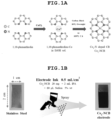
- the preparation process of the Co 1 -NCB powder is schematically shown in FIG. 1A .
- the obtained Co 1 -NCB powder was cooled and stored in an Ar atmosphere until further use.
- Co 1 -NCBs with higher Co wt% were synthesized through a similar process, except for using the same molar ratio of cobalt (II) chloride hexahydrate and 1,10-phenanthroline in larger amounts compared to those in 1 wt% Co 1 -NCB (hereafter referred to as 3 wt% Co 1 -NCB and 5 wt% Co 1 -NCB).
- the manufacturing process of a Co 1 -NCB electrode is shown in FIG. 1B .
- Catalyst ink was prepared by mixing 20 mg of the Co 1 -NCB powder with 2 mL of isopropanol (IPA) and 80 ⁇ L of Nafion ® 117 (5% wt).
- Nafion ® 117 refers to Tetrafluoroethylene-perfluoro-3,6-dioxa-4-methyl-7-octenesulfonic acid copolymer.
- the catalyst ink was sonicated for 2 hours and then applied on an electrode substrate (SUS 304, stainless steel substrate based in Japanese industrial standards equivalent to US AISI 304) over a geometric area of 1.0 ⁇ 1.0 cm 2 through spray coating.
- the amount of the catalyst ink applied on each electrode substrate through spray coating was 0.5 ml. Both the anode and cathode were coated in the same manner.
- Co 1 -NCBs of Preparation Example 1 was analyzed using an aberration-corrected high-angle annular dark-field scanning transmission electron microscope (HAADF-STEM, JEM134 ARM200CF) at 200 kV.
- XANES X-ray absorption near edge structure
- EXAFS extended x-ray absorption fine structure
- the measurement was performed in fluorescence mode using a 4-element silicon drift detector (SDD). Co foil was measured simultaneously and used to align the spectra. Cobalt oxide (CoO) and cobalt phthalocyanine (Co-Pc) were used as reference materials. The pre-edge and post-edge backgrounds were subtracted, and the spectra were normalized to 1 based on edge height. Data reduction was performed using Athena, and EXAFS fitting was performed using Artemis from the Demeter package. Wavelet transform (WT) analysis was performed using the Larch package with continuous Cauchy mother wavelet.
- SDD 4-element silicon drift detector
- FIG. 2A is an HAADF-STEM image for Co 1 -NCB
- FIGS. 2B and 2C are energy dispersive spectroscopy (EDS) element maps of carbon and cobalt, respectively.
- FIGS. 2A to 2C show that the carbon and cobalt elements are relatively uniformly distributed on a spherical carbon black support having an average diameter of about 30 nm.
- FIGS. 2D to 2F are HAADF-STEM images of the Co single atoms on carbon black, the images taken at various magnifications.
- FIGS. 2D to 2F show that Co does not aggregate in a metal cluster or particle form. In contrast, the circled area in FIG. 2F measuring only a few angstroms indicates that Co is atomically immobilized on the carbon black support.
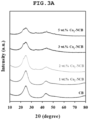
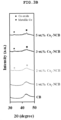
- FIGS. 3A and 3B are XRD diagrams, showing that Co 1 -NCB containing 1 wt% of Co lacks crystalline Co species.
- the two broad diffraction peaks at about 24° and 43° correspond to the (002) and (100) planes of carbon black (JCPDS card No. 34-0567).
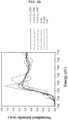
- FIG. 4A shows XANES (X-ray absorption Near Edge Structure) spectra of the normalized Co K-edge for Co 1 -NCBs, Co-foil, CoO, and Co-Pc
- FIG. 4B shows Fourier-transformed k 2 -weighted EXAFS spectra of Co 1 -NCBs, Co-foil, CoO, and Co-Pc.
- a rather strong evidence supporting the Co atomic dispersion in NCB was obtained by the XANES and EXAFS (extended X-ray absorption fine structure) analysis.
- 4A is composed of three regions: i) a weak pre-edge feature associated with the forbidden electron transition to a level of 3d from 1s; ii) a main absorption edge associated with the electron transition from the occupied 1s level to the unoccupied 4p band, which provides a good estimate for the formal oxidation state of Co; and iii) an extended EXAFS usable in determining the localized structure around the absorbing atoms.
- the XANES spectrum of Co 1 -NCB shows that the edge is between the Co foil and the CoO reference, which implies a formal oxidation state between 0 and +2.
- FIGS. 4C and 4D show EXAFS fitting results of the first shell of 1 wt% Co 1 -NCB.
- 1 wt% Co 1 -NCB exhibits a Co-N/O path length of 1.98 ⁇ in the first shell, which is longer than the Co-N path of Co-Pc.
- the presence of the Co-O path and a coordination number of 4.96 support the XANES results of 1 wt% Co 1 -NCB, which is similar to the case of CoO.
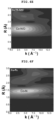
- FIGS. 4E to 4H show wavelet transform (WT) analysis results of ⁇ (k) for 1 wt% Co 1 -NCB, Co-Pc, CoO, and Co foil, respectively.
- WT contour maximum intensity of 1 wt% Co 1 -NCB appears at about 4.9 ⁇ -1 , which closely matches those in the case of Co-Pc and CoO. This indicates the presence of the first shell composed of Co-N/O.
- R refers to the interatomic distance (bond length between the center atom and the surrounding coordination atom)
- ⁇ 2 refers to the Debye-Waller factor (DWF)
- R-factor refers to the goodness of fit.
- the amplitude reduction factor (S 0 2 ) was estimated by Co foil fitting. A value of 0.768 was set for the EXAFS fitting of the sample. The * indicates that the coordination number is fixed to a known crystallographic value for the reference compound.
- ROS reactive oxygen species
- H-cells divided by Nafion 117 membranes (perfluorosulfonic acid membrane composed of a sulfonated tetrafluoroethylene copolymer).
- Electron paramagnetic resonance (EPR) spectroscopy JES-X310, JEOL was performed using 5,5-dimethyl-1-pyrroline N-oxide (DMPO) as a spin trap agent to identify ROS. Samples were taken at predetermined time intervals and analyzed under the following conditions: a microwave frequency of 9,417 MHz, a microwave power of 5 mW, a modulation frequency of 100 MHz, and a modulation amplitude of 2.0 G.
- the electrogenerated hydroxyl radicals are expected from the water oxidation reaction (H 2 O ⁇ ⁇ OH + H + + e - ).
- Other reactive oxygen species (ROS) involving hydroxyl radical generation in the 1 wt% Co 1 -NCB anode were analyzed using EPR spectroscopy.
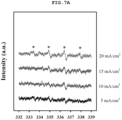
- FIG. 7A shows EPR spectra of the DMPO adducts depending on current densities
- FIG. 7B shows EPR spectra of the DMPO adducts depending on initial pH values.
- the EPR signal intensity of the radicals increased as the current density increased.
- the Co 1 -NCB anode exhibited consistent hydroxyl radical generation over a wide range of solution pH from 3 to 9, contrary to earlier studies suggesting that more hydroxyl radicals would be formed under acidic conditions.
- transition metal single-atom catalysts effectively promote H 2 O 2 generation through a two-electron selective oxygen reduction reaction (O 2 + 2e - + 2H + ⁇ H 2 O 2 ). Therefore, the activation of H 2 O 2 for hydroxyl radical generation and the electrocatalytic performance of the Co 1 -NCB cathode in the two-electron selective oxygen reduction reaction were further examined.
- the H 2 O 2 concentration in a solution was quantified by iodine titration using a UV-vis spectrophotometer (Biotek Synergy Mx). Briefly, 1 mL of a sample aliquot was mixed with 1 L of deionized water (DI water), 0.75 mL of potassium hydrogen phthalate (0.1 M), 0.75 mL of potassium iodide (0.4 M), NaOH (0.06 M), and ammonium molybdate tetrahydrate (10 -4 M), followed by vigorously stirring the resulting mixture for 2 minutes. Then, the absorbance was measured at 348 nm.
- DI water deionized water
- potassium hydrogen phthalate 0.1 M
- potassium iodide 0.4 M
- NaOH 0.06 M
- ammonium molybdate tetrahydrate 10 -4 M
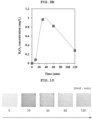
- FIGS. 8A and 8B show that the test strips turn blue 10 minutes after the reaction, indicating that H 2 O 2 was generated through the selective oxygen reduction reaction in the Co 1 -NCB cathode.
- FIGS. 9A and 9B are plots showing changes in absorbance at particular wavelength values over time and changes in hydrogen peroxide concentration over time, respectively. Referring to FIG. 9B , the H 2 O 2 concentration first increased, reaching about 1 mg/L at maximum after 10 minutes, and then decreased. This was consistent with the colorimetric results in FIG. 9A .
- LSV Linear sweep voltammetry
- CV cyclic voltammetry
- Electrochemical studies were conducted in O 2 - and N 2 -saturated 100 mM NaClO 4 electrolytes to evaluate the oxygen reduction reaction activity of the cathode.
- the CV was performed at a scan rate of 10 mV/s within an applied potential window in the range of +1.0 V to -1.5 V (versus Ag/AgCl).
- FIG. 8C is a comparative LSV profile of the Co 1 -NCB cathode in the O 2 /N 2 -saturated 100 mM NaClO 4 electrolytes, wherein the small graph corresponds to the CV curve. Referring to FIG. 8C , the occurrence of a reduction current peak at about -0.8 V in the O 2 -saturated condition during the CV analysis further allows H 2 O 2 synthesis from the oxygen reduction reaction to be confirmed.
- the electrochemical cell was equipped with the Co 1 -NCB electrodes with a defined geometric area of 1.0 cm 2 (separated using Teflon). The spacing between the electrodes was 1.0 cm.
- the experiments were performed in constant current mode using a potentiostat (Ivium Technologies, Netherlands) at room temperature under magnetic stirring (500 rpm) while applying a constant current density in the range of 5 to 20 mA/cm 2 .
- FIGS. 11A and 11B are plots showing the electrochemical oxidation efficiency of phenol using the Co 1 -NCB electrode under conditions at different current densities and initial pH values, respectively
- FIG. 11C is a graph showing the phenol removal efficiencies when both the cathode and anode use the Co 1 -NCB electrode compared to when only the anode uses the Co 1 -NCB electrode.
- the phenol removal efficiency increased as the current density increased from 5 mA/cm 2 to 20 mA/cm 2 .
- Phenol removal at various current densities also followed pseudo-first order kinetics with rate constants of 0.398, 0.664, 0.794, and 0.832 h -1 (R 2 > 0.99 for each case).
- the most important side reactions that can reduce hydroxyl radical generation were (i) H 2 evolution (2H + + 2e - ⁇ H 2 ) at the cathode and (ii) O 2 evolution (2H 2 O ⁇ O 2 + 4H + + 4e - ) at the anode, both of which may compete with hydroxyl radical generation.
- FIG. 11B shows the electrochemical phenol removal of the two Co 1 -NCB electrodes at initial pH values of 3.0, 6.5, and 9.0.
- the pseudo-first order model R 2 > 0.99 for each case
- the phenol removal efficiency was highest at pH 6.5.
- the phenol removal efficiencies in all cases exceed 90% within 240 minutes, meaning that the electrochemical advanced oxidation process based on the Co 1 -NCB electrode has high electrochemical activity in a wide pH range, and is consistent with the EPR results.
Landscapes
- Chemical & Material Sciences (AREA)
- Engineering & Computer Science (AREA)
- Chemical Kinetics & Catalysis (AREA)
- Electrochemistry (AREA)
- Materials Engineering (AREA)
- General Chemical & Material Sciences (AREA)
- Organic Chemistry (AREA)
- Metallurgy (AREA)
- Manufacturing & Machinery (AREA)
- Catalysts (AREA)
- Water Treatment By Electricity Or Magnetism (AREA)
- Electrodes For Compound Or Non-Metal Manufacture (AREA)
- Electrolytic Production Of Non-Metals, Compounds, Apparatuses Therefor (AREA)
Applications Claiming Priority (2)
| Application Number | Priority Date | Filing Date | Title |
|---|---|---|---|
| KR20230151830 | 2023-11-06 | ||
| KR1020240124216A KR20250066411A (ko) | 2023-11-06 | 2024-09-11 | 단원자 촉매 및 이의 제조 방법 |
Publications (2)
| Publication Number | Publication Date |
|---|---|
| EP4550480A2 true EP4550480A2 (de) | 2025-05-07 |
| EP4550480A3 EP4550480A3 (de) | 2025-05-21 |
Family
ID=93430621
Family Applications (1)
| Application Number | Title | Priority Date | Filing Date |
|---|---|---|---|
| EP24210735.7A Pending EP4550480A3 (de) | 2023-11-06 | 2024-11-05 | Einatomiger katalysator und verfahren zu seiner herstellung |
Country Status (4)
| Country | Link |
|---|---|
| US (1) | US20250146149A1 (de) |
| EP (1) | EP4550480A3 (de) |
| JP (1) | JP2025078087A (de) |
| CN (1) | CN119926457A (de) |
Families Citing this family (1)
| Publication number | Priority date | Publication date | Assignee | Title |
|---|---|---|---|---|
| CN120978015B (zh) * | 2025-10-15 | 2026-02-10 | 西北工业大学 | 基于单原子催化的硫化钠碳限域预钠涂层的制备方法 |
Citations (1)
| Publication number | Priority date | Publication date | Assignee | Title |
|---|---|---|---|---|
| KR102342524B1 (ko) | 2020-03-04 | 2021-12-23 | 서울대학교산학협력단 | 단일 원자 촉매 및 그 형성 방법 |
Family Cites Families (1)
| Publication number | Priority date | Publication date | Assignee | Title |
|---|---|---|---|---|
| KR102293767B1 (ko) * | 2019-11-26 | 2021-08-26 | 한국과학기술연구원 | 금속 단일원자 촉매의 제조방법 |
-
2024
- 2024-11-05 US US18/937,024 patent/US20250146149A1/en active Pending
- 2024-11-05 EP EP24210735.7A patent/EP4550480A3/de active Pending
- 2024-11-06 CN CN202411571699.7A patent/CN119926457A/zh active Pending
- 2024-11-06 JP JP2024194300A patent/JP2025078087A/ja active Pending
Patent Citations (1)
| Publication number | Priority date | Publication date | Assignee | Title |
|---|---|---|---|---|
| KR102342524B1 (ko) | 2020-03-04 | 2021-12-23 | 서울대학교산학협력단 | 단일 원자 촉매 및 그 형성 방법 |
Also Published As
| Publication number | Publication date |
|---|---|
| US20250146149A1 (en) | 2025-05-08 |
| EP4550480A3 (de) | 2025-05-21 |
| CN119926457A (zh) | 2025-05-06 |
| JP2025078087A (ja) | 2025-05-19 |
Similar Documents
| Publication | Publication Date | Title |
|---|---|---|
| Zhang et al. | Ir-Pd nanoalloys with enhanced surface-microstructure-sensitive catalytic activity for oxygen evolution reaction in acidic and alkaline media | |
| KR101670929B1 (ko) | 산소 발생 촉매, 전극 및 전기화학반응 시스템 | |
| KR102173226B1 (ko) | 산소 발생 촉매, 전극 및 전기화학반응 시스템 | |
| Zhang et al. | Intensification of anodic charge transfer by contaminant degradation for efficient H2 production | |
| US20240352602A1 (en) | A catalyst | |
| Fujimoto et al. | Cobalt-doped electrolytic manganese dioxide as an efficient bifunctional catalyst for oxygen evolution/reduction reactions | |
| Cheng et al. | Boosting selective chlorine evolution reaction: Impact of Ag doping in RuO2 electrocatalysts | |
| Sun et al. | Rational design of an air-breathing gas-diffusion electrode with oxygen vacancy-rich ZnO for robust and durable H2O2 electrosynthesis | |
| Saha et al. | Dissolution induced self-selective Zn-and Ru-doped TiO2 structure for electrochemical generation of KClO3 | |
| Saranya et al. | Hierarchical CuCo2O4/NiCo2O4 on self-standing Ni foam for high-performance water electrolysis | |
| Zhu et al. | In-situ reconstruction of non-noble multi-metal core-shell oxyfluorides for water oxidation | |
| Poochai et al. | The influence of copper in dealloyed binary platinum–copper electrocatalysts on methanol electroxidation catalytic activities | |
| US20250146149A1 (en) | Single-atom catalyst and method of preparing same | |
| Ye et al. | Mixed-valence Cu-based heterostructures for efficient electrochemical nitrate reduction to ammonia | |
| Zhang et al. | Unraveling the impact of iron incorporation toward efficient oxygen evolution reaction of nickel tungstate | |
| Buldu-Akturk et al. | Optimizing bimetallic NiRu@ Ti3C2Tx catalysts for oxygen evolution: The Impact of MXene content on Ru stability | |
| Hu et al. | Anionic Engineering of ReS2‐Re2O7‐Ni (OH) 2/NF Heterostructure for Enhanced Alkaline Hydrogen Evolution | |
| WO2024015017A1 (en) | Ruthenium-based electrocatalyst for oxygen evolution in acidic media | |
| KR20180028042A (ko) | Pt 복합입자 및 그 제조방법과 이를 포함하는 일체형 재생연료전지 | |
| Jianjian et al. | Sn quantum dots for electrocatalytic reduction of CO 2 to HCOOH | |
| Fu et al. | Surface/interface regulation of Ni0. 85Se via tungsten-doping for enhanced oxygen evolution reaction | |
| Liang et al. | In situ assembly of the FeOOH@ MOF-74 heterostructure on IF as efficient electrocatalysts for water splitting | |
| Sadeghi et al. | Suppress Ru Over‐Oxidation Through Oxygen Vacancy Engineering–Showcase With Ni‐Modified RuO2 via Molten‐Salt Synthesis | |
| Zhang et al. | A highly active NiCe (Fe) O x H y electrocatalyst for the oxygen evolution reaction with ultralow Fe leaching | |
| Wang et al. | Interfacial Ru–O–W Orbital Coupling Enables Lattice Oxygen Stabilization for Enhanced Acidic OER |
Legal Events
| Date | Code | Title | Description |
|---|---|---|---|
| PUAI | Public reference made under article 153(3) epc to a published international application that has entered the european phase |
Free format text: ORIGINAL CODE: 0009012 |
|
| STAA | Information on the status of an ep patent application or granted ep patent |
Free format text: STATUS: REQUEST FOR EXAMINATION WAS MADE |
|
| PUAL | Search report despatched |
Free format text: ORIGINAL CODE: 0009013 |
|
| 17P | Request for examination filed |
Effective date: 20241105 |
|
| AK | Designated contracting states |
Kind code of ref document: A2 Designated state(s): AL AT BE BG CH CY CZ DE DK EE ES FI FR GB GR HR HU IE IS IT LI LT LU LV MC ME MK MT NL NO PL PT RO RS SE SI SK SM TR |
|
| AK | Designated contracting states |
Kind code of ref document: A3 Designated state(s): AL AT BE BG CH CY CZ DE DK EE ES FI FR GB GR HR HU IE IS IT LI LT LU LV MC ME MK MT NL NO PL PT RO RS SE SI SK SM TR |
|
| RIC1 | Information provided on ipc code assigned before grant |
Ipc: H01M 4/90 20060101ALI20250414BHEP Ipc: H01M 4/88 20060101ALI20250414BHEP Ipc: H01M 4/66 20060101AFI20250414BHEP |