EP4549988A1 - Information processing device, information processing system, and information processing method - Google Patents
Information processing device, information processing system, and information processing method Download PDFInfo
- Publication number
- EP4549988A1 EP4549988A1 EP23745254.5A EP23745254A EP4549988A1 EP 4549988 A1 EP4549988 A1 EP 4549988A1 EP 23745254 A EP23745254 A EP 23745254A EP 4549988 A1 EP4549988 A1 EP 4549988A1
- Authority
- EP
- European Patent Office
- Prior art keywords
- information
- leaning vehicle
- surrounding environment
- information processing
- reliability
- Prior art date
- Legal status (The legal status is an assumption and is not a legal conclusion. Google has not performed a legal analysis and makes no representation as to the accuracy of the status listed.)
- Pending
Links
Images


Classifications
-
- G—PHYSICS
- G01—MEASURING; TESTING
- G01S—RADIO DIRECTION-FINDING; RADIO NAVIGATION; DETERMINING DISTANCE OR VELOCITY BY USE OF RADIO WAVES; LOCATING OR PRESENCE-DETECTING BY USE OF THE REFLECTION OR RERADIATION OF RADIO WAVES; ANALOGOUS ARRANGEMENTS USING OTHER WAVES
- G01S7/00—Details of systems according to groups G01S13/00, G01S15/00, G01S17/00
- G01S7/003—Transmission of data between radar, sonar or lidar systems and remote stations
-
- G—PHYSICS
- G01—MEASURING; TESTING
- G01C—MEASURING DISTANCES, LEVELS OR BEARINGS; SURVEYING; NAVIGATION; GYROSCOPIC INSTRUMENTS; PHOTOGRAMMETRY OR VIDEOGRAMMETRY
- G01C21/00—Navigation; Navigational instruments not provided for in groups G01C1/00 - G01C19/00
- G01C21/26—Navigation; Navigational instruments not provided for in groups G01C1/00 - G01C19/00 specially adapted for navigation in a road network
- G01C21/28—Navigation; Navigational instruments not provided for in groups G01C1/00 - G01C19/00 specially adapted for navigation in a road network with correlation of data from several navigational instruments
- G01C21/30—Map- or contour-matching
-
- B—PERFORMING OPERATIONS; TRANSPORTING
- B62—LAND VEHICLES FOR TRAVELLING OTHERWISE THAN ON RAILS
- B62J—CYCLE SADDLES OR SEATS; AUXILIARY DEVICES OR ACCESSORIES SPECIALLY ADAPTED TO CYCLES AND NOT OTHERWISE PROVIDED FOR, e.g. ARTICLE CARRIERS OR CYCLE PROTECTORS
- B62J45/00—Electrical equipment arrangements specially adapted for use as accessories on cycles, not otherwise provided for
- B62J45/20—Cycle computers as cycle accessories
-
- G—PHYSICS
- G01—MEASURING; TESTING
- G01S—RADIO DIRECTION-FINDING; RADIO NAVIGATION; DETERMINING DISTANCE OR VELOCITY BY USE OF RADIO WAVES; LOCATING OR PRESENCE-DETECTING BY USE OF THE REFLECTION OR RERADIATION OF RADIO WAVES; ANALOGOUS ARRANGEMENTS USING OTHER WAVES
- G01S13/00—Systems using the reflection or reradiation of radio waves, e.g. radar systems; Analogous systems using reflection or reradiation of waves whose nature or wavelength is irrelevant or unspecified
- G01S13/88—Radar or analogous systems specially adapted for specific applications
- G01S13/89—Radar or analogous systems specially adapted for specific applications for mapping or imaging
-
- G—PHYSICS
- G01—MEASURING; TESTING
- G01S—RADIO DIRECTION-FINDING; RADIO NAVIGATION; DETERMINING DISTANCE OR VELOCITY BY USE OF RADIO WAVES; LOCATING OR PRESENCE-DETECTING BY USE OF THE REFLECTION OR RERADIATION OF RADIO WAVES; ANALOGOUS ARRANGEMENTS USING OTHER WAVES
- G01S13/00—Systems using the reflection or reradiation of radio waves, e.g. radar systems; Analogous systems using reflection or reradiation of waves whose nature or wavelength is irrelevant or unspecified
- G01S13/88—Radar or analogous systems specially adapted for specific applications
- G01S13/93—Radar or analogous systems specially adapted for specific applications for anti-collision purposes
- G01S13/931—Radar or analogous systems specially adapted for specific applications for anti-collision purposes of land vehicles
-
- G—PHYSICS
- G01—MEASURING; TESTING
- G01S—RADIO DIRECTION-FINDING; RADIO NAVIGATION; DETERMINING DISTANCE OR VELOCITY BY USE OF RADIO WAVES; LOCATING OR PRESENCE-DETECTING BY USE OF THE REFLECTION OR RERADIATION OF RADIO WAVES; ANALOGOUS ARRANGEMENTS USING OTHER WAVES
- G01S13/00—Systems using the reflection or reradiation of radio waves, e.g. radar systems; Analogous systems using reflection or reradiation of waves whose nature or wavelength is irrelevant or unspecified
- G01S13/88—Radar or analogous systems specially adapted for specific applications
- G01S13/93—Radar or analogous systems specially adapted for specific applications for anti-collision purposes
- G01S13/931—Radar or analogous systems specially adapted for specific applications for anti-collision purposes of land vehicles
- G01S2013/9316—Radar or analogous systems specially adapted for specific applications for anti-collision purposes of land vehicles combined with communication equipment with other vehicles or with base stations
-
- G—PHYSICS
- G01—MEASURING; TESTING
- G01S—RADIO DIRECTION-FINDING; RADIO NAVIGATION; DETERMINING DISTANCE OR VELOCITY BY USE OF RADIO WAVES; LOCATING OR PRESENCE-DETECTING BY USE OF THE REFLECTION OR RERADIATION OF RADIO WAVES; ANALOGOUS ARRANGEMENTS USING OTHER WAVES
- G01S13/00—Systems using the reflection or reradiation of radio waves, e.g. radar systems; Analogous systems using reflection or reradiation of waves whose nature or wavelength is irrelevant or unspecified
- G01S13/88—Radar or analogous systems specially adapted for specific applications
- G01S13/93—Radar or analogous systems specially adapted for specific applications for anti-collision purposes
- G01S13/931—Radar or analogous systems specially adapted for specific applications for anti-collision purposes of land vehicles
- G01S2013/932—Radar or analogous systems specially adapted for specific applications for anti-collision purposes of land vehicles using own vehicle data, e.g. ground speed, steering wheel direction
-
- G—PHYSICS
- G01—MEASURING; TESTING
- G01S—RADIO DIRECTION-FINDING; RADIO NAVIGATION; DETERMINING DISTANCE OR VELOCITY BY USE OF RADIO WAVES; LOCATING OR PRESENCE-DETECTING BY USE OF THE REFLECTION OR RERADIATION OF RADIO WAVES; ANALOGOUS ARRANGEMENTS USING OTHER WAVES
- G01S13/00—Systems using the reflection or reradiation of radio waves, e.g. radar systems; Analogous systems using reflection or reradiation of waves whose nature or wavelength is irrelevant or unspecified
- G01S13/88—Radar or analogous systems specially adapted for specific applications
- G01S13/93—Radar or analogous systems specially adapted for specific applications for anti-collision purposes
- G01S13/931—Radar or analogous systems specially adapted for specific applications for anti-collision purposes of land vehicles
- G01S2013/9322—Radar or analogous systems specially adapted for specific applications for anti-collision purposes of land vehicles using additional data, e.g. driver condition, road state or weather data
-
- G—PHYSICS
- G01—MEASURING; TESTING
- G01S—RADIO DIRECTION-FINDING; RADIO NAVIGATION; DETERMINING DISTANCE OR VELOCITY BY USE OF RADIO WAVES; LOCATING OR PRESENCE-DETECTING BY USE OF THE REFLECTION OR RERADIATION OF RADIO WAVES; ANALOGOUS ARRANGEMENTS USING OTHER WAVES
- G01S13/00—Systems using the reflection or reradiation of radio waves, e.g. radar systems; Analogous systems using reflection or reradiation of waves whose nature or wavelength is irrelevant or unspecified
- G01S13/88—Radar or analogous systems specially adapted for specific applications
- G01S13/93—Radar or analogous systems specially adapted for specific applications for anti-collision purposes
- G01S13/931—Radar or analogous systems specially adapted for specific applications for anti-collision purposes of land vehicles
- G01S2013/9327—Sensor installation details
- G01S2013/93271—Sensor installation details in the front of the vehicles
Definitions
- This disclosure relates to an information processing apparatus, an information processing system, and an information processing method capable of appropriately specifying an absolute position of a leaning vehicle.
- Patent Literature 1 discloses a driver support system that warns, based on information detected by a sensor apparatus that detects an obstacle present in a traveling direction or substantially present in the traveling direction, a rider of a motorcycle about an inappropriate approach to the obstacle.
- the driving support control or the like that supports the driving by a rider is executed based on absolute position information that is information related to an absolute position of a leaning vehicle in some cases. Therefore, appropriately specifying the absolute position of the leaning vehicle is desired.
- the invention is made in view of the abovementioned problem, and obtains an information processing apparatus, an information processing system, and an information processing method capable of appropriately specify an absolute position of a leaning vehicle.
- An information processing apparatus is an information processing apparatus that performs information processing related to a position of a leaning vehicle, and is provided with: an acquiring section that acquires surrounding environment information that is information related to an environment in a surrounding of the leaning vehicle based on an output from a radar mounted to the leaning vehicle; and a specifying section that specifies an absolute position of the leaning vehicle based on the surrounding environment information.
- An information processing system is an information processing system that performs information processing related to a position of a leaning vehicle, and is provided with: an acquiring section that acquires surrounding environment information that is information related to an environment in a surrounding of the leaning vehicle based on an output from a radar mounted to the leaning vehicle; a creating section that executes map creating processing of creating or updating a map based on the surrounding environment information; and a specifying section that specifies an absolute position of the leaning vehicle based on the map.
- An information processing method is an information processing method of performing information processing related to a position of a leaning vehicle, and includes: acquiring, by an acquiring section of an information processing apparatus, surrounding environment information that is information related to an environment in a surrounding of the leaning vehicle based on an output from a radar mounted to the leaning vehicle; and specifying, by a specifying section of the information processing apparatus, an absolute position of the leaning vehicle based on the surrounding environment information.
- an acquiring section of the information processing apparatus acquires surrounding environment information that is information related to an environment in a surrounding of the leaning vehicle based on an output from a radar mounted to the leaning vehicle, and a specifying section of the information processing apparatus specifies an absolute position of the leaning vehicle based on the surrounding environment information. Therefore, the surrounding environment information that is appropriately acquired based on the output from the radar is used to specify an absolute position of the leaning vehicle. Therefore, the absolute position of the leaning vehicle can be appropriately specified.
- the leaning vehicle included in the information processing system may be another leaning vehicle other than the two-wheeled motorcycle.
- the leaning vehicle indicates a vehicle in which the vehicle body falls on the right side in turning traveling in the right direction, and the vehicle body falls on the left side in turning traveling in the left direction.
- the leaning vehicle includes, for example, motorcycles (a two-wheeled motor vehicle and a three-wheeled motor vehicle), and a bicycle.
- the motorcycle includes a vehicle that uses an engine as a power source, a vehicle that uses an electric motor as a power source, and the like.
- the motorcycle includes, for example, a motorbike, a scooter, and an electric scooter.
- the bicycle indicates a vehicle capable of traveling on a road by a pedal force of a rider that is applied to a pedal.
- the bicycle includes an electric assist bicycle, an electric bicycle, and the like.
- an engine specifically, an engine 11 in Fig. 1 , which is described later
- another drive source for example, electric motor
- another drive source may be mounted as a drive source, or a plurality of drive sources may be mounted.
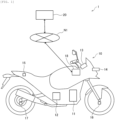
- Fig. 1 is a schematic diagram illustrating a schematic configuration of the information processing system 1.
- the information processing system 1 includes the leaning vehicle 10 and a server 20 that allows wireless communication with each other via a wireless communication network N1.
- the leaning vehicle 10 is a two-wheeled motorcycle corresponding to one example of a leaning vehicle according to the invention. Note that, one leaning vehicle 10 is illustrated in Fig. 1 for easy understanding, however, a plurality of vehicles including the leaning vehicle 10 are actually communicable with the server 20 via the communication network N1.
- the plurality of vehicles communicable with the server 20 include, in addition to the leaning vehicle 10, leaning vehicles other than the leaning vehicle 10, four-wheeled automobiles, and the like.
- the leaning vehicle 10 is provided with the engine 11, a hydraulic pressure control unit 12, a display apparatus 13, a radar 14, an inertial measurement apparatus (IMU) 15, a front-wheel wheel speed sensor 16, a rear-wheel wheel speed sensor 17, and an information processing apparatus (ECU) 18.
- the engine 11 a hydraulic pressure control unit 12
- a display apparatus 13 a radar 14
- an inertial measurement apparatus (IMU) 15
- a front-wheel wheel speed sensor 16 a rear-wheel wheel speed sensor 17
- ECU information processing apparatus
- the engine 11 corresponds to one example of a drive source of the leaning vehicle 10, and is capable of outputting power for driving a wheel.
- the engine 11 is provided with one or a plurality of cylinders in which a combustion chamber is formed in an inside thereof, a fuel injection valve that injects fuel toward the combustion chamber, and an ignition plug.
- the fuel is injected from the fuel injection valve to form an air-fuel mixture containing air and fuel in the combustion chamber, and the air-fuel mixture is ignited by the ignition plug and burns.
- a piston provided in the cylinder reciprocates, and a crankshaft rotates.
- a throttle valve is provided in an air-intake pipe of the engine 11 to change the air-intake quantity to the combustion chamber in accordance with the opening degree of throttle that is the opening degree of the throttle valve.
- the hydraulic pressure control unit 12 is a unit that has a function of controlling a braking force that is generated in the wheel.
- the hydraulic pressure control unit 12 is provided on an oil passage that connects a master cylinder to a wheel cylinder, and includes components (for example, a control valve and a pump) for controlling a braking hydraulic pressure of the wheel cylinder.
- the operation of the components in the hydraulic pressure control unit 12 is controlled to control a braking force to be generated in the wheel.
- the hydraulic pressure control unit 12 may respectively control braking forces to be generated in both of a front wheel and a rear wheel, or may control the braking force to be generated in only one of the front wheel and the rear wheel.
- the display apparatus 13 has a display function of visually displaying information. Examples of the display apparatus 13 can include a liquid crystal display or a lamp.
- the display apparatus 13 is provided in front of a handle in a body of the leaning vehicle 10, for example. Further, an arrangement of the display apparatus 13 with respect to the vehicle body is not specially limited.
- the radar 14 detects surrounding environment information that is information related to an environment in the surrounding of the leaning vehicle 10.
- the radar 14 is provided to a front part of the leaning vehicle 10, and detects surrounding environment information in front of the leaning vehicle 10.
- the surrounding environment information detected by the radar 14 is output to the information processing apparatus 18.
- the surrounding environment information that is detected by the radar 14 may be information (for example, a relative position, a relative distance, a relative speed, or a relative acceleration) related to a distance to or an orientation of a subject that is positioned in the periphery of the leaning vehicle 10, or may be a feature (for example, a type of the subject, a shape of the subject itself, or a mark assigned to the subject) of the subject that is positioned in the periphery of the leaning vehicle 10.
- information for example, a relative position, a relative distance, a relative speed, or a relative acceleration
- a feature for example, a type of the subject, a shape of the subject itself, or a mark assigned to the subject
- the inertial measurement apparatus 15 is provided with a three-axis gyro sensor and a three-way acceleration sensor, and detects a posture of the leaning vehicle 10.
- the inertial measurement apparatus 15 is provided to the body of the leaning vehicle 10, for example.
- the inertial measurement apparatus 15 detects a lean angle, a pitch angle, and a yaw angle of the leaning vehicle 10, and outputs detection results.
- the inertial measurement apparatus 15 may detect other physical amounts that can be substantially converted into the lean angle, the pitch angle, and the yaw angle of the leaning vehicle 10.
- the lean angle corresponds to an angle indicating an inclination of the vehicle body (specifically, body) of the leaning vehicle 10 in the roll direction with respect to the vertical upward direction.
- the inertial measurement apparatus 15 may be provided with parts of the three-axis gyro sensor and the three-way acceleration sensor.
- the front-wheel wheel speed sensor 16 is a wheel speed sensor that detects a wheel speed of the front wheel (for example, a rotational frequency [rpm] per unit time or a movement distance [km/h] per unit time, and the like of the front wheel), and outputs a detection result.
- the front-wheel wheel speed sensor 16 may detect another physical amount that can be substantially converted into the wheel speed of the front wheel.
- the front-wheel wheel speed sensor 16 is provided to the front wheel.
- the rear-wheel wheel speed sensor 17 is a wheel speed sensor that detects a wheel speed of the rear wheel (for example, a rotational frequency [rpm] per unit time or a movement distance [km/h] per unit time, and the like of the rear wheel), and outputs a detection result.
- the rear-wheel wheel speed sensor 17 may detect another physical amount that can be substantially converted into the wheel speed of the rear wheel.
- the rear-wheel wheel speed sensor 17 is provided to the rear wheel.
- the information processing apparatus 18 performs various kinds of information processing. Specifically, the information processing apparatus 18 performs information processing related to a position of the leaning vehicle 10, and information processing related to control of each apparatus in the leaning vehicle 10.
- a part or all of the information processing apparatus 18 includes a microcomputer, a microprocessor unit, and the like.
- a part or all of the information processing apparatus 18 may include an updatable component such as firmware, and may be a program module or the like that is executed by a command from a CPU or the like.
- the information processing apparatus 18 may be one information processing apparatus 18 or may be divided into a plurality of the information processing apparatuses 18, for example.
- the communicating section 18a communicates with various kinds of communication apparatuses that can communicate with the communicating section 18a.
- the communicating section 18a communicates with the server 20 via the communication network N1.
- the communicating section 18a communicates with vehicles in the periphery of the leaning vehicle 10 by vehicle-to-vehicle communication (for example, V2V).
- vehicle-to-vehicle communication for example, V2V
- the vehicle-to-vehicle communication is executed via the communication network N1, for example.
- the communicating section 18a communicates with traffic equipment in the periphery of the leaning vehicle 10 by the wireless communication (for example, V2X).
- the V2V communication and/or the V2X communication is executed via the communication network N1.
- the communicating section 18a can also communicate with a positioning system (for example, GPS: Global Positioning System).
- the acquiring section 18b acquires information from the respective apparatuses in the leaning vehicle 10. For example, the acquiring section 18b acquires information from the radar 14, the inertial measurement apparatus 15, the front-wheel wheel speed sensor 16, and the rear-wheel wheel speed sensor 17. Note that, in the present description, the acquisition of information can include extraction, creation, and the like of the information.
- the acquiring section 18b may acquire information via the communicating section 18a, from various kinds of communication apparatuses that can wirelessly communicate with the communicating section 18a.
- the specifying section 18c specifies an absolute position of the leaning vehicle 10. A specified result by the specifying section 18c is used for driving support control by the executing section 18d, for example.
- the executing section 18d executes the driving support control.
- the driving support control is control of supporting the driving by a rider of the leaning vehicle 10, and can include various kinds of control.
- the executing section 18d executes the driving support control by controlling as appropriate operations of the engine 11, the hydraulic pressure control unit 12, and the display apparatus 13, for example. Note that, details of the driving support control are described later.
- the server 20 in Fig. 1 collects and manages information from a plurality of vehicles including the leaning vehicle 10 and/or the road equipment, creates or updates a map that is information to be used in each vehicle for the driving support control, and transmits the map to each vehicle.
- a part or all of the server 20 includes a microcomputer, a microprocessor unit, and the like.
- a part or all of the server 20 may include an updatable component such as firmware, and may be a program module or the like that is executed by a command from a CPU or the like.
- the server 20 may be one server 20 or may be divided into a plurality of the servers 20, for example.
- Fig. 3 is a block diagram illustrating one example of a function configuration of the server 20.
- the server 20 is provided with, for example, a communicating section 21, a creating section 22, and a storing section 23.
- the communicating section 21 communicates with a plurality of vehicles including the leaning vehicle 10 via the communication network N1.
- the communicating section 21 communicates with the information processing apparatus 18 in the leaning vehicle 10.
- the communicating section 21 communicates with the road equipment via the communication network N1.
- the creating section 22 executes map creating processing of creating or updating the abovementioned map based on the information collected from the plurality of vehicles.
- the map includes various kinds of information.
- the map includes a data set in which huge quantities of detection point data indicating detection points detected by surrounding environment sensors in the respective vehicles are integrated.
- the detection point data includes, in addition to data indicating a position of each vehicle, data indicating a position of a lane boundary. Note that, details of the map are described later.
- the storing section 23 stores therein various kinds of information.
- the storing section 23 stores therein information received by the communicating section 21.
- the map creating processing by the creating section 22 is performed based on the information to be stored in the storing section 23.
- the storing section 23 stores therein the map created or updated by the creating section 22.
- communication is performed between the information processing apparatus 18 in the leaning vehicle 10 and the server 20 to implement appropriately specifying an absolute position of the leaning vehicle 10.
- processing related to creating a map and processing related to using the map will be described sequentially.
- Fig. 4 is a flowchart illustrating one example of a flow of processing related to creating a map that is performed by the information processing system 1.
- S101 in Fig. 4 corresponds to a start of a processing flow illustrated in Fig. 4 .
- the acquiring section 18b of the information processing apparatus 18 acquires surrounding environment information based on an output from the radar 14.
- the surrounding environment information that is acquired at S102 includes detection point data such as detection point data indicating a position of a vehicle in the surrounding, and detection point data indicating a position of a lane boundary (for example, a median strip or a guard rail) in the surrounding.
- detection point data such as detection point data indicating a position of a vehicle in the surrounding
- detection point data indicating a position of a lane boundary (for example, a median strip or a guard rail) in the surrounding.
- the communicating section 18a of the information processing apparatus 18 transmits the surrounding environment information acquired at S102 to the server 20 that is an external apparatus.
- the communicating section 21 of the server 20 receives the transmitted surrounding environment information.
- the creating section 22 of the server 20 executes the map creating processing based on the surrounding environment information, and the processing returns to S102.
- the map that is created or updated by the map creating processing includes, as mentioned above, a data set in which huge quantities of detection point data indicating detection points detected by the surrounding environment sensors in the respective vehicles are integrated.
- a plurality of detection point data indicating positions of the lane boundary correspond to information indicating a road shape, for example.
- a plurality of detection point data indicating positions of the respective vehicles correspond to information indicating a traffic situation, for example.
- the map can include, for example, information related to a road surface gradient, a road surface state, a sign, a legal speed, and the presence or absence of an accident. In the map, these various kinds of information are integrated.
- surrounding environment information to be acquired at S102 is added to the map stored in the storing section 23 of the server 20 to create a new map.
- Fig. 5 a flowchart illustrating one example of a flow of processing related to using a map that is performed by the information processing system 1.
- S201 in Fig. 5 corresponds to a start of a processing flow illustrated in Fig. 5 .
- the communicating section 18a of the information processing apparatus 18 receives a map from the server 20.
- the specifying section 18c of the information processing apparatus 18 specifies an absolute position of the leaning vehicle 10 based on the map acquired at S202.
- the specifying section 18c compares the map acquired at S202 with the surrounding environment information acquired at S102 in Fig. 4 to specify an absolute position of the leaning vehicle 10.
- the specifying section 18c can specify an absolute position of the leaning vehicle 10 by comparing a detection point indicating a lane boundary that is included in the map with a detection point indicating a lane boundary detected by the radar 14 in the leaning vehicle 10.
- the executing section 18d of the information processing apparatus 18 executes driving support control based on the absolute position information that is information related to the absolute position specified at S203, and the processing returns to S202.
- the driving support control is control of supporting the driving by the rider of the leaning vehicle 10, as mentioned above.
- the executing section 18d executes, for example, as driving support control, control based on the surrounding environment information that is detected by the radar 14.
- an absolute position of the leaning vehicle 10 is appropriately specified. Therefore, the appropriately specified absolute position information can be used for the driving support control, so that the driving support control can be appropriately executed.
- the executing section 18d may execute driving support control for improving the safety, such as Adaptive cruise control, based on at least one of information on a position of the leaning vehicle 10 in a lane width direction and information on a position of the leaning vehicle 10 in a lane front-and-rear direction.
- driving support control for improving the safety, such as Adaptive cruise control, based on at least one of information on a position of the leaning vehicle 10 in a lane width direction and information on a position of the leaning vehicle 10 in a lane front-and-rear direction.
- Adaptive cruise control for example, the speed of the leaning vehicle 10 is controlled based on information indicating the speed of the leaning vehicle 10 that is acquired based on a detection result by the front-wheel wheel speed sensor 16 and a detection result by the rear-wheel wheel speed sensor 17.
- the executing section 18d may execute, in driving support control related to group traveling, determination of a vehicle train where the own vehicle is present, based on information on a position of the leaning vehicle 10 in the lane width direction.
- a plurality of vehicles including the own vehicle travel in a plurality of vehicle trains (specifically, two vehicle trains of a vehicle train on the left side and a vehicle train on the right side in the same lane).
- the executing section 18d may execute lane keeping assist as driving support control based on information on a position of the leaning vehicle 10 in the lane width direction.
- the lane keeping assist is a driving support operation that prevents the own vehicle from deviating from the traveling lane.
- the executing section 18d may prohibit the lane keeping assist when the leaning vehicle 10 approaches a curved road.
- the executing section 18d may execute notification control of making a notification to a rider based on information on a position of the leaning vehicle 10 in the lane front-and-rear direction, as driving support control. For example, in the notification control, it is notified that the speed of the leaning vehicle 10 is expected to exceed the legal speed. Moreover, for example, in the notification control, it is notified that a road surface on which the leaning vehicle 10 is traveling or will travel in the future is a frozen road. Note that, under a situation where these pieces of notification control are performed, in addition to the notification control or in place of the notification control, the executing section 18d may execute control of automatically decelerating the leaning vehicle 10 as driving support control.
- the situation where the driving support control is executed based on the absolute position information for example, various kinds of situations including a situation where the leaning vehicle 10 is changing the lane are assumed.
- the situation where the driving support control is executed based on the absolute position information is not limited to the abovementioned examples, but for example, the executing section 18d may execute the driving support control based on the absolute position information in the situation where the leaning vehicle 10 performs slip-through traveling (what is called, Lane splitting).
- the driving support control may be executed based on, in addition to the absolute position information, information other than the absolute position information.
- the executing section 18d may execute the driving support control based on, in addition to the absolute position information, information (for example, traveling state information, map information, or reliability information, which is described later) already acquired during when the absolute position is specified.
- the acquiring section 18b acquires surrounding environment information on the leaning vehicle 10 based on an output from the radar 14 mounted to the leaning vehicle 10, and the specifying section 18c specifies an absolute position of the leaning vehicle 10 based on the surrounding environment information.
- the communicating section 18a transmits surrounding environment information to the server 20 that is an external apparatus, and the specifying section 18c specifies an absolute position based on a map that is created or updated based on the surrounding environment information transmitted to the server 20.
- the radar 14 is used to implement acquiring the surrounding environment information on the leaning vehicle 10 with high accuracy. Therefore, the surrounding environment information that is appropriately acquired based on the output from the radar 14 is used to specify an absolute position of the leaning vehicle 10. Therefore, an absolute position of the leaning vehicle 10 can be appropriately specified.
- the examples of the processing related to creating a map, and the processing related to using the map have been described. Further, the processing that is performed by the information processing system 1 may be processing other than the above-described processing.
- the communicating section 18a may transmit absolute position information that is information related to an absolute position of the leaning vehicle 10, to an external apparatus.
- the communicating section 18a transmits the absolute position information to vehicles in the surrounding, for example. Accordingly, in a vehicle in the surrounding, the absolute position of the leaning vehicle 10 can be displayed on a display apparatus, and the absolute position of the leaning vehicle 10 can be informed to a driver of the vehicle in the surrounding.
- the specifying section 18c may specify an absolute position of the leaning vehicle 10 without using a map that is created or updated by the server 20.
- the specifying section 18c directly uses surrounding environment information that is acquired based on the output from the radar 14 to specify an absolute position of the leaning vehicle 10, for example. Accordingly, without using the communication between the information processing apparatus 18 and the server 20, an absolute position of the leaning vehicle 10 can be specified.
- the information processing system 1 preferably performs the processing related to creating a map by considering reliability information that is information on the reliability for the surrounding environment information.
- reliability information that is information on the reliability for the surrounding environment information.
- Fig. 6 is a flowchart illustrating one example of a flow of the first processing that is related to creating a map in which reliability information is considered, and is performed by the information processing system 1.
- S301 in Fig. 6 corresponds to a start of a processing flow illustrated in Fig. 6 .
- the acquiring section 18b of the information processing apparatus 18 acquires surrounding environment information based on an output from the radar 14.
- the processing at S302 is similar to the processing at S102 in Fig. 4 .
- the acquiring section 18b of the information processing apparatus 18 acquires reliability information that is information on reliability for surrounding environment information.
- a posture easily changes in the leaning vehicle 10, in comparison with a four-wheeled automobile and the like. Further, in a situation where the posture of the leaning vehicle 10 easily changes, due to the posture of the leaning vehicle 10 becoming a posture different from a reference posture (for example, a posture in which the leaning vehicle 10 stands upright) or the like, the reliability for surrounding environment information to be detected by the radar 14 that is mounted to the leaning vehicle 10 becomes low.
- the map that is managed by the server 20 includes, in addition to surrounding environment information that is acquired by the leaning vehicle 10, surrounding environment information that is acquired by a four-wheeled automobile and the like. Therefore, it is important to maintain the reliability for the surrounding environment information that is acquired by the leaning vehicle 10 and is used for the map creating processing to the level similar to that of the reliability for the surrounding environment information that is acquired by the four-wheeled automobile and the like.
- the reliability information is information for determining whether the reliability for the acquired surrounding environment information is lower than a reference.
- a case where the reliability for the acquired surrounding environment information is lower than the reference corresponds to a case where the reliability for the surrounding environment information that is acquired by the leaning vehicle 10 does not reach to the level similar to that of the reliability for the surrounding environment information that is acquired by the four-wheeled automobile and the like.
- a case where the reliability for the acquired surrounding environment information is equal to or higher than the reference corresponds to a case where the reliability for the surrounding environment information that is acquired by the leaning vehicle 10 reaches to the level similar to that of the reliability for the surrounding environment information that is acquired by the four-wheeled automobile and the like.
- the acquiring section 18b may acquire reliability information based on traveling state information that is information related to a traveling state of the leaning vehicle 10.
- the traveling state information includes a lean angle, the degree of change in the lean angle, a pitch angle, the degree of change in the pitch angle, a yaw angle, the degree of change in the yaw angle (in other words, yaw rate), a steering angle of a handle, the degree of change in the steering angle of the handle, the speed of the leaning vehicle 10, the acceleration of the leaning vehicle 10, and the like.
- the acquiring section 18b acquires information indicating that the reliability for the acquired surrounding environment information is lower than the reference, as reliability information.
- the lean angle is excessively large, it is assumed that the leaning vehicle 10 performs curve traveling. In a case where the leaning vehicle 10 performs the curve traveling, the posture of the leaning vehicle 10 easily changes. Therefore, it can be determined that the reliability for the acquired surrounding environment information is lower than the reference.
- the acquiring section 18b acquires information indicating that the reliability for the acquired surrounding environment information is lower than the reference, as reliability information.
- the speed of the leaning vehicle 10 is excessively low, in order to balance the leaning vehicle 10, a rider performs an operation of swinging the handle little by little from side to side. Accordingly, the radar 14 is swung from side to side in synchronization with the handle, so that the direction of the radar 14 easily varies. Therefore, it can be determined that the reliability for the acquired surrounding environment information is lower than the reference.
- the speed of the leaning vehicle 10 is excessively high, it is assumed that the posture of the leaning vehicle 10 becomes unstable and easily changes. Therefore, it can be determined that the reliability for the acquired surrounding environment information is lower than the reference.
- the acquiring section 18b may acquire reliability information based on map information.
- the map information is stored in the storing section 23 of the server 20, for example, and is transmitted from the server 20.
- the map information may be acquired from an apparatus other than the server 20.
- the acquiring section 18b acquires information indicating that the reliability for the acquired surrounding environment information is lower than the reference, as reliability information.
- the posture of the leaning vehicle 10 easily varies. Therefore, it can be determined that the reliability for the acquired surrounding environment information is lower than the reference.
- the communicating section 18a of the information processing apparatus 18 transmits surrounding environment information and reliability information to the server 20 that is an external apparatus.
- the communicating section 21 of the server 20 receives the transmitted surrounding environment information and reliability information.
- the creating section 22 of the server 20 determines whether the reliability information is information indicating that the reliability for the acquired surrounding environment information is lower than the reference.
- the processing proceeds to S306.
- the creating section 22 executes the map creating processing based on the surrounding environment information, and the processing returns to S302.
- the processing at S306 is similar to the processing at S104 in Fig. 4 .
- the reliability information is information indicating that the reliability for the acquired surrounding environment information is lower than the reference (S305/YES)
- S306 is not performed and the processing returns to S302.
- the creating section 22 executes the map creating processing based on the reliability information that is information on the reliability for the surrounding environment information.
- the specifying section 18c specifies an absolute position of the leaning vehicle 10 based on the map created or updated based on the reliability information. Therefore, the specifying section 18c specifies an absolute position of the leaning vehicle 10 based on the reliability information that is information on the reliability for the surrounding environment information. Accordingly, an absolute position of the leaning vehicle 10 can be specified by considering the reliability for the surrounding environment information, so that the absolute position of the leaning vehicle 10 can be more appropriately specified.
- the creating section 22 does not execute the map creating processing. Accordingly, it is possible to prevent surrounding environment information with low reliability from being used in the map creating processing. Therefore, an absolute position of the leaning vehicle 10 can be specified using the map with high accuracy, so that more appropriately specifying the absolute position of the leaning vehicle 10 is appropriately implemented.
- the server 20 determines whether the execution of the map creating processing is possible based on the reliability information. Further, in a case where the reliability information is information indicating that the reliability for the acquired surrounding environment information is lower than the reference, the communicating section 18a of the information processing apparatus 18 does not need to transmit the surrounding environment information to the server 20. In this case as well, as a result, the map creating processing is not executed.
- the creating section 22 may execute the map creating processing not based on the acquired surrounding environment information. For example, in such a case, the creating section 22 does not use the surrounding environment information acquired by the leaning vehicle 10, but may execute the map creating processing based on surrounding environment information acquired by a vehicle other than the leaning vehicle 10.
- the executing section 18d may execute the driving support control not based on the absolute position information.
- Fig. 7 is a flowchart illustrating one example of a flow of second processing that is related to creating a map in which reliability information is considered, and is performed by the information processing system 1.
- S401 in Fig. 7 corresponds to a start of a processing flow illustrated in Fig. 7 .
- the acquiring section 18b of the information processing apparatus 18 acquires surrounding environment information based on an output from the radar 14.
- the processing at S402 is similar to the processing at S102 in Fig. 4 .
- the acquiring section 18b of the information processing apparatus 18 acquires reliability information that is information on reliability for surrounding environment information.
- the processing at S403 is similar to the processing at S303 in Fig. 6 .
- the acquiring section 18b of the information processing apparatus 18 determines whether the reliability information is information indicating that the reliability for the acquired surrounding environment information is lower than the reference.
- the processing proceeds to S405.
- the acquiring section 18b of the information processing apparatus 18 acquires corrected surrounding environment information that is information obtained by correcting the acquired surrounding environment information, and the processing proceeds to S406.
- the acquiring section 18b acquires the corrected surrounding environment information, for example, by replacing the surrounding environment information acquired at S402 with surrounding environment information having been determined that the reliability is equal to or more than the reference, among the surrounding environment information acquired in the past. For example, if it has been determined as YES at S404 due to the excessive large lean angle of the leaning vehicle 10, the acquiring section 18b acquires the corrected surrounding environment information by replacing surrounding environment information acquired at S402 with surrounding environment information acquired in the past in a situation of the small lean angle of the leaning vehicle 10.
- S404 if it has been determined that the reliability information is not information indicating that the reliability for the acquired surrounding environment information is lower than the reference (S404/NO), S405 is not performed and the processing proceeds to S406.
- the communicating section 18a of the information processing apparatus 18 transmits the surrounding environment information or the corrected surrounding environment information to the server 20 that is an external apparatus. If no S405 is performed, the communicating section 18a transmits the surrounding environment information acquired at S402 to the server 20. On the other hand, if S405 has been performed, the communicating section 18a transmits the corrected surrounding environment information acquired at S405 to the server 20. The communicating section 21 of the server 20 receives the transmitted surrounding environment information or corrected surrounding environment information.
- the creating section 22 executes the map creating processing based on the surrounding environment information or the corrected surrounding environment information, and the processing returns to S402.
- the processing at S407 is similar to the processing at S104 in Fig. 4 .
- the creating section 22 executes the map creating processing based on the reliability information that is information on the reliability for the surrounding environment information.
- the specifying section 18c specifies an absolute position of the leaning vehicle 10 based on the map created or updated based on the reliability information. Therefore, the specifying section 18c specifies an absolute position of the leaning vehicle 10 based on the reliability information that is information on the reliability for the surrounding environment information. Accordingly, an absolute position of the leaning vehicle 10 can be specified by considering the reliability for the surrounding environment information, so that the absolute position of the leaning vehicle 10 can be more appropriately specified.
- the acquiring section 18b acquires corrected surrounding environment information that is information obtained by correcting the acquired surrounding environment information. Accordingly, it is possible to prevent surrounding environment information with low reliability from being used in the map creating processing. Therefore, an absolute position of the leaning vehicle 10 can be specified using the map with high accuracy, so that more appropriately specifying the absolute position of the leaning vehicle 10 is appropriately implemented.
- the processing that is performed by the information processing system 1 has been described by distinguishing the processing to be performed by the information processing apparatus 18 from the processing to be performed by the server 20. Further, a part or all of the processing that is performed by the information processing apparatus 18 in the abovementioned example may be performed by the server 20, and a part or all of the processing that is performed by the server 20 in the abovementioned example may be performed by the information processing apparatus 18.
- the specifying section 18c specifies an absolute position of the leaning vehicle 10 based on reliability information that is information on the reliability for the surrounding environment information. Accordingly, an absolute position of the leaning vehicle 10 can be specified by considering the reliability for the surrounding environment information, so that the absolute position of the leaning vehicle 10 can be more appropriately specified.
- the acquiring section 18b acquires reliability information based on traveling state information that is information related to a traveling state of the leaning vehicle 10. Accordingly, the reliability information can be appropriately acquired using the traveling state information. Therefore, whether the reliability for the acquired surrounding environment information is lower than the reference can be appropriately determined.
- the acquiring section 18b acquires reliability information based on map information. Accordingly, the reliability information can be appropriately acquired using the map information. Therefore, whether the reliability for the acquired surrounding environment information is lower than the reference can be appropriately determined.
- the communicating section 18a transmits surrounding environment information to the external apparatus (the server 20 in the abovementioned example), and the specifying section 18c specifies an absolute position based on a map that is created or updated based on the surrounding environment information transmitted to the external apparatus. Accordingly, specifying an absolute position of the leaning vehicle 10 using the surrounding environment information that is appropriately acquired based on the output from the radar 14 is appropriately implemented. Therefore, appropriately specifying the absolute position of the leaning vehicle 10 is appropriately implemented.
- the communicating section 18a transmits absolute position information that is information related to an absolute position of the leaning vehicle 10, to an external apparatus.
- the external apparatus can perform various kinds of processing using the absolute position information. For example, in a vehicle in the surrounding, the absolute position of the leaning vehicle 10 can be displayed on a display apparatus, and the absolute position of the leaning vehicle 10 can be informed to a driver of the vehicle in the surrounding.
- the executing section 18d executes the driving support control that supports the driving by the rider of the leaning vehicle 10 based on the absolute position information that is information related to an absolute position of the leaning vehicle 10. Accordingly, the appropriately specified absolute position information can be used for the driving support control, so that the driving support control can be appropriately executed.
- the acquiring section 18b acquires surrounding environment information that is information related to an environment in the surrounding of the leaning vehicle 10 based on the output from the radar 14 mounted to the leaning vehicle 10
- the creating section 22 executes the map creating processing of creating or updating a map based on the surrounding environment information
- the specifying section 18c specifies an absolute position of the leaning vehicle 10 based on the map.
- the surrounding environment information that is appropriately acquired based on the output from the radar 14 is used to create or update a map.
- such a map is used to specify an absolute position of the leaning vehicle 10. Therefore, the absolute position of the leaning vehicle 10 can be appropriately specified.
- an absolute position of the leaning vehicle 10 is specified by only using GPS, an error occurs, and an absolute position of the leaning vehicle 10 cannot be accurately specified in some cases.
- employing an absolute position of the leaning vehicle 10 specified with the map allows the absolute position of the leaning vehicle 10 to be determined with high accuracy.
- the creating section 22 does not execute the map creating processing. Accordingly, it is possible to prevent surrounding environment information with low reliability from being used in the map creating processing. Therefore, an absolute position of the leaning vehicle 10 can be specified using the map with high accuracy, so that more appropriately specifying the absolute position of the leaning vehicle 10 is appropriately implemented.
- the acquiring section 18b acquires corrected surrounding environment information that is information obtained by correcting the acquired surrounding environment information. Accordingly, it is possible to prevent surrounding environment information with low reliability from being used in the map creating processing. Therefore, an absolute position of the leaning vehicle 10 can be specified using the map with high accuracy, so that more appropriately specifying the absolute position of the leaning vehicle 10 is appropriately implemented.
- the creating section 22 executes the map creating processing not based on the acquired surrounding environment information. Accordingly, the surrounding environment information acquired by the leaning vehicle 10 is not used, but a map can be created or updated based on surrounding environment information acquired by a vehicle other than the leaning vehicle 10.
- the invention is not limited the description of the embodiment. For example, only a part of the embodiment may be executed.
- information to be used for acquiring reliability information in each processing of the first processing and the second processing related to creating a map by considering the reliability information described above is not specially limited.
- traveling state information may be used, or map information may be used.
- map information may be used.
- both of the traveling state information and the map information may be used.
Landscapes
- Engineering & Computer Science (AREA)
- Remote Sensing (AREA)
- Radar, Positioning & Navigation (AREA)
- Physics & Mathematics (AREA)
- General Physics & Mathematics (AREA)
- Computer Networks & Wireless Communication (AREA)
- Electromagnetism (AREA)
- Mechanical Engineering (AREA)
- Automation & Control Theory (AREA)
- Traffic Control Systems (AREA)
- Radar Systems Or Details Thereof (AREA)
Abstract
The present invention obtains an information processing apparatus, an information processing system, and an information processing method capable of appropriately specifying an absolute position of a leaning vehicle.
In an information processing apparatus (18), an information processing system (1), and an information processing method according to the invention, an acquiring section of the information processing apparatus (18) acquires surrounding environment information that is information related to an environment in a surrounding of a leaning vehicle (10) based on an output from a radar (14) mounted to the leaning vehicle (10), and a specifying section of the information processing apparatus (18) specifies an absolute position of the leaning vehicle (10) based on the surrounding environment information.
Description
- This disclosure relates to an information processing apparatus, an information processing system, and an information processing method capable of appropriately specifying an absolute position of a leaning vehicle.
- As a related art related to a leaning vehicle such as a motorcycle, there is a technique of supporting driving by a rider. For example,
Patent Literature 1 discloses a driver support system that warns, based on information detected by a sensor apparatus that detects an obstacle present in a traveling direction or substantially present in the traveling direction, a rider of a motorcycle about an inappropriate approach to the obstacle. - PTL 1:
JP2009-116882A - For example, the driving support control or the like that supports the driving by a rider is executed based on absolute position information that is information related to an absolute position of a leaning vehicle in some cases. Therefore, appropriately specifying the absolute position of the leaning vehicle is desired.
- The invention is made in view of the abovementioned problem, and obtains an information processing apparatus, an information processing system, and an information processing method capable of appropriately specify an absolute position of a leaning vehicle.
- An information processing apparatus according to the invention is an information processing apparatus that performs information processing related to a position of a leaning vehicle, and is provided with: an acquiring section that acquires surrounding environment information that is information related to an environment in a surrounding of the leaning vehicle based on an output from a radar mounted to the leaning vehicle; and a specifying section that specifies an absolute position of the leaning vehicle based on the surrounding environment information.
- An information processing system according to the invention is an information processing system that performs information processing related to a position of a leaning vehicle, and is provided with: an acquiring section that acquires surrounding environment information that is information related to an environment in a surrounding of the leaning vehicle based on an output from a radar mounted to the leaning vehicle; a creating section that executes map creating processing of creating or updating a map based on the surrounding environment information; and a specifying section that specifies an absolute position of the leaning vehicle based on the map.
- An information processing method according to the invention is an information processing method of performing information processing related to a position of a leaning vehicle, and includes: acquiring, by an acquiring section of an information processing apparatus, surrounding environment information that is information related to an environment in a surrounding of the leaning vehicle based on an output from a radar mounted to the leaning vehicle; and specifying, by a specifying section of the information processing apparatus, an absolute position of the leaning vehicle based on the surrounding environment information.
- In the information processing apparatus, the information processing system, and the information processing method according to the invention, an acquiring section of the information processing apparatus acquires surrounding environment information that is information related to an environment in a surrounding of the leaning vehicle based on an output from a radar mounted to the leaning vehicle, and a specifying section of the information processing apparatus specifies an absolute position of the leaning vehicle based on the surrounding environment information. Therefore, the surrounding environment information that is appropriately acquired based on the output from the radar is used to specify an absolute position of the leaning vehicle. Therefore, the absolute position of the leaning vehicle can be appropriately specified.
-
-
Fig. 1 is a schematic diagram illustrating a schematic configuration of an information processing system according to an embodiment of the invention. -
Fig. 2 is a block diagram illustrating one example of a function configuration of an information processing apparatus according to the embodiment of the invention. -
Fig. 3 is a block diagram illustrating one example of a function configuration of a server according to the embodiment of the invention. -
Fig. 4 is a flowchart illustrating one example of a flow of processing related to creating a map that is performed by the information processing system according to the embodiment of the invention. -
Fig. 5 is a flowchart illustrating one example of a flow of processing related to using the map that is performed by the information processing system according to the embodiment of the invention. -
Fig. 6 is a flowchart illustrating one example of a flow of first processing related to creating a map in which reliability information is considered, and is performed by the information processing system according to the embodiment of the invention. -
Fig. 7 is a flowchart illustrating one example of a flow of second processing related to creating a map in which reliability information is considered, and is performed by the information processing system according to the embodiment of the invention. - Hereinafter, an information processing apparatus, an information processing system, and an information processing method according to the invention will be described with reference to the drawings.
- Note that, although a case where a leaning vehicle included in the information processing system is a two-wheeled motorcycle is described in the following (see a
leaning vehicle 10 inFig. 1 ), the leaning vehicle included in the information processing system according to the invention may be another leaning vehicle other than the two-wheeled motorcycle. The leaning vehicle indicates a vehicle in which the vehicle body falls on the right side in turning traveling in the right direction, and the vehicle body falls on the left side in turning traveling in the left direction. The leaning vehicle includes, for example, motorcycles (a two-wheeled motor vehicle and a three-wheeled motor vehicle), and a bicycle. The motorcycle includes a vehicle that uses an engine as a power source, a vehicle that uses an electric motor as a power source, and the like. The motorcycle includes, for example, a motorbike, a scooter, and an electric scooter. The bicycle indicates a vehicle capable of traveling on a road by a pedal force of a rider that is applied to a pedal. The bicycle includes an electric assist bicycle, an electric bicycle, and the like. - Moreover, although a case where an engine (specifically, an
engine 11 inFig. 1 , which is described later) is mounted as a drive source capable of outputting power for driving wheels is described in the following, another drive source (for example, electric motor) other than the engine may be mounted as a drive source, or a plurality of drive sources may be mounted. - Moreover, the configuration, the operation, and the like to be described in the following are examples, and an information processing apparatus, an information processing system, and an information processing method according to the invention are not limited to the case having such the configuration, the operation, and the like.
- Moreover, the same or similar descriptions are simplified or omitted as appropriate in the following. Moreover, in the respective drawings, as for the same or similar members or portions, assigning reference numerals thereto is omitted, or the same reference numerals are assigned thereto. Moreover, detailed structures are simplified or omitted as appropriate.
- With reference to
Figs. 1 and2 , a configuration of aninformation processing system 1 according to the embodiment of the invention will be described. -
Fig. 1 is a schematic diagram illustrating a schematic configuration of theinformation processing system 1. As illustrated inFig. 1 , theinformation processing system 1 includes theleaning vehicle 10 and aserver 20 that allows wireless communication with each other via a wireless communication network N1. Theleaning vehicle 10 is a two-wheeled motorcycle corresponding to one example of a leaning vehicle according to the invention. Note that, oneleaning vehicle 10 is illustrated inFig. 1 for easy understanding, however, a plurality of vehicles including theleaning vehicle 10 are actually communicable with theserver 20 via the communication network N1. The plurality of vehicles communicable with theserver 20 include, in addition to the leaningvehicle 10, leaning vehicles other than the leaningvehicle 10, four-wheeled automobiles, and the like. - As illustrated in
Fig. 1 , theleaning vehicle 10 is provided with theengine 11, a hydraulicpressure control unit 12, adisplay apparatus 13, aradar 14, an inertial measurement apparatus (IMU) 15, a front-wheelwheel speed sensor 16, a rear-wheelwheel speed sensor 17, and an information processing apparatus (ECU) 18. - The
engine 11 corresponds to one example of a drive source of the leaningvehicle 10, and is capable of outputting power for driving a wheel. For example, theengine 11 is provided with one or a plurality of cylinders in which a combustion chamber is formed in an inside thereof, a fuel injection valve that injects fuel toward the combustion chamber, and an ignition plug. The fuel is injected from the fuel injection valve to form an air-fuel mixture containing air and fuel in the combustion chamber, and the air-fuel mixture is ignited by the ignition plug and burns. Accordingly, a piston provided in the cylinder reciprocates, and a crankshaft rotates. Moreover, a throttle valve is provided in an air-intake pipe of theengine 11 to change the air-intake quantity to the combustion chamber in accordance with the opening degree of throttle that is the opening degree of the throttle valve. - The hydraulic
pressure control unit 12 is a unit that has a function of controlling a braking force that is generated in the wheel. For example, the hydraulicpressure control unit 12 is provided on an oil passage that connects a master cylinder to a wheel cylinder, and includes components (for example, a control valve and a pump) for controlling a braking hydraulic pressure of the wheel cylinder. The operation of the components in the hydraulicpressure control unit 12 is controlled to control a braking force to be generated in the wheel. Note that, the hydraulicpressure control unit 12 may respectively control braking forces to be generated in both of a front wheel and a rear wheel, or may control the braking force to be generated in only one of the front wheel and the rear wheel. - The
display apparatus 13 has a display function of visually displaying information. Examples of thedisplay apparatus 13 can include a liquid crystal display or a lamp. Thedisplay apparatus 13 is provided in front of a handle in a body of the leaningvehicle 10, for example. Further, an arrangement of thedisplay apparatus 13 with respect to the vehicle body is not specially limited. - The
radar 14 detects surrounding environment information that is information related to an environment in the surrounding of the leaningvehicle 10. For example, theradar 14 is provided to a front part of the leaningvehicle 10, and detects surrounding environment information in front of the leaningvehicle 10. The surrounding environment information detected by theradar 14 is output to theinformation processing apparatus 18. - The surrounding environment information that is detected by the
radar 14 may be information (for example, a relative position, a relative distance, a relative speed, or a relative acceleration) related to a distance to or an orientation of a subject that is positioned in the periphery of the leaningvehicle 10, or may be a feature (for example, a type of the subject, a shape of the subject itself, or a mark assigned to the subject) of the subject that is positioned in the periphery of the leaningvehicle 10. - The
inertial measurement apparatus 15 is provided with a three-axis gyro sensor and a three-way acceleration sensor, and detects a posture of the leaningvehicle 10. Theinertial measurement apparatus 15 is provided to the body of the leaningvehicle 10, for example. For example, theinertial measurement apparatus 15 detects a lean angle, a pitch angle, and a yaw angle of the leaningvehicle 10, and outputs detection results. Theinertial measurement apparatus 15 may detect other physical amounts that can be substantially converted into the lean angle, the pitch angle, and the yaw angle of the leaningvehicle 10. The lean angle corresponds to an angle indicating an inclination of the vehicle body (specifically, body) of the leaningvehicle 10 in the roll direction with respect to the vertical upward direction. Theinertial measurement apparatus 15 may be provided with parts of the three-axis gyro sensor and the three-way acceleration sensor. - The front-wheel
wheel speed sensor 16 is a wheel speed sensor that detects a wheel speed of the front wheel (for example, a rotational frequency [rpm] per unit time or a movement distance [km/h] per unit time, and the like of the front wheel), and outputs a detection result. The front-wheelwheel speed sensor 16 may detect another physical amount that can be substantially converted into the wheel speed of the front wheel. The front-wheelwheel speed sensor 16 is provided to the front wheel. - the rear-wheel
wheel speed sensor 17 is a wheel speed sensor that detects a wheel speed of the rear wheel (for example, a rotational frequency [rpm] per unit time or a movement distance [km/h] per unit time, and the like of the rear wheel), and outputs a detection result. The rear-wheelwheel speed sensor 17 may detect another physical amount that can be substantially converted into the wheel speed of the rear wheel. The rear-wheelwheel speed sensor 17 is provided to the rear wheel. - The
information processing apparatus 18 performs various kinds of information processing. Specifically, theinformation processing apparatus 18 performs information processing related to a position of the leaningvehicle 10, and information processing related to control of each apparatus in the leaningvehicle 10. For example, a part or all of theinformation processing apparatus 18 includes a microcomputer, a microprocessor unit, and the like. Moreover, for example, a part or all of theinformation processing apparatus 18 may include an updatable component such as firmware, and may be a program module or the like that is executed by a command from a CPU or the like. Theinformation processing apparatus 18 may be oneinformation processing apparatus 18 or may be divided into a plurality of theinformation processing apparatuses 18, for example. -
Fig. 2 is a block diagram illustrating one example of a function configuration of theinformation processing apparatus 18. As illustrated inFig. 2 , theinformation processing apparatus 18 is provided with, for example, a communicatingsection 18a, an acquiringsection 18b, a specifyingsection 18c, and an executingsection 18d. - The communicating
section 18a communicates with various kinds of communication apparatuses that can communicate with the communicatingsection 18a. For example, the communicatingsection 18a communicates with theserver 20 via the communication network N1. For example, the communicatingsection 18a communicates with vehicles in the periphery of the leaningvehicle 10 by vehicle-to-vehicle communication (for example, V2V). The vehicle-to-vehicle communication is executed via the communication network N1, for example. For example, the communicatingsection 18a communicates with traffic equipment in the periphery of the leaningvehicle 10 by the wireless communication (for example, V2X). For example, the V2V communication and/or the V2X communication is executed via the communication network N1. For example, the communicatingsection 18a can also communicate with a positioning system (for example, GPS: Global Positioning System). - The acquiring
section 18b acquires information from the respective apparatuses in the leaningvehicle 10. For example, the acquiringsection 18b acquires information from theradar 14, theinertial measurement apparatus 15, the front-wheelwheel speed sensor 16, and the rear-wheelwheel speed sensor 17. Note that, in the present description, the acquisition of information can include extraction, creation, and the like of the information. The acquiringsection 18b may acquire information via the communicatingsection 18a, from various kinds of communication apparatuses that can wirelessly communicate with the communicatingsection 18a. - The specifying
section 18c specifies an absolute position of the leaningvehicle 10. A specified result by the specifyingsection 18c is used for driving support control by the executingsection 18d, for example. - The executing
section 18d executes the driving support control. The driving support control is control of supporting the driving by a rider of the leaningvehicle 10, and can include various kinds of control. The executingsection 18d executes the driving support control by controlling as appropriate operations of theengine 11, the hydraulicpressure control unit 12, and thedisplay apparatus 13, for example. Note that, details of the driving support control are described later. - The
server 20 inFig. 1 collects and manages information from a plurality of vehicles including the leaningvehicle 10 and/or the road equipment, creates or updates a map that is information to be used in each vehicle for the driving support control, and transmits the map to each vehicle. For example, a part or all of theserver 20 includes a microcomputer, a microprocessor unit, and the like. Moreover, for example, a part or all of theserver 20 may include an updatable component such as firmware, and may be a program module or the like that is executed by a command from a CPU or the like. Theserver 20 may be oneserver 20 or may be divided into a plurality of theservers 20, for example. -
Fig. 3 is a block diagram illustrating one example of a function configuration of theserver 20. As illustrated inFig. 3 , theserver 20 is provided with, for example, a communicatingsection 21, a creatingsection 22, and astoring section 23. - The communicating
section 21 communicates with a plurality of vehicles including the leaningvehicle 10 via the communication network N1. For example, the communicatingsection 21 communicates with theinformation processing apparatus 18 in the leaningvehicle 10. For example, the communicatingsection 21 communicates with the road equipment via the communication network N1. - The creating
section 22 executes map creating processing of creating or updating the abovementioned map based on the information collected from the plurality of vehicles. The map includes various kinds of information. For example, the map includes a data set in which huge quantities of detection point data indicating detection points detected by surrounding environment sensors in the respective vehicles are integrated. The detection point data includes, in addition to data indicating a position of each vehicle, data indicating a position of a lane boundary. Note that, details of the map are described later. - The storing
section 23 stores therein various kinds of information. For example, the storingsection 23 stores therein information received by the communicatingsection 21. The map creating processing by the creatingsection 22 is performed based on the information to be stored in thestoring section 23. Moreover, for example, the storingsection 23 stores therein the map created or updated by the creatingsection 22. - With reference to
Figs. 4 to 7 , an operation of theinformation processing system 1 according to the embodiment of the invention will be described. - In the
information processing system 1, communication is performed between theinformation processing apparatus 18 in the leaningvehicle 10 and theserver 20 to implement appropriately specifying an absolute position of the leaningvehicle 10. Hereinafter, among processing performed by theinformation processing system 1, processing related to creating a map and processing related to using the map will be described sequentially. -
Fig. 4 is a flowchart illustrating one example of a flow of processing related to creating a map that is performed by theinformation processing system 1. S101 inFig. 4 corresponds to a start of a processing flow illustrated inFig. 4 . - When the processing flow illustrated in
Fig. 4 is started, at S102, the acquiringsection 18b of theinformation processing apparatus 18 acquires surrounding environment information based on an output from theradar 14. - The surrounding environment information that is acquired at S102 includes detection point data such as detection point data indicating a position of a vehicle in the surrounding, and detection point data indicating a position of a lane boundary (for example, a median strip or a guard rail) in the surrounding.
- Next to S102, at S103, the communicating
section 18a of theinformation processing apparatus 18 transmits the surrounding environment information acquired at S102 to theserver 20 that is an external apparatus. The communicatingsection 21 of theserver 20 receives the transmitted surrounding environment information. - Next to S103, at S104, the creating
section 22 of theserver 20 executes the map creating processing based on the surrounding environment information, and the processing returns to S102. - The map that is created or updated by the map creating processing includes, as mentioned above, a data set in which huge quantities of detection point data indicating detection points detected by the surrounding environment sensors in the respective vehicles are integrated. In the map, a plurality of detection point data indicating positions of the lane boundary correspond to information indicating a road shape, for example. Moreover, in the map, a plurality of detection point data indicating positions of the respective vehicles correspond to information indicating a traffic situation, for example. Moreover, the map can include, for example, information related to a road surface gradient, a road surface state, a sign, a legal speed, and the presence or absence of an accident. In the map, these various kinds of information are integrated. At S104, for example, surrounding environment information to be acquired at S102 is added to the map stored in the
storing section 23 of theserver 20 to create a new map. -
Fig. 5 a flowchart illustrating one example of a flow of processing related to using a map that is performed by theinformation processing system 1. S201 inFig. 5 corresponds to a start of a processing flow illustrated inFig. 5 . - When the processing flow illustrated in
Fig. 5 is started, at S202, the communicatingsection 18a of theinformation processing apparatus 18 receives a map from theserver 20. - Next to S202, at S203, the specifying
section 18c of theinformation processing apparatus 18 specifies an absolute position of the leaningvehicle 10 based on the map acquired at S202. - At S203, for example, the specifying
section 18c compares the map acquired at S202 with the surrounding environment information acquired at S102 inFig. 4 to specify an absolute position of the leaningvehicle 10. For example, the specifyingsection 18c can specify an absolute position of the leaningvehicle 10 by comparing a detection point indicating a lane boundary that is included in the map with a detection point indicating a lane boundary detected by theradar 14 in the leaningvehicle 10. - Next to S203, at S204, the executing
section 18d of theinformation processing apparatus 18 executes driving support control based on the absolute position information that is information related to the absolute position specified at S203, and the processing returns to S202. - The driving support control is control of supporting the driving by the rider of the leaning
vehicle 10, as mentioned above. The executingsection 18d executes, for example, as driving support control, control based on the surrounding environment information that is detected by theradar 14. In theinformation processing system 1, as is described later, an absolute position of the leaningvehicle 10 is appropriately specified. Therefore, the appropriately specified absolute position information can be used for the driving support control, so that the driving support control can be appropriately executed. - For example, the executing
section 18d may execute driving support control for improving the safety, such as Adaptive cruise control, based on at least one of information on a position of the leaningvehicle 10 in a lane width direction and information on a position of the leaningvehicle 10 in a lane front-and-rear direction. In Adaptive cruise control, for example, the speed of the leaningvehicle 10 is controlled based on information indicating the speed of the leaningvehicle 10 that is acquired based on a detection result by the front-wheelwheel speed sensor 16 and a detection result by the rear-wheelwheel speed sensor 17. - Moreover, for example, the executing
section 18d may execute, in driving support control related to group traveling, determination of a vehicle train where the own vehicle is present, based on information on a position of the leaningvehicle 10 in the lane width direction. In the group traveling, a plurality of vehicles including the own vehicle travel in a plurality of vehicle trains (specifically, two vehicle trains of a vehicle train on the left side and a vehicle train on the right side in the same lane). - Moreover, for example, the executing
section 18d may execute lane keeping assist as driving support control based on information on a position of the leaningvehicle 10 in the lane width direction. The lane keeping assist is a driving support operation that prevents the own vehicle from deviating from the traveling lane. Note that, the executingsection 18d may prohibit the lane keeping assist when the leaningvehicle 10 approaches a curved road. - Moreover, for example, the executing
section 18d may execute notification control of making a notification to a rider based on information on a position of the leaningvehicle 10 in the lane front-and-rear direction, as driving support control. For example, in the notification control, it is notified that the speed of the leaningvehicle 10 is expected to exceed the legal speed. Moreover, for example, in the notification control, it is notified that a road surface on which the leaningvehicle 10 is traveling or will travel in the future is a frozen road. Note that, under a situation where these pieces of notification control are performed, in addition to the notification control or in place of the notification control, the executingsection 18d may execute control of automatically decelerating the leaningvehicle 10 as driving support control. - As mentioned above, as the situation where the driving support control is executed based on the absolute position information, for example, various kinds of situations including a situation where the leaning
vehicle 10 is changing the lane are assumed. Note that, the situation where the driving support control is executed based on the absolute position information is not limited to the abovementioned examples, but for example, the executingsection 18d may execute the driving support control based on the absolute position information in the situation where the leaningvehicle 10 performs slip-through traveling (what is called, Lane splitting). - Note that, the driving support control may be executed based on, in addition to the absolute position information, information other than the absolute position information. For example, the executing
section 18d may execute the driving support control based on, in addition to the absolute position information, information (for example, traveling state information, map information, or reliability information, which is described later) already acquired during when the absolute position is specified. - As has been described in the foregoing, in the
information processing system 1, the acquiringsection 18b acquires surrounding environment information on the leaningvehicle 10 based on an output from theradar 14 mounted to the leaningvehicle 10, and the specifyingsection 18c specifies an absolute position of the leaningvehicle 10 based on the surrounding environment information. Specifically, the communicatingsection 18a transmits surrounding environment information to theserver 20 that is an external apparatus, and the specifyingsection 18c specifies an absolute position based on a map that is created or updated based on the surrounding environment information transmitted to theserver 20. Herein, in the processing that is performed by theinformation processing apparatus 18, theradar 14 is used to implement acquiring the surrounding environment information on the leaningvehicle 10 with high accuracy. Therefore, the surrounding environment information that is appropriately acquired based on the output from theradar 14 is used to specify an absolute position of the leaningvehicle 10. Therefore, an absolute position of the leaningvehicle 10 can be appropriately specified. - In the above, with reference to
Figs. 4 and5 , the examples of the processing related to creating a map, and the processing related to using the map have been described. Further, the processing that is performed by theinformation processing system 1 may be processing other than the above-described processing. - For example, the communicating
section 18a may transmit absolute position information that is information related to an absolute position of the leaningvehicle 10, to an external apparatus. The communicatingsection 18a transmits the absolute position information to vehicles in the surrounding, for example. Accordingly, in a vehicle in the surrounding, the absolute position of the leaningvehicle 10 can be displayed on a display apparatus, and the absolute position of the leaningvehicle 10 can be informed to a driver of the vehicle in the surrounding. - Moreover, for example, the specifying
section 18c may specify an absolute position of the leaningvehicle 10 without using a map that is created or updated by theserver 20. The specifyingsection 18c directly uses surrounding environment information that is acquired based on the output from theradar 14 to specify an absolute position of the leaningvehicle 10, for example. Accordingly, without using the communication between theinformation processing apparatus 18 and theserver 20, an absolute position of the leaningvehicle 10 can be specified. - In the above, with reference to
Fig. 4 , the processing example related to creating a map has been described. Herein, from the viewpoint of more appropriately specifying an absolute position of the leaningvehicle 10, theinformation processing system 1 preferably performs the processing related to creating a map by considering reliability information that is information on the reliability for the surrounding environment information. Hereinafter, as an example of processing related to creating a map in which reliability information is considered, first processing and second processing will be described sequentially. -
Fig. 6 is a flowchart illustrating one example of a flow of the first processing that is related to creating a map in which reliability information is considered, and is performed by theinformation processing system 1. S301 inFig. 6 corresponds to a start of a processing flow illustrated inFig. 6 . - When the processing flow illustrated in
Fig. 6 is started, at S302, the acquiringsection 18b of theinformation processing apparatus 18 acquires surrounding environment information based on an output from theradar 14. The processing at S302 is similar to the processing at S102 inFig. 4 . - Next to S302, at S303, the acquiring
section 18b of theinformation processing apparatus 18 acquires reliability information that is information on reliability for surrounding environment information. - Herein, a posture easily changes in the leaning
vehicle 10, in comparison with a four-wheeled automobile and the like. Further, in a situation where the posture of the leaningvehicle 10 easily changes, due to the posture of the leaningvehicle 10 becoming a posture different from a reference posture (for example, a posture in which the leaningvehicle 10 stands upright) or the like, the reliability for surrounding environment information to be detected by theradar 14 that is mounted to the leaningvehicle 10 becomes low. The map that is managed by theserver 20 includes, in addition to surrounding environment information that is acquired by the leaningvehicle 10, surrounding environment information that is acquired by a four-wheeled automobile and the like. Therefore, it is important to maintain the reliability for the surrounding environment information that is acquired by the leaningvehicle 10 and is used for the map creating processing to the level similar to that of the reliability for the surrounding environment information that is acquired by the four-wheeled automobile and the like. - The reliability information is information for determining whether the reliability for the acquired surrounding environment information is lower than a reference. A case where the reliability for the acquired surrounding environment information is lower than the reference corresponds to a case where the reliability for the surrounding environment information that is acquired by the leaning
vehicle 10 does not reach to the level similar to that of the reliability for the surrounding environment information that is acquired by the four-wheeled automobile and the like. On the other hand, a case where the reliability for the acquired surrounding environment information is equal to or higher than the reference corresponds to a case where the reliability for the surrounding environment information that is acquired by the leaningvehicle 10 reaches to the level similar to that of the reliability for the surrounding environment information that is acquired by the four-wheeled automobile and the like. - For example, the acquiring
section 18b may acquire reliability information based on traveling state information that is information related to a traveling state of the leaningvehicle 10. The traveling state information includes a lean angle, the degree of change in the lean angle, a pitch angle, the degree of change in the pitch angle, a yaw angle, the degree of change in the yaw angle (in other words, yaw rate), a steering angle of a handle, the degree of change in the steering angle of the handle, the speed of the leaningvehicle 10, the acceleration of the leaningvehicle 10, and the like. - For example, in a case where the lean angle of the leaning
vehicle 10 is excessively large, the acquiringsection 18b acquires information indicating that the reliability for the acquired surrounding environment information is lower than the reference, as reliability information. In a case where the lean angle is excessively large, it is assumed that the leaningvehicle 10 performs curve traveling. In a case where the leaningvehicle 10 performs the curve traveling, the posture of the leaningvehicle 10 easily changes. Therefore, it can be determined that the reliability for the acquired surrounding environment information is lower than the reference. - Moreover, for example, in a case where the speed of the leaning
vehicle 10 is excessively low or excessively high, the acquiringsection 18b acquires information indicating that the reliability for the acquired surrounding environment information is lower than the reference, as reliability information. In a case where the speed of the leaningvehicle 10 is excessively low, in order to balance the leaningvehicle 10, a rider performs an operation of swinging the handle little by little from side to side. Accordingly, theradar 14 is swung from side to side in synchronization with the handle, so that the direction of theradar 14 easily varies. Therefore, it can be determined that the reliability for the acquired surrounding environment information is lower than the reference. In a case where the speed of the leaningvehicle 10 is excessively high, it is assumed that the posture of the leaningvehicle 10 becomes unstable and easily changes. Therefore, it can be determined that the reliability for the acquired surrounding environment information is lower than the reference. - Moreover, for example, the acquiring
section 18b may acquire reliability information based on map information. The map information is stored in thestoring section 23 of theserver 20, for example, and is transmitted from theserver 20. Note that, the map information may be acquired from an apparatus other than theserver 20. - For example, in a case where it has been determined that the leaning
vehicle 10 is traveling on a curved road based on the map information, the acquiringsection 18b acquires information indicating that the reliability for the acquired surrounding environment information is lower than the reference, as reliability information. As mentioned above, in a case where the leaningvehicle 10 performs the curve traveling, the posture of the leaningvehicle 10 easily varies. Therefore, it can be determined that the reliability for the acquired surrounding environment information is lower than the reference. - Next to S303, at S304, the communicating
section 18a of theinformation processing apparatus 18 transmits surrounding environment information and reliability information to theserver 20 that is an external apparatus. The communicatingsection 21 of theserver 20 receives the transmitted surrounding environment information and reliability information. - Next to S304, at S305, the creating
section 22 of theserver 20 determines whether the reliability information is information indicating that the reliability for the acquired surrounding environment information is lower than the reference. - At S305, if it has been determined that the reliability information is not information indicating that the reliability for the acquired surrounding environment information is lower than the reference (S305/NO), the processing proceeds to S306. At S306, the creating
section 22 executes the map creating processing based on the surrounding environment information, and the processing returns to S302. The processing at S306 is similar to the processing at S104 inFig. 4 . - On the other hand, at S305, if it has been determined that the reliability information is information indicating that the reliability for the acquired surrounding environment information is lower than the reference (S305/YES), S306 is not performed and the processing returns to S302.
- In the first processing described above, the creating
section 22 executes the map creating processing based on the reliability information that is information on the reliability for the surrounding environment information. Further, the specifyingsection 18c specifies an absolute position of the leaningvehicle 10 based on the map created or updated based on the reliability information. Therefore, the specifyingsection 18c specifies an absolute position of the leaningvehicle 10 based on the reliability information that is information on the reliability for the surrounding environment information. Accordingly, an absolute position of the leaningvehicle 10 can be specified by considering the reliability for the surrounding environment information, so that the absolute position of the leaningvehicle 10 can be more appropriately specified. - In particular, in the first processing, in a case where the reliability information is information indicating that the reliability for the acquired surrounding environment information is lower than the reference, the creating
section 22 does not execute the map creating processing. Accordingly, it is possible to prevent surrounding environment information with low reliability from being used in the map creating processing. Therefore, an absolute position of the leaningvehicle 10 can be specified using the map with high accuracy, so that more appropriately specifying the absolute position of the leaningvehicle 10 is appropriately implemented. - In the processing described with reference to
Fig. 6 in the above, theserver 20 determines whether the execution of the map creating processing is possible based on the reliability information. Further, in a case where the reliability information is information indicating that the reliability for the acquired surrounding environment information is lower than the reference, the communicatingsection 18a of theinformation processing apparatus 18 does not need to transmit the surrounding environment information to theserver 20. In this case as well, as a result, the map creating processing is not executed. - Note that, in a case where the reliability information is information indicating that the reliability for the acquired surrounding environment information is lower than the reference, the creating
section 22 may execute the map creating processing not based on the acquired surrounding environment information. For example, in such a case, the creatingsection 22 does not use the surrounding environment information acquired by the leaningvehicle 10, but may execute the map creating processing based on surrounding environment information acquired by a vehicle other than the leaningvehicle 10. - Note that, in a case where the map creating processing is executed even in a case where the reliability information is information indicating that the reliability for the acquired surrounding environment information is lower than the reference, the executing
section 18d may execute the driving support control not based on the absolute position information. -
Fig. 7 is a flowchart illustrating one example of a flow of second processing that is related to creating a map in which reliability information is considered, and is performed by theinformation processing system 1. S401 inFig. 7 corresponds to a start of a processing flow illustrated inFig. 7 . - When the processing flow illustrated in
Fig. 7 is started, at S402, the acquiringsection 18b of theinformation processing apparatus 18 acquires surrounding environment information based on an output from theradar 14. The processing at S402 is similar to the processing at S102 inFig. 4 . - Next to S402, at S403, the acquiring
section 18b of theinformation processing apparatus 18 acquires reliability information that is information on reliability for surrounding environment information. The processing at S403 is similar to the processing at S303 inFig. 6 . - Next to S403, at S404, the acquiring
section 18b of theinformation processing apparatus 18 determines whether the reliability information is information indicating that the reliability for the acquired surrounding environment information is lower than the reference. - At S404, if it has been determined that the reliability information is information indicating that the reliability for the acquired surrounding environment information is lower than the reference (S404/YES), the processing proceeds to S405. At S405, the acquiring
section 18b of theinformation processing apparatus 18 acquires corrected surrounding environment information that is information obtained by correcting the acquired surrounding environment information, and the processing proceeds to S406. - At S405, the acquiring
section 18b acquires the corrected surrounding environment information, for example, by replacing the surrounding environment information acquired at S402 with surrounding environment information having been determined that the reliability is equal to or more than the reference, among the surrounding environment information acquired in the past. For example, if it has been determined as YES at S404 due to the excessive large lean angle of the leaningvehicle 10, the acquiringsection 18b acquires the corrected surrounding environment information by replacing surrounding environment information acquired at S402 with surrounding environment information acquired in the past in a situation of the small lean angle of the leaningvehicle 10. - On the other hand, at S404, if it has been determined that the reliability information is not information indicating that the reliability for the acquired surrounding environment information is lower than the reference (S404/NO), S405 is not performed and the processing proceeds to S406.
- Next to S405 or if it has been determined as NO at S404, at S406, the communicating
section 18a of theinformation processing apparatus 18 transmits the surrounding environment information or the corrected surrounding environment information to theserver 20 that is an external apparatus. If no S405 is performed, the communicatingsection 18a transmits the surrounding environment information acquired at S402 to theserver 20. On the other hand, if S405 has been performed, the communicatingsection 18a transmits the corrected surrounding environment information acquired at S405 to theserver 20. The communicatingsection 21 of theserver 20 receives the transmitted surrounding environment information or corrected surrounding environment information. - Next to S406, at S407, the creating
section 22 executes the map creating processing based on the surrounding environment information or the corrected surrounding environment information, and the processing returns to S402. The processing at S407 is similar to the processing at S104 inFig. 4 . - In the second processing described above, similar to the first processing, the creating
section 22 executes the map creating processing based on the reliability information that is information on the reliability for the surrounding environment information. Further, the specifyingsection 18c specifies an absolute position of the leaningvehicle 10 based on the map created or updated based on the reliability information. Therefore, the specifyingsection 18c specifies an absolute position of the leaningvehicle 10 based on the reliability information that is information on the reliability for the surrounding environment information. Accordingly, an absolute position of the leaningvehicle 10 can be specified by considering the reliability for the surrounding environment information, so that the absolute position of the leaningvehicle 10 can be more appropriately specified. - In particular, in the second processing, in a case where the reliability information is information indicating that the reliability for the acquired surrounding environment information is lower than the reference, the acquiring
section 18b acquires corrected surrounding environment information that is information obtained by correcting the acquired surrounding environment information. Accordingly, it is possible to prevent surrounding environment information with low reliability from being used in the map creating processing. Therefore, an absolute position of the leaningvehicle 10 can be specified using the map with high accuracy, so that more appropriately specifying the absolute position of the leaningvehicle 10 is appropriately implemented. - In the above, with reference to
Figs. 4 to 7 , the processing that is performed by theinformation processing system 1 has been described by distinguishing the processing to be performed by theinformation processing apparatus 18 from the processing to be performed by theserver 20. Further, a part or all of the processing that is performed by theinformation processing apparatus 18 in the abovementioned example may be performed by theserver 20, and a part or all of the processing that is performed by theserver 20 in the abovementioned example may be performed by theinformation processing apparatus 18. - <Effects of Information Processing System>
- Effects of the
information processing system 1 according to the embodiment of the invention will be described. - In the
information processing system 1, the acquiringsection 18b acquires surrounding environment information on the leaningvehicle 10 based on an output from theradar 14 mounted to the leaningvehicle 10, and the specifyingsection 18c specifies an absolute position of the leaningvehicle 10 based on the surrounding environment information. Therefore, the surrounding environment information that is appropriately acquired based on the output from theradar 14 is used to specify an absolute position of the leaningvehicle 10. Therefore, the absolute position of the leaningvehicle 10 can be appropriately specified. For example, in a case where an absolute position of the leaningvehicle 10 is specified by only using GPS, an error occurs, and an absolute position of the leaningvehicle 10 cannot be accurately specified in some cases. With the disclosure, instead of or in combination with an absolute position of the leaningvehicle 10 specified by GPS, employing an absolute position of the leaningvehicle 10 specified based on the surrounding environment information allows the absolute position of the leaningvehicle 10 to be determined with high accuracy. - Preferably, in the
information processing system 1, the specifyingsection 18c specifies an absolute position of the leaningvehicle 10 based on reliability information that is information on the reliability for the surrounding environment information. Accordingly, an absolute position of the leaningvehicle 10 can be specified by considering the reliability for the surrounding environment information, so that the absolute position of the leaningvehicle 10 can be more appropriately specified. - Preferably, in the
information processing system 1, the acquiringsection 18b acquires reliability information based on traveling state information that is information related to a traveling state of the leaningvehicle 10. Accordingly, the reliability information can be appropriately acquired using the traveling state information. Therefore, whether the reliability for the acquired surrounding environment information is lower than the reference can be appropriately determined. - Preferably, in the
information processing system 1, the acquiringsection 18b acquires reliability information based on map information. Accordingly, the reliability information can be appropriately acquired using the map information. Therefore, whether the reliability for the acquired surrounding environment information is lower than the reference can be appropriately determined. - Preferably, in the
information processing system 1, the communicatingsection 18a transmits surrounding environment information to the external apparatus (theserver 20 in the abovementioned example), and the specifyingsection 18c specifies an absolute position based on a map that is created or updated based on the surrounding environment information transmitted to the external apparatus. Accordingly, specifying an absolute position of the leaningvehicle 10 using the surrounding environment information that is appropriately acquired based on the output from theradar 14 is appropriately implemented. Therefore, appropriately specifying the absolute position of the leaningvehicle 10 is appropriately implemented. - Preferably, in the
information processing system 1, the communicatingsection 18a transmits absolute position information that is information related to an absolute position of the leaningvehicle 10, to an external apparatus. Accordingly, the external apparatus can perform various kinds of processing using the absolute position information. For example, in a vehicle in the surrounding, the absolute position of the leaningvehicle 10 can be displayed on a display apparatus, and the absolute position of the leaningvehicle 10 can be informed to a driver of the vehicle in the surrounding. - Preferably, in the
information processing system 1, the executingsection 18d executes the driving support control that supports the driving by the rider of the leaningvehicle 10 based on the absolute position information that is information related to an absolute position of the leaningvehicle 10. Accordingly, the appropriately specified absolute position information can be used for the driving support control, so that the driving support control can be appropriately executed. - Moreover, in the
information processing system 1, the acquiringsection 18b acquires surrounding environment information that is information related to an environment in the surrounding of the leaningvehicle 10 based on the output from theradar 14 mounted to the leaningvehicle 10, the creatingsection 22 executes the map creating processing of creating or updating a map based on the surrounding environment information, and the specifyingsection 18c specifies an absolute position of the leaningvehicle 10 based on the map. Accordingly, the surrounding environment information that is appropriately acquired based on the output from theradar 14 is used to create or update a map. Further, such a map is used to specify an absolute position of the leaningvehicle 10. Therefore, the absolute position of the leaningvehicle 10 can be appropriately specified. For example, in a case where an absolute position of the leaningvehicle 10 is specified by only using GPS, an error occurs, and an absolute position of the leaningvehicle 10 cannot be accurately specified in some cases. With the disclosure, instead of or in combination with an absolute position of the leaningvehicle 10 specified by GPS, employing an absolute position of the leaningvehicle 10 specified with the map allows the absolute position of the leaningvehicle 10 to be determined with high accuracy. - Preferably, in the
information processing system 1, in case where the reliability information is information indicating that the reliability for the acquired surrounding environment information is lower than the reference, the creatingsection 22 does not execute the map creating processing. Accordingly, it is possible to prevent surrounding environment information with low reliability from being used in the map creating processing. Therefore, an absolute position of the leaningvehicle 10 can be specified using the map with high accuracy, so that more appropriately specifying the absolute position of the leaningvehicle 10 is appropriately implemented. - Preferably, in the
information processing system 1, in a case where the reliability information is information indicating that the reliability for the acquired surrounding environment information is lower than the reference, the acquiringsection 18b acquires corrected surrounding environment information that is information obtained by correcting the acquired surrounding environment information. Accordingly, it is possible to prevent surrounding environment information with low reliability from being used in the map creating processing. Therefore, an absolute position of the leaningvehicle 10 can be specified using the map with high accuracy, so that more appropriately specifying the absolute position of the leaningvehicle 10 is appropriately implemented. - Preferably, in the
information processing system 1, in a case where the reliability information is information indicating that the reliability for the acquired surrounding environment information is lower than the reference, the creatingsection 22 executes the map creating processing not based on the acquired surrounding environment information. Accordingly, the surrounding environment information acquired by the leaningvehicle 10 is not used, but a map can be created or updated based on surrounding environment information acquired by a vehicle other than the leaningvehicle 10. - The invention is not limited the description of the embodiment. For example, only a part of the embodiment may be executed. For example, information to be used for acquiring reliability information in each processing of the first processing and the second processing related to creating a map by considering the reliability information described above is not specially limited. Specifically, in each processing of the first processing and the second processing described above, as information that is used for acquiring reliability information, traveling state information may be used, or map information may be used. Moreover, in each processing of the first processing and the second processing described above, as information that is used for acquiring reliability information, both of the traveling state information and the map information may be used.
-
- 1:
- Information processing system
- 10:
- Leaning vehicle
- 11:
- Engine
- 12:
- Hydraulic pressure control unit
- 13:
- Display apparatus
- 14:
- Radar
- 15:
- Inertial measurement apparatus
- 16:
- Front-wheel wheel speed sensor
- 17:
- Rear-wheel wheel speed sensor
- 18:
- Information processing apparatus
- 18a:
- Communicating section
- 18b:
- Acquiring section
- 18c:
- Specifying section
- 18d:
- Executing section
- 20:
- Server
- 21:
- Communicating section
- 22:
- Creating section
- 23:
- Storing section
- N1:
- Communication network
Claims (14)
- An information processing apparatus (18) that performs information processing related to a position of a leaning vehicle (10), the information processing apparatus comprising:an acquiring section (18b) that acquires surrounding environment information that is information related to an environment in a surrounding of the leaning vehicle (10) based on an output from a radar (14) mounted to the leaning vehicle (10); anda specifying section (18c) that specifies an absolute position of the leaning vehicle (10) based on the surrounding environment information.
- The information processing apparatus according to claim 1, wherein the specifying section (18c) specifies the absolute position based on reliability information that is information on reliability for the surrounding environment information.
- The information processing apparatus according to claim 2, wherein the acquiring section (18b) acquires the reliability information based on traveling state information that is information related to a traveling state of the leaning vehicle (10).
- The information processing apparatus according to claim 2, wherein the acquiring section (18b) acquires the reliability information based on map information.
- The information processing apparatus according to claim 1, further comprising a communicating section (18a) that transmits the surrounding environment information to an external apparatus (20), wherein the specifying section (18c) specifies the absolute position based on a map created or updated based on the surrounding environment information transmitted to the external apparatus (20).
- The information processing apparatus according to claim 1, further comprising a communicating section (18a) that transmits absolute position information that is information related to the absolute position to the external apparatus (20).
- The information processing apparatus according to any one of claims 1 to 6, further comprising an executing section (18d) that executes driving support control to support driving by a rider of the leaning vehicle (10) based on absolute position information that is information related to the absolute position.
- An information processing system (1) that performs information processing related to a position of a leaning vehicle (10), the information processing system comprising:an acquiring section (18b) that acquires surrounding environment information that is information related to an environment in a surrounding of the leaning vehicle (10) based on an output from a radar (14) mounted to the leaning vehicle (10);a creating section (22) that executes map creating processing of creating or updating a map based on the surrounding environment information; anda specifying section (18c) that specifies an absolute position of the leaning vehicle (10) based on the map.
- The information processing system according to claim 8, wherein the specifying section (18c) specifies the absolute position based on reliability information that is information on reliability for the surrounding environment information.
- The information processing system according to claim 9, wherein the creating section (22) does not execute the map creating processing when the reliability information is information indicating that the reliability for the acquired surrounding environment information is lower than a reference.
- The information processing system according to claim 9, wherein the acquiring section (18b) acquires corrected surrounding environment information that is information obtained by correcting the acquired surrounding environment information, when the reliability information is information indicating that the reliability for the acquired surrounding environment information is lower than a reference.
- The information processing system according to claim 9, wherein the creating section (22) executes the map creating processing not based on the acquired surrounding environment information, when the reliability information is information indicating that the reliability for the acquired surrounding environment information is lower than a reference.
- The information processing system according to any one of claims 8 to 12, further comprising an executing section (18d) that executes driving support control to support driving by a rider of the leaning vehicle (10) based on absolute position information that is information related to the absolute position.
- An information processing method of performing information processing related to a position of a leaning vehicle (10), the information processing method comprising:acquiring, by an acquiring section (18b) of an information processing apparatus (18), surrounding environment information that is information related to an environment in a surrounding of the leaning vehicle (10) based on an output from a radar (14) mounted to the leaning vehicle (10); andspecifying, by a specifying section (18c) of the information processing apparatus (18), an absolute position of the leaning vehicle (10) based on the surrounding environment information.
Applications Claiming Priority (2)
| Application Number | Priority Date | Filing Date | Title |
|---|---|---|---|
| JP2022106713 | 2022-06-30 | ||
| PCT/IB2023/056250 WO2024003665A1 (en) | 2022-06-30 | 2023-06-16 | Information processing device, information processing system, and information processing method |
Publications (1)
| Publication Number | Publication Date |
|---|---|
| EP4549988A1 true EP4549988A1 (en) | 2025-05-07 |
Family
ID=87468491
Family Applications (1)
| Application Number | Title | Priority Date | Filing Date |
|---|---|---|---|
| EP23745254.5A Pending EP4549988A1 (en) | 2022-06-30 | 2023-06-16 | Information processing device, information processing system, and information processing method |
Country Status (4)
| Country | Link |
|---|---|
| US (1) | US20250383209A1 (en) |
| EP (1) | EP4549988A1 (en) |
| JP (1) | JPWO2024003665A1 (en) |
| WO (1) | WO2024003665A1 (en) |
Family Cites Families (10)
| Publication number | Priority date | Publication date | Assignee | Title |
|---|---|---|---|---|
| US3630079A (en) * | 1969-03-27 | 1971-12-28 | Texas Instruments Inc | Navigation method and apparatus utilizing multiple sensors |
| JP3848431B2 (en) * | 1997-04-28 | 2006-11-22 | 本田技研工業株式会社 | VEHICLE POSITION ESTIMATION APPARATUS, VEHICLE POSITION ESTIMATION METHOD, TRAVEL lane maintenance apparatus, and TR |
| DE10030258A1 (en) * | 2000-06-20 | 2002-01-03 | Daimler Chrysler Ag | Method for controlling the distance of a vehicle from a preceding vehicle and distance control system |
| JP2017019421A (en) * | 2015-07-13 | 2017-01-26 | 日立オートモティブシステムズ株式会社 | Peripheral environment recognition device, and peripheral environment recognition program |
| JP6532786B2 (en) * | 2015-08-07 | 2019-06-19 | 株式会社日立製作所 | Vehicle travel control device and speed control method |
| EP3358550A4 (en) * | 2015-09-30 | 2019-06-12 | Sony Corporation | INFORMATION PROCESSING DEVICE AND INFORMATION PROCESSING METHOD |
| IT201700050502A1 (en) * | 2017-05-10 | 2018-11-10 | Ducati Motor Holding Spa | MOTORCYCLE WITH A DETECTION DEVICE FOR A VEHICLE THAT OVERALLS FROM THE BACK |
| US11125567B2 (en) * | 2019-01-18 | 2021-09-21 | GM Global Technology Operations LLC | Methods and systems for mapping and localization for a vehicle |
| JP2020184129A (en) * | 2019-05-06 | 2020-11-12 | ロベルト・ボッシュ・ゲゼルシャフト・ミト・ベシュレンクテル・ハフツングRobert Bosch Gmbh | Abnormality diagnostic device |
| CN113587941A (en) * | 2020-05-01 | 2021-11-02 | 华为技术有限公司 | High-precision map generation method, positioning method and device |
-
2023
- 2023-06-16 EP EP23745254.5A patent/EP4549988A1/en active Pending
- 2023-06-16 JP JP2024530069A patent/JPWO2024003665A1/ja active Pending
- 2023-06-16 US US18/879,055 patent/US20250383209A1/en active Pending
- 2023-06-16 WO PCT/IB2023/056250 patent/WO2024003665A1/en not_active Ceased
Also Published As
| Publication number | Publication date |
|---|---|
| US20250383209A1 (en) | 2025-12-18 |
| WO2024003665A1 (en) | 2024-01-04 |
| JPWO2024003665A1 (en) | 2024-01-04 |
Similar Documents
| Publication | Publication Date | Title |
|---|---|---|
| JP2022096468A (en) | Control device and control method | |
| JP2021082076A (en) | Control system, control device, and control method | |
| JP7614236B2 (en) | Control device and control method | |
| JP2023175515A (en) | Control device and control method | |
| EP4549988A1 (en) | Information processing device, information processing system, and information processing method | |
| US12539931B2 (en) | Controller and control method | |
| US12606163B2 (en) | Controller and control method | |
| EP4647283A1 (en) | Control device and control method | |
| EP4456034A1 (en) | Rider assistance system, data structure, and control method | |
| EP4647311A1 (en) | Control device and control method | |
| US20250214584A1 (en) | Controller and control method | |
| EP4488137A2 (en) | Controller and control method | |
| EP4549275B1 (en) | Controller and control method | |
| EP4597471A1 (en) | Control device and control method | |
| EP4703225A1 (en) | Control device and control method | |
| JP7791658B2 (en) | Control device and control method | |
| WO2025046348A1 (en) | Control device and control method | |
| JP2021030881A (en) | Processing equipment and evaluation method | |
| EP4697302A1 (en) | Control device and control method | |
| WO2026069022A1 (en) | Control device and control method | |
| CN121794173A (en) | Control device and control method | |
| WO2026009055A1 (en) | Control device and control method |
Legal Events
| Date | Code | Title | Description |
|---|---|---|---|
| STAA | Information on the status of an ep patent application or granted ep patent |
Free format text: STATUS: UNKNOWN |
|
| STAA | Information on the status of an ep patent application or granted ep patent |
Free format text: STATUS: THE INTERNATIONAL PUBLICATION HAS BEEN MADE |
|
| PUAI | Public reference made under article 153(3) epc to a published international application that has entered the european phase |
Free format text: ORIGINAL CODE: 0009012 |
|
| STAA | Information on the status of an ep patent application or granted ep patent |
Free format text: STATUS: REQUEST FOR EXAMINATION WAS MADE |
|
| 17P | Request for examination filed |
Effective date: 20250130 |
|
| AK | Designated contracting states |
Kind code of ref document: A1 Designated state(s): AL AT BE BG CH CY CZ DE DK EE ES FI FR GB GR HR HU IE IS IT LI LT LU LV MC ME MK MT NL NO PL PT RO RS SE SI SK SM TR |
|
| DAV | Request for validation of the european patent (deleted) | ||
| DAX | Request for extension of the european patent (deleted) |