EP4549680A1 - Élément de construction en forme de plaque et procédé de fabrication d'éléments de construction en forme de plaque - Google Patents
Élément de construction en forme de plaque et procédé de fabrication d'éléments de construction en forme de plaque Download PDFInfo
- Publication number
- EP4549680A1 EP4549680A1 EP24189572.1A EP24189572A EP4549680A1 EP 4549680 A1 EP4549680 A1 EP 4549680A1 EP 24189572 A EP24189572 A EP 24189572A EP 4549680 A1 EP4549680 A1 EP 4549680A1
- Authority
- EP
- European Patent Office
- Prior art keywords
- layer
- panel
- carrier plate
- plate
- multilayer
- Prior art date
- Legal status (The legal status is an assumption and is not a legal conclusion. Google has not performed a legal analysis and makes no representation as to the accuracy of the status listed.)
- Pending
Links
Images
Classifications
-
- E—FIXED CONSTRUCTIONS
- E04—BUILDING
- E04F—FINISHING WORK ON BUILDINGS, e.g. STAIRS, FLOORS
- E04F15/00—Flooring
- E04F15/02—Flooring or floor layers composed of a number of similar elements
- E04F15/10—Flooring or floor layers composed of a number of similar elements of other materials, e.g. fibrous or chipped materials, organic plastics, magnesite tiles, hardboard, or with a top layer of other materials
- E04F15/107—Flooring or floor layers composed of a number of similar elements of other materials, e.g. fibrous or chipped materials, organic plastics, magnesite tiles, hardboard, or with a top layer of other materials composed of several layers, e.g. sandwich panels
-
- B—PERFORMING OPERATIONS; TRANSPORTING
- B27—WORKING OR PRESERVING WOOD OR SIMILAR MATERIAL; NAILING OR STAPLING MACHINES IN GENERAL
- B27N—MANUFACTURE BY DRY PROCESSES OF ARTICLES, WITH OR WITHOUT ORGANIC BINDING AGENTS, MADE FROM PARTICLES OR FIBRES CONSISTING OF WOOD OR OTHER LIGNOCELLULOSIC OR LIKE ORGANIC MATERIAL
- B27N3/00—Manufacture of substantially flat articles, e.g. boards, from particles or fibres
- B27N3/007—Manufacture of substantially flat articles, e.g. boards, from particles or fibres and at least partly composed of recycled material
-
- B—PERFORMING OPERATIONS; TRANSPORTING
- B27—WORKING OR PRESERVING WOOD OR SIMILAR MATERIAL; NAILING OR STAPLING MACHINES IN GENERAL
- B27N—MANUFACTURE BY DRY PROCESSES OF ARTICLES, WITH OR WITHOUT ORGANIC BINDING AGENTS, MADE FROM PARTICLES OR FIBRES CONSISTING OF WOOD OR OTHER LIGNOCELLULOSIC OR LIKE ORGANIC MATERIAL
- B27N3/00—Manufacture of substantially flat articles, e.g. boards, from particles or fibres
- B27N3/08—Moulding or pressing
- B27N3/18—Auxiliary operations, e.g. preheating, humidifying, cutting-off
-
- B—PERFORMING OPERATIONS; TRANSPORTING
- B27—WORKING OR PRESERVING WOOD OR SIMILAR MATERIAL; NAILING OR STAPLING MACHINES IN GENERAL
- B27N—MANUFACTURE BY DRY PROCESSES OF ARTICLES, WITH OR WITHOUT ORGANIC BINDING AGENTS, MADE FROM PARTICLES OR FIBRES CONSISTING OF WOOD OR OTHER LIGNOCELLULOSIC OR LIKE ORGANIC MATERIAL
- B27N7/00—After-treatment, e.g. reducing swelling or shrinkage, surfacing; Protecting the edges of boards against access of humidity
- B27N7/005—Coating boards, e.g. with a finishing or decorating layer
-
- B—PERFORMING OPERATIONS; TRANSPORTING
- B27—WORKING OR PRESERVING WOOD OR SIMILAR MATERIAL; NAILING OR STAPLING MACHINES IN GENERAL
- B27N—MANUFACTURE BY DRY PROCESSES OF ARTICLES, WITH OR WITHOUT ORGANIC BINDING AGENTS, MADE FROM PARTICLES OR FIBRES CONSISTING OF WOOD OR OTHER LIGNOCELLULOSIC OR LIKE ORGANIC MATERIAL
- B27N3/00—Manufacture of substantially flat articles, e.g. boards, from particles or fibres
- B27N3/04—Manufacture of substantially flat articles, e.g. boards, from particles or fibres from fibres
Definitions
- the invention relates to a plate-shaped building element, in particular a floor panel, which has a carrier plate and a top-side wear layer, as well as a method for producing plate-shaped building elements.
- Panel-shaped building elements in the form of laminate are widely used. This is a multi-layer panel with a core made of compacted fiber materials.
- a multi-layer decorative layer is applied to the upper surface of the core.
- the decorative layer can comprise a resin-coated decorative paper and determines the appearance of the laminate.
- the so-called overlay or sealant forms a specially resin-coated wear layer, which gives the floor panel a high surface durability.
- a counter-layer is applied to the underside of the carrier plate. This serves to ensure dimensional stability and act as a moisture barrier.
- a laminate floor consists of several rows of rectangular floor panels. On one long side and one end, the floor panel has continuous grooves, and on the opposite long side and end, continuous tongues that are adapted to the grooves.
- the floor elements are installed by connecting the tongue and groove.
- floor panels are predominantly connected using a so-called click system. These involve mechanical fasteners on the grooves and tongues that engage with each other when adjacent floor panels are installed in a floor covering. This allows for glue-free installation of the floor panels. It also prevents the formation of gaps in the installed surface covering due to expansion and shrinkage.
- the invention is based on the object of creating an ecologically advantageous plate-shaped building element and of demonstrating a method for producing such building elements.
- the method according to the invention is the subject of claim 10.
- a panel-shaped structural element according to the invention is, in particular, a floor panel.
- the structural element comprises a carrier plate and a wear layer on the upper side.
- the carrier plate is made from a multilayer panel from a second use.
- a multilayer panel from a second use can be a used or previously used building element, in particular a laminate flooring element.
- a multilayer panel from a second use can also be a second-quality or second-choice panel.
- Multilayer panels from overproduction or discontinued collections can also be subjected to the second use according to the invention and used to manufacture the carrier plate of a building element according to the invention.
- the invention creates a further use for multilayer panels through their secondary use and enables the creation of a new product from old, used or damaged multilayer panels, as well as from multilayer panels from overproduction or discontinued collections. Waste is reduced and the environment is protected.
- the invention creates an ecologically beneficial panel-shaped building element with sustainable and economic added value for manufacturers and consumers.
- the multilayer panel has a decorative layer on its top side. This layer is specifically constructed in multiple layers.
- the multilayer panel has a counter-layer on its underside.
- the multilayer panel from a second use is reprocessed into a carrier panel. Both the top and bottom sides can be mechanically processed, especially cleaned.
- the processing of the multi-layer panel into a carrier plate requires, in particular, that the multi-layer panel is trimmed at the edges. original fasteners on the side edges of the multi-layer panel.
- the components are cleaned.
- the top and bottom surfaces can be cleaned using a brush station if necessary and then dried.
- cleaning agents with antibacterial additives or odorous substances can be applied to the panel body.
- a wear layer is applied to the upper side.
- the previously used product i.e. the multi-layer panels from a second use, forms the carrier board for a new panel-shaped building element.
- the carrier board is recoated or covered on at least one side. This is done on systems that perform board lamination or coating. This can be done using PUR adhesives, PUR hot melt, permanent pressure-sensitive adhesives, reactive adhesives, in particular two-component adhesives, or water-based or aqueous adhesives that cure through IR drying or hot press contact.
- an adhesion promoter in particular an adhesion primer, to the old surface to be coated is advisable.
- the lamination of the layers of the panel-shaped component according to the invention, in particular the carrier plate and the wear layer, and optionally the counterlayer, can be carried out by wet lamination, dry lamination, or thermal lamination.
- Individual panel-shaped components can be laminated one after the other, or several panel-shaped components can be laminated simultaneously.
- Laminate flooring or laminate flooring elements usually have more or less pronounced structures on the top surface. These can be disadvantageous in terms of adhesion and/or lamination for the newly applied wear layer. Surface structures can also become visible on the top surface. Therefore, it is advantageous if the wear layer is applied to the previous underside of the multi-layer panel.
- the original underside is usually In contrast to the old good side, it is usually smooth and also less affected by adhesive films of care products or dirt.
- the wear layer can have different structures.
- the wear layer is multi-layered.
- Films, especially decorative films, but also real wood veneers and similar materials can be used to form the wear layer.
- films and adhesives are used that do not exert tensile stress on the product and do not affect the flatness of the building element.
- PVC-free systems are particularly suitable. Because laminate flooring is manufactured with a counterlayer and decorative layer, its structure makes it very dimensionally stable, meaning the decorative recoating to create the wear layer of the flooring element can only be applied to one side.
- the original decorative layer can also function as a counterlayer.
- a particularly advantageous embodiment provides that the carrier plate is provided with a counter-pull on the underside.
- the carrier plate is profiled along at least two opposite parallel side edges, whereby connecting means are formed on the side edges.
- the original underside of the multilayer panel forming the top side of the carrier plate.
- This is particularly advantageous because the original underside is usually very smooth and is subject to little, if any, wear during use.
- the original underside requires little machining to serve as the top side of the component's carrier plate.
- the wear layer of the panel-shaped building element according to the invention is preferably multi-layered. It comprises one or more decorative layers, in particular a decorative paper or a decorative film, as well as an overlay or sealant that imparts a high surface durability to the building element.
- a counter-layer is applied to the underside of the carrier plate. This serves to ensure dimensional stability and act as a moisture barrier. Depending on the design, impact sound insulation can be provided on the underside of the carrier plate.
- Connecting elements are provided on the side edges of the support plate. These connecting elements are preferably designed with click or snap-in connection elements.
- the wear layer may comprise a decorative film.
- a decorative film is preferably made of polyethylene terephthalate (PET), polypropylene (PP), or polyolefin (PO) and is printed on at least one side.
- Laminate flooring and laminate flooring elements are very well suited as multi-layer panels for secondary use.
- the laminate flooring elements have a closed surface, are robust and solvent-resistant, abrasion-resistant, and also flame-retardant.
- An advantage is that laminate floors largely have a similar structure regardless of the manufacturer.
- the decorative layer usually features an overlay of melamine paper with corundum components and a decorative paper.
- the core board is made of a highly compressed fiber material.
- the multi-layer panels have a counter-layer on the underside. Product thicknesses range from 6 mm to 10 mm in certain increments.
- Laminate flooring elements are equipped with a click connection and installed floating. Such planks or laminate flooring elements can be neatly removed at the end of their service life and returned to the manufacturer or put to secondary use.
- a typical and frequently used format has a width between 192 mm and 197 mm and a length between 1280 mm and 1380 mm.
- tile formats with side dimensions of 300 mm x 400 mm or 400 mm x 850 mm.
- Long plank formats have a width between 195 mm and 250 mm and a length of 1850 mm to 2200 mm. Of course, other dimensions are also available.
- These can also be used as multi-layer panels for secondary use. The multi-layer panels from secondary use are collected, sorted, and categorized by size. The edges are then trimmed. This involves cutting off the existing fasteners on all long sides and the front or end faces of the multi-layer panels.
- the multilayer panels are fed into a sawing unit.
- the edge trimming takes place in the sawing unit, where the multilayer panels are cut to a uniform length and width. Trimming the multilayer panels is preferably brought to a uniform size, smaller than the smallest old plank size or the original size of the multilayer panels from a second use, in order to achieve the greatest possible material yield.
- the existing old fasteners or click profiles are removed on all sides.
- Cleaning follows. In principle, cleaning could also be performed beforehand. However, cleaning after the trimming process is advisable to remove cutting dust and similar debris.
- the cleaning process may also involve mechanical action on one or both surfaces of the multilayer panels. This may involve sanding or brushing, particularly roughening the surfaces. Roughening the surfaces is beneficial to ensure good adhesion during subsequent bonding processes.
- the wear layer is applied to the top surface of the carrier board.
- an adhesion promoter can be applied to the top surface.
- the wear layer is then constructed, which is usually multi-layered and includes a decorative paper and/or a decorative film.
- An abrasion-resistant coating and/or a varnish forms the outermost wear layer of the wear layer on the top side.
- the wear layer of the panel-shaped structural element according to the invention can also be a veneer layer made of real wood or a cork layer.
- the wear layer can be single-layered or multi-layered.
- An abrasion-resistant, transparent wear layer forms the surface of the wear layer.
- Any material suitable for flooring or wall surfaces that can be applied and bonded to a base plate made of a multi-layer panel from a second use using a laminating agent is suitable as a wear layer. This allows for current interior design trends and furnishing styles to be accommodated.
- An advantageous aspect of the invention provides that the underside of the multilayer panel from a secondary use is used as the upper side of the carrier plate of the panel-shaped building element according to the invention.
- the multilayer panel or the carrier plate reprocessed from the multilayer panel is turned over during the manufacturing process, and the original underside of the multilayer panel is used to construct the upper wear layer of the building element.
- the multilayer panel from a second use or the carrier board made from the multilayer panel can be treated with a disinfectant, especially on all sides, and/or an odorant can be applied to the multilayer panel from a second use or the carrier board. Odorants can be sprayed on, for example, or added as a component to the bonding agent, adhesive, or primer.
- the invention enables the reuse of multi-layer panels from a second use. Worn or no longer needed multi-layer panels are given an attractive, modern, contemporary surface. Waste is avoided and resources are saved. This results in both ecological and economic benefits.
- the plate-shaped components are provided with a marking, in particular a marking on the underside, from which the characteristic properties of a plate-shaped component are evident, in particular that it is a plate-shaped component from a second use.
- the marking makes it clear that the plate-shaped component is a second-life (2nd) product.
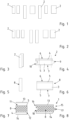
- FIGS. 1 to 8 show a technically schematic system for the reuse of multi-layer panels from a secondary use and a method for producing a plate-shaped building element according to the invention in the form of a floor panel.
- a plate-shaped building element 1 in the form of a floor panel is technically schematically shown in the Figure 8 shown.
- multilayer panels 2 are collected from a secondary use.
- the multilayer panels 2 used may be used products, as well as B-stock or multilayer panels 2 from overproduction or discontinued collections.
- An unordered number of multilayer panels 2 in different dimensions or sizes and dimensions is in the Figure 1 shown.
- Such a multi-layer panel 2 is, in particular, a laminate flooring element.
- the multi-layer panel 2 comprises a panel body 3 made of a compacted, in particular highly compacted, wood-based fiber material, as well as a top-side decorative layer 4 and a bottom-side counter-layer 5 (see Figure 4 ).
- the multi-layer panel 2 has a top side 6 and a bottom side 7.
- the multi-layer panels 2 from a secondary use are sorted and categorized by size ( Figure 2 ).
- the multilayer panels undergo a quality inspection 2. This check focuses on flatness and technical properties, as well as the degree of contamination. Furthermore, they are sorted according to material strength or thickness.
- the multilayer panels 2 from secondary use are assessed for their suitability for use as a carrier plate 8 of a panel-shaped building element 1. Unusable multilayer panels 2 are sorted out and recycled elsewhere.
- the multilayer panels 2 are fed to a processing unit to form the carrier plate 8. During processing, the edges of the multilayer panels 2 are trimmed. This is done in a sawing unit as shown in the Figure 4 is indicated schematically. When trimming the edges of the multilayer panels 2, the old fasteners 9,10 are separated from the multi-layer panel 2. This is shown in the Figure 4 shown.
- the reconditioned multilayer panels 2 or the carrier plates 8 produced from them are cleaned. This may include surface treatment.
- a carrier plate 8 is in the Figure 6
- the carrier plate 8 still has the original multi-layer structure of the multi-layer panel 2 with the plate body 3, the decorative layer 4 and the counter-layer 5.
- the carrier plate 8 reclaimed from the multilayer panel 2 from secondary use, is then sent for further processing.
- the carrier plate 8 can be turned over so that the original underside 7 of the multilayer panel 2 is used as the top side 11 of the carrier plate 8. This step is optional.
- the original top side 6 of the multilayer panel 2 can also be used as the top side 11 of the carrier plate 8.
- the original top side 6 of the multilayer panel 2 forms the bottom side 12 of the carrier plate 8
- the original bottom side 7 of the multilayer panel 2 forms the top side 11 of the carrier plate 8.
- a wear layer 13 is applied to the upper side 11 of the carrier plate 8. For this purpose, an adhesion promoter has been applied to the upper side 11. The wear layer 13 is then completed.
- the wear layer 13 can comprise a layer of real wood veneer, cork, fabric or woven material, decorative paper, and/or a decorative film.
- the panel-shaped component 1 according to the invention has a film-based wear layer 13.
- Decorative films are used here, which are preferably made of polyethylene terephthalate (PET), polypropylene (PP), or polyolefin (PO). The decorative films are printed on at least one side. Such decorative films are available ready for use.
- the application of the wear layer 13, including an outer top-side wear layer, can be carried out in a press, in particular a surface press. This is carried out in a single element production, wherein the carrier plate 8 is provided on the top side with an adhesion promoter and the wear layer 13.
- Individual carrier plates 8 can be bonded one after the other, or several carrier plates 8 can be bonded in parallel or simultaneously, each to a wear layer 13. This can be done by wet lamination, dry lamination, or thermal lamination.
- the bond can be achieved by heat, heat and pressure, or by pressure and extended pressing times.
- Individual plate-shaped components can be pressed one after the other, in parallel, or positioned one above the other.
- the adhesion promoter is an adhesive that is applied in film form or as a hot melt adhesive.
- a water-based adhesive can also be applied to the top surface.
- a prefabricated surface covering is applied to the adhesion promoter layer as a wear layer 13.
- the wear layer 13 is joined on the top side.
- the wear layer 13 can be joined to the carrier plate 8 in a pressing or rolling process.
- the wear layer 13 can be stored on a roll and unrolled and joined to the carrier plate 8, with the wear layer 13 being cut from the roll in required lengths and fixed to the top side 11 of the carrier plate 8.
- the application of the wear layer 13 can be a classic roll lamination or a wrapping process.
- a counter-layer 14 is applied to the underside of the carrier plate 8.
- the new counter-layer 14 is applied to the original decorative layer 4 on the upper side 6 of the multi-layer panel 2.
- the carrier plates 8, provided with the wear layer 13, are then stacked and cured. In a subsequent process step, the edge profiling of the carrier plate 8 takes place.
- the carrier plates 8 are profiled along at least two opposing parallel side edges 15, 16. This is done by mechanical processing, with connecting means 17, 18 being formed on the side edges 15, 16.
- the invention provides a system for the reuse of multilayer panels 2 from a second use.
- the method produces new plate-shaped Building elements 1 created in a cost-effective manner with a low carbon footprint.
- the carrier panels 8, made from a multilayer panel 2 already contain all barrier layers.
- a thin, textured wear layer 13 with a new surface finish is applied to the top. In this way, multilayer panels 2 from secondary use can be reused for many years, both in residential and commercial applications.
Landscapes
- Life Sciences & Earth Sciences (AREA)
- Engineering & Computer Science (AREA)
- Manufacturing & Machinery (AREA)
- Wood Science & Technology (AREA)
- Forests & Forestry (AREA)
- Architecture (AREA)
- Civil Engineering (AREA)
- Structural Engineering (AREA)
- Floor Finish (AREA)
Priority Applications (1)
| Application Number | Priority Date | Filing Date | Title |
|---|---|---|---|
| EP24189572.1A EP4549680A1 (fr) | 2023-10-26 | 2023-10-26 | Élément de construction en forme de plaque et procédé de fabrication d'éléments de construction en forme de plaque |
Applications Claiming Priority (2)
| Application Number | Priority Date | Filing Date | Title |
|---|---|---|---|
| EP24189572.1A EP4549680A1 (fr) | 2023-10-26 | 2023-10-26 | Élément de construction en forme de plaque et procédé de fabrication d'éléments de construction en forme de plaque |
| EP23206179.6A EP4545729A1 (fr) | 2023-10-26 | 2023-10-26 | Élément de construction en forme de plaque et procédé de fabrication d'éléments de construction en forme de plaque |
Related Parent Applications (2)
| Application Number | Title | Priority Date | Filing Date |
|---|---|---|---|
| EP23206179.6A Division EP4545729A1 (fr) | 2023-10-26 | 2023-10-26 | Élément de construction en forme de plaque et procédé de fabrication d'éléments de construction en forme de plaque |
| EP23206179.6A Division-Into EP4545729A1 (fr) | 2023-10-26 | 2023-10-26 | Élément de construction en forme de plaque et procédé de fabrication d'éléments de construction en forme de plaque |
Publications (1)
| Publication Number | Publication Date |
|---|---|
| EP4549680A1 true EP4549680A1 (fr) | 2025-05-07 |
Family
ID=88558441
Family Applications (3)
| Application Number | Title | Priority Date | Filing Date |
|---|---|---|---|
| EP24189572.1A Pending EP4549680A1 (fr) | 2023-10-26 | 2023-10-26 | Élément de construction en forme de plaque et procédé de fabrication d'éléments de construction en forme de plaque |
| EP23206179.6A Pending EP4545729A1 (fr) | 2023-10-26 | 2023-10-26 | Élément de construction en forme de plaque et procédé de fabrication d'éléments de construction en forme de plaque |
| EP24155990.5A Pending EP4545730A1 (fr) | 2023-10-26 | 2024-02-06 | Element de construction en forme de plaque |
Family Applications After (2)
| Application Number | Title | Priority Date | Filing Date |
|---|---|---|---|
| EP23206179.6A Pending EP4545729A1 (fr) | 2023-10-26 | 2023-10-26 | Élément de construction en forme de plaque et procédé de fabrication d'éléments de construction en forme de plaque |
| EP24155990.5A Pending EP4545730A1 (fr) | 2023-10-26 | 2024-02-06 | Element de construction en forme de plaque |
Country Status (1)
| Country | Link |
|---|---|
| EP (3) | EP4549680A1 (fr) |
Citations (2)
| Publication number | Priority date | Publication date | Assignee | Title |
|---|---|---|---|---|
| JP2006112134A (ja) * | 2004-10-15 | 2006-04-27 | Achilles Corp | タイル床材 |
| DE102019117425A1 (de) * | 2019-06-27 | 2020-12-31 | Guido Schulte | Plattenförmiges Bauelement und Verfahren zu dessen Herstellung |
-
2023
- 2023-10-26 EP EP24189572.1A patent/EP4549680A1/fr active Pending
- 2023-10-26 EP EP23206179.6A patent/EP4545729A1/fr active Pending
-
2024
- 2024-02-06 EP EP24155990.5A patent/EP4545730A1/fr active Pending
Patent Citations (2)
| Publication number | Priority date | Publication date | Assignee | Title |
|---|---|---|---|---|
| JP2006112134A (ja) * | 2004-10-15 | 2006-04-27 | Achilles Corp | タイル床材 |
| DE102019117425A1 (de) * | 2019-06-27 | 2020-12-31 | Guido Schulte | Plattenförmiges Bauelement und Verfahren zu dessen Herstellung |
Also Published As
| Publication number | Publication date |
|---|---|
| EP4545730A1 (fr) | 2025-04-30 |
| EP4545729A1 (fr) | 2025-04-30 |
Similar Documents
| Publication | Publication Date | Title |
|---|---|---|
| EP1627977B1 (fr) | Procédé pour la fabrication de parquets laminés comprenant une balance, en particulier une structure imprégnée pour équilibrer les contraintes, et dispositif pour la fabrication de balances | |
| EP3092356B1 (fr) | Procede de production d'une latte de revetement de sol | |
| EP2540490B1 (fr) | Procédé destiné à la fabrication d'une plaque sandwich | |
| DE102012102379B4 (de) | Paneel | |
| DE102012022461B4 (de) | Abriebfestes dekoratives Beschichtungsmaterial, Verfahren zu dessen Herstellung und Verwendung des abriebfesten dekorativen Beschichtungsmaterials | |
| EP2905135A2 (fr) | Procédé de fabrication d'un panneau | |
| EP2345776B1 (fr) | Revêtement de sol doté de plaques de pierre intégrales et son procédé de fabrication | |
| DE102007039126A1 (de) | Verbundplatte und Verfahren zu ihrer Herstellung | |
| EP0156295B1 (fr) | Procédé pour le revêtement avec élastomères de matériaux et produit obtenu par ce procédé | |
| DE102008022805A1 (de) | Wellfurnierplatte und daraus aufgebaute Leichtbauplatte sowie Verfahren zu deren Herstellung | |
| EP2688722B1 (fr) | Procédé façonnage des bords de panneaux en matériau dérivé du bois | |
| DE102019117425B4 (de) | Plattenförmiges Bauelement und Verfahren zu dessen Herstellung | |
| EP2451655A2 (fr) | Panneau composite stratifié et procédé de production | |
| DE19615879A1 (de) | Verfahren zur Veredelung einer Spanplatte sowie eine mit diesem Verfahren hergestellte Platte | |
| DE19609468C1 (de) | Verfahren zum Herstellen dünner Platten aus Natur- oder Kunststein | |
| EP4549680A1 (fr) | Élément de construction en forme de plaque et procédé de fabrication d'éléments de construction en forme de plaque | |
| EP0719365B1 (fr) | Procede permettant de coller les surfaces de coupe de panneaux de laine minerale | |
| DE10305747A1 (de) | Werkstück mehrlagigen Längsschnitts, Verfahren und Vorrichtung zu seiner Herstellung | |
| WO2024099870A1 (fr) | Procédé de production d'un panneau de particules et panneau de particules | |
| EP1275796A2 (fr) | Elément de construction, en particulier panneau de coffrage, avec couche protective | |
| EP4035861B1 (fr) | Procédé de recyclage d'un panneau multicouche | |
| DE202012004515U1 (de) | Vorrichtung zur Reparatur von Betonschalungselementen | |
| EP2117842A1 (fr) | Procédé de fabrication d'un panneau de revêtement de sol comprenant une âme et une couche d'insonorisation | |
| DE202011108623U1 (de) | Möbelfront mit Schindelfurnier | |
| EP3974176B1 (fr) | Feuille de protection de fermeture pour panneaux décoratifs |
Legal Events
| Date | Code | Title | Description |
|---|---|---|---|
| PUAI | Public reference made under article 153(3) epc to a published international application that has entered the european phase |
Free format text: ORIGINAL CODE: 0009012 |
|
| STAA | Information on the status of an ep patent application or granted ep patent |
Free format text: STATUS: THE APPLICATION HAS BEEN PUBLISHED |
|
| AC | Divisional application: reference to earlier application |
Ref document number: 4545729 Country of ref document: EP Kind code of ref document: P |
|
| AK | Designated contracting states |
Kind code of ref document: A1 Designated state(s): AL AT BE BG CH CY CZ DE DK EE ES FI FR GB GR HR HU IE IS IT LI LT LU LV MC ME MK MT NL NO PL PT RO RS SE SI SK SM TR |
|
| STAA | Information on the status of an ep patent application or granted ep patent |
Free format text: STATUS: REQUEST FOR EXAMINATION WAS MADE |
|
| 17P | Request for examination filed |
Effective date: 20251030 |