EP4546830A1 - Dateiübertragungssystem, elektronische vorrichtung und dateiübertragungsverfahren durch diese elektronische vorrichtung - Google Patents
Dateiübertragungssystem, elektronische vorrichtung und dateiübertragungsverfahren durch diese elektronische vorrichtung Download PDFInfo
- Publication number
- EP4546830A1 EP4546830A1 EP23843227.2A EP23843227A EP4546830A1 EP 4546830 A1 EP4546830 A1 EP 4546830A1 EP 23843227 A EP23843227 A EP 23843227A EP 4546830 A1 EP4546830 A1 EP 4546830A1
- Authority
- EP
- European Patent Office
- Prior art keywords
- electronic device
- code data
- sharing
- address book
- item
- Prior art date
- Legal status (The legal status is an assumption and is not a legal conclusion. Google has not performed a legal analysis and makes no representation as to the accuracy of the status listed.)
- Pending
Links
Images









Classifications
-
- H—ELECTRICITY
- H04—ELECTRIC COMMUNICATION TECHNIQUE
- H04L—TRANSMISSION OF DIGITAL INFORMATION, e.g. TELEGRAPHIC COMMUNICATION
- H04L67/00—Network arrangements or protocols for supporting network services or applications
- H04L67/01—Protocols
- H04L67/06—Protocols specially adapted for file transfer, e.g. file transfer protocol [FTP]
-
- G—PHYSICS
- G06—COMPUTING OR CALCULATING; COUNTING
- G06K—GRAPHICAL DATA READING; PRESENTATION OF DATA; RECORD CARRIERS; HANDLING RECORD CARRIERS
- G06K19/00—Record carriers for use with machines and with at least a part designed to carry digital markings
- G06K19/06—Record carriers for use with machines and with at least a part designed to carry digital markings characterised by the kind of the digital marking, e.g. shape, nature, code
- G06K19/06009—Record carriers for use with machines and with at least a part designed to carry digital markings characterised by the kind of the digital marking, e.g. shape, nature, code with optically detectable marking
- G06K19/06046—Constructional details
- G06K19/06112—Constructional details the marking being simulated using a light source, e.g. a barcode shown on a display or a laser beam with time-varying intensity profile
-
- G—PHYSICS
- G06—COMPUTING OR CALCULATING; COUNTING
- G06F—ELECTRIC DIGITAL DATA PROCESSING
- G06F3/00—Input arrangements for transferring data to be processed into a form capable of being handled by the computer; Output arrangements for transferring data from processing unit to output unit, e.g. interface arrangements
- G06F3/01—Input arrangements or combined input and output arrangements for interaction between user and computer
- G06F3/048—Interaction techniques based on graphical user interfaces [GUI]
- G06F3/0484—Interaction techniques based on graphical user interfaces [GUI] for the control of specific functions or operations, e.g. selecting or manipulating an object, an image or a displayed text element, setting a parameter value or selecting a range
- G06F3/04842—Selection of displayed objects or displayed text elements
-
- G—PHYSICS
- G06—COMPUTING OR CALCULATING; COUNTING
- G06F—ELECTRIC DIGITAL DATA PROCESSING
- G06F3/00—Input arrangements for transferring data to be processed into a form capable of being handled by the computer; Output arrangements for transferring data from processing unit to output unit, e.g. interface arrangements
- G06F3/14—Digital output to display device ; Cooperation and interconnection of the display device with other functional units
-
- G—PHYSICS
- G06—COMPUTING OR CALCULATING; COUNTING
- G06K—GRAPHICAL DATA READING; PRESENTATION OF DATA; RECORD CARRIERS; HANDLING RECORD CARRIERS
- G06K19/00—Record carriers for use with machines and with at least a part designed to carry digital markings
- G06K19/06—Record carriers for use with machines and with at least a part designed to carry digital markings characterised by the kind of the digital marking, e.g. shape, nature, code
- G06K19/06009—Record carriers for use with machines and with at least a part designed to carry digital markings characterised by the kind of the digital marking, e.g. shape, nature, code with optically detectable marking
- G06K19/06037—Record carriers for use with machines and with at least a part designed to carry digital markings characterised by the kind of the digital marking, e.g. shape, nature, code with optically detectable marking multi-dimensional coding
-
- G—PHYSICS
- G06—COMPUTING OR CALCULATING; COUNTING
- G06K—GRAPHICAL DATA READING; PRESENTATION OF DATA; RECORD CARRIERS; HANDLING RECORD CARRIERS
- G06K7/00—Methods or arrangements for sensing record carriers, e.g. for reading patterns
- G06K7/10—Methods or arrangements for sensing record carriers, e.g. for reading patterns by electromagnetic radiation, e.g. optical sensing; by corpuscular radiation
- G06K7/14—Methods or arrangements for sensing record carriers, e.g. for reading patterns by electromagnetic radiation, e.g. optical sensing; by corpuscular radiation using light without selection of wavelength, e.g. sensing reflected white light
- G06K7/1404—Methods for optical code recognition
- G06K7/1408—Methods for optical code recognition the method being specifically adapted for the type of code
- G06K7/1417—2D bar codes
-
- H—ELECTRICITY
- H04—ELECTRIC COMMUNICATION TECHNIQUE
- H04W—WIRELESS COMMUNICATION NETWORKS
- H04W12/00—Security arrangements; Authentication; Protecting privacy or anonymity
- H04W12/06—Authentication
- H04W12/069—Authentication using certificates or pre-shared keys
-
- H—ELECTRICITY
- H04—ELECTRIC COMMUNICATION TECHNIQUE
- H04W—WIRELESS COMMUNICATION NETWORKS
- H04W12/00—Security arrangements; Authentication; Protecting privacy or anonymity
- H04W12/60—Context-dependent security
- H04W12/69—Identity-dependent
- H04W12/77—Graphical identity
-
- H—ELECTRICITY
- H04—ELECTRIC COMMUNICATION TECHNIQUE
- H04W—WIRELESS COMMUNICATION NETWORKS
- H04W4/00—Services specially adapted for wireless communication networks; Facilities therefor
- H04W4/06—Selective distribution of broadcast services, e.g. multimedia broadcast multicast service [MBMS]; Services to user groups; One-way selective calling services
-
- H—ELECTRICITY
- H04—ELECTRIC COMMUNICATION TECHNIQUE
- H04M—TELEPHONIC COMMUNICATION
- H04M1/00—Substation equipment, e.g. for use by subscribers
- H04M1/72—Mobile telephones; Cordless telephones, i.e. devices for establishing wireless links to base stations without route selection
- H04M1/724—User interfaces specially adapted for cordless or mobile telephones
- H04M1/72469—User interfaces specially adapted for cordless or mobile telephones for operating the device by selecting functions from two or more displayed items, e.g. menus or icons
-
- H—ELECTRICITY
- H04—ELECTRIC COMMUNICATION TECHNIQUE
- H04W—WIRELESS COMMUNICATION NETWORKS
- H04W8/00—Network data management
- H04W8/005—Discovery of network devices, e.g. terminals
Definitions
- the disclosure relates to a file transmission system, an electronic device, and a method for transmitting a file by the electronic device, in which a reception side electronic device induces a transmission side electronic device to be configured as a sharing permitted target so that the reception side electronic device may receive a file transmitted from the transmission side electronic device.
- a transmission side electronic device includes a file transmission function (e.g., a D2D file transmission function) capable of searching for and connecting to a nearby reception side external electronic device so as to transmit a file to the reception side electronic device.
- a file transmission function e.g., a D2D file transmission function
- the reception side electronic device may configure the transmission side electronic device as a sharing permitted target.
- the reception side electronic device may configure the sharing permitted target by using an item selected by a user from a first item, a second item, and a third item among sharing options for configuring a sharing permitted target, wherein the first item is for disabling a sharing permitted target, the second item is for configuring only a contact stored in an address book to be a sharing permitted target, and the third item is for configuring all nearby electronic devices to be sharing permitted targets.
- the reception side electronic device has the inconvenience of having to find and configure the sharing option in order to receive a file from the transmission side electronic device.
- the transmission side electronic device is unable to search for a nearby reception side electronic device.
- the transmission side terminal is unable to search for a nearby reception side electronic device.
- a system for determining an activity state of a user may include a first electronic device configured to, when a second electronic device for file transmission is not found, generate QR code data including information for changing the first electronic device to a sharing permitted target, and broadcast a packet for a QR code scan request.
- a system for file transmission may include the second electronic device configured to, when the packet for the QR code scan request is received from the first electronic device, scan the QR code data of the first electronic device, and based on analysis of the scanned QR code data, provide a UI configured to enable selection of a sharing option allowing the first electronic device to be configured as a sharing permitted target.
- An electronic device may include a communication module, a display, and a processor.
- the processor may be configured to broadcast a search request packet for searching for an external electronic device for file transmission via the communication module, and if reception of a search response packet from the external electronic device fails, generate QR code data including information for changing the electronic device to a sharing permitted target, broadcast a packet for a QR code scan request, and control the display to display the generated QR code data.
- An electronic device may include a communication module, a camera, a display, and a processor.
- the processor may be configured to, when a packet for a QR code scan request is received from an external electronic device via the communication module, scan QR code data of the external electronic device via the camera, and based on analysis of the scanned QR code data, control the display to provide a UI configured to enable selection of a sharing option allowing the external electronic device to be configured as a sharing permitted target.
- a file transmission method may include, by a first electronic device, when a second electronic device for file transmission is not found, generating QR code data including information for changing the first electronic device to a sharing permitted target, and broadcasting a packet for a QR code scan request.
- the file transmission method may include, by the second electronic device, when the packet for the QR code scan request is received from the first electronic device, scanning the QR code data of the first electronic device, and based on analysis of the scanned QR code data, providing a UI configured to enable selection of a sharing option allowing the first electronic device to be configured as a sharing permitted target.
- a file transmission method of an electronic device may include broadcasting a search request packet for searching for an external electronic device for file transmission via a communication module of the electronic device.
- the file transmission method of the electronic device may include, if reception of a search response packet from the external electronic device fails, generating QR code data including information for changing the electronic device to a sharing permitted target.
- the file transmission method of the electronic device may include, when a packet for a QR code scan request is received from the external electronic device via the communication module of the electronic device, scanning the QR code data of the external electronic device via a camera of the electronic device.
- the file transmission method of the electronic device may include, based on analysis of the scanned QR code data, controlling the display to provide a UI configured to enable selection of a sharing option allowing the external electronic device to be configured as a sharing permitted target.
- a transmission side electronic device may conveniently search for a reception side electronic device by inducing the reception side electronic device to select the transmission side electronic device as a sharing permitted target.
- the transmission side electronic device may conveniently search for a reception side electronic device by inducing the reception side electronic device to select the transmission side electronic device as a sharing permitted target by only scanning QR code generated by the transmission side electronic device.
- the reception side electronic device may store a phone number of the transmission side electronic device, which is not stored in an address book of the reception side electronic device, by only scanning the QR code generated by the transmission side electronic device, so that the transmission side electronic device may conveniently search for the reception side electronic device.
- FIG. 1 is a block diagram illustrating an electronic device 101 in a network environment 100 according to various embodiments.
- the electronic device 101 in the network environment 100 may communicate with an electronic device 102 via a first network 198 (e.g., a short-range wireless communication network), or at least one of an electronic device 104 or a server 108 via a second network 199 (e.g., a long-range wireless communication network).
- the electronic device 101 may communicate with the electronic device 104 via the server 108.
- the electronic device 101 may include a processor 120, memory 130, an input module 150, a sound output module 155, a display module 160, an audio module 170, a sensor module 176, an interface 177, a connecting terminal 178, a haptic module 179, a camera module 180, a power management module 188, a battery 189, a communication module 190, a subscriber identification module (SIM) 196, or an antenna module 197.
- at least one of the components e.g., the connecting terminal 178) may be omitted from the electronic device 101, or one or more other components may be added in the electronic device 101.
- some of the components e.g., the sensor module 176, the camera module 180, or the antenna module 197) may be implemented as a single component (e.g., the display module 160).
- the processor 120 may execute, for example, software (e.g., a program 140) to control at least one other component (e.g., a hardware or software component) of the electronic device 101 coupled with the processor 120, and may perform various data processing or computation. According to one embodiment, as at least part of the data processing or computation, the processor 120 may store a command or data received from another component (e.g., the sensor module 176 or the communication module 190) in volatile memory 132, process the command or the data stored in the volatile memory 132, and store resulting data in non-volatile memory 134.
- software e.g., a program 140
- the processor 120 may store a command or data received from another component (e.g., the sensor module 176 or the communication module 190) in volatile memory 132, process the command or the data stored in the volatile memory 132, and store resulting data in non-volatile memory 134.
- the processor 120 may include a main processor 121 (e.g., a central processing unit (CPU) or an application processor (AP)), or an auxiliary processor 123 (e.g., a graphics processing unit (GPU), a neural processing unit (NPU), an image signal processor (ISP), a sensor hub processor, or a communication processor (CP)) that is operable independently from, or in conjunction with, the main processor 121.
- a main processor 121 e.g., a central processing unit (CPU) or an application processor (AP)
- auxiliary processor 123 e.g., a graphics processing unit (GPU), a neural processing unit (NPU), an image signal processor (ISP), a sensor hub processor, or a communication processor (CP)
- the main processor 121 may be adapted to consume less power than the main processor 121, or to be specific to a specified function.
- the auxiliary processor 123 may be implemented as separate from, or as part of the main processor 121.
- the auxiliary processor 123 may control at least some of functions or states related to at least one component (e.g., the display module 160, the sensor module 176, or the communication module 190) among the components of the electronic device 101, instead of the main processor 121 while the main processor 121 is in an inactive (e.g., sleep) state, or together with the main processor 121 while the main processor 121 is in an active state (e.g., executing an application).
- the auxiliary processor 123 e.g., an image signal processor or a communication processor
- the memory 130 may store various data used by at least one component (e.g., the processor 120 or the sensor module 176) of the electronic device 101.
- the various data may include, for example, software (e.g., the program 140) and input data or output data for a command related thereto.
- the memory 130 may include the volatile memory 132 or the non-volatile memory 134.
- the program 140 may be stored in the memory 130 as software, and may include, for example, an operating system (OS) 142, middleware 144, or an application 146.
- OS operating system
- middleware middleware
- application application
- the input module 150 may receive a command or data to be used by another component (e.g., the processor 120) of the electronic device 101, from the outside (e.g., a user) of the electronic device 101.
- the input module 150 may include, for example, a microphone, a mouse, a keyboard, a key (e.g., a button), or a digital pen (e.g., a stylus pen).
- the sound output module 155 may output sound signals to the outside of the electronic device 101.
- the sound output module 155 may include, for example, a speaker or a receiver.
- the speaker may be used for general purposes, such as playing multimedia or playing record.
- the receiver may be used for receiving incoming calls. According to an embodiment, the receiver may be implemented as separate from, or as part of the speaker.
- the display module 160 may visually provide information to the outside (e.g., a user) of the electronic device 101.
- the display module 160 may include, for example, a display, a hologram device, or a projector and control circuitry to control a corresponding one of the display, hologram device, and projector.
- the display module 160 may include a touch sensor adapted to detect a touch, or a pressure sensor adapted to measure the intensity of force incurred by the touch.
- the audio module 170 may convert a sound into an electrical signal and vice versa. According to an embodiment, the audio module 170 may obtain the sound via the input module 150, or output the sound via the sound output module 155 or a headphone of an external electronic device (e.g., an electronic device 102) directly (e.g., wiredly) or wirelessly coupled with the electronic device 101.
- an external electronic device e.g., an electronic device 102
- directly e.g., wiredly
- wirelessly e.g., wirelessly
- the sensor module 176 may detect an operational state (e.g., power or temperature) of the electronic device 101 or an environmental state (e.g., a state of a user) external to the electronic device 101, and then generate an electrical signal or data value corresponding to the detected state.
- the sensor module 176 may include, for example, a gesture sensor, a gyro sensor, an atmospheric pressure sensor, a magnetic sensor, an acceleration sensor, a grip sensor, a proximity sensor, a color sensor, an infrared (IR) sensor, a biometric sensor, a temperature sensor, a humidity sensor, or an illuminance sensor.
- the interface 177 may support one or more specified protocols to be used for the electronic device 101 to be coupled with the external electronic device (e.g., the electronic device 102) directly (e.g., wiredly) or wirelessly.
- the interface 177 may include, for example, a high definition multimedia interface (HDMI), a universal serial bus (USB) interface, a secure digital (SD) card interface, or an audio interface.
- HDMI high definition multimedia interface
- USB universal serial bus
- SD secure digital
- a connecting terminal 178 may include a connector via which the electronic device 101 may be physically connected with the external electronic device (e.g., the electronic device 102).
- the connecting terminal 178 may include, for example, a HDMI connector, a USB connector, a SD card connector, or an audio connector (e.g., a headphone connector).
- the haptic module 179 may convert an electrical signal into a mechanical stimulus (e.g., a vibration or a movement) or electrical stimulus which may be recognized by a user via his tactile sensation or kinesthetic sensation.
- the haptic module 179 may include, for example, a motor, a piezoelectric element, or an electric stimulator.
- the camera module 180 may capture a still image or moving images.
- the camera module 180 may include one or more lenses, image sensors, image signal processors, or flashes.
- the power management module 188 may manage power supplied to the electronic device 101.
- the power management module 188 may be implemented as at least part of, for example, a power management integrated circuit (PMIC).
- PMIC power management integrated circuit
- the battery 189 may supply power to at least one component of the electronic device 101.
- the battery 189 may include, for example, a primary cell which is not rechargeable, a secondary cell which is rechargeable, or a fuel cell.
- the communication module 190 may support establishing a direct (e.g., wired) communication channel or a wireless communication channel between the electronic device 101 and the external electronic device (e.g., the electronic device 102, the electronic device 104, or the server 108) and performing communication via the established communication channel.
- the communication module 190 may include one or more communication processors that are operable independently from the processor 120 (e.g., the application processor (AP)) and supports a direct (e.g., wired) communication or a wireless communication.
- AP application processor
- the communication module 190 may include a wireless communication module 192 (e.g., a cellular communication module, a short-range wireless communication module, or a global navigation satellite system (GNSS) communication module) or a wired communication module 194 (e.g., a local area network (LAN) communication module or a power line communication (PLC) module).
- a wireless communication module 192 e.g., a cellular communication module, a short-range wireless communication module, or a global navigation satellite system (GNSS) communication module
- GNSS global navigation satellite system
- wired communication module 194 e.g., a local area network (LAN) communication module or a power line communication (PLC) module.
- LAN local area network
- PLC power line communication
- a corresponding one of these communication modules may communicate with the external electronic device via the first network 198 (e.g., a short-range communication network, such as BluetoothTM, wireless-fidelity (Wi-Fi) direct, or infrared data association (IrDA)) or the second network 199 (e.g., a long-range communication network, such as a legacy cellular network, a 5G network, a next-generation communication network, the Internet, or a computer network (e.g., LAN or wide area network (WAN)).
- first network 198 e.g., a short-range communication network, such as BluetoothTM, wireless-fidelity (Wi-Fi) direct, or infrared data association (IrDA)
- the second network 199 e.g., a long-range communication network, such as a legacy cellular network, a 5G network, a next-generation communication network, the Internet, or a computer network (e.g., LAN or wide area network (WAN)).
- the wireless communication module 192 may identify and authenticate the electronic device 101 in a communication network, such as the first network 198 or the second network 199, using subscriber information (e.g., international mobile subscriber identity (IMSI)) stored in the subscriber identification module 196.
- subscriber information e.g., international mobile subscriber identity (IMSI)
- the wireless communication module 192 may support a 5G network, after a 4G network, and next-generation communication technology, e.g., new radio (NR) access technology.
- the NR access technology may support enhanced mobile broadband (eMBB), massive machine type communications (mMTC), or ultra-reliable and low-latency communications (URLLC).
- eMBB enhanced mobile broadband
- mMTC massive machine type communications
- URLLC ultra-reliable and low-latency communications
- the wireless communication module 192 may support a high-frequency band (e.g., the mmWave band) to achieve, e.g., a high data transmission rate.
- the wireless communication module 192 may support various technologies for securing performance on a high-frequency band, such as, e.g., beamforming, massive multiple-input and multiple-output (massive MIMO), full dimensional MIMO (FD-MIMO), array antenna, analog beam-forming, or large scale antenna.
- the wireless communication module 192 may support various requirements specified in the electronic device 101, an external electronic device (e.g., the electronic device 104), or a network system (e.g., the second network 199).
- the wireless communication module 192 may support a peak data rate (e.g., 20Gbps or more) for implementing eMBB, loss coverage (e.g., 164dB or less) for implementing mMTC, or U-plane latency (e.g., 0.5ms or less for each of downlink (DL) and uplink (UL), or a round trip of 1ms or less) for implementing URLLC.
- a peak data rate e.g., 20Gbps or more
- loss coverage e.g., 164dB or less
- U-plane latency e.g., 0.5ms or less for each of downlink (DL) and uplink (UL), or a round trip of 1ms or less
- the signal or the power may then be transmitted or received between the communication module 190 and the external electronic device via the selected at least one antenna.
- another component e.g., a radio frequency integrated circuit (RFIC)
- RFIC radio frequency integrated circuit
- the antenna module 197 may form a mmWave antenna module.
- the mmWave antenna module may include a printed circuit board, a RFIC disposed on a first surface (e.g., the bottom surface) of the printed circuit board, or adjacent to the first surface and capable of supporting a designated high-frequency band (e.g., the mmWave band), and a plurality of antennas (e.g., array antennas) disposed on a second surface (e.g., the top or a side surface) of the printed circuit board, or adjacent to the second surface and capable of transmitting or receiving signals of the designated high-frequency band.
- a RFIC disposed on a first surface (e.g., the bottom surface) of the printed circuit board, or adjacent to the first surface and capable of supporting a designated high-frequency band (e.g., the mmWave band)
- a plurality of antennas e.g., array antennas
- At least some of the above-described components may be coupled mutually and communicate signals (e.g., commands or data) therebetween via an inter-peripheral communication scheme (e.g., a bus, general purpose input and output (GPIO), serial peripheral interface (SPI), or mobile industry processor interface (MIPI)).
- an inter-peripheral communication scheme e.g., a bus, general purpose input and output (GPIO), serial peripheral interface (SPI), or mobile industry processor interface (MIPI)
- commands or data may be transmitted or received between the electronic device 101 and the external electronic device 104 via the server 108 coupled with the second network 199.
- Each of the electronic devices 102 or 104 may be a device of a same type as, or a different type, from the electronic device 101.
- all or some of operations to be executed at the electronic device 101 may be executed at one or more of the external electronic devices 102, 104, or 108. For example, if the electronic device 101 should perform a function or a service automatically, or in response to a request from a user or another device, the electronic device 101, instead of, or in addition to, executing the function or the service, may request the one or more external electronic devices to perform at least part of the function or the service.
- the one or more external electronic devices receiving the request may perform the at least part of the function or the service requested, or an additional function or an additional service related to the request, and transfer an outcome of the performing to the electronic device 101.
- the electronic device 101 may provide the outcome, with or without further processing of the outcome, as at least part of a reply to the request.
- a cloud computing, distributed computing, mobile edge computing (MEC), or client-server computing technology may be used, for example.
- the electronic device 101 may provide ultra low-latency services using, e.g., distributed computing or mobile edge computing.
- the external electronic device 104 may include an internet-of-things (IoT) device.
- the server 108 may be an intelligent server using machine learning and/or a neural network.
- the external electronic device 104 or the server 108 may be included in the second network 199.
- the electronic device 101 may be applied to intelligent services (e.g., smart home, smart city, smart car, or healthcare) based on 5G communication technology or IoT-related technology.
- FIG. 2 is a diagram 200 illustrating a system for file transmission according to an embodiment.
- a system for file transmission in the disclosure may include a first electronic device 301 and a second electronic device 401.
- the first electronic device 301 is a transmission side electronic device for file transmission
- the second electronic device 401 is a reception side electronic device for file reception
- the first electronic device 301 may be a reception side electronic device capable of receiving a file in the same manner as the second electronic device 401
- the second electronic device 401 may be a transmission side electronic device capable of transmitting a file in the same manner as the first electronic device 301.
- the first electronic device 301 may generate QR code data including information for changing the first electronic device to a sharing permitted target, and broadcast a packet for a QR code scan request.
- a file transmission function e.g., a D2D file transmission function
- the first electronic device 301 may broadcast a search request packet (e.g., an advertisement packet) when execution of the file transmission function (e.g., the D2D file transmission function) capable of transmitting a file to an external electronic device located in a short distance is selected.
- a search request packet e.g., an advertisement packet
- the file transmission function e.g., the D2D file transmission function
- the first electronic device 301 may generate the QR code data including the information for changing the first electronic device 301 to the sharing permitted target, and control a display of the first electronic device 301 to display the QR code data. If the first electronic device 301 fails to receive the search response packet within a configured time (e.g., 5 seconds to 10 seconds), the QR code may be generated, and the configured time may be configured differently for each electronic device or depending on a current signal strength or interference.
- a configured time e.g., 5 seconds to 10 seconds
- the QR code data including the information for changing the first electronic device 301 to the sharing permitted target may include at least one of certificate information received by the first electronic device from a server or a phone number of the first electronic device.
- the certificate information may include a key combination to ensure uniqueness as information issued for each account for personal information protection.
- the first electronic device may perform security processing (e.g., hashing or encryption) on the phone number of the first electronic device, and then add the phone number to the QR code data.
- the first electronic device 301 may control, based on a search result, the display of the first electronic device 301 to display a search list including information of the second electronic device.
- the first electronic device 301 may receive connection information for file transmission during authentication with the second electronic device, and based on the connection information, may establish a communication connection to the second electronic device 401 by using a short-range communication technology (e.g., Wi-Fi-direct or Wi-Fi-aware) and then transmit a file to the second electronic device 401.
- a short-range communication technology e.g., Wi-Fi-direct or Wi-Fi-aware
- the second electronic device 401 may scan the QR code data of the first electronic device 301, and based on analysis of the scanned QR code data, may provide a UI enabling selection of a sharing option that allows the first electronic device 301 to be configured as a sharing permitted target.
- the second electronic device 401 may scan the QR code data of the first electronic device 301 and, based on analysis of the scanned QR data, provide a user with the UI enabling selection of the second item for configuring only a contact stored in an address book to be a sharing permitted target, or a third item for configuring all nearby electronic devices to be sharing permitted targets.
- the second electronic device 401 may provide the UI enabling selection of the second item for configuring only a contact stored in an address book to be a sharing permitted target, based on a condition of satisfying at least one condition of a condition that the certificate information included in the QR code data exists in a buddy list of the second electronic device, a condition that the second electronic device has been logged in to a server account when the certificate information included in the QR code data does not exist in the buddy list of the second electronic device, a condition of identifying the user's selection to store the phone number, which is included in the QR code data, in an address book when the certificate information included in the QR code data does not exist in the buddy list of the second electronic device and the second electronic device has been logged in to the server account, or a condition that the phone number included in the QR code data exists in the address book when the certificate information included in the QR code data does not exist in the buddy list
- the second electronic device 401 may provide the UI enabling selection of the second item for configuring only a contact stored in an address book to be a sharing permitted target, based on a condition of satisfying at least one condition of a condition that the phone number included in the QR code data exists in the address book of the second electronic device, or a condition of identifying the user's selection to store the phone number, which is included in the QR code data, in the address book of the second electronic device when the phone number included in the QR code data does not exist in the address book of the second electronic device.
- the second electronic device 401 may provide the UI enabling selection of the third item for configuring all nearby electronic devices to be sharing permitted targets, upon satisfaction of at least one condition of a condition that the certificate information included in the QR code data does not exist in the buddy list of the second electronic device, the second electronic device has been logged in to the server account, and the user's selection to store the phone number, which is included in the QR code data, in an address book is not identified, or a condition that the certificate information included in the QR code data does not exist in the buddy list of the second electronic device, the second electronic device has not been logged in to the server account, and the phone number included in the QR code data does not exist in the address book.
- the second electronic device 401 may provide the UI enabling selection of the third item for configuring all nearby electronic devices to be sharing permitted targets, upon satisfaction of at least one condition of a condition that the phone number included in the QR code data does not exist in the address book of the second electronic device, or a condition that the user's selection to store the phone number, which is included in the QR code data, in the address book of the second electronic device is not identified when the phone number included in the QR code data does not exist in the address book of the second electronic device.
- the buddy list includes contacts, which have a certificate by using a specific account, among contacts stored in the address book, and may be expressed as "buddy list ⁇ (a ⁇ b) ⁇ (c ⁇ d)".
- (a) may indicate local contact information (e.g., contacts in the address book) in the user's electronic device (A)
- (b) may indicate contacts, which have a certificate (unique key combination) by using a specific account, in the local contact information in the user's electronic device (A)
- (c) may indicate local contact information (e.g., contacts in the address book) in another electronic device (B) of the user
- (d) may indicate contacts, which have a certificate (unique key combination) by using a specific account, in the local contact information in another electronic device (B) of the user.
- the second electronic device 401 may store the phone number, which is included in the QR code data, in the address book when a condition of identifying the user's selection to store the phone number, which is included in the QR code data, in the address book is satisfied, and may provide the UI enabling selection of the third item for configuring all nearby electronic devices to be sharing permitted targets when the condition of identifying the user's selection to store the phone number, which is included in the QR code data, in the address book cannot be satisfied.
- the second electronic device 401 may transmit a search response packet to the first electronic device 301.
- the second electronic device 401 may transmit the search response packet to the first electronic device 301.
- the second electronic device 401 may transmit connection information for file reception during authentication with the first electronic device 301, establish a communication connection to the first electronic device 301 by using a short-range communication technology (e.g., Wi-Fi-direct or Wi-Fi-aware) based on the connection information, and then receive a file from the first electronic device 301.
- a short-range communication technology e.g., Wi-Fi-direct or Wi-Fi-aware
- the second electronic device 401 may store, in memory of the electronic device 401, a buddy list including certificate information corresponding to at least one phone number among phone numbers included in the address book.
- the second electronic device 401 may request, from the server, certificate information for at least one phone number having a server account among the phone numbers included in the address book, receive, from the server, the certificate information corresponding to the at least one phone number having the server account among the phone numbers included in the address book, and update the received certificate information in the buddy list.
- FIG. 3 is a block diagram 300 of a first electronic device according to an embodiment.
- the electronic device 301 may include a first processor 320, first memory 330, a first display 360, a first camera 380, and a first communication module 390.
- At least some of the elements of the electronic device 301 illustrated in FIG. 3 may be identical or similar to the elements of the electronic device 101 of FIG. 1 and/or the first electronic device 301 illustrated in FIG. 2 , and duplicate descriptions, hereinafter, will be omitted.
- the elements of the transmission side electronic device 301 for file transmission are described as an example, but, when the electronic device 301 is a reception side electronic device, the elements of the electronic device of FIG. 3 may perform the same functions as the elements of the electronic device of FIG. 4 .
- the first processor 320 may be implemented substantially identically or similarly to the processor 120 of FIG. 1 .
- the first processor 320 may broadcast a search request packet (e.g., an advertisement packet) to search for an external electronic device for file transmission, and if reception of a search response packet from the external electronic device (e.g., the second electronic device 401 of FIG. 2 ) fails, the first processor 320 may generate QR code data including information for changing the electronic device 301 to a sharing permitted target, and provide the QR code data to the external electronic device.
- a search request packet e.g., an advertisement packet
- the external electronic device e.g., the second electronic device 401 of FIG. 2
- the first electronic device 320 may broadcast the search request packet (e.g., the advertisement packet) at low power by using a Bluetooth low energy (BLE) communication module included in the first communication module 390.
- a file transmission function e.g., a D2D file transmission function
- the external electronic device e.g., the second electronic device 401 of FIG. 2
- the first electronic device 320 may broadcast the search request packet (e.g., the advertisement packet) at low power by using a Bluetooth low energy (BLE) communication module included in the first communication module 390.
- BLE Bluetooth low energy
- the first processor 320 may generate QR code data including information for changing the electronic device 301 to a sharing permitted target, broadcast a packet for a QR code scan request via the first communication module 390, and control the first display 360 to display the generated QR code data.
- the QR code data including the information for changing the first electronic device 301 to the sharing permitted target may include at least one of certificate information of the electronic device, which is received from a server by the electronic device 301, or a phone number of the electronic device.
- the first processor 320 may update, based on a search result, a search list including information of the external electronic device and may control the first display 360 to display the updated search list.
- the first processor 320 may receive connection information for file transmission during authentication with the external electronic device, and based on the connection information, may establish a communication connection to the external electronic device by using a short-range communication technology (e.g., Wi-Fi-direct or Wi-Fi-aware) and then transmit a file selected by a user to the external electronic device.
- a short-range communication technology e.g., Wi-Fi-direct or Wi-Fi-aware
- the first memory 330 may be implemented substantially identically or similarly to the memory 130 of FIG. 1 .
- the first memory 330 may store an address book including at least one phone number, and store a buddy list including certificate information corresponding to at least one phone number among phone numbers included in the address book.
- the first display 360 may be implemented substantially identically or similarly to the display module 160 of FIG. 1 .
- the search list including information of the external electronic device (e.g., the second electronic device 401 of FIG. 2 ) having transmitted the search response packet may be displayed based on the search result of the external electronic device located in a short distance.
- the file transmission function e.g., the D2D file transmission function
- the first camera 380 may be implemented substantially identically or similarly to the camera module 180 of FIG. 1 .
- the first communication module 390 may be implemented substantially identically or similarly to the communication module 190 of FIG. 1 , and may include multiple communication circuits using different communication technologies.
- the first communication module 390 may include at least one of a wireless LAN module (not illustrated) and a short-range communication module (not illustrated), and may include, as the short-range communication module (not illustrated), an ultra-wide-band (UWB) communication module, a Wi-Fi communication module, an NFC communication module, a Bluetooth legacy communication module, and/or a BLE communication module.
- a wireless LAN module not illustrated
- a short-range communication module may include, as the short-range communication module (not illustrated), an ultra-wide-band (UWB) communication module, a Wi-Fi communication module, an NFC communication module, a Bluetooth legacy communication module, and/or a BLE communication module.
- UWB ultra-wide-band
- the first communication module 390 may broadcast the search request packet according to execution of the file transmission function (e.g., the D2D file transmission function), and receive the search response packet from the external electronic device (e.g., the second electronic device 401 of FIG. 2 ) in response to the search request packet.
- the file transmission function e.g., the D2D file transmission function
- the external electronic device e.g., the second electronic device 401 of FIG. 2
- FIG. 4 is a block diagram 400 of a second electronic device according to an embodiment.
- the electronic device 401 may include a second processor 420, second memory 430, a second display 460, a second camera 480, and a second communication module 490.
- At least some of the elements of the electronic device 401 illustrated in FIG. 4 may be identical or similar to the elements of the electronic device 101 of FIG. 1 and/or the second electronic device 401 illustrated in FIG. 2 , and duplicate descriptions, hereinafter, will be omitted.
- the elements of the reception side electronic device 401 for file reception are described as an example, but, when the electronic device 401 is a transmission side electronic device, the elements of the electronic device of FIG. 4 may perform the same functions as the elements of the electronic device of FIG. 3 .
- the second processor 420 may be implemented substantially identically or similarly to the processor 120 of FIG. 1 .
- the second processor 420 may enable a QR code scan function to scan QR code data of the external electronic device via the second camera 480, and based on analysis of the scanned QR code data, control the second display 460 to provide a UI enabling selection of a sharing option that allows the external electronic device to be configured as a sharing permitted target.
- the sharing option enabling configuration as a sharing permitted target may include a first item for disabling a sharing permitted target (e.g., a state where all sharing permitted targets are turned off), a second item for configuring only a contact stored in an address book to be a sharing permitted target, and/or a third item for configuring all nearby electronic devices to be sharing permitted targets.
- a sharing permitted target e.g., a state where all sharing permitted targets are turned off
- a second item for configuring only a contact stored in an address book to be a sharing permitted target
- a third item for configuring all nearby electronic devices to be sharing permitted targets.
- the second processor 420 may scan, using the second camera 480, the QR code data provided via the display (e.g., the first display 360 of FIG.
- control the second display 460 to display the UI enabling selection of the sharing option for sharing permitted target configuration so that the first item is switched to the second item for configuring only a contact stored in an address book to be a sharing permitted target or the third item for configuring all nearby electronic devices to be sharing permitted targets.
- the second processor 420 may control the second display 460 to display the UI enabling selection of the second item for configuring only a contact stored in an address book to be a sharing permitted target.
- the second processor 420 may, based on the analysis of the scanned QR code data, store the phone number, which is included in the QR code data, in the address book and download certificate information of account information corresponding to the phone number included in the QR code data from the server, so as to update the buddy list.
- the second processor 420 may control the second display 460 to display the UI enabling selection of the second item for configuring only a contact stored in an address book to be a sharing permitted target.
- the second processor 420 may, based on the analysis of the scanned QR code data, display a UI that induces login to the server account, and when the electronic device 401 is logged in to the server account, download authentication information of account information corresponding to the phone number from the server so as to update the buddy list.
- the second processor 420 may control the second display 460 to display the UI enabling selection of the second item for configuring only a contact stored in an address book to be a sharing permitted target.
- the second processor 420 may control, based on the analysis of the scanned QR code data, the second display 460 to display the UI so as to enable selection of the third item for configuring all nearby electronic devices to be sharing permitted targets.
- the second processor 420 may control, based on the analysis of the scanned QR code data, the second display 460 to display the UI so as to enable selection of the third item for configuring all nearby electronic devices to be sharing permitted targets.
- the second processor 420 may store the phone number, which is included in the QR code data, in the address book based on the analysis of the scanned QR code data.
- the second processor 420 may control, based on the analysis of the scanned QR code data, the second display 460 to display the UI so as to enable selection of the third item for configuring all nearby electronic devices to be sharing permitted targets.
- the second processor 420 may store, in the second memory 430 of the electronic device 401, the buddy list including certificate information corresponding to at least one phone number among phone numbers included in the address book.
- the second processor 420 may request, from the server, certificate information for at least one phone number having a server account among the phone numbers included in the address book, receive, as the certificate information from the server, account information for the at least one phone number having a server account among the phone numbers included in the address book, and update the received certificate information in the buddy list.
- the second processor 420 may request the server to transmit the certificate information of the electronic device 401 to external electronic devices corresponding to the phone numbers included in the address book.
- the certificate information included in the buddy list may be account information of the server that manages the electronic device, or may be account information of a 3rd party (e.g., an application) capable of issuing a certificate.
- a 3rd party e.g., an application
- the second processor 420 may change the sharing option, which enables configuration as a sharing permitted target, to a previously configured item (e.g., the first item for disabling a sharing permitted target or the second item for configuring only a contact stored in an address book to be a sharing permitted target) or to an item configured by default (e.g., the first item for disabling a sharing permitted target).
- the sharing option which enables configuration as a sharing permitted target
- the previously configured item e.g., the first item for disabling a sharing permitted target or the second item for configuring only a contact stored in an address book to be a sharing permitted target
- the item configured by default e.g., the first item for disabling a sharing permitted target
- configuration to the changed item e.g., the second item or the third item may be performed based on the analysis of the scanned QR code data.
- the second processor 420 may change the sharing option which enables configuration as a sharing permitted target, so as to configure the second item for configuring only a contact stored in an address book to be a sharing permitted target or the third item for configuring all nearby electronic devices to be sharing permitted targets, according to whether the user's selection to store, in the buddy list, the certificate information and/or phone number included in the scanned QR code data is identified.
- the second processor 420 may configure the second item if the user's selection to store, in the buddy list, the certificate information and/or phone number included in the scanned QR code data is identified, and may configure the third item if the user's selection to store, in the buddy list, the certificate information and/or phone number included in the scanned QR code data cannot be identified.
- the second memory 430 may be implemented substantially identically or similarly to the memory 130 of FIG. 1 .
- the second memory 430 may store an address book including at least one phone number, and store a buddy list including certificate information corresponding to at least one phone number among phone numbers included in the address book.
- the second display 460 may be implemented substantially identically or similarly to the display module 160 of FIG. 1 .
- the UI including the sharing option (e.g., the first item, the second item, and/or the third item) which enables configuration to a sharing permitted target may be displayed.
- the sharing option e.g., the first item, the second item, and/or the third item
- the second camera 480 may be implemented substantially identically or similarly to the camera module 180 of FIG. 1 .
- the QR code data displayed on the display (e.g., the first display 360 of FIG. 3 ) of the external electronic device (e.g., the first electronic device 301 of FIG. 2 ) may be scanned via the second camera 480.
- the second communication module 490 may be implemented substantially identically or similarly to the communication module 190 of FIG. 1 , and may include multiple communication circuits using different communication technologies.
- the second communication module 490 may include at least one of a wireless LAN module (not illustrated) and a short-range communication module (not illustrated), and may include, as the short-range communication module (not illustrated), an ultra-wide-band (UWB) communication module, a Wi-Fi communication module, an NFC communication module, a Bluetooth legacy communication module, and/or a BLE communication module.
- a wireless LAN module not illustrated
- a short-range communication module may include, as the short-range communication module (not illustrated), an ultra-wide-band (UWB) communication module, a Wi-Fi communication module, an NFC communication module, a Bluetooth legacy communication module, and/or a BLE communication module.
- UWB ultra-wide-band
- the packet for the QR code scan request may be received from the external electronic device (e.g., the first electronic device 301), and the search response packet may be transmitted to the external electronic device.
- the external electronic device e.g., the first electronic device 301
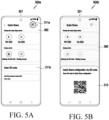
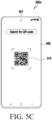
- FIG. 5A to FIG. 5C are diagrams 500a to 500c for illustrating an operation of configuring a sharing option for file transmission according to an embodiment.
- a file transmission function (e.g., a D2D file transmission function) capable of transmitting a file to an external electronic device located in a short distance is executed, if the second electronic device 401 (e.g., the second electronic device 401 of FIG. 2 and the electronic device 401 of FIG. 4 ) for file transmission is not found, the first electronic device 301 (the first electronic device 301 of FIG. 2 and the electronic device 301 of FIG.
- QR code data including certificate information and a phone number of the first electronic device, broadcast a packet for a QR code scan request, display an icon 311A capable of providing the generated QR code at the top of the display of the first electronic device 301, and display a text menu 311B capable of providing the generated QR code at the bottom of the display of the first electronic device 301.
- the first electronic device 301 may control the display 360 (e.g., the first display 360 of FIG. 3 ) of the first electronic device to display the QR code data 313.
- the second electronic device 401 may execute a QR code scan function and scan the QR code data 313 displayed on the display 360 of the first electronic device 301 via a camera (e.g., the second camera 480 of FIG. 4 ) of the second electronic device 401.
- the second electronic device 401 may, based on analysis of the scanned QR code data 313, provide a user with a UI enabling selection of a sharing option that allows the first electronic device 301 to be configured as a sharing permitted target.
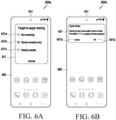
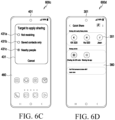
- FIG. 6A to FIG. 6D are diagrams 600a to 600d for illustrating an operation of configuring a sharing option for file transmission according to an embodiment.
- the second electronic device 401 (the second electronic device 401 of FIG. 2 and the electronic device 401 of FIG. 4 ) may control, based on analysis of the QR code data generated by the first electronic device 301 (the first electronic device 301 of FIG. 2 and the electronic device 301 of FIG. 3 ), the display 460 (e.g., the second display 460 of FIG. 4 ) of the second electronic device 401 to display a UI 451 that induces storing of the phone number, which is included in the QR code data, in an address book of the second electronic device 401.
- the display 460 e.g., the second display 460 of FIG. 4
- the second electronic device 401 may separately display an OK button (not illustrated), based on the analysis of the QR code data generated by the first electronic device 301, and if selection of the OK button is identified, control the display 460 to display the UI 451 that induces storing of the phone number, which is included in the QR code data, in the address book of the second electronic device 401.
- an OK button not illustrated
- the second electronic device 401 may induce, based on the analysis of the QR code data generated by the first electronic device 301, additional selection of the second item 431b while providing a visual effect (e.g., a color change or blinking effect) in an area where the second item 431b is displayed.
- a visual effect e.g., a color change or blinking effect
- the second electronic device 401 may control the display 460 to display the UI 451 that induces storing of the phone number, which is included in the QR code data, in the address book of the second electronic device 401.
- the second electronic device 401 may control, based on the analysis of the QR code data generated by the first electronic device 301, the display 460 to display the UI 451 that induces storing of the phone number, which is included in the QR code data, in the address book of the second electronic device 401, without an additional operation.
- the display 460 may control, based on the analysis of the QR code data generated by the first electronic device 301, the display 460 to display the UI 451 that induces storing of the phone number, which is included in the QR code data, in the address book of the second electronic device 401, without an additional operation.
- the second electronic device 401 may transmit a search response packet to the first electronic device 301.
- the second electronic device 401 may control the display 460 of the second electronic device 401 and provide a UI 431 enabling selection of a third item 431c for configuring all nearby electronic devices to be sharing permitted targets from among sharing options for sharing permitted target configuration.
- the first electronic device 301 may control the display 360 of the first electronic device 301 to display a search list including information 351 of the second electronic device.
- the file transmission function e.g., the D2D file transmission function
- FIG. 7A to FIG. 7C are diagrams 700a to 700c for illustrating an operation of configuring a sharing option for file transmission according to an embodiment.
- the second electronic device 401 in a state where a first item 431a for disabling a sharing permitted target has been configured among the sharing options 431 for sharing permitted target configuration, the second electronic device 401 (the second electronic device 401 of FIG. 2 and the electronic device 401 of FIG. 4 ) may determine, based on analysis of the QR code data generated by the first electronic device 301 (the first electronic device 301 of FIG. 2 and the electronic device 301 of FIG. 3 ), whether a condition that certificate information of the QR code data exists in a buddy list of the second electronic device is satisfied.
- the second electronic device 401 may control the display 460 (e.g., the second display 460 of FIG. 4 ) of the second electronic device 401 to provide the UI 431 enabling selection of the second item 431b for configuring only a contact stored in an address book to be a sharing permitted target from among the sharing options for sharing permitted target configuration.
- the second electronic device 401 may transmit a search response packet to the first electronic device 301.
- the first electronic device 301 may control the display 360 of the first electronic device 301 to display a search list including the information 351 of the second electronic device.
- the file transmission function e.g., the D2D file transmission function
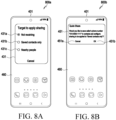
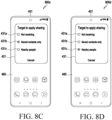
- FIG. 8A to FIG. 8E are diagrams 800a to 800e for illustrating an operation of configuring a sharing option for file transmission according to an embodiment.
- the second electronic device 401 (the second electronic device 401 of FIG. 2 and the electronic device 401 of FIG. 4 ) may determine, based on analysis of the QR code data generated by the first electronic device 301 (the first electronic device 301 of FIG. 2 and the electronic device 301 of FIG. 3 ), whether a condition that, if the certificate information of the QR code data does not exist in the buddy list of the second electronic device, the second electronic device is logged in to a server account is satisfied.
- the second electronic device 401 may control the display 460 of the second electronic device to display the UI 451 that induces storing of the phone number, which is included in the QR code data, in the address book of the second electronic device 401.
- the second electronic device 401 may provide the UI 431 enabling selection of the second item 431b for configuring only a contact stored in an address book to be a sharing permitted target from among the sharing options for sharing permitted target configuration. Based on the user's selection for the second item 431b among the sharing options, the second electronic device 401 may transmit a search response packet to the first electronic device 301.
- the second electronic device 401 may provide the UI 431 enabling selection of the third item 431c for configuring all nearby electronic devices to be sharing permitted targets from among the sharing options for sharing permitted target configuration. Based on the user's selection for the third item 431c among the sharing options, the second electronic device 401 may transmit a search response packet to the first electronic device 301.
- the first electronic device 301 may control the display 360 of the first electronic device 301 to display a search list including the information 351 of the second electronic device.
- the file transmission function e.g., the D2D file transmission function
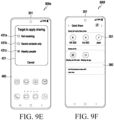
- FIG. 9A to FIG. 9F are diagrams 900a to 900f for illustrating an operation of configuring a sharing option for file transmission according to an embodiment.
- the second electronic device 401 may determine, based on analysis of the QR code data generated by the first electronic device 301 (the first electronic device 301 of FIG. 2 and the electronic device 301 of FIG. 3 ), whether a condition that the certificate information of the QR code data does not exist in the buddy list of the second electronic device, the second electronic device has not been logged in to the server account, and the phone number included in the QR code data exists in the address book is satisfied.
- the second electronic device 401 may control the display 460 of the second electronic device to display a UI 453 that induces logging into the server account.
- the second electronic device 401 may log in to the server account as the user selects "OK" 453b. While being logged in to the server account, the second electronic device 401 may download, as certificate information, account information of the phone number included in the QR code data from the server, and update the buddy list of the second electronic device.
- the second electronic device 401 may provide the UI 453 enabling selection of the second item 453b for configuring only a contact stored in an address book to be a sharing permitted target from among the sharing options for sharing permitted target configuration. Based on the user's selection for the second item 431b among the sharing options, the second electronic device 401 may transmit a search response packet to the first electronic device 301.
- the second electronic device 401 may provide, as the user selects "Cancel" 453a, the UI 431 enabling selection of the third item 431c for configuring all nearby electronic devices to be sharing permitted targets from among the sharing options for sharing permitted target configuration. Based on the user's selection for the third item 431c among the sharing options, the second electronic device 401 may transmit a search response packet to the first electronic device 301.
- the first electronic device 301 may control the display 360 of the first electronic device 301 to display a search list including the information 351 of the second electronic device.
- the file transmission function e.g., the D2D file transmission function
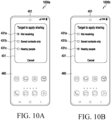
- FIG. 10A to FIG. 10C are diagrams 1000a to 1000c for illustrating an operation of configuring a sharing option for file transmission according to an embodiment.
- the second electronic device 401 (the second electronic device 401 of FIG. 2 and the electronic device 401 of FIG. 4 ) may determine, based on analysis of the QR code data generated by the first electronic device 301 (the first electronic device 301 of FIG. 2 and the electronic device 301 of FIG. 3 ), whether a condition that the certificate information of the QR code data does not exist in the buddy list of the second electronic device, the second electronic device has not been logged in to the server account, and the phone number included in the QR code data does not exist in the address book is satisfied.
- the second electronic device 401 may provide the UI 431 enabling selection of the third item 431c for configuring all nearby electronic devices to be sharing permitted targets from among the sharing options for sharing permitted target configuration. Based on the user's selection for the third item 431c among the sharing options, the second electronic device 401 may transmit a search response packet to the first electronic device 301.
- the first electronic device 301 may control the display 360 of the first electronic device 301 to display a search list including the information 351 of the second electronic device.
- the file transmission function e.g., the D2D file transmission function
- a system for file transmission may include a first electronic device (301 of FIG. 2 ; 301 of FIG. 3 ) configured to, when a second electronic device for file transmission is not found, generate QR code data including information for changing the first electronic device to a sharing permitted target, and broadcast a packet for a QR code scan request.
- the system for file transmission may include the second electronic device (401 of FIG. 3 ; 401 of FIG. 4 ) configured to, when the packet for the QR code scan request is received from the first electronic device, scan the QR code data of the first electronic device, and based on analysis of the scanned QR code data, provide a UI enabling selection of a sharing option that allows the first electronic device to be configured as a sharing permitted target.
- the second electronic device (401 of FIG. 2 ; 401 of FIG. 4 ) may be configured to, in a state where a first item for disabling a sharing permitted target has been configured among sharing options for sharing permitted target configuration, provide the UI enabling selection of a second item for configuring only a contact stored in an address book to be a sharing permitted target, based on a condition of satisfying at least one of a condition that the certificate information included in the QR code data exists in a buddy list of the second electronic device, a condition of identifying a user's selection to store the phone number, which is included in the QR code data, in an address book when the certificate information included in the QR code data does not exist in the buddy list of the second electronic device and the second electronic device has been logged in to a server account, or a condition that the phone number included in the QR code data exists in the address book when the certificate information included in the QR code data does not exist in the buddy list of the second electronic device and the second electronic device has not been logged in to the server account.
- An electronic device may include a communication module (190 of FIG. 1 ; 390 of FIG. 3 ), a display (160 of FIG. 1 ; 360 of FIG. 3 ), and a processor (120 of FIG. 1 ; 320 of FIG. 3 ).
- the processor may be configured to broadcast a search request packet for searching for an external electronic device for file transmission via the communication module, and if reception of a search response packet from the external electronic device fails, generate QR code data including information for changing the electronic device to a sharing permitted target, broadcast a packet for a QR code scan request, and control the display to display the generated QR code data.
- the information for changing the first electronic device to the sharing permitted target, which is included in the QR code data may include at least one of certificate information or a phone number.
- An electronic device may include a communication module (190 of FIG. 1 ; 490 of FIG. 4 ), a camera (180 of FIG. 1 ; 480 of FIG. 4 ), a display (160 of FIG. 1 ; 460 of FIG. 4 ), and a processor (120 of FIG. 1 ; 420 of FIG. 4 ).
- a communication module (190 of FIG. 1 ; 490 of FIG. 4 )
- a camera 180 of FIG. 1 ; 480 of FIG. 4
- a display 160 of FIG. 1 ; 460 of FIG. 4
- a processor 120 of FIG. 1 ; 420 of FIG. 4 .
- the processor (120 of FIG. 1 ; 420 of FIG. 4 ) may be configured to, when a packet for a QR code scan request is received from an external electronic device via the communication module, scan QR code data of the external electronic device via the camera, and based on analysis of the scanned QR code data, control the display to provide a UI enabling selection of a sharing option that allows the external electronic device to be configured as a sharing permitted target.
- the processor (120 of FIG. 1 ; 420 of FIG. 4 ) may be configured to, in a state where a first item for disabling a sharing permitted target has been configured among sharing options for sharing permitted target configuration, provide the UI enabling selection of a second item for configuring only a contact stored in an address book to be a sharing permitted target, at satisfaction of at least one condition among a condition that certificate information included in the QR code data exists in a buddy list of the second electronic device, a condition that the certificate information included in the QR code data does not exist in the buddy list of the second electronic device, the second electronic device has been logged in to a server account, and a user's selection to store a phone number, which is included in the QR code data, in an address book is identified, and a condition that the certificate information included in the QR code data does not exist in the buddy list of the second electronic device, the second electronic device has not been logged in to the server account, the phone number included in the QR code data exists in the address book.
- the processor (120 of FIG. 1 ; 420 of FIG. 4 ) may be configured to, in the state where the first item for disabling a sharing permitted target has been configured among the sharing options for sharing permitted target configuration, provide the UI enabling selection of a third item for configuring all nearby electronic devices to be sharing permitted targets, upon satisfaction of at least one condition of a condition that the certificate information included in the QR code data does not exist in the buddy list of the second electronic device, the second electronic device has been logged in to the server account, and the user's selection to store the phone number, which is included in the QR code data, in the address book is not identified, or a condition that the certificate information included in the QR code data does not exist in the buddy list of the second electronic device, the second electronic device has not been logged in to the server account, and the phone number included in the QR code data does not exist in the address book.
- the processor (120 of FIG. 1 ; 420 of FIG. 4 ) may be configured to, in a state where the second item for configuring only a contact stored in an address book to be a sharing permitted target is configured, store the phone number, which is included in the QR code data, in the address book when a condition of identifying the user's selection to store the phone number, which is included in the QR code data, in the address book is satisfied, and provide the UI enabling selection of the third item for configuring all nearby electronic devices to be sharing permitted targets when a condition of being unable to identify the user's selection to store the phone number, which is included in the QR code data, in the address book is satisfied.
- FIG. 11 is a flowchart 1100 for illustrating file transmission operations according to an embodiment.
- the file transmission operations may include operations 1101 to 1121.
- the respective operations may be sequentially performed, but are not necessarily performed sequentially. For example, the order of the respective operations may be changed, at least two actions may be performed in parallel, or another operation may be added.
- the first electronic device 301 may identify execution of a file transmission function.
- the first electronic device 301 may identify execution of the file transmission function (e.g., the D2D file transmission function) capable of transmitting a file to an external electronic device located in a short distance.
- the file transmission function e.g., the D2D file transmission function
- the first electronic device 301 may broadcast a search request packet.
- the first electronic device 301 may broadcast the search request packet (e.g., an advertisement packet) at low power by using a Bluetooth low energy (BLE) communication module included in a communication module (e.g., the first communication module 390 of FIG. 3 ) of the first electronic device.
- BLE Bluetooth low energy
- the first electronic device 301 may generate QR code data if no search response packet is received.
- the first electronic device 301 may broadcast a packet for a QR code scan request.
- the first electronic device 301 may broadcast the packet for the QR code scan request at low power by using the Bluetooth low energy (BLE) communication module included in the communication module (e.g., the first communication module 390 of FIG. 3 ) of the first electronic device.
- BLE Bluetooth low energy
- the second electronic device 401 may receive the packet for the QR code scan request.
- the second electronic device 401 may receive the packet for the QR code scan request via a Bluetooth low energy (BLE) communication module included in a communication module (e.g., the second communication module 490 of FIG. 4 ) of the second electronic device.
- BLE Bluetooth low energy
- the second electronic device 401 may scan the QR code data by using a camera, and analyze the QR code data.
- the second electronic device 401 may scan the QR code data being displayed on the display of the first electronic device 301 by using the camera (e.g., the second camera 480 of FIG. 4 ) of the second electronic device.
- the camera e.g., the second camera 480 of FIG. 4
- the second electronic device 401 may parse and analyze the scanned QR code data.
- the second electronic device 401 may provide, based on the QR code data, a UI enabling selection of a sharing option that allows the first electronic device to be configured as a sharing target.
- the sharing option enabling configuration as a sharing permitted target may include a first item for disabling a sharing permitted target (e.g., a state where all sharing permitted targets are turned off), a second item for configuring only a contact stored in an address book to be a sharing permitted target, and/or a third item for configuring all nearby electronic devices to be sharing permitted targets.
- a sharing permitted target e.g., a state where all sharing permitted targets are turned off
- a second item for configuring only a contact stored in an address book to be a sharing permitted target
- a third item for configuring all nearby electronic devices to be sharing permitted targets.
- the second electronic device 401 may control the display (e.g., the second display 460 of FIG. 4 ) of the second electronic device to display the UI enabling selection of the second item for configuring only a contact stored in an address book to be a sharing permitted target or the third item for configuring all nearby electronic devices to be sharing permitted targets.
- the display e.g., the second display 460 of FIG. 4
- the second electronic device 401 may transmit a search response packet in operation 1117.
- the second electronic device 401 may transmit the search response packet via the Bluetooth low energy (BLE) communication module included in the communication module (e.g., the second communication module 490 of FIG. 4 ) of the second electronic device.
- BLE Bluetooth low energy
- the first electronic device 301 may display a search list including information of the second electronic device.
- the first electronic device 301 may update, based on a search result, the search list including the information of the second electronic device, and control the display (e.g., the first display 360) of the first electronic device to display the updated search list.
- the first electronic device 301 may establish a communication connection to the second electronic device 401.
- the first electronic device 301 may receive connection information for file transmission during authentication with the second electronic device, and based on the connection information, may establish a communication connection to the second electronic device 401 by using a short-range communication technology (e.g., Wi-Fi-direct or Wi-Fi-aware) and then transmit a file selected by a user to the second electronic device 401.
- a short-range communication technology e.g., Wi-Fi-direct or Wi-Fi-aware
- the first electronic device 301 may broadcast multiple search request packets, and the second electronic device 401 may transmit the search response packet to the first electronic device 301 in a state where the first electronic device is permitted as a sharing target (e.g., when the second item for configuring only a contact stored in an address book to be a sharing permitted target or the third item for configuring all nearby electronic devices to be sharing permitted targets is configured).
- a sharing target e.g., when the second item for configuring only a contact stored in an address book to be a sharing permitted target or the third item for configuring all nearby electronic devices to be sharing permitted targets is configured.
- FIG. 12 is a flowchart 1200 for illustrating file transmission operations according to an embodiment.
- the file transmission operations may include operations 1201 to 1213.
- the respective operations may be sequentially performed, but are not necessarily performed sequentially.
- the order of the respective operations may be changed, at least two actions may be performed in parallel, or another operation may be added.
- an electronic device e.g., the first electronic device 301 of FIG. 2 and/or the first electronic device 301 of FIG. 3 ) may identify execution of a file transmission function.
- the electronic device may identify execution of the file transmission function (e.g., the D2D file transmission function) capable of transmitting a file to an external electronic device located in a short distance.
- the file transmission function e.g., the D2D file transmission function
- the electronic device may broadcast a search request packet (e.g., an advertisement packet).
- a search request packet e.g., an advertisement packet
- the electronic device may broadcast the search request packet (e.g., the advertisement packet) at low power by using a Bluetooth low energy (BLE) communication module included in a communication module (e.g., the first communication module 390 of FIG. 3 ) of the electronic device.
- BLE Bluetooth low energy
- the electronic device 301 may generate QR code data if no search response packet is received.
- the electronic device 301 may generate the QR code data including information for changing the electronic device to a sharing permitted target, and control a display (e.g., the first display 360) of the electronic device to display the generated QR code data.
- an external electronic device e.g., the second electronic device 401 of FIG. 2 and/or the second electronic device 401 of FIG. 4
- the electronic device 301 may generate the QR code data including information for changing the electronic device to a sharing permitted target, and control a display (e.g., the first display 360) of the electronic device to display the generated QR code data.
- the QR code data including the information for changing the electronic device to the sharing permitted target may include at least one of certificate information of the electronic device or a phone number of the electronic device.
- the electronic device may broadcast a packet for a QR code scan request.
- the electronic device may broadcast the packet for the QR code scan request at low power by using the Bluetooth low energy (BLE) communication module included in the communication module (e.g., the first communication module 390 of FIG. 3 ) of the electronic device.
- BLE Bluetooth low energy
- the electronic device may receive a search response packet.
- the electronic device may receive connection information for file transmission during authentication with the external electronic device, establish a communication connection to the external electronic device by using a short-range communication technology (e.g., Wi-Fi-direct or Wi-Fi-aware) based on the connection information, and then receive a file from the external electronic device.
- a short-range communication technology e.g., Wi-Fi-direct or Wi-Fi-aware
- the server 501 may generate, as certificate information, account information corresponding to each of the phone numbers included in the address book of the first electronic device.
- the server 501 may transmit the certificate information to the first electronic device.
- the first electronic device 301 may generate a buddy list including the certificate information or update the buddy list.
- the first electronic device may generate or update the buddy list including the certificate information, which is synchronized with the address book including the phone numbers.
- the first electronic device 301 may request the server 501 to transmit the certificate information of the first electronic device to electronic devices corresponding to the phone numbers included in the address book.
- the file transmission method may include, by the second electronic device, when the packet for the QR code scan request is received from the first electronic device, scanning the QR code data of the first electronic device, and based on analysis of the scanned QR code data, providing a UI configured to enable selection of a sharing option allowing the first electronic device to be configured as a sharing permitted target.
- the file transmission method may further include, in a state where a first item for disabling a sharing permitted target has been configured among the sharing options for sharing permitted target configuration, providing, by the second electronic device, a UI configured to enable selection of a second item for configuring only a contact stored in an address book to be a sharing permitted target, based on a condition of satisfying at least one condition of a condition that the certificate information included in the QR code data exists in a buddy list of the second electronic device, a condition of identifying a user's selection to store the phone number, which is included in the QR code data, in an address book when the certificate information included in the QR code data does not exist in the buddy list of the second electronic device and the second electronic device has been logged in to a server account, or a condition that the phone number included in the QR code data exists in the address book when the certificate information included in the QR code data does not exist in the buddy list of the second electronic device and the second electronic device has not been logged in to the server account.
- the file transmission method may include, in a state where the second item for configuring only a contact stored in an address book to be a sharing permitted target is configured, storing, in the address book, the phone number included in the QR code data by the second electronic device if a condition of identifying the user's selection to store the phone number, which is included in the QR code data, in the address book is satisfied, and providing, by the second electronic device, the UI configured to enable selection of a third item for configuring all nearby electronic devices to be sharing permitted targets if the condition of identifying the user's selection to store the phone number, which is included in the QR code data, in the address book cannot be satisfied.
- the file transmission method of the electronic device may include broadcasting a packet for a QR code scan request.
- the file transmission method of the electronic device may include controlling a display to display the generated QR code data.
- the information for changing the first electronic device to the sharing permitted target, which is included in the QR code data may include at least one of certificate information or a phone number.
- the file transmission method of the electronic device may include, when the packet for the QR code scan request is received from the external electronic device via a communication module of the electronic device, scanning the QR code data of the external electronic device via a camera of the electronic device.
- the file transmission method of the electronic device may include, based on analysis of the scanned QR code data, controlling the display to provide a UI configured to enable selection of a sharing option allowing the external electronic device to be configured as a sharing permitted target.
- the file transmission method of the electronic device may further include, in the state where the first item for disabling a sharing permitted target has been configured among the sharing options for sharing permitted target configuration, providing the UI configured to enable selection of a third item for configuring all nearby electronic devices to be sharing permitted targets, upon satisfaction of at least one condition of a condition that the certificate information included in the QR code data does not exist in the buddy list of the second electronic device, the second electronic device has been logged in to the server account, and the user's selection to store the phone number, which is included in the QR code data, in the address book is not identified, or a condition that the certificate information included in the QR code data does not exist in the buddy list of the second electronic device, the second electronic device has not been logged in to the server account, and the phone number included in the QR code data does not exist in the address book.
- the file transmission method of the electronic device may further include, in a state where the second item for configuring only a contact stored in an address book to be a sharing permitted target is configured, if the condition of identifying the user's selection to store the phone number, which is included in the QR code data, in the address book is satisfied, storing, in the address book, the phone number included in the QR code data.
- the file transmission method of the electronic device may further include, if a condition of being unable to identify the user's selection to store the phone number, which is included in the QR code data, in the address book is satisfied, providing the UI configured to enable selection of the third item for configuring all nearby electronic devices to be sharing permitted targets.
- each of such phrases as “A or B,” “at least one of A and B,” “at least one of A or B,” “A, B, or C,” “at least one of A, B, and C,” and “at least one of A, B, or C,” may include any one of, or all possible combinations of the items enumerated together in a corresponding one of the phrases.
- such terms as “1st” and “2nd,” or “first” and “second” may be used to simply distinguish a corresponding component from another, and does not limit the components in other aspect (e.g., importance or order).
- an element e.g., a first element
- the element may be coupled with the other element directly (e.g., wiredly), wirelessly, or via a third element.
- module may include a unit implemented in hardware, software, or firmware, and may interchangeably be used with other terms, for example, “logic,” “logic block,” “part,” or “circuitry”.
- a module may be a single integral component, or a minimum unit or part thereof, adapted to perform one or more functions.
- the module may be implemented in a form of an application-specific integrated circuit (ASIC).
- ASIC application-specific integrated circuit
- Various embodiments as set forth herein may be implemented as software (e.g., the program 140) including one or more instructions that are stored in a storage medium (e.g., internal memory 136 or external memory 138) that is readable by a machine (e.g., the electronic device 101 or the electronic device 301).
- a processor e.g., the processor 520
- the machine e.g., the electronic device 301
- the one or more instructions may include a code generated by a complier or a code executable by an interpreter.
- the machine-readable storage medium may be provided in the form of a non-transitory storage medium.
- non-transitory simply means that the storage medium is a tangible device, and does not include a signal (e.g., an electromagnetic wave), but this term does not differentiate between where data is semi-permanently stored in the storage medium and where the data is temporarily stored in the storage medium.
- a method may be included and provided in a computer program product.
- the computer program product may be traded as a product between a seller and a buyer.
- the computer program product may be distributed in the form of a machine-readable storage medium (e.g., compact disc read only memory (CD-ROM)), or be distributed (e.g., downloaded or uploaded) online via an application store (e.g., PlayStore TM ), or between two user devices (e.g., smart phones) directly. If distributed online, at least part of the computer program product may be temporarily generated or at least temporarily stored in the machine-readable storage medium, such as memory of the manufacturer's server, a server of the application store, or a relay server.
- CD-ROM compact disc read only memory
- an application store e.g., PlayStore TM
- two user devices e.g., smart phones
- each component e.g., a module or a program of the above-described components may include a single entity or multiple entities, and some of the multiple entities may be separately disposed in different components. According to various embodiments, one or more of the above-described components may be omitted, or one or more other components may be added. Alternatively or additionally, a plurality of components (e.g., modules or programs) may be integrated into a single component. In such a case, according to various embodiments, the integrated component may still perform one or more functions of each of the plurality of components in the same or similar manner as they are performed by a corresponding one of the plurality of components before the integration.
- operations performed by the module, the program, or another component may be carried out sequentially, in parallel, repeatedly, or heuristically, or one or more of the operations may be executed in a different order or omitted, or one or more other operations may be added.
- a non-volatile storage medium which stores commands
- the commands are configured to cause, when executed by an electronic device, the electronic device to perform at least one operation, wherein the at least one operation may include, by a first electronic device, when a second electronic device for file transmission is not found, generating QR code data including information for changing the first electronic device to a sharing permitted target, and broadcasting a packet for a QR code scan request
- a file transmission method may include, by the second electronic device, when the packet for the QR code scan request is received from the first electronic device, scanning the QR code data of the first electronic device, and based on analysis of the scanned QR code data, providing a UI configured to enable selection of a sharing option allowing the first electronic device to be configured as a sharing permitted target.
- the commands are configured to cause, when executed by an electronic device, the electronic device to perform at least one operation, wherein the at least one operation may include broadcasting a search request packet for searching for an external electronic device for file transmission via a communication module of the electronic device, and if reception of a search response packet from the external electronic device fails, generating QR code data including information for changing the electronic device to a sharing permitted target.
- the commands are configured to cause, when executed by an electronic device, the electronic device to perform at least one operation, wherein the at least one operation may include, when a packet for a QR code scan request is received from an external electronic device via a communication module of the electronic device, scanning QR code data of the external electronic device via a camera of the electronic device, and based on analysis of the scanned QR code data, controlling a display to provide a UI configured to enable selection of a sharing option allowing the external electronic device to be configured as a sharing permitted target.
Landscapes
- Engineering & Computer Science (AREA)
- Physics & Mathematics (AREA)
- Theoretical Computer Science (AREA)
- General Physics & Mathematics (AREA)
- Computer Networks & Wireless Communication (AREA)
- Signal Processing (AREA)
- General Engineering & Computer Science (AREA)
- Computer Security & Cryptography (AREA)
- Human Computer Interaction (AREA)
- Electromagnetism (AREA)
- Toxicology (AREA)
- Artificial Intelligence (AREA)
- Computer Vision & Pattern Recognition (AREA)
- General Health & Medical Sciences (AREA)
- Health & Medical Sciences (AREA)
- Optics & Photonics (AREA)
- Multimedia (AREA)
- Telephone Function (AREA)
Applications Claiming Priority (3)
| Application Number | Priority Date | Filing Date | Title |
|---|---|---|---|
| KR20220090075 | 2022-07-21 | ||
| KR1020220110981A KR20240013000A (ko) | 2022-07-21 | 2022-09-01 | 파일 전송 시스템, 전자 장치 및 상기 전자 장치에서 파일 전송 방법 |
| PCT/KR2023/009526 WO2024019376A1 (ko) | 2022-07-21 | 2023-07-05 | 파일 전송 시스템, 전자 장치 및 상기 전자 장치에서 파일 전송 방법 |
Publications (2)
| Publication Number | Publication Date |
|---|---|
| EP4546830A1 true EP4546830A1 (de) | 2025-04-30 |
| EP4546830A4 EP4546830A4 (de) | 2025-10-08 |
Family
ID=89618219
Family Applications (1)
| Application Number | Title | Priority Date | Filing Date |
|---|---|---|---|
| EP23843227.2A Pending EP4546830A4 (de) | 2022-07-21 | 2023-07-05 | Dateiübertragungssystem, elektronische vorrichtung und dateiübertragungsverfahren durch diese elektronische vorrichtung |
Country Status (3)
| Country | Link |
|---|---|
| US (1) | US20250165738A1 (de) |
| EP (1) | EP4546830A4 (de) |
| WO (1) | WO2024019376A1 (de) |
Family Cites Families (10)
| Publication number | Priority date | Publication date | Assignee | Title |
|---|---|---|---|---|
| US9066326B2 (en) * | 2013-03-14 | 2015-06-23 | Google Technology Holdings LLC | Automatic user notification, with quick response (QR) code generation following failed NFC device pairing |
| US20150009152A1 (en) * | 2013-07-03 | 2015-01-08 | Htc Corporation | Method of sharing application and electronic device using the same |
| KR102314272B1 (ko) * | 2015-04-30 | 2021-10-20 | 삼성전자주식회사 | 서비스 공유 장치 및 방법 |
| US9904735B2 (en) * | 2016-05-05 | 2018-02-27 | Red Hat, Inc. | Camera-activated data transfer from a source computing device to a target computing device |
| WO2021080364A1 (en) * | 2019-10-25 | 2021-04-29 | Samsung Electronics Co., Ltd. | Method for communicating with external electronic apparatus and electronic apparatus thereof |
| KR102822035B1 (ko) * | 2019-10-25 | 2025-06-18 | 삼성전자주식회사 | 외부 전자 장치와 통신하는 방법 및 그 전자 장치 |
| KR102852019B1 (ko) * | 2020-02-10 | 2025-08-28 | 삼성전자주식회사 | 외부 전자 장치의 상태에 기반하여 통신하는 방법 및 그 전자 장치 |
| ES2850280A1 (es) * | 2020-02-26 | 2021-08-26 | Univ Vigo | Procedimiento y sistema para mejorar la experiencia de usuario utilizando capacidades de un dispositivo electrónico diferente |
| CN111857498B (zh) * | 2020-06-30 | 2022-05-20 | 维沃移动通信有限公司 | 数据交互方法和装置、及电子设备 |
| KR102827766B1 (ko) * | 2020-11-04 | 2025-07-01 | 삼성전자주식회사 | 전자 장치 및 전자 장치에서 이미지 공유 방법 |
-
2023
- 2023-07-05 EP EP23843227.2A patent/EP4546830A4/de active Pending
- 2023-07-05 WO PCT/KR2023/009526 patent/WO2024019376A1/ko not_active Ceased
-
2025
- 2025-01-21 US US19/032,821 patent/US20250165738A1/en active Pending
Also Published As
| Publication number | Publication date |
|---|---|
| US20250165738A1 (en) | 2025-05-22 |
| WO2024019376A1 (ko) | 2024-01-25 |
| EP4546830A4 (de) | 2025-10-08 |
Similar Documents
| Publication | Publication Date | Title |
|---|---|---|
| US11899897B2 (en) | Method for controlling application of external electronic device and electronic device supporting same | |
| US20260032579A1 (en) | Method and electronic device for communicating based on access point | |
| EP4395273A1 (de) | Elektronische vorrichtung zur bereitstellung einer rcs-funktion und betriebsverfahren dafür | |
| EP4262236A1 (de) | Audiovorrichtung zur verarbeitung von audiodaten und betriebsverfahren dafür | |
| EP4104638B1 (de) | Elektronische vorrichtung zur drahtlosen kommunikation und verfahren zum betrieb einer elektronischen vorrichtung | |
| US20240007935A1 (en) | Electronic device for sharing function and operating method therefor | |
| US20240030960A1 (en) | Electronic device and harmonic control method of electronic device | |
| EP4546830A1 (de) | Dateiübertragungssystem, elektronische vorrichtung und dateiübertragungsverfahren durch diese elektronische vorrichtung | |
| US12382518B2 (en) | Electronic device for performing scan in wireless LAN system and method for operating same | |
| US20230128203A1 (en) | Electronic device for performing sa query in wlan system and operating method thereof | |
| EP4401502A1 (de) | Elektronische vorrichtung zur wlan-kommunikation mit mehreren externen vorrichtungen und betriebsverfahren dafür | |
| EP4243462B1 (de) | Elektronische vorrichtung zur verarbeitung einer nachricht und betriebsverfahren dafür | |
| EP4284041A1 (de) | Elektronische vorrichtung und verfahren zur installation eines eingebetteten teilnehmeridentifikationsmodulprofils in einer elektronischen vorrichtung | |
| US20220330357A1 (en) | Electronic device and method for registering external device using device information | |
| EP4664867A1 (de) | System zur identifizierung einer externen elektronischen vorrichtung, elektronische vorrichtung und verfahren zur identifizierung einer externen elektronischen vorrichtung | |
| EP4579474A1 (de) | Elektronische vorrichtung, verfahren und nichttransitorisches computerlesbares speichermedium zur gemeinsamen dateinutzung | |
| EP4580226A1 (de) | Elektronische vorrichtung, verfahren und nichttransitorisches computerlesbares speichermedium zur verarbeitung von werbepaketen aus einer externen elektronischen vorrichtung in einer drahtlosen umgebung | |
| EP4354918B1 (de) | Elektronische vorrichtung zur datenübertragung unter verwendung von drahtloser nahbereichskommunikation und betriebsverfahren dafür | |
| KR20240013000A (ko) | 파일 전송 시스템, 전자 장치 및 상기 전자 장치에서 파일 전송 방법 | |
| US12250269B2 (en) | Electronic device and method of forming Wi-Fi peer to peer (P2P) group | |
| EP4418708B1 (de) | Elektronische vorrichtung und verfahren zur durchführung von bluetooth-kommunikation zur steuerung einer externen elektronischen vorrichtung auf basis von standortinformationen in einer drahtlosen umgebung | |
| EP4538841A1 (de) | Elektronische vorrichtung zur unterstützung von paarung und steuerungsverfahren dafür | |
| EP4380064A1 (de) | Elektronische vorrichtung und verfahren zur verbesserung der heizleistung einer elektronischen vorrichtung | |
| US12273140B2 (en) | Electronic device supporting wireless communication | |
| US12557005B2 (en) | Electronic device, system and operation method of thereof |
Legal Events
| Date | Code | Title | Description |
|---|---|---|---|
| STAA | Information on the status of an ep patent application or granted ep patent |
Free format text: STATUS: THE INTERNATIONAL PUBLICATION HAS BEEN MADE |
|
| PUAI | Public reference made under article 153(3) epc to a published international application that has entered the european phase |
Free format text: ORIGINAL CODE: 0009012 |
|
| STAA | Information on the status of an ep patent application or granted ep patent |
Free format text: STATUS: REQUEST FOR EXAMINATION WAS MADE |
|
| 17P | Request for examination filed |
Effective date: 20250122 |
|
| AK | Designated contracting states |
Kind code of ref document: A1 Designated state(s): AL AT BE BG CH CY CZ DE DK EE ES FI FR GB GR HR HU IE IS IT LI LT LU LV MC ME MK MT NL NO PL PT RO RS SE SI SK SM TR |
|
| REG | Reference to a national code |
Ref country code: DE Ref legal event code: R079 Free format text: PREVIOUS MAIN CLASS: H04W0004800000 Ipc: H04L0067060000 |
|
| A4 | Supplementary search report drawn up and despatched |
Effective date: 20250908 |
|
| RIC1 | Information provided on ipc code assigned before grant |
Ipc: H04L 67/06 20220101AFI20250902BHEP Ipc: H04W 4/80 20180101ALI20250902BHEP Ipc: H04W 4/06 20090101ALI20250902BHEP Ipc: H04W 8/00 20090101ALI20250902BHEP Ipc: H04W 12/77 20210101ALI20250902BHEP Ipc: G06K 19/06 20060101ALI20250902BHEP Ipc: H04W 88/02 20090101ALI20250902BHEP |
|
| DAV | Request for validation of the european patent (deleted) | ||
| DAX | Request for extension of the european patent (deleted) |