EP4544893A1 - Arbeitsfahrzeug - Google Patents
Arbeitsfahrzeug Download PDFInfo
- Publication number
- EP4544893A1 EP4544893A1 EP23831353.0A EP23831353A EP4544893A1 EP 4544893 A1 EP4544893 A1 EP 4544893A1 EP 23831353 A EP23831353 A EP 23831353A EP 4544893 A1 EP4544893 A1 EP 4544893A1
- Authority
- EP
- European Patent Office
- Prior art keywords
- work vehicle
- motor
- field
- control device
- stop command
- Prior art date
- Legal status (The legal status is an assumption and is not a legal conclusion. Google has not performed a legal analysis and makes no representation as to the accuracy of the status listed.)
- Pending
Links
Images




Classifications
-
- A—HUMAN NECESSITIES
- A01—AGRICULTURE; FORESTRY; ANIMAL HUSBANDRY; HUNTING; TRAPPING; FISHING
- A01B—SOIL WORKING IN AGRICULTURE OR FORESTRY; PARTS, DETAILS, OR ACCESSORIES OF AGRICULTURAL MACHINES OR IMPLEMENTS, IN GENERAL
- A01B69/00—Steering of agricultural machines or implements; Guiding agricultural machines or implements on a desired track
- A01B69/007—Steering or guiding of agricultural vehicles, e.g. steering of the tractor to keep the plough in the furrow
- A01B69/008—Steering or guiding of agricultural vehicles, e.g. steering of the tractor to keep the plough in the furrow automatic
-
- A—HUMAN NECESSITIES
- A01—AGRICULTURE; FORESTRY; ANIMAL HUSBANDRY; HUNTING; TRAPPING; FISHING
- A01B—SOIL WORKING IN AGRICULTURE OR FORESTRY; PARTS, DETAILS, OR ACCESSORIES OF AGRICULTURAL MACHINES OR IMPLEMENTS, IN GENERAL
- A01B69/00—Steering of agricultural machines or implements; Guiding agricultural machines or implements on a desired track
-
- B—PERFORMING OPERATIONS; TRANSPORTING
- B60—VEHICLES IN GENERAL
- B60L—PROPULSION OF ELECTRICALLY-PROPELLED VEHICLES; SUPPLYING ELECTRIC POWER FOR AUXILIARY EQUIPMENT OF ELECTRICALLY-PROPELLED VEHICLES; ELECTRODYNAMIC BRAKE SYSTEMS FOR VEHICLES IN GENERAL; MAGNETIC SUSPENSION OR LEVITATION FOR VEHICLES; MONITORING OPERATING VARIABLES OF ELECTRICALLY-PROPELLED VEHICLES; ELECTRIC SAFETY DEVICES FOR ELECTRICALLY-PROPELLED VEHICLES
- B60L50/00—Electric propulsion with power supplied within the vehicle
- B60L50/50—Electric propulsion with power supplied within the vehicle using propulsion power supplied by batteries or fuel cells
- B60L50/75—Electric propulsion with power supplied within the vehicle using propulsion power supplied by batteries or fuel cells using propulsion power supplied by both fuel cells and batteries
-
- B—PERFORMING OPERATIONS; TRANSPORTING
- B60—VEHICLES IN GENERAL
- B60L—PROPULSION OF ELECTRICALLY-PROPELLED VEHICLES; SUPPLYING ELECTRIC POWER FOR AUXILIARY EQUIPMENT OF ELECTRICALLY-PROPELLED VEHICLES; ELECTRODYNAMIC BRAKE SYSTEMS FOR VEHICLES IN GENERAL; MAGNETIC SUSPENSION OR LEVITATION FOR VEHICLES; MONITORING OPERATING VARIABLES OF ELECTRICALLY-PROPELLED VEHICLES; ELECTRIC SAFETY DEVICES FOR ELECTRICALLY-PROPELLED VEHICLES
- B60L7/00—Electrodynamic brake systems for vehicles in general
- B60L7/02—Dynamic electric resistor braking
- B60L7/08—Controlling the braking effect
-
- B—PERFORMING OPERATIONS; TRANSPORTING
- B60—VEHICLES IN GENERAL
- B60L—PROPULSION OF ELECTRICALLY-PROPELLED VEHICLES; SUPPLYING ELECTRIC POWER FOR AUXILIARY EQUIPMENT OF ELECTRICALLY-PROPELLED VEHICLES; ELECTRODYNAMIC BRAKE SYSTEMS FOR VEHICLES IN GENERAL; MAGNETIC SUSPENSION OR LEVITATION FOR VEHICLES; MONITORING OPERATING VARIABLES OF ELECTRICALLY-PROPELLED VEHICLES; ELECTRIC SAFETY DEVICES FOR ELECTRICALLY-PROPELLED VEHICLES
- B60L2200/00—Type of vehicles
- B60L2200/40—Working vehicles
-
- B—PERFORMING OPERATIONS; TRANSPORTING
- B60—VEHICLES IN GENERAL
- B60L—PROPULSION OF ELECTRICALLY-PROPELLED VEHICLES; SUPPLYING ELECTRIC POWER FOR AUXILIARY EQUIPMENT OF ELECTRICALLY-PROPELLED VEHICLES; ELECTRODYNAMIC BRAKE SYSTEMS FOR VEHICLES IN GENERAL; MAGNETIC SUSPENSION OR LEVITATION FOR VEHICLES; MONITORING OPERATING VARIABLES OF ELECTRICALLY-PROPELLED VEHICLES; ELECTRIC SAFETY DEVICES FOR ELECTRICALLY-PROPELLED VEHICLES
- B60L2240/00—Control parameters of input or output; Target parameters
- B60L2240/60—Navigation input
- B60L2240/62—Vehicle position
- B60L2240/622—Vehicle position by satellite navigation
-
- B—PERFORMING OPERATIONS; TRANSPORTING
- B60—VEHICLES IN GENERAL
- B60L—PROPULSION OF ELECTRICALLY-PROPELLED VEHICLES; SUPPLYING ELECTRIC POWER FOR AUXILIARY EQUIPMENT OF ELECTRICALLY-PROPELLED VEHICLES; ELECTRODYNAMIC BRAKE SYSTEMS FOR VEHICLES IN GENERAL; MAGNETIC SUSPENSION OR LEVITATION FOR VEHICLES; MONITORING OPERATING VARIABLES OF ELECTRICALLY-PROPELLED VEHICLES; ELECTRIC SAFETY DEVICES FOR ELECTRICALLY-PROPELLED VEHICLES
- B60L2260/00—Operating Modes
- B60L2260/20—Drive modes; Transition between modes
- B60L2260/32—Auto pilot mode
-
- B—PERFORMING OPERATIONS; TRANSPORTING
- B60—VEHICLES IN GENERAL
- B60L—PROPULSION OF ELECTRICALLY-PROPELLED VEHICLES; SUPPLYING ELECTRIC POWER FOR AUXILIARY EQUIPMENT OF ELECTRICALLY-PROPELLED VEHICLES; ELECTRODYNAMIC BRAKE SYSTEMS FOR VEHICLES IN GENERAL; MAGNETIC SUSPENSION OR LEVITATION FOR VEHICLES; MONITORING OPERATING VARIABLES OF ELECTRICALLY-PROPELLED VEHICLES; ELECTRIC SAFETY DEVICES FOR ELECTRICALLY-PROPELLED VEHICLES
- B60L7/00—Electrodynamic brake systems for vehicles in general
- B60L7/24—Electrodynamic brake systems for vehicles in general with additional mechanical or electromagnetic braking
- B60L7/26—Controlling the braking effect
-
- Y—GENERAL TAGGING OF NEW TECHNOLOGICAL DEVELOPMENTS; GENERAL TAGGING OF CROSS-SECTIONAL TECHNOLOGIES SPANNING OVER SEVERAL SECTIONS OF THE IPC; TECHNICAL SUBJECTS COVERED BY FORMER USPC CROSS-REFERENCE ART COLLECTIONS [XRACs] AND DIGESTS
- Y02—TECHNOLOGIES OR APPLICATIONS FOR MITIGATION OR ADAPTATION AGAINST CLIMATE CHANGE
- Y02E—REDUCTION OF GREENHOUSE GAS [GHG] EMISSIONS, RELATED TO ENERGY GENERATION, TRANSMISSION OR DISTRIBUTION
- Y02E60/00—Enabling technologies; Technologies with a potential or indirect contribution to GHG emissions mitigation
- Y02E60/30—Hydrogen technology
- Y02E60/50—Fuel cells
-
- Y—GENERAL TAGGING OF NEW TECHNOLOGICAL DEVELOPMENTS; GENERAL TAGGING OF CROSS-SECTIONAL TECHNOLOGIES SPANNING OVER SEVERAL SECTIONS OF THE IPC; TECHNICAL SUBJECTS COVERED BY FORMER USPC CROSS-REFERENCE ART COLLECTIONS [XRACs] AND DIGESTS
- Y02—TECHNOLOGIES OR APPLICATIONS FOR MITIGATION OR ADAPTATION AGAINST CLIMATE CHANGE
- Y02T—CLIMATE CHANGE MITIGATION TECHNOLOGIES RELATED TO TRANSPORTATION
- Y02T90/00—Enabling technologies or technologies with a potential or indirect contribution to GHG emissions mitigation
- Y02T90/40—Application of hydrogen technology to transportation, e.g. using fuel cells
Definitions
- the present disclosure relates to a work vehicle.
- Patent Document 1 discloses a tractor that includes a fuel cell (FC) power generation system and a motor, while maintaining the structure of a conventional engine-driven tractor with minimal alteration.
- FC fuel cell
- Patent Document 1 Japanese Laid-Open Patent Publication No. 2002-225577
- the present disclosure provides technology for improving stop control of a work vehicle equipped with a fuel cell module.
- a work vehicle includes a fuel cell module including a fuel cell stack, a motor connected to the fuel cell module, a travel device to be driven by the motor, a control device to control the motor, and a positioning system.
- the control device changes a manner of stopping the motor when a travel stop command is issued during driving of the motor, depending on whether a position of the work vehicle identified by the positioning system is within a field or not, and makes a time from when the travel stop command is issued until the motor stops shorter when the position of the work vehicle is within the field than when the position of the work vehicle is outside the field.
- the computer-readable storage media may include volatile storage media or non-volatile storage media.
- the apparatuses may be configured with a plurality of devices. When the apparatuses are configured with two or more devices, the two or more devices may be arranged within a single equipment or may be arranged separately in two or more pieces of equipment.
- the term "work vehicle” refers to a vehicle used to perform a task at a work site.
- a "work site” includes any place where work is carried out, such as a field, forest, or construction site.
- a “field” refers to any place where agricultural work is performed, such as an orchard, farm, paddy field, grain farm, or pasture.
- a work vehicle may include an agricultural machine such as a tractor, rice planter, combine harvester, riding field management vehicle, or riding mower, as well as a non-agricultural vehicle such as a construction work vehicle or snowplow.
- the work vehicles described in this disclosure may be equipped with an implement (also called a "work machine” or “work device”) attached to at least one of its front and rear portions, depending on the nature of the work. Travel of a work vehicle while performing a task may be referred to as "tasked travel.”
- An “agricultural machine” refers to a machine for agricultural application.
- Examples of agricultural machines include tractors, harvesters, rice planters, riding field management vehicles, vegetable transplanters, mowers, seeders, spreaders, and agricultural mobile robots.
- a work vehicle such as a tractor function as an "agricultural machine” on its own, but also the entire combination of a work vehicle and an implement attached to or towed by the work vehicle may function as an "agricultural machine.”
- An agricultural machine performs agricultural work on the ground in a field, such as tilling, seeding, pest control, fertilizing, planting crops, or harvesting.
- Self-driving refers to controlling the movement of agricultural machine through the function of a control device without manual operation by an operator.
- An agricultural machine performing self-driving may be referred to as an "self-driving agricultural machine” or a “robotic agricultural machine”.
- self-driving not only the movement of the agricultural machinery but also agricultural work operations (e.g., implement operations) may be automatically controlled.
- self-traveling traveling of the agricultural machine by self-driving is referred to as “self-traveling”.
- the control device may control at least one of steering, travel speed adjustment, and start and stop of movement necessary for the movement of the agricultural machine.
- the control device may also control operations such as raising and lowering the implement, and starting and stopping the operation of the implement. Movement by self-driving may include not only movement of the agricultural machine along a predetermined path toward a destination, but also movement following a tracking target. Agricultural machine performing self-driving may partially move based on user instructions. Additionally, the agricultural machine performing self-driving may operate in a manual operation mode in which it moves by manual operation of the operator, in addition to the self-driving mode. Steering the agricultural machine through the function of the control device without manual operation is referred to as "automatic steering". A portion or entirety of the control device may be external to the agricultural machine.
- Control signals, commands, or data may occur between the control device external to the agricultural machine and the agricultural machine.
- An agricultural machine performing self-driving may move autonomously while sensing the surrounding environment without human involvement in controlling the movement of the agricultural machine.
- the agricultural machine capable of autonomous movement can travel unmanned within the field or outside the field (e.g., on roads). During autonomous movement, obstacle detection and obstacle avoidance maneuvers may be performed.
- An “environment map” is data that expresses the position or area of objects existing in the environment where the agricultural machine moves, using a predetermined coordinate system.
- the environment map may be simply referred to as a "map” or “map data”.
- the coordinate system defining the environment map may be, for example, a world coordinate system such as a geographic coordinate system fixed to the Earth.
- the environment map may include information other than position (e.g., attribute information and other information) about objects existing in the environment.
- the environment map includes various types of maps such as point cloud maps or grid maps. Local maps or partial maps generated or processed in the process of constructing the environment map are also referred to as "maps" or "map data".
- the work vehicle described below includes a motor and a fuel cell power generation system (hereinafter referred to as "FC power generation system”) that performs the power generation necessary to drive the motor.
- FC power generation system a fuel cell power generation system
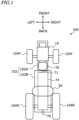
- FIG. 1 is a schematic plan view showing an example of the basic configuration of a work vehicle 100 in this disclosure.
- the direction in which the work vehicle 100 travels straight forward is called the "forward direction”
- the direction in which it travels straight backward is called the “backward direction.”
- the direction extending perpendicularly to the right of the "forward direction” is called the “right direction”
- the direction extending perpendicularly to the left is called the “left direction.”
- the "forward direction,” “backward direction,” “right direction,” and “left direction” are indicated by arrows labeled "front,” “back,” “right,” and “left” respectively. Both the forward and backward directions may be collectively referred to as the "front-back direction.”
- the work vehicle 100 illustrated in this example is, for instance, a tractor, which defines and functions as an example of agricultural machinery.
- the technologies disclosed herein are not limited to work vehicles such as tractors and may be applied to other types of work vehicles.
- the work vehicle 100 is configured to attach or tow an implement and travel within a field while performing agricultural tasks appropriate to the type of implement. Additionally, the work vehicle 100 is configured to travel both within and outside the field (including on roads) with the implement raised or without an implement attached.
- the work vehicle 100 like a conventional tractor, includes a vehicle frame 102 that rotatably supports left and right front wheels 104F and left and right rear wheels 104R.
- the vehicle frame 102 includes a front frame 102A where the front wheels 104F are mounted, and a transmission case 102B where the rear wheels 104R are mounted.
- the front frame 102A is fixed to the front portion of the transmission case 102B.
- the front wheels 104F and rear wheels 104R may be collectively referred to as wheels 104. Strictly speaking, the wheels 104 refer to wheel rims with tires attached.
- the term “wheel” generally refers to the entire assembly of the “wheel rim and tire.”
- Either or both of the front wheels 104F and rear wheels 104R may be replaced with a plurality of wheels (crawler) equipped with endless tracks instead of wheels with tires.
- the left and right front wheels 104F and left and right rear wheels 104R, the axles that rotate these four wheels, and the braking devices (brakes) that brake each axle may be collectively referred to as the "travel device.”
- the work vehicle 100 includes a fuel cell module (FC module) 10 and a motor 70, which are directly or indirectly supported by the front frame 102A.
- FC module 10 includes a fuel cell stack (FC stack) and functions as an onboard power generator that generates electricity from fuel, as will be described later.
- FC stack fuel cell stack
- the motor 70 is electrically connected to the FC module 10.
- the motor 70 converts the electric power generated by the FC module 10 into mechanical motion (power) to produce the driving force (traction) necessary for the work vehicle 100 to travel.
- An example of the motor 70 is an AC synchronous motor. Since the FC stack of the FC module 10 generates direct current, when the motor 70 is an AC synchronous motor, a group of electrical circuits, including an inverter device, is installed between the FC stack and the motor 70 to convert the direct current to alternating current. A portion of such electrical circuit group may be inside the FC module 10, while another portion of the electrical circuit group may be attached to the motor 70 as a motor drive circuit.
- the motor 70 includes an output shaft 71 that rotates.
- the torque of the output shaft 71 is transmitted to the rear wheels 104R through mechanical components such as a transmission (gearbox) and a rear wheel differential gear device installed inside the transmission case 102B.
- the power generated by the motor 70 which serves as the power source, is transmitted to the rear wheels 104R through a power transmission system (drivetrain) 74 including the transmission installed in the transmission case 102B.
- the "transmission case” may also be referred to as a "mission case.”
- a portion of the power of the motor 70 is also transmitted to the front wheels 104F.
- the power of the motor 70 may be used not only to drive the work vehicle 100 but also to operate implements.
- a power take-off (PTO) shaft 76 is provided at the rear end of the transmission case 102B.
- the PTO shaft 76 is driven by the motor 70 and is configured to be connected to implements.
- the torque from the output shaft 71 of the motor 70 is transmitted to the PTO shaft 76.
- Implements attached to or towed by the work vehicle 100 are configured to receive power from the PTO shaft 76 to perform various work-related operations.
- the motor 70 and the power transmission system 74 may collectively be referred to as an electric powertrain.
- the work vehicle 100 disclosed herein does not include an internal combustion engine such as a diesel engine, but includes the FC module 10 and the motor 70. Additionally, the output shaft 71 of the motor 70 is mechanically coupled to the power transmission system 74, including the transmission in the transmission case 102B.
- the motor 70 efficiently generates torque over a relatively wide range of rotational speeds compared to an internal combustion engine.
- the power transmission system 74, including the transmission it becomes easier to adjust the torque and rotational speed from the motor 70 over an even wider range by performing multi-stage or continuously variable speed change operations. This configuration allows for efficient execution of not only the travel of the work vehicle 100 but also various operations using implements.
- some functions of the power transmission system 74 may be omitted. For example, a portion or an entirety of the transmission responsible for speed change functions may be omitted.
- the number and mounting position of motors 70 are also not limited to the example shown in FIG. 1 .
- the work vehicle 100 includes at least one fuel tank 50 that stores fuel to be supplied to the FC module 10.
- FIG. 1 shows one fuel tank 50.
- a plurality of fuel tanks 50 may be housed in a tank case to define a fuel tank module.
- the fuel tank 50 is supported by structural elements fixed to the vehicle frame 102A described later.
- the FC module 10 and the fuel tank 50 are connected by piping and open/close valves, and similar components, defining an FC power generation system mounted on a vehicle. The configuration and operation of the FC power generation system will be described later.
- the work vehicle 100 in the embodiments described later includes a seat for a driver, hereinafter referred to as "a driver seat,” supported by the vehicle frame 102.
- the driver seat may be enclosed by a cabin supported by the vehicle frame 102.
- the FC module 10 is positioned in front of the driver seat, and the fuel tank 50 is positioned above the driver seat.
- Such FC module 10 and fuel tank 50 are housed in at least one "enclosure.”
- the "enclosure” functions as a housing, for example, and plays a role in protecting the FC module 10 and fuel tank 50 from sunlight exposure and wind and rain. Additionally, such an enclosure is designed to control the spread of fuel gas into the atmosphere and to facilitate the detection of fuel gas when fuel gas leaks from the FC module 10 or fuel tank 50.
- the FC module 10 may be housed in a front housing called a "bonnet,” for example.
- the front housing is a portion of the "enclosure.”
- the front housing is supported by the front portion of the vehicle frame 102 (front frame 102A ).
- the fuel tank 50 is housed in a tank case, as mentioned earlier.
- the tank case is directly or indirectly supported by the vehicle frame 102.
- FC power generation system 180 mounted on the work vehicle 100 .
- the FC power generation system 180 shown in FIG. 2 functions as an onboard power generation system in the work vehicle 100 of FIG. 1 .
- the electric power generated by the FC power generation system 180 is used not only for the travel of the work vehicle 100 but also for the operation of implements towed or attached to the work vehicle 100.
- the FC power generation system 180 in the illustrated example includes the FC module 10 and at least one fuel tank 50 that stores fuel to be supplied to the FC module 10.
- the FC power generation system 180 also includes a radiator device 34 to cool the FC module 10.
- the FC module 10 includes main components such as a fuel cell stack (FC stack) 11, an air compressor 12, a fuel circulation pump 24, a coolant pump 31, a boost circuit 40, and a control device 42. These components are housed within the casing of the FC module 10 and are connected to each other through electrical or fluid communication.
- FC stack fuel cell stack
- air compressor 12 air compressor
- fuel circulation pump 24 a fuel circulation pump
- coolant pump 31 a boost circuit 40
- control device 42 a control device
- the FC stack 11 generates electric power through an electrochemical reaction between the fuel, referred to as "anode gas” and the oxidizing gas, referred to as "cathode gas.”
- the FC stack 11 is composed of polymer electrolyte fuel cells.
- the FC stack 11 has a stack structure in which a plurality of single cells (fuel cell elements) are stacked.
- a single cell includes, for example, an electrolyte membrane formed from an ion exchange membrane, an anode electrode formed on one side of the electrolyte membrane, a cathode electrode formed on the other side of the electrolyte membrane, and a pair of separators sandwiching the anode electrode and cathode electrode on both sides.
- the voltage generated in a single cell is, for example, less than 1 volt. Therefore, in the FC stack 11, for instance, more than 300 single cells are connected in series to generate a voltage of several hundred volts.
- Anode gas is supplied to the anode electrode of the FC stack 11.
- the anode gas is called "fuel gas” or simply “fuel.”
- the anode gas (fuel) is hydrogen gas.
- Cathode gas is supplied to the cathode electrode.
- the cathode gas is an oxidizing gas such as air.
- the anode electrode is called the fuel electrode, and the cathode electrode is called the air electrode.
- anode gas after being used in the above reaction is called “anode off-gas”
- cathode off-gas The anode gas after being used in the above reaction is called “cathode off-gas.”
- the air compressor 12 supplies air taken from the outside as cathode gas to the cathode electrode of the FC stack 11.
- the cathode gas supply system including the air compressor 12 includes a cathode gas supply pipe 13, a cathode off-gas pipe 14, and a bypass pipe 15.
- the cathode gas supply pipe 13 flows cathode gas (air) supplied from the air compressor 12 to the cathode electrode of the FC stack 11.
- the cathode off-gas pipe 14 flows cathode off-gas discharged from the FC stack 11 to the outside air.
- the bypass pipe 15 branches from the cathode gas supply pipe 13 downstream of the air compressor 12, bypasses the FC stack 11, and connects to the cathode off-gas pipe 14.
- a control valve 16 is provided on the bypass pipe 15 to adjust the flow rate of cathode gas flowing through the bypass pipe 15.
- a shut-off valve 17 is provided on the cathode gas supply pipe 13 to selectively block the inflow of cathode gas to the FC stack 11.
- a pressure regulating valve 18 is provided on the cathode off-gas pipe 14 to adjust the back pressure of the cathode gas.
- the cathode gas supply system of the FC module 10 includes a rotation speed detection sensor S1 that detects the rotation speed of the air compressor 12 and a gas flow rate detection sensor S2 that detects the flow rate of cathode gas flowing through the cathode gas supply pipe 13.
- the control valve 16, shut-off valve 17, and pressure regulating valve 18 are, for example, electromagnetic valves.
- the fuel circulation pump 24 supplies fuel gas (anode gas) sent from the fuel tank 50 to the anode electrode of the FC stack 11.
- the anode gas supply system including the fuel circulation pump 24 includes an anode gas supply pipe 21, an anode off-gas pipe 22, and a circulation path 23.
- the anode gas supply pipe 21 flows anode gas supplied from the fuel tank 50 to the anode electrode of the FC stack 11.
- the fuel tank 50 is a hydrogen tank that stores high-pressure hydrogen gas.
- the anode off-gas pipe 22 flows anode off-gas discharged from the FC stack 11.
- the anode off-gas is led through the anode off-gas pipe 22 to a gas-liquid separator 25 in which moisture is removed.
- the anode off-gas with moisture removed returns to the anode gas supply pipe 21 through the circulation path 23 by the fuel circulation pump 24.
- the anode off-gas circulating through the circulation path 23 can be discharged through the anode off-gas pipe 22 by opening an exhaust valve 26.
- Moisture accumulated in the gas-liquid separator 25 can be discharged through the anode off-gas pipe 22 by opening the exhaust valve 26.
- the exhaust valve 26 is, for example, an electromagnetic valve.
- the anode off-gas pipe 22 is connected to the cathode off-gas pipe 14.
- FIG. 2 shows a coolant circulation system including a coolant pump 31 for the FC stack 11, but as described later, cooling circulation systems for other electrical equipment may also be provided. Note that the air compressor 12, fuel circulation pump 24, and coolant pump 31 included in the FC module 10 are driven by individual built-in motors. These motors are also electrical equipment.
- the coolant circulation system including the coolant pump 31 shown in FIG. 2 includes a coolant supply pipe 32, a coolant discharge pipe 33, a radiator device 34, and a temperature sensor S3.
- This coolant circulation system is configured to adjust the temperature of the FC stack 11 within a predetermined range by circulating coolant through the FC stack 11.
- the coolant is supplied to the FC stack 11 through the coolant supply pipe 32.
- the supplied coolant flows through a coolant path between single cells and is discharged into the coolant discharge pipe 33.
- the coolant discharged into the coolant discharge pipe 33 flows to the radiator device 34.
- the radiator device 34 performs heat exchange between the incoming coolant and the outside air to release heat from the coolant, and then resupplies the cooled coolant to the coolant supply pipe 32.
- the coolant pump 31 is provided on either the coolant supply pipe 32 or the coolant discharge pipe 33 to pump coolant to the FC stack 11.
- a coolant bypass flow path may be provided between the coolant discharge pipe 33 and the coolant supply pipe 32.
- a flow dividing valve is provided at the branching point at which the coolant bypass flow path branches from the coolant discharge pipe 33. The flow dividing valve is configured to adjust the flow rate of coolant flowing through the bypass flow path.
- the temperature sensor S3 detects the temperature of the coolant flowing through the coolant discharge pipe 33.
- the coolant used to cool the FC stack 11 is circulated through the flow path by an electric coolant pump 31.
- a coolant control valve may be provided downstream of the FC stack 11.
- the coolant control valve adjusts the ratio of coolant flowing to the radiator device 34 and coolant bypassing the radiator device 34, enabling more accurate control of the coolant temperature.
- the liquid delivery amount by the coolant pump it is also possible to control the coolant temperature difference between the inlet and outlet of the FC stack 11 to be within a desired range.
- the temperature of the coolant in the FC stack 11 may be controlled to be around 70°C, for example, which is a temperature where the power generation efficiency of the FC stack 11 is high.
- the coolant flowing through the FC stack 11 preferably has higher insulation properties compared to the coolant used to cool ordinary electrical equipment. Since voltages exceeding 300 volts can occur in the FC stack 11, increasing the electrical resistance of the coolant allows for the suppression of current leakage through the coolant or devices such as the radiator device 34. The electrical resistance of the coolant may decrease as the coolant is used. This is because ions dissolve into the coolant flowing through the FC stack 11. To remove such ions from the coolant and increase insulation property, it is desirable to place an ion exchanger in the coolant flow path.
- the boost circuit 40 is configured to increase the voltage output by the FC stack 11 through power generation to a desired level.
- the subsequent stage of the boost circuit 40 is connected to the high-voltage electrical circuit including an inverter device for motor drive.
- the subsequent stage of the boost circuit 40 may also be connected in parallel to the low-voltage electrical circuit via a step-down circuit.
- the control device 42 may include an electronic control unit (ECU) configured or programmed to control power generation by the FC module 10.
- the control device 42 detects or estimates the operating state of the FC power generation system 180 based on signals output from various sensors.
- the control device 42 is configured or programmed to control power generation by the FC stack 11 by regulating the operation of the air compressor 12, fuel circulation pump 24, coolant pump 31, and various valves, based on the operating state of the FC power generation system 180 and instructions output from a primary computer or other ECUs.
- the control device 42 includes, for example, a processor, a storage device, and an input/output interface.
- anode gas may be referred to as “fuel gas” or “fuel”
- anode gas supply pipe may be referred to as "piping.”
- FIG. 3 is a block diagram schematically showing an example of electrical connections and power transmission between components of the work vehicle 100 according to this disclosure.
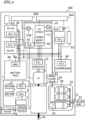
- FIG. 4 is a block diagram showing a more detailed configuration than the example in FIG. 3 .
- FIG. 4 schematically shows the paths of electrical signals (thin solid lines) and coolant (dotted lines) between components in the work vehicle 100.
- Electrical connections include both high-voltage and low-voltage systems.
- High-voltage electrical connections provide, for example, the power supply voltage for inverter devices.
- Low-voltage electrical connections provide, for example, the power supply voltage for electronic components that operate at relatively low voltages.
- the work vehicle 100 includes an FC module 10, an inverter device 72, a motor 70, a power transmission system 74, and a PTO shaft 76.
- the DC voltage of the power generated in the FC stack 11 of the FC module 10 is boosted by the boost circuit 40 and then supplied to the inverter device 72.
- the inverter device 72 converts the DC voltage into, for example, a three-phase AC voltage and supplies it to the motor 70.
- the inverter device 72 includes a bridge circuit including a plurality of power transistors.
- the motor 70 includes a rotating rotor and a stator with a plurality of coils electrically connected to the inverter device 72.
- the rotor is coupled to the output shaft 71, for example, via a reduction gear (speed reducer) or directly.
- the motor 70 rotates the output shaft 71 with torque and rotational speed controlled according to the waveform of the three-phase AC voltage from the inverter device 72.
- the work vehicle 100 further includes a control device (ECU) 72A that controls the motor 70.
- the control device 72A is connected to the inverter device 72 and controls the switching operation (turn-on or turn-off) of each of a plurality of power transistors included in the bridge circuit of the inverter device 72.
- the control device 72A may be connected to the inverter device 72 via a pre-driver (which may be referred to as a "gate driver").
- the control device 72A may operate under the control of a primary computer.
- the torque of the output shaft 71 of the motor 70 is transmitted to the power transmission system 74.
- the power transmission system 74 operates with the motor 70 as the power source to drive the wheels 104R and 104F, as shown in FIG. 1 , and/or the PTO shaft 76.
- This power transmission system 74 may have the same or a similar structure as the power transmission system in conventional tractors including internal combustion engines such as diesel engines.
- a power transmission system used in agricultural tractors for example, it is possible to reduce the design and manufacturing costs for producing an agricultural work vehicle 100 including an FC power generation system.
- the power transmission system 74 includes a travel power transmission mechanism that transmits power from the motor 70 to the left and right rear wheels 104R through a clutch, transmission, and rear wheel differential device, as well as a PTO power transmission mechanism that transmits power from the motor 70 to the PTO shaft 76.
- the transmission case 102B in FIG. 1 may be divided into a front case (mission case) housing the clutch and transmission and related components, and a rear case (differential gear case) housing the rear wheel differential device and related components.
- the rear case may also be referred to as a rear axle case.
- the work vehicle 100 includes a secondary battery (battery pack) 80 that temporarily stores electrical energy generated by the FC module 10.
- An example of the battery pack 80 includes a pack of lithium-ion batteries.
- the battery pack 80 is electrically connected to the FC module 10 and electrically connected to the motor 70 via the inverter device 72.
- the battery pack 80 is configured to supply power to the inverter device 72 at the necessary timing in cooperation with the FC module 10 or independently.
- Various battery packs used in electric passenger vehicles may be adopted as the battery pack 80.
- the battery pack 80 may be simply referred to as "battery 80.”
- the work vehicle 100 includes various electrical equipment (onboard electronic components) that operates on electricity, in addition to the motor 70 and the inverter device 72.
- electrical equipment include electromagnetic valves such as open/close valves 20, air cooling fans of the radiator device 34, electric pumps of air conditioning compressors 85, and temperature control devices for heating or cooling the FC stack 11.
- the temperature control devices include electric heaters 86.
- First and second DC-DC converters 81 and 82 to obtain appropriate power supply voltages for the operation of electrical equipment, and storage batteries 83 may also be included in the electrical equipment.
- various electronic components not shown such as lamps, electric motors for hydraulic systems
- the electrical equipment may be electronic components similar to electrical equipment installed in conventional agricultural tractors.
- the first DC-DC converter 81 is a circuit that steps down the voltage output from the boost circuit 40 of the FC module 10 to a first voltage, for example, 12 volts.
- the storage battery 83 is, for example, a lead-acid battery and stores electrical energy at the voltage output from the first DC-DC converter 81.
- the storage battery 83 may be used as a power source for various electrical equipment such as lamps.
- the work vehicle 100 shown in FIG. 3 includes not only the first DC-DC converter 81 but also a second DC-DC converter 82 as a voltage conversion circuit that steps down the high voltage output by the FC module 10.
- the second DC-DC converter 82 is a circuit that steps down the voltage output from the boost circuit 40 of the FC module 10 (for example, several hundred volts) to a second voltage higher than the first voltage, for example, 24 volts.
- the air cooling fan of the radiator device 34 for example, is configured to operate on the voltage output from the second DC-DC converter 82. Note that although the radiator device 34 is described as a single component in FIG. 3 , one work vehicle 100 may include a plurality of radiator devices 34. Additionally, the electric pump of the air conditioning compressor 85 and the electric heater 86 are configured to operate on the voltage output from the second DC-DC converter 82.
- the work vehicle 100 shown in FIG. 3 includes a temperature control device that cools or heats the FC stack 11 included in the FC power generation system.
- the operation of the temperature control device or alike requires relatively large power.
- the relatively high 24-volt voltage output by the second DC-DC converter 82 is applied to the temperature control device.
- the temperature control device includes the radiator device 34 that releases heat from the coolant cooling the FC stack 11, and the relatively high 24-volt voltage (second voltage) output by the second DC-DC converter 82 is applied to the radiator device 34.
- the temperature control device includes a heater 86 that heats the FC stack 11.
- the relatively high voltage output by the second DC-DC converter 82 may also be applied to the heater.
- the relatively high voltage output by the second DC-DC converter 82 may also be applied to air conditioning devices such as the air conditioning compressor 85.
- the work vehicle 100 may include a third voltage conversion circuit that converts the high voltage output by the FC module 10 to a third voltage higher than the second voltage.
- the third voltage is, for example, 48 volts. If the work vehicle 100 includes another motor in addition to the motor 70, for example, the third voltage may be used as the power source for such other motors.
- the agricultural work vehicle in addition to the electrical equipment necessary for agricultural task, the agricultural work vehicle also includes electrical equipment necessary for the operation of fuel cell power generation, so the appropriate voltage magnitude may differ for each electrical equipment. According to the embodiments of this disclosure, it is possible to supply voltages of appropriate magnitudes.
- a plurality of fuel tanks 50 are housed in a single tank case 51.
- the fuel tank 50 is connected to a supplying port (fueling port) 52 through which fuel is supplied from the outside. This connection is made via piping 21 for flowing fuel gas.
- the fuel tank 50 is also connected to the FC module 10 via piping 21, which is equipped with an open/close valve 20.
- the piping 21 may be formed from materials with high resistance to hydrogen embrittlement, such as austenitic stainless steel like SUS316L.
- a valve space 53 is provided in the tank case 51, and various valves including a pressure reducing valve are placed in the valve space 53.
- the piping 21 connects the fuel tank 50 and the FC module 10.
- Fuel gas with reduced pressure by the pressure reducing valve flows through the piping 21 connecting the tank case 51 and the FC module 10.
- the fuel gas is hydrogen gas
- high-pressure hydrogen gas of, for example, 35 megapascals or more may be filled in the fuel tank 50, but the hydrogen gas after passing through the pressure reducing valve may be reduced to about 2 atmospheres or less.
- FIG. 4 shows a plurality of ECUs that communicate within the work vehicle 100 and a user interface 1. Communication can be executed via CAN bus wiring and other similar communication pathways, which function as paths for electrical signals (thin solid lines).
- FIG. 4 also shows a cooling system to perform thermal management of components. Specifically, the path of coolant (dotted line) is schematically shown.
- the first and second DC-DC converters 81 and 82 are configured to output voltages of different magnitudes. ECUs are also provided for these first and second DC-DC converters 81 and 82 to control each voltage conversion circuit. The relatively low first voltage which the first DC-DC converter 81 outputs is applied to these ECUs, like other ECUs.
- the work vehicle 100 includes a cooling system in which coolant circulates via coolant pumps 31A and 31B. These coolant pumps 31A and 31B are provided inside the FC module 10.
- the cooling system in this example includes a first radiator device 34A responsible for cooling the FC stack 11 and a second radiator device 34B to cool other electrical equipment.
- the cooling system includes a flow path (first flow path) where coolant flows between the FC stack 11 and the first radiator device 34A.
- this cooling system has a flow path (second flow path) where coolant flows between electrical equipment including the motor 70 and the second radiator device 34B.
- a heater core 87 used to heat the cabin is provided, and the coolant flowing through the first radiator device 34A flows through the heater core 87.
- the user interface 1 includes an operation device 2 such as an accelerator pedal (or accelerator lever) and a main ECU 3 connected to the operation device 2.
- the main ECU 3 is communicably connected via a bus to a main meter 4, a storage device 7, a positioning system 8, and similar components.
- the storage device 7 and positioning system 8 will be described later.
- the main meter 4 may display various parameters that identify the travel state or operating state of the work vehicle 100.
- the user interface 1 further includes an FC system ECU 5 to control the FC power generation system.
- the FC system ECU 5 is connected to an FC meter 6.
- the FC meter 6 may display various parameters that identify the operating state of the FC power generation system.
- the storage device 7 includes one or more storage media such as flash memory or magnetic disks.
- the storage device 7 stores various data generated by the main ECU 3 and FC system ECU 5.
- the storage device 7 also stores computer programs that cause the main ECU 3 and FC system ECU 5 to perform desired operations.
- the computer programs may be provided to the work vehicle 100 via storage media (e.g., semiconductor memory or optical discs) or telecommunication lines (e.g., the Internet).
- the computer programs may be sold as commercial software.
- the work vehicle 100 may further include a positioning system 8.
- the positioning system 8 includes, for example, a GNSS (Global Navigation Satellite System) receiver used for positioning, and an external sensor that senses the external state of the work vehicle 100.
- GNSS Global Navigation Satellite System
- An example of the block configuration of the positioning system 8 will be described later.
- the cells of the battery pack 80 are controlled by a Battery Management Unit (BMU).
- BMU Battery Management Unit
- the BMU includes circuits and a CPU (Central Processing Unit) that perform voltage monitoring for each cell of the battery, monitoring of overcharging and over-discharging, and cell balance control. These circuits and CPU may be mounted on a battery controller board.
- CPU Central Processing Unit
- FIG. 5 is a perspective view schematically showing a configuration example of the work vehicle 200 in this embodiment.
- FIG. 6 is a side view schematically showing a configuration example of the work vehicle 200 in this embodiment.
- the work vehicle 200 of this embodiment includes an FC module 10, a fuel tank 50, a motor 70, a driver seat 107, a vehicle frame 102, a control device, and a traveling device.
- the work vehicle 200 includes a configuration similar to that of the work vehicle 100 described with reference to Fig. 1 .
- the ECU includes a storage device (ROM) and may further include, for example, an FPGA (Field Programmable Gate Array) and/or a GPU (Graphics Processing Unit).
- ROM Read Only Memory
- FPGA Field Programmable Gate Array
- GPU Graphics Processing Unit
- the work vehicle 200 of this embodiment further includes a positioning system 8 (see Fig. 4 ) and an operation terminal 400.
- the operation terminal 400 is a terminal for a user to perform operations related to the travel of the work vehicle and the operation of implements, and is also referred to as a virtual terminal (VT).
- the operation terminal 400 may include a touch screen type display device and/or one or more buttons.
- the display device may be, for example, a liquid crystal or organic light-emitting diode (OLED) display.
- Fig. 7 is a schematic block diagram showing an example configuration of the positioning system 8.
- the positioning system 8 exemplified in Fig. 7 includes a GNSS receiver 8A, an external sensor 8B, and a self-position estimation device 8C.
- the positioning system 8 may further include an RTK (Real Time Kinematic) receiver and an inertial measurement unit (IMU).
- RTK Real Time Kinematic
- IMU inertial measurement unit
- the GNSS receiver 8A includes, for example, an antenna and a GNSS receiver.
- the GNSS receiver 8A receives satellite signals transmitted from a plurality of GNSS satellites and generates GNSS data based on the satellite signals.
- the GNSS data is generated in a predetermined format, for example, the NMEA-0183 format.
- the GNSS data may include, for example, values indicating the identification number, elevation angle, azimuth angle, and reception strength of each satellite from which satellite signals are received.
- the external sensor 8B outputs sensor data indicating the distribution of objects present in the surroundings of the work vehicle 200.
- external sensors include LiDAR sensors, cameras (or image sensors), laser range finders (also referred to as “scanning distance sensors”), ultrasonic sensors, millimeter-wave radars, and magnetic sensors.
- the self-position estimation device 8C is a device that performs estimation of the position and orientation of the work vehicle 200 (self-position estimation) using sensor data output from the external sensor 8B.
- algorithms such as SLAM may be used.
- the self-position estimation device 8C may be implemented by an ECU.
- the self-position estimation device 8C estimates the position of the work vehicle 200 by matching sensor data output from the external sensor 8B with an environmental map. The matching may be performed using any matching algorithm such as NDT (Normal Distribution Transform) or ICP (Iterative Closest Point).
- the fuel tank 50 is supported by a mounting frame 120.
- the mounting frame 120 is fixed to the vehicle frame 102 across the driver seat 107.
- the fuel tank 50 is positioned above the driver seat 107.
- the installation location of the fuel tank 50 is not limited to the illustrated example and may be, for example, inside the front housing 110.
- the mounting frame 120 is an elongated structure such as a pipe fixed to the vehicle frame 102.
- the mounting frame 120 includes two frames positioned on the left and right sides of the work vehicle 200 (see Fig. 5 ).
- the front portion of the mounting frame 120 has a curved shape.
- the shape of the mounting frame 120 shown is just an example, and the shape of the mounting frame 120 is not limited to this example.
- the vehicle frame 102 includes a front frame 102A that rotatably supports the front wheels 104F and a transmission case 102B that rotatably supports the rear wheels 104R.
- One end (front end) of the mounting frame 120 is fixed to the front frame 102A.
- the other end (rear end) of the mounting frame 120 is fixed to the transmission case 102B.
- fixations may be done by appropriate methods such as welding or bolt joining, depending on the material of the mounting frame 120 .
- the mounting frame 120 may be formed from metal, synthetic resin, carbon fiber, or composite materials such as carbon fiber reinforced plastic or glass fiber reinforced plastic.
- the transmission case 102B includes a rear axle case, and the rear end of the mounting frame 120 may be fixed to the rear axle case. When the mounting frame 120 is formed from metal, a portion or entirety of its surface may be covered with synthetic resin.
- the work vehicle 200 includes a cabin 105 surrounding the driver seat 107 between the vehicle frame 102 and the mounting frame 120.
- the driver seat 107 is located in the rear portion of the interior of the cabin 105.
- a steering wheel 106 to change the direction of the front wheels 104F and an operation terminal 400 are provided in front of the driver seat 107.
- the cabin 105 includes a cabin frame that defines its skeleton.
- a roof 109 is provided on the upper portion of the cabin frame.
- the cabin frame in this embodiment is a 4-pillar style.
- the cabin 105 is supported by the transmission case 102B of the vehicle frame 102, for example, via vibration-isolating mounts.
- the user interface 1 described with reference to FIG. 4 is provided inside the cabin 105. Since the cabin 105 does not directly support the fuel tank 50, there is no need to specially increase its strength, and a cabin that has been used in conventional tractors may be adopted.
- the work vehicle 200 includes a placement platform 51A that connects the left frame 120 and the right frame 120.
- the fuel tank 50 can be positioned on the placement platform 51A.
- the plurality of fuel tanks 50 may be provided in a fuel tank module 55.
- the fuel tank module 55 includes a tank case 51 that houses a plurality of fuel tanks 50.
- the left and right mounting frames 120 may be connected to each other by members other than the placement platform 51A ⁇
- a coupling device 108 is provided at the rear end of the transmission case 102B, which defines the rear portion of the vehicle frame 102.
- the coupling device 108 includes, for example, a three-point support device (referred to as a "three-point link” or “three-point hitch”), a PTO shaft, a universal joint, and a communication cable.
- the implement 300 can be attached to or detached from the work vehicle 200 using the coupling device 108.
- the coupling device 108 can, for example, raise and lower the three-point link by a hydraulic device to change the position or posture of the implement 300. Additionally, power can be transmitted from the work vehicle 200 to the implement 300 via the universal joint.
- the work vehicle 200 can execute predetermined work (agricultural task) with the implement 300 while pulling the implement 300.
- the coupling device 108 may be provided on the front portion of the vehicle frame 102, in which case the implement 300 can be connected to the front of the work vehicle 200.
- the implement 300 may include, for example, a drive device, a control device, and a communication device.
- the drive device performs operations necessary for the implement 300 to execute predetermined work.
- the drive device includes devices appropriate for the application of the implement 300, such as hydraulic devices, electric motors, or pumps.
- the control device controls the operation of the drive device.
- the control device causes the drive device to perform various operations in response to signals transmitted from the work vehicle 200 via the communication device.
- the communication device can also transmit signals corresponding to the state of the implement 300 to the work vehicle 200.
- the implement 300 shown in Fig. 6 is a rotary tiller, but the implement 300 is not limited to a rotary tiller.
- any implement such as a seeder, a spreader (fertilizer applicator), a transplanter, a mower, a rake, a baler, a harvester, a sprayer, or a harrow can be connected to and used with the work vehicle 200.
- the work vehicle 200 shown in Fig. 6 is capable of both manned operation and unmanned operation, but it may also be configured for unmanned operation only. In that case, components necessary only for manned operation, such as the cabin 105, steering wheel 106, and driver seat 107, may not be provided on the work vehicle 200.
- the work vehicle may be equipped with an automatic driving function. That is, the work vehicle can travel by the action of the control device without manual operation.
- the work vehicle 200 of this embodiment can operate in both manual driving mode and self-driving mode. In the self-driving mode, the work vehicle 200 is configured to travel unmanned.
- the work vehicle 200 which is unmanned is configured to travel autonomously or by remote control by a user.
- the work vehicle 200 is capable of self-driving both inside and outside the field (e.g., on roads).
- the control device may perform calculations and control to achieve in cooperation with the positioning system 8.
- the control device may perform self-driving control of the work vehicle 200 based on the estimated position of the work vehicle 200.
- the control device changes the manner of stopping the motor 70 when a travel stop command is issued during driving of the motor 70, depending on whether the position of the work vehicle 200 identified by the positioning system 8 is within the field or not. Specifically, the control device makes the time from when the travel stop command is issued until the motor 70 stops shorter when the position of the work vehicle 200 is within the field than when the position of the work vehicle 200 is outside the field.
- the time from when the travel stop command is issued until the motor 70 stops when the position of the work vehicle 200 is outside the field is referred to as the "first stop time”.
- the time from when the travel stop command is issued until the motor 70 stops when the position of the work vehicle 200 is within the field is referred to as the "second stop time”.
- the second stop time is shorter than the first stop time.
- the travel stop command may be issued, for example, from the FC system ECU 5, or a primary computer that communicates with the FC system ECU 5, to the main ECU 3 or the ECU 72A that controls the driving of the motor 70.
- the travel stop command may be issued from the main ECU 3 to the ECU 72A.
- the FC meter 6 is configured to display indicators that indicate the operating state of the FC power generation system 180.
- the display on the FC meter 6 may include, for example, an indicator to notify abnormalities in the FC power generation system 180, and indicators such as a water temperature gauge to indicate the state of the radiator device (e.g., temperature measured by the temperature sensor S3).
- a pressure sensor may be provided in the fuel tank 50 to measure the remaining amount of fuel in the fuel tank 50.
- a temperature sensor may be provided to measure the temperature inside the fuel tank 50.
- the FC system ECU 5 acquires sensor data output from the temperature sensor of the fuel tank 50 and measures the temperature of the fuel tank 50 based on the sensor data.
- the FC system ECU 5 acquires sensor data output from the pressure sensor of the fuel tank 50 and measures the pressure (residual pressure) of the fuel in the fuel tank 50 based on the sensor data.
- the FC system ECU 5 determines whether each of the temperature of the fuel tank 50 and the pressure of the fuel is within a normal range. When either the temperature of the fuel tank 50 or the pressure of the fuel is not within the normal range, the FC system ECU 5 may, for example, turn on or flash an indicator notifying an abnormality in the FC power generation system 180. For example, a stop button for emergency stopping of the work vehicle 200 during automatic travel may be displayed on the screen of the operation terminal 400. When a driver seated in the driver seat 107 who notices the lighting or flashing of the indicator presses this stop button or a switch provided in the cabin 105, the main ECU 3, for example, issues a travel stop command to the ECU 72A in response to this press. The ECU 72A stops the motor 70 in response to the travel stop command.
- the main ECU 3 may issue a travel stop command to the ECU 72A in response to this press.
- the FC system ECU 5 detects an abnormality in the FC power generation system 180, it may issue a travel stop command to, for example, the ECU 72A.
- the ECU 72A stops the motor 70 in response to the travel stop command.
- a travel stop command is issued mainly for emergency stopping when an abnormality in the FC power generation system 180 is detected.
- the issuance of the travel stop command is not limited to when an abnormality occurs in the FC power generation system.
- a travel stop command may be issued when the stop button is pressed.
- a travel stop command may be issued to stop the work vehicle in place when an obstacle is detected by the positioning system during self-traveling in the field.
- the work vehicle 200 of this embodiment includes a first switch R1 provided in the current path between the FC module 10 and the motor 70.
- the work vehicle 200 may further include a second switch R2 provided in the current path between the battery 80 and the motor 70.
- Examples of the first switch R1 and the second switch R2 are relays.
- the on/off control of each of the first switch R1 and the second switch R2 is performed by, for example, the FC system ECU 5. By turning off the first switch R1, power supply from the FC module 10 to the motor 70 is shut off. By turning off the second switch R2, power supply from the battery 80 to the motor 70 is shut off.
- Fig. 8 is a flowchart showing an example of the processing procedure of the operation of the control device.
- the control device executes automatic travel control based on sensor data output from the positioning system 8, in cooperation with the positioning system 8 (step S110 ).
- step S120 a travel stop command is issued in response to this press (step S120 ), and the processing performed by the control device proceeds to the next step S130.
- the control device continues the automatic travel control until the travel stop command is issued (No in step S120, step S110 ) .
- the control device determines whether the position of the work vehicle 200 identified by the positioning system 8 is within the field or outside the field (step S130 ).
- the storage device 7 described above may further store an environmental map of an area including one or more fields.
- the GNSS receiver 8A of the positioning system 8 performs positioning, and in an environment where the reception status is not good, the self-position estimation device 8C performs self-position estimation to identify or estimate the position of the work vehicle 200.
- the control device determines whether the position of the work vehicle 200 is within the field or outside the field based on the position identified by the positioning system 8 and the environmental map stored in the storage device 7. For example, the control device acquires position data indicating the position of the work vehicle 200 generated by the GNSS receiver 8A.
- the position data includes information on the geographical coordinates of the position of the work vehicle 200.
- the information on geographical coordinates includes, for example, information on latitude and longitude.
- the environmental map stored in the storage device 7 includes information on the geographical coordinates of the area shown by the map.
- the environmental map may include a plurality of area polygons corresponding to a plurality of areas, and further include attribute data indicating the attributes of objects located within each area.
- Each of the plurality of area polygons is defined by geographical coordinates.
- the control device determines the area corresponding to the geographical coordinates indicated by the position data of the identified work vehicle 200 using the environmental map.
- the determined area corresponds to the area where the work vehicle 200 is located.
- the control device is configured to determine whether the area corresponding to the geographical coordinates indicated by the position data is within the field or outside the field.
- the control device stops the motor 70 after the second stop time from the travel stop command. For example, the control device stops the motor 70 by turning off the first switch R1 (step S140 ). When the position of the work vehicle 200 is within the field, the control device may stop the motor 70 by turning off both the first switch R1 and the second switch R2 in response to the travel stop command. On the other hand, when the position of the work vehicle 200 is outside the field (No in step S130 ), the control device stops the motor 70 after the first stop time from the travel stop command (step S150 ).
- the control device after receiving the travel stop command, the control device maintains the driving of the motor for a certain time (e.g., the first stop time) before stopping the motor 70.
- a certain time e.g., the first stop time
- power supply to the motor 70 may be maintained for a predetermined time.
- the control device may perform the following operations instead of turning off each switch.
- the ECU 72A stops the control of the inverter device 72 after the first stop time elapses after receiving the travel stop command.
- the FC system ECU 5 may instruct the control device 42 of the FC module 10 to stop power generation after the first stop time elapses, thus stopping the power generation of the FC module 10.
- the control device stops the motor 70 at different timings depending on whether the position of the work vehicle 200 is within the field or not.
- the control device immediately shuts off power supply to the motor by turning off the first switch in response to, for example, an emergency stop command, thus stopping the motor. Therefore, the work vehicle traveling or working in the field can be immediately stopped in emergency. Furthermore, by turning off both the first switch and the second switch in response to, for example, an emergency stop command, the control device completely shuts off power supply to the motor immediately, enabling appropriate stopping of the motor.
- the control device For a work vehicle traveling outside the field, the control device maintains the driving of the motor for the first stop time after receiving the travel stop command, allowing the work vehicle to continue traveling. In other words, the control device does not immediately shut off power supply to the motor in response to the travel stop command. This allows, for example, for moving the work vehicle to the shoulder of the road. After moving the work vehicle to the shoulder of the road, the control device may stop the motor by turning off the first switch and/or the second switch. In this manner, the work vehicle can be safely parked in a safe place.
- the work vehicle in this embodiment is not limited to self-driving.
- the control device can stop the motor at different timings depending on whether the position of the work vehicle is within the field or not when a travel stop command is issued during the driving of the motor, that is, during the travel of the work vehicle.
- the present disclosure includes the work vehicle described in the following Items.
- a work vehicle comprising:
- the work vehicle according to item 1 further comprising a first switch provided on a current path between the fuel cell module and the motor; wherein the control device, in response to the travel stop command issued during driving of the motor:
- the work vehicle according to item 2 further comprising:
- the work vehicle according to any one of items 1 to 3, wherein the positioning system includes a GNSS receiver.
- the work vehicle according to any one of items 1 to 4, further comprising a storage device to store an environmental map of an area including one or more fields; wherein the control device determines whether the position of the work vehicle is within the field or outside the field based on the position identified by the positioning system and the environmental map.
- the positioning system includes:
- control device performs automatic travel control of the work vehicle based on an estimated position of the work vehicle.
- control device stops the motor at different timings depending on whether the position of the work vehicle is within the field or not.
- the work vehicle according to any one of items 1 to 8, wherein the work vehicle is an agricultural machine.
- the technology of this disclosure can be applied to agricultural machines such as tractors, harvesters, rice planters, riding management vehicles, vegetable transplanting machines, mowers, seeders, fertilizer applicators, or agricultural robots.
Landscapes
- Engineering & Computer Science (AREA)
- Life Sciences & Earth Sciences (AREA)
- Mechanical Engineering (AREA)
- Soil Sciences (AREA)
- Environmental Sciences (AREA)
- Power Engineering (AREA)
- Transportation (AREA)
- Sustainable Development (AREA)
- Sustainable Energy (AREA)
- Electric Propulsion And Braking For Vehicles (AREA)
- Fuel Cell (AREA)
Applications Claiming Priority (2)
| Application Number | Priority Date | Filing Date | Title |
|---|---|---|---|
| JP2022103774 | 2022-06-28 | ||
| PCT/JP2023/023489 WO2024004911A1 (ja) | 2022-06-28 | 2023-06-26 | 作業車両 |
Publications (2)
| Publication Number | Publication Date |
|---|---|
| EP4544893A1 true EP4544893A1 (de) | 2025-04-30 |
| EP4544893A4 EP4544893A4 (de) | 2025-10-29 |
Family
ID=89383015
Family Applications (1)
| Application Number | Title | Priority Date | Filing Date |
|---|---|---|---|
| EP23831353.0A Pending EP4544893A4 (de) | 2022-06-28 | 2023-06-26 | Arbeitsfahrzeug |
Country Status (5)
| Country | Link |
|---|---|
| US (1) | US20250107477A1 (de) |
| EP (1) | EP4544893A4 (de) |
| JP (1) | JPWO2024004911A1 (de) |
| CN (1) | CN119486586A (de) |
| WO (1) | WO2024004911A1 (de) |
Family Cites Families (7)
| Publication number | Priority date | Publication date | Assignee | Title |
|---|---|---|---|---|
| JP2002225577A (ja) | 2001-02-05 | 2002-08-14 | Iseki & Co Ltd | トラクタ |
| JP6266407B2 (ja) * | 2014-03-28 | 2018-01-24 | ヤンマー株式会社 | 自律走行作業車両 |
| JP7075576B2 (ja) | 2017-12-07 | 2022-05-26 | 株式会社セガ | 景品取得ゲーム装置 |
| JP2020162281A (ja) * | 2019-03-26 | 2020-10-01 | ヤンマーパワーテクノロジー株式会社 | 作業車両 |
| JP7227944B2 (ja) * | 2020-07-03 | 2023-02-22 | 日立チャネルソリューションズ株式会社 | 作業車および作業方法 |
| JP2022052261A (ja) * | 2020-09-23 | 2022-04-04 | ヤンマーホールディングス株式会社 | 自動走行システム、自動走行方法、及び自動走行プログラム |
| JP7399070B2 (ja) * | 2020-11-27 | 2023-12-15 | 株式会社クボタ | 作業機 |
-
2023
- 2023-06-26 EP EP23831353.0A patent/EP4544893A4/de active Pending
- 2023-06-26 JP JP2024530810A patent/JPWO2024004911A1/ja active Pending
- 2023-06-26 WO PCT/JP2023/023489 patent/WO2024004911A1/ja not_active Ceased
- 2023-06-26 CN CN202380050335.1A patent/CN119486586A/zh active Pending
-
2024
- 2024-12-12 US US18/978,015 patent/US20250107477A1/en active Pending
Also Published As
| Publication number | Publication date |
|---|---|
| EP4544893A4 (de) | 2025-10-29 |
| WO2024004911A1 (ja) | 2024-01-04 |
| US20250107477A1 (en) | 2025-04-03 |
| CN119486586A (zh) | 2025-02-18 |
| JPWO2024004911A1 (de) | 2024-01-04 |
Similar Documents
| Publication | Publication Date | Title |
|---|---|---|
| US20250108703A1 (en) | Work vehicle | |
| EP4527675A1 (de) | Nutzfahrzeug, nutzfahrzeugsteuerungsvorrichtung und steuerungsverfahren | |
| JP7769113B2 (ja) | 作業車両 | |
| EP4527657A1 (de) | Arbeitsfahrzeug | |
| US20250100373A1 (en) | Work vehicle | |
| US20250108711A1 (en) | Work vehicle | |
| US20250108705A1 (en) | Agricultural work vehicle | |
| US20250115166A1 (en) | Agricultural tractor | |
| US20250108704A1 (en) | Work vehicle | |
| US20250115141A1 (en) | Work vehicle, and control device and control method for work vehicle | |
| EP4544893A1 (de) | Arbeitsfahrzeug | |
| US20250108684A1 (en) | Work vehicle | |
| US20250108708A1 (en) | Work vehicle | |
| US12533972B2 (en) | Work vehicle | |
| JP2026022653A (ja) | 作業車両 | |
| WO2025142025A1 (ja) | 作業機械、作業車両、及びタンクユニット |
Legal Events
| Date | Code | Title | Description |
|---|---|---|---|
| STAA | Information on the status of an ep patent application or granted ep patent |
Free format text: STATUS: THE INTERNATIONAL PUBLICATION HAS BEEN MADE |
|
| PUAI | Public reference made under article 153(3) epc to a published international application that has entered the european phase |
Free format text: ORIGINAL CODE: 0009012 |
|
| STAA | Information on the status of an ep patent application or granted ep patent |
Free format text: STATUS: REQUEST FOR EXAMINATION WAS MADE |
|
| 17P | Request for examination filed |
Effective date: 20250122 |
|
| AK | Designated contracting states |
Kind code of ref document: A1 Designated state(s): AL AT BE BG CH CY CZ DE DK EE ES FI FR GB GR HR HU IE IS IT LI LT LU LV MC ME MK MT NL NO PL PT RO RS SE SI SK SM TR |
|
| DAV | Request for validation of the european patent (deleted) | ||
| DAX | Request for extension of the european patent (deleted) | ||
| A4 | Supplementary search report drawn up and despatched |
Effective date: 20250926 |
|
| RIC1 | Information provided on ipc code assigned before grant |
Ipc: A01B 69/00 20060101AFI20250922BHEP Ipc: G05D 1/20 20240101ALI20250922BHEP Ipc: B60L 7/08 20060101ALI20250922BHEP Ipc: B60L 50/75 20190101ALI20250922BHEP |