EP4542915A2 - Verfahren und vorrichtung zur datenübertragung - Google Patents
Verfahren und vorrichtung zur datenübertragung Download PDFInfo
- Publication number
- EP4542915A2 EP4542915A2 EP25161682.7A EP25161682A EP4542915A2 EP 4542915 A2 EP4542915 A2 EP 4542915A2 EP 25161682 A EP25161682 A EP 25161682A EP 4542915 A2 EP4542915 A2 EP 4542915A2
- Authority
- EP
- European Patent Office
- Prior art keywords
- data
- transmission
- transmission node
- ack
- node
- Prior art date
- Legal status (The legal status is an assumption and is not a legal conclusion. Google has not performed a legal analysis and makes no representation as to the accuracy of the status listed.)
- Pending
Links
Images

Classifications
-
- H—ELECTRICITY
- H04—ELECTRIC COMMUNICATION TECHNIQUE
- H04L—TRANSMISSION OF DIGITAL INFORMATION, e.g. TELEGRAPHIC COMMUNICATION
- H04L27/00—Modulated-carrier systems
- H04L27/26—Systems using multi-frequency codes
- H04L27/2601—Multicarrier modulation systems
- H04L27/2602—Signal structure
- H04L27/2605—Symbol extensions, e.g. Zero Tail, Unique Word [UW]
- H04L27/2607—Cyclic extensions
-
- H—ELECTRICITY
- H04—ELECTRIC COMMUNICATION TECHNIQUE
- H04L—TRANSMISSION OF DIGITAL INFORMATION, e.g. TELEGRAPHIC COMMUNICATION
- H04L1/00—Arrangements for detecting or preventing errors in the information received
- H04L1/12—Arrangements for detecting or preventing errors in the information received by using return channel
- H04L1/16—Arrangements for detecting or preventing errors in the information received by using return channel in which the return channel carries supervisory signals, e.g. repetition request signals
- H04L1/18—Automatic repetition systems, e.g. Van Duuren systems
- H04L1/1829—Arrangements specially adapted for the receiver end
- H04L1/1854—Scheduling and prioritising arrangements
-
- H—ELECTRICITY
- H04—ELECTRIC COMMUNICATION TECHNIQUE
- H04L—TRANSMISSION OF DIGITAL INFORMATION, e.g. TELEGRAPHIC COMMUNICATION
- H04L1/00—Arrangements for detecting or preventing errors in the information received
- H04L1/12—Arrangements for detecting or preventing errors in the information received by using return channel
- H04L1/16—Arrangements for detecting or preventing errors in the information received by using return channel in which the return channel carries supervisory signals, e.g. repetition request signals
- H04L1/18—Automatic repetition systems, e.g. Van Duuren systems
- H04L1/1867—Arrangements specially adapted for the transmitter end
- H04L1/1887—Scheduling and prioritising arrangements
-
- H—ELECTRICITY
- H04—ELECTRIC COMMUNICATION TECHNIQUE
- H04L—TRANSMISSION OF DIGITAL INFORMATION, e.g. TELEGRAPHIC COMMUNICATION
- H04L5/00—Arrangements affording multiple use of the transmission path
- H04L5/003—Arrangements for allocating sub-channels of the transmission path
- H04L5/0044—Allocation of payload; Allocation of data channels, e.g. PDSCH or PUSCH
-
- H—ELECTRICITY
- H04—ELECTRIC COMMUNICATION TECHNIQUE
- H04L—TRANSMISSION OF DIGITAL INFORMATION, e.g. TELEGRAPHIC COMMUNICATION
- H04L5/00—Arrangements affording multiple use of the transmission path
- H04L5/003—Arrangements for allocating sub-channels of the transmission path
- H04L5/0058—Allocation criteria
Definitions
- the present application relates to, but is not limited to, wireless communication and, in particular, relates to a method and device for data transmission.
- the uplink synchronization includes the following four steps.
- the UE transmits a Physical Random Access Channel (PRACH).
- PRACH Physical Random Access Channel
- a base station obtains the amount of timing adjustment according to the PRACH transmitted by the UE, and transmits timing adjustment information and scheduling information used by the UE for transmitting uplink data to target UE.
- the target UE transmits a message 3 (Msg3) to the base station according to the timing adjustment information and the scheduling information for transmitting the uplink data transmitted by the base station, where the Msg3 includes information such as a connection request and a user identifier.
- Msg3 includes information such as a connection request and a user identifier.
- the base station feeds back a message 4 (Msg4) according to the received connection request message and the user identifier message where the Msg4 includes the user identifier and a response to the connection request.
- the PRACH is a specific sequence.
- the UE randomly selects and transmits a PRACH in a resource pool, which is configured by the base station. There is a case in which two pieces of UE select the same PRACH, In this case, the base station cannot identify these two pieces of UE when detecting the PRACH.
- the aim of the UE transmitting the user identifier in the third step and the base station transmitting the received user identifier in the fourth step is to allow the user to identify whether the user accesses the network successfully or not.
- the identifier is a globally unique identifier (GUID) of a length of 40 bits of the user.
- GUID globally unique identifier
- Embodiments of the present invention provide a method and device for data transmission.
- the method and device for data transmission may transmit the data more quickly, reduce delay, and increase usage efficiency of system resources, and at the same time, minimize the impact on data transmission of other users in an asynchronous scenario.
- the method for data transmission includes: transmitting, by a first transmission node, data on n orthogonal frequency-division multiplexing (OFDM) symbols, where the data includes more than 1 bit, the data is encoded and then mapped onto the n OFDM symbols, and n is an integer greater than 1.
- OFDM orthogonal frequency-division multiplexing
- a first OFDM symbol of the n OFDM symbols is provided with a first cyclic prefix (CP).
- OFDM symbols other than the first OFDM symbol of the n OFDM symbols are provided with no CP or respective second CPs.
- the length of the first CP is greater than or equal to the length of each second CP of the second CPs.
- the length of the first CP may be greater than time domain asynchronous offset of the first transmission node.
- a position relationship of the second CPs may include:
- a guard period may be further added after the n OFDM symbols.
- a total time domain length of the first CP, the second CPs, the n OFDM symbols and the GP may be 2 m ms, where a time domain length of the GP is greater than or equal to 0, and m is an integer.
- a time domain position corresponding to the n OFDM symbols may be configured by a base station through signaling.
- a value of n may be determined in one of following manners: predefinition, configuration through a base station, and determination according to a predefined parameter, where the predefined parameter includes at least one of: a data transport block size, a data type, a system bandwidth, a coverage level corresponding to the data, a number of repetitions corresponding to the data, and subcarrier spacing.
- a frequency domain bandwidth for transmitting the data may be determined in one of following manners: predefinition, configuration through a base station, and determination according to the predefined parameter, where the predefined parameter includes at least one of: a data transport block size, a data type, a system bandwidth, a coverage level corresponding to the data, a number of repetitions corresponding to the data, and subcarrier spacing.
- the length of the first CP when the each second CP has a length greater than a first threshold, the length of the first CP may be equal to the length of the each second CP; and when the each second CP has a length less than the first threshold, the length of the first CP may be greater than the length of the each second CP.
- the data in initial access to a network, may include at least one of: an identifier specific to and carried by the first transmission node, a connection establishment request message, and a service data packet; and in transmission of the data after the access to the network, the data may include at least one of: an identifier allocated by a second transmission node to the first transmission node, a service data packet, and a short security information packet allocated by the second transmission node.
- At least one of a retransmission manner of the data, a transmission manner of next new data and a feedback manner corresponding to the data may be determined at least according to a buffer scheduling request (BSR), a data type, a data transport block size, duration of the data, and a bandwidth of the data.
- BSR buffer scheduling request
- the determination of at least one of the retransmission manner of the data, the transmission manner of the next new data and the feedback manner corresponding to the data according to the BSR, the data type, the data transport block size, the duration of the data, and the bandwidth of the data may include at least one of:
- the method may further include: determining, by the first transmission node, whether to retransmit the data according to at least one of the ACK/NACK message and the random identifier information.
- the method may further include: when the first transmission node only obtains the NACK message, randomly selecting, by the first transmission node, a resource again to retransmit the data.
- the method may further include: when the first transmission node obtains a timing advance (TA), randomly selecting, by the first transmission node, a second resource from a second resource set to transmit retransmission data or new data, where the second resource set is a set of a plurality of the second resources configured by the base station for transmitting the data, the second resource is a basic unit for transmitting the data, a frequency domain bandwidth and a time domain length of the second resource are predefined, and the second resources has a same structure as a resource for transmitting the data based on the scheduling of the second transmission node.
- TA timing advance
- the method may further include: when the first transmission node obtains the TA and a UL grant or only the UL grant, transmitting, by the first transmission node, the retransmission data or the new data on a resource indicated by the UL grant.
- the method may further include:
- the first transmission node may determine a transmission manner according to at least one of configuration information, a predefined rule, and capability information of the first transmission node in a current system, where the predefined rule includes selection of the transmission manner by the first transmission node according to at least one of a size of transmission data or a size of the BSR, a time domain transmission unit corresponding to the transmission data, retransmission corresponding to the transmission data, and system-configured dedicated information.
- the data is transmitted in at least one of the following manners:
- the device for data transmission provided in an embodiment of the present invention includes a transmitting unit.
- the transmitting unit is configured to transmit data on n OFDM symbols, where the data includes more than 1 bit, the data is encoded and then mapped onto the n OFDM symbols, n is an integer greater than 1.
- a first OFDM symbol of the n OFDM symbols is provided with a first CP.
- OFDM symbols other than the first OFDM symbol of the n OFDM symbols are provided with no CP or respective second CPs.
- the length of the first CP is greater than or equal to the length of each second CP of the second CPs.
- the length of the first CP may be greater than time domain asynchronous offset of the first transmission node.
- a position relationship of the second CPs may include:
- a GP may be further added after the n OFDM symbols.
- a total time domain length of the first CP, the second CPs, the n OFDM symbols and the GP may be 2 m ms, where a time domain length of the GP is greater than or equal to 0, and m is an integer.
- a time domain position corresponding to the n OFDM symbols may be configured by a base station through signaling.
- a value of n may be determined based on one of following manners: predefinition, configuration through a base station, and determination according to a predefined parameter, where the predefined parameter includes at least one of: a data transport block size, a data type, a system bandwidth, a coverage level corresponding to the data, a number of repetitions corresponding to the data, and subcarrier spacing.
- a frequency domain bandwidth for transmitting the data may be determined in one of following manners: predefinition, configuration through a base station, and determination according to the predefined parameter, where the predefined parameter includes at least one of: a data transport block size, a data type, a system bandwidth, a coverage level corresponding to the data, a number of repetitions corresponding to the data, and subcarrier spacing.
- the length of the first CP when the each second CP has a length greater than a first threshold, the length of the first CP may be equal to the length of the each second CP; and when the each second CP has a length less than the first threshold, the length of the first CP may be greater than the length of the each second CP.
- the data in initial access to a network, may include at least one of: an identifier specific to and carried by the first transmission node, a connection establishment request message, and a service data packet; and in transmission of the data after the access to the network, the data may include at least one of: an identifier allocated by a second transmission node to the first transmission node, a service data packet, and a short security information packet allocated by the second transmission node.
- At least one of a retransmission manner of the data, a transmission manner of next new data and a feedback manner corresponding to the data may be determined at least according to a BSR, a data type, a data transport block size, duration of the data, and a bandwidth of the data.
- the determination of at least one of the retransmission manner of the data, the transmission manner of the next new data and the feedback manner corresponding to the data according to the BSR, the data type, the data transport block size, the duration of the data, and the bandwidth of the data may include at least one of:
- the device may further include a processing unit.
- the processing unit is configured to determine whether to retransmit the data according to at least one of the ACK/NACK message and the random identifier information.
- the transmitting unit may be further configured to, when the first transmission node only obtains the NACK message, randomly select a resource again to retransmit the data.
- the transmitting unit may be further configured to, when the first transmission node obtains a TA, randomly select a second resource from a second resource set to transmit retransmission data or new data, where the second resource set is a set of a plurality of the second resources configured by the base station for transmitting the data, the second resource is a basic unit for transmitting the data, a frequency domain bandwidth and a time domain length of the second resource are predefined, and the second resource has a same structure as a resource for transmitting the data based on the scheduling of the second transmission node.
- the transmitting unit may be further configured to, when the first transmission node obtains the TA and a UL grant or only the UL grant, transmit the retransmission data or the new data on a resource indicated by the UL grant.
- the processing unit may be further configured to:
- the transmitting unit may be further configured to determine a transmission manner according to at least one of configuration information, a predefined rule, and capability information of the first transmission node in a current system, where the predefined rule includes selection of the transmission manner by the first transmission node according to at least one of a size of transmission data or a size of the BSR, a time domain transmission unit corresponding to the transmission data, retransmission corresponding to the transmission data, and system-configured dedicated information.
- the data is transmitted in at least one of the following manners: the first transmission node configures non-scheduled transmission according to the second transmission node, and retransmits the data or transmits the new data in a non-scheduled mode according to the ACK/NACK message fed back by the second transmission node;
- an embodiment of the present application further provides a computer-readable medium, which is configured to store data transmission programs.
- the data transmission programs when executed by a processor, implement the steps of the method for data transmission described above.
- data is transmitted on n OFDM symbols.
- the data includes more than 1 bit, the data is encoded and then mapped onto the n OFDM symbols, and n is an integer greater than 1.
- a first OFDM symbol of the n OFDM symbols is provided with a first CP, OFDM symbols other than the first OFDM symbol of the n OFDM symbols are provided with respective second CPs, and the length of the first CP is greater than or equal to the length of each second CP of the second CPs.
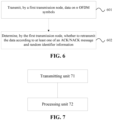
- FIG. 6 is a flowchart of a method for data transmission according to an embodiment of the present invention. As shown in FIG. 6 , the method for data transmission includes step 601 described below.
- a first transmission node transmits data on n OFDM symbols.
- the data includes more than 1 bit, the data is encoded and then mapped onto the n OFDM symbols, and n is an integer greater than 1.
- a first OFDM symbol of the n OFDM symbols is provided with a first CP, and OFDM symbols other than the first OFDM symbol of the n OFDM symbols are provided with respective second CPs.
- the length of the first CP is greater than or equal to the length of each second CP of the second CPs.
- the first transmission node here may be a terminal, a base station, a relay or other node devices.
- the length of the first CP may be greater than time domain asynchronous offset of the first transmission node.
- each of the n OFDM symbols is provided with a CP
- the length of the first CP (CP1) of the first OFDM symbol is greater than the length of each second CP (CP2) of the respective one of the other OFDM symbols
- the second CPs of the other OFDM symbols have the same time domain length.
- the long CP1 is mainly used to address the interference on the data transmission of other users in the time domain in an asynchronous scenario
- the CPs of the other OFDM symbols are mainly used to solve the interference between the other OFDM symbols caused by multipath delay.
- only the first OFDM symbol is provided with a CP, and the other OFDM symbols are provided with no CP. As shown in FIG.
- the long CP1 is mainly used to address the interference on the data transmission of other users in the time domain in the asynchronous scenario, and the interference between the other OFDM symbols caused by multipath delay is addressed by new waveform modulation, such as FB-OFDM.
- the other OFDM symbols may be provided with one or more types of CPs.
- Each of the CPs of the other OFDM symbols has a length less than the CP1 of the first OFDM symbol.
- the CPs may be of 3 types, or may be of 4, 5 or more types.
- one or more CPs, except the first CP may have one of following position relationships.
- CP2s and CP3s are spaced by the CP1.
- CP2s and CP3s are disposed consecutively without interlacing.
- CP2s and CP3s are disposed consecutively without interlacing.
- CP2s and CP3s are disposed consecutively without interlacing.
- CP2s and CP3s are disposed consecutively without interlacing.
- CP2s and CP3s interlace with each other.
- a guard period may be further added after the n OFDM symbols.
- the total time domain length of the first CP, the second CPs, the n OFDM symbols and the GP is 2 m ms, where the time domain length of the GP is greater than or equal to 0, and m is an integer such as -4, -3, -2, -1, 0, 1, 2, 3, 4, 8, and 16.
- the number n of the OFDM symbols is 7, the length of a long CP is 5.2 us, the length of a short CP is 4.7 us, and m is -1.
- the number n of the OFDM symbols is 14, the length of the long CP is 5.7 us, the length of the short CP is 4.7 us, and m is 0.
- the number n of the OFDM symbols is 56, the length of the long CP is 8.7 us, the length of the short CP is 4.7 us, and m is 2.
- the number n of the OFDM symbols is 112, the length of the long CP is 12.7 us, the length of the short CP is 4.7 us, and m is 3.
- the number n of the OFDM symbols is 13, the length of the long CP is 39.25 us, the length of the short CP is 4.7 us, m is 0, and the length of the GP is the remaining length.
- the number n of the OFDM symbols is 12, the length of the long CP is 75 us, the length of the short CP is 4.7 us, m is 0, and the length of the GP is the remaining length.
- the number n of the OFDM symbols is 11, the length of the long CP is 100 us, the length of the short CP is 4.7 us, m is 0, and the length of the GP is the remaining length.
- the number n of the OFDM symbols is 9, the length of the long CP is 100 us (or 83.4 us or 116.7 us), the length of the short CP is 16.7 us, m is 0, and the length of the GP is the remaining length.
- the number n of the OFDM symbols is 21, the length of the long CP is 100 us, the length of the short CP is 4.7 us, m is 1, and the length of the GP is the remaining length.
- the number n of the OFDM symbols is 3, the length of the long CP is 16.7 us, the length of the short CP is 4.7 us, m is 0, and the length of the GP is the remaining length.
- a time domain position corresponding to the n OFDM symbols may be configured by a base station through signaling.
- the time domain position may be obtained by configuring a period and an offset position.
- the value of n may be determined in one of following manners: predefinition, configuration through a base station, and determination according to a predefined parameter.
- the predefined parameter includes at least one of: a data transport block size, a data type, a system bandwidth, a coverage level corresponding to the data, a number of repetitions corresponding to the data, and subcarrier spacing.
- the types of the data include, for example, control information, periodic service information, aperiodic service information, scheduling request information, link establishment information, and first transmission node capability information.
- n may be 6, 7, 12, 13, or 14.
- n may be 6, 7, 12, 13, or 14.
- n may be 4, 6, 7, 8, 12, 13, 14 or 16.
- a plurality of the n OFDMs may be included in the time domain to constitute time domain resources for the data transmission.
- a frequency domain bandwidth for transmitting the data may be determined in one of following manners: predefinition, configuration through a base station, and determination according to the predefined parameter.
- the predefined parameter includes at least one of: a data transport block size, a data type, a system bandwidth, a coverage level corresponding to the data, the number of repetitions corresponding to the data, and subcarrier spacing.
- the frequency domain bandwidth for transmitting the data may be determined according to the data transport block size. For example, when the data transport block size is X1, the frequency domain bandwidth is Y1; and when the data transport block size is X2, the frequency domain bandwidth is Y2.
- the frequency domain bandwidth for transmitting the data may be determined according to the system bandwidth. For example, when the system bandwidth is less than X3, a full bandwidth is occupied in frequency domain; and when the system bandwidth is greater than X3, a configured bandwidth or a predefined bandwidth is occupied in frequency domain.
- a single subcarrier is used in frequency domain; and when the data corresponds to a conventional coverage scenario, a plurality of subcarriers is used in frequency domain.
- the plurality of subcarriers includes 12 subcarriers, 24 subcarriers, a single resource block or two resource blocks.
- the frequency domain bandwidth is 360 kHz.
- the frequency domain bandwidth is 180 kHz.
- the frequency domain bandwidth is 720 kHz, 1440 kHz or 1800 kHz.
- the subcarrier spacing may be 3.75 kHz, 2.5 kHz, 15 kHz, 30 kHz, 60 kHz or 75 kHz.
- the length of the first CP may be equal to the length of each second CP.
- the length of the first CP may be greater than the length of each second CP.
- the length of each second CP when the first CP has a length less than a second threshold, the length of each second CP may be greater than 2 (3, or 4) times of the length of the first CP; and when the first CP has a length greater than the second threshold, the length of each second CP may be greater than 1.5 (or 1.25) times of the length of the first CP.
- the data in initial access to a network, may include at least one of: an identifier specific to and carried by the first transmission node, a connection establishment request message, and a service data packet; and in transmission of the data after the access to the network, the data may include at least one of: an identifier allocated by a second transmission node to the first transmission node, a service data packet, and a short security information packet allocated by the second transmission node.
- At least one of a retransmission manner of the data, a transmission manner of next new data and a feedback manner corresponding to the data may be determined at least according to a buffer scheduling request (BSR), a data type, a data transport block size, duration of the data, and a bandwidth of the data.
- BSR buffer scheduling request
- the determination of at least one of the retransmission manner of the data, the transmission manner of the next new data and the feedback manner corresponding to the data according to the BSR, the data type, the data transport block size, the duration of the data, and the bandwidth of the data may include at least one of:
- the method may further include step 602 described below.
- the first transmission node determines whether to retransmit the data according to at least one of the ACK/NACK message and the random identifier information.
- the method may further include the following step.
- the first transmission node When the first transmission node only obtains the NACK message, the first transmission node randomly selects a resource again to retransmit the data.
- the method may further include the following step.
- the first transmission node When the first transmission node obtains a timing advance (TA), the first transmission node randomly selects a second resource from a second resource set to transmit retransmission data or new data, where the second resource set is a set of a plurality of the second resources configured by the base station for transmitting the data, the second resource is a basic unit for transmitting the data, a frequency domain bandwidth and a time domain length of the second resource are predefined.
- the second resource includes two physical resource blocks, or two physical resource blocks of four consecutive subframes; or in the NB-IoT system, the second resource includes two resource units (RUs), four RUs, or eight RUs.
- the second resource has a same structure (e.g., subcarrier spacing, length and position of CP) as a resource scheduled by the second transmission node for transmitting the data.
- timing adjustment is required in the transmission of the data.
- the method may further include the following step.
- the first transmission node When the first transmission node obtains the TA and a UL grant or only the UL grant, the first transmission node transmits the retransmission data or the new data on a resource indicated by the UL grant.
- the method may further include the following step.
- the first transmission node When the first transmission node obtains a random identifier consistent with a target random identifier (a random identifier generated according to a reported ID, or a report identifier included in the data), the first transmission node determines that the data is transmitted successfully; or when the first transmission node obtains a random identifier inconsistent with the target random identifier, the first transmission node randomly selects a resource again to retransmit the data.
- a target random identifier a random identifier generated according to a reported ID, or a report identifier included in the data
- the first transmission node may determine a transmission manner according to at least one of configuration information, a predefined rule, and capability information of the first transmission node in a current system.
- the predefined rule includes selection of the transmission manner by the first transmission node according to at least one of a size of transmission data or a size of the BSR, a time domain transmission unit corresponding to the transmission data, retransmission corresponding to the transmission data, and system-configured dedicated information.
- the data is transmitted in at least one of the following manners:
- step 1a the base station is configured for non-scheduled transmission.
- step 1b the terminal configures the non-scheduled transmission according to the base station.
- step 1c the base station feeds back the ACK/NACK message.
- step 1d the terminal retransmits the data or transmits the new data in the non-scheduled mode according to the feedback of the base station.
- step 2a the base station is configured for non-scheduled transmission.
- step 2b the terminal configures the non-scheduled transmission according to the base station.
- step 2c the base station feeds back the ACK/NACK message and the TA (in the first transmission, the TA is fed back; and in subsequent transmission, the TA is not fed back).
- step 2d the terminal retransmits the data or transmits the new data in the non-scheduled mode according to the feedback (the ACK/NACK message and the TA) of the base station, where the first transmission node performs adjustment according to the received TA and retransmits the data or transmits the new data.
- the feedback the ACK/NACK message and the TA
- step 3a the base station is configured for non-scheduled transmission.
- step 3b the terminal configures the non-scheduled transmission according to the base station.
- step 3c the base station feeds back the UL grant and the TA, or only feeds back the UL grant (in the first transmission, the TA is fed back; and in subsequent transmission, the TA is not fed back).
- step 3d the terminal retransmits the data or transmits the new data based on the scheduling according to the feedback (the UL grant and the TA) of the base station.
- step 4a the base station is configured for non-scheduled transmission.
- step 4b the terminal configures the non-scheduled transmission according to the base station.
- step 4c the base station feeds back the UL grant.
- step 4d the terminal retransmits the data or transmits the new data according to the detected information (information fed back by the base station).
- the above manners may be dynamically switched.
- the manner 1 and the manner 3 may be combined to form a manner 5
- the manner 1 and the manner 4 may be combined to form a manner 6.
- step 5a the base station is configured for non-scheduled transmission.
- step 5b the terminal configures the non-scheduled transmission according to the base station.
- step 5c the base station feeds back the information according to the step 1c or the step 3c.
- step 5d the terminal retransmits the data or transmits the new data by adopting the step 1d or the step 3d correspondingly according to the feedback of the base station.
- step 6a the base station is configured for non-scheduled transmission.
- step 6b the terminal configures the non-scheduled transmission according to the base station.
- step 6c the base station feeds back the information according to the step 1c or the step 4c.
- step 6d the terminal retransmits the data or transmits the new data by adopting the step 1d or the step 4d correspondingly according to the feedback of the base station.
- the manner of transmitting the data is selected from the non-scheduled transmission and the scheduled transmission according to the BSR, the data type, the data transport block size, the duration of the data, and the bandwidth of the data.
- the combination of the non-scheduled transmission and the scheduled transmission can reduce the performance degradation caused by data collisions in the non-scheduled transmission.
- the scheduled transmission can supplement and improve the reliability of the data transmission and improve the transmission efficiency.
- Different scheduling manners may be chosen for different scenarios, which can better implement the data transmission, reduce the transmission delay, and improve the transmission efficiency.
- FIG. 7 is a structural diagram of a device for data transmission according to an embodiment of the present invention. As shown in FIG. 7 , the device for data transmission includes a transmitting unit 71.
- the transmitting unit 71 is configured to transmit data on n OFDM symbols.
- the data includes more than 1 bit, the data is encoded and then mapped onto the n OFDM symbols, and n is an integer greater than 1.
- a first OFDM symbol of the n OFDM symbols is provided with a first CP, and OFDM symbols other than the first OFDM symbol of the n OFDM symbols are provided with respective second CPs.
- the length of the first CP is greater than or equal to the length of each second CP of the second CPs.
- the length of the first CP may be greater than time domain asynchronous offset of the first transmission node.
- the device for data transmission is disposed in the first transmission node.
- one or more CPs, except the first CP may have one of following position relationships.
- a GP may be further added after the n OFDM symbols.
- the total time domain length of the first CP, the second CPs, the n OFDM symbols and the GP may be 2 m ms, where the time domain length of the GP is greater than or equal to 0, and m is an integer.
- a time domain position corresponding to the n OFDM symbols may be configured by a base station through signaling.
- the value of n may be determined in one of following manners: predefinition, configuration through a base station, and determination according to a predefined parameter.
- the predefined parameter includes at least one of: a data transport block size, a data type, a system bandwidth, a coverage level corresponding to the data, a number of repetitions corresponding to the data, and subcarrier spacing.
- a frequency domain bandwidth for transmitting the data may be determined in one of following manners: predefinition, configuration through a base station, and determination according to the predefined parameter.
- the predefined parameter includes at least one of: a data transport block size, a data type, a system bandwidth, a coverage level corresponding to the data, the number of repetitions corresponding to the data, and subcarrier spacing.
- the length of the first CP may be equal to the length of each second CP.
- the length of the first CP may be greater than the length of each second CP.
- the data in initial access to a network, may include at least one of: an identifier specific to and carried by the first transmission node, a connection establishment request message, and a service data packet; and in transmission of the data after the access to the network, the data may include at least one of: an identifier allocated by a second transmission node to the first transmission node, a service data packet, and a short security information packet allocated by the second transmission node.
- At least one of a retransmission manner of the data, a transmission manner of next new data and a feedback manner corresponding to the data may be determined at least according to a buffer scheduling request (BSR), a data type, a data transport block size, duration of the data, and a bandwidth of the data.
- BSR buffer scheduling request
- the determination of at least one of the retransmission manner of the data, the transmission manner of the next new data and the feedback manner corresponding to the data according to the BSR, the data type, the data transport block size, the duration of the data, and the bandwidth of the data may include at least one of:
- the device may further include a processing unit 72.
- the processing unit 72 is configured to determine whether to retransmit the data according to at least one of the ACK/NACK message and the random identifier information.
- the transmitting unit 71 may be further configured to, when the first transmission node only obtains the NACK message, randomly select a resource again to retransmit the data.
- the transmitting unit 71 may be further configured to, when the first transmission node obtains a TA, randomly select a second resource from a second resource set to transmit retransmission data or new data, where the second resource set is a set of a plurality of the second resources configured by the base station for transmitting the data, the second resource is a basic unit for transmitting the data, a frequency domain bandwidth and a time domain length of the second resource are predefined.
- the second resource has a same structure as a resource scheduled by the second transmission node for transmitting the data.
- the transmitting unit 71 may be further configured to, when the first transmission node obtains the TA and a UL grant or only the UL grant, transmit the retransmission data or the new data on a resource indicated by the UL grant.
- the processing unit 72 may be further configured to, when the first transmission node obtains a random identifier consistent with a target random identifier, determine that the data is transmitted successfully; or when the first transmission node obtains a random identifier inconsistent with the target random identifier, randomly select a resource again to retransmit the data.
- the data is transmitted in at least one of the following manners:
- the second transmission node may be a terminal, a base station, a relay or other node devices.
- the transmission includes sending and/or receiving.
- the terminal sends the data to the base station, and the base station receives the data from the terminal.
- the device may be disposed in the terminal or the base station.
- the base station sends the data to the terminal, and the terminal receives the data from the base station.
- the device may be disposed in the terminal or the base station.
- a first terminal sends the data to a second terminal, and the second terminal receives the data from the first terminal.
- the device may be disposed in the first terminal or the second terminal.
- the terminal sends the data to a relay, and the relay receives the data form the terminal.
- the device may be disposed in the terminal or the relay.
- the relay sends the data to the base station, and the base station receives the data from the relay.
- the device may be disposed in the base station or the relay.
- the relay sends the data to the terminal, and the terminal receives the data from the relay.
- the device may be disposed in the terminal or the relay.
- the base station sends the data to the relay, and the relay receives the data from the base station.
- the device may be disposed in the base station or the relay.
- the length of the first CP may further be greater than 1.5, 2, 5, 10, 50, 100, or 500 times of the length of each second CP.
- the relationship between the length of the first CP and the length of each second CP may be different for different cell radius.
- the length of the first CP and the length of each second CP may be adaptively expanded on the basis of the above limitation.
- the first type of data may include an access request, a data transmission request, or a link establishment request.
- the second type of data may include a non-access request, a non-data transmission request, or a non-link establishment request.
- the thresholds S1, S2, A1, A2, B1 and B2 may be predefined, or may be configured by the second transmission node, or maybe broadcasted by the first transmission node.
- the first transmission node may determine a transmission manner according to at least one of configuration information, a predefined rule, and capability information of the first transmission node in a current system.
- the predefined rule may include selection of the transmission manner by the first transmission node according to at least one of a size of transmission data or a size of the BSR, a time domain transmission unit corresponding to the transmission data, retransmission corresponding to the transmission data, and system-configured dedicated information.
- the system is configured with only the scheduled transmission manner.
- the first transmission node sends a scheduling request, and transmits the data after the scheduling.
- the first transmission node sends a random access channel, obtains the TA, and transits the data according to the scheduling and the TA.
- the system is configured with only the transmission manner.
- the first transmission node directly transmits the data in the manner described above.
- the system is configured with a non-scheduled transmission resource and a scheduled random access channel resource.
- the first transmission node selects the transmission manner according to the size of transmission data or the size of the BSR, and the capability information of the first transmission node.
- the first transmission node supports the non-scheduled transmission manner
- the non-scheduled transmission manner in which the first transmission node transmits the data
- other transmission manners may be adopted.
- the first transmission node sends the scheduling request, and transmits the data after the scheduling; alternatively, the first transmission node sends the random access channel, obtains the TA and transmits the data according to the scheduling and the TA.
- the first transmission node does not support the non-scheduling-based transmission manner
- other transmission manners may be adopted.
- the first transmission node sends the scheduling request, and transmits the data after the scheduling; alternatively, the first transmission node sends the random access channel, obtains the TA and transmits the data according to the scheduling and the TA.
- the system is configured with the non-scheduling-based transmission resource and the scheduling-based random access channel resource.
- the first transmission node selects the transmission manner according to the time domain transmission unit corresponding to the transmission data.
- the time domain transmission unit may include a time domain length corresponding to an encoded transmission block.
- duration corresponding to conventional data is 1 ms and duration of special data transmission is 0.5 ms.
- the time domain transmission unit corresponds to a size of a time domain OFDM symbol.
- the size of the time domain OFDM symbol corresponding to the conventional data is 66.7 us
- the size of the time domain OFDM symbol corresponding to the special data is 33.375 us.
- the non-scheduled transmission manner when the time domain transmission unit corresponding to the data is less than a threshold t1 (for example, delay-sensitive services, or the time domain transmission unit is less than a conventional time domain transmission unit), the non-scheduled transmission manner is adopted, in which the first transmission node transmits the data in the manner described above; and when the time domain transmission unit corresponding to the data is greater than a threshold t2 (for example, delay-insensitive services, or the time domain transmission unit is the conventional time domain transmission unit), other transmission manners may be adopted.
- the first transmission node sends the scheduling request, and transmits the data after the scheduling; alternatively, the first transmission node sends the random access channel, obtains the TA and transmits the data according to the scheduling and the TA.
- the first transmission node does not support the non-scheduled transmission manner
- other transmission manners may be adopted.
- the first transmission node sends the scheduling request, and transmits the data after the scheduling.
- the first transmission node sends the random access channel, obtains the TA and transmits the data according to the scheduling and the TA.
- the system is configured with the non-scheduled transmission resource and the scheduled random access channel resource.
- the first transmission node selects the transmission manner according to the number of times of the retransmission corresponding to the transmission data.
- the number of times of the retransmission mainly refers to the number of repeated data transmission for improving coverage in a coverage enhancement scenario. Different coverage levels may correspond to different numbers of times of the retransmission. Furthermore, retransmission in a non-coverage enhancement scenario is not excluded.
- the non-scheduled transmission manner when the number of times of the retransmission corresponding to the data is less than a threshold x1, the non-scheduled transmission manner is adopted, in which the first transmission node transmits the data; and when the number of times of the retransmission corresponding to the data is greater than a threshold x2, other transmission manners may be adopted.
- the first transmission node sends the scheduling request, and transmits the data after the scheduling; alternatively, the first transmission node sends the random access channel, obtains the TA and transmits the data according to the scheduling and the TA.
- the first transmission node does not support the non-scheduled transmission manner
- other transmission manners may be adopted.
- the first transmission node sends the scheduling request, and transmits the data after the scheduling.
- the first transmission node sends the random access channel, obtains the TA and transmits the data according to the scheduling and the TA.
- the system is configured with the non-scheduled transmission resource and the scheduled random access channel resource.
- the first transmission node selects the transmission manner according to the system-configured dedicated information.
- the system-configured dedicated information mainly refers to dedicated information of the first transmission node configured by the system after the first transmission node accesses the network.
- the dedicated information includes information for indicating whether the transmission node adopts the non-scheduled transmission manner (the transmission manner proposed by the present application).
- the system includes the second transmission node or a third transmission node.
- the third transmission node includes a node similar to the first transmission node or the second transmission node, or a transmission node at a higher level, such as a mobility management entity (MME), a specific server or a network element.
- MME mobility management entity
- the first transmission node supports the non-scheduled transmission manner
- the first transmission node when the first transmission node obtains the system-configured dedicated information, the first transmission node transmits the data in the manner described above in the system; and when the first transmission node fails to access the network or the first transmission node is handed over to other systems (for example, cell handover or system handover), other transmission manners may be adopted.
- the first transmission node sends the scheduling request, and transmits the data after the scheduling; alternatively, the first transmission node sends the random access channel, obtains the TA and transmits the data according to the scheduling and the TA.
- the first transmission node does not support the non-scheduled transmission manner
- other transmission manners may be adopted.
- the first transmission node sends the scheduling request, and transmits the data after the scheduling.
- the first transmission node sends the random access channel, obtains the TA and transmits the data according to the scheduling and the TA.
- More than one of predefined rules in scenarios 3, 4, 5 and 6 may be used at the same time.
- the non-scheduled transmission manner is adopted, in which the first transmission node transmits the data in the manner proposed in the present application; otherwise, other transmission manners may be adopted.
- the first transmission node sends the scheduling request, and transmits the data after the scheduling; alternatively, the first transmission node sends the random access channel, obtains the TA and transmits the data according to the scheduling and the TA.
- the transmission of data in the LTE system is applied into an enhance machine type communication (eMTC) scenario.
- eMTC enhance machine type communication
- the resource pool includes resources which are periodically configured.
- one or more frequency domain resources may exist for selection by a user.
- a plurality of periods may be available in the time domain, such as 5 ms, 10 ms, 20 ms, 40 ms and 160 ms.
- One or more time domain positions may exist in one period, for example three time domain positions within 20 ms, or three time domain positions within 40 ms.
- One or more frequency domain resources may exist on one time domain unit, such as 1, 2, or 4 frequency domain resources.
- the length of the time domain unit may be 1 ms, 2 ms, 4 ms or 8 ms.
- the frequency domain bandwidth may be 2, 3, 4, 6, or 8 physical resource blocks (PRBs).
- the UE accesses the network by using a relevant LTE process. After configured by the base station in a connection state, the UE simultaneously detects downlink control information (DL grant and UL grant), and randomly selects a resource in the resource pool configured by the base station for uplink data transmission.
- DL grant and UL grant downlink control information
- a subframe structure of the uplink data transmission is the same as a subframe structure in the LTE system.
- the data type transmission includes at least one of the following:
- the various types of data described above may further include a random ID of the UE.
- the number of bits of the random ID is less than the number of bits of the ID allocated by the base station.
- the random ID includes, for example, 2 bits, 3 bits or 4 bits.
- a data type 1 is selected in the initial access
- a data type 2 is selected after the establishment of radio resource control (RRC)
- RRC radio resource control
- a data type 3 is selected in the connection state
- a data type 4 is selected in an idle state
- a data type 5 is selected in a paging and wakeup scenario.
- the base station receives the data, determines the UE corresponding to the data according to the ID carried in the data, sends the UL grant according to remaining traffic of the UE for instructing the UE to transmit the new data at a scheduling position after correctly performing the decoding, and implicitly notifies the UE that the base station has successfully performed the decoding; or only indicates through the UL grant that the UE has successfully sent the data.
- the base station feeds back the ACK/NACK message in a downlink feedback channel corresponding to the data, and the UE obtains the ACK/NACK message in the downlink feedback channel and determines whether to retransmit the data.
- the timing adjustment information of the UE and the UL grant may be transmitted to the UE through a physical downlink control channel or a physical share channel; or the timing adjustment information of multiple pieces of UE may be transmitted in a downlink; or the timing adjustment information of the pieces of UE and the UL grant are transmitted in the downlink.
- a conflict resolution ID may be further carried.
- the conflict resolution ID is randomly generated according to the UE ID, or may be a random ID in the data.
- the conflict resolution ID has a value of 0, 1 or 2.
- the conflict resolution ID is fed back jointly with the ACK/NACK message through 2 bits.
- the conflict resolution ID has a value of 0 or 1.
- the conflict resolution ID is fed back jointly with the ACK/NACK message through 2 bits.
- the conflict resolution ID has a value of 0, 1, 2, 3, 4, 5 or 6.
- the conflict resolution ID is fed back jointly with the ACK/NACK message through 3 bits.
- the conflict resolution ID has a value of 0, 1, 2, 3, 4 or 5.
- the conflict resolution ID is fed back jointly with the ACK/NACK message through 3 bits.
- the UE determines, according to the feedback information, whether to retransmit the data and whether the conflict occurs. For example, when the feedback information detected by the UE is the ACK message, but the conflict resolution ID is different from the UE ID, the UE determines that the UE fails to correctly transmit the data and needs to retransmit the data.
- the UE retransmits the data or transmits the new data according to the timing adjustment information.
- the number of resource pools for transmitting the data may be one or more. For example, in a case of two resource pools, one is configured to transmit the data after receiving the timing adjustment information, and the other one is configured to transmit the data without the timing adjustment information.
- the UE may select the resource pool depending on whether receives the timing adjustment information.
- the base station may detect a plurality of resource pools in a blind detection manner.
- the UE accesses the network, and selects a resource in the resource pool configured by the base station to perform uplink data transmission. After the first data uplink transmission, the UE may further, according to the scheduling of the base station, retransmit the data and transmit the new data.
- the number of OFDM symbols in a data transmission subframe is less the number of OFDM symbols of a PUSCH transmission subframe in the LTE system.
- the length of a CP of a first OFDM symbol of the data transmission subframe is greater than the length of a CP of a first OFDM symbol of the PUSCH transmission subframe in the LTE system.
- the length of the CP of the first OFDM symbol of the data transmission subframe is greater than or equal to the length of a CP of a first OFDM symbol of a PRACH transmission subframe in the LTE system.
- the data type transmission includes at least one of the following:
- the base station detects the data in the blind detection manner, determines the UE corresponding to the data according to the ID carried in the data, sends the UL grant and the TA according to remaining traffic of the UE for instructing the UE to transmit the new data and the timing adjustment at the scheduling position after correctly performing the decoding, implicitly notifies the UE that the base station has successfully performed the decoding, and further allocates a user temporary ID for the scheduling and transmission of the sequent data; or only indicates through the UL grant that the UE has successfully sent the data.
- the base station feeds back the ACK/NACK message in the downlink feedback channel corresponding to the data, and the UE obtains the ACK/NACK message in the downlink feedback channel and determines whether to retransmit the data.
- the timing adjustment information of the UE and the UL grant may be transmitted to the UE through the physical downlink control channel or the physical share channel; or the timing adjustment information of the multiple pieces of UE may be transmitted in a downlink; or the timing adjustment information of the multiple pieces of UE and the UL grant are transmitted in the downlink.
- the conflict resolution ID may be further carried.
- the conflict resolution ID is randomly generated according to the UE ID, or may be the random ID in the data.
- the conflict resolution ID has a value of 0, 1 or 2.
- the conflict resolution ID is fed back jointly with the ACK/NACK message through 2 bits.
- the conflict resolution ID has a value of 0 or 1.
- the conflict resolution ID is fed back jointly with the ACK/NACK message through 2 bits.
- the conflict resolution ID has a value of 0, 1, 2, 3, 4, 5 or 6.
- the conflict resolution ID is fed back jointly with the ACK/NACK message through 3 bits.
- the conflict resolution ID has a value of 0, 1, 2, 3, 4 or 5.
- the conflict resolution ID is fed back jointly with the ACK/NACK message through 3 bits.
- the UE retransmit the data or transmit the new data according to the timing adjustment information.
- the number of resource pools for transmitting the data may be one or more. For example, in a case of two resource pools, one is configured to transmit the data after receiving the timing adjustment information, and the other one is configured to transmit the data without the timing adjustment information.
- the UE may select the resource pool depending on whether receives the timing adjustment information.
- the base station may adopt the blind detection manner.
- the data is transmitted in the NB-IoT system.
- the resource pool includes resources which are periodically configured.
- one or more frequency domain resources may exist for selection by a user.
- the plurality of periods may be available in the time domain, such as 2 ms, 4 ms, 8 ms, 16 ms, 32 ms, 64 ms, 128 ms, 256 ms, 512 ms, 1024 ms and 4048 ms.
- One or more time domain positions may exist in one period, for example four time domain positions within 32 ms, or two time domain positions within 128 ms.
- One or more frequency domain resources may exist on one time domain unit, such as 1, 2, or 4 frequency domain resources.
- the length of the time domain unit may be 1 ms, 2 ms, 4 ms, 8 ms, 16 ms, 32 ms or 64 ms.
- the frequency domain bandwidth may be 1, 3, 6, or 12 tones.
- the UE accesses the network by using the relevant LTE process. After configured by the base station in the connection state, the UE simultaneously detects downlink control information (DL grant and UL grant), and randomly selects a resource in the resource pool configured by the base station for uplink data transmission.
- downlink control information DL grant and UL grant
- the subframe structure of the uplink data transmission is the same as the subframe structure in the LTE system.
- the data type transmission includes at least one of the following:
- the various types of data described above may further include the random ID of the UE.
- the number of bits of the random ID is less than the number of bits of the ID allocated by the base station.
- the random ID includes, for example, 2 bits, 3 bits or 4 bits.
- the data type 1 is selected in the initial access
- the data type 2 is selected after the establishment of RRC
- the data type 3 is selected in the connection state
- the data type 4 is selected in the idle state
- the data type 5 is selected in the paging and wakeup scenario.
- the base station receives the data, determines the UE corresponding to the data according to the ID carried in the data, sends the UL grant according to remaining traffic of the UE for instructing the UE to transmit the new data at the scheduling position after correctly performing the decoding, and implicitly notifies the UE that the base station has successfully performed the decoding; or only indicates through the UL grant that the UE has successfully sent the data.
- the base station feeds back the ACK/NACK message in the downlink feedback channel corresponding to the data, and the UE obtains the ACK/NACK message in the downlink feedback channel and determines whether to retransmit the data.
- the timing adjustment information of the UE and the UL grant may be transmitted to the UE through the physical downlink control channel or the physical share channel; or the timing adjustment information of multiple pieces of UE may be transmitted in a downlink; or the timing adjustment information of the pieces of UE and the UL grant are transmitted in the downlink.
- the conflict resolution ID may be further carried.
- the conflict resolution ID is randomly generated according to the UE ID, or may be the random ID in the data.
- the conflict resolution ID has a value of 0, 1 or 2.
- the conflict resolution ID is fed back jointly with the ACK/NACK message through 2 bits.
- the conflict resolution ID has a value of 0 or 1.
- the conflict resolution ID is fed back jointly with the ACK/NACK message through 2 bits.
- the conflict resolution ID has a value of 0, 1, 2, 3, 4, 5 or 6.
- the conflict resolution ID is fed back jointly with the ACK/NACK message through 3 bits.
- the conflict resolution ID has a value of 0, 1, 2, 3, 4 or 5.
- the conflict resolution ID is fed back jointly with the ACK/NACK message through 3 bits.
- the UE determines, according to the feedback information, whether to retransmit the data and whether the conflict occurs. For example, when the feedback information detected by the UE is the ACK message, but the conflict resolution ID is different from the UE ID, the UE determines that the UE fails to correctly transmit the data and needs to retransmit the data.
- the UE retransmit the data or transmit the new data according to the timing adjustment information.
- the number of resource pools for transmitting the data may be one or may be more than one.
- the number of resource pools is two, where one is configured to transmit the data after receiving the timing adjustment information, and the other one is configured to transmit the data without the timing adjustment information.
- the UE may select the resource pool depending on whether receives the timing adjustment information.
- the base station may detect a plurality of resource pools in the blind detection manner.
- the UE accesses the network, and selects a resource in the resource pool configured by the base station to perform uplink data transmission. After the first data uplink transmission, the UE may further, according to the scheduling of the base station, retransmit the data and transmit the new data.
- the number of OFDM symbols in the data transmission subframe is less the number of OFDM symbols of the PUSCH transmission subframe in the LTE system.
- the length of the CP of the first OFDM symbol of the data transmission subframe is greater than the length of the CP of the first OFDM symbol of the PUSCH transmission subframe in the LTE system.
- the length of the CP of the first OFDM symbol of the data transmission subframe is greater than or equal to the length of the CP of the first OFDM symbol of the PRACH transmission subframe in the LTE system.
- the data type transmission includes at least one of the following:
- the base station detects the data in the blind detection manner, determines the UE corresponding to the data according to the ID carried in the data, sends the UL grant and the TA according to remaining traffic of the UE for instructing the UE to transmit the new data and the timing adjustment at the scheduling position after correctly performing the decoding, implicitly notifies the UE that the base station has successfully performed the decoding, and further allocates the user temporary ID for the scheduling and transmission of the sequent data; or only indicates through the UL grant that the UE has successfully sent the data.
- the base station feeds back the ACK/NACK message in the downlink feedback channel corresponding to the data, and the UE obtains the ACK/NACK message in the downlink feedback channel and determines whether to retransmit the data.
- the timing adjustment information of the UE and the UL grant may be transmitted to the UE through the physical downlink control channel or the physical share channel; or the timing adjustment information of the multiple pieces of UE may be transmitted in a downlink; or the timing adjustment information of the multiple pieces of UE and the UL grant are transmitted in the downlink.
- the conflict resolution ID may be further carried.
- the conflict resolution ID is randomly generated according to the UE ID, or may be the random ID in the data.
- the conflict resolution ID has a value of 0, 1 or 2.
- the conflict resolution ID is fed back jointly with the ACK/NACK message through 2 bits.
- the conflict resolution ID has a value of 0 or 1.
- the conflict resolution ID is fed back jointly with the ACK/NACK message through 2 bits.
- the conflict resolution ID is 0, 1, 2, 3, 4, 5 or 6.
- the conflict resolution ID is fed back jointly with the ACK/NACK message through 3 bits.
- the conflict resolution ID is 0, 1, 2, 3, 4 or 5.
- the conflict resolution ID is fed back jointly with the ACK/NACK message through 3 bits.
- the UE retransmit the data or transmit the new data according to the timing adjustment information.
- the number of resource pools for transmitting the data may be one or more. For example, in a case of two resource pools, one is configured to transmit the data after receiving the timing adjustment information, and the other one is configured to transmit the data without the timing adjustment information.
- the UE may select the resource pool depending on whether receives the timing adjustment information.
- the base station may adopt the blind detection manner.
- the data is transmitted in a 5G system (a new system).
- the resource pool includes resources with are periodically configured. On one basic time domain unit, one or more frequency domain resources may exist for selection by a user.
- the plurality of periods may be available in the time domain, such as 2 ms, 4 ms, 8 ms, 16 ms, 32 ms, 64 ms, 128 ms, 256 ms, 512 ms, 1024 ms, and 4048 ms; or 1 ms, 2 ms, 5 ms, 10 ms, 20 ms, 40 ms, 80 ms, 160 ms, 320 ms and 640 ms, or 0.1 ms, 0.125 ms, 0.25 ms, 0.5 ms and 1 ms.
- One or more time domain positions may exist in one period, for example two time domain positions within 5 ms, or three time domain positions within 20 ms.
- One or more frequency domain resources may exist on one time domain unit, such as 1, 2, or 4 frequency domain resources.
- the length of the time domain unit may be 1 ms, 2 ms, 4 ms, 16ms, 32 ms or 64 ms.
- the frequency domain bandwidth may be 1, 3, 6, or 12 tones, or two PRBs, or four PRBs, or six PRBs, or ten PRBs, or twelve PRBs.
- the subcarrier spacing may be 1.25 kHz, 2.5 kHz, 3.75 kHz, 7.5 kHz, 15 kHz, 30 kHz, 60 kHz, 75 kHz, 90 kHz, 120 kHz or 150 kHz.
- the UE performs uplink synchronization with the base station, accesses the network and is configured by the base station.
- the UE may detect the downlink control information, and may also randomly select a resource in the resource pool configured by the base station for uplink data transmission.
- the subframe structure of the uplink data transmission adopts a subframe structure of an uplink synchronous scenario in the 5G system.
- the data type transmission includes at least one of the following:
- the various types of data described above may further include the random ID of the UE.
- the number of bits of the random ID is less than the number of bits of the ID allocated by the base station.
- the random ID includes, for example 2 bits, 3 bits or 4 bits.
- the data type 1 is selected in the initial access
- the data type 2 is selected after the establishment of RRC
- the data type 3 is selected in the connection state
- the data type 4 is selected in the idle state
- the data type 5 is selected in the paging and wakeup scenario.
- the base station receives the data, determines the UE corresponding to the data according to the ID carried in the data, sends the UL grant according to remaining traffic of the UE for instructing the UE to transmit the new data at the scheduling position after correctly performing the decoding, and implicitly notifies the UE that the base station has successfully performed the decoding; or only indicates through the UL grant that the UE has successfully sent the data.
- the base station feeds back the ACK/NACK message in the downlink feedback channel corresponding to the data, and the UE obtains the ACK/NACK message in the downlink feedback channel and determines whether to retransmit the data.
- the timing adjustment information of the UE and the UL grant may be transmitted to the UE through the physical downlink control channel or the physical share channel; or the timing adjustment information of the multiple pieces of UE may be transmitted in a downlink; or the timing adjustment information of the pieces of UE and the UL grant are transmitted in the downlink.
- the conflict resolution ID may be further carried.
- the conflict resolution ID is randomly generated according to the UE ID, or may be the random ID in the data.
- the conflict resolution ID has a value of 0, 1 or 2.
- the conflict resolution ID is fed back jointly with the ACK/NACK message through 2 bits.
- the conflict resolution ID has a value of 0 or 1.
- the conflict resolution ID is fed back jointly with the ACK/NACK message through 2 bits.
- the conflict resolution ID is 0, 1, 2, 3, 4, 5 or 6.
- the conflict resolution ID is fed back jointly with the ACK/NACK message through 3 bits.
- the conflict resolution ID has a value of 0, 1, 2, 3, 4 or 5.
- the conflict resolution ID is fed back jointly with the ACK/NACK message through 3 bits.
- the UE determines, according to the feedback information, whether to retransmit the data and whether the conflict occurs. For example, when the feedback information detected by the UE is the ACK message, but the conflict resolution ID is different from the UE ID, the UE determines that the UE fails to correctly transmit the data and needs to retransmit the data.
- the UE retransmit the data or transmit the new data according to the timing adjustment information.
- the number of resource pools for transmitting the data may be one or more. For example, in a case of two resource pools, one is configured to transmit the data after receiving the timing adjustment information, and the other one is configured to transmit the data without the timing adjustment information.
- the UE may select the resource pool depending on whether receives the timing adjustment information.
- the base station may detect the plurality of resource pools in the blind detection manner.
- the UE accesses the network, and selects a resource in the resource pool configured by the base station to perform uplink data transmission. After the first data uplink transmission, the UE may further, according to the scheduling of the base station, retransmit the data and transmit the new data.
- the number of OFDM symbols in the data transmission subframe is less the number of OFDM symbols for transmitting the data of the subframe (a subframe type 1) in the uplink asynchronous scenario of the 5G system.
- the length of the CP of the first OFDM symbol of the data transmission subframe (a subframe type 2) is greater than the length of a CP of a first OFDM symbol of the subframe (the subframe type 1) in the uplink asynchronous scenario of the 5G system.
- the length of the CP of the first OFDM symbol of the data transmission subframe (the subframe type 2) is greater than or equal to the length of a CP of a first OFDM symbol of a subframe (a subframe type 3) on an uplink synchronization channel of the 5G system.
- the data type transmission includes at least one of the following:
- the base station detects the data in the blind detection manner, determines the UE corresponding to the data according to the ID carried in the data, sends the UL grant and the TA according to remaining traffic of the UE for instructing the UE to transmit the new data and the timing adjustment at the scheduling position after correctly performing the decoding, implicitly notifies the UE that the base station has successfully performed the decoding, and further allocates the user temporary ID for the scheduling and transmission of the sequent data; or only indicates through the UL grant that the UE has successfully sent the data.
- the base station feeds back the ACK/NACK message in the downlink feedback channel corresponding to the data, and the UE obtains the ACK/NACK message in the downlink feedback channel and determines whether to retransmit the data.
- the timing adjustment information of the UE and the UL grant may be transmitted to the UE through the physical downlink control channel or the physical share channel; or the timing adjustment information of the multiple pieces of UE are transmitted in a downlink; or the timing adjustment information of the multiple pieces of UE and the UL grant are transmitted in the downlink.
- the conflict resolution ID may be further carried.
- the conflict resolution ID is randomly generated according to the UE ID, or may be the random ID in the data.
- the conflict resolution ID has a value of 0, 1 or 2.
- the conflict resolution ID is fed back jointly with the ACK/NACK message through 2 bits.
- the conflict resolution ID is 0 or 1.
- the conflict resolution ID is fed back jointly with the ACK/NACK message through 2 bits.
- the conflict resolution ID is 0, 1, 2, 3, 4, 5 or 6.
- the conflict resolution ID is fed back jointly with the ACK/NACK message through 3 bits.
- the conflict resolution ID is 0, 1, 2, 3, 4 or 5.
- the conflict resolution ID is fed back jointly with the ACK/NACK message through 3 bits.
- the UE retransmit the data or transmit the new data according to the timing adjustment information.
- the number of resource pools for transmitting the data may be one or more. For example, in a case of two resource pools, one is configured to transmit the data after receiving the timing adjustment information, and the other one is configured to transmit the data without the timing adjustment information.
- the UE may select the resource pool depending on whether receives the timing adjustment information.
- the base station may adopt the blind detection manner.
- an embodiment of the present application further provides a computer-readable medium, which is configured to store data transmission programs which, when executed by a processor, implement the steps of the method for data transmission described above.
- the embodiments of the present invention may be provided as methods, systems or computer program products. Therefore, the embodiments of the present invention may be implemented by hardware, software, or a combination of hardware and software.
- the present invention may take the form of a computer program product implemented on one or more computer-usable storage media (including, but not limited to, a disk memory and an optical memory) that includes computer-usable program codes.
- These computer program instructions can also be stored in a computer-readable memory which can direct a computer or other programmable data processing devices to operate in a particular manner so that the instructions stored in the computer-readable memory produce a manufactured product including an instruction apparatus.
- the instruction apparatus implements the functions specified in one or more flows in the flowcharts and/or one or more blocks in the block diagrams.
- the term, computer storage medium includes volatile and nonvolatile, removable and non-removable medium implemented in any method or technology for storing information (such as computer-readable instructions, data structures, program modules or other data).
- the computer storage medium includes, but is not limited to, a RAM, a ROM, an EEPROM, a flash memory or other memory technologies, a CD-ROM, a digital versatile disc (DVD) or other optical disc storage, a magnetic cassette, a magnetic tape, a magnetic disk storage or other magnetic storage devices, or any other medium used for storing desired information and accessed by a computer.
- the communication medium generally includes computer-readable instructions, data structures, program modules or other data in modulated data signals such as carriers or other transmission mechanisms, and may include any information delivery medium.
- Embodiments of the present application provide a method and device for data transmission.
- the method and device for data transmission may transmit the data more quickly, reduce delay, and increase usage efficiency of system resources, and at the same time, minimize the impact on data transmission of other users in an asynchronous scenario.
Landscapes
- Engineering & Computer Science (AREA)
- Signal Processing (AREA)
- Computer Networks & Wireless Communication (AREA)
- Mobile Radio Communication Systems (AREA)
Applications Claiming Priority (3)
| Application Number | Priority Date | Filing Date | Title |
|---|---|---|---|
| CN201610557106.0A CN107623652B (zh) | 2016-07-14 | 2016-07-14 | 一种数据传输方法及装置 |
| PCT/CN2017/092247 WO2018010606A1 (zh) | 2016-07-14 | 2017-07-07 | 一种数据传输方法及装置 |
| EP17826942.9A EP3487137B1 (de) | 2016-07-14 | 2017-07-07 | Verfahren und vorrichtung zur datenübertragung |
Related Parent Applications (1)
| Application Number | Title | Priority Date | Filing Date |
|---|---|---|---|
| EP17826942.9A Division EP3487137B1 (de) | 2016-07-14 | 2017-07-07 | Verfahren und vorrichtung zur datenübertragung |
Publications (2)
| Publication Number | Publication Date |
|---|---|
| EP4542915A2 true EP4542915A2 (de) | 2025-04-23 |
| EP4542915A3 EP4542915A3 (de) | 2025-06-25 |
Family
ID=60952812
Family Applications (2)
| Application Number | Title | Priority Date | Filing Date |
|---|---|---|---|
| EP25161682.7A Pending EP4542915A3 (de) | 2016-07-14 | 2017-07-07 | Verfahren und vorrichtung zur datenübertragung |
| EP17826942.9A Active EP3487137B1 (de) | 2016-07-14 | 2017-07-07 | Verfahren und vorrichtung zur datenübertragung |
Family Applications After (1)
| Application Number | Title | Priority Date | Filing Date |
|---|---|---|---|
| EP17826942.9A Active EP3487137B1 (de) | 2016-07-14 | 2017-07-07 | Verfahren und vorrichtung zur datenübertragung |
Country Status (3)
| Country | Link |
|---|---|
| EP (2) | EP4542915A3 (de) |
| CN (1) | CN107623652B (de) |
| WO (1) | WO2018010606A1 (de) |
Families Citing this family (5)
| Publication number | Priority date | Publication date | Assignee | Title |
|---|---|---|---|---|
| CN109982380A (zh) * | 2019-04-03 | 2019-07-05 | 成都中科微信息技术研究院有限公司 | 一种电力无线通信系统中的传输模式选择方法 |
| CN110337112B (zh) * | 2019-04-30 | 2022-05-06 | 中国联合网络通信集团有限公司 | 终端接入方法及装置 |
| CN112015435A (zh) * | 2019-05-30 | 2020-12-01 | 中车株洲电力机车研究所有限公司 | 一种用于变流器在线调试的数据传输方法 |
| CN112583562B (zh) * | 2019-09-30 | 2022-08-26 | 华为技术有限公司 | 数据传输的方法与装置 |
| CN116760512B (zh) * | 2023-08-17 | 2023-11-17 | 上海朗力半导体有限公司 | 用于Multi-Link的HARQ重传控制方法及装置 |
Family Cites Families (15)
| Publication number | Priority date | Publication date | Assignee | Title |
|---|---|---|---|---|
| US7548506B2 (en) * | 2001-10-17 | 2009-06-16 | Nortel Networks Limited | System access and synchronization methods for MIMO OFDM communications systems and physical layer packet and preamble design |
| WO2007089199A2 (en) * | 2006-02-03 | 2007-08-09 | Telefonaktiebolaget Lm Ericsson (Publ) | Method for processing the random access transmission in the frequency domain |
| CN100589471C (zh) * | 2006-09-07 | 2010-02-10 | 中兴通讯股份有限公司 | 一种无线信号成帧的循环前缀参数设置方法 |
| CN101267419B (zh) * | 2007-03-16 | 2011-09-21 | 富士通株式会社 | 一种用于ofdm符号定时的时间提前量调节方法及装置 |
| CN101499846B (zh) * | 2008-01-29 | 2012-10-17 | 电信科学技术研究院 | 一种高速上行分组接入技术中的同步控制方法及装置 |
| CN101499890B (zh) * | 2008-02-03 | 2011-09-14 | 电信科学技术研究院 | 一种对非调度传输失败的数据进行重传的方法和设备 |
| KR101738162B1 (ko) * | 2009-04-10 | 2017-05-22 | 엘지전자 주식회사 | 무선 통신 시스템에서 포지셔닝 참조 신호 전송 방법 및 장치 |
| US8937914B2 (en) * | 2009-09-29 | 2015-01-20 | Lg Electronics Inc. | Method and apparatus for transceiving data in a wireless communication system |
| EP2306665A1 (de) * | 2009-10-02 | 2011-04-06 | Panasonic Corporation | Uplink-Relaisrücktransport-HARQ-Protokoll |
| KR101853914B1 (ko) * | 2010-12-21 | 2018-05-02 | 엘지전자 주식회사 | 셀간 간섭을 완화하는 방법 및 이를 위한 장치 |
| CN102638433B (zh) * | 2011-02-15 | 2015-01-28 | 中兴通讯股份有限公司 | 信号处理方法、装置及系统 |
| US9843434B2 (en) * | 2012-08-05 | 2017-12-12 | Lg Electronics Inc. | Method of configuring cyclic prefix for small cell in wireless communication system and apparatus therefor |
| US9160589B1 (en) * | 2013-11-26 | 2015-10-13 | The United States Of America As Represented By The Secretary Of The Navy | Biased estimation of symbol timing offset in OFDM systems |
| CN106534032A (zh) * | 2014-05-28 | 2017-03-22 | 上海数字电视国家工程研究中心有限公司 | 频域ofdm符号的生成方法 |
| US9647864B2 (en) * | 2015-04-10 | 2017-05-09 | Motorola Mobility Llc | Method and apparatus for reception of control signaling |
-
2016
- 2016-07-14 CN CN201610557106.0A patent/CN107623652B/zh active Active
-
2017
- 2017-07-07 EP EP25161682.7A patent/EP4542915A3/de active Pending
- 2017-07-07 EP EP17826942.9A patent/EP3487137B1/de active Active
- 2017-07-07 WO PCT/CN2017/092247 patent/WO2018010606A1/zh not_active Ceased
Also Published As
| Publication number | Publication date |
|---|---|
| EP3487137B1 (de) | 2025-03-05 |
| EP4542915A3 (de) | 2025-06-25 |
| WO2018010606A1 (zh) | 2018-01-18 |
| CN107623652B (zh) | 2022-01-11 |
| CN107623652A (zh) | 2018-01-23 |
| EP3487137A4 (de) | 2020-03-25 |
| EP3487137A1 (de) | 2019-05-22 |
Similar Documents
| Publication | Publication Date | Title |
|---|---|---|
| US11902028B2 (en) | Method and apparatus for transmitting and receiving signal in a communication system | |
| US10764914B2 (en) | Uplink information processing method and apparatus | |
| US11405145B2 (en) | Method and apparatus for transmitting and receiving signal in a communication system | |
| US20230276504A1 (en) | Method and apparatus for data transmission for coverage extension | |
| US11540210B2 (en) | Method for transmitting and receiving downlink channel for MTC terminal, and apparatus therefor | |
| US20210168853A1 (en) | Method and apparatus for transmitting sounding reference signal in wireless communication system of unlicensed band and method and apparatus for triggering sounding reference signal transmission | |
| US10772123B2 (en) | Random access response message transmission | |
| US10581577B2 (en) | Data scheduling and transmission method, apparatus, and system | |
| US10856328B2 (en) | Method for communicating in network supporting licensed and unlicensed bands | |
| JP6546607B2 (ja) | 無線通信システムにおいて競合ベースリソースを用いたスケジューリング要求伝送方法及びそのための装置 | |
| US11044747B2 (en) | Method for scheduling uplink transmission in communication network | |
| US11277220B2 (en) | Multiplexing of different traffic types in a telecommunications network | |
| EP2983403A1 (de) | Endgerätevorrichtung, integrierter schaltkreis und drahtloskommunikationsverfahren | |
| JP2019161527A (ja) | 端末装置、基地局装置、および、通信方法 | |
| JP2016517227A (ja) | 無線通信システムにおいて端末間直接通信を用いて信号を送受信する方法及びそのための装置 | |
| EP3487137B1 (de) | Verfahren und vorrichtung zur datenübertragung | |
| US12022382B2 (en) | Method for transmitting and receiving downlink channel for MTC terminal, and apparatus therefor | |
| US20230164762A1 (en) | User equipments, base stations, and methods | |
| US20230300893A1 (en) | Terminal apparatus, base station apparatus, and communication method | |
| JP7455539B2 (ja) | 端末装置、および通信方法 | |
| US20230276456A1 (en) | Terminal devices, base stations, and communication methods | |
| WO2021090958A1 (en) | User equipments, base stations, and methods | |
| US20260113762A1 (en) | Method and apparatus for channel access in unlicensed band communication | |
| US20250031246A1 (en) | Method and apparatus for signal transmission in sidelink communication |
Legal Events
| Date | Code | Title | Description |
|---|---|---|---|
| PUAI | Public reference made under article 153(3) epc to a published international application that has entered the european phase |
Free format text: ORIGINAL CODE: 0009012 |
|
| STAA | Information on the status of an ep patent application or granted ep patent |
Free format text: STATUS: REQUEST FOR EXAMINATION WAS MADE |
|
| 17P | Request for examination filed |
Effective date: 20250304 |
|
| AC | Divisional application: reference to earlier application |
Ref document number: 3487137 Country of ref document: EP Kind code of ref document: P |
|
| AK | Designated contracting states |
Kind code of ref document: A2 Designated state(s): AL AT BE BG CH CY CZ DE DK EE ES FI FR GB GR HR HU IE IS IT LI LT LU LV MC MK MT NL NO PL PT RO RS SE SI SK SM TR |
|
| REG | Reference to a national code |
Ref country code: DE Ref legal event code: R079 Free format text: PREVIOUS MAIN CLASS: H04L0005000000 Ipc: H04L0027260000 |
|
| PUAL | Search report despatched |
Free format text: ORIGINAL CODE: 0009013 |
|
| AK | Designated contracting states |
Kind code of ref document: A3 Designated state(s): AL AT BE BG CH CY CZ DE DK EE ES FI FR GB GR HR HU IE IS IT LI LT LU LV MC MK MT NL NO PL PT RO RS SE SI SK SM TR |
|
| RIC1 | Information provided on ipc code assigned before grant |
Ipc: H04L 1/1867 20230101ALI20250521BHEP Ipc: H04L 1/1829 20230101ALI20250521BHEP Ipc: H04L 5/00 20060101ALI20250521BHEP Ipc: H04L 27/26 20060101AFI20250521BHEP |