EP4541791A1 - Dihydrooxadiazinone compound and pharmaceutical use thereof - Google Patents
Dihydrooxadiazinone compound and pharmaceutical use thereof Download PDFInfo
- Publication number
- EP4541791A1 EP4541791A1 EP23823976.8A EP23823976A EP4541791A1 EP 4541791 A1 EP4541791 A1 EP 4541791A1 EP 23823976 A EP23823976 A EP 23823976A EP 4541791 A1 EP4541791 A1 EP 4541791A1
- Authority
- EP
- European Patent Office
- Prior art keywords
- compound
- alkyl
- pharmaceutically acceptable
- acceptable salt
- optionally substituted
- Prior art date
- Legal status (The legal status is an assumption and is not a legal conclusion. Google has not performed a legal analysis and makes no representation as to the accuracy of the status listed.)
- Pending
Links
Classifications
-
- A—HUMAN NECESSITIES
- A61—MEDICAL OR VETERINARY SCIENCE; HYGIENE
- A61K—PREPARATIONS FOR MEDICAL, DENTAL OR TOILETRY PURPOSES
- A61K31/00—Medicinal preparations containing organic active ingredients
- A61K31/33—Heterocyclic compounds
- A61K31/395—Heterocyclic compounds having nitrogen as a ring hetero atom, e.g. guanethidine or rifamycins
- A61K31/535—Heterocyclic compounds having nitrogen as a ring hetero atom, e.g. guanethidine or rifamycins having six-membered rings with at least one nitrogen and one oxygen as the ring hetero atoms, e.g. 1,2-oxazines
- A61K31/5395—Heterocyclic compounds having nitrogen as a ring hetero atom, e.g. guanethidine or rifamycins having six-membered rings with at least one nitrogen and one oxygen as the ring hetero atoms, e.g. 1,2-oxazines having two or more nitrogen atoms in the same ring, e.g. oxadiazines
-
- A—HUMAN NECESSITIES
- A61—MEDICAL OR VETERINARY SCIENCE; HYGIENE
- A61K—PREPARATIONS FOR MEDICAL, DENTAL OR TOILETRY PURPOSES
- A61K31/00—Medicinal preparations containing organic active ingredients
- A61K31/33—Heterocyclic compounds
- A61K31/395—Heterocyclic compounds having nitrogen as a ring hetero atom, e.g. guanethidine or rifamycins
- A61K31/55—Heterocyclic compounds having nitrogen as a ring hetero atom, e.g. guanethidine or rifamycins having seven-membered rings, e.g. azelastine, pentylenetetrazole
-
- A—HUMAN NECESSITIES
- A61—MEDICAL OR VETERINARY SCIENCE; HYGIENE
- A61P—SPECIFIC THERAPEUTIC ACTIVITY OF CHEMICAL COMPOUNDS OR MEDICINAL PREPARATIONS
- A61P35/00—Antineoplastic agents
-
- A—HUMAN NECESSITIES
- A61—MEDICAL OR VETERINARY SCIENCE; HYGIENE
- A61P—SPECIFIC THERAPEUTIC ACTIVITY OF CHEMICAL COMPOUNDS OR MEDICINAL PREPARATIONS
- A61P43/00—Drugs for specific purposes, not provided for in groups A61P1/00-A61P41/00
-
- A—HUMAN NECESSITIES
- A61—MEDICAL OR VETERINARY SCIENCE; HYGIENE
- A61P—SPECIFIC THERAPEUTIC ACTIVITY OF CHEMICAL COMPOUNDS OR MEDICINAL PREPARATIONS
- A61P7/00—Drugs for disorders of the blood or the extracellular fluid
- A61P7/02—Antithrombotic agents; Anticoagulants; Platelet aggregation inhibitors
-
- C—CHEMISTRY; METALLURGY
- C07—ORGANIC CHEMISTRY
- C07D—HETEROCYCLIC COMPOUNDS
- C07D273/00—Heterocyclic compounds containing rings having nitrogen and oxygen atoms as the only ring hetero atoms, not provided for by groups C07D261/00 - C07D271/00
- C07D273/02—Heterocyclic compounds containing rings having nitrogen and oxygen atoms as the only ring hetero atoms, not provided for by groups C07D261/00 - C07D271/00 having two nitrogen atoms and only one oxygen atom
- C07D273/04—Six-membered rings
-
- C—CHEMISTRY; METALLURGY
- C07—ORGANIC CHEMISTRY
- C07D—HETEROCYCLIC COMPOUNDS
- C07D401/00—Heterocyclic compounds containing two or more hetero rings, having nitrogen atoms as the only ring hetero atoms, at least one ring being a six-membered ring with only one nitrogen atom
- C07D401/14—Heterocyclic compounds containing two or more hetero rings, having nitrogen atoms as the only ring hetero atoms, at least one ring being a six-membered ring with only one nitrogen atom containing three or more hetero rings
-
- C—CHEMISTRY; METALLURGY
- C07—ORGANIC CHEMISTRY
- C07D—HETEROCYCLIC COMPOUNDS
- C07D413/00—Heterocyclic compounds containing two or more hetero rings, at least one ring having nitrogen and oxygen atoms as the only ring hetero atoms
- C07D413/02—Heterocyclic compounds containing two or more hetero rings, at least one ring having nitrogen and oxygen atoms as the only ring hetero atoms containing two hetero rings
- C07D413/04—Heterocyclic compounds containing two or more hetero rings, at least one ring having nitrogen and oxygen atoms as the only ring hetero atoms containing two hetero rings directly linked by a ring-member-to-ring-member bond
-
- C—CHEMISTRY; METALLURGY
- C07—ORGANIC CHEMISTRY
- C07D—HETEROCYCLIC COMPOUNDS
- C07D413/00—Heterocyclic compounds containing two or more hetero rings, at least one ring having nitrogen and oxygen atoms as the only ring hetero atoms
- C07D413/02—Heterocyclic compounds containing two or more hetero rings, at least one ring having nitrogen and oxygen atoms as the only ring hetero atoms containing two hetero rings
- C07D413/10—Heterocyclic compounds containing two or more hetero rings, at least one ring having nitrogen and oxygen atoms as the only ring hetero atoms containing two hetero rings linked by a carbon chain containing aromatic rings
-
- C—CHEMISTRY; METALLURGY
- C07—ORGANIC CHEMISTRY
- C07D—HETEROCYCLIC COMPOUNDS
- C07D413/00—Heterocyclic compounds containing two or more hetero rings, at least one ring having nitrogen and oxygen atoms as the only ring hetero atoms
- C07D413/02—Heterocyclic compounds containing two or more hetero rings, at least one ring having nitrogen and oxygen atoms as the only ring hetero atoms containing two hetero rings
- C07D413/12—Heterocyclic compounds containing two or more hetero rings, at least one ring having nitrogen and oxygen atoms as the only ring hetero atoms containing two hetero rings linked by a chain containing hetero atoms as chain links
-
- C—CHEMISTRY; METALLURGY
- C07—ORGANIC CHEMISTRY
- C07D—HETEROCYCLIC COMPOUNDS
- C07D413/00—Heterocyclic compounds containing two or more hetero rings, at least one ring having nitrogen and oxygen atoms as the only ring hetero atoms
- C07D413/14—Heterocyclic compounds containing two or more hetero rings, at least one ring having nitrogen and oxygen atoms as the only ring hetero atoms containing three or more hetero rings
-
- C—CHEMISTRY; METALLURGY
- C07—ORGANIC CHEMISTRY
- C07D—HETEROCYCLIC COMPOUNDS
- C07D471/00—Heterocyclic compounds containing nitrogen atoms as the only ring hetero atoms in the condensed system, at least one ring being a six-membered ring with one nitrogen atom, not provided for by groups C07D451/00 - C07D463/00
- C07D471/02—Heterocyclic compounds containing nitrogen atoms as the only ring hetero atoms in the condensed system, at least one ring being a six-membered ring with one nitrogen atom, not provided for by groups C07D451/00 - C07D463/00 in which the condensed system contains two hetero rings
- C07D471/04—Ortho-condensed systems
-
- C—CHEMISTRY; METALLURGY
- C07—ORGANIC CHEMISTRY
- C07D—HETEROCYCLIC COMPOUNDS
- C07D487/00—Heterocyclic compounds containing nitrogen atoms as the only ring hetero atoms in the condensed system, not provided for by groups C07D451/00 - C07D477/00
- C07D487/02—Heterocyclic compounds containing nitrogen atoms as the only ring hetero atoms in the condensed system, not provided for by groups C07D451/00 - C07D477/00 in which the condensed system contains two hetero rings
- C07D487/04—Ortho-condensed systems
-
- C—CHEMISTRY; METALLURGY
- C07—ORGANIC CHEMISTRY
- C07D—HETEROCYCLIC COMPOUNDS
- C07D491/00—Heterocyclic compounds containing in the condensed ring system both one or more rings having oxygen atoms as the only ring hetero atoms and one or more rings having nitrogen atoms as the only ring hetero atoms, not provided for by groups C07D451/00 - C07D459/00, C07D463/00, C07D477/00 or C07D489/00
- C07D491/02—Heterocyclic compounds containing in the condensed ring system both one or more rings having oxygen atoms as the only ring hetero atoms and one or more rings having nitrogen atoms as the only ring hetero atoms, not provided for by groups C07D451/00 - C07D459/00, C07D463/00, C07D477/00 or C07D489/00 in which the condensed system contains two hetero rings
- C07D491/08—Bridged systems
-
- C—CHEMISTRY; METALLURGY
- C07—ORGANIC CHEMISTRY
- C07D—HETEROCYCLIC COMPOUNDS
- C07D491/00—Heterocyclic compounds containing in the condensed ring system both one or more rings having oxygen atoms as the only ring hetero atoms and one or more rings having nitrogen atoms as the only ring hetero atoms, not provided for by groups C07D451/00 - C07D459/00, C07D463/00, C07D477/00 or C07D489/00
- C07D491/02—Heterocyclic compounds containing in the condensed ring system both one or more rings having oxygen atoms as the only ring hetero atoms and one or more rings having nitrogen atoms as the only ring hetero atoms, not provided for by groups C07D451/00 - C07D459/00, C07D463/00, C07D477/00 or C07D489/00 in which the condensed system contains two hetero rings
- C07D491/10—Spiro-condensed systems
- C07D491/107—Spiro-condensed systems with only one oxygen atom as ring hetero atom in the oxygen-containing ring
-
- C—CHEMISTRY; METALLURGY
- C07—ORGANIC CHEMISTRY
- C07D—HETEROCYCLIC COMPOUNDS
- C07D498/00—Heterocyclic compounds containing in the condensed system at least one hetero ring having nitrogen and oxygen atoms as the only ring hetero atoms
- C07D498/02—Heterocyclic compounds containing in the condensed system at least one hetero ring having nitrogen and oxygen atoms as the only ring hetero atoms in which the condensed system contains two hetero rings
- C07D498/04—Ortho-condensed systems
-
- C—CHEMISTRY; METALLURGY
- C07—ORGANIC CHEMISTRY
- C07D—HETEROCYCLIC COMPOUNDS
- C07D498/00—Heterocyclic compounds containing in the condensed system at least one hetero ring having nitrogen and oxygen atoms as the only ring hetero atoms
- C07D498/02—Heterocyclic compounds containing in the condensed system at least one hetero ring having nitrogen and oxygen atoms as the only ring hetero atoms in which the condensed system contains two hetero rings
- C07D498/08—Bridged systems
-
- C—CHEMISTRY; METALLURGY
- C07—ORGANIC CHEMISTRY
- C07D—HETEROCYCLIC COMPOUNDS
- C07D498/00—Heterocyclic compounds containing in the condensed system at least one hetero ring having nitrogen and oxygen atoms as the only ring hetero atoms
- C07D498/02—Heterocyclic compounds containing in the condensed system at least one hetero ring having nitrogen and oxygen atoms as the only ring hetero atoms in which the condensed system contains two hetero rings
- C07D498/10—Spiro-condensed systems
-
- C—CHEMISTRY; METALLURGY
- C07—ORGANIC CHEMISTRY
- C07D—HETEROCYCLIC COMPOUNDS
- C07D519/00—Heterocyclic compounds containing more than one system of two or more relevant hetero rings condensed among themselves or condensed with a common carbocyclic ring system not provided for in groups C07D453/00 or C07D455/00
Definitions
- the present invention relates to a dihydrooxadiazinone compound or a pharmaceutically acceptable salt thereof having a phospholipase D (hereinafter to be referred to as "PLD") inhibitory activity, a pharmaceutical composition comprising the same, and a pharmaceutical use thereof, and the like.
- PLD phospholipase D
- thrombus formation Three important factors for thrombus formation are said to be changes in blood components, changes in properties of vascular wall, and changes in blood flow.
- Arterial blood flow is laminar, faster in the center and slower near the vascular wall.
- the shear stress generated by this velocity difference exerts a strong influence on platelets flowing near the vascular wall, and enhances the platelet aggregation ability.
- Thrombus formation in arteries is largely triggered by arteriosclerotic plaque rupture.
- the reaction of the platelet membrane receptor with collagen in the subendothelial tissue exposed with arteriosclerotic plaque rupture, or von Willebrand factor (vWF) adhering to the collagen triggers platelet activation signalling, which in turn causes platelet aggregation, thereby initiating thrombus formation.
- vWF von Willebrand factor
- the primary role of thrombus formation in vivo is a hemostatic mechanism to prevent blood leakage.
- platelets adhere to the site of damaged vascular wall (primary hemostasis).
- the next step following platelet adhesion is platelet aggregation reaction. Platelets firmly adhering to the damaged vascular wall capture and combine with platelets supplied through the bloodstream one after another, resulting in spatial growth of the platelet thrombus.
- platelets firmly adhering to the damaged vascular wall capture and combine with platelets supplied through the bloodstream one after another, resulting in spatial growth of the platelet thrombus.
- the final reaction is cross-linking of platelets to each other by binding of fibrinogen or vWF to activated integrin ⁇ IIb ⁇ 3 (glycoprotein GPIIb/IIIa, GPIIb/IIIa) on the platelet membrane.
- integrin ⁇ IIb ⁇ 3 glycoprotein GPIIb/IIIa, GPIIb/IIIa
- the drugs carry a bleeding risk as an extension of their anti-thrombotic action (Non-Patent Document 5).
- thrombus formation at the site of atheromatous stenosis may be mainly caused by platelet adhesion and aggregation due to high shear stress. Therefore, drugs that can inhibit only platelet aggregation reaction under high shear stress are expected to have a lower bleeding risk than existing drugs.
- PLD1 and PLD2 are known as major isoforms of PLD.
- PLD1 is encoded by the gene of the same name, and its expression has been confirmed throughout the human body.
- PLD1 is a phospholipid-metabolizing enzyme that hydrolyzes a biomembrane-constituting phospholipid, phosphatidylcholine (PC) to produce phosphatidic acid (PA). Since PA produced by PLD1 acts as a signaling molecule, PLD1 is thought to regulate various cellular functions via PA.
- PLD2 exists as an enzyme that hydrolyzes PC into PA and choline in cells like PLD1.
- PLD2 is also encoded by the gene of the same name, and its expression has also been confirmed throughout the human body. PLD activity confirmed in mammalian cells and tissues is thought to be due to these PLD1 and PLD2 (Non-Patent Document 6).
- Non-Patent Documents 9, 10 and 11 Both PLD1 and PLD2 are reported to contribute to various phenomena such as cell proliferation, survival, metabolism, migration and membrane fusion. Activation of PLD1 and PLD2 is thought to contribute to multiple pathologies including cancers (Non-Patent Documents 12 and 13), and their expression and increased activity have been detected in various human cancers in the colon, breast, stomach, thyroid, brain, kidney, uterine smooth muscle and the like (Non-Patent Documents 11, 12 and 13).
- Non-Patent Documents 11, 12 and 13 there are many reports that PLD1 and PLD2 enzymes are directly involved in transformation and tumorigenesis in various cancer types such as breast cancer, ovarian cancer, lung cancer, colorectal cancer, kidney cancer, pancreatic cancer, prostate cancer, and brain tumor.
- Non-Patent Documents 13, 12 and 13 In studies using PLD1 and PLD2 knockout mice and their respective inhibitors, it has been confirmed that the growth of tumor tissue is suppressed (Non-Patent Documents 13 and 14).
- PLD inhibitors are considered to be therapeutic agents (e.g., drugs for secondary prevention, drugs for relapse prevention, drugs for exacerbation prevention, etc.) or prophylactic agents for thrombosis (e.g., arterial thrombosis, acute coronary syndrome, stable angina, unstable angina, non-ST elevation myocardial infarction, ST elevation myocardial infarction, ischemic stroke, non-cardioembolic stroke, atherosclerotic stroke, cryptogenic stroke, embolic stroke of undetermined source (ESUS), lacunar stroke, transient ischemic attack, peripheral arterial disease, etc.), and thrombosis during perioperative and postoperative periods associated with revascularization (coronary artery bypass graft, percutaneous coronary intervention, carotid endarterectomy, carotid artery stenting, thrombolysis, lower extremity revascularization, etc.) or aortic valve replacement (surgical aortic valve replacement, transcatheter
- the present invention provides a dihydrooxadiazinone compound or a pharmaceutically acceptable salt thereof having a PLD inhibitory activity, a pharmaceutical composition comprising the same, and a pharmaceutical use thereof. Accordingly, the present invention includes the embodiments exemplified below.
- the compound represented by Formula [I] or Formula [Ia] or a pharmaceutically acceptable salt thereof of the present invention has a PLD inhibitory activity, it may be useful for the treatment or prophylaxis of thrombosis and cancer.
- halogen examples include fluorine, chlorine, bromine and iodine.
- the "C 1-4 alkyl” means a linear or branched saturated hydrocarbon group having 1 to 4 carbon atoms.
- Examples of the “C 1-4 alkyl” include methyl, ethyl, n-propyl, isopropyl, n-butyl, sec-butyl, isobutyl, and tert-butyl.
- the preferred “C 1-4 alkyl” are methyl, ethyl, n-propyl, n-butyl, isobutyl, and tert-butyl.
- the "C 1-6 alkyl” means a linear or branched saturated hydrocarbon group having 1 to 6 carbon atoms.
- Examples of the “C 1-6 alkyl” include methyl, ethyl, n-propyl, isopropyl, n-butyl, sec-butyl, isobutyl, tert-butyl, n-pentyl, isopentyl, neo-pentyl, 1,1-dimethylpropyl, 1,2-dimethylpropyl, 1-ethylpropyl, n-hexyl, isohexyl, 1-ethyl-2-methylpropyl, and 3,3-dimethylbutyl.
- the preferred “C 1-6 alkyl” are methyl, ethyl, n-propyl, isopropyl, n-butyl, isobutyl, and tert-butyl.
- the "C 2-4 alkenyl” means a linear or branched hydrocarbon group having 2 to 4 carbon atoms and a carbon-carbon double bond.
- Examples of the "C 2-4 alkenyl” include vinyl, allyl, prop-1-en-1-yl, prop-1-en-2-yl, 2-methylprop-1-ene-yl, but-3-en-1-yl, but-2-en-1-yl, and but-2-en-2-yl.
- the preferred “C 2-4 alkenyl” are vinyl, prop-1-en-1-yl, and 2-methylprop-1-ene-yl.
- C 1-4 haloalkyl means the above-mentioned “C 1-4 alkyl” substituted by 1 to 5 halogen independently selected from the group consisting of the above-mentioned “halogen”.
- Examples of the “C 1-4 haloalkyl” include monofluoromethyl, difluoromethyl, trifluoromethyl, 2-fluoroethyl, 2-chloroethyl, 2-bromoethyl, 1,1-difluoroethyl, 1-fluoro-1-methylethyl, 2,2-difluoroethyl, 2,2,2-trifluoroethyl, pentafluoroethyl, 3,3,3-trifluoropropyl, and 4,4,4-trifluorobutyl.
- the preferred “C 1-4 haloalkyl” are difluoromethyl, trifluoromethyl, 2,2-difluoroethyl, 2,2,2-trifluoroethyl, and 3,
- the "C 1-4 alkoxy” means a group wherein the above-mentioned “C 1-4 alkyl” is bonded to an oxygen atom.
- Examples of the “C 1-4 alkoxy” include methoxy, ethoxy, n-propoxy, isopropoxy, n-butoxy, sec-butoxy, isobutoxy, and tert-butoxy.
- the preferred “C 1-4 alkoxy” are methoxy, ethoxy, n-propoxy, isobutoxy, and tert-butoxy.
- the "C 1-6 alkoxy” means a group wherein the above-mentioned “C 1-6 alkyl” is bonded to an oxygen atom.
- Examples of the “C 1-6 alkoxy” include methoxy, ethoxy, n-propoxy, isopropoxy, n-butoxy, sec-butoxy, isobutoxy, tert-butoxy, n-pentyloxy, (3-methylbutan-2-yl)oxy, and n-hexyloxy.
- the preferred "C 1-6 alkoxy” are methoxy, ethoxy, n-propoxy, isobutoxy, and tert-butoxy.
- the "C 3-4 cycloalkyl” means a monocyclic saturated hydrocarbon group having 3 or 4 carbon atoms. Examples of the “C 3-4 cycloalkyl” include cyclopropyl, and cyclobutyl. The preferred “C 3-4 cycloalkyl” is cyclopropyl.
- the "C 5-8 bridged cycloalkyl” means a 5 to 8-membered bridged cyclic saturated hydrocarbon group.
- Examples of the “C 5-8 bridged cycloalkyl” include bicyclo[1.1.1]pentyl, bicyclo[2.2.1]heptyl, and bicyclo[2.2.2]octyl.
- the preferred “C 5-8 bridged cycloalkyl” is bicyclo[1.1.1]pentyl.
- the "C 6-10 aryl” means an aromatic hydrocarbon group having 6 to 10 carbon atoms. Examples of the “C 6-10 aryl” include phenyl and naphthyl. The preferred “C 6-10 aryl” is phenyl.
- the "4 to 7-membered heterocycloalkyl containing one or two heteroatoms selected from the group consisting of nitrogen and oxygen atoms as a ring constituting atom, besides carbon atom” means a 4 to 7-membered saturated heterocyclic group containing one or two of nitrogen and oxygen atoms as a ring constituting atom, besides carbon atom.
- Examples of the "4 to 7-membered heterocycloalkyl containing one or two heteroatoms selected from the group consisting of nitrogen and oxygen atoms as a ring constituting atom, besides carbon atom” include azetidinyl, oxetanyl, pyrrolidinyl, tetrahydrofuryl, piperidyl, tetrahydropyranyl, dioxanyl, piperazinyl, morpholinyl, and azepanyl.
- the preferred "4 to 7-membered heterocycloalkyl containing one or two heteroatoms selected from the group consisting of nitrogen and oxygen atoms as a ring constituting atom, besides carbon atom" are azetidinyl, oxetanyl, pyrrolidinyl, tetrahydrofuryl, piperidyl, dioxanyl, and morpholinyl.
- the "5 to 9-membered bridged heterocycloalkyl containing one or two heteroatoms selected from the group consisting of nitrogen and oxygen atoms as a ring constituting atom, besides carbon atom” means a 5 to 9-membered bridged heterocyclic group containing one or two of nitrogen and oxygen atoms as a ring constituting atom, besides carbon atom.
- Examples of the "5 to 9-membered bridged heterocycloalkyl containing one or two heteroatoms selected from the group consisting of nitrogen and oxygen atoms as a ring constituting atom, besides carbon atom” include 6-azabicyclo[3.1.1]heptyl, 7-azabicyclo[2.2.1]heptyl, 3-oxa-6-azabicyclo[3.1.1]heptyl, 2-oxa-5-azabicyclo[2.2.1]heptyl, and 8-oxa-3-azabicyclo[3.2.1]octyl.
- the preferred "5 to 9-membered bridged heterocycloalkyl containing one or two heteroatoms selected from the group consisting of nitrogen and oxygen atoms as a ring constituting atom, besides carbon atom" are 2-oxa-5-azabicyclo[2.2.1]heptyl, and 8-oxa-3-azabicyclo[3.2.1]octyl.
- the "6 to 11-membered spiro heterocycloalkyl containing one or two heteroatoms selected from the group consisting of nitrogen and oxygen atoms as a ring constituting atom, besides carbon atom” means a 6 to 11-membered spiro heterocyclic group containing one or two of nitrogen and oxygen atoms as a ring constituting atom, besides carbon atom.
- Examples of the "6 to 11-membered spiro heterocycloalkyl containing one or two heteroatoms selected from the group consisting of nitrogen and oxygen atoms as a ring constituting atom, besides carbon atom” include 2-azaspiro[3.3]heptyl, 2-oxa-6-azaspiro[3.3]heptyl, 5-azaspiro[2.4]heptyl, 4-oxa-7-azaspiro[2.5]octyl, 2,8-diazaspiro[4.5]decyl, and 3-oxa-9-azaspiro[5.5]undecyl.
- the preferred "6 to 11-membered spiro heterocycloalkyl containing one or two heteroatoms selected from the group consisting of nitrogen and oxygen atoms as a ring constituting atom, besides carbon atom" are 2-oxa-6-azaspiro[3.3]heptyl, 5-azaspiro[2.4]heptyl, and 4-oxa-7-azaspiro[2.5]octyl.
- the "5- or 6-membered heteroaryl containing one or two nitrogen atoms as a ring constituting atom, besides carbon atom” means a 5- or 6-membered aromatic heterocyclic group containing one or two nitrogen atoms as a ring constituting atom, besides carbon atom.
- Examples of the "5- or 6-membered heteroaryl containing one or two nitrogen atoms as a ring constituting atom, besides carbon atom” include pyrrolyl, imidazolyl, pyrazolyl, pyridyl, pyrazinyl, pyrimidinyl and pyridazinyl.
- the preferred "5- or 6-membered heteroaryl containing one or two nitrogen atoms as a ring constituting atom, besides carbon atom” are pyrrolyl, imidazolyl, pyrazolyl, pyridyl, pyrazinyl, pyrimidinyl, and pyridazinyl.
- the "5 to 10-membered heteroaryl containing one or two nitrogen atoms as a ring constituting atom, besides carbon atom” means a 5 to 10-membered aromatic heterocyclic group containing one or two nitrogen atoms as a ring constituting atom, besides carbon atom.
- Examples of the "5 to 10-membered heteroaryl containing one or two nitrogen atoms as a ring constituting atom, besides carbon atom” include pyrrolyl, imidazolyl, pyrazolyl, pyridyl, pyrazinyl, pyrimidinyl, pyridazinyl, indolyl, benzimidazolyl, indazolyl, indolizinyl, imidazo[1,2-a]pyridyl, pyrazolo[1,5-a]pyridyl, quinolyl, isoquinolyl, and quinoxalyl.
- the preferred "5 to 10-membered heteroaryl containing one or two nitrogen atoms as a ring constituting atom, besides carbon atom” are pyrrolyl, imidazolyl, pyrazolyl, pyridyl, pyrazinyl, pyrimidinyl, pyridazinyl, and pyrazolo[1,5-a]pyridyl.
- the "5 to 10-membered heteroaryl containing 1 to 3 heteroatoms selected from the group consisting of nitrogen and oxygen atoms as a ring constituting atom, besides carbon atom” means a 5 to 10-membered aromatic heterocyclic group containing 1 to 3 of nitrogen and oxygen atoms as a ring constituting atom, besides carbon atom.
- Examples of the "5 to 10-membered heteroaryl containing 1 to 3 heteroatoms selected from the group consisting of nitrogen and oxygen atoms as a ring constituting atom, besides carbon atom” include pyrrolyl, furyl, imidazolyl, pyrazolyl, 1,2,3-triazolyl, 1,2,4-triazolyl, oxazolyl, isoxazolyl, 1,2,4-oxadiazolyl, pyridyl, pyrazinyl, pyrimidinyl, pyridazinyl, triazinyl, indolyl, benzofuranyl, benzimidazolyl, indazolyl, benzoxazolyl, benzisoxazolyl, indolizinyl, imidazo[1,2-a]pyridyl, pyrazolo[1,5-a]pyridyl, quinolyl, isoquinolyl, and quinoxalyl.
- the preferred "5 to 10-membered heteroaryl containing 1 to 3 heteroatoms selected from the group consisting of nitrogen and oxygen atoms as a ring constituting atom, besides carbon atom” are pyrrolyl, imidazolyl, pyrazolyl, 1,2,3-triazolyl, 1,2,4-triazolyl, isoxazolyl, 1,2,4-oxadiazolyl, pyridyl, pyrimidinyl, pyridazinyl, pyrazinyl, indolyl, benzofuranyl, benzimidazolyl, indolizinyl, imidazo[1,2-a]pyridyl, and pyrazolo[1,5-a]pyridyl.
- the "5 to 7-membered partially unsaturated cyclic group containing one or two nitrogen atoms as a ring constituting atom, besides carbon atom” means a 5 to 7-membered partially unsaturated cyclic group containing one or two nitrogen atoms as a ring constituting atom, besides carbon atom.
- Examples of the "5 to 7-membered partially unsaturated cyclic group containing one or two nitrogen atoms as a ring constituting atom, besides carbon atom” include dihydropyrrolyl, dihydropyridyl, and dihydropyrimidinyl.
- the preferred "5 to 7-membered partially unsaturated cyclic group containing one or two nitrogen atoms as a ring constituting atom, besides carbon atom” is dihydropyridyl.
- the "8 to 10-membered saturated or partially unsaturated fused cyclic group containing 1 to 4 heteroatoms selected from the group consisting of nitrogen and oxygen atoms as a ring constituting atom, besides carbon atom” means a 8 to 10-membered fused heterocyclic group containing 1 to 4 heteroatoms selected from the group consisting of nitrogen and oxygen atoms as a ring constituting atom, besides carbon atom and containing at least one saturated ring as a constituent ring in the fused ring.
- Examples of the "8 to 10-membered saturated or partially unsaturated fused cyclic group containing 1 to 4 heteroatoms selected from the group consisting of nitrogen and oxygen atoms as a ring constituting atom, besides carbon atom” include octahydro-2H-isoindolyl, dihydrobenzofuranyl, benzo[d][1,3]dioxolyl, isoindolyl, dihydroisoquinolyl, dihydro-1,6-naphthyridinyl, dihydro-1,7-naphthyridinyl, dihydroisoxazolo[4,3-c]pyridyl, dihydropyrazolo[1,5-a]pyrazinyl, and dihydrotriazolo[1,5-a]pyrazinyl.
- the "9- or 10-membered partially unsaturated fused cyclic group containing one or two oxygen atoms as a ring constituting atom, besides carbon atom” means a 9- or 10-membered fused heterocyclic group containing one or two oxygen atoms as a ring constituting atom, besides carbon atom, and containing at least one saturated ring as a constituent ring in the fused ring.
- Examples of the "9- or 10-membered partially unsaturated fused cyclic group containing one or two oxygen atoms as a ring constituting atom, besides carbon atom” include 2,3-dihydrobenzo[b][1,4]dioxiranyl, dihydrobenzofuranyl, and benzo[d][1,3]dioxolyl.
- the preferred "9- or 10-membered partially unsaturated fused cyclic group containing one or two oxygen atoms as a ring constituting atom, besides carbon atom” are dihydrobenzofuranyl, and benzo[d][1,3]dioxolyl.
- Substituent ⁇ is "optionally substituted" by Substituent ⁇ means that Substituent ⁇ is unsubstituted, or substituted by Substituent ⁇ at any substitutable position thereof (any hydrogen is replaced with Substituent ⁇ ).
- the "C 1-6 alkyl optionally substituted by hydroxy” means that C 1-6 alkyl is unsubstituted, or substituted by hydroxy at any substitutable position thereof.
- each substituent of the compound of Formula [I] (hereinafter, also to be referred to as "Compound [I]”) and the compound of Formula [Ia] (hereinafter, also to be referred to as “Compound [Ia]”) are exemplified below.
- Each group of Compound [I] and Compound [Ia] is not limited to its specific embodiments, and Compound [I] and Compound [Ia] also includes combinations of two or more embodiments selected appropriately from the specific embodiments of each substituent.
- A is preferably CR 10 wherein R 10 is hydrogen, hydroxy, or halogen.
- Cy is preferably
- R 3 is preferably C 1-4 alkyl.
- R 4 is preferably hydrogen.
- R 5 is preferably hydrogen.
- R 6 is preferably hydrogen.
- R 7 and R 8 are preferably both hydrogens.
- R 9 is preferably hydrogen.
- m is preferably one or two.
- One of preferred embodiments of Compound [I] is a compound represented by Formula [II]: wherein
- Preferred specific embodiments of Compound [I] include the compounds of Examples 1 to 339 listed in Table 1-1 to Table 1-43 described later.
- Compound [Ia] includes Compound [I].
- a a is preferably CR 10a .
- a a is preferably N.
- a 2a is preferably CR 5a .
- Cy a is preferably
- R 1a is preferably
- R 1a is preferably
- R 2a in the number of m are each independently preferably
- R 3a is preferably C 1-4 alkyl.
- R 3a is preferably methyl.
- R 4a is preferably hydrogen.
- R 6a , R 7a and R 8a is preferably
- R 6a , R 7a and R 8a are preferably all hydrogen.
- R 9a is preferably hydrogen.
- R 10a is preferably
- One or two R 22a are each independently preferably
- m is preferably one or two.
- Compound [Ia] is a compound represented by Formula [IIa]: wherein A a , Cy a , R 1a , R 2a , R 3a , R 4a , R 5a , R 6a , R 7a , R 8a and m are as defined above.
- Compound [Ia] is a compound represented by Formula [IIIa]: wherein Cy a , R 1a , R 2a , R 3a , R 4a , R 5a , R 6a , R 7a , R 8a and m are as defined above.
- Compound [Ia] is a compound represented by Formula [IVa]: wherein Cy a , R 1b , R 2a , R 3a , R 4a , R 5a , R 6a , R 7a , R 8a and m are as defined above.
- Compound [Ia] is a compound represented by Formula [Va]: wherein Cy a , R 1b , R 2a , R 3a , R 4a and m are as defined above.
- Compound [Ia] is a compound represented by Formula [VIa]: wherein Cy b , R 1b , R 2a , R 3a , R 4a and m are as defined above.
- Compound [Ia] is a compound represented by Formula [VIIa]: wherein Cy a , R 1b , R 2a , R 3a , R 5a , R 6a , R 7a , R 8a and m are as defined above.
- Compound [Ia] is a compound represented by Formula [VIIIa]: wherein Cy a , R 1b , R 2a , R 3a and m are as defined above.
- Compound [Ia] is a compound represented by Formula [IXa]: wherein Cy b , R 1b , R 2a , R 3a and m are as defined above.
- Compound [Ia] is a compound represented by Formula [Xa]: wherein Cya, R 1a , R 2a , R 3a , R4a, R5a, R 6a , R 7a , R 8a , R 10a and m are as defined above.
- Compound [Ia] is a compound represented by Formula [XIa]: wherein Cya, R 1a , R2a, R 3a , R 4a , R 5a , R 6a , R 7a , R 8a , R 10a and m are as defined above.
- Compound [Ia] is a compound represented by Formula [XIIa]: wherein Cy a , R 1b , R 2a , R 3a , R 4a , R 5a , R 6a , R 7a , R 8a , R 10a and m are as defined above.
- Compound [Ia] is a compound represented by Formula [XIIIa]: wherein Cy a , R 1b , R 2a , R 3a , R 4a , R 10a and m are as defined above.
- Compound [Ia] is a compound represented by Formula [XVa]: wherein Cy a , R 1b , R 2a , R 3a , R 5a , R 6a , R 7a , R 3a , R 10a and m are as defined above.
- Compound [Ia] is a compound represented by Formula [XVIa]: wherein Cya, R 1b , R 2a , R 3a , R 10a and m are as defined above.
- Compound [Ia] is a compound represented by Formula [XXIIa]: wherein Cy a , R 1c , R 2a , R 3a , R 5a , R 6a , R 7a , R 8a and m are as defined above.
- Compound [Ia] is a compound represented by Formula [XXVa]: wherein Cy b , R 1c , R 2a and m are as defined above.
- Compound [Ia] is a compound represented by Formula [XXVIa-1], Formula [XXVIa-2], Formula [XXVIa-3], Formula [XXVIa-4], Formula [XXVIa-5], Formula [XXVIa-6], Formula [XXVIa-7], Formula [XXVIa-8], or Formula [XXVIa-9]: wherein R 1b , R 2a and m are as defined above.
- Compound [Ia] is a compound represented by Formula [XXVIIIa]: wherein Cy b , R 1b , R 2a , R 10a and m are as defined above.
- Compound [Ia] is a compound represented by Formula [XXIXa]: wherein Cy a , R 1c , R 2a , R 3a , R 4a , R 5a , R 6a , R 7a , R 8a , R 10a and m are as defined above.
- Compound [Ia] is a compound represented by Formula [XXXa]: wherein Cy a , R 1c , R 2a , R 3a , R 4a , R 10a and m are as defined above.
- Compound [Ia] is a compound represented by Formula [XXXIa]: wherein Cy b , R 1c , R 2a , R 3a , R 4a , R 10a and m are as defined above.
- Compound [Ia] is a compound represented by Formula [XXXIIa]: wherein Cya, R 1c , R 2a , R 3a , R 5a , R 6a , R 7a , R 8a , R 10a and m are as defined above.
- Compound [Ia] is a compound represented by Formula [XXXIIIa]: wherein Cy a , R 1c , R 2a , R 3a , R 10a and m are as defined above.
- Compound [Ia] is a compound represented by Formula [XXXIVa]: wherein Cy b , R 1c , R 2a , R 3a , R 10a and m are as defined above.
- Compound [Ia] is a compound represented by Formula [XXXVa]: wherein Cy b , R 1c , R 2a , R 10a and m are as defined above.
- Compound [Ia] is a compound represented by Formula [XXXVIa-1], Formula [XXXVIa-2], Formula [XXXVIa-3], Formula [XXXVIa-4], Formula [XXXVIa-5], Formula [XXXVIa-6], Formula [XXXVIa-7], Formula [XXXVIa-8], or Formula [XXXVIa-9]: wherein R 1b , R 2a , R 10a and m are as defined above.
- Compound [Ia] is a compound represented by Formula [XXXVIIa-1], Formula [XXXVIIa-2], Formula [XXXVIIa-3], Formula [XXXVIIa-4], Formula [XXXVIIa-5], Formula [XXXVIIa-6], Formula [XXXVIIa-7], Formula [XXXVIIa-8], Formula [XXXVIIa-9], Formula [XXXVIIa-10], or Formula [XXXVIIa-11]: wherein R 1b , R 2a , R 10a and ma are as defined above.
- Compound [Ia] include the compounds of Examples 1 to 339 and Examples 2-001 to 2-172 listed in Table 1-1 to Table 1-61 described later.
- the "pharmaceutically acceptable salt” may be any salt known in the art as long as it is not associated with undue toxicity. Specific examples thereof include salts with inorganic acid, salts with organic acid, salts with inorganic base, and salts with organic base. Various forms of pharmaceutically acceptable salts are well known in the art, and they are described in the following documents.
- the pharmaceutically acceptable salt can be obtained by reacting Compound [I] or Compound [Ia] with an inorganic acid, an organic acid, an inorganic base or an organic base according to a known method.
- salt with inorganic acid examples include salts with hydrofluoric acid, hydrochloric acid, hydrobromic acid, hydriodic acid, nitric acid, phosphoric acid and sulfuric acid.
- salt with organic acid examples include salts with acetic acid, adipic acid, alginic acid, 4-aminosalicylic acid, anhydromethylenecitric acid, benzoic acid, benzenesulfonic acid, calcium edetate, camphoric acid, camphor-10-sulfonic acid, carbonic acid, citric acid, edetic acid, ethane-1,2-disulfonic acid, dodecylsulfuric acid, ethanesulfonic acid, fumaric acid, glucoheptonic acid, gluconic acid, glucuronic acid, glucoheptonic acid, glycollylarsanilic acid, hexylresorcinoic acid, hydroxynaphthoic acid, 2-hydroxy-1-ethanesulfonic acid, lactic acid, lactobionic acid, malic acid, maleic acid, mandelic acid, methanesulfonic acid, methylsulfuric acid, methylnitric acid
- salt with inorganic base examples include salts with lithium, sodium, potassium, magnesium, calcium, barium, aluminium, zinc, bismass and ammonium. Preferred are salts with sodium, potassium, calcium, magnesium and zinc.
- salt with organic base examples include salts with arecoline, betaine, choline, clemizole, ethylene diamine, N-methylglucamine, N-benzyl phenethylamine, tris(hydroxymethyl)methylamine, arginine and lysine. Preferred are salts with tris(hydroxymethyl)methylamine, N-methylglucamine and lysine.
- solvate refers to Compound [I] or Compound [Ia] or a pharmaceutically acceptable salt thereof with which a solvent molecule is coordinated.
- the solvate may be any pharmaceutically acceptable solvate, and include hydrates, ethanolates, acetic acid solvate, dimethyl sulfoxidates or the like of Compound [I] or Compound [Ia] or a pharmaceutically acceptable salt thereof.
- Compound [I] or Compound [Ia] may be present as a tautomer.
- Compound [I] or Compound [Ia] can be a single tautomer or a mixture thereof.
- Compound [I] or Compound [Ia] may have a carbon-carbon double bond.
- Compound [I] or Compound [Ia] can be present as an E form, a Z form, or a mixture thereof.
- Compound [I] or Compound [Ia] may be present as a stereoisomer that should be recognized as a cis/trans isomer.
- Compound [I] or Compound [Ia] can be present as a cis form, a trans form, or a mixture thereof.
- Compound [I] or Compound [Ia] may contain one or more asymmetric carbons.
- Compound [I] or Compound [Ia] may be present as a single enantiomer, a single diastereomer, a mixture of enantiomers or a mixture of diastereomers.
- Compound [I] or Compound [Ia] may be present as an atropisomer. In this case, Compound [I] or Compound [Ia] may be present as a single atropisomer or a mixture thereof.
- a diastereomeric mixture can be separated into each diastereomer by conventional methods such as chromatography and crystallization.
- each diastereomer can also be produced by using a stereochemically single starting material, or by a synthesis method employing a stereoselective reaction.
- the absolute steric configuration can be determined by the X-ray crystal analysis of the crystalline product or intermediate.
- a crystalline product or intermediate derivatized with a reagent having an asymmetric center with a known steric configuration may be used if necessary.
- Compound [I] or Compound [Ia] may be labeled with an isotope [ 2 H(D), 3 H, 11 C, 13 C, 14 C, 13 N, 15 N, 15 O, 18 O, 18 F, 35 S, 123 I etc.].
- an isotope [ 2 H(D), 3 H, 11 C, 13 C, 14 C, 13 N, 15 N, 15 O, 18 O, 18 F, 35 S, 123 I etc.].
- the methyl can be replaced by -CD 3 .
- Such labeled Compound [I] or Compound [Ia] is also included in the present invention.
- Compound [I] or Compound [Ia] labeled with an isotope may be useful for medicaments, pharmacokinetic studies, in vitro and/or in vivo assays, and/or diagnostics (e.g.
- Compound [I] or Compound [Ia] labeled with an isotope can be produced using an isotope-labelling reagent instead of a non-isotope-labelling reagent, according to known methods or the methods described here.
- Compound [I] or Compound [Ia] or a pharmaceutically acceptable salt thereof is preferably substantially purified, Compound [I] or Compound [Ia] or a pharmaceutically acceptable salt thereof. Further preferably, it is Compound [I] or Compound [Ia] or a pharmaceutically acceptable salt thereof that is purified to a purity of 80% or more.
- the pharmaceutical composition of the present invention may be produced by appropriately admixing a therapeutically effective amount of an active ingredient (e.g., Compound [I] or Compound [Ia] or a pharmaceutically acceptable salt thereof) with at least one kind of a pharmaceutically acceptable carrier and the like, according to a method known in the art of pharmaceutical preparations.
- an active ingredient e.g., Compound [I] or Compound [Ia] or a pharmaceutically acceptable salt thereof
- the content of the active ingredient in the pharmaceutical composition varies depending on the dosage form, the dose, and the like. It is, for example, 0.1 to 100 wt% of the whole composition.
- Examples of the dosage form of the pharmaceutical composition containing Compound [I] or Compound [Ia] or a pharmaceutically acceptable salt thereof include oral preparations such as tablet, capsule, granule, powder, troche, syrup, emulsion and suspension, and parenteral preparations such as external preparation, suppository, injection, eye drop, nasal preparations and pulmonary preparation.
- the "pharmaceutically acceptable carrier” include various organic or inorganic carrier substances conventionally used as preparation materials, and specifically include excipient, disintegrant, binder, glidant, lubricant and the like for solid preparations; solvent, solubilizing agent, suspending agent, isotonicity agent, buffering agent, soothing agent and the like for liquid preparations; and base, emulsifier, moistening agent, stabilizer, stabilizing agent, dispersant, plasticizer, pH adjuster, absorption enhancer, gelling agent, preservative, filler, solvent, solubilizing agent, suspending agent and the like for semi-solid preparations. Where necessary, additives such as preservative, antioxidant, colorant, sweetening agent and the like may be used.
- excipient examples include lactose, sucrose, D-mannitol, D-sorbitol, corn starch, dextrin, microcrystalline cellulose, crystalline cellulose, carmellose, carmellose calcium, sodium carboxymethyl starch, low-substituted hydroxypropylcellulose, gum arabic and the like.
- disintegrant examples include carmellose, carmellose calcium, carmellose sodium, sodium carboxymethyl starch, croscarmellose sodium, crospovidone, low-substituted hydroxypropylcellulose, hydroxypropylmethylcellulose, crystalline cellulose and the like.
- binder examples include hydroxypropylcellulose, hydroxypropylmethylcellulose, povidone, crystalline cellulose, sucrose, dextrin, starch, gelatin, carmellose sodium, gum arabic and the like.
- Examples of the "glidant” include light anhydrous silicic acid, magnesium stearate and the like.
- lubricant examples include magnesium stearate, calcium stearate, talc and the like.
- solvent examples include purified water, ethanol, propylene glycol, macrogol, sesame oil, corn oil, olive oil and the like.
- Examples of the "solubilizing agent” include propylene glycol, D-mannitol, benzyl benzoate, ethanol, triethanolamine, sodium carbonate, sodium citrate and the like.
- suspending agent examples include benzalkonium chloride, carmellose, hydroxypropylcellulose, propylene glycol, povidone, methylcellulose, glycerol monostearate and the like.
- isotonic agent examples include glucose, D-sorbitol, sodium chloride, D-mannitol and the like.
- buffering agent examples include sodium hydrogenphosphate, sodium acetate, sodium carbonate, sodium citrate and the like.
- the “soothing agent” examples include benzyl alcohol and the like.
- base examples include water, animal and vegetable oils (olive oil, corn oil, arachis oil, sesame oil, castor oil etc.), lower alcohols (ethanol, propanol, propylene glycol, 1,3-butylene glycol, phenol etc.), higher fatty acids and esters thereof, wax, higher alcohols, polyalcohols, hydrocarbons (white vaseline, liquid paraffin, paraffin etc.), hydrophilic vaseline, purified lanolin, absorptive ointment, hydrous lanolin, hydrophilic ointment, starch, pullulan, gum arabic, tragacanth gum, gelatin, dextran, cellulose derivatives (methyl cellulose, carboxymethyl cellulose, hydroxyethyl cellulose, hydroxypropyl cellulose etc.), synthetic polymers (carboxyvinyl polymer, sodium polyacrylate, polyvinyl alcohol, polyvinyl pyrrolidone etc.), propylene glycol, Macrogol (Macrogol 200), lower alcohol
- preservative examples include ethyl parahydroxybenzoate, chlorobutanol, benzyl alcohol, sodium dehydroacetate, sorbic acid and the like.
- antioxidant examples include sodium sulfite, ascorbic acid and the like.
- Examples of the "colorant” include food colors (Food Color Red No. 2 or 3, and Food Color Yellow No. 4 or 5 etc.), ⁇ -carotene and the like.
- sweetening agent examples include saccharin sodium, dipotassium glycyrrhizinate, aspartame and the like.
- the pharmaceutical composition can be administered orally or parenterally (topically, rectally, intravenously, intramuscularly, and subcutaneously etc.) to human as well as mammals other than human (mouse, rat, hamster, guinea pig, rabbit, cat, dog, swine, bovine, horse, sheep, monkey etc.).
- the dose (hereinafter, also to be referred to as "therapeutically effective amount”) varies depending on administration subject, administration route, target disease, symptom, severity of disease, dosage form and the like.
- the lower limit of the therapeutically effective amount is, for example, about 0.01 mg, about 0.1 mg, about 0.5 mg, about 1 mg, about 10 mg, about 20 mg or about 50 mg per day
- the upper limit of the therapeutically effective amount is, for example, about 1 mg, about 5 mg, about 10 mg, about 20 mg, about 50 mg, about 100 mg, about 200 mg, about 500 mg or about 1000 mg per day. This amount can be administered in once, twice, three or more times a day.
- inhibiting PLD means to eliminate or attenuate the activity of PLD by inhibiting its function. For example, it means to inhibit the function as PLD based on the conditions in the below-mentioned Experimental Example 1 and/or Experimental Example 2. Inhibition of the function of PLD or elimination or attenuation of the activity of PLD is preferably performed in human clinical indications.
- inhibiting PLD1 means to eliminate or attenuate the activity of PLD1 by inhibiting its function. For example, it means to inhibit the function as PLD1 based on the conditions in the below-mentioned Experimental Example 1 and/or Experimental Example 2. Inhibition of the function of PLD1 or elimination or attenuation of the activity of PLD1 is preferably performed in human clinical indications.
- inhibiting PLD1/2 means to eliminate or attenuate the activities of PLD1 and PLD2 by inhibiting their functions. For example, it means to inhibit the functions as PLD1 and PLD2 based on the conditions in the below-mentioned Experimental Example 1 and/or Experimental Example 2. Inhibition of the functions of PLD1 and PLD2 or elimination or attenuation of the activities of PLD1 and PLD2 is preferably performed in human clinical indications.
- the “inhibiting PLD” is preferably “inhibiting human PLD”.
- the "PLD inhibitor” means a substance that binds to PLD and inhibits the function of PLD.
- the "PLD inhibitor” is preferably "human PLD inhibitor”.
- PLD inhibitor is “PLD1 inhibitor”.
- the "PLD1 inhibitor” means a substance that binds to PLD1 and inhibits the function of PLD1.
- the "PLD1 inhibitor” is preferably "human PLD1 inhibitor”.
- PLD inhibitor is "PLD1/2 inhibitor”.
- the "PLD1/2 inhibitor” means a substance that binds to PLD1 and PLD2 and inhibits the functions of PLD1 and PLD2.
- the "PLD1/2 inhibitor” is preferably "human PLD1/2 inhibitor”.
- Compound [I] or Compound [Ia] or a pharmaceutically acceptable salt thereof has a PLD inhibitory activity, and may be useful for the treatment and/or prophylaxis of various diseases or conditions expected to be improved by controlling PLD activity.
- various diseases or conditions expected to be improved by controlling PLD activity include thrombosis (e.g., arterial thrombosis, acute coronary syndrome, stable angina, unstable angina, non-ST elevation myocardial infarction, ST elevation myocardial infarction, ischemic stroke, non-cardioembolic stroke, atherosclerotic stroke, cryptogenic stroke, embolic stroke of undetermined source (ESUS), lacunar stroke, transient ischemic attack, peripheral arterial disease, etc.), thrombosis during perioperative and postoperative periods associated with revascularization (coronary artery bypass graft, percutaneous coronary intervention, carotid endarterectomy, carotid artery stenting, thrombolysis, lower extremity revascularization, etc
- treatment includes improvement of symptoms, prevention of severity, maintenance of remission, prevention of exacerbation, secondary prevention and prevention of relapse.
- prophylaxis includes suppressing the onset of symptoms.
- the PLD inhibitor or pharmaceutical composition may be provided in the form of a kit (administration, treatment and/or prevention kits, etc.), a package (packaging good, etc.) and a medicine set (and/or a container), associated therewith a written matter stating that it can or should be used for the prophylaxis or treatment of the above-mentioned diseases.
- kit, package and medicine set may contain one or more containers filled with PLD inhibitor and/or other medicines or drugs (or components). Examples of such kit, package and medicine set include commercial kits, commercial packages and commercial medicines, which are appropriately directed to the treatment and/or prevention of target diseases.
- Examples of the written matter contained therein include precautions or package inserts in the form directed by the government organization which regulates manufacture, use or sale of pharmaceutical or biological products, which show the approval of the government organization about manufacture, use or sale of the products related to human administration.
- kit, package and medicine set packed products may also be included, and structures constructed for suitable administration step may also be included, and structures constructed to achieve more preferred medical treatment and/or prevention, including treatment and/or prevention of the target diseases, may also be included.
- Compound [I] or Compound [Ia] or a pharmaceutically acceptable salt thereof of the present invention can be used in combination with one or a plurality of other medicaments (hereinafter to be also referred to as "concomitant drug") (hereinafter to be referred to as combined use), as long as the medicinal effects thereof are not impaired.
- the administration period is not limited, and they may be administered to an administration subject simultaneously or at given intervals.
- the combination of Compound [I] or Compound [Ia] or pharmaceutically acceptable salt thereof and the concomitant drug can also be administered as a single preparation.
- the administration form of the concomitant drug is not particularly limited, and it is only required that Compound [I] or Compound [Ia] or a pharmaceutically acceptable salt thereof of the present invention is combined with a concomitant drug.
- the dose of the concomitant drug can be appropriately selected based on the dose used in clinical practice.
- the ratio of Compound [I] or Compound [Ia] or a pharmaceutically acceptable salt thereof of the present invention to the concomitant drug can be appropriately selected according to the subject of administration, route of administration, target disease, symptoms and combination.
- PLD inhibitors with existing thrombotic agents is expected to suppress arterial thrombus formation without increasing a risk of bleeding.
- concomitant drug examples include anti-platelet agents, anti-coagulants, thrombolytic agents and the like.
- anti-platelet agent examples include aspirin, ticlopidine, cilostazol, clopidogrel, prasugrel, ticagrelor, selatogrel, glenzoshimab, sarunfiban, revacept, anfibatide, PZ-128, vikagrel, tirofiban, abciximab and the like.
- anti-coagulant examples include warfarin, rivaroxaban, apixaban, edoxaban, dabigatran, heparin, heparinoid, fondaparinux, argatroban, tecarfarin, abelacimab, milvexian, asundexian, BAY-2306001, TRx1, osocimab, AB-023, and dimolegin and the like.
- thrombolytic agent examples include recombinant tissue plasminogen activator, urokinase and the like.
- the compound obtained in each step can be, if necessary, isolated or purified according to a method known per se such as distillation, recrystallization and column chromatography, or directly used in the next step without isolation or purification.
- the room temperature refers to a temperature in an uncontrolled state, and one embodiment includes 1°C to 40°C.
- Production Method A1 production method of Compound [I] or a salt thereof
- Compound [I] or a salt thereof can be produced by reacting Compound [A1-1] or a salt thereof with Compound [A1-2] or a salt thereof.
- Compound [I] or a salt thereof can be produced by reacting Compound [A1-1] or a salt thereof with Compound [A1-2] or a salt thereof in the presence of a base, in a solvent.
- Examples of the base include triethylamine, N,N-diisopropylethylamine and the like.
- the preferred base is N,N-diisopropylethylamine.
- Examples of the solvent include DMF, acetonitrile, THF and the like.
- the preferred solvent is DMF.
- the reaction temperature is, for example, 0°C to 60°C, preferably 20°C to 40°C.
- Compound [I] or a salt thereof can also be produced by reacting Compound [A1-1] or a salt thereof with Compound [A1-2] or a salt thereof in the presence of a condensing agent and a base, in a solvent.
- Examples of the base include triethylamine, N,N-diisopropylethylamine and the like.
- the preferred base is N,N-diisopropylethylamine.
- condensing agent examples include WSC, HATU, DMT-MM and the like.
- the preferred condensing agent is WSC or HATU.
- Examples of the solvent include DMF, acetonitrile, methanol, THF and the like.
- the preferred solvent is DMF.
- the reaction temperature is, for example, 0°C to 60°C, preferably 20°C to 40°C.
- Compound [A1-1] or a salt thereof may be a commercially available product, or can be produced from a commercially available product by a known method, for example, it can be also produced according to Production Methods B1 and B2 described below.
- Compound [A1-2] or a salt thereof may be a commercially available product, or can be produced from a commercially available product by a known method.
- Compound [I] or a salt thereof can also be produced by carrying out this production method using compound or a salt thereof having a functional group or a protected functional group on Cy that can be converted to R 2 by a known reaction, instead of Compound [A1-1] or a salt thereof to obtain a compound corresponding to Compound [I], or a salt thereof, and then converting the functional group of the compound or salt thereof to R 2 .
- Production Method A2 production method of Compound [I-2] or a salt thereof
- Compound [I] or a salt thereof wherein R 1 is NR 31 R 32 i.e., Compound [I-2] or a salt thereof, can be produced, for example, according to the following Production Method A2.
- Compound [I-2] or a salt thereof can be produced by reacting Compound [A1-1] or a salt thereof with Compound [A2-1] or a salt thereof in the presence of an ureating agent and a base, in a solvent.
- ureating agent examples include CDI, triphosgene and the like.
- the preferred ureating agent is CDI.
- Examples of the base include N-methylmorpholine, triethylamine, N,N-diisopropylethylamine and the like.
- the preferred base is N-methylmorpholine.
- the solvent examples include THF, acetonitrile, DMF, water, mixed solvent thereof and the like.
- the preferred solvent is THF or a mixed solvent of THF and water.
- the reaction temperature is, for example, 0°C to 80°C, preferably 30°C to 60°C.
- Compound [A2-1] or a salt thereof may be a commercially available product, or can be produced from a commercially available product by a known method.
- Compound [I-2] or a salt thereof can also be produced by carrying out this production method using compound or a salt thereof having a functional group or a protected functional group on Cy that can be converted to R 2 by a known reaction, instead of Compound [A1-1] or a salt thereof to obtain a compound corresponding to Compound [I-2], or a salt thereof, and then converting the functional group of the compound or salt thereof to R 2 .
- Production Method A3 production method of Compound [Ia] or a salt thereof
- Compound [I] or a salt thereof can be produced by reacting Compound [A3-1] or a salt thereof with Compound [A3-2] or a salt thereof.
- Compound [Ia] or a salt thereof can be produced by reacting Compound [A3-1] or a salt thereof with Compound [A3-2] or a salt thereof in the presence of a base, in a solvent.
- Examples of the base include triethylamine, N,N-diisopropylethylamine and the like.
- the preferred base is N,N-diisopropylethylamine.
- Examples of the solvent include DMF, acetonitrile, THF and the like.
- the preferred solvent is DMF.
- the reaction temperature is, for example, 0°C to 60°C, preferably 20°C to 40°C.
- Compound [Ia] or a salt thereof can also be produced by reacting Compound [A3-1] or a salt thereof with Compound [A3-2] or a salt thereof in the presence of a condensing agent and a base, in a solvent.
- Examples of the base include triethylamine, N,N-diisopropylethylamine and the like.
- the preferred base is N,N-diisopropylethylamine.
- condensing agent examples include WSC, HATU, DMT-MM and the like.
- the preferred condensing agent is WSC or HATU.
- Examples of the solvent include DMF, acetonitrile, methanol, THF and the like.
- the preferred solvent is DMF.
- the reaction temperature is, for example, 0°C to 60°C, preferably 20°C to 40°C.
- Compound [A3-1] or a salt thereof may be a commercially available product, or can be produced from a commercially available product by a known method, for example, it can be also produced according to Production Methods B3 and B4 described below.
- Compound [Ia] or a salt thereof can also be produced by carrying out this production method using compound or a salt thereof having a functional group or a protected functional group on Cy a that can be converted to R 2a by a known reaction, instead of Compound [A3-1] or a salt thereof to obtain a compound corresponding to Compound [Ia], or a salt thereof, and then converting the functional group of the compound or salt thereof to R 2a ,
- Production Method A4 production method of Compound [Ia-2] or a salt thereof
- Compound [Ia] or a salt thereof wherein R 1a is NR 31 R 32 i.e., Compound [Ia-2] or a salt thereof, can be produced, for example, according to the following Production Method A4. wherein A a , Cy a , R 2a , R 3a , R 4a , R 5a , R 6a , R 7a , R 8a , R 9a , R 31 , R 32 and m are as defined above.
- Compound [Ia-2] or a salt thereof can be produced by reacting Compound [A3-1] or a salt thereof with Compound [A2-1] or a salt thereof in the presence of an ureating agent and a base, in a solvent.
- ureating agent examples include CDI, triphosgene and the like.
- the preferred ureating agent is CDI.
- Examples of the base include N-methylmorpholine, triethylamine, N,N-diisopropylethylamine and the like.
- the preferred base is N-methylmorpholine.
- the solvent examples include THF, acetonitrile, DMF, water, mixed solvent thereof and the like.
- the preferred solvent is THF or a mixed solvent of THF and water.
- the reaction temperature is, for example, 0°C to 80°C, preferably 30°C to 60°C.
- Compound [Ia-2] or a salt thereof can also be produced by carrying out this production method using compound or a salt thereof having a functional group or a protected functional group on Cy 2 that can be converted to R 2a by a known reaction, instead of Compound [A3-1] or a salt thereof to obtain a compound corresponding to Compound [Ia-2], or a salt thereof, and then converting the functional group of the compound or salt thereof to R 2a .
- Production Method B1 production method of Compound [B1-7] or a salt thereof
- Compound [A1-1] or a salt thereof (used in Production Methods A1 and A2) wherein A is CR 10 and R 9 is hydrogen, i.e., Compound [B1-7] or a salt thereof, can be produced, for example, according to the following Production Method B1.
- Compound [B1-2] or a salt thereof can be produced by reacting Compound [B1-1] or a salt thereof with trimethylsilylcyanide in the presence of a catalyst, in a solvent.
- Examples of the catalyst include lithium chloride, DMAP and the like.
- the preferred catalyst is lithium chloride or DMAP.
- the solvent examples include THF, acetonitrile and the like.
- the preferred solvent is THF.
- the reaction temperature is, for example, 0°C to 60°C, preferably 15°C to 30°C.
- Compound [B1-1] or a salt thereof may be a commercially available product, or can be produced from a commercially available product by a known method.
- Compound [B1-4] or a salt thereof can be produced by reacting Compound [B1-2] or a salt thereof with Compound [B1-3] or a salt thereof in the presence of a catalyst and a base, in a solvent. Step B1-1 and Step B1-2 can also be carried out in one-pot.
- Examples of the catalyst include lithium chloride, DMAP and the like.
- the preferred catalyst is lithium chloride or DMAP.
- Examples of the base include LiHMDS, NaHMDS, LDA, n-butyllithium and the like.
- the preferred base is LiHMDS or NaHMDS.
- solvent examples include THF, n-hexane, toluene and the like.
- the preferred solvent is THF or toluene.
- the reaction temperature is, for example, -100°C to 0°C, preferably -78°C to -50°C.
- Compound [B1-3] or a salt thereof may be a commercially available product, or can be produced from a commercially available product by a known method, for example, it can be also produced according to Production Method C1 described below.
- Compound [B1-5] or a salt thereof can be produced by reacting Compound [B1-4] or a salt thereof in the presence of a desilylating agent and an acid, in a solvent.
- Examples of the desilylating agent include TBAF, hydrogen fluoride-pyridine and the like.
- the preferred desilylating agent is TBAF.
- Examples of the acid include acetic acid and the like.
- the preferred acid is acetic acid.
- the solvent examples include THF, acetonitrile and the like.
- the preferred solvent is THF.
- the reaction temperature is, for example, 0°C to 60°C, preferably 15°C to 30°C.
- Compound [B1-6] or a salt thereof can be produced by reacting Compound [B1-5] or a salt thereof in the presence of a base, CDI and hydrazine monohydrate, in a solvent.
- Examples of the base include DBU, N-methylimidazole and the like.
- the preferred base is DBU.
- solvent examples include THF, DMF, acetonitrile and the like.
- the preferred solvent is THF or DMF.
- the reaction temperature is, for example, 0°C to 60°C, preferably 20°C to 40°C.
- Compound [B1-7] or a salt thereof can be produced by reacting Compound [B1-6] or a salt thereof in the presence of an acid, in a solvent.
- Examples of the acid include hydrochloric acid, acetic acid and the like.
- the preferred acid is hydrochloric acid.
- solvent examples include THF, water, toluene and the like.
- the preferred solvent is THF.
- the reaction temperature is, for example, 15°C to 120°C, preferably 20°C to 60°C.
- Compound [B1-7] or a salt thereof can also be produced by carrying out this production method using compound or a salt thereof having a functional group or a protected functional group on Cy that can be converted to R 2 by a known reaction, instead of Compound [B1-1] or a salt thereof to obtain a compound corresponding to Compound [B1-7], or a salt thereof, and then converting the functional group of the compound or salt thereof to R 2 .
- Production Method B2 production method of Compound [B2-8] or a salt thereof
- Compound [A1-1] or a salt thereof (used in Production Methods A1 and A2) wherein A is N and R 9 is hydrogen, i.e., Compound [B2-8] or a salt thereof, can be produced, for example, according to the following Production Method B2.
- Compound [B2-2] or a salt thereof can be produced by reacting Compound [B1-2] or a salt thereof with Compound [B2-1] or a salt thereof according to Step B1-2.
- Compound [B2-1] or a salt thereof may be a commercially available product, or can be produced from a commercially available product by a known method.
- Compound [B2-3] or a salt thereof can be produced by reacting Compound [B2-2] or a salt thereof according to Step B1-3.
- Compound [B2-4] or a salt thereof can be produced by reacting Compound [B2-3] or a salt thereof according to Step B1-4.
- Compound [B2-5] or a salt thereof can be produced by reacting Compound [B2-4] or a salt thereof according to Step B1-5.
- Compound [B2-7] or a salt thereof can be produced by reacting Compound [B2-5] or a salt thereof with Compound [B2-6] or a salt thereof in the presence of a base, in a solvent.
- Examples of the base include triethylamine, N,N-diisopropylethylamine and the like.
- the preferred base is triethylamine.
- the solvent examples include methanol, acetonitrile, THF and the like.
- the preferred solvent is methanol.
- the reaction temperature is, for example, 0°C to 60°C, preferably 20°C to 40°C.
- Compound [B2-6] or a salt thereof may be a commercially available product, or can be produced from a commercially available product by a known method.
- Compound [B2-8] or a salt thereof can be produced by removing the protecting group P 13 of Compound [B2-7] or a salt thereof employing a deprotection reaction.
- the deprotection reaction can be carried out under a condition suitable for the type of P 13 .
- Compound [B2-8] or a salt thereof can be produced by reacting Compound [B2-7] or a salt thereof with an acid in a solvent.
- Examples of the acid include hydrochloric acid, trifluoroacetic acid and the like.
- the preferred acid is hydrochloric acid.
- the solvent examples include CPME, ethyl acetate and the like.
- the preferred solvent is CPME or ethyl acetate.
- the reaction temperature is, for example, 0°C to 60°C, preferably 20°C to 40°C.
- Compound [B2-8] or a salt thereof can also be produced by carrying out this production method using compound or a salt thereof having a functional group or a protected functional group on Cy that can be converted to R 2 by a known reaction, instead of Compound [B1-2] or a salt thereof to obtain a compound corresponding to Compound [B2-8], or a salt thereof, and then converting the functional group of the compound or salt thereof to R 2 .
- Production Method B3 production method of Compound [B3-7] or a salt thereof
- Compound [A3-1] or a salt thereof (used in Production Methods A3 and A4) wherein A a is CR 10a and R 9a is hydrogen, i.e., Compound [B3-7] or a salt thereof, can be produced, for example, according to the following Production Method B3.
- Compound [B3-2] or a salt thereof can be produced by reacting Compound [B3-1] or a salt thereof with trimethylsilylcyanide in the presence of a catalyst, in a solvent.
- Examples of the catalyst include lithium chloride, DMAP and the like.
- the preferred catalyst is lithium chloride or DMAP.
- the solvent examples include THF, acetonitrile and the like.
- the preferred solvent is THF.
- the reaction temperature is, for example, 0°C to 60°C, preferably 15°C to 30°C.
- Compound [B3-1] or a salt thereof may be a commercially available product, or can be produced from a commercially available product by a known method.
- Compound [B3-4] or a salt thereof can be produced by reacting Compound [B3-2] or a salt thereof with Compound [B3-3] or a salt thereof in the presence of a catalyst and a base, in a solvent. Step B3-1 and Step B3-2 can also be carried out in one-pot.
- Examples of the catalyst include lithium chloride, DMAP and the like.
- the preferred catalyst is lithium chloride or DMAP.
- Examples of the base include LiHMDS, NaHMDS, LDA, n-butyllithium and the like.
- the preferred base is LiHMDS or NaHMDS.
- solvent examples include THF, n-hexane, toluene and the like.
- the preferred solvent is THF or toluene.
- the reaction temperature is, for example, -100°C to 0°C, preferably -78°C to -50°C.
- Compound [B3-3] or a salt thereof may be a commercially available product, or can be produced from a commercially available product by a known method, for example, it can be also produced according to Production Method C2 described below.
- Compound [B3-5] or a salt thereof can be produced by reacting Compound [B3-4] or a salt thereof in the presence of a desilylating agent and an acid, in a solvent.
- Examples of the desilylating agent include TBAF, hydrogen fluoride-pyridine and the like.
- the preferred desilylating agent is TBAF.
- Examples of the acid include acetic acid and the like.
- the preferred acid is acetic acid.
- the solvent examples include THF, acetonitrile and the like.
- the preferred solvent is THF.
- the reaction temperature is, for example, 0°C to 60°C, preferably 15°C to 30°C.
- Compound [B3-6] or a salt thereof can be produced by reacting Compound [B3-5] or a salt thereof in the presence of a base, CDI and hydrazine monohydrate, in a solvent.
- Examples of the base include DBU, N-methylimidazole and the like.
- the preferred base is DBU.
- solvent examples include THF, DMF, acetonitrile and the like.
- the preferred solvent is THF or DMF.
- the reaction temperature is, for example, 0°C to 60°C, preferably 20°C to 40°C.
- Compound [B3-7] or a salt thereof can be produced by reacting Compound [B3-6] or a salt thereof in the presence of an acid, in a solvent.
- Examples of the acid include hydrochloric acid, acetic acid and the like.
- the preferred acid is hydrochloric acid.
- solvent examples include THF, water, toluene and the like.
- the preferred solvent is THF.
- the reaction temperature is, for example, 15°C to 120°C, preferably 20°C to 60°C.
- Compound [B3-7] or a salt thereof can also be produced by carrying out this production method using compound or a salt thereof having a functional group or a protected functional group on Cy a that can be converted to R 2a by a known reaction, instead of Compound [B3-1] or a salt thereof to obtain a compound corresponding to Compound [B3-7], or a salt thereof, and then converting the functional group of the compound or salt thereof to R 2a .
- Production Method B4 production method of Compound [B4-8] or a salt thereof
- Compound [A3-1] or a salt thereof (used in Production Methods A3 and A4) wherein A 2 is N and R 9a is hydrogen, i.e., Compound [B4-8] or a salt thereof, can be produced, for example, according to the following Production Method B4. wherein
- Compound [B4-2] or a salt thereof can be produced by reacting Compound [B3-2] or a salt thereof with Compound [B4-1] or a salt thereof according to Step B3-2.
- Compound [B4-1] or a salt thereof may be a commercially available product, or can be produced from a commercially available product by a known method.
- Compound [B4-3] or a salt thereof can be produced by reacting Compound [B4-2] or a salt thereof according to Step B3-3.
- Compound [B4-4] or a salt thereof can be produced by reacting Compound [B4-3] or a salt thereof according to Step B3-4.
- Compound [B4-5] or a salt thereof can be produced by reacting Compound [B4-4] or a salt thereof according to Step B3-5.
- Compound [B4-7] or a salt thereof can be produced by reacting Compound [B4-5] or a salt thereof with Compound [B4-6] or a salt thereof in the presence of a base, in a solvent.
- Examples of the base include triethylamine, N,N-diisopropylethylamine and the like.
- the preferred base is triethylamine.
- the solvent examples include methanol, acetonitrile, THF and the like.
- the preferred solvent is methanol.
- the reaction temperature is, for example, 0°C to 60°C, preferably 20°C to 40°C.
- Compound [B4-6] or a salt thereof may be a commercially available product, or can be produced from a commercially available product by a known method.
- Compound [B4-8] or a salt thereof can be produced by removing the protecting group P 13a of Compound [B4-7] or a salt thereof employing a deprotection reaction.
- the deprotection reaction can be carried out under a condition suitable for the type of P 13a .
- Compound [B4-8] or a salt thereof can be produced by reacting Compound [B4-7] or a salt thereof with an acid in a solvent.
- Examples of the acid include hydrochloric acid, trifluoroacetic acid and the like.
- the preferred acid is hydrochloric acid.
- the solvent examples include CPME, ethyl acetate and the like.
- the preferred solvent is CPME or ethyl acetate.
- the reaction temperature is, for example, 0°C to 60°C, preferably 20°C to 40°C.
- Compound [B4-8] or a salt thereof can also be produced by carrying out this production method using compound or a salt thereof having a functional group or a protected functional group on Cy a that can be converted to R 2a by a known reaction, instead of Compound [B3-2] or a salt thereof to obtain a compound corresponding to Compound [B4-8], or a salt thereof, and then converting the functional group of the compound or salt thereof to R 2a .
- Production Method C1 production method of Compound [C1-9] or a salt thereof
- Compound [B1-3] or a salt thereof (used in Production Method B1) wherein R 10 is hydrogen, i.e., Compound [C1-9] or a salt thereof, can be produced, for example, according to the following Production Method C1.
- Compound [C1-3] or a salt thereof can be produced by reacting Compound [C1-1] or a salt thereof with Compound [C1-2] or a salt thereof in the presence of a base, in a solvent.
- Examples of the base include sodium ethoxide, sodium hydride, DBU and the like.
- the preferred base is sodium ethoxide.
- the solvent examples include ethanol, THF, DMF and the like.
- the preferred solvent is ethanol.
- the reaction temperature is, for example, 0°C to 60°C, preferably 20°C to 40°C.
- Compound [C1-1] or a salt thereof may be a commercially available product, or can be produced from a commercially available product by a known method.
- Compound [C1-2] or a salt thereof may be a commercially available product, or can be produced from a commercially available product by a known method.
- Compound [C1-4] or a salt thereof can be produced by subjecting Compound [C1-3] or a salt thereof to catalytic hydrogenation in the presence of a metal catalyst, in a solvent.
- metal catalyst examples include Pd-C, Pt-C, palladium hydroxide and the like.
- the preferred metal catalyst is Pd-C or palladium hydroxide.
- the solvent examples include methanol, ethanol, THF and the like.
- the preferred solvent is THF.
- the reaction temperature is, for example, 0°C to 60°C, preferably 20°C to 40°C.
- Compound [C1-6] or a salt thereof can be produced by subjecting Compound [C1-4] or a salt thereof to a reductive amination reaction with Compound [C1-5] or a salt thereof in a solvent.
- the reductive amination reaction includes, for example, a reaction using an acid and a reducing agent.
- Examples of the reducing agent include sodium triacetoxyborohydride, sodium cyanoborohydride, sodium borohydride and the like.
- the preferred reducing agent is sodium triacetoxyborohydride.
- Examples of the acid include acetic acid, trifluoroacetic acid, hydrochloric acid and the like.
- the preferred acid is acetic acid.
- solvent examples include THF, chloroform, toluene, N-methylpyrrolidone and the like.
- the preferred solvent is THF.
- the reaction temperature is, for example, 0°C to 60°C, preferably 20°C to 40°C.
- Compound [C1-5] or a salt thereof may be a commercially available product, or can be produced from a commercially available product by a known method.
- solvent examples include toluene, THF, ethyl acetate and the like.
- the preferred solvent is ethyl acetate.
- Compound [C1-7] or a salt thereof can be produced by removing the protecting group P 14 of Compound [C1-6] or a salt thereof employing a deprotection reaction.
- the deprotection reaction can be carried out under a condition suitable for the type of P 14 .
- Compound [C1-7] or a salt thereof can be produced by reacting Compound [C1-6] or a salt thereof according to Step C1-2.
- Compound [C1-8] or a salt thereof can be produced by introducing the protecting group P 11 to Compound [C1-7] or a salt thereof.
- the introduction of the protecting group can be carried out under a condition suitable for the type of P 11 .
- Compound [C1-8] or a salt thereof can be produced by reacting Compound [C1-7] or a salt thereof with the corresponding carbamating agent in a solvent.
- Bases may be added according to conditions.
- Examples of the corresponding carbamating agent include Boc 2 O and the like.
- the preferred corresponding carbamating agent is Boc 2 O.
- Examples of the base include sodium hydroxide, sodium bicarbonate and the like.
- the reaction temperature is, for example, 0°C to 60°C, preferably 20°C to 40°C.
- Compound [C1-9] or a salt thereof can be produced by reacting Compound [C1-8] or a salt thereof in the presence of a catalyst, in a solvent.
- the catalyst examples include trifluoroacetic acid, p-toluenesulfonic acid, p-toluenesulfonic acid pyridine salt and the like.
- the preferred catalyst is p-toluenesulfonic acid pyridine salt.
- the solvent examples include THF, acetone, water, mixed solvent thereof and the like.
- the preferred solvent is a mixed solvent of acetone and water.
- the reaction temperature is, for example, 20°C to 100°C, preferably 40°C to 80°C.
- Production Method C2 production method of Compound [C2-9] or a salt thereof
- Compound [B3-3] or a salt thereof (used in Production Method B3) wherein R 10a is hydrogen and A 2a is CR 5a , i.e., Compound [C2-9] or a salt thereof, can be produced, for example, according to the following Production Method C2.
- Compound [C2-3] or a salt thereof can be produced by reacting Compound [C2-1] or a salt thereof with Compound [C2-2] or a salt thereof in the presence of a base, in a solvent.
- Examples of the base include sodium ethoxide, sodium hydride, DBU and the like.
- the preferred base is sodium ethoxide.
- the solvent examples include ethanol, THF, DMF and the like.
- the preferred solvent is ethanol.
- the reaction temperature is, for example, 0°C to 60°C, preferably 20°C to 40°C.
- Compound [C2-1] or a salt thereof may be a commercially available product, or can be produced from a commercially available product by a known method.
- Compound [C2-2] or a salt thereof may be a commercially available product, or can be produced from a commercially available product by a known method.
- Compound [C2-4] or a salt thereof can be produced by subjecting Compound [C2-3] or a salt thereof to catalytic hydrogenation in the presence of a metal catalyst, in a solvent.
- metal catalyst examples include Pd-C, Pt-C, palladium hydroxide and the like.
- the preferred metal catalyst is Pd-C or palladium hydroxide.
- the solvent examples include methanol, ethanol, THF and the like.
- the preferred solvent is THF.
- the reaction temperature is, for example, 0°C to 60°C, preferably 20°C to 40°C.
- Compound [C2-6] or a salt thereof can be produced by subjecting Compound [C2-4] or a salt thereof to a reductive amination reaction with Compound [C2-5] or a salt thereof in a solvent.
- the reductive amination reaction includes, for example, a reaction using an acid and a reducing agent.
- Examples of the reducing agent include sodium triacetoxyborohydride, sodium cyanoborohydride, sodium borohydride and the like.
- the preferred reducing agent is sodium triacetoxyborohydride.
- Examples of the acid include acetic acid, trifluoroacetic acid, hydrochloric acid and the like.
- the preferred acid is acetic acid.
- solvent examples include THF, chloroform, toluene, N-methylpyrrolidone and the like.
- the preferred solvent is THF.
- the reaction temperature is, for example, 0°C to 60°C, preferably 20°C to 40°C.
- Compound [C2-5] or a salt thereof may be a commercially available product, or can be produced from a commercially available product by a known method.
- solvent examples include toluene, THF, ethyl acetate and the like.
- the preferred solvent is ethyl acetate.
- Compound [C2-7] or a salt thereof can be produced by removing the protecting group P 14a of Compound [C2-6] or a salt thereof employing a deprotection reaction.
- the deprotection reaction can be carried out under a condition suitable for the type of P 14a .
- Compound [C2-8] or a salt thereof can be produced by introducing the protecting group P 11a to Compound [C2-7] or a salt thereof.
- the introduction of the protecting group can be carried out under a condition suitable for the type of P 11a .
- Compound [C2-8] or a salt thereof can be produced by reacting Compound [C2-7] or a salt thereof with the corresponding carbamating agent in a solvent.
- Bases may be added according to conditions.
- Examples of the corresponding carbamating agent include Boc 2 O and the like.
- the preferred corresponding carbamating agent is Boc 2 O.
- Examples of the base include sodium hydroxide, sodium bicarbonate and the like.
- the solvent examples include THF, water, mixed solvent thereof and the like.
- the preferred solvent is a mixed solvent of THF and water.
- the reaction temperature is, for example, 0°C to 60°C, preferably 20°C to 40°C.
- the catalyst examples include trifluoroacetic acid, p-toluenesulfonic acid, p-toluenesulfonic acid pyridine salt and the like.
- the preferred catalyst is p-toluenesulfonic acid pyridine salt.
- the reaction temperature is, for example, 20°C to 100°C, preferably 40°C to 80°C.
- the compound obtained in each step can be, if necessary, isolated or purified according to a method known per se such as distillation, recrystallization and column chromatography, or directly used in the next step without isolation or purification.
- the room temperature refers to a temperature in an uncontrolled state, and one embodiment includes 1°C to 40°C.
- the obtained solution was concentrated under reduced pressure, isopropyl alcohol (20 kg) was added thereto, and the mixture was concentrated under reduced pressure. The same operation was performed again, and to the obtained solid was added isopropyl alcohol (43 kg) to prepare a suspension.
- This suspension was heated to 70°C, and acetic acid (1 kg) was added dropwise thereto. After stirring for 2 hr, the mixture was allowed to cool to room temperature, and stirred for 17 hr. The mixture was stirred for additional 2 hr at an internal temperature of 5°C, and the obtained solid was collected by filtration, washed with ice-cooled isopropyl alcohol (20 kg), and dried at 30°C for 19 hr to give the title compound (9 kg) in 65% yield.
- the aqueous layer was subjected to re-extraction twice with ethyl acetate, and the combined organic layers were washed with saturated aqueous sodium bicarbonate solution and saturated brine, and dried over sodium sulfate.
- the sodium sulfate was removed by filtration, and the filtrate was concentrated under reduced pressure.
- the obtained residue was purified by silica gel chromatography (developing solvent: ethyl acetate/n-hexane) to give the title compound (1.1 g) in 93% yield.
- the aqueous layer was subjected to re-extraction twice with ethyl acetate, and the combined organic layers were washed with saturated brine, and dried over sodium sulfate.
- the sodium sulfate was removed by filtration, and the filtrate was concentrated under reduced pressure.
- the obtained residue was purified by silica gel chromatography (developing solvent: ethyl acetate/n-hexane, ethyl acetate/methanol).
- THF 6.5 ml
- 6M hydrochloric acid 3.2 ml
- the residue was subjected to azeotropy twice with toluene (10 ml), and the obtained residue was purified by silica gel chromatography (developing solvent: ethyl acetate/n-hexane), and then reverse-phase silica gel chromatography (developing solvent: acetonitrile/water).
- the obtained solid was subjected to recrystallization in ethyl acetate (8.4 ml)/isopropyl ether (8.4 ml) at 50°C, and the mixture was stirred at room temperature all day.
- the obtained organic layer was washed with 5% aqueous sodium bicarbonate solution (500 ml), water (500 ml) and saturated brine (500 ml), and dried over sodium sulfate.
- the sodium sulfate was removed by filtration, and the filtrate was concentrated under reduced pressure.
- Methanol 150 ml was added thereto, and the mixture was concentrated again under reduced pressure.
- To the obtained residue were added methanol (270 ml) and water (90 ml), and the mixture was stirred for two days. Under ice-cooled, the mixture was stirred again all day, and the obtained solid was collected by filtration.
- the obtained organic layer was washed with 10% aqueous citric acid solution (240 ml), water (240 ml) and 20% brine (240 ml), and dried over sodium sulfate. The sodium sulfate was removed by filtration, and the filtrate was concentrated under reduced pressure. To the obtained residue was added ethyl acetate (530 ml), and the mixture was stirred at room temperature for 1 hr. The solid was removed by filtration, and the filtrate was concentrated under reduced pressure. To concentrate were added THF (240 ml) and 6M hydrochloric acid (120 ml) at room temperature, and the mixture was stirred at 50°C for 5 hr.
- the mixture was gradually cooled to room temperature, water (242 ml) and 8M aqueous sodium hydroxide solution (91 ml) were added thereto, and the mixture was stirred for 5 min.
- THF 120 ml
- toluene 240 ml
- the aqueous layer was subjected to re-extraction with THF (96 ml) and toluene (120 ml).
- the combined organic layers were washed with 20% brine (240 ml), and dried over sodium sulfate. The sodium sulfate was removed by filtration, and the filtrate was concentrated under reduced pressure.
- the obtained solution was concentrated under reduced pressure, the ethyl acetate was evaporated, and the obtained solution was subjected to dust removal filtration, followed by washing with DMF (139 ml).
- DMF 139 ml
- To the obtained DMF solution was added water (150 ml) at room temperature. After confirming the solid precipitation, water (612 ml) was added dropwise thereto, and the obtained suspension was stirred at room temperature for 5 days. The suspension was warmed to 50°C, stirred overnight, and allowed to cool to room temperature. The suspension was filtered, and the solid was washed with water. The obtained wet crystals were air-dried overnight, and then dried under reduced pressure at 60°C for 3 hr to give the title compound (45 g).
- the aqueous layer was subjected to re-extraction with ethyl acetate, and the combined organic layers were washed with water and saturated brine, and dried over sodium sulfate. The sodium sulfate was removed by filtration, and the filtrate was concentrated under reduced pressure. The obtained residue was purified by thin layer chromatography (developing solvent: ethyl acetate) to give the title compound (0.019 g) in 79% yield.
- the aqueous layer was subjected to re-extraction twice with ethyl acetate, and the combined organic layers were washed with saturated brine, and dried over sodium sulfate. The sodium sulfate was removed by filtration, and the filtrate was concentrated under reduced pressure. The obtained residue was purified by silica gel chromatography (developing solvent: ethyl acetate/n-hexane) to give the title compound (0.80 g) in 86% yield.
- the aqueous layer was subjected to re-extraction twice with ethyl acetate, and the combined organic layers were washed with saturated brine, and dried over sodium sulfate.
- the sodium sulfate was removed by filtration, and the filtrate was concentrated under reduced pressure.
- the obtained residue was purified by silica gel chromatography (developing solvent: ethyl acetate/n-hexane). To the obtained solid were added THF (9.0 ml) and 6M hydrochloric acid (4.5 ml) at room temperature, and the mixture was stirred all day and then at 50°C for 6 hr.
- the aqueous layer was subjected to re-extraction with ethyl acetate, and the combined organic layers were washed with saturated brine, and dried over sodium sulfate. The sodium sulfate was removed by filtration, and the filtrate was concentrated under reduced pressure. The obtained residue was purified by silica gel chromatography (developing solvent: ethyl acetate/n-hexane) to give the title compound (7.5 g) in 81% yield.
- the mixture was warmed to 0°C over 1 hr, water and ethyl acetate were added thereto, and the mixture was subjected to extraction.
- the aqueous layer was subjected to re-extraction twice with ethyl acetate, and the combined organic layers were washed with saturated brine, and dried over sodium sulfate.
- the sodium sulfate was removed by filtration, and the filtrate was concentrated under reduced pressure.
- the obtained residue was purified by silica gel chromatography (developing solvent: ethyl acetate/n-hexane) to give the title compound (0.22 g) in 66% yield.
- the aqueous layer was subjected to re-extraction twice with ethyl acetate, and the combined organic layers were washed with saturated aqueous sodium bicarbonate solution and saturated brine, and dried over sodium sulfate.
- the sodium sulfate was removed by filtration, and the filtrate was concentrated under reduced pressure.
- the obtained residue was purified by silica gel chromatography (developing solvent: ethyl acetate/n-hexane) to give the title compound (0.17 g) in 66% yield.
- the aqueous layer was subjected to re-extraction twice with ethyl acetate, and the combined organic layers were washed with saturated brine, and dried over sodium sulfate. The sodium sulfate was removed by filtration, and the filtrate was concentrated under reduced pressure. The obtained residue was purified by silica gel chromatography (developing solvent: ethyl acetate/n-hexane). To the obtained solid were added THF (1.5 ml) and 6M hydrochloric acid (0.73 ml) at room temperature, and the mixture was stirred for 15 min, and allowed to stand all day.
- the obtained residue was purified by silica gel chromatography (developing solvent: ethyl acetate/n-hexane) to give a cis isomer (0.047 g) of the title compound in 27% yield, and a trans isomer (0.060 g) of the title compound in 30% yield.
- reaction solution was concentrated under reduced pressure, and the residue was purified by silica gel chromatography (InertSep (registered trademark) SCX, developing solvent: methanol/2M ammonia-methanol solution) to give the title compound (0.030 g) in 85% yield.
- silica gel chromatography InertSep (registered trademark) SCX, developing solvent: methanol/2M ammonia-methanol solution
- the obtained residue was purified by silica gel chromatography (developing solvent: ethyl acetate/n-hexane) and then reverse-phase silica gel chromatography (developing solvent: acetonitrile/water) to give the title compound (0.004 g) in 26% yield.
- the obtained residue was purified by silica gel chromatography (developing solvent: ethyl acetate/n-hexane) and then reverse-phase silica gel chromatography (developing solvent: acetonitrile/water) to give the title compound (0.007 g) in 34% yield.
- the sodium sulfate was removed by filtration, and the filtrate was concentrated under reduced pressure.
- the organic layer was dried over sodium sulfate, the sodium sulfate was removed by filtration, and the filtrate was concentrated under reduced pressure.
- the obtained organic layer was washed with saturated brine, and dried over sodium sulfate, the sodium sulfate was removed by filtration, and the filtrate was concentrated under reduced pressure.
- the sodium sulfate was removed by filtration, and the filtrate was concentrated under reduced pressure.
- To the obtained solid were added THF (1.6 ml) and 6M hydrochloric acid (0.8 ml), and the mixture was stirred at 50°C for 2 hr. The mixture was allowed to cool to room temperature, and the reaction solution was concentrated, followed by azeotropy with THF to give the title compound (0.14 g) in 96% yield.
- 542 540 39 Mixture of two diastereomers due to 1,2-positions of cyclopropane ring (relative configuration: cis) 1H-NMR (CDCl3) ⁇ : 8.11 (1H, s), 7.50-7.41 (1H, m), 7.23-7.09 (5H, m), 7.08-7.03 (1H, m), 6.90-6.86 (1H, m), 4.97-4.89 (1H, m), 3.89-3.80 (1H, m), 2.44-2.35 (1H, m), 2.27-2.12 (2H, m), 1.91-1.83 (1H, m), 1.69-1.61 (2H, m), 1.50-1.00 (9H, m), 0.94-0.74 (3H, m), 542 540 40 1H-NMR (CDCl3) ⁇ : 8.15 (1H, s), 7.74-7.71 (2H, m), 7.51-7.38 (4H, m), 7.20-7.16 (1H, m), 7.10-7.05 (1
Landscapes
- Chemical & Material Sciences (AREA)
- Organic Chemistry (AREA)
- Health & Medical Sciences (AREA)
- General Health & Medical Sciences (AREA)
- Veterinary Medicine (AREA)
- Medicinal Chemistry (AREA)
- Public Health (AREA)
- Pharmacology & Pharmacy (AREA)
- Life Sciences & Earth Sciences (AREA)
- Animal Behavior & Ethology (AREA)
- Chemical Kinetics & Catalysis (AREA)
- Nuclear Medicine, Radiotherapy & Molecular Imaging (AREA)
- General Chemical & Material Sciences (AREA)
- Engineering & Computer Science (AREA)
- Bioinformatics & Cheminformatics (AREA)
- Epidemiology (AREA)
- Diabetes (AREA)
- Hematology (AREA)
- Pharmaceuticals Containing Other Organic And Inorganic Compounds (AREA)
- Nitrogen Condensed Heterocyclic Rings (AREA)
- Plural Heterocyclic Compounds (AREA)
- Nitrogen And Oxygen Or Sulfur-Condensed Heterocyclic Ring Systems (AREA)
Abstract
Description
- The present invention relates to a dihydrooxadiazinone compound or a pharmaceutically acceptable salt thereof having a phospholipase D (hereinafter to be referred to as "PLD") inhibitory activity, a pharmaceutical composition comprising the same, and a pharmaceutical use thereof, and the like.
- Three important factors for thrombus formation are said to be changes in blood components, changes in properties of vascular wall, and changes in blood flow. Arterial blood flow is laminar, faster in the center and slower near the vascular wall. The shear stress generated by this velocity difference exerts a strong influence on platelets flowing near the vascular wall, and enhances the platelet aggregation ability. Thrombus formation in arteries is largely triggered by arteriosclerotic plaque rupture. The reaction of the platelet membrane receptor with collagen in the subendothelial tissue exposed with arteriosclerotic plaque rupture, or von Willebrand factor (vWF) adhering to the collagen, triggers platelet activation signalling, which in turn causes platelet aggregation, thereby initiating thrombus formation. Thus, platelet aggregation initiated at the site of plaque rupture in coronary arteries and cerebral arteries may cause rapid thrombotic occlusion, resulting in the development of myocardial infarction and stroke. At the site of atherosclerotic stenosis, and the like, where these pathologies are thought to occur, it is assumed that extremely high shear stress is generated. Recent studies using an in vitro flow chamber incorporating a blood flow environment have revealed that platelet adhesion and aggregation mechanisms differ depending on the shear stress. Under high shear stress, platelet adhesion and aggregation reactions proceed by mechanisms completely different from the classical concepts established in conventional static systems and closed stirring experimental systems (Non-Patent Documents 1, 2, 3 and 4).
- The primary role of thrombus formation in vivo is a hemostatic mechanism to prevent blood leakage. As the first step in hemostatic mechanism, platelets adhere to the site of damaged vascular wall (primary hemostasis). The next step following platelet adhesion is platelet aggregation reaction. Platelets firmly adhering to the damaged vascular wall capture and combine with platelets supplied through the bloodstream one after another, resulting in spatial growth of the platelet thrombus. There are many factors that activate platelets and induce platelet aggregation. Regardless of the type of triggering factor, the final reaction is cross-linking of platelets to each other by binding of fibrinogen or vWF to activated integrin αIIbβ3 (glycoprotein GPIIb/IIIa, GPIIb/IIIa) on the platelet membrane. Since all of existing anti-platelet drugs represented by aspirin and clopidogrel have an action of inhibiting signals leading to platelet activation and impairing the primary hemostatic function, the drugs carry a bleeding risk as an extension of their anti-thrombotic action (Non-Patent Document 5). As mentioned above, thrombus formation at the site of atheromatous stenosis may be mainly caused by platelet adhesion and aggregation due to high shear stress. Therefore, drugs that can inhibit only platelet aggregation reaction under high shear stress are expected to have a lower bleeding risk than existing drugs.
- PLD1 and PLD2 are known as major isoforms of PLD. PLD1 is encoded by the gene of the same name, and its expression has been confirmed throughout the human body. PLD1 is a phospholipid-metabolizing enzyme that hydrolyzes a biomembrane-constituting phospholipid, phosphatidylcholine (PC) to produce phosphatidic acid (PA). Since PA produced by PLD1 acts as a signaling molecule, PLD1 is thought to regulate various cellular functions via PA. In addition, PLD2 exists as an enzyme that hydrolyzes PC into PA and choline in cells like PLD1. PLD2 is also encoded by the gene of the same name, and its expression has also been confirmed throughout the human body. PLD activity confirmed in mammalian cells and tissues is thought to be due to these PLD1 and PLD2 (Non-Patent Document 6).
- As a result of phenotypic analysis using PLD1 knockout mice, it was clarified that the mice exhibit an anti-thrombotic effect without showing a bleeding risk. In addition, as a result of phenotypic analysis using PLD1/2 dual knockout mice, it was shown that, in addition to the phenotype of PLD1 knockout mice, they also have an inhibitory effect on α-granule secretion from platelets. As a result of analysis using these mouse-derived platelets, it was shown that suppression of PLD1 and PLD2 inhibits platelet aggregation under high shear stress, but does not affect platelet aggregation induced by soluble agonists, which are shown to inhibit by existing anti-platelet drugs (Non-Patent Documents 7 and 8).
- Both PLD1 and PLD2 are reported to contribute to various phenomena such as cell proliferation, survival, metabolism, migration and membrane fusion (Non-Patent Documents 9, 10 and 11). Activation of PLD1 and PLD2 is thought to contribute to multiple pathologies including cancers (Non-Patent Documents 12 and 13), and their expression and increased activity have been detected in various human cancers in the colon, breast, stomach, thyroid, brain, kidney, uterine smooth muscle and the like (Non-Patent Documents 11, 12 and 13). In addition, there are many reports that PLD1 and PLD2 enzymes are directly involved in transformation and tumorigenesis in various cancer types such as breast cancer, ovarian cancer, lung cancer, colorectal cancer, kidney cancer, pancreatic cancer, prostate cancer, and brain tumor (Non-Patent Documents 11, 12 and 13). In studies using PLD1 and PLD2 knockout mice and their respective inhibitors, it has been confirmed that the growth of tumor tissue is suppressed (Non-Patent Documents 13 and 14).
- In view of the above, PLD inhibitors are considered to be therapeutic agents (e.g., drugs for secondary prevention, drugs for relapse prevention, drugs for exacerbation prevention, etc.) or prophylactic agents for thrombosis (e.g., arterial thrombosis, acute coronary syndrome, stable angina, unstable angina, non-ST elevation myocardial infarction, ST elevation myocardial infarction, ischemic stroke, non-cardioembolic stroke, atherosclerotic stroke, cryptogenic stroke, embolic stroke of undetermined source (ESUS), lacunar stroke, transient ischemic attack, peripheral arterial disease, etc.), and thrombosis during perioperative and postoperative periods associated with revascularization (coronary artery bypass graft, percutaneous coronary intervention, carotid endarterectomy, carotid artery stenting, thrombolysis, lower extremity revascularization, etc.) or aortic valve replacement (surgical aortic valve replacement, transcatheter aortic valve replacement, etc.). Moreover, PLD inhibitors are also considered to be useful as therapeutic agents for cancers (e.g., breast cancer, ovarian cancer, lung cancer, colorectal cancer, kidney cancer, pancreatic cancer, prostate cancer, brain tumor, etc.).
-
- [Non-Patent Document 1] Cell. 1996 Jan 26; 84(2): 289-297
- [Non-Patent Document 2] J Thromb Haemost. 2014; 12(3): 418-420
- [Non-Patent Document 3] Nat Med. 2009 Jun; 15(6): 665-673
- [Non-Patent Document 4] The Journal of Japanese College of Angiology. 2011; 51(3): 275-281
- [Non-Patent Document 5] Thromb Haemost. 2010 Jun; 103(6):1128-1135
- [Non-Patent Document 6] Chem Rev. 2011 Oct 12;111(10):6064-119.
- [Non-Patent Document 7] Sci Signal. 2010 Jan 5; 3(103): ra1
- [Non-Patent Document 8] J Thromb Haemost. 2012 Nov;10(11):2361-72
- [Non-Patent Document 9] J Biol Chem. 2014 Aug 15; 289(33): 22567-22574
- [Non-Patent Document 10] J Biol Chem. 2014 Aug 15;289 (33) :22557-22566.
- [Non-Patent Document 11] J Biol Chem. 2014; 289(33): 22575-22582
- [Non-Patent Document 12] Pharmacol Rev. 2014 Oct; 66(4): 1033-1079
- [Non-Patent Document 13] Nat Rev Drug Discov. 2017 May; 16(5):351-367
- [Non-Patent Document 14] Adv Biol Regul. 2018 Jan;67:134-140.
- The present invention provides a dihydrooxadiazinone compound or a pharmaceutically acceptable salt thereof having a PLD inhibitory activity, a pharmaceutical composition comprising the same, and a pharmaceutical use thereof. Accordingly, the present invention includes the embodiments exemplified below.
-
- [Item 1] A compound represented by Formula [I] or a pharmaceutically acceptable salt thereof:

- A is CR10 or N;
- Cy is
- (1) C6-10 aryl,
- (2) 5- or 6-membered heteroaryl containing one or two nitrogen atoms as a ring constituting atom, besides carbon atom, or
- (3) a 9- or 10-membered partially unsaturated fused cyclic group containing one or two oxygen atoms as a ring constituting atom, besides carbon atom;
- R1 is
- (1) C1-6 alkyl wherein the alkyl is optionally substituted by
- (a) hydroxy,
- (b) cyano,
- (c) SO2R11 wherein R11 is C1-4 alkyl, or
- (d) NHCOR12 wherein R12 is C1-4 alkyl,
- (2) C2-4 alkenyl wherein the alkenyl is optionally substituted by NR13R14 wherein R13 and R14 are each independently hydrogen or C1-4 alkyl,
- (3) C1-4 haloalkyl,
- (4) C1-6 alkoxy wherein the alkoxy is optionally substituted by phenyl,
- (5) NR15R16 wherein R15 and R16 are each independently
- (a) hydrogen,
- (b) C1-4 alkyl wherein the alkyl is optionally substituted by
- (i) phenyl wherein the phenyl is optionally substituted by halogen, or
- (ii) pyridyl,
- (c) C1-4 alkoxy, or
- (d) C3-4 cycloalkyl,
- (6) COR17 wherein R17 is C1-4 alkyl,
- (7) CONR18R19 wherein R18 and R19 are each independently
- (a) hydrogen,
- (b) C1-4 alkyl,
- (c) C3-4 cycloalkyl, or
- (d) C5-8 bridged cycloalkyl,
- (8) C3-4 cycloalkyl wherein the cycloalkyl is optionally substituted by
- (a) hydroxy,
- (b) halogen, or
- (c) phenyl,
- (9) 4 to 7-membered heterocycloalkyl containing one or two heteroatoms selected from the group consisting of nitrogen and oxygen atoms as a ring constituting atom, besides carbon atom, wherein the heterocycloalkyl is optionally substituted by
- (a) hydroxy,
- (b) oxo,
- (c) NR20R21 wherein R20 and R21 are each independently hydrogen or C1-4 alkyl, or
- (d) phenyl,
- (10) 6 to 11-membered spiro heterocycloalkyl containing one or two heteroatoms selected from the group consisting of nitrogen and oxygen atoms as a ring constituting atom, besides carbon atom,
- (11) phenyl wherein the phenyl is optionally substituted by one or two halogens,
- (12) 5 to 10-membered heteroaryl containing 1 to 3 heteroatoms selected from the group consisting of nitrogen and oxygen atoms as a ring constituting atom, besides carbon atom, wherein the heteroaryl is optionally substituted by one or two R22, or
- (13) a 8 to 10-membered saturated or partially unsaturated fused cyclic group containing 1 to 4 heteroatoms selected from the group consisting of nitrogen and oxygen atoms as a ring constituting atom, besides carbon atom, wherein the fused cyclic group is optionally substituted by C1-4 haloalkyl;
- (1) C1-6 alkyl wherein the alkyl is optionally substituted by
- R2 in the number of m are each independently
- (1) hydroxy,
- (2) cyano,
- (3) halogen,
- (4) C1-6 alkyl wherein the alkyl is optionally substituted by
- (a) hydroxy, or
- (b) C3-4 cycloalkyl,
- (5) C2-4 alkenyl wherein the alkenyl is optionally substituted by C1-4 alkoxy,
- (6) C1-4 haloalkyl,
- (7) C1-4 alkoxy wherein the alkoxy is optionally substituted by 1 to 3 substituents selected from the group consisting of
- (a) hydroxy, and
- (b) halogen,
- (8) SR23 wherein R23 is C1-4 alkyl,
- (9) COR24 wherein R24 is hydroxy or C1-4 alkyl,
- (10) CONR25R26 wherein R25 and R26 are each independently
- (a) hydrogen,
- (b) C1-6 alkyl, or
- (c) C3-4 cycloalkyl,
- (11) SO2R27 wherein R27 is C1-6 alkyl,
- (12) C3-4 cycloalkyl,
- (13) 4 to 7-membered heterocycloalkyl containing one or two heteroatoms selected from the group consisting of nitrogen and oxygen atoms as a ring constituting atom, besides carbon atom, wherein the heterocycloalkyl is optionally substituted by one or two substituents selected from the group consisting of
- (a) halogen,
- (b) C1-4 alkyl, and
- (c) C1-4 haloalkyl,
- (14) 5 to 9-membered bridged heterocycloalkyl containing one or two heteroatoms selected from the group consisting of nitrogen and oxygen atoms as a ring constituting atom, besides carbon atom,
- (15) 6 to 11-membered spiro heterocycloalkyl containing one or two heteroatoms selected from the group consisting of nitrogen and oxygen atoms as a ring constituting atom, besides carbon atom, or
- (16) phenyl;
- R3, R4, R5 and R6 are each independently hydrogen or C1-4 alkyl;
- R7 and R8 are both hydrogens, or R7 and R8 are bonded to each other to form a cyclopentane ring together with the carbon atoms to which they are bonded;
- R9 is hydrogen or CONHR28 wherein R28 is C3-4 cycloalkyl;
- R10 is
- (1) hydrogen,
- (2) hydroxy, or
- (3) halogen;
- one or two R22 are each independently
- (1) halogen,
- (2) C1-4 alkyl,
- (3) C1-4 haloalkyl,
- (4) C1-4 alkoxy,
- (5) NHCOR29 wherein R29 is C1-4 alkyl, or
- (6) SO2R30 wherein R30 is C1-4 alkyl; and
- m is 0, 1, 2 or 3.
- [Item 2] The compound according to Item 1 or a pharmaceutically acceptable salt thereof, wherein R9 is hydrogen.
- [Item 3] The compound according to Item 1 or 2, or a pharmaceutically acceptable salt thereof, wherein A is N.
- [Item 4] The compound according to Item 1 or 2, or a pharmaceutically acceptable salt thereof, wherein A is CR10 wherein R10 is as defined in Item 1.
- [Item 5] The compound according to Item 4, or a pharmaceutically acceptable salt thereof, which is represented by Formula [II]:

Cy, R1, R2, R3, R4, R5, R6, R7, R8, R9, R10 and m are as defined in Item 1. - [Item 6] The compound according to any one of Items 1 to 5, or a pharmaceutically acceptable salt thereof, wherein R3 is C1-4 alkyl.
- [Item 7] A pharmaceutical composition comprising a compound as defined in any one of Items 1 to 6, or a pharmaceutically acceptable salt thereof, and a pharmaceutically acceptable carrier.
- [Item 8] A PLD1 inhibitor comprising a compound as defined in any one of Items 1 to 6, or a pharmaceutically acceptable salt thereof.
- [Item 9] An agent for the treatment or prophylaxis of a disease selected from the group consisting of thrombosis and cancer, comprising a compound as defined in any one of Items 1 to 6, or a pharmaceutically acceptable salt thereof.
- [Item 10] A method for inhibiting PLD1 in a mammal, comprising administering a therapeutically effective amount of a compound as defined in any one of Items 1 to 6, or a pharmaceutically acceptable salt thereof to the mammal.
- [Item 11] A method for treating or preventing a disease selected from the group consisting of thrombosis and cancer in a mammal, comprising administering a therapeutically effective amount of a compound as defined in any one of Items 1 to 6, or a pharmaceutically acceptable salt thereof to the mammal.
- [Item 12] Use of a compound as defined in any one of Items 1 to 6, or a pharmaceutically acceptable salt thereof, for the manufacture of a PLD1 inhibitor.
- [Item 13] Use of a compound as defined in any one of Items 1 to 6, or a pharmaceutically acceptable salt thereof, for the manufacture of an agent for the treatment or prophylaxis of a disease selected from the group consisting of thrombosis and cancer.
- [Item 14] A compound as defined in any one of Items 1 to 6, or a pharmaceutically acceptable salt thereof, for use in the inhibition of PLD1.
- [Item 15] A compound as defined in any one of Items 1 to 6, or a pharmaceutically acceptable salt thereof, for use in the treatment or prophylaxis of a disease selected from the group consisting of thrombosis and cancer.
- [Item 1a] A compound represented by Formula [Ia] or a pharmaceutically acceptable salt thereof:

- Aa is CR10a or N;
- A2a is CR5a or O;
- Cya is
- (1) C6-10 aryl,
- (2) 5 to 10-membered heteroaryl containing one or two nitrogen atoms as a ring constituting atom, besides carbon atom, or
- (3) a 9- or 10-membered partially unsaturated fused cyclic group containing one or two oxygen atoms as a ring constituting atom, besides carbon atom;
- R1a is
- (1) C1-6 alkyl wherein the alkyl is optionally substituted by
- (a) hydroxy,
- (b) cyano,
- (c) SO2R11 wherein R11 is C1-4 alkyl, or
- (d) NHCOR12 wherein R12 is C1-4 alkyl,
- (2) C2-4 alkenyl wherein the alkenyl is optionally substituted by 1 to 3 of
- (a) NR13R14 wherein R13 and R14 are each independently hydrogen or C1-4 alkyl,
- (b) halogen,
- (c) COR35a wherein R35a is hydroxy or C1-4 alkoxy,
- (d) CONR36aR37a wherein R36a and R37a are each independently hydrogen or C1-4 alkyl, or
- (e) a partial structural formula:

- (3) C1-4 haloalkyl wherein the haloalkyl is optionally substituted by hydroxy,
- (4) C1-6 alkoxy wherein the alkoxy is optionally substituted by phenyl,
- (5) NR15R16 wherein R15 and R16 are each independently
- (a) hydrogen,
- (b) C1-4 alkyl wherein the alkyl is optionally substituted by
- (i) phenyl wherein the phenyl is optionally substituted by halogen, or
- (ii) pyridyl,
- (c) C1-4 alkoxy, or
- (d) C3-4 cycloalkyl,
- (6) COR17a wherein R17a is C1-4 alkyl or hydroxy,
- (7) CONR18aR19a wherein R18a and R19a are each independently
- (a) hydrogen,
- (b) C1-4 alkyl wherein the alkyl is optionally substituted by hydroxy,
- (c) C3-4 cycloalkyl,
- (d) C5-8 bridged cycloalkyl,
- (e) C1-4 haloalkyl, or
- (f) C1-4 alkoxy,
- (8) C3-4 cycloalkyl wherein the cycloalkyl is optionally substituted by
- (a) hydroxy,
- (b) halogen, or
- (c) phenyl,
- (9) 4 to 7-membered heterocycloalkyl containing one or two heteroatoms selected from the group consisting of nitrogen and oxygen atoms as a ring constituting atom, besides carbon atom, wherein the heterocycloalkyl is optionally substituted by
- (a) hydroxy,
- (b) oxo,
- (c) NR20R21 wherein R20 and R21 are each independently hydrogen or C1-4 alkyl, or
- (d) phenyl,
- (10) 6 to 11-membered spiro heterocycloalkyl containing one or two heteroatoms selected from the group consisting of nitrogen and oxygen atoms as a ring constituting atom, besides carbon atom,
- (11) phenyl wherein the phenyl is optionally substituted by one or two of
- (a) halogen, or
- (b) C1-4 haloalkyl,
- (12) 5 to 10-membered heteroaryl containing 1 to 3 heteroatoms selected from the group consisting of nitrogen and oxygen atoms as a ring constituting atom, besides carbon atom, wherein the heteroaryl is optionally substituted by one or two R22a,
- (13) a 8 to 10-membered saturated or partially unsaturated fused cyclic group containing 1 to 4 heteroatoms selected from the group consisting of nitrogen and oxygen atoms as a ring constituting atom, besides carbon atom, wherein the fused cyclic group is optionally substituted by C1-4 haloalkyl, or
- (14) a 5 to 7-membered partially unsaturated cyclic group containing one or two nitrogen atoms as a ring constituting atom, besides carbon atom, wherein the partially unsaturated cyclic group is optionally substituted by an oxo group and C1-4 alkyl;
- (1) C1-6 alkyl wherein the alkyl is optionally substituted by
- R2a in the number of m are each independently
- (1) hydroxy,
- (2) cyano,
- (3) halogen,
- (4) C1-6 alkyl wherein the alkyl is optionally substituted by
- (a) hydroxy, or
- (b) C3-4 cycloalkyl,
- (5) C2-4 alkenyl wherein the alkenyl is optionally substituted by C1-4 alkoxy,
- (6) C1-4 haloalkyl,
- (7) C1-4 alkoxy wherein the alkoxy is optionally substituted by 1 to 3 substituents selected from the group consisting of
- (a) hydroxy, and
- (b) halogen,
- (8) SR23a wherein R23a is C1-4 alkyl or C1-4 haloalkyl,
- (9) COR24a wherein R24a is
- (a) hydroxy,
- (b) C1-4 alkyl, or
- (c) C1-4 alkoxy,
- (10) CONR25aR26a wherein R25a and R26a are each independently
- (a) hydrogen,
- (b) C1-6 alkyl, or
- (c) C3-4 cycloalkyl, or
- (11) SO2R27 wherein R27 is C1-6 alkyl,
- (12) C3-4 cycloalkyl,
- (13) 4 to 7-membered heterocycloalkyl containing one or two heteroatoms selected from the group consisting of nitrogen and oxygen atoms as a ring constituting atom, besides carbon atom, wherein the heterocycloalkyl is optionally substituted by one or two substituents selected from the group consisting of
- (a) halogen,
- (b) C1-4 alkyl, and
- (c) C1-4 haloalkyl,
- (14) 5 to 9-membered bridged heterocycloalkyl containing one or two heteroatoms selected from the group consisting of nitrogen and oxygen atoms as a ring constituting atom, besides carbon atom,
- (15) 6 to 11-membered spiro heterocycloalkyl containing one or two heteroatoms selected from the group consisting of nitrogen and oxygen atoms as a ring constituting atom, besides carbon atom, or
- (16) phenyl;
- R3a is
- (1) hydrogen,
- (2) C1-4 alkyl, or
- (3) C1-4 haloalkyl;
- R4a is
- (1) hydrogen,
- (2) C1-4 alkyl, or
- (3) cyano;
- R5a is hydrogen or C1-4 alkyl;
- the combination of R6a, R7a and R8a is
- (1) a combination where R6a is hydrogen or C1-4 alkyl, and R7a and R8a are both hydrogens,
- (2) a combination where R6a is hydrogen or C1-4 alkyl, and R7a and R8a are bonded to each other to form a cyclopentane ring together with the spiro carbon atom and the carbon atoms to which they are bonded, or
- (3) a combination where R6a and R7a are bonded to each other to form a cyclopentane ring together with the spiro carbon atom and the carbon atoms to which they are bonded, and R8a is hydrogen;
- R9a is
- (1) hydrogen,
- (2) CONHR28 wherein R28 is C3-4 cycloalkyl, or
- (3) C1-4 alkyl;
- R10a is
- (1) hydrogen,
- (2) hydroxy,
- (3) halogen,
- (4) C1-4 alkyl,
- (5) cyano, or
- (6) C1-4 alkoxy;
- one or two R22a are each independently
- (1) halogen,
- (2) C1-4 alkyl,
- (3) C1-4 haloalkyl,
- (4) C1-4 alkoxy,
- (5) NHCOR29 wherein R29 is C1-4 alkyl,
- (6) SO2R30 wherein R30 is C1-4 alkyl,
- (7) cyano, or
- (8) C3-4 cycloalkyl; and
- m is 0, 1, 2 or 3.
- [Item 2a] The compound according to Item 1a or a pharmaceutically acceptable salt thereof, which is represented by Formula [IIa]:

Aa, Cya, R1a, R2a, R3a, R4a, R5a, R6a, R7a, R8a and m are as defined in Item 1a. - [Item 3a] The compound according to Item 1a or a pharmaceutically acceptable salt thereof, which is represented by Formula [IIIa]:

Cya, R1a, R2a, R3a, R4a, R5a, R6a, R7a, R8a and m are as defined in Item 1a. - [Item 4a] The compound according to Item 1a or a pharmaceutically acceptable salt thereof, which is represented by Formula [IVa]:
-

- R1b is
- (1) C1-6 alkyl wherein the alkyl is optionally substituted by
- (a) hydroxy,
- (b) cyano,
- (c) SO2R11 wherein R11 is C1-4 alkyl, or
- (d) NHCOR12 wherein R12 is C1-4 alkyl,
- (2) C2-4 alkenyl wherein the alkenyl is optionally substituted by 1 to 3 of
- (a) NR13R14 wherein R13 and R14 are each independently hydrogen or C1-4 alkyl,
- (b) halogen,
- (c) COR35a wherein R35a is hydroxy or C1-4 alkoxy,
- (d) CONR36aR37a wherein R36a and R37a are each independently hydrogen or C1-4 alkyl, or
- (e) a partial structural formula:

- (3) C1-6 alkoxy wherein the alkoxy is optionally substituted by phenyl,
- (4) NR15R16 wherein R15 and R16 are each independently
- (a) hydrogen,
- (b) C1-4 alkyl wherein the alkyl is optionally substituted by
- (i) phenyl wherein the phenyl is optionally substituted by halogen, or
- (ii) pyridyl,
- (c) C1-4 alkoxy, or
- (d) C3-4 cycloalkyl,
- (5) CONR18aR19a wherein R18a and R19a are each independently
- (a) hydrogen,
- (b) C1-4 alkyl wherein the alkyl is optionally substituted by hydroxy,
- (c) C3-4 cycloalkyl,
- (d) C5-8 bridged cycloalkyl,
- (e) C1-4 haloalkyl, or
- (f) C1-4 alkoxy,
- (6) 6 to 11-membered spiro heterocycloalkyl containing one or two heteroatoms selected from the group consisting of nitrogen and oxygen atoms as a ring constituting atom, besides carbon atom,
- (7) 5 to 10-membered heteroaryl containing 1 to 3 heteroatoms selected from the group consisting of nitrogen and oxygen atoms as a ring constituting atom, besides carbon atom, wherein the heteroaryl is optionally substituted by one or two R22a,
- (8) a 8 to 10-membered saturated or partially unsaturated fused cyclic group containing 1 to 4 heteroatoms selected from the group consisting of nitrogen and oxygen atoms as a ring constituting atom, besides carbon atom, wherein the fused cyclic group is optionally substituted by C1-4 haloalkyl, or
- (9) a 5 to 7-membered partially unsaturated cyclic group containing one or two nitrogen atoms as a ring constituting atom, besides carbon atom, wherein the partially unsaturated cyclic group is optionally substituted by an oxo group and C1-4 alkyl; and
- (1) C1-6 alkyl wherein the alkyl is optionally substituted by
- Cya, R2a, R3a, R4a, R5a, R6a, R7a, R8a, R22a and m are as defined in Item 1a.
- R1b is
- [Item 5a] The compound according to Item 4a or a pharmaceutically acceptable salt thereof, which is represented by Formula [Va]:

Cya, R2a, R3a, R4a and m are as defined in Item 1a; and R1b is as defined in Item 4a. - [Item 6a] The compound according to Item 4a or a pharmaceutically acceptable salt thereof, which is represented by Formula [VIa]:

- Cyb is
- (1) C6-10 aryl, or
- (2) 5- or 6-membered heteroaryl containing one or two nitrogen atoms as a ring constituting atom, besides carbon atom;
- R1b is as defined in Item 4a; and
- R2a, R3a, R4a and m are as defined in Item 1a.
- Cyb is
- [Item 7a] The compound according to Item 4a or a pharmaceutically acceptable salt thereof, which is represented by Formula [VIIa]:

- Cya, R2a, R3a, R5a, R6a, R7a, R8a and m are as defined in Item 1a; and
- R1b is as defined in Item 4a.
- [Item 8a] The compound according to Item 4a or a pharmaceutically acceptable salt thereof, which is represented by Formula [VIIIa]:

- Cya, R2a, R3a and m are as defined in Item 1a; and
- R1b is as defined in Item 4a.
- [Item 9a] The compound according to Item 6a or a pharmaceutically acceptable salt thereof, which is represented by Formula [IXa]:

- Cyb is as defined in Item 6a;
- R1b is as defined in Item 4a; and
- R2a, R3a and m are as defined in Item 1a.
- [Item 10a]
The compound according to Item 1a or a pharmaceutically acceptable salt thereof, which is represented by Formula [Xa]:
Cya, R1a, R2a, R3a, R4a, R5a, R6a, R7a, R8a, R10a and m are as defined in Item 1a. - [Item 11a] The compound according to Item 1a or a pharmaceutically acceptable salt thereof, which is represented by Formula [XIa]:

Cya, R1a, R2a, R3a, R4a, R5a, R6a, R7a, R8a, R10a and m are as defined in Item 1a. - [Item 12a] The compound according to Item 1a or a pharmaceutically acceptable salt thereof, which is represented by Formula [XIIa] :

- R1b is
- (1) C1-6 alkyl wherein the alkyl is optionally substituted by
- (a) hydroxy,
- (b) cyano,
- (c) SO2R11 wherein R11 is C1-4 alkyl, or
- (d) NHCOR12 wherein R12 is C1-4 alkyl,
- (2) C2-4 alkenyl wherein the alkenyl is optionally substituted by 1 to 3 of
- (a) NR13R14 wherein R13 and R14 are each independently hydrogen or C1-4 alkyl,
- (b) halogen,
- (c) COR35a wherein R35a is hydroxy or C1-4 alkoxy,
- (d) CONR36aR37a wherein R36a and R37a are each independently hydrogen or C1-4 alkyl, or
- (e) a partial structural formula:

- (3) C1-6 alkoxy wherein the alkoxy is optionally substituted by phenyl,
- (4) NR15R16 wherein R15 and R16 are each independently
- (a) hydrogen,
- (b) C1-4 alkyl wherein the alkyl is optionally substituted by
- (i) phenyl wherein the phenyl is optionally substituted by halogen, or
- (ii) pyridyl,
- (c) C1-4 alkoxy, or
- (d) C3-4 cycloalkyl,
- (5) CONR18aR19a wherein R18a and R19a are each independently
- (a) hydrogen,
- (b) C1-4 alkyl wherein the alkyl is optionally substituted by hydroxy,
- (c) C3-4 cycloalkyl,
- (d) C5-8 bridged cycloalkyl,
- (e) C1-4 haloalkyl, or
- (f) C1-4 alkoxy,
- (6) 6 to 11-membered spiro heterocycloalkyl containing one or two heteroatoms selected from the group consisting of nitrogen and oxygen atoms as a ring constituting atom, besides carbon atom,
- (7) 5 to 10-membered heteroaryl containing 1 to 3 heteroatoms selected from the group consisting of nitrogen and oxygen atoms as a ring constituting atom, besides carbon atom, wherein the heteroaryl is optionally substituted by one or two R22a,
- (8) a 8 to 10-membered saturated or partially unsaturated fused cyclic group containing 1 to 4 heteroatoms selected from the group consisting of nitrogen and oxygen atoms as a ring constituting atom, besides carbon atom, wherein the fused cyclic group is optionally substituted by C1-4 haloalkyl, or
- (9) a 5 to 7-membered partially unsaturated cyclic group containing one or two nitrogen atoms as a ring constituting atom, besides carbon atom, wherein the partially unsaturated cyclic group is optionally substituted by an oxo group and C1-4 alkyl; and
- (1) C1-6 alkyl wherein the alkyl is optionally substituted by
- Cya, R2a, R3a, R4a, R5a, R6a, R7a, R8a, R10a, R22a and m are as defined in Item 1a.
- R1b is
- [Item 13a] The compound according to Item 12a or a pharmaceutically acceptable salt thereof, which is represented by Formula [XIIIa]:

Cya, R2a, R3a, R4a, R10a and m are as defined in Item 1a; and R1b is as defined in Item 12a. - [Item 14a] The compound according to Item 12a or a pharmaceutically acceptable salt thereof, which is represented by Formula [XIVa]:

- Cyb is
- (1) C6-10 aryl, or
- (2) 5- or 6-membered heteroaryl containing one or two nitrogen atoms as a ring constituting atom, besides carbon atom;
- R1b is as defined in Item 12a; and
- R2a, R3a, R4a, R10a and m are as defined in Item 1a.
- Cyb is
- [Item 15a] The compound according to Item 12a or a pharmaceutically acceptable salt thereof, which is represented by Formula [XVa]:

- Cya, R2a, R3a, R5a, R6a, R7a, R8a, R10a and m are as defined in Item 1a; and
- R1b is as defined in Item 12a.
- [Item 16a] The compound according to Item 12a or a pharmaceutically acceptable salt thereof, which is represented by Formula [XVIa]:

Cya, R2a, R3a, R10a and m are as defined in Item 1a; and R1b is as defined in Item 12a. - [Item 17a] The compound according to Item 14a or a pharmaceutically acceptable salt thereof, which is represented by Formula [XVIIa]:

- Cyb is as defined in Item 14a;
- R1b is as defined in Item 12a; and
- R2a, R3a, R10a and m are as defined in Item 1a.
- [Item 18a] A compound selected from the group consisting of compounds represented by the following formulae:


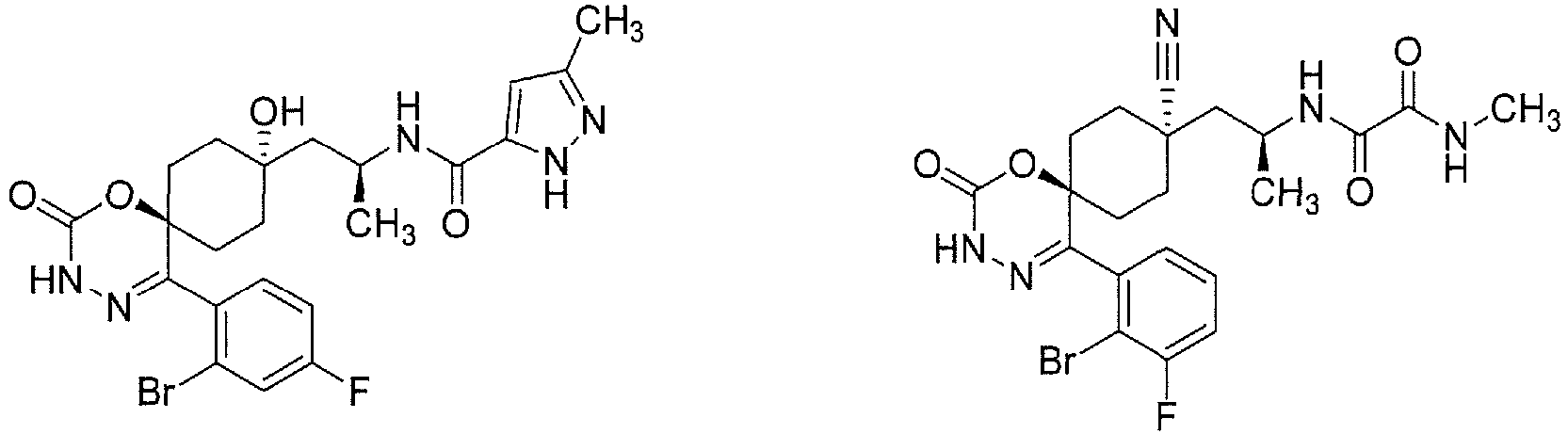

- [Item 19a] A pharmaceutical composition comprising a compound as defined in any one of Items 1a to 18a, or a pharmaceutically acceptable salt thereof, and a pharmaceutically acceptable carrier.
- [Item 20a] A pharmaceutical composition comprising a compound as defined in any one of Items 1a to 18a, or a pharmaceutically acceptable salt thereof, in combination with one or more other drugs, and a pharmaceutically acceptable carrier.
- [Item 21a] A PLD inhibitor comprising a compound as defined in any one of Items 1a to 18a, or a pharmaceutically acceptable salt thereof.
- [Item 22a] A PLD1 inhibitor comprising a compound as defined in any one of Items 1a to 18a, or a pharmaceutically acceptable salt thereof.
- [Item 23a] A PLD1/2 inhibitor comprising a compound as defined in any one of Items 1a to 18a, or a pharmaceutically acceptable salt thereof.
- [Item 24a] An agent for the treatment or prophylaxis of a disease selected from the group consisting of thrombosis and cancer, comprising a compound as defined in any one of Items 1a to 18a, or a pharmaceutically acceptable salt thereof.
- [Item 25a] An agent for the treatment or prophylaxis of a disease selected from the group consisting of thrombosis and cancer, comprising a compound as defined in any one of Items 1a to 18a, or a pharmaceutically acceptable salt thereof, in combination with one or more other drugs.
- [Item 26a] A method for inhibiting PLD in a mammal, comprising administering a therapeutically effective amount of a compound as defined in any one of Items 1a to 18a, or a pharmaceutically acceptable salt thereof to the mammal.
- [Item 27a] A method for inhibiting PLD1 in a mammal, comprising administering a therapeutically effective amount of a compound as defined in any one of Items 1a to 18a, or a pharmaceutically acceptable salt thereof to the mammal.
- [Item 28a] A method for inhibiting PLD1/2 in a mammal, comprising administering a therapeutically effective amount of a compound as defined in any one of Items 1a to 18a, or a pharmaceutically acceptable salt thereof to the mammal.
- [Item 29a] A method for treating or preventing a disease selected from the group consisting of thrombosis and cancer in a mammal, comprising administering a therapeutically effective amount of a compound as defined in any one of Items 1a to 18a, or a pharmaceutically acceptable salt thereof to the mammal.
- [Item 30a] A method for treating or preventing a disease selected from the group consisting of thrombosis and cancer in a mammal, comprising administering a therapeutically effective amount of a compound as defined in any one of Items 1a to 18a, or a pharmaceutically acceptable salt thereof, in combination with one or more other drugs, to the mammal.
- [Item 31a] Use of a compound as defined in any one of Items 1a to 18a, or a pharmaceutically acceptable salt thereof, for the manufacture of a PLD inhibitor.
- [Item 32a] Use of a compound as defined in any one of Items 1a to 18a, or a pharmaceutically acceptable salt thereof, for the manufacture of a PLD1 inhibitor.
- [Item 33a] Use of a compound as defined in any one of Items 1a to 18a, or a pharmaceutically acceptable salt thereof, for the manufacture of a PLD1/2 inhibitor.
- [Item 34a] Use of a compound as defined in any one of Items 1a to 18a, or a pharmaceutically acceptable salt thereof, for the manufacture of an agent for the treatment or prophylaxis of a disease selected from the group consisting of thrombosis and cancer.
- [Item 35a] Use of a compound as defined in any one of Items 1a to 18a, or a pharmaceutically acceptable salt thereof, in combination with one or more other drugs, for the manufacture of an agent for the treatment or prophylaxis of a disease selected from the group consisting of thrombosis and cancer.
- [Item 36a] A compound as defined in any one of Items 1a to 18a, or a pharmaceutically acceptable salt thereof, for use in the inhibition of PLD.
- [Item 37a] A compound as defined in any one of Items 1a to 18a, or a pharmaceutically acceptable salt thereof, for use in the inhibition of PLD1.
- [Item 38a] A compound as defined in any one of Items 1a to 18a, or a pharmaceutically acceptable salt thereof, for use in the inhibition of PLD1/2.
- [Item 39a] A compound as defined in any one of Items 1a to 18a, or a pharmaceutically acceptable salt thereof, for use in the treatment or prophylaxis of a disease selected from the group consisting of thrombosis and cancer.
- [Item 40a] A compound as defined in any one of Items 1a to 18a, or a pharmaceutically acceptable salt thereof, in combination with one or more other drugs, for use in the treatment or prophylaxis of a disease selected from the group consisting of thrombosis and cancer.
- Since the compound represented by Formula [I] or Formula [Ia] or a pharmaceutically acceptable salt thereof of the present invention has a PLD inhibitory activity, it may be useful for the treatment or prophylaxis of thrombosis and cancer.
- The definitions of the terms used herein are as follows.
- Examples of the "halogen" include fluorine, chlorine, bromine and iodine.
- The "C1-4 alkyl" means a linear or branched saturated hydrocarbon group having 1 to 4 carbon atoms. Examples of the "C1-4 alkyl" include methyl, ethyl, n-propyl, isopropyl, n-butyl, sec-butyl, isobutyl, and tert-butyl. The preferred "C1-4 alkyl" are methyl, ethyl, n-propyl, n-butyl, isobutyl, and tert-butyl.
- The "C1-6 alkyl" means a linear or branched saturated hydrocarbon group having 1 to 6 carbon atoms. Examples of the "C1-6 alkyl" include methyl, ethyl, n-propyl, isopropyl, n-butyl, sec-butyl, isobutyl, tert-butyl, n-pentyl, isopentyl, neo-pentyl, 1,1-dimethylpropyl, 1,2-dimethylpropyl, 1-ethylpropyl, n-hexyl, isohexyl, 1-ethyl-2-methylpropyl, and 3,3-dimethylbutyl. The preferred "C1-6 alkyl" are methyl, ethyl, n-propyl, isopropyl, n-butyl, isobutyl, and tert-butyl.
- The "C2-4 alkenyl" means a linear or branched hydrocarbon group having 2 to 4 carbon atoms and a carbon-carbon double bond. Examples of the "C2-4 alkenyl" include vinyl, allyl, prop-1-en-1-yl, prop-1-en-2-yl, 2-methylprop-1-ene-yl, but-3-en-1-yl, but-2-en-1-yl, and but-2-en-2-yl. The preferred "C2-4 alkenyl" are vinyl, prop-1-en-1-yl, and 2-methylprop-1-ene-yl.
- The "C1-4 haloalkyl" means the above-mentioned "C1-4 alkyl" substituted by 1 to 5 halogen independently selected from the group consisting of the above-mentioned "halogen". Examples of the "C1-4 haloalkyl" include monofluoromethyl, difluoromethyl, trifluoromethyl, 2-fluoroethyl, 2-chloroethyl, 2-bromoethyl, 1,1-difluoroethyl, 1-fluoro-1-methylethyl, 2,2-difluoroethyl, 2,2,2-trifluoroethyl, pentafluoroethyl, 3,3,3-trifluoropropyl, and 4,4,4-trifluorobutyl. The preferred "C1-4 haloalkyl" are difluoromethyl, trifluoromethyl, 2,2-difluoroethyl, 2,2,2-trifluoroethyl, and 3,3,3-trifluoropropyl.
- The "C1-4 alkoxy" means a group wherein the above-mentioned "C1-4 alkyl" is bonded to an oxygen atom. Examples of the "C1-4 alkoxy" include methoxy, ethoxy, n-propoxy, isopropoxy, n-butoxy, sec-butoxy, isobutoxy, and tert-butoxy. The preferred "C1-4 alkoxy" are methoxy, ethoxy, n-propoxy, isobutoxy, and tert-butoxy.
- The "C1-6 alkoxy" means a group wherein the above-mentioned "C1-6 alkyl" is bonded to an oxygen atom. Examples of the "C1-6 alkoxy" include methoxy, ethoxy, n-propoxy, isopropoxy, n-butoxy, sec-butoxy, isobutoxy, tert-butoxy, n-pentyloxy, (3-methylbutan-2-yl)oxy, and n-hexyloxy. The preferred "C1-6 alkoxy" are methoxy, ethoxy, n-propoxy, isobutoxy, and tert-butoxy.
- The "C3-4 cycloalkyl" means a monocyclic saturated hydrocarbon group having 3 or 4 carbon atoms. Examples of the "C3-4 cycloalkyl" include cyclopropyl, and cyclobutyl. The preferred "C3-4 cycloalkyl" is cyclopropyl.
- The "C5-8 bridged cycloalkyl" means a 5 to 8-membered bridged cyclic saturated hydrocarbon group. Examples of the "C5-8 bridged cycloalkyl" include bicyclo[1.1.1]pentyl, bicyclo[2.2.1]heptyl, and bicyclo[2.2.2]octyl. The preferred "C5-8 bridged cycloalkyl" is bicyclo[1.1.1]pentyl.
- The "C6-10 aryl" means an aromatic hydrocarbon group having 6 to 10 carbon atoms. Examples of the "C6-10 aryl" include phenyl and naphthyl. The preferred "C6-10 aryl" is phenyl.
- The "4 to 7-membered heterocycloalkyl containing one or two heteroatoms selected from the group consisting of nitrogen and oxygen atoms as a ring constituting atom, besides carbon atom" means a 4 to 7-membered saturated heterocyclic group containing one or two of nitrogen and oxygen atoms as a ring constituting atom, besides carbon atom. Examples of the "4 to 7-membered heterocycloalkyl containing one or two heteroatoms selected from the group consisting of nitrogen and oxygen atoms as a ring constituting atom, besides carbon atom" include azetidinyl, oxetanyl, pyrrolidinyl, tetrahydrofuryl, piperidyl, tetrahydropyranyl, dioxanyl, piperazinyl, morpholinyl, and azepanyl. The preferred "4 to 7-membered heterocycloalkyl containing one or two heteroatoms selected from the group consisting of nitrogen and oxygen atoms as a ring constituting atom, besides carbon atom" are azetidinyl, oxetanyl, pyrrolidinyl, tetrahydrofuryl, piperidyl, dioxanyl, and morpholinyl.
- The "5 to 9-membered bridged heterocycloalkyl containing one or two heteroatoms selected from the group consisting of nitrogen and oxygen atoms as a ring constituting atom, besides carbon atom" means a 5 to 9-membered bridged heterocyclic group containing one or two of nitrogen and oxygen atoms as a ring constituting atom, besides carbon atom. Examples of the "5 to 9-membered bridged heterocycloalkyl containing one or two heteroatoms selected from the group consisting of nitrogen and oxygen atoms as a ring constituting atom, besides carbon atom" include 6-azabicyclo[3.1.1]heptyl, 7-azabicyclo[2.2.1]heptyl, 3-oxa-6-azabicyclo[3.1.1]heptyl, 2-oxa-5-azabicyclo[2.2.1]heptyl, and 8-oxa-3-azabicyclo[3.2.1]octyl. The preferred "5 to 9-membered bridged heterocycloalkyl containing one or two heteroatoms selected from the group consisting of nitrogen and oxygen atoms as a ring constituting atom, besides carbon atom" are 2-oxa-5-azabicyclo[2.2.1]heptyl, and 8-oxa-3-azabicyclo[3.2.1]octyl.
- The "6 to 11-membered spiro heterocycloalkyl containing one or two heteroatoms selected from the group consisting of nitrogen and oxygen atoms as a ring constituting atom, besides carbon atom" means a 6 to 11-membered spiro heterocyclic group containing one or two of nitrogen and oxygen atoms as a ring constituting atom, besides carbon atom. Examples of the "6 to 11-membered spiro heterocycloalkyl containing one or two heteroatoms selected from the group consisting of nitrogen and oxygen atoms as a ring constituting atom, besides carbon atom" include 2-azaspiro[3.3]heptyl, 2-oxa-6-azaspiro[3.3]heptyl, 5-azaspiro[2.4]heptyl, 4-oxa-7-azaspiro[2.5]octyl, 2,8-diazaspiro[4.5]decyl, and 3-oxa-9-azaspiro[5.5]undecyl. The preferred "6 to 11-membered spiro heterocycloalkyl containing one or two heteroatoms selected from the group consisting of nitrogen and oxygen atoms as a ring constituting atom, besides carbon atom" are 2-oxa-6-azaspiro[3.3]heptyl, 5-azaspiro[2.4]heptyl, and 4-oxa-7-azaspiro[2.5]octyl.
- The "5- or 6-membered heteroaryl containing one or two nitrogen atoms as a ring constituting atom, besides carbon atom" means a 5- or 6-membered aromatic heterocyclic group containing one or two nitrogen atoms as a ring constituting atom, besides carbon atom. Examples of the "5- or 6-membered heteroaryl containing one or two nitrogen atoms as a ring constituting atom, besides carbon atom" include pyrrolyl, imidazolyl, pyrazolyl, pyridyl, pyrazinyl, pyrimidinyl and pyridazinyl. The preferred "5- or 6-membered heteroaryl containing one or two nitrogen atoms as a ring constituting atom, besides carbon atom" are pyrrolyl, imidazolyl, pyrazolyl, pyridyl, pyrazinyl, pyrimidinyl, and pyridazinyl.
- The "5 to 10-membered heteroaryl containing one or two nitrogen atoms as a ring constituting atom, besides carbon atom" means a 5 to 10-membered aromatic heterocyclic group containing one or two nitrogen atoms as a ring constituting atom, besides carbon atom. Examples of the "5 to 10-membered heteroaryl containing one or two nitrogen atoms as a ring constituting atom, besides carbon atom" include pyrrolyl, imidazolyl, pyrazolyl, pyridyl, pyrazinyl, pyrimidinyl, pyridazinyl, indolyl, benzimidazolyl, indazolyl, indolizinyl, imidazo[1,2-a]pyridyl, pyrazolo[1,5-a]pyridyl, quinolyl, isoquinolyl, and quinoxalyl. The preferred "5 to 10-membered heteroaryl containing one or two nitrogen atoms as a ring constituting atom, besides carbon atom" are pyrrolyl, imidazolyl, pyrazolyl, pyridyl, pyrazinyl, pyrimidinyl, pyridazinyl, and pyrazolo[1,5-a]pyridyl.
- The "5 to 10-membered heteroaryl containing 1 to 3 heteroatoms selected from the group consisting of nitrogen and oxygen atoms as a ring constituting atom, besides carbon atom" means a 5 to 10-membered aromatic heterocyclic group containing 1 to 3 of nitrogen and oxygen atoms as a ring constituting atom, besides carbon atom. Examples of the "5 to 10-membered heteroaryl containing 1 to 3 heteroatoms selected from the group consisting of nitrogen and oxygen atoms as a ring constituting atom, besides carbon atom" include pyrrolyl, furyl, imidazolyl, pyrazolyl, 1,2,3-triazolyl, 1,2,4-triazolyl, oxazolyl, isoxazolyl, 1,2,4-oxadiazolyl, pyridyl, pyrazinyl, pyrimidinyl, pyridazinyl, triazinyl, indolyl, benzofuranyl, benzimidazolyl, indazolyl, benzoxazolyl, benzisoxazolyl, indolizinyl, imidazo[1,2-a]pyridyl, pyrazolo[1,5-a]pyridyl, quinolyl, isoquinolyl, and quinoxalyl. The preferred "5 to 10-membered heteroaryl containing 1 to 3 heteroatoms selected from the group consisting of nitrogen and oxygen atoms as a ring constituting atom, besides carbon atom" are pyrrolyl, imidazolyl, pyrazolyl, 1,2,3-triazolyl, 1,2,4-triazolyl, isoxazolyl, 1,2,4-oxadiazolyl, pyridyl, pyrimidinyl, pyridazinyl, pyrazinyl, indolyl, benzofuranyl, benzimidazolyl, indolizinyl, imidazo[1,2-a]pyridyl, and pyrazolo[1,5-a]pyridyl.
- The "5 to 7-membered partially unsaturated cyclic group containing one or two nitrogen atoms as a ring constituting atom, besides carbon atom" means a 5 to 7-membered partially unsaturated cyclic group containing one or two nitrogen atoms as a ring constituting atom, besides carbon atom. Examples of the "5 to 7-membered partially unsaturated cyclic group containing one or two nitrogen atoms as a ring constituting atom, besides carbon atom" include dihydropyrrolyl, dihydropyridyl, and dihydropyrimidinyl. The preferred "5 to 7-membered partially unsaturated cyclic group containing one or two nitrogen atoms as a ring constituting atom, besides carbon atom" is dihydropyridyl.
- The "8 to 10-membered saturated or partially unsaturated fused cyclic group containing 1 to 4 heteroatoms selected from the group consisting of nitrogen and oxygen atoms as a ring constituting atom, besides carbon atom" means a 8 to 10-membered fused heterocyclic group containing 1 to 4 heteroatoms selected from the group consisting of nitrogen and oxygen atoms as a ring constituting atom, besides carbon atom and containing at least one saturated ring as a constituent ring in the fused ring. Examples of the "8 to 10-membered saturated or partially unsaturated fused cyclic group containing 1 to 4 heteroatoms selected from the group consisting of nitrogen and oxygen atoms as a ring constituting atom, besides carbon atom" include octahydro-2H-isoindolyl, dihydrobenzofuranyl, benzo[d][1,3]dioxolyl, isoindolyl, dihydroisoquinolyl, dihydro-1,6-naphthyridinyl, dihydro-1,7-naphthyridinyl, dihydroisoxazolo[4,3-c]pyridyl, dihydropyrazolo[1,5-a]pyrazinyl, and dihydrotriazolo[1,5-a]pyrazinyl.
- The "9- or 10-membered partially unsaturated fused cyclic group containing one or two oxygen atoms as a ring constituting atom, besides carbon atom" means a 9- or 10-membered fused heterocyclic group containing one or two oxygen atoms as a ring constituting atom, besides carbon atom, and containing at least one saturated ring as a constituent ring in the fused ring. Examples of the "9- or 10-membered partially unsaturated fused cyclic group containing one or two oxygen atoms as a ring constituting atom, besides carbon atom" include 2,3-dihydrobenzo[b][1,4]dioxiranyl, dihydrobenzofuranyl, and benzo[d][1,3]dioxolyl. The preferred "9- or 10-membered partially unsaturated fused cyclic group containing one or two oxygen atoms as a ring constituting atom, besides carbon atom" are dihydrobenzofuranyl, and benzo[d][1,3]dioxolyl.
- The expression that Substituent α is "optionally substituted" by Substituent β means that Substituent α is unsubstituted, or substituted by Substituent β at any substitutable position thereof (any hydrogen is replaced with Substituent β). For example, the "C1-6 alkyl optionally substituted by hydroxy" means that C1-6 alkyl is unsubstituted, or substituted by hydroxy at any substitutable position thereof.
- Specific embodiments of each substituent of the compound of Formula [I] (hereinafter, also to be referred to as "Compound [I]") and the compound of Formula [Ia] (hereinafter, also to be referred to as "Compound [Ia]") are exemplified below. Each group of Compound [I] and Compound [Ia] is not limited to its specific embodiments, and Compound [I] and Compound [Ia] also includes combinations of two or more embodiments selected appropriately from the specific embodiments of each substituent.
- First, specific embodiments of each substituent of Compound [I] are exemplified below.
- A is preferably CR10 wherein R10 is hydrogen, hydroxy, or halogen.
- Cy is preferably
- (1) C6-10 aryl, or
- (2) 5- or 6-membered heteroaryl containing one or two nitrogen atoms as a ring constituting atom, besides carbon atom.
- R3 is preferably C1-4 alkyl.
- R4 is preferably hydrogen.
- R5 is preferably hydrogen.
- R6 is preferably hydrogen.
- R7 and R8 are preferably both hydrogens.
- R9 is preferably hydrogen.
- m is preferably one or two.
- One of preferred embodiments of Compound [I] is a compound represented by Formula [II]:
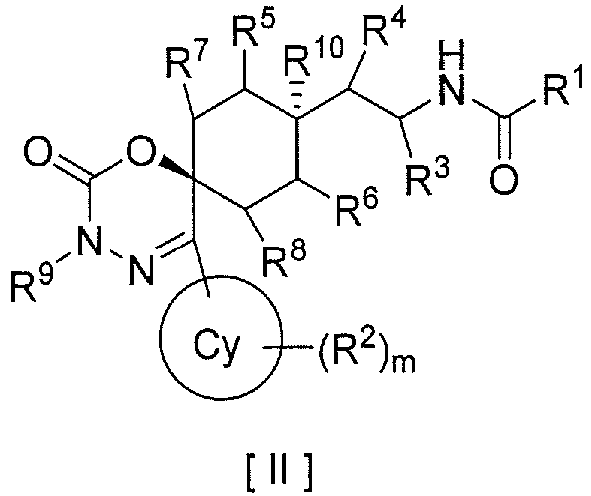
- Cy is
- (1) C6-10 aryl, or
- (2) 5- or 6-membered heteroaryl containing one or two nitrogen atoms as a ring constituting atom, besides carbon atom;
- R1 is
- (1) C1-6 alkyl wherein the alkyl is optionally substituted by
- (a) hydroxy,
- (b) cyano,
- (c) SO2R11 wherein R11 is C1-4 alkyl, or
- (d) NHCOR12 wherein R12 is C1-4 alkyl,
- (2) C2-4 alkenyl wherein the alkenyl is optionally substituted by NR13R14 wherein R13 and R14 are each independently hydrogen or C1-4 alkyl,
- (3) C1-4 haloalkyl,
- (4) C1-6 alkoxy wherein the alkoxy is optionally substituted by phenyl,
- (5) NR15R16 wherein R15 and R16 are each independently
- (a) hydrogen,
- (b) C1-4 alkyl wherein the alkyl is optionally substituted by
- (i) phenyl wherein the phenyl is optionally substituted by halogen, or
- (ii) pyridyl,
- (c) C1-4 alkoxy, or
- (d) C3-4 cycloalkyl,
- (6) COR17 wherein R17 is C1-4 alkyl,
- (7) CONR18R19 wherein R18 and R19 are each independently
- (a) hydrogen,
- (b) C1-4 alkyl,
- (c) C3-4 cycloalkyl, or
- (d) C5-8 bridged cycloalkyl,
- (8) C3-4 cycloalkyl wherein the cycloalkyl is optionally substituted by
- (a) hydroxy,
- (b) halogen, or
- (c) phenyl,
- (9) 4 to 7-membered heterocycloalkyl containing one or two heteroatoms selected from the group consisting of nitrogen and oxygen atoms as a ring constituting atom, besides carbon atom, wherein the heterocycloalkyl is optionally substituted by
- (a) hydroxy,
- (b) oxo,
- (c) NR20R21 wherein R20 and R21 are each independently hydrogen or C1-4 alkyl, or
- (d) phenyl,
- (10) 6 to 11-membered spiro heterocycloalkyl containing one or two heteroatoms selected from the group consisting of nitrogen and oxygen atoms as a ring constituting atom, besides carbon atom,
- (11) phenyl wherein the phenyl is optionally substituted by one or two halogens,
- (12) 5 to 10-membered heteroaryl containing 1 to 3 heteroatoms selected from the group consisting of nitrogen and oxygen atoms as a ring constituting atom, besides carbon atom, wherein the heteroaryl is optionally substituted by one or two R22, or
- (13) a 8 to 10-membered saturated or partially unsaturated fused cyclic group containing 1 to 4 heteroatoms selected from the group consisting of nitrogen and oxygen atoms as a ring constituting atom, besides carbon atom, wherein the fused cyclic group is optionally substituted by C1-4 haloalkyl;
- (1) C1-6 alkyl wherein the alkyl is optionally substituted by
- R2 in the number of m are each independently
- (1) hydroxy,
- (2) cyano,
- (3) halogen,
- (4) C1-6 alkyl wherein the alkyl is optionally substituted by
- (a) hydroxy, or
- (b) C3-4 cycloalkyl,
- (5) C2-4 alkenyl wherein the alkenyl is optionally substituted by C1-4 alkoxy,
- (6) C1-4 haloalkyl,
- (7) C1-4 alkoxy wherein the alkoxy is optionally substituted by 1 to 3 substituents selected from the group consisting of
- (a) hydroxy, and
- (b) halogen,
- (8) SR23 wherein R23 is C1-4 alkyl,
- (9) COR24 wherein R24 is hydroxy or C1-4 alkyl,
- (10) CONR25R26 wherein R25 and R26 are each independently
- (a) hydrogen,
- (b) C1-6 alkyl, or
- (c) C3-4 cycloalkyl,
- (11) SO2R27 wherein R27 is C1-6 alkyl,
- (12) C3-4 cycloalkyl,
- (13) 4 to 7-membered heterocycloalkyl containing one or two heteroatoms selected from the group consisting of nitrogen and oxygen atoms as a ring constituting atom, besides carbon atom, wherein the heterocycloalkyl is optionally substituted by one or two substituents selected from the group consisting of
- (a) halogen,
- (b) C1-4 alkyl, and
- (c) C1-4 haloalkyl,
- (14) 5 to 9-membered bridged heterocycloalkyl containing one or two heteroatoms selected from the group consisting of nitrogen and oxygen atoms as a ring constituting atom, besides carbon atom,
- (15) 6 to 11-membered spiro heterocycloalkyl containing one or two heteroatoms selected from the group consisting of nitrogen and oxygen atoms as a ring constituting atom, besides carbon atom, or
- (16) phenyl;
- R3 is C1-4 alkyl;
- R4, R5, R6, R7, R8 and R9 are all hydrogen;
- R10 is
- (1) hydrogen,
- (2) hydroxy, or
- (3) halogen;
- one or two R22 are each independently
- (1) halogen,
- (2) C1-4 alkyl,
- (3) C1-4 haloalkyl,
- (4) C1-4 alkoxy,
- (5) NHCOR29 wherein R29 is C1-4 alkyl, or
- (6) SO2R30 wherein R30 is C1-4 alkyl; and
- m is one or two.
- Preferred specific embodiments of Compound [I] include the compounds of Examples 1 to 339 listed in Table 1-1 to Table 1-43 described later.
- Next, specific embodiments of each substituent of Compound [Ia] are exemplified below. Compound [Ia] includes Compound [I].
- Aa is preferably CR10a.
- In another embodiment, Aa is preferably N.
- A2a is preferably CR5a.
- Cya is preferably
- (1) C6-10 aryl, or
- (2) 5- or 6-membered heteroaryl containing one or two nitrogen atoms as a ring constituting atom, besides carbon atom.
- R1a is preferably
- (1) C1-6 alkyl wherein the alkyl is optionally substituted by
- (a) hydroxy,
- (b) cyano,
- (c) SO2R11 wherein R11 is C1-4 alkyl, or
- (d) NHCOR12 wherein R12 is C1-4 alkyl,
- (2) C2-4 alkenyl wherein the alkenyl is optionally substituted by 1 to 3 of
- (a) NR13R14 wherein R13 and R14 are each independently hydrogen or C1-4 alkyl,
- (b) halogen,
- (c) COR35a wherein R35a is hydroxy or C1-4 alkoxy,
- (d) CONR36aR37a wherein R36a and R37a are each independently hydrogen or C1-4 alkyl, or
- (e) a partial structural formula:

- (3) C1-6 alkoxy wherein the alkoxy is optionally substituted by phenyl,
- (4) NR15R16 wherein R15 and R16 are each independently
- (a) hydrogen,
- (b) C1-4 alkyl wherein the alkyl is optionally substituted by
- (i) phenyl wherein the phenyl is optionally substituted by halogen, or
- (ii) pyridyl,
- (c) C1-4 alkoxy, or
- (d) C3-4 cycloalkyl,
- (5) CONR18aR19a wherein R18a and R19a are each independently
- (a) hydrogen,
- (b) C1-4 alkyl wherein the alkyl is optionally substituted by hydroxy,
- (c) C3-4 cycloalkyl,
- (d) C5-8 bridged cycloalkyl,
- (e) C1-4 haloalkyl, or
- (f) C1-4 alkoxy,
- (6) 6 to 11-membered spiro heterocycloalkyl containing one or two heteroatoms selected from the group consisting of nitrogen and oxygen atoms as a ring constituting atom, besides carbon atom,
- (7) 5 to 10-membered heteroaryl containing 1 to 3 heteroatoms selected from the group consisting of nitrogen and oxygen atoms as a ring constituting atom, besides carbon atom, wherein the heteroaryl is optionally substituted by one or two R22a wherein each R22a is as defined above,
- (8) a 8 to 10-membered saturated or partially unsaturated fused cyclic group containing 1 to 4 heteroatoms selected from the group consisting of nitrogen and oxygen atoms as a ring constituting atom, besides carbon atom, wherein the fused cyclic group is optionally substituted by C1-4 haloalkyl, or
- (9) a 5 to 7-membered partially unsaturated cyclic group containing one or two nitrogen atoms as a ring constituting atom, besides carbon atom, wherein the partially unsaturated cyclic group is optionally substituted by an oxo group and C1-4 alkyl.
- In another embodiment, R1a is preferably
- (1) NR15R16 wherein R15 and R16 are each independently
- (a) hydrogen,
- (b) C1-4 alkyl wherein the alkyl is optionally substituted by
- (i) phenyl wherein the phenyl is optionally substituted by halogen, or
- (ii) pyridyl,
- (c) C1-4 alkoxy, or
- (d) C3-4 cycloalkyl,
- (2) CONR18aR19a wherein R18a and R19a are each independently
- (a) hydrogen,
- (b) C1-4 alkyl wherein the alkyl is optionally substituted by hydroxy,
- (c) C3-4 cycloalkyl,
- (d) C5-8 bridged cycloalkyl,
- (e) C1-4 haloalkyl, or
- (f) C1-4 alkoxy, or
- (3) 5 to 10-membered heteroaryl containing 1 to 3 heteroatoms selected from the group consisting of nitrogen and oxygen atoms as a ring constituting atom, besides carbon atom, wherein the heteroaryl is optionally substituted by one or two R22a wherein each R22a is as defined above.
- R2a in the number of m are each independently preferably
- (1) cyano,
- (2) halogen, or
- (3) C1-6 alkyl wherein the alkyl is optionally substituted by
- (a) hydroxy, or
- (b) C3-4 cycloalkyl.
- R3a is preferably C1-4 alkyl.
- In another embodiment, R3a is preferably methyl.
- R4a is preferably hydrogen.
- R5a is preferably hydrogen.
- The combination of R6a, R7a and R8a is preferably
- (1) a combination where R6a is hydrogen, and R7a and R8a are both hydrogens,
- (2) a combination where R6a is hydrogen, and R7a and R8a are bonded to each other to form a cyclopentane ring together with the spiro carbon atom and the carbon atoms to which they are bonded, or
- (3) a combination where R6a and R7a are bonded to each other to form a cyclopentane ring together with the spiro carbon atom and the carbon atoms to which they are bonded, and R8a is hydrogen.
- In another embodiment, R6a, R7a and R8a are preferably all hydrogen.
- R9a is preferably hydrogen.
- R10a is preferably
- (1) hydrogen,
- (2) hydroxy, or
- (3) cyano.
- One or two R22a are each independently preferably
- (1) halogen,
- (2) C1-4 alkyl,
- (3) C1-4 haloalkyl,
- (4) C1-4 alkoxy,
- (5) NHCOR29 wherein R29 is C1-4 alkyl,
- (6) cyano, or
- (7) C3-4 cycloalkyl.
- m is preferably one or two.
- One of preferred embodiments of Compound [Ia] is a compound represented by Formula [IIa]:

Aa, Cya, R1a, R2a, R3a, R4a, R5a, R6a, R7a, R8a and m are as defined above. - Another preferred embodiment of Compound [Ia] is a compound represented by Formula [IIIa]:

Cya, R1a, R2a, R3a, R4a, R5a, R6a, R7a, R8a and m are as defined above. - Another preferred embodiment of Compound [Ia] is a compound represented by Formula [IVa]:
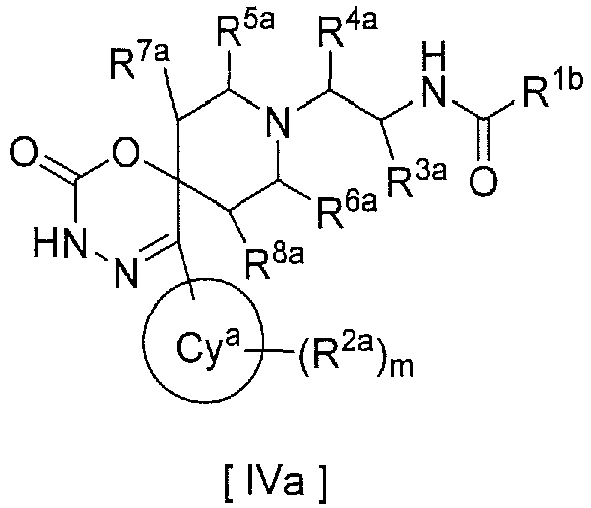
Cya, R1b, R2a, R3a, R4a, R5a, R6a, R7a, R8a and m are as defined above. - Another preferred embodiment of Compound [Ia] is a compound represented by Formula [Va]:

Cya, R1b, R2a, R3a, R4a and m are as defined above. - Another preferred embodiment of Compound [Ia] is a compound represented by Formula [VIa]:

Cyb, R1b, R2a, R3a, R4a and m are as defined above. - Another preferred embodiment of Compound [Ia] is a compound represented by Formula [VIIa]:

Cya, R1b, R2a, R3a, R5a, R6a, R7a, R8a and m are as defined above. - Another preferred embodiment of Compound [Ia] is a compound represented by Formula [VIIIa]:

Cya, R1b, R2a, R3a and m are as defined above. - Another preferred embodiment of Compound [Ia] is a compound represented by Formula [IXa]:

Cyb, R1b, R2a, R3a and m are as defined above. - Another preferred embodiment of Compound [Ia] is a compound represented by Formula [Xa]:

Cya, R1a, R2a, R3a, R4a, R5a, R6a, R7a, R8a, R10a and m are as defined above. - Another preferred embodiment of Compound [Ia] is a compound represented by Formula [XIa]:

Cya, R1a, R2a, R3a, R4a, R5a, R6a, R7a, R8a, R10a and m are as defined above. - Another preferred embodiment of Compound [Ia] is a compound represented by Formula [XIIa]:

Cya, R1b, R2a, R3a, R4a, R5a, R6a, R7a, R8a, R10a and m are as defined above. - Another preferred embodiment of Compound [Ia] is a compound represented by Formula [XIIIa]:

Cya, R1b, R2a, R3a, R4a, R10a and m are as defined above. - Another preferred embodiment of Compound [Ia] is a compound represented by Formula [XIVa]:

Cyb, R1b, R2a, R3a, R4a, R10a and m are as defined above. - Another preferred embodiment of Compound [Ia] is a compound represented by Formula [XVa]:

Cya, R1b, R2a, R3a, R5a, R6a, R7a, R3a, R10a and m are as defined above. - Another preferred embodiment of Compound [Ia] is a compound represented by Formula [XVIa]:

Cya, R1b, R2a, R3a, R10a and m are as defined above. - Another preferred embodiment of Compound [Ia] is a compound represented by Formula [XVIIa]:

Cyb, R1b, R2a, R3a, R10a and m are as defined above. - Another preferred embodiment of Compound [Ia] is a compound represented by Formula [XVIIIa]:

Cyb, R1b, R2a and m are as defined above. - Another preferred embodiment of Compound [Ia] is a compound represented by Formula [XIXa]:

- R1c is
- (1) C1-4 haloalkyl wherein the haloalkyl is optionally substituted by hydroxy,
- (2) COR17a wherein R17a is C1-4 alkyl or hydroxy,
- (3) C3-4 cycloalkyl wherein the cycloalkyl is optionally substituted by
- (a) hydroxy,
- (b) halogen, or
- (c) phenyl,
- (4) 4 to 7-membered heterocycloalkyl containing one or two heteroatoms selected from the group consisting of nitrogen and oxygen atoms as a ring constituting atom, besides carbon atom, wherein the heterocycloalkyl is optionally substituted by
- (a) hydroxy,
- (b) oxo,
- (c) NR20R21 wherein R20 and R21 are each independently hydrogen or C1-4 alkyl, or
- (d) phenyl, or
- (5) phenyl wherein the phenyl is optionally substituted by one or two of
- (a) halogen, or
- (b) C1-4 haloalkyl, and
- Cya, R2a, R3a, R4a, R5a, R6a, R7a, R8a and m are as defined above.
- Another preferred embodiment of Compound [Ia] is a compound represented by Formula [XXa]:

Cya, R1c, R2a, R3a, R4a and m are as defined above. - Another preferred embodiment of Compound [Ia] is a compound represented by Formula [XXIa]:

Cyb, R1c, R2a, R3a, R4a and m are as defined above. - Another preferred embodiment of Compound [Ia] is a compound represented by Formula [XXIIa]:

Cya, R1c, R2a, R3a, R5a, R6a, R7a, R8a and m are as defined above. - Another preferred embodiment of Compound [Ia] is a compound represented by Formula [XXIIIa]:

Cya, R1c, R2a, R3a and m are as defined above. - Another preferred embodiment of Compound [Ia] is a compound represented by Formula [XXIVa]:

Cyb, R1c, R2a, R3a and m are as defined above. - Another preferred embodiment of Compound [Ia] is a compound represented by Formula [XXVa]:

Cyb, R1c, R2a and m are as defined above. - Another preferred embodiment of Compound [Ia] is a compound represented by Formula [XXVIa-1], Formula [XXVIa-2], Formula [XXVIa-3], Formula [XXVIa-4], Formula [XXVIa-5], Formula [XXVIa-6], Formula [XXVIa-7], Formula [XXVIa-8], or Formula [XXVIa-9]:


R1b, R2a and m are as defined above. - Another preferred embodiment of Compound [Ia] is a compound represented by Formula [XXVIIa-1], Formula [XXVIIa-2], Formula [XXVIIa-3], Formula [XXVIIa-4], Formula [XXVIIa-5], Formula [XXVIIa-6], Formula, [XXVIIa-7], Formula [XXVIIa-8], Formula [XXVIIa-9], Formula [XXVIIa-10], or Formula [XXVIIa-11]:


- ma is 0, one or two, and
- R1b and R2a are as defined above.
- Another preferred embodiment of Compound [Ia] is a compound represented by Formula [XXVIIIa]:
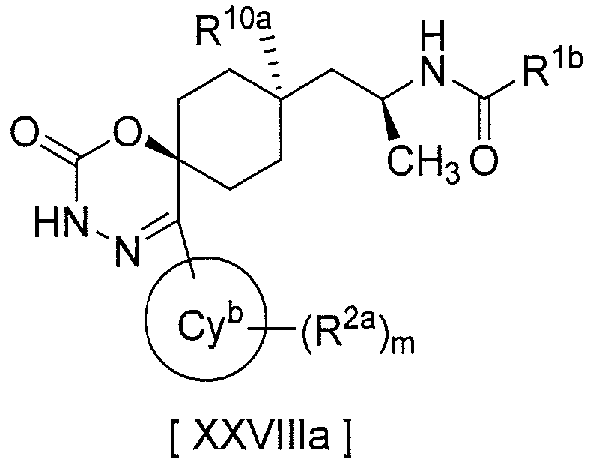
Cyb, R1b, R2a, R10a and m are as defined above. - Another preferred embodiment of Compound [Ia] is a compound represented by Formula [XXIXa]:

Cya, R1c, R2a, R3a, R4a, R5a, R6a, R7a, R8a, R10a and m are as defined above. - Another preferred embodiment of Compound [Ia] is a compound represented by Formula [XXXa]:

Cya, R1c, R2a, R3a, R4a, R10a and m are as defined above. - Another preferred embodiment of Compound [Ia] is a compound represented by Formula [XXXIa]:

Cyb, R1c, R2a, R3a, R4a, R10a and m are as defined above. - Another preferred embodiment of Compound [Ia] is a compound represented by Formula [XXXIIa]:

Cya, R1c, R2a, R3a, R5a, R6a, R7a, R8a, R10a and m are as defined above. - Another preferred embodiment of Compound [Ia] is a compound represented by Formula [XXXIIIa]:

Cya, R1c, R2a, R3a, R10a and m are as defined above. - Another preferred embodiment of Compound [Ia] is a compound represented by Formula [XXXIVa]:

Cyb, R1c, R2a, R3a, R10a and m are as defined above. - Another preferred embodiment of Compound [Ia] is a compound represented by Formula [XXXVa]:

Cyb, R1c, R2a, R10a and m are as defined above. - Another preferred embodiment of Compound [Ia] is a compound represented by Formula [XXXVIa-1], Formula [XXXVIa-2], Formula [XXXVIa-3], Formula [XXXVIa-4], Formula [XXXVIa-5], Formula [XXXVIa-6], Formula [XXXVIa-7], Formula [XXXVIa-8], or Formula [XXXVIa-9]:


R1b, R2a, R10a and m are as defined above. - Another preferred embodiment of Compound [Ia] is a compound represented by Formula [XXXVIIa-1], Formula [XXXVIIa-2], Formula [XXXVIIa-3], Formula [XXXVIIa-4], Formula [XXXVIIa-5], Formula [XXXVIIa-6], Formula [XXXVIIa-7], Formula [XXXVIIa-8], Formula [XXXVIIa-9], Formula [XXXVIIa-10], or Formula [XXXVIIa-11]:


R1b, R2a, R10a and ma are as defined above. - Preferred specific embodiments of Compound [Ia] include the compounds of Examples 1 to 339 and Examples 2-001 to 2-172 listed in Table 1-1 to Table 1-61 described later.
- The "pharmaceutically acceptable salt" may be any salt known in the art as long as it is not associated with undue toxicity. Specific examples thereof include salts with inorganic acid, salts with organic acid, salts with inorganic base, and salts with organic base. Various forms of pharmaceutically acceptable salts are well known in the art, and they are described in the following documents.
- (a) Berge et al., J. Pharm. Sci., 66, p 1-19 (1977),
- (b) Stahl et al., "Handbook of Pharmaceutical Salt: Properties, Selection, and Use" (Wiley-VCH, Weinheim, Germany, 2002),
- (c) Paulekuhn et al., J. Med. Chem., 50, p 6665-6672 (2007)
- The pharmaceutically acceptable salt can be obtained by reacting Compound [I] or Compound [Ia] with an inorganic acid, an organic acid, an inorganic base or an organic base according to a known method.
- Examples of the salt with inorganic acid include salts with hydrofluoric acid, hydrochloric acid, hydrobromic acid, hydriodic acid, nitric acid, phosphoric acid and sulfuric acid. Preferred are salts with hydrochloric acid, nitric acid, sulfuric acid, phosphoric acid and hydrobromic acid.
- Examples of the salt with organic acid include salts with acetic acid, adipic acid, alginic acid, 4-aminosalicylic acid, anhydromethylenecitric acid, benzoic acid, benzenesulfonic acid, calcium edetate, camphoric acid, camphor-10-sulfonic acid, carbonic acid, citric acid, edetic acid, ethane-1,2-disulfonic acid, dodecylsulfuric acid, ethanesulfonic acid, fumaric acid, glucoheptonic acid, gluconic acid, glucuronic acid, glucoheptonic acid, glycollylarsanilic acid, hexylresorcinoic acid, hydroxynaphthoic acid, 2-hydroxy-1-ethanesulfonic acid, lactic acid, lactobionic acid, malic acid, maleic acid, mandelic acid, methanesulfonic acid, methylsulfuric acid, methylnitric acid, methylenebis(salicylic acid), galactaric acid, naphthalene-2-sulfonic acid, 2-naphthoic acid, 1,5-naphthalenedisulfonic acid, oleic acid, oxalic acid, pamoic acid, pantothenic acid, pectic acid, picric acid, propionic acid, polygalacturonic acid, salicylic acid, stearic acid, succinic acid, tannic acid, tartaric acid, teoclic acid, thiocyanic acid, trifluoroacetic acid, p-toluenesulfonic acid, undecanoic acid, aspartic acid and glutamic acid. Preferred are salts with oxalic acid, maleic acid, citric acid, fumaric acid, lactic acid, malic acid, succinic acid, tartaric acid, acetic acid, trifluoroacetic acid, benzoic acid, glucuronic acid, oleic acid, pamoic acid, methanesulfonic acid, benzenesulfonic acid, p-toluenesulfonic acid and 2-hydroxy-1-ethanesulfonic acid.
- Examples of the salt with inorganic base include salts with lithium, sodium, potassium, magnesium, calcium, barium, aluminium, zinc, bismass and ammonium. Preferred are salts with sodium, potassium, calcium, magnesium and zinc.
- Examples of the salt with organic base include salts with arecoline, betaine, choline, clemizole, ethylene diamine, N-methylglucamine, N-benzyl phenethylamine, tris(hydroxymethyl)methylamine, arginine and lysine. Preferred are salts with tris(hydroxymethyl)methylamine, N-methylglucamine and lysine.
- Compound [I] or Compound [Ia] or a pharmaceutically acceptable salt thereof may be present as a solvate. The term "solvate" refers to Compound [I] or Compound [Ia] or a pharmaceutically acceptable salt thereof with which a solvent molecule is coordinated. The solvate may be any pharmaceutically acceptable solvate, and include hydrates, ethanolates, acetic acid solvate, dimethyl sulfoxidates or the like of Compound [I] or Compound [Ia] or a pharmaceutically acceptable salt thereof.
- Specific examples include semihydrate, monohydrate, dihydrate, mono acetic acid solvate and monoethanolate of Compound [I] or Compound [Ia], monohydrate of sodium salt of Compound [I] or Compound [Ia], and 2/3 ethanolate of monohydrochloride of Compound [I] or Compound [Ia]. These solvates can be obtained according to a known method.
- Compound [I] or Compound [Ia] may be present as a tautomer. In this case, Compound [I] or Compound [Ia] can be a single tautomer or a mixture thereof.
- Compound [I] or Compound [Ia] may have a carbon-carbon double bond. In this case, Compound [I] or Compound [Ia] can be present as an E form, a Z form, or a mixture thereof.
- Compound [I] or Compound [Ia] may be present as a stereoisomer that should be recognized as a cis/trans isomer. In this case, Compound [I] or Compound [Ia] can be present as a cis form, a trans form, or a mixture thereof.
- Compound [I] or Compound [Ia] may contain one or more asymmetric carbons. In this case, Compound [I] or Compound [Ia] may be present as a single enantiomer, a single diastereomer, a mixture of enantiomers or a mixture of diastereomers.
- Compound [I] or Compound [Ia] may be present as an atropisomer. In this case, Compound [I] or Compound [Ia] may be present as a single atropisomer or a mixture thereof.
- Compound [I] or Compound [Ia] may simultaneously contain a plurality of structural features that give rise to the above-mentioned isomers. Moreover, Compound [I] or Compound [Ia] may contain the above-mentioned isomers at any ratio.
- The formulae, chemical structures and compound names indicated herein without specifying the stereochemistry thereof includes all of the above isomers that may be present, unless otherwise noted. For example, the structure represented by formula:

- (1) a mixture of two diastereomers (the stereochemistry of the asymmetric carbon marked with * is S or R) represented by the following formula:

- (2) a diastereomer where the stereochemistry of the asymmetric carbon marked with * is S, and
- (3) a diastereomer where the stereochemistry of the asymmetric carbon marked with * is R,
- A diastereomeric mixture can be separated into each diastereomer by conventional methods such as chromatography and crystallization. Alternatively, each diastereomer can also be produced by using a stereochemically single starting material, or by a synthesis method employing a stereoselective reaction.
- An enantiomeric mixture can be separated into each single enantiomer by a method well known in the art. For example, first, a diastereomeric mixture can be prepared by reacting an enantiomeric mixture with a substantially pure enantiomer compound known as a chiral auxiliary. Next, the obtained diastereomeric mixture can be separated into a single diastereomer having high isomer ratio or a substantially pure single diastereomer by a conventional method such as fractional crystallization and chromatography. Finally, the separated diastereomer can be converted to a desired enantiomer by removing the added chiral auxiliary by cleavage. Moreover, an enantiomeric mixture can also be directly separated by a chromatography method using a chiral solid phase well known in the art. Alternatively, one of enantiomers can also be obtained by using a substantially pure optically active starting material or by employing stereoselective synthesis (asymmetric induction) of a prochiral intermediate using a chiral auxiliary and an asymmetric catalyst.
- The absolute steric configuration can be determined by the X-ray crystal analysis of the crystalline product or intermediate. In this case, a crystalline product or intermediate derivatized with a reagent having an asymmetric center with a known steric configuration may be used if necessary.
- Compound [I] or Compound [Ia] may be labeled with an isotope [2H(D), 3H, 11C, 13C, 14C, 13N, 15N, 15O, 18O, 18F, 35S, 123I etc.]. For example, when Compound [I] or Compound [Ia] has methyl, the methyl can be replaced by -CD3. Such labeled Compound [I] or Compound [Ia] is also included in the present invention. Compound [I] or Compound [Ia] labeled with an isotope may be useful for medicaments, pharmacokinetic studies, in vitro and/or in vivo assays, and/or diagnostics (e.g. positron emission tomography (PET), single photon emission computed tomography (SPECT)). Compound [I] or Compound [Ia] labeled with an isotope can be produced using an isotope-labelling reagent instead of a non-isotope-labelling reagent, according to known methods or the methods described here.
- Compound [I] or Compound [Ia] or a pharmaceutically acceptable salt thereof is preferably substantially purified, Compound [I] or Compound [Ia] or a pharmaceutically acceptable salt thereof. Further preferably, it is Compound [I] or Compound [Ia] or a pharmaceutically acceptable salt thereof that is purified to a purity of 80% or more.
- The pharmaceutical composition of the present invention may be produced by appropriately admixing a therapeutically effective amount of an active ingredient (e.g., Compound [I] or Compound [Ia] or a pharmaceutically acceptable salt thereof) with at least one kind of a pharmaceutically acceptable carrier and the like, according to a method known in the art of pharmaceutical preparations. The content of the active ingredient in the pharmaceutical composition varies depending on the dosage form, the dose, and the like. It is, for example, 0.1 to 100 wt% of the whole composition.
- Examples of the dosage form of the pharmaceutical composition containing Compound [I] or Compound [Ia] or a pharmaceutically acceptable salt thereof include oral preparations such as tablet, capsule, granule, powder, troche, syrup, emulsion and suspension, and parenteral preparations such as external preparation, suppository, injection, eye drop, nasal preparations and pulmonary preparation.
- Examples of the "pharmaceutically acceptable carrier" include various organic or inorganic carrier substances conventionally used as preparation materials, and specifically include excipient, disintegrant, binder, glidant, lubricant and the like for solid preparations; solvent, solubilizing agent, suspending agent, isotonicity agent, buffering agent, soothing agent and the like for liquid preparations; and base, emulsifier, moistening agent, stabilizer, stabilizing agent, dispersant, plasticizer, pH adjuster, absorption enhancer, gelling agent, preservative, filler, solvent, solubilizing agent, suspending agent and the like for semi-solid preparations. Where necessary, additives such as preservative, antioxidant, colorant, sweetening agent and the like may be used.
- Examples of the "excipient" include lactose, sucrose, D-mannitol, D-sorbitol, corn starch, dextrin, microcrystalline cellulose, crystalline cellulose, carmellose, carmellose calcium, sodium carboxymethyl starch, low-substituted hydroxypropylcellulose, gum arabic and the like.
- Examples of the "disintegrant" include carmellose, carmellose calcium, carmellose sodium, sodium carboxymethyl starch, croscarmellose sodium, crospovidone, low-substituted hydroxypropylcellulose, hydroxypropylmethylcellulose, crystalline cellulose and the like.
- Examples of the "binder" include hydroxypropylcellulose, hydroxypropylmethylcellulose, povidone, crystalline cellulose, sucrose, dextrin, starch, gelatin, carmellose sodium, gum arabic and the like.
- Examples of the "glidant" include light anhydrous silicic acid, magnesium stearate and the like.
- Examples of the "lubricant" include magnesium stearate, calcium stearate, talc and the like.
- Examples of the "solvent" include purified water, ethanol, propylene glycol, macrogol, sesame oil, corn oil, olive oil and the like.
- Examples of the "solubilizing agent" include propylene glycol, D-mannitol, benzyl benzoate, ethanol, triethanolamine, sodium carbonate, sodium citrate and the like.
- Examples of the "suspending agent" include benzalkonium chloride, carmellose, hydroxypropylcellulose, propylene glycol, povidone, methylcellulose, glycerol monostearate and the like.
- Examples of the "isotonic agent" include glucose, D-sorbitol, sodium chloride, D-mannitol and the like.
- Examples of the "buffering agent" include sodium hydrogenphosphate, sodium acetate, sodium carbonate, sodium citrate and the like.
- Examples of the "soothing agent" include benzyl alcohol and the like.
- Examples of the "base" include water, animal and vegetable oils (olive oil, corn oil, arachis oil, sesame oil, castor oil etc.), lower alcohols (ethanol, propanol, propylene glycol, 1,3-butylene glycol, phenol etc.), higher fatty acids and esters thereof, wax, higher alcohols, polyalcohols, hydrocarbons (white vaseline, liquid paraffin, paraffin etc.), hydrophilic vaseline, purified lanolin, absorptive ointment, hydrous lanolin, hydrophilic ointment, starch, pullulan, gum arabic, tragacanth gum, gelatin, dextran, cellulose derivatives (methyl cellulose, carboxymethyl cellulose, hydroxyethyl cellulose, hydroxypropyl cellulose etc.), synthetic polymers (carboxyvinyl polymer, sodium polyacrylate, polyvinyl alcohol, polyvinyl pyrrolidone etc.), propylene glycol, Macrogol (Macrogol 200 to 600), and combinations of two or more types thereof.
- Examples of the "preservative" include ethyl parahydroxybenzoate, chlorobutanol, benzyl alcohol, sodium dehydroacetate, sorbic acid and the like.
- Examples of the "antioxidant" include sodium sulfite, ascorbic acid and the like.
- Examples of the "colorant" include food colors (Food Color Red No. 2 or 3, and Food Color Yellow No. 4 or 5 etc.), β-carotene and the like.
- Examples of the "sweetening agent" include saccharin sodium, dipotassium glycyrrhizinate, aspartame and the like.
- The pharmaceutical composition can be administered orally or parenterally (topically, rectally, intravenously, intramuscularly, and subcutaneously etc.) to human as well as mammals other than human (mouse, rat, hamster, guinea pig, rabbit, cat, dog, swine, bovine, horse, sheep, monkey etc.). The dose (hereinafter, also to be referred to as "therapeutically effective amount") varies depending on administration subject, administration route, target disease, symptom, severity of disease, dosage form and the like. For example, when administered orally to a human (adult patient) (body weight 60 kg), the lower limit of the therapeutically effective amount is, for example, about 0.01 mg, about 0.1 mg, about 0.5 mg, about 1 mg, about 10 mg, about 20 mg or about 50 mg per day, and the upper limit of the therapeutically effective amount is, for example, about 1 mg, about 5 mg, about 10 mg, about 20 mg, about 50 mg, about 100 mg, about 200 mg, about 500 mg or about 1000 mg per day. This amount can be administered in once, twice, three or more times a day.
- The expression "inhibiting PLD" means to eliminate or attenuate the activity of PLD by inhibiting its function. For example, it means to inhibit the function as PLD based on the conditions in the below-mentioned Experimental Example 1 and/or Experimental Example 2. Inhibition of the function of PLD or elimination or attenuation of the activity of PLD is preferably performed in human clinical indications.
- One embodiment of the "inhibiting PLD" is "inhibiting PLD1"
- The expression "inhibiting PLD1" means to eliminate or attenuate the activity of PLD1 by inhibiting its function. For example, it means to inhibit the function as PLD1 based on the conditions in the below-mentioned Experimental Example 1 and/or Experimental Example 2. Inhibition of the function of PLD1 or elimination or attenuation of the activity of PLD1 is preferably performed in human clinical indications.
- One embodiment of the "inhibiting PLD" is "inhibiting PLD1/2"
- The expression "inhibiting PLD1/2" means to eliminate or attenuate the activities of PLD1 and PLD2 by inhibiting their functions. For example, it means to inhibit the functions as PLD1 and PLD2 based on the conditions in the below-mentioned Experimental Example 1 and/or Experimental Example 2. Inhibition of the functions of PLD1 and PLD2 or elimination or attenuation of the activities of PLD1 and PLD2 is preferably performed in human clinical indications.
- The "inhibiting PLD" is preferably "inhibiting human PLD".
- The "PLD inhibitor" means a substance that binds to PLD and inhibits the function of PLD. The "PLD inhibitor" is preferably "human PLD inhibitor".
- One embodiment of the "PLD inhibitor" is "PLD1 inhibitor".
- The "PLD1 inhibitor" means a substance that binds to PLD1 and inhibits the function of PLD1. The "PLD1 inhibitor" is preferably "human PLD1 inhibitor".
- One embodiment of the "PLD inhibitor" is "PLD1/2 inhibitor".
- The "PLD1/2 inhibitor" means a substance that binds to PLD1 and PLD2 and inhibits the functions of PLD1 and PLD2. The "PLD1/2 inhibitor" is preferably "human PLD1/2 inhibitor".
- Compound [I] or Compound [Ia] or a pharmaceutically acceptable salt thereof has a PLD inhibitory activity, and may be useful for the treatment and/or prophylaxis of various diseases or conditions expected to be improved by controlling PLD activity. Examples of various diseases or conditions expected to be improved by controlling PLD activity include thrombosis (e.g., arterial thrombosis, acute coronary syndrome, stable angina, unstable angina, non-ST elevation myocardial infarction, ST elevation myocardial infarction, ischemic stroke, non-cardioembolic stroke, atherosclerotic stroke, cryptogenic stroke, embolic stroke of undetermined source (ESUS), lacunar stroke, transient ischemic attack, peripheral arterial disease, etc.), thrombosis during perioperative and postoperative periods associated with revascularization (coronary artery bypass graft, percutaneous coronary intervention, carotid endarterectomy, carotid artery stenting, thrombolysis, lower extremity revascularization, etc.) or aortic valve replacement (surgical aortic valve replacement, transcatheter aortic valve replacement, etc.), and cancers (e.g., breast cancer, ovarian cancer, lung cancer, colorectal cancer, kidney cancer, pancreatic cancer, prostate cancer, brain tumor, etc.).
- As used herein, the term "treatment" includes improvement of symptoms, prevention of severity, maintenance of remission, prevention of exacerbation, secondary prevention and prevention of relapse.
- As used herein, the term "prophylaxis" includes suppressing the onset of symptoms.
- In some embodiments, the PLD inhibitor or pharmaceutical composition may be provided in the form of a kit (administration, treatment and/or prevention kits, etc.), a package (packaging good, etc.) and a medicine set (and/or a container), associated therewith a written matter stating that it can or should be used for the prophylaxis or treatment of the above-mentioned diseases. Such kit, package and medicine set may contain one or more containers filled with PLD inhibitor and/or other medicines or drugs (or components). Examples of such kit, package and medicine set include commercial kits, commercial packages and commercial medicines, which are appropriately directed to the treatment and/or prevention of target diseases. Examples of the written matter contained therein include precautions or package inserts in the form directed by the government organization which regulates manufacture, use or sale of pharmaceutical or biological products, which show the approval of the government organization about manufacture, use or sale of the products related to human administration. In the above-mentioned kit, package and medicine set, packed products may also be included, and structures constructed for suitable administration step may also be included, and structures constructed to achieve more preferred medical treatment and/or prevention, including treatment and/or prevention of the target diseases, may also be included.
- Compound [I] or Compound [Ia] or a pharmaceutically acceptable salt thereof of the present invention can be used in combination with one or a plurality of other medicaments (hereinafter to be also referred to as "concomitant drug") (hereinafter to be referred to as combined use), as long as the medicinal effects thereof are not impaired. The administration period is not limited, and they may be administered to an administration subject simultaneously or at given intervals. In addition, the combination of Compound [I] or Compound [Ia] or pharmaceutically acceptable salt thereof and the concomitant drug can also be administered as a single preparation. The administration form of the concomitant drug is not particularly limited, and it is only required that Compound [I] or Compound [Ia] or a pharmaceutically acceptable salt thereof of the present invention is combined with a concomitant drug.
- The dose of the concomitant drug can be appropriately selected based on the dose used in clinical practice. The ratio of Compound [I] or Compound [Ia] or a pharmaceutically acceptable salt thereof of the present invention to the concomitant drug can be appropriately selected according to the subject of administration, route of administration, target disease, symptoms and combination.
- The combination of PLD inhibitors with existing thrombotic agents is expected to suppress arterial thrombus formation without increasing a risk of bleeding.
- Examples of the concomitant drug include anti-platelet agents, anti-coagulants, thrombolytic agents and the like.
- Examples of the anti-platelet agent include aspirin, ticlopidine, cilostazol, clopidogrel, prasugrel, ticagrelor, selatogrel, glenzoshimab, sarunfiban, revacept, anfibatide, PZ-128, vikagrel, tirofiban, abciximab and the like.
- Examples of the anti-coagulant include warfarin, rivaroxaban, apixaban, edoxaban, dabigatran, heparin, heparinoid, fondaparinux, argatroban, tecarfarin, abelacimab, milvexian, asundexian, BAY-2306001, TRx1, osocimab, AB-023, and dimolegin and the like.
- Examples of the thrombolytic agent include recombinant tissue plasminogen activator, urokinase and the like.
- The presentation herein of preferred embodiments and options of the compounds, methods, uses and compositions of the present invention also includes the presentation of combinations of such preferred embodiments and options, as long as they are combinable and consistent.
- The general production method of Compound [I] or Compound [Ia] or a pharmaceutically acceptable salt thereof is explained in the following. However, the general production method of Compound [I] or Compound [Ia] or a pharmaceutically acceptable salt thereof is not limited to such production methods. Unless otherwise referred, the salt of each compound in general production methods can be selected appropriately from the above "pharmaceutically acceptable salt".
- The compound obtained in each step can be, if necessary, isolated or purified according to a method known per se such as distillation, recrystallization and column chromatography, or directly used in the next step without isolation or purification.
- As used herein, the room temperature refers to a temperature in an uncontrolled state, and one embodiment includes 1°C to 40°C.
- The abbreviations used are as follows.
- THF: tetrahydrofuran
- DMF: N,N-dimethylformamide
- CDCl3: deuteration chloroform
- Pt-C: platinum-activated carbon
- Pd-C: palladium-activated carbon
- DMSO: dimethyl sulfoxide
- LiHMDS: lithium bis(trimethylsilyl)amide
- NaHMDS: sodium bis(trimethylsilyl)amide
- TBAF: tetra-n-butylammonium fluoride
- DBU: diazabicycloundecene
- CDI: 1,1'-carbonyldiimidazole
- WSC: 1-ethyl-3-(3-dimethylaminopropyl)carbodiimide hydrochloride
- HATU: 1-[bis(dimethylamino)methylene]-1H-1,2,3-triazole[4,5-b]pyridinium 3-oxide hexafluorophosphate
- DMT-MM: 4-(4,6-dimethoxy-1,3,5-triazin-2-yl)-4-methylmorpholinium chloride
- HOAt: 1-hydroxy-7-azabenzotriazole
- DMAP: 4-dimethylaminopyridine
- CPME: cyclopentyl methyl ether
- DMA: dimethylacetamide
- Boc2O: di-tert-butyl dicarbonate
- LDA: lithium diisopropylamide
- Compound [I] or a salt thereof can be produced, for example, according to the following Production Method A1.

- A, Cy, R1, R2, R3, R4, R5, R6, R7, R8, R9 and m are as defined above, and
- L11 is hydroxy or a leaving group (for example, halogen, etc.).
- Compound [I] or a salt thereof can be produced by reacting Compound [A1-1] or a salt thereof with Compound [A1-2] or a salt thereof.
- For example, when L11 is halogen, Compound [I] or a salt thereof can be produced by reacting Compound [A1-1] or a salt thereof with Compound [A1-2] or a salt thereof in the presence of a base, in a solvent.
- Examples of the base include triethylamine, N,N-diisopropylethylamine and the like. The preferred base is N,N-diisopropylethylamine.
- Examples of the solvent include DMF, acetonitrile, THF and the like. The preferred solvent is DMF.
- The reaction temperature is, for example, 0°C to 60°C, preferably 20°C to 40°C.
- Alternatively, for example, when L11 is hydroxy, Compound [I] or a salt thereof can also be produced by reacting Compound [A1-1] or a salt thereof with Compound [A1-2] or a salt thereof in the presence of a condensing agent and a base, in a solvent.
- Examples of the base include triethylamine, N,N-diisopropylethylamine and the like. The preferred base is N,N-diisopropylethylamine.
- Examples of the condensing agent include WSC, HATU, DMT-MM and the like. The preferred condensing agent is WSC or HATU.
- Examples of the solvent include DMF, acetonitrile, methanol, THF and the like. The preferred solvent is DMF.
- The reaction temperature is, for example, 0°C to 60°C, preferably 20°C to 40°C.
- Compound [A1-1] or a salt thereof may be a commercially available product, or can be produced from a commercially available product by a known method, for example, it can be also produced according to Production Methods B1 and B2 described below.
- Compound [A1-2] or a salt thereof may be a commercially available product, or can be produced from a commercially available product by a known method.
- Alternatively, Compound [I] or a salt thereof can also be produced by carrying out this production method using compound or a salt thereof having a functional group or a protected functional group on Cy that can be converted to R2 by a known reaction, instead of Compound [A1-1] or a salt thereof to obtain a compound corresponding to Compound [I], or a salt thereof, and then converting the functional group of the compound or salt thereof to R2.
- Compound [I] or a salt thereof wherein R1 is NR31R32, i.e., Compound [I-2] or a salt thereof, can be produced, for example, according to the following Production Method A2.

- A, Cy, R2, R3, R4, R5, R6, R7, R8, R9 and m are as defined above, and
- R31 and R32 are each independently
- (1) hydrogen,
- (2) C1-4 alkyl wherein the alkyl is optionally substituted by
- (a) phenyl wherein the phenyl is optionally substituted by halogen, or
- (b) pyridyl,
- (3) C1-4 alkoxy, or
- (4) C3-4 cycloalkyl, or
R31 and R32 are bonded to each other to form, together with the nitrogen atoms to which they are bonded, - (5) 4 to 7-membered heterocycloalkyl containing one or two heteroatoms selected from the group consisting of nitrogen and oxygen atoms as a ring constituting atom, besides carbon atom, wherein the heterocycloalkyl is optionally substituted by
- (a) hydroxy,
- (b) oxo,
- (c) NR20R21 wherein R20 and R21 are each independently hydrogen or C1-4 alkyl, or
- (d) phenyl,
- (6) 6 to 11-membered spiro heterocycloalkyl containing one or two heteroatoms selected from the group consisting of nitrogen and oxygen atoms as a ring constituting atom, besides carbon atom, or
- (7) a 8 to 10-membered saturated or partially unsaturated fused cyclic group containing 1 to 4 heteroatoms selected from the group consisting of nitrogen and oxygen atoms as a ring constituting atom, besides carbon atom, wherein the fused cyclic group is optionally substituted by C1-4 haloalkyl.
- Compound [I-2] or a salt thereof can be produced by reacting Compound [A1-1] or a salt thereof with Compound [A2-1] or a salt thereof in the presence of an ureating agent and a base, in a solvent.
- Examples of the ureating agent include CDI, triphosgene and the like. The preferred ureating agent is CDI.
- Examples of the base include N-methylmorpholine, triethylamine, N,N-diisopropylethylamine and the like. The preferred base is N-methylmorpholine.
- Examples of the solvent include THF, acetonitrile, DMF, water, mixed solvent thereof and the like. The preferred solvent is THF or a mixed solvent of THF and water.
- The reaction temperature is, for example, 0°C to 80°C, preferably 30°C to 60°C.
- Compound [A2-1] or a salt thereof may be a commercially available product, or can be produced from a commercially available product by a known method.
- Alternatively, Compound [I-2] or a salt thereof can also be produced by carrying out this production method using compound or a salt thereof having a functional group or a protected functional group on Cy that can be converted to R2 by a known reaction, instead of Compound [A1-1] or a salt thereof to obtain a compound corresponding to Compound [I-2], or a salt thereof, and then converting the functional group of the compound or salt thereof to R2.
- Compound [Ia] or a salt thereof can be produced, for example, according to the following Production Method A3.

- Aa, A2a, Cya, R1a, R2a, R3a, R4a, R6a, R7a, R8a, R9a and m are as defined above, and
- L11a is hydroxy or a leaving group (for example, halogen, etc.).
- Compound [I] or a salt thereof can be produced by reacting Compound [A3-1] or a salt thereof with Compound [A3-2] or a salt thereof.
- For example, when L11a is halogen, Compound [Ia] or a salt thereof can be produced by reacting Compound [A3-1] or a salt thereof with Compound [A3-2] or a salt thereof in the presence of a base, in a solvent.
- Examples of the base include triethylamine, N,N-diisopropylethylamine and the like. The preferred base is N,N-diisopropylethylamine.
- Examples of the solvent include DMF, acetonitrile, THF and the like. The preferred solvent is DMF.
- The reaction temperature is, for example, 0°C to 60°C, preferably 20°C to 40°C.
- Alternatively, for example, when L11a is hydroxy, Compound [Ia] or a salt thereof can also be produced by reacting Compound [A3-1] or a salt thereof with Compound [A3-2] or a salt thereof in the presence of a condensing agent and a base, in a solvent.
- Examples of the base include triethylamine, N,N-diisopropylethylamine and the like. The preferred base is N,N-diisopropylethylamine.
- Examples of the condensing agent include WSC, HATU, DMT-MM and the like. The preferred condensing agent is WSC or HATU.
- Examples of the solvent include DMF, acetonitrile, methanol, THF and the like. The preferred solvent is DMF.
- The reaction temperature is, for example, 0°C to 60°C, preferably 20°C to 40°C.
- Compound [A3-1] or a salt thereof may be a commercially available product, or can be produced from a commercially available product by a known method, for example, it can be also produced according to Production Methods B3 and B4 described below.
- Compound [A3-2] or a salt thereof may be a commercially available product, or can be produced from a commercially available product by a known method.
- Alternatively, Compound [Ia] or a salt thereof can also be produced by carrying out this production method using compound or a salt thereof having a functional group or a protected functional group on Cya that can be converted to R2a by a known reaction, instead of Compound [A3-1] or a salt thereof to obtain a compound corresponding to Compound [Ia], or a salt thereof, and then converting the functional group of the compound or salt thereof to R2a,
- Compound [Ia] or a salt thereof wherein R1a is NR31R32, i.e., Compound [Ia-2] or a salt thereof, can be produced, for example, according to the following Production Method A4.

Aa, Cya, R2a, R3a, R4a, R5a, R6a, R7a, R8a, R9a, R31, R32 and m are as defined above. - Compound [Ia-2] or a salt thereof can be produced by reacting Compound [A3-1] or a salt thereof with Compound [A2-1] or a salt thereof in the presence of an ureating agent and a base, in a solvent.
- Examples of the ureating agent include CDI, triphosgene and the like. The preferred ureating agent is CDI.
- Examples of the base include N-methylmorpholine, triethylamine, N,N-diisopropylethylamine and the like. The preferred base is N-methylmorpholine.
- Examples of the solvent include THF, acetonitrile, DMF, water, mixed solvent thereof and the like. The preferred solvent is THF or a mixed solvent of THF and water.
- The reaction temperature is, for example, 0°C to 80°C, preferably 30°C to 60°C.
- Alternatively, Compound [Ia-2] or a salt thereof can also be produced by carrying out this production method using compound or a salt thereof having a functional group or a protected functional group on Cy2 that can be converted to R2a by a known reaction, instead of Compound [A3-1] or a salt thereof to obtain a compound corresponding to Compound [Ia-2], or a salt thereof, and then converting the functional group of the compound or salt thereof to R2a.
- Compound [A1-1] or a salt thereof (used in Production Methods A1 and A2) wherein A is CR10 and R9 is hydrogen, i.e., Compound [B1-7] or a salt thereof, can be produced, for example, according to the following Production Method B1.

- Cy, R2, R3, R4, R5, R6, R7, R8, R10 and m are as defined above, and
- P11 is a protecting group for amine (for example, tert-butoxycarbonyl, benzyloxycarbonyl, etc.).
- Compound [B1-2] or a salt thereof can be produced by reacting Compound [B1-1] or a salt thereof with trimethylsilylcyanide in the presence of a catalyst, in a solvent.
- Examples of the catalyst include lithium chloride, DMAP and the like. The preferred catalyst is lithium chloride or DMAP.
- Examples of the solvent include THF, acetonitrile and the like. The preferred solvent is THF.
- The reaction temperature is, for example, 0°C to 60°C, preferably 15°C to 30°C.
- Compound [B1-1] or a salt thereof may be a commercially available product, or can be produced from a commercially available product by a known method.
- Compound [B1-4] or a salt thereof can be produced by reacting Compound [B1-2] or a salt thereof with Compound [B1-3] or a salt thereof in the presence of a catalyst and a base, in a solvent. Step B1-1 and Step B1-2 can also be carried out in one-pot.
- Examples of the catalyst include lithium chloride, DMAP and the like. The preferred catalyst is lithium chloride or DMAP.
- Examples of the base include LiHMDS, NaHMDS, LDA, n-butyllithium and the like. The preferred base is LiHMDS or NaHMDS.
- Examples of the solvent include THF, n-hexane, toluene and the like. The preferred solvent is THF or toluene.
- The reaction temperature is, for example, -100°C to 0°C, preferably -78°C to -50°C.
- Compound [B1-3] or a salt thereof may be a commercially available product, or can be produced from a commercially available product by a known method, for example, it can be also produced according to Production Method C1 described below.
- Compound [B1-5] or a salt thereof can be produced by reacting Compound [B1-4] or a salt thereof in the presence of a desilylating agent and an acid, in a solvent.
- Examples of the desilylating agent include TBAF, hydrogen fluoride-pyridine and the like. The preferred desilylating agent is TBAF.
- Examples of the acid include acetic acid and the like. The preferred acid is acetic acid.
- Examples of the solvent include THF, acetonitrile and the like. The preferred solvent is THF.
- The reaction temperature is, for example, 0°C to 60°C, preferably 15°C to 30°C.
- Compound [B1-6] or a salt thereof can be produced by reacting Compound [B1-5] or a salt thereof in the presence of a base, CDI and hydrazine monohydrate, in a solvent.
- Examples of the base include DBU, N-methylimidazole and the like. The preferred base is DBU.
- Examples of the solvent include THF, DMF, acetonitrile and the like. The preferred solvent is THF or DMF.
- The reaction temperature is, for example, 0°C to 60°C, preferably 20°C to 40°C.
- Compound [B1-7] or a salt thereof can be produced by reacting Compound [B1-6] or a salt thereof in the presence of an acid, in a solvent.
- Examples of the acid include hydrochloric acid, acetic acid and the like. The preferred acid is hydrochloric acid.
- Examples of the solvent include THF, water, toluene and the like. The preferred solvent is THF.
- The reaction temperature is, for example, 15°C to 120°C, preferably 20°C to 60°C.
- Alternatively, Compound [B1-7] or a salt thereof can also be produced by carrying out this production method using compound or a salt thereof having a functional group or a protected functional group on Cy that can be converted to R2 by a known reaction, instead of Compound [B1-1] or a salt thereof to obtain a compound corresponding to Compound [B1-7], or a salt thereof, and then converting the functional group of the compound or salt thereof to R2.
- Compound [A1-1] or a salt thereof (used in Production Methods A1 and A2) wherein A is N and R9 is hydrogen, i.e., Compound [B2-8] or a salt thereof, can be produced, for example, according to the following Production Method B2.

- Cy, R2, R3, R4, R5, R6, R7, R8 and m are as defined above, and
- P12 and P13 are each independently a protecting group for amine (for example, tert-butoxycarbonyl, etc.).
- Compound [B2-2] or a salt thereof can be produced by reacting Compound [B1-2] or a salt thereof with Compound [B2-1] or a salt thereof according to Step B1-2.
- Compound [B2-1] or a salt thereof may be a commercially available product, or can be produced from a commercially available product by a known method.
- Compound [B2-3] or a salt thereof can be produced by reacting Compound [B2-2] or a salt thereof according to Step B1-3.
- Compound [B2-4] or a salt thereof can be produced by reacting Compound [B2-3] or a salt thereof according to Step B1-4.
- Compound [B2-5] or a salt thereof can be produced by reacting Compound [B2-4] or a salt thereof according to Step B1-5.
- Compound [B2-7] or a salt thereof can be produced by reacting Compound [B2-5] or a salt thereof with Compound [B2-6] or a salt thereof in the presence of a base, in a solvent.
- Examples of the base include triethylamine, N,N-diisopropylethylamine and the like. The preferred base is triethylamine.
- Examples of the solvent include methanol, acetonitrile, THF and the like. The preferred solvent is methanol.
- The reaction temperature is, for example, 0°C to 60°C, preferably 20°C to 40°C.
- Compound [B2-6] or a salt thereof may be a commercially available product, or can be produced from a commercially available product by a known method.
- Compound [B2-8] or a salt thereof can be produced by removing the protecting group P13 of Compound [B2-7] or a salt thereof employing a deprotection reaction. The deprotection reaction can be carried out under a condition suitable for the type of P13.
- For example, when P13 is tert-butoxycarbonyl, Compound [B2-8] or a salt thereof can be produced by reacting Compound [B2-7] or a salt thereof with an acid in a solvent.
- Examples of the acid include hydrochloric acid, trifluoroacetic acid and the like. The preferred acid is hydrochloric acid.
- Examples of the solvent include CPME, ethyl acetate and the like. The preferred solvent is CPME or ethyl acetate.
- The reaction temperature is, for example, 0°C to 60°C, preferably 20°C to 40°C.
- Alternatively, Compound [B2-8] or a salt thereof can also be produced by carrying out this production method using compound or a salt thereof having a functional group or a protected functional group on Cy that can be converted to R2 by a known reaction, instead of Compound [B1-2] or a salt thereof to obtain a compound corresponding to Compound [B2-8], or a salt thereof, and then converting the functional group of the compound or salt thereof to R2.
- Compound [A3-1] or a salt thereof (used in Production Methods A3 and A4) wherein Aa is CR10a and R9a is hydrogen, i.e., Compound [B3-7] or a salt thereof, can be produced, for example, according to the following Production Method B3.

- A2a, Cya, R2a, R3a, R4a, R6a, R7a, R8a, R10a and m are as defined above, and
- P11a is a protecting group for amine (for example, tert-butoxycarbonyl, benzyloxycarbonyl, etc.).
- Compound [B3-2] or a salt thereof can be produced by reacting Compound [B3-1] or a salt thereof with trimethylsilylcyanide in the presence of a catalyst, in a solvent.
- Examples of the catalyst include lithium chloride, DMAP and the like. The preferred catalyst is lithium chloride or DMAP.
- Examples of the solvent include THF, acetonitrile and the like. The preferred solvent is THF.
- The reaction temperature is, for example, 0°C to 60°C, preferably 15°C to 30°C.
- Compound [B3-1] or a salt thereof may be a commercially available product, or can be produced from a commercially available product by a known method.
- Compound [B3-4] or a salt thereof can be produced by reacting Compound [B3-2] or a salt thereof with Compound [B3-3] or a salt thereof in the presence of a catalyst and a base, in a solvent. Step B3-1 and Step B3-2 can also be carried out in one-pot.
- Examples of the catalyst include lithium chloride, DMAP and the like. The preferred catalyst is lithium chloride or DMAP.
- Examples of the base include LiHMDS, NaHMDS, LDA, n-butyllithium and the like. The preferred base is LiHMDS or NaHMDS.
- Examples of the solvent include THF, n-hexane, toluene and the like. The preferred solvent is THF or toluene.
- The reaction temperature is, for example, -100°C to 0°C, preferably -78°C to -50°C.
- Compound [B3-3] or a salt thereof may be a commercially available product, or can be produced from a commercially available product by a known method, for example, it can be also produced according to Production Method C2 described below.
- Compound [B3-5] or a salt thereof can be produced by reacting Compound [B3-4] or a salt thereof in the presence of a desilylating agent and an acid, in a solvent.
- Examples of the desilylating agent include TBAF, hydrogen fluoride-pyridine and the like. The preferred desilylating agent is TBAF.
- Examples of the acid include acetic acid and the like. The preferred acid is acetic acid.
- Examples of the solvent include THF, acetonitrile and the like. The preferred solvent is THF.
- The reaction temperature is, for example, 0°C to 60°C, preferably 15°C to 30°C.
- Compound [B3-6] or a salt thereof can be produced by reacting Compound [B3-5] or a salt thereof in the presence of a base, CDI and hydrazine monohydrate, in a solvent.
- Examples of the base include DBU, N-methylimidazole and the like. The preferred base is DBU.
- Examples of the solvent include THF, DMF, acetonitrile and the like. The preferred solvent is THF or DMF.
- The reaction temperature is, for example, 0°C to 60°C, preferably 20°C to 40°C.
- Compound [B3-7] or a salt thereof can be produced by reacting Compound [B3-6] or a salt thereof in the presence of an acid, in a solvent.
- Examples of the acid include hydrochloric acid, acetic acid and the like. The preferred acid is hydrochloric acid.
- Examples of the solvent include THF, water, toluene and the like. The preferred solvent is THF.
- The reaction temperature is, for example, 15°C to 120°C, preferably 20°C to 60°C.
- Alternatively, Compound [B3-7] or a salt thereof can also be produced by carrying out this production method using compound or a salt thereof having a functional group or a protected functional group on Cya that can be converted to R2a by a known reaction, instead of Compound [B3-1] or a salt thereof to obtain a compound corresponding to Compound [B3-7], or a salt thereof, and then converting the functional group of the compound or salt thereof to R2a.
- Compound [A3-1] or a salt thereof (used in Production Methods A3 and A4) wherein A2 is N and R9a is hydrogen, i.e., Compound [B4-8] or a salt thereof, can be produced, for example, according to the following Production Method B4.

- A2a, Cya, R2a, R3a, R4a, R6a, R7a, R8a and m are as defined above, and
- P12a and P13a are each independently a protecting group for amine (for example, tert-butoxycarbonyl, benzyloxycarbonyl, etc.).
- Compound [B4-2] or a salt thereof can be produced by reacting Compound [B3-2] or a salt thereof with Compound [B4-1] or a salt thereof according to Step B3-2.
- Compound [B4-1] or a salt thereof may be a commercially available product, or can be produced from a commercially available product by a known method.
- Compound [B4-3] or a salt thereof can be produced by reacting Compound [B4-2] or a salt thereof according to Step B3-3.
- Compound [B4-4] or a salt thereof can be produced by reacting Compound [B4-3] or a salt thereof according to Step B3-4.
- Compound [B4-5] or a salt thereof can be produced by reacting Compound [B4-4] or a salt thereof according to Step B3-5.
- Compound [B4-7] or a salt thereof can be produced by reacting Compound [B4-5] or a salt thereof with Compound [B4-6] or a salt thereof in the presence of a base, in a solvent.
- Examples of the base include triethylamine, N,N-diisopropylethylamine and the like. The preferred base is triethylamine.
- Examples of the solvent include methanol, acetonitrile, THF and the like. The preferred solvent is methanol.
- The reaction temperature is, for example, 0°C to 60°C, preferably 20°C to 40°C.
- Compound [B4-6] or a salt thereof may be a commercially available product, or can be produced from a commercially available product by a known method.
- Compound [B4-8] or a salt thereof can be produced by removing the protecting group P13a of Compound [B4-7] or a salt thereof employing a deprotection reaction. The deprotection reaction can be carried out under a condition suitable for the type of P13a.
- For example, when P13a is tert-butoxycarbonyl, Compound [B4-8] or a salt thereof can be produced by reacting Compound [B4-7] or a salt thereof with an acid in a solvent.
- Examples of the acid include hydrochloric acid, trifluoroacetic acid and the like. The preferred acid is hydrochloric acid.
- Examples of the solvent include CPME, ethyl acetate and the like. The preferred solvent is CPME or ethyl acetate.
- The reaction temperature is, for example, 0°C to 60°C, preferably 20°C to 40°C.
- Alternatively, Compound [B4-8] or a salt thereof can also be produced by carrying out this production method using compound or a salt thereof having a functional group or a protected functional group on Cya that can be converted to R2a by a known reaction, instead of Compound [B3-2] or a salt thereof to obtain a compound corresponding to Compound [B4-8], or a salt thereof, and then converting the functional group of the compound or salt thereof to R2a.
- Compound [B1-3] or a salt thereof (used in Production Method B1) wherein R10 is hydrogen, i.e., Compound [C1-9] or a salt thereof, can be produced, for example, according to the following Production Method C1.

- R3, R4, R5, R6, R7, R8 and P11 are as defined above,
- R33 and R34 are each independently C1-4 alkyl, and
- P14 is a protecting group for amine (for example, benzyl, (S)-1-phenylethyl, etc.).
- Compound [C1-3] or a salt thereof can be produced by reacting Compound [C1-1] or a salt thereof with Compound [C1-2] or a salt thereof in the presence of a base, in a solvent.
- Examples of the base include sodium ethoxide, sodium hydride, DBU and the like. The preferred base is sodium ethoxide.
- Examples of the solvent include ethanol, THF, DMF and the like. The preferred solvent is ethanol.
- The reaction temperature is, for example, 0°C to 60°C, preferably 20°C to 40°C.
- Compound [C1-1] or a salt thereof may be a commercially available product, or can be produced from a commercially available product by a known method.
- Compound [C1-2] or a salt thereof may be a commercially available product, or can be produced from a commercially available product by a known method.
- Compound [C1-4] or a salt thereof can be produced by subjecting Compound [C1-3] or a salt thereof to catalytic hydrogenation in the presence of a metal catalyst, in a solvent.
- Examples of the metal catalyst include Pd-C, Pt-C, palladium hydroxide and the like. The preferred metal catalyst is Pd-C or palladium hydroxide.
- Examples of the solvent include methanol, ethanol, THF and the like. The preferred solvent is THF.
- The reaction temperature is, for example, 0°C to 60°C, preferably 20°C to 40°C.
- Compound [C1-6] or a salt thereof can be produced by subjecting Compound [C1-4] or a salt thereof to a reductive amination reaction with Compound [C1-5] or a salt thereof in a solvent. The reductive amination reaction includes, for example, a reaction using an acid and a reducing agent.
- Examples of the reducing agent include sodium triacetoxyborohydride, sodium cyanoborohydride, sodium borohydride and the like. The preferred reducing agent is sodium triacetoxyborohydride.
- Examples of the acid include acetic acid, trifluoroacetic acid, hydrochloric acid and the like. The preferred acid is acetic acid.
- Examples of the solvent include THF, chloroform, toluene, N-methylpyrrolidone and the like. The preferred solvent is THF.
- The reaction temperature is, for example, 0°C to 60°C, preferably 20°C to 40°C.
- Compound [C1-5] or a salt thereof may be a commercially available product, or can be produced from a commercially available product by a known method.
- Compound [C1-6] or a salt thereof wherein R3 is methyl, and R4, R5, R6, R7 and R8 are all hydrogens, i.e., the following Compound [C1-10]

- P14 are as defined above,
- or a salt thereof can be produced by, for example, carrying out Step C1-3 using (S)-1-phenethylamine as Compound [C1-5] or a
- salt thereof, and stirring the obtained diastereomeric mixture or a salt thereof in a solvent, and then collecting the precipitated solid by filtration.
- Examples of the solvent include toluene, THF, ethyl acetate and the like. The preferred solvent is ethyl acetate.
- Compound [C1-7] or a salt thereof can be produced by removing the protecting group P14 of Compound [C1-6] or a salt thereof employing a deprotection reaction. The deprotection reaction can be carried out under a condition suitable for the type of P14.
- For example, when P14 is (S)-1-phenylethyl, Compound [C1-7] or a salt thereof can be produced by reacting Compound [C1-6] or a salt thereof according to Step C1-2.
- Compound [C1-8] or a salt thereof can be produced by introducing the protecting group P11 to Compound [C1-7] or a salt thereof. The introduction of the protecting group can be carried out under a condition suitable for the type of P11.
- For example, when P11 is tert-butoxycarbonyl, Compound [C1-8] or a salt thereof can be produced by reacting Compound [C1-7] or a salt thereof with the corresponding carbamating agent in a solvent. Bases may be added according to conditions.
- Examples of the corresponding carbamating agent include Boc2O and the like. The preferred corresponding carbamating agent is Boc2O.
- Examples of the base include sodium hydroxide, sodium bicarbonate and the like.
- Examples of the solvent include THF, water, mixed solvent thereof and the like. The preferred solvent is a mixed solvent of THF and water.
- The reaction temperature is, for example, 0°C to 60°C, preferably 20°C to 40°C.
- Compound [C1-9] or a salt thereof can be produced by reacting Compound [C1-8] or a salt thereof in the presence of a catalyst, in a solvent.
- Examples of the catalyst include trifluoroacetic acid, p-toluenesulfonic acid, p-toluenesulfonic acid pyridine salt and the like. The preferred catalyst is p-toluenesulfonic acid pyridine salt.
- Examples of the solvent include THF, acetone, water, mixed solvent thereof and the like. The preferred solvent is a mixed solvent of acetone and water.
- The reaction temperature is, for example, 20°C to 100°C, preferably 40°C to 80°C.
- Compound [B3-3] or a salt thereof (used in Production Method B3) wherein R10a is hydrogen and A2a is CR5a, i.e., Compound [C2-9] or a salt thereof, can be produced, for example, according to the following Production Method C2.

- R3a, R4a, R5a, R6a, R7a, R8a and P11a are as defined above,
- R33a and R34a are each independently C1-4 alkyl, and
- P14a is a protecting group for amine (for example, benzyl, (S)-1-phenylethyl, etc.).
- Compound [C2-3] or a salt thereof can be produced by reacting Compound [C2-1] or a salt thereof with Compound [C2-2] or a salt thereof in the presence of a base, in a solvent.
- Examples of the base include sodium ethoxide, sodium hydride, DBU and the like. The preferred base is sodium ethoxide.
- Examples of the solvent include ethanol, THF, DMF and the like. The preferred solvent is ethanol.
- The reaction temperature is, for example, 0°C to 60°C, preferably 20°C to 40°C.
- Compound [C2-1] or a salt thereof may be a commercially available product, or can be produced from a commercially available product by a known method.
- Compound [C2-2] or a salt thereof may be a commercially available product, or can be produced from a commercially available product by a known method.
- Compound [C2-4] or a salt thereof can be produced by subjecting Compound [C2-3] or a salt thereof to catalytic hydrogenation in the presence of a metal catalyst, in a solvent.
- Examples of the metal catalyst include Pd-C, Pt-C, palladium hydroxide and the like. The preferred metal catalyst is Pd-C or palladium hydroxide.
- Examples of the solvent include methanol, ethanol, THF and the like. The preferred solvent is THF.
- The reaction temperature is, for example, 0°C to 60°C, preferably 20°C to 40°C.
- Compound [C2-6] or a salt thereof can be produced by subjecting Compound [C2-4] or a salt thereof to a reductive amination reaction with Compound [C2-5] or a salt thereof in a solvent. The reductive amination reaction includes, for example, a reaction using an acid and a reducing agent.
- Examples of the reducing agent include sodium triacetoxyborohydride, sodium cyanoborohydride, sodium borohydride and the like. The preferred reducing agent is sodium triacetoxyborohydride.
- Examples of the acid include acetic acid, trifluoroacetic acid, hydrochloric acid and the like. The preferred acid is acetic acid.
- Examples of the solvent include THF, chloroform, toluene, N-methylpyrrolidone and the like. The preferred solvent is THF.
- The reaction temperature is, for example, 0°C to 60°C, preferably 20°C to 40°C.
- Compound [C2-5] or a salt thereof may be a commercially available product, or can be produced from a commercially available product by a known method.
- Compound [C2-6] or a salt thereof wherein R3a is methyl, and R4a, R5a, R6a, R7a and R8a are all hydrogens, i.e., the following Compound [C2-10]

- P14a are as defined above
- or a salt thereof can be produced by, for example, carrying out Step C2-3 using (S)-1-phenethylamine as Compound [C2-5] or a salt thereof, and stirring the obtained diastereomeric mixture or a salt thereof in a solvent, and then collecting the precipitated solid by filtration.
- Examples of the solvent include toluene, THF, ethyl acetate and the like. The preferred solvent is ethyl acetate.
- Compound [C2-7] or a salt thereof can be produced by removing the protecting group P14a of Compound [C2-6] or a salt thereof employing a deprotection reaction. The deprotection reaction can be carried out under a condition suitable for the type of P14a.
- For example, when P14a is (S)-1-phenylethyl, Compound [C2-7] or a salt thereof can be produced by reacting Compound [C2-6] or a salt thereof according to Step C2-2.
- Compound [C2-8] or a salt thereof can be produced by introducing the protecting group P11a to Compound [C2-7] or a salt thereof. The introduction of the protecting group can be carried out under a condition suitable for the type of P11a.
- For example, when P11a is tert-butoxycarbonyl, Compound [C2-8] or a salt thereof can be produced by reacting Compound [C2-7] or a salt thereof with the corresponding carbamating agent in a solvent. Bases may be added according to conditions.
- Examples of the corresponding carbamating agent include Boc2O and the like. The preferred corresponding carbamating agent is Boc2O.
- Examples of the base include sodium hydroxide, sodium bicarbonate and the like.
- Examples of the solvent include THF, water, mixed solvent thereof and the like. The preferred solvent is a mixed solvent of THF and water.
- The reaction temperature is, for example, 0°C to 60°C, preferably 20°C to 40°C.
- Compound [C2-9] or a salt thereof can be produced by reacting Compound [C2-8] or a salt thereof in the presence of a catalyst in a solvent.
- Examples of the catalyst include trifluoroacetic acid, p-toluenesulfonic acid, p-toluenesulfonic acid pyridine salt and the like. The preferred catalyst is p-toluenesulfonic acid pyridine salt.
- Examples of the solvent include THF, acetone, water, mixed solvent thereof and the like. The preferred solvent is a mixed solvent of acetone and water.
- The reaction temperature is, for example, 20°C to 100°C, preferably 40°C to 80°C.
- Next, the production method of Compound [I] or Compound [Ia] or a pharmaceutically acceptable salt thereof of the present invention will be concretely explained with reference to the following Production Examples. However, the production method of Compound [I] or Compound [Ia] or a pharmaceutically acceptable salt thereof of the present invention should not be limited to such production examples.
- The compound obtained in each step can be, if necessary, isolated or purified according to a method known per se such as distillation, recrystallization and column chromatography, or directly used in the next step without isolation or purification.
- As used herein, the room temperature refers to a temperature in an uncontrolled state, and one embodiment includes 1°C to 40°C.
-

-

- Under argon atmosphere, to a solution of 2-(trans-4-((tert-butoxycarbonyl)amino)cyclohexyl)acetic acid (1.4 kg) in THF (6.2 kg) was added dropwise a solution of carbonyldiimidazole(1 kg) in DMF (4.7 kg) at room temperature, and the mixture was stirred. The washing with DMF (0.7 kg) is combined therewith, and the mixture was stirred for 3 hr. Monoethyl potassium malonate (1.3 kg) was added thereto, and then magnesium chloride (0.6 kg) was added thereto in divided portions. After stirring all day, water (4.2 kg) and 6M hydrochloric acid (3.1 kg) were added thereto at an internal temperature of 5°C, and the mixture was stirred at room temperature for 1 hr. Toluene (6.1 kg) was added thereto, the mixture was subjected to extraction, and the aqueous layer was subjected to re-extraction with toluene (2.4 kg). The combined organic layers were washed twice with 20% brine (7 kg). The organic layer was concentrated under reduced pressure, followed by azeotropy with methanol (2.2 kg). To the obtained residue was added methanol (3.3 kg) to give a methanol solution. The above methanol solution was combined with a methanol solution obtained by the same procedures from 2-(trans-4-((tert-butoxycarbonyl)amino)cyclohexyl)acetic acid (8 kg) to give a methanol solution (34 kg) of the title compound. A part of it was concentrated to give an NMR sample.
1H-NMR (CDCl3) δ: 4.44-4.31 (1H, m), 4.19 (2H, q, J = 7.1 Hz), 3.46-3.27 (1H, m), 3.40 (2H, s), 2.43 (2H, d, J = 6.3 Hz), 2.04-1.93 (2H, m), 1.88-1.69 (3H, m), 1.44 (9H, s), 1.28 (3H, t, J = 7.1 Hz), 1.19-0.97 (4H, m). -

- The methanol solution obtained in (1) (34 kg) of ethyl 4-(trans-4-((tert-butoxycarbonyl)amino)cyclohexyl)-3-oxobutanoate was warmed to 35°C, 4M aqueous sodium hydroxide solution (20 kg) was added thereto, and the mixture was stirred. After stirring at 40°C for 2 hr, a solution of citric acid (8.4 kg) in water (19 kg) was added dropwise thereto at 45°C. Ethyl acetate (25 kg) was added thereto, the mixture was stirred for 20 min, and a solution of citric acid (8.4 kg) in water (19 kg) was added dropwise thereto. After stirring for 3 hr, the mixture was allowed to cool to room temperature, ethyl acetate (25 kg) was added thereto, and the mixture was subjected to liquid separation. The organic layer was washed with 10% brine (47 kg), and concentrated under reduced pressure. Ethyl acetate (17 kg) was added thereto, and the mixture was concentrated under reduced pressure to give the title compound (8.1 kg) in 87% yield.
1H-NMR (CDCl3) δ: 4.36 (1H, br s), 3.35 (1H, br s), 2.31 (2H, d, J = 6.4 Hz), 2.12 (3H, s), 2.02-1.95 (2H, m), 1.83-1.71 (3H, m), 1.44 (9H, s), 1.18-0.95 (4H, m). -

- A solution of tert-butyl (trans-4-(2-oxopropyl)cyclohexyl)carbamate obtained in (2) (8.1 kg) in methanol (67 kg) was prepared, and under Ar atmosphere, (S)-1-phenethylamine (4.4 kg), acetic acid (1.2 kg) and a suspension of 2% Pt-C (0.42 kg) in water (1.7 kg) were added thereto at room temperature, and the mixture was stirred. The mixture was stirred under hydrogen atmosphere (4 atm) at 40°C for 20 hr. After cooling to room temperature, the 2% Pt-C was removed by filtration with KC flock (registered trademark) as a filter aid, and washed twice with methanol (15 kg). The obtained solution was concentrated under reduced pressure, isopropyl alcohol (20 kg) was added thereto, and the mixture was concentrated under reduced pressure. The same operation was performed again, and to the obtained solid was added isopropyl alcohol (43 kg) to prepare a suspension. This suspension was heated to 70°C, and acetic acid (1 kg) was added dropwise thereto. After stirring for 2 hr, the mixture was allowed to cool to room temperature, and stirred for 17 hr. The mixture was stirred for additional 2 hr at an internal temperature of 5°C, and the obtained solid was collected by filtration, washed with ice-cooled isopropyl alcohol (20 kg), and dried at 30°C for 19 hr to give the title compound (9 kg) in 65% yield.
1H-NMR (DMSO-D6) δ: 7.35-7.25 (4H, m), 7.21-7.15 (1H, m), 6.62 (1H, d, J = 7.5 Hz), 3.80 (1H, q, J = 6.5 Hz), 3.17-3.01 (1H, m), 2.48-2.38 (1H, m), 1.90 (3H, s), 1.77-1.59 (3H, m), 1.54-1.28 (11H, m), 1.23-0.66 (12H, m). -

- To a solution of tert-butyl (trans-4-((S)-2-(((S)-1-phenylethyl)amino)propyl)cyclohexyl)carbamate acetate obtained in (3) (8.9 kg) in methanol (85 kg) was added a suspension of 5% Pd-C (PE type) (0.89 kg) in water (1.8 kg) under Ar atmosphere at room temperature, and the mixture was stirred. The mixture was stirred under hydrogen atmosphere (4 atm) at 35°C for 2 hr. After gradually cooling to room temperature, the 5% Pd-C was removed by filtration with KC flock (registered trademark) as a filter aid, and washed with methanol (21 kg). The filtrate was concentrated under reduced pressure, followed by azeotropy with acetonitrile (21 kg). To the obtained solid was added methanol (42 kg) to give a methanol solution of the title compound. A part of it was concentrated to give an NMR sample.
1H-NMR (DMSO-D6) δ: 6.71-6.64 (1H, m), 6.14 (3H, br s), 3.21-3.02 (1H, m), 2.99-2.86 (1H, m), 1.84-1.58 (7H, m), 1.37 (9H, s), 1.32-1.04 (5H, m), 1.03-0.96 (3H, m), 0.94-0.75 (2H, m). -

- To a solution of tert-butyl (S)-(trans-4-(2-aminopropyl)cyclohexyl)carbamate acetate (obtained in the same manner as in (4)) (218 g) in DMF (1080 ml) was added triethylamine (100 ml) at room temperature, and the mixture was stirred. Under water-cooling, N-carbobenzoxyoxysuccinimide (179 g) was added thereto, and the mixture was stirred at room temperature for 6 hr. Under water-cooling, water (2160 ml) was added thereto, and the mixture was stirred for 1 hr. The obtained solid was collected by filtration, washed with water (1200 ml), and dried at room temperature for 48 hr to give seed crystals (257 g) of the title compound in 97% yield.
- To a methanol solution obtained in (4) of tert-butyl (S)-(trans-4-(2-aminopropyl)cyclohexyl)carbamate acetate were added triethylamine (5.1 kg) and a solution of N-carbobenzoxyoxysuccinimide(5.8 kg) in acetonitrile (14 kg) at 10°C, and the mixture was stirred. The washing with acetonitrile (3.5 kg) is combined therewith, and the mixture was stirred for 3 hr. Water (8.9 kg) was added thereto, the seed crystals obtained in the same manner as above were added thereto, and the mixture was stirred for 2 hr. The obtained solid was collected by filtration, washed with 50% methanol aqueous solution (24 kg), and dried for 69 hr to give the title compound (8 kg) in 97% yield.
1H-NMR (DMSO-D6) δ: 7.41-7.27 (5H, m), 7.06 (1H, d, J = 8.2 Hz), 6.66 (1H, d, J = 8.2 Hz), 5.03 (1H, d, J = 12.0 Hz), 4.98 (1H, d, J = 12.0 Hz), 3.66-3.52 (1H, m), 3.19-3.03 (1H, m), 1.80-1.51 (4H, m), 1.43-1.26 (1H, m), 1.37 (9H, s), 1.23-0.75 (6H, m), 1.01 (3H, d, J = 6.7 Hz). -

- A suspension of benzyl (S)-(1-(trans-4-((tert-butoxycarbonyl)amino)cyclohexyl)propan-2-yl)carbamate (obtained in the same manner as in (5)) (257 g) in ethyl acetate (2570 ml) was heated to 80°C, p-toluenesulfonic acid monohydrate (188 g) was added thereto, and the mixture was stirred for 3 hr. After gradually cooling to room temperature, the mixture was allowed to stand all day. The obtained solid was collected by filtration, and washed with ethyl acetate (236 ml). The solid was dried at 50°C for 8 hr dried under reduced pressure, and then dried under reduced pressure at room temperature all day to give seed crystals (281 g) of the title compound in 92% yield.
- A suspension of benzyl (S)-(1-(trans-4-((tert-butoxycarbonyl)amino)cyclohexyl)propan-2-yl)carbamate obtained in (5) (8 kg) in ethyl acetate (58 kg) was prepared, p-toluenesulfonic acid monohydrate (5.1 kg) was added thereto at room temperature, and the mixture was stirred. The washing with ethyl acetate (1.4 kg) is combined therewith, and the mixture was stirred for 1 hr. the seed crystals obtained in the same manner as above were added thereto, and the mixture was stirred for 1 hr, warmed to 55°C, and stirred for 4 hr. After gradually cooling to room temperature, the mixture was stirred for 14 hr. The obtained solid was collected by filtration, washed with ethyl acetate (22 kg), and dried at 50°C for 23 hr to give the title compound (9 kg) in 96% yield.
1H-NMR (DMSO-D6) δ: 7.67 (3H, br s), 7.47 (2H, d, J = 8.2 Hz), 7.41-7.28 (5H, m), 7.14-7.06 (3H, m), 5.02 (1H, d, J = 12.7 Hz), 4.98 (1H, d, J = 12.7 Hz), 3.66-3.53 (1H, m), 2.98-2.83 (1H, m), 2.29 (3H, s), 1.95-1.60 (4H, m), 1.39-0.81 (7H, m), 1.02 (3H, d, J = 6.7 Hz). -

- To a solution of benzyl (S)-(1-(trans-4-aminocyclohexyl)propan-2-yl)carbamate p-toluenesulfonate obtained in (6) (30 g) in 2-methyl-tetrahydrofuran (120 ml) was added 4M aqueous sodium hydroxide solution (17 ml) at room temperature, and the mixture was stirred for 1.5 hr. Water (120 ml) was added thereto, the mixture was subjected to extraction, and the organic layer was washed with water (120 ml, twice) and saturated brine (120 ml), and dried over sodium sulfate. The sodium sulfate was removed by filtration, and the filtrate was concentrated under reduced pressure. Methanol (90 ml) was added thereto, and the mixture was concentrated under reduced pressure to give the title compound (18 g) in 96% yield.
1H-NMR (DMSO-D6) δ: 7.41-7.25 (5H, m), 7.05 (1H, d, J = 8.5 Hz), 5.03 (1H, d, J = 12.5 Hz), 4.97 (1H, d, J = 12.5 Hz), 3.68-3.50 (1H, m), 2.46-2.33 (1H, m), 1.81-0.71 (13H, m), 1.01 (3H, d, J = 6.5 Hz). -

- To a solution of benzyl (S)-(1-trans-(4-aminocyclohexyl)propan-2-yl)carbamate obtained in (7) (18 g) in methanol (90 ml) was added 3,5-di-tert-butyl-1,2-benzoquinone (14 g) at room temperature, and the mixture was stirred for 1.5 hr. Water (18 ml), acetone (72 ml) and DOWEX (45 g) were added thereto, and the mixture was stirred for 1.5 hr. Additional DOWEX (9 g) was added thereto, and the mixture was stirred for 30 min. The mixture was filtered with ethyl acetate, and the filtrate was concentrated under reduced pressure. Ethyl acetate (72 ml) and water (36 ml) were added thereto, the mixture was subjected to extraction, and the organic layer was dried over sodium sulfate. The sodium sulfate was removed by filtration, and the filtrate was concentrated under reduced pressure. Ethyl acetate (36 ml) and silica gel (18 g) were added thereto, and the mixture was stirred for 30 min. The mixture was filtered with ethyl acetate, and the filtrate was concentrated under reduced pressure. To the obtained residue was added diisopropyl ether (18 ml), and the mixture was warmed to an internal temperature of 48°C. Heptane (72 ml) was added dropwise thereto, and the mixture was stirred for 1.5 hr. The obtained solid was collected by filtration, washed with heptane, and dried under reduced pressure at 60°C for 3 hr and then at room temperature all day to give the title compound (15 g) in 83% yield.
1H-NMR (DMSO-D6) δ: 7.41-7.25 (5H, m), 7.15 (1H, d, J = 8.6 Hz), 5.03 (1H, d, J = 12.4 Hz), 4.99 (1H, d, J = 12.4 Hz), 3.70-3.55 (1H, m), 2.40-2.10 (4H, m), 2.08-1.66 (3H, m), 1.49-1.18 (4H, m), 1.06 (3H, d, J = 6.5 Hz). -

- To a solution of benzyl (S)-(1-(4-oxocyclohexyl)propan-2-yl)carbamate obtained in (8) (15 g) in methanol (145 ml) were added 10% Pd-C (1.5 g) and Boc2O (12 g) under argon atmosphere at room temperature. The mixture was stirred under hydrogen atmosphere (1 atm) for 4 hr. After purging with nitrogen, the 10% Pd-C was removed by Celite filtration, and washed with methanol. The filtrate was concentrated under reduced pressure, to the obtained residue was added acetone (27 ml), and the mixture was stirred at room temperature. Water (82 ml) was added thereto, and the mixture was stirred all day. The obtained solid was collected by filtration, washed with water, and dried under reduced pressure at 60°C for 3 hr and then at room temperature all day to give the title compound (12 g) in 88% yield. The same procedures as in (7)-(9) above were performed with benzyl (S)-(1-(trans-4-aminocyclohexyl)propan-2-yl)carbamate p-toluenesulfonate (211 g) to give the title compound (60 g).
1H-NMR (DMSO-D6) δ: 6.65 (1H, d, J = 8.6 Hz), 3.63-3.46 (1H, m), 2.42-2.10 (4H, m), 2.08-1.97 (1H, m), 1.94-1.83 (1H, m), 1.80-1.66 (1H, m), 1.46-1.16 (4H, m), 1.38 (9H, s), 1.02 (3H, d, J = 6.5 Hz). -

-

- To a solution of 3-bromo-4-formylbenzonitrile (2.1 g) in THF (4 ml) were added lithium chloride (0.043 g) and trimethylsilylcyanide (1.5 ml) at room temperature, and the mixture was stirred at room temperature for 1 hr. THF (26 ml) was added thereto, and the mixture was cooled to -78°C. 1M NaHMDS-THF solution (10.2 ml) was added thereto, and the mixture was stirred for 3 min. A solution of tert-butyl (S)-(1-(4-oxocyclohexyl)propan-2-yl)carbamate (obtained in the same manner as in (9) of [Production Example 1]) (2 g) in THF (10 ml) was added thereto, and the mixture was stirred for 30 min, and warmed to -10°C over 1 hr. Water and ethyl acetate were added thereto, and the mixture was subjected to extraction. The aqueous layer was subjected to re-extraction twice with ethyl acetate, and the combined organic layers were washed with saturated brine, and dried over sodium sulfate. The sodium sulfate was removed by filtration, and the filtrate was concentrated under reduced pressure. The obtained residue was purified by silica gel chromatography (developing solvent: ethyl acetate/n-hexane) to give the title compound (1.2 g) in 28% yield.
1H-NMR (CDCl3) δ: 7.89 (1H, s), 7.62 (1H, d, J = 8.1 Hz), 7.39 (1H, d, J = 8.1 Hz), 4.30-4.15 (1H, m), 3.84-3.56 (1H, m), 2.01-1.92 (2H, m), 1.86-1.70 (3H, m), 1.64-1.52 (1H, m), 1.43 (9H, s), 1.40-1.18 (5H, m), 1.11 (3H, d, J = 6.5 Hz), 0.04 (9H, s). -

- To a solution of tert-butyl ((S)-1-(cis-4-(2-bromo-4-cyanobenzoyl)-4-((trimethylsilyl)oxy)cyclohexyl)propan-2-yl)carbamate obtained in (1) and the same compound obtained in the same manner as above (total 1.4 g) in THF (2.7 ml) were added acetic acid (0.42 ml) and 1M TBAF-THF solution (3.7 ml) at room temperature, and the mixture was stirred for 15 min. Saturated aqueous ammonium chloride solution, water and ethyl acetate were added thereto, and the mixture was subjected to extraction. The aqueous layer was subjected to re-extraction twice with ethyl acetate, and the combined organic layers were washed with saturated aqueous sodium bicarbonate solution and saturated brine, and dried over sodium sulfate. The sodium sulfate was removed by filtration, and the filtrate was concentrated under reduced pressure. The obtained residue was purified by silica gel chromatography (developing solvent: ethyl acetate/n-hexane) to give the title compound (1.1 g) in 93% yield.
1H-NMR (CDCl3) δ: 7.89 (1H, s), 7.65 (1H, d, J = 8.1 Hz), 7.32 (1H, d, J = 7.5 Hz), 4.30-4.17 (1H, m), 3.84-3.67 (1H, m), 2.66 (1H, s), 1.93-1.74 (5H, m), 1.69-1.60 (1H, m), 1.50-1.22 (5H, m), 1.43 (9H, s), 1.10 (3H, d, J = 5.9 Hz). -

- To a solution of tert-butyl ((S)-1-(cis-4-(2-bromo-4-cyanobenzoyl)-4-hydroxycyclohexyl)propan-2-yl)carbamate obtained in (2) (1.1 g) in THF (11 ml) were added DBU (0.052 ml) and CDI (0.55 g) at room temperature, and the mixture was stirred for 1 hr. Hydrazine monohydrate was added thereto, and the mixture was stirred for 30 min. 10% Aqueous citric acid solution and ethyl acetate were added thereto, and the mixture was subjected to extraction. The aqueous layer was subjected to re-extraction twice with ethyl acetate, and the combined organic layers were washed with saturated brine, and dried over sodium sulfate. The sodium sulfate was removed by filtration, and the filtrate was concentrated under reduced pressure. The obtained residue was purified by silica gel chromatography (developing solvent: ethyl acetate/n-hexane, ethyl acetate/methanol). To the obtained solid were added THF (6.5 ml) and 6M hydrochloric acid (3.2 ml) at room temperature, and the mixture was stirred all day and then at 50°C for 5 hr. The reaction solution was concentrated under reduced pressure, followed by azeotropy twice with THF (2 ml) to give the title compound (0.61 g).
1H-NMR (DMSO-D6) δ: 11.37 (1H, s), 8.39 (1H, s), 7.99 (1H, d, J = 8.1 Hz), 7.90-7.72 (3H, m), 7.70 (1H, d, J = 8.1 Hz), 3.27-3.13 (1H, m), 2.23-2.10 (2H, m), 1.62-1.17 (9H, m), 1.13 (3H, d, J = 5.4 Hz). -

- To a solution of 4-(cis-9-((S)-2-aminopropyl)-2-oxo-1-oxa-3,4-diazaspiro[5.5]undec-4-en-5-yl)-3-bromobenzonitrile hydrochloride obtained in (3) (0.57 g) in DMF (8.4 ml) were added 2-methylamino-2-oxoacetic acid (0.24 g), HOAt (0.33 g) and N,N-diisopropylethylamine (1.0 ml) at room temperature. WSC (0.47 g) was added thereto, and the mixture was stirred at room temperature all day. Water, saturated aqueous sodium bicarbonate solution and ethyl acetate were added thereto, and the mixture was subjected to extraction. The aqueous layer was subjected to re-extraction twice with ethyl acetate, and the combined organic layers were washed with saturated brine, and dried over sodium sulfate. The sodium sulfate was removed by filtration, and the filtrate was concentrated under reduced pressure. The residue was subjected to azeotropy twice with toluene (10 ml), and the obtained residue was purified by silica gel chromatography (developing solvent: ethyl acetate/n-hexane), and then reverse-phase silica gel chromatography (developing solvent: acetonitrile/water). The obtained solid was subjected to recrystallization in ethyl acetate (8.4 ml)/isopropyl ether (8.4 ml) at 50°C, and the mixture was stirred at room temperature all day. The obtained suspension was filtered, and the obtained solid was washed threetimes with a mixed solvent (1 ml) of ice-cooled ethyl acetate:isopropyl ether=1:1, and dried under reduced pressure at 50°C for 4 hr to give the title compound (0.30 g) in 57% yield.
1H-NMR (CDCl3) δ: 8.24 (1H, s), 7.97 (1H, d, J = 1.6 Hz), 7.68 (1H, dd, J = 7.9, 1.6 Hz), 7.44-7.39 (1H, m), 7.33 (1H, d, J = 7.9 Hz), 7.18-7.14 (1H, m), 4.08-4.00 (1H, m), 2.89 (3H, d, J = 5.3 Hz), 2.34-2.28 (2H, m), 1.79-1.72 (1H, m), 1.60-1.51 (2H, m), 1.50-1.31 (5H, m), 1.30-1.21 (1H, m), 1.16 (3H, d, J = 6.5 Hz). -

-

- To a solution of 2-bromo-4-fluorobenzaldehyde (1.2 ml) and DMAP (0.015 g) in acetonitrile (20 ml) was added trimethylsilylcyanide (1.5 ml) at room temperature, and the mixture was stirred for 3 hr. The reaction solution was concentrated, THF (18 ml) was added thereto, and the mixture was cooled to -78°C. 1.1M LiHMDS-n-hexane solution (10 ml) was added thereto, and the mixture was stirred for 30 min. A solution of tert-butyl 4-oxopiperidine-1-carboxylate (2 g) in THF (9 ml) was added thereto, and the mixture was stirred for 1 hr. 2M Hydrochloric acid (12 ml) was added thereto, and the mixture was stirred at room temperature all day. The reaction solution was ice-cooled, 2M aqueous sodium hydroxide solution (12.5 ml) was added thereto, and the mixture was stirred at room temperature for 30 min. Water and ethyl acetate were added thereto, and the mixture was subjected to extraction. The aqueous layer was subjected to re-extraction with ethyl acetate, and the combined organic layers were dried over magnesium sulfate. The magnesium sulfate was removed by filtration, and the filtrate was concentrated under reduced pressure. The obtained residue was purified by silica gel chromatography (developing solvent: ethyl acetate/n-hexane=15/85 to 35/65) to give the title compound (1.8 g) in 34% yield.
1H-NMR (DMSO-D6) δ: 7.74 (1H, dd, J = 8.7, 2.4 Hz), 7.62 (1H, dd, J = 8.6, 6.0 Hz), 7.38 (1H, td, J = 8.6, 2.5 Hz), 3.66 (2H, dt, J = 13.9, 4.0 Hz), 3.24-3.14 (2H, m), 1.92-1.83 (2H, m), 1.82-1.75 (2H, m), 1.38 (9H, s), 0.06 (9H, s). -

- To a solution of tert-butyl 4-(2-bromo-4-fluorobenzoyl)-4-((trimethylsilyl)oxy)piperidine-1-carboxylate obtained in (1) (1.0 g) in THF (8.8 ml) was added 1M TBAF-THF solution (1.9 ml) at room temperature, and the mixture was stirred for 1 hr. Saturated aqueous ammonium chloride solution and ethyl acetate were added thereto, and the mixture was subjected to extraction. The organic layer was concentrated under reduced pressure, and the obtained residue was purified by silica gel chromatography (developing solvent: ethyl acetate/n-hexane=20/80 to 40/60) to give the title compound (0.74 g) in 92% yield.
1H-NMR (DMSO-D6) δ: 7.67 (1H, dd, J = 8.8, 2.5 Hz), 7.58 (1H, dd, J = 8.6, 6.0 Hz), 7.34 (1H, td, J = 8.6, 2.4 Hz), 5.70 (1H, s), 3.84-3.73 (2H, m), 3.15-2.92 (2H, m), 1.81-1.66 (4H, m), 1.40 (9H, s). -

- To a solution of tert-butyl 4-(2-bromo-4-fluorobenzoyl)-4-hydroxypiperidine-1-carboxylate obtained in (2) (0.74 g) in THF (6.9 ml) were added DBU (0.026 ml) and CDI (0.42 g) at room temperature, and the mixture was stirred for 1 hr. Hydrazine monohydrate (0.25 ml) was added thereto, and the mixture was stirred for 1 hr. 1M Hydrochloric acid and ethyl acetate were added thereto, and the mixture was subjected to extraction. The aqueous layer was subjected to re-extraction with ethyl acetate, and the combined organic layers were washed with saturated aqueous sodium bicarbonate solution and saturated brine, and dried over magnesium sulfate. The sodium sulfate was removed by filtration, and the filtrate was concentrated under reduced pressure. To the obtained residue were added THF (7.3 ml) and 6M hydrochloric acid (3.7 ml) at room temperature, and the mixture was stirred for 20 hr. The mixture was neutralized with 4M aqueous sodium hydroxide solution (6.0 ml), Boc2O (0.44 ml) was added thereto, and the mixture was stirred for 1 hr. Ethyl acetate was added thereto, and the mixture was subjected to extraction. The organic layer was concentrated under reduced pressure, and the obtained residue was purified by silica gel chromatography (developing solvent: ethyl acetate/n-hexane=30/70 to 50/50) to give the title compound (0.60 g) in 79% yield.
1H-NMR (DMSO-D6) δ: 11.35 (1H, s), 7.76 (1H, dd, J = 8.6, 2.5 Hz), 7.57 (1H, dd, J = 8.7, 5.9 Hz), 7.36 (1H, td, J = 8.5, 2.6 Hz), 3.90-3.78 (2H, m), 3.10-2.91 (2H, m), 2.16-2.06 (2H, m), 1.59-1.46 (2H, m), 1.35 (9H, s). -

- To tert-butyl 5-(2-bromo-4-fluorophenyl)-2-oxo-1-oxa-3,4,9-triazaspiro[5,5]undec-4-ene-9-carboxylate obtained in (3) (0.60 g) was added 4M hydrogen chloride-CPME solution (5.6 ml) at room temperature, and the mixture was stirred for 3 hr. The obtained reaction solution was concentrated under reduced pressure to give the title compound (0.53 g) in 100% yield.
1H-NMR (DMSO-D6) δ: 11.48 (1H, s), 8.87-8.70 (1H, m), 8.56-8.40 (1H, m), 7.81 (1H, dd, J = 8.6, 2.5 Hz), 7.61 (1H, dd, J = 8.7, 5.9 Hz), 7.44 (1H, td, J = 8.5, 2.6 Hz), 3.28-3.20 (2H, m), 3.11-2.99 (2H, m), 2.36-2.26 (2H, m), 1.99-1.85 (2H, m). -

- To a solution of 5-(2-bromo-4-fluorophenyl)-1-oxa-3,4,9-triazaspiro[5.5]undec-4-en-2-one hydrochloride obtained in (4) (0.53 g) in methanol (5.3 ml) were added triethylamine (0.89 ml) and tert-butyl (S)-4-methyl-1,2,3-oxathiazolidine-3-carboxylate 2,2-dioxide (0.36 g) under ice-cooled, and the mixture was stirred for 5 hr. The methanol was evaporated, THF (5.3 ml), water (5.3 ml) and potassium hydrogen sulfate (0.52 g) were added thereto, and the mixture was stirred at room temperature for 2 days. Saturated aqueous sodium bicarbonate solution and ethyl acetate were added thereto, and the mixture was subjected to extraction. The organic layer was concentrated under reduced pressure, and the obtained residue was purified by thin layer chromatography (developing solvent: ethyl acetate/n-hexane=67/33) to give the title compound (0.57 g) in 84% yield.
1H-NMR (DMSO-D6) δ: 11.24 (1H, s), 7.75 (1H, dd, J = 8.7, 2.7 Hz), 7.53 (1H, dd, J = 8.6, 6.0 Hz), 7.36 (1H, td, J = 8.5, 2.6 Hz), 6.45-6.38 (1H, m), 3.64-3.51 (1H, m), 2.81-2.71 (1H, m), 2.63-2.57 (1H, m), 2.35-2.24 (1H, m), 2.24-2.01 (5H, m), 1.68-1.44 (2H, m), 1.28 (9H, s), 0.94 (3H, d, J = 6.5 Hz). -

- To tert-butyl (S)-(1-(5-(2-bromo-4-fluorophenyl)-2-oxo-1-oxa-3,4,9-triazaspiro[5.5]undec-4-en-9-yl)propan-2-yl)carbamate obtained in (5) (0.12 g) was added 4M hydrogen chloride-CPME solution (1.1 ml) at room temperature, and the mixture was stirred for 3 hr. The obtained reaction solution was concentrated under reduced pressure to give the title compound (0.13 g).
1H-NMR (DMSO-D6) δ: 11.59-11.30 (1H, m), 10.86-10.59 (1H, m), 8.46-8.13 (2H, m), 7.79 (1H, dd, J = 8.6, 2.5 Hz), 7.58 (1H, dd, J = 8.6, 6.0 Hz), 7.41 (1H, td, J = 8.5, 2.5 Hz), 3.90-3.53 (5H, m), 3.49-3.30 (1H, m), 2.44-2.10 (4H, m), 1.68-1.42 (2H, m), 1.31-1.13 (3H, m). -

- To a solution of (S)-9-(2-aminopropyl)-5-(2-bromo-4-fluorophenyl)-1-oxa-3,4,9-triazaspiro[5.5]undec-4-en-2-one dihydrochloride obtained in (6) (0.04 g) in acetonitrile (0.34 ml) were added 2-methylamino-2-oxoacetic acid (0.014 g), HOAt (0.018 g) and N,N-diisopropylethylamine (0.059 ml) at room temperature. WSC (0.026 g) was added thereto, and the mixture was stirred at room temperature for 3 hr. Saturated aqueous sodium bicarbonate solution and ethyl acetate were added thereto, and the mixture was subjected to extraction. The organic layer was concentrated under reduced pressure, and the obtained residue was purified by thin layer chromatography (developing solvent: ethyl acetate) to give the title compound (0.029 g) in 87% yield.
1H-NMR (DMSO-D6) δ: 11.25 (1H, s), 8.63 (1H, q, J = 4.7 Hz), 8.35 (1H, d, J = 8.8 Hz), 7.75 (1H, dd, J = 8.6, 2.5 Hz), 7.54 (1H, dd, J = 8.6, 5.8 Hz), 7.36 (1H, td, J = 8.6, 2.5 Hz), 3.96-3.89 (1H, m), 2.72-2.60 (2H, m), 2.64 (3H, d, J = 4.7 Hz), 2.42 (1H, dd, J = 12.5, 8.3 Hz), 2.33-2.19 (3H, m), 2.10-2.02 (2H, m), 1.64-1.48 (2H, m), 1.04 (3H, d, J = 6.5 Hz). -

-

- To a solution of 4-bromo-3-formylbenzonitrile (54 g) and lithium chloride (1.1 g) in THF (350 ml) was added trimethylsilylcyanide (34 ml) under water-cooling, and the mixture was stirred for 1 hr. The mixture was cooled to -78°C, 1.1M LiHMDS-n-hexane solution (225 ml) was added thereto, and the mixture was stirred for 2 hr. The mixture was warmed to - 60°C, a solution of tert-butyl (S)-(1-(4-oxocyclohexyl)propan-2-yl)carbamate (obtained in (9) of [Production Example 1]) (50 g) in THF (100 ml) was added thereto, and the mixture was stirred for 1.5 hr. Acetic acid (15 ml) was added thereto, the mixture was warmed to -20°C, and water (250 ml) was added thereto. After stirring at room temperature for 10 min, water (250 ml) and toluene (500 ml) were added thereto, and the mixture was subjected to extraction. The organic layer was washed with water (500 ml, threetimes) and 20% brine (500 ml), and dried over sodium sulfate. The sodium sulfate was removed by filtration, and the filtrate was concentrated under reduced pressure at room temperature to give the title compound (150 g) containing small amount of toluene.
1H-NMR (DMSO-D6) δ: 8.01-7.98 (1H, m), 7.96 (1H, d, J = 8.3 Hz), 7.89-7.85 (1H, m), 6.59 (1H, d, J = 8.6 Hz), 3.62-3.48 (1H, m), 2.01-1.91 (2H, m), 1.77-1.50 (4H, m), 1.40-1.07 (5H, m), 1.36 (9H, s), 0.99 (3H, d, J = 6.5 Hz), 0.00 (9H, s). -

- To tert-butyl ((S)-1-(cis-4-(2-bromo-5-cyanobenzoyl)-4-((trimethylsilyl)oxy)cyclohexyl)propan-2-yl)carbamate obtained in (1) (150 g) were added THF (310 ml), acetic acid (14 ml) and 1M TBAF-THF solution (230 ml) at room temperature, and the mixture was stirred at room temperature for 1.5 hr. Water (500 ml) and toluene (500 ml) were added thereto, and the mixture was subjected to extraction. The obtained organic layer was washed with 5% aqueous sodium bicarbonate solution (500 ml), water (500 ml) and saturated brine (500 ml), and dried over sodium sulfate. The sodium sulfate was removed by filtration, and the filtrate was concentrated under reduced pressure. Methanol (150 ml) was added thereto, and the mixture was concentrated again under reduced pressure. To the obtained residue were added methanol (270 ml) and water (90 ml), and the mixture was stirred for two days. Under ice-cooled, the mixture was stirred again all day, and the obtained solid was collected by filtration. The solid was washed with a mixed solvent of ice-cooled methanol (68 ml) and water (22 ml), and dried under reduced pressure at 60°C for 3 hr and then at room temperature all day to give the title compound (52 g) in 58% yield.
1H-NMR (DMSO-D6) δ: 7.92-7.88 (2H, m), 7.83-7.79 (1H, m), 6.59 (1H, d, J = 8.1 Hz), 5.28 (1H, s), 3.64-3.48 (1H, m), 1.88-1.78 (2H, m), 1.71-1.09 (9H, m), 1.38 (9H, s), 0.99 (3H, d, J = 6.5 Hz). -

- To a solution of tert-butyl ((S)-1-(cis-4-(2-bromo-5-cyanobenzoyl)-4-hydroxycyclohexyl)propan-2-yl)carbamate obtained in (2) (48 g) in THF (240 ml) were added DBU (2.4 ml) and CDI (25 g) at room temperature, and the mixture was stirred for 1 hr. Hydrazine monohydrate (10 ml) was added thereto, and the mixture was stirred for 30 min. Water (240 ml) and ethyl acetate (240 ml) were added thereto, and the mixture was subjected to extraction. The obtained organic layer was washed with 10% aqueous citric acid solution (240 ml), water (240 ml) and 20% brine (240 ml), and dried over sodium sulfate. The sodium sulfate was removed by filtration, and the filtrate was concentrated under reduced pressure. To the obtained residue was added ethyl acetate (530 ml), and the mixture was stirred at room temperature for 1 hr. The solid was removed by filtration, and the filtrate was concentrated under reduced pressure. To concentrate were added THF (240 ml) and 6M hydrochloric acid (120 ml) at room temperature, and the mixture was stirred at 50°C for 5 hr. The mixture was gradually cooled to room temperature, water (242 ml) and 8M aqueous sodium hydroxide solution (91 ml) were added thereto, and the mixture was stirred for 5 min. THF (120 ml) and toluene (240 ml) were added thereto, and the mixture was subjected to extraction. The aqueous layer was subjected to re-extraction with THF (96 ml) and toluene (120 ml). The combined organic layers were washed with 20% brine (240 ml), and dried over sodium sulfate. The sodium sulfate was removed by filtration, and the filtrate was concentrated under reduced pressure. Ethyl acetate (144 ml) was added thereto, and the mixture was concentrated again under reduced pressure. To the obtained residue was added ethyl acetate (54 ml) at room temperature, and the mixture was stirred all day. The obtained solid was collected by filtration, washed with ice-cooled ethyl acetate (36 ml), and dried under reduced pressure 60°C for 3 hr and then at room temperature all day to give the title compound (32 g) in 89% yield.
1H-NMR (DMSO-D6) δ: 11.29 (1H, br s), 8.04-7.96 (2H, m), 7.91-7.84 (1H, m), 2.87-2.75 (1H, m), 2.19-2.05 (2H, m), 1.80-1.03 (11H, m), 0.92 (3H, d, J = 5.9 Hz). -

- To a solution of 3-(cis-9-((S)-2-aminopropyl)-2-oxo-1-oxa-3,4-diazaspiro[5.5]undec-4-en-5-yl)-4-bromobenzonitrile (obtained in the same manner as in (3)) (0.02 g) in DMF (0.5 ml) were added 2-methylamino-2-oxoacetic acid (0.008 g), HOAt (0.007 g), WSC (0.014 g) and N,N-diisopropylethylamine (0.026 ml) at room temperature, and the mixture was stirred all day. Water and ethyl acetate were added thereto, and the mixture was subjected to extraction. The aqueous layer was subjected to re-extraction with ethyl acetate. The combined organic layers were washed with water and saturated brine, and dried over sodium sulfate. The sodium sulfate was removed by filtration, and the filtrate was concentrated under reduced pressure. The residue was purified by thin layer chromatography (developing solvent: ethyl acetate) to give the title compound (0.021 g) in 87% yield.
1H-NMR (DMSO-D6) δ: 11.29 (1H, s), 8.65-8.59 (1H, m), 8.41 (1H, d, J = 9.0 Hz), 8.00 (1H, d, J = 1.8 Hz), 7.98 (1H, d, J = 8.3 Hz), 7.86 (1H, dd, J = 8.3, 1.8 Hz), 3.98-3.85 (1H, m), 2.64 (3H, d, J = 4.9 Hz), 2.16-2.04 (2H, m), 1.69-1.59 (1H, m), 1.59-1.13 (8H, m), 1.06 (3H, d, J = 6.5 Hz). -

- Under nitrogen atmosphere, to a solution of 3-(cis-9-((S)-2-aminopropyl)-2-oxo-1-oxa-3,4-diazaspiro[5.5]undec-4-en-5-yl)-4-bromobenzonitrile (obtained in the same manner as in (3)) (42 g), 2-methylamino-2-oxoacetic acid (13 g) and WSC (24 g) in DMF (210 ml) was added HOAt (7.1 g) at room temperature, and the mixture was stirred for 1 hr. 5% Aqueous sodium bicarbonate solution (420 ml) and ethyl acetate (420 ml) were added thereto, and the mixture was subjected to extraction. The aqueous layer was subjected to re-extraction with ethyl acetate (210 ml), and the combined organic layers were washed with 5% aqueous sodium bicarbonate solution (210 ml), water (210 ml×2) and saturated brine (210 ml). Sodium sulfate and activated carbon (1.3 g) were added thereto, the mixture was stirred for 1.5 hr, and the solid was removed by filtration. The obtained solution was concentrated under reduced pressure, and to the obtained amorphous solid was added DMF (115 ml). The obtained solution was concentrated under reduced pressure, the ethyl acetate was evaporated, and the obtained solution was subjected to dust removal filtration, followed by washing with DMF (139 ml). To the obtained DMF solution was added water (150 ml) at room temperature. After confirming the solid precipitation, water (612 ml) was added dropwise thereto, and the obtained suspension was stirred at room temperature for 5 days. The suspension was warmed to 50°C, stirred overnight, and allowed to cool to room temperature. The suspension was filtered, and the solid was washed with water. The obtained wet crystals were air-dried overnight, and then dried under reduced pressure at 60°C for 3 hr to give the title compound (45 g).
-

-

- To a solution of 3-(cis-9-((S)-2-aminopropyl)-2-oxo-1-oxa-3,4-diazaspiro[5.5]undec-4-en-5-yl)-4-bromobenzonitrile (obtained in the same manner as in (3) of [Production Example 4]) (0.020 g) in THF (0.4 ml) was added cyclopropylisocyanate (0.005 ml) at room temperature, and the mixture was stirred for 3 hr. Water and ethyl acetate were added thereto, and the mixture was subjected to extraction. The aqueous layer was subjected to re-extraction with ethyl acetate, and the combined organic layers were washed with water and saturated brine, and dried over sodium sulfate. The sodium sulfate was removed by filtration, and the filtrate was concentrated under reduced pressure. The obtained residue was purified by thin layer chromatography (developing solvent: ethyl acetate) to give the title compound (0.019 g) in 79% yield.
1H-NMR (DMSO-D6) δ: 11.30 (1H, s), 8.03 (1H, d, J = 1.8 Hz), 7.99 (1H, d, J = 8.3 Hz), 7.87 (1H, dd, J = 8.4, 2.0 Hz), 5.89 (1H, d, J = 2.8 Hz), 5.46 (1H, d, J = 8.6 Hz), 3.72-3.61 (1H, m), 2.40-2.31 (1H, m), 2.19-2.07 (2H, m), 1.70-1.57 (1H, m), 1.56-1.06 (8H, m), 0.97 (3H, d, J = 6.5 Hz), 0.56-0.46 (2H, m), 0.31-0.22 (2H, m). -

-

- To a mixture of 4-chloro-6-methylnicotinaldehyde (0.55 g) and lithium chloride (0.015 g) was added trimethylsilylcyanide (0.55 ml), and the mixture was stirred at room temperature for 10 min. THF (7 ml) was added thereto, and the mixture was cooled to -78°C. 1M NaHMDS-THF solution (1.9 ml) was added thereto, and the mixture was stirred for 5 min. tert-Butyl (S)-(1-(4-oxocyclohexyl)propan-2-yl)carbamate (obtained in the same manner as in (9) of [Production Example 1]) (0.7 g) was added thereto, and the mixture was stirred for 30 min, and warmed to 0°C over 1 hr. Water and ethyl acetate were added thereto, and the mixture was subjected to extraction. The aqueous layer was subjected to re-extraction twice with ethyl acetate, and the combined organic layers were washed with saturated brine, and dried over sodium sulfate. The sodium sulfate was removed by filtration, and the filtrate was concentrated under reduced pressure. The obtained residue was purified by silica gel chromatography (developing solvent: ethyl acetate/n-hexane) to give the title compound (1.1 g) in 83% yield.
1H-NMR (CDCl3) δ: 8.58 (1H, s), 7.25 (1H, s), 4.32-4.15 (1H, m), 3.84-3.65 (1H, m), 2.57 (3H, s), 1.99-1.88 (2H, m), 1.83-1.68 (3H, m), 1.66-1.55 (1H, m), 1.43 (9H, s), 1.41-1.21 (5H, m), 1.11 (3H, d, J = 6.5 Hz), 0.06 (9H, s). -

- To a solution of tert-butyl ((S)-1-(cis-4-(4-chloro-6-methylnicotinoyl)-4-((trimethylsilyl)oxy)cyclohexyl)propan-2-yl)carbamate obtained in (1) (1.1 g) in THF (2.2 ml) were added acetic acid (0.39 ml) and 1M TBAF-THF solution (3.4 ml) at room temperature, and the mixture was stirred for 15 min, and allowed to stand all day. Saturated aqueous ammonium chloride solution, water and ethyl acetate were added thereto, and the mixture was subjected to extraction. The aqueous layer was subjected to re-extraction twice with ethyl acetate, and the combined organic layers were washed with saturated brine, and dried over sodium sulfate. The sodium sulfate was removed by filtration, and the filtrate was concentrated under reduced pressure. The obtained residue was purified by silica gel chromatography (developing solvent: ethyl acetate/n-hexane) to give the title compound (0.80 g) in 86% yield.
1H-NMR (CDCl3) δ: 8.39 (1H, s), 7.26 (1H, s), 4.29-4.16 (1H, m), 3.83-3.65 (1H, m), 2.93 (1H, s), 2.58 (3H, s), 1.87-1.73 (5H, m), 1.67-1.59 (1H, m), 1.43 (9H, s), 1.41-1.22 (5H, m), 1.10 (3H, d, J = 6.5 Hz). -

- To a solution of tert-butyl ((S)-1-(cis-4-(4-chloro-6-methylnicotinoyl)-4-hydroxycyclohexyl)propan-2-yl)carbamate obtained in (2) (0.8 g) in THF (8 ml) were added DBU (0.044 ml) and CDI (0.47 g) at room temperature, and the mixture was stirred for 1 hr. Hydrazine monohydrate (0.19 ml) was added thereto, and the mixture was stirred for 1 hr. 10% Aqueous citric acid solution and ethyl acetate were added thereto, and the mixture was subjected to extraction. The aqueous layer was subjected to re-extraction twice with ethyl acetate, and the combined organic layers were washed with saturated brine, and dried over sodium sulfate. The sodium sulfate was removed by filtration, and the filtrate was concentrated under reduced pressure. The obtained residue was purified by silica gel chromatography (developing solvent: ethyl acetate/n-hexane). To the obtained solid were added THF (9.0 ml) and 6M hydrochloric acid (4.5 ml) at room temperature, and the mixture was stirred all day and then at 50°C for 6 hr. The reaction solution was concentrated under reduced pressure, followed by azeotropy twice with THF (10 ml) to give the title compound (0.98 g).
1H-NMR (DMSO-D6) δ: 11.40 (1H, s), 8.64 (1H, s), 8.08-7.97 (3H, m), 7.81 (1H, s), 3.25-3.14 (1H, m), 2.59 (3H, s), 2.18-2.08 (2H, m), 1.62-1.19 (9H, m), 1.15 (3H, d, J = 6.5 Hz). -

- To a solution of cis-9-((S)-2-aminopropyl)-5-(4-chloro-6-methylpyridin-3-yl)-1-oxa-3,4-diazaspiro[5.5]undec-4-en-2-one dihydrochloride obtained in (3) (0.1 g) in DMF (1.5 ml) were added 2-methylamino-2-oxoacetic acid (0.045 g), HOAt (0.062 g) and N,N-diisopropylethylamine (0.23 ml) at room temperature. WSC (0.087 g) was added thereto, and the mixture was stirred at room temperature for 15 min, and allowed to stand all day. Water, saturated aqueous sodium bicarbonate solution and ethyl acetate were added thereto, and the mixture was subjected to extraction. The aqueous layer was subjected to re-extraction twice with ethyl acetate, and the combined organic layers were washed with saturated brine, and dried over sodium sulfate. The sodium sulfate was removed by filtration, and the filtrate was concentrated under reduced pressure, followed by azeotropy with toluene (5 ml). The obtained residue was purified by silica gel chromatography (developing solvent: ethyl acetate/n-hexane) to give the title compound (0.067 g) in 71% yield.
1H-NMR (DMSO-D6) δ: 11.28 (1H, s), 8.62 (1H, q, J = 4.8 Hz), 8.48 (1H, s), 8.41 (1H, d, J = 9.2 Hz), 7.58 (1H, s), 3.98-3.83 (1H, m), 2.64 (3H, d, J = 4.8 Hz), 2.51 (3H, s), 2.15-2.02 (2H, m), 1.71-1.59 (1H, m), 1.57-1.15 (8H, m), 1.05 (3H, d, J = 6.5 Hz). -

-

- A solution of 1,4-dioxaspiro[4.5]decan-8-one (5 g) in THF (50 ml) was cooled to -78°C, 1.1M LiHMDS-n-hexane solution (31 ml) was added thereto, and the mixture was stirred for 10 min. The mixture was warmed to 0°C, stirred for 20 min, and cooled to -78°C, and Comins reagent (14 g) was added thereto. The mixture was stirred for 30 min, warmed to 0°C, and stirred for additional 1.5 hr. Saturated aqueous sodium bicarbonate solution, water and ethyl acetate were added thereto, and the mixture was subjected to extraction. The aqueous layer was subjected to re-extraction with ethyl acetate, and the combined organic layers were washed with saturated brine, and dried over sodium sulfate. The sodium sulfate was removed by filtration, and the filtrate was concentrated under reduced pressure. The obtained residue was purified by silica gel chromatography (developing solvent: ethyl acetate/n-hexane) to give the title compound (7.5 g) in 81% yield.
1H-NMR (CDC13) δ: 5.69-5.65 (1H, m), 4.00 (4H, t, J = 2.4 Hz), 2.54 (2H, t, J = 6.5 Hz), 2.41 (2H, d, J = 2.7 Hz), 1.91 (2H, t, J = 6.7 Hz). -

- To a solution of tert-butyl (S)-(1-hydroxypropan-2-yl)carbamate (10 g) in THF (100 ml) was added triethylamine (16 ml) at room temperature. The mixture was cooled to 0°C, methanesulfonic anhydride (11 g) was added thereto, and the mixture was stirred at room temperature for 15 min. The reaction solution was concentrated under reduced pressure, and the obtained residue was purified by silica gel chromatography (developing solvent: ethyl acetate/n-hexane) to give the title compound (13.7 g) in 95% yield.
1H-NMR (CDCl3) δ: 4.68-4.49 (1H, m), 4.28-4.19 (1H, m), 4.15 (1H, dd, J = 9.7, 4.3 Hz), 4.04-3.88 (1H, m), 3.04 (3H, s), 1.45 (9H, s), 1.24 (3H, d, J = 7.0 Hz). -

- To a solution of 1,4-dioxaspiro[4.5]dec-7-en-8-yl trifluoromethanesulfonate obtained in (1) (5 g) in DMA (100 ml) were added (S)-2-((tert-butoxycarbonyl)amino)propyl methanesulfonate obtained in (2) (7.9 g), nickel(II) iodide (0.093 ml), 2,2':6',2"-terpyridine (0.61 g), manganese (2.9 g) and sodium iodide (1.3 g) at room temperature, and the mixture was stirred at 80°C for 1.5 hr. Water and ethyl acetate were added thereto at room temperature, and the mixture was subjected to extraction. The aqueous layer was subjected to re-extraction twice with ethyl acetate, and the combined organic layers were washed with saturated brine, and dried over sodium sulfate. The sodium sulfate was removed by filtration, and the filtrate was concentrated under reduced pressure. The obtained residue was purified by silica gel chromatography (developing solvent: ethyl acetate/n-hexane) to give the title compound (1.9 g) in 37% yield.
1H-NMR (CDCl3) δ: 5.34 (1H, s), 4.40-4.21 (1H, m), 3.97 (4H, s), 3.88-3.71 (1H, m), 2.30-1.98 (6H, m), 1.75 (2H, t, J = 6.5 Hz), 1.43 (9H, s), 1.10 (3H, d, J = 6.5 Hz). -

- To a solution of tert-butyl (S)-(1-(1,4-dioxaspiro[4,5]dec-7-en-8-yl)propan-2-yl)carbamate obtained in (3) (0.5 g) in water (2 ml) was added acetic acid (8 ml) at room temperature, and the mixture was stirred for 15 min, and allowed to stand all day. The reaction solution was concentrated under reduced pressure, followed by azeotropy threetimes with toluene (2 ml), and the obtained residue was purified by silica gel chromatography (developing solvent: ethyl acetate/n-hexane) to give the title compound (0.37 g) in 87% yield.
1H-NMR (CDCl3) δ: 5.49 (1H, s), 4.37-4.22 (1H, m), 3.91-3.76 (1H, m), 2.85 (2H, s), 2.60-2.30 (4H, m), 2.22-2.09 (2H, m), 1.42 (9H, s), 1.14 (3H, d, J = 6.5 Hz). -

- To 2-bromo-4-fluorobenzaldehyde (0.16 g) and lithium chloride (0.003 g) was added trimethylcyanide (0.12 ml) at room temperature, and the mixture was stirred for 10 min. THF (1.5 ml) was added thereto, and the mixture was cooled to -78°C. 1M NaHMDS-THF solution (0.77 ml) was added thereto, and the mixture was stirred for 5 min. tert-Butyl (S)-(1-(4-oxocyclohex-1-en-1-yl)propan-2-yl)carbamate obtained in (4) (0.15 g) was added to the reaction solution, and the mixture was stirred for 30 min. The mixture was warmed to 0°C over 1 hr, water and ethyl acetate were added thereto, and the mixture was subjected to extraction. The aqueous layer was subjected to re-extraction twice with ethyl acetate, and the combined organic layers were washed with saturated brine, and dried over sodium sulfate. The sodium sulfate was removed by filtration, and the filtrate was concentrated under reduced pressure. The obtained residue was purified by silica gel chromatography (developing solvent: ethyl acetate/n-hexane) to give the title compound (0.22 g) in 66% yield.
1H-NMR (CDCl3) δ: 7.65 (0.3H, dd, J = 8.6, 6.5 Hz), 7.56 (0.7H, dd, J = 8.1, 6.5 Hz), 7.36 (1H, d, J = 8.1 Hz), 7.04 (1H, t, J = 8.4 Hz), 5.36 (1H, s), 4.37-4.21 (1H, m), 3.88-3.74 (1H, m), 2.81-2.67 (1H, m), 2.34-1.92 (7H, m), 1.45 (3H, s), 1.43 (6H, s), 1.14 (2.1H, d, J = 6.5 Hz), 1.12 (0.9H, d, J = 6.5 Hz), 0.01 (6.3H, s), 0.00 (2.7H, s). -

- To a solution of tert-butyl ((2S)-1-(4-(2-bromo-4-fluorobenzoyl)-4-((trimethylsilyl)oxy)cyclohex-1-en-1-yl)propan-2-yl)carbamate obtained in (5) (0.22 g) in THF (0.41 ml) were added acetic acid (0.067 ml) and 1M TBAF-THF solution (0.59 ml) at room temperature, and the mixture was stirred for 15 min, and allowed to stand at room temperature all day. Saturated aqueous ammonium chloride solution, water and ethyl acetate were added thereto, and the mixture was subjected to extraction. The aqueous layer was subjected to re-extraction twice with ethyl acetate, and the combined organic layers were washed with saturated aqueous sodium bicarbonate solution and saturated brine, and dried over sodium sulfate. The sodium sulfate was removed by filtration, and the filtrate was concentrated under reduced pressure. The obtained residue was purified by silica gel chromatography (developing solvent: ethyl acetate/n-hexane) to give the title compound (0.17 g) in 66% yield.
1H-NMR (CDCl3) δ: 7.50-7.41 (0.3H, m), 7.40-7.29 (1.7H, m), 7.12-6.96 (1H, m), 5.43-5.35 (1H, m), 4.37-4.18 (1H, m), 4.01 (0.3H, s), 3.90-3.73 (1H, m), 3.10 (0.7H, s), 2.82-2.50 (1H, m), 2.30-1.88 (7H, m), 1.39-1.38 (2.7H, s), 1.37-1.35 (6.3H, s), 1.14 (0.9H, d, J = 7.5 Hz), 1.12 (2.1H, d, J = 6.5 Hz). -

- To a solution of tert-butyl ((2S)-1-(4-(2-bromo-4-fluorobenzoyl)-4-hydroxycyclohex-1-en-1-yl)propan-2-yl)carbamate obtained in (6) (0.17 g) in THF (1.7 ml) were added DBU (0.009 ml) and CDI (0.093 g) at room temperature, and the mixture was stirred for 30 min. Hydrazine monohydrate (0.037 ml) was added thereto, and the mixture was stirred at room temperature for 30 min. 10% Aqueous citric acid solution and ethyl acetate were added thereto, and the mixture was subjected to extraction. The aqueous layer was subjected to re-extraction twice with ethyl acetate, and the combined organic layers were washed with saturated brine, and dried over sodium sulfate. The sodium sulfate was removed by filtration, and the filtrate was concentrated under reduced pressure. The obtained residue was purified by silica gel chromatography (developing solvent: ethyl acetate/n-hexane). To the obtained solid were added THF (1.5 ml) and 6M hydrochloric acid (0.73 ml) at room temperature, and the mixture was stirred for 15 min, and allowed to stand all day. The mixture was stirred at 50°C for 1.5 hr, and the reaction solution was concentrated under reduced pressure, followed by azeotropy twice with THF (2 ml). To the obtained solid were added saturated aqueous sodium bicarbonate solution (0.65 mL), THF (1.3 ml), water (0.65 ml) and Boc2O (0.19 ml) at room temperature, and the mixture was stirred all day. Water and ethyl acetate were added thereto, and the mixture was subjected to extraction. The aqueous layer was subjected to re-extraction twice with ethyl acetate, and the combined organic layers were washed with saturated brine, and dried over sodium sulfate. The sodium sulfate was removed by filtration, and the filtrate was concentrated under reduced pressure. The obtained residue was purified by silica gel chromatography (developing solvent: ethyl acetate/n-hexane) to give the title compound (0.12 g) in 88% yield.
1H-NMR (CDCl3) δ: 8.13 (1H, s), 7.44-7.39 (1H, m), 7.24-7.16 (1H, m), 7.13-7.02 (1H, m), 5.31-5.18 (1H, m), 4.40-4.14 (1H, m), 3.86-3.67 (1H, m), 2.71-2.60 (1H, m), 2.44-2.08 (4H, m), 2.07-1.91 (2H, m), 1.78-1.66 (1H, m), 1.43 (2.7H, s), 1.32 (6.3H, s), 1.12 (0.9H, d, J = 7.0 Hz), 1.07 (2.1H, d, J = 7.0 Hz). -

- To a solution of tert-butyl ((2S)-1-(5-(2-bromo-4-fluorophenyl)-2-oxo-1-oxa-3,4-diazaspiro[5.5]undeca-4,8-dien-9-yl)propan-2-yl)carbamate obtained in (7) (0.12 g) in THF (1.8 ml) were added cobalt(II) acetyl acetone (0.063 g) and phenylsilane (0.30 ml) at room temperature, and the mixture was stirred under oxygen atmosphere all day. Saturated aqueous sodium thiosulfate solution, water and ethyl acetate were added thereto, and the mixture was subjected to extraction. The aqueous layer was subjected to re-extraction twice with ethyl acetate, and the combined organic layers were washed with saturated brine, and dried over sodium sulfate. The sodium sulfate was removed by filtration, and the filtrate was concentrated under reduced pressure. The obtained residue was purified by silica gel chromatography (developing solvent: ethyl acetate/n-hexane) to give a cis isomer (0.047 g) of the title compound in 27% yield, and a trans isomer (0.060 g) of the title compound in 30% yield.
- (cis isomer)
1H-NMR (CDCl3) δ: 8.22-8.08 (1H, m), 7.43 (1H, dd, J = 8.1, 2.2 Hz), 7.27-7.22 (1H, m), 7.11 (1H, td, J = 8.1, 2.5 Hz), 4.63 (1H, d, J = 6.5 Hz), 3.81-3.67 (1H, m), 2.32-2.22 (2H, m), 2.19 (1H, s), 2.00-1.84 (3H, m), 1.84-1.48 (5H, m), 1.42 (9H, s), 1.15 (3H, d, J = 6.5 Hz). - (trans isomer)
1H-NMR (CDCl3) δ: 8.10 (1H, s), 7.40 (1H, dd, J = 8.1, 2.2 Hz), 7.28-7.22 (1H, m), 7.10 (1H, t, J = 8.6 Hz), 4.59-4.44 (1H, m), 3.99-3.81 (1H, m), 3.81-3.66 (1H, m), 2.19 (1H, s), 2.15-2.03 (1H, m), 2.03-1.89 (2H, m), 1.85-1.73 (2H, m), 1.73-1.50 (4H, m), 1.41 (9H, s), 1.17 (3H, d, J = 7.0 Hz). -

- To a solution of tert-butyl ((S)-1-(cis-5-(2-bromo-4-fluorophenyl)-9-hydroxy-2-oxo-1-oxa-3,4-diazaspiro[5.5]undec-4-en-9-yl)propan-2-yl)carbamate obtained in (8) (0.039 g) in chloroform (0.39 ml) was added trifluoroacetic acid (0.39 ml) at room temperature, and the mixture was stirred for 30 min. The reaction solution was concentrated under reduced pressure, and the residue was purified by silica gel chromatography (InertSep (registered trademark) SCX, developing solvent: methanol/2M ammonia-methanol solution) to give the title compound (0.030 g) in 85% yield.
1H-NMR (DMSO-D6) δ: 11.30-11.21 (1H, m), 7.75 (1H, dd, J = 8.6, 2.7 Hz), 7.56 (1H, dd, J = 8.9, 5.7 Hz), 7.40-7.32 (1H, m), 2.97-2.85 (1H, m), 2.10-1.97 (2H, m), 1.81-1.27 (9H, m), 1.09-0.99 (2H, m), 0.96 (3H, d, J = 6.5 Hz). -

- To a solution of cis-9-((S)-2-aminopropyl)-5-(2-bromo-4-fluorophenyl)-9-hydroxy-1-oxa-3,4-diazaspiro[5.5]undec-4-en-2-one obtained in (9) (0.013 g) in DMF (0.2 ml) were added 3-methyl-1H-pyrazole-5-carboxylic acid (0.005 g), HOAt (0.006 g) and N,N-diisopropylethylamine (0.017 ml) at room temperature. WSC (0.008 g) was added thereto, and the mixture was stirred at room temperature for 15 min, and allowed to stand all day. Water, saturated aqueous sodium bicarbonate solution and ethyl acetate were added thereto, and the mixture was subjected to extraction. The aqueous layer was subjected to re-extraction twice with ethyl acetate, and the combined organic layers were washed with saturated brine, and dried over sodium sulfate. The sodium sulfate was removed by filtration, and the filtrate was concentrated under reduced pressure, followed by azeotropy twice with toluene (2 ml). The obtained residue was purified by silica gel chromatography (developing solvent: ethyl acetate/n-hexane) and then reverse-phase silica gel chromatography (developing solvent: acetonitrile/water) to give the title compound (0.004 g) in 26% yield.
1H-NMR (DMSO-D6) δ: 12.81 (1H, s), 11.24 (1H, s), 7.90-7.79 (1H, m), 7.74 (1H, d, J = 8.1 Hz), 7.59-7.48 (1H, m), 7.39-7.26 (1H, m), 6.29 (1H, s), 4.59 (1H, s), 4.07-3.93 (1H, m), 2.25 (3H, s), 2.11-1.94 (2H, m), 1.78-1.28 (8H, m), 1.12 (3H, d, J = 5.9 Hz). -

-

- To a solution of tert-butyl ((S)-1-(trans-5-(2-bromo-4-fluorophenyl)-9-hydroxy-2-oxo-1-oxa-3,4-diazaspiro[5,5]undec-4-en-9-yl)propan-2-yl)carbamate (obtained in (8) of [Production Example 7]) (0.056 g) in chloroform (0.44 ml) was added trifluoroacetic acid (0.44 ml) at room temperature, and the mixture was stirred for 30 min. The reaction solution was concentrated under reduced pressure, and the residue was purified by silica gel chromatography (InertSep (registered trademark) SCX, developing solvent: methanol/2M ammonia-methanol solution) to give the title compound (0.036 g) in 100% yield.
LC-MS(M+1): 414 -

- To a solution of trans-9-((S)-2-aminopropyl)-5-(2-bromo-4-fluorophenyl)-9-hydroxy-1-oxa-3,4-diazaspiro[5,5]undec-4-en-2-one obtained in (1) (0.016 g) in DMF (0.24 ml) were added 3-methyl-1H-pyrazole-5-carboxylic acid (0.006 g), HOAt (0.007 g) and N,N-diisopropylethylamine (0.020 ml) at room temperature. WSC (0.010 g) was added thereto, and the mixture was stirred at room temperature for 15 min, and allowed to stand all day. Water, saturated aqueous sodium bicarbonate solution and ethyl acetate were added thereto, and the mixture was subjected to extraction. The aqueous layer was subjected to re-extraction twice with ethyl acetate, and the combined organic layers were washed with saturated brine, and dried over sodium sulfate. The sodium sulfate was removed by filtration, and the filtrate was concentrated under reduced pressure, followed by azeotropy twice with toluene (2 ml). The obtained residue was purified by silica gel chromatography (developing solvent: ethyl acetate/n-hexane) and then reverse-phase silica gel chromatography (developing solvent: acetonitrile/water) to give the title compound (0.007 g) in 34% yield.
1H-NMR (DMSO-D6) δ: 12.80 (1H, s), 11.18 (1H, s), 7.85 (1H, d, J = 7.5 Hz), 7.74 (1H, dd, J = 8.6, 2.7 Hz), 7.51 (1H, dd, J = 8.6, 5.9 Hz), 7.37 (1H, ddd, J = 8.6, 8.1, 2.7 Hz), 6.31 (1H, s), 4.25-4.08 (1H, m), 4.21 (1H, s), 2.24 (3H, s), 1.97-1.82 (2H, m), 1.82-1.66 (3H, m), 1.66-1.34 (5H, m), 1.12 (3H, d, J = 6.5 Hz). -

-

- A solution of 1,4-dioxaspiro[4.5]decane-8-carbonitrile (7.5 g) in THF (75 ml) was cooled to -78°C, 1.11M LDA-THF/n-hexane solution (48.5 ml) was added thereto, and the mixture was stirred for 1 hr. tert-Butyl (S)-4-methyl-1,2,3-oxathiazolidine-3-carboxylate 2,2-dioxide (12.8 g) was added thereto, and the mixture was warmed to 0°C, and stirred for 1 hr. 1M Hydrochloric acid (135 ml) was added thereto, and the mixture was stirred at room temperature for 30 min. Ethyl acetate and water were added thereto, and the mixture was subjected to extraction. The organic layer was washed with saturated brine, and dried over sodium sulfate. The sodium sulfate was removed by filtration, and the filtrate was concentrated under reduced pressure. The obtained residue was purified by silica gel chromatography (developing solvent: ethyl acetate/n-hexane=25/75 to 55/45), and the fractions were concentrated under reduced pressure to give the title compound (14.3 g) in 98% yield.
1H-NMR (DMSO-D6) δ: 6.78 (1H, d, J = 8.6 Hz), 3.87 (4H, s), 3.78-3.63 (1H, m), 2.06-1.44 (10H, m), 1.37 (9H, s), 1.06 (3H, d, J = 6.5 Hz). -

- To a solution of tert-butyl (S)-(1-(8-cyano-1,4-dioxaspiro[4.5]decan-8-yl)propan-2-yl)carbamate obtained in (1) (10.9 g) in THF (54.5 ml) was added 6M hydrochloric acid (28 ml) at room temperature, and the mixture was stirred at 60°C for 6 hr. After standing at room temperature for 3 days, 10M aqueous sodium hydroxide solution (16.8 ml) and Boc2O (23.4 ml) were added thereto, and the mixture was stirred for 2 hr. Ethyl acetate and water were added thereto, and the mixture was subjected to extraction. The organic layer was washed with saturated brine, and dried over sodium sulfate. The sodium sulfate was removed by filtration, and the filtrate was concentrated under reduced pressure. The obtained residue was purified by silica gel chromatography (developing solvent: ethyl acetate/n-hexane=30/70 to 65/35), and the fractions were concentrated under reduced pressure to give the title compound (5.59 g) in 59% yield.
1H-NMR (DMSO-D6) δ: 6.84 (1H, d, J = 9.2 Hz), 3.83-3.67 (1H, m), 2.55-2.39 (2H, m), 2.36-2.10 (4H, m), 1.92-1.75 (3H, m), 1.65 (1H, dd, J = 14.3, 3.5 Hz), 1.38 (9H, s), 1.09 (3H, d, J = 6.5 Hz). -

- Under argon atmosphere, to a solution of 2-bromo-3-fluorobenzaldehyde (0.38 g) and lithium chloride (0.008 g) in THF (0.8 ml) was added trimethylsilylcyanide (0.27 ml) at room temperature, and the mixture was stirred for 30 min. THF (5.2 ml) was added thereto, and the mixture was cooled to -78°C, and stirred for 5 min. 1.13M LiHMDS-n-hexane solution (1.6 ml) was added thereto, and the mixture was stirred for 10 min. tert-Butyl (S)-(1-(1-cyano-4-oxocyclohexyl)propan-2-yl)carbamate obtained in (2) (0.40 g) was added thereto, and the mixture was stirred for 30 min. Then, and the mixture was warmed to 0°C over 1 hr, water and ethyl acetate were added thereto, and the mixture was subjected to extraction. The organic layer was washed with saturated brine, and dried over sodium sulfate. The sodium sulfate was removed by filtration, and the filtrate was concentrated under reduced pressure. The obtained residue was purified by silica gel chromatography (developing solvent: ethyl acetate/n-hexane=3/97 to 30/70), and the fractions were concentrated under reduced pressure to give the title compound (0.62 g) in 78% yield.
1H-NMR (DMSO-D6) δ: 7.59-7.41 (2H, m), 7.39-7.33 (1H, m), 6.84 (1H, d, J = 8.6 Hz), 3.82-3.67 (1H, m), 2.07-1.49 (10H, m), 1.37 (9H, s), 1.08 (3H, d, J = 6.5 Hz), 0.04 (9H, s). -

- To a solution of tert-butyl ((S)-1-(trans-4-(2-bromo-3-fluorobenzoyl)-1-cyano-4-((trimethylsilyl)oxy)cyclohexyl)propan-2-yl)carbamate obtained in (3) (0.62 g) in THF (3.1 ml) were added acetic acid (0.19 ml) and 1M TBAF-THF solution (1.7 ml) at room temperature, and the mixture was stirred for 2 hr. Saturated aqueous sodium bicarbonate solution and ethyl acetate were added thereto, the mixture was subjected to extraction, and the organic layer was dried over sodium sulfate. The sodium sulfate was removed by filtration, and the filtrate was concentrated under reduced pressure. The obtained residue was purified by silica gel chromatography (developing solvent: ethyl acetate/n-hexane=30/70 to 60/40), and the fractions were concentrated under reduced pressure to give the title compound (0.25 g) in 46% yield.
1H-NMR (DMSO-D6) δ: 7.55-7.39 (2H, m), 7.32-7.27 (1H, m), 6.81 (1H, d, J = 8.6 Hz), 5.53 (1H, s), 3.83-3.69 (1H, m), 2.02-1.49 (10H, m), 1.37 (9H, s), 1.07 (3H, d, J = 6.5 Hz). -

- To a solution of tert-butyl ((S)-1-(trans-4-(2-bromo-3-fluorobenzoyl)-1-cyano-4-hydroxycyclohexyl)propan-2-yl)carbamate obtained in (4) (0.25 g) in THF (2.5 ml) were added CDI (0.13 g) and DBU (0.012 ml) at room temperature, and the mixture was stirred for 30 min. Hydrazine monohydrate (0.069 ml) was added, and the mixture was stirred for 30 min. 10% Aqueous citric acid solution and ethyl acetate were added thereto, and the mixture was subjected to extraction. The organic layer was dried over sodium sulfate, the sodium sulfate was removed by filtration, and the filtrate was concentrated under reduced pressure. The obtained residue was purified by silica gel chromatography (developing solvent: ethyl acetate/n-hexane=50/50 to 90/10), and the fractions were concentrated under reduced pressure. To the obtained solid were added THF (2.3 ml) and 6M hydrochloric acid (1.1 ml), and the mixture was stirred at 50°C for 2 hr. The reaction solution was concentrated under reduced pressure, followed by azeotropy with THF to give the title compound (0.17 g) in 72% yield.
1H-NMR (DMSO-D6) δ: 11.45 (1H, s), 7.93 (3H, br s), 7.62-7.50 (2H, m), 7.42-7.36 (1H, m), 3.44-3.34 (1H, m), 2.31-2.19 (2H, m), 2.03-1.81 (4H, m), 1.78-1.58 (4H, m), 1.31 (3H, d, J = 6.5 Hz). -

- To a solution of trans-9-((S)-2-aminopropyl)-5-(2-bromo-3-fluorophenyl)-2-oxo-1-oxa-3,4-diazaspiro[5.5]undec-4-ene-9-carbonitrile hydrochloride obtained in (5) (0.025 g) in DMF (0.4 ml) were added 2-methylamino-2-oxoacetic acid (0.007 g), N,N-diisopropylethylamine (0.048 ml) and HATU (0.025 g) at room temperature, and the mixture was stirred for 1 hr. The reaction solution was purified by reverse-phase silica gel chromatography (developing solvent: acetonitrile/water=5/95 to 70/30) and then thin layer chromatography (developing solvent: ethyl acetate), and the fractions were concentrated under reduced pressure to give the title compound (0.018 g) in 65% yield.
1H-NMR (DMSO-D6) δ: 11.39 (1H, s), 8.72 (1H, d, J = 9.2 Hz), 8.63-8.57 (1H, m), 7.58-7.47 (2H, m), 7.38-7.34 (1H, m), 4.17-4.04 (1H, m), 2.64 (3H, d, J = 4.8 Hz), 2.27-1.95 (4H, m), 1.81-1.53 (6H, m), 1.12 (3H, d, J = 6.5 Hz). -

-

- To a solution of 1,4-dioxaspiro[4.5]decan-8-one (5.0 g) in methanol (50 ml) were added dimethyl (2-oxopropyl)phosphonate (5.9 g) and 28% sodium methoxide-methanol solution (23.5 ml) at room temperature, and the mixture was stirred all day. Water (20 ml) was added thereto, and the mixture was concentrated under reduced pressure to evaporate the methanol. The mixture was diluted with ethyl acetate, and washed with saturated brine. The obtained organic layer was dried over sodium sulfate, the sodium sulfate was removed by filtration, and the filtrate was concentrated under reduced pressure. The obtained residue was purified by silica gel chromatography (developing solvent: ethyl acetate/n-hexane=20/80 to 50/50), and the fractions were concentrated under reduced pressure to give the title compound (2.1 g) in 28% yield.
1H-NMR (DMSO-D6) δ: 3.83 (4H, s), 3.15 (3H, s), 2.57 (2H, s), 2.11 (3H, s), 1.78-1.68 (2H, m), 1.66-1.41 (6H, m). -

- To a solution of 1-(8-methoxy-1,4-dioxaspiro[4.5]decan-8-yl)propan-2-one obtained in (1) (2.1 g) in THF (31 ml) were added (S)-1-phenethylamine (1.3 ml), acetic acid (0.52 ml) and sodium triacetoxyborohydride (3.6 g) at room temperature, and the mixture was stirred for 3 hr. Under ice-cooled, 4M aqueous sodium hydroxide solution (11.3 ml) and water were added thereto, and the mixture was diluted with ethyl acetate. The obtained organic layer was washed with saturated brine. The organic layer was dried over sodium sulfate, the sodium sulfate was removed by filtration, and the filtrate was concentrated under reduced pressure. The obtained residue was purified by silica gel chromatography (developing solvent: methanol/ethyl acetate/n-hexane=0/25/75 to 0/100/0 to 5/95/0), and the fractions were concentrated under reduced pressure to give the title compound (1.4 g) in 46% yield.
1H-NMR (DMSO-D6) δ: 7.36-7.23 (4H, m), 7.20-7.15 (1H, m), 3.82 (4H, s), 3.78 (1H, q, J = 6.7 Hz), 3.04 (3H, s), 2.66-2.56 (1H, m), 1.89-1.29 (11H, m), 1.24-1.10 (3H, m), 0.90 (3H, d, J = 6.6 Hz). -

- To a solution of (S)-1-(8-methoxy-1,4-dioxaspiro[4.5]decan-8-yl)-N-((S)-1-phenylethyl)propan-2-amine obtained in (2) (1.4 g) in THF (14 ml) were added acetic acid (0.48 ml) and 20% palladium hydroxide-activated carbon at room temperature, and the mixture was stirred under hydrogen atmosphere (1 atm) all day. The reaction solution was filtered through Celite, followed by washing with THF (14 ml). To the obtained THF solution were added water (4.8 ml), sodium bicarbonate (1.1 g) and Boc2O (1.1 ml) at room temperature, and the mixture was stirred for 2 hr. The mixture was diluted with ethyl acetate, and washed with saturated brine. The obtained organic layer was dried over sodium sulfate, the sodium sulfate was removed by filtration, and the filtrate was concentrated under reduced pressure. The obtained residue was purified by silica gel chromatography (developing solvent: ethyl acetate/n-hexane=15/85 to 50/50), and the fractions were concentrated under reduced pressure to give the title compound (1.0 g) in 76% yield.
1H-NMR (DMSO-D6) δ: 6.62 (1H, d, J = 8.1 Hz), 3.83 (4H, s), 3.65-3.48 (1H, m), 3.02 (3H, s), 1.79-1.27 (10H, m), 1.36 (9H, s), 1.03 (3H, d, J = 6.5 Hz). -

- To a solution of tert-butyl (S)-(1-(8-methoxy-1.4-dioxaspiro[4.5]decan-8-yl)propan-2-yl)carbamate obtained in (3) (1.0 g) in a mixed solvent of acetone (10 ml) and water (4.2 ml) was added pyridinium p-toluenesulfonate (0.16 g) at room temperature, and the mixture was stirred at 60°C for 6 hr. Saturated aqueous sodium bicarbonate solution (5 ml) was added thereto at room temperature, and the acetone was evaporated. Ethyl acetate was added thereto, and the mixture was subjected to extraction. The obtained organic layer was washed with saturated brine, and dried over sodium sulfate, the sodium sulfate was removed by filtration, and the filtrate was concentrated under reduced pressure. The obtained residue was purified by silica gel chromatography (developing solvent: ethyl acetate/n-hexane=20/80 to 55/45), and the fractions were concentrated under reduced pressure to give the title compound (0.77 g) in 85% yield.
1H-NMR (DMSO-D6) δ: 6.68 (1H, d, J = 8.6 Hz), 3.70-3.54 (1H, m), 3.14 (3H, s), 2.48-2.31 (2H, m), 2.11-1.92 (4H, m), 1.78-1.54 (4H, m), 1.36 (9H, s), 1.06 (3H, d, J = 6.5 Hz). -

- Under argon atmosphere, to a solution of 4-bromo-3-formylbenzonitrile (0.24 g) and lithium chloride (0.005 g) in THF (0.5 ml) was added trimethylsilylcyanide (0.16 ml), and the mixture was stirred at room temperature for 30 min. THF (3.3 ml) was added thereto, and the mixture was cooled to -78°C, and stirred for 5 min. 1.13M LiHMDS-n-hexane solution (1.0 ml) was added thereto, and the mixture was stirred for 10 min. tert-Butyl (S)-(1-(1-methoxy-4-oxocyclohexyl)propan-2-yl)carbamate obtained in (4) (0.25 g) was added thereto, and the mixture was stirred for 30 min. Then the mixture was warmed to 0°C over 1 hr, water and ethyl acetate were added thereto, and the mixture was subjected to extraction. The organic layer was washed with saturated brine, and dried over sodium sulfate. The sodium sulfate was removed by filtration, and the filtrate was concentrated under reduced pressure. The obtained residue was purified by silica gel chromatography (developing solvent: ethyl acetate/n-hexane=5/95 to 33/67), and the fractions were concentrated under reduced pressure to give the title compound (0.23 g) in 45% yield.
1H-NMR (DMSO-D6) δ: 8.05-7.82 (3H, m), 6.69 (1H, d, J = 8.1 Hz), 3.67-3.51 (1H, m), 3.00 (3H, s), 2.01-1.31 (10H, m), 1.36 (9H, s), 1.04 (3H, d, J = 6.5 Hz), 0.00-0.03 (9H, m). -

- To a solution of tert-butyl ((S)-1-(trans-4-(2-bromo-5-cyanobenzoyl)-1-methoxy-4-((trimethylsilyl)oxy)cyclohexyl)propan-2-yl)carbamate obtained in (5) (0.22 g) in THF (2.2 ml) were added acetic acid (0.067 ml) and 1M TBAF-THF solution (0.58 ml) at room temperature, and the mixture was stirred for 2 hr. Saturated aqueous sodium bicarbonate solution and ethyl acetate were added thereto, and the mixture was subjected to extraction. The organic layer was washed with saturated brine, and dried over sodium sulfate. The sodium sulfate was removed by filtration, and the filtrate was concentrated under reduced pressure. The obtained residue was purified by silica gel chromatography (developing solvent: ethyl acetate/n-hexane=30/70 to 60/40), and the fractions were concentrated under reduced pressure to give the title compound (0.15 g) in 78% yield.
1H-NMR (DMSO-D6) δ: 7.93-7.88 (2H, m), 7.84-7.79 (1H, m), 6.64 (1H, d, J = 8.1 Hz), 5.31 (1H, s), 3.69-3.56 (1H, m), 3.04 (3H, s), 1.97-1.31 (10H, m), 1.36 (9H, s), 1.04 (3H, d, J = 6.5 Hz). -

- To a solution of tert-butyl ((S)-1-(trans-4-(2-bromo-5-cyanobenzoyl)-4-hydroxy-1-methoxycyclohexyl)propan-2-yl)carbamate obtained in (6) (0.15 g) in THF (1.5 ml) were added CDI (0.073 g) and DBU (0.007 ml), and the mixture was stirred at room temperature for 30 min. Hydrazine monohydrate (0.045 ml) was added thereto, and the mixture was stirred for 30 min. 10% Aqueous citric acid solution and ethyl acetate were added thereto, the mixture was subjected to extraction, and organic layer was dried over sodium sulfate. The sodium sulfate was removed by filtration, and the filtrate was concentrated under reduced pressure. The obtained residue was purified by silica gel chromatography (developing solvent: ethyl acetate/n-hexane=50/50 to 90/10), and the fractions were concentrated under reduced pressure. To the obtained solid were added THF (1.6 ml) and 6M hydrochloric acid (0.8 ml), and the mixture was stirred at 50°C for 2 hr. The mixture was allowed to cool to room temperature, and the reaction solution was concentrated, followed by azeotropy with THF to give the title compound (0.14 g) in 96% yield.
1H-NMR (DMSO-D6) δ: 11.38 (1H, s), 8.12-8.08 (1H, m), 8.05-8.00 (1H, m), 7.93-7.86 (1H, m), 7.71 (3H, br s), 3.68-3.49 (1H, m), 2.98 (3H, s), 2.07-1.93 (2H, m), 1.84-1.45 (8H, m), 1.22 (3H, d, J = 6.5 Hz). -
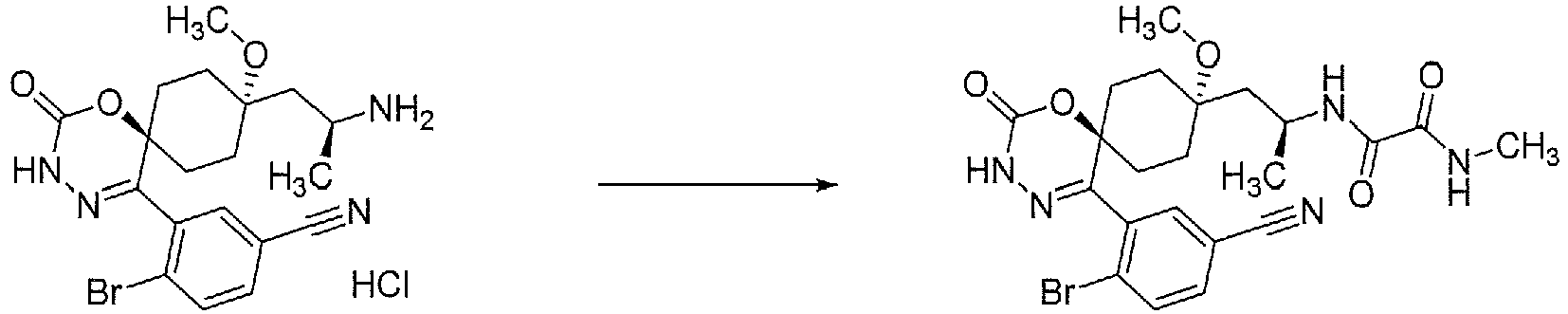
- To a solution of 3-(trans-9-((S)-2-aminopropyl)-9-methoxy-2-oxo-1-oxa-3,4-diazaspiro[5.5]undec-4-en-5-yl)-4-bromobenzonitrile hydrochloride obtained in (7) (0.050 g) in DMF (0.75 ml) were added 2-methylamino-2-oxoacetic acid (0.016 g), N,N-diisopropylethylamine (0.074 ml) and HATU (0.060 g) at room temperature, and the mixture was stirred for 1 hr. The reaction solution was purified by reverse-phase silica gel chromatography (developing solvent: acetonitrile/water=5/95 to 65/35) and then thin layer chromatography (developing solvent: ethyl acetate/n-hexane=67/33), and the fractions were concentrated under reduced pressure to give the title compound (0.049 g) in 89% yield.
1H-NMR (DMSO-D6) δ: 11.32 (1H, s), 8.65-8.54 (2H, m), 8.09-8.05 (1H, m), 8.03-7.98 (1H, m), 7.91-7.86 (1H, m), 4.01-3.92 (1H, m), 2.92 (3H, s), 2.67-2.63 (3H, m), 1.99-1.42 (10H, m), 1.08 (3H, d, J = 6.5 Hz). - The compounds of the other Examples were obtained by employing the same methods as in the above Production Methods or Production Examples, and, where necessary, known methods. The structural formulae and physical property data of the compounds of Examples 1 to 339 and 2-001 to 2-172 are shown in Table 1-1 to Table 1-61.
Table 1-1 Ex. No. Structure Notes 1H-NMR (400 MHz) MS (M+1) MS (M-1) 1 
1H-NMR (DMSO-D6) δ: 11.65 (1H, s), 11.16 (1H, s), 8.17 (1H, d, J = 8.3 Hz), 7.44-7.37 (4H, m), 7.16 (2H, t, J = 8.3 Hz), 7.11 (1H, s), 7.04 (1H, td, J = 8.3, 2.6 Hz), 4.24-4.16 (1H, m), 2.82-2.71 (2H, m), 2.39-2.30 (4H, m), 1.97 (2H, d, J = 13.6 Hz), 1.81 (2H, td, J = 13.6, 5.2 Hz), 1.15 (3H, d, J = 6.5 Hz). 482 480 2 
1H-NMR (DMSO-D6) δ: 11.63 (1H, s), 11.30 (1H, s), 8.20 (1H, d, J = 6.5 Hz), 7.73 (1H, d, J = 6.5 Hz), 7.51 (1H, t, J = 7.6 Hz), 7.42-7.36 (2H, m), 7.30 (1H, t, J = 8.9 Hz), 7.08 (1H, s), 7.03 (1H, t, J = 8.9 Hz), 4.29-4.18 (1H, m), 2.48-2.35 (6H, m), 2.17-2.09 (2H, m), 1.69-1.57 (2H, m), 1.13 (3H, d, J = 6.7 Hz). 560 558 3 
1H-NMR (DMSO-D6) δ: 12.80 (1H, s), 11.26 (1H, s), 7.74 (1H, d, J = 8.0 Hz), 7.58 (1H, d, J = 7.4 Hz), 7.53 (1H, t, J = 7.4 Hz), 7.35 (1H, t, J = 8.0 Hz), 6.29 (1H, s), 4.12-4.02 (1H, m), 2.68 (2H, d, J = 12.3 Hz), 2.44-2.39 (1H, m), 2.33-2.25 (3H, m), 2.24 (3H, s), 2.07 (2H, d, J = 12.3 Hz), 1.55 (2H, s), 1.07 (3H, d, J = 6.2 Hz). 507 505 4 
1H-NMR (DMSO-D6) δ: 11.62 (1H, s), 11.11 (1H, s), 8.20 (1H, d, J = 8.3 Hz), 7.50 (2H, dd, J = 8.8, 5.5 Hz), 7.42-7.36 (2H, m), 7.22 (2H, t, J = 8.8 Hz), 7.12 (1H, d, J = 1.6 Hz), 7.02 (1H, td, J = 8.8, 2.5 Hz), 4.21-4.12 (1H, m), 2.04-1.95 (2H, m), 1.78-1.70 (2H, tm), 1.68-1.61 (1H, m), 1.61-1.51 (2H, m), 1.48-1.23 (4H, m), 1.15 (3H, d, J = 6.5 Hz). 481 479 5 
1H-NMR (DMSO-D6) δ: 12.82 (1H, s), 11.11 (1H, s), 7.62 (1H, s), 7.51 (2H, dd, J = 8.6, 5.3 Hz), 7.23 (2H, dd, J = 8.6, 5.3 Hz), 6.33 (1H, s), 4.12-4.02 (1H, m), 2.24 (3H, s), 2.02-1.95 (2H, m), 1.74-1.66 (2H, m), 1.66-1.60 (1H, m), 1.59-1.50 (2H, m), 1.42-1.22 (4H, m), 1.10 (3H, d, J = 6.2 Hz). 428 426 6 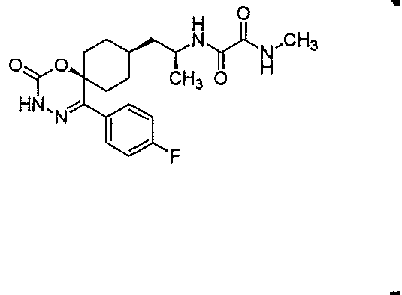
1H-NMR (DMSO-D6) δ: 11.11 (1H, s), 8.66 (1H, d, J = 5.3 Hz), 8.45 (1H, d, J = 9.2 Hz), 7.52 (2H, dd, J = 8.9, 5.3 Hz), 7.25 (2H, t, J = 8.9 Hz), 3.99-3.89 (1H, m), 2.66 (3H, d, J = 5.3 Hz), 2.02-1.95 (2H, m), 1.74-1.46 (5H, m), 1.35-1.21 (4H, m), 1.08 (3H, d, J = 6.5 Hz). 405 403 7 
1H-NMR (DMSO-D6) δ: 11.12 (1H, s), 8.45 (1H, d, J = 8.3 Hz), 7.76 (1H, d, J = 8.3 Hz), 7.65 (1H, d, J = 8.3 Hz), 7.52 (1H, s), 7.51 (2H, t, J = 7.5 Hz), 7.46 (1H, t, J = 7.5 Hz), 7.33 (1H, t, J = 8.3 Hz), 7.22 (2H, t, J = 8.3 Hz), 4.20-4.10 (1H, m), 2.04-1.94 (2H, m), 1.74-1.53 (5H, m), 1.46-1.26 (4H, m), 1.16 (3H, d, J = 6.5 Hz). 464 462 8 
1H-NMR (DMSO-D6) δ: 11.62 (1H, s), 11.29 (1H, s), 8.20 (1H, d, J = 9.0 Hz), 7.93 (2H, d, J = 8.3 Hz), 7.74 (2H, d, J = 8.3 Hz), 7.42-7.36 (2H, m), 7.13 (1H, d, J = 2.1 Hz), 7.02 (1H, td, J = 9.0, 2.3 Hz), 4.21-4.13 (1H, m), 3.24 (3H, s), 2.08-1.98 (2H, m), 1.78-1.30 (9H, m), 1.16 (3H, d, J = 6.5 Hz). 541 539 Table 1-2 9 
1H-NMR (DMSO-D6) δ: 12.83 (1H, s), 11.28 (1H, s), 7.94 (2H, d, J = 8.3 Hz), 7.74 (2H, d, J = 8.3 Hz), 7.63 (1H, d, J = 8.8 Hz), 6.32 (1H, s), 4.12-4.05 (1H, m), 3.25 (3H, s), 2.24 (3H, s), 2.06-1.98 (2H, m), 1.75-1.68 (2H, m), 1.65-1.54 (3H, m), 1.43-1.23 (4H, m), 1.10 (3H, d, J = 6.7 Hz). 488 486 10 
1H-NMR (DMSO-D6) δ: 11.29 (1H, s), 8.66 (1H, d, J = 5.1 Hz), 8.46 (1H, q, J = 5.1 Hz), 7.96 (2H, d, J = 8.3 Hz), 7.76 (2H, d, J = 8.3 Hz), 3.98-3.90 (1H, m), 3.27 (3H, s), 2.66 (3H, d, J = 5.1 Hz), 2.06-1.98 (2H, m), 1.77-1.50 (5H, m), 1.38-1.23 (4H, m), 1.08 (3H, d, J = 6.5 Hz). 465 463 11 
1H-NMR (DMSO-D6) δ: 11.20 (1H, s), 7.74 (1H, dd, J = 8.4, 2.4 Hz), 7.58-7.50 (2H, m), 7.35 (1H, td, J = 8.4, 2.4 Hz), 3.86-3.76 (1H, m), 2.16-2.08 (2H, m), 1.73 (3H, s), 1.65-1.58 (1H, m), 1.51-1.14 (8H, m), 0.97 (3H, d, J = 6.5 Hz). 440 438 12 
1H-NMR (DMSO-D6) δ: 12.96 (0.18H, s), 12.81 (0.82H, s), 11.20 (1H, s), 7.97 (0.18H, d, J = 8.1 Hz), 7.71 (1H, dd, J = 8.6, 2.5 Hz), 7.60 (0.82H, d, J = 8.1 Hz), 7.51 (1H, dd, J = 8.6, 6.0 Hz), 7.31 (1H, td, J = 8.1, 2.5 Hz), 6.59 (0.18H, s), 6.31 (0.82H, s), 4.10-4.00 (1H, m), 2.23 (3H, s), 2.17-2.07 (2H, m), 1.73-1.65 (1H, m), 1.55-1.45 (2H, m), 1.40-1.20 (6H, m), 1.07 (3H, d, J = 6.5 Hz). 506 504 13 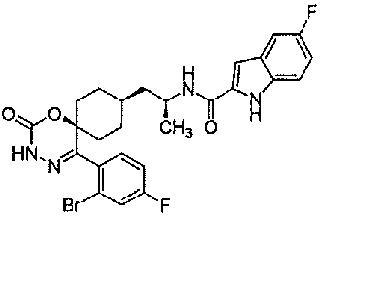
1H-NMR (DMSO-D6) δ: 11.60 (1H, s), 11.20 (1H, s), 8.17 (1H, d, J = 8.7 Hz), 7.70 (1H, dd, J = 8.7, 2.7 Hz), 7.49 (1H, dd, J = 8.7, 6.1 Hz), 7.38 (1H, s), 7.40-7.32 (1H,m), 7.30 (1H, td, J = 8.7, 2.7 Hz), 7.10 (1H, s), 7.02 (1H, td, J = 9.2, 2.7 Hz), 4.20-4.08 (1H, m), 2.18-2.08 (2H, m), 1.78-1.70 (1H, m), 1.57-1.49 (2H, m), 1.43-1.23 (6H, m), 1.13 (3H, d, J = 6.5 Hz), 559 557 14 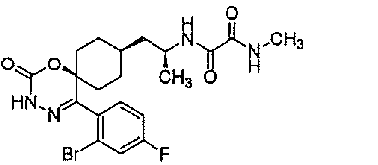
1H-NMR (DMSO-D6) δ: 11.20 (1H, s), 8.64 (1H, q, J = 5.0 Hz), 8.43 (1H, d, J = 8.6 Hz), 7.73 (1H, dd, J = 8.6, 2.5 Hz), 7.52 (1H, dd, J = 8.6, 5,0 Hz), 7.34 (1H, td, J = 8.6, 2.5 Hz), 3.96-3.85 (1H, m), 2.64 (3H, d, J = 5.0 Hz), 2.17-2.05 (2H, m), 1.67-1.63 (1H, m), 1.55-1.15 (8H, m), 1.05 (3H, d, J = 6.5 Hz). 483 481 15 
1H-NMR (DMSO-D6) δ: 11.62 (1H, s), 11.25 (1H, s), 8.63 (1H, d, J = 2.4 Hz), 8.62 (1H, dd, J = 4.9, 1.8 Hz), 8.20 (1H, d, J = 8.3 Hz), 7.92 (1H, dt, J = 8.3, 1.8 Hz), 7.44-7.36 (3H, m), 7.12 (1H, d, J = 1.8 Hz), 7.02 (1H, td, J = 9.1, 2.4 Hz), 4.22-4.12 (1H, m), 2.06-1.98 (2H, m), 1.77-1.45 (6H, m), 1.41-1.28 (3H, m), 1.16 (3H, d, J = 6.5 Hz). 464 462 16 
1H-NMR (DMSO-D6) δ: 12.82 (1H, s), 11.24 (1H, s), 8.64 (1H, s), 8.63 (1H, dd, J = 4.7, 1.3 Hz), 7.93 (1H, d, J = 8.1 Hz), 7.65-7.58 (1H, m), 7.44 (1H, dd, J = 8.1, 4.7 Hz), 6.32 (1H, s), 4.14-4.04 (1H, m), 2.24 (3H, s), 2.06-1.99 (2H, m), 1.74-1.51 (5H, m), 1.46-1.23 (4H, m), 1.10 (3H, d, J = 6.0 Hz). 411 409 Table 1-3 17 
1H-NMR (DMSO-D6) δ: 11.24 (1H, s), 8.67-8.63 (3H, m), 8.44 (1H, d, J = 9.2 Hz), 7.94 (1H, dt, J = 8.0, 1.8 Hz), 7.46 (1H, dd, J = 8.0, 4.7 Hz), 3.97-3.87 (1H, m), 2.65 (3H, d, J = 4.7 Hz), 2.04-1.97 (2H, m), 1.77-1.48 (5H, m), 1.35-1.24 (4H, m), 1.08 (3H, d, J = 6.7 Hz). 388 386 18 
"Mixture of two diastereomers due to 5-position of pyrrolidone ring 1H-NMR (DMSO-D6) δ: 11.21 (1H, s), 7.76-7.73 (2H, m), 7.68 (1H, dd, J = 8.6, 4.6 Hz), 7.53 (1H, dd, J = 8.6, 6.0 Hz), 7.36 (1H, tt, J = 8.6, 2.3 Hz), 3.92-3.86 (1H, m), 3.85-3.81 (1H, m), 2.20-2.02 (5H, m), 1.82-1.73 (1H, m), 1.63-1.58 (1H, m), 1.51-1.18 (8H, m), 1.01-0.98 (3H, m). 509 507 19 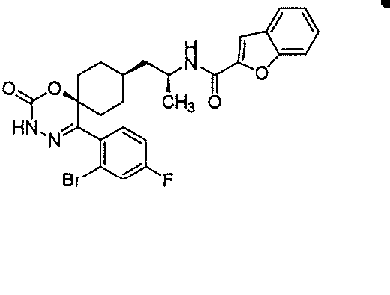
1H-NMR (DMSO-D6) δ: 11.20 (1H, s), 8.41 (1H, d, J = 8.6 Hz), 7.75 (1H, d, J = 7.6 Hz), 7.70 (1H, dd, J = 8.6, 2.2 Hz), 7.63 (1H, d, J = 7.6 Hz), 7.50 (1H, dd, J = 8.6, 5.9 Hz), 7.49 (1H, s), 7.45 (1H, td, J = 7.6, 2.2 Hz), 7.33 (1H, t, J = 4.7 Hz), 7.31-7.27 (1H, m), 4.19-4.09 (1H, m), 2.18-2.07 (2H, m), 1.75-1.67 (1H, m), 1.60-1.50 (2H, m), 1.46-1.19 (6H, m), 1.13 (3H, d, J = 6.5 Hz). 542 540 20 
1H-NMR (DMSO-D6) δ: 11.20 (1H, s), 7.74 (1H, dd, J = 8.6, 2.5 Hz), 7.53 (1H, dd, J = 8.6, 6.0 Hz), 7.42 (1H, d, J = 8.4 Hz), 7.35 (1H, td, J = 8.4, 2.5 Hz), 3.86-3.76 (1H, m), 2.30-2.23 (1H, m), 2.16-2.08 (2H, m), 1.63-1.56 (1H, m), 1.53-1.46 (1H, m), 1.43-1.18 (7H, m), 0.97-0.92 (9H, m). 468 466 21 
1H-NMR (DMSO-D6) δ: 11.20 (1H, s), 7.77 (1H, d, J = 7.9 Hz), 7.74 (1H, dd, J = 8.7, 2.5 Hz), 7.54 (1H, dd, J = 8.7, 5.9 Hz), 7.35 (1H, td, J = 8.7, 2.5 Hz), 3.87-3.78 (1H, m), 2.17-2.07 (2H, m), 1.64-1.56 (1H, m), 1.52-1.17 (9H, m), 0.98 (3H, d, J = 6.5 Hz), 0.62-0.56 (4H, m). 466 464 22 
1H-NMR (DMSO-D6) δ: 12.82 (1H, s), 11.15 (1H, s), 7.63-7.59 (1H, m), 7.60 (2H, d, J = 8.6 Hz), 7.41 (2H, d, J = 8.6 Hz), 6.33 (1H, s), 4.07 (1H, s), 2.25 (3H, s), 2.01-1.96 (2H, m), 1.72-1.51 (5H, m), 1.40-1.24 (4H, m), 1.10 (3H, d, J = 6.5 Hz). 488 486 23 
1H-NMR (DMSO-D6) δ: 11.15 (1H, s), 8.65 (1H, q, J = 4.9 Hz), 8.44 (1H, d, J = 9.2 Hz), 7.62 (2H, d, J = 8.6 Hz), 7.43 (2H, d, J = 8.6 Hz), 3.98-3.88 (1H, m), 2.66 (3H, d, J = 4.9 Hz), 2.02-1.95 (2H, m), 1.74-1.47 (5H, m), 1.34-1.21 (4H, m), 1.08 (3H, d, J = 6.5 Hz). 465 463 24 
1H-NMR (DMSO-D6) δ: 11.16 (1H, s), 8.65 (1H, q, J =4.5 Hz), 8.43 (1H, d, J = 9.0 Hz), 7.66 (1H, d, J = 7.5 Hz), 7.62 (1H, s), 7.50 (1H, d, J = 7.5 Hz), 7.39 (1H, t, J = 7.5 Hz), 3.98-3.88 (1H, m), 2.65 (3H, d, J = 4.5 Hz), 2.03-1.96 (2H, m), 1.83-1.48 (5H, m), 1.33-1.21 (4H, m), 1.08 (3H, d, J = 6.7 Hz). 465 463 Table 1-4 25 
1H-NMR (DMSO-D6) δ: 12.81 (1H, s), 11.16 (1H, s), 7.66-7.58 (3H, m), 7.48 (1H, d, J = 7.9 Hz), 7.38 (1H, d, J = 7.9 Hz), 6.32 (1H, s), 4.12-4.02 (1H, m), 2.24 (3H, s), 2.04-1.97 (2H, m), 1.78-1.48 (5H, m), 1.44-1.20 (4H, m), 1.10 (3H, d, J = 6.0 Hz). 488 486 26 
1H-NMR (DMSO-D6) δ: 11.16 (1H, s), 8.63 (1H, q, J = 4.8 Hz), 8.41 (1H, d, J = 8.6 Hz), 7.73 (1H, d, J = 8.6 Hz), 7.48-7.37 (3H, m), 3.95-3.85 (1H, m), 2.63 (3H, d, J = 4.8 Hz), 2.18-2.08 (2H, m), 1.69-1.61 (1H, m), 1.54-1.13 (8H, m), 1.05 (3H, d, J = 6.7 Hz). 465 463 27 
1H-NMR (DMSO-D6) δ: 12.94 (0.18H, s), 12.80 (0.82H, s), 11.16 (1H, s), 7.94 (0.18H, d, J = 9.0 Hz), 7.72 (1H, d, J = 7.6 Hz), 7.58 (0.82H, d, J = 9.0 Hz), 7.44-7.38 (3H, m), 6.56 (0,18H, s), 6.30 (0.82H, s), 4.10-4.00 (1H, m), 2.23 (3H, s), 2.17-2.08 (2H, m), 1.75-1.63 (1H, m), 1.55-1.45 (2H, m), 1.39-1.20 (6H, m), 1.07 (3H, d, J = 6.0 Hz). 488 486 28 
1H-NMR (DMSO-D6) δ: 11.20 (1H, s), 7.74 (1H, dd, J = 8.6, 2.5 Hz), 7.53 (1H, dd, J = 8.6, 6.0 Hz), 7.35 (1H, td, J = 8.6, 2.5 Hz), 7.29 (1H, d, J = 8.6 Hz), 5.35 (1H, d, J = 5.3 Hz), 3.92-3.84 (2H, m), 2.16-2.09 (2H, m), 1.65-1.58 (1H, m), 1.52-1.18 (8H, m), 1.14 (3H, d, J = 6.7 Hz), 1.01 (3H, d, J = 6.5 Hz). 470 468 29 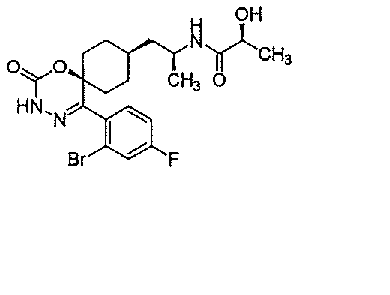
1H-NMR (DMSO-D6) δ: 11.19 (1H, s), 7.74 (1H, dd, J = 8.8, 2.6 Hz), 7.53 (1H, dd, J = 8.6, 6.0 Hz), 7.35 (1H, td, J = 8.6, 2.6 Hz), 7.27 (1H, d, J = 8.8 Hz), 5.32 (1H, d, J = 5.1 Hz), 3.91-3.82 (2H, m), 2.17-2.09 (2H, m), 1.67-1.60 (1H, m), 1.51-1.19 (8H, m), 1.15 (3H, d, J = 6.7 Hz), 1.00 (3H, d, J = 6.5 Hz). 470 468 30 
1H-NMR (DMSO-D6) δ: 11.19 (1H, s), 8.27 (1H, d, J = 9.0 Hz), 7.73 (1H, dd, J = 8.6, 2.6 Hz), 7.52 (1H, dd, J = 8.6, 6.1 Hz), 7.34 (1H, td, J = 8.6, 2.6 Hz), 3.91-3.82 (1H, m), 2.30 (3H, s), 2.15-2,08 (2H, m), 1.64-1.59 (1H, m), 1.50-1.18 (8H, m), 1.04 (3H, d, J = 6.5 Hz). 468 466 31 
1H-NMR (DMSO-D6) δ: 12.80 (1H, s), 11.31 (1H, s), 8.23 (1H, d, J = 1.8 Hz), 7.95 (1H, dd, J = 8.2, 1.8 Hz), 7.74 (1H, d, J = 8.2 Hz), 7.61-7.56 (1H, m), 6.31-6.29 (1H, m), 4.10-4.02 (1H, m), 3.33 (3H, s), 2.23 (3H, s), 2.20-2.10 (2H, m), 1.73-1.67 (1H, m), 1.55-1.46 (2H, m), 1.45-1.21 (6H, m), 1.07 (3H, d, J = 6.5 Hz). 566 564 32 
1H-NMR (DMSO-D6) δ: 11.58 (1H, s), 11.32 (1H, s), 8.22 (1H, d, J = 1.8 Hz), 8.16 (1H, d, J = 8.6 Hz), 7.94 (1H, dd, J = 8.0, 1.8 Hz), 7.72 (1H, d, J = 8.0 Hz), 7.40-7.34 (2H, m), 7.10-7.08 (1H, m), 7.04-6.98 (1H, m), 4.18-4.09 (1H, m), 3.31 (3H, s), 2.20-2.12 (2H, m), 1.77-1.71 (1H, m), 1.57-1.49 (2H, m), 1.47-1.22 (6H, m), 1.13 (3H, d, J = 6.5 Hz). 619 617 Table 1-5 33 
1H-NMR (DMSO-D6) δ: 11.31 (1H, s), 8.65-8.60 (1H, m), 8.41 (1H, d, J = 9.2 Hz), 8.25 (1H, d, J = 1.8 Hz), 7.97 (1H, dd, J = 8.1, 1.8 Hz), 7.75 (1H, d, J = 8.1 Hz), 3.95-3.86 (1H, m), 3.34 (3H, s), 2.63 (3H, d, J = 4.9 Hz), 2.17-2.11 (2H, m), 1.69-1.63 (1H, m), 1.56-1.44 (2H, m), 1.40-1.18 (6H, m), 1.05 (3H, d, J = 6.5 Hz). 543 541 34 
1H-NMR (DMSO-D6) δ: 11.20 (1H, s), 7.74 (1H, dd, J = 8.5, 2.5 Hz), 7.53 (1H, dd, J = 8.5, 6.0 Hz), 7.35 (1H, td, J = 8.5, 2.5 Hz), 6.56 (1H, d, J = 9.0 Hz), 3.55-3.45 (1H, m), 2.19-2.08 (2H, m), 1.68-1.60 (1H, m), 1.50-1.12 (8H, m), 1.32 (9H, s), 0.96 (3H, d, J = 6.5 Hz). 498 496 35 
1H-NMR (DMSO-D6) δ: 11.20 (1H, s), 8.05 (1H, d, J = 8.4 Hz), 7.74 (1H, dd, J = 8.4, 2.5 Hz), 7.54 (1H, dd, J = 8.4, 6.1 Hz), 7.36 (1H, td, J = 8.4, 2.5 Hz), 4.00-3.92 (1H, m), 2.18-2.09 (2H, m), 1.65-1.59 (1H, m), 1.51-1.19 (10H, m), 1.16-1,10 (2H, m), 1.06 (3H, d, J = 6.7 Hz). 484 482 36 
1H-NMR (DMSO-D6) δ: 11.20 (1H, s), 7.74 (1H, dd, J = 8.7, 2.5 Hz), 7.54 (1H, dd, J = 8.7, 5.9 Hz), 7.42 (1H, d, J = 8.7 Hz), 7.36 (1H, td, J = 8.7, 2.5 Hz), 6.11 (1H, s), 3.93-3.85 (1H, m), 2.18-2.09 (2H, m), 1.66-1.59 (1H, m), 1.53-1.22 (8H, m), 1.03 (3H, d, J = 6.5 Hz), 0.96 (2H, q, J = 3.8 Hz), 0.77 (2H, q, J = 3.8 Hz). 482 480 37 
1H-NMR (CDCl3) δ: 8.19 (1H, br s), 7.41 (1H, dd, J = 8.1, 2.5 Hz), 7.21-7.17 (1H, m), 7.12-7.07 (1H, m), 6.87 (1H, s), 6.22-6.18 (1H, m), 4.31-4.21 (1H, m), 2.35-2.28 (2H, m), 1.82-1.77 (1H, m), 1.63-1.52 (2H, m), 1.51-1.36 (5H, m), 1.34-1.25 (1H, m), 1.23 (3H, d, J = 6.5 Hz). 527 525 38 
Mixture of two diastereomers due to 1, 2-posltlons of cyclopropane ring (relative configuration: trans) 1H-NMR (CDCl3) δ: 8.12-8.08 (1H, m), 7.43-7.40 (1H, m), 7.30-7.24 (2H, m), 7.23-7.16 (2H, m), 7.13-7.02 (3H, m), 5.29-5.23 (1H, m), 4.16-4.07 (1H, m), 2.47-2.40 (1H, m), 2.35-2.26 (2H, m), 1.80-1.75 (1H, m), 1.62-1.38 (7H, m), 1.37-1.17 (4H, m), 1.14-1.10 (3H, m). 542 540 39 
Mixture of two diastereomers due to 1,2-positions of cyclopropane ring (relative configuration: cis) 1H-NMR (CDCl3) δ: 8.11 (1H, s), 7.50-7.41 (1H, m), 7.23-7.09 (5H, m), 7.08-7.03 (1H, m), 6.90-6.86 (1H, m), 4.97-4.89 (1H, m), 3.89-3.80 (1H, m), 2.44-2.35 (1H, m), 2.27-2.12 (2H, m), 1.91-1.83 (1H, m), 1.69-1.61 (2H, m), 1.50-1.00 (9H, m), 0.94-0.74 (3H, m), 542 540 40 
1H-NMR (CDCl3) δ: 8.15 (1H, s), 7.74-7.71 (2H, m), 7.51-7.38 (4H, m), 7.20-7.16 (1H, m), 7.10-7.05 (1H, m), 5.77 (1H, d, J = 9.0 Hz), 4.38-4.28 (1H, m), 2.33-2.27 (2H, m), 1.90-1.85 (1H, m), 1.62-1.52 (3H, m), 1.51-1.38 (4H, m), 1.37-1.28 (1H, m), 1.22 (3H, d, J = 6.5 Hz). 502 500 Table 1-6 41 
1H-NMR (CDCl3) δ: 8.11 (1H, s), 7.42 (1H, dd, J = 8.1, 2.5 Hz), 7.23-7.19 (1H, m), 7.14-7.09 (1H, m), 5.74-5.70 (1H, m), 4.15-4.07 (1H, m), 3.33 (2H, s), 2.35-2.29 (2H, m), 1.78-1.73 (1H, m), 1.59-1.52 (2H, m), 1.50-1.37 (4H, m), 1.29-1.21 (2H, m), 1.16 (3H, d, J = 6.5 Hz). 465 463 42 
1H-NMR (CDCl3) δ: 8.10 (1H, s), 7.41 (1H, dd, J = 8.1, 2.5 Hz), 7.22-7.18 (1H, m), 7.13-7.07 (1H, m), 5.08-5.02 (1H, m), 4.16-4.08 (1H, m), 2.32-2.27 (2H, m), 2.09 (2H, t, J = 7.5 Hz), 1.84-1.79 (1H, m), 1.67-1.59 (2H, m), 1.57-1.40 (5H, m), 1.33-1.23 (3H, m), 1.10 (3H, d, J = 6.5 Hz), 0.91 (3H, t, J = 7.5 Hz). 468 466 43 
1H-NMR (CDCl3) δ: 8.12 (1H, s), 7.42 (1H, dd, J = 8.2, 2.7 Hz), 7.23-7.20 (1H, m), 7.13-7.09 (1H, m), 5.31-5.28 (1H, m), 4.15-4.07 (1H, m), 3.46-3.31 (2H, m), 2.91 (3H, s), 2.69-2.65 (2H, m), 2.33-2.27 (2H, m), 1.77-1.72 (1H, m), 1.56-1.42 (5H, m), 1.36-1.24 (3H, m), 1.12 (3H, d, J = 6.5 Hz). 532 530 44 
1H-NMR (DMSO-D6) δ: 11.20 (1H, s), 8.66-8.60 (1H, m), 8.41 (1H, d, J = 9.0 Hz), 7.59 (1H, dd, J = 8.8, 2.5 Hz), 7.53 (1H, dd, J = 8.6, 6.1 Hz), 7.30 (1H, td, J = 6.6, 2.8 Hz), 3.97-3.85 (1H, m), 2.64 (3H, d, J = 5.0 Hz), 2.09 (2H, d, J = 13.0 Hz), 1.70-1.12 (9H, m), 1.05 (3H, d, J = 6.5 Hz). 439 437 45 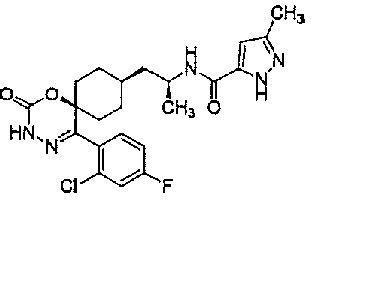
1H-NMR (DMSO-D6) δ: 12.80 (1H, s), 11.19 (1H, s), 7.63-7.47 (3H, m), 7.28 (1H, td, J = 8.5, 2.2 Hz), 6.30 (1H, s), 4.14-3.99 (1H, m), 2.29-2.04 (5H, m), 1.79-1.16 (9H, m), 1.07 (3H, d, J = 6.5 Hz). 462 460 46 
1H-NMR (DMSO-D6) δ: 11.20 (1H, s), 8.40 (1H, d, J = 8.5 Hz), 7.75 (1H, d, J = 7.8 Hz), 7.63 (1H, d, J = 8.3 Hz), 7.57 (1H, dd, J = 8.8, 2.5 Hz), 7.52 (1H, dd, J = 8.8, 6.0 Hz), 7.49 (1H, d, J = 0.8 Hz), 7.47-7.42 (1H, m), 7.32 (1H, t, J = 7.5 Hz), 7.26 (1H, td, J = 8.5, 2.6 Hz), 4.18-4.08 (1H, m), 2.16-2.05 (2H, m), 1.75-1.66 (1H, m), 1.63-1.21 (8H, m), 1.13 (3H, d, J = 6.5 Hz). 498 496 47 
1H-NMR (DMSO-D6) δ: 11.20 (1H, s), 8,70-8,61 (2H, m), 7.74 (1H, dd, J = 8.0, 2.5 Hz), 7.53 (1H, dd, J = 8.0, 6.6 Hz), 7.36 (1H, td, J = 8.0, 2.5 Hz), 3.18-3.00 (2H, m), 2.64 (3H, d, J = 4.9 Hz), 2.17-2.09 (2H, m), 1.62-1.56 (2H, m), 1.45-1.33 (4H, m), 1.28-1.20 (3H, m). 469 467 48 
1H-NMR (CDCl3) δ: 8.24 (1H, d, J = 1.8 Hz), 8.21 (1H, s), 7.94 (1H, dd, J = 8.1, 1.8 Hz), 7.42 (1H, d, J = 8.1 Hz), 6.86 (1H, s), 6.20-6.17 (1H, m), 4.31-4.22 (1H, m), 3.11 (3H, s), 2.37-2.32 (2H, m), 1.87-1.80 (1H, m), 1.64-1.27 (8H, m), 1.23 (3H, d, J = 6.5 Hz). 587 585 Table 1-7 49 
1H-NMR (CDCl3) δ: 8.23 (1H, d, J = 1.8 Hz), 8.18 (1H, s), 7.92 (1H, dd, J = 8.2, 1.8 Hz), 7.73-7.70 (2H, m), 7.52-7.48 (1H, m), 7.45-7.40 (3H, m), 5.78-5.73 (1H, m), 4.38-4.31 (1H, m), 3.10 (3H, s), 2.36-2.30 (2H, m), 1.96-1.90 (1H, m), 1.64-1.49 (2H, m), 1.48-1.26 (6H, m), 1.22 (3H, d, J =6.7 Hz). 562 560 50 
1H-NMR (DMSO-D6) δ: 11.15 (1H, s), 8.43 (1H, d, J = 9.0 Hz), 7.76 (1H, d, J = 7.3 Hz), 7.65 (1H, d, J = 8.6 Hz), 7.59 (2H, d, J = 8.6 Hz), 7.51 (1H, s), 7.46 (1H, t, J = 7.3 Hz), 7.41 (2H, d, J = 8.6 Hz), 7.33 (1H, t, J = 7.3 Hz), 4.19-4.12 (1H, m), 2.04-1.96 (2H, m), 1.74-1.53 (5H, m), 1.47-1.24 (4H, m), 1.16 (3H, d, J = 6.5 Hz). 524 522 51 
1H-NMR (DMSO-D6) δ: 11.32 (1H, s), 8.65-8.58 (1H, m), 8.41 (1H, d, J = 9.0 Hz), 8.12 (1H, d, J = 1.8 Hz), 7.93 (1H, dd, J = 8.0, 1.8 Hz), 7.78 (1H, d, J = 8.0 Hz), 3.95-3.85 (1H, m), 3.34 (3H, s), 2.63 (3H, d, J = 4.8 Hz), 2.18-2.08 (2H, m), 1.69-1.61 (1H, m), 1.59-1.14 (8H, m), 1.05 (3H, d, J = 6.5 Hz). 499 497 52 
1H-NMR (DMSO-D6) δ: 11.32 (1H, s), 8.77 (1H, d, J = 8.5 Hz), 8.11 (1H, d, J = 1.8 Hz), 7.93 (1H, dd, J = 8.0, 1.8 Hz), 7.78 (1H, d, J = 8.0 Hz), 7.32 (1H, s), 4.12-4.00 (1H, m), 3.33 (3H, s), 2.14 (2H, d, J = 11.3 Hz), 1.66 (1H, d, J = 11.0 Hz), 1.56-1.19 (8H, m), 1.10 (3H, d, J = 6.5 Hz). 543 541 53 
1H-NMR (DMSO-D6) δ: 11.32 (1H, s), 8.40 (1H, d, J = 8.5 Hz), 8.09 (1H, d, J = 1.8 Hz), 7.90 (1H, dd, J = 8.0, 1.8 Hz), 7.75 (2H, t, J = 7.5 Hz), 7.62 (1H, d, J = 8.8 Hz), 7.48 (1H, s), 7.44 (1H, t, J = 7.3 Hz), 7.32 (1H, t, J = 7.3 Hz), 4.15 (1H, bs), 3.36 (3H, s), 2.14 (2H, t, J = 11.0 Hz), 1.71 (1H, d, J = 9.0 Hz), 1.60-1.30 (8H, m), 1.13 (3H, d, J = 6.5 Hz). 558 556 54 
1H-NMR (DMSO-D6) δ: 11.00 (1H, s), 8.64 (1H, q, J = 4.7 Hz), 8.42 (1H, d, J = 9.8 Hz), 7.21 (1H, dd, J = 8.4, 6.8 Hz), 7.01 (1H, dd, J = 9.8, 2.4 Hz), 6.81 (1H, td, J = 8.4, 2.4 Hz), 3.96-3.86 (1H, m), 3.79 (3H, s), 2.64 (3H, d, J = 4.7 Hz), 2.00-1.93 (2H, m), 1.68-1.60 (1H,m), 1.50-1.38 (4H, m), 1.28-1.13 (4H, m), 1.06 (3H, d, J = 6.8 Hz). 435 433 55 
1H-NMR (DMSO-D6) δ: 11.08 (1H, s), 8.62 (1H, q, J = 4.9 Hz), 8.41 (1H, d, J = 9.0 Hz), 7.32 (1H, dd, J = 8.6, 6.0 Hz), 7.17 (1H, dd, J = 10.3, 2.7 Hz), 7.06 (1H, td, J = 8.6, 2.7 Hz), 3.95-3.86 (1H, m), 2.64 (3H, d, J = 4.9 Hz), 2.23 (3H, s), 2.06-1.99 (2H, m), 1.68-1.15 (9H, m), 1.05 (3H, d, J = 6.5 Hz). 419 417 56 
1H-NMR (DMSO-D6) δ: 11.26 (1H, s), 8.64 (1H, q, J = 4.9 Hz), 8.43 (1H, d, J = 9.2 Hz), 7.80 (1H, dd, J = 9.2, 2.5 Hz), 7.71 (1H, dd, J = 8.8, 5.3 Hz), 7.65-7.58 (1H, m), 3.97-3.84 (1H, m), 2.65 (3H, d, J = 4.9 Hz), 2.07-1.88 (2H, m), 1.70-1.60 (1H, m), 1.60-1.14 (8H, m), 1.06 (3H, d, J = 6.5 Hz). 473 471 Table 1-8 57 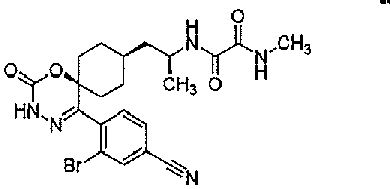
1H-NMR (CDCl3) δ: 8.24 (1H, s), 7.97 (1H, d, J = 1.6 Hz), 7.68 (1H, dd, J = 7.9, 1.6 Hz), 7.44-7.39 (1H, m), 7.33 (1H, d, J = 7.9 Hz), 7.18-7.14 (1H, m), 4.08-4.00 (1H, m), 2.89 (3H, d, J = 5.3 Hz), 2.34-2.28 (2H, m), 1.79-1.72 (1H, m), 1.60-1.51 (2H, m), 1.50-1.31 (5H, m), 1.30-1.21 (1H, m), 1.16 (3H, d, J = 6.5 Hz). 490 488 58 
1H-NMR (DMSO-D6) δ: 11.10 (1H, s), 8.65-8.60 (1H, m), 8.41 (1H, d, J = 9.5 Hz), 7.34 (1H, d, J = 8.6 Hz), 7.28 (1H, d, J = 2.5 Hz), 7.01 (1H, dd, J = 8.6, 2.5 Hz), 3.95-3.85 (1H, m), 3.81 (3H, s), 2.64 (3H, d, J = 4.9 Hz), 2.14-2.05 (2H, m), 1.68-1.62 (1H, m), 1.56-1.11 (8H, m), 1.05 (3H, d, J = 6.5 Hz). 495 493 59 
1H-NMR (DMSO-D6) δ: 11.10 (1H, s), 8.77 (1H, d, J = 8.3 Hz), 7.34 (1H, d, J = 8.6 Hz), 7.32 (1H, s), 7.28 (1H, d, J = 2.5 Hz), 7.00 (1H, dd, J = 8.6, 2.8 Hz), 4.11-4.01 (1H, m), 3.80 (3H, s), 2.15-2.06 (2H, m), 1.69-1.61 (1H, m), 1.55-1.20 (8H, m), 1.11 (3H, d, J = 6.5 Hz). 539 537 60 
1H-NMR (DMSO-D6) δ: 11.21 (1H, s), 8.62 (1H, q, J = 5.2 Hz), 8.41 (1H, d, J = 9.7 Hz), 8.02 (1H, d, J = 1.8 Hz), 7.66 (1H, dd, J = 8.3, 1.8 Hz), 7.41 (1H, d, J = 8.3 Hz), 3.95-3.86 (1H, m), 2.64 (3H, d, J = 5.2 Hz), 2.13-2.06 (2H, m), 1.68-1.61 (1H, m), 1.53-1.15 (8H, m), 1.05 (3H, d, J = 6.5 Hz), 543 541 61 
1H-NMR (DMSO-D6) δ: 11.20 (1H, s), 8.46 (1H, d, J = 8.5 Hz), 7.66 (1H, dd, J = 9.0, 4.3 Hz), 7.57 (2H, dd, J = 8.8, 2.8 Hz), 7.52 (1H, dd, J = 8.6, 6.1 Hz), 7.49 (1H, s), 7.33-7.23 (2H, m), 4.18-4.07 (1H, m), 2.16-2.05 (2H, m), 1.75-1.66 (1H, m), 1.62-1.21 (8H, m), 1.13 (3H, d, J = 6.5 Hz). 516 514 62 
1H-NMR (DMSO-D6) δ: 12.07 (1H, s), 11.20 (1H, s), 8.34 (1H, d, J = 8.5 Hz), 8.24 (1H, s), 7.68 (1H, dd, J = 8.8, 1,8 Hz), 7.61-7.55 (2H, m), 7.51 (1H, dd, J = 8.6, 6.1 Hz), 7.33 (1H, d, J = 1.5 Hz), 7.26 (1H, td, J = 8.6, 2.6 Hz), 4.22-4.10 (1H, m), 3.17 (3H, s), 2.15-2.06 (2H, m), 1.77-1.69 (1H, m), 1.59-1.21 (8H, m), 1.15 (3H, d, J = 6.5 Hz). 575 573 63 
1H-NMR (DMSO-D6) δ: 11.20 (1H, s), 8.77 (1H, d, J = 8.3 Hz), 7.59 (1H, dd, J = 9.0, 2.5 Hz), 7.53 (1H, dd, J = 8.6, 6.1 Hz), 7.32 (1H, s), 7.29 (1H, td, J = 8.5, 2.5 Hz), 4.12-4.01 (1H, m), 2.10 (2H, d, J = 13.0 Hz), 1.69-1.60 (1H, m), 1.57-1.20 (8H, m), 1.11 (3H, d, J = 6.8 Hz). 483 481 64 
1H-NMR (CDCl3) δ: 8.09 (1H, s), 7.44-7.38 (1H, m), 7.18-7.13 (1H, m), 7.08-7.04 (1H, m), 6.90-6.85 (1H, m), 6,52 (1H, dd, J = 10.6, 2.5 Hz), 4.08-3.98 (1H, m), 2.89 (3H, d, J = 5.3 Hz), 2.27-2.19 (2H, m), 1.89-1.82 (1H, m), 1.76-1.70 (1H, m), 1.54-1.35 (7H, m), 1.29-1.21 (1H, m), 1.16 (3H, d, J = 6.5 Hz), 1.06-1.02 (2H, m), 0.75-0.71 (2H, m), 445 443 Table 1-9 65 
1H-NMR (CDCl3) δ: 8.07 (1H, s), 7.05 (1H, dd, J = 8.6, 5.8 Hz), 6.89-6.84 (2H, m), 6.52 (1H, dd, J = 10.4, 2.5 Hz), 6.20-6.16 (1H, m), 4.30-4.21 (1H, m), 2.28-2.22 (2H, m), 1,89-1.77 (2H, m), 1.60-1.39 (7H, m), 1.35-1.26 (1H, m), 1.23 (3H, d, J = 6.5 Hz), 1.06-1.02 (2H, m), 0.75-0.71 (2H, m). 489 487 66 
1H-NMR (CDCl3) δ: 8.21 (1H, s), 8.18 (1H, d, J = 1.7 Hz), 7.88 (1H, dd, J = 8.0, 1.7 Hz), 7.43-7.39 (2H, m), 7.17-7.14 (1H, m), 4.11-4.01 (1H, m), 3.29-3.21 (1H, m), 2.89 (3H, d, J = 5.3 Hz), 2.36-2.29 (2H, m), 1.79-1.74 (1H, m), 1.58-1.37 (7H, m), 1.35 (6H, d, J = 7.2 Hz), 1.29-1.21 (1H, m), 1.16 (3H, d, J = 6.5 Hz). 571 569 67 
1H-NMR (CDCl3) δ: 8.19 (1H, s), 8.17 (1H, d, J = 1.8 Hz), 7.87 (1H, dd, J = 8.0, 1.8 Hz), 7.41 (1H, d, J = 8.0 Hz), 6.86 (1H, s), 6.21-6.17 (1H, m), 4.32-4.22 (1H, m), 3.27-3.20 (1H, m), 2.38-2.31 (2H, m), 1.86-1.77 (1H, m), 1.61-1.39 (7H, m), 1.34 (6H, d, J = 6.9 Hz), 1.29-1.21 (4H, m). 615 613 68 
1H-NMR (DMSO-D6) δ: 11.35 (1H, s), 8.68-8.63 (1H, m), 8.44 (1H, d, J = 9.2 Hz), 7.48 (1H, d, J = 1.8 Hz), 6.62 (1H, d, J = 2.1 Hz), 3.97-3.87 (1H, m), 3.81 (3H, s), 2.66 (3H, d, J = 5.1 Hz), 2.03-1.96 (2H, m), 1.77-1.46 (5H, m), 1.37-1.17 (4H, m), 1.08 (3H, d, J = 6.5 Hz). 391 389 69 
1H-NMR (DMSO-D6) δ: 11.19 (1H, s), 8.58 (1H, d, J = 8.3 Hz), 7.72 (1H, dd, J = 8.7, 2.7 Hz), 7.52 (1H, dd, J = 8.6, 6.0 Hz), 7.33 (1H, td, J = 8.5, 2.5 Hz), 6.75 (1H, s), 4.09-3.99 (1H, m), 3.92 (3H, s), 2.16-2.07 (2H, m), 1.69-1.61 (1H, m), 1.55-1.20 (8H, m), 1.09 (3H, d, J = 6.7 Hz). 523 521 70 
1H-NMR (DMSO-D6) δ: 11.20 (1H, s), 8.68 (1H, d, J = 5.2 Hz), 8.41 (1H, d, J = 9.0 Hz), 7.60 (1H, dd, J = 8.6, 2.6 Hz), 7.53 (1H, dd, J = 9.0, 6.0 Hz), 7.30 (1H, td, J = 8.4, 2.6 Hz), 3.93-3.85 (1H, m), 2.77-2.70 (1H, m), 2.12-2.04 (2H, m), 1.68-1.61 (1H, m), 1.54-1.16 (8H, m), 1.05 (3H, d, J = 6.7 Hz), 0.64-0,58 (4H, m), 465 463 71 
1H-NMR (CDCl3) δ: 8.17 (1H, s), 7.96 (1H, d, J = 1.6 Hz), 7.67 (1H, dd, J = 8.0, 1.6 Hz), 7.33 (1H, d, J = 8.0 Hz), 6.86 (1H, s), 6.19-6.15 (1H, m), 4.30-4.22 (1H, m), 2.35-2.31 (2H, m), 1.85-1.79 (1H, m), 1.60-1.25 (8H, m), 1.23 (3H, d, J = 6.5 Hz). 534 532 72 
1H-NMR (DMSO-D6) δ: 14.40-14.28 (1H, m), 11.20 (1H, s), 8.30-8.25 (1H, m), 7.72 (1H, dd, J = 8.7, 2.7 Hz), 7.50 (1H, dd, J = 8.6, 6.0 Hz), 7.32 (1H, td, J = 8.4, 2.5 Hz), 7.26 (1H, s), 4.14-4.03 (1H, m), 2.16-2.07 (2H, m), 1.75-1.67 (1H, m), 1.54-1.21 (8H, m), 1.11 (3H, d, J = 6.5 Hz). 560 558 Table 1-10 73 
1H-NMR (DMSO-D6) δ: 11.06 (1H, s), 8.68 (1H, q, J = 5.2 Hz), 8.38 (1H, d, J = 9.0 Hz), 7.78 (2H, d, J = 7.6 Hz), 7.74 (1H, dd, J = 8.1, 2.0 Hz), 7.66 (1H, d, J = 2.0 Hz), 7.51-7.37 (9H, m), 3.90-3.80 (1H, m), 2.67 (3H, d, J = 5.0 Hz), 1.63-1.07 (11H, m), 1.02 (3H, d, J = 6.7 Hz). 539 537 74 
1H-NMR (DMSO-D6) δ: 11.09 (1H, s), 8.63 (1H, q, J = 4.7 Hz), 8.41 (1H, d, J = 9.0 Hz), 7.46-7.36 (2H, m), 7.26-7.15 (2H, m), 3.95-3.85 (1H, m), 2.64 (3H, d, J = 4.7 Hz), 2.43 (3H, s), 2.16-2.07 (2H, m), 1.66-1.60 (1H, m), 1.53-1.37 (3H, m), 1.34-1.13 (5H, m), 1.05 (3H, d, J = 6.5 Hz). 433 431 75 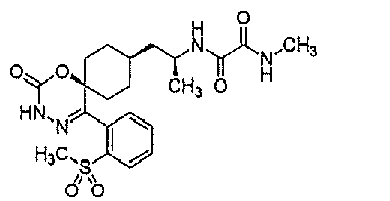
1H-NMR (DMSO-D6) δ: 11.12 (1H, s), 8.64 (1H, q, J = 4.6 Hz), 8.42 (1H, d, J = 8.8 Hz), 8.07 (1H, d, J = 7.8 Hz), 7.82-7.75 (2H, m), 7.66 (1H, d, J = 7.8 Hz), 3.96-3.86 (1H, m), 3.24 (3H, s), 2.65 (3H, d, J = 4.6 Hz), 2.20-2.09 (2H, m), 1.66-1.45 (4H, m), 1.34-1.17 (5H, m), 1.06 (3H, d, J = 6.7 Hz). 465 463 76 
1H-NMR (DMSO-D6) δ: 11.12 (1H, s), 8.78 (1H, d, J = 8.1 Hz), 8.06 (1H, d, J = 7.6 Hz), 7.77 (2H, dt, J = 18.1, 7.5 Hz), 7.65 (1H, d, J = 6.5 Hz), 7.33 (1H, s), 4.07 (1H, s), 3.24 (3H, s), 2.21-2.06 (2H, m), 1.68-1.42 (4H, m), 1.39-1.20 (5H, m), 1.12 (3H, d, J = 6.2 Hz). 509 507 77 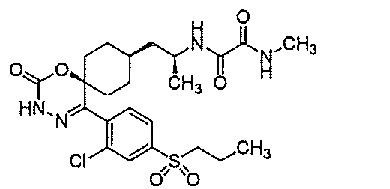
1H-NMR (DMSO-D6) δ: 11.32 (1H, s), 8.66-8.59 (1H, m), 8.41 (1H, d, J = 9.3 Hz), 8.06 (1H, d, J = 1.8 Hz), 7.90 (1H, dd, J = 8.0, 1.8 Hz), 7.77 (1H, d, J = 8.0 Hz), 3.96-3.84 (1H, m), 3.45-3.39 (2H, m), 2.63 (3H, d, J = 5.3 Hz), 2.16-2.06 (2H, m), 1.69-1.13 (11H, m), 1.05 (3H, d, J = 6.5 Hz), 0.94 (3H, t, J = 7.5 Hz). 527 525 78 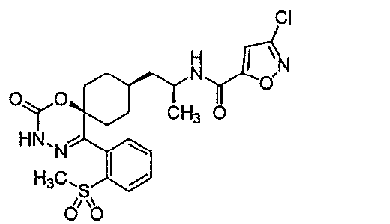
1H-NMR (DMSO-D6) δ: 11.12 (1H, s), 8.78 (1H, d, J = 8.1 Hz), 8.06 (1H, d, J = 7.0 Hz), 7,82-7.72 (2H, m), 7.65 (1H, d, J = 7.0 Hz), 7.33 (1H, s), 4.10-4.02 (1H, m), 3.24 (3H, s), 2.21-2.06 (2H, m), 1.68-1.42 (4H, m), 1.39-1.20 (5H, m), 1.12 (3H, d, J = 6.2 Hz). 509 507 79 
1H-NMR (DMSO-D6) δ: 11.09 (1H, s), 8.76 (1H, d, J = 9.0 Hz), 7.45-7.37 (2H, m), 7.32 (1H, s), 7.25-7.18 (2H, m), 4.10-4.03 (1H, m), 2.43 (3H, s), 2.17-2.09 (2H, m), 1.66-1.61 (1H, m), 1.54-1.21 (8H, m), 1.11 (3H, d, J = 6.5 H). 477 475 80 
1H-NMR (DMSO-D6) δ: 11.25 (1H, s), 8.66-8.60 (1H, m), 8.41 (1H, d, J = 9.2 Hz), 7.85-7.83 (1H, m), 7.61 (1H, d, J = 8.3 Hz), 7.51-7.46 (1H, m), 3.95-3.85 (1H, m), 2.64 (3H, d, J = 4.9 Hz), 2.16-2.08 (2H, m), 1.70-1.61 (1H, m), 1.56-1.16 (8H, m), 1.05 (3H, d, J = 6.5 Hz). 549 547 Table 1-11 81 
1H-NMR (DMSO-D6) δ: 11.25 (1H, s), 8.77 (1H, d, J = 8.6 Hz), 7.85-7.83 (1H, m), 7.61 (1H, d, J = 8.6 Hz), 7.50-7.46 (1H, m), 7.33-7.31 (1H, m), 4.11-4.01 (1H, m), 2.18-2.09 (2H, m), 1.70-1.62 (1H, m), 1.57-1.21 (8H, m), 1.11 (3H, d, J = 6.5 Hz). 593 591 82 
1H-NMR (DMSO-D6) δ: 11.23 (1H, s), 8.71-8.65 (1H, m), 8.49 (1H, d, J = 9.5 Hz), 7.39 (1H, s), 7.03 (1H, s), 4.01-3.90 (1H, m), 3.98 (2H, d, J = 7.6 Hz), 2.68 (3H, d, J = 4.9 Hz), 2.37-2.20 (2H, m), 1.93-1.82 (2H, m), 1.73-1.64 (1H, m), 1.62-1.45 (2H, m), 1.37-1.15 (5H, m), 1.09 (3H, d, J = 6.5 Hz), 0.52-0.45 (2H, m), 0.37-0.30 (2H, m). 431 429 83 
1H-NMR (DMSO-D6) δ: 11.24 (1H, s), 8.86-8.82 (1H, m), 7.38 (2H, d, J = 9.0 Hz), 7.01 (1H, s), 4.16-4.06 (1H, m), 3.98 (2H, d, J = 7.4 Hz), 2.37-2.22 (2H, m), 1.93-1.84 (2H, m), 1.72-1.65 (1H, m), 1.60-1.50 (2H, m), 1.44-1.17 (5H, m), 1.15 (3H, d, J = 6.9 Hz), 0.51-0.45 (2H, m), 0.37-0.31 (2H, m). 475 473 84 
1H-NMR (DMSO-D6) δ: 11.23 (1H, s), 8.47 (1H, d, J = 8.3 Hz), 7.79-7.75 (1H, m), 7.66 (1H, d, J = 8.6 Hz), 7.54 (1H, s), 7.50-7.43 (1H, m), 7.37 (1H, s), 7.34 (1H, t, J = 8.2 Hz), 6.98 (1H, s), 4.24-4.13 (1H, m), 3.97 (2H, d, J = 7.2 Hz), 2.38-2.21 (2H, m), 1.93-1.85 (2H, m), 1.79-1.69 (1H, m), 1.67-1.51 (2H, m), 1.48-1.14 (5H, m), 1.17 (3H, d, J = 6.2 Hz), 0.51-0.44 (2H, m), 0.36-0.29 (2H, m). 490 488 85 
1H-NMR (DMSO-D6) δ: 11.12 (1H, s), 8.67-8.59 (1H, m), 8.44-8.39 (1H, m), 7.41-7.35 (2H, m), 7.11-7.07 (1H, m), 6.55-6.23 (1H, m), 4.47-4.36 (2H, m), 3.98-3.82 (1H, m), 2.64 (3H, d, J = 4.9 Hz), 2.14-2.05 (2H, m), 1.71-1.61 (1H, m), 1.59-1,10 (8H, m), 1.05 (3H, d, J = 6.5 Hz). 545 543 86 
1H-NMR (DMSO-D6) δ: 11.14 (1H, d, J = 2.3 Hz), 8.65-8.60 (1H, m), 8.41 (1H, d, J = 9.0 Hz), 7.46 (1H, d, J = 2.8 Hz), 7.41 (1H, d, J = 8.1 Hz), 7.14 (1H, dd, J = 8.6, 2.5 Hz), 4.87 (2H, q, J = 8.8 Hz), 3.96-3.85 (1H, m), 2.64 (3H, d, J = 4.6 Hz), 2.15-2.05 (2H, m), 1.70-1.60 (1H, m), 1.58-1.09 (8H, m), 1.05 (3H, d, J = 6.5 Hz). 563 561 87 
1H-NMR (DMSO-D6) δ: 11.24 (1H, s), 8.40 (1H, d, J = 9.2 Hz), 7.82 (1H, d, J = 1.8 Hz), 7.74 (1H, d, J = 8.1 Hz), 7.63 (1H, d, J = 8.3 Hz), 7.59 (1H, d, J = 8.6 Hz), 7.49 (1H, d, J = 0.9 Hz), 7.47-7.42 (2H, m), 7.34-7.30 (1H, m), 4.18-4.07 (1H, m), 2.18-2.09 (2H, m), 1.75-1.66 (1H, m), 1.65-1.20 (8H, m), 1.13 (3H, d, J = 6.7 Hz). 608 606 88 
1H-NMR (DMSO-D6) δ: 11.09 (1H, s), 8.13 (1H, d, J = 8.3 Hz), 7.56-7.48 (2H, m), 7.36-7.30 (2H, m), 7.18 (1H, dd, J = 10.2, 2.8 Hz), 7.08 (1H, td, J = 8.6, 2.8 Hz), 4.08-4.00 (1H, m), 2.24 (3H, s), 2.10-2.02 (2H, m), 1.70-1.63 (1H, m), 1.56-1.23 (8H, m), 1.09 (3H, d, J = 6.5 Hz). 490 488 Table 1-12 89 
1H-NMR (DMSO-D6) δ: 11.08 (1H, s), 8.66 (1H, d, J = 2.3 Hz), 8.45 (1H, d, J = 9.2 Hz), 8.09 (1H, dd, J = 8.6, 2.3 Hz), 8.01 (1H, d, J = 8.6 Hz), 7.30 (1H, dd, J = 8.4, 5.9 Hz), 7.16 (1H, dd, J = 10.2, 2.5 Hz), 7.03 (1H, td, J = 8.4, 2.5 Hz), 4.16-4.07 (1H, m), 2.22 (3H, s), 2.08-1.98 (2H, m), 1.72-1.21 (9H, m), 1.13 (3H, d, J = 6.7 Hz). 473 471 90 
1H-NMR (DMSO-D6) δ: 11.26 (1H, s), 8.66-8.59 (1H, m), 8.35 (1H, d, J = 8.8 Hz), 7.62 (1H, dd, J = 9.0, 2.5 Hz), 7.56 (1H, dd, J = 8.6, 6.1 Hz), 7.33 (1H, td, J = 8.6, 2.6 Hz), 3.98-3.86 (1H, m), 2.74-2.59 (2H, m), 2.64 (3H, d, J = 5.0 Hz), 2.42 (1H, dd, J = 12.5, 8.3 Hz), 2.35-2.18 (3H, m), 2.10-2,00 (2H, m), 1,63-1,46 (2H, m), 1.04 (3H, d, J = 6.5 Hz). 440 438 91 
1H-NMR (DMSO-D6) δ: 11.25 (1H, s), 8.39 (1H, d, J = 8.3 Hz), 7.65 (1H, dd, J = 9.1, 4.1 Hz), 7.59 (1H, d, J = 2.5 Hz), 7.56 (1H, d, J = 2.5 Hz), 7.52 (1H, dd, J = 8.6, 5.9 Hz), 7.45 (1H, s), 7.31 (1H, td, J = 8.6, 2.7 Hz), 7.26 (1H, td, J = 8.6, 2.5 Hz), 4.20-4.09 (1H, m), 2.77-2.64 (2H, m), 2.49-2.43 (1H, m), 2.37-2.25 (3H, m), 2.06 (2H, d, J = 14.3 Hz), 1.61-1.48 (2H, m), 1.11 (3H, d, J = 6.8 Hz). 517 515 92 
1H-NMR (DMSO-D6) δ: 11.26 (1H, s), 8.72 (1H, d, J = 8.5 Hz), 7.61 (1H, dd, J = 9.0, 2.5 Hz), 7.54 (1H, dd, J = 8.6, 6.1 Hz), 7.34-7.28 (1H, m), 7.28 (1H, s), 4.14-4.04 (1H, m), 2.76-2.61 (2H, m), 2.42 (1H, dd, J = 12.5, 8.0 Hz), 2.37-2.23 (3H, m), 2.09-2.00 (2H, m), 1.60-1.48 (2H, m), 1.09 (3H, d, J = 6.8 Hz). 484 482 93 
1H-NMR (DMSO-D6) δ: 12.80 (1H, s), 11.25 (1H, s), 7.66-7.50 (3H, m), 7.31 (1H, td, J = 8.5, 2.6 Hz), 6.28 (1H, s), 4.12-4.01 (1H, m), 2.75-2.61 (2H, m), 2.46-2.38 (1H, m), 2.35-2.14 (6H, m), 2.10-2.01 (2H, m), 1.63-1.49 (2H, m), 1.07 (3H, d, J = 6.5 Hz). 463 461 94 
1H-NMR (DMSO-D6) δ: 11.26 (1H, s), 8.41 (1H, s), 8.10 (1H, d, J = 8.5 Hz), 7.61 (1H, dd, J = 8.8, 2.5 Hz), 7.54 (1H, dd, J = 8.5, 6.0 Hz), 7.31 (1H, td, J = 8.5, 2.6 Hz), 4.16-4.01 (1H, m), 4.07 (3H, s), 2.75-2.65 (2H, m), 2.49-2.42 (1H, m), 2.35-2.23 (3H, m), 2.10-2.00 (2H, m), 1.64-1.48 (2H, m), 1.09 (3H, d, J = 6.5 Hz), 464 462 95 
1H-NMR (DMSO-D6) δ: 14.62 (1H, brs), 11.26 (1H, s), 8.46-8.09 (1H, m), 7.95 (1H, s), 7.60 (1H, dd, J = 8.8, 2.5 Hz), 7.54 (1H, dd, J = 8.8, 6.0 Hz), 7.31 (1H, td, J = 8.8, 2.5 Hz), 4.17-4.04 (1H, m), 2.77-2.61 (2H, m), 2.54-2.43 (1H, m), 2.37-2.21 (3H, m), 2.10-2.00 (2H, m), 1.65-1.48 (2H, m), 1.10 (3H, d, J = 6.5 Hz). 450 448 96 
1H-NMR (DMSO-D6) δ: 11.14 (1H, s), 8.63 (1H, q, J = 4.7 Hz), 8.41 (1H, d, J = 9.7 Hz), 7.78 (1H, s), 7.50 (1H, d, J = 8.2 Hz), 7.36 (1H, d, J = 8.2 Hz), 5.23 (1H, s), 3.97-3.83 (1H, m), 2.64 (3H, d, J = 4.7 Hz), 2.19-2.05 (2H, m), 1.72-1.61 (1H, m), 1.56-1.14 (8H, m), 1.43 (6H, s), 1.05 (3H, d, J = 6.7 Hz). 523 521 Table 1-13 97 
1H-NMR (DMSO-D6) δ: 11.14 (1H, s), 8.76 (1H, d, J = 9.0 Hz), 7.78 (1H, s), 7.49 (1H, d, J = 8.2 Hz), 7.35 (1H, d, J = 8.2 Hz), 7.32 (1H, s), 5.22 (1H, s), 4.11-3.99 (1H, m), 2.19-2.07 (2H, m), 1.71-1.60 (1H, m), 1.57-1.20 (8H, m), 1.42 (6H, s), 1.11 (3H, d, J = 6.7 Hz). 567 565 98 
1H-NMR (DMSO-D6) δ: 11.25 (1H, s), 8.30 (1H, d, J = 8.5 Hz), 7.62 (1H, dd, J = 9.0, 2.5 Hz), 7.55 (1H, dd, J = 8.6, 6.1 Hz), 7.32 (1H, td, J = 8.5, 2.5 Hz), 6.42 (1H, s), 4.14-4.03 (1H, m), 2.74-2.61 (2H, m), 2.47-2.38 (1H, m), 2.44 (3H, s), 2.36-2.23 (3H, m), 2.10-2.00 (2H, m), 1.62-1.47 (2H, m), 1.07 (3H, d, J = 6.8 Hz). 464 462 99 
1H-NMR (DMSO-D6) δ: 11.51 (1H, s), 9,12-9,07 (1H, m), 7.83 (1H, s), 7.72-7.58 (2H, m), 7.45-7.36 (1H, m), 4.56-4.32 (1H, m), 2.55-2.24 (6H, m), 2.12-1.81 (2H, m), 1.67-1.43 (2H, m), 1.21 (3H, d, J = 6.5 Hz). 520 (M+3) 516 100 
1H-NMR (DMSO-D6) δ: 14.36 (1H, s), 11.26 (1H, s), 8.26 (1H, d, J = 8.0 Hz), 7.60 (1H, dd, J = 8.8, 2,5 Hz), 7.52 (1H, dd, J = 8.6, 6.1 Hz), 7.29 (1H, td, J = 8.6, 2.6 Hz), 7.23 (1H, s), 4.16-4.06 (1H, m), 2.78-2.64 (2H, m), 2.41 (1H, dd, J = 12.4, 7.6 Hz), 2.36-2.25 (3H, m), 2.05 (2H, d, J = 13.5 Hz), 1.62-1.50 (2H, m), 1.10 (3H, d, J = 6.5 Hz). 517 515 101 
1H-NMR (DMSO-D6) δ: 11,08 (1H, s), 7.34-7.24 (5H, m), 7.16 (1H, dd, J = 10.3, 2.7 Hz), 7.04 (1H, td, J = 8.5, 2.5 Hz), 5.88 (1H, d, J = 8.3 Hz), 4.60-4.50 (4H, m), 3.84-3.75 (1H, m), 2.23 (3H, s), 2.09-2.00 (2H, m), 1.69-1.61 (1H, m), 1.55-1.17 (8H, m), 1.04 (3H, d, J = 6.5 Hz). 479 477 102 
1H-NMR (DMSO-D6) δ: 11.17 (1H, s), 8.62 (1H, q, J = 4.5 Hz), 8.51 (1H, d, J = 5.2 Hz), 8.41 (1H, d, J = 9.0 Hz), 7.73 (1H, d, J = 7.5 Hz), 7.28 (1H, dd, J = 7.5, 5.2 Hz), 3.97-3.83 (1H, m), 2.64 (3H, d, J = 4.5 Hz), 2.41 (3H, s), 2.14-2.01 (2H, m), 1.71-1.60 (1H, m), 1.58-1.40 (3H, m), 1.40-1.15 (5H, m), 1.05 (3H, d, J = 6.7 Hz). 402 400 103 
1H-NMR (DMSO-D6) δ: 11.17 (1H, s), 8.77 (1H, d, J = 8.2 Hz), 8.50 (1H, d, J = 4.5 Hz), 7.72 (1H, d, J = 7.5 Hz), 7.32 (1H, s), 7.27 (1H, dd, J = 7.5, 4.5 Hz), 4.12-4.00 (1H, m), 2.41 (3H, s), 2.14-2.03 (2H, m), 1.71-1.61 (1H, m), 1.56-1.21 (8H, m), 1.11 (3H, d, J = 6.0 Hz). 446 444 104 
1H-NMR (DMSO-D6) δ: 11.17 (1H, s), 8.48 (1H, d, J = 3.0 Hz), 8.40 (1H, d, J = 9.0 Hz), 7.74 (1H, d, J = 8.2 Hz), 7.71 (1H, dd, J = 8,2, 1.5 Hz), 7.63 (1H, d, J = 8.2 Hz), 7.49 (1H, s), 7.45 (1H, t, J = 7.5 Hz), 7.32 (1H, t, J = 7.5 Hz), 7.24 (1H, dd, J = 7.9, 4.9 Hz), 4.19-4.07 (1H, m), 2.41 (3H, s), 2.14-2.01 (2H, m), 1.75-1.66 (1H, m), 1.63-1.21 (8H, m), 1.13 (3H, d, J = 6.7 Hz). 461 459 Table 1-14 105 
1H-NMR (DMSO-D6) δ: 11.22 (1H, s), 8.63 (1H, q, J = 4.5 Hz), 8.42 (1H, d, J = 9.7 Hz), 7.64-7.58 (1H, m), 7.55-7.43 (3H, m), 3.97-3.83 (1H, m), 2.64 (3H, d, J = 4.5 Hz), 2.07-1.96 (2H, m), 1.71-1.58 (1H, m), 1.58-1.14 (8H, m), 1.05 (3H, d, J = 6.7 Hz). 471 469 106 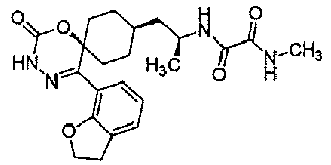
1H-NMR (DMSO-D6) δ: 11.03 (1H, s), 8.70-8.65 (1H, m), 8.44 (1H, d, J = 9.0 Hz), 7.31 (1H, d, J = 6.9 Hz), 7.03 (1H, d, J = 7.6 Hz), 6.87 (1H, t, J = 7.5 Hz), 4.57-4.49 (2H, m), 4.00-3.87 (1H, m), 3.21 (2H, t, J = 8.4 Hz), 2.66 (3H, d, J = 4.9 Hz), 1.99-1.87 (2H, m), 1.79-1.42 (5H, m), 1.35-1.14 (4H, m), 1.07 (3H, d, J = 6.7 Hz). 429 427 107 
1H-NMR (DMSO-D6) δ: 12.87-12.77 (1H, m), 11.02 (1H, s), 7.65-7.57 (1H, m), 7.31-7.27 (1H, m), 7.03-7.00 (1H, m), 6.85 (1H, t, J = 7.5 Hz), 6.35-6.29 (1H, m), 4.53-4.39 (2H, m), 4.13-4,02 (1H, m), 3.18 (2H, t, J = 8.7 Hz), 2.29-2.16 (3H, m), 1.98-1.87 (2H, m), 1.76-1.43 (5H, m), 1.33-1.17 (4H, m), 1.09 (3H, d, J = 6.5 Hz). 452 450 108 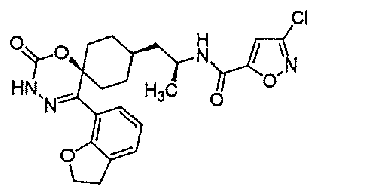
1H-NMR (DMSO-D6) δ: 11.03 (1H, s), 8.80 (1H, d, J = 9.0 Hz), 7.35 (1H, s), 7.30 (1H, d, J = 7.4 Hz), 7.02 (1H, d, J = 7.4 Hz), 6.86 (1H, t, J = 7.5 Hz), 4.57-4.43 (2H, m), 4.13-4.01 (1H, m), 3.20 (2H, t, J = 8.7 Hz), 1.99-1.90 (2H, m), 1.77-1.44 (5H, m), 1.37-1.16 (4H, m), 1.13 (3H, d, J = 6.5 Hz). 473 471 109 
1H-NMR (DMSO-D6) δ: 11.30 (1H, s), 8.33 (1H, d, J = 1.4 Hz), 7.92 (1H, dd, J = 7.9, 1.6 Hz), 7.67 (1H, d, J = 7.9 Hz), 7.32-7.25 (4H, m), 5.88 (1H, d, J = 8.1 Hz), 4.61-4.47 (4H, m), 3.86-3.75 (1H, m), 2.20-2.10 (2H, m), 1.73-1.60 (1H, m), 1.58-1.13 (8H, m), 1.04 (3H, d, J = 6.5 Hz). 550 548 110 
1H-NMR (DMSO-D6) δ: 12.80 (1H, s), 11.22 (1H, s), 7.63-7.56 (2H, m), 7.53-7.49 (1H, m), 7.49-7.42 (2H, m), 6.30 (1H, s), 4.12-3.99 (1H, m), 2.23 (3H, s), 2.08-1.96 (2H, m), 1.74-1.62 (1H, m), 1.58-1.18 (8H, m), 1.07 (3H, d, J = 6.7 Hz). 494 492 111 
1H-NMR (DMSO-D6) δ: 11.22 (1H, s), 8.77 (1H, d, J = 8.2 Hz), 7.65-7.56 (1H, m), 7.55-7.42 (3H, m), 7.32 (1H, s), 4.13-3.99 (1H, m), 2.10-1.97 (2H, m), 1.71-1.61 (1H, m), 1.57-1.20 (8H, m), 1.11 (3H, d, J = 6.7 Hz). 515 513 112 
1H-NMR (DMSO-D6) δ: 11.20 (1H, s), 8.62 (1H, q, J = 4.5 Hz), 8.51-8.44 (2H, m), 8.41 (1H, d, J = 9.0 Hz), 7.35 (1H, d, J = 5.2 Hz), 3.98-3.83 (1H, m), 2.64 (3H, d, J = 4.5 Hz), 2.25 (3H, s), 2.13-2.00 (2H, m), 1.72-1.60 (1H, m), 1.58-1.42 (3H, m), 1.42-1.17 (5H, m), 1.06 (3H, d, J = 6.0 Hz). 402 400 Table 1-15 113 
1H-NMR (DMSO-D6) δ: 11.21 (1H, s), 8.77 (1H, d, J = 8.2 Hz), 8.47 (1H, d, J = 5.2 Hz), 8.45 (1H, s), 7.35 (1H, d, J = 5.2 Hz), 7.32 (1H, s), 4.13-3.99 (1H, m), 2.25 (3H, s), 2.14-2.00 (2H, m), 1.71-1.59 (1H, m), 1.57-1.20 (8H, m), 1.11 (3H, d, J = 6.7 Hz). 446 444 114 
1H-NMR (DMSO-D6) δ: 11.21 (1H, s), 8.49-8.37 (3H, m), 7.74 (1H, d, J = 8.2 Hz), 7.63 (1H, d, J = 8.2 Hz), 7.49 (1H, s), 7.44 (1H, t, J = 7.9 Hz), 7.37-7.28 (2H, m), 4.21-4.05 (1H, m), 2.24 (3H, s), 2.15-2.02 (2H, m), 1.79-1.65 (1H, m), 1.65-1.20 (8H, m), 1.13 (3H, d, J = 6.7 Hz). 461 459 115 
1H-NMR (DMSO-D6) δ: 11.21 (1H, s), 8.40 (1H, d, J = 8.5 Hz), 7.66 (1H, dd, J = 9.0, 4.0 Hz), 7.58 (1H, dd, J = 8.6, 2.9 Hz), 7.46 (1H, s), 7.40 (1H, d, J = 1.8 Hz), 7.34 (1H, d, J = 8.3 Hz), 7.29 (1H, dd, J = 9.1, 2.9 Hz), 7.22 (1H, dd, J = 8.1, 1.9 Hz), 4.20-4.08 (1H, m), 3.32 (3H, s), 2.78-2.65 (2H, m), 2.49-2.41 (1H, m), 2.37-2.24 (3H, m), 2.09-1.99 (2H, m), 1.64-1.49 (2H, m), 1.11 (3H, d, J = 6.5 Hz). 545 543 116 
1H-NMR (DMSO-D6) δ: 11.37 (1H, s), 8.40 (1H, d, J = 8.5 Hz), 8.12 (1H, d, J = 1.8 Hz), 7.93 (1H, dd, J = 8.3, 1.8 Hz), 7.79 (1H, d, J = 7.8 Hz), 7.68-7.63 (1H, m), 7.60-7.55 (1H, m), 7.44 (1H, s), 7.33-7.26 (1H, m), 4,19-4.08 (1H, m), 3.32 (3H, s), 2.80-2.65 (3H, m), 2.38-2.25 (3H, m), 2.15-2.05 (2H, m), 1.66-1.51 (2H, m), 1.11 (3H, d, J = 6.5 Hz). 577 575 117 
1H-NMR (DMSO-D6) δ: 11.32 (1H, s), 8.46 (1H, d, J = 8.8 Hz), 8.09 (1H, d, J = 1.8 Hz), 7.90 (1H, dd, J = 8.0, 1.8 Hz), 7.76 (1H, d, J = 8.0 Hz), 7.66 (1H, dd, J = 9.1, 4.1 Hz), 7.57 (1H, dd, J = 8.8, 2.5 Hz), 7.48 (1H, s), 7.29 (1H, td, J = 9.1, 2.7 Hz), 4.18-4.06 (1H, m), 3.31 (3H, s), 2.14 (2H, t, J = 9.9 Hz), 1.75-1.67 (1H, m), 1.62-1.21 (8H, m), 1.12 (3H, d, J = 6.5 Hz). 576 574 118 
1H-NMR (DMSO-D6) δ: 11.35 (1H, s), 8.63 (1H, q, J = 4.9 Hz), 8.44 (1H, d, J = 9.2 Hz), 7.51 (1H, dd, J = 6.2, 3.0 Hz), 7.31-7.25 (2H, m), 3.99-3.88 (1H, m), 2.65 (3H, d, J = 4.9 Hz), 2.07-1.98 (2H, m), 1.74-1.46 (5H, m), 1.36-1.18 (4H, m), 1.07 (3H, d, J = 6.5 Hz). 467 465 119 
1H-NMR (DMSO-D6) δ: 11.05 (1H, s), 8.63 (1H, q, J = 4.5 Hz), 8.41 (1H, d, J = 9.0 Hz), 7.38-7.18 (4H, m), 3.98-3.82 (1H, m), 2.64 (3H, d, J = 4.5 Hz), 2.22 (3H, s), 2.10-1.97 (2H, m), 1.70-1.60 (1H, m), 1.58-1.38 (3H, m), 1.38-1.15 (5H, m), 1.05 (3H, d, J = 6.7 Hz). 401 399 120 
Mixture (4:1) of two stereoisomers due to 1,4-posistions of cyclohexane ring (cis form is presumed to be major.) 1H-NMR (DMSO-D6) δ: 11.37 (0.2H, s), 11.34 (0.8H, s), 8.91 (0.2H, s), 8.88 (0.8H, s), 8.68-8.58 (2H, m), 8.47-8.43 (0,2H, m), 8.41 (0.8H, d, J = 9.0 Hz), 7.62 (0.2H, d, J = 4.5 Hz), 7.55 (0.8H, d, J = 5.2 Hz), 3.97-3.83 (0.8H, m), 3.82-3.70 (0.2H, m), 2.67-2.65 (0.6H, m), 2.64 (2.4H, d, J = 4.5 Hz), 2.18-2.06 (1.6H, m), 1.91-1.82 (0.4H, m), 1.79-1.13 (9H, m), 1.05 (2.4H, d, J = 6.7 Hz), 1.05-1.01 (0.6H, m). 466 464 Table 1-16 121 
Mixture (4:1) of two stereoisomers due to 1,4-posistions of cyclohexane ring (cis form is presumed to be major.) 1H-NMR (DMSO-D6) δ: 11.38 (0.2H, s), 11.35 (0.8H, s), 8.91 (0.2H, s), 8.88 (0.8H, s), 8.81-8.78 (0.2H, m), 8.77 (0.8H, d, J = 9.0 Hz), 8.66 (0.2H, d, J = 5.2 Hz), 8.62 (0.8H, d, J = 5.2 Hz), 7.62 (0.2H, d, J = 4.5 Hz), 7.55 (0.8H, d, J = 5.2 Hz), 7.32 (1H, s), 4.13-3.99 (0.8H, m), 3.99-3.85 (0.2H, m), 2.22-2.04 (1.6H, m), 1.93-1.84 (0.4H, m), 1.81-1.59 (2H, m), 1.58-1.19 (7H, m), 1.11 (2.4H, d, J = 6.0 Hz), 1.10-1.07 (0.6H, m). 510 508 122 
Mixture (4:1) of two stereoisomers due to 1,4-posistions of cyclohexane ring (cis form is presumed to be major.) 1H-NMR (DMSO-D6) δ: 11.37 (0.2H, s), 11.34 (0.8H, s), 8.91 (0.2H, s), 8.85 (0.8H, s), 8.66 (0.2H, d, J = 4.5 Hz), 8.58 (0.8H, d, J = 5.2 Hz), 8.44-8.41 (0.2H, m), 8.41 (0.8H, d, J = 8.2 Hz), 7.78-7.75 (0.2H, m), 7.74 (0.8H, d, J = 6.7 Hz), 7.66-7.60 (1.2H, m), 7.54 (0.8H, d, J = 5.2 Hz), 7.51-7.41 (2H, m), 7.36-7.29 (1H, m), 4.21-4.06 (0.8H, m), 4.06-3.93 (0.2H, m), 2,19-2,07 (1.6H, m), 1.94-1.84 (0.4H, m), 1.82-1.66 (2H, m), 1.62-1.20 (7H, m), 1.13 (2.4H, d, J = 6.7 Hz), 1.13-1.09 (0.6H, m), 525 523 123 
1H-NMR (DMSO-D6) δ: 11.20 (1H, s), 7.73 (1H, dd, J = 8.2, 2.2 Hz), 7.53 (1H, dd, J = 8.6, 5.6 Hz), 7.42 (1H, d, J = 9.0 Hz), 7.35 (1H, td, J = 8.6, 2.2 Hz), 6.66 (1H, s), 4.69 (1H, d, J = 6.0 Hz), 4.65 (1H, d, J = 6.0 Hz), 4.39 (2H, d, J = 6.0 Hz), 3.98-3.85 (1H, m), 2.17-2.07 (2H, m), 1.68-1.57 (1H, m), 1.53-1.14 (8H, m), 1.01 (3H, d, J = 6.7 Hz). 498 496 124 
1H-NMR (DMSO-D6) δ: 11.20 (1H, s), 7.74 (1H, dd, J = 8.6, 2.6 Hz), 7.52 (1H, dd, J = 9.0, 6.0 Hz), 7.45 (1H, d, J = 9.0 Hz), 7.35 (1H, td, J = 8.6, 2.6 Hz), 4.63 (1H, d, J = 6.0 Hz), 4.59 (1H, d, J = 6.0 Hz), 4.31 (1H, d, J = 6.0 Hz), 4.30 (1H, d, J = 6.0 Hz), 3.97-3.84 (1H, m), 2.99-2.81 (1H, m), 2.18-2.08 (2H, m), 2.05 (3H, s), 1.66-1.57 (1H, m), 1.54-1.16 (8H, m), 1.01 (3H, d, J = 6.0 Hz). 511 509 125 
Mixture (4:1) of two stereoisomers due to 1,4-posistions of cyclohexane ring (cis form is presumed to be major.) 1H-NMR (DMSO-D6) δ: 11.28-11.19 (1H, m), 8.69-8.51 (2H, m), 8.51-8.37 (2H, m), 7.40-7.36 (0.2H, m), 7.36-7.31 (0.8H, m), 3.99-3.83 (0.8H, m), 3.83-3.70 (0.2H, m), 2.71-2.60 (3H, m), 2.23 (3H, s), 2.12-2.00 (1.6H, m), 1.89-1.17 (9.4H, m), 1.08-1.02 (3H, m), 402 400 126 
1H-NMR (DMSO-D6) δ: 11.02 (1H, s), 8.63 (1H, q, J = 4.5 Hz), 8.41 (1H, d, J = 9.0 Hz), 7.17 (1H, d, J = 7.5 Hz), 7.12 (1H, d, J = 7.5 Hz), 7.04 (1H, s), 3.98-3.83 (1H, m), 2.64 (3H, d, J = 4.5 Hz), 2.28 (3H, s), 2.16 (3H, s), 2.09-1.98 (2H, m), 1.71-1.58 (1H, m), 1.58-1.39 (3H, m), 1.39-1.14 (5H, m), 1.06 (3H, d, J = 6.7 Hz). 415 413 127 
1H-NMR (DMSO-D6) δ: 12.80 (1H, s), 11.21 (1H, s), 7.61-7.53 (1H, m), 7.42 (1H, d, J = 1.8 Hz), 7.36 (1H, d, J = 8.3 Hz), 7.27 (1H, dd, J = 8.4, 1.9 Hz), 6.29 (1H, s), 4.12-3.99 (1H, m), 2,76-2.64 (2H, m), 2.53 (3H, s), 2.47-2.37 (1H, m), 2.34-2.18 (6H, m), 2.09-2.00 (2H, m), 1.64-1.49 (2H, m), 1.07 (3H, d, J = 6.5 Hz). 491 489 128 
1H-NMR (DMSO-D6) δ: 12.80 (1H, s), 11.38 (1H, s), 8.13 (1H, d, J = 1.8 Hz), 7.95 (1H, dd, J = 8.0, 1.8 Hz), 7.80 (1H, d, J = 8.0 Hz), 7.30-7.20 (1H, m), 6.29 (1H, s), 4.11-3.99 (1H, m), 3.34 (3H, s), 2.81-2.65 (2H, m), 2.48-2.40 (1H, m), 2.35-2.19 (6H, m), 2.13-2.05 (2H, m), 1.64-1.50 (2H, m), 1.06 (3H, d, J = 6.5 Hz). 523 521 Table 1-17 129 
1H-NMR (DMSO-D6) δ: 11.02 (1H, s), 8.65-8.57 (1H, m), 8.40 (1H, d, J = 8.8 Hz), 7.22 (1H, d, J = 6.9 Hz), 7.13 (1H, t, J = 7.6 Hz), 7.05 (1H, d, J = 7.9 Hz), 3.97-3.83 (1H, m), 2.63 (3H, d, J = 4.9 Hz), 2.26 (3H, s), 2.11 (3H, s), 2.08-1.97 (2H, m), 1.68-1.60 (1H, m), 1.57-1.10 (8H, m), 1.05 (3H, d, J = 6.7 Hz). 415 413 130 
1H-NMR (DMSO-D6) δ: 11.10 (1H, s), 8.63 (1H, q, J = 4.9 Hz), 8.41 (1H, d, J = 8.8 Hz), 7.32 (1H, d, J = 8.8 Hz), 7.28 (1H, d, J = 2.5 Hz), 7.01 (1H, dd, J = 8.8, 2.5 Hz), 4.64 (1H, s), 3.95-3.86 (1H, m), 3.77 (2H, s), 2.64 (3H, d, J = 4.9 Hz), 2.13-2.05 (2H, m), 1.66-1.14 (9H, m), 1.19 (6H, s), 1.05 (3H, d, J = 6.5 Hz), 553 551 131 
1H-NMR (DMSO-D6) δ: 11.10 (1H, s), 8.77 (1H, d, J = 8.3 Hz), 7.33 (1H, s), 7.32 (1H, d, J = 8.3 Hz), 7.27 (1H, d, J = 2.5 Hz), 7.00 (1H, dd, J = 8.3, 2.5 Hz), 4.63 (1H, s), 4.10-4.02 (1H, m), 3.76 (2H, s), 2.15-2.07 (2H, m), 1.68-1.62 (1H, m), 1.53-1.22 (8H, m), 1.19 (6H, s), 1.11 (3H, d, J = 6.5 Hz). 597 595 132 
1H-NMR (DMSO-D6) δ: 11.10 (1H, s), 8.40 (1H, d, J = 8.8 Hz), 7.75 (1H, d, J = 7.9 Hz), 7.63 (1H, d, J = 8.8 Hz), 7.49 (1H, s), 7.45 (1H, t, J = 8.3 Hz), 7.34-7.29 (2H, m), 7.25 (1H, d, J = 2.5 Hz), 6.97 (1H, dd, J = 8.3, 2.5 Hz), 4.61 (1H, s), 4.18-4.00 (1H, m), 3.74 (2H, s), 2.15-2.05 (2H, m), 1.74-1.66 (1H, m), 1.57-1.25 (8H, m), 1.17 (6H, s), 1.13 (3H, d, J = 6.5 Hz). 612 610 133 
1H-NMR (DMSO-D6) δ: 11.10 (1H, s), 8.62 (1H, q, J = 4.8 Hz), 8.41 (1H, d, J = 9.0 Hz), 7.30-7.25 (2H, m), 7.06 (1H, td, J = 8.5, 2.5 Hz), 3.95-3.85 (1H, m), 2.87-2.80 (1H, m), 2.64 (3H, d, J = 4.8 Hz), 2.05-1.93 (2H, m), 1.67-1.60 (1H, m), 1.52-1.18 (8H, m), 1.16 (6H, d, J = 6.5 Hz), 1.05 (3H, d, J = 6,5 Hz). 447 445 134 
1H-NMR (DMSO-D6) δ: 11.10 (1H, s), 8.77 (1H, d, J = 8.6 Hz), 7.32 (1H, s), 7.29-7.25 (2H, m), 7.05 (1H, td, J = 8.6, 2.5 Hz), 4.09-4.00 (1H, m), 2.87-2.80 (1H, m), 2.08-1.95 (2H, m), 1.68-1.61 (1H, m), 1.53-1.21 (8H, m), 1.16 (6H, d, J = 6.7 Hz), 1.11 (3H, d, J = 6.7 Hz). 491 489 135 
1H-NMR (DMSO-D6) δ: 11.18 (1H, s), 8.63 (1H, q, J = 4.7 Hz), 8.42 (1H, d, J = 9.0 Hz), 7.41 (1H, dd, J = 8.6, 5.6 Hz), 7.36 (1H, dd, J = 10.1, 2.6 Hz), 7.15 (1H, td, J = 8.6, 2.6 Hz), 3.97-3.84 (1H, m), 2.79-2.70 (2H, m), 2.64 (3H, d, J = 5.2 Hz), 2.61-2.52 (2H, m), 2.08-1.94 (2H, m), 1.71-1.58 (1H, m), 1.58-1.17 (8H, m), 1.06 (3H, d, J = 6.7 Hz). 501 499 136 
1H-NMR (DMSO-D6) δ: 11.08 (1H, s), 7.33 (1H, dd, J = 8.6, 6.0 Hz), 7.18 (1H, dd, J = 10.2, 2.5 Hz), 7.07 (1H, td, J = 8.6, 2.5 Hz), 5.55 (1H, d, J = 8.3 Hz), 3.77-3.68 (1H, m), 3.18-3.11 (4H, m), 2.24 (3H, s), 2.08-2.00 (2H, m), 1.79-1.71 (4H, m), 1.65-1.58 (1H, m), 1.53-1.11 (8H, m), 0.99 (3H, d, J = 6.5 Hz). 431 429 Table 1-18 137 
1H-NMR (DMSO-D6) δ: 11.09 (1H, s), 7.36-7.17 (7H, m), 7.07 (1H, td, J = 8.6, 2.8 Hz), 5.66 (1H, d, J = 8.6 Hz), 3.80-3.71 (1H, m), 3.67-3.61 (1H, m), 3.44-3.12 (4H, m), 2.24 (3H, s), 2.22-2.14 (1H, m), 2.09-2.02 (2H, m), 1.96-1.84 (1H, m), 1.67-1.60 (1H, m), 1.33 (8H, d, J = 158.6 Hz), 1.00 (3H, d, J = 6.5 Hz). 507 505 138 
1H-NMR (DMSO-D6) δ: 11.09 (1H, s), 7.36-7.16 (7H, m), 7.07 (1H, td, J = 8.5, 2.9 Hz), 5.67 (1H, d, J = 8.6 Hz), 3.80-3.71 (1H, m), 3.67 (1H, dd, J = 9.8, 7.5 Hz), 3.47-3.40 (1H, m), 3.37-3.18 (2H, m), 3.14-3.08 (1H, m), 2.24 (3H, s), 2.22-2.13 (1H, m), 2.09-2.01 (2H, m), 1.96-1.84 (1H, m), 1.67-1.60 (1H, m), 1.53-1.13 (8H, m), 1.00 (3H, d, J = 6.5 Hz). 507 505 139 
1H-NMR (DMSO-D6) δ: 11.19 (1H, s), 8.67-8.60 (1H, m), 8.42 (1H, d, J = 9.5 Hz), 7.86 (1H, dd, J = 8.6, 2.5 Hz), 7.44 (1H, dd, J = 8.6, 5.8 Hz), 7.33 (1H, td, J = 8.4, 2.8 Hz), 3.97-3.83 (1H, m), 2.64 (3H, d, J = 4.9 Hz), 2.17-2.07 (2H, m), 1.70-1.59 (1H, m), 1.59-1.13 (8H, m), 1.05 (3H, d, J = 6.7 Hz). 531 529 140 
1H-NMR (DMSO-D6) δ: 11.20 (1H, s), 8.63 (1H, d, J = 5.1 Hz), 8.41 (1H, d, J = 9.0 Hz), 7.60 (1H, d, J = 2.3 Hz), 7.52 (1H, d, J = 8.6 Hz), 7.36 (1H, t, J = 74.3 Hz), 7.27 (1H, dd, J = 8.4, 2.4 Hz), 3.97-3.82 (1H, m), 2.64 (3H, d, J = 4.9 Hz), 2.15-2.07 (2H, m), 1.70-1.59 (1H, m), 1.59-1.13 (8H, m), 1.05 (3H, d, J = 6.7 Hz). 531 529 141 
1H-NMR (DMSO-D6) δ: 11.20 (1H, s), 7.61 (1H, d, J = 2.5 Hz), 7.57-7.53 (1H, m), 7.54 (1H, d, J = 8.6 Hz), 7.37 (1H, t, J = 74.0 Hz), 7.28 (1H, dd, J = 8.2, 2.4 Hz), 3.88-3.78 (1H, m), 2.19-2.06 (2H, m), 1.73 (3H, s), 1.67-1.59 (1H, m), 1.56-1.14 (8H, m), 0.97 (3H, d, J = 6.7 Hz). 488 486 142 
1H-NMR (DMSO-D6) δ: 11.51 (1H, s), 11.11 (1H, s), 9.77 (1H, s), 8.17 (1H, d, J = 8.6 Hz), 7.53-7.46 (2H, m), 7.41 (1H, d, J = 7.4 Hz), 7.27-7.06 (5H, m), 4.25-4.13 (1H, m), 2.12 (3H, s), 2.06-1.96 (2H, m), 1.83-1.23 (9H, m), 1.15 (3H, d, J = 6.5 Hz). 520 518 143 
1H-NMR (DMSO-D6) δ: 13.22-13.09 (1H, m), 11.20 (1H, s), 7.82-7.67 (2H, m), 7.58 (1H, d, J = 2.3 Hz), 7.51 (1H, d, J = 8.3 Hz), 7.35 (1H, t, J = 73.1 Hz), 7.24 (1H, dd, J = 8.7, 2.7 Hz), 6.63-6.53 (1H, m), 4.14-4.00 (1H, m), 2.19-2.06 (2H, m), 1.77-1.63 (1H, m), 1.63-1.17 (8H, m), 1.09 (3H, d, J = 6.5 Hz). 540 538 144 
1H-NMR (DMSO-D6) δ: 13.81-13.58 (1H, m), 11.20 (1H, s), 8.14 (1H, d, J = 8.6 Hz), 7.59 (1H, d, J = 2.3 Hz), 7.51 (1H, d, J = 8.3 Hz), 7.36 (1H, t, J = 72.8 Hz), 7.26 (1H, dd, J = 8.6, 2.3 Hz), 6.83 (1H, s), 4.13-3.98 (1H, m), 2.18-2.07 (2H, m), 1.73-1.63 (1H, m), 1.55-1.20 (8H, m), 1.10 (3H, d, J = 6.5 Hz), 574 572 Table 1-19 145 
1H-NMR (DMSO-D6) δ: 11.01 (1H, s), 8.65-8.60 (1H, m), 8.41 (1H, d, J = 9.2 Hz), 7.13 (1H, d, J = 7.6 Hz), 7.12-7.10 (1H, m), 7.04 (1H, d, J = 7.6 Hz), 3.95-3.83 (1H, m), 2.64 (3H, d, J = 4.9 Hz), 2.29 (3H, s), 2.18 (3H, s), 2.05-1.97 (2H, m), 1.68-1.60 (1H, m), 1.57-1.10 (8H, m), 1.05 (3H, d, J = 6.5 Hz). 415 413 146 
1H-NMR (DMSO-D6) δ: 13.14 (1H, s), 11.20 (1H, s), 8.61 (1H, d, J = 6.7 Hz), 8.47-8.39 (2H, m), 7.68 (1H, d, J = 6.7 Hz), 7.50 (1H, d, J = 6.7 Hz), 7.34-7.20 (3H, m), 4.22-4.08 (1H, m), 2.23 (3H, s), 2.12-2.00 (2H, m), 1.80-1.69 (1H, m), 1.69-1.57 (1H, m), 1.57-1.20 (7H, m), 1.16 (3H, d, J = 6.0 Hz). 461 459 147 
1H-NMR (DMSO-D6) δ: 11.14 (1H, s), 8.66 (1H, q, J = 4.5 Hz), 8.50-8.41 (2H, m), 7.75 (1H, d, J = 7.9 Hz), 7.35 (1H, dd, J = 7.9, 4.9 Hz), 4.00-3.85 (1H, m), 2.66 (3H, d, J = 4.5 Hz), 2.31 (3H, s), 2.02-1.90 (2H, m), 1.88-1.42 (5H, m), 1.37-1.16 (4H, m), 1.07 (3H, d, J = 6.0 Hz). 402 400 148 
1H-NMR (DMSO-D6) δ: 11.15 (1H, s), 8.80 (1H, d, J = 9.0 Hz), 8.43 (1H, d, J = 4.5 Hz), 7.75 (1H, d, J = 7.5 Hz), 7.39-7.31 (2H, m), 4.15-4.01 (1H, m), 2.30 (3H, s), 2.02-1.92 (2H, m), 1.87-1.71 (2H, m), 1.69-1.61 (1H, m), 1.58-1.46 (2H, m), 1.38-1.21 (4H, m), 1.13 (3H, d, J = 6.7 Hz). 446 444 149 
1H-NMR (DMSO-D6) δ: 11.15 (1H, s), 8.44 (1H, d, J = 8.2 Hz), 8.40 (1H, d, J = 4.5 Hz), 7.76 (1H, d, J = 8.2 Hz), 7.73 (1H, d, J = 8.2 Hz), 7.65 (1H, d, J = 8.2 Hz), 7.51 (1H, s), 7.46 (1H, t, J = 7.9 Hz), 7.38-7.28 (2H, m), 4.23-4.08 (1H, m), 2.30 (3H, s), 2.04-1.92 (2H, m), 1.88-1.65 (3H, m), 1.65-1,47 (2H, m), 1.41-1.21 (4H, m), 1.15 (3H, d, J = 6.0 Hz). 461 459 150 
Mixture of three stereoisomers due to octahydro-1H-isoindole moiety 1H-NMR (DMSO-D6) δ: 11.08 (1H, s), 7.34 (1H, dd, J = 8.7, 5.9 Hz), 7.18 (1H, dd, J = 10.1, 2.7 Hz), 7.07 (1H, td, J = 8.7, 2.7 Hz), 5.50 (1H, d, J = 8.6 Hz), 3.75-3.66 (1H, m), 3.44-3.35 (2H, m), 2.70-2.61 (2H, m), 2.24 (3H, s), 2.08-2.00 (2H, m), 1.84-1.68 (4H, m), 1.64-1.57 (1H, m), 1.52-1.01 (14H, m), 0.97 (3H, d, J = 6.5 Hz). 485 483 151 
1H-NMR (DMSO-D6) δ: 11.32 (1H, s), 8.65-8.59 (1H, m), 8.60 (1H, s), 8.50 (1H, d, J = 5.5 Hz), 8.41 (1H, d, J = 9.0 Hz), 7.85 (1H, d, J = 5.3 Hz), 3,97-3,84 (1H, m), 2.63 (3H, d, J = 4.9 Hz), 2.17-2.08 (2H, m), 1.71-1.60 (1H, m), 1.58-1.17 (8H, m), 1.05 (3H, d, J = 6.5 Hz). 466 464 152 
1H-NMR (DMSO-D6) δ: 11.21 (1H, s), 8.62 (1H, q, J = 5.2 Hz), 8.41 (1H, d, J = 8.3 Hz), 7.83 (1H, s), 7.71 (1H, d, J = 8.3 Hz), 7.51 (1H, d, J = 8.3 Hz), 3.95-3.85 (1H, m), 2.64 (3H, d, J = 5.2 Hz), 2.27 (3H, s), 2.09-2.01 (2H, m), 1.68-1.61 (1H, m), 1.54-1.37 (3H, m), 1.35-1.16 (5H, m), 1.05 (3H, d, J = 6.7 Hz). 426 424 Table 1-20 153 
1H-NMR (DMSO-D6) δ: 12.80 (1H, s), 11.20 (1H, s), 7.81 (1H, s), 7.68 (1H, d, J = 8.1 Hz), 7.58 (1H, d, J = 8.1 Hz), 7.50 (1H, d, J = 8.1 Hz), 6.30 (1H, s), 4.09-4.00 (1H, m), 2.26 (3H, s), 2.23 (3H, s), 2.10-2.01 (2H, m), 1.71-1.65 (1H, m), 1.55-1.20 (8H, m), 1.07 (3H, d, J = 6.2 Hz). 449 447 154 
1H-NMR (DMSO-D6) δ: 11.13 (1H, s), 8.63 (1H, q, J = 4.5 Hz), 8.41 (1H, d, J = 9.7 Hz), 8.07 (1H, s), 6.77 (1H, s), 3.98-3.83 (1H, m), 3.86 (3H, s), 2.64 (3H, d, J = 4.5 Hz), 2.19 (3H, s), 2.09-1.96 (2H, m), 1.72-1.59 (1H, m), 1.57-1.16 (8H, m), 1.06 (3H, d, J = 6.7 Hz). 432 430 155 
1H-NMR (DMSO-D6) δ: 11.08 (1H, s), 7.31 (1H, dd, J = 8.6, 6.0 Hz), 7.21-7.04 (6H, m), 6.12 (1H, d, J = 8.3 Hz), 4.43 (2H, s), 3.84-3.73 (1H, m), 3.57-3.44 (2H, m), 2.75-2.66 (2H, m), 2.23 (3H, s), 2.05-1.97 (2H, m), 1.65-1.14 (9H, m), 1.01 (3H, d, J = 6.7 Hz). 493 491 156 
1H-NMR (DMSO-D6) δ: 11.09 (1H, s), 7.34 (1H, dd, J = 8.4, 5.9 Hz), 7.18 (1H, dd, J = 10.1, 2.7 Hz), 7.07 (1H, td, J = 8.4, 2.7 Hz), 6.88 (1H, d, J = 8.6 Hz), 3.59-3.43 (1H, m), 3.47 (3H, s), 2.24 (3H, s), 2.08-2.00 (2H, m), 1.63-1.12 (9H, m), 0.99 (3H, d, J = 6.5 Hz). 392 390 157 
1H-NMR (DMSO-D6) δ: 11.22 (1H, s), 8.65-8.59 (1H, m), 8.41 (1H, d, J = 9.0 Hz), 7.77 (1H, dd, J = 8.9, 5.2 Hz), 7.43 (1H, dd, J = 9.0, 3.0 Hz), 7.30 (1H, td, J = 8.6, 3.0 Hz), 3.97-3.83 (1H, m), 2.64 (3H, d, J = 4.9 Hz), 2.19-2.06 (2H, m), 1.70-1.16 (9H, m), 1.06 (3H, d, J = 6.7 Hz). 483 481 158 
1H-NMR (DMSO-D6) δ: 11.26 (1H, s), 8.65-8.59 (1H, m), 8.41 (1H, d, J = 9.2 Hz), 8.33 (1H, s), 7.54 (1H, s), 3.98-3.86 (1H, m), 2.64 (3H, d, J = 4.9 Hz), 2.26 (3H, s), 2.10-2.00 (2H, m), 1.70-1.61 (1H, m), 1.58-1.14 (8H, m), 1.06 (3H, d, J = 6.7 Hz). 436 434 159 
1H-NMR (DMSO-D6) δ: 11.02 (1H, s), 8.66-8.60 (1H, m), 8.41 (1H, d, J = 9.0 Hz), 7.90 (1H, s), 6.24 (1H, s), 3.98-3.87 (1H, m), 3.94 (4H, t, J = 7.4 Hz), 2.65 (3H, d, J = 5.1 Hz), 2.36-2.27 (2H, m), 2.12 (3H, s), 2.03-1.94 (2H, m), 1.71-1.60 (1H, m), 1.57-1.14 (8H, m), 1.06 (3H, d, J = 6.5 Hz). 457 501 (formic acid adduct) 160 
1H-NMR (DMSO-D6) δ: 12.80 (1H, s), 11.13 (1H, s), 8.05 (1H, s), 7.58 (1H, d, J = 8.6 Hz), 6.76 (1H, s), 6.31 (1H, s), 4.14-3.98 (1H, m), 3.84 (3H, s), 2.23 (3H, s), 2.18 (3H, s), 2.07-1.99 (2H, m), 1.73-1.64 (1H, m), 1.57-1.16 (8H, m), 1.08 (3H, d, J = 6.5 Hz). 455 453 Table 1-21 161 
1H-NMR (DMSO-D6) δ: 11.11 (1H, s), 8.62 (1H, q, J = 4.7 Hz), 8.41 (1H, d, J = 9.2 Hz), 7.56 (1H, d, J = 1.8 Hz), 7.43 (1H, dd, J = 8.1, 1.8 Hz), 7.23 (1H, d, J = 8.1 Hz), 3.95-3.86 (1H, m), 2.64 (3H, d, J = 4.7 Hz), 2.22 (3H, s), 2.05-1.98 (2H, m), 1.68-1.63 (1H, m), 1.55-1.36 (3H, m), 1.34-1.15 (5H, m), 1.05 (3H, d, J = 6.5 Hz). 479 477 162 
1H-NMR (DMSO-D6) δ: 11.64 (1H, s), 11.07 (1H, s), 8.64 (1H, q, J = 4.5 Hz), 8.42 (1H, d, J = 9.7 Hz), 7.36 (1H, s), 6.24 (1H, s), 3.99-3.85 (1H, m), 2.65 (3H, d, J = 4.5 Hz), 2.02 (3H, s), 2.02-1.93 (2H, m), 1.71-1.62 (1H, m), 1.59-1.38 (4H, m), 1.33-1.13 (4H, m), 1.07 (3H, d, J = 6.7 Hz). 418 416 163 
1H-NMR (DMSO-D6) δ: 11.07 (1H, s), 8.62 (1H, q, J = 4.7 Hz), 8.41 (1H, d, J = 9.2 Hz), 7.53 (1H, d, J = 1.8 Hz), 7.46 (1H, dd, J = 8.0, 1.8 Hz), 7.25 (1H, d, J = 8.0 Hz), 4.79 (1H, d, J = 2.8 Hz), 4.32 (1H, d, J = 2.8 Hz), 3.95-3.87 (1H, m), 3.90 (2H, q, J = 6.9 Hz), 2.64 (3H, d, J = 4.7 Hz), 2.24 (3H, s), 2.07-1,99 (2H, m), 1.69-1.62 (1H, m), 1.53-1.39 (3H, m), 1.35 (3H, t, J = 6.9 Hz), 1.31-1.15 (5H, m), 1.06 (3H, d, J = 6.9 Hz). 471 469 164 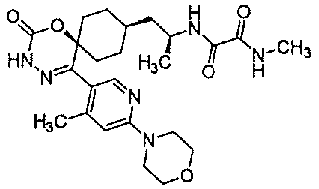
1H-NMR (DMSO-D6) δ: 11.04 (1H, s), 8.66-8.59 (1H, m), 8.41 (1H, d, J = 9.0 Hz), 7.99 (1H, s), 6.75 (1H, s), 3.97-3.85 (1H, m), 3.71-3.66 (4H, m), 3.50-3.43 (4H, m), 2.64 (3H, d, J = 4.9 Hz), 2.15 (3H, s), 2.04-1.96 (2H, m), 1.69-1.61 (1H, m), 1.57-1.17 (8H, m), 1.06 (3H, d, J = 6.7 Hz). 487 485 165 
1H-NMR (DMSO-D6) δ: 11.00 (1H, s), 8.65-8.60 (1H, m), 8.41 (1H, d, J = 9.2 Hz), 7.92 (1H, s), 6.33 (1H, s), 3.97-3.86 (1H, m), 3.41-3.35 (4H, m), 2.64 (3H, d, J = 4.9 Hz), 2.13 (3H, s), 2.04-1.90 (6H, m), 1.70-1.62 (1H, m), 1.58-1.15 (8H, m), 1.06 (3H, d, J = 6.5 Hz). 471 469 166 
1H-NMR (DMSO-D6) δ: 11.01 (1H, s), 8.66-8.61 (1H, m), 8.41 (1H, d, J = 9.0 Hz), 7.93 (1H, s), 6.71 (1H, s), 3.98-3.86 (1H, m), 3.57-3.49 (4H, m), 2.64 (3H, d, J = 4.9 Hz), 2.13 (3H, s), 2.03-1.95 (2H, m), 1.69-1.18 (15H, m), 1.06 (3H, d, J = 6.5 Hz). 485 483 167 
1H-NMR (DMSO-D6) δ: 11.15 (1H, s), 8.62 (1H, q, J = 4.8 Hz), 8.41 (1H, d, J = 9.2 Hz), 7.89 (1H, d, J = 1.7 Hz), 7.80 (1H, dd, J = 8.1, 1.7 Hz), 7.43 (1H, d, J = 8.1 Hz), 3.95-3.85 (1H, m), 2.63 (3H, d, J = 4.8 Hz), 2.59 (3H, s), 2.30 (3H, s), 2.10-2.02 (2H, m), 1.68-1.61 (1H, m), 1.54-1.41 (3H, m), 1.34-1.17 (5H, m), 1.05 (3H, d, J = 5.8 Hz). 443 441 168 
1H-NMR (DMSO-D6) δ: 11.37 (1H, s), 8.64-8.58 (1H, m), 8.33 (1H, d, J = 8.5 Hz), 8.23 (1H, d, J = 1.5 Hz), 7.93 (1H, dd, J = 8.0, 1.5 Hz), 7.72 (1H, d, J = 8.0 Hz), 3.98-3.87 (1H, m), 2.73-2.59 (2H, m), 2.64 (3H, d, J = 5.0 Hz), 2.42 (1H, dd, J = 12.5, 8.3 Hz), 2.35-2.18 (3H, m), 2.12-2.01 (2H, m), 1.63-1.47 (2H, m), 1.04 (3H, d, J = 6.5 Hz). 447 445 Table 1-22 169 
1H-NMR (DMSO-D6) δ: 12,79 (1H, s), 11.36 (1H, s), 8.22 (1H, d, J = 1.3 Hz), 7.91 (1H, dd, J = 8.0, 1.5 Hz), 7.71 (1H, d, J = 8.0 Hz), 7.55 (1H, d, J = 8.0 Hz), 6.28 (1H, s), 4.10-4.00 (1H, m), 2.74-2.64 (2H, m), 2.46-2.38 (1H, m), 2.35-2.14 (6H, m), 2.07 (2H, d, J = 14.3 Hz), 1.61-1.49 (2H, m), 1.06 (3H, d, J = 6.5 Hz). 470 468 170 
1H-NMR (DMSO-D6) δ: 11.18 (1H, s), 8.62 (1H, q, J = 4.9 Hz), 8.41 (1H, d, J = 9.2 Hz), 8.12 (1H, s), 6.97 (1H, s), 5.00 (2H, q, J = 8.9 Hz), 3.99-3.84 (1H, m), 2.64 (3H, d, J = 4.9 Hz), 2.23 (3H, s), 2.10-1.97 (2H, m), 1.71-1.59 (1H, m), 1.57-1.43 (3H, m), 1.42-1.14 (5H, m), 1.06 (3H, d, J = 6.7 Hz). 500 498 171 
1H-NMR (DMSO-D6) δ: 11.14 (1H, s), 8.63 (1H, q, J = 4.9 Hz), 8.40 (1H, d, J = 9.2 Hz), 8.25 (1H, s), 7.24 (1H, s), 3.97-3.84 (1H, m), 2.64 (3H, d, J = 4.9 Hz), 2.19 (3H, s), 2.11-1.97 (3H, m), 1.71-1.60 (1H, m), 1.56-1.41 (3H, m), 1.41-1.15 (5H, m), 1.06 (3H, d, J = 6.5 Hz), 0.99-0.89 (4H, m). 442 440 172 
1H-NMR (DMSO-D6) δ: 11.24 (1H, s), 8.62 (1H, q, J = 4.5 Hz), 8.41 (1H, d, J = 9.0 Hz), 8.25 (1H, s), 7.87 (1H, s), 3.98-3.84 (1H, m), 2.64 (3H, d, J = 4.5 Hz), 2.18 (3H, s), 2.09-1.97 (2H, m), 1.71-1.59 (1H, m), 1.57-1.15 (8H, m), 1.05 (3H, d, J = 6.7 Hz). 528 526 173 
1H-NMR (DMSO-D6) δ: 11.16 (1H, s), 8.66-8.59 (1H, m), 8.40 (1H, d, J = 9.0 Hz), 8.30 (1H, s), 7.21 (1H, s), 3.97-3.83 (1H, m), 2.64 (3H, d, J = 4.9 Hz), 2.44 (3H, s), 2.20 (3H, s), 2.10-1.98 (2H, m), 1.70-1,60 (1H, m), 1.57-1.17 (8H, m), 1.05 (3H, d, J = 6.5 Hz). 416 414 174 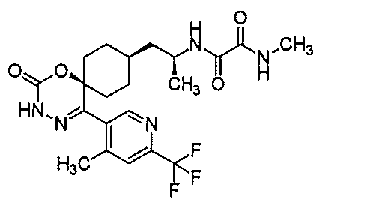
1H-NMR (DMSO-D6) δ: 11.33 (1H, s), 8.69 (1H, s), 8.63 (1H, q, J = 4.5 Hz), 8.41 (1H, d, J = 8.2 Hz), 7.93 (1H, s), 3.98-3.84 (1H, m), 2.64 (3H, d, J = 4.5 Hz), 2.37 (3H, s), 2.14-2.04 (2H, m), 1.72-1.61 (1H, m), 1.58-1.15 (8H, m), 1.06 (3H, d, J = 6.0 Hz). 470 468 175 
1H-NMR (DMSO-D6) δ: 11.32 (1H, s), 8.67-8.59 (1H, m), 8.42 (1H, d, J = 9.2 Hz), 8.22 (1H, d, J = 1.6 Hz), 7.91 (1H, dd, J = 8.1, 1.6 Hz), 7.70 (1H, d, J = 8.1 Hz), 3.95-3.85 (1H, m), 2.64 (3H, d, J = 4.8 Hz), 2.10 (2H, d, J = 11.3 Hz), 1.69-1.62 (1H, m), 1.58-1.15 (8H, m), 1.05 (3H, d, J = 6.5 Hz). 446 444 176 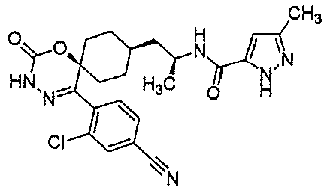
1H-NMR (DMSO-D6) δ: 12.79 (1H, s), 11.30 (1H, s), 8.19 (1H, s), 7.88 (1H, d, J = 8.3 Hz), 7.69 (1H, d, J = 7.8 Hz), 7.63-7.53 (1H, m), 6.30 (1H, s), 4.12-4.00 (1H, m), 2.27-2.06 (5H, m), 1.90-1.83 (1H, m), 1.75-1.18 (8H, m), 1.07 (3H, d, J = 6.0 Hz). 469 467 Table 1-23 177 
1H-NMR (DMSO-D6) δ: 11.19 (1H, s), 8.68 (1H, d, J = 5.3 Hz), 8.42 (1H, d, J = 9.0 Hz), 7.86 (1H, dd, J = 8.4, 2.7 Hz), 7.44 (1H, dd, J = 8.7, 5.9 Hz), 7.33 (1H, td, J = 8.5, 2.6 Hz), 3.95-3.82 (1H, m), 2.78-2.70 (1H, m), 2.16-2.06 (2H, m), 1.69-1.60 (1H, m), 1.59-1.12 (8H, m), 1.05 (3H, d, J = 6.7 Hz), 0.65-0.56 (4H, m). 557 555 178 
1H-NMR (DMSO-D6) δ: 11.02 (1H, s), 8.63 (1H, q, J = 4.9 Hz), 8.41 (1H, d, J = 9.2 Hz), 7.38 (1H, d, J = 1.5 Hz), 7.31 (1H, dd, J = 8.1, 1.5 Hz), 7.17 (1H, d, J = 8.1 Hz), 5.01 (1H, s), 3.95-3.85 (1H, m), 2.63 (3H, d, J = 4.9 Hz), 2.21 (3H, s), 2.06-1.98 (2H, m), 1.68-1.62 (1H, m), 1.54-1.43 (3H, m), 1.42 (6H, s), 1.33-1.16 (5H, m), 1.05 (3H, d, J = 6.5 Hz). 459 457 179 
1H-NMR (DMSO-D6) δ: 11.25 (1H, s), 8.63 (1H, q, J = 4.7 Hz), 8.35 (1H, d, J = 8.8 Hz), 7.75 (1H, dd, J = 8.6, 2.5 Hz), 7.54 (1H, dd, J = 8.6, 5.8 Hz), 7.36 (1H, td, J = 8.6, 2.5 Hz), 3.96-3.89 (1H, m), 2.72-2.60 (2H, m), 2.64 (3H, d, J = 4.7 Hz), 2.42 (1H, dd, J = 12.5, 8.3 Hz), 2.33-2.19 (3H, m), 2.10-2.02 (2H, m), 1.64-1.48 (2H, m), 1.04 (3H, d, J = 6.5 Hz), 484 482 180 
1H-NMR (DMSO-D6) δ: 11.25 (1H, s), 8.68 (1H, d, J = 5.3 Hz), 8.35 (1H, d, J = 8.6 Hz), 7.75 (1H, dd, J = 8.6, 2.6 Hz), 7.54 (1H, dd, J = 8.6, 6.0 Hz), 7.36 (1H, td, J = 8.6, 2.6 Hz), 3.95-3.88 (1H, m), 2.75-2.57 (3H, m), 2.46-2.38 (1H, m), 2.33-2.19 (3H, m), 2.10-2.02 (2H, m), 1.62-1.49 (2H, m), 1.04 (3H, d, J = 6.5 Hz), 0.66-0.56 (4H, m). 510 508 181 
1H-NMR (DMSO-D6) δ: 11.19 (1H, s), 8.66-8.59 (1H, m), 8.41 (1H, d, J = 9.2 Hz), 7.71 (1H, s), 7.59 (1H, d, J = 7.6 Hz), 7.52 (1H, d, J = 7.9 Hz), 3.95-3.85 (1H, m), 2.63 (3H, d, J = 4.9 Hz), 2.31 (3H, s), 2.10-2.02 (2H, m), 1.70-1.60 (1H, m), 1.57-1.14 (8H, m), 1.05 (3H, d, J = 6.7 Hz), 557 555 182 
1H-NMR (DMSO-D6) δ: 11.02 (1H, s), 8.66-8.60 (1H, m), 8.41 (1H, d, J = 9.2 Hz), 7.90 (1H, s), 6.23 (1H, s), 4.06 (2H, t, J = 8.4 Hz), 3.96-3.87 (1H, m), 3.51 (2H, dd, J = 7.9, 5.5 Hz), 2.83-2.72 (1H, m), 2.64 (3H, d, J = 4.9 Hz), 2.11 (3H, s), 2.04-1.94 (2H, m), 1.72-1.60 (1H, m), 1.57-1.14 (8H, m), 1.23 (3H, d, J = 6.7 Hz), 1.06 (3H, d, J = 6.7 Hz). 557 555 183 
1H-NMR (DMSO-D6) δ: 11.20 (1H, s), 7.87 (1H, dd, J = 8.4, 2.7 Hz), 7.46 (1H, dd, J = 8.7, 5,9 Hz), 7.34 (1H, td, J = 8.5, 2.6 Hz), 5.55 (1H, d, J = 8.6 Hz), 5.48 (1H, q, J = 4.5 Hz), 3.69-3.58 (1H, m), 2.50-2.48 (3H, m), 2.18-2.09 (2H, m), 1.67-1.58 (1H, m), 1.54-1,10 (8H, m), 0.96 (3H, d, J = 6.5 Hz). 503 501 184 
1H-NMR (DMSO-D6) δ: 11.23 (1H, s), 8.62 (1H, q, J = 4.5 Hz), 8.42 (1H, d, J = 9.0 Hz), 7.78 (1H, d, J = 9.0 Hz), 7.32 (1H, t, J = 73.7 Hz), 7.28 (1H, d, J = 3.0 Hz), 7.23 (1H, dd, J = 9.0, 3.0 Hz), 3.97-3.83 (1H, m), 2.64 (3H, d, J = 4.5 Hz), 2.19-2.07 (2H, m), 1.70-1,60 (1H, m), 1.57-1.15 (8H, m), 1.06 (3H, d, J = 6.0 Hz). 531 529 Table 1-24 185 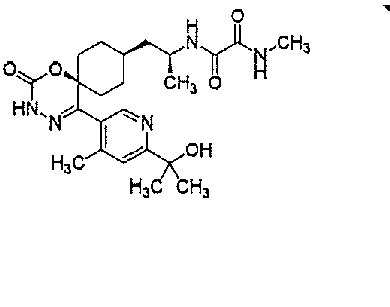
1H-NMR (DMSO-D6) δ: 11.18 (1H, s), 8.63 (1H, q, J = 4.5 Hz), 8.41 (1H, d, J = 9.0 Hz), 8.36 (1H, s), 7.59 (1H, s), 5.22 (1H, s), 3.98-3.82 (1H, m), 2.63 (3H, d, J = 4.5 Hz), 2.25 (3H, s), 2.11-2.00 (2H, m), 1.72-1.61 (1H, m), 1.56-1.17 (8H, m), 1.44 (6H, s), 1.06 (3H, d, J = 6.7 Hz). 460 458 186 
1H-NMR (DMSO-D6) δ: 11.20 (1H, s), 8.62 (1H, q, J = 4.9 Hz), 8.41 (1H, d, J = 9.2 Hz), 8.25 (1H, s), 7.81 (1H, s), 3.98-3.83 (1H, m), 2.63 (3H, d, J = 4.9 Hz), 2.25 (3H, s), 2.11-2.00 (2H, m), 1.72-1.62 (1H, m), 1.56-1.38 (3H, m), 1.38-1.15 (5H, m), 1.05 (3H, d, J = 6.5 Hz). 446 444 187 
1H-NMR (CD3OD) δ: 8.46 (1H, s), 8.04 (1H, s), 4.09-3.97 (1H, m), 2.78 (3H, s), 2.40 (3H, s), 2.25-2.14 (2H, m), 1.80-1.72 (1H, m), 1.63-1.24 (8H, m), 1.14 (3H, d, J = 6.5 Hz). 445 443 188 
1H-NMR (DMSO-D6) δ: 11.34 (1H, s), 8.67 (1H, s), 8.61 (1H, q, J = 4.9 Hz), 8.41 (1H, d, J = 9.2 Hz), 8.07 (1H, s), 3.97-3.83 (1H, m), 2.64 (3H, d, J = 4.9 Hz), 2.32 (3H, s), 2.13-2.03 (2H, m), 1.69-1.60 (1H, m), 1.58-1.14 (8H, m), 1.05 (3H, d, J = 6.7 Hz). 427 425 189 
1H-NMR (DMSO-D6) δ: 11.26 (1H, s), 7.76 (1H, dd, J = 8.6, 2.5 Hz), 7.56 (1H, dd, J = 8.6, 6.0 Hz), 7.38 (1H, td, J = 8.6, 2.5 Hz), 6.05 (1H, d, J = 1.8 Hz), 5.48 (1H, d, J = 7.2 Hz), 3.69-3.62 (1H, m), 2.70-2.61 (2H, m), 2.34-2.06 (7H, m), 1.69-1.50 (2H, m), 0.98 (3H, d, J = 6.5 Hz), 0.51-0.46 (2H, m), 0.26-0.21 (2H, m). 482 480 190 
1H-NMR (DMSO-D6) δ: 8.36 (1H, d, J = 3.7 Hz), 7.80 (1H, dd, J = 8.6, 2.5 Hz), 7.62 (1H, dd, J = 8.6, 6.0 Hz), 7.41 (1H, td, J = 8.6, 2.5 Hz), 6.04 (1H, s), 5.48 (1H, d, J = 6,9 Hz), 3.68-3.62 (1H, m), 2.72-2.65 (3H, m), 2.33-2.13 (7H, m), 1.70-1.56 (2H, m), 0.98 (3H, d, J = 6.5 Hz), 0.72-0.66 (2H, m), 0.56-0.46 (4H, m), 0.23-0.21 (2H, m). 565 609 (formic acid adduct) 191 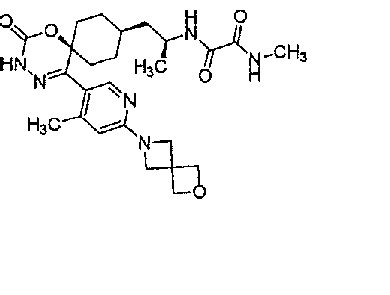
1H-NMR (DMSO-D6) δ: 11.03 (1H, s), 8.66-8.60 (1H, m), 8.41 (1H, d, J = 9.0 Hz), 7.92 (1H, s), 6.28 (1H, s), 4.71 (4H, s), 4.11 (4H, s), 3.96-3.86 (1H, m), 2.64 (3H, d, J = 4.9 Hz), 2.12 (3H, s), 2.02-1.93 (2H, m), 1.72-1.62 (1H, m), 1.59-1.14 (8H, m), 1.06 (3H, d, J = 6.5 Hz). 499 497 192 
1H-NMR (DMSO-D6) δ: 11.06 (1H, s), 8.65-8.60 (1H, m), 8.41 (1H, d, J = 9.0 Hz), 7.97 (1H, s), 6.39 (1H, s), 4.20 (2H, t, J = 8.9 Hz), 3.96 (2H, dd, J = 9.0, 4.5 Hz), 3.96-3.87 (1H, m), 3.80-3.65 (1H, m), 2.64 (3H, d, J = 4.9 Hz), 2.15 (3H, s), 2.04-1.95 (2H, m), 1.71-1.59 (1H, m), 1.59-1.13 (8H, m), 1.06 (3H, d, J = 6.5 Hz). 525 523 Table 1-25 193 
1H-NMR (DMSO-D6) δ: 11.30 (1H, s), 8.67-8.58 (2H, m), 8.41 (1H, d, J = 9.2 Hz), 7.91 (1H, s), 3.99-3.82 (1H, m), 2.70-2.59 (6H, m), 2.34 (3H, s), 2.15-2.02 (2H, m), 1.71-1.60 (1H, m), 1.58-1.42 (3H, m), 1.42-1.16 (5H, m), 1.05 (3H, d, J = 6.5 Hz). 444 442 194 
1H-NMR (DMSO-D6) δ: 11.12 (1H, s), 8.62 (1H, q, J = 4.5 Hz), 8.41 (1H, d, J = 9.0 Hz), 7.35 (1H, d, J = 8.5 Hz), 7.24 (1H, t, J = 74.3 Hz), 7.15 (1H, d, J = 8.1 Hz), 7.06 (1H, s), 3.98-3.83 (1H, m), 2.63 (3H, d, J = 4.5 Hz), 2.19 (3H, s), 2.11-1.98 (2H, m), 1.71-1.59 (1H, m), 1.57-1.39 (3H, m), 1.39-1.16 (5H, m), 1.06 (3H, d, J = 6.7 Hz). 467 465 195 
1H-NMR (DMSO-D6) δ: 11.25 (1H, s), 7.86 (1H, d, J = 2.3 Hz), 7.63 (1H, d, J = 8.6 Hz), 7.50 (1H, d, J = 8.6 Hz), 5.88 (1H, d, J = 2.3 Hz), 5.45 (1H, d, J = 8.3 Hz), 3.70-3.62 (1H, m), 2.38-2.31 (1H, m), 2.18-2.10 (2H, m), 1.68-1.60 (1H, m), 1.53-1.13 (8H, m), 0.97 (3H, d, J = 6.2 Hz), 0.53-0.49 (2H, m), 0.27-0.23 (2H, m). 547 545 196 
1H-NMR (DMSO-D6) δ: 11.41 (1H, s), 8.64-8.57 (1H, m), 8.35 (1H, d, J = 8,3 Hz), 7.68 (1H, dd, J = 8.6, 6.1 Hz), 7.60 (1H, dd, J = 8.8, 2.8 Hz), 7.31 (1H, td, J = 8.6, 2.7 Hz), 3.98-3.86 (1H, m), 2.80-2.72 (1H, m), 2.70-2.31 (7H, m), 2.64 (3H, d, J = 5.0 Hz), 1.63-1.49 (2H, m), 1.18-1.02 (1H, m), 1.07 (3H, d, J = 6.5 Hz), 0.99-0,82 (1H, m). 466 464 197 
1H-NMR (DMSO-D6) δ: 12.77 (1H, s), 11.40 (1H, s), 7.67 (1H, dd, J = 8.6, 6.1 Hz), 7.62-7.57 (2H, m), 7.30 (1H, td, J = 8.6, 2.5 Hz), 6.29 (1H, s), 4.11-3.98 (1H, m), 2.80-2.30 (8H, m), 2.22 (3H, s), 1.68-1.49 (2H, m), 1.18-1.02 (1H, m), 1.11 (3H, d, J = 6.5 Hz), 0.98-0.80 (1H, m). 489 487 198 
1H-NMR (DMSO-D6) δ: 11.29 (1H, s), 8.65-8.59 (1H, m), 8.41 (1H, d, J = 9.0 Hz), 8.00 (1H, d, J = 1.8 Hz), 7.98 (1H, d, J = 8.3 Hz), 7.86 (1H, dd, J = 8.3, 1.8 Hz), 3.98-3.85 (1H, m), 2.64 (3H, d, J = 4.9 Hz), 2.16-2.04 (2H, m), 1.69-1.59 (1H, m), 1.59-1.13 (8H, m), 1.06 (3H, d, J = 6.5 Hz). 490 488 199 
1H-NMR (DMSO-D6) δ: 12.84-12.75 (1H, m), 11.30 (1H, s), 8.32 (1H, d, J = 1.6 Hz), 7.91 (1H, dd, J = 8.0, 1.6 Hz), 7.66 (1H, d, J = 8.1 Hz), 7.59 (1H, d, J = 9.2 Hz), 6.30 (1H, s), 4.11-3.96 (1H, m), 2.23 (3H, s), 2.19-2.07 (2H, m), 1.75-1.63 (1H, m), 1.61-1.15 (8H, m), 1.07 (3H, d, J = 6.5 Hz). 513 511 200 
1H-NMR (DMSO-D6) δ: 10.94 (1H, s), 7.09 (1H, d, J = 8.5 Hz), 6.84 (1H, d, J = 2.3 Hz), 6.78 (1H, dd, J = 8.5, 2.3 Hz), 6.08 (1H, d, J = 7.9 Hz), 3.78-3.76 (1H, m), 3.73 (4H, t, J = 4.7 Hz), 3.49 (4H, t, J = 4.7 Hz), 3.20 (4H, t, J = 4.7 Hz), 3.14 (4H, t, J = 4.7 Hz), 2.18 (3H, s), 2.05-1.97 (2H, m), 1.62-1.56 (1H, m), 1.50-1.35 (4H, m), 1.27-1.14 (4H, m), 0.99 (3H, d, J = 6.5 Hz). 514 512 Table 1-26 201 
1H-NMR (DMSO-D6) δ: 13.00-12.76 (2H, m), 11.14 (1H, s), 7.85 (1H, s), 7.76 (1H, d, J = 7.9 Hz), 7.68-7.56 (1H, m), 7.38 (1H, d, J = 7.9 Hz), 6.33 (1H, s), 4.10-3.98 (1H, m), 2.27 (3H, s), 2.21 (3H, s), 2.09-2.00 (2H, m), 1.71-1.65 (1H, m), 1.52-1.21 (8H, m), 1.07 (3H, d, J = 6.5 Hz). 468 466 202 
1H-NMR (DMSO-D6) δ: 11.26 (1H, s), 9.15 (1H, s), 8.33 (1H, d, J = 9.0 Hz), 7.75 (1H, dd, J = 8.4, 2.5 Hz), 7.55 (1H, dd, J = 8.4, 6.1 Hz), 7.36 (1H, td, J = 8.4, 2.5 Hz), 3.94-3.87 (1H, m), 2.74-2.60 (2H, m), 2.44-2.38 (2H, m), 2.33-2.20 (3H, m), 2.09-2.03 (2H, m), 2.01 (6H, s), 1.63-1.50 (2H, m), 1.03 (3H, d, J = 6.5 Hz). 536 534 203 
1H-NMR (DMSO-D6) δ: 11.19 (1H, s), 8.68 (1H, d, J = 5.3 Hz), 8.41 (1H, d, J = 8.9 Hz), 7.73 (1H, dd, J = 8.9, 2.4 Hz), 7.52 (1H, dd, J = 8.9, 6.2 Hz), 7.34 (1H, td, J = 8.9, 2.4 Hz), 3.95-3.85 (1H, m), 2.78-2.70 (1H, m), 2.16-2.06 (2H, m), 1.68-1.61 (1H, m), 1.57-1.17 (8H, m), 1.05 (3H, d, J = 6.2 Hz), 0.65-0.58 (4H, m), 509 507 204 
1H-NMR (DMSO-D6) δ: 12.95 (0.15H, s), 12.80 (0.85H, s), 11.11 (1H, s), 8.42 (1H, d, J = 3.9 Hz), 7.93 (0.15H, s), 7.71 (1H, s), 7.62-7.57 (1.85H, m), 7.33 (1H, d, J = 7.9 Hz), 6.56 (0.15H, s), 6.30 (0.85H, s), 4.10-4.00 (1H, m), 2.86-2.80 (1H, m), 2.25 (3H, s), 2.23 (3H, s), 2.08-2.01 (2H, m), 1.71-1.65 (1H, m), 1.53-1.19 (8H, m), 1.07 (3H, d, J = 6.2 Hz), 0.71-0.66 (2H, m), 0.57-0.53 (2H, m), 507 505 205 
1H-NMR (DMSO-D6) δ: 11.25 (1H, s), 8.65 (1H, q, J = 4.9 Hz), 8.44 (1H, d, J = 9.0 Hz), 7.81 (1H, d, J = 8.1 Hz), 7.56 (1H, s), 7.48 (1H, dd, J = 8.1, 1.4 Hz), 3.98-3.87 (1H, m), 2.66 (3H, d, J = 4.9 Hz), 2.51 (3H, s), 2.04-1.94 (2H, m), 1.77-1.46 (5H, m), 1.40-1.19 (4H, m), 1.08 (3H, d, J = 6.5 Hz). 426 424 206 
1H-NMR (DMSO-D6) δ: 11.36 (1H, s), 8.65-8.57 (1H, m), 8.36 (1H, d, J = 1.5 Hz), 8.33 (1H, d, J = 8.8 Hz), 7.96 (1H, dd, J = 8.0, 1.5 Hz), 7.70 (1H, d, J = 8.0 Hz), 3.98-3.87 (1H, m), 2.75-2.58 (2H, m), 2.64 (3H, d, J = 5.0 Hz), 2.42 (1H, dd, J = 12.4, 8.4 Hz), 2.35-2.20 (3H, m), 2.13-2.04 (2H, m), 1.64-1.47 (2H, m), 1.04 (3H, d, J = 6.5 Hz). 491 489 207 
1H-NMR (DMSO-D6) δ: 12.79 (1H, s), 11.35 (1H, s), 8.35 (1H, d, J = 1.5 Hz), 7.95 (1H, dd, J = 8.0, 1.5 Hz), 7.69 (1H, d, J = 7.8 Hz), 7.55 (1H, d, J = 8.5 Hz), 6.28 (1H, s), 4.10-4.00 (1H, m), 2.76-2.64 (2H, m), 2.46-2.37 (1H, m), 2.35-2.20 (6H, m), 2.09 (2H, d, J = 14.3 Hz), 1.63-1.47 (2H, m), 1.06 (3H, d, J = 6.8 Hz). 514 512 208 
1H-NMR (DMSO-D6) δ: 11.20 (1H, s), 8.88 (1H, s), 7.86 (1H, dd, J = 8.6, 2.5 Hz), 7.46 (1H, dd, J = 8.7, 5.9 Hz), 7.34 (1H, td, J = 8.6, 2.5 Hz), 6.49 (1H, d, J = 9.0 Hz), 3.84-3.70 (1H, m), 3.47 (3H, s), 2.19-2.06 (2H, m), 1.73-1.61 (1H, m), 1.57-1.14 (8H, m), 1.03 (3H, d, J = 6.7 Hz). 519 517 Table 1-27 209 
1H-NMR (DMSO-D6) δ: 11.11 (1H, s), 8.68 (1H, d, J = 5.3 Hz), 8.41 (1H, d, J = 9.2 Hz), 7.56 (1H, d, J = 1.8 Hz), 7.43 (1H, dd, J = 8.2, 1.8 Hz), 7.23 (1H, d, J = 8.2 Hz), 3.93-3.84 (1H, m), 2,76-2.71 (1H, m), 2.22 (3H, s), 2.06-1.98 (2H, m), 1.68-1.60 (1H, m), 1.54-1.39 (3H, m), 1.36-1.16 (5H, m), 1.05 (3H, d, J = 6.5 Hz), 0.64-0.59 (4H, m), 505 503 210 
1H-NMR (DMSO-D6) δ: 11.12 (1H, s), 7.57 (1H, d, J = 1.6 Hz), 7.44 (1H, dd, J = 8.0, 1.6 Hz), 7.25 (1H, d, J = 8.0 Hz), 5.88 (1H, d, J = 2.3 Hz), 5.45 (1H, d, J = 8.0 Hz), 3.69-3.63 (1H, m), 2.38-2.32 (1H, m), 2.23 (3H, s), 2.08-2.00 (2H, m), 1.66-1.59 (1H, m), 1.51-1.13 (8H, m), 0.97 (3H, d, J = 6.5 Hz), 0.54-0.50 (2H, m), 0.28-0.24 (2H, m). 477 475 211 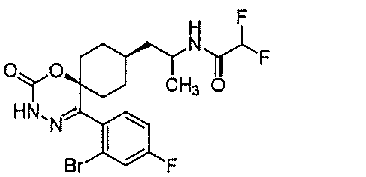
1H-NMR (DMSO-D6) δ: 11.20 (1H, s), 8.52 (1H, d, J = 8.8 Hz), 7.73 (1H, dd, J = 8.8, 2.4 Hz), 7.53 (1H, dd, J = 8.8, 6.1 Hz), 7.35 (1H, td, J = 8.8, 2.4 Hz), 6.12 (1H, t, J = 53.8 Hz), 3.95-3.85 (1H, m), 2.18-2.09 (2H, m), 1.65-1.55 (1H, m), 1.51-1.18 (8H, m), 1.05 (3H, d, J = 6.5 Hz). 476 474 212 
1H-NMR (DMSO-D6) δ: 11.13 (1H, s), 8.63 (1H, q, J = 4.8 Hz), 8.41 (1H, d, J = 9.2 Hz), 7.53 (1H, dd, J = 8.2, 2.1 Hz), 7.46 (1H, d, J = 2.1 Hz), 7.27 (1H, d, J = 8.2 Hz), 3.94-3.87 (1H, m), 2.64 (3H, d, J = 4.8 Hz), 2.18 (3H, s), 2.09-2.01 (2H, m), 1.69-1.62 (1H, m), 1.53-1.17 (8H, m), 1.06 (3H, d, J = 6.5 Hz). 479 477 213 
1H-NMR (DMSO-D6) δ: 11.19 (1H, s), 7.96 (1H, t, J = 5.4 Hz), 7.74 (1H, dd, J = 9.4, 1.9 Hz), 7.60-7.49 (2H, m), 7.35 (1H, td, J = 8.4, 2.7 Hz), 3.91-3.78 (1H, m), 3.57 (2H, d, J = 5.4 Hz), 2.20-2.04 (2H, m), 1.79 (3H, s), 1.68-1.56 (1H, m), 1.52-1.12 (8H, m), 0.99 (3H, d, J = 7.0 Hz). 497 495 214 
1H-NMR (DMSO-D6) δ: 12.80 (1H, s), 11,22 (1H, s), 7.77 (1H, d, J = 8.6 Hz), 7.59 (1H, d, J = 9.2 Hz), 7.31 (1H, t, J = 73.5 Hz), 7.27 (1H, s), 7.21 (1H, dd, J =9.2, 1.6 Hz), 6.30 (1H, s), 4.12-3.98 (1H, m), 2.23 (3H, s), 2.19-2.07 (2H, m), 1.75-1.63 (1H, m), 1.58-1.18 (8H, m), 1.07 (3H, d, J = 6.5 Hz). 554 552 215 
1H-NMR (DMSO-D6) δ: 12.79 (1H, s), 11.12 (1H, s), 7.59 (1H, d, J = 8.1 Hz), 7.34 (1H, d, J = 8.6 Hz), 7.22 (1H, t, J = 74.1 Hz), 7.13 (1H, d, J = 8.6 Hz), 7.06 (1H, s), 6.30 (1H, s), 4.14-3.98 (1H, m), 2.22 (3H, s), 2.19 (3H, s), 2.11-1.99 (2H, m), 1.75-1.61 (1H, m), 1,59-1,16 (8H, m), 1.08 (3H, d, J = 6.5 Hz), 490 488 216 
1H-NMR (DMSO-D6) δ: 11.16 (1H, s), 8.65-8.58 (1H, m), 8.34 (1H, d, J = 8.8 Hz), 7.43 (1H, s), 7.35-7.28 (2H, m), 4.01-3.84 (1H, m), 2.73-2.59 (2H, m), 2.64 (3H, d, J = 4.8 Hz), 2.42 (1H, dd, J = 12.6, 8.4 Hz), 2.35-2.19 (3H, m), 2.22 (3H, s), 2.03-1.95 (2H, m), 1.64-1.45 (2H, m), 1.04 (3H, d, J = 6.5 Hz). 436 434 Table 1-28 217 
1H-NMR (DMSO-D6) δ: 12.79 (1H, s), 11,16 (1H, s), 7.55 (1H, d, J = 7.5 Hz), 7.42 (1H, s), 7.33-7.25 (2H, m), 6.29 (1H, s), 4.12-3.99 (1H, m), 2.74-2.63 (2H, m), 2.41 (1H, dd, J = 12.3, 8.0 Hz), 2.35-2.14 (9H, m), 1.99 (2H, d, J = 13.5 Hz), 1.62-1.49 (2H, m), 1.07 (3H, d, J = 6.5 Hz), 459 457 218 
1H-NMR (DMSO-D6) δ: 10.94 (1H, s), 8.69 (1H, d, J = 5.3 Hz), 8.41 (1H, d, J = 9.0 Hz), 7.08 (1H, d, J = 9.0 Hz), 6.83 (1H, d, J = 2.3 Hz), 6.78 (1H, dd, J = 9.0, 2.3 Hz), 3.94-3.85 (1H, m), 3.72 (4H, dd, J = 5.5, 4.2 Hz), 3.14 (4H, dd, J = 5.5, 4.2 Hz), 2.76-2.70 (1H, m), 2.17 (3H, s), 2.03-1.95 (2H, m), 1.68-1.61 (1H, m), 1.53-1.16 (8H, m), 1.05 (3H, d, J = 6.5 Hz), 0.63-0.58 (4H, m). 512 510 219 
1H-NMR (DMSO-D6) δ: 11.19 (1H, s), 8.06 (1H, s), 7.78 (1H, s), 7.72 (1H, dd, J = 8.6, 2.5 Hz), 7.65 (1H, d, J = 8.6 Hz), 7.51 (1H, dd, J = 8.6, 6.0 Hz), 7.32 (1H, td, J = 8.6, 2.5 Hz), 4.08-3.99 (1H, m), 3.82 (3H, s), 2.15-2.08 (2H, m), 1.70-1.63 (1H, m), 1.53-1.20 (8H, m), 1.06 (3H, d, J = 6.5 Hz), 506 504 220 
1H-NMR (DMSO-D6) δ: 11.13 (1H, s), 8.68 (1H, d, J = 5.5 Hz), 8.41 (1H, d, J = 9.2 Hz), 8.07 (1H, s), 6.77 (1H, s), 3.95-3.83 (1H, m), 3.86 (3H, s), 2.78-2.69 (1H, m), 2.19 (3H, s), 2.07-1.97 (2H, m), 1.69-1.14 (9H, m), 1.06 (3H, d, J = 6.7 Hz), 0.66-0.56 (4H, m), 458 456 221 
1H-NMR (DMSO-D6) δ: 13.01-12.72 (1H, m), 11.04 (1H, s), 7.97 (1H, s), 7.63-7.55 (1H, m), 6.73 (1H, s), 6.31 (1H, s), 4.13-4.00 (1H, m), 3.67 (4H, t, J = 4.7 Hz), 3.64-3.56 (1H, m), 3.46 (4H, t, J = 4.9 Hz), 2.26-2.19 (2H, m), 2.14 (3H, s), 2.05-1.96 (2H, m), 1.75-1.64 (1H, m), 1.56-1.20 (8H, m), 1.08 (3H, d, J = 6.5 Hz). 510 508 222 
1H-NMR (DMSO-D6) δ: 11.30 (1H, s), 8.03 (1H, d, J = 1.8 Hz), 7.99 (1H, d, J = 8.3 Hz), 7.87 (1H, dd, J = 8.4, 2.0 Hz), 5.89 (1H, d, J = 2.8 Hz), 5.46 (1H, d, J = 8.6 Hz), 3.72-3.61 (1H, m), 2.40-2.31 (1H, m), 2.19-2.07 (2H, m), 1.70-1.57 (1H, m), 1.56-1.06 (BH, m), 0.97 (3H, d, J = 6.5 Hz), 0.56-0.46 (2H, m), 0.31-0.22 (2H, m). 488 486 223 
1H-NMR (DMSO-D6) δ: 12.80 (1H, s), 11.30 (1H, s), 7.86 (1H, s), 7.63-7.54 (1H, m), 6.75 (1H, s), 6.31 (1H, s), 4.12-3.99 (1H, m), 3.71 (2H, t, J = 12.8 Hz), 3.49 (2H, t, J = 7.3 Hz), 2.60-2.51 (2H, m), 2.26-2.05 (1H, m), 2.23 (3H, s), 1.96-1.76 (1H, m), 1.74-1.62 (1H, m), 1.60-1.14 (8H, m), 1.08 (3H, d, J = 6.5 Hz). 550 548 224 
1H-NMR (DMSO-D6) δ: 12.80 (1H, s), 11.15 (1H, s), 8.10 (1H, s), 7.59 (1H, d, J = 8.3 Hz), 6.75 (1H, s), 6.30 (1H, s), 4.11-4.00 (1H, m), 3.86 (2H, t, J = 13.1 Hz), 3.65 (2H, t, J = 7.4 Hz), 2.60-2.50 (2H, m), 2.23 (3H, s), 2.11-1.98 (2H, m), 1.74-1.62 (1H, m), 1.59-1.12 (8H, m), 1.08 (3H, d, J = 6.5 Hz). 550 548 Table 1-29 225 
1H-NMR (DMSO-D6) δ: 12.80 (1H, s), 11.25 (1H, s), 7.96 (1H, s), 7.58 (1H, d, J = 8.3 Hz), 7.08 (1H, s), 6.30 (1H, s), 4.11-3.98 (1H, m), 3.61 (4H, t, J = 4.5 Hz), 3.18-3.05 (4H, m), 2.23 (3H, s), 2.13-1.99 (2H, m), 1.72-1.63 (1H, m), 1.55-1.14 (8H, m), 1.08 (3H, d, J = 6.5 Hz). 530 528 226 
1H-NMR (DMSO-D6) δ: 12.80 (1H, s), 11.15 (1H, s), 8.09 (1H, s), 7.59 (1H, d, J = 8.3 Hz), 7.00 (1H, s), 6.31 (1H, s), 4.11-3.99 (1H, m), 3.67 (4H, t, J = 4.7 Hz), 3.51 (4H, t, J = 4.9 Hz), 2.23 (3H, s), 2.10-2.00 (2H, m), 1.73-1.63 (1H, m), 1.57-1.15 (8H, m), 1.08 (3H, d, J = 6.5 Hz). 530 528 227 
1H-NMR (DMSO-D6) δ: 11.08 (1H, s), 8.66-8.60 (1H, m), 8.41 (1H, d, J = 9.2 Hz), 7.95 (1H, s), 6.46-6.37 (1H, m), 6.38 (1H, td, J = 56.4, 4.3 Hz), 4.10 (2H, t, J = 8.3 Hz), 3.97-3.86 (3H, m), 3.32-3.14 (1H, m), 2.64 (3H, d, J = 4.9 Hz), 2.15 (3H, s), 2.05-1.95 (2H, m), 1.71-1.60 (1H, m), 1.59-1.14 (8H, m), 1.06 (3H, d, J = 6.5 Hz). 507 505 228 
1H-NMR (DMSO-D6) δ: 11.08 (1H, s), 8.66-8.60 (1H, m), 8.41 (1H, d, J = 9.2 Hz), 8.01 (1H, s), 6.50 (1H, s), 4.39 (4H, t, J = 12.5 Hz), 3.99-3.85 (1H, m), 2.64 (3H, d, J = 4.9 Hz), 2.16 (3H, s), 2.06-1.98 (2H, m), 1.70-1.60 (1H, m), 1.59-1.15 (8H, m), 1.06 (3H, d, J = 6.7 Hz). 507 505 229 
1H-NMR (DMSO-D6) δ: 10.94 (1H, s), 7.09 (1H, d, J = 8.6 Hz), 6.84 (1H, d, J = 2.7 Hz), 6.78 (1H, dd, J = 8.6, 2.7 Hz), 5.88 (1H, d, J = 2.7 Hz), 5.46 (1H, d, J = 8.6 Hz), 3.73 (4H, dd, J = 5.8, 4.4 Hz), 3.69-3.64 (1H, m), 3.14 (4H, dd, J = 5.8, 4.4 Hz), 2.37-2.33 (1H, m), 2.18 (3H, s), 2.05-1.96 (2H, m), 1.65-1.58 (1H, m), 1.51-1.36 (3H, m), 1.31-1.15 (5H, m), 0.97 (3H, d, J = 6.5 Hz), 0.54-0.50 (2H, m), 0.28-0.23 (2H, m), 484 482 230 
1H-NMR (DMSO-D6) δ: 11.28 (1H, s), 8.62 (1H, q, J = 4.8 Hz), 8.48 (1H, s), 8.41 (1H, d, J = 9.2 Hz), 7.58 (1H, s), 3.98-3.83 (1H, m), 2.64 (3H, d, J = 4.8 Hz), 2.51 (3H, s), 2.15-2.02 (2H, m), 1.71-1.59 (1H, m), 1.57-1.15 (8H, m), 1.05 (3H, d, J = 6.5 Hz). 436 434 231 
1H-NMR (DMSO-D6) δ: 12.80 (1H, s), 11.28 (1H, s), 8.47 (1H, s), 7.65-7.51 (1H, m), 7.56 (1H, s), 6.31 (1H, s), 4.12-4.00 (1H, m), 2.50 (3H, s), 2.22 (3H, s), 2.14-2.02 (2H, m), 1.74-1.63 (1H, m), 1.55-1.15 (8H, m), 1.07 (3H, d, J = 6.7 Hz). 459 457 232 
1H-NMR (DMSO-D6) δ: 12.75 (1H, s), 11.34 (1H, s), 8.21 (1H, s), 7.90 (1H, d, J = 7.5 Hz), 7.68 (1H, d, J = 8.0 Hz), 7.46 (1H, d, J = 8.0 Hz), 6.22 (1H, s), 4.03-3,91 (1H, m), 2.92-2.82 (1H, m), 2.80-2.71 (1H, m), 2.41-2.30 (3H, m), 2.25 (3H, s), 2.00-1.89 (2H, m), 1.83-1.75 (1H, m), 1.68-1.56 (1H, m), 1.08 (3H, d, J = 6.8 Hz), 1.05 (3H, d, J = 6.5 Hz). 484 482 Table 1-30 233 
1H-NMR (DMSO-D6) δ: 11.35 (1H, s), 8.60-8,53 (1H, m), 8.28-8.21 (2H, m), 7.92 (1H, dd, J = 8.0, 1.5 Hz), 7.71 (1H, d, J = 8.0 Hz), 3.90-3.76 (1H, m), 2.90-2.82 (1H, m), 2.77-2.69 (1H, m), 2.64 (3H, d, J = 5.0 Hz), 2.40-2.29 (3H, m), 2.00-1.89 (2H, m), 1.85-1.75 (1H, m), 1.63-1.52 (1H, m), 1.07 (3H, d, J = 6.8 Hz), 1.03 (3H, d, J = 6.5 Hz). 461 459 234 
1H-NMR (DMSO-D6) δ: 11.14 (1H, s), 8.08 (1H, s), 7.25-7.18 (2H, m), 7.14-7.08 (1H, m), 6.99-6.94 (1H, m), 6.81 (1H, s), 6.11 (1H, t, J = 6.1 Hz), 5.74 (1H, d, J = 8.8 Hz), 4.24 (1H, dd, J = 15.7, 6.1 Hz), 4.16 (1H, dd, J = 15.7, 6.1 Hz), 3.87 (3H, s), 3.74-3.66 (1H, m), 2.20 (3H, s), 2.10-1.99 (2H, m), 1.68-1.61 (1H, m), 1.52-1.13 (8H, m), 0.99 (3H, d, J = 6.5 Hz), 498 496 235 
1H-NMR (DMSO-D6) δ: 11.14 (1H, s), 8.07 (1H, s), 7.58 (1H, s), 6.78 (1H, s), 6.47 (1H, d, J = 8.1 Hz), 4.62 (2H, s), 4.31 (2H, t, J = 5.4 Hz), 3.85 (3H, s), 3.83-3.72 (3H, m), 2.19 (3H, s), 2.06-1.98 (2H, m), 1.63-1.15 (9H, m), 1.01 (3H, d, J = 6.5 Hz). 497 495 236 
1H-NMR (DMSO-D6) δ: 11.13 (1H, s), 8.06 (1H, s), 7.18-7.05 (4H, m), 6.79 (1H, s), 6.12 (1H, d, J = 8.3 Hz), 4.44 (2H, s), 3.86 (3H, s), 3.83-3.73 (1H, m), 3.61-3.38 (2H, m), 2.81-2.66 (2H, m), 2.19 (3H, s), 2.05-1.96 (2H, m), 1.63-1.56 (1H, m), 1.51-1.14 (8H, m), 1.01 (3H, d, J = 6.5 Hz), 506 504 237 
1H-NMR (DMSO-D6) δ: 11.13 (1H, s), 8.07 (1H, s), 7.36 (1H, d, J = 1.8 Hz), 6.78 (1H, s), 6.40 (1H, d, J = 8.1 Hz), 6.04 (1H, d, J = 1.8 Hz), 4.54 (2H, s), 4.02 (2H, t, J = 5.4 Hz), 3.86 (3H, s), 3.81-3.72 (3H, m), 2.19 (3H, s), 2.06-1.98 (2H, m), 1.63-1.15 (9H, m), 1.01 (3H, d, J = 6.5 Hz). 496 494 238 
1H-NMR (DMSO-D6) δ: 12.80 (1H, s), 11.04 (1H, s), 7.97 (1H, s), 7.63-7.55 (1H, m), 6.46 (1H, s), 6.31 (1H, s), 4.13-4.00 (1H, m), 3.82 (2H, t, J = 13.4 Hz), 3.61 (2H, t, J = 7.3 Hz), 2.59-2.50 (2H, m), 2.23 (3H, s), 2.15 (3H, s), 2.04-1.97 (2H, m), 1.72-1.64 (1H, m), 1.57-1.19 (8H, m), 1.08 (3H, d, J = 6.5 Hz). 530 528 239 
1H-NMR (DMSO-D6) δ: 12.80 (1H, s), 11.13 (1H, s), 8.02 (1H, s), 7.63-7.54 (1H, m), 6.72 (1H, s), 6.31 (1H, s), 4.90 (1H, s), 4.67 (1H, s), 4.12-4.02 (1H, m), 3.76 (1H, d, J = 6.0 Hz), 3.64 (1H, d, J = 7.4 Hz), 3.44 (1H, d, J = 10.2 Hz), 3.32-3.28 (1H, m), 2.23 (3H, s), 2.11-2.00 (2H, m), 1.93-1.82 (2H, m), 1.73-1.64 (1H, m), 1.56-1.16 (8H, m), 1.08 (3H, d, J = 6.5 Hz). 542 540 240 
1H-NMR (DMSO-D6) δ: 12.80 (1H, s), 11.13 (1H, s), 8,02 (1H, s), 7.59 (1H, d, J = 9.0 Hz), 6.80-6.65 (1H, m), 6.31 (1H, s), 4.90 (1H, s), 4.67 (1H, s), 4.13-3.98 (1H, m), 3.76 (1H, d, J = 6.0 Hz), 3.65 (1H, d, J = 7.4 Hz), 3.44 (1H, d, J = 9.0 Hz), 3.32-3.24 (1H, m), 2.23 (3H, s), 2.10-2.00 (2H, m), 1.93-1.81 (2H, m), 1.73-1.65 (1H, m), 1.55-1.15 (8H, m), 1.08 (3H, d, J = 6.5 Hz), 542 540 Table 1-31 241 
1H-NMR (DMSO-D6) δ: 11.16 (1H, s), 8.66-8.60 (1H, m), 8.41 (1H, d, J = 9.2 Hz), 8.11 (1H, s), 6.76 (1H, s), 3.95-3.84 (1H, m), 3.88 (2H, t, J = 13.2 Hz), 3.66 (2H, t, J = 7.4 Hz), 2.64 (3H, d, J = 4.9 Hz), 2.61-2.52 (2H, m), 2.10-2.00 (2H, m), 1.71-1.57 (1H, m), 1.57-1.14 (8H, m), 1.06 (3H, d, J = 6.7 Hz), 527 525 242 
1H-NMR (DMSO-D6) δ: 11.15 (1H, s), 8.66-8.60 (1H, m), 8.41 (1H, d, J = 9.2 Hz), 8.10 (1H, s), 7.02 (1H, s), 3.99-3.83 (1H, m), 3.68 (4H, t, J = 4.9 Hz), 3.53 (4H, t, J = 4.7 Hz), 2.64 (3H, d, J = 4.9 Hz), 2.08-2.00 (2H, m), 1.70-1.60 (1H, m), 1.58-1.16 (8H, m), 1.06 (3H, d, J = 6.7 Hz). 507 505 243 
1H-NMR (DMSO-D6) δ: 11.13 (1H, s), 8.67-8.60 (1H, m), 8.41 (1H, d, J = 9.0 Hz), 8.03 (1H, s), 6.79-6.69 (1H, m), 4.91 (1H, s), 4.68 (1H, s), 3.97-3.85 (1H, m), 3.77 (1H, d, J = 7.4 Hz), 3.65 (1H, d, J = 7.4 Hz), 3.48-3.43 (1H, m), 3.33-3.27 (1H, m), 2.64 (3H, d, J = 4.9 Hz), 2.09-1.99 (2H, m), 1.94-1.83 (2H, m), 1.71-1.62 (1H, m), 1.58-1.14 (8H, m), 1.06 (3H, d, J = 6.5 Hz). 519 563 (formic acid adduct) 244 
1H-NMR (DMSO-D6) δ: 11.13 (1H, s), 8.67-8.60 (1H, m), 8.41 (1H, d, J = 9.5 Hz), 8.03 (1H, s), 6.78-6.69 (1H, m), 4.91 (1H, s), 4.68 (1H, s), 3.97-3.85 (1H, m), 3.77 (1H, d, J = 7.4 Hz), 3.65 (1H, d, J = 7.4 Hz), 3.48-3.42 (1H, m), 3.32-3.28 (1H, m), 2.64 (3H, d, J = 4.9 Hz), 2.08-2.00 (2H, m), 1.92-1.83 (2H, m), 1.70-1.61 (1H, m), 1.58-1.16 (8H, m), 1.06 (3H, d, J = 6.5 Hz), 519 563 (formic acid adduct) 245 
1H-NMR (DMSO-D6) δ: 11.20 (1H, s), 7.87 (1H, dd, J = 8.4, 2.7 Hz), 7.46 (1H, dd, J = 8.6, 5.8 Hz), 7.34 (1H, td, J = 8.5, 2.6 Hz), 5.89 (1H, d, J = 2.8 Hz), 5.46 (1H, d, J = 8.3 Hz), 3.72-3.61 (1H, m), 2.40-2.31 (1H, m), 2.19-2.08 (2H, m), 1.69-1.57 (1H, m), 1.55-1.08 (8H, m), 0.97 (3H, d, J = 6.5 Hz), 0.55-0.48 (2H, m), 0.29-0.23 (2H, m). 529 527 246 
1H-NMR (DMSO-D6) δ: 11.14 (1H, s), 8.66-8.61 (1H, m), 8.41 (1H, d, J = 9.2 Hz), 8,07 (1H, s), 6.90 (1H, s), 4.45-4.40 (2H, m), 3.97-3.81 (1H, m), 3.86 (2H, d, J = 11.6 Hz), 3.03-2.96 (1H, m), 2.64 (3H, d, J = 4.9 Hz), 2.09-1.99 (2H, m), 1.87-1.80 (2H, m), 1.75-1.17 (12H, m), 1.06 (3H, d, J = 6.5 Hz), 533 577 (formic acid adduct) 247 
1H-NMR (DMSO-D6) δ: 12.80 (1H, s), 11.14 (1H, s), 8.06 (1H, s), 7.63-7.55 (1H, m), 6.88 (1H, s), 6.31 (1H, s), 4.44-4,39 (2H, m), 4.11-4.00 (1H, m), 3.85 (2H, d, J = 12.5 Hz), 3.02-2.95 (2H, m), 2.23 (3H, s), 2.09-2.01 (2H, m), 1.87-1.64 (5H, m), 1.56-1.17 (8H, m), 1.08 (3H, d, J = 6.5 Hz), 556 554 248 
1H-NMR (DMSO-D6) δ: 11.04 (1H, s), 8.66-8.59 (1H, m), 8.41 (1H, d, J = 9.2 Hz), 7.98 (1H, s), 6.47 (1H, s), 3.96-3.84 (1H, m), 3.84 (2H, t, J = 13.4 Hz), 3.63 (2H, t, J = 7.3 Hz), 2.64 (3H, d, J = 4.9 Hz), 2.60-2,52 (2H, m), 2.16 (3H, s), 2.04-1.96 (2H, m), 1.69-1.60 (1H, m), 1.58-1.14 (8H, m), 1.06 (3H, d, J = 6.7 Hz). 507 505 Table 1-32 249 
1H-NMR (DMSO-D6) δ: 13.02-12.64 (1H, m), 11.04 (1H, s), 7.91 (1H, s), 7.79-7.49 (1H, m), 6.58-6.24 (2H, m), 4.86 (1H, s), 4.66 (1H, s), 4.13-4.00 (1H, m), 3.76 (1H, d, J = 7.2 Hz), 3.64 (1H, d, J = 7.2 Hz), 3.44 (1H, d, J = 10.2 Hz), 3.24 (1H, d, J = 10.2 Hz), 2.22 (3H, s), 2.13 (3H, s), 2.05-1.96 (2H, m), 1.93-1.80 (2H, m), 1.73-1.63 (1H, m), 1.56-1.16 (8H, m), 1.08 (3H, d, J = 6.5 Hz). 522 520 250 
1H-NMR (DMSO-D6) δ: 12.80 (1H, s), 11.02 (1H, s), 7.91 (1H, s), 7.63-7.54 (1H, m), 6.42 (1H, s), 6.31 (1H, s), 4.85 (1H, s), 4.65 (1H, s), 4.11-4.00 (1H, m), 3.76 (1H, d, J = 7.2 Hz), 3.63 (1H, d, J = 7.2 Hz), 3.43 (1H, d, J = 10.2 Hz), 3.22 (1H, d, J = 10.2 Hz), 2.23 (3H, s), 2.12 (3H, s), 2.05-1.95 (2H, m), 1.91-1.80 (2H, m), 1.72-1.63 (1H, m), 1.57-1.21 (8H, m), 1.08 (3H, d, J = 6.7 Hz). 522 520 251 
1H-NMR (DMSO-D6) δ: 12.80 (1H, s), 11.03 (1H, s), 7.95 (1H, s), 7.59 (1H, d, J = 8.1 Hz), 6.62 (1H, s), 6.31 (1H, s), 4.42 (2H, s), 4.12-3.98 (1H, m), 3.81 (2H, d, J = 12.3 Hz), 2.93 (2H, d, J = 12.3 Hz), 2.23 (3H, s), 2.13 (3H, s), 2.04-1.95 (2H, m), 1.88-1.63 (5H, m), 1.57-1.18 (8H, m), 1.08 (3H, d, J = 6.5 Hz). 536 534 252 
1H-NMR (DMSO-D6) δ: 11.19 (1H, s), 8.84 (1H, d, J = 9.0 Hz), 8.05 (1H, d, J = 8.8 Hz), 7.73 (1H, d, J = 8.8 Hz), 7.70 (1H, dd, J = 8.8, 2.7 Hz), 7.50 (1H, dd, J = 8.8, 6.0 Hz), 7.30 (1H, td, J = 8.8, 2.7 Hz), 4.22-4.13 (1H, m), 2.69 (3H, s), 2.16-2.08 (2H, m), 1.75-1.60 (2H, m), 1.58-1.49 (1H, m), 1.42-1.23 (6H, m), 1.16 (3H, d, J = 6.5 Hz). 518 516 253 
1H-NMR (DMSO-D6) δ: 11.19 (1H, s), 9.01 (1H, d, J = 1.0 Hz), 8.58 (1H, d, J = 1.0 Hz), 8.50 (1H, d, J = 8.6 Hz), 7.71 (1H, dd, J = 8.6, 2.5 Hz), 7.50 (1H, dd, J = 8.6, 6.0 Hz), 7.31 (1H, td, J = 8.6, 2.5 Hz), 4.18-4.11 (1H, m), 2.58 (3H, s), 2.18-2.06 (2H, m), 1.73-1.68 (1H, m), 1.65-1.45 (2H, m), 1.43-1.22 (6H, m), 1.13 (3H, d, J = 6.7 Hz). 518 516 254 
1H-NMR (DMSO-D6) δ: 11.25 (1H, s), 8.05 (1H, s), 7.76 (1H, s), 7.74 (1H, dd, J = 8.6, 2.6 Hz), 7.64 (1H, d, J = 7.4 Hz), 7.54 (1H, dd, J = 8.6, 6.0 Hz), 7.35 (1H, td, J = 8.6, 2.6 Hz), 4.09-4.02 (1H, m), 3.82 (3H, s), 2.73-2.66 (2H, m), 2.40-2.21 (4H, m), 2.11-2.04 (2H, m), 1.63-1.51 (2H, m), 1.05 (3H, d, J = 6.7 Hz). 507 505 255 
1H-NMR (DMSO-D6) δ: 11.25 (1H, s), 8.85 (1H, s), 8.24 (1H, s), 8.03 (1H, d, J = 8.1 Hz), 7.74 (1H, dd, J = 8.6, 2.5 Hz), 7.53 (1H, dd, J = 8.6, 5.9 Hz), 7.34 (1H, td, J = 8.6, 2.5 Hz), 4.13-4.05 (1H, m), 2.75-2.65 (2H, m), 2.41-2.24 (4H, m), 2.12-2.03 (2H, m), 1.63-1.51 (2H, m), 1.08 (3H, d, J = 6.7 Hz), 561 559 256 
1H-NMR (DMSO-D6) δ: 10.99 (1H, s), 8.63 (1H, q, J = 4.9 Hz), 8.41 (1H, d, J = 9.0 Hz), 7.14 (1H, d, J = 8.4 Hz), 6.91 (1H, dd, J = 8.4, 2.3 Hz), 6.70 (1H, d, J = 2.3 Hz), 3.95-3.85 (1H, m), 3.72 (4H, dd, J = 5.6, 4.6 Hz), 3.06 (4H, dd, J = 5.6, 4.6 Hz), 2.64 (3H, d, J = 4.9 Hz), 2.10 (3H, s), 2.09-2.00 (2H, m), 1.69-1.61 (1H, m), 1.52-1.39 (3H, m), 1.32-1.16 (5H, m), 1.06 (3H, d, J = 6.7 Hz), 486 484 Table 1-33 257 
1H-NMR (DMSO-D6) δ: 11.13 (1H, s), 8.07 (1H, s), 7.90 (1H, s), 6.78 (1H, s), 6.50 (1H, d, J = 8.1 Hz), 4.61 (2H, s), 4.09 (2H, t, J = 5.3 Hz), 3.88-3.71 (3H, m), 3.86 (3H, s), 2.19 (3H, s), 2.06-1.97 (2H, m), 1.63-1.14 (9H, m), 1.02 (3H, d, J = 6.5 Hz). 497 495 258 
1H-NMR (DMSO-D6) δ: 11.13 (1H, s), 8.33 (1H, dd, J = 4.7, 1.5 Hz), 8.06 (1H, s), 7.50 (1H, dd, J = 7.6, 1.5 Hz), 7.15 (1H, dd, J = 7.6, 4.7 Hz), 6.79 (1H, s), 6.27 (1H, d, J = 8.3 Hz), 4.49 (2H, s), 3.86 (3H, s), 3.83-3.74 (1H, m), 3.61-3.49 (2H, m), 2.76-2.70 (2H, m), 2.19 (3H, s), 2.05-1.97 (2H, m), 1.63-1.56 (1H, m), 1.52-1.15 (8H, m), 1.01 (3H, d, J = 6.5 Hz), 507 505 259 
1H-NMR (DMSO-D6) δ: 11.14 (1H, s), 8.06 (1H, s), 6.78 (1H, s), 6.55 (1H, d, J = 8.1 Hz), 4.75 (2H, s), 4.13-4.07 (2H, m), 3.85 (3H, s), 3.83-3.70 (3H, m), 2.19 (3H, s), 2.07-1.98 (2H, m), 1.62-1,16 (9H, m), 1.02 (3H, d, J = 6.7 Hz), 565 563 260 
1H-NMR (DMSO-D6) δ: 11.13 (1H, s), 8.65 (1H, s), 8.06 (1H, s), 6.78 (1H, s), 6.32 (1H, d, J = 8.1 Hz), 4.41 (1H, d, J = 16.0 Hz), 4.36 (1H, d, J = 16.0 Hz), 3.86 (3H, s), 3.80-3.71 (1H, m), 3.63-3.51 (2H, m), 2.70 (2H, t, J = 5.9 Hz), 2.19 (3H, s), 2.06-1.97 (2H, m), 1.62-1.55 (1H, m), 1.52-1.14 (8H, m), 1.00 (3H, d, J = 6.7 Hz). 497 495 261 
1H-NMR (DMSO-D6) δ: 11,14 (1H, s), 8.46-8.41 (1H, m), 8.08 (1H, s), 7.59 (1H, td, J = 7.7, 1.8 Hz), 7.22-7.15 (2H, m), 6.81 (1H, s), 6.25 (1H, t, J = 5.9 Hz), 5.88 (1H, d, J = 8.3 Hz), 4.28 (1H, dd, J = 16.4, 5.9 Hz), 4.22 (1H, dd, J = 16.4, 5.9 Hz), 3.87 (3H, s), 3.74-3.64 (1H, m), 2.20 (3H, s), 2.10-1.98 (2H, m), 1.69-1.60 (1H, m), 1.54-1.13 (8H, m), 0.99 (3H, d, J = 6.5 Hz). 481 479 262 
1H-NMR (DMSO-D6) δ: 11.14 (1H, s), 8.08 (1H, s), 7.33-7.21 (5H, m), 7.05 (1H, d, J = 8.6 Hz), 6.81 (1H, s), 5.02 (1H, d, J = 12.7 Hz), 4.93 (1H, d, J = 12.7 Hz), 3.87 (3H, s), 3.65-3.56 (1H, m), 2.20 (3H, s), 2.09-1.98 (2H, m), 1.67-1.58 (1H, m), 1.54-1.13 (8H, m), 1.01 (3H, d, J = 6.5 Hz). 481 479 263 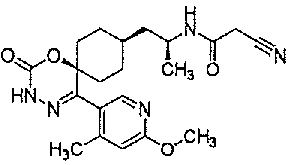
1H-NMR (DMSO-D6) δ: 11.15 (1H, s), 8.07 (1H, s), 8.00 (1H, d, J = 8.1 Hz), 6.79 (1H, s), 3.88-3.76 (1H, m), 3.86 (3H, s), 3.57 (1H, d, J = 18.0 Hz), 3.50 (1H, d, J = 18.0 Hz), 2.20 (3H, s), 2.09-2.00 (2H, m), 1.63-1.57 (1H, m), 1.53-1.15 (8H, m), 1.01 (3H, d, J = 6.5 Hz). 414 412 264 
1H-NMR (DMSO-D6) δ: 11.13 (1H, s), 8.31 (1H, dd, J = 4.9, 1.4 Hz), 8.06 (1H, s), 7.50 (1H, dd, J = 7.6, 1.4 Hz), 7.17 (1H, dd, J = 7.6, 4.9 Hz), 6.78 (1H, s), 6.24 (1H, d, J = 8.3 Hz), 4.47 (2H, s), 3.86 (3H, s), 3.82-3.73 (1H, m), 3.68-3.56 (2H, m), 2.81 (2H, t, J = 5.9 Hz), 2.19 (3H, s), 2.06-1.97 (2H, m), 1.64-1.56 (1H, m), 1.53-1.15 (8H, m), 1.01 (3H, d, J = 6.5 Hz). 507 505 Table 1-34 265 
1H-NMR (DMSO-D6) δ: 11.27 (1H, s), 8.63 (1H, q, J = 4.8 Hz), 8.413 (1H, d, J = 9.2 Hz), 8.412 (1H, s), 7.62 (1H, s), 3.99-3.83 (1H, m), 2.64 (3H, d, J = 4.8 Hz), 2.23-2.13 (1H, m), 2.13-2.01 (2H, m), 1.72-1.59 (1H, m), 1.57-1.12 (8H, m), 1.05 (3H, d, J = 6.5 Hz), 1.05-0.94 (4H, m). 462 460 266 
1H-NMR (DMSO-D6) δ: 12.80 (1H, s), 11.27 (1H, s), 8.41 (1H, s), 7.67-7.55 (1H, m), 7.61 (1H, s), 6.31 (1H, s), 4.14-3.98 (1H, m), 2.23 (3H, s), 2.21-2.01 (3H, m), 1.76-1.62 (1H, m), 1.58-1.15 (8H, m), 1.07 (3H, d, J = 6.5 Hz), 1.05-0.92 (4H, m). 485 483 267 
1H-NMR (DMSO-D6) δ: 11.02 (1H, s), 8.66-8.61 (1H, m), 8.41 (1H, d, J = 9.5 Hz), 7.92 (1H, s), 6.43 (1H, s), 4.86 (1H, s), 4.66 (1H, s), 3.97-3.87 (1H, m), 3.77 (1H, d, J = 7.4 Hz), 3.64 (1H, d, J = 7.4 Hz), 3.44 (1H, d, J = 10.4 Hz), 3.23 (1H, d, J = 10.4 Hz), 2.64 (3H, d, J = 4.9 Hz), 2.13 (3H, s), 2.04-1.95 (2H, m), 1.93-1.81 (2H, m), 1.73-1.61 (1H, m), 1.58-1.16 (8H, m), 1.06 (3H, d, J = 6.5 Hz). 499 543 (formic acid adduct) 268 
1H-NMR (DMSO-D6) δ: 11.02 (1H, s), 8.66-8.60 (1H, m), 8.41 (1H, d, J = 9.2 Hz), 7.92 (1H, s), 6.44 (1H, s), 4.86 (1H, s), 4.66 (1H, s), 3.98-3.84 (1H, m), 3.77 (1H, d, J = 7.2 Hz), 3.63 (1H, d, J = 7.2 Hz), 3.44 (1H, d, J = 9.9 Hz), 3.23 (1H, d, J = 9.9 Hz), 2.64 (3H, d, J = 4.9 Hz), 2.13 (3H, s), 2.04-1.95 (2H, m), 1.92-1.81 (2H, m), 1.70-1.61 (1H, m), 1.59-1.17 (8H, m), 1.06 (3H, d, J = 6.5 Hz). 499 N.D. 269 
1H-NMR (DMSO-D6) δ: 11.03 (1H, s), 8.66-8.60 (1H, m), 8.41 (1H, d, J = 9.0 Hz), 7.96 (1H, s), 6.63 (1H, s), 4.43 (2H, s), 3.98-3.84 (1H, m), 3.82 (2H, d, J = 12.0 Hz), 2.94 (2H, dd, J = 12.5, 2.3 Hz), 2.64 (3H, d, J = 4.9 Hz), 2.14 (3H, s), 2.03-1.95 (2H, m), 1.87-1.61 (5H, m), 1.60-1.15 (8H, m), 1.06 (3H, d, J = 6.5 Hz). 513 N.D. 270 
1H-NMR (DMSO-D6) δ: 11.30 (1H, s), 8.36 (1H, d, J = 1.6 Hz), 7.96 (1H, dd, J = 7.9, 1.6 Hz), 7.67 (1H, d, J = 7.9 Hz), 7.36 (1H, d, J = 1.8 Hz), 6.39 (1H, d, J = 8.3 Hz), 6.04 (1H, d, J = 1.8 Hz), 4.53 (2H, s), 4.01 (2H, t, J = 5.4 Hz), 3.83-3.69 (3H, m), 2.16-2.06 (2H, m), 1.63-1.55 (1H, m), 1.54-1.12 (8H, m), 1.00 (3H, d, J = 6.5 Hz). 554 552 271 
1H-NMR (DMSO-D6) δ: 11.31 (1H, s), 8.35 (1H, d, J = 1.6 Hz), 7.96 (1H, dd, J = 8.0, 1.5 Hz), 7.67 (1H, d, J = 8.1 Hz), 7.58 (1H, s), 6.47 (1H, d, J = 8.1 Hz), 4.67-4,56 (2H, m), 4.30 (2H, t, J = 5.4 Hz), 3.82-3.72 (3H, m), 2.16-2.08 (2H, m), 1.63-1.56 (1H, m), 1.51-1.13 (8H, m), 1.00 (3H, d, J = 6.5 Hz). 555 553 272 
1H-NMR (DMSO-D6) δ: 12.80 (1H, s), 11.29 (1H, s), 8.00 (1H, d, J = 2.0 Hz), 7.96 (1H, d, J = 8.4 Hz), 7.84 (1H, dd, J = 8.4, 2.0 Hz), 7.63-7.55 (1H, m), 6.31 (1H, s), 4.13-3.98 (1H, m), 2.23 (3H, s), 2,20-2,03 (2H, m), 1.74-1.62 (1H, m), 1.59-1.15 (8H, m), 1.08 (3H, d, J = 6.9 Hz), 513 511 Table 1-35 273 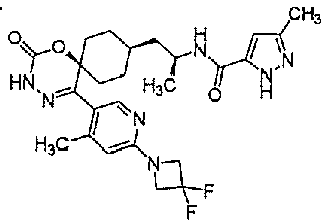
1H-NMR (DMSO-D6) δ: 12.80 (1H, s), 11.08 (1H, s), 7.99 (1H, s), 7.63-7.55 (1H, m), 6.48 (1H, s), 6.31 (1H, s), 4.38 (4H, t, J = 12.5 Hz), 4.11-4.01 (1H, m), 2.23 (3H, s), 2.16 (3H, s), 2.07-1.98 (2H, m), 1.73-1.65 (1H, m), 1.59-1.18 (8H, m), 1.08 (3H, d, J = 6.5 Hz). 516 514 274 
1H-NMR (DMSO-D6) δ: 11.16 (1H, s), 8.66-8.60 (1H, m), 8.41 (1H, d, J = 9.0 Hz), 8.10 (1H, s), 7.16 (1H, s), 3.97-3.86 (1H, m), 3.75 (4H, t, J = 5.7 Hz), 2.64 (3H, d, J = 4.9 Hz), 2.09-1.94 (6H, m), 1.70-1.62 (1H, m), 1.57-1.15 (8H, m), 1.06 (3H, d, J = 6.7 Hz), 541 539 275 
1H-NMR (DMSO-D6) δ: 11.15 (1H, s), 8.10 (1H, s), 7.36 (1H, d, J = 1.8 Hz), 7.03 (1H, s), 6.40 (1H, d, J = 8.3 Hz), 6.04 (1H, s), 4.54 (2H, s), 4.02 (2H, t, J = 5.3 Hz), 3.80-3.73 (3H, m), 3.71-3.65 (4H, m), 3.57-3.49 (4H, m), 2.09-1.99 (2H, m), 1.64-1.55 (1H, m), 1.53-1.14 (8H, m), 1.01 (3H, d, J = 6.7 Hz). 571 569 276 
1H-NMR (DMSO-D6) δ: 11.28 (1H, s), 8.48 (1H, s), 7.59 (1H, s), 7.35 (1H, d, J = 1.3 Hz), 6.39 (1H, d, J = 8.1 Hz), 6.03 (1H, d, J = 1.3 Hz), 4.53 (2H, s), 4.01 (2H, t, J = 5.4 Hz), 3.85-3.68 (3H, m), 2.51 (3H, s), 2.16-2.02 (2H, m), 1.66-1.54 (1H, m), 1.54-1.14 (8H, m), 1.01 (3H, d, J = 6.7 Hz). 500 498 277 
1H-NMR (DMSO-D6) δ: 11.26 (1H, s), 8.42 (1H, s), 7.64 (1H, s), 7.34 (1H, d, J = 0.9 Hz), 6.39 (1H, d, J = 8.1 Hz), 6.03 (1H, d, J = 0.9 Hz), 4.53 (2H, s), 4.01 (2H, t, J = 5.4 Hz), 3.86-3.68 (3H, m), 2.24-2.14 (1H, m), 2.14-2.01 (2H, m), 1.64-1.54 (1H, m), 1.54-1.12 (8H, m), 1.08-0.95 (4H, m), 1.01 (3H, d, J = 6.3 Hz). 526 524 278 
Mixture of two diastereomers due to chlorofluoromethyl moiety 1H-NMR (DMSO-D6) δ: 11.20 (1H, s), 8.42 (1H, d, J = 8.6 Hz), 7.74 (1H, dd, J = 8.6, 2.4 Hz), 7.53 (1H, dd, J = 8.6, 6.2 Hz), 7.35 (1H, td, J = 8.4, 2.4 Hz), 6.63 (1H, d, J = 49.5 Hz), 3.93-3.84 (1H, m), 2.18-2.10 (2H, m), 1.65-1.56 (1H, m), 1.51-1.19 (8H, m), 1.05 (3H, dd, J = 6.2, 4.5 Hz), 492 490 279 
1H-NMR (DMSO-D6) δ: 11.20 (1H, s), 7.73 (2H, dd, J = 8.6, 2.5 Hz), 7.53 (1H, dd, J = 8.6, 6.0 Hz), 7.34 (1H, td, J = 8.6, 2.5 Hz), 6.49 (1H, dt, J = 15.5, 6.1 Hz), 5.96 (1H, d, J = 15.5 Hz), 3.95-3.85 (1H, m), 2.96 (2H, d, J = 6.1 Hz), 2.13 (6H, s), 2.11-2.09 (2H, m), 1.65-1.59 (1H, m), 1.52-1.18 (8H, m), 1.01 (3H, d, J = 6.5 Hz). 509 507 280 
1H-NMR (DMSO-D6) δ: 11.35 (1H, s), 8.63-8.56 (1H, m), 8.30 (1H, d, J = 8.8 Hz), 8.23 (1H, d, J = 1.5 Hz), 7.93 (1H, dd, J = 8.0, 1.5 Hz), 7.73 (1H, d, J = 8.0 Hz), 3.84-3.74 (1H, m), 2.90-2.72 (2H, m), 2.65 (3H, d, J = 4.8 Hz), 2.42 (1H, dd, J = 12.6, 7.6 Hz), 2.35-2.25 (2H, m), 2.00-1.89 (2H, m), 1.87-1.79 (1H, m), 1.69-1.59 (1H, m), 1.05 (3H, d, J = 6.8 Hz), 1.02 (3H, d, J = 6.5 Hz). 461 459 Table 1-36 281 
1H-NMR (DMSO-D6) δ: 12.78 (1H, s), 11.35 (1H, s), 8.21 (1H, d, J = 1.5 Hz), 7.91 (1H, d, J = 7.8 Hz), 7.71 (1H, d, J = 7.8 Hz), 7.55-7.47 (1H, m), 6.28 (1H, s), 3.99-3.87 (1H, m), 2.94-2.75 (2H, m), 2.44 (1H, dd, J = 12.6, 7.1 Hz), 2.38-2.13 (7H, m), 2.01-1.90 (2H, m), 1.87-1.79 (1H, m), 1.68-1.58 (1H, m), 1.07 (3H, d, J = 6.8 Hz), 1.05 (3H, d, J = 6.5 Hz), 484 482 282 
1H-NMR (DMSO-D6) δ: 11.19 (1H, s), 7.74 (1H, dd, J = 8.6, 2.5 Hz), 7.54 (1H, dd, J = 8.6, 6.1 Hz), 7.35 (1H, td, J = 8.6, 2.5 Hz), 5.56 (1H, d, J = 8.6 Hz), 3.76-3.69 (1H, m), 3.35-3.31 (2H, m), 3.11-3.02 (2H, m), 2.15-2.10 (2H, m), 1.70 (2H, t, J = 6.8 Hz), 1.65-1.59 (1H, m), 1.52-1.13 (8H, m), 0.99 (3H, d, J = 6.5 Hz), 0.51 (4H, s). 521 519 283 
1H-NMR (DMSO-D6) δ: 11.20 (1H, s), 7.74 (1H, dd, J = 8.6, 2.5 Hz), 7.54 (1H, dd, J = 8.6, 6.1 Hz), 7.35 (1H, td, J = 8.6, 2.5 Hz), 6.02 (1H, d, J = 8.6 Hz), 3.80-3.73 (1H, m), 3.53 (2H, t, J = 4.7 Hz), 3.29-3.16 (4H, m), 2.17-2.09 (2H, m), 1.66-1.60 (1H, m), 1.51-1.13 (8H, m), 0.98 (3H, d, J = 6.5 Hz), 0.60-0.57 (2H, m), 0.49-0.46 (2H, m). 537 535 284 
1H-NMR (DMSO-D6) δ: 11.26 (1H, s), 7.76 (1H, dd, J = 8.7, 2.5 Hz), 7.56 (1H, dd, J = 8.7, 5.9 Hz), 7.37 (1H, td, J = 8.7, 2.5 Hz), 5.52 (1H, d, J = 7.9 Hz), 3.79-3.70 (1H, m), 3.28 (2H, t, J = 6.8 Hz), 3.09-2.98 (2H, m), 2.70-2.62 (2H, m), 2.32-2.17 (4H, m), 2.14-2.02 (2H, m), 1.67 (2H, q, J = 6.2 Hz), 1.61-1.54 (2H, m), 0.99 (3H, d, J = 6.2 Hz), 0.53-0.46 (4H, m). 522 520 285 
1H-NMR (DMSO-D6) δ: 11.30 (1H, s), 8.64 (1H, q, J = 4.8 Hz), 8.60 (1H, d, J = 9.2 Hz), 7.75 (1H, dd, J = 8.6, 2.7 Hz), 7.56 (1H, dd, J = 8.6, 5.9 Hz), 7.37 (1H, ddd, J = 8.6, 8.1, 2.7 Hz), 4.16-3.99 (1H, m), 2.65 (3H, d, J = 4.8 Hz), 2.16-1.97 (3H, m), 1.86-1.52 (7H, m), 1.08 (3H, d, J = 6.5 Hz), 501 499 286 
1H-NMR (DMSO-D6) δ: 12.83 (1H, s), 11.29 (1H, s), 7.81 (1H, d, J = 8.6 Hz), 7.74 (1H, dd, J = 8.6, 2.7 Hz), 7.55 (1H, dd, J = 8.6, 5.9 Hz), 7.36 (1H, ddd, J = 8.6, 8.1, 2.7 Hz), 6.32 (1H, s), 4.29-4.16 (1H, m), 2.24 (3H, s), 2.14-1.95 (3H, m), 1.88-1.53 (7H, m), 1.11 (3H, d, J = 6.5 Hz). 524 522 287 
1H-NMR (DMSO-D6) δ: 11.19 (1H, s), 8.64 (1H, q, J = 4.8 Hz), 8.42 (1H, d, J = 9.2 Hz), 7.81 (1H, s), 7.80 (1H, d, J = 8.1 Hz), 7.53 (1H, d, J = 8.1 Hz), 3.95-3.86 (1H, m), 2.64 (3H, d, J = 4.8 Hz), 2.30 (3H, s), 2.08-2.00 (2H, m), 1.68-1.61 (1H, m), 1.55-1.44 (3H, m), 1.39-1.18 (5H, m), 1.06 (3H, d, J = 6.5 Hz). 426 424 288 
1H-NMR (DMSO-D6) δ: 12.67 (1H, s), 11.21 (1H, s), 7.71 (1H, d, J = 8.6 Hz), 7.50 (1H, d, J = 7.4 Hz), 7.38-7.31 (2H, m), 6.18 (1H, s), 3.78-3.70 (1H, m), 2.72-2.65 (2H, m), 2.58-2.53 (2H, m), 2.36-2.29 (1H, m), 2.26 (3H, s), 2.09-1.92 (2H, m), 1.58-1.48 (1H, m), 1.45-1.35 (1H, m), 1.09 (3H, d, J = 6.5 Hz), 0.92 (3H, d, J = 6.5 Hz). 521 519 Table 1-37 289 
1H-NMR (DMSO-D6) δ: 11.23 (1H, s), 8.56 (1H, d, J = 5.0 Hz), 8.27 (1H, d, J = 7.9 Hz), 7.74 (1H, dd, J = 8.6, 2.5 Hz), 7.47 (1H, dd, J = 8.6, 6.0 Hz), 7.33 (1H, td, J = 8.6, 2.5 Hz), 3.65-3.58 (1H, m), 2.72-2.65 (2H, m), 2.62 (3H, d, J = 5.0 Hz), 2.47-2.41 (2H, m), 2.36-2.28 (1H, m), 2.10-1.95 (2H, m), 1.60-1.40 (2H, m), 1.06 (3H, d, J = 6.5 Hz), 0.90 (3H, d, J = 6.5 Hz). 498 N.D. 290 
1H-NMR (DMSO-D6) δ: 12.83 (1H, s), 11.26 (1H, s), 7.77 (1H, dd, J = 8.6, 2.6 Hz), 7.65 (1H, d, J = 8.1 Hz), 7.57 (1H, dd, J = 8.6, 6.0 Hz), 7.39 (1H, td, J = 8.6, 2.6 Hz), 6.32 (1H, s), 3.98-3.91 (1H, m), 2.79-2.70 (1H,m), 2.60-2.54 (2H, m), 2.46-2.40 (2H, m), 2.24 (3H, s), 2.15-2.05 (2H, m), 1.70-1.50 (2H, m), 1.06 (3H, d, J = 6,3 Hz), 0.86 (3H, d, J = 6.3 Hz). 521 519 291 
1H-NMR (DMSO-D6) δ: 11.26 (1H, s), 8.65 (1H, q, J = 4.9 Hz), 8.46 (1H, d, J = 9.5 Hz), 7.76 (1H, dd, J = 8.6, 2.4 Hz), 7.56 (1H, dd, J = 8.6, 6.0 Hz), 7.38 (1H, td, J = 8.6, 2.4 Hz), 3.82-3.74 (1H, m), 2.77-2.68 (1H, m), 2.65 (3H, d, J = 4.9 Hz), 2.61-2.38 (4H, m), 2.14-2.06 (2H, m), 1.68-1.48 (2H, m), 1.04 (3H, d, J = 6.6 Hz), 0.81 (3H, d, J = 6.6 Hz). 498 N.D. 292 
1H-NMR (DMSO-D6) δ: 11.30 (1H, s), 8.69 (1H, d, J = 5.1 Hz), 8.43 (1H, d, J = 9.2 Hz), 8.00 (1H, d, J = 1.8 Hz), 7.98 (1H, d, J = 8.5 Hz), 7.86 (1H, dd, J = 8.5, 1.8 Hz), 3.95-3.85 (1H, m), 2.76-2.70 (1H, m), 2.15-2.05 (2H, m), 1.68-1.61 (1H, m), 1.56-1.35 (4H, m), 1.33-1.14 (4H, m), 1.06 (3H, d, J = 6.7 Hz), 0.64-0.58 (4H, m). 516 514 293 
1H-NMR (DMSO-D6) δ: 11.31 (1H, s), 9.77 (1H, s), 8.79 (1H, d, J = 8.6 Hz), 8.01 (1H, d, J = 1.6 Hz), 7.97 (1H, d, J = 8.6 Hz), 7.85 (1H, dd, J = 8.4, 1,9 Hz), 4.16-4,05 (1H, m), 2.19-2.06 (2H, m), 1.72-1.64 (1H, m), 1.63-1.18 (8H, m), 1.12 (3H, d, J = 6.5 Hz). 501 499 294 
1H-NMR (DMSO-D6) δ: 11.27 (1H, s), 8.67-8.60 (1H, m), 8.43 (1H, d, J = 9.2 Hz), 7.88 (1H, d, J = 8.6 Hz), 7.56 (1H, d, J = 2.7 Hz), 7.48-7.42 (1H, m), 3.96-3.85 (1H, m), 2.63 (3H, d, J = 4.8 Hz), 2.19-2.08 (2H, m), 1.69-1.62 (1H, m), 1.59-1.12 (8H, m), 1.05 (3H, d, J = 6.5 Hz). 549 547 295 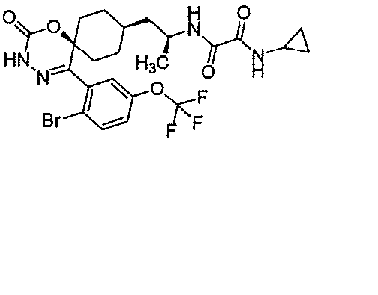
1H-NMR (DMSO-D6) δ: 11.27 (1H, s), 8.69 (1H, d, J = 5.4 Hz), 8.43 (1H, d, J = 9.2 Hz), 7.88 (1H, d, J = 8.6 Hz), 7.56 (1H, d, J = 2.7 Hz), 7.48-7.42 (1H, m), 3.95-3.83 (1H, m), 2.76-2.70 (1H, m), 2.18-2.07 (2H, m), 1.69-1.60 (1H, m), 1.60-1.12 (8H, m), 1.05 (3H, d, J = 6.5 Hz), 0.66-0.53 (4H, m). 575 573 296 
1H-NMR (DMSO-D6) δ: 11.18 (1H, s), 8.67-8.59 (1H, m), 8.43 (1H, d, J = 9.2 Hz), 7.66 (1H, d, J = 9.2 Hz), 7.13-7.08 (2H, m), 4.90-4.77 (2H, m), 3.97-3.85 (1H, m), 2.63 (3H, d, J = 4.8 Hz), 2.19-2.08 (2H, m), 1.69-1.60 (1H, m), 1.59-1.14 (8H, m), 1.05 (3H, d, J = 6.5 Hz). 563 561 Table 1-38 297 
1H-NMR (DMSO-D6) δ: 11.18 (1H, s), 8.69 (1H, d, J = 5.4 Hz), 8.43 (1H, d, J = 9.2 Hz), 7.69-7.64 (1H, m), 7.13-7.07 (2H, m), 4.91-4.77 (2H, m), 3.97-3.83 (1H, m), 2.78-2.68 (1H, m), 2.18-2.07 (2H, m), 1.69-1.61 (1H, m), 1.59-1.14 (8H, m), 1.05 (3H, d, J = 6.5 Hz), 0.66-0.53 (4H, m). 589 587 298 
1H-NMR (DMSO-D6) δ: 12.80 (1H, s), 11.18 (1H, s), 7.65 (1H, d, J = 8.1 Hz), 7.60 (1H, d, J = 8.1 Hz), 7.12-7.06 (2H, m), 6.30 (1H, s), 4.88-4.76 (2H, m), 4.13-4.00 (1H, m), 2.23 (3H, s), 2.19-2.08 (2H, m), 1.73-1.63 (1H, m), 1.57-1.17 (8H, m), 1.07 (3H, d, J = 6.5 Hz), 586 584 299 
1H-NMR (DMSO-D6) δ: 11.21 (1H, s), 8.64-8.58 (1H, m), 8.39 (1H, d, J = 9.0 Hz), 7.91 (1H, s), 7.80 (2H, s), 7.75 (1H, s), 3.85-3.86 (1H, m), 2.63 (3H, d, J = 4.8 Hz), 2.17 (2H, d, J = 13.0 Hz), 1.71-1.64 (1H, m), 1.55-1.15 (8H, m), 1.38 (9H, s), 1.06 (3H, d, J = 6.5 Hz), 564 562 300 
1H-NMR (DMSO-D6) δ: 11.35 (1H, s), 8.64-8.58 (1H, m), 8.35 (1H, d, J = 8.5 Hz), 8.07 (1H, d, J = 2.0 Hz), 8.00 (1H, d, J = 8.5 Hz), 7.88 (1H, dd, J = 8.3, 2.0 Hz), 3.99-3.87 (1H, m), 2.75-2.60 (2H, m), 2.64 (3H, d, J = 5.0 Hz), 2.43 (1H, dd, J = 12.6, 8.1 Hz), 2.35-2.20 (3H, m), 2.14-2.03 (2H, m), 1.75-1.48 (2H, m), 1.05 (3H, d, J = 6.8 Hz). 491 489 301 
1H-NMR (DMSO-D6) δ: 12.79 (1H, s), 11.34 (1H, s), 8.06 (1H, d, J = 1.8 Hz), 7.99 (1H, d, J = 8.3 Hz), 7.87 (1H, dd, J = 8.3, 2.0 Hz), 7.60-7.50 (1H, m), 6.28 (1H, s), 4.15-3.99 (1H, m), 2.70 (2H, t, J = 11.6 Hz), 2.43 (1H, dd, J = 12.3, 7.8 Hz), 2.35-2.15 (6H, m), 2.09 (2H, d, J = 12.8 Hz), 1.69-1.54 (2H, m), 1.07 (3H, d, J = 6.5 Hz). 514 512 302 
1H-NMR (DMSO-D6) δ: 11.46-11.09 (2H, m), 8.06 (1H, d, J = 1.8 Hz), 7.99 (1H, d, J = 8.3 Hz), 7.87 (1H, dd, J = 8.4, 1.9 Hz), 7.64 (1H, d, J = 8.3 Hz), 6.74-6.71 (1H, m), 6.57 (1H, s), 4.12-4.02 (1H, m), 2.77-2.63 (2H, m), 2.39 (1H, dd, J = 12.4, 7.1 Hz), 2.35-2.21 (3H, m), 2.14-2.04 (2H, m), 1.72-1.56 (2H, m), 1.07 (3H, d, J = 6.5 Hz). 517 515 303 
1H-NMR (DMSO-D6) δ: 11.27 (1H, s), 8.05 (1H, s), 7.87 (1H, m), 7.77 (1H, s), 7.65 (1H, m), 7.56 (1H, m), 7.44 (1H, m), 4.04 (1H, s), 3.81 (3H, s), 2.14 (2H, d, J = 12.4 Hz), 1.67 (1H, d, J = 8.6 Hz), 1.52-1.24 (8H, m), 1.06 (3H, d, J = 6.5 Hz). 572 570 304 
1H-NMR (DMSO-D6) δ: 12.80 (1H, s), 11.27 (1H, s), 7.87 (1H, m), 7.60 (1H, d, J = 9.2 Hz), 7.55 (1H, m), 7.43 (1H, d, J = 9.2 Hz), 6.29 (1H, s), 4.05-4.03 (1H, m), 2.23 (3H, s), 2.14 (2H, d, J = 12.4 Hz), 1.70 (1H, s), 1.51-1.25 (8H, m), 1.07 (3H, d, J = 5.9 Hz). 572 570 Table 1-39 305 
1H-NMR (DMSO-D6) δ: 11.18 (1H, s), 8.05 (1H, s), 7.78 (1H, s), 7.67 (1H, s), 7.64 (1H, s), 7.11-7.08 (2H, m), 4.82 (2H, q, J = 8.8 Hz), 4.09-3.96 (1H, m), 3.81 (3H, s), 2.14 (2H, d, J = 11.9 Hz), 1.67 (1H, d, J = 9.7 Hz), 1.51-1.24 (8H, m), 1.06 (3H, d, J = 6.5 Hz). 586 584 306 
1H-NMR (DMSO-D6) δ: 11.23 (1H, s), 8.64 (1H, q, J = 4.7 Hz), 8.43 (1H, d, J = 9.2 Hz), 7.51 (1H, t, J = 7.8 Hz), 7.40 (1H, d, J = 8.1 Hz), 7.33 (1H, t, J = 73.8 Hz), 7.32 (1H, d, J = 6.5 Hz), 3.91-3.88 (1H, m), 2.63 (3H, d, J = 4.8 Hz), 2.13 (2H, d, J = 11.9 Hz), 1.64 (1H, s), 1.55-1.17 (8H, m), 1.05 (3H, d, J = 6.5 Hz). 531 529 307 
1H-NMR (DMSO-D6) δ: 12.81 (1H, s), 11.22 (1H, s), 7.61 (1H, d, J = 8.6 Hz), 7.51-7.48 (1H, m), 7.38 (1H, d, J = 8.1 Hz), 7.32 (1H, t, J = 73.3 Hz), 7.31 (1H, d, J = 7.3 Hz), 6.30 (1H, s), 4.05 (1H, m), 2.23 (3H, s), 2.13 (2H, d, J = 15.6 Hz), 1.69 (1H, s), 1.49-1.24 (8H, m), 1.07 (3H, d, J = 6.5 Hz). 554 552 308 
1H-NMR (DMSO-D6) δ: 11.23 (1H, s), 8.69 (1H, d, J = 5.4 Hz), 8.42 (1H, d, J = 9.2 Hz), 7.52 (1H, t, J = 8.1 Hz), 7.41 (1H, d, J = 8.1 Hz), 7.33 (1H, t, J = 73.3 Hz), 7.32 (1H, d, J = 7.5 Hz), 3.89 (1H, s), 2.74-2.72 (1H, m), 2.13 (2H, d, J = 10.8 Hz), 1.65 (1H, d, J = 7.0 Hz), 1.54-1.20 (8H, m), 1.05 (3H, d, J = 6.5 Hz), 0.62-0.60 (4H, m), 557 555 309 
1H-NMR (DMSO-D6) δ: 11.23 (1H, s), 8.05 (1H, s), 7.78 (1H, s), 7.65 (1H, d, J = 8.6 Hz), 7.52-7.48 (1H, m), 7.39 (1H, d, J = 8.6 Hz), 7.32 (1H, t, J = 73.3 Hz), 7.31 (1H, d, J = 3.2 Hz), 4.05-4.01 (1H, m), 3.81 (3H, s), 2.13 (2H, d, J = 9.7 Hz), 1.68 (1H, s), 1.52-1.25 (8H, m), 1.05 (3H, d, J = 6.5 Hz). 554 552 310 
1H-NMR (DMSO-D6) δ: 11.40 (1H, s), 8.64 (1H, q, J = 4.8 Hz), 8.61 (1H, d, J = 8.6 Hz), 8.10 (1H, s), 8.01 (1H, d, J = 8.6 Hz), 7.88 (1H, d, J = 8.6 Hz), 4.16-4.01 (1H, m), 2.65 (3H, d, J = 4.8 Hz), 2.16-1.98 (3H, m), 1.86-1.56 (7H, m), 1.08 (3H, d, J = 6.5 Hz). 508 506 311 
1H-NMR (DMSO-D6) δ: 12.82 (1H, s), 11.39 (1H, s), 8.09 (1H, s), 8.00 (1H, d, J = 8.6 Hz), 7.87 (1H, d, J = 8.6 Hz), 7.81 (1H, d, J = 8.6 Hz), 6.32 (1H, s), 4.30-4.15 (1H, m), 2.24 (3H, s), 2.15-1.97 (3H, m), 1.89-1.56 (7H, m), 1.11 (3H, d, J = 6.5 Hz). 531 529 312 
1H-NMR (DMSO-D6) δ: 11.35 (1H, br s), 10.95 (1H, s), 8.06 (1H, d, J = 1.8 Hz), 7.99 (1H, d, J = 8.3 Hz), 7.87 (1H, dd, J = 8.3, 2.0 Hz), 7.46 (1H, d, J = 8.3 Hz), 6.58 (1H, s), 6.52 (1H, s), 4.11-4.02 (1H, m), 2.78-2.68 (2H, m), 2.40 (1H, dd, J = 12.3, 7.3 Hz), 2.32-2.22 (3H, m), 2.14-2.04 (2H, m), 1.99 (3H, s), 1.73-1.53 (2H, m), 1.06 (3H, d, J = 6.5 Hz), 513 511 Table 1-40 313 
1H-NMR (DMSO-D6) δ: 11.24 (1H, s), 8.64 (1H, d, J = 7.2 Hz), 8.07 (1H, d, J = 9.0 Hz), 7.75 (1H, d, J = 9.0 Hz), 7.61-7.57 (2H, m), 7.53 (1H, dd, J = 9.0, 2.4 Hz), 7.27 (1H, dd, J = 9,0, 6.8 Hz), 7.01 (1H, t, J = 6.8 Hz), 6.94 (1H, s), 4.19-4.10 (1H, m), 2.17-2.07 (2H, m), 1.77-1.68 (1H, m), 1.63-1.21 (8H, m), 1.13 (3H, d, J = 6.7 Hz). 514 512 314 
1H-NMR (DMSO-D6) δ: 11.24 (1H, s), 8.64 (1H, q, J = 4.9 Hz), 8.42 (1H, d, J = 9.2 Hz), 7.65-7.55 (3H, m), 3.95-3.86 (1H, m), 2.64 (3H, d, J = 4.9 Hz), 2.16-2.06 (2H, m), 1.71-1.61 (1H, m), 1.57-1.13 (8H, m), 1.06 (3H, d, J = 6.5 Hz). 455 453 315 
1H-NMR (DMSO-D6) δ: 11.32 (1H, s), 8.64 (1H, q, J = 4.8 Hz), 8.43 (1H, d, J = 8.6 Hz), 8.03 (1H, dd, J = 7.8, 1.3 Hz), 7.79 (1H, dd, J = 7.8, 1.3 Hz), 7.65 (1H, t, J = 7.8 Hz), 3.90-3.90 (1H, m), 2.63 (3H, d, J = 4,8 Hz), 2.12 (2H, d, J = 11.9 Hz), 1.64 (1H, s), 1.53-1.21 (8H, m), 1.05 (3H, d, J = 6.5 Hz). 490 488 316 
1H-NMR (DMSO-D6) δ: 11.32 (1H, s), 8.69 (1H, d, J = 5.4 Hz), 8.43 (1H, d, J = 9.2 Hz), 8.04 (1H, dd, J = 7.8, 1.3 Hz), 7.79 (1H, dd, J = 7.8, 1.3 Hz), 7.66 (1H, t, J = 7.8 Hz), 3.90-3.89 (1H, m), 2.75-2.72 (1H, m), 2.11 (2H, d, J = 9.2 Hz), 1.64 (1H, s), 1.55-1.21 (8H, m), 1.05 (3H, d, J = 6.5 Hz), 0.63-0.60 (4H, m). 516 514 317 
1H-NMR (DMSO-D6) δ: 12.81 (1H, s), 11.31 (1H, s), 8.01 (1H, dd, J = 7.8, 1.3 Hz), 7.78 (1H, dd, J = 7.8, 1.3 Hz), 7.63 (1H, br s), 7.61 (1H, s), 6.31 (1H, br s), 4.07-4.05 (1H, m), 2.22 (3H, s), 2.12 (2H, s), 1.69 (1H, d, J = 8.1 Hz), 1.49-1.26 (8H, m), 1.07 (3H, d, J = 6.5 Hz). 513 511 318 
1H-NMR (DMSO-D6) δ: 11.32 (1H, s), 8.05 (1H, s), 8.02 (1H, m), 7,80-7.78 (2H, m), 7.67-7.61 (2H, m), 4.04-4.02 (1H, m), 3.81 (3H, s), 2.13 (2H, d, J = 11.9 Hz), 1.67 (1H, d, J = 9.2 Hz), 1.52-1.23 (8H, m), 1.05 (3H, d, J = 6.5 Hz). 513 511 319 
1H-NMR (DMSO-D6) δ: 11.25 (1H, s), 8.62 (1H, q, J = 4.8 Hz), 8.55 (1H, d, J = 8.1 Hz), 7.74 (1H, dd, J = 8.6, 2.7 Hz), 7.53 (1H, dd, J = 8.6, 5.9 Hz), 7.35 (1H, td, J = 8.6, 2.7 Hz), 4.57 (1H, s), 3.96-3.81 (1H, m), 2.66 (3H, d, J = 4.8 Hz), 2.11-1.94 (2H, m), 1.76-1.29 (8H, m), 1.08 (3H, d, J = 6.5 Hz), 499 497 320 
1H-NMR (DMSO-D6) δ: 12.81 (1H, s), 11.24 (1H, s), 7.90-7.79 (1H, m), 7.74 (1H, d, J = 8.1 Hz), 7.59-7.48 (1H, m), 7.39-7.26 (1H, m), 6.29 (1H, s), 4.59 (1H, s), 4.07-3.93 (1H, m), 2.25 (3H, s), 2.11-1.94 (2H, m), 1.78-1.28 (8H, m), 1.12 (3H, d, J = 5.9 Hz). 522 520 Table 1-41 321 
1H-NMR (DMSO-D6) δ: 11.20 (1H, s), 8.63 (1H, q, J = 4.8 Hz), 8.56 (1H, d, J = 7.5 Hz), 7.75 (1H, dd, J = 8.6, 2.7 Hz), 7.52 (1H, dd, J = 8.6, 5.9 Hz), 7.37 (1H, ddd, J = 8.6, 8.1, 2.7 Hz), 4.17 (1H, s), 4.10-3.94 (1H, m), 2.65 (3H, d, J = 4.8 Hz), 1.97-1.85 (2H, m), 1.85-1.66 (3H, m), 1.63-1.33 (5H, m), 1.08 (3H, d, J = 5.9 Hz). 499 497 322 
1H-NMR (DMSO-D6) δ: 12.80 (1H, s), 11.18 (1H, s), 7.85 (1H, d, J = 7.5 Hz), 7.74 (1H, dd, J = 8.6, 2.7 Hz), 7.51 (1H, dd, J = 8.6, 5.9 Hz), 7.37 (1H, ddd, J = 8.6, 8.1, 2.7 Hz), 6.31 (1H, s), 4.25-4.08 (1H, m), 4.21 (1H, s), 2.24 (3H, s), 1.97-1.82 (2H, m), 1.82-1.66 (3H, m), 1.66-1.34 (5H, m), 1.12 (3H, d, J = 6.5 Hz). 522 520 323 
1H-NMR (DMSO-D6) δ: 11.24 (1H, s), 8.22 (1H, dd, J = 7.0, 1.0 Hz), 7.91 (1H, d, J = 1.4 Hz), 7.81 (1H, d, J = 8.4 Hz), 7.61-7.57 (2H, m), 7.53 (1H, dd, J = 8.4, 2.4 Hz), 7.40 (1H, d, J = 9.2 Hz), 6.76 (1H, s), 6.70 (1H, ddd, J = 9.2, 6.5, 1.0 Hz), 6.57 (1H, td, J = 6.5, 1.4 Hz), 4.15-4.05 (1H, m), 2.17-2.08 (2H, m), 1.74-1.66 (1H, m), 1.58-1.21 (8H, m), 1.10 (3H, d, J = 6,5 Hz), 513 511 324 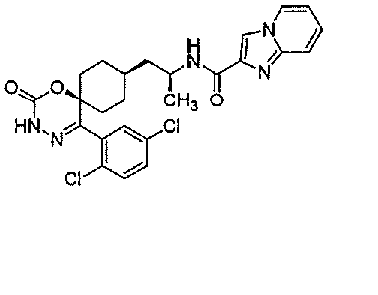
1H-NMR (DMSO-D6) δ: 11.24 (1H, s), 8.55 (1H, dt, J = 6.9, 1.1 Hz), 8.31 (1H, d, J = 0.6 Hz), 7.97 (1H, d, J = 9.0 Hz), 7.61-7.51 (4H, m), 7.32 (1H, ddd, J = 9.0, 6.9, 1.1 Hz), 6.96 (1H, td, J = 6.9, 1.1 Hz), 4.18-4.08 (1H, m), 2.17-2.07 (2H, m), 1.76-1.68 (1H, m), 1.63-1.20 (8H, m), 1.13 (3H, d, J = 6.7 Hz). 514 512 325 
1H-NMR (DMSO-D6) δ: 11.30 (1H, s), 8.06 (1H, s), 8.00 (1H, d, J = 1.8 Hz), 7.97 (1H, d, J = 8.3 Hz), 7.85 (1H, dd, J = 8.3, 2.1 Hz), 7.78 (1H, d, J = 0.7 Hz), 7.66 (1H, d, J = 8.3 Hz), 4.10-3.96 (1H, m), 3.82 (3H, s), 2.18-2.05 (2H, m), 1.72-1.61 (1H, m), 1.59-1,16 (8H, m), 1.06 (3H, d, J = 6.5 Hz). 513 511 326 
1H-NMR (DMSO-D6) δ: 12.80 (1H, s), 11.43 (1H, s), 8.47 (1H, s), 8.23 (1H, d, J = 7.8 Hz), 7.87 (1H, d, J = 7.8 Hz), 7.62-7.54 (1H, m), 6.30 (1H, s), 4.11-4.01 (1H, m), 2.77-2.66 (2H, m), 2.53-2.37 (1H, m), 2,36-2.16 (6H, m), 2.04-1.88 (2H, m), 1.71-1,53 (2H, m), 1.08 (3H, d, J = 6.5 Hz), 504 502 327 
1H-NMR (DMSO-D6) δ: 11.43 (1H, s), 8.66-8.59 (1H, m), 8.48 (1H, s), 8.35 (1H, d, J = 8.5 Hz), 8.25 (1H, d, J = 8,0 Hz), 7.89 (1H, d, J = 8.0 Hz), 3.99-3.87 (1H, m), 2.76-2.61 (2H, m), 2.65 (3H, d, J = 4.8 Hz), 2.44 (1H, dd, J = 12.5, 8.0 Hz), 2.36-2.20 (3H, m), 2.03-1.90 (2H, m), 1.72-1.52 (2H, m), 1.05 (3H, d, J = 6.5 Hz), 481 479 328 
1H-NMR (DMSO-D6) δ: 11.34 (1H, s), 8.67-8.59 (1H, m), 8.35 (1H, d, J = 8.3 Hz), 8.09 (1H, s), 7.99 (1H, d, J = 8.3 Hz), 7.60 (1H, d, J = 8.3 Hz), 3.99-3.85 (1H, m), 2.74-2.60 (2H, m), 2.65 (3H, d, J = 4.8 Hz), 2.43 (1H, dd, J = 12.6, 7.9 Hz), 2.35-2.20 (3H, m), 2.01-1.84 (2H, m), 1.70-1,53 (2H, m), 1.05 (3H, d, J = 6.5 Hz). 534 532 Table 1-42 329 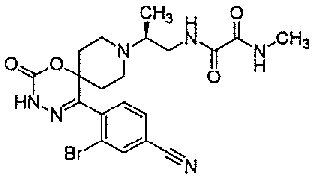
1H-NMR (DMSO-D6) δ: 11.35 (1H, s), 8.66-8.59 (1H, m), 8.41-8.35 (2H, m), 7.97 (1H, dd, J = 7.9, 1.4 Hz), 7.70 (1H, d, J = 8.0 Hz), 3.17-3.00 (2H, m), 2.73 (1H, q, J = 7.5 Hz), 2.68-2.58 (3H, m), 2.65 (3H, d, J = 4.8 Hz), 2.41 (1H, t, J = 11.5 Hz), 2.16-2.06 (2H, m), 1.64-1.47 (2H, m), 0.87 (3H, d, J = 6.8 Hz), 491 489 330 
1H-NMR (DMSO-D6) δ: 11.35 (1H, s), 8.66-8.59 (1H, m), 8.41-8.35 (2H, m), 7.97 (1H, dd, J = 7.9, 1.4 Hz), 7.70 (1H, d, J = 8.0 Hz), 3.17-3.00 (2H, m), 2.73 (1H, q, J = 7.5 Hz), 2.68-2.58 (3H, m), 2.65 (3H, d, J = 4.8 Hz), 2.41 (1H, t, J = 11.5 Hz), 2.16-2.06 (2H, m), 1.64-1.47 (2H, m), 0.87 (3H, d, J = 6.8 Hz). 491 489 331 
1H-NMR (DMSO-D6) δ: 12.82 (1H, br s), 11.29 (1H, br s), 8.08 (1H, d, J = 1.8 Hz), 7.97 (1H, dd, J = 8.5, 1.5 Hz), 7,66-7.55 (1H, m), 7.58 (1H, d, J = 8.5 Hz), 6.34 (1H, s), 4.11-4.01 (1H, m), 2.75-2.65 (2H, m), 2.43 (1H, dd, J = 12.9, 7.6 Hz), 2.35-2.24 (3H, m), 2.24 (3H, s), 2.02-1.86 (2H, m), 1.70-1.54 (2H, m), 1.08 (3H, d, J = 6.5 Hz), 557 555 332 
1H-NMR (DMSO-D6) δ: 12.77 (1H, s), 11.35 (1H, s), 8.37 (1H, s), 7.97 (1H, d, J = 7.8 Hz), 7.68 (2H, d, J = 8.0 Hz), 6.28 (1H, s), 2.80-2.38 (7H, m), 2.25 (3H, s), 2.11 (2H, d, J = 13.3 Hz), 1.65-1.48 (2H, m), 0.90 (3H, d, J = 6.5 Hz). 514 512 333 
1H-NMR (CDCl3) δ: 8.17 (1H, s), 7.47-7.37 (3H, m), 7.24-7.20 (1H, m), 7.13 (1H, td, J = 8.2, 2.5 Hz), 4.00-3.93 (1H, m), 2.89 (3H, d, J = 5.5 Hz), 2.75-2.68 (1H, m), 2.67-2.61 (2H, m), 2.47 (1H, td, J = 12.1, 2.9 Hz), 2.25-2.16 (2H, m), 1.82-1.65 (2H, m), 1.18 (3H, d, J = 6.1 Hz). 486 484 334 
1H-NMR (DMSO-D6) δ: 11.26 (1H, s), 8.05 (1H, s), 7.77-7.72 (2H, m), 7.65 (1H, d, J = 8.3 Hz), 7.54 (1H, dd, J = 8.6, 6.0 Hz), 7.35 (1H, td, J = 8.5, 2.6 Hz), 4.08-4.00 (1H, m), 3.82 (3H, s), 2.74-2.65 (2H, m), 2.35-2.23 (2H, m), 2.12-2.02 (2H, m), 1.64-1.51 (2H, m), 1.05 (3H, d, J = 6.7 Hz). 509 507 335 
1H-NMR (DMSO-D6) δ: 12.77 (1H, s), 11.35 (1H, s), 8.37 (1H, s), 7.97 (1H, d, J = 7.8 Hz), 7.68 (2H, d, J = 8.0 Hz), 6.28 (1H, s), 2.80-2.38 (7H, m), 2.25 (3H, s), 2.11 (2H, d, J = 13.3 Hz), 1.65-1.48 (2H, m), 0.90 (3H, d, J = 6.5 Hz). 514 512 336 
1H-NMR (DMSO-D6) δ: 11.36 (1H, s), 8.36 (1H, s), 8.04 (1H, s), 7.95 (1H, d, J = 8.0 Hz), 7.76 (1H, s), 7.69 (1H, d, J = 7.8 Hz), 7.63 (1H, d, J = 8.0 Hz), 4.13-4.00 (1H, m), 3.83 (3H, s), 2.75-2.65 (2H, m), 2.42-2.20 (4H, m), 2.14-2.05 (2H, m), 1.63-1.51 (2H, m), 1.05 (3H, d, J = 6.8 Hz). 514 512 Table 1-43 337 
1H-NMR (DMSO-D6) δ: 11.27 (1H, s), 8.19 (1H, s), 8.15 (1H, s), 8.03 (1H, s), 7.92 (1H, dd, J = 8.0, 1.3 Hz), 7.76 (1H, s), 7.66-7.53 (3H, m), 4.10-3.98 (1H, m), 3.82 (3H, s), 2.74-2.65 (2H, m), 2.41-2.20 (4H, m), 2.14-2.05 (2H, m), 1.65-1.53 (2H, m), 1.06-1.02 (3H, m). 532 530 338 
1H-NMR (DMSO-D6) δ: 11.30 (1H, s), 8.67-8.61 (1H, m), 8.43 (1H, d, J = 9.2 Hz), 8.04-7.97 (2H, m), 7.89-7.85 (1H, m), 3.85-3.75 (1H, m), 2.65 (3H, d, J = 4.3 Hz), 2.24-2.06 (2H, m), 1.59-1.21 (8H, m), 1.02 (3H, d, J = 6.5 Hz), 0.77 (3H, d, J = 7.0 Hz). 504 502 339 
1H-NMR (DMSO-D6) δ: 11.30 (1H, s), 8.07 (1H, s), 8.03-7.96 (2H, m), 7.88-7.83 (1H, m), 7.80 (1H, s), 7.68 (1H, d, J = 8.1 Hz), 4.06-3.97 (1H, m), 3.82 (3H, s), 2.23-2.09 (2H, m), 1.61-1.21 (8H, m), 1.00 (3H, d, J = 7.0 Hz), 0.80 (3H, d, J = 7.0 Hz). 527 525 Table 1-44 2-001 
1H-NMR (DMSO-D6) δ: 11.35 (1H, s), 8.58 (1H, s), 8.35 (1H, d, J = 8.8 Hz), 8.07 (1H, d, J = 2.0 Hz), 8.00 (1H, d, J = 8.5 Hz), 7.88 (1H, dd, J = 8.4, 1.9 Hz), 3.99-3.86 (1H, m), 2.75-2.60 (2H, m), 2.43 (1H, dd, J = 12.4, 8.1 Hz), 2.34-2.20 (3H, m), 2.13-2.02 (2H, m), 1.72-1.48 (2H, m), 1.05 (3H, d, J = 6.5 Hz), 494 492 2-002 
1H-NMR (DMSO-D6) δ: 11.35 (2H, s), 8.07 (1H, d, J = 1.8 Hz), 8.00 (1H, d, J = 8.3 Hz), 7.88 (1H, dd, J = 8.4, 1.9 Hz), 7.81 (1H, d, J = 7.8 Hz), 6.31 (1H, s), 4.34-4.22 (1H, m), 3.96-3.83 (1H, m), 2.73-2.63 (2H, m), 2.36-2.22 (4H, m), 2.18 (1H, dd, J = 12.4, 7.1 Hz), 2.14-2.04 (2H, m), 1.72-1.58 (2H, m), 0.99 (3H, d, J = 6.8 Hz). 546 544 2-003 
1H-NMR (DMSO-D6) δ: 11.35 (1H, s), 8.29 (1H, d, J = 7.8 Hz), 8.08 (1H, d, J = 1.8 Hz), 8.00 (1H, d, J = 8.3 Hz), 7.88 (1H, dd, J = 8.4, 1.9 Hz), 6.72-6.69 (2H, m), 4.02-3.90 (1H, m), 2.74-2.63 (2H, m), 2.37-2.20 (4H, m), 2.14-2.05 (2H, m), 1.69-1.55 (2H, m), 1.04 (3H, d, J = 6.5 Hz), 528 526 2-004 
1H-NMR (DMSO-D6) δ: 11.36 (1H, s), 8.59 (1H, s), 8.35 (1H, d, J = 8.3 Hz), 8.19 (1H, d, J = 6.8 Hz), 8.15 (1H, d, J = 9.3 Hz), 4.00-3.89 (1H, m), 2.75-2.60 (3H, m), 2.49-2.40 (1H, m), 2.34-2.20 (2H, m), 2.13-2.00 (2H, m), 1.81-1.59 (2H, m), 1.05 (3H, d, J = 6.5 Hz). 512 510 2-005 
mixture of two stereoisomers 1H-NMR (DMSO-D6) δ: 11.33 (1H, s), 8.67 (1H, d, J = 4.9 Hz), 8.37 (1H, d, J = 7.9 Hz), 7.75 (1H, dd, J = 8.4, 2.4 Hz), 7.60 (1H, dd, J = 8.6, 5.8 Hz), 7.39 (1H, td, J = 8.4, 2.6 Hz), 3.81-3.74 (1H, m), 3.09 (1H, brs), 2.92-2.80 (2H, br m), 2.66 (3H, d, J = 5.1 Hz), 2.59-2.47 (4H, m), 1.99 (1H, br s), 1.80 (1H, brs), 1.64-1.62 (1H, br m), 1.09-1.07 (3H, m). 496 494 2-006 
1H-NMR (DMSO-D6) δ: 11.35 (1H, s), 8.64-8.58 (1H, m), 8.35 (1H, d, J = 8.5 Hz), 8.11 (1H, d, J = 2.0 Hz), 7.99 (1H, dd, J = 8.4, 1.9 Hz), 7.84 (1H, d, J = 8.3 Hz), 3.98-3.86 (1H, m), 2.75-2.60 (2H, m), 2.64 (3H, d, J = 6.5 Hz), 2.43 (1H, dd, J = 12.4, 8.1 Hz), 2.36-2.18 (3H, m), 2.15-1.98 (2H, m), 1.68-1.49 (2H, m), 1.05 (3H, d, J = 6.5 Hz). 447 445 2-007 
1H-NMR (DMSO-D6) δ: 12.78 (1H, s), 11.35 (1H, s), 8.10 (1H, d, J = 2.0 Hz), 7.98 (1H, dd, J = 8.3, 2.0 Hz), 7.83 (1H, d, J = 8.5 Hz), 7.55 (1H, d, J = 8.3 Hz), 6.28 (1H, s), 4.13-4.01 (1H, m), 2.76-2.64 (2H, m), 2.42 (1H, dd, J = 12.3, 7.5 Hz), 2.34-2.26 (3H, m), 2.23 (3H, s), 2.12-2.02 (2H, m), 1.68-1.49 (2H, m), 1.07 (3H, d, J = 6.5 Hz). 470 468 2-008 
1H-NMR (DMSO) δ: 11.35 (1H, s, ), 8.58 (1H, s, ), 8.34 (1H, d, J = 8.8 Hz, ), 8.11 (1H, d, J = 1.8 Hz, ), 7.99 (1H, dd, J = 8.5, 2.0 Hz, ), 7.84 (1H, d, J = 8.5 Hz, ), 3.96-3.88 (1H, m, ), 2.75-2.59 (2H, m, ), 2.43 (1H, dd, J = 12.6, 8.1 Hz, ), 2.34-2.19 (3H, m, ), 2.12-2.01 (2H, m, ), 1.69-1.48 (2H, m, ), 1.05 (3H, d, J = 6.5 Hz, ). 450 448 2-009 
1H-NMR (DMSO-D6) δ: 11.33 (1H, s), 8.05 (1H, d, J = 1.8 Hz), 7.99 (1H, dd, J = 8,3, 2.0 Hz), 7.84 (1H, d, J = 8.3 Hz), 7.77 (1H, d, J = 8.8 Hz), 7.05 (1H, d, J = 6.8 Hz), 4.44-4.34 (1H, m), 4.03-3.92 (1H, m), 2.75-2.66 (1H, m), 2.63-2.55 (1H, m), 2.38-1.98 (6H, m), 1.67-1.42 (2H, m), 1.01 (3H, d, J = 6.8 Hz). 488 486 2-010 
mixture of two diastereomers 1H-NMR (DMSO-D6) δ: 11.34 (0.5H, s), 11.31 (0.5H, s), 8.93 (0.5H, d, J = 9.7 Hz), 8.77 (0.5H, q, J = 4.9 Hz), 8.65 (0.5H, q, J = 4.9 Hz), 8.52 (0.5H, d, J = 9.5 Hz), 7.78-7.74 (1H, m), 7,58 (0.5H, dd, J = 8.6, 6.0 Hz), 7.49 (0.5H, dd, J = 8.6, 6.0 Hz), 7.41-7.31 (1H, m), 4.21-4.09 (1H, m), 3.84 (1H, t, J = 10.6 Hz), 2.80-2.54 (6H, m), 2.41-2.30 (1H, m), 2.18-2.07 (2H, m), 1.75-1.60 (1H, m), 1.58-1.40 (1H, m), 1.24 (1.5H, d, J = 6.7 Hz), 1.07 (1.5H, d, J = 6.7 Hz). 509 507 Table 1-45 2-011 
1H-NMR (DMSO-D6) δ: 11.26 (1H, s), 8.63 (1H, d, J = 4.9 Hz), 8.36 (1H, d, J = 8.8 Hz), 7.75 (1H, dd, J = 8.6, 2.5 Hz), 7.54 (1H, dd, J = 8.6, 6.0 Hz), 7.36 (1H, td, J = 8.5, 2.6 Hz), 3.96-3.89 (1H, m), 2.72-2.59 (6H, m), 2.44-2.20 (3H, m), 2.10-2.03 (2H, m), 1.59-1.52 (2H, m), 1.04 (3H, d, J = 6.7 Hz), 484 482 2-012 
1H-NMR (DMSO-D6) δ: 12.80 (1H, s), 11.25 (1H, s), 7.74 (1H, dd, J = 8.6, 2.5 Hz), 7.59-7.51 (2H, m), 7.35 (1H, td, J = 8.4, 2.8 Hz), 6.29 (1H, s), 4.11-4.02 (1H, m), 2.75-2.65 (3H, m), 2.46-2.39 (1H, m), 2.33-2.22 (5H, m), 2.11-2.04 (2H, br m), 1.61-1.51 (2H, br m), 1.07 (3H, d, J = 6.5 Hz), 507 505 2-013 
1H-NMR (DMSO-D6) δ: 11.27 (1H, s), 8.69-8.62 (2H, m), 8.48-8.41 (1H, m), 8.26-8.21 (1H, m), 7.47-7.42 (1H, m), 3.97-3.85 (1H, m), 2.65 (3H, d, J = 4.8 Hz), 2.08-2.00 (2H, m), 1.69-1.44 (5H, m), 1.34-1.14 (4H, m), 1.06 (3H, d, J = 6.5 Hz). 466 464 2-014 
1H-NMR (DMSO-D6) δ: 11.18 (1H, s), 8.69-8.63 (1H, m), 8.45 (1H, d, J = 9.2 Hz), 7.62 (1H, d, J = 9.2 Hz), 7.04-6.96 (2H, m), 4.65 (1H, s), 3.99-3.89 (1H, m), 3.78 (2H, s), 2.67 (3H, d, J = 4.9 Hz), 2.22-2.14 (2H, m), 1.73-1.17 (15H, m), 1.09 (3H, d, J = 6.7 Hz), 553 551 2-015 
1H-NMR (DMSO-D6) δ: 11.30 (1H, s), 8.65-8.58 (1H, m), 8.35 (1H, d, J = 8.8 Hz), 7.95 (1H, d, J = 7.3 Hz), 7.81 (1H, d, J = 8.5 Hz), 3.98-3.88 (1H, m), 2.76-2.62 (2H, m), 2.64 (3H, d, J = 5.0 Hz), 2.43 (1H, dd, J = 12.5, 8.0 Hz), 2.35-2.18 (3H, m), 2.12-1.98 (2H, m), 1.68-1.49 (2H, m), 1.05 (3H, d, J = 6.5 Hz), 518 516 2-016 
1H-NMR (DMSO-D6) δ: 12.79 (1H, s), 11.30 (1H, s), 7.95 (1H, d, J = 7.3 Hz), 7.80 (1H, d, J = 8.8 Hz), 7.61-7.50 (1H, m), 6.28 (1H, s), 4.12-4.01 (1H, m), 2.76-2.65 (2H, m), 2.45-2.38 (1H, m), 2.34-2.18 (6H, m), 2.10-2.02 (2H, m), 1.65-1.50 (2H, m), 1.07 (3H, d, J = 6.5 Hz). 541 539 2-017 
1H-NMR (DMSO-D6) δ: 11.38 (1H, s), 9.23 (1H, d, J = 9.0 Hz), 8.78 (1H, q, J = 4.9 Hz), 8.07 (1H, d, J = 1.8 Hz), 8.00 (1H, d, J = 8.3 Hz), 7.88 (1H, dd, J = 8.4, 2.0 Hz), 4.65-4.55 (1H, m), 2.95 (1H, dd, J = 13.1, 9.8 Hz), 2.74-2.58 (7H, m), 2.33-2.26 (1H, m), 2.14-2.05 (2H, br m), 1.68-1,47 (2H, br m). 545 543 2-018 
1H-NMR (DMSO-D6) δ: 11.44 (1H, s), 8.67-8.60 (1H, m), 8.37 (1H, d, J = 8.1 Hz), 7.67-7.62 (1H, m), 7.54-7.41 (2H, m), 3.97-3.87 (1H, m), 2.76-2.60 (2H, m), 2.64 (3H, d, J = 4.8 Hz), 2.46-2.02 (6H, m), 1.72-1.46 (2H, m), 1.05 (3H, d, J = 6.5 Hz), 484 N.D. 2-019 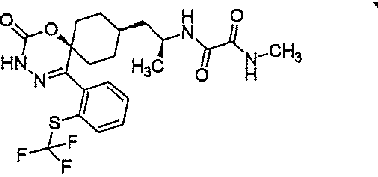
1H-NMR (DMSO-D6) δ: 11.30 (1H, s), 8.66-8.60 (1H, m), 8.42 (1H, d, J = 9.2 Hz), 7.87-7.82 (1H, m), 7.66-7.61 (3H, m), 3.96-3.86 (1H, m), 2.64 (3H, d, J = 4.8 Hz), 2.08-1.99 (2H, m), 1.72-1.11 (9H, m), 1.06 (3H, d, J = 6.5 Hz). 487 485 2-020 
1H-NMR (DMSO-D6) δ: 11.30 (1H, s), 8.06 (1H, s), 7.87-7.81 (1H, m), 7.78 (1H, s), 7.68-7.59 (4H, m), 4.09-3.98 (1H, m), 3.82 (3H, s), 2.09-2.01 (2H, m), 1.73-1.21 (9H, m), 1.06 (3H, d, J = 6.5 Hz). 510 508 Table 1-46 2-021 
1H-NMR (DMSO-D6) δ: 11.36 (1H, s), 8.71-8.59 (1H, m), 8.42-8.33 (1H, m), 7.93-7.83 (1H, m), 7.73-7.61 (3H, m), 4.02-3.87 (1H, m), 2.78-2.60 (2H, m), 2.64 (3H, d, J = 4.8 Hz), 2.43-2.19 (4H, m), 2.10-1.95 (2H, m), 1.75-1.54 (2H, m), 1.15-1.01 (3H, m). 488 486 2-022 
1H-NMR (DMSO-D6) δ: 11.34 (1H, s), 8.07 (1H, d, J = 2.0 Hz), 8.01 (1H, d, J = 8.5 Hz), 7.89 (1H, dd, J = 8.3, 2.0 Hz), 7.41 (1H, d, J = 8.3 Hz), 5.56 (1H, s, ), 3.96-3.86 (1H, m), 2.76-2.63 (2H, m), 2.34-2.21 (3H, m), 2.19-2.03 (3H, m), 1.98 (3H, s), 1.74 (3H, s), 1.69-1.51 (2H, m), 0.98 (3H, d, J = 6.5 Hz). 488 486 2-023 
1H-NMR (DMSO-D6) δ: 11.34 (1H, s), 8.07 (1H, d, J = 2.0 Hz), 8.01 (1H, d, J = 8.5 Hz), 7.89 (1H, dd, J = 8.3, 2.0 Hz), 7.41 (1H, d, J = 8.3 Hz), 5.56 (1H, s), 3.96-3.86 (1H, m), 2.76-2.63 (2H, m), 2.34-2.21 (3H, m), 2.19-2.03 (3H, m), 1.98 (3H, s), 1.74 (3H, s), 1.69-1.51 (2H, m), 0.98 (3H, d, J = 6.5 Hz). 530 528 2-024 
1H-NMR (DMSO-D6) &: 11.35 (1H, s), 8.36 (1H, d, J = 1.5 Hz), 7.95 (1H, dd, J = 8.0, 1.5 Hz), 7.82 (1H, d, J = 8.5 Hz), 7.70-7.66 (2H, m), 7.47 (1H, d, J = 1.0 Hz), 4.13-4.00 (1H, m), 3.73 (3H, s), 3.48-3.40 (1H, m), 2.75-2.65 (2H, m), 2.40-2.22 (3H, m), 2.14-2.03 (2H, m), 1.64-1.48 (2H, m), 1.08-1.03 (3H, m). 518 516 2-025 
1H-NMR (DMSO-D6) δ: 11.47 (1H, s), 8.68-8.60 (1H, m), 8.53-8.48 (0.5H, m), 8.40-8.35 (0.5H, m), 8.13-8.09 (1H, m), 8.04-7.99 (1H, m), 7.93-7.87 (1H, m), 4.24-4.11 (1H, m), 4.10-3.98 (1H, m), 3.90-3.73 (1H, m), 2.92-2.58 (7H, m), 2.27-2.18 (1H, m), 1.97-1.84 (1H, m), 1.11-1.03 (3H, m). 493 491 2-026 
1H-NMR (DMSO-D6) δ: 11.15 (1H, s), 8.65-8.59 (1H, m), 8.41 (1H, d, J = 9.2 Hz), 7.63 (1H, d, J = 9.2 Hz), 7.47-7.40 (2H, m), 5.19 (1H, s), 3.96-3.82 (1H, m), 2.63 (3H, d, J = 5.4 Hz), 2.20-2.09 (2H, m), 1.71-1.11 (9H, m), 1.41 (6H, s), 1.06 (3H, d, J = 6.5 Hz). 523 521 2-027 
1H-NMR (DMSO-D6) δ: 11.15 (1H, s), 8.04 (1H, s), 7.76 (1H, s), 7.67-7.60 (2H, m), 7.48-7.37 (2H, m), 5.18 (1H, s), 4.09-3.96 (1H, m), 3.81 (3H, s), 2.21-2.09 (2H, m), 1.73-1.15 (9H, m), 1.39 (6H, s), 1.06 (3H, d, J = 4.3 Hz). 546 544 2-028 
1H-NMR (DMSO-D6) δ: 11.36 (1H, s), 8.71-8.65 (2H, m), 8.43-8.39 (1H, m), 8.30-8.27 (1H, m), 7.52-7.47 (1H, m), 4.02-3.92 (1H, m), 2.78-2.61 (2H, m), 2.69 (3H, d, J = 4.9 Hz), 2.55-2.24 (4H, m), 2.06-1.77 (4H, m), 1.09 (3H, d, J = 6.5 Hz). 467 N.D. 2-029 
1H-NMR (DMSO-D6) δ; 11.35 (1H, s), 8.17 (1H, d, J = 8.5 Hz), 8.08 (1H, d, J = 2.0 Hz), 8.01 (1H, d, J = 8.5 Hz), 7.89 (1H, dd, J = 8.5, 2.0 Hz), 7.73 (1H, d, J = 7.5 Hz), 7.70-7.58 (2H, m), 7.41 (1H, d, J = 7.3 Hz), 4.14-4.03 (1H, m), 2.81-2.74 (1H, m), 2.71-2.64 (1H, m), 2.42-2.21 (4H, m), 2.17-2.07 (2H, m), 1.74-1.53 (2H, m), 1.06 (3H, d, J = 6.5 Hz). 578 576 2-030 
1H-NMR (DMSO-D6) δ: 11.30 (1H, s), 8.62 (1H, d, J = 5.1 Hz), 8.35 (1H, d, J = 8.8 Hz), 7.56-7.47 (2H, m), 7.32 (1H, dd, J = 7.3, 1.7 Hz), 3.96-3.88 (1H, m), 2.73-2.60 (5H, m), 2.42 (1H, dd, J = 12.5, 8.1 Hz), 2.33-2.21 (3H, m), 2.11-2.03 (2H, br m), 1.63-1.50 (2H, m), 1.04 (3H, d, J = 6.7 Hz). 484 482 Table 1-47 2-031 
1H-NMR (DMSO-D6) δ: 12.79 (1H, s), 11.30 (1H, s), 7.58-7.46 (3H, m), 7.31 (1H, dd, J = 6.8, 2.0 Hz), 6.28 (1H, s), 4.09-4.02 (1H, m), 2.74-2.65 (2H, br m), 2.42 (1H, dd, J = 12.5, 7.4 Hz), 2.33-2.24 (6H, m), 2.11-2.04 (2H, br m), 1.63-1.53 (2H, br m), 1.06 (3H, d, J = 6.7 Hz). 507 505 2-032 
1H-NMR (DMSO-D6) δ: 11.25 (1H, s), 8,65-8,59 (1H, m), 8.43-8.38 (1H, m), 7.94-7.90 (2H, m), 7.86-7.83 (1H, m), 3.96-3.83 (1H, m), 3.87 (3H, s), 2.63 (3H, d, J = 4.8 Hz), 2.21-2.12 (2H, m), 1.71-1.15 (9H, m), 1.05 (3H, d, J = 6.5 Hz). 523 521 2-033 
1H-NMR (DMSO-D6) δ: 11.32 (1H, s), 8.65-8,58 (1H, m), 8.39-8.33 (1H, m), 7.95-7.92 (2H, m), 7.89-7.86 (1H, m), 3.97-3.85 (1H, m), 3.87 (3H, s), 2.75-2.60 (2H, m), 2.62 (3H, d, J = 4.8 Hz), 2.46-2.07 (6H, m), 1.63-1.46 (2H, m), 1.04 (3H, d, J = 7.0 Hz). 524 522 2-034 
1H-NMR (DMSO-D6) δ: 11.20 (1H, s), 8.64-8.58 (1H, m), 8.38-8.33 (1H, m), 7.67-7.63 (1H, m), 7.50-7.45 (1H, m), 7.43-7.40 (1H, m), 5.21 (1H, s), 3.97-3.87 (1H, m), 2.74-2.60 (2H, m), 2.63 (3H, d, J = 4.8 Hz), 2.46-2.02 (6H, m), 1.65-1.48 (2H, m), 1.41 (6H, s), 1.04 (3H, d, J = 6.5 Hz). 524 522 2-035 
1H-NMR (DMSO-D6) δ: 11.23 (1H, s), 8.65-8.57 (2H, m), 8.43-8.38 (1H, m), 7.87-7.80 (2H, m), 7.78-7.76 (1H, m), 3.96-3.84 (1H, m), 2.78 (3H, d, J = 4.3 Hz), 2.63 (3H, d, J = 4.8 Hz), 2.20-2.10 (2H, m), 1.71-1.17 (9H, m), 1.05 (3H, d, J = 6.5 Hz). 522 520 2-036 
1H-NMR (DMSO-D6) δ: 11.21 (1H, s), 8.66-8.60 (1H, m), 8.44-8.38 (1H, m), 7.82-7.78 (1H, m), 7.48-7.45 (1H, m), 7.43-7.39 (1H, m), 3.96-3.85 (1H, m), 2.97 (3H, s), 2.87 (3H, s), 2,64 (3H, d, J = 4.8 Hz), 2.19-2.09 (2H, m), 1.71-1.13 (9H, m), 1.05 (3H, d, J = 6.5 Hz). 536 534 2-037 
1H-NMR (DMSO-D6) δ: 11.29 (1H, s), 8.65-8.57 (2H, m), 8.38-8.34 (1H, m), 7.88-7.83 (2H, m), 7.81-7.78 (1H, m), 3.98-3.89 (1H, m), 2.79 (3H, d, J = 4.3 Hz), 2.75-2.62 (2H, m), 2.63 (3H, d, J = 4.8 Hz), 2.47-2.06 (6H, m), 1.71-1.51 (2H, m), 1.04 (3H, d, J = 6.5 Hz). 523 521 2-038 
1H-NMR (DMSO-D6) δ: 11.27 (1H, s), 8.67-8.58 (1H, m), 8.37-8.31 (1H, m), 7.85-7.80 (1H, m), 7.51-7.48 (1H, m), 7.45-7.40 (1H, m), 3.98-3.87 (1H, m), 2.98 (3H, s), 2.87 (3H, s), 2.74-2.60 (2H, m), 2.64 (3H, d, J = 4.8 Hz), 2.47-2.03 (6H, m), 1.67-1.49 (2H, m), 1.04 (3H, d, J = 6.5 Hz). 537 535 2-039 
1H-NMR (DMSO-D6) δ: 11.30 (1H, s), 8.77 (1H, d, J = 6.9 Hz), 8.61 (1H, t, J = 4.9 Hz), 8.36 (1H, d, J = 8.6 Hz), 8.04 (1H, d, J = 2.3 Hz), 7.28 (1H, dd, J = 6.9, 0.9 Hz), 6.95 (1H, t, J = 7.1 Hz), 6.60 (1H, dd, J = 2.3, 0.9 Hz), 3.96-3.89 (1H, m), 2.73-2.60 (5H, m), 2.42 (1H, dd, J = 12.5, 8.1 Hz), 2.35-2.24 (3H, m), 2.08-2.04 (2H, br m), 1.79-1.66 (2H, m), 1.04 (3H, d, J = 6.7 Hz). 428 426 2-040 
1H-NMR (DMSO-D6) δ: 11.44 (1H, s), 8.72 (1H, d, J = 9.0 Hz), 8.59 (1H, d, J = 4.9 Hz), 8.14 (1H, d, J = 1.8 Hz), 8.03 (1H, d, J = 8.6 Hz), 7.90 (1H, dd, J = 8.3, 2.1 Hz), 4.11 (1H, d, J = 9.7 Hz), 2.64 (3H, d, J = 4.9 Hz), 2.23 (2H, t, J = 11.8 Hz), 2.10-2.04 (1H, m), 2.01-1.97 (1H, m), 1.79-1.56 (6H, m), 1.12 (3H, d, J = 6.7 Hz). 515 513 Table 1-48 2-041 
1H-NMR (DMSO-D6) δ: 11.35 (1H, s), 8.31-8.24 (1H, m), 8.15 (1H, d, J = 8.0 Hz), 8.08 (1H, d, J = 2.0 Hz), 8.00 (1H, d, J = 8.3 Hz), 7.87 (1H, dd, J = 8.3, 2.0 Hz), 6.77 (1H, d, J = 15.3 Hz), 6.72 (1H, d, J = 15.3 Hz), 4.02-3.89 (1H, m), 2.71-2.65 (1H, m), 2.67 (3H, d, J = 5.0 Hz), 2.36-2.16 (5H, m), 2.15-2.03 (2H, m), 1.71-1.53 (2H, m), 1.02 (3H, d, J = 6.5 Hz). 517 515 2-042 
1H-NMR (DMSO-D6) δ: 11.35 (1H, s), 8.53-8.45 (1H, m), 8.08 (1H, d, J = 1.8 Hz), 8.00 (1H, d, J = 8.5 Hz), 7.87 (1H, dd, J = 8.4, 2.1 Hz), 7.27 (1H, d, J = 15.5 Hz), 6.77 (1H, d, J = 15.5 Hz), 4.06-3.94 (1H, m), 2.77 (4H, s), 2.73-2.64 (1H, m), 2.41-2.22 (5H, m), 2.18-2.03 (2H, m), 1.71-1.57 (2H, m), 1.06 (3H, d, J = 6.5 Hz). 601 599 2-043 
1H-NMR (DMSO-D6) δ: 11.11 (1H, s), 8.68-8.62 (1H, m), 8.47-8.41 (1H, m), 8.00 (1H, s), 3.99-3.82 (1H, m), 3.85 (3H, s), 2.65 (3H, d, J = 4.8 Hz), 1.97-1.87 (2H, m), 1.81-1.43 (5H, m), 1.35-1.16 (4H, m), 1.07 (3H, d, J = 6.5 Hz), 517 515 2-044 
1H-NMR (DMSO-D6) δ: 11.27 (1H, s), 8.70-8.63 (1H, m), 8.48-8.42 (1H, m), 7.99 (1H, d, J = 8.4 Hz), 7.53 (1H, d, J = 2.4 Hz), 7.32 (1H, dd, J = 8.4, 2.4 Hz), 4.00-3.89 (1H, m), 2.68 (3H, d, J = 4.9 Hz), 2.22-2.13 (2H, m), 1,74-1.17 (9H, m), 1.10 (3H, d, J = 6.5 Hz). 547 545 2-045 
1H-NMR (DMSO-D6) δ: 11.14 (1H, s), 8.70-8.65 (1H, m), 8.44-8.38 (1H, m), 7.66-7.61 (1H, m), 7.48-7.43 (1H, m), 7.42-7.39 (1H, m), 5.19 (1H, s), 3.94-3.84 (1H, m), 2.76-2.67 (1H, m), 2.20-2.09 (2H, m), 1.71-1.11 (9H, m), 1.41 (6H, s), 1.05 (3H, d, J = 6.5 Hz), 0.66-0.55 (4H, m). 549 547 2-046 
1H-NMR (DMSO-D6) δ: 11.11 (1H, s), 8.80 (1H, d, J = 8.1 Hz), 7.99 (1H, s), 7.34 (1H, s), 4.14-4.01 (1H, m), 3.84 (3H, s), 1.98-1.20 (11H, m), 1.13 (3H, d, J = 6.5 Hz). 561 559 2-047 
1H-NMR (DMSO-D6) δ: 11.35 (1H, s), 8.07 (1H, d, J = 2.0 Hz), 8.00 (1H, d, J = 8.5 Hz), 7.87 (1H, dd, J = 8.5, 2.0 Hz), 6.13 (1H, d, J = 12.8 Hz), 6.07-5.98 (1H, m), 3.97-3.89 (1H, m), 2,74-2.67 (2H, m), 2.40-2,20 (4H, m), 2.14-2.04 (2H, m), 1.73-1.58 (2H, m), 1.04 (3H, d, J = 6.5 Hz). 504 502 2-048 
Mixture of two diastereomers due to 2-position of furan ring 1H-NMR (DMSO-D6) δ: 11.34-11.34 (1H, m), 8.09-8.07 (1H, m), 8.04-7.99 (1H, m), 7.92-7.87 (1H, m), 7.37 (0.5H, d, J = 8.8 Hz), 7.23 (0.5H, d, J = 8.8 Hz), 4.16-4.05 (1H, m), 3.97-3.61 (3H, m), 2.76-2.54 (2H, m), 2.41-1.87 (7H, m), 1.81-1.35 (5H, m), 1.00 (3H, d, J = 6.5 Hz), 504 502 2-049 
Mixture of two diastereomers due to 2-position of dioxane ring 1H-NMR (DMSO-D6) δ: 11.36-11.32 (1H, m), 8.09-8.06 (1H, m), 8.03-7.98 (1H, m), 7.91-7.85 (1H, m), 7.44 (0.5H, d, J = 8.6 Hz), 7.36 (0.5H, d, J = 8.6 Hz), 4,00-3,19 (8H, m), 2.73-2.58 (2H, m), 2.40-2.01 (6H, m), 1.72-1.41 (2H, m), 1.00 (3H, d, J = 6.5 Hz). 520 518 2-050 
1H-NMR (DMSO-D6) δ: 11.18 (1H, s), 8.66-8.59 (1H, m), 8.44-8.38 (1H, m), 7.44-7.36 (1H, m), 7.25-7.19 (1H, m), 3.95-3.84 (4H, m), 2.64 (3H, d, J = 4.8 Hz), 2.16-2.06 (2H, m), 1.69-1.12 (9H, m), 1.05 (3H, d, J = 6.5 Hz), 513 511 Table 1-49 2-051 
1H-NMR (DMSO-D6) δ: 11.30 (1H, s), 8.77 (1H, d, J = 6.9 Hz), 8.61 (1H, t, J = 4.9 Hz), 8.36 (1H, d, J = 8.6 Hz), 8.04 (1H, d, J = 2.3 Hz), 7.28 (1H, dd, J = 6.9, 0.9 Hz), 6.95 (1H, t, J = 7.1 Hz), 6.60 (1H, dd, J = 2.3, 0.9 Hz), 3.96-3.89 (1H, m), 2.73-2.60 (5H, m), 2.42 (1H, dd, J = 12.5, 8.1 Hz), 2.35-2.24 (3H, m), 2.08-2.04 (2H, br m), 1.79-1.66 (2H, m), 1.04 (3H, d, J = 6.7 Hz), 428 426 2-052 
1H-NMR (DMSO-D6) δ: 11.44 (1H, s), 8.72 (1H, d, J = 9.0 Hz), 8.59 (1H, d, J = 4.9 Hz), 8.14 (1H, d, J = 1.8 Hz), 8.03 (1H, d, J = 8.6 Hz), 7.90 (1H, dd, J = 8.3, 2.1 Hz), 4.11 (1H, d, J = 9.7 Hz), 2.64 (3H, d, J = 4.9 Hz), 2.23 (2H, t, J = 11.8 Hz), 2.10-2.04 (1H, m), 2.01-1.97 (1H, m), 1.79-1.56 (6H, m), 1.12 (3H, d, J = 6.7 Hz). 515 513 2-053 
1H-NMR (DMSO-D6) δ: 11.34 (1H, s), 8.06 (1H, d, J = 2.0 Hz), 8.00 (1H, d, J = 8.3 Hz), 7.87 (1H, dd, J = 8.3, 2.0 Hz), 7.83 (1H, d, J = 8.3 Hz), 7.67 (1H, s), 7.48 (1H, d, J = 1.0 Hz), 4.13-4.04 (1H, m), 3.73 (3H, s), 2.77-2.65 (2H, m), 2.41-2.23 (4H, m), 2.14-2.05 (2H, m), 1.68-1.52 (2H, m), 1.07 (3H, d, J = 6.5 Hz). 514 512 2-054 
1H-NMR (DMSO-D6) δ: 11.34 (1H, s), 8.06 (1H, d, J = 2.2 Hz), 8.00 (1H, d, J = 8.5 Hz), 7.90-7.85 (1H, m), 7.58 (1H, s), 7.54 (1H, d, J = 1.0 Hz), 7.48 (1H, d, J = 8.3 Hz), 4.08-4,00 (1H, m), 3.67 (3H, s), 2.74-2.64 (2H, m), 2.43 (1H, dd, J = 12.3, 7.8 Hz), 2.34-2.23 (3H, m), 2.13-2.03 (2H, m), 1.70-1.53 (2H, m), 1.08 (3H, d, J = 6.5 Hz), 514 N.D. 2-055 
1H-NMR (DMSO-D6) δ: 11.37 (1H, s), 8.75-8.70 (1H, m), 8.63-8.57 (1H, m), 7.85-7.80 (1H, m), 7.50-7.30 (2H, m), 7.29-7.24 (1H, m), 4.17-4.07 (1H, m), 2.64 (3H, d, J = 4.8 Hz), 2.28-1.96 (4H, m), 1.81-1.53 (6H, m), 1.12 (3H, d, J = 6.5 Hz), 556 554 2-056 
1H-NMR (DMSO-D6) δ: 11.22 (1H, s), 8.67-8.57 (1H, m), 8.46-8.37 (1H, m), 7.86-7.79 (1H, m), 7.63-7.51 (2H, m), 3.97-3.82 (3H, m), 3.74-3.61 (2H, m), 2.63 (3H, d, J = 4.8 Hz), 2.55-2.36 (2H, m), 2.20-2.09 (2H, m), 1.71-1.14 (9H, m), 1.05 (3H, d, J = 6.5 Hz), 598 596 2-057 
1H-NMR (CDCl3) δ: 8.27 (1H, s), 7.77-7.72 (1H, m), 7.53-7.49 (2H, m), 7.46-7.40 (1H, m), 7.20-7.14 (1H, m), 4.60-4.50 (4H, m), 4,09-3.98 (1H, m), 2.88 (3H, d, J = 5.4 Hz), 2.37-2.27 (2H, m), 1.80-1.33 (9H, m), 1.16 (3H, d, J = 6.5 Hz), 584 582 2-058 
1H-NMR (DMSO-D6) δ: 11.17 (1H, s), 8.69-8.62 (1H, m), 8.49-8.41 (1H, m), 8.09 (1H, s), 6.55-6.23 (1H, m), 4.70-4.58 (2H, m), 3.99-3.87 (1H, m), 2.65 (3H, d, J = 4.8 Hz), 1.98-1.88 (2H, m), 1.84-1.41 (5H, m), 1.35-1,17 (4H, m), 1.07 (3H, d, J = 6.5 Hz), 567 565 2-059 
1H-NMR (DMSO-D6) δ: 11.35 (1H, s), 8.36 (1H, d, J = 1.5 Hz), 7.95 (1H, dd, J = 8.0, 1.5 Hz), 7.82 (1H, d, J = 8.5 Hz), 7.70-7.66 (2H, m), 7.47 (1H, d, J = 1.2 Hz), 4.10-4.01 (1H, m), 3.73 (3H, s), 2.76-2.64 (2H, m), 2.42-2.22 (4H, m), 2.15-2.05 (2H, m), 1.63-1.47 (2H, m), 1,09-1.00 (3H, m). 514 512 2-060 
1H-NMR (DMSO-D6) δ: 11.36 (1H, s), 8.35 (1H, d, J = 1.5 Hz), 7.96 (1H, dd, J = 8.0, 1.5 Hz), 7.69 (1H, d, J = 8.0 Hz), 7.59 (1H, s), 7.54 (1H, d, J = 1.0 Hz), 7.48 (1H, d, J = 8.3 Hz), 4.09-3.97 (1H, m), 3.67 (3H, s), 2.73-2.64 (2H, m), 2.43 (1H, dd, J = 12.4, 7.9 Hz), 2.35-2.22 (3H, m), 2.12-2.03 (2H, m), 1.64-1.48 (2H, m), 1.07 (3H, d, J = 6.5 Hz). 514 512 Table 1-50 2-061 
1H-NMR (DMSO-D6) δ: 11.36 (1H, s), 8.71 (1H, d, J = 8.3 Hz), 8.35 (1H, d, J = 1.5 Hz), 7.94 (1H, dd, J = 7.9, 1.6 Hz), 7.68 (1H, d, J = 8.0 Hz), 7.28 (1H, s), 4.14-4.04 (1H, m), 2.76-2.61 (2H, m), 2.46-2.23 (4H, m), 2.12-2.07 (2H, m), 1.58-1.51 (2H, m), 1.09 (3H, d, J = 6.5 Hz). 535 533 2-062 
1H-NMR (DMSO-D6) δ: 11.36 (1H, s), 8.51 (1H, d, J= 8.5 Hz), 8.35 (1H, d, J = 1.5 Hz), 7.95 (1H, dd, J = 8.0, 1.5 Hz), 7.68 (1H, d, J = 8.0 Hz), 6.82 (1H, s), 4.13-4.01 (1H, m), 2.76-2.61 (2H, m), 2.46-2.38 (1H, m), 2.36-2.24 (3H, m), 2.28 (3H, s), 2.12-2.05 (2H, m), 1.61-1.46 (2H, m), 1.08 (3H, d, J = 6.5 Hz). 515 513 2-063 
1H-NMR (DMSO-D6) δ: 11.35 (1H, s), 8.32-7.83 (6H, m), 6.75 (1H, d, J = 5.0 Hz), 4.00-3.84 (1H, m), 2.73-2.64 (1H, m), 2.67 (3H, d, J = 4.8 Hz), 2.35-2.02 (7H, m), 1.70-1.56 (2H, m), 1.02 (3H, d, J = 6.5 Hz), 517 515 2-064 
1H-NMR (DMSO-D6) δ: 11.36 (1H, s), 8.67 (1H, d, J = 5.3 Hz), 8.38-8.31 (2H, m), 7.96 (1H, dd, J = 8.0, 1.5 Hz), 7.70 (1H, d, J = 8.0 Hz), 3.97-3.86 (1H, m), 2.76-2.67 (2H, m), 2.65-2.59 (1H, m), 2.42 (1H, dd, J = 12.5, 8.3 Hz), 2.36-2.19 (3H, m), 2.16-2.03 (2H, m), 1.64-1.48 (2H, m), 1.04 (3H, d, J = 6.5 Hz), 0.68-0.53 (4H, m). 517 515 2-065 
1H-NMR (DMSO-D6) δ: 11.46 (1H, s), 8.73 (1H, d, J = 9.2 Hz), 8.60 (1H, d, J = 4.8 Hz), 8.39 (1H, s), 8.01 (1H, d, J = 8.1 Hz), 7.75 (1H, d, J = 8.1 Hz), 4.12 (1H, brs), 2.64 (3H, d, J = 4.8 Hz), 2.24 (2H, t, J = 10.5 Hz), 2.07 (1H, dd, J = 13.7, 11.0 Hz), 1.99 (1H, br s), 1.79-1.53 (6H, m), 1.12 (3H, d, J = 6.5 Hz). 515 513 2-066 
1H-NMR (DMSO-D6) δ: 11.43 (1H, s), 8.75-8.69 (1H, m), 8.62-8.57 (1H, m), 8.06-8.01 (1H, m), 7.94 (1H, s), 7.83-7.78 (1H, m), 4.16-4.05 (1H, m), 2.65-2.62 (3H, m), 2.33-2.19 (2H, m), 2.11-1.96 (2H, m), 1.81-1.52 (6H, m), 1.12 (3H, d, J = 6.5 Hz), 558 556 2-067 
1H-NMR (DMSO-D6) δ: 11.34 (1H, s), 8.75-8.69 (1H, m), 8.63-8.57 (1H, m), 7.65-7.62 (1H, m), 7.60-7.55 (1H, m), 7.41-7.20 (2H, m), 4.18-4.06 (1H, m), 2.66-2.62 (3H, m), 2.27-1.97 (4H, m), 1.82-1.54 (6H, m), 1.12 (3H, d, J = 6.5 Hz), 556 554 2-068 
1H-NMR (DMSO-D6) δ: 11.44 (1H, s), 9.01 (1H, d, J = 8.6 Hz), 8.16-8.13 (1H, m), 8.04-8.00 (1H, m), 7.91-7.88 (1H, m), 7.30-7.28 (1H, m), 4.35-4.24 (1H, m), 2.32-2.17 (2H, m), 2.07-1.97 (2H, m), 1.87-1.54 (6H, m), 1,20-1.16 (3H, m). 559 557 2-069 
1H-NMR (DMSO-D6) δ: 12.91 (0.25H, s), 12.85 (0.75H, s), 11.29 (1H, s), 8.01-7.93 (2.5H, m), 7.86-7.81 (1H, m), 7.61-7.54 (0.5H, m), 6.49 (0.25H, s), 6.22 (0.75H, s), 4.10-4.00 (1H, m), 2,19-1.79 (3H, m), 1.74-1.14 (9H, m), 1.07 (3H, d, J = 6.5 Hz), 0.98-0,55 (4H, m). 539 537 2-070 
1H-NMR (DMSO-D6) δ: 11.29 (1H, s), 8.01-7.94 (2H, m), 7.86-7.81 (1H, m), 7.74-7.71 (1H, m), 7.68-7.63 (1H, m), 6.57-6.54 (1H, m), 4.12-4.02 (1H, m), 3.88-3.86 (3H, m), 2.17-2.06 (2H, m), 1.73-1.18 (9H, m), 1.08 (3H, d, J = 6.5 Hz). 513 511 Table 1-51 2-071 
1H-NMR (DMSO-D6) δ: 11.28 (1H, s), 8.01-7.94 (2H, m), 7.86-7.81 (1H, m), 7.61-7.59 (1H, m), 7.55-7.53 (1H, m), 7.47-7.41 (1H, m), 4.09-3.99 (1H, m), 3.66 (3H, s), 2.16-2.06 (2H, m), 1.74-1.18 (9H, m), 1.07 (3H, d, J = 7.0 Hz), 513 511 2-072 
1H-NMR (DMSO-D6) δ: 12.95-12.82 (1H, m), 11.30 (1H, s), 8.34-8.31 (1H, m), 7.94-7.89 (1H, m), 7.69-7.64 (1H, m), 7.61-7.54 (1H, m), 6.54-6.18 (1H, m), 4.12-3.98 (1H, m), 2.17-2.07 (2H, m), 1.95-1.64 (2H, m), 1.57-1.12 (8H, m), 1.07 (3H, d, J = 5.9 Hz), 0.98-0.56 (4H, m). 539 537 2-073 
1H-NMR (DMSO-D6) δ: 11.28 (1H, s), 8.59 (1H, s), 8.40 (1H, d, J = 9.0 Hz), 8.00 (1H, d, J = 1.8 Hz), 7.98 (1H, d, J = 8.3 Hz), 7.85 (1H, dd, J = 8.3, 1.8 Hz), 3.98-3.85 (1H, m), 2.16-2.04 (2H, m), 1.69-1.59 (1H, m), 1.59-1.13 (8H, m), 1.06 (3H, d, J = 6.5 Hz). 493 491 2-074 
1H-NMR (DMSO-D6) δ: 11.30 (1H, s), 8.65-8.60 (1H, m), 8.47-8.38 (2H, m), 7,00 (1H, s), 3.96-3.84 (1H, m), 3.88 (3H, s), 2.64 (3H, d, J = 4.8 Hz), 2.15-2.06 (2H, m), 1.70-1.15 (9H, m), 1.05 (3H, d, J = 6.5 Hz). 496 494 2-075 
1H-NMR (DMSO-D6) δ: 11.43 (1H, s), 9.09 (1H, s), 8.65-8.58 (1H, m), 8.43-8.38 (1H, m), 8.08 (1H, s), 3.96-3,84 (1H, m), 2.63 (3H, d, J = 4.8 Hz), 2.20-2.11 (2H, m), 1.69-1.16 (9H, m), 1.05 (3H, d, J = 6.5 Hz). 534 532 2-076 
1H-NMR (DMSO-D6) δ: 11.44 (1H, s), 8.72 (1H, d, J = 9.2 Hz), 8.63-8.55 (1H, m), 8.00-7.95 (1H, m), 7.85-7.80 (1H, m), 7.76-7.69 (1H, m), 4.19-4.04 (1H, m), 2.64 (3H, d, J = 4.8 Hz), 2.37-1.92 (4H, m), 1.84-1.35 (6H, m), 1.12 (3H, d, J = 6.5 Hz). 558 556 2-077 
1H-NMR (DMSO-D6) δ: 11.46 (1H, s), 8,75-8.70 (1H, m), 8,63-8.57 (1H, m), 8.49 (1H, s), 7.11 (1H, s), 4.17-4.06 (1H, m), 3.90-3.87 (3H, m), 2.64 (3H, d, J = 3.8 Hz), 2.27-1.97 (4H, m), 1.82-1.53 (6H, m), 1.12 (3H, d, J = 6.5 Hz). 521 519 2-078 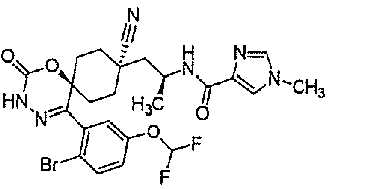
1H-NMR (DMSO-D6) δ: 11.36 (1H, s), 7.86-7.79 (2H, m), 7.61 (1H, s), 7.56 (1H, s), 7.49-7.10 (3H, m), 4.32-4.21 (1H, m), 3.66 (3H, s), 2.29-1.96 (4H, m), 1.88-1.54 (6H, m), 1.14 (3H, d, J = 6.5 Hz). 579 577 2-079 
1H-NMR (DMSO-D6) δ: 11.42 (1H, s), 8.06-8.01 (1H, m), 7.96-7.91 (1H, m), 7.85-7.76 (2H, m), 7.61 (1H, s), 7.55 (1H, s), 4.32-4.20 (1H, m), 3.66 (3H, s), 2.33-1.95 (4H, m), 1.88-1.50 (6H, m), 1.14 (3H, d, J = 7.0 Hz). 581 579 2-080 
1H-NMR (DMSO-D6) δ: 11.41 (1H, s), 8.75-8.70 (1H, m), 8.63-8.57 (1H, m), 7.95-7.90 (1H, m), 7.67-7.64 (1H, m), 7.51-7.46 (1H, m), 4.17-4.05 (1H, m), 2.64 (3H, d, J = 4.8 Hz), 2.30-1.94 (4H, m), 1.81-1.52 (6H, m), 1.12 (3H, d, J = 7.0 Hz), 574 572 Table 1-52 2-081 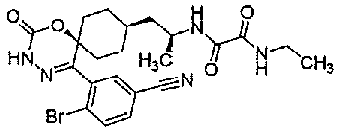
1H-NMR (DMSO-D6) δ: 11.29 (1H, s), 8.71-8.64 (1H, m), 8.44-8.37 (1H, m), 8.01-7.95 (2H, m), 7.89-7.82 (1H, m), 3.96-3.85 (1H, m), 3.18-3.06 (2H, m), 2.16-2.05 (2H, m), 1.69-1.16 (9H, m), 1.09-0.99 (6H, m). 504 502 2-082 
1H-NMR (DMSO-D6) δ: 11.37 (1H, s), 8.75-8.69 (1H, m), 8.68-8.62 (1H, m), 7.85-7.80 (1H, m), 7.50-7,10 (3H, m), 4.17-4.05 (1H, m), 3.21-3.04 (2H, m), 2.29-1.96 (4H, m), 1.82-1.56 (6H, m), 1.12 (3H, d, J = 6.5 Hz), 1.02 (3H, t, J = 7.3 Hz), 570 568 2-083 
1H-NMR (DMSO-D6) δ: 11.32 (1H, s), 8,66-8,58 (2H, m), 8.45-8.38 (1H, m), 7.10 (1H, s), 6.56-6.24 (1H, m), 4.63-4.51 (2H, m), 3.97-3.84 (1H, m), 2.64 (3H, d, J = 3,8 Hz), 2.16-2.07 (2H, m), 1.71-1.13 (9H, m), 1.06 (3H, d, J = 6.5 Hz). 594 592 2-084 
1H-NMR (DMSO-D6) δ: 11.32 (1H, s), 8.66-8.60 (1H, m), 8.47 (1H, s), 8.44-8.38 (1H, m), 7.14 (1H, s), 6,56-6,24 (1H, m), 4.64-4.52 (2H, m), 3.96-3.85 (1H, m), 2.64 (3H, d, J = 4.8 Hz), 2.15-2.07 (2H, m), 1.70-1.16 (9H, m), 1.05 (3H, d, J = 6.5 Hz). 546 544 2-085 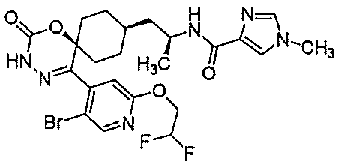
1H-NMR (DMSO-D6) δ: 11.32 (1H, s), 8.46 (1H, s), 7.60 (1H, s), 7.54 (1H, s), 7.45 (1H, d, J = 9.2 Hz), 7.14 (1H, s), 6.57-6.21 (1H, m), 4.63-4.50 (2H, m), 4.11-3.96 (1H, m), 3.66 (3H, s), 2.17-2.07 (2H, m), 1.76-1.15 (9H, m), 1.07 (3H, d, J = 6.5 Hz), 569 567 2-086 
1H-NMR (DMSO-D6) δ: 11.31 (1H, s), 8.59 (1H, s), 7.61 (1H, s), 7.54 (1H, s), 7.45 (1H, d, J = 8.6 Hz), 7.10 (1H, s), 6.55-6.21 (1H, m), 4.61-4.50 (2H, m), 4.09-3.98 (1H, m), 3.66 (3H, s), 2.17-2.06 (2H, m), 1.75-1.14 (9H, m), 1.07 (3H, d, J = 6.5 Hz). 617 615 2-087 
1H-NMR (DMSO-D6) δ: 11.31 (1H, s), 8.64-8.58 (1H, m), 8.43-8.38 (1H, m), 8.07-8.02 (1H, m), 7.92-7.88 (2H, m), 3.96-3.84 (1H, m), 3.32 (3H, s), 2.63 (3H, d, J = 4.8 Hz), 2.21-2.12 (2H, m), 1.71-1.13 (9H, m), 1.05 (3H, d, J = 6.5 Hz), 543 541 2-088 
1H-NMR (DMSO-D6) δ: 11.34 (1H, s), 8.75-8.69 (1H, m), 8.63-8.57 (1H, m), 7.80-7,75 (1H, m), 7.61-7.55 (1H, m), 7.43-7.36 (1H, m), 4.18-4.06 (1H, m), 2.64 (3H, d, J = 4.8 Hz), 2.26-1.95 (4H, m), 1.81-1.53 (6H, m), 1.12 (3H, d, J = 6.5 Hz), 508 506 2-089 
1H-NMR (DMSO-D6) δ: 11.33 (1H, s), 8.03 (1H, s), 7.86 (1H, d, J = 9.2 Hz), 7,78-7,73 (2H, m), 7.60-7.54 (1H, m), 7.41-7.34 (1H, m), 4.32-4.20 (1H, m), 3.82 (3H, s), 2.27-2.15 (2H, m), 2.03-1.51 (8H, m), 1.12 (3H, d, J = 6.5 Hz). 531 529 2-090 
1H-NMR (DMSO-D6) δ: 11.37 (1H, s), 8.03 (1H, s), 7.90-7.78 (2H, m), 7.76 (1H, s), 7.50-7.08 (3H, m), 4.32-4.20 (1H, m), 3.82 (3H, s), 2.29-2.16 (2H, m), 2.04-1.54 (8H, m), 1.12 (3H, d, J = 6.5 Hz). 579 577 Table 1-53 2-091 
1H-NMR (DMSO-D6) δ: 11.31 (1H, s), 8.59 (1H, s), 8.05 (1H, s), 7.78 (1H, s), 7.64 (1H, d, J = 8.1 Hz), 7.10 (1H, s), 6.56-6.21 (1H, m), 4.63-4.49 (2H, m), 4.09-3.94 (1H, m), 3.81 (3H, s), 2.17-2.07 (2H, m), 1.73-1.14 (9H, m), 1.06 (3H, d, J = 5.9 Hz). 617 615 2-092 
1H-NMR (DMSO-D6) δ; 11.45 (1H, s), 8.75-8.70 (1H, m), 8.67-8.63 (1H, m), 8.15-8.13 (1H, m), 8.05-8.01 (1H, m), 7.93-7.88 (1H, m), 4.16-4.04 (1H, m), 2.78-2.69 (1H, m), 2.29-1.94 (4H, m), 1.82-1.53 (6H, m), 1.12 (3H, d, J = 6.5 Hz), 0.64-0.56 (4H, m). 541 539 2-093 
1H-NMR (DMSO-D6) δ: 11.46 (1H, s), 8.75-8.69 (1H, m), 8.67-8.63 (1H, m), 8.49 (1H, s), 7.11 (1H, s), 4.15-4.02 (1H, m), 3.89 (3H, s), 2.77-2.68 (1H, m), 2.27-1.96 (4H, m), 1.82-1.53 (6H, m), 1.12 (3H, d, J = 6.5 Hz), 0.66-0.54 (4H, m). 547 545 2-094 
1H-NMR (DMSO-D6) δ: 11.44 (1H, s), 8.14 (1H, s), 8.04-8.00 (2H, m), 7.91-7.83 (2H, m), 7.76 (1H, s), 4.35-4.19 (1H, m), 3.82 (3H, s), 2.31-2.16 (2H, m), 2.04-1.54 (8H, m), 1.13 (3H, d, J = 6.5 Hz). 538 536 2-095 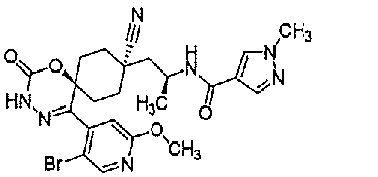
1H-NMR (CDCl3) δ: 8.49 (1H, s), 8.34 (1H, s), 7.81 (1H, s), 7.75 (1H, s), 6.62 (1H, s), 5.68 (1H, d, J = 9.7 Hz), 4.59-4.47 (1H, m), 3.92 (3H, s), 3.89 (3H, s), 2.37-2.27 (2H, m), 2.18-1.69 (8H, m), 1.27 (3H, d, J = 6.5 Hz). 544 542 2-096 
1H-NMR (DMSO-D6) δ: 8.35 (1H, d, J = 1.5 Hz), 7.95 (1H, dd, J = 8.0, 1.5 Hz), 7.70 (1H, d, J = 8.0 Hz), 7.42-7.35 (2H, m), 4.10-3.98 (1H, m), 2.74-2.65 (2H, m), 2.46-2.38 (1H, m), 2.34-2.21 (4H, m), 2.24 (3H, s), 2.15-2.04 (2H, m), 1.65-1.51 (2H, m), 1.06 (3H, d, J = 6.5 Hz), 514 512 2-097 
1H-NMR (DMSO-D6) δ: 11.43 (1H, s), 8.02 (1H, s), 7.98-7.94 (1H, m), 7.88-7.79 (2H, m), 7.76 (1H, s), 7.73-7.68 (1H, m), 4.33-4.20 (1H, m), 3.83-3.80 (3H, m), 2.36-2.13 (2H, m), 2.04-1.60 (8H, m), 1.12 (3H, d, J = 6.5 Hz). 581 579 2-098 
1H-NMR (DMSO-D6) δ: 11.38 (1H, s), 8.75-8.70 (1H, m), 8.63-8.57 (1H, m), 7.84-7.79 (1H, m), 7.56-7.51 (1H, m), 7.38-7.30 (1H, m), 4.17-4.06 (1H, m), 2.64 (3H, d, J = 4.8 Hz), 2.27-1.95 (4H, m), 1.81-1.53 (6H, m), 1.12 (3H, d, J = 6.5 Hz). 508 506 2-099 
1H-NMR (DMSO-D6) δ: 11.49 (1H, s), 8.77-8.68 (1H, m), 8.63-8.56 (1H, m), 8.52 (1H, s), 7.25 (1H, s), 6.58-6.24 (1H, m), 4.67-4.54 (2H, m), 4.07-3.97 (1H, m), 2.66 (3H, d, J = 3.8 Hz), 2.08-1.55 (10H, m), 1.11 (3H, d, J = 6.5 Hz). 571 569 2-100 
1H-NMR (DMSO-D6) δ: 11.38 (1H, s), 8.72 (1H, d, J = 9.2 Hz), 8.65 (1H, d, J = 5.4 Hz), 7.84-7.79 (1H, m), 7.56-7.51 (1H, m), 7.38-7.31 (1H, m), 4.16-4.04 (1H, m), 2.78-2.69 (1H, m), 2.27-1.94 (4H, m), 1.82-1.54 (6H, m), 1.12 (3H, d, J = 6.5 Hz), 0.65-0.55 (4H, m). 534 532 Table 1-54 2-101 
1H-NMR (DMSO-D6) δ: 11.49 (1H, s), 8.75-8.68 (1H, m), 8.67-8.60 (1H, m), 8.51 (1H, s), 7.25 (1H, s), 6.58-6.24 (1H, m), 4.67-4.55 (2H, m), 4.07-3.94 (1H, m), 2.80-2.69 (1H, m), 2.08-1.54 (10H, m), 1.10 (3H, d, J = 6.5 Hz), 0.69-0.55 (4H, m). 597 595 2-102 
1H-NMR (DMSO-D6) δ: 11.40 (1H, s), 8.77-8.67 (1H, m), 8.66-8.56 (1H, m), 7.67-7.50 (2H, m), 7.27 (1H, t, J = 71.9 Hz), 4.19-4.05 (1H, m), 2.66-2.62 (3H, m), 2.31-1.93 (4H, m), 1.82-1,50 (6H, m), 1.12 (3H, d, J = 6,5 Hz). 574 572 2-103 
1H-NMR (DMSO-D6) δ: 11.40 (1H, s), 8.72 (1H, d, J = 9.7 Hz), 8.65 (1H, d, J = 4.8 Hz), 7.66-7.59 (1H, m), 7.57-7.51 (1H, m), 7.27 (1H, t, J = 72.2 Hz), 4.17-4.04 (1H, m), 2.77-2.69 (1H, m), 2.27-1.93 (4H, m), 1.82-1.50 (6H, m), 1.12 (3H, d, J = 6.5 Hz), 0.68-0,53 (4H, m). 600 598 2-104 
1H-NMR (DMSO-D6) δ: 11.38 (1H, s), 8.97-8.90 (1H, m), 8.88-8.82 (1H, m), 7.85-7.80 (1H, m), 7.50-7.10 (3H, m), 6.20-5.87 (1H, m), 4.20-4.07 (1H, m), 3.65-3.40 (2H, m), 2.30-1.95 (4H, m), 1.83-1.54 (6H, m), 1.13 (3H, d, J = 6.5 Hz). 606 604 2-105 
1H-NMR (CDCl3) δ: 9.73 (1H, s), 8.34 (1H, s), 7.66 (1H, d, J = 9.2 Hz), 7.39-7.33 (1H, m), 7.15-7.10 (1H, m), 7.02 (1H, d, J = 2.7 Hz), 6.51 (1H, t, J = 72.7 Hz), 4.35-4.22 (1H, m), 3.82 (3H, s), 2.41-2.29 (2H, m), 2.10-1.70 (8H, m), 1.30 (3H, d, J = 6.5 Hz). 572 570 2-106 
1H-NMR (DMSO-D6) δ: 11.46 (1H, s), 8.96-8.91 (1H, m), 8.88-8.82 (1H, m), 8.49 (1H, s), 7.11 (1H, s), 6.21-5.86 (1H, m), 4.18-4.07 (1H, m), 3.88 (3H, s), 3.66-3.39 (2H, m), 2.29-1.95 (4H, m), 1.81-1.55 (6H, m), 1.13 (3H, d, J = 6.5 Hz). 571 569 2-107 
1H-NMR (DMSO-D6) δ: 11.38 (1H, s), 8.75-8.69 (1H, m), 8.67-8.63 (1H, m), 7.85-7.81 (1H, m), 7.52-7.11 (3H, m), 4.16-4.01 (1H, m), 2.78-2.67 (1H, m), 2.29-1.93 (4H, m), 1.86-1.52 (6H, m), 1.12 (3H, d, J = 6.5 Hz), 0.67-0.54 (4H, m). 582 580 2-108 
1H-NMR (DMSO-D6) δ: 11.22 (1H, s), 8.38 (1H, d, J = 8.6 Hz), 7.98 (1H, s), 7.81-7.76 (1H, m), 7.71 (1H, s), 7.53-7.12 (3H, m), 3.95-3.80 (1H, m), 2.21-2.08 (2H, m), 1.70-1.14 (9H, m), 1.05 (3H, d, J = 6.5 Hz). 517 515 2-109 
1H-NMR (DMSO-D6) δ: 11.36 (1H, s), 8.75-8.69 (1H, m), 8.63-8.57 (1H, m), 7.59-7.52 (1H, m), 7.46-7.42 (1H, m), 7.39-7.34 (2H, m), 4.16-4.05 (1H, m), 2.66-2.61 (3H, m), 2.29-1.94 (4H, m), 1.81-1.57 (6H, m), 1.11 (3H, d, J = 4.8 Hz). 556 554 2-110 
1H-NMR (DMSO-D6) δ: 11.37 (1H, s), 8.74-8.69 (1H, m), 8,67-8.63 (1H, m), 7.59-7.53 (1H, m), 7.47-7.42 (1H, m), 7.39-7.35 (2H, m), 4.16-4.03 (1H, m), 2.78-2.68 (1H, m), 2.29-1.93 (4H, m), 1.82-1.55 (6H, m), 1.12 (3H, d, J = 6.5 Hz), 0.67-0.56 (4H, m). 582 580 Table 1-55 2-111 
1H-NMR (DMSO-D6) δ: 11.37 (1H, s), 8.97-8.90 (1H, m), 8.88-8.82 (1H, m), 7.59-7.52 (1H, m), 7.47-7.42 (1H, m), 7.39-7.35 (2H, m), 6.20-5.87 (1H, m), 4,20-4,07 (1H, m), 3.64-3.38 (2H, m), 2.30-1.94 (4H, m), 1.83-1.53 (6H, m), 1.13 (3H, d, J = 6.5 Hz). 606 604 2-112 
1H-NMR (DMSO-D6) δ: 8.66-8.59 (1H, m), 8.46-8.38 (1H, m), 8.04-7.96 (2H, m), 7.90-7.84 (1H, m), 3.96-3.85 (1H, m), 3.32 (3H, s), 2.64 (3H, d, J = 4.8 Hz), 2.16-2.05 (2H, m), 1.70-1.38 (4H, m), 1.31-1.14 (5H, m), 1.05 (3H, d, J = 7.0 Hz). 504 N.D. 2-113 
1H-NMR (DMSO-D6) δ: 11.38 (1H, s), 8.72 (1H, d, J = 9.2 Hz), 8.57 (1H, s), 7.85-7.81 (1H, m), 7.50-7.11 (3H, m), 4.16-4.05 (1H, m), 2.28-1.95 (4H, m), 1.81-1.57 (6H, m), 1.12 (3H, d, J = 7.0 Hz). 559 557 2-114 
1H-NMR (CDCl3) δ: 9.77 (1H, s), 8.49 (1H, s), 7.83-7.79 (1H, m), 7.57-7.51 (1H, m), 7.43-7.38 (2H, m), 4.36-4.23 (1H, m), 3.81 (3H, s), 2.45-2.35 (2H, m), 2.09-1.70 (8H, m), 1.29 (3H, d, J = 7.0 Hz). 574 572 2-115 
1H-NMR (CDCl3) δ: 9.84 (1H, s), 8.53 (1H, s), 7.48-7.39 (2H, m), 7.35-7.30 (1H, m), 7.14-7.09 (1H, m), 6.58 (1H, t, J = 72.7 Hz), 4.35-4.22 (1H, m), 3.81 (3H, s), 2.43-2,30 (2H, m), 2.09-1.68 (8H, m), 1.29 (3H, d, J = 7.0 Hz), 572 570 2-116 
1H-NMR (CDCl3) δ: 9.96 (1H, s), 8.77 (1H, s), 8.35 (1H, s), 7.56 (1H, d, J = 9.7 Hz), 6.64 (1H, s), 4.36-4.24 (1H, m), 3.93 (3H, s), 3.82 (3H, s), 2.36-2.29 (2H, m), 2.08-1.70 (8H, m), 1.29 (3H, d, J = 6.5 Hz). 537 535 2-117 
1H-NMR (DMSO-D6) δ: 11.44 (1H, s), 8.74-8.69 (1H, m), 8,67-8,63 (1H, m), 8,00-7.95 (1H, m), 7.85-7.80 (1H, m), 7.76-7.70 (1H, m), 4.16-4.04 (1H, m), 2.78-2.69 (1H, m), 2.34-1.93 (4H, m), 1.84-1.60 (6H, m), 1.12 (3H, d, J = 6.5 Hz), 0.66-0.53 (4H, m). 584 582 2-118 
1H-NMR (DMSO-D6) δ: 11.44 (1H, s), 8.74-8.69 (1H, m), 8.56 (1H, s), 7.99-7.95 (1H, m), 7.84-7.80 (1H, m), 7.75-7.69 (1H, m), 4.15-4,04 (1H, m), 2.33-1.95 (4H, m), 1.81-1.59 (6H, m), 1.11 (3H, d, J = 6.5 Hz), 561 559 2-119 
1H-NMR (DMSO-D6) δ: 12.01 (1H, s), 11.42 (1H, s), 8.86-8.80 (1H, m), 7.96-7.90 (1H, m), 7.67-7.64 (1H, m), 7.51-7.47 (1H, m), 4.17-4.04 (1H, m), 3.59 (3H, s), 2.31-1.95 (4H, m), 1.83-1.52 (6H, m), 1.12 (3H, d, J = 6.6 Hz), 590 588 2-120 
1H-NMR (DMSO-D6) δ: 12.02 (1H, s), 11.23 (1H, s), 8.53 (1H, d, J = 8.1 Hz), 7.79 (1H, d, J = 9.2 Hz), 7.53-7.12 (3H, m), 3.98-3.85 (1H, m), 3.60 (3H, s), 2.20-2.08 (2H, m), 1,70-1.14 (9H, m), 1.05 (3H, d, J = 6.5 Hz). 547 545 Table 1-56 2-121 
1H-NMR (DMSO-D6) δ: 11.30 (1H, s), 8.44 (1H, s), 8.42-8.34 (1H, m), 7.99 (1H, s), 7.72 (1H, s), 7.01 (1H, s), 3.94-3.82 (1H, m), 3.88 (3H, s), 2.17-2.06 (2H, m), 1.69-1.15 (9H, m), 1.05 (3H, d, J = 6.5 Hz). 482 480 2-122 
1H-NMR (DMSO-D6) δ: 11.32 (1H, s), 8.47 (1H, s), 8.41-8.34 (1H, m), 7.99 (1H, s), 7.72 (1H, s), 7.15 (1H, s), 6.57-6.25 (1H, m), 4.66-4.52 (2H, m), 3.96-3.82 (1H, m), 2.19-2.07 (2H, m), 1.71-1.15 (9H, m), 1.05 (3H, d, J = 6.5 Hz). 532 530 2-123 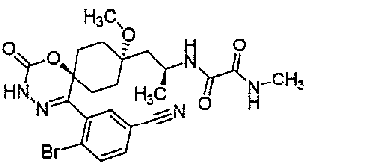
1H-NMR (DMSO-D6) δ: 11.32 (1H, s), 8.65-8.54 (2H, m), 8.09-8.05 (1H, m), 8.03-7.98 (1H, m), 7.91-7.86 (1H, m), 4.01-3.92 (1H, m), 2.92 (3H, s), 2.67-2.63 (3H, m), 1.99-1.42 (10H, m), 1.08 (3H, d, J = 6.5 Hz), 520 518 2-124 
1H-NMR (DMSO-D6) δ: 11.31 (1H, s), 8.65-8,51 (2H, m), 8.00-7.92 (1H, m), 7.80-7.66 (2H, m), 4.04-3.91 (1H, m), 2.90 (3H, s), 2.65 (3H, d, J = 4.8 Hz), 2.01-1.40 (10H, m), 1.08 (3H, d, J = 6.5 Hz). 563 561 2-125 
1H-NMR (DMSO-D6) δ: 11.33 (1H, s), 8.66-8.53 (2H, m), 8.46 (1H, s), 7.03 (1H, s), 4.03-3.91 (1H, m), 3.89 (3H, s), 2.93 (3H, s), 2.65 (3H, d, J = 4.8 Hz), 1.97-1.68 (4H, m), 1.65-1.41 (6H, m), 1.08 (3H, d, J = 6.5 Hz). 526 524 2-126 
1H-NMR (DMSO-D6) δ: 11.33 (1H, s), 8.68-8.64 (1H, m), 8.59-8.54 (1H, m), 8.06 (1H, s), 8.03-7.98 (1H, m), 7.90-7.86 (1H, m), 4.02-3.92 (1H, m), 2.92 (3H, s), 2.78-2.69 (1H, m), 2.00-1.69 (4H, m), 1.64-1.43 (6H, m), 1.08 (3H, d, J = 6.5 Hz), 0.68-0.57 (4H, m), 546 544 2-127 
1H-NMR (DMSO-D6) δ: 11.38 (1H, s), 8.97-8.95 (1H, m), 8.69-8.66 (1H, m), 8.56-8,52 (1H, m), 8.16-8.12 (1H, m), 7.81 (1H, d, J = 8.8 Hz), 7.50-7.46 (1H, m), 7.40-7.38 (1H, m), 7.28 (1H, t, J = 73.6 Hz), 7.27-7.23 (1H, m), 4.41-4.32 (1H, m), 2.31-2.19 (2H, m), 2.08-1.99 (2H, m), 1.88-1.57 (6H, m), 1.20-1.16 (3H, m). 576 574 2-128 
1H-NMR (DMSO-D6) δ: 11.36 (1H, s), 8.78-8.73 (1H, m), 8.64-8.60 (1H, m), 8,03-7.93 (2H, m), 7.82-7.78 (1H, m), 7.60-7.55 (1H, m), 7.39-7.36 (1H, m), 7.28 (1H, t, J = 73.5 Hz), 7.27-7.21 (1H, m), 4.40-4.30 (1H, m), 2.29-1.99 (4H, m), 1.85-1.54 (6H, m), 1.20 (3H, d, J = 6.5 Hz), 576 574 2-129 
1H-NMR (DMSO-D6) δ: 11.31 (1H, s), 8.59-8.53 (2H, m), 7.97-7.93 (1H, m), 7.78-7.66 (2H, m), 4.03-3.90 (1H, m), 2.90 (3H, s), 2.01-1.41 (10H, m), 1.07 (3H, d, J = 6.5 Hz). 566 564 2-130 
1H-NMR (DMSO-D6) δ: 11.33 (1H, s), 8.60-8.54 (2H, m), 8.38-8.35 (1H, m), 8.00-7.95 (1H, m), 7.70-7.66 (1H, m), 4.03-3.90 (1H, m), 2.91 (3H, s), 1.99-1.68 (4H, m), 1.62-1.44 (6H, m), 1.08 (3H, d, J = 6.5 Hz). 523 521 Table 1-57 2-131 
1H-NMR (DMSO-D6) δ: 11.25 (1H, s), 8.60-8.52 (2H, m), 7.83-7.76 (1H, m), 7.49-7.43 (1H, m), 7.35-7.28 (1H, m), 4.02-3.91 (1H, m), 2.92 (3H, s), 1.99-1.67 (4H, m), 1.64-1.41 (6H, m), 1.08 (3H, d, J = 6.5 Hz). 516 514 2-132 
1H-NMR (DMSO-D6) δ: 11.41 (1H, s), 8.73 (1H, d, J = 9.2 Hz), 8.58 (1H, s), 7.92 (1H, d, J = 8.8 Hz), 7.67-7.64 (1H, m), 7.51-7.46 (1H, m), 4.16-4.03 (1H, m), 2.30-1.94 (4H, m), 1.84-1.51 (6H, m), 1.12 (3H, d, J = 6.6 Hz). 577 575 2-133 
1H-NMR (DMSO-D6) δ: 11.38 (1H, s), 8.73 (1H, d, J = 9.7 Hz), 8.58 (1H, s), 7.85-7.79 (1H, m), 7.58-7.50 (1H, m), 7.40-7.30 (1H, m), 4.19-4.06 (1H, m), 2.29-1.95 (4H, m), 1.83-1.53 (6H, m), 1.12 (3H, d, J = 6.6 Hz). 511 509 2-134 
1H-NMR (DMSO-D6) δ: 11.34 (1H, s), 8.72 (1H, d, J = 9.2 Hz), 8.57 (1H, s), 7.82-7.74 (1H, m), 7.62-7.54 (1H, m), 7.44-7.36 (1H, m), 4,17-4,05 (1H, m), 2.27-2.14 (2H, m), 2.13-1.96 (2H, m), 1.81-1.53 (6H, m), 1.12 (3H, d, J = 6.5 Hz). 511 509 2-135 
1H-NMR (DMSO-D6) δ: 11.22 (1H, s), 8.62-8.52 (2H, m), 7.78-7.70 (1H, m), 7.56-7.47 (1H, m), 7.41-7.33 (1H, m), 4.03-3.91 (1H, m), 2.93-2.89 (3H, m), 1.96-1.79 (3H, m), 1.75-1.66 (1H, m), 1.63-1.42 (6H, m), 1.08 (3H, d, J = 6.5 Hz). 516 514 2-136 
1H-NMR (DMSO-D6) δ: 11.23 (1H, s), 9.31 (1H, s), 9.04 (1H, d, J = 4.8 Hz), 8.87 (1H, d, J = 8.6 Hz), 8.00 (1H, d, J = 5.4 Hz), 7.81-7.75 (1H, m), 7.48-7.42 (1H, m), 7.35-7.27 (1H, m), 4.28-4.14 (1H, m), 2.95 (3H, s), 2.02-1.86 (3H, m), 1.80-1.73 (1H, m), 1.69-1.46 (6H, m), 1.17 (3H, d, J = 6.5 Hz). 534 532 2-137 
1H-NMR (DMSO-D6) δ: 11.23 (1H, s), 9.40-9.37 (1H, m), 9.10 (1H, d, J = 8.6 Hz), 8.20-8,16 (1H, m), 7.91-7.86 (1H, m), 7.81-7.75 (1H, m), 7.47-7.42 (1H, m), 7.34-7.27 (1H, m), 4.34-4.22 (1H, m), 2.96 (3H, s), 2.04-1.48 (10H, m), 1.20 (3H, d, J = 6.5 Hz), 534 532 2-138 
1H-NMR (DMSO-D6) δ: 11.40 (1H, s), 8.73 (1H, d, J = 9.2 Hz), 8.57 (1H, s), 7.67-7.59 (1H, m), 7.57-7.51 (1H, m), 7.27 (1H, t, J = 72.2 Hz), 4.18-4.05 (1H, m), 2.29-1.93 (4H, m), 1.83-1,50 (6H, m), 1.12 (3H, d, J = 6.5 Hz), 577 575 2-139 
1H-NMR (DMSO-D6) δ: 11.40 (1H, s), 8.73 (1H, d, J = 9.7 Hz), 8.63-8.57 (1H, m), 8.08-8.01 (1H, m), 7.88-7.81 (1H, m), 4.17-4.06 (1H, m), 2.64 (3H, d, J = 4.8 Hz), 2.27-2.15 (2H, m), 2.13-1.96 (2H, m), 1.81-1.55 (6H, m), 1.12 (3H, d, J = 6.5 Hz), 526 524 2-140 
1H-NMR (DMSO-D6) δ: 11.40 (1H, s), 8.73 (1H, d, J = 9.7 Hz), 8.57 (1H, s), 8.08-8.01 (1H, m), 7.88-7.81 (1H, m), 4.18-4.06 (1H, m), 2.28-1.93 (4H, m), 1.84-1.55 (6H, m), 1.12 (3H, d, J = 6.5 Hz). 529 527 Table 1-58 2-141 
1H-NMR (DMSO-D6) δ: 11.36 (1H, s), 9.30 (1H, s), 9.06-9.00 (2H, m), 8.01-7.97 (1H, m), 7.82-7.76 (1H, m), 7.55-7.49 (1H, m), 7.35-7.28 (1H, m), 4.44-4.28 (1H, m), 2.31-2.01 (4H, m), 1,86-1,52 (6H, m), 1.21 (3H, d, J = 6.5 Hz). 529 527 2-142 
1H-NMR (DMSO-D6) δ: 11.36 (1H, s), 9.38 (1H, d, J = 5.4 Hz), 9.27 (1H, d, J = 9.7 Hz), 8.20-8.15 (1H, m), 7.90-7.85 (1H, m), 7.82-7.77 (1H, m), 7.55-7.49 (1H, m), 7.35-7.28 (1H, m), 4,50-4.36 (1H, m), 2.31-2.03 (4H, m), 1.87-1.54 (6H, m), 1.24 (3H, d, J = 6.5 Hz). 529 527 2-143 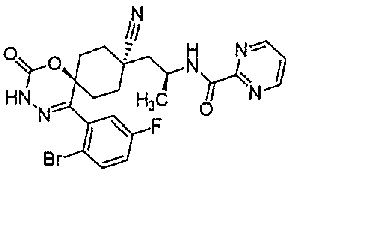
1H-NMR (DMSO-D6) δ: 11.36 (1H, s), 8.94 (2H, d, J = 4.8 Hz), 8.89 (1H, d, J = 9.2 Hz), 7.83-7.77 (1H, m), 7.67-7.63 (1H, m), 7.55-7.50 (1H, m), 7.35-7.28 (1H, m), 4.41-4.30 (1H, m), 2.31-2,01 (4H, m), 1.87-1.55 (6H, m), 1.20 (3H, d, J = 7.0 Hz). 529 527 2-144 
1H-NMR (DMSO-D6) δ: 11.25 (1H, s), 8.65-8.53 (2H, m), 7.84-7.76 (1H, m), 7.49-7.42 (1H, m), 7.36-7.28 (1H, m), 4.02-3.91 (1H, m), 2.92 (3H, d, J = 1.1 Hz), 2.65 (3H, dd, J = 4.8, 1.1 Hz), 1.98-1.66 (4H, m), 1.63-1.40 (6H, m), 1.08 (3H, d, J = 6.5 Hz). 513 511 2-145 
1H-NMR (DMSO-D6) δ: 11.21 (1H, s), 8.65-8.53 (2H, m), 7.76-7.71 (1H, m), 7.55-7.48 (1H, m), 7.40-7.33 (1H, m), 4.03-3.91 (1H, m), 2.91 (3H, d, J = 1.1 Hz), 2.65 (3H, d, J = 4.3 Hz), 1.96-1.67 (4H, m), 1.64-1.41 (6H, m), 1.08 (3H, d, J = 6.5 Hz). 513 511 2-146 
1H-NMR (DMSO-D6) δ: 11.36 (1H, s), 9.16 (1H, s), 8.92 (1H, d, J = 9.7 Hz), 8.86-8.83 (1H, m), 8.72-8.69 (1H, m), 7.83-7.77 (1H, m), 7.55-7.49 (1H, m), 7.35-7.29 (1H, m), 4.45-4.32 (1H, m), 2,35-2.03 (4H, m), 1.85-1.55 (6H, m), 1.21 (3H, d, J = 6.5 Hz). 529 527 2-147 
1H-NMR (DMSO-D6) δ: 11.37 (1H, s), 9.89-9.80 (1H, m), 8.30-8.24 (1H, m), 8.04-7.99 (1H, m), 7.83-7.76 (1H, m), 7.56-7.50 (1H, m), 7.36-7.29 (1H, m), 6.50-6.43 (1H, m), 4.38-4.24 (1H, m), 3.54 (3H, s), 2.29-2.16 (2H, m), 2.09-1.54 (8H, m), 1.21-1.15 (3H, m), 558 556 2-148 
racemate 1H-NMR (DMSO-D6) δ: 11.32 (1H, s), 8.64-8.58 (1H, m), 8.46 (1H, d, J = 9.2 Hz), 8.10 (1H, s), 8.03-7.99 (1H, m), 7.91-7.86 (1H, m), 3.83-3.73 (1H, m), 2.66 (3H, d, J = 4.8 Hz), 1.94-1.55 (7H, m), 1.47-1.15 (4H, m), 1.04 (3H, d, J = 6.6 Hz). 490 488 2-149 
1H-NMR (DMSO-D6) δ: 11.32 (1H, s), 8.64-8.58 (1H, m), 8.46 (1H, d, J = 9.2 Hz), 8.10 (1H, s), 8.03-7.99 (1H, m), 7.91-7.86 (1H, m), 3,83-3.73 (1H, m), 2.66 (3H, d, J = 4.8 Hz), 1.94-1.55 (7H, m), 1.47-1.15 (4H, m), 1.04 (3H, d, J = 6.6 Hz). 490 488 2-150 
1H-NMR (DMSO-D6) δ: 11.32 (1H, s), 8.64-8.58 (1H, m), 8.46 (1H, d, J = 9.2 Hz), 8.10 (1H, s), 8.03-7.99 (1H, m), 7.91-7.86 (1H, m), 3.83-3.73 (1H, m), 2.66 (3H, d, J = 4.8 Hz), 1.94-1.55 (7H, m), 1.47-1.15 (4H, m), 1.04 (3H, d, J = 6.6 Hz), 490 488 Table 1-59 2-151 
1H-NMR (DMSO-D6) δ: 11.27 (1H, s), 8.65-8.52 (2H, m), 8.05-7.97 (1H, m), 7.80-7.72 (1H, m), 4.02-3.91 (1H, m), 2.93 (3H, s), 2.65 (3H, d, J = 4.8 Hz), 1.96-1.69 (4H, m), 1.64-1.41 (6H, m), 1.08 (3H, d, J = 6.5 Hz). 531 529 2-152 
1H-NMR (DMSO-D6) δ: 11.39 (1H, s), 8.72 (1H, d, J = 9.2 Hz), 8.57 (1H, s), 7.59-7.48 (2H, m), 7.39-7.34 (1H, m), 4.17-4.05 (1H, m), 2.28-2.15 (2H, m), 2.13-1.95 (2H, m), 1.82-1.52 (6H, m), 1.12 (3H, d, J = 6.5 Hz). 511 509 2-153 
1H-NMR (DMSO-D6) δ: 11.39 (1H, s), 8.72 (1H, d, J = 9.2 Hz), 8.63-8.57 (1H, m), 7.58-7.47 (2H, m), 7.38-7.34 (1H, m), 4.17-4.04 (1H, m), 2.64 (3H, d, J = 4.8 Hz), 2.27-1.95 (4H, m), 1.81-1.53 (6H, m), 1.12 (3H, d, J = 6.5 Hz). 508 506 2-154 
1H-NMR (DMSO-D6) δ: 11.38 (1H, s), 9.40-9.36 (1H, m), 9.27 (1H, d, J = 9.2 Hz), 8.19-8.15 (1H, m), 7.91-7.85 (1H, m), 7.55-7.45 (2H, m), 7.36-7.31 (1H, m), 4.48-4.35 (1H, m), 2.30-2.03 (4H, m), 1.88-1.52 (6H, m), 1.23 (3H, d, J = 7.0 Hz). 529 527 2-155 
1H-NMR (DMSO-D6) δ: 11.36 (1H, s), 9.39-9.36 (1H, m), 9.27 (1H, d, J = 9.2 Hz), 8.19-8.16 (1H, m), 7.88 (1H, dd, J = 8.6, 4.8 Hz), 7.80 (1H, d, J = 8.6 Hz), 7.39-7.36 (1H, m), 7.28 (1H, t, J = 73.5 Hz), 7.27-7.22 (1H, m), 4.48-4.36 (1H, m), 2,31-2,02 (4H, m), 1.87-1.55 (6H, m), 1.24 (3H, d, J = 6.5 Hz). 577 575 2-156 
1H-NMR (DMSO-D6) δ: 11.33 (1H, s), 9.39-9.36 (1H, m), 9.27 (1H, d, J = 9.2 Hz), 8.20-8.15 (1H, m), 7.88 (1H, dd, J = 8.6, 4.8 Hz), 7.75 (1H, dd, J = 8.6, 2.7 Hz), 7,59-7.53 (1H, m), 7.40-7,33 (1H, m), 4.48-4.36 (1H, m), 2.29-2.02 (4H, m), 1.86-1.52 (6H, m), 1.23 (3H, d, J = 6.5 Hz). 529 527 2-157 
1H-NMR (DMSO-D6) δ: 11.39 (1H, s), 9.40-9.36 (1H, m), 9.27 (1H, d, J = 9.7 Hz), 8.19-8.15 (1H, m), 8.05-7.99 (1H, m), 7.90-7.79 (2H, m), 4.47-4.38 (1H, m), 2.29-2.04 (4H, m), 1.86-1.56 (6H, m), 1.24 (3H, d, J = 6.5 Hz). 547 545 2-158 
1H-NMR (DMSO-D6) δ: 11.27 (1H, s), 8.64-8.53 (2H, m), 7.57-7.46 (2H, m), 7.30 (1H, d, J = 7.0 Hz), 4.04-3.91 (1H, m), 2.91 (3H, s), 2.65 (3H, d, J = 4.8 Hz), 1.96-1.67 (4H, m), 1.65-1.41 (6H, m), 1.08 (3H, d, J = 6.5 Hz), 513 511 2-159 
1H-NMR (DMSO-D6) δ: 11.38 (1H, s), 8.76 (1H, d, J = 9.2 Hz), 8.62 (1H, d, J = 4.3 Hz), 8.03-7.93 (2H, m), 7.59-7.45 (3H, m), 7.36-7.32 (1H, m), 4.41-4.29 (1H, m), 2.29-2.01 (4H, m), 1.87-1.53 (6H, m), 1.20 (3H, d, J = 7.0 Hz). 528 526 2-160 
1H-NMR (DMSO-D6) δ: 11.30 (1H, s), 8.64-8.56 (2H, m), 8.08 (1H, d, J = 1.6 Hz), 8,01-7,97 (1H, m), 7.89-7.85 (1H, m), 4.06-3.96 (1H, m), 2.65 (3H, d, J = 4.8 Hz), 2.03-1.89 (2H, m), 1.76-1.43 (4H, m), 1.27-1.17 (4H, m), 1.06 (3H, d, J = 6.5 Hz), 0.76 (3H, 504 502 Table 1-60 2-161 
1H-NMR (DMSO-D6) δ: 11.31 (1H, s), 8.64-8.57 (2H, m), 8.07-7.94 (4H, m), 7.89-7.85 (1H, m), 7.60-7.55 (1H, m), 4.24-4.14 (1H, m), 2.96 (3H, s), 1.98-1.47 (10H, m), 1.17 (3H, d, J = 6.5 Hz). 540 538 2-162 
1H-NMR (DMSO-D6) δ: 11.33 (1H, s), 8.64-8.53 (2H, m), 8.36 (1H, d, J = 1.6 Hz), 8.00-7.96 (1H, m), 7.68 (1H, d, J = 8.1 Hz), 4.02-3.91 (1H, m), 2.91 (3H, s), 2.65 (3H, d, J = 4.8 Hz), 1.98-1.79 (3H, m), 1.77-1.68 (1H, m), 1.62-1.42 (6H, m), 1.08 (3H, d, J = 7.0 Hz). 520 518 2-163 
1H-NMR (DMSO-D6) δ: 11.31 (1H, s), 8.71 (1H, d, J = 9.7 Hz), 8.63-8.56 (1H, m), 7.77 (1H, d, J = 7.5 Hz), 7.51-7.47 (2H, m), 7.45-7.40 (1H, m), 4,17-4,04 (1H, m), 2.64 (3H, d, J = 4.8 Hz), 2.27-2.16 (2H, m), 2.11-1.95 (2H, m), 1.81-1.52 (6H, m), 1.12 (3H, d, J = 6.5 Hz), 490 488 2-164 
1H-NMR (DMSO-D6) δ: 11.31 (1H, s), 8.71 (1H, d, J = 9.2 Hz), 8.57 (1H, s), 7.77 (1H, d, J = 8.1 Hz), 7.54-7.38 (3H, m), 4.19-4.03 (1H, m), 2.27-2.16 (2H, m), 2.12-1.93 (2H, m), 1.82-1.52 (6H, m), 1.12 (3H, d, J = 6.5 Hz). 493 491 2-165 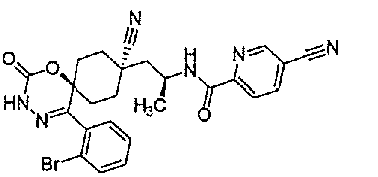
1H-NMR (DMSO-D6) δ: 11.30 (1H, s), 9.09 (1H, d, J = 2.2 Hz), 8.99 (1H, d, J = 9.2 Hz), 8.50-8.46 (1H, m), 8.14 (1H, d, J = 8.1 Hz), 7.75 (1H, d, J = 7.5 Hz), 7.48-7.44 (2H, m), 7.43-7.37 (1H, m), 4.41-4.31 (1H, m), 2.29-2.01 (4H, m), 1.84-1.53 (6H, m), 1.20 (3H, d, J = 6.5 Hz). 535 533 2-166 
1H-NMR (DMSO-D6) δ: 11.38 (1H, s), 9.10-9.08 (1H, m), 8.99 (1H, d, J = 9.7 Hz), 8.50-8.46 (1H, m), 8.14 (1H, d, J = 8.1 Hz), 7.55-7.46 (2H, m), 7.36-7.32 (1H, m), 4.41-4.31 (1H, m), 2.28-2.01 (4H, m), 1.83-1,52 (6H, m), 1.20 (3H, d, J = 6.5 Hz). 553 551 2-167 
1H-NMR (DMSO-D6) δ: 11.33 (1H, s), 9.09 (1H, d, J = 2.2 Hz), 8.99 (1H, d, J = 9.7 Hz), 8,50-8,46 (1H, m), 8.16-8.13 (1H, m), 7.75 (1H, dd, J = 8.6, 2.2 Hz), 7.58-7.53 (1H, m), 7.40-7.33 (1H, m), 4.42-4.31 (1H, m), 2.28-2.01 (4H, m), 1.83-1.51 (6H, m), 1.20 (3H, d, J = 7.0 Hz). 553 551 2-168 
1H-NMR (DMSO-D6) δ: 11.29 (1H, s), 8.75 (1H, d, J = 9.7 Hz), 8.61 (1H, d, J = 3.8 Hz), 8.03-7.93 (2H, m), 7.75 (1H, d, J = 8.1 Hz), 7.59-7.54 (1H, m), 7.48-7.44 (2H, m), 7.43-7.36 (1H, m), 4.40-4.29 (1H, m), 2.32-2,01 (4H, m), 1.87-1.52 (6H, m), 1.20 (3H, d, J = 6.5 Hz). 510 508 2-169 
1H-NMR (DMSO-D6) δ: 11.29 (1H, s), 8.65-8.59 (1H, m), 8.41 (1H, d, J = 9.0 Hz), 8.00 (1H, d, J = 1.8 Hz), 7.98 (1H, d, J = 8,3 Hz), 7.86 (1H, dd, J = 8.3, 1.8 Hz), 3.98-3.85 (1H, m), 2.64 (3H, d, J = 4.9 Hz), 2.16-2.04 (2H, m), 1.69-1.59 (1H, m), 1.59-1.13 (8H, m), 1.06 (3H, d, J = 6.5 Hz). 490 488 2-170 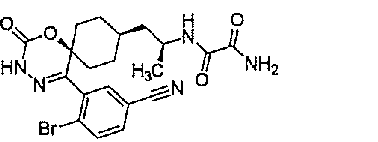
1H-NMR (DMSO-D6) δ: 11.30 (1H, s), 8.39 (1H, d, J = 8.6 Hz), 8.02-7.95 (3H, m), 7.88-7.83 (1H, m), 7.72 (1H, brs), 3.94-3.82 (1H, m), 2.16-2.06 (2H, m), 1.68-1.60 (1H, m), 1.56-1.12 (8H, m), 1.05 (3H, d, J = 6.5 Hz), 476 474 Table 1-61 2-171 
1H-NMR (DMSO-D6) δ: 11.30 (1H, s), 8.07-7,80 (4H, m), 3.84-3.74 (1H, m), 2.21-2.01 (2H, m), 1.70-1.10 (9H, m), 1.01 (3H, d, J = 6.6 Hz). 477 475 2-172 
1H-NMR (DMSO-D6) δ: 11.30 (1H, s), 9.11 (1H, t, J = 6.7 Hz), 8.52 (1H, d, J = 9.2 Hz), 8.00 (1H, d, J = 2.2 Hz), 7.98 (1H, d, J = 8.6 Hz), 7.86 (1H, dd, J = 8.6, 2.2 Hz), 5.65 (1H, t, J = 6.7 Hz), 4.54 (2H, t, J = 6.7 Hz), 3.98-3.86 (1H, m), 2.16-2.06 (2H, m), 1.68-1,16 (9H, m), 1.06 (3H, d, J = 6.5 Hz). 488 (M-17) 504 - A method for measuring human PLD1 enzyme inhibitory activity using an enzyme in which a FLAG-tag is added to the N-terminus of full-length human PLD1 (1-1036 amino acids) is shown below.
- DNA fragment in which a FLAG-tag sequence is added to the 5'-end of full-length human PLD1 was amplified by PCR method, using commercially available human PLD1 gene (Promega KK) as a template. The amplified DNA fragment was fused with vector pVL1393 for baculovirus production (Pharmingen) digested with BamHI and EcoRI, using In-Fusion HD Cloning Kit (Takara Bio). The full-length human PLD1-expression plasmid DNA for baculovirus was isolated from Escherichia coli DH5α (TOYOBO) transformed with the obtained In-Fusion reaction product. Next, DNA fragment in which a FLAG-tag sequence is added to the 5'-end of full-length human PLD1 was amplified by PCR method, using the full-length human PLD1-expression plasmid DNA for baculovirus as a template. The amplified DNA fragment was fused with a DNA fragment in which a linker sequence is introduced into pcDNA3.4-TOPO (Life Technologies), using In-Fusion HD Cloning Kit (Takara Bio). The full-length human PLD1-expression plasmid DNA for animal cells was isolated from Escherichia coli DH5α transformed with the obtained In-Fusion reaction product. The base sequence of the full-length human PLD1 cloned into vector was determined by a Dye Terminator method using BigDye Terminator v3.1 Cycle Sequencing Kit (Applied Biosystems). The determined sequence was a sequence in which the FLAG-tag sequence was inserted at the 5'-end of the full-length human PLD1 (GenBank Accession
Number:NM_001130081). - Expi293F cells (Life Technologies) were cultured with shaking using Expi293 Expression Medium (Life Technologies) as a medium at 37°C in the presence of 8% CO2. The gene introduction reagent PEI was prepared by dissolving Polyethylenimine Max (nominally MW 40,000) (Polysciences) in MilliQ water, adjusting the pH of the solution to 7.0 with NaOH to obtain a 1 mg/mL solution, and then filtering the solution through 0.22 µm filter. The full-length human PLD1-expression plasmid DNA for animal cells was transfected into Expi293F cells using PEI, and after 48 hours of shaking culture, the cells were collected and stored at -80°C.
- To the full-length human PLDl-expressed cells was added a Homogenate buffer (20 mmol/L Na-phosphate pH 7.5, 250 mmol/L NaCl, 1 mmol/L MgCl2, 1%β-OG, 0.05 mmol/L DTT+complete EDTA-free (Roche Diagnostics K.K.)), and the cells were lysed by Microfluidizer Processor M-110EH (Mizuho Kogyo Co., Ltd.). The lysate was centrifuged at 10,100×g at 4°C for 15 minutes, and the supernatant was collected and filtered through 0.45 µm filter. To the centrifuged supernatant was added ANTI-FLAG M2 Affinity Gel (SIGMA-Aldrich) resin equilibrated with a Homogenate buffer, and the mixed solution was stirred at 4°C for 1 hr or more. The mixed solution was loaded onto Poly-Prep column, and the resin was washed with a Wash buffer (20 mmol/L Na-phosphate pH 7.5, 150 mmol/L NaCl, 1 mmol/L MgCl2, 0.02% Triton, 0.05 mmol/L DTT). A Wash buffer containing 400 µg/mL DYKDDDDK Peptide (Scrum Inc.) was added to the column to elute the protein bound to the resin. The eluted fractions were subjected to SDS-PAGE followed by CBB staining to identify the fractions containing the full-length human PLD1. The eluted fractions of the full-length human PLD1 were collected and concentrated using Amicon Ultra-15 100k (Merck Millipore). The concentrated fractions were collected, flash-frozen in liquid nitrogen and stored at -80°C.
- A DMSO or test substance solution (the DMSO final concentration: 5%) prepared by diluting DMSO or test substance with an Assay buffer (50 mmol/L HEPES pH 7.5, 80 mmol/L KCl, 3 mmol/L EGTA, 3.6 mmol/L MgCl2, 0.01% NP-40, 0.1% BSA), and the solution was added to a 384 well Assay Plate (Black, Polystyrene, Non-Treated, Cat No.3573, Corning) by 5 µL/well. A full-length human PLD1 enzyme solution (6 nmol/L) diluted with an Assay buffer was added thereto by 5 µL/well (the Assay buffer was added to blank wells). A 1,2-diheptanoyl-sn-glycero-3-phosphocholine (Avanti Polar Lipids) substrate solution (6 mmol/L) diluted with an Assay buffer was added thereto by 5 µL/well, and enzymatic reaction was carried out at room temperature for 60 minutes. Immediately before stopping the reaction, a detection solution (200 µmol/L AmplexRed (Thermofisher), 0.1 U/mL Choline Oxidase (Sigma-Aldrich), 4 U/mL Horseradish peroxidase (Thermofisher)) containing 4 µmol/L of 5-fluoro-2-indolyl deschlorohalopemide (R&D Systems) as a reaction terminator was prepared with an Assay buffer, the detection solution was added thereto at 5 µL/well to terminate the enzymatic reaction. Immediately after stopping the reaction and 30 minutes after incubation at room temperature, the fluorescence values at Ex: 531 nm/Em: 590 nm were measured by ARVO X5 (PerkinElmer). The inhibition rate was calculated from the change in the fluorescence values immediately after stopping the reaction and after 30 minutes. Data were obtained by subtracting the average fluorescence value of the blank wells from the average fluorescence value of the treated wells. The inhibition rate at each concentration of the test substance was calculated from the following formula:

- A: data of solvent control
- B: data of test substance-treatment
- The IC50 value (50% inhibitory concentration) of the test substance was calculated by fitting the inhibition rate at each concentration of the test substance to a logistic curve. The results of the compounds of each example are shown in Tables 2-1 to 2-14 below. For Examples 34, 186, 2-047, 2-099, 2-101, 2-150 and 2-171, the inhibition rate of PLD1 at 10 µM compound is shown, and Example 34 gave 36% inhibition, Example 186 gave 33% inhibition, Example 2-047 gave 32% inhibition, Example 2-099 gave 21% inhibition, Example 2-101 gave 13% inhibition, Examples 2-150 gave 25% inhibition, and Example 2-171 gave 12% inhibition.
- A method for measuring human PLD2 enzyme inhibitory activity using an enzyme in which a FLAG-tag is added to the N-terminus of full-length human PLD2 (1-933 amino acids) is shown below.
- DNA fragment in which a FLAG-tag sequence is added to the 5'-end of full-length human PLD2 was amplified by PCR method, using commercially available human PLD2 gene (Promega KK) as a template. The amplified DNA fragment was fused with vector pVL1393 for baculovirus production (Pharmingen) digested with BamHI and EcoRI, using In-Fusion HD Cloning Kit (Takara Bio). The full-length human PLD2-expression plasmid DNA for baculovirus was isolated from Escherichia coli DH5α (TOYOBO) transformed with the obtained In-Fusion reaction product. Next, DNA fragment in which a FLAG-tag sequence is added to the 5'-end of full-length human PLD2 was amplified by PCR method, using the full-length human PLD2-expression plasmid DNA for baculovirus as a template. The amplified DNA fragment was fused with a DNA fragment in which a linker sequence is introduced into pcDNA3.4-TOPO (Life Technologies), using In-Fusion HD Cloning Kit (Takara Bio). The full-length human PLD2-expression plasmid DNA for animal cells was isolated from Escherichia coli DH5α transformed with the obtained In-Fusion reaction product. The base sequence of the full-length human PLD2 cloned into vector was determined by a Dye Terminator method using BigDye Terminator v3.1 Cycle Sequencing Kit (Applied Biosystems). The determined sequence was a sequence in which the FLAG-tag sequence was inserted at the 5'-end of the full-length human PLD2 (GenBank Accession
Number:NM_002663) . - Expi293F cells (Life Technologies) were cultured with shaking using Expi293 Expression Medium (Life Technologies) as a medium at 37°C in the presence of 8% CO2. The gene introduction reagent PEI was prepared by dissolving Polyethylenimine Max (nominally MW 40,000) (Polysciences) in MilliQ water, adjusting the pH of the solution to 7.0 with NaOH to obtain a 1 mg/mL solution, and then filtering the solution through 0.22 µm filter. The full-length human PLD2-expression plasmid DNA for animal cells was transfected into Expi293F cells using PEI, and after 48 hours of shaking culture, the cells were collected and stored at -80°C.
- To the full-length human PLD2-expressed cells was added a Homogenate buffer (20 mmol/L Na-phosphate pH 7.5, 250 mmol/L NaCl, 1 mmol/L MgCl2, 1%β-OG, 0.05 mmol/L DTT+complete EDTA-free (Roche Diagnostics K.K.)), and the cells were lysed by Microfluidizer Processor M-110EH (Mizuho Kogyo Co., Ltd.). The lysate was centrifuged at 10,100×g at 4°C for 15 minutes, and the supernatant was collected and filtered through 0.45 µm filter. To the centrifuged supernatant was added ANTI-FLAG M2 Affinity Gel (SIGMA-Aldrich) resin equilibrated with a Homogenate buffer, and the mixed solution was stirred at 4°C for 1 hr or more. The mixed solution was loaded onto Poly-Prep column, and the resin was washed with a Wash buffer (20 mmol/L Na-phosphate pH 7.5, 150 mmol/L NaCl, 1 mmol/L MgCl2, 0.02% Triton, 0.05 mmol/L DTT). A Wash buffer containing 400 µg/mL DYKDDDDK Peptide (Scrum Inc.) was added to the column to elute the protein bound to the resin. The eluted fractions were subjected to SDS-PAGE followed by CBB staining to identify the fractions containing the full-length human PLD2. The eluted fractions of the full-length human PLD2 were collected and concentrated using Amicon Ultra-15 100k (Merck Millipore). The concentrated fractions were collected, flash-frozen in liquid nitrogen and stored at -80°C.
- A DMSO or test substance solution (the DMSO final concentration: 5%) prepared by diluting DMSO or test substance with an Assay buffer (50 mmol/L HEPES pH 7.5, 80 mmol/L KCl, 3 mmol/L EGTA, 3.6 mmol/L MgCl2, 0.01% NP-40, 0.1% BSA), and the solution was added to a 384 well Assay Plate (Black, Polystyrene, Non-Treated, Cat No.3573, Corning) by 5 µL/well. A full-length human PLD2 enzyme solution (6 nmol/L) diluted with an Assay buffer was added thereto by 5 µL/well (the Assay buffer was added to blank wells). A 1,2-diheptanoyl-sn-glycero-3-phosphocholine (Avanti Polar Lipids) substrate solution (6 mmol/L) diluted with an Assay buffer was added thereto by 5 µL/well, and enzymatic reaction was carried out at room temperature for 60 minutes. Immediately before stopping the reaction, a detection solution (200 µmol/L AmplexRed (Thermofisher), 0.1 U/mL Choline Oxidase (Sigma-Aldrich), 4 U/mL Horseradish peroxidase (Thermofisher)) containing 4 µmol/L of 5-fluoro-2-indolyl deschlorohalopemide (R&D Systems) as a reaction terminator was prepared with an Assay buffer, the detection solution was added thereto at 5 µL/well to terminate the enzymatic reaction. Immediately after stopping the reaction and 30 minutes after incubation at room temperature, the fluorescence values at Ex: 531 nm/Em: 590 nm were measured by ARVO X5 (PerkinElmer). The inhibition rate was calculated from the change in the fluorescence values immediately after stopping the reaction and after 30 minutes. Data were obtained by subtracting the average fluorescence value of the blank wells from the average fluorescence value of the treated wells. The inhibition rate at each concentration of the test substance was calculated from the following formula:

- A: data of solvent control
- B: data of test substance-treatment
- The IC50 value (50% inhibitory concentration) of the test substance was calculated by fitting the inhibition rate at each concentration of the test substance to a logistic curve. The results of the compounds of each example are shown in Tables 2-1 to 2-14 below. For Examples 34, 186, 2-047, 2-101, 2-112, 2-150 and 2-171, the inhibition rate of PLD2 at 10 µM compound is shown, and Example 34 gave 17% inhibition, Example 186 gave 18% inhibition, Example 2-047 gave Example 34% inhibition, Example 2-101 gave 28% inhibition, Example 2-112 gave 39% inhibition, Example 2-150 gave 30% inhibition, and Example 2-171 gave 23% inhibition.
Table 2-1 Example No. PLD1 IC50 (µM) PLD2 IC50 (µM) 1 0.033 < 0.010 2 0.020 < 0.010 3 0.027 < 0.010 4 0.036 0.011 5 0.164 0.171 6 0.069 0.120 7 0.030 0.044 8 0.030 0.010 9 0.083 0.056 10 0.092 0.106 11 0.228 0.394 12 < 0.010 < 0.010 13 0.036 < 0.010 14 0.010 < 0.010 15 0.025 < 0.010 16 0.926 0.968 17 0.816 1.044 18 0.852 0.157 19 0.017 0.010 20 1.646 3.769 21 0.307 0.346 22 0.066 0.049 23 0.039 0.051 24 0.041 0.031 25 0.108 0.101 26 < 0.010 < 0.010 27 0.014 0.013 28 0.341 0.303 29 0.999 1.715 30 0.123 0.153 31 0.024 < 0.010 32 0.032 < 0.010 33 0.025 < 0.010 34 36% inhibition at 10µM 17% inhibition at 10µM 35 0.257 0.367 36 0.221 0.137 37 < 0.010 < 0.010 38 0.035 0.088 39 0.093 0.024 40 0.013 < 0.010 Table 2-2 41 0.229 0.500 42 0.247 0.261 43 0.221 0.184 44 0.018 < 0.010 45 0.027 0.023 46 0.012 < 0.010 47 0.119 < 0.010 48 0.014 < 0.010 49 0.031 0.011 50 0.033 0.051 51 0.033 0.016 52 0.021 < 0.010 53 0.019 < 0.010 54 0.020 < 0.010 55 0.015 < 0.010 56 0.026 0.017 57 0.016 < 0.010 58 0.014 < 0.010 59 < 0.010 < 0.010 60 < 0.010 < 0.010 61 0.014 0.011 62 0.140 0.223 63 < 0.010 < 0.010 64 0.018 < 0.010 65 < 0.010 < 0.010 66 0.016 < 0.010 67 < 0.010 < 0.010 68 2.028 4.659 69 < 0.010 < 0.010 70 0.028 0.020 71 < 0.010 < 0.010 72 0.034 0.024 73 0.023 0.015 74 < 0.010 < 0.010 75 1.628 1.992 76 0.017 0.017 77 0.026 < 0.010 78 0.350 0.252 79 < 0.010 < 0.010 80 < 0.010 < 0.010 Table 2-3 81 0.012 < 0.010 82 0.421 0.358 83 0.259 0.221 84 0.070 0.053 85 0.012 < 0,010 86 0.013 < 0.010 87 0.039 < 0.010 88 0.056 0.065 89 0.038 0.037 90 0.045 0.018 91 0.023 0.015 92 0.026 0.013 93 0.032 < 0.010 94 0.068 0.060 95 8.056 6.165 96 0.018 < 0.010 97 < 0.010 < 0.010 98 0.057 0.078 99 0.241 0.373 100 0.041 0.033 101 < 0.010 < 0.010 102 0.288 0.666 103 0.170 0.379 104 0.075 0.217 105 0.027 0.041 106 0.026 0.048 107 0.085 0.139 108 0.025 0.038 109 0.012 < 0.010 110 0.083 0.099 111 0.017 0.021 112 0.031 0.020 113 0.017 0.013 114 0.013 < 0.010 115 0.015 < 0.010 116 0.043 0.037 117 0.021 0.018 118 0.050 0.073 119 0.011 < 0.010 120 0.012 0.011 Table 2-4 121 < 0.010 < 0.010 122 < 0.010 < 0.010 123 0.202 0.502 124 0.638 2.736 125 0.040 0.057 126 0.013 < 0.010 127 0.025 < 0.010 128 0.186 0.060 129 0.018 < 0.010 130 0.018 < 0.010 131 0.010 < 0.010 132 0.014 < 0.010 133 0.029 0.031 134 0.021 0.030 135 0.086 0.033 136 0,155 0.170 137 0.505 1.586 138 0.774 1.396 139 < 0.010 < 0.010 140 < 0.010 < 0.010 141 0.141 0.164 142 0.022 < 0.010 143 0.027 0.025 144 0.011 < 0.010 145 0.017 < 0.010 146 0.020 < 0.010 147 0.032 0.032 148 0.020 0.018 149 0.012 < 0.010 150 0.880 0.640 151 0.018 < 0.010 152 0.023 0.013 153 0.027 0.028 154 0.027 0.014 155 0.014 < 0.010 156 0.236 0.412 157 < 0.010 < 0.010 158 0.027 0.015 159 0.028 < 0.010 160 0.026 0.017 Table 2-5 161 0.020 0.013 162 0.322 0.536 163 < 0.010 < 0.010 164 0.038 < 0.010 165 0.019 < 0.010 166 0.019 < 0.010 167 0.020 < 0.010 168 0.056 0.035 169 0.034 0.020 170 0.019 < 0.010 171 0.013 < 0.010 172 0.023 0.012 173 0.029 0.010 174 0.042 0.017 175 0.021 0.015 176 0.029 0.029 177 0.010 < 0.010 178 0.014 0.017 179 0.025 < 0.010 180 0,028 0.012 181 0.013 < 0.010 182 0.019 < 0.010 183 0.042 0.107 184 < 0.010 < 0.010 185 0.068 0.064 186 33% inhibition at 10µM 18% inhibition at 10uM 187 0.222 0.455 188 0.044 0.033 189 0.130 0.140 190 0.642 0.776 191 0.038 < 0.010 192 0.021 < 0.010 193 0.055 0.046 194 < 0.010 < 0.010 195 0.039 0.067 196 0.027 < 0.010 197 0.026 < 0.010 198 0.011 < 0.010 199 0.010 < 0.010 200 0.103 0.082 Table 2-6 201 0.328 0.371 202 0.832 1.247 203 0.012 < 0.010 204 0.123 0.146 205 0.035 0.102 206 0.036 0.013 207 0.025 < 0.010 208 0.045 0.224 209 0.018 0.018 210 0.296 1.087 211 0.102 0.429 212 < 0.010 < 0.010 213 0.086 0.115 214 < 0.010 < 0.010 215 < 0.010 < 0.010 216 0.029 0.019 217 0.017 < 0.010 218 0.023 0.013 219 < 0.010 < 0.010 220 0.042 0.033 221 0.016 < 0.010 222 0.059 0.171 223 0.396 0.246 224 0.013 < 0.010 225 0.513 0.203 226 0.018 < 0.010 227 0.019 < 0.010 228 0.028 < 0.010 229 0.197 0.310 230 0.021 < 0.010 231 0.024 0.012 232 2.580 2.132 233 1.861 1. 796 234 0.247 0.474 235 0.035 0.013 236 0.015 < 0.010 237 0.034 < 0.010 238 0.012 < 0.010 239 0.018 < 0.010 240 0.013 < 0.010 Table 2-7 241 0.017 < 0.010 242 0.016 < 0.010 243 0.024 < 0.010 244 0.019 < 0.010 245 0.040 0.107 246 0.015 < 0.010 247 0.014 < 0.010 248 0.017 < 0.010 249 0.025 < 0.010 250 0.022 < 0.010 251 0.017 < 0.010 252 0.174 0.335 253 0.252 0.324 254 0.029 < 0.010 255 0.032 0.014 256 0.027 < 0.010 257 0.262 0.215 258 0.186 0.249 259 1.450 2.499 260 0.031 < 0.010 261 0.168 0.313 262 0.015 < 0.010 263 2.777 4.499 264 0.036 < 0.010 265 0.013 < 0.010 266 0.015 < 0.010 267 0.026 < 0.010 268 0.030 < 0.010 269 0.018 < 0.010 270 0.017 < 0.010 271 0.018 < 0.010 272 0.015 < 0.010 273 0.019 < 0.010 274 0.017 < 0.010 275 0.025 < 0.010 276 0.021 < 0.010 277 0.017 < 0.010 278 0.246 1.176 279 0.086 0.044 280 0.147 0.316 Table 2-8 281 0.169 0.232 282 0.097 0.146 283 0.043 0.048 284 0.061 0.040 285 < 0.010 < 0.010 286 0.014 < 0.010 287 0.013 < 0.010 288 0.026 < 0.010 289 0.018 < 0.010 290 0.122 0.046 291 0.150 0.234 292 0.023 < 0.010 293 0.127 0.325 294 0.011 < 0.010 295 < 0.010 < 0.010 296 0.013 < 0.010 297 0.013 < 0.010 298 0.015 < 0.010 299 0.025 < 0.010 300 0.038 < 0.010 301 0.030 < 0.010 302 0.017 < 0.010 303 0.011 < 0.010 304 < 0.010 < 0.010 305 0.015 < 0.010 306 < 0.010 < 0.010 307 0.013 < 0.010 306 0.015 < 0.010 309 0.015 < 0.010 310 0.014 < 0.010 311 0.015 < 0.010 312 0.029 < 0.010 313 0.023 0.025 314 < 0.010 < 0.010 315 0.025 0.024 316 0.046 0.061 317 0.071 0.065 318 0.037 0.041 319 2.092 0.744 320 3.881 1.577 Table 2-9 321 0.042 < 0.010 322 0.030 < 0.010 323 0.010 < 0.010 324 0.020 0.022 325 0.015 < 0.010 326 0.054 0.038 327 0.110 0.051 328 0.048 0.034 329 0.051 < 0.010 330 3.151 0.026 331 0.032 0.022 332 2.595 0.015 333 0.025 < 0.010 334 0.026 < 0.010 335 0.126 < 0.010 336 0.033 < 0.010 337 0.074 0.028 338 0.024 < 0.010 339 0.039 0.010 Table 2-10 2-001 0.041 < 0.010 2-002 1.254 1.865 2-003 0.038 0.012 2-004 0.068 < 0.010 2-005 0.433 0.035 2-006 0.056 0.011 2-007 0.028 < 0.010 2-008 0.062 0.011 2-009 2.154 1.037 2-010 1.015 1.258 2-011 2.110 2.943 2-012 2.044 0.245 2-013 0.012 < 0.010 2-014 0.022 < 0.010 2-015 0.026 0.012 2-016 0.019 < 0.010 2-017 0.099 0.045 2-018 0.022 < 0.010 2-019 0.012 < 0.010 2-020 0.021 0.016 2-021 0.027 0.015 2-022 0.738 0.388 2-023 0.102 0.064 2-024 0.046 0.028 2-025 0.219 0.205 2-026 0.012 < 0.010 2-027 0.013 < 0.010 2-028 0.045 0.032 2-029 1.507 8.407 2-030 0.031 0.018 2-031 0.019 < 0.010 2-032 0.011 < 0.010 2-033 0.035 < 0.010 2-034 0.031 0.010 2-035 0.021 < 0.010 2-036 0.017 < 0.010 2-037 0.043 0.013 2-038 0.060 0.011 2-039 0.153 0.264 2-040 0.021 < 0.010 Table 2-11 2-041 0.148 0.103 2-042 3.018 0.383 2-043 0.033 0.152 2-044 < 0.010 < 0.010 2-045 0.018 < 0.010 2-046 0.024 0.118 2-047 32% inhibition at 10µM 34% inhibition at 10uM 2-048 0.644 1.014 2-049 1.743 1. 443 2-050 0.012 < 0.010 2-051 0.025 < 0.010 2-052 0.021 < 0.010 2-053 0.676 0.245 2-054 0.037 < 0.010 2-055 0.011 < 0.010 2-056 0.017 < 0.010 2-057 0.018 < 0.010 2-058 0.026 0.066 2-059 0.731 0.505 2-060 0.027 0.011 2-061 0.014 < 0.010 2-062 0.025 0.025 2-063 0.173 0.106 2-064 0.027 0.011 2-065 0.021 < 0.010 2-066 0.015 < 0.010 2-067 0.015 < 0.010 2-068 < 0.010 < 0.010 2-069 < 0.010 < 0.010 2-070 0.068 0.038 2-071 0.013 < 0.010 2-072 0.014 0.024 2-073 0.014 0.002 2-074 0.011 < 0.010 2-075 0.016 < 0.010 2-076 0.011 < 0.010 2-077 0.015 < 0.010 2-078 < 0.010 < 0.010 2-079 0.011 0.010 2-080 < 0.010 < 0.010 Table 2-12 2-081 < 0.010 < 0.010 2-082 < 0.010 < 0.010 2-083 < 0.010 < 0.010 2-084 0.013 < 0.010 2-085 0.022 < 0.010 2-086 0.015 < 0.010 2-087 0.012 < 0.010 2-088 0.019 < 0.010 2-089 0.018 < 0.010 2-090 0.013 < 0.010 2-091 < 0.010 < 0.010 2-092 0.026 < 0.010 2-093 0.038 0.013 2-094 0.026 < 0.010 2-095 0.035 0.012 2-096 0.055 0.031 2-097 0.020 < 0.010 2-098 0.013 < 0.010 2-099 21% inhibition at 10uM 6.889 2-100 0.015 < 0.010 2-101 13% inhibition at 10µM 28% Inhibition at 10uM 2-102 0.014 < 0.010 2-103 0.023 < 0.010 2-104 0.021 0.011 2-105 0.017 < 0.010 2-106 0.073 0.127 2-107 0.011 < 0.010 2-108 < 0.010 < 0.010 2-109 0.011 < 0.010 2-110 0.021 < 0.010 2-111 0.025 0.029 2-112 3.590 39% inhibition at 10µM 2-113 0.014 < 0.010 2-114 0.052 < 0.010 2-115 0.038 < 0.010 2-116 0.081 0.017 2-117 0.030 < 0.010 2-118 0.019 < 0.010 2-119 0.034 < 0.010 2-120 0.021 < 0.010 Table 2-13 2-121 0.026 0.021 2-122 0.014 < 0.010 2-123 0.026 < 0.010 2-124 0.022 < 0.010 2-125 0.043 0.016 2-126 0.035 0.014 2-127 < 0.010 < 0.010 2-128 < 0.010 < 0.010 2-129 0.025 < 0.010 2-130 0.032 < 0.010 2-131 0.015 < 0.010 2-132 0.011 < 0.010 2-133 0.014 < 0,010 2-134 0.018 < 0.010 2-135 0.020 < 0.010 2-136 0.017 0.015 2-137 0.029 0.033 2-138 0.014 < 0.010 2-139 0.014 < 0.010 2-140 0.017 < 0.010 2-141 < 0.010 < 0.010 2-142 0.012 < 0.010 2-143 0.262 0.738 2-144 0.012 < 0.010 2-145 0.014 < 0.010 2-146 0.019 0.016 2-147 0.136 0.152 2-148 0.140 0.046 2-149 0.045 0.023 2-150 25% inhibition at 10µM 30% inhibition at 10µM 2-151 0.024 < 0.010 2-152 0.016 < 0.010 2-153 0.016 < 0.010 2-154 0.021 0.017 2-155 < 0.010 < 0.010 2-156 0.013 < 0.010 2-157 0.017 < 0.010 2-158 0.016 < 0.010 2-159 0.015 < 0.010 2-160 0.011 < 0.010 Table 2-14 2-161 0.014 < 0.010 2-162 0.021 < 0.010 2-163 < 0.010 < 0.010 2-164 < 0.010 < 0.010 2-165 < 0.010 < 0.010 2-166 0.011 < 0.010 2-167 0.011 < 0.010 2-168 < 0.010 < 0.010 2-169 0.045 0.100 2-170 0.009 0.002 2-171 12% inhibition at 10µM 23% inhibition at 10µM 2-172 0.020 0.003 - The formulation examples of the present invention include the following formulations. However, the present invention is not limited by such formulation examples.
-
1) Compound of Example 1 30 mg 2) Microcrystalline cellulose 10 mg 3) Lactose 19 mg 4) Magnesium stearate 1 mg -
1) Compound of Example 1 10 g 2) Lactose 50 g 3) Corn starch 15 g 4) Carmellose calcium 44 g 5) Magnesium stearate 1 g - The total amount of 1), 2), 3) and 30 g of 4) are kneaded with water, vacuum dried and then granulated. The granulated powder is mixed with 14 g of 4) and 1 g of 5), and the mixture is tableted by a tableting machine. In this way, 1000 tablets containing 10 mg of the compound of Example 1 per tablet are obtained.
- Since Compound [I] or Compound [Ia] or a pharmaceutically acceptable salt thereof of the present invention has a PLD inhibitory activity, it may be useful for the treatment or prophylaxis of thrombosis and cancer.
Claims (40)
- A compound represented by Formula [Ia] or a pharmaceutically acceptable salt thereof:
 Aa is CR10a or N;A2a is CR5a or 0;Cya is(1) C6-10 aryl,(2) 5 to 10-membered heteroaryl containing one or two nitrogen atoms as a ring constituting atom, besides carbon atom, or(3) a 9- or 10-membered partially unsaturated fused cyclic group containing one or two oxygen atoms as a ring constituting atom, besides carbon atom;R1a is(1) C1-6 alkyl wherein the alkyl is optionally substituted by(a) hydroxy,(b) cyano,(c) SO2R11 wherein R11 is C1-4 alkyl, or(d) NHCOR12 wherein R12 is C1-4 alkyl,(2) C2-4 alkenyl wherein the alkenyl is optionally substituted by 1 to 3 of(a) NR13R14 wherein R13 and R14 are each independently hydrogen or C1-4 alkyl,(b) halogen,(c) COR35a wherein R35a is hydroxy or C1-4 alkoxy,(d) CONR36aR37a wherein R36a and R37a are each independently hydrogen or C1-4 alkyl, or(e) a partial structural formula:
 (3) C1-4 haloalkyl wherein the haloalkyl is optionally substituted by hydroxy,(4) C1-6 alkoxy wherein the alkoxy is optionally substituted by phenyl,(5) NR15R16 wherein R15 and R16 are each independently(a) hydrogen,(b) C1-4 alkyl wherein the alkyl is optionally substituted by(i) phenyl wherein the phenyl is optionally substituted by halogen, or(ii) pyridyl,(c) C1-4 alkoxy, or(d) C3-4 cycloalkyl,(6) COR17a wherein R17a is C1-4 alkyl or hydroxy,(7) CONR18aR19a wherein R18a and R19a are each independently(a) hydrogen,(b) C1-4 alkyl wherein the alkyl is optionally substituted by hydroxy,(c) C3-4 cycloalkyl,(d) C5-8 bridged cycloalkyl,(e) C1-4 haloalkyl, or(f) C1-4 alkoxy,(8) C3-4 cycloalkyl wherein the cycloalkyl is optionally substituted by(a) hydroxy,(b) halogen, or(c) phenyl,(9) 4 to 7-membered heterocycloalkyl containing one or two heteroatoms selected from the group consisting of nitrogen and oxygen atoms as a ring constituting atom, besides carbon atom, wherein the heterocycloalkyl is optionally substituted by(a) hydroxy,(b) oxo,(c) NR20R21 wherein R20 and R21 are each independently hydrogen or C1-4 alkyl, or(d) phenyl,(10) 6 to 11-membered spiro heterocycloalkyl containing one or two heteroatoms selected from the group consisting of nitrogen and oxygen atoms as a ring constituting atom, besides carbon atom,(11) phenyl wherein the phenyl is optionally substituted by one or two of(a) halogen, or(b) C1-4 haloalkyl,(12) 5 to 10-membered heteroaryl containing 1 to 3 heteroatoms selected from the group consisting of nitrogen and oxygen atoms as a ring constituting atom, besides carbon atom, wherein the heteroaryl is optionally substituted by one or two R22a,(13) a 8 to 10-membered saturated or partially unsaturated fused cyclic group containing 1 to 4 heteroatoms selected from the group consisting of nitrogen and oxygen atoms as a ring constituting atom, besides carbon atom, wherein the fused cyclic group is optionally substituted by C1-4 haloalkyl, or(14) a 5 to 7-membered partially unsaturated cyclic group containing one or two nitrogen atoms as a ring constituting atom, besides carbon atom, wherein the partially unsaturated cyclic group is optionally substituted by an oxo group and C1-4 alkyl;R2a in the number of m are each independently(1) hydroxy,(2) cyano,(3) halogen,(4) C1-6 alkyl wherein the alkyl is optionally substituted by(a) hydroxy, or(b) C3-4 cycloalkyl,(5) C2-4 alkenyl wherein the alkenyl is optionally substituted by C1-4 alkoxy,(6) C1-4 haloalkyl,(7) C1-4 alkoxy wherein the alkoxy is optionally substituted by 1 to 3 substituents selected from the group consisting of(a) hydroxy, and(b) halogen,(8) SR23a wherein R23a is C1-4 alkyl or C1-4 haloalkyl,(9) COR24a wherein R24a is(a) hydroxy,(b) C1-4 alkyl, or(c) C1-4 alkoxy,(10) CONR25aR26a wherein R25a and R26a are each independently(a) hydrogen,(b) C1-6 alkyl, or(c) C3-4 cycloalkyl, or
R25a and R26a are bonded to each other to form 4 to 7-membered heterocycloalkyl together with the nitrogen atom to which they are bonded, wherein the heterocycloalkyl contains one or two heteroatoms selected from the group consisting of nitrogen and oxygen atoms as a ring constituting atom, besides carbon atom, and is optionally substituted by one or two halogens,(11) SO2R27 wherein R27 is C1-6 alkyl,(12) C3-4 cycloalkyl,(13) 4 to 7-membered heterocycloalkyl containing one or two heteroatoms selected from the group consisting of nitrogen and oxygen atoms as a ring constituting atom, besides carbon atom, wherein the heterocycloalkyl is optionally substituted by one or two substituents selected from the group consisting of(a) halogen,(b) C1-4 alkyl, and(c) C1-4 haloalkyl,(14) 5 to 9-membered bridged heterocycloalkyl containing one or two heteroatoms selected from the group consisting of nitrogen and oxygen atoms as a ring constituting atom, besides carbon atom,(15) 6 to 11-membered spiro heterocycloalkyl containing one or two heteroatoms selected from the group consisting of nitrogen and oxygen atoms as a ring constituting atom, besides carbon atom, or(16) phenyl;R3a is(1) hydrogen,(2) C1-4 alkyl, or(3) C1-4 haloalkyl;R4a is(1) hydrogen,(2) C1-4 alkyl, or(3) cyano;R5a is hydrogen or C1-4 alkyl;the combination of R6a, R7a and R8a is(1) a combination where R6a is hydrogen or C1-4 alkyl, and R7a and R8a are both hydrogens,(2) a combination where R6a is hydrogen or C1-4 alkyl, and R7a and R8a are bonded to each other to form a cyclopentane ring together with the spiro carbon atom and the carbon atoms to which they are bonded, or(3) a combination where R6a and R7a are bonded to each other to form a cyclopentane ring together with the spiro carbon atom and the carbon atoms to which they are bonded, and R82 is hydrogen;R9a is(1) hydrogen,(2) CONHR28 wherein R28 is C3-4 cycloalkyl, or(3) C1-4 alkyl;R10a is(1) hydrogen,(2) hydroxy,(3) halogen,(4) C1-4 alkyl,(5) cyano, or(6) C1-4 alkoxy;one or two R22a are each independently(1) halogen,(2) C1-4 alkyl,(3) C1-4 haloalkyl,(4) C1-4 alkoxy,(5) NHCOR29 wherein R29 is C1-4 alkyl,(6) SO2R30 wherein R30 is C1-4 alkyl,(7) cyano, or(8) C3-4 cycloalkyl; andm is 0, 1, 2 or 3. - The compound according to Claim 1 or a pharmaceutically acceptable salt thereof, which is represented by Formula [IIa]:

Aa, Cya, R1a, R2a, R3a, R4a, R5a, R6a, R7a, R8a and m are as defined in Claim 1. - The compound according to Claim 1 or a pharmaceutically acceptable salt thereof, which is represented by Formula [IIIa]:

Cya, R1a, R2a, R3a, R4a, R5a, R6a, R7a, R8a and m are as defined in Claim 1. - The compound according to Claim 1 or a pharmaceutically acceptable salt thereof, which is represented by Formula [IVa]:
 R1b is(1) C1-6 alkyl wherein the alkyl is optionally substituted by(a) hydroxy,(b) cyano,(c) SO2R11 wherein R11 is C1-4 alkyl, or(d) NHCOR12 wherein R12 is C1-4 alkyl,(2) C2-4 alkenyl wherein the alkenyl is optionally substituted by 1 to 3 of(a) NR13R14 wherein R13 and R14 are each independently hydrogen or C1-4 alkyl,(b) halogen,(c) COR35a wherein R35a is hydroxy or C1-4 alkoxy,(d) CONR36aR37a wherein R36a and R37a are each independently hydrogen or C1-4 alkyl, or(e) a partial structural formula:
 (3) C1-6 alkoxy wherein the alkoxy is optionally substituted by phenyl,(4) NR15R16 wherein R15 and R16 are each independently(a) hydrogen,(b) C1-4 alkyl wherein the alkyl is optionally substituted by(i) phenyl wherein the phenyl is optionally substituted by halogen, or(ii) pyridyl,(c) C1-4 alkoxy, or(d) C3-4 cycloalkyl,(5) CONR18aR19a wherein R18a and R19a are each independently(a) hydrogen,(b) C1-4 alkyl wherein the alkyl is optionally substituted by hydroxy,(c) C3-4 cycloalkyl,(d) C5-8 bridged cycloalkyl,(e) C1-4 haloalkyl, or(f) C1-4 alkoxy,(6) 6 to 11-membered spiro heterocycloalkyl containing one or two heteroatoms selected from the group consisting of nitrogen and oxygen atoms as a ring constituting atom, besides carbon atom,(7) 5 to 10-membered heteroaryl containing 1 to 3 heteroatoms selected from the group consisting of nitrogen and oxygen atoms as a ring constituting atom, besides carbon atom, wherein the heteroaryl is optionally substituted by one or two R22a,(8) a 8 to 10-membered saturated or partially unsaturated fused cyclic group containing 1 to 4 heteroatoms selected from the group consisting of nitrogen and oxygen atoms as a ring constituting atom, besides carbon atom, wherein the fused cyclic group is optionally substituted by C1-4 haloalkyl, or(9) a 5 to 7-membered partially unsaturated cyclic group containing one or two nitrogen atoms as a ring constituting atom, besides carbon atom, wherein the partially unsaturated cyclic group is optionally substituted by an oxo group and C1-4 alkyl; andCya, R2a, R3a, R4a, R5a, R6a, R7a, R8a, R22a and m are as defined in Claim 1.
 - The compound according to Claim 4 or a pharmaceutically acceptable salt thereof, which is represented by Formula [Va]:
 Cya, R2a, R3a, R4a and m are as defined in Claim 1; andR1b is as defined in Claim 4.
 - The compound according to Claim 4 or a pharmaceutically acceptable salt thereof, which is represented by Formula [VIa]:
 Cyb is(1) C6-10 aryl, or(2) 5- or 6-membered heteroaryl containing one or two nitrogen atoms as a ring constituting atom, besides carbon atom;R1b is as defined in Claim 4; andR2a, R3a, R4a and m are as defined in Claim 1.
 - The compound according to Claim 4 or a pharmaceutically acceptable salt thereof, which is represented by Formula [VIIa]:
 Cya, R2a, R3a, R5a, R6a, R7a, R82 and m are as defined in Claim 1; andR1b is as defined in Claim 4.
 - The compound according to Claim 4 or a pharmaceutically acceptable salt thereof, which is represented by Formula [VIIIa]:
 Cya, R2a, R3a and m are as defined in Claim 1; andR1b is as defined in Claim 4.
 - The compound according to Claim 6 or a pharmaceutically acceptable salt thereof, which is represented by Formula [IXa]:
 Cyb is as defined in Claim 6;R1b is as defined in Claim 4; andR2a, R3a and m are as defined in Claim 1.
 - The compound according to Claim 1 or a pharmaceutically acceptable salt thereof, which is represented by Formula [Xa]:

Cya, R1a, R2a, R3a, R4a, R5a, R6a, R7a, R8a, R10a and m are as defined in Claim 1. - The compound according to Claim 1 or a pharmaceutically acceptable salt thereof, which is represented by Formula [XIa]:

Cya, R1a, R2a, R3a, R4a, R5a, R6a, R7a, R8a, R10a and m are as defined in Claim 1. - The compound according to Claim 1 or a pharmaceutically acceptable salt thereof, which is represented by Formula [XIIa]:
 R1b is(1) C1-6 alkyl wherein the alkyl is optionally substituted by(a) hydroxy,(b) cyano,(c) SO2R11 wherein R11 is C1-4 alkyl, or(d) NHCOR12 wherein R12 is C1-4 alkyl,(2) C2-4 alkenyl wherein the alkenyl is optionally substituted by 1 to 3 of(a) NR13R14 wherein R13 and R14 are each independently hydrogen or C1-4 alkyl,(b) halogen,(c) COR35a wherein R35a is hydroxy or C1-4 alkoxy,(d) CONR36aR37a wherein R36a and R37a are each independently hydrogen or C1-4 alkyl, or(e) a partial structural formula:
 (3) C1-6 alkoxy wherein the alkoxy is optionally substituted by phenyl,(4) NR15R16 wherein R15 and R16 are each independently(a) hydrogen,(b) C1-4 alkyl wherein the alkyl is optionally substituted by(i) phenyl wherein the phenyl is optionally substituted by halogen, or(ii) pyridyl,(c) C1-4 alkoxy, or(d) C3-4 cycloalkyl,(5) CONR18aR19a wherein R18a and R19a are each independently(a) hydrogen,(b) C1-4 alkyl wherein the alkyl is optionally substituted by hydroxy,(c) C3-4 cycloalkyl,(d) C5-8 bridged cycloalkyl,(e) C1-4 haloalkyl, or(f) C1-4 alkoxy,(6) 6 to 11-membered spiro heterocycloalkyl containing one or two heteroatoms selected from the group consisting of nitrogen and oxygen atoms as a ring constituting atom, besides carbon atom,(7) 5 to 10-membered heteroaryl containing 1 to 3 heteroatoms selected from the group consisting of nitrogen and oxygen atoms as a ring constituting atom, besides carbon atom, wherein the heteroaryl is optionally substituted by one or two R22a,(8) a 8 to 10-membered saturated or partially unsaturated fused cyclic group containing 1 to 4 heteroatoms selected from the group consisting of nitrogen and oxygen atoms as a ring constituting atom, besides carbon atom, wherein the fused cyclic group is optionally substituted by C1-4 haloalkyl, or(9) a 5 to 7-membered partially unsaturated cyclic group containing one or two nitrogen atoms as a ring constituting atom, besides carbon atom, wherein the partially unsaturated cyclic group is optionally substituted by an oxo group and C1-4 alkyl; andCya, R2a, R3a, R4a, R5a, R6a, R7a, R8a, R10a, R22a and m are as defined in Claim 1.
 - The compound according to Claim 12 or a pharmaceutically acceptable salt thereof, which is represented by Formula [XIIIa]:

Cya, R2a, R3a, R4a, R10a and m are as defined in Claim 1; and R1b is as defined in Claim 12. - The compound according to Claim 12 or a pharmaceutically acceptable salt thereof, which is represented by Formula [XIVa]:
 Cyb is(1) C6-10 aryl, or(2) 5- or 6-membered heteroaryl containing one or two nitrogen atoms as a ring constituting atom, besides carbon atom;R1b is as defined in Claim 12; andR2a, R3a, R4a, R10a and m are as defined in Claim 1.
 - The compound according to Claim 12 or a pharmaceutically acceptable salt thereof, which is represented by Formula [XVa]:
 Cya, R2a, R3a, R5a, R6a, R7a, R8a, R10a and m are as defined in Claim 1; andR1b is as defined in Claim 12.
 - The compound according to Claim 12 or a pharmaceutically acceptable salt thereof, which is represented by Formula [XVIa]:
 Cya, R2a, R3a, R10a and m are as defined in Claim 1; andR1b is as defined in Claim 12.
 - The compound according to Claim 14 or a pharmaceutically acceptable salt thereof, which is represented by Formula [XVIIa]:
 Cyb is as defined in Claim 14;R1b is as defined in Claim 12; andR2a, R3a, R10a and m are as defined in Claim 1.
 - A compound selected from the group consisting of compounds represented by the following formulae:


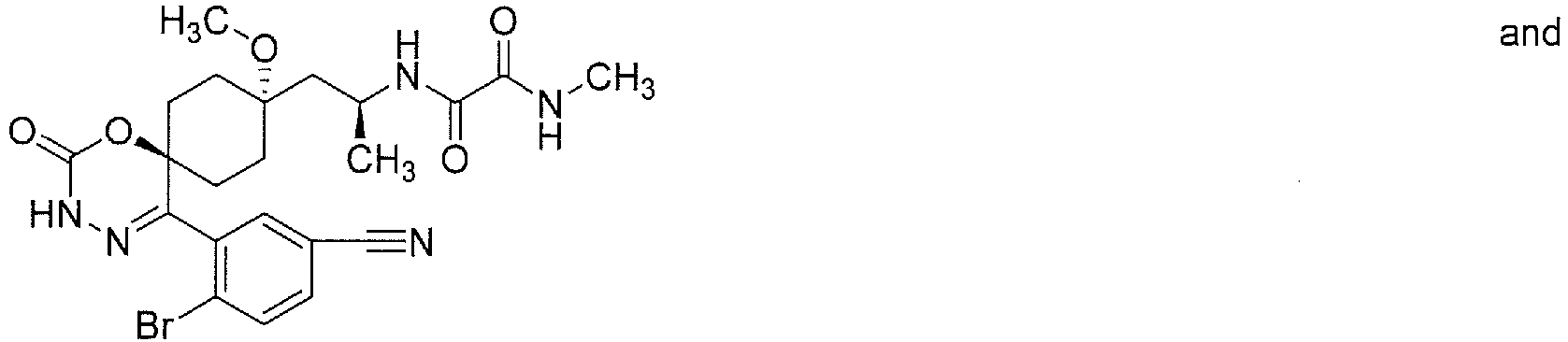
- A pharmaceutical composition comprising a compound as defined in any one of Claims 1 to 18, or a pharmaceutically acceptable salt thereof, and a pharmaceutically acceptable carrier.
- A pharmaceutical composition comprising a compound as defined in any one of Claims 1 to 18, or a pharmaceutically acceptable salt thereof, in combination with one or more other drugs, and a pharmaceutically acceptable carrier.
- A PLD inhibitor comprising a compound as defined in any one of Claims 1 to 18, or a pharmaceutically acceptable salt thereof.
- A PLD1 inhibitor comprising a compound as defined in any one of Claims 1 to 18, or a pharmaceutically acceptable salt thereof.
- A PLD1/2 inhibitor comprising a compound as defined in any one of Claims 1 to 18, or a pharmaceutically acceptable salt thereof.
- An agent for the treatment or prophylaxis of a disease selected from the group consisting of thrombosis and cancer, comprising a compound as defined in any one of Claims 1 to 18, or a pharmaceutically acceptable salt thereof.
- An agent for the treatment or prophylaxis of a disease selected from the group consisting of thrombosis and cancer, comprising a compound as defined in any one of Claims 1 to 18, or a pharmaceutically acceptable salt thereof, in combination with one or more other drugs.
- A method for inhibiting PLD in a mammal, comprising administering a therapeutically effective amount of a compound as defined in any one of Claims 1 to 18, or a pharmaceutically acceptable salt thereof to the mammal.
- A method for inhibiting PLD1 in a mammal, comprising administering a therapeutically effective amount of a compound as defined in any one of Claims 1 to 18, or a pharmaceutically acceptable salt thereof to the mammal.
- A method for inhibiting PLD1/2 in a mammal, comprising administering a therapeutically effective amount of a compound as defined in any one of Claims 1 to 18, or a pharmaceutically acceptable salt thereof to the mammal.
- A method for treating or preventing a disease selected from the group consisting of thrombosis and cancer in a mammal, comprising administering a therapeutically effective amount of a compound as defined in any one of Claims 1 to 18, or a pharmaceutically acceptable salt thereof to the mammal.
- A method for treating or preventing a disease selected from the group consisting of thrombosis and cancer in a mammal, comprising administering a therapeutically effective amount of a compound as defined in any one of Claims 1 to 18, or a pharmaceutically acceptable salt thereof, in combination with one or more other drugs, to the mammal.
- Use of a compound as defined in any one of Claims 1 to 18, or a pharmaceutically acceptable salt thereof, for the manufacture of a PLD inhibitor.
- Use of a compound as defined in any one of Claims 1 to 18, or a pharmaceutically acceptable salt thereof, for the manufacture of a PLD1 inhibitor.
- Use of a compound as defined in any one of Claims 1 to 18, or a pharmaceutically acceptable salt thereof, for the manufacture of a PLD1/2 inhibitor.
- Use of a compound as defined in any one of Claims 1 to 18, or a pharmaceutically acceptable salt thereof, for the manufacture of an agent for the treatment or prophylaxis of a disease selected from the group consisting of thrombosis and cancer.
- Use of a compound as defined in any one of Claims 1 to 18, or a pharmaceutically acceptable salt thereof, in combination with one or more other drugs, for the manufacture of an agent for the treatment or prophylaxis of a disease selected from the group consisting of thrombosis and cancer.
- A compound as defined in any one of Claims 1 to 18, or a pharmaceutically acceptable salt thereof, for use in the inhibition of PLD.
- A compound as defined in any one of Claims 1 to 18, or a pharmaceutically acceptable salt thereof, for use in the inhibition of PLD1.
- A compound as defined in any one of Claims 1 to 18, or a pharmaceutically acceptable salt thereof, for use in the inhibition of PLD1/2.
- A compound as defined in any one of Claims 1 to 18, or a pharmaceutically acceptable salt thereof, for use in the treatment or prophylaxis of a disease selected from the group consisting of thrombosis and cancer.
- A compound as defined in any one of Claims 1 to 18, or a pharmaceutically acceptable salt thereof, in combination with one or more other drugs, for use in the treatment or prophylaxis of a disease selected from the group consisting of thrombosis and cancer.
Applications Claiming Priority (2)
| Application Number | Priority Date | Filing Date | Title |
|---|---|---|---|
| JP2022097544 | 2022-06-16 | ||
| PCT/JP2023/022253 WO2023243686A1 (en) | 2022-06-16 | 2023-06-15 | Dihydrooxadiazinone compound and pharmaceutical use thereof |
Publications (2)
| Publication Number | Publication Date |
|---|---|
| EP4541791A1 true EP4541791A1 (en) | 2025-04-23 |
| EP4541791A4 EP4541791A4 (en) | 2026-06-24 |
Family
ID=89191483
Family Applications (1)
| Application Number | Title | Priority Date | Filing Date |
|---|---|---|---|
| EP23823976.8A Pending EP4541791A4 (en) | 2022-06-16 | 2023-06-15 | DIHYDROOXADIAZINONE COMPOUND AND ITS PHARMACEUTICAL USE |
Country Status (16)
| Country | Link |
|---|---|
| US (1) | US20240101572A1 (en) |
| EP (1) | EP4541791A4 (en) |
| JP (1) | JP2023184492A (en) |
| KR (1) | KR20250025419A (en) |
| CN (1) | CN119365445A (en) |
| AR (1) | AR129618A1 (en) |
| AU (1) | AU2023296188A1 (en) |
| CA (1) | CA3258991A1 (en) |
| CL (1) | CL2024003845A1 (en) |
| CO (1) | CO2024017164A2 (en) |
| IL (1) | IL317147A (en) |
| MX (1) | MX2024015597A (en) |
| PE (1) | PE20250420A1 (en) |
| TW (1) | TW202413374A (en) |
| WO (1) | WO2023243686A1 (en) |
| ZA (1) | ZA202408903B (en) |
Family Cites Families (4)
| Publication number | Priority date | Publication date | Assignee | Title |
|---|---|---|---|---|
| WO2010138869A1 (en) * | 2009-05-29 | 2010-12-02 | The Trustees Of Columbia University In The City Of New York | Modulation of phospholipase d for the treatment of neurodegenerative disorders |
| RU2012106657A (en) * | 2009-07-24 | 2013-08-27 | Вандербилт Юниверсити | PHOSPHOLIPASE D SELECT INHIBITOR ISOFORM |
| WO2019136451A1 (en) * | 2018-01-08 | 2019-07-11 | G1 Therapeutics, Inc. | G1t38 superior dosage regimes |
| WO2020157188A1 (en) * | 2019-02-01 | 2020-08-06 | Bayer Aktiengesellschaft | Dihydrooxadiazinones for the treatment of hyperproliferative diseases |
-
2023
- 2023-06-15 EP EP23823976.8A patent/EP4541791A4/en active Pending
- 2023-06-15 US US18/335,687 patent/US20240101572A1/en active Pending
- 2023-06-15 TW TW112122428A patent/TW202413374A/en unknown
- 2023-06-15 IL IL317147A patent/IL317147A/en unknown
- 2023-06-15 KR KR1020257001108A patent/KR20250025419A/en active Pending
- 2023-06-15 CA CA3258991A patent/CA3258991A1/en active Pending
- 2023-06-15 PE PE2024002966A patent/PE20250420A1/en unknown
- 2023-06-15 JP JP2023098437A patent/JP2023184492A/en active Pending
- 2023-06-15 AR ARP230101527A patent/AR129618A1/en unknown
- 2023-06-15 WO PCT/JP2023/022253 patent/WO2023243686A1/en not_active Ceased
- 2023-06-15 AU AU2023296188A patent/AU2023296188A1/en active Pending
- 2023-06-15 CN CN202380047152.4A patent/CN119365445A/en active Pending
-
2024
- 2024-11-22 ZA ZA2024/08903A patent/ZA202408903B/en unknown
- 2024-12-13 CO CONC2024/0017164A patent/CO2024017164A2/en unknown
- 2024-12-13 CL CL2024003845A patent/CL2024003845A1/en unknown
- 2024-12-13 MX MX2024015597A patent/MX2024015597A/en unknown
Also Published As
| Publication number | Publication date |
|---|---|
| JP2023184492A (en) | 2023-12-28 |
| IL317147A (en) | 2025-01-01 |
| CL2024003845A1 (en) | 2025-04-21 |
| EP4541791A4 (en) | 2026-06-24 |
| MX2024015597A (en) | 2025-02-10 |
| US20240101572A1 (en) | 2024-03-28 |
| PE20250420A1 (en) | 2025-02-14 |
| AU2023296188A1 (en) | 2025-01-16 |
| CN119365445A (en) | 2025-01-24 |
| TW202413374A (en) | 2024-04-01 |
| WO2023243686A1 (en) | 2023-12-21 |
| CO2024017164A2 (en) | 2024-12-19 |
| CA3258991A1 (en) | 2025-03-18 |
| KR20250025419A (en) | 2025-02-21 |
| AR129618A1 (en) | 2024-09-11 |
| ZA202408903B (en) | 2025-07-30 |
Similar Documents
| Publication | Publication Date | Title |
|---|---|---|
| JP7249950B2 (en) | Heterocyclic compound | |
| EP3305785B1 (en) | Pyrido[3,4-d]pyrimidine derivative and pharmaceutically acceptable salt thereof | |
| AU2020213376A1 (en) | Compounds and methods for the targeted degradation of the androgen receptor | |
| JP2021098703A (en) | Polycyclic tlr7/8 antagonists and use thereof in the treatment of immune disorders | |
| CA3199074A1 (en) | Compounds and methods for the targeted degradation of androgen receptor protein | |
| TW202136247A (en) | Solid forms of 2-((4-((s)-2-(5-chloropyridin-2-yl)-2-methylbenzo [d] [1,3] dioxol-4-yl)piperidin-1-yl)methyl)-1-(((s)-oxetan-2-yl)methyl)-1h-benzo [d] imidazole-6-carboxylic acid, 1,3-dihydroxy-2-(hydroxymethyl)propan-2 -amine salt | |
| JP2020528918A (en) | Compounds and methods for targeted degradation of androgen receptors | |
| KR20190005838A (en) | As dual LSD1 / HDAC inhibitors cyclopropyl-amide compounds | |
| TWI573786B (en) | Pyrrolidine derivatives | |
| EP3095786A1 (en) | Condensed 5-oxazolidinone derivative | |
| KR20050100615A (en) | Compounds, compositions and methods | |
| EP2905282A1 (en) | Substituted thiazole or oxazole as P2X7 receptor antagonists | |
| EP4400497A1 (en) | 3clpro protease inhibitor | |
| CA3140173A1 (en) | Pyrazole and imidazole derivatives, compositions and methods as orexin antagonists | |
| EP3049394A1 (en) | Substituted phenylalanine derivatives as modulators of factor xia | |
| WO2016020031A1 (en) | Pyrrolidinone derivatives as metap-2 inhibitors | |
| EP3049390A1 (en) | Substituted phenylalanine derivatives | |
| KR20210108274A (en) | 1,3,4-Oxadiazole Derivative Compounds as Histone Deacetylase 6 Inhibitor, and the Pharmaceutical Composition Comprising the same | |
| TW202413352A (en) | Azacycloalkylcarbonyl cyclic amine compound | |
| EP3049404A1 (en) | Substituted phenylalanine derivatives | |
| EP2261210A1 (en) | 3-substituted sulfonyl piperazine derivative | |
| KR20170002407A (en) | Potent and selective inhibitors of hepatitis c virus | |
| HK40120402A (en) | Dihydrooxadiazinone compound and pharmaceutical use thereof | |
| US20240101572A1 (en) | Dihydrooxadiazinone compound and pharmaceutical use thereof | |
| EP3350175B1 (en) | Non-steroidal glucocorticoid receptor modulators for local drug delivery |
Legal Events
| Date | Code | Title | Description |
|---|---|---|---|
| STAA | Information on the status of an ep patent application or granted ep patent |
Free format text: STATUS: THE INTERNATIONAL PUBLICATION HAS BEEN MADE |
|
| PUAI | Public reference made under article 153(3) epc to a published international application that has entered the european phase |
Free format text: ORIGINAL CODE: 0009012 |
|
| STAA | Information on the status of an ep patent application or granted ep patent |
Free format text: STATUS: REQUEST FOR EXAMINATION WAS MADE |
|
| 17P | Request for examination filed |
Effective date: 20250113 |
|
| AK | Designated contracting states |
Kind code of ref document: A1 Designated state(s): AL AT BE BG CH CY CZ DE DK EE ES FI FR GB GR HR HU IE IS IT LI LT LU LV MC ME MK MT NL NO PL PT RO RS SE SI SK SM TR |
|
| REG | Reference to a national code |
Ref country code: HK Ref legal event code: DE Ref document number: 40120402 Country of ref document: HK |
|
| DAV | Request for validation of the european patent (deleted) | ||
| RAP1 | Party data changed (applicant data changed or rights of an application transferred) |
Owner name: SHIONOGI & CO., LTD. |
|
| RIC1 | Information provided on ipc code assigned before grant |
Ipc: C07D 273/04 20060101AFI20260504BHEP Ipc: A61K 31/5395 20060101ALI20260504BHEP Ipc: A61K 31/55 20060101ALI20260504BHEP Ipc: A61P 7/02 20060101ALI20260504BHEP Ipc: A61P 35/00 20060101ALI20260504BHEP Ipc: A61P 43/00 20060101ALI20260504BHEP Ipc: C07D 413/04 20060101ALI20260504BHEP Ipc: C07D 413/12 20060101ALI20260504BHEP Ipc: C07D 413/14 20060101ALI20260504BHEP Ipc: C07D 471/04 20060101ALI20260504BHEP Ipc: C07D 487/04 20060101ALI20260504BHEP Ipc: C07D 491/08 20060101ALI20260504BHEP Ipc: C07D 491/107 20060101ALI20260504BHEP Ipc: C07D 498/04 20060101ALI20260504BHEP Ipc: C07D 498/10 20060101ALI20260504BHEP |
|
| A4 | Supplementary search report drawn up and despatched |
Effective date: 20260521 |
|
| RIC1 | Information provided on ipc code assigned before grant |
Ipc: C07D 273/04 20060101AFI20260515BHEP Ipc: A61K 31/5395 20060101ALI20260515BHEP Ipc: A61K 31/55 20060101ALI20260515BHEP Ipc: A61P 7/02 20060101ALI20260515BHEP Ipc: A61P 35/00 20060101ALI20260515BHEP Ipc: A61P 43/00 20060101ALI20260515BHEP Ipc: C07D 413/04 20060101ALI20260515BHEP Ipc: C07D 413/12 20060101ALI20260515BHEP Ipc: C07D 413/14 20060101ALI20260515BHEP Ipc: C07D 471/04 20060101ALI20260515BHEP Ipc: C07D 487/04 20060101ALI20260515BHEP Ipc: C07D 491/08 20060101ALI20260515BHEP Ipc: C07D 491/107 20060101ALI20260515BHEP Ipc: C07D 498/04 20060101ALI20260515BHEP Ipc: C07D 498/10 20060101ALI20260515BHEP |