EP4539199A2 - Einspannvorrichtung zum testen von sekundärbatteriezellen - Google Patents
Einspannvorrichtung zum testen von sekundärbatteriezellen Download PDFInfo
- Publication number
- EP4539199A2 EP4539199A2 EP24195118.5A EP24195118A EP4539199A2 EP 4539199 A2 EP4539199 A2 EP 4539199A2 EP 24195118 A EP24195118 A EP 24195118A EP 4539199 A2 EP4539199 A2 EP 4539199A2
- Authority
- EP
- European Patent Office
- Prior art keywords
- connection unit
- gripper
- secondary battery
- mounting frame
- jig
- Prior art date
- Legal status (The legal status is an assumption and is not a legal conclusion. Google has not performed a legal analysis and makes no representation as to the accuracy of the status listed.)
- Pending
Links
Images


Classifications
-
- G—PHYSICS
- G01—MEASURING; TESTING
- G01R—MEASURING ELECTRIC VARIABLES; MEASURING MAGNETIC VARIABLES
- G01R31/00—Arrangements for testing electric properties; Arrangements for locating electric faults; Arrangements for electrical testing characterised by what is being tested not provided for elsewhere
- G01R31/36—Arrangements for testing, measuring or monitoring the electrical condition of accumulators or electric batteries, e.g. capacity or state of charge [SoC]
- G01R31/3644—Constructional arrangements
-
- H—ELECTRICITY
- H01—ELECTRIC ELEMENTS
- H01M—PROCESSES OR MEANS, e.g. BATTERIES, FOR THE DIRECT CONVERSION OF CHEMICAL ENERGY INTO ELECTRICAL ENERGY
- H01M10/00—Secondary cells; Manufacture thereof
- H01M10/42—Methods or arrangements for servicing or maintenance of secondary cells or secondary half-cells
- H01M10/4285—Testing apparatus
-
- G—PHYSICS
- G01—MEASURING; TESTING
- G01R—MEASURING ELECTRIC VARIABLES; MEASURING MAGNETIC VARIABLES
- G01R1/00—Details of instruments or arrangements of the types included in groups G01R5/00 - G01R13/00 and G01R31/00
- G01R1/02—General constructional details
- G01R1/04—Housings; Supporting members; Arrangements of terminals
- G01R1/0408—Test fixtures or contact fields; Connectors or connecting adaptors; Test clips; Test sockets
- G01R1/0416—Connectors, terminals
-
- G—PHYSICS
- G01—MEASURING; TESTING
- G01R—MEASURING ELECTRIC VARIABLES; MEASURING MAGNETIC VARIABLES
- G01R31/00—Arrangements for testing electric properties; Arrangements for locating electric faults; Arrangements for electrical testing characterised by what is being tested not provided for elsewhere
- G01R31/36—Arrangements for testing, measuring or monitoring the electrical condition of accumulators or electric batteries, e.g. capacity or state of charge [SoC]
- G01R31/378—Arrangements for testing, measuring or monitoring the electrical condition of accumulators or electric batteries, e.g. capacity or state of charge [SoC] specially adapted for the type of battery or accumulator
-
- G—PHYSICS
- G01—MEASURING; TESTING
- G01R—MEASURING ELECTRIC VARIABLES; MEASURING MAGNETIC VARIABLES
- G01R31/00—Arrangements for testing electric properties; Arrangements for locating electric faults; Arrangements for electrical testing characterised by what is being tested not provided for elsewhere
- G01R31/36—Arrangements for testing, measuring or monitoring the electrical condition of accumulators or electric batteries, e.g. capacity or state of charge [SoC]
- G01R31/382—Arrangements for monitoring battery or accumulator variables, e.g. SoC
-
- H—ELECTRICITY
- H01—ELECTRIC ELEMENTS
- H01M—PROCESSES OR MEANS, e.g. BATTERIES, FOR THE DIRECT CONVERSION OF CHEMICAL ENERGY INTO ELECTRICAL ENERGY
- H01M10/00—Secondary cells; Manufacture thereof
- H01M10/42—Methods or arrangements for servicing or maintenance of secondary cells or secondary half-cells
- H01M10/44—Methods for charging or discharging
-
- H—ELECTRICITY
- H02—GENERATION; CONVERSION OR DISTRIBUTION OF ELECTRIC POWER
- H02J—ELECTRIC POWER NETWORKS; CIRCUIT ARRANGEMENTS OR SYSTEMS FOR SUPPLYING OR DISTRIBUTING ELECTRIC POWER; SYSTEMS FOR STORING ELECTRIC ENERGY
- H02J7/00—Circuit arrangements for charging or discharging batteries or for supplying loads from batteries
- H02J7/70—Circuit arrangements for charging or discharging batteries or for supplying loads from batteries characterised by the mechanical construction
- H02J7/751—Circuit arrangements for charging or discharging batteries or for supplying loads from batteries characterised by the mechanical construction concerning the insertion or the connection of the batteries
-
- Y—GENERAL TAGGING OF NEW TECHNOLOGICAL DEVELOPMENTS; GENERAL TAGGING OF CROSS-SECTIONAL TECHNOLOGIES SPANNING OVER SEVERAL SECTIONS OF THE IPC; TECHNICAL SUBJECTS COVERED BY FORMER USPC CROSS-REFERENCE ART COLLECTIONS [XRACs] AND DIGESTS
- Y02—TECHNOLOGIES OR APPLICATIONS FOR MITIGATION OR ADAPTATION AGAINST CLIMATE CHANGE
- Y02E—REDUCTION OF GREENHOUSE GAS [GHG] EMISSIONS, RELATED TO ENERGY GENERATION, TRANSMISSION OR DISTRIBUTION
- Y02E60/00—Enabling technologies; Technologies with a potential or indirect contribution to GHG emissions mitigation
- Y02E60/10—Energy storage using batteries
Definitions
- the present disclosure relates to a jig for charging and discharging tests on a secondary battery cell, and more particularly, to a jig for a secondary battery cell test, which can perform charging and discharging tests on various types (or specifications) of secondary battery pouch cells by using one jig for tests.
- a secondary battery may be divided into a cylindrical type, a prismatic type, and a pouch type depending on its form.
- the cylindrical type secondary battery was mainstream, but the use of the prismatic type secondary battery or the pouch type secondary battery that is advantageous in weight lightening, has high energy density, and can be fabricated in various sizes is recently increased.
- the prismatic type and pouch type secondary batteries have advantages in that space utilization is increased and more flexibility can be allowed in their designs.
- Such a secondary battery charging and discharging characteristic test is a very important process of determining the quality of the secondary battery.
- a secondary battery charging and discharging-dedicated jig is used.
- the secondary battery is charged and discharged by applying a current to the secondary battery through a charger and discharger, in the state in which the secondary battery has been held in the jig and the electrode tab of the secondary battery has been connected to the current terminal of the jig.
- Such a jig for the secondary battery charging and discharging test needs to be fabricated so that tests can be performed on a unidirectional secondary battery in which the electrode tabs of the secondary battery are disposed in the same direction and a bidirectional secondary battery in which the electrode tabs of the secondary battery are disposed in directions in which the electrode tabs face each other. Furthermore, there is a need for the development of a jig for charging and discharging tests, which can perform charging and discharging tests by connecting various types (or specifications) of secondary batteries to the jig because the design specifications of the secondary battery, such as a length or a thickness, are various depending on places where the secondary battery is used.
- Patent Document 1 Korean Patent Application Publication No. 2020-0027250 (March 12, 2020 )
- a jig for a secondary battery cell test including a main body, a first connection unit disposed in the main body and connected to a secondary battery cell, a second connection unit disposed to face the first connection unit, installed to be movable so that the second connection unit becomes close to or distant from the first connection unit, and connected to the secondary battery cell, a third connection unit disposed to neighbor the first connection unit and connected to the secondary battery cell, and a flexible connection unit including at least one flexible busbar that is deformable and configured to connect the second connection unit and the third connection unit so that the second connection unit and the third connection unit are electrically conductable.
- the flexible connection unit may include a first flexible busbar configured to be deformable and to have one end connected to the second connection unit and the other end connected to a conductive plate that is fixed to an upper part of a bottom of the main body, and a second flexible busbar configured to be deformable and to have one end connected to the third connection unit and the other end connected to the conductive plate.
- the jig for a secondary battery cell test may further include a third flexible busbar disposed under the first connection unit and configured to be deformable and to have one end connected to an external charger and discharger and the other end connected to the first connection unit.
- the jig for a secondary battery cell test may further include a connection plate disposed under the third connection unit and configured to have one end connected to an external charger and discharger and the other end connected to the third connection unit.
- the jig for a secondary battery cell test may further include a pair of guide shafts installed in the length direction of the main body and configured to provide guidance to a movement of the second connection unit.
- each of the first to third connection units may include an upper gripper and a lower gripper configured to come into contact with a terminal of the secondary battery cell on upper and lower parts thereof, respectively, a gripper mounting frame in which the lower gripper is seated and with which the upper gripper is coupled so that the upper gripper is movable up and down, a base frame through which the lower gripper penetrates and with which the gripper mounting frame is coupled so that the gripper mounting frame is movable up and down, and a gripper mounting frame height adjustment member configured to adjust an up and down height of the gripper mounting frame with respect to the base frame.
- the gripper mounting frame height adjustment member may include a bolt shaft configured to have a screw thread formed on an outer circumferential surface thereof, screwed onto the gripper mounting frame, and configured to have a bottom rotatably supported by the base frame, and a rotary knob coupled with a top of the bolt shaft in an upper part of the gripper mounting frame.
- a gradation through which the height of the gripper mounting frame according to the up and down movement of the gripper mounting frame is able to be checked may be formed on an external surface of the base frame.
- an indication member to indicate a location of a gradation formed on an external surface of the base frame may be mounted on the gripper mounting frame.
- the jig for a secondary battery cell test according to an embodiment of the present disclosure has an advantage in that charging and discharging tests can be easily performed on secondary battery pouch cells having various specifications by using one jig for charging and discharging tests.
- the jig for a secondary battery cell test has an advantage in that charging and discharging tests can be performed on secondary battery cells having various thicknesses by connecting a secondary battery cell, such as a secondary battery cell having a barrier rib that maintains an interval between unit batteries or a secondary battery cell not having the barrier rib, to the contact part of the jig, regardless of whether the barrier rib is present, because the contact part of the jig connected to the electrode terminal of the secondary battery cell has a structure in which the contact part is freely adjusted in the vertical direction.
- a secondary battery cell such as a secondary battery cell having a barrier rib that maintains an interval between unit batteries or a secondary battery cell not having the barrier rib
- the existing jig structure in which the connection unit of the jig that is connected to the terminal of a secondary battery cell is moved in the horizontal direction, while physically coming into contact with the top of the busbar having a flat plate form has a problem in that a connection failure occurs because a deviation occurs in contact resistance between the connection unit and the busbar due to poor flatness of the busbar or an assembly tolerance between parts.
- the jig for a secondary battery cell test according to an embodiment of the present disclosure has an advantage in that charging and discharging tests can be always stably performed on a secondary battery cell because the flexible busbar always maintains an electrical connection with the connection unit while connection unit is moved in the horizontal direction.
- connection unit can always stably slidably move along a predetermined movement path without being moved left and right or up and down during a process of the connection unit being moved in the horizontal direction because the connection unit is constructed to slidably move along the pair of guide shafts that is installed in the length direction of the main body. Accordingly, it is possible to improve the mobility of the connection unit and to also improve current connectivity and test workability according to the improved mobility.
- the jig for a secondary battery cell test has effects in that a charging and discharging characteristic test can be performed on a secondary battery cell from a low current band to a high current band through the flexible busbar and in particular, efficiency of a driving space can be improved through an optimized size which may be applied when a high current band is measured.
- the jig for a secondary battery cell test has effects in that charging and discharging tests can be performed by connecting various types of secondary battery cells to the connection unit regardless of the height of the terminal of a secondary battery cell because the height of the gripper that is engaged with the terminal of the secondary battery cell can be freely adjusted through the rotary knob included in the connection unit, and workability according to the charging and discharging tests can also be improved.
- the height of the gripper when the height of the gripper is adjusted by using the rotary knob, the heights of the grippers in the vertical direction, which are included in the connection units, respectively, can be accurately adjusted through the indication member mounted on the gripper mounting frame, while accurately checking the location of the gradation on the external surface of the base frame. Accordingly, it is possible to reduce the time taken for setting work for charging and discharging tests on a secondary battery cell, to improve workability for the charging and discharging tests, and to enable more reliable test work.
- FIG. 1 illustrates a jig for a secondary battery cell test according to an embodiment of the present disclosure.
- FIG. 2 illustrates major components of the jig for a secondary battery cell test according to an embodiment of the present disclosure.
- FIGS. 3 and 4 illustrate forms of the jig for a secondary battery cell test illustrated in FIG. 2 , which are viewed from the top and side thereof.
- a jig 100 for a second battery cell test includes a main body 110, a first connection unit 120, a second connection unit 130, a third connection unit 140, and a flexible connection unit 150.
- the main body 110 forms an appearance of the jig 100 for a second battery cell test according to an embodiment of the present disclosure.
- the main body 110 forms a rectangular parallelepiped appearance having a pair of short sides that face each other and a pair of long sides that face each other.
- the main body 110 provides a space in which the first connection unit 120, the second connection unit 130, the third connection unit 140, and the flexible connection unit 150 are disposed.
- the first connection unit 120 is disposed on one side of the main body 110.
- the first connection unit 120 is disposed in a short side portion on one side of the main body 110, among the pair of short sides that face each other. That is, the first connection unit 120 is installed in a first short side S 1 that is perpendicular to the length direction (i.e., long-side direction) of the main body 110, and is electrically connected to the positive electrode terminal or negative electrode terminal of a secondary battery cell (not illustrated).
- the first connection unit 120 is maintained in the state in which the first connection unit 120 has been fixed to the main body 110 in the first short side S1 of the main body 110.
- the second connection unit 130 is disposed to face the first connection unit 120 on the main body 110. That is, the second connection unit 130 is disposed to face the first connection unit 120 in a second short side S2 that faces the first short side S1 of the main body 110.
- the first connection unit 120 and the second connection unit 130 are electrically connected to the positive electrode terminal and negative electrode terminal of the secondary battery cell (not illustrated), that is, a charging and discharging test target, respectively.
- the first connection unit 120 and the second connection unit 130 may be used for an electrical connection of a bidirectional secondary battery cell that is disposed in both directions in which the positive electrode terminal and the negative electrode terminal are opposite to each other.
- any one of the first connection unit 120 and the second connection unit 130 may be connected to the positive electrode terminal or negative electrode terminal of the secondary battery cell.
- any one of the first connection unit 120 and the third connection unit 140 may be connected to a positive electrode connection cable 182 or negative electrode connection cable 184 of a charger and discharger 180 for charging and discharging tests on the secondary battery cell.
- the second connection unit 130 is installed to slidably move in the length direction of the main body 110 along a pair of guide shafts 160 that is installed to be parallel to the length direction (i.e., Y axis direction) of the main body 110.
- the pair of guide shafts 160 may be installed in a structure in which the pair of guide shafts horizontally penetrates a base frame BF, which is disposed at the bottom of the second connection unit 130.
- the pair of guide shafts 160 that horizontally penetrates the second connection unit 130 and that is installed on the main body 110 plays a role to provide guidance so that the second connection unit 130 can slidably move along an accurate movement trajectory when the second connection unit 130 slides and moves. That is, the pair of guide shafts 160 enables the second connection unit 130 to always slidably move along a predetermined movement traj ectory without moving left and right or vertically during a process of the second connection unit 130 horizontally moving.
- the third connection unit 140 is disposed to neighbor the first connection unit 120 in the first short side S1 of the main body 110 in which the first connection unit 120 is disposed.
- the third connection unit 140 is formed to form one body along with the first connection unit 120 at a location that neighbors the first connection unit 120, and is maintained in the state in which the third connection unit 140 has been fixed to the main body 110 like the first connection unit 120.
- the flexible connection unit 150 includes the first flexible busbar 151 and the second flexible busbar 153 that are deformable, and a conductive plate 152 that connects the first flexible busbar 151 and the second flexible busbar 153.
- the end of the second flexible busbar 153 on one side thereof is connected to a protrusion part of the lower gripper 142 of the third connection unit 140, which is exposed downward from the base frame BF.
- the end of the second flexible busbar 153 on the other side thereof is connected to the conductive plate 152.
- the second connection unit 130 and the third connection unit 140 may be electrically connected through the first flexible busbar 151, the conductive plate 152, and the second flexible busbar 153 that are each composed of a conductor and are connected.
- the first flexible busbar 151 and the second flexible busbar 153 that are connected through the conductive plate 152 are disposed at upper parts that are spaced apart from the bottom of the main body 110 at a predetermined distance, so that the first flexible busbar 151 and the second flexible busbar 153 do not come into contact with the bottom of the main body 110.
- the jig 100 for a secondary battery cell test includes a third flexible busbar 172 that is disposed under the first connection unit 120 and that is deformable.
- the third flexible busbar 172 is disposed under the first connection unit 120, and has one end connected to the charger and discharger 180 and the other end connected to the first connection unit 120. That is, the end of the third flexible busbar 172 on one side thereof is connected to the positive electrode connection cable 182 or negative electrode connection cable 184 of the charger and discharger 180.
- the end of the third flexible busbar 172 on the other side thereof is connected to a protrusion part of the lower gripper 122 of the first connection unit 120, which is exposed downward from the base frame BF. Accordingly, the first connection unit 120 may be electrically connected to the external charger and discharger 180 through the medium of the third flexible busbar 172.
- the second and third flexible busbars 153 and 172 are deformed upward or downward during a process of lower grippers 122 and 142 that are included in the first and third connection units 120 and 140, respectively, being moved in the vertical direction, and can absorb movement displacements of the lower grippers 122 and 142, respectively.
- a situation such as a connection failure, never occurs because the second and third flexible busbars 153 and 172 are maintained in the state in which the second and third flexible busbars 153 and 172 always electrically come into contact with the lower grippers 122 and 142 while the lower grippers 122 and 142 included in the first and third connection units 120 and 140 are moved in the vertical direction.
- FIG. 5 exemplifies a structure of a flexible busbar that is adopted in the jig for a secondary battery cell test according to an embodiment of the present disclosure.
- some area of each of the first to third flexible busbars 151, 153, and 172 that are installed within the main body 110 of the jig 100 for a secondary battery cell test is constructed in a freely deformable form.
- each of the first to third flexible busbars 151, 153, and 172 may be formed to have a structure in which both ends 151a and 151b that are connected to each of the first to third connection units 120, 130, and 140, the conductive plate 152, and the charger and discharger 180 do not have flexibility and a part except the both ends 151a and 151b has flexibility that allows the part to be freely deformable.
- Each of the first to third flexible busbars 151, 153, and 172 may be formed to have a braided wire busbar or shunt busbar structure.
- each of the first to third flexible busbars 151, 153, and 172 may be formed in the form of a braided wire busbar in which several thin copper lines are twisted in the form of a wide plane and terminals for an electrical contact are constructed at both ends of the plane or a shunt busbar in which several deformable thin laminate plane copper plates are overlaid.
- the flexible busbar that is formed in such a form is suitable for charging and discharging tests for a high current because the flexible busbar has high current efficiency per cross section, and can suppress an excessive temperature rise within the main body 110 in which the flexible bars are installed because the amount of heat generated from the flexible busbar is small.
- the first to third flexible busbars 151, 153, and 172 enable a current to be stably supplied from a low current band to a high current band (up to 2000 A) when the charger and discharger 180 supplies the current to the secondary battery cell. Furthermore, the first to third flexible busbars 151, 153, and 172 are each formed to have a thin plate-shaped structure, and can simply and compactly construct a current supply line from the charger and discharger 180 to the first to third connection units 120, 130, and 140 while optimizing the utilization of a space within the main body 110.
- FIG. 7 illustrates a detailed form of the first and third connection units in the jig for a secondary battery cell test according to an embodiment of the present disclosure and a detailed diagram specifically illustrating connection structures of the first to third flexible busbars.
- FIG. 8 is a cross-sectional view illustrating cross section structures of the first connection unit and the third connection unit.
- the first connection unit 120 includes a gripper interval adjustment member 123 that is coupled with the top of the gripper mounting frame IF and that adjusts an interval between the upper gripper 121 and the lower gripper 122.
- the upper gripper 121 is disposed at an upper part of the internal space of the gripper mounting frame IF, and is connected to the bottom of the gripper interval adjustment member 123.
- a screw thread is formed on the outer circumferential surface of the gripper interval adjustment member 123.
- the gripper interval adjustment member 123 is coupled with the top of the gripper mounting frame IF by a screw fastening method.
- the bottom of the gripper interval adjustment member 123 is rotatably supported by the upper gripper 121. Accordingly, when the gripper interval adjustment member 123 is rotated clockwise or counterclockwise, the gripper interval adjustment member 123 may rise or drop.
- the upper gripper 121 connected to the gripper interval adjustment member 123 may also be raised or dropped.
- the lower gripper 122 is disposed under the upper gripper 121 in the internal space of the gripper mounting frame IF.
- the top of the lower gripper 122 is seated on the bottom of the internal space of the gripper mounting frame IF.
- the lower gripper 122 has the protrusion part that is exposed downward from the base frame BF through the gripper mounting frame IF and the base frame BF.
- the positive electrode terminal or negative electrode terminal of the secondary battery cell may be connected to the upper gripper 121 and the lower gripper 122 by being engaged therebetween.
- the gripper interval adjustment member 123 may widen or narrow the interval between the upper gripper 121 and the lower gripper 122 by raising or dropping the upper gripper 121.
- An end of the third flexible busbar 172 on one side thereof is fixed on the main body 110 and connected to the positive electrode connection cable 182 or negative electrode connection cable 184 of the charger and discharger 180.
- An end of the third flexible busbar 172 on the other side thereof is connected to the protrusion part of the lower gripper 122, which is exposed downward from the base frame BF.
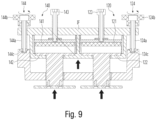
- the gripper mounting frame height adjustment member 124 may adjust the up and down height of the gripper mounting frame IF with respect to the base frame BF.
- the gripper mounting frame height adjustment member 124 includes a bolt shaft 124a and a rotary knob 124b.
- a screw thread is formed on the outer circumferential surface of the bolt shaft 124a, and thus the bolt shaft 124a is screwed onto the gripper mounting frame IF.
- the bottom 124c of the bolt shaft 124a is rotatably supported by the base frame BF.
- the rotary knob 124b is coupled with the top of the bolt shaft 124a over the gripper mounting frame IF.
- the gripper mounting frame IF is raised as the bolt shaft 124a supported by the base frame BF is rotated.
- the gripper mounting frame IF is dropped.
- the height of the gripper mounting frame IF can be adjusted by the rotation of the rotary knob 124b, and thus the heights of the upper gripper 121 and the lower gripper 122 that are engaged with the secondary battery cell can be adjusted. Accordingly, charging and discharging tests can be easily performed on secondary battery cells having various thicknesses in the state in which the secondary battery cell has been engaged between the upper gripper 121 and the lower gripper 122.
- the third connection unit 140 includes an upper gripper 141 and the lower gripper 142 that are mounted to be movable up and down in the internal space of the gripper mounting frame IF.
- the third connection unit 140 includes a gripper interval adjustment member 143 that is coupled with the top of the gripper mounting frame IF and that adjusts an interval between the upper gripper 141 and the lower gripper 142.
- the upper gripper 141 is disposed at the upper part of the internal space of the gripper mounting frame IF, and is connected to the bottom of the gripper interval adjustment member 143.
- a screw thread is formed on the outer circumferential surface of the gripper interval adjustment member 143.
- the gripper interval adjustment member 143 is coupled with the top of the gripper mounting frame IF by a screw fastening method.
- the bottom of the gripper interval adjustment member 143 is rotatably supported by the upper gripper 141. Accordingly, when the gripper interval adjustment member 143 is rotated clockwise or counterclockwise, the gripper interval adjustment member 143 may rise or drop, and the upper gripper 141 connected to the gripper interval adjustment member 143 may also be raised or dropped.
- the lower gripper 142 is disposed under the upper gripper 141 in the internal space of the gripper mounting frame IF.
- the top of the lower gripper 142 is seated on the bottom of the internal space of the gripper mounting frame IF.
- the lower gripper 142 has a protrusion part that is exposed downward from the base frame BF through the gripper mounting frame IF and the base frame BF.
- the positive electrode terminal or negative electrode terminal of the secondary battery cell may be connected to the upper gripper 141 and the lower gripper 142 by being engaged therebetween.
- the gripper interval adjustment member 143 may widen or narrow the interval between the upper gripper 141 and the lower gripper 142 by raising or dropping the upper gripper 141.
- the protrusion part of the lower gripper 142 which is exposed downward from the base frame BF, is connected to an end of the second flexible busbar 153 on one side thereof.
- the gripper mounting frame IF is raised as the bolt shaft 144a supported by the base frame BF is rotated.
- the gripper mounting frame IF is dropped.
- the height of the gripper mounting frame IF can be adjusted by the rotation of the rotary knob 144b, and thus the heights of the upper gripper 141 and the lower gripper 142 with which the secondary battery cell is engaged can be adjusted. Accordingly, charging and discharging tests can be easily performed on secondary battery cells having various thicknesses in the state in which the secondary battery cell has been engaged between the upper gripper 141 and the lower gripper 142.
- connection plate 174 that is connected to the conductive plate 152 is fastened to the conductive plate 152 in the state in which the end of the connection plate 174 has overlapped the end of the second flexible busbar 153, so that the connection plate 174 is electrically connected to the second flexible busbar 153 and the conductive plate 152. Furthermore, as the conductive plate 152 is connected to the first flexible busbar 151, a current can be supplied to the second flexible busbar 153 and the first flexible busbar 151 through the connection plate 174 connected to the connection cable of the charger and discharger 180.
- the second connection unit 130 includes an upper gripper 131 and the lower gripper 132 that are mounted to be movable up and down in the internal space of the gripper mounting frame IF. Furthermore, the second connection unit 130 includes a gripper interval adjustment member 133 that is coupled with the top of the gripper mounting frame IF and that adjusts an interval between the upper gripper 131 and the lower gripper 132. In this case, a protrusion part of the lower gripper 132, which is exposed downward from the base frame BF, is connected to an end of the first flexible busbar 151 on one side thereof.
- the second connection unit 130 further includes a gripper mounting frame height adjustment member 134 capable of adjusting the up and down height of the gripper mounting frame IF.
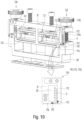
- the indication member 190 includes a first indication member 192 and a second indication member 194 each having a plate shape having a " ⁇ " (or "L") shape.
- the indication portion of the second indication member 194 is disposed to be vertical to the indication portion of the first indication member 192. That is, the indication portion of the second indication member 194 is disposed in the horizontal direction that is perpendicular to the moving direction of the gripper mounting frame IF. In this case, the bottom of the indication portion of the second indication member 194 is formed so that an extension line of the bottom is disposed at a location identical with the bottom of the indication portion of the first indication member 192. Furthermore, an arrow design 195 is formed at the end of the indication portion of the second indication member 194 so that the arrow design 195 accurately indicates the location of the gradation G.
Landscapes
- Engineering & Computer Science (AREA)
- Physics & Mathematics (AREA)
- General Physics & Mathematics (AREA)
- Manufacturing & Machinery (AREA)
- Chemical & Material Sciences (AREA)
- Chemical Kinetics & Catalysis (AREA)
- Electrochemistry (AREA)
- General Chemical & Material Sciences (AREA)
- Power Engineering (AREA)
- Secondary Cells (AREA)
- Battery Mounting, Suspending (AREA)
Applications Claiming Priority (1)
| Application Number | Priority Date | Filing Date | Title |
|---|---|---|---|
| KR1020230124441A KR102925999B1 (ko) | 2023-09-19 | 2023-09-19 | 이차전지 셀 테스트용 지그 |
Publications (2)
| Publication Number | Publication Date |
|---|---|
| EP4539199A2 true EP4539199A2 (de) | 2025-04-16 |
| EP4539199A3 EP4539199A3 (de) | 2025-06-25 |
Family
ID=92458945
Family Applications (1)
| Application Number | Title | Priority Date | Filing Date |
|---|---|---|---|
| EP24195118.5A Pending EP4539199A3 (de) | 2023-09-19 | 2024-08-19 | Einspannvorrichtung zum testen von sekundärbatteriezellen |
Country Status (3)
| Country | Link |
|---|---|
| US (1) | US20250093419A1 (de) |
| EP (1) | EP4539199A3 (de) |
| KR (1) | KR102925999B1 (de) |
Citations (1)
| Publication number | Priority date | Publication date | Assignee | Title |
|---|---|---|---|---|
| KR20200027250A (ko) | 2018-09-04 | 2020-03-12 | 주식회사 피앤이솔루션 | 이차전지 충방전용 지그 |
Family Cites Families (1)
| Publication number | Priority date | Publication date | Assignee | Title |
|---|---|---|---|---|
| KR102441976B1 (ko) * | 2020-06-29 | 2022-09-08 | 피닉슨컨트롤스 주식회사 | 위치조절 가능한 검사부를 구비하는 2차전지 테스트 장치 |
-
2023
- 2023-09-19 KR KR1020230124441A patent/KR102925999B1/ko active Active
-
2024
- 2024-08-19 EP EP24195118.5A patent/EP4539199A3/de active Pending
- 2024-09-18 US US18/889,211 patent/US20250093419A1/en active Pending
Patent Citations (1)
| Publication number | Priority date | Publication date | Assignee | Title |
|---|---|---|---|---|
| KR20200027250A (ko) | 2018-09-04 | 2020-03-12 | 주식회사 피앤이솔루션 | 이차전지 충방전용 지그 |
Also Published As
| Publication number | Publication date |
|---|---|
| KR102925999B1 (ko) | 2026-02-11 |
| EP4539199A3 (de) | 2025-06-25 |
| US20250093419A1 (en) | 2025-03-20 |
| KR20250041705A (ko) | 2025-03-26 |
Similar Documents
| Publication | Publication Date | Title |
|---|---|---|
| US12066503B2 (en) | Bus bar for battery cell connection, battery pack, and manufacturing method therefor | |
| KR102788140B1 (ko) | 전지셀의 임피던스 측정 충방전지그 | |
| US20150118530A1 (en) | Battery Pack | |
| US8564244B2 (en) | Battery with battery cells and method for monitoring and controlling the battery cells of the battery | |
| US20150044511A1 (en) | Battery pack | |
| US20240396099A1 (en) | Battery pack detection circuit | |
| KR102441976B1 (ko) | 위치조절 가능한 검사부를 구비하는 2차전지 테스트 장치 | |
| KR20170042407A (ko) | 확장형 배터리 셀 모듈 조립체 | |
| ES2977964T3 (es) | Dispositivo de inspección de calidad de soldadura | |
| CN102412445A (zh) | 包括在用于二次电池充放电的夹具中的端子接触部件和包括该端子接触部件的夹具 | |
| US12015175B2 (en) | Battery system with flexible printed circuit | |
| KR101802926B1 (ko) | 셀의 신호 처리를 위한 센싱 어셈블리를 가지는 배터리 | |
| EP4539199A2 (de) | Einspannvorrichtung zum testen von sekundärbatteriezellen | |
| CN209992635U (zh) | 一种新型的电池极耳夹持装置、电池化成分容设备 | |
| KR101778673B1 (ko) | 다양한 전장 및 두께를 갖는 전지팩들의 검사 장치 | |
| EP4628910A1 (de) | Eigenschaftsmessvorrichtung einer batteriezelle für eine wiederaufladbare batterie und messvorrichtung damit | |
| JP6674636B2 (ja) | 電池モジュール | |
| EP4398391A1 (de) | Wiederaufladbares batteriepack | |
| KR102131507B1 (ko) | 이차전지 충방전용 지그 | |
| KR102564176B1 (ko) | 포메이션 충방전기용 온도센서 일체형 클립 | |
| KR20200015246A (ko) | 배터리 모듈 | |
| KR20230089842A (ko) | 배터리팩 및 이를 이용한 제조방법 | |
| CN223109157U (zh) | 电源装置用的电极端子连接结构体、以及电源装置 | |
| KR101447435B1 (ko) | 배터리 지그 버스바 및 버스바 표면 처리 방법 | |
| CN222154428U (zh) | 一种电芯点焊治具 |
Legal Events
| Date | Code | Title | Description |
|---|---|---|---|
| PUAI | Public reference made under article 153(3) epc to a published international application that has entered the european phase |
Free format text: ORIGINAL CODE: 0009012 |
|
| STAA | Information on the status of an ep patent application or granted ep patent |
Free format text: STATUS: REQUEST FOR EXAMINATION WAS MADE |
|
| 17P | Request for examination filed |
Effective date: 20240819 |
|
| AK | Designated contracting states |
Kind code of ref document: A2 Designated state(s): AL AT BE BG CH CY CZ DE DK EE ES FI FR GB GR HR HU IE IS IT LI LT LU LV MC ME MK MT NL NO PL PT RO RS SE SI SK SM TR |
|
| PUAL | Search report despatched |
Free format text: ORIGINAL CODE: 0009013 |
|
| AK | Designated contracting states |
Kind code of ref document: A3 Designated state(s): AL AT BE BG CH CY CZ DE DK EE ES FI FR GB GR HR HU IE IS IT LI LT LU LV MC ME MK MT NL NO PL PT RO RS SE SI SK SM TR |
|
| RIC1 | Information provided on ipc code assigned before grant |
Ipc: G01R 31/36 20200101ALI20250516BHEP Ipc: H02J 7/00 20060101ALI20250516BHEP Ipc: H01M 10/42 20060101AFI20250516BHEP |