EP4537770A2 - Okklusive medizinische vorrichtung mit dichtungselement - Google Patents
Okklusive medizinische vorrichtung mit dichtungselement Download PDFInfo
- Publication number
- EP4537770A2 EP4537770A2 EP25154894.7A EP25154894A EP4537770A2 EP 4537770 A2 EP4537770 A2 EP 4537770A2 EP 25154894 A EP25154894 A EP 25154894A EP 4537770 A2 EP4537770 A2 EP 4537770A2
- Authority
- EP
- European Patent Office
- Prior art keywords
- occlusive
- covering
- implant
- occlusion
- medical implant
- Prior art date
- Legal status (The legal status is an assumption and is not a legal conclusion. Google has not performed a legal analysis and makes no representation as to the accuracy of the status listed.)
- Pending
Links
Images







Classifications
-
- A—HUMAN NECESSITIES
- A61—MEDICAL OR VETERINARY SCIENCE; HYGIENE
- A61B—DIAGNOSIS; SURGERY; IDENTIFICATION
- A61B17/00—Surgical instruments, devices or methods
- A61B17/0057—Implements for plugging an opening in the wall of a hollow or tubular organ, e.g. for sealing a vessel puncture or closing a cardiac septal defect
-
- A—HUMAN NECESSITIES
- A61—MEDICAL OR VETERINARY SCIENCE; HYGIENE
- A61B—DIAGNOSIS; SURGERY; IDENTIFICATION
- A61B17/00—Surgical instruments, devices or methods
- A61B17/12—Surgical instruments, devices or methods for ligaturing or otherwise compressing tubular parts of the body, e.g. blood vessels or umbilical cord
- A61B17/12022—Occluding by internal devices, e.g. balloons or releasable wires
- A61B17/12099—Occluding by internal devices, e.g. balloons or releasable wires characterised by the location of the occluder
- A61B17/12122—Occluding by internal devices, e.g. balloons or releasable wires characterised by the location of the occluder within the heart
-
- A—HUMAN NECESSITIES
- A61—MEDICAL OR VETERINARY SCIENCE; HYGIENE
- A61B—DIAGNOSIS; SURGERY; IDENTIFICATION
- A61B17/00—Surgical instruments, devices or methods
- A61B17/12—Surgical instruments, devices or methods for ligaturing or otherwise compressing tubular parts of the body, e.g. blood vessels or umbilical cord
- A61B17/12022—Occluding by internal devices, e.g. balloons or releasable wires
- A61B17/12131—Occluding by internal devices, e.g. balloons or releasable wires characterised by the type of occluding device
- A61B17/12168—Occluding by internal devices, e.g. balloons or releasable wires characterised by the type of occluding device having a mesh structure
- A61B17/12172—Occluding by internal devices, e.g. balloons or releasable wires characterised by the type of occluding device having a mesh structure having a pre-set deployed three-dimensional shape
-
- A—HUMAN NECESSITIES
- A61—MEDICAL OR VETERINARY SCIENCE; HYGIENE
- A61B—DIAGNOSIS; SURGERY; IDENTIFICATION
- A61B17/00—Surgical instruments, devices or methods
- A61B17/12—Surgical instruments, devices or methods for ligaturing or otherwise compressing tubular parts of the body, e.g. blood vessels or umbilical cord
- A61B17/12022—Occluding by internal devices, e.g. balloons or releasable wires
- A61B17/12131—Occluding by internal devices, e.g. balloons or releasable wires characterised by the type of occluding device
- A61B17/12168—Occluding by internal devices, e.g. balloons or releasable wires characterised by the type of occluding device having a mesh structure
- A61B17/12177—Occluding by internal devices, e.g. balloons or releasable wires characterised by the type of occluding device having a mesh structure comprising additional materials, e.g. thrombogenic, having filaments, having fibers or being coated
-
- A—HUMAN NECESSITIES
- A61—MEDICAL OR VETERINARY SCIENCE; HYGIENE
- A61B—DIAGNOSIS; SURGERY; IDENTIFICATION
- A61B17/00—Surgical instruments, devices or methods
- A61B17/12—Surgical instruments, devices or methods for ligaturing or otherwise compressing tubular parts of the body, e.g. blood vessels or umbilical cord
- A61B17/12022—Occluding by internal devices, e.g. balloons or releasable wires
- A61B17/12099—Occluding by internal devices, e.g. balloons or releasable wires characterised by the location of the occluder
- A61B17/12109—Occluding by internal devices, e.g. balloons or releasable wires characterised by the location of the occluder in a blood vessel
-
- A—HUMAN NECESSITIES
- A61—MEDICAL OR VETERINARY SCIENCE; HYGIENE
- A61B—DIAGNOSIS; SURGERY; IDENTIFICATION
- A61B17/00—Surgical instruments, devices or methods
- A61B2017/00526—Methods of manufacturing
-
- A—HUMAN NECESSITIES
- A61—MEDICAL OR VETERINARY SCIENCE; HYGIENE
- A61B—DIAGNOSIS; SURGERY; IDENTIFICATION
- A61B17/00—Surgical instruments, devices or methods
- A61B2017/00831—Material properties
- A61B2017/00867—Material properties shape memory effect
-
- A—HUMAN NECESSITIES
- A61—MEDICAL OR VETERINARY SCIENCE; HYGIENE
- A61B—DIAGNOSIS; SURGERY; IDENTIFICATION
- A61B17/00—Surgical instruments, devices or methods
- A61B2017/00831—Material properties
- A61B2017/00893—Material properties pharmaceutically effective
-
- A—HUMAN NECESSITIES
- A61—MEDICAL OR VETERINARY SCIENCE; HYGIENE
- A61B—DIAGNOSIS; SURGERY; IDENTIFICATION
- A61B17/00—Surgical instruments, devices or methods
- A61B17/12—Surgical instruments, devices or methods for ligaturing or otherwise compressing tubular parts of the body, e.g. blood vessels or umbilical cord
- A61B17/12022—Occluding by internal devices, e.g. balloons or releasable wires
- A61B2017/1205—Introduction devices
-
- A—HUMAN NECESSITIES
- A61—MEDICAL OR VETERINARY SCIENCE; HYGIENE
- A61B—DIAGNOSIS; SURGERY; IDENTIFICATION
- A61B90/00—Instruments, implements or accessories specially adapted for surgery or diagnosis and not covered by any of the groups A61B1/00 - A61B50/00, e.g. for luxation treatment or for protecting wound edges
- A61B90/39—Markers, e.g. radio-opaque or breast lesions markers
- A61B2090/3966—Radiopaque markers visible in an X-ray image
Definitions
- the left atrial appendage is a small organ attached to the left atrium of the heart as a pouch-like extension.
- the left atrial appendage may not properly contract with the left atrium, causing stagnant blood to pool within its interior, which can lead to the undesirable formation of thrombi within the left atrial appendage.
- Thrombi forming in the left atrial appendage may break loose from this area and enter the blood stream. Thrombi that migrate through the blood vessels may eventually plug a smaller vessel downstream and thereby contribute to stroke or heart attack.
- Clinical studies have shown that the majority of blood clots in patients with atrial fibrillation are found in the left atrial appendage.
- An example occlusive implant includes an expandable framework configured to shift between a collapsed configuration and an expanded configuration, an occlusive member disposed along at least a portion of the expandable framework and a sealing member disposed along the occlusive member.
- sealing member forms a folded portion along an outer surface of the occlusive member.
- sealing member includes an expandable element disposed along a portion of the sealing member.
- sealing member includes one or more flaps extending radially away from the occlusive member.
- the expandable framework includes a plurality of anchor members extending radially outward from the expandable framework.
- expandable framework and the plurality of anchor members are formed from a unitary tubular member.
- Another example medical implant for occluding a left atrial appendage comprising:
- the covering is formed from a fabric.
- the covering extends along only a portion of the covering of the expandable framework.
- the protrusion portion extends circumferentially around an outer surface of the covering.
- numeric values are herein assumed to be modified by the term "about,” whether or not explicitly indicated.
- the term “about”, in the context of numeric values, generally refers to a range of numbers that one of skill in the art would consider equivalent to the recited value (e.g., having the same function or result). In many instances, the term “about” may include numbers that are rounded to the nearest significant figure. Other uses of the term “about” (e.g., in a context other than numeric values) may be assumed to have their ordinary and customary definition(s), as understood from and consistent with the context of the specification, unless otherwise specified.
- proximal distal
- distal proximal
- distal proximal
- distal proximal
- distal proximal
- distal proximal
- distal proximal
- distal proximal
- distal may be arbitrarily assigned in an effort to facilitate understanding of the disclosure, and such instances will be readily apparent to the skilled artisan.
- Other relative terms such as “upstream”, “downstream”, “inflow”, and “outflow” refer to a direction of fluid flow within a lumen, such as a body lumen, a blood vessel, or within a device.
- an "extent” may be considered a greatest possible dimension measured according to the intended usage, while a “minimum extent” may be considered a smallest possible dimension measured according to the intended usage.
- an “extent” may generally be measured orthogonally within a plane and/or cross-section, but may be, as will be apparent from the particular context, measured differently - such as, but not limited to, angularly, radially, circumferentially (e.g., along an arc), etc.
- contraction of the left atrial appendage may be out of phase up to 180 degrees with the left ventricle, which may create significant resistance to the desired flow of blood.
- most left atrial appendage geometries are complex and highly variable, with large irregular surface areas and a narrow ostium or opening compared to the depth of the left atrial appendage.
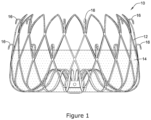
- FIG. 1 illustrates an example occlusive implant 10.
- the implant 10 may include an expandable framework 12.
- the occlusive implant 10 may also include an occlusive member 14 disposed on, disposed over, disposed about, or covering at least a portion of the expandable framework 12.
- the occlusive member 14 may be disposed on, disposed over, disposed about or cover at least a portion of an outer (or outwardly-facing) surface of the expandable framework 12.
- FIG. 1 further illustrates that the occlusive member 14 may extend only partially along the longitudinal extent of the expandable framework 12. However, this is not intended to be limiting. Rather, the occlusive member 14 may extend along the longitudinal extent of the expandable framework to any degree (e.g., the full longitudinal extend of the expandable framework 12).
- the occlusive member 14 may be permeable or impermeable to blood and/or other fluids, such as water.
- the occlusive member 14 may include a woven, braided and/or knitted material, a fiber, a sheet-like material, a fabric, a polymeric membrane, a metallic or polymeric mesh, a porous filter-like material, or other suitable construction.
- the occlusive member 14 may prevent thrombi (i.e. blood clots, etc.) from passing through the occlusive member 14 and out of the left atrial appendage into the blood stream.
- the plurality of anchor members 16 disposed along the expandable framework 12 may include two rows of anchor members 16. However, this is not intended to be limiting. Rather, the expandable framework 12 may include a single row of anchor members 16. In other examples, the expandable framework 12 may include more than two rows of anchor members 16. For example, in some instances the expandable framework 12 may include 1, 2, 3, 4 or more rows of anchor members 16.
- the delivery system 20 may include a hub member 22 coupled to a proximal region of the delivery catheter 24.
- the hub member 22 may be manipulated by a clinician to direct the distal end region of the delivery catheter 24 to a position adjacent the left atrial appendage 50.
- an occlusive implant delivery system may include a core wire 18.
- a proximal end of the expandable framework 12 may be configured to releasably attach, join, couple, engage, or otherwise connect to the distal end of the core wire 18.
- an end region of the expandable framework 12 may include a threaded insert coupled thereto.
- FIG. 3 illustrates that the expandable framework 12 may be compliant and, therefore, substantially conform to and/or be in sealing engagement with the shape and/or geometry of a lateral wall of a left atrial appendage in the expanded configuration.
- the occlusive implant 10 may expand to a size, extent, or shape less than or different from a maximum unconstrained extent, as determined by the surrounding tissue and/or lateral wall of the left atrial appendage.
- FIG. 3 illustrates that the expandable framework 12 may be held fixed adjacent to the left atrial appendage by one or more anchoring members 16.
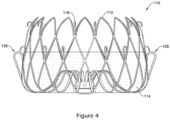
- FIG. 4 illustrates an example occlusion implant device 110.
- the occlusion implant device 110 may be similar in form and function to other occlusion implant devices disclosed herein.
- the occlusion implant device 110 may include an expandable frame 112, an occlusion member 114 and one or more anchoring members 116.
- FIG. 4 illustrates that the occlusion device 110 may include a sealing member 126.
- the sealing member 126 may extend outward from the occlusion member 114 and/or the expandable framework 112.
- the sealing member 126 may extend radially away from the occlusion member 114 and/or the expandable framework 112.
- the sealing member 126 may include a folded portion. It can be appreciated that the folded portion of the sealing member 126 adds "extra" material the occlusion device 110 which, as stated above, extends radially outward from the occlusion member 114 and/or the expandable framework 112. It can be further appreciated that this extra material (defining the sealing member) may be able to conform to the specific shape and/or geometry of a lateral wall of a left atrial appendage. In other words, the sealing member 126 may resemble extra material which may bunch, fill and/or conform to the specific shape and/or geometry of a lateral wall of a left atrial appendage when positioned adjacent thereto.
- the sealing member 126 may be formed separate from and later attached (e.g., joined, adhered, sewn, etc.) to the occlusive member 114.
- the occlusive member 114 may be formed separate from and later attached (e.g., joined, adhered, sewn, etc.) to the occlusive member 114.
- the sealing member 126 illustrated in FIG. 4 may extend either partially or entirely around the outer surface of the occlusive member 114.
- the sealing member 126 may extend either partially or entirely around the circumference of the occlusive member 114 and/or expandable framework 112. It can be appreciated that in instances in which the sealing member 126 extends entirely around the outer surface of the occlusive member 112, the sealing member 126 may resemble an annular ring having an open space existing therein. It can be appreciated that the open space permits the sealing member to conform to the specific geometry of the let atrial appendage, thereby permitting the sealing member 126 to sufficiently seal against the lateral wall of the left atrial appendage.
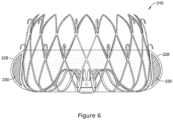
- FIG. 6 illustrates the conformable material 230 described with respect to FIG. 5 and FIG. 5A in an expanded state. It can be appreciated that as the conformable material 230 expands (e.g., when adjacent the left atrial appendage), it may conform to the specific geometries of the wall of the left atrial appendage.
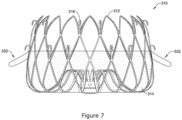
- FIG. 7 illustrates another example occlusion implant device 310.
- the occlusion implant device 310 may be similar in form and function to other occlusion implant devices disclosed herein.
- the occlusion implant device 310 may include an expandable frame 312, an occlusion member 314 and one or more anchoring members 316.
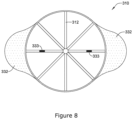
- the occlusive device 310 shown in FIG. 8 includes two sealing members 332, this is not intended to be limiting. Rather, it is contemplated that the occlusive device 310 may include 1, 2, 3, 4, or more sealing members 332. Further, the sealing members 332 may be positioned symmetrically around the perimeter of the expandable framework 312. In other instances, however, the sealing members 332 may be positioned asymmetrically around the expendable framework 312. It can be appreciated that the sealing members 332 described above may be designed to seal against the left atrial appendage in a manner similar to other sealing members described herein. For example, the sealing members 332 shown in FIG. 8 may designed to conform to the specific geometries of the wall of the left atrial appendage.
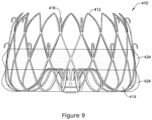
- FIG. 9 illustrates that the occlusion device 410 may include one or more sealing members 434.
- the sealing members 434 may be positioned directly adjacent one another. However, in other examples the sealing members 434 may be spaced from one another. Sealing members 434 may extend radially away from the expandable member 412 and/or the occlusion member 414. In some examples the sealing members 434 may resemble "pillows" which extend radially outward from the expandable member 412 and/or the occlusion member 414.
- the sealing members 434 may include "extra" material that extends radially outward from the occlusion member 414 and/or the expandable framework 412. It can be further appreciated that this extra material (defining the sealing members 434) may be able to conform to the specific shape and/or geometry of a lateral wall of a left atrial appendage. In other words, the sealing members 434 may resemble extra material that may bunch, fill and/or conform to the specific shape and/or geometry of a lateral wall of a left atrial appendage when positioned adjacent thereto.
- the sealing members 434 may be formed from the same material as the material forming the occlusive member 414.
- the material forming the sealing members 434 may be an extension of the material forming the occlusive member 414.
- the occlusive member 414 may be formed from a fabric material, and therefore, in some instances the sealing member may be formed from the same fabric.
- the sealing members 434 may be formed from a material which is distinct from the material forming the occlusive member 414.
- the sealing members 434 may be formed from a variety of fibers, bands, sheet material, mesh materials, ring strictures, or the like. These materials may be woven, braided, knitted, or combined using a variety of manufacturing techniques.
- the sealing members 434 may extend around the expandable framework in a helical manner.
- the sealing members 434 illustrated in FIG. 9 may extend either partially or entirely around the outer surface of the occlusive member 414.
- the sealing members 434 may extend either partially or entirely around the circumference of the occlusive member 414 and/or expandable framework 412. It can be appreciated that in instances in which the sealing members 434 extend entirely around the outer surface of the occlusive member 414, the sealing members 434 may resemble annular rings extending around the outer surface of the occlusive member 414.
- FIG. 11 illustrates a top-view of the occlusive device 510 shown in FIG. 10 .
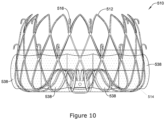
- the sealing members 538 may be positioned directly adjacent one another. However, in other examples the sealing members 538 may be spaced from one another. Additionally, FIG. 11 shows that the sealing members 538 may include a curved portion which extends radially outward from the expandable framework 512.
- the occlusive device 510 shown in FIG. 11 includes ten sealing members 538, this is not intended to be limiting. Rather, it is contemplated that the occlusive device 510 may include more or less than ten sealing members 538. For example, the occlusive device 510 may include 1, 2, 3, 4, 5, 6, 7, 8, 9, 10, 11, 12, 13, 14, 15 or more sealing members 538.
- the sealing members 538 may be positioned symmetrically around the perimeter of the expandable framework 512. In other instances, however, the sealing members 538 may be positioned asymmetrically around the expendable framework 512. It can be appreciated that the sealing members 538 described above may be designed to seal against the left atrial appendage in a manner similar to other sealing members described herein. For example, the sealing members 538 shown in FIG. 10 and FIG. 11 may be designed to conform to the specific geometries of the wall of the left atrial appendage. As illustrated in FIG. 10 and FIG. 11 , the sealing members 538 may include "extra" material that extends radially outward from the occlusion member 514 and/or the expandable framework 512.
- FIG. 12 illustrates another example occlusion implant device 610.
- the occlusion implant device 610 may be similar in form and function to other occlusion implant devices disclosed herein.
- the occlusion implant device 610 may include an expandable frame 612, an occlusion member 614 and one or more of the anchoring members 616.
- FIG. 12 illustrates that the occlusion device 610 may include a sealing member 640.
- the sealing member 640 may resemble an "annular flap" that extends around the outer surface of the occlusion member 614 and/or the expandable member 612.
- the sealing member 640 may extend radially away from the expandable member 612 and/or the occlusion member 614.
- the sealing member 640 may provide extra material which is able to conform to the specific shape and/or geometry of a lateral wall of a left atrial appendage.
- the sealing member 640 may resemble extra material which may bunch, fill and/or conform to the specific shape and/or geometry of a lateral wall of a left atrial appendage when positioned adjacent thereto.
- the sealing member 640 may be formed from the same material as the material forming the occlusive member 614.
- the material forming the sealing member 640 may be an extension of the material forming the occlusive member 614.
- the occlusive member 614 may be formed from a fabric material, and therefore, in some instances the sealing member 640 may be formed from the same fabric.
- this is not intended to be limiting. Rather, it is contemplated that in some examples the sealing member 640 may be formed from a material which is distinct from the material forming the occlusive member 614.
- the sealing member 640 illustrated in FIG. 12 may extend either partially or entirely around the outer surface of the occlusive member 614.
- the sealing member 640 may extend either partially or entirely around the circumference of the occlusive member 614 and/or expandable framework 612. It can be appreciated that in instances in which the sealing member 640 extends entirely around the outer surface of the occlusive member 612, the sealing member 640 may resemble a flat, annular ring extending entirely around the outer surface of the occlusive member 612.
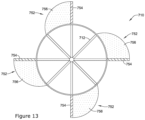
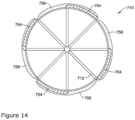
- FIG. 13 illustrates a top view of another example occlusion implant device 710.
- the occlusion implant device 710 may be similar in form and function to other occlusion implant devices disclosed herein.
- the occlusion implant device 710 may include an expandable frame 712 and one or more sealing members 752.
- sealing members 752 may include a support member 754 which may extend radially away from the expandable frame 712.
- the sealing members 752 may include an occlusion member 756 which may be coupled to both the support member 754 and a portion of the expandable frame 712.
- the occlusion members 756 may extend along the entire longitudinal length of the expandable frame 712.
- FIG. 14 illustrates that in some instances, the support arms 754 may bend and/or pivot around the outer circumference of the expandable frame 712.
- the support arms 754 may pivot and collapse around the perimeter of the expandable frame 712 (as shown in FIG. 14 ), as each of the support arms 754 engage with the lateral wall of the left atrial appendage (for example, as the occlusion implant device is being positioned adjacent the left atrial appendage).
- the occlusion material 756 that is coupled to the support arms 754 and the expandable frame 712 may seal the occlusive device 710 against the lateral wall of the left atrial appendage.
- FIG. 15 illustrates another example occlusion implant device 810.
- the occlusion implant device 810 may be similar in form and function to other occlusion implant devices disclosed herein.
- the occlusion implant device 810 may include an expandable frame 812, an occlusion member 814 and one or more of the anchoring members 816.
- FIG. 15 illustrates that in some instances the occlusion member 814 may include one or more apertures 842 which permit one or more of the anchoring members 816 to extend therethrough. It can be appreciated that the apertures 842 may be strategically positioned along the occlusion member 814 to align with one or more anchoring members 816.
- anchoring members 816 may be arranged along the expandable frame 812 to provide an optimal anchoring of the occlusion implant device 810 within the left atrial appendage. It is contemplated that the apertures 842 described herein may be applied to any of the occlusion implant device configurations described herein.
- linear elastic and/or non-super-elastic nitinol as recoverable strain increases, the stress continues to increase in a substantially linear, or a somewhat, but not necessarily entirely linear relationship until plastic deformation begins or at least in a relationship that is more linear than the super elastic plateau and/or flag region that may be seen with super elastic nitinol.
- linear elastic and/or non-super-elastic nitinol may also be termed "substantially" linear elastic and/or non-super-elastic nitinol.
- linear elastic and/or non-super-elastic nitinol may also be distinguishable from super elastic nitinol in that linear elastic and/or non-super-elastic nitinol may accept up to about 2-5% strain while remaining substantially elastic (e.g., before plastically deforming) whereas super elastic nitinol may accept up to about 8% strain before plastically deforming. Both of these materials can be distinguished from other linear elastic materials such as stainless steel (that can also be distinguished based on its composition), which may accept only about 0.2 to 0.44 percent strain before plastically deforming.
- the linear elastic and/or non-super-elastic nickel-titanium alloy may be in the range of about 50 to about 60 weight percent nickel, with the remainder being essentially titanium. In some embodiments, the composition is in the range of about 54 to about 57 weight percent nickel.
- a suitable nickel-titanium alloy is FHP-NT alloy commercially available from Furukawa Techno Material Co. of Kanagawa, Japan. Other suitable materials may include ULTANIUM TM (available from Neo-Metrics) and GUM METAL TM (available from Toyota).
- a superelastic alloy for example a superelastic nitinol can be used to achieve desired properties.
- portions or all of the occlusive implant 10 may also be doped with, made of, or otherwise include a radiopaque material.
- Radiopaque materials are understood to be materials capable of producing a relatively bright image on a fluoroscopy screen or another imaging technique during a medical procedure. This relatively bright image aids a user in determining the location of the occlusive implant 10 (and variations, systems or components thereof disclosed herein).
- Some examples of radiopaque materials can include, but are not limited to, gold, platinum, palladium, tantalum, tungsten alloy, polymer material loaded with a radiopaque filler, and the like. Additionally, other radiopaque marker bands and/or coils may also be incorporated into the design of the occlusive implant 10 (and variations, systems or components thereof disclosed herein). to achieve the same result.
- a degree of Magnetic Resonance Imaging (MRI) compatibility is imparted into the occlusive implant 10 (and variations, systems or components thereof disclosed herein).
- the occlusive implant 10 (and variations, systems or components thereof disclosed herein) and/or components or portions thereof may be made of a material that does not substantially distort the image and create substantial artifacts (e.g., gaps in the image). Certain ferromagnetic materials, for example, may not be suitable because they may create artifacts in an MRI image.
- the occlusive implant 10 (and variations, systems or components disclosed herein) or portions thereof may also be made from a material that the MRI machine can image.
- the synthetic yarns may be a metallic yarn or a glass or ceramic yarn or fiber.
- Useful metallic yarns include those yarns made from or containing stainless steel, platinum, gold, titanium, tantalum or a Ni-Co-Cr-based alloy.
- the yarns may further include carbon, glass or ceramic fibers.
- the yarns are made from thermoplastic materials including, but not limited to, polyesters, polypropylenes, polyethylenes, polyurethanes, polynaphthalenes, polytetrafluoroethylenes, and the like.
- the yarns may be of the multifilament, monofilament, or spun-types.
- the type and denier of the yarn chosen may be selected in a manner which forms a biocompatible and implantable prosthesis and, more particularly, a vascular structure having desirable properties.
- the occlusive implant 10 may include and/or be treated with a suitable therapeutic agent.
- suitable therapeutic agents may include anti-thrombogenic agents (such as heparin, heparin derivatives, urokinase, and PPack (dextrophenylalanine proline arginine chloromethylketone)); anti-proliferative agents (such as enoxaparin, angiopeptin, monoclonal antibodies capable of blocking smooth muscle cell proliferation, hirudin, and acetylsalicylic acid); anti-inflammatory agents (such as dexamethasone, prednisolone, corticosterone, budesonide, estrogen, sulfasalazine, and mesalamine); antineoplastic/antiproliferative/anti-mitotic agents (such as paclitaxel, 5-fluorouracil, cisplatin, vinblastine, vincristine, epot
- an occlusive implant for use in the left atrial appendage of the heart
- the aforementioned features may also be useful in other types of medical implants where a fabric or membrane is attached to a frame or support structure including, but not limited to, implants for the treatment of aneurysms (e.g., abdominal aortic aneurysms, thoracic aortic aneurysms, etc.), replacement valve implants (e.g., replacement heart valve implants, replacement aortic valve implants, replacement mitral valve implants, replacement vascular valve implants, etc.), and/or other types of occlusive devices (e.g., atrial septal occluders, cerebral aneurysm occluders, peripheral artery occluders, etc.).
- aneurysms e.g., abdominal aortic aneurysms, thoracic aortic aneurysms, etc.
- replacement valve implants e.g., replacement heart valve implants, replacement
Landscapes
- Health & Medical Sciences (AREA)
- Surgery (AREA)
- Life Sciences & Earth Sciences (AREA)
- Heart & Thoracic Surgery (AREA)
- Molecular Biology (AREA)
- Veterinary Medicine (AREA)
- Engineering & Computer Science (AREA)
- Biomedical Technology (AREA)
- Public Health (AREA)
- Medical Informatics (AREA)
- Nuclear Medicine, Radiotherapy & Molecular Imaging (AREA)
- Animal Behavior & Ethology (AREA)
- General Health & Medical Sciences (AREA)
- Reproductive Health (AREA)
- Vascular Medicine (AREA)
- Cardiology (AREA)
- Surgical Instruments (AREA)
- Prostheses (AREA)
Applications Claiming Priority (3)
| Application Number | Priority Date | Filing Date | Title |
|---|---|---|---|
| US201762560796P | 2017-09-20 | 2017-09-20 | |
| EP18792597.9A EP3684271B1 (de) | 2017-09-20 | 2018-09-20 | Okklusive medizinische vorrichtung mit dichtungselement |
| PCT/US2018/051953 WO2019060544A1 (en) | 2017-09-20 | 2018-09-20 | OCCLUSIVE MEDICAL DEVICE WITH SEALING ASSEMBLY |
Related Parent Applications (2)
| Application Number | Title | Priority Date | Filing Date |
|---|---|---|---|
| EP18792597.9A Division EP3684271B1 (de) | 2017-09-20 | 2018-09-20 | Okklusive medizinische vorrichtung mit dichtungselement |
| EP18792597.9A Division-Into EP3684271B1 (de) | 2017-09-20 | 2018-09-20 | Okklusive medizinische vorrichtung mit dichtungselement |
Publications (2)
| Publication Number | Publication Date |
|---|---|
| EP4537770A2 true EP4537770A2 (de) | 2025-04-16 |
| EP4537770A3 EP4537770A3 (de) | 2025-06-25 |
Family
ID=63963395
Family Applications (2)
| Application Number | Title | Priority Date | Filing Date |
|---|---|---|---|
| EP18792597.9A Active EP3684271B1 (de) | 2017-09-20 | 2018-09-20 | Okklusive medizinische vorrichtung mit dichtungselement |
| EP25154894.7A Pending EP4537770A3 (de) | 2017-09-20 | 2018-09-20 | Okklusive medizinische vorrichtung mit dichtungselement |
Family Applications Before (1)
| Application Number | Title | Priority Date | Filing Date |
|---|---|---|---|
| EP18792597.9A Active EP3684271B1 (de) | 2017-09-20 | 2018-09-20 | Okklusive medizinische vorrichtung mit dichtungselement |
Country Status (3)
| Country | Link |
|---|---|
| US (2) | US12082794B2 (de) |
| EP (2) | EP3684271B1 (de) |
| WO (1) | WO2019060544A1 (de) |
Families Citing this family (23)
| Publication number | Priority date | Publication date | Assignee | Title |
|---|---|---|---|---|
| US11484322B2 (en) | 2018-01-03 | 2022-11-01 | Aneuclose Llc | Aneurysm neck bridge with a closeable opening or lumen through which embolic material is inserted into the aneurysm sac |
| US11471163B2 (en) | 2008-05-01 | 2022-10-18 | Aneuclose Llc | Intrasaccular aneurysm occlusion device with net or mesh expanded by string-of-pearls embolies |
| US11464518B2 (en) | 2008-05-01 | 2022-10-11 | Aneuclose Llc | Proximal concave neck bridge with central lumen and distal net for occluding cerebral aneurysms |
| JP6423851B2 (ja) | 2013-03-13 | 2018-11-14 | アーロン・ヴィ・カプラン | 左心耳に空置術を行うためのデバイス |
| US11399842B2 (en) | 2013-03-13 | 2022-08-02 | Conformal Medical, Inc. | Devices and methods for excluding the left atrial appendage |
| EP3134010B1 (de) | 2014-04-25 | 2020-04-22 | Flow Medtech, LLC | Verschlussvorrichtung für das linke herzohr |
| AU2015317365A1 (en) | 2014-09-19 | 2017-05-11 | Flow Medtech, Inc. | Left atrial appendage occlusion device delivery system |
| EP4516244A3 (de) | 2016-10-27 | 2025-09-03 | Conformal Medical, Inc. | Vorrichtungen zum ausschluss des linken herzohrs |
| US11426172B2 (en) | 2016-10-27 | 2022-08-30 | Conformal Medical, Inc. | Devices and methods for excluding the left atrial appendage |
| DE102019100530B4 (de) * | 2019-01-10 | 2021-05-06 | Qatna Medical GmbH | Okkluder und System zur Einführung eines Okkluders |
| US12144508B2 (en) | 2019-02-08 | 2024-11-19 | Conformal Medical, Inc. | Devices and methods for excluding the left atrial appendage |
| EP3920810A4 (de) | 2019-02-08 | 2022-11-09 | Conformal Medical, Inc. | Vorrichtungen und verfahren zum ausschluss des linken vorhofanhangs |
| WO2020198259A1 (en) | 2019-03-25 | 2020-10-01 | Laminar, Inc. | Devices and systems for treating the left atrial appendage |
| EP3998962B1 (de) * | 2019-07-17 | 2024-05-08 | Boston Scientific Scimed, Inc. | Linkes herzohrimplantat mit kontinuierlicher abdeckung |
| US11540838B2 (en) * | 2019-08-30 | 2023-01-03 | Boston Scientific Scimed, Inc. | Left atrial appendage implant with sealing disk |
| US12303116B2 (en) | 2020-03-24 | 2025-05-20 | Laminar, Inc. | Devices, systems, and methods for occluding cavities within the body |
| CN111839644B (zh) * | 2020-07-24 | 2025-06-03 | 宁波迪创医疗科技有限公司 | 一种自适应腔体的装置 |
| CN114617602A (zh) * | 2020-12-10 | 2022-06-14 | 先健科技(深圳)有限公司 | 封堵装置 |
| EP4358872A1 (de) | 2021-06-22 | 2024-05-01 | Boston Scientific Scimed, Inc. | Implantat für linkes herzohr |
| EP4498948A1 (de) | 2022-03-28 | 2025-02-05 | Laminar, Inc. | Vorrichtungen, systeme und verfahren zur transseptalen punktion |
| EP4604852A1 (de) * | 2022-10-26 | 2025-08-27 | Boston Scientific Scimed, Inc. | Implantierbare medizinische vorrichtung mit dichtung zur aufnahme eines unregelmässigen ostiums |
| US20240423630A1 (en) * | 2023-06-23 | 2024-12-26 | Medtronic, Inc. | Occlusion apparatus and methods |
| WO2025064628A1 (en) * | 2023-09-21 | 2025-03-27 | Boston Scientific Scimed, Inc. | Medical system for left atrial appendage ostial cinching |
Family Cites Families (26)
| Publication number | Priority date | Publication date | Assignee | Title |
|---|---|---|---|---|
| US7044134B2 (en) | 1999-11-08 | 2006-05-16 | Ev3 Sunnyvale, Inc | Method of implanting a device in the left atrial appendage |
| US6231581B1 (en) | 1998-12-16 | 2001-05-15 | Boston Scientific Corporation | Implantable device anchors |
| US8377114B2 (en) * | 1999-08-09 | 2013-02-19 | Cardiokinetix, Inc. | Sealing and filling ventricular partitioning devices to improve cardiac function |
| US6231561B1 (en) | 1999-09-20 | 2001-05-15 | Appriva Medical, Inc. | Method and apparatus for closing a body lumen |
| ATE369178T1 (de) | 1999-09-20 | 2007-08-15 | Ev3 Endovascular Inc | Vorrichtung zur schliessung eines körperlumens |
| US6689150B1 (en) | 1999-10-27 | 2004-02-10 | Atritech, Inc. | Filter apparatus for ostium of left atrial appendage |
| BR0109404A (pt) | 2000-03-20 | 2003-06-03 | By Pass Inc | Sistema de distribuição de enxerto médico, guia de enxerto removìvel para um sistema de distribuição de enxerto, e, puxador de vaso |
| WO2004087014A2 (en) | 2003-03-28 | 2004-10-14 | Gi Dynamics, Inc. | Anti-obesity devices |
| WO2005060869A1 (en) | 2003-12-09 | 2005-07-07 | Gi Dynamics, Inc. | Intestinal sleeve |
| US20050256532A1 (en) | 2004-05-12 | 2005-11-17 | Asha Nayak | Cardiovascular defect patch device and method |
| US7972359B2 (en) | 2005-09-16 | 2011-07-05 | Atritech, Inc. | Intracardiac cage and method of delivering same |
| US10143456B2 (en) | 2005-10-07 | 2018-12-04 | Alex Javois | Left atrial appendage occlusion device |
| WO2008074027A1 (en) * | 2006-12-13 | 2008-06-19 | Biomerix Corporation | Aneurysm occlusion devices |
| US8784469B2 (en) | 2011-06-30 | 2014-07-22 | Ghassan S. Kassab | Devices, systems, and methods for inverting and closing the left atrial appendage |
| US20090005803A1 (en) | 2007-06-27 | 2009-01-01 | Stanley Batiste | Removable vascular filter and method of filter use |
| WO2010024801A1 (en) | 2008-08-25 | 2010-03-04 | Cardiokinetix, Inc. | Retrievable cardiac devices |
| US8696739B2 (en) | 2008-08-29 | 2014-04-15 | Cook Medical Technologies Llc | Barbed anchor |
| US9693781B2 (en) * | 2009-06-17 | 2017-07-04 | Coherex Medical, Inc. | Medical device for modification of left atrial appendage and related systems and methods |
| US20110054515A1 (en) * | 2009-08-25 | 2011-03-03 | John Bridgeman | Device and method for occluding the left atrial appendage |
| US8562509B2 (en) | 2010-12-30 | 2013-10-22 | Cook Medical Technologies Llc | Ventricular assist device |
| US20120245619A1 (en) | 2011-03-25 | 2012-09-27 | Boston Scientific Scimed, Inc. | Retrievable Filter with Retractable Wire Barbs and Method of Use |
| US8764787B2 (en) * | 2011-06-17 | 2014-07-01 | Aga Medical Corporation | Occlusion device and associated deployment method |
| WO2013059743A1 (en) * | 2011-10-19 | 2013-04-25 | Foundry Newco Xii, Inc. | Devices, systems and methods for heart valve replacement |
| WO2013159065A1 (en) * | 2012-04-20 | 2013-10-24 | Paul Lubock | Expandable occlusion devices and methods of use |
| US9700323B2 (en) | 2012-12-31 | 2017-07-11 | Boston Scientific Scimed Inc. | Medical devices having fixation anchor |
| US9730701B2 (en) * | 2014-01-16 | 2017-08-15 | Boston Scientific Scimed, Inc. | Retrieval wire centering device |
-
2018
- 2018-09-20 EP EP18792597.9A patent/EP3684271B1/de active Active
- 2018-09-20 US US16/136,674 patent/US12082794B2/en active Active
- 2018-09-20 EP EP25154894.7A patent/EP4537770A3/de active Pending
- 2018-09-20 WO PCT/US2018/051953 patent/WO2019060544A1/en not_active Ceased
-
2024
- 2024-09-09 US US18/829,096 patent/US20240423599A1/en active Pending
Also Published As
| Publication number | Publication date |
|---|---|
| EP3684271A1 (de) | 2020-07-29 |
| WO2019060544A1 (en) | 2019-03-28 |
| EP4537770A3 (de) | 2025-06-25 |
| US20240423599A1 (en) | 2024-12-26 |
| US12082794B2 (en) | 2024-09-10 |
| US20190083075A1 (en) | 2019-03-21 |
| EP3684271B1 (de) | 2025-04-02 |
Similar Documents
| Publication | Publication Date | Title |
|---|---|---|
| US20240423599A1 (en) | Occlusive medical device with sealing member | |
| EP3700436B1 (de) | Okklusive medizinische vorrichtung mit dämpfungselementen | |
| US12082797B2 (en) | Occlusive medical device with fabric retention barb | |
| US20220142650A1 (en) | Occlusive medical device | |
| US11992220B2 (en) | Occlusive medical device with fixation members | |
| US12232736B2 (en) | Occlusive medical device | |
| EP4294286B1 (de) | Implantat für linkes herzohr | |
| EP4262583B1 (de) | Okklusive medizinische vorrichtung mit messkapazitäten | |
| US11096696B2 (en) | Occlusive medical device |
Legal Events
| Date | Code | Title | Description |
|---|---|---|---|
| PUAI | Public reference made under article 153(3) epc to a published international application that has entered the european phase |
Free format text: ORIGINAL CODE: 0009012 |
|
| STAA | Information on the status of an ep patent application or granted ep patent |
Free format text: STATUS: REQUEST FOR EXAMINATION WAS MADE |
|
| 17P | Request for examination filed |
Effective date: 20250228 |
|
| AC | Divisional application: reference to earlier application |
Ref document number: 3684271 Country of ref document: EP Kind code of ref document: P |
|
| AK | Designated contracting states |
Kind code of ref document: A2 Designated state(s): AL AT BE BG CH CY CZ DE DK EE ES FI FR GB GR HR HU IE IS IT LI LT LU LV MC MK MT NL NO PL PT RO RS SE SI SK SM TR |
|
| PUAL | Search report despatched |
Free format text: ORIGINAL CODE: 0009013 |
|
| RIN1 | Information on inventor provided before grant (corrected) |
Inventor name: LARSEN, STEVEN R. Inventor name: MEREGOTTE, JOSE A. Inventor name: ONUSHKO, JOHN DAVID |
|
| AK | Designated contracting states |
Kind code of ref document: A3 Designated state(s): AL AT BE BG CH CY CZ DE DK EE ES FI FR GB GR HR HU IE IS IT LI LT LU LV MC MK MT NL NO PL PT RO RS SE SI SK SM TR |
|
| RIC1 | Information provided on ipc code assigned before grant |
Ipc: A61B 17/12 20060101AFI20250522BHEP |