EP4537696A2 - Schuhe für ballsportarten - Google Patents
Schuhe für ballsportarten Download PDFInfo
- Publication number
- EP4537696A2 EP4537696A2 EP25161480.6A EP25161480A EP4537696A2 EP 4537696 A2 EP4537696 A2 EP 4537696A2 EP 25161480 A EP25161480 A EP 25161480A EP 4537696 A2 EP4537696 A2 EP 4537696A2
- Authority
- EP
- European Patent Office
- Prior art keywords
- actuator
- shoe
- event
- sensor
- shoe according
- Prior art date
- Legal status (The legal status is an assumption and is not a legal conclusion. Google has not performed a legal analysis and makes no representation as to the accuracy of the status listed.)
- Pending
Links
Images







Classifications
-
- A—HUMAN NECESSITIES
- A43—FOOTWEAR
- A43B—CHARACTERISTIC FEATURES OF FOOTWEAR; PARTS OF FOOTWEAR
- A43B3/00—Footwear characterised by the shape or the use
- A43B3/24—Collapsible or convertible
- A43B3/242—Collapsible or convertible characterised by the upper
-
- A—HUMAN NECESSITIES
- A43—FOOTWEAR
- A43B—CHARACTERISTIC FEATURES OF FOOTWEAR; PARTS OF FOOTWEAR
- A43B1/00—Footwear characterised by the material
- A43B1/0054—Footwear characterised by the material provided with magnets, magnetic parts or magnetic substances
-
- A—HUMAN NECESSITIES
- A43—FOOTWEAR
- A43B—CHARACTERISTIC FEATURES OF FOOTWEAR; PARTS OF FOOTWEAR
- A43B13/00—Soles; Sole-and-heel integral units
- A43B13/14—Soles; Sole-and-heel integral units characterised by the constructive form
-
- A—HUMAN NECESSITIES
- A43—FOOTWEAR
- A43B—CHARACTERISTIC FEATURES OF FOOTWEAR; PARTS OF FOOTWEAR
- A43B23/00—Uppers; Boot legs; Stiffeners; Other single parts of footwear
- A43B23/02—Uppers; Boot legs
- A43B23/0205—Uppers; Boot legs characterised by the material
- A43B23/021—Leather
-
- A—HUMAN NECESSITIES
- A43—FOOTWEAR
- A43B—CHARACTERISTIC FEATURES OF FOOTWEAR; PARTS OF FOOTWEAR
- A43B23/00—Uppers; Boot legs; Stiffeners; Other single parts of footwear
- A43B23/02—Uppers; Boot legs
- A43B23/0205—Uppers; Boot legs characterised by the material
- A43B23/0215—Plastics or artificial leather
-
- A—HUMAN NECESSITIES
- A43—FOOTWEAR
- A43B—CHARACTERISTIC FEATURES OF FOOTWEAR; PARTS OF FOOTWEAR
- A43B23/00—Uppers; Boot legs; Stiffeners; Other single parts of footwear
- A43B23/02—Uppers; Boot legs
- A43B23/0245—Uppers; Boot legs characterised by the constructive form
-
- A—HUMAN NECESSITIES
- A43—FOOTWEAR
- A43B—CHARACTERISTIC FEATURES OF FOOTWEAR; PARTS OF FOOTWEAR
- A43B23/00—Uppers; Boot legs; Stiffeners; Other single parts of footwear
- A43B23/02—Uppers; Boot legs
- A43B23/0245—Uppers; Boot legs characterised by the constructive form
- A43B23/028—Resilient uppers, e.g. shock absorbing
-
- A—HUMAN NECESSITIES
- A43—FOOTWEAR
- A43B—CHARACTERISTIC FEATURES OF FOOTWEAR; PARTS OF FOOTWEAR
- A43B23/00—Uppers; Boot legs; Stiffeners; Other single parts of footwear
- A43B23/02—Uppers; Boot legs
- A43B23/0245—Uppers; Boot legs characterised by the constructive form
- A43B23/028—Resilient uppers, e.g. shock absorbing
- A43B23/029—Pneumatic upper, e.g. gas filled
-
- A—HUMAN NECESSITIES
- A43—FOOTWEAR
- A43B—CHARACTERISTIC FEATURES OF FOOTWEAR; PARTS OF FOOTWEAR
- A43B3/00—Footwear characterised by the shape or the use
- A43B3/26—Footwear characterised by the shape or the use adjustable as to length or size
-
- A—HUMAN NECESSITIES
- A43—FOOTWEAR
- A43B—CHARACTERISTIC FEATURES OF FOOTWEAR; PARTS OF FOOTWEAR
- A43B3/00—Footwear characterised by the shape or the use
- A43B3/34—Footwear characterised by the shape or the use with electrical or electronic arrangements
-
- A—HUMAN NECESSITIES
- A43—FOOTWEAR
- A43B—CHARACTERISTIC FEATURES OF FOOTWEAR; PARTS OF FOOTWEAR
- A43B3/00—Footwear characterised by the shape or the use
- A43B3/34—Footwear characterised by the shape or the use with electrical or electronic arrangements
- A43B3/38—Footwear characterised by the shape or the use with electrical or electronic arrangements with power sources
-
- A—HUMAN NECESSITIES
- A43—FOOTWEAR
- A43B—CHARACTERISTIC FEATURES OF FOOTWEAR; PARTS OF FOOTWEAR
- A43B3/00—Footwear characterised by the shape or the use
- A43B3/34—Footwear characterised by the shape or the use with electrical or electronic arrangements
- A43B3/44—Footwear characterised by the shape or the use with electrical or electronic arrangements with sensors, e.g. for detecting contact or position
-
- A—HUMAN NECESSITIES
- A43—FOOTWEAR
- A43B—CHARACTERISTIC FEATURES OF FOOTWEAR; PARTS OF FOOTWEAR
- A43B5/00—Footwear for sporting purposes
-
- A—HUMAN NECESSITIES
- A43—FOOTWEAR
- A43B—CHARACTERISTIC FEATURES OF FOOTWEAR; PARTS OF FOOTWEAR
- A43B5/00—Footwear for sporting purposes
- A43B5/02—Football boots or shoes, i.e. for soccer, football or rugby
-
- A—HUMAN NECESSITIES
- A43—FOOTWEAR
- A43B—CHARACTERISTIC FEATURES OF FOOTWEAR; PARTS OF FOOTWEAR
- A43B5/00—Footwear for sporting purposes
- A43B5/02—Football boots or shoes, i.e. for soccer, football or rugby
- A43B5/025—Football boots or shoes, i.e. for soccer, football or rugby characterised by an element which improves the contact between the ball and the footwear
Definitions
- the present invention relates to a shoe for ball sports.
- a player's foot usually has contact with the ball in very different situations of e.g. a match.
- a ball may be kicked with the intention to take a shot at the goal (e.g. by a striker or during a penalty), be passed to another player, be kept under control during dribbling, be received after a teammate's pass, etc.
- a player makes different demands on his/her shoe. For example, when the player kicks the ball, he/she wants high friction and maximum energy transfer. However, when the player controls the ball, he/she wants a smooth surface and direct touch to the ball.
- Known shoes for ball sports are often a compromise between those different demands. Thus, there are usually match situations, in which the shoe does not perform optimally.
- Other shoes are specifically tailored for certain match situations.
- soccer shoes are known, which have a structured surface on the upper with fin-like projections which aim to increase the friction with the ball, e.g. to make the ball spin during flight.
- those shoes are not optimal, when it comes to controlling the ball due to the structured surface.
- US 2010/0154255 A1 discloses active-response golf shoes.
- the golf shoes include a plurality of pressure sensors, a controller, and at least one active-response element.
- the sensor and controller operate to determine if a golfer is walking or swinging a golf club, based on whether the sensors sense a pressure greater than a preset swing threshold within a preset time interval threshold. If the controller determines that the golfer is walking, the shoe provides a soft and flexible walking platform. If the controller determines that the golfer is swinging, the shoe morphs or changes automatically to provide a stable hitting platform.
- US 2012/0291564 A1 discloses an article of footwear which includes an upper member and a sole structure, with a sensor system connected to the sole structure. The sensor system includes a plurality of sensors that are configured for detecting forces exerted by a user's foot on the sensor. Each sensor includes two electrodes that are in communication with a force sensitive resistive material.
- the sensor system may be provided on an insert that may form a sole member of the article of footwear.
- the insert may include an airflow system that includes one or more air chambers in communication with one or more air reservoirs through air passages extending therebetween.
- the insert may also have a multi-layered structure, with the airflow system provided between the layers
- WO 2015/006067 A1 discloses an article of footwear which includes an intermediate covering portion with an adjustable volume. The intermediate covering portion is closed around the instep of the foot.
- the article also includes a tensioning system that can be used to change the volume of the intermediate covering portion.
- US 2013/0074374 A1 discloses an article of footwear which includes a first ball control portion, a second ball control portion and a third ball control portion.
- Each ball control portion includes a group of gripping members configured to facilitate various types of ball control.
- Each group of gripping members is arranged so that the ball control portions present a series of approximately continuous edges to a ball, which can help maintain a smooth trajectory for a ball
- At least one surface property is the surface structure of the portion of the outer surface.
- the at least one surface property may be the friction of the portion of the outer surface or the surface area of the portion of the outer surface.
- At least the portion of the outer surface of the upper may be elastic and the shoe may further comprise a plurality of fins arranged below the portion of the outer surface of the upper and connected to the actuator, such that the fins can be lowered or raised by means of the actuator to change the at least one surface property of the elastic portion of the outer surface.
- At least the portion of the outer surface of the upper may be elastic and the actuator may be a pneumatic valve
- the shoe may further comprise an air pump configured to provide pressurized air to the pneumatic valve, and at least one inflatable element arranged under the elastic portion of the outer surface of the upper, wherein the pneumatic valve is configured to provide pressurized air to the inflatable element to inflate the inflatable element and to change the at least one surface property of the portion of the outer surface.
- the pressurized air may be generated through actions of a player wearing the shoe.
- the portion of the outer surface comprises a plurality of flaps, which are configured to be lowered or raised by means of the actuator.
- the actuator may be based on a shape memory alloy or an electrical motor.
- the outer surface may be skin-like.
- the predetermined event is a kick.
- the predetermined event may also be a short pass, long pass, shot, or control of a ball.
- the time-series may be preprocessed by digital filtering using for example a non-recursive moving average filter, a Cascade Integrator Comb filter or a filter bank.
- the event class may comprise at least the event to be detected and a NULL class associated with the sensor data that does not belong to a specific event.
- the features are based at least on one of temporal, spatio-temporal, spectral, or ensemble statistics by applying, for example, wavelet analysis, principal component analysis, or Fast Fourier Transform.
- the features are based on one of simple mean, normalized signal energy, movement intensity, signal magnitude area, correlation between axes, maximum value in a window, minimum value in a window, maximum detail coefficient of a wavelet transform, correlation with a template, projection onto a principal component of a template, distance to an eigenspace of a template, spectral centroid, bandwidth, or dominant frequency.
- the time-series may be segmented in the plurality of windows based on a sliding window.
- the time-series may also be segmented in the plurality of windows based on at least one condition present in the time-series.
- the at least one condition is the crossing of the sensor data of a defined threshold or the matching of a template using correlation, Matched Filtering, Dynamic Time Warping, or Longest Common Subsequence and its sliding window variant, warping Longest Common Subsequence.
- the event class is estimated based on a Bayesian classifier such as Naive Bayes classifier, a maximum margin classifier such as Support Vector Machine, an ensemble learning algorithm such as AdaBoost classifier and Random Forest classifier, a Nearest Neighbor classifier, a Neural Network classifier, a Rule based classifier, or a Tree based classifier.
- the event class is estimated based on probabilistic modeling the sequential behavior of the events and a NULL class by Conditional Random Fields or dynamic Bayesian networks.
- the inflatable element being arranged under the elastic surface directly influences the at least one surface property and, therefore, for example the friction of the surface.
- This construction has the advantage of having only a few movable parts, i.e. the pneumatic valve and the inflatable elements. Therefore, it is a very robust construction.
- the actuator may comprise more than one pneumatic valve and that the shoe may comprise two or more air pumps.
- Pins allow to generate very fine-grained structures on the surface of the upper.
- the friction achievable with this construction is high, while the control of the ball, i.e. the "touch" can be maintained.
- the actuator may be a thermal actuator.
- a thermal actuator changes the temperature of a material with a preferably large coefficient of thermal expansion. Thus, as the temperature changes, so does the length of the material which may be used to drive a mechanism which changes the surface properties of the portion of the outer surface of the upper.
- the actuator may be a pneumatic actuator.
- a small piston could be driven by pressurized air to drive in turn a mechanism which changes the surface properties of the portion of the outer surface of the upper.
- the actuator may be an electroactive polymer.
- Such polymers exhibit a shape change in response to electrical stimulation. For example, if a voltage is applied to such a polymer, the polymer may contract in the direction of the field lines and expand perpendicular to them.
- An electroactive polymer may be created by laminating thin films of dielectric elastomers on the front and back with carbon containing soft polymer films.
- the main types of electroactive polymers which may be used in the context of the present invention include electronic electroactive polymers which are drive by an electric field, ionic electroactive polymers which involve mobility of ions, and nanotubes.
- the actuator may be supported by a pre-stressed element.
- a pre-stressed element For example, the force from a pre-stressed spring, elastic strap, or compressed bladder may add to the force of the actuator to support the actuator.
- the predetermined event may be a short pass, long pass, shot, or control of a ball. Also these events are regularly performed in sports such as soccer, football, American football and rugby. Therefore, adapting the shoe for one of those events is of high value for the player.
- This sequence of steps allows for a reliable detection of events, is computationally inexpensive, capable for real-time processing and can be applied to a vast spectrum of different events during a match.
- events can be detected before they are actually completed. For example, a shot can be identified in an early phase.
- the processing of the data can be focused to a limited amount of data given by the window size.
- the dimension of the problem can be reduced. For example, if each window comprises a few hundred data points, extracting about a dozen of relevant features results in a significant reduction of computational costs.
- the subsequent step of estimating an event class associated with the plurality of windows needs to operate on the extracted features only, but not on the full set of data points in each window.
- the time-series may be segmented in a plurality of windows based on at least one condition present in the time-series. In this way, it may be guaranteed that each of the windows is in a fixed temporal relationship with the predetermined event to be detected. For example, the temporal location of the first window of the plurality of windows may coincide with the beginning of the predetermined event.
- the condition may be the crossing of the sensor data of a defined threshold. Crossing of sensor data can easily be detected, is computationally inexpensive and shows good correlation with the temporal location of events to be detected.
- the time-series may be segmented in a plurality of windows based using matching with a template of an event that is defined using known signals of pre-recorded events.
- the matching may be based on correlation, Matched Filtering, Dynamic Time Warping, or Longest Common Subsequence ("LCSS”) and its sliding window variant, warping LCSS.
- LCSS Longest Common Subsequence
- the features may be based at least on one of temporal, spatio-temporal, spectral, or ensemble statistics by applying, for example, wavelet analysis, principal component analysis (“PCA”) or Fast Fourier Transform (“FFT”).
- PCA principal component analysis
- FFT Fast Fourier Transform
- the features may be based on one of simple mean, normalized signal energy, movement intensity, signal magnitude area, correlation between axes, maximum value in a window, minimum value in a window, maximum detail coefficient of a wavelet transform, correlation with a template, projection onto a principal component of a template, distance to an eigenspace of a template, spectral centroid, bandwidth, or dominant frequency.
- the event class may be estimated based on a Bayesian Classifier such as Naive Bayes classifier, a maximum margin classifier such as Support Vector Machine, an ensemble learning algorithm such as AdaBoost classifier and a Random Forest classifier, a Nearest Neighbor classifier, a Neural Network classifier, a Rule based classifier, or a Tree based classifier.
- a Bayesian Classifier such as Naive Bayes classifier
- a maximum margin classifier such as Support Vector Machine
- AdaBoost classifier an ensemble learning algorithm
- Random Forest classifier such as AdaBoost classifier and a Random Forest classifier
- a Nearest Neighbor classifier such as Neural Network classifier
- Rule based classifier such as Rule based classifier
- Tree based classifier such as Tree based classifier.
- the event class may be estimated based on probabilistic modeling the sequential behavior of the events and the NULL class by Conditional Random Fields, dynamic Bayesian networks or other.
- the event class may be estimated based on a hybrid classifier, comprising the steps of: (a.) discriminating between different phases of the predetermined event to be detected and a NULL class, wherein the NULL class is associated with sensor data that does not belong to a specific event; and (b.) modeling the sequential behavior of the event and the NULL class by dynamic Bayesian networks, e.g. Hidden Markov type models.
- a hybrid classifier increases the response time and is, therefore, ideally suited for real-time detection of events. This is due to the fact, that a hybrid classifier may classify an event before it has actually finished.
- the step of estimating may be based on a classifier which has been trained based on supervised learning.
- Supervised learning allows adapting the classifier to predetermined classes of events (e.g. kicks, shots, passes, etc.) and/or to predetermined types of athletes (e.g. professional, amateur, recreational), or even to a specific person.
- Figures 1a and 1b show a schematic drawing of certain embodiments of a shoe 100 for ball sports according to the present invention.
- a shoe 100 may be used for ball sports such as soccer, football, American football, rugby, and the like.
- the shoe 100 comprises an upper 101 having an outer surface 102.
- the upper 101 may be made from conventional materials, such as leather, synthetic leather, plastics such as polyester, and the like. If the upper is made from yarns, it may for example be weft knitted, warp knitted, woven and the like.
- the at least one surface property may be the friction of the portion of the outer surface of the upper.
- the processing unit 106 may detect for example that the player makes a shot, it may cause the actuator 104 to increase the surface friction of the portion of the outer surface 102 of the upper 101 so that the player may shoot the ball with a lot of spin.
- FIG. 2A and 2B An exemplary mechanism 200 to change the surface structure of the upper 101 by means of the actuator 104 is described with reference to Figs. 2A and 2B .
- at least a portion of the outer surface 102 of the upper 101 is elastic.
- "Elastic" in the context of the present invention is understood in that the outer surface of the upper deforms under force and/or pressure, but restores its shape almost entirely (up to small tolerances) to the initial state.
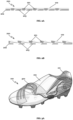
- FIG. 3A shows the entire shoe 100 and Figs. 3B and 4 show details of the mechanism 300.
- FIG. 3A shows the entire shoe 100
- Figs. 3B and 4 show details of the mechanism 300.
- at least a portion of the outer surface 102 of the upper 101 is elastic.
- a plurality of inflatable elements 301 in the form of stripes are arranged below the elastic portion of the outer surface 102 of the upper 101.
- the number of inflatable elements 301 may vary, as well as does the shape of the inflatable elements.
- the number of inflatable elements may range between 1 and 10, but more inflatable elements could be used.
- dot-shaped or undulating inflatable elements may be used.
- the pneumatic valve in the module 302 is configured to provide pressurized air from the air reservoir 304 to the inflatable elements 301. As the elements 301 are inflated, the elements 301 show up through the elastic outer surface 102 of the upper 101. In this way, the at least one surface property of a portion of the outer surface 102 is changed.
- the pressurized air may be released from the inflatable elements 301 by using e.g. a three-way valve.
- the inflatable elements 301 are connected to the middle port of the valve, which is connected to one of the side ports when the valve is in a first state and to the other side port when the valve is in a different, second state.
- the air reservoir 304 is connected to one side port and the other side port is left open, i.e. can be used for venting.
- the inflatable elements 301 may be pressurized with the valve in the first state, while the inflatable elements 301 vent in the other, second state of the valve.
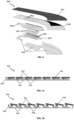
- a further exemplary mechanism 500 to change at least one surface property of a portion of the outer surface 102 of the upper by means of the actuator 104 is described with reference to Figs. 5A, 5B and 6 .
- at least a portion of the outer surface 102 of the upper 101 is elastic.
- a plurality of pins 501 is arranged below the elastic portion of the outer surface 102 of the upper 101.
- An undulating structure 502 is arranged below the plurality of pins 501.
- the undulating structure 502 is connected to the actuator 104, such that the undulating structure 502 can be moved relative to the pins 501. In this way the pins 501 can be lowered or raised with respect to the outer surface 102.
- the surface structure of the outer surface 102 can be changed, i.e. buckles or elevations show up on the surface, when the pins 501 are raised.
- a "pin” in the context of the present invention is understood as any structure that is able to change the surface properties by moving against the elastic outer surface.
- a pin may have the shape of a nib, a ball, a pyramid, a cube, etc.
- Fig. 5A the pins 501 are shown in the lower position. In this position the pins 501 rest in dimples 503 of the undulating structure 502. As the actuator 104 moves the undulating structure 502 relative to the pins 501, the pins 501 are raised. Thus, in Fig. 5B , the pins 501 are shown in the upper position in which the dimples 503 of the undulating structure 502 have moved away from the pins 501.
- FIG. 6 Certain embodiments of this mechanism are shown in Fig. 6 .
- An elastic portion 601 of the outer surface 102 of the upper 101 is arranged on top of a mid-layer 602 comprising openings 603 for the pins 501.
- a guide layer 604 is arranged below the mid-layer 602 .
- the guide layer 604 guides the pins 501 in a vertical direction.
- the guide layer 604 is optional and the mid-layer 602 would be sufficient to hold the pins 501 in place.
- Below the pins 501 the undulating structure 502 having dimples 503 is arranged.
- the undulating structure 502 is surrounded by a base layer 605.
- the operation of the mechanism shown in Fig. 6 has been described already with reference to Figs. 5A and 5B .
- the portion of the outer surface 102 of the upper 101 the property of which is changed may be arranged in the forefoot area, only on a medial side, only on the lateral side, on both sides, in the heel area, in the (medial and/or lateral) midfoot area, etc.
- the portion may also be arranged on any combination of the areas mentioned before.
- a "portion" is understood as a single area, or two or more separate and distinct areas on the surface 102 of the upper 101.
- the portion whose property is changed may be arranged at arbitrary positions on the surface 102 of the upper 101.
- FIGs 8A and 8B illustrate the principle of an electroactive polymer.
- the electroactive polymer in this example is a dielectric elastomeric film 81 which is covered by compliant electrodes 82a and 82b on the upper and lower side, respectively.
- the electrodes 82a and 82b allow the application of a voltage to the dielectric elastomeric film 81.
- wires 83a and 83b, respectively, are connected to the electrodes 82a and 82b.
- Fig. 8A shows the electroactive polymer in a state which no voltage applied.
- Electronic electroactive polymers can be divided in several sub-types, such as ferroelectric polymers, dielectric elastomers, electrorestrictive polymers and liquid crystal materials.
- the active principle of electronic electroactive polymers is based on an applied electric field which effects a shape change by acting directly on charges within the polymer.
- Electronic electroactive polymers exhibit a fast response, are efficient (down to 1.5 mW) and relatively insensitive to temperature and humidity fluctuations. They operate on high voltages and low currents.
- FIGs 9A and 9B illustrate certain embodiments of an electroactive polymer which may be used in the context of the present invention, wherein Fig. 9A shows the inactive (i.e. without voltage applied) and Fig. 9B shows the active (i.e. with voltage applied) state of the electroactive polymer.
- the electroactive polymer is a thin film 91 which is coated by electrodes 92a and 92b, respectively.
- the film 91 in the inactive state, the film 91 is in a flat configuration. If a voltage V is applied across the film 91 via the electrodes, the film 91 is flattened and increases its width and depth, i.e. its surface area, as described with respect to Figures 8A and 8B .
- the film 91 buckles and acquires a hemisphere-like configuration. It would also possible that the film 91 have a different shape (e.g. cuboids, rectangle,...), not shown. If the voltage is interrupted, the film 91 returns to the flat configuration shown in Fig. 9A .
- Such an electroactive polymer 81 and 91 may be used in the context of the present invention as follows: At least a portion of the outer surface 102 of the upper 101 may be elastic and the electroactive polymer 81, 91 may be arranged below the elastic portion, such that a change of the shape of the electroactive polymer 81, 91 causes a change of the surface property of the elastic portion of the outer surface 102 of the upper 101. In this way, the surface property may be directly changed by the actuator 81, 91 without a further mechanism.
- the change in shape of the electroactive polymer 81, 91 may include a change in length, volume, thickness, width, surface area, modulus of elasticity and/or modulus of rigidity.
- Fig. 10 shows a module 1000 comprising elastomeric polymers as described with respect to Figures 9A and 9B .
- the module is shown in the active state (voltage applied) in which the elastomeric polymers show up as bumps (i.e. small hemispheres) on the upper side of the module 1000. Three of those bumps are exemplarily denoted with the reference numeral 1001. In the inactive state, the bumps would disappear.
- the module 1000 also comprises wires 1002a and 1002b, respectively, to apply a voltage to the module 1000.
- the module 1000 could for example be mounted under an elastic portion of an outer surface 102 of an upper 101.
- the bumps which are formed on the module would show up on the portion of the outer surface 102.
- surface properties, such as friction, surface area and surface structure can be easily changed by means of the module 1000 and the elastomeric polymers therein which act as actuators.
- Electroactive polymers may also cause a change of a surface property of the portion of the outer surface 102 of the upper 101 indirectly.
- an electroactive polymer such as the polymers 81 and 91 shown in Figures 8A, 8B and 9A, 9B , respectively, could be coupled to a mechanism, such that the electroactive polymer may change the surface property of a portion of the outer surface 102 of the upper 101 via the mechanism.
- the mechanism may be a mechanism as described in detail herein, i.e. pins, flaps and/or fins, etc.
- Fig. 11 illustrates an exemplary arrangement of a portion 1101 of the outer surface 102 of the upper 101 at least one property of which is changed according to the invention.
- the portion 1101 runs from the lateral side of the shoe near the toes over the instep to the medial side near the arch of the foot. This arrangement may be desirable for full and half instep kicks, which are most important in ball sports such as soccer, American football and rugby.
- one of the exemplary mechanisms described above can be arranged.
- the portion of the outer surface 102 of the upper 101 the property of which is changed may also be arranged in the forefoot area, only on a medial side, only on the lateral side, on both sides, in the heel area, in the (medial and/or lateral) midfoot area, etc.
- the portion may also be arranged on any combination of the areas mentioned before.
- a "portion" is understood as a single area, or two or more separate and distinct areas on the surface 102 of the upper 101.
- the portion whose property is changed may be arranged at arbitrary positions on the surface 102 of the upper 101.
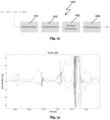
- a general overview of such a method 120 is shown in Fig. 12 .
- the raw sensor data is preprocessed for noise reduction and computational efficiency, i.e. signal processing methods like low pass filters and decimation are applied.
- the time series is divided into segments.
- features are extracted from the segmented time-series.
- the extracted features are classified to detect an event.
- the time-series may be preprocessed by digital filtering using for example a nonrecursive moving average filter, a Cascade Integrator Comb ("CIC”) filter or a filter bank.
- a nonrecursive moving average filter for example a Cascade Integrator Comb ("CIC") filter or a filter bank.
- CIC Cascade Integrator Comb
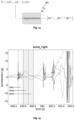
- the time-series of sensor data After the time-series of sensor data has been retrieved and preprocessed in method step 121, the time-series is segmented in windows in method step 122 as shown in Fig. 14 .
- the windows segmented from time-series T are indicated by 1,..., n , ⁇ W (1) ,..., W ( n -1) , W ( n ) ⁇ as shown in Fig. 14 .
- the next step as shown in Fig. 12 is feature extraction 930.
- a plurality of features from the sensor data in each of the windows is extracted.
- Features also denoted as characteristic variables
- the most relevant and non-redundant features should be selected to reduce the complexity of the implementation of the method. Any redundancy between features can result in unnecessarily increased computational costs. Simultaneously, this subset of features should yield the best classification performance.
- Random Forest classifiers can be used for feature selection.
- a Random Forest can be described as an ensemble of decision tree classifiers, growing by randomly choosing features of the training data. For each tree, a subset of training data is drawn from the whole training set with replacement (bootstrapping). Within this subset, features are chosen randomly and thresholds are built with their values at each splitting node of the decision tree. During classification, each tree decides for the most probable class of an observed feature vector and the outputs of all trees are merged. The class with the most votes is the final output of the classifier (majority voting). Details of Random Forest classifiers can be found in Leo Breiman, "Random forests", Machine learning, 45(1):5-32, 2001 .
- Fig. 18 depicts an exemplary one-stage classification at a time instance n given feature vectors x.
- the classification step 124 maps the feature vectors ⁇ x (1) ,..., x ( n -1) , x ( n ) ⁇ to an estimated event class ⁇ ( n ) at time instance n.
- event y ( n ) has a finite duration of v windows and is statistically independent from previous feature vectors ⁇ x (1) ,..., x ( n-v ) ⁇ .
- conditional probability density function in the previous equation equals p ( y ( n )
- x (1) ,..., x ( n -1) , x ( n ) ) p ( y ( n )
- the approach described above can be applied to different distributions for the probability density functions, such as Student's t-distribution, Rayleigh distributions, Exponential distributions, and the like. Furthermore, instead of maximum-likelihood estimation of the parameters of the underlying probability density function, a different approach may be used as well.
- the feature vectors of the event or the events to be estimated and the NULL class are analyzed in the feature space.
- a maximum margin is found by the SVM, separating the classes with a maximum distance. This distance equals the maximum distance between the convex hulls of the feature sets.
- kernel types can be applied, e.g. polynomial or radial basis function ("RBF").
- RBF radial basis function
- a soft margin model can be used that allows training errors, i.e. outliers lying on the wrong side of the margin. These errors are caused by non-linear separable feature sets.
- the outliers of a class y are punished by costs. For example, the costs of the event or the events to be estimated can be set higher than the costs of the NULL class to reduce the number of non-detected events.
- the optimal hyper-plane is shifted towards the feature set of the class y with lower costs.
- the support vectors defining the hyper-plane are stored for the classification procedure.
- the trees Given a training dataset D , the trees can be built as described e.g. in Trevor Hastie, Robert Tibshirani, Jerome Friedman, "The elements of statistical learning", volume 2, Springer 2009 .
- a subset of data is drawn from the training dataset with replacement (bootstrap data).
- bootstrap data replacement
- each tree is grown from the bootstrap data by recursively repeating the following steps until the minimum node size is reached: firstly, a subset of features is selected randomly. Secondly, among the subset, the feature providing the best splitting between classes is picked to build the threshold at the current node. The chosen feature is omitted for the next iteration. Thirdly, this node is split into daughter nodes.
- the class ⁇ ( n ) is estimated according to the estimated class of all trees.
- the class with the majority of votes corresponds to the estimate of the Random Forest ⁇ ( n ) .
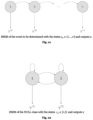
- This sequential process can be described as a Markov chain with the states z K as illustrated in Fig. 21 .
- First-order Markov chains are defined as stochastic processes, where the next state z K n + 1 only depends on the present state z K n .
- the phases of the event to be detected i.e. the states z K , are unknown or "hidden”. Only outputs of the states ⁇ (e.g. feature vectors) can be observed. This leads to a HMM, which is described below.
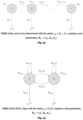
- the NULL class is also modelled by a finite number of states z N ⁇ ⁇ 1,2 ⁇ as shown in Fig. 22 .
- the transitions between these states are not specified a priori but during training of the HMM.
- the HMM can be extended to more states in order to improve the model of the NULL class.
- the problem is to find the underlying model, i.e. if the feature vectors were omitted by the HMM of the event to be detected or the NULL class. Therefore, the probability of observing the output ⁇ at a given state, p ( ⁇
- the observed feature vectors are not used as outputs of the HMMs directly.
- the second stage classifier models the sequential behavior of the event to be detected and the NULL class by HMMs as depicted in Figs. 21 and 22 .
- HMMs are described by the transition probabilities between the states.
- the transition matrix A K ⁇ a K,ij ⁇ contains these probabilities, where a K,ij corresponds to the element in the i-th row and j -th column.
- the transition matrix of the NULL class A N ⁇ [0,1] 2 ⁇ 2 is determined while training (described below).
- the emission probability density functions characterized an HMM.
- z K i ).
- the emission probability density functions can be assumed to be Gaussian distributed p ( ⁇
- z K i ) ⁇ N ( ⁇ ; ⁇ K,i , ⁇ K , i with the
- Gaussian distributed emission probability density functions other multivariate distributions can be considered as well.
- the parameter sets ⁇ K and ⁇ N are learnt while training the HMMs as described in the following paragraph.
- the Backward algorithm performs the following steps (in pseudocode):
Landscapes
- Engineering & Computer Science (AREA)
- Microelectronics & Electronic Packaging (AREA)
- Health & Medical Sciences (AREA)
- General Health & Medical Sciences (AREA)
- Physical Education & Sports Medicine (AREA)
- Chemical & Material Sciences (AREA)
- Materials Engineering (AREA)
- Life Sciences & Earth Sciences (AREA)
- Zoology (AREA)
- Footwear And Its Accessory, Manufacturing Method And Apparatuses (AREA)
Applications Claiming Priority (3)
| Application Number | Priority Date | Filing Date | Title |
|---|---|---|---|
| US14/694,379 US9609904B2 (en) | 2015-04-23 | 2015-04-23 | Shoes for ball sports |
| EP20150548.4A EP3692848B1 (de) | 2015-04-23 | 2016-04-21 | Schuhe für ballsportarten |
| EP16166347.1A EP3092913B1 (de) | 2015-04-23 | 2016-04-21 | Schuhe für ballspiele |
Related Parent Applications (2)
| Application Number | Title | Priority Date | Filing Date |
|---|---|---|---|
| EP16166347.1A Division EP3092913B1 (de) | 2015-04-23 | 2016-04-21 | Schuhe für ballspiele |
| EP20150548.4A Division EP3692848B1 (de) | 2015-04-23 | 2016-04-21 | Schuhe für ballsportarten |
Publications (2)
| Publication Number | Publication Date |
|---|---|
| EP4537696A2 true EP4537696A2 (de) | 2025-04-16 |
| EP4537696A3 EP4537696A3 (de) | 2025-07-23 |
Family
ID=55806202
Family Applications (3)
| Application Number | Title | Priority Date | Filing Date |
|---|---|---|---|
| EP25161480.6A Pending EP4537696A3 (de) | 2015-04-23 | 2016-04-21 | Schuhe für ballsportarten |
| EP20150548.4A Active EP3692848B1 (de) | 2015-04-23 | 2016-04-21 | Schuhe für ballsportarten |
| EP16166347.1A Active EP3092913B1 (de) | 2015-04-23 | 2016-04-21 | Schuhe für ballspiele |
Family Applications After (2)
| Application Number | Title | Priority Date | Filing Date |
|---|---|---|---|
| EP20150548.4A Active EP3692848B1 (de) | 2015-04-23 | 2016-04-21 | Schuhe für ballsportarten |
| EP16166347.1A Active EP3092913B1 (de) | 2015-04-23 | 2016-04-21 | Schuhe für ballspiele |
Country Status (4)
| Country | Link |
|---|---|
| US (7) | US9609904B2 (de) |
| EP (3) | EP4537696A3 (de) |
| JP (1) | JP6364438B2 (de) |
| CN (1) | CN106063607B (de) |
Families Citing this family (39)
| Publication number | Priority date | Publication date | Assignee | Title |
|---|---|---|---|---|
| US20150310336A1 (en) * | 2014-04-29 | 2015-10-29 | Wise Athena Inc. | Predicting customer churn in a telecommunications network environment |
| US9609904B2 (en) * | 2015-04-23 | 2017-04-04 | Adidas Ag | Shoes for ball sports |
| US9820531B2 (en) | 2015-05-29 | 2017-11-21 | Nike, Inc. | Footwear including an incline adjuster |
| US10932523B2 (en) | 2015-11-30 | 2021-03-02 | Nike, Inc. | Electrorheological fluid structure with attached conductor and method of fabrication |
| US10595584B2 (en) * | 2016-01-28 | 2020-03-24 | Christopher Anthony Silva | Adjustable article system |
| US10602801B2 (en) * | 2016-01-28 | 2020-03-31 | Compuglobalhypermeganet Llc | Adjustable article system |
| KR102070964B1 (ko) * | 2016-01-30 | 2020-01-29 | 푸마 에스이 | 신발, 특히 스포츠 신발, 그리고 그 신발을 고정하는 방법 |
| US11272762B2 (en) | 2016-03-15 | 2022-03-15 | Nike, Inc. | Assembly process for automated footwear platform |
| US12044789B2 (en) | 2016-04-22 | 2024-07-23 | Azar Zandifar | Systems and methods for occupancy detection using WiFi sensing technologies |
| CA3026740C (en) | 2016-06-08 | 2021-12-28 | Aerial Technologies Inc. | System and methods for smart intrusion detection using wireless signals and artificial intelligence |
| US20180116334A1 (en) | 2016-10-27 | 2018-05-03 | Nike, Inc. | Footwear with mechanical foot-insertion assist |
| US11793461B2 (en) | 2017-03-07 | 2023-10-24 | Motionize Israel Ltd. | Football smart footwear with automatic personal and team performance statistics extraction |
| CN106873423A (zh) * | 2017-04-18 | 2017-06-20 | 董昱 | 基于气囊式鞋面鞋子穿、脱自适应调节的电路控制系统 |
| CN113892728B (zh) | 2017-04-21 | 2023-09-19 | 耐克创新有限合伙公司 | 具有双侧和足下部分的针织鞋面 |
| US10455900B2 (en) | 2017-05-18 | 2019-10-29 | Feinstein Patents, Llc | Bi-stable strap with a snap spring hinge |
| CN107229298B (zh) * | 2017-06-05 | 2019-11-26 | 黎明职业大学 | 一种基于远程控制的鞋子温度调节控制系统 |
| CN109198797A (zh) * | 2017-07-03 | 2019-01-15 | 研能科技股份有限公司 | 鞋用气压固定装置 |
| CN207836864U (zh) * | 2017-07-06 | 2018-09-11 | 迈克尔·弗雷德里克·格林贝格 | 鞋装置、鞋以及能改装的鞋附件 |
| US11280031B2 (en) * | 2017-07-14 | 2022-03-22 | Regents Of The University Of Minnesota | Active knit compression garments, devices and related methods |
| US10976173B2 (en) * | 2017-07-14 | 2021-04-13 | Allstate Insurance Company | Distributed data processing systems for processing remotely captured sensor data |
| US10702014B2 (en) * | 2017-07-18 | 2020-07-07 | Brian J Stasey | Nitinol-driven bottom of foot compression system |
| JP6843296B2 (ja) | 2017-08-31 | 2021-03-17 | ナイキ イノベイト シーブイ | 複数の個別チャンバを有する傾斜アジャスタ |
| WO2019046516A1 (en) | 2017-08-31 | 2019-03-07 | Nike Innovate C.V. | FOOTWEAR COMPRISING A TILT ADJUSTMENT ELEMENT |
| KR102330563B1 (ko) | 2017-10-13 | 2021-12-01 | 나이키 이노베이트 씨.브이. | 전기유변 유체 하우징을 갖춘 풋웨어 중창 |
| US11153364B1 (en) | 2017-11-29 | 2021-10-19 | Parallels International Gmbh | Embedding remote applications into HTML pages |
| US10334906B1 (en) | 2018-05-31 | 2019-07-02 | Nike, Inc. | Intelligent electronic footwear and control logic for automated infrastructure-based pedestrian tracking |
| US11122852B2 (en) | 2018-05-31 | 2021-09-21 | Nike, Inc. | Intelligent electronic footwear and logic for navigation assistance by automated tactile, audio, and visual feedback |
| EP3616548B1 (de) * | 2018-09-03 | 2021-03-03 | Grimberg, Michael Fredrick | Elektronisch verbesserter schuhgriff |
| US10743619B2 (en) * | 2018-09-28 | 2020-08-18 | Nano And Advanced Materials Institute Limited | Shoe closure device |
| US11484089B2 (en) * | 2019-10-21 | 2022-11-01 | Puma SE | Article of footwear having an automatic lacing system with integrated sound damping |
| DE102019219742B4 (de) | 2019-12-16 | 2023-05-17 | Adidas Ag | Mehrlagiges Oberteil für einen Schuh |
| US11006860B1 (en) | 2020-06-16 | 2021-05-18 | Motionize Israel Ltd. | Method and apparatus for gait analysis |
| US12017114B2 (en) | 2020-12-23 | 2024-06-25 | Nike, Inc. | Gesture recognition device for footwear motor actuation |
| KR102929180B1 (ko) | 2020-12-23 | 2026-02-20 | 나이키 이노베이트 씨.브이. | 신발류 모터를 작동시키기 위한 제스처 인식장치 |
| IT202100014261A1 (it) * | 2021-05-31 | 2022-12-01 | Alpinestars Res Spa | Calzatura con sistema di trattenuta |
| CN117729862A (zh) * | 2021-08-02 | 2024-03-19 | 耐克创新有限合伙公司 | 用于鞋类或服装制品的泵 |
| US12279667B2 (en) | 2022-10-11 | 2025-04-22 | Stella Ryan | Footwear with transformable sole system |
| US20240115001A1 (en) * | 2022-10-11 | 2024-04-11 | Nike, Inc. | Automatic pump for article of footwear |
| CN119111433A (zh) * | 2023-12-20 | 2024-12-13 | 广西绿航现代农业科技有限公司 | 一种螺蛳养殖水质调控方法、系统及存储介质 |
Citations (4)
| Publication number | Priority date | Publication date | Assignee | Title |
|---|---|---|---|---|
| US20100154255A1 (en) | 2004-03-01 | 2010-06-24 | Robinson Douglas K | Shoe with sensors, controller and active-response elements and method for use thereof |
| US20120291564A1 (en) | 2008-06-13 | 2012-11-22 | Nike, Inc. | Footwear Having Sensor System |
| US20130074374A1 (en) | 2011-09-26 | 2013-03-28 | Nike, Inc. | Athletic Footwear With Ball Control Portions |
| WO2015006067A1 (en) | 2013-07-11 | 2015-01-15 | Nike Innovate C.V. | Article with closed instep portion having variable volume |
Family Cites Families (36)
| Publication number | Priority date | Publication date | Assignee | Title |
|---|---|---|---|---|
| US4924605A (en) * | 1985-05-22 | 1990-05-15 | Spademan Richard George | Shoe dynamic fitting and shock absorbtion system |
| US5230249A (en) * | 1990-08-20 | 1993-07-27 | Casio Computer Co., Ltd. | Shoe or boot provided with tank chambers |
| US5839210A (en) * | 1992-07-20 | 1998-11-24 | Bernier; Rejeanne M. | Shoe tightening apparatus |
| US5791068A (en) * | 1992-07-20 | 1998-08-11 | Bernier; Rejeanne M. | Self-tightening shoe |
| US5813148A (en) * | 1996-04-08 | 1998-09-29 | Guerra; Rafael J. | Footwear with optical fiber illuminating display areas and control module |
| US6812624B1 (en) * | 1999-07-20 | 2004-11-02 | Sri International | Electroactive polymers |
| US6809462B2 (en) * | 2000-04-05 | 2004-10-26 | Sri International | Electroactive polymer sensors |
| US6882086B2 (en) * | 2001-05-22 | 2005-04-19 | Sri International | Variable stiffness electroactive polymer systems |
| JPH10229902A (ja) * | 1997-02-20 | 1998-09-02 | Advanced Circuit Technol:Kk | 自動温度調節機能を有する靴 |
| US7219449B1 (en) * | 1999-05-03 | 2007-05-22 | Promdx Technology, Inc. | Adaptively controlled footwear |
| US6430843B1 (en) * | 2000-04-18 | 2002-08-13 | Nike, Inc. | Dynamically-controlled cushioning system for an article of footwear |
| US6598322B2 (en) * | 2001-01-12 | 2003-07-29 | Cymer, Inc. | Shoe with quick tightening upper |
| JP2002238611A (ja) * | 2001-02-15 | 2002-08-27 | Seiko Epson Corp | 着脱装置付履物 |
| WO2003020064A1 (en) * | 2001-08-01 | 2003-03-13 | Innovision Research & Technology Plc | An article of apparel |
| US6681504B2 (en) * | 2002-04-09 | 2004-01-27 | Albert J. Kinan | Chameleon footwear |
| US6775932B2 (en) * | 2002-09-06 | 2004-08-17 | Li Chieh Lin | Air bladder device having pattern changing mechanism |
| CA2522827A1 (en) * | 2003-04-22 | 2004-11-04 | Konstantinos Hatzilias | Footwear for gripping and kicking a ball |
| US7310895B2 (en) * | 2004-03-01 | 2007-12-25 | Acushnet Company | Shoe with sensors, controller and active-response elements and method for use thereof |
| US7607243B2 (en) * | 2006-05-03 | 2009-10-27 | Nike, Inc. | Athletic or other performance sensing systems |
| DE102007063160A1 (de) * | 2007-12-29 | 2009-07-09 | Puma Aktiengesellschaft Rudolf Dassler Sport | Verfahren zum Beeinflussen des Pronationsverhaltens eines Schuhs |
| US8046937B2 (en) * | 2008-05-02 | 2011-11-01 | Nike, Inc. | Automatic lacing system |
| US7918811B2 (en) * | 2008-08-05 | 2011-04-05 | Adidas International Marketing B.V. | Support device for a joint |
| CN201929109U (zh) * | 2009-06-26 | 2011-08-17 | 阿库施耐特公司 | 具有传感器、控制器和主动响应元件的鞋 |
| US8525386B2 (en) * | 2009-12-09 | 2013-09-03 | Texas Instruments Incorporated | Dynamically adjustable orthotic device |
| US9301569B2 (en) * | 2010-06-22 | 2016-04-05 | Nike, Inc. | Article of footwear with color change portion and method of changing color |
| US8474146B2 (en) * | 2010-06-22 | 2013-07-02 | Nike, Inc. | Article of footwear with color change portion and method of changing color |
| US8935860B2 (en) * | 2011-10-28 | 2015-01-20 | George Torres | Self-tightening shoe |
| JP6581989B2 (ja) * | 2013-09-20 | 2019-09-25 | ナイキ イノヴェイト シーヴィーNike Innovate C.V. | 取り外し可能な電動調整システムを有する履物 |
| US9380834B2 (en) * | 2014-04-22 | 2016-07-05 | Nike, Inc. | Article of footwear with dynamic support |
| US20150033588A1 (en) * | 2014-10-22 | 2015-02-05 | William Lai | Article of footwear with a dynamically responsive element for kicking a ball |
| US9609904B2 (en) * | 2015-04-23 | 2017-04-04 | Adidas Ag | Shoes for ball sports |
| EP3302726B1 (de) * | 2015-05-28 | 2020-07-29 | Nike Innovate C.V. | Vorrichtung zur überwachung einer sportlichen aktivität mit energieerfassung |
| US9743712B2 (en) * | 2015-05-28 | 2017-08-29 | Nike, Inc. | Sole structure with electrically controllable damping element |
| US10188169B2 (en) * | 2016-03-15 | 2019-01-29 | Nike, Inc. | Sensor for an article of footwear |
| US10959644B2 (en) * | 2016-03-24 | 2021-03-30 | Bend Labs Inc. | Compliant sensors for force sensing |
| US20180008005A1 (en) * | 2016-07-06 | 2018-01-11 | Patricia Vandervoort | Footwear with deployable and retractable tractive features |
-
2015
- 2015-04-23 US US14/694,379 patent/US9609904B2/en active Active
-
2016
- 2016-04-08 JP JP2016077842A patent/JP6364438B2/ja active Active
- 2016-04-21 EP EP25161480.6A patent/EP4537696A3/de active Pending
- 2016-04-21 EP EP20150548.4A patent/EP3692848B1/de active Active
- 2016-04-21 EP EP16166347.1A patent/EP3092913B1/de active Active
- 2016-04-22 CN CN201610258510.8A patent/CN106063607B/zh active Active
-
2017
- 2017-03-03 US US15/449,385 patent/US10039339B2/en active Active
-
2018
- 2018-06-26 US US16/018,732 patent/US10863790B2/en active Active
-
2020
- 2020-11-10 US US17/094,097 patent/US11540589B2/en active Active
-
2022
- 2022-11-29 US US18/071,412 patent/US11903448B2/en active Active
-
2024
- 2024-01-11 US US18/409,938 patent/US12262793B2/en active Active
-
2025
- 2025-01-17 US US19/030,028 patent/US20250160473A1/en active Pending
Patent Citations (4)
| Publication number | Priority date | Publication date | Assignee | Title |
|---|---|---|---|---|
| US20100154255A1 (en) | 2004-03-01 | 2010-06-24 | Robinson Douglas K | Shoe with sensors, controller and active-response elements and method for use thereof |
| US20120291564A1 (en) | 2008-06-13 | 2012-11-22 | Nike, Inc. | Footwear Having Sensor System |
| US20130074374A1 (en) | 2011-09-26 | 2013-03-28 | Nike, Inc. | Athletic Footwear With Ball Control Portions |
| WO2015006067A1 (en) | 2013-07-11 | 2015-01-15 | Nike Innovate C.V. | Article with closed instep portion having variable volume |
Non-Patent Citations (5)
| Title |
|---|
| COLLIN F. BAKERCHARLES J. FILL-MOREJOHN B. LOWE: "Proceedings of the 36th Annual Meeting of the Association form Computational Linguistics and 17th International Conference on Computational Linguistics", vol. 1, 1998, ASSOCIATION FORM COMPUTATIONAL LINGUISTICS, article "The Berkeley fragment project", pages: 86 - 90 |
| MARTIN VETTERLICORMAC HERLEY: "Wavelets and filter banks: Theory and design", IEEE TRANSACTIONS ON SIGNAL PROCESSING, vol. 40, no. 9, 1992, pages 2207 - 2232, XP000311749, DOI: 10.1109/78.157221 |
| RICHARD O. DUDAPETER E. HARTDAVID G. STORK: "Pattern Classification", 2000, JOHN WILEY & SONS |
| SERGIOS THEODORIDISKONSTANTINOS KOUTROUMBAS: "Pattern Recognition", 2008, ELSEVIER |
| TREVOR HASTIEROBERT TIBSHIRANIJEROME FRIEDMAN: "The elements of statistical learning", vol. 2, 2009, SPRINGER |
Also Published As
| Publication number | Publication date |
|---|---|
| EP3092913B1 (de) | 2020-01-08 |
| US20250160473A1 (en) | 2025-05-22 |
| US20210052032A1 (en) | 2021-02-25 |
| CN106063607B (zh) | 2020-06-19 |
| US20230088266A1 (en) | 2023-03-23 |
| US20240260705A1 (en) | 2024-08-08 |
| EP4537696A3 (de) | 2025-07-23 |
| JP6364438B2 (ja) | 2018-07-25 |
| US11540589B2 (en) | 2023-01-03 |
| US10863790B2 (en) | 2020-12-15 |
| US20180332921A1 (en) | 2018-11-22 |
| US20160309834A1 (en) | 2016-10-27 |
| EP3692848B1 (de) | 2025-03-05 |
| JP2016221251A (ja) | 2016-12-28 |
| CN106063607A (zh) | 2016-11-02 |
| US20170172246A1 (en) | 2017-06-22 |
| US12262793B2 (en) | 2025-04-01 |
| EP3692848A1 (de) | 2020-08-12 |
| US10039339B2 (en) | 2018-08-07 |
| US11903448B2 (en) | 2024-02-20 |
| EP3092913A1 (de) | 2016-11-16 |
| US9609904B2 (en) | 2017-04-04 |
Similar Documents
| Publication | Publication Date | Title |
|---|---|---|
| US12262793B2 (en) | Shoes for ball sports | |
| US11823050B2 (en) | Semi-supervised person re-identification using multi-view clustering | |
| Minnen et al. | Discovering characteristic actions from on-body sensor data | |
| Dallaire et al. | Autonomous tactile perception: A combined improved sensing and Bayesian nonparametric approach | |
| US9978425B2 (en) | Method and device for associating frames in a video of an activity of a person with an event | |
| Chamroukhi et al. | Joint segmentation of multivariate time series with hidden process regression for human activity recognition | |
| US10535015B2 (en) | Walking assistance apparatus and method of controlling same | |
| Cheng et al. | Recognition of human activities using machine learning methods with wearable sensors | |
| Wang et al. | Recognizing human daily activities from accelerometer signal | |
| Yenamandra et al. | Facts: First amplify correlations and then slice to discover bias | |
| CN103218617B (zh) | 一种多线性大间距的特征提取方法 | |
| JP2019207730A (ja) | 行動データを用いた一般化されたスキル評価のためのシステム及び方法 | |
| Safi et al. | Recognition of different daily living activities using hidden Markov model regression | |
| Li et al. | PAGE: domain-incremental adaptation with past-agnostic generative replay for smart healthcare | |
| US20190377407A1 (en) | Vertical motion simulator and method of implementing virtual reality of vertical motion using the same | |
| Zeng et al. | Adaptive activity recognition with dynamic heterogeneous sensor fusion. | |
| Perina et al. | Image analysis by counting on a grid | |
| Yousif et al. | Evaluation of machine learning approaches for sensor-based human activity recognition | |
| Iosifidis et al. | Multi-view regularized extreme learning machine for human action recognition | |
| Jiang et al. | Dimensionality reduction via diffusion map improved with supervised linear projection | |
| Arras et al. | Classifying dynamic objects: An unsupervised learning approach | |
| Zhang et al. | Derivative delay embedding: Online modeling of streaming time series | |
| Eskofier et al. | Embedded classification of speed and inclination during running | |
| CN121196526A (zh) | 基于卷积神经网络的步态相位识别方法及系统 | |
| Hema et al. | Research Article Design and Development of Polymer-Based Optical Fiber Sensor for GAIT Analysis |
Legal Events
| Date | Code | Title | Description |
|---|---|---|---|
| PUAI | Public reference made under article 153(3) epc to a published international application that has entered the european phase |
Free format text: ORIGINAL CODE: 0009012 |
|
| STAA | Information on the status of an ep patent application or granted ep patent |
Free format text: STATUS: REQUEST FOR EXAMINATION WAS MADE |
|
| 17P | Request for examination filed |
Effective date: 20250304 |
|
| AC | Divisional application: reference to earlier application |
Ref document number: 3092913 Country of ref document: EP Kind code of ref document: P Ref document number: 3692848 Country of ref document: EP Kind code of ref document: P |
|
| AK | Designated contracting states |
Kind code of ref document: A2 Designated state(s): AL AT BE BG CH CY CZ DE DK EE ES FI FR GB GR HR HU IE IS IT LI LT LU LV MC MK MT NL NO PL PT RO RS SE SI SK SM TR |
|
| REG | Reference to a national code |
Ref country code: DE Ref legal event code: R079 Free format text: PREVIOUS MAIN CLASS: A43B0005020000 Ipc: A43B0003000000 |
|
| PUAL | Search report despatched |
Free format text: ORIGINAL CODE: 0009013 |
|
| AK | Designated contracting states |
Kind code of ref document: A3 Designated state(s): AL AT BE BG CH CY CZ DE DK EE ES FI FR GB GR HR HU IE IS IT LI LT LU LV MC MK MT NL NO PL PT RO RS SE SI SK SM TR |
|
| RIC1 | Information provided on ipc code assigned before grant |
Ipc: A43B 3/00 20220101AFI20250613BHEP Ipc: A43B 5/02 20060101ALI20250613BHEP |