EP4535917A2 - System und verfahren zur planung von ultrabreitbandsitzungen - Google Patents
System und verfahren zur planung von ultrabreitbandsitzungen Download PDFInfo
- Publication number
- EP4535917A2 EP4535917A2 EP24202853.8A EP24202853A EP4535917A2 EP 4535917 A2 EP4535917 A2 EP 4535917A2 EP 24202853 A EP24202853 A EP 24202853A EP 4535917 A2 EP4535917 A2 EP 4535917A2
- Authority
- EP
- European Patent Office
- Prior art keywords
- uwb
- session
- value
- window
- time
- Prior art date
- Legal status (The legal status is an assumption and is not a legal conclusion. Google has not performed a legal analysis and makes no representation as to the accuracy of the status listed.)
- Pending
Links
Images







Classifications
-
- H—ELECTRICITY
- H04—ELECTRIC COMMUNICATION TECHNIQUE
- H04W—WIRELESS COMMUNICATION NETWORKS
- H04W76/00—Connection management
- H04W76/10—Connection setup
-
- H—ELECTRICITY
- H04—ELECTRIC COMMUNICATION TECHNIQUE
- H04W—WIRELESS COMMUNICATION NETWORKS
- H04W74/00—Wireless channel access
- H04W74/04—Scheduled access
-
- H—ELECTRICITY
- H04—ELECTRIC COMMUNICATION TECHNIQUE
- H04B—TRANSMISSION
- H04B1/00—Details of transmission systems, not covered by a single one of groups H04B3/00 - H04B13/00; Details of transmission systems not characterised by the medium used for transmission
- H04B1/69—Spread spectrum techniques
- H04B1/7163—Spread spectrum techniques using impulse radio
Definitions
- UWB sessions access the medium at a regular interval, called a block duration.
- Each UWB access is a round, whose duration may be known in advance. Collision between UWB sessions can happen when the durations of two UWB rounds overlap in time (e.g., one UWB session round starts before the end of the other UWB session round).
- a collision can cause a UWB session to be denied access to the medium for its low priority.
- There are some existing ways to reduce collision for example, it is possible to enable hopping to change the time at which the round is positioned into the block, but this must be decided in advance so that controlee devices are able to know the time at which the control message will be transmitted.
- the determining of the first credit value comprises computing a first session deficit value of the first UWB session based on the first access time and a previous first session deficit value; and the determining of the second credit value comprises computing a second session deficit value of the second UWB session based on the second access time and a previous second session deficit value.
- the computing of the first access time comprises adding the first shared time with a duration of the first UWB session that is non-overlapping with the second UWB session; and the computing of the second access time comprises adding the second shared time with a duration of the second UWB session that is non-overlapping with the first UWB session.
- the method further includes, in response to the in-window queue not empty, the out-window queue not empty, and the round begin time of the first out-window session being equal to the window end time; adding the first out-window session to the in-window session as a second in-window session; determining a second out-window session to be a new first out-window session; and updating an in-window priority sum by including a priority value of the second in-window.
- the method further includes: in response to the in-window queue not empty and the round begin time of the first in-window session being equal to the window end time: subtracting a priority value of the first in-window session from the priority sum value; updating the set of collision sets to include the first in-window session; and determining the second in-window session to be a new first in-window session.
- Embodiments of the present disclosure provide a UWB device.
- the UWB device includes a transceiver operable to perform a UWB communication, a memory for storing program instructions, device information of a plurality of devices, round begin times and round end times of the plurality of UWB sessions, and computed access times for one or more of the plurality of devices, and a processor coupled to the transceiver and to the memory.
- the processor is operable to execute the program instructions.
- the UWB device When executed by the processor, the UWB device performs the following operations to schedule communication of the plurality of devices.
- the operations include: determining a set of colliding UWB sessions that comprises a first UWB session and a second UWB session partially overlaps with each other in time; computing a first access time of the first UWB session and a second access time of the second UWB session; determining a first credit value based at least on the first access time and a second credit value based at least one the second access time; and selecting one of the first UWB session or the second UWB with a higher credit value.
- the method further includes: selecting one of the first UWB session and the second UWB with a higher deficit value; updating a respective session deficit value of the selected UWB session by subtracting a round duration of the selected UWB session; and perform access with the selected session.
- the computing of the first access time of the first UWB session and the second access of the second UWB session comprises: determining a time period in which the first UWB session overlaps with the second UWB session; determining a priority sum value including a sum of a first priority value of the first UWB session and a second priority value of the second UWB session; computing a first shared time proportional to a length of the time period and a first priority value of the first UWB session, and inversely proportional to the priority sum value; and computing a second shared time proportional to the length of the time period and a second priority value of the second UWB session, and inversely proportional to the priority sum value.
- the computing of the first access time of the first UWB session and the second access of the second UWB session comprises: determining a priority sum value including a sum of priority values of all colliding UWB sessions; computing the first access time proportional to a duration of the first UWB session and a first priority value of the first UWB session, and inversely proportional to the priority sum value; and computing the second access time proportional to a duration of the second UWB session and a second priority value of the second UWB session, and inversely proportional to the priority sum value.
- the selecting one of the first UWB session or the second UWB with the higher credit value comprises: selecting one of the first UWB session and the second UWB with a higher deficit sum value; and updating a respective session deficit value of the selected UWB session by subtracting a ranging round duration.
- the method further includes: determining a respective round begin time of the first UWB session and the second UWB session; determining a non-selected UWB session overlapping with the selected UWB session and having the respective round begin time earlier than an round end time of the selected UWB session; updating a respective session deficit value of the non-selected UWB session by adding the respective session deficit difference value; and perform access with the selected session.
- the method further includes, after the updating of the window end time, computing an access time of a respective UWB session using the respective priority value and a priority sum value including a sum of all priority values of the UWB sessions in the window period.
- the method further includes, in response to the in-window queue not empty, the out-window queue not empty, and the round begin time of the first out-window session being equal to the window end time; adding the first out-window session to the in-window session as a second in-window session; determining a second out-window session to be a new first out-window session; and updating an in-window priority sum by including a priority value of the second in-window.
- the method further includes: in response to the in-window queue not being empty, updating the window end time to the round end time of the first in-window session; determining whether the out-window queue is empty; and in response to the out-window queue not being empty, updating the window end time to be a minimum of the round end time of the first in-window session or an round begin time of the new first out-window session.
- UWB ultra-wideband
- embodiments may also apply to other communication systems with similar technical background or features.
- a communication system using Bluetooth or ZigBee may be included therein.
- embodiments may be modified in such a range as not to significantly depart from the scope of the present disclosure under the determination by one of ordinary skill in the art and such modifications may be applicable to other communication systems.
- UWB may refer to a short-range high-rate wireless communication technology using a wide frequency band of several hundreds of MHz to several GHz or more, low spectral density, and short pulse width (e.g., 1 nsec to 4 nsec) in a baseband state.
- UWB may mean a band itself to which UWB communication is applied.
- UWB may enable secure and accurate ranging between devices.
- UWB enables relative position estimation based on the distance between two devices or accurate position estimation of a device based on the distance from fixed devices (whose positions are known, also referred to as anchors or anchor devices).
- anchors or anchor devices whose positions are known, also referred to as anchors or anchor devices.
- the present disclosure assumes that the user is carrying a device capable of communicating through UWB (referred to as "UWB-enabled user device" or simply user device).
- a controller device refers to the suitable hardware and/or software, e.g., a processor and corresponding instructions, that performs/initiates the UWB coordination, scheduling, computation, and/or other UWB communication operations.
- a controlee devices listens to and responds to the controller device.
- a UWB device e.g., an electronic device capable of UWB functions, that functions as a controller device in some UWB sessions may function as a controlee device in some other UWB sessions.
- a round begin time refers to the begin time of a ranging round in a UWB session
- a round end time refers to the end time of a ranging round in a UWB session.
- a round begin time of a UWB session refers to the begin time of the first ranging round in the UWB session
- a round end time of a UWB session refers to the end time of the last ranging round in the UWB session.
- a "priority" parameter or priority value between 1 and 100 is defined and assigned to a UWB session to indicate the urgency/importance of the UWB session.
- a higher priority value indicates a higher urgency/importance, and vice versa.
- a UWB system (or UWBS), e.g., embedded in a mobile device such as a mobile phone, may schedule ranging for UWB sessions based on their priority values.
- the UWBS schedules a UWB session using the priority value as a "hard priority.” For example, in case of a collision, the session with the higher/highest priority is often granted access to the medium.
- the session with the lower priority value is often deferred access, leading to starvation.
- Embodiments of the present disclosure provide a system and methods for scheduling UWB sessions by a UWB scheduler.
- the methods of the present disclosure take into account of the loss of access for a UWB session as a result of its lower priority value using a credit value, and allow access of the low-priority UWB session when its credit value is sufficiently high.
- a UWB scheduler updates the credit value of a UWB parameter based on its selection status in a collision for each block duration. When the UWB session is selected to access the medium, the UWB scheduler decreases the session deficit value of the UWB session.
- FIG. 1A illustrates an example UWB communication system 100, according to some embodiments of the present disclosure.
- UWB communication system 100 may include a first device 102 and one or more second devices 104-1, 104-2, ..., 104-(n-1), and 104-n, n being a positive number.
- first device 102 is a controller device
- second devices 104-1, ..., 104-n are controlee devices.
- first device 102 is a controlee device.
- methods of the present disclosure can be performed by either a controller device or a controlee device in a cluster of UWB devices.
- First device 102 may communicate with second devices 104-1, ...
- first device 102 and the second devices 104-1, ... 104-n may be equipped with UWB capabilities such that first device 102 can perform ranging with each of the second devices 104-1, ..., 104-n.
- first device 102 and second devices 104-1, ..., 104-n may each transmit RF signals in one or more wireless communication protocols such as UWB, WiFi, Bluetooth, NFC, or the like.
- Examples of second devices 104-1, ..., 104-n can include a safe, a digital lock, a door, a gate, a car, or any other digital device that can perform ranging with first device 102, and execute operations (such as unlocking) based on messages transmitted from first device 102 in a UWB session allocated to the second device.
- first device 102 is sufficiently close to more than one second device, and is configured to communicate with more than one second devices in more than one UWB sessions that may overlap (e.g., collide) in time.
- control device 102 may be configured to schedule the access of UWB sessions based on their priority values, which may be known to control device 102.
- first device 102 obtains the priority values of second devices 104-1, ..., 104-n from prior communication, e.g., out-of-band (OOB) characterization prior to ranging.
- first device 102 is pre-stored with priority values of second devices 104-1, ..., 104-n.
- First device 102 may schedule the access of the more than one UWB session based on their priority values. In an existing scheduling method, if a collision occurs between two UWB sessions, first device 102 may allow access of the UWB session of a higher priority value, and defer access of the UWB session of a lower priority value.
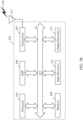
- FIG. 1B illustrates an example of a first device 102, e.g., a mobile phone.
- First device 102 may be in the form of a cellular telephone, a smartphone, a laptop computer, a tablet, a personal digital assistant (PDA), a computing device, or any other mobile device having wireless connection capability.
- first device 102 includes a processor 103, a digital signal processor (DSP) 105, a transceiver 107, an antenna 117, a memory 109, an input device 111, an output device 113, and a bus 115.
- DSP digital signal processor
- the hardware components of first device 102 may be communicatively coupled to bus 115.
- bus 115 can be used for processor 103 to communicate between cores and/or with memory 109.
- Processor 103 may include one or more general-purpose processors and/or one or more special-purpose processors (such as digital signal processing chips, graphics acceleration processors, and/or the like).
- Processor 103 may process wireless signals 119 received by transceiver 107, such as ranging signals, and/or data from UWB communication.
- Input device 111 may include a camera, a mouse, a keyboard, a touch sensitive screen/display, a touch pad, a keypad, and/or the like.
- An output device 113 may include a display, a printer, and/or the like.
- a user may load one or more unlock applications, which automatically unlocks one or more second devices if the distance to the respective second device is sufficiently small.
- First device 102 may include a transceiver 107 communicatively coupled to bus 115.
- Transceiver 107 may be operable to transmit and receive wireless signals 119 via antenna 117.
- Wireless signals 119 may be transmitted/received via a wireless network, although not shown in this figure.
- the wireless network may be any wireless network such as a local wireless network, such as WiFi, a Personal Access Network (PAN), such as Matter, Bluetooth ® or Zigbee ® , or a cellular network (e.g., 4G, 5G).
- Transceiver 107 may be configured to receive wireless signals 119 via antenna 117 from a network control device (e.g., a gateway, a router, etc.), a cloud network, a satellite, and/or the like. For example, transceiver 107 may transmit ranging signals to a second device and/or receive a ranging signal from a second device. First device 102 may also be configured to decode and/or decrypt, via the DSP 105 and/or processor 103, various signals received by antenna 117.
- a network control device e.g., a gateway, a router, etc.
- First device 102 may also be configured to decode and/or decrypt, via the DSP 105 and/or processor 103, various signals received by antenna 117.
- Memory 109 may include one or more non-transitory storage devices that can include local and/or network accessible storage, a disk drive, a drive array, an optical storage device, a solid-state storage device such as a random access memory (“RAM”) and/or a read-only memory (“ROM”), a programmable ROM, a flash-updateable ROM, and/or the like.
- RAM random access memory
- ROM read-only memory
- Such storage devices may be configured to implement any appropriate data storage, including without limitation, various file systems, database structures, and/or the like.
- memory 109 includes a device database, including device information (e.g., unique device identification (ID), device keys, priority values, round begin times and round end times of a plurality of UWB sessions, vendor information, device type, etc.) of first device 102 and/or one or more of second devices 104-1, ..., 104-n.
- device information e.g., unique device identification (ID)
- device keys e.g., device keys
- priority values e.g., round begin times and round end times of a plurality of UWB sessions, vendor information, device type, etc.
- STS scrambled timestamp sequence
- the application programs may include computer programs, stored in memory 109, executed by processor 103 and/or DSP 105 to implement various functions under the control of the operating system.
- the computer programs may have been pre-packaged with first device 102 or may have been downloaded by a user into memory 109 of the first device 102.
- Some mobile applications may be more user-interactive applications, such as an application to prompt a first device 102 to unlock one or more second devices 104-1, ..., 104-n, whereas some other mobile applications may be less user-interactive in nature, such as an application that schedules one or more UWB sessions and automatically ranges with one or more second devices 104-1, ..., 104-n in the one or more UWB sessions to determine their distances to first device 102.
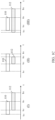
- FIG. 1C illustrates scenarios of collisions between UWB sessions 110 and 112, according to some embodiments of the present disclosure.
- each UWB session is allocated a plurality of ranging rounds, each including one or more slots.
- UWB session 110 may be allocated for first device 102 to conduct communication with one of second devices 104-1, ..., 104-n
- UWB session 112 may be allocated for first device 102 to conduct communication with another one of second devices 104-1, ..., 104-n.
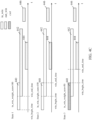
- FIGS. 2A , 2B , and 2C illustrate various methods 200, 210, and 220 to compute access times for UWB sessions in a collision by a UWB scheduler (e.g., first device 102), according to embodiments of the present disclosure.
- the access times computed using methods 200, 210, and/or 220 may later be used in methods 300 and/or 301 to schedule access to the medium for all UWB sessions based on their session deficit values (e.g., "credit values”) such that the access time can be more fairly (or evenly) distributed to all UWB sessions over time.
- session deficit values e.g., "credit values”
- the scheduling of UWB sessions based on the computed access time may allow more or all colliding UWB sessions with lower priority values to access the medium.
- the computed access time (using each of methods 200, 210, and 220) reflects the ideal average access time each colliding UWB session is permitted over a reasonably long time, e.g., tens of hundreds of block durations.
- Methods 200, 210, and 220 may each be referred to as "generalized processor sharing" or GPS, which computes the ideal sharing of different UWB sessions based on their priority values (e.g., weights) and duration in a collision set, and can be used to evaluate how fair a scheduling method (e.g., 300) is.
- UWB sessions 202, 204, and 206 may be in a collision set, and may partially overlap with one another, causing one or more collisions.
- UWB sessions 202 and 204 may be in a collision, and UWB sessions 204 and 206 may be in a collision.
- Method 200 also referred to as a "fine granularity" method, may be used to compute the access time Ti of each UWB session as the accumulation of shared access times in a time period 240 occupied by the UWB sessions. As shown in FIG.
- the shared access time of UWB session i in a sub-period is computed as duration of sub ⁇ period ⁇ w i sub ⁇ period _ weight _ sum , in which w i refers to the priority value (or weight value) of UWB session i, and sub-period_weight_sum refers to the sum of priority values in the sub-period.
- FIG. 3A is described in connection with FIGS. 2A-2C .
- method 300 is performed after each performed access, and repeats to prepare the next access to perform. In some embodiments, method 300 proceeds back to step 302 after step 314.
- the UWB scheduler starts a loop to compute the session deficit value for each UWB session in the colliding set.
- the UWB scheduler computes the access time for a UWB session in the colliding set.
- the UWB scheduler may compute the access time using any one of methods 200, 210, and 220 to obtain the computed access time for the UWB session.
- the UWB scheduler may compute the access time for UWB sessions 202, 204, and 206 in a colliding set shown in FIGS. 2A-2C .
- the UWB scheduler may complete the loop for each UWB session and obtain a session deficit value for each UWB session in the colliding set. For example, the UWB scheduler may compute the session deficit values for UWB sessions 202, 204, and 206. Method 300 may then proceed to step 310, at which the UWB scheduler select the UWB session with the highest deficit value. In some embodiments, the UWB scheduler selects the UWB session with the highest session deficit value to access the medium.
- an initialization step is performed prior to step 303 when controller 102 starts scheduling for the first block duration.
- Controller 102 may initialize the values of certain parameters. For example, the session deficit value of each UWB session may have an initial value of 0, the session deficit difference value of each UWB session may have an initial value of 0, the sum of session deficit difference value and session deficit value may have an initial value of 0, and the computed access time of each UWB session may have an initial value of 0, etc. In some embodiments, for each UWB session, the session deficit value and the session deficit difference value from a previous block duration is updated in the next block duration.
- the UWB scheduler determines the set of colliding sessions.
- the UWB scheduler may determine the set of colliding sessions that includes UWB session 202, 204, and 206.
- the UWB scheduler starts a loop to compute the session deficit difference value for each UWB session in the colliding set.
- the UWB scheduler computes the access time for a UWB session in the colliding set.
- the UWB scheduler may compute the access time using any one of methods 200, 210, and 220 to obtain the computed access time for the UWB session.
- the UWB scheduler may compute the access time for UWB sessions 202, 204, and 206 in a colliding set shown in FIGS. 2A-2C .
- the UWB scheduler reduces the session deficit value of the selected UWB session.
- the UWB scheduler computes/updates the session deficit value of the selected UWB session by subtracting the round duration of the selected UWB session from the current UWB session. For example, if UWB session 202 is selected, round duration of 10 ms is subtracted from its session deficit value.
- the UWB scheduler starts a loop to compute the session deficit value of each UWB session that collides with the selected UWB session.
- the UWB scheduler may compute the session deficit values for UWB sessions 202, 204, and 206.
- the UWB scheduler determines whether a UWB session starts before the end of the selected UWB session. In some embodiments, the UWB scheduler determines whether the round begin time of the UWB session is before the round end time of the selected UWB session, e.g., overlaps/collide with the selected UWB session. If yes, method 301 proceeds to step 319; and if no, method 301 proceeds to step 321.
- the UWB scheduler increases the session deficit value for the UWB session that overlaps with the selected UWB session.
- the UWB scheduler may increase the session deficit value of UWB session 204 in step 319.
- the UWB scheduler computes/updates the session deficit value of the UWB session by adding the session deficit difference value, computed in step 309, to the current session deficit value.
- step 321 the operations from steps 317 and 319 are directed to step 315 such that all UWB sessions in the colliding set are checked to determine if their session deficit values need to be updated/increased.
- process 301 proceeds to step 323, at which the UWB scheduler performs access with the selected UWB session.
- the performed access time is the actual access time of the selected UWB session.
- Method 300 updates the deficit of all UWB sessions in the colliding set.
- Method 301 only updates the deficit of sessions which round starts before the end of the selected UWB session.
- the "session deficit difference" of method 301 is computed to facilitate such updates in method 301.
- only one UWB session e.g., with the highest session deficit value
- all other UWB sessions even those do not collide with the selected UWB session, are prevented access in the block duration.
- the UWB sessions that collide with the selected UWB session are prevented access in the block duration, and UWB sessions that do not collide with the selected UWB session can still access the medium.
- the UWB scheduler (e.g., first device 102) may prevent access of the UWB session colliding with the selected UWB session and increase the chance of access for the colliding UWB sessions by increasing its session deficit value (at step 319). Meanwhile, since the non-colliding UWB session can access the medium, the UWB scheduler does not increase its session deficit value.
- the control device permits only one access per colliding set based on its session deficit value. For example, if UWB session 202 is selected, all other UWB sessions (e.g., UWB sessions 204 and 206) may have their session deficit values increased to account for their loss of access. Using method 301, if UWB session 202 is selected for access, UWB session 206 (not colliding with UWB session 202) is not prevented to access the medium, and therefore its session deficit value is not increased. In the next block duration, UWB session 206 is selected for access because it is the only one left in the colliding set. Method 301 thus allows more than one access per colliding set.
- the UWB scheduler handles each possible access as if it was part of a different colliding set. This means that some UWB sessions may get "free" accesses, and are allowed to use more medium time.
- the UWB scheduler may use method 220 (e.g., the collision granularity method) to compute the access time and keep track of colliding set for past sessions access. This is more costly to implement, both for the access time computation and for session book-keeping.
- desynchronized UWB sessions try to a receive control frame from a UWB scheduler to resynchronize. This means that they need to listen to the medium as often as possible. When computing the colliding set, they should be handled differently so they do not extend the colliding set past the last synchronized UWB session. If one or several desynchronized UWB sessions are not selected, they may have their access requirement shortened to be able to listen to the medium before the colliding set. In that case another round of selection is done to determine which desynchronized UWB session will have access to the medium. Another option is to listen for all desynchronized UWB sessions at the same time, so desynchronized sessions do not need to content for the medium between them.
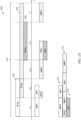
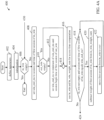
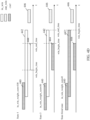
- UWB scheduler determines whether in_win is empty. If yes, method 400 proceeds to end; if no, method 400 proceeds to step 408, at which the UWB scheduler sets win_end_ms to round end time of first session of in_win. As shown in FIG. 4C , the UWB scheduler may set win_end_ms as the round end time of UWB session 404.
- each sub-period e.g., (i), ..., or (v)
- the computation of access time is performed after method 400.
- the UWB scheduler determines whether in_win is not empty and round end time of first session of in_win equals win_end_ms.
- the UWB scheduler determines whether in_win is not empty and out_win is not empty and round begin time of the first session of out_win equals win_end_ms. If yes, method 400 proceeds to step 426; if no, method 400 proceeds to step 430. Referring to FIG. 4C , the UWB scheduler determines in_win is not empty and out_win is not empty and round begin time of UWB session 442 (e.g., the first session of out_win) is equal to win_end_ms. Method 400 then proceeds to step 426.
- the UWB scheduler sets/maintains win_end_ms to round end time of UWB session 440, which is the minimum of round end time of UWB session 440 and the round begin time of UWB session 444.
- Method 400 may then proceed to steps 414 and 416, at which the UWB scheduler computes the access time for UWB sessions 440 and 442 in the window (between win_begin_ms and win_end_ms) using method 200.
- Method 400 then proceeds to step 424, at which the UWB scheduler determines in_win not empty and out_win not empty and round begin time of the first session of out_win is not equal to the win_end_ms.
- the UWB scheduler determines the round begin time of UWB session 444 is not equal to win_end_ms (e.g., the round end time of UWB session 440).
- Method 400 may then proceed to step 430, at which the controller sets win_begin_ms to win_end_ms.
- the UWB scheduler sets win_begin_ms to the current win_end_ms, which is the round end time of UWB session 440, and method proceeds to step 406.
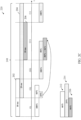
- the UWB scheduler moves the first session (e.g., UWB session 444) from out_win to in_win.
- Method 400 then proceeds to step 424 and determines round begin time of first session of out_win (e.g., UWB session 446) is not equal to win_end_ms (e.g., round begin time of UWB session 444), and then proceeds to step 430, at which the UWB scheduler sets win_begin_ms to current win_end_ms (e.g., the round begin time of UWB session 444).
- Method 400 then proceeds to steps 406-412, at which the UWB scheduler sets win_end_ms to the first session of in_win (e.g., UWB session 444), and then performs step 416 as an optional operation.
- Method 400 then proceeds to step 418, 420, and 422, where the UWB scheduler subtract weight (priority value) of UWB session 444 from in_win_weight_sum (100), and obtains 50 for in_win_weight_sum, at state 5.
- UWB scheduler may then move UWB session 444 to cset.
- UWB session 442 may be the only session in in _win.
- the UWB scheduler subtracts weight (priority value) of the first session of in_win (e.g., UWB device 442) from in_win_weight_sum, resulting in_win_weight_sum to be 0 in state 6/end state.
- the UWB scheduler also moves the first session (e.g., UWB device 442) from in_win to cset, as shown in state 6/end state.
- all colliding UWB sessions e.g., 440, 442, and 444 are in cset.
- Method 400 then proceeds to step 424, as in_win is empty, and then to step 430, at which the UWB scheduler sets win_begin_ms to the existing win_end_ms (e.g., the round end time of UWB session 442). Method 400 then proceeds to step 406, and then proceeds to "End” as in_win is empty.
- the UWB scheduler determines a set of colliding UWB sessions that comprises a first UWB session and a second UWB session (e.g., UWB sessions 440, 442, 444) partially overlaps with each other in time.
- the UWB scheduler determines a UWB session with an earlier round begin time in the out-window queue as a first in-window session in an in-window queue, and another UWB session with a later round begin time in the out-window queue as a first out-window session in the out-window queue (e.g., step 408).
- the UWB scheduler determines a window period with a window begin time and a window end time later than the window begin time, the window end time being equal to a round end time of the first in-window session (e.g., step 412).
- the average access times of UWB sessions A, B, and C by fair scheduler of the present disclosure are comparable/similar to those computed using GPS over several block durations, suggesting that the fair scheduler can provide a more fair, close to ideal scheduling of UWB sessions of different priority values, avoiding starvation.
- the communication between a UWB scheduler and more than one second devices can be improved.
Landscapes
- Engineering & Computer Science (AREA)
- Computer Networks & Wireless Communication (AREA)
- Signal Processing (AREA)
- Mobile Radio Communication Systems (AREA)
Applications Claiming Priority (2)
| Application Number | Priority Date | Filing Date | Title |
|---|---|---|---|
| US202363587943P | 2023-10-04 | 2023-10-04 | |
| US202463651755P | 2024-05-24 | 2024-05-24 |
Publications (2)
| Publication Number | Publication Date |
|---|---|
| EP4535917A2 true EP4535917A2 (de) | 2025-04-09 |
| EP4535917A3 EP4535917A3 (de) | 2025-05-28 |
Family
ID=92925758
Family Applications (1)
| Application Number | Title | Priority Date | Filing Date |
|---|---|---|---|
| EP24202853.8A Pending EP4535917A3 (de) | 2023-10-04 | 2024-09-26 | System und verfahren zur planung von ultrabreitbandsitzungen |
Country Status (3)
| Country | Link |
|---|---|
| US (1) | US20250119940A1 (de) |
| EP (1) | EP4535917A3 (de) |
| CN (1) | CN119789242A (de) |
Family Cites Families (3)
| Publication number | Priority date | Publication date | Assignee | Title |
|---|---|---|---|---|
| CN107370683B (zh) * | 2016-05-13 | 2020-06-26 | 电信科学技术研究院 | 一种数据传输方法、终端及基站 |
| CN107734680B (zh) * | 2016-08-12 | 2023-05-09 | 中兴通讯股份有限公司 | 一种传输信息的方法及装置、接收信息的方法及装置 |
| CN117425832A (zh) * | 2021-06-14 | 2024-01-19 | 索尼集团公司 | 信息处理系统、信息处理终端和信息处理方法 |
-
2024
- 2024-09-11 CN CN202411267228.7A patent/CN119789242A/zh active Pending
- 2024-09-17 US US18/887,765 patent/US20250119940A1/en active Pending
- 2024-09-26 EP EP24202853.8A patent/EP4535917A3/de active Pending
Also Published As
| Publication number | Publication date |
|---|---|
| CN119789242A (zh) | 2025-04-08 |
| US20250119940A1 (en) | 2025-04-10 |
| EP4535917A3 (de) | 2025-05-28 |
Similar Documents
| Publication | Publication Date | Title |
|---|---|---|
| US12120739B2 (en) | Decrementation of delay intervals for rapid 5G/6G communications | |
| US11229063B1 (en) | Early disclosure of destination address for fast information transfer in 5G | |
| CN107949067A (zh) | 一种信道检测的控制方法及相关装置 | |
| US20230065013A1 (en) | Communication device and operating method thereof | |
| EP2744141A1 (de) | Verfahren und Vorrichtung für die Zeitzuweisung und Frequenzressourcen für mindestens eine Datenübertragung über einen selektiven Kanal für eine schnelle Fadingfrequenz | |
| JP2017528939A (ja) | リソースプリエンプション方法、サイト及びコンピュータ記憶媒体 | |
| US20220295557A1 (en) | Single-bit readiness signal for rapid access in 5g and 6g | |
| Adebayo et al. | Dynamic spectrum sharing in heterogeneous wireless networks using deep reinforcement learning | |
| US10159096B2 (en) | System and method of achieving fairness in a mixture of full-duplex and half-duplex nodes in a wireless network | |
| EP4535917A2 (de) | System und verfahren zur planung von ultrabreitbandsitzungen | |
| Riterman et al. | Modeling of preemptive channel access in Wi-Fi networks | |
| EP4472310A1 (de) | Ressourcenauswahlverfahren und -vorrichtung sowie endgerät | |
| EP4238362A1 (de) | Belichtungssteuerung | |
| EP3113530B1 (de) | Drahtloskommunikationsknoten und verfahren zur reservierung eines zeitraums für kommunikationen über ein frequenzband das zwischen zwei unterschiedlichen funknetz technologien geteilt ist | |
| CN106455110B (zh) | 一种信道接入方法及装置 | |
| EP4550849A1 (de) | System und verfahren zur dynamischen verwaltung von ultrabreitband-ranging-sitzungen | |
| US20250316120A1 (en) | Method of locating a uwb-enabled device | |
| Jung et al. | Performance analysis of opportunistic CSMA schemes in cognitive radio networks | |
| CN105101445B (zh) | 一种时间调度方法及电子设备 | |
| CN116896758A (zh) | 一种通信方法及装置 | |
| US20240397385A1 (en) | System and methods for dynamic coordination of phases in ultra-wideband communication | |
| Yazdani-Abyaneh et al. | Countermeasuring Aggressors via Intelligent Adaptation of Contention Window in CSMA/CA Systems | |
| Bosch et al. | Latency modelling in IEEE 802.11 systems with non-IEEE 802.11 interfering source | |
| Bartolomeu et al. | Implementing the wireless FTT protocol: a feasibility analysis | |
| Pandit et al. | Self-scheduled MAC-layer protocol for spectrum sharing in cognitive radio communication |
Legal Events
| Date | Code | Title | Description |
|---|---|---|---|
| PUAI | Public reference made under article 153(3) epc to a published international application that has entered the european phase |
Free format text: ORIGINAL CODE: 0009012 |
|
| STAA | Information on the status of an ep patent application or granted ep patent |
Free format text: STATUS: THE APPLICATION HAS BEEN PUBLISHED |
|
| AK | Designated contracting states |
Kind code of ref document: A2 Designated state(s): AL AT BE BG CH CY CZ DE DK EE ES FI FR GB GR HR HU IE IS IT LI LT LU LV MC ME MK MT NL NO PL PT RO RS SE SI SK SM TR |
|
| PUAL | Search report despatched |
Free format text: ORIGINAL CODE: 0009013 |
|
| AK | Designated contracting states |
Kind code of ref document: A3 Designated state(s): AL AT BE BG CH CY CZ DE DK EE ES FI FR GB GR HR HU IE IS IT LI LT LU LV MC ME MK MT NL NO PL PT RO RS SE SI SK SM TR |
|
| RIC1 | Information provided on ipc code assigned before grant |
Ipc: H04W 76/10 20180101AFI20250422BHEP |
|
| STAA | Information on the status of an ep patent application or granted ep patent |
Free format text: STATUS: REQUEST FOR EXAMINATION WAS MADE |
|
| 17P | Request for examination filed |
Effective date: 20251124 |