EP4535896A1 - Trägeraggregationssteuerungsverfahren und -vorrichtung, endgerät und netzwerkseitige vorrichtung - Google Patents
Trägeraggregationssteuerungsverfahren und -vorrichtung, endgerät und netzwerkseitige vorrichtung Download PDFInfo
- Publication number
- EP4535896A1 EP4535896A1 EP23815013.0A EP23815013A EP4535896A1 EP 4535896 A1 EP4535896 A1 EP 4535896A1 EP 23815013 A EP23815013 A EP 23815013A EP 4535896 A1 EP4535896 A1 EP 4535896A1
- Authority
- EP
- European Patent Office
- Prior art keywords
- carrier aggregation
- terminal
- network
- side equipment
- association information
- Prior art date
- Legal status (The legal status is an assumption and is not a legal conclusion. Google has not performed a legal analysis and makes no representation as to the accuracy of the status listed.)
- Pending
Links
Images


Classifications
-
- H—ELECTRICITY
- H04—ELECTRIC COMMUNICATION TECHNIQUE
- H04W—WIRELESS COMMUNICATION NETWORKS
- H04W72/00—Local resource management
- H04W72/04—Wireless resource allocation
- H04W72/044—Wireless resource allocation based on the type of the allocated resource
- H04W72/0453—Resources in frequency domain, e.g. a carrier in FDMA
-
- H—ELECTRICITY
- H04—ELECTRIC COMMUNICATION TECHNIQUE
- H04L—TRANSMISSION OF DIGITAL INFORMATION, e.g. TELEGRAPHIC COMMUNICATION
- H04L5/00—Arrangements affording multiple use of the transmission path
- H04L5/0091—Signalling for the administration of the divided path, e.g. signalling of configuration information
- H04L5/0096—Indication of changes in allocation
-
- H—ELECTRICITY
- H04—ELECTRIC COMMUNICATION TECHNIQUE
- H04L—TRANSMISSION OF DIGITAL INFORMATION, e.g. TELEGRAPHIC COMMUNICATION
- H04L5/00—Arrangements affording multiple use of the transmission path
- H04L5/0001—Arrangements for dividing the transmission path
- H04L5/0003—Two-dimensional division
- H04L5/0005—Time-frequency
- H04L5/0007—Time-frequency the frequencies being orthogonal, e.g. OFDM(A) or DMT
- H04L5/001—Time-frequency the frequencies being orthogonal, e.g. OFDM(A) or DMT the frequencies being arranged in component carriers
-
- H—ELECTRICITY
- H04—ELECTRIC COMMUNICATION TECHNIQUE
- H04L—TRANSMISSION OF DIGITAL INFORMATION, e.g. TELEGRAPHIC COMMUNICATION
- H04L5/00—Arrangements affording multiple use of the transmission path
- H04L5/003—Arrangements for allocating sub-channels of the transmission path
- H04L5/0053—Allocation of signalling, i.e. of overhead other than pilot signals
-
- H—ELECTRICITY
- H04—ELECTRIC COMMUNICATION TECHNIQUE
- H04L—TRANSMISSION OF DIGITAL INFORMATION, e.g. TELEGRAPHIC COMMUNICATION
- H04L5/00—Arrangements affording multiple use of the transmission path
- H04L5/0091—Signalling for the administration of the divided path, e.g. signalling of configuration information
- H04L5/0096—Indication of changes in allocation
- H04L5/0098—Signalling of the activation or deactivation of component carriers, subcarriers or frequency bands
Definitions
- an embodiment of this application provides a carrier aggregation control method, applied to a terminal and including:
- an embodiment of this application provides a carrier aggregation control method, applied to a network-side equipment and including:
- an embodiment of this application provides a carrier aggregation control apparatus, applied to a terminal and including:
- an embodiment of this application provides a carrier aggregation control apparatus, applied to a network-side equipment and including:
- an embodiment of this application provides a terminal.
- the terminal includes a processor and a memory, the memory stores a program or instructions executable on the processor, and the program or the instructions are executed by the processor to implement the steps of the method according to the first aspect.
- an embodiment of this application provides a network-side equipment, including a processor and a memory, the memory stores a program or instructions executable on the processor, and when the program or the instructions are executed by the processor, the steps of the method according to the second aspect are implemented.
- an embodiment of this application provides a readable storage medium, where the readable storage medium stores a program or instructions, and when the program or the instructions are executed by a processor, the steps according to the first aspect are implemented, or when the program or the instructions are executed by the processor, the steps according to the second aspect are implemented.
- an embodiment of this application provides a chip.
- the chip includes a processor and a communications interface, the communications interface is coupled to the processor, and the processor is configured to run a program or instructions, to implement the method according to the first aspect or the method according to the second aspect.
- an embodiment of this application provides a computer program product, where the program product is stored in a storage medium, and the program product is executed by at least one processor to implement the method according to the first aspect, or the program product is executed by at least one processor to implement the method according to the second aspect.
- the service state of the terminal is obtained after the first message delivered by the network-side equipment is received, and the corresponding carrier aggregation association information is reported to the network-side equipment based on the service state, to indicate whether the network-side equipment configures the secondary cell of carrier aggregation for the terminal, so that carrier aggregation is configured for the terminal only when the terminal actually needs to be configured with carrier aggregation. Consequently, a problem of power consumption and network occupation caused by configuring carrier aggregation when carrier aggregation is not needed may be avoided, user experience is improved, and more network resources may be saved for other terminals to use, thereby improving overall adaptability of a network.
- LTE-Advanced puts forward a concept of carrier aggregation (Carrier Aggregation, CA for short) with a fundamental purpose of aggregating a plurality of relatively narrow-band carriers into a wider spectrum, that is, aggregating a plurality of component carriers (Component Carrier, CC), and improving a peak rate and a system capacity of the terminal, to meet an increasing network rate requirement of the terminal.
- Carrier Aggregation CA for short
- component carriers Component Carrier
- Radio Resource Control Radio Resource Control
- Pcell Primary Cell
- Scell Secondary Cell
- QoS Quality of Service
- a terminal in a CA radio frequency operation mode needs to be built with more radio frequency transceiver circuits and a more complicated modulation and demodulation procedure, which may generate greater power consumption and shorten a use time of a terminal battery when the terminal operates.
- FIG. 2 is a schematic flowchart of a carrier aggregation control method applied to a terminal according to an embodiment of this application. As shown in FIG. 2 , an embodiment of this application provides a carrier aggregation control method applied to a terminal, and the method includes the following steps.
- Step 201 Receive a first message delivered by a network-side equipment.
- the terminal selects a cell to access, completes a network attachment process, and establishes an initial connection.
- a serving cell on which the terminal currently camps is a primary cell (Pcell), and after the connection is established, the terminal may interact with the network-side equipment.
- Pcell primary cell
- the network-side equipment may deliver the first message, and if the terminal receives the first message delivered by the network-side equipment, the terminal obtains a service state of the terminal in response to the message.
- the service state of the terminal may represent a type and importance of the service currently performed by the terminal, for example, whether the service currently performed is a network service or a non-network service, and whether the network service currently performed is an important network service or a non-important network service. Consequently, it may be determined based on the service state of the terminal whether the terminal needs a carrier aggregation function in this case.
- carrier aggregation when the important network service is performed, if the terminal needs to ensure a good network condition, carrier aggregation needs to be performed to provide a large bandwidth and a high network speed. Certainly, carrier aggregation may usually increase power consumption of the terminal, thereby reducing a use time of the terminal. If the non-important network service is performed, or a non-network-related service (namely, a non-network service) is performed, it indicates that the terminal does not necessarily need the good network condition, so carrier aggregation may not be performed.
- the network-side equipment may first configure a carrier aggregation parameter cell set and configure a parameter related to carrier aggregation.
- the network-side equipment includes a base station, which may be a 4G base station (eNodeB, eNB) or a 5G base station (gNodeB, gNB), and the base station configures a plurality of cells in a logical set to form the carrier aggregation parameter cell set. Only a cell in the set is allowed for carrier aggregation.
- Step 202 Report corresponding carrier aggregation association information to the network-side equipment based on a service state of the terminal, where the carrier aggregation association information indicates whether the network-side equipment configures a secondary cell of carrier aggregation for the terminal.
- the terminal may report carrier aggregation association information corresponding to the service state of the terminal to the network-side equipment. For example, the terminal may generate corresponding carrier aggregation association information based on the obtained service state, where the carrier aggregation association information indicates whether the network-side equipment configures the secondary cell of carrier aggregation for the terminal, that is, the carrier aggregation association information is determined based on the service state of the terminal.
- the network-side equipment may determine, based on the carrier aggregation association information, whether to configure the secondary cell of carrier aggregation for the terminal.
- the carrier aggregation association information may be independent information, or may be added to another message sent by the terminal to the network-side equipment and reported to the network-side equipment together with the another message.
- Step 203 In response to a second message delivered by the network-side equipment based on the carrier aggregation association information, activate the secondary cell in a case that the network-side equipment configures the secondary cell of carrier aggregation for the terminal, and deactivate the secondary cell or maintain a closed state of carrier aggregation in a case that the network-side equipment does not configure the secondary cell of carrier aggregation for the terminal.
- the network-side equipment may determine, based on the carrier aggregation association information, whether to configure the secondary cell of carrier aggregation for the terminal, that is, in a case that the carrier aggregation association information indicates that the network-side equipment configures the secondary cell of carrier aggregation for the terminal, the network-side equipment may configure the secondary cell of carrier aggregation for the terminal, while the network-side equipment may not configure the secondary cell of carrier aggregation for the terminal in a case that the carrier aggregation association information indicates that the network-side equipment does not configure the secondary cell of carrier aggregation for the terminal. Then the network-side equipment may deliver the second message to the terminal based on the received carrier aggregation association information.
- the secondary cell activated by the terminal should be a cell in the carrier aggregation parameter cell set pre-configured by the network-side equipment.
- a quantity of secondary cells activated by the terminal may be determined based on a capability supported by the terminal, a capability supported by the network-side equipment, and a specific requirement of the terminal.
- the terminal may deactivate the secondary cell to release occupied network resources, while if the terminal has not established a connection with any secondary cell, the terminal may continue to maintain the closed state of carrier aggregation, or the terminal may not perform any processing.
- the first message delivered by the network-side equipment to the terminal is an A4 event control message
- the A4 event control message is used to instruct the terminal to perform A4 event measurement.
- the terminal receives the A4 event control message delivered by the network-side equipment
- the terminal performs A4 event measurement in response to the A4 event control message, and obtains relevant parameters.
- the terminal may obtain the service state of the terminal, then generate an A4 event measurement report based on the service state of the terminal and an A4 event measurement result, and then upload the A4 event measurement report to the network-side equipment.
- the target parameter may be reference signal receiving quality (Reference Signal Receiving Quality, RSRQ), reference signal receiving power (Reference Signal Receiving Power, RSRP), and the like.
- RSRQ Reference Signal Receiving Quality
- RSRP Reference Signal Receiving Power
- the second message delivered by the network-side equipment may be an RRC message.
- corresponding Scell (secondary cell) information may be included in the RRC message.
- the terminal may activate a corresponding secondary cell and perform a corresponding network service.
- the corresponding Scell (secondary cell) information may not be included in the RRC message. In this case, if the terminal already has a configured secondary cell, the terminal may deactivate the configured secondary cell; and if the terminal is not configured with a secondary cell, the terminal may maintain a closed state of carrier aggregation without any processing.
- the service state of the terminal is obtained after the first message delivered by the network-side equipment is received, and the corresponding carrier aggregation association information is reported to the network-side equipment based on the service state, to indicate whether the network-side equipment configures the secondary cell of carrier aggregation for the terminal, so that carrier aggregation is configured for the terminal only when the terminal actually needs to be configured with carrier aggregation.
- carrier aggregation is configured only when the terminal is in the important network service state, to improve a network bandwidth and a network speed, while carrier aggregation is not configured when the terminal is in the non-important network service state or the non-network service state.
- FIG. 3 is a schematic flowchart of a carrier aggregation control method applied to a network-side equipment according to an embodiment of this application.
- another embodiment of this application provides a carrier aggregation control method applied to a terminal, and the method includes the following steps.
- Step 301 Deliver a first message to a terminal.
- the first message is an A4 event control message
- the A4 event control message is used to instruct the terminal to perform A4 event measurement.
- the network-side equipment may first configure a carrier aggregation parameter cell set and configure a parameter related to carrier aggregation.
- the network-side equipment includes a base station, which may be an eNodeB or a gNodeB, and the base station configures a plurality of cells in a logical set to form the carrier aggregation parameter cell set. Only a cell in the set is allowed for carrier aggregation.
- Step 302 Receive carrier aggregation association information reported by the terminal in response to the first message, where the carrier aggregation association information is generated by the terminal based on a service state of the terminal, and the carrier aggregation association information indicates whether the network-side equipment configures a secondary cell of carrier aggregation for the terminal.
- the terminal may obtain the service state of the terminal in response to the first message. After obtaining the service state of the terminal, the terminal may generate carrier aggregation association information based on the obtained service state.
- the carrier aggregation association information indicates whether the network-side equipment needs to configure carrier aggregation for the terminal, that is, the carrier aggregation association information is determined based on the service state of the terminal.
- the network-side equipment may determine, based on the carrier aggregation association information, whether to configure carrier aggregation for the terminal.
- the service state of the terminal may represent a type and importance of the service currently performed by the terminal, for example, whether the service currently performed is a network service or a non-network service, and whether the network service currently performed is an important network service or a non-important network service. Consequently, it may be determined based on the service state of the terminal whether the terminal needs a carrier aggregation function in this case. For example, when the important network service is performed, if the terminal needs to ensure a good network condition, carrier aggregation needs to be performed to provide a large bandwidth and a high network speed. Certainly, carrier aggregation may usually increase power consumption of the terminal, thereby reducing a use time of the terminal. If the non-important network service is performed, or a non-network-related service (namely, a non-network service) is performed, it indicates that the terminal does not necessarily need the good network condition, so carrier aggregation may not be performed.
- the carrier aggregation association information may be independent information, or may be added to another message sent by the terminal to the network-side equipment and reported to the network-side equipment together with the another message.
- Step 303 Determine, based on the carrier aggregation association information, whether to configure the secondary cell of carrier aggregation for the terminal.
- the network-side equipment may determine, based on the carrier aggregation association information, whether to configure carrier aggregation for the terminal, that is, in a case that the carrier aggregation association information indicates that the network-side equipment configures carrier aggregation for the terminal, the network-side equipment may configure carrier aggregation for the terminal, while the network-side equipment may not configure carrier aggregation for the terminal in a case that the carrier aggregation association information indicates that the network-side equipment does not configure carrier aggregation for the terminal. Then the network-side equipment may deliver the second message to the terminal based on the received carrier aggregation association information.
- the terminal determines, by receiving the carrier aggregation association information that is generated based on the service state of the terminal and that is reported by the terminal, whether the terminal needs to be configured with the secondary cell of carrier aggregation, so that carrier aggregation is configured for the terminal only when the terminal actually needs to be configured with carrier aggregation. Consequently, a problem of power consumption and network occupation caused by configuring carrier aggregation when carrier aggregation is not needed may be avoided, user experience is improved, and more network resources may be saved for other terminals to use, thereby improving overall adaptability of a network.
- the service state of the terminal includes an important network service state, a non-important network service state, and a non-network service state;
- the carrier aggregation association information indicates that the network-side equipment does not need to configure carrier aggregation for the terminal.
- the first message is an A4 event control message
- the A4 event control message is used to instruct the terminal to perform A4 event measurement
- the receiving carrier aggregation association information reported by the terminal in response to the first message includes: receiving an A4 event measurement report reported by the terminal, where the carrier aggregation association information is added to the A4 event measurement report.
- the first message delivered by the network-side equipment to the terminal is an A4 event control message
- the A4 event control message is used to instruct the terminal to perform A4 event measurement.
- the terminal receives the A4 event control message delivered by the network-side equipment
- the terminal performs A4 event measurement in response to the A4 event control message, obtains relevant parameters, and then generates the A4 event measurement report.
- the terminal may obtain the service state of the terminal, generate carrier aggregation association information based on the service state of the terminal, and then add the carrier aggregation association information to the A4 event measurement report, to upload the carrier aggregation association information together with the A4 event measurement report to the network-side equipment.
- the carrier aggregation association information is a carrier aggregation addition indication field, such as "ca add", which may be determined based on an actual situation. For example, when the carrier aggregation association information indicates that the network-side equipment needs to configure carrier aggregation for the terminal, the carrier aggregation addition indication field is set to "1" or "true", while when the carrier aggregation association information indicates that the network-side equipment does not need to configure carrier aggregation for the terminal, the carrier aggregation addition indication field is set to "0" or "false”.
- the first message delivered by the network-side equipment to the terminal is an A4 event control message
- the A4 event control message is used to instruct the terminal to perform A4 event measurement.
- the terminal receives the A4 event control message delivered by the network-side equipment
- the terminal performs A4 event measurement in response to the A4 event control message, and obtains relevant parameters.
- the terminal may obtain the service state of the terminal, then generate an A4 event measurement report based on the service state of the terminal and an A4 event measurement result, and then upload the A4 event measurement report to the network-side equipment.
- a value of a target parameter associated with carrier aggregation in the A4 event measurement result may be modified, and whether the value of the target parameter meets a carrier aggregation configuration threshold may indicate whether the network-side equipment needs to configure carrier aggregation for the terminal.
- the value of the target parameter associated with carrier aggregation indicates whether the network-side equipment needs to configure carrier aggregation for the terminal. Therefore, the value corresponding to the target parameter in the A4 event measurement report is compared with a threshold of a target parameter required to meet a condition of adding carrier aggregation.
- the carrier aggregation association information is equivalent to the A4 event measurement report, and more accurately, the carrier aggregation association information is the value of the target parameter associated with carrier aggregation in the A4 event measurement report.
- the target parameter may be reference signal receiving quality (Reference Signal Receiving Quality, RSRQ), reference signal receiving power (Reference Signal Receiving Power, RSRP), and the like.
- RSRQ Reference Signal Receiving Quality
- RSRP Reference Signal Receiving Power
- the network-side equipment may deliver the second message to the terminal.
- a second message that includes secondary cell configuration information may be delivered to the terminal, so that the terminal may add a related configuration of carrier aggregation after receiving the second message.
- a second message that does not include the secondary cell configuration information may be delivered to the terminal, so that the terminal may deactivate the secondary cell or maintain a closed state of carrier aggregation after receiving the second message.
- the second message delivered by the network-side equipment may be an RRC message.
- corresponding Scell (secondary cell) information may be included in the RRC message.
- the terminal may activate a corresponding secondary cell and perform a corresponding network service.
- the corresponding Scell (secondary cell) information may not be included in the RRC message. In this case, if the terminal already has a configured secondary cell, the terminal may deactivate the configured secondary cell; and if the terminal is not configured with a secondary cell, the terminal may maintain a closed state of carrier aggregation without any processing.
- the carrier aggregation control method that is applied to a terminal provided in this embodiment of this application may be executed by a carrier aggregation control apparatus.
- that the carrier aggregation control apparatus performs the carrier aggregation control method is used as an example to describe the carrier aggregation control apparatus provided in this embodiment of this application.
- FIG. 4 is a schematic diagram of a structure of a carrier aggregation control apparatus applied to a terminal according to an embodiment of this application. As shown in FIG. 4 , an embodiment of this application further provides a carrier aggregation control apparatus applied to a terminal, and the apparatus 400 includes:
- the service state of the terminal is obtained, carrier aggregation association information is generated based on the service state, and the carrier aggregation association information is reported to the network-side equipment, to indicate whether the network-side equipment needs to configure the secondary cell of carrier aggregation for the terminal, so that carrier aggregation is configured for the terminal only when the terminal actually needs to be configured with carrier aggregation. Consequently, a problem of power consumption and network occupation caused by configuring carrier aggregation when carrier aggregation is not needed may be avoided, user experience is improved, and more network resources may be saved for other terminals to use, thereby improving overall adaptability of a network.
- the service state includes an important network service state, a non-important network service state, and a non-network service state
- the reporting module includes:
- the reporting module includes: a third generating unit, configured to: in a case that the terminal does not re-enter the important network service state within preset duration from an end of the important network service state, the carrier aggregation association information indicates that the network-side equipment does not configure a secondary cell of carrier aggregation for the terminal.
- the apparatus further includes:
- the apparatus further includes:
- the carrier aggregation control apparatus in this embodiment of this application may be an electronic device, for example, an electronic device with an operating system, or may be a component in the electronic device, for example, an integrated circuit or a chip.
- the electronic device may be a terminal, or another device other than the terminal.
- the terminal may include but is not limited to the foregoing listed types of the terminal 11.
- the another device may be a server, a network attached storage (Network Attached Storage, NAS), and the like. This is not specifically limited in this embodiment of this application.
- the carrier aggregation control apparatus provided in this embodiment of this application can implement the processes implemented in the method embodiment of FIG. 2 , and a same technical effect can be achieved. To avoid repetition, details are not described herein again.
- an embodiment of this application further provides a terminal 500, including a processor 501 and a memory 502, and the memory 502 stores a program or instructions that can be run on the processor 501.
- the steps of the carrier aggregation control method are implemented, and a same technical effect can be achieved. To avoid repetition, details are not described herein again.
- FIG. 6 is a schematic diagram of a hardware structure of a terminal according to an embodiment of this application.
- the terminal 600 includes but is not limited to: components such as a radio frequency unit 601, a network module 602, an audio output unit 603, an input unit 604, a sensor 605, a display unit 606, a user input unit 607, an interface unit 608, a memory 609, and a processor 6010.
- components such as a radio frequency unit 601, a network module 602, an audio output unit 603, an input unit 604, a sensor 605, a display unit 606, a user input unit 607, an interface unit 608, a memory 609, and a processor 6010.
- the terminal 600 may further include a power supply (such as a battery) that supplies power to each component.
- the power supply may be logically connected to the processor 6010 through a power management system, to implement functions such as charging and discharging management, and power consumption management by using the power management system.
- the terminal structure shown in FIG. 6 constitutes no limitation on the terminal, and the terminal may include more or fewer components than those shown in the figure, or combine some components, or have different component arrangements. Details are not described herein.
- the radio frequency unit 601 is configured to receive a first message delivered by a network-side equipment
- the service state of the terminal is obtained, carrier aggregation association information is generated based on the service state, and the carrier aggregation association information is reported to the network-side equipment, to indicate whether the network-side equipment configures the secondary cell of carrier aggregation for the terminal, so that the secondary cell of carrier aggregation is configured for the terminal only when the terminal actually needs to be configured with carrier aggregation. Consequently, a problem of power consumption and network occupation caused by configuring carrier aggregation when carrier aggregation is not needed may be avoided, user experience is improved, and more network resources may be saved for other terminals to use, thereby improving overall adaptability of a network.
- the service state includes an important network service state, a non-important network service state, and a non-network service state, and in a case that a current service state of the terminal is the important network service state, carrier aggregation association information indicating that the network-side equipment needs to configure carrier aggregation for the terminal is generated;
- the carrier aggregation association information indicates that the network-side equipment does not configure a secondary cell of carrier aggregation for the terminal.
- the first message is an A4 event control message, and the A4 event control message is used to instruct the terminal to perform A4 event measurement;
- the first message is an A4 event control message, and the A4 event control message is used to instruct the terminal to perform A4 event measurement;
- the input unit 604 may include a graphics processing unit (Graphics Processing Unit, GPU) 6041 and a microphone 6042, and the graphics processing unit 6041 processes image data of a still picture or a video obtained by an image capture apparatus (such as a camera) in a video capture mode or an image capture mode.
- the display unit 606 may include a display panel 6061, and the display panel 6061 may be configured in a form of a liquid crystal display, an organic light-emitting diode, or the like.
- the user input unit 607 includes at least one of a touch panel 6071 and another input device 6072.
- the touch panel 6071 is also referred to as a touchscreen.
- the touch panel 6071 may include two parts: a touch detection apparatus and a touch controller.
- the another input device 6072 may include but is not limited to a physical keyboard, a functional button (such as a volume control button or a power on/off button), a trackball, a mouse, and a joystick. Details are not described herein.
- the memory 609 may be configured to store a software program and various data.
- the memory 609 may mainly include a first storage area for storing a program or an instruction and a second storage area for storing data.
- the first storage area may store an operating system, and an application or an instruction required by at least one function (for example, a sound playing function or an image playing function).
- the memory 609 may be a volatile memory or a non-volatile memory, or the memory 609 may include a volatile memory and a non-volatile memory.
- the volatile memory may be a random access memory (Random Access Memory, RAM), a static random access memory (Static RAM, SRAM), a dynamic random access memory (Dynamic RAM, DRAM), a synchronous dynamic random access memory (Synchronous DRAM, SDRAM), a double data rate synchronous dynamic random access memory (Double Data Rate SDRAM, DDRSDRAM), an enhanced synchronous dynamic random access memory (Enhanced SDRAM, ESDRAM), a synch link dynamic random access memory (Synch link DRAM, SLDRAM), and a direct rambus random access memory (Direct Rambus RAM, DRRAM).
- RAM Random Access Memory
- SRAM static random access memory
- DRAM dynamic random access memory
- DRAM synchronous dynamic random access memory
- SDRAM double data rate synchronous dynamic random access memory
- Enhanced SDRAM, ESDRAM enhanced synchronous dynamic random access memory
- Synch link DRAM, SLDRAM synch link dynamic random access memory
- Direct Rambus RAM Direct Rambus RAM
- the processor 6010 may include one or more processing units.
- an application processor and a modem processor are integrated into the processor 6010.
- the application processor mainly processes an operating system, a user interface, an application, or the like.
- the modem processor mainly processes a wireless communication signal, for example, a baseband processor. It can be understood that the foregoing modem processor may not be integrated into the processor 6010.
- the carrier aggregation control method that is applied to a network-side equipment provided in this embodiment of this application may be executed by a carrier aggregation control apparatus.
- that the carrier aggregation control apparatus performs the carrier aggregation control method is used as an example to describe the carrier aggregation control apparatus provided in this embodiment of this application.
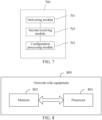
- FIG. 7 is a schematic diagram of a structure of a carrier aggregation control apparatus applied to a network-side equipment according to an embodiment of this application. As shown in FIG. 7 , an embodiment of this application further provides a carrier aggregation control apparatus applied to a network-side equipment, and the apparatus 700 includes:
- the terminal determines, by receiving the carrier aggregation association information that is generated based on the service state of the terminal and that is reported by the terminal, whether the terminal needs to be configured with the secondary cell of carrier aggregation, so that carrier aggregation is configured for the terminal only when the terminal actually needs to be configured with carrier aggregation. Consequently, a problem of power consumption and network occupation caused by configuring carrier aggregation when carrier aggregation is not needed may be avoided, user experience is improved, and more network resources may be saved for other terminals to use, thereby improving overall adaptability of a network.
- the first message is an A4 event control message
- the A4 event control message is used to instruct the terminal to perform A4 event measurement
- the second receiving module includes: a first receiving unit, configured to receive an A4 event measurement report reported by the terminal, where the carrier aggregation association information is added to the A4 event measurement report.
- the first message is an A4 event control message, and the A4 event control message is used to instruct the terminal to perform A4 event measurement;
- the second receiving module includes:
- the network-side equipment in this embodiment of this application may include but is not limited to the types of network-side equipments 12 listed above. This is not specifically limited in this embodiment of this application.
- the carrier aggregation control apparatus provided in this embodiment of this application can implement the processes implemented in the method embodiment of FIG. 3 , and a same technical effect can be achieved. To avoid repetition, details are not described herein again.
- an embodiment of this application further provides a network-side equipment 800, including a processor 801 and a memory 802, and the memory 802 stores a program or instructions that can be run on the processor 801.
- the steps of the carrier aggregation control method are implemented, and a same technical effect can be achieved. To avoid repetition, details are not described herein again.
- An embodiment of this application further provides a readable storage medium.
- the readable storage medium stores a program or instructions, and when the program or the instructions are executed by a processor, the processes of the foregoing carrier aggregation control method embodiment are implemented, and a same technical effect can be achieved. To avoid repetition, details are not described herein again.
- the processor is a processor in the terminal in the foregoing embodiments.
- the readable storage medium includes a computer-readable storage medium, such as a computer read-only memory, a random access memory, a magnetic disk, or an optical disc.
- An embodiment of this application further provides a chip.
- the chip includes a processor and a communications interface, the communications interface is coupled to the processor, and the processor is configured to run a program or an instruction to implement the processes of the carrier aggregation control method embodiment, and a same technical effect can be achieved. To avoid repetition, details are not described herein again.
- chip mentioned in this embodiment of this application may alternatively be referred to as a system-level chip, a system chip, a chip system, or a system on chip.
- An embodiment of this application provides a computer program product.
- the program product is stored in a storage medium.
- the program product is executed by at least one processor to implement the processes of the foregoing carrier aggregation control method embodiment, and a same technical effect can be achieved. To avoid repetition, details are not described herein again.
- the term "include”, “comprise”, or any other variant thereof is intended to cover a non-exclusive inclusion, so that a process, a method, an article, or an apparatus that includes a list of elements not only includes those elements but also includes other elements which are not expressly listed, or further includes elements inherent to such process, method, article, or apparatus.
- an element preceded by a statement "includes a" does not preclude the presence of additional identical elements in the process, method, article, or apparatus that includes the element.
- the method in the foregoing embodiment may be implemented by software in addition to a necessary universal hardware platform or by hardware only. In most circumstances, the former is a preferred implementation.
- the technical solutions of this application essentially or the part contributing to the related art may be implemented in a form of a computer software product.
- the computer software product is stored in a storage medium (such as a ROM/RAM, a hard disk, or an optical disc), and includes several instructions for instructing a terminal (which may be a mobile phone, a computer, a server, a network device, or the like) to perform the methods described in the embodiments of this application.
Landscapes
- Engineering & Computer Science (AREA)
- Signal Processing (AREA)
- Computer Networks & Wireless Communication (AREA)
- Mobile Radio Communication Systems (AREA)
Applications Claiming Priority (2)
| Application Number | Priority Date | Filing Date | Title |
|---|---|---|---|
| CN202210599156.0A CN114786270A (zh) | 2022-05-30 | 2022-05-30 | 载波聚合控制方法及装置、终端和网络侧设备 |
| PCT/CN2023/095729 WO2023231829A1 (zh) | 2022-05-30 | 2023-05-23 | 载波聚合控制方法及装置、终端和网络侧设备 |
Publications (2)
| Publication Number | Publication Date |
|---|---|
| EP4535896A1 true EP4535896A1 (de) | 2025-04-09 |
| EP4535896A4 EP4535896A4 (de) | 2025-10-01 |
Family
ID=82421759
Family Applications (1)
| Application Number | Title | Priority Date | Filing Date |
|---|---|---|---|
| EP23815013.0A Pending EP4535896A4 (de) | 2022-05-30 | 2023-05-23 | Trägeraggregationssteuerungsverfahren und -vorrichtung, endgerät und netzwerkseitige vorrichtung |
Country Status (4)
| Country | Link |
|---|---|
| US (1) | US20250096992A1 (de) |
| EP (1) | EP4535896A4 (de) |
| CN (1) | CN114786270A (de) |
| WO (1) | WO2023231829A1 (de) |
Families Citing this family (3)
| Publication number | Priority date | Publication date | Assignee | Title |
|---|---|---|---|---|
| CN114786270A (zh) * | 2022-05-30 | 2022-07-22 | 维沃移动通信有限公司 | 载波聚合控制方法及装置、终端和网络侧设备 |
| CN116744454A (zh) * | 2023-06-07 | 2023-09-12 | 中国联合网络通信集团有限公司 | 一种辅载波激活方法、装置、网络设备及存储介质 |
| WO2025035328A1 (zh) * | 2023-08-11 | 2025-02-20 | Oppo广东移动通信有限公司 | 用于载波聚合的指示方法、装置、设备及存储介质 |
Family Cites Families (9)
| Publication number | Priority date | Publication date | Assignee | Title |
|---|---|---|---|---|
| KR101276848B1 (ko) * | 2008-07-17 | 2013-06-18 | 엘지전자 주식회사 | 멀티 캐리어를 이용하는 통신시스템에서 전력절감을 위한 데이터 송수신 방법 및 장치 |
| CN104618963B (zh) * | 2013-11-01 | 2018-06-26 | 中国移动通信集团公司 | 一种辅载波资源的调度方法和设备 |
| EP3127393B1 (de) * | 2014-04-04 | 2017-10-04 | Telefonaktiebolaget LM Ericsson (publ) | Trägeraggregationsbewusste lastverteilung |
| CN106550458A (zh) * | 2015-09-16 | 2017-03-29 | 大唐移动通信设备有限公司 | 一种用户设备ue的辅载波配置方法和系统 |
| CN107465493A (zh) * | 2016-06-02 | 2017-12-12 | 中兴通讯股份有限公司 | 载波聚合的控制方法及装置、基站 |
| CN112751655B (zh) * | 2019-10-30 | 2023-05-02 | 中国电信股份有限公司 | 上行载波聚合方法、装置、系统和存储介质 |
| CN114390608A (zh) * | 2020-10-22 | 2022-04-22 | 展讯通信(上海)有限公司 | 辅小区状态的配置方法、激活辅小区的方法、设备及介质 |
| CN113489580B (zh) * | 2021-07-30 | 2022-09-02 | 中国联合网络通信集团有限公司 | 一种载波聚合辅小区的配置方法和装置 |
| CN114786270A (zh) * | 2022-05-30 | 2022-07-22 | 维沃移动通信有限公司 | 载波聚合控制方法及装置、终端和网络侧设备 |
-
2022
- 2022-05-30 CN CN202210599156.0A patent/CN114786270A/zh active Pending
-
2023
- 2023-05-23 EP EP23815013.0A patent/EP4535896A4/de active Pending
- 2023-05-23 WO PCT/CN2023/095729 patent/WO2023231829A1/zh not_active Ceased
-
2024
- 2024-12-02 US US18/965,576 patent/US20250096992A1/en active Pending
Also Published As
| Publication number | Publication date |
|---|---|
| CN114786270A (zh) | 2022-07-22 |
| US20250096992A1 (en) | 2025-03-20 |
| EP4535896A4 (de) | 2025-10-01 |
| WO2023231829A1 (zh) | 2023-12-07 |
Similar Documents
| Publication | Publication Date | Title |
|---|---|---|
| EP4395444A1 (de) | Verfahren zur auswahl und konfiguration von direktzugriffsressourcen, vorrichtung, endgerät und netzwerkseitige vorrichtung | |
| EP4535896A1 (de) | Trägeraggregationssteuerungsverfahren und -vorrichtung, endgerät und netzwerkseitige vorrichtung | |
| EP4407899A1 (de) | Verfahren zur implementierung eines erfassungsdienstes und vorrichtung | |
| EP4422279A1 (de) | Zellenneuauswahlverfahren und -vorrichtung sowie zugehörige vorrichtung | |
| CN116170122B (zh) | 激活或去激活Gap的方法、终端及网络侧设备 | |
| EP4507364A1 (de) | Verfahren und vorrichtung zur verarbeitung von kandidatenzellen, endgerät und netzwerkseitige vorrichtung | |
| EP4561168A1 (de) | Verfahren und vorrichtung zur verarbeitung von informationen über bedingte konfiguration und kommunikationsvorrichtung | |
| US20240188166A1 (en) | Data Transmission Method for Small Data Transmission (SDT) and Terminal | |
| US20240334177A1 (en) | Communication Method and Apparatus, Terminal, Network Device, and Medium | |
| US20250168739A1 (en) | Conditional configuration information processing method and apparatus, and terminal | |
| US20250063566A1 (en) | Information reporting method and apparatus, communication device, and storage medium | |
| US20250261136A1 (en) | Method and apparatus for triggering ue assistant information reporting, and user equipment | |
| US20240389076A1 (en) | Resource selection method and apparatus, and terminal | |
| US20240349278A1 (en) | Transmission Method, Terminal, and Network-Side Device | |
| US20240323714A1 (en) | Model configuration method and apparatus and communication device | |
| US20240276401A1 (en) | Information reporting method, information receiving method, terminal, network side device, and storage medium | |
| US20250039783A1 (en) | Key determining method and apparatus, terminal, network side device, and storage medium | |
| US20250071522A1 (en) | Sidelink positioning method and apparatus, terminal, server, and radio access network device | |
| US20240365203A1 (en) | Conditional Handover Method, Terminal, and Network-Side Device | |
| US20250048190A1 (en) | Conditional handover configuration method, terminal, and network side device | |
| US20240284457A1 (en) | Information processing method and apparatus, communication device, and readable storage medium | |
| EP4383816A1 (de) | Messrelaxationsverfahren und -vorrichtung, endgerät und netzwerkseitige vorrichtung | |
| CN117222029A (zh) | 小区激活方法、装置、电子设备及介质 | |
| CN117295123A (zh) | 切换处理方法、装置及通信设备 | |
| EP4383815A1 (de) | Verfahren und vorrichtung zur bestimmung eines niedrigen mobilitätszustands, endgerät und netzwerkseitige vorrichtung |
Legal Events
| Date | Code | Title | Description |
|---|---|---|---|
| STAA | Information on the status of an ep patent application or granted ep patent |
Free format text: STATUS: THE INTERNATIONAL PUBLICATION HAS BEEN MADE |
|
| PUAI | Public reference made under article 153(3) epc to a published international application that has entered the european phase |
Free format text: ORIGINAL CODE: 0009012 |
|
| STAA | Information on the status of an ep patent application or granted ep patent |
Free format text: STATUS: REQUEST FOR EXAMINATION WAS MADE |
|
| 17P | Request for examination filed |
Effective date: 20241218 |
|
| AK | Designated contracting states |
Kind code of ref document: A1 Designated state(s): AL AT BE BG CH CY CZ DE DK EE ES FI FR GB GR HR HU IE IS IT LI LT LU LV MC ME MK MT NL NO PL PT RO RS SE SI SK SM TR |
|
| DAV | Request for validation of the european patent (deleted) | ||
| DAX | Request for extension of the european patent (deleted) | ||
| A4 | Supplementary search report drawn up and despatched |
Effective date: 20250902 |
|
| RIC1 | Information provided on ipc code assigned before grant |
Ipc: H04W 72/04 20230101AFI20250827BHEP Ipc: H04L 5/00 20060101ALI20250827BHEP Ipc: H04W 52/00 20090101ALI20250827BHEP |