EP4535546A1 - Sammelschienenanordnung und batteriepack damit - Google Patents
Sammelschienenanordnung und batteriepack damit Download PDFInfo
- Publication number
- EP4535546A1 EP4535546A1 EP23920172.6A EP23920172A EP4535546A1 EP 4535546 A1 EP4535546 A1 EP 4535546A1 EP 23920172 A EP23920172 A EP 23920172A EP 4535546 A1 EP4535546 A1 EP 4535546A1
- Authority
- EP
- European Patent Office
- Prior art keywords
- glass fiber
- busbar
- fiber layer
- battery
- module
- Prior art date
- Legal status (The legal status is an assumption and is not a legal conclusion. Google has not performed a legal analysis and makes no representation as to the accuracy of the status listed.)
- Pending
Links
Images



Classifications
-
- H—ELECTRICITY
- H01—ELECTRIC ELEMENTS
- H01M—PROCESSES OR MEANS, e.g. BATTERIES, FOR THE DIRECT CONVERSION OF CHEMICAL ENERGY INTO ELECTRICAL ENERGY
- H01M50/00—Constructional details or processes of manufacture of the non-active parts of electrochemical cells other than fuel cells, e.g. hybrid cells
- H01M50/50—Current conducting connections for cells or batteries
- H01M50/502—Interconnectors for connecting terminals of adjacent batteries; Interconnectors for connecting cells outside a battery casing
- H01M50/521—Interconnectors for connecting terminals of adjacent batteries; Interconnectors for connecting cells outside a battery casing characterised by the material
-
- C—CHEMISTRY; METALLURGY
- C08—ORGANIC MACROMOLECULAR COMPOUNDS; THEIR PREPARATION OR CHEMICAL WORKING-UP; COMPOSITIONS BASED THEREON
- C08L—COMPOSITIONS OF MACROMOLECULAR COMPOUNDS
- C08L83/00—Compositions of macromolecular compounds obtained by reactions forming in the main chain of the macromolecule a linkage containing silicon with or without sulfur, nitrogen, oxygen or carbon only; Compositions of derivatives of such polymers
- C08L83/04—Polysiloxanes
-
- H—ELECTRICITY
- H01—ELECTRIC ELEMENTS
- H01M—PROCESSES OR MEANS, e.g. BATTERIES, FOR THE DIRECT CONVERSION OF CHEMICAL ENERGY INTO ELECTRICAL ENERGY
- H01M10/00—Secondary cells; Manufacture thereof
- H01M10/42—Methods or arrangements for servicing or maintenance of secondary cells or secondary half-cells
-
- H—ELECTRICITY
- H01—ELECTRIC ELEMENTS
- H01M—PROCESSES OR MEANS, e.g. BATTERIES, FOR THE DIRECT CONVERSION OF CHEMICAL ENERGY INTO ELECTRICAL ENERGY
- H01M10/00—Secondary cells; Manufacture thereof
- H01M10/42—Methods or arrangements for servicing or maintenance of secondary cells or secondary half-cells
- H01M10/425—Structural combination with electronic components, e.g. electronic circuits integrated to the outside of the casing
-
- H—ELECTRICITY
- H01—ELECTRIC ELEMENTS
- H01M—PROCESSES OR MEANS, e.g. BATTERIES, FOR THE DIRECT CONVERSION OF CHEMICAL ENERGY INTO ELECTRICAL ENERGY
- H01M50/00—Constructional details or processes of manufacture of the non-active parts of electrochemical cells other than fuel cells, e.g. hybrid cells
- H01M50/50—Current conducting connections for cells or batteries
- H01M50/502—Interconnectors for connecting terminals of adjacent batteries; Interconnectors for connecting cells outside a battery casing
- H01M50/521—Interconnectors for connecting terminals of adjacent batteries; Interconnectors for connecting cells outside a battery casing characterised by the material
- H01M50/526—Interconnectors for connecting terminals of adjacent batteries; Interconnectors for connecting cells outside a battery casing characterised by the material having a layered structure
-
- H—ELECTRICITY
- H01—ELECTRIC ELEMENTS
- H01M—PROCESSES OR MEANS, e.g. BATTERIES, FOR THE DIRECT CONVERSION OF CHEMICAL ENERGY INTO ELECTRICAL ENERGY
- H01M50/00—Constructional details or processes of manufacture of the non-active parts of electrochemical cells other than fuel cells, e.g. hybrid cells
- H01M50/50—Current conducting connections for cells or batteries
- H01M50/572—Means for preventing undesired use or discharge
- H01M50/584—Means for preventing undesired use or discharge for preventing incorrect connections inside or outside the batteries
- H01M50/588—Means for preventing undesired use or discharge for preventing incorrect connections inside or outside the batteries outside the batteries, e.g. incorrect connections of terminals or busbars
-
- H—ELECTRICITY
- H01—ELECTRIC ELEMENTS
- H01M—PROCESSES OR MEANS, e.g. BATTERIES, FOR THE DIRECT CONVERSION OF CHEMICAL ENERGY INTO ELECTRICAL ENERGY
- H01M50/00—Constructional details or processes of manufacture of the non-active parts of electrochemical cells other than fuel cells, e.g. hybrid cells
- H01M50/50—Current conducting connections for cells or batteries
- H01M50/572—Means for preventing undesired use or discharge
- H01M50/584—Means for preventing undesired use or discharge for preventing incorrect connections inside or outside the batteries
- H01M50/59—Means for preventing undesired use or discharge for preventing incorrect connections inside or outside the batteries characterised by the protection means
-
- H—ELECTRICITY
- H01—ELECTRIC ELEMENTS
- H01M—PROCESSES OR MEANS, e.g. BATTERIES, FOR THE DIRECT CONVERSION OF CHEMICAL ENERGY INTO ELECTRICAL ENERGY
- H01M10/00—Secondary cells; Manufacture thereof
- H01M10/42—Methods or arrangements for servicing or maintenance of secondary cells or secondary half-cells
- H01M10/425—Structural combination with electronic components, e.g. electronic circuits integrated to the outside of the casing
- H01M2010/4271—Battery management systems including electronic circuits, e.g. control of current or voltage to keep battery in healthy state, cell balancing
-
- H—ELECTRICITY
- H01—ELECTRIC ELEMENTS
- H01M—PROCESSES OR MEANS, e.g. BATTERIES, FOR THE DIRECT CONVERSION OF CHEMICAL ENERGY INTO ELECTRICAL ENERGY
- H01M50/00—Constructional details or processes of manufacture of the non-active parts of electrochemical cells other than fuel cells, e.g. hybrid cells
- H01M50/20—Mountings; Secondary casings or frames; Racks, modules or packs; Suspension devices; Shock absorbers; Transport or carrying devices; Holders
- H01M50/204—Racks, modules or packs for multiple batteries or multiple cells
- H01M50/207—Racks, modules or packs for multiple batteries or multiple cells characterised by their shape
- H01M50/209—Racks, modules or packs for multiple batteries or multiple cells characterised by their shape adapted for prismatic or rectangular cells
-
- Y—GENERAL TAGGING OF NEW TECHNOLOGICAL DEVELOPMENTS; GENERAL TAGGING OF CROSS-SECTIONAL TECHNOLOGIES SPANNING OVER SEVERAL SECTIONS OF THE IPC; TECHNICAL SUBJECTS COVERED BY FORMER USPC CROSS-REFERENCE ART COLLECTIONS [XRACs] AND DIGESTS
- Y02—TECHNOLOGIES OR APPLICATIONS FOR MITIGATION OR ADAPTATION AGAINST CLIMATE CHANGE
- Y02E—REDUCTION OF GREENHOUSE GAS [GHG] EMISSIONS, RELATED TO ENERGY GENERATION, TRANSMISSION OR DISTRIBUTION
- Y02E60/00—Enabling technologies; Technologies with a potential or indirect contribution to GHG emissions mitigation
- Y02E60/10—Energy storage using batteries
Definitions
- the present disclosure relates to a busbar assembly and a battery pack including the same, and more specifically, to a busbar assembly having an improved fire resistance and a battery pack including the same.
- chargeable/dischargeable secondary batteries are used as a power source for an electric vehicle (EV), a hybrid electric vehicle (HEV), a plug-in hybrid electric vehicle (P-HEV) and the like, in an attempt to solve air pollution and the like caused by existing gasoline vehicles using fossil fuel. Therefore, the demand for development of the secondary battery is growing.
- EV electric vehicle
- HEV hybrid electric vehicle
- P-HEV plug-in hybrid electric vehicle
- the lithium secondary battery has come into the spotlight because it has advantages, for example, hardly exhibiting memory effects compared to nickel-based secondary batteries and thus being freely charged and discharged, and having very low self-discharge rate and high energy density.
- Such a lithium secondary battery generally uses lithium-based oxide and a carbon material as a positive electrode active material and a negative electrode active material, respectively.
- the lithium secondary battery includes an electrode assembly in which a positive electrode plate and a negative electrode plate respectively coated with the positive electrode active material and the negative electrode active material are arranged with a separator interposed between them, and an exterior material or a battery case which hermetically houses the electrode assembly together with an electrolyte.
- a lithium secondary battery may be classified into a can type secondary battery where the electrode assembly is incorporated into a metal can and a pouch type battery where the electrode assembly is incorporated into a pouch of an aluminum laminate sheet.
- a battery module in which a plurality of battery cells are electrically connected is used.
- a plurality of battery cells are connected to each other in series or parallel to form a cell assembly, thereby improving capacity and output.
- one or more battery modules can be mounted together with various control and protection systems such as a BDU (battery disconnect unit), a BMS (battery management system), and a cooling system to form a battery pack.
- heat generated from multiple battery cells can be added up in a narrow space, so that the temperature can rise more quickly and excessively.
- battery modules in which multiple battery cells are stacked and a battery pack equipped with these battery modules can obtain high output, but it is not easy to remove heat generated from the battery cells during charging and discharging.
- the heat dissipation of battery cells is not properly performed or thermal runaway phenomenon occurs in a battery cell, the possibility of explosion or ignition increases.
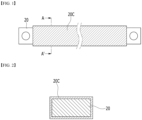
- FIG. 1 is a plan view showing a conventional busbar
- FIG. 2 is a cross-sectional view showing a cross section taken along the cutting line A-A' in FIG. 1 .
- a conventional busbar 20 is a rod-shaped metal member that extends along the longitudinal direction, and a through hole for connecting with a terminal busbar of a battery module may be formed at both end parts of the busbar 20.
- a busbar 20 is configured to be in charge of HV (High voltage) connection in the battery pack.
- the HV connection means a connection that serves as a power source to supply electric power
- the busbar 20 is configured to guide electrical connection of the battery module, and generally includes a metal material having excellent electrical conductivity.
- the busbar 20 may include a copper (Cu) material.
- the covering member 20C can surround such a busbar 20.
- the covering member 20C may include a material that is electrically insulating, and for example, it may include a silicone material or an epoxy material. Since the covering member 20C surrounds the busbar 20 through which a high current flows, it is possible to prevent the busbar 20 from coming into contact with other electrical equipment or conductive members in addition to the terminal busbar of the battery module, thereby interrupting generation of short circuits.
- battery packs have been required to have equipment in which flames are not ejected to the outside of the battery pack even if a fire occurs inside the battery pack. Since the flame generated inside the battery pack has a very high temperature of approximately 1000°C, the covering member 20C surrounding the busbar 20 may melt, so that the busbar 20 may be exposed. If the exposed busbar 20 comes into contact with another electrical component or conductive member to cause a short circuit, the internal flame may further spread, and the flame may propagate to the outside of the battery pack. This could ultimately lead to an explosion of the battery pack or the vehicle equipped with the battery pack.
- a busbar assembly comprising: a busbar for guiding electrical connection inside the battery pack; a glass fiber layer that includes glass fibers and surrounds the busbar; and a fire resistant silicone layer that fills an empty space of the glass fiber layer and surrounds the busbar.
- the fire resistant silicone layer may be formed through injection molding of a fire resistant silicone material onto the busbar in the state of being surrounded by the glass fiber layer.
- the glass fiber layer may be a fabric made in a shape in which the glass fibers are woven.
- the fire resistant silicone layer may fill a space between the woven glass fibers.
- the glass fiber layer may include an inner glass fiber layer surrounding the busbar and an outer glass fiber layer surrounding the busbar on the outside of the inner glass fiber layer.
- Each of the inner glass fiber layer and the outer glass fiber layer may be a fabric made in a shape in which the glass fibers are woven.
- the fire resistant silicone layer may fill a space between the glass fibers woven in the inside of each of the inner glass fiber layer and the outer glass fiber layer.
- the fire resistant silicone layer may fill a space between the inner glass fiber layer and the outer glass fiber layer.
- the fire resistant silicone layer may include a silicone material that is ceramified at high temperature.
- a battery pack comprising: at least one busbar assembly as described above; battery modules; a BDU (Battery Disconnect Unit) module that controls electrical connection of the battery modules; and a BMS (Battery Management System) module that monitors and controls the operation of the battery module, wherein the at least one busbar assembly electrically connects at least one of between the battery modules, between the battery module and the BDU module, between the battery module and the BMS module, or between the BDU module and the BMS module.
- BDU Battery Disconnect Unit
- BMS Battery Management System
- a fire resistant silicone layer that is ceramified at high heat or flame, and a glass fiber layer that supplements the structural rigidity of the fire resistant silicon layer are provided in the busbar assembly, so that the electrical insulation properties of the busbar assembly can be maintained even under high heat or flame conditions.
- planar it means when a target portion is viewed from the upper side, and when it is referred to as “cross-sectional”, it means when a target portion is viewed from the side of a cross section cut vertically.
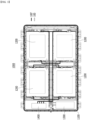
- FIG. 3 is a plan view showing a battery pack according to an embodiment of the present disclosure.
- the battery pack 1000 includes a busbar assembly 100; battery modules 1200, a BDU (Battery Disconnect Unit) module 1300 for controlling electrical connection of the battery modules 1200, and a BMS (Battery Management System) module 1400 that monitors and controls the operation of the battery module 1200.
- At least one busbar assembly 100 electrically connects at least one of between the battery modules 1200, between the battery module 1200 and the BDU module 1300, between the battery module 1200 and the BMS module 1400, or between the BDU module 1300 and the BMS module 1400.
- a plurality of battery modules 1200 may be housed in the pack frame 1100, and electrical connection between the battery modules 1200 or electrical connection between the battery module 1200 and the BDU module 1300 may be made by the busbar assembly 100. That is, the busbar assembly 100 according to the present embodiment can be in charge of HV (High voltage) connection.
- HV connection is a power connection that serves to supply electric power requiring high voltage, and refers to a connection between battery cells or a connection between battery modules.
- the BDU module 1300 is a member for controlling electrical connection of the battery module 1200, and can cut off power between the power converter and the battery module 1200.
- the BDU module 1300 can cut off electric power to the battery pack 1000 to ensure safety of the battery pack 1000.
- the LV connection member 100' may be in charge of electrical connection between the battery module 1200 and the BMS module 1400.
- the electrical connection herein is a LV (low voltage) connection, which means a sensing connection for detecting and controlling the voltage and temperature of the battery module 1200.
- sensors, and the like are arranged inside the battery module 1200, and real-time temperature information or voltage information of the battery module 1200 is transmitted to a BMS module 1400 via the LV connection member 100'. It is possible to monitor and control the real-time operating status of the battery module 1200 via the BMS module 1400.
- an HV current sensor may be integrated into the BMS module 1400.
- the busbar assembly according to the present embodiment may be in charge of electrical connection between the battery module 1200 and the BMS module 1400 or between the BDU module 1300 and the BMS module 1400.
- the battery module 1200 according to the present embodiment will be described with reference to FIGS. 4 and 5 .
- the battery module 1200 described below has one exemplary structure of a battery module including a plurality of battery cells 11, and various types of battery modules including a plurality of battery cells can be applied.
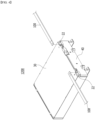
- FIG. 4 is a perspective view showing one of the battery modules included in the battery pack of FIG. 3 .
- FIG. 5 is a partial perspective view showing a state in which the module frame and the end plate are removed in the battery module of FIG. 4 .
- the battery module 1200 may include a battery cell stack 11A in which a plurality of battery cells 11 are stacked.
- the battery cell stack 11A is illustrated in FIG. 5 .
- Such a battery cell stack 11A can be housed in the module frame 30 and the end plate 40.
- the busbar assembly 100 is electrically connected to such a terminal busbar 22, so that the above-mentioned HV connection can be achieved. That is, the battery module 1200 may be electrically connected to the other battery module 1200, BDU module 1300, or BMS module 1400 via the busbar assembly 100 connected to the terminal busbar 22.
- the battery cells and battery modules described in FIGS. 4 and 5 are exemplary structures, and the types or forms of the battery cells and battery modules included in the battery pack to which the busbar assembly according to the present embodiment is applied are not particularly limited. That is, although a pouch-type battery cell was described as an example, a prismatic battery cell or a cylindrical battery cell can also be applied to the battery module according to an embodiment of the present disclosure. In addition, a battery module in which battery cells are housed in a module frame was described as an example, but a CTP (cell to pack) type battery module in which a plurality of battery cells are mounted on a battery pack without being housed in a module frame can also be applied as an example of the present disclosure.
- a CTP cell to pack
- busbar assembly according to an embodiment of the present disclosure will be described in detail with reference to FIGS. 6 to 8 .
- FIG. 6 is a plan view showing a busbar and a glass fiber layer included in a busbar assembly according to an embodiment of the present disclosure.
- the busbar assembly 100a includes a busbar 200 for guiding electrical connection within the battery pack 1000; and a glass fiber layer 400 that includes glass fibers 400W and surrounds the busbar 200.
- the busbar 200 is configured to guide electrical connection, that is, HV connection, of the battery module, and may include a metal material with excellent electrical conductivity.
- the busbar 200 may include copper(Cu) material.
- the busbar 200 may be a metal rod extending along the longitudinal direction Ld.
- the glass fiber layer 400 may be a fabric formed in a shape in which the glass fibers 400W are woven. As an example, a plurality of glass fibers 400W are twisted and entangled to form glass fiber strands 400S, and such glass fiber strands 400S may be woven to provide a glass fiber layer 400 in the form of a fabric.
- the weaving method is not particularly limited, and various weaving methods such as plain weave, twill weave, and satin weave can be applied.
- This glass fiber layer 400 may surround the outer peripheral surface of the busbar 200, excluding partial areas of both end parts of the busbar 200 connected to the terminal busbar 22 (see FIG. 5 ). Since the glass fiber layer 400 is a fabric, a space S may be formed between the glass fiber strands 400S woven within the glass fiber layer 400, and a predetermined space may also be formed between the glass fiber layer 400 and the busbar 200.
- FIG. 7 is a plan view showing a state in which a fire resistant silicon layer is provided in the busbar assembly of FIG. 6 .
- FIG. 8 is a cross-sectional view showing a cross section taken along the cutting line B-B' of FIG. 7 .
- the busbar assembly 100a further includes a fire resistant silicon layer 300 that fills an empty space S of the glass fiber layer 400 and surrounds the busbar 200.
- the fire resistant silicon layer 300 can be provided through injection molding of a fire resistance silicone material on the outer peripheral surface of the busbar 200 while the busbar 200 is surrounded by the glass fiber layer 400. That is, the fire resistant silicon layer 300 according to the present embodiment may be formed through injection molding of the fire resistant silicone material onto the busbar 200 in the state of being surrounded by the glass fiber layer 400. Thereby, the glass fibers 400W of the glass fiber layer 400 may be located inside the fire resistant silicon layer 300.
- the shape of the woven glass fibers or the weaving method are not particularly limited, as long as the glass fiber layer 400 in the present disclosure is a fabric made in a shape in which glass fibers 400W are woven.
- the fire resistant silicone layer 300 may surround the outer peripheral surface of the busbar 200 except for partial areas of both end parts of the busbar 200 that are connected to the terminal busbar 22 (see FIG. 5 ).
- the fire resistant silicone layer 300 having electrical insulation properties functions as an insulating layer that protects the busbar 200, thereby preventing the busbar 200 from coming into contact with other electrical equipment or conductive members and causing a short circuit.
- the fire resistant silicone material is a material that is formed into ceramic when exposed to flame or at high heat, unlike common silicone materials that burn when exposed to flame or burn at high temperatures.
- the fire resistant silicone material may be a silicone material that is ceramified when the temperature exceeds a certain temperature.
- the fire resistant silicone material may include silicone polymer and silica.
- the applied silicone polymer may be a polysiloxane-based compound having a vinyl group as a functional group, and corresponds to a base material for a fire resistant silicone material.
- the silica may be fumed silica, which is a reinforcing filler included in the silicone polymer.
- a high-purity silicone chloride (SiCl 4 ) compound can be produced using metallic silicone as a main raw material through reaction with hydrochloric acid and purification process, and this can be reacted with hydrogen and oxygen in a high temperature flame to obtain fumed silica.
- the fire resistant silicone may contain platinum Pt as a catalyst.
- the fire resistant silicone layer 300 does not burn or melt, but can be ceramified and maintain electrical insulation properties, even if exposed to flame or placed in a high-temperature environment.
- a space S may be formed between the intersecting glass fiber strands 400S in the glass fiber layer 400, which is a fabric, and a predetermined space may also be formed between the glass fiber layer 400 and the busbar 200. Further, spaces may be formed between the glass fibers 400W which are twisted and entangled within the glass fiber strands 400S themselves. During the process of injection molding the fire resistant silicon layer 300, the fire resistant silicone material may permeate into these spaces. The fire resistant silicon layer 300 can fill the space between the woven glass fibers 400W.
- the fire resistant silicon layer 300 When the fire resistant silicon layer 300 is ceramified in a flame or high-temperature environment, the electrical insulation properties of the fire resistant silicon layer 300 can be maintained, but the strength of the fire resistant silicon layer 300 becomes weaker, and it is more likely to be cracked due to external force.
- it has been designed such that the fire resistant silicon layer 300 fills the space between the woven glass fibers, and the glass fiber layer 400 is located inside the fire resistant silicon layer 300. Thereby, it is possible to supplement the structural rigidity of the fire resistant silicon layer 300, and even if the fire resistant silicon layer 300 is ceramified, it is attempted to be prevented from being cracked by external force.
- the fire resistant silicone material permeates in the space between the glass fiber strands 400S within the glass fiber layer 400 , which is a fabric, or between the glass fibers 400W that are twisted inside the glass fiber strand 400S itself, thereby capable of realizing enhanced rigidity of the fire resistant silicon layer 300 and strong bonding strength between the fire resistant silicon layer 300 and the glass fiber layer 400.
- the busbar assembly 100a according to the present embodiment has improved fire resistance, and can maintain electrical insulation properties even in a flame or high-temperature environment.
- busbar assembly according to another embodiment of the present disclosure will be described in detail with reference to FIGS. 9 to 12 .
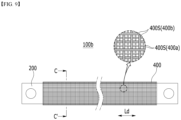
- FIG. 9 is a plan view showing a busbar and a glass fiber layer included in a busbar assembly according to another embodiment of the present disclosure.
- FIG. 10 is a cross-sectional view showing a cross section taken along the cutting line C-C' of FIG. 9 .
- the busbar assembly 100b may include a busbar 200 and a glass fiber layer 400 that includes glass fibers 400W and surrounds the busbar 200.
- the glass fiber layer 400 may include an inner glass fiber layer 400a surrounding the busbar 200 and an outer glass fiber layer 400b surrounding the busbar 200 on the outside of the inner glass fiber layer 400a. That is, the glass fiber layer 400 according to the present embodiment may have a multilayer structure of an inner glass fiber layer 400a and an outer glass fiber layer 400b.
- the glass fiber layer according to another embodiment of the present disclosure may have a multilayer structure of three or more layers.
- Each of the inner glass fiber layer 400a and the outer glass fiber layer 400b may be a fabric formed in a shape in which glass fibers 400W are woven. More specifically, a plurality of glass fibers 400W are twisted and entangled to form glass fiber strands 400S, wherein such glass fiber strands 400S may be woven to provide an inner glass fiber layer 400a and an outer glass fiber layer 400b in the form of a fabric.
- a space S1 may be formed between the intersecting glass fiber strands 400S
- a space S2 may be formed between the intersecting glass fiber strands 400S.
- a predetermined space S3 may be formed between the inner glass fiber layer 400a and the outer glass fiber layer 400b, and a predetermined space S4 may also be formed between the inner glass fiber layer 400a and the busbar 200. This is due to the fact that each of the inner glass fiber layer 400a and the outer glass fiber layer 400b is a fabric. In FIG. 8 , such spaces are exaggerated for convenience of explanation.
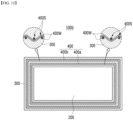
- FIG. 11 is a plan view showing a state in which a fire resistant silicon layer is provided in the busbar assembly of FIG. 9 .
- FIG. 12 is a cross-sectional view showing a cross section taken along the cutting line D-D' of FIG. 11 .
- the busbar assembly 100b may further includes a fire resistant silicon layer 300 that fills empty spaces of the inner glass fiber layer 400a and the outer glass fiber layer 400b and surrounds the busbar 200. That is, the fire resistant silicone material can be injection-molded on the busbar 200 surrounded by the inner glass fiber layer 400a and the outer glass fiber layer 400b, thereby producing the fire resistant silicon layer 300. Thereby, the glass fibers 400W of the inner glass fiber layer 400a and the glass fibers 400W of the outer glass fiber layer 400b may be located inside the fire resistant silicon layer 300.
- the fire resistant silicone material may permeate into the internal spaces S1 and S2 of each of the inner glass fiber layer 400a and the outer glass fiber layer 400b, and the fire resistant silicone material may also permeate into the space S3 between the inner glass fiber layer 400a and the outer glass fiber layer 400b. That is, the fire resistant silicon layer 300 can fill the spaces S1 and S2 between the glass fiber strands 400S woven in the inside of each of the inner glass fiber layer 400a and the outer glass fiber layer 400b, and can also fill the space S3 between the inner glass fiber layer 400a and the outer glass fiber layer 400b, and may penetrate between the glass fibers 400W that are twisted within the glass fiber strands 400S themselves.
- the busbar assembly 100b according to the present embodiment is designed so that the inner glass fiber layer 400a and the outer glass fiber layer 400b are located inside the fire resistant silicon layer 300. Therefore, similar to the busbar assembly 100a previously described in FIGS. 6 to 8 , the structural rigidity of the fire resistant silicon layer 300 can be supplemented, and even if the fire resistant silicon layer 300 is ceramifized, it can be prevented from being cracked by external force. Ultimately, the busbar assembly 100b according to the present embodiment has improved fire resistance, and can maintain electrical insulation properties even in a flame or high-temperature environment.
- the inner glass fiber layer 400a reinforces the structural rigidity of the fire resistant silicon layer 300 itself, and protects internal components such as the busbar 200 even if the outer glass fiber layer 400b or the outer fire resistant silicon layer 300 is cracked.
- the outer glass fiber layer 400b can function to prevent the inner fire resistant silicon layer 300 and the inner glass fiber layer 400a from being directly exposed to flame or the like.
- the outer glass fiber layer 400b can protect the inner busbar 200 from physical external forces and thus prevent short circuits from occurring.
- the one or more battery modules according to embodiments of the present disclosure described above can be mounted together with various control and protection systems such as a BMS (battery management system) module, a BDU(battery disconnect unit) module, and a cooling system to form a battery pack.
- BMS battery management system
- BDU battery disconnect unit
- the battery module or the battery pack can be applied to various devices. Specifically, it can be applied to vehicle means such as an electric bike, an electric vehicle, and a hybrid electric vehicle, or an ESS (Energy Storage System) and may be applied to various devices capable of using a secondary battery, without being limited thereto.
- vehicle means such as an electric bike, an electric vehicle, and a hybrid electric vehicle, or an ESS (Energy Storage System) and may be applied to various devices capable of using a secondary battery, without being limited thereto.
- ESS Electronicgy Storage System
Landscapes
- Chemical & Material Sciences (AREA)
- Chemical Kinetics & Catalysis (AREA)
- Electrochemistry (AREA)
- General Chemical & Material Sciences (AREA)
- Engineering & Computer Science (AREA)
- Manufacturing & Machinery (AREA)
- Health & Medical Sciences (AREA)
- Medicinal Chemistry (AREA)
- Polymers & Plastics (AREA)
- Organic Chemistry (AREA)
- Microelectronics & Electronic Packaging (AREA)
- Connection Of Batteries Or Terminals (AREA)
- Battery Mounting, Suspending (AREA)
- Insulated Conductors (AREA)
Applications Claiming Priority (2)
| Application Number | Priority Date | Filing Date | Title |
|---|---|---|---|
| KR1020230011438A KR20240119410A (ko) | 2023-01-30 | 2023-01-30 | 버스바 조립체 및 이를 포함하는 전지팩 |
| PCT/KR2023/021856 WO2024162623A1 (ko) | 2023-01-30 | 2023-12-28 | 버스바 조립체 및 이를 포함하는 전지팩 |
Publications (2)
| Publication Number | Publication Date |
|---|---|
| EP4535546A1 true EP4535546A1 (de) | 2025-04-09 |
| EP4535546A4 EP4535546A4 (de) | 2025-12-03 |
Family
ID=92146974
Family Applications (1)
| Application Number | Title | Priority Date | Filing Date |
|---|---|---|---|
| EP23920172.6A Pending EP4535546A4 (de) | 2023-01-30 | 2023-12-28 | Sammelschienenanordnung und batteriepack damit |
Country Status (5)
| Country | Link |
|---|---|
| EP (1) | EP4535546A4 (de) |
| JP (1) | JP2025523473A (de) |
| KR (1) | KR20240119410A (de) |
| CN (1) | CN119547266A (de) |
| WO (1) | WO2024162623A1 (de) |
Families Citing this family (1)
| Publication number | Priority date | Publication date | Assignee | Title |
|---|---|---|---|---|
| KR20240119411A (ko) * | 2023-01-30 | 2024-08-06 | 주식회사 엘지에너지솔루션 | 버스바 조립체 및 이를 포함하는 전지팩 |
Family Cites Families (11)
| Publication number | Priority date | Publication date | Assignee | Title |
|---|---|---|---|---|
| KR20160041311A (ko) * | 2014-10-07 | 2016-04-18 | 주식회사 엘지화학 | 내화성 안전 부재를 포함하는 전지팩 |
| KR20160049260A (ko) * | 2014-10-27 | 2016-05-09 | 엘에스전선 주식회사 | 플렉서블 버스바 |
| KR102487411B1 (ko) | 2017-10-31 | 2023-01-12 | 엘지디스플레이 주식회사 | 발광소자 패키지 및 전자기기 |
| KR102946350B1 (ko) * | 2019-10-29 | 2026-03-30 | 주식회사 엘지에너지솔루션 | 화재 안전성이 우수한 버스바 |
| CN214624512U (zh) * | 2021-05-13 | 2021-11-05 | 深圳市富程威科技有限公司 | 一种绕包带、高压连接件和动力电池 |
| CN215770643U (zh) * | 2021-06-23 | 2022-02-08 | 深圳市沃尔热缩有限公司 | 母排连接件 |
| US12503797B2 (en) * | 2021-07-13 | 2025-12-23 | Systems Protection Group Us Llc | Circumferentially continuous, fire suppressing, dielectric sleeve |
| CN217405140U (zh) * | 2022-05-06 | 2022-09-09 | 德塔云母材料科技(上海)有限公司 | 一种模压电动汽车母排绝缘件 |
| CN218274013U (zh) * | 2022-06-28 | 2023-01-10 | 广东合晟新能源科技有限公司 | 防火挤塑折弯母排 |
| CN115458871B (zh) * | 2022-10-12 | 2025-04-18 | 东莞市朗晟材料科技有限公司 | 一种新型防火耐高温绝缘的电池高压连接件及制作工艺 |
| KR20240119411A (ko) * | 2023-01-30 | 2024-08-06 | 주식회사 엘지에너지솔루션 | 버스바 조립체 및 이를 포함하는 전지팩 |
-
2023
- 2023-01-30 KR KR1020230011438A patent/KR20240119410A/ko active Pending
- 2023-12-28 CN CN202380053520.6A patent/CN119547266A/zh active Pending
- 2023-12-28 JP JP2024574795A patent/JP2025523473A/ja active Pending
- 2023-12-28 EP EP23920172.6A patent/EP4535546A4/de active Pending
- 2023-12-28 WO PCT/KR2023/021856 patent/WO2024162623A1/ko not_active Ceased
Also Published As
| Publication number | Publication date |
|---|---|
| WO2024162623A1 (ko) | 2024-08-08 |
| KR20240119410A (ko) | 2024-08-06 |
| EP4535546A4 (de) | 2025-12-03 |
| JP2025523473A (ja) | 2025-07-23 |
| CN119547266A (zh) | 2025-02-28 |
Similar Documents
| Publication | Publication Date | Title |
|---|---|---|
| EP4531192A1 (de) | Sammelschienenanordnung und batteriepack damit | |
| EP4535547A1 (de) | Sammelschienenanordnung und batteriepack damit | |
| EP4531193A1 (de) | Sammelschienenanordnung und batteriepack damit | |
| EP4597733A1 (de) | Sammelschienenanordnung und batteriepack damit | |
| CN119547266A (zh) | 汇流条组件和包括汇流条组件的电池组 | |
| EP4564581A1 (de) | Sammelschienenanordnung und batteriepack damit | |
| EP4531196A1 (de) | Sammelschienenanordnung und batteriepack damit | |
| EP4485671A1 (de) | Sammelschienenanordnung und batteriepack damit | |
| EP4597734A1 (de) | Sammelschienenanordnung und batteriepack damit | |
| EP4604303A1 (de) | Sammelschienenanordnung und batteriepack damit | |
| EP4661202A1 (de) | Sammelschienenanordnung und batteriepack damit | |
| EP4614700A1 (de) | Sammelschienenanordnung und batteriepack damit | |
| KR20240119414A (ko) | 버스바 조립체 및 이를 포함하는 전지팩 | |
| KR20250014833A (ko) | 버스바 조립체 및 이를 포함하는 전지 팩 | |
| KR20260047861A (ko) | 버스바 조립체 및 이를 포함하는 전지 팩 | |
| EP4672489A1 (de) | Sammelschienenanordnung und batteriepack damit | |
| KR20250058590A (ko) | 버스바 조립체 및 이를 포함하는 전지 팩 |
Legal Events
| Date | Code | Title | Description |
|---|---|---|---|
| STAA | Information on the status of an ep patent application or granted ep patent |
Free format text: STATUS: THE INTERNATIONAL PUBLICATION HAS BEEN MADE |
|
| PUAI | Public reference made under article 153(3) epc to a published international application that has entered the european phase |
Free format text: ORIGINAL CODE: 0009012 |
|
| STAA | Information on the status of an ep patent application or granted ep patent |
Free format text: STATUS: REQUEST FOR EXAMINATION WAS MADE |
|
| 17P | Request for examination filed |
Effective date: 20241230 |
|
| AK | Designated contracting states |
Kind code of ref document: A1 Designated state(s): AL AT BE BG CH CY CZ DE DK EE ES FI FR GB GR HR HU IE IS IT LI LT LU LV MC ME MK MT NL NO PL PT RO RS SE SI SK SM TR |
|
| A4 | Supplementary search report drawn up and despatched |
Effective date: 20251031 |
|
| RIC1 | Information provided on ipc code assigned before grant |
Ipc: H01M 50/521 20210101AFI20251027BHEP Ipc: H01M 50/59 20210101ALI20251027BHEP Ipc: H01M 50/588 20210101ALI20251027BHEP Ipc: H01M 50/526 20210101ALI20251027BHEP Ipc: C08L 83/04 20060101ALI20251027BHEP Ipc: H01M 10/42 20060101ALI20251027BHEP |
|
| DAV | Request for validation of the european patent (deleted) | ||
| DAX | Request for extension of the european patent (deleted) |