EP4535470A1 - Cylindrical battery winding apparatus - Google Patents
Cylindrical battery winding apparatus Download PDFInfo
- Publication number
- EP4535470A1 EP4535470A1 EP22945018.4A EP22945018A EP4535470A1 EP 4535470 A1 EP4535470 A1 EP 4535470A1 EP 22945018 A EP22945018 A EP 22945018A EP 4535470 A1 EP4535470 A1 EP 4535470A1
- Authority
- EP
- European Patent Office
- Prior art keywords
- separator
- electrode material
- cylindrical battery
- winding apparatus
- pair
- Prior art date
- Legal status (The legal status is an assumption and is not a legal conclusion. Google has not performed a legal analysis and makes no representation as to the accuracy of the status listed.)
- Pending
Links
Images



Classifications
-
- H—ELECTRICITY
- H01—ELECTRIC ELEMENTS
- H01M—PROCESSES OR MEANS, e.g. BATTERIES, FOR THE DIRECT CONVERSION OF CHEMICAL ENERGY INTO ELECTRICAL ENERGY
- H01M10/00—Secondary cells; Manufacture thereof
- H01M10/04—Construction or manufacture in general
- H01M10/0404—Machines for assembling batteries
- H01M10/0409—Machines for assembling batteries for cells with wound electrodes
-
- Y—GENERAL TAGGING OF NEW TECHNOLOGICAL DEVELOPMENTS; GENERAL TAGGING OF CROSS-SECTIONAL TECHNOLOGIES SPANNING OVER SEVERAL SECTIONS OF THE IPC; TECHNICAL SUBJECTS COVERED BY FORMER USPC CROSS-REFERENCE ART COLLECTIONS [XRACs] AND DIGESTS
- Y02—TECHNOLOGIES OR APPLICATIONS FOR MITIGATION OR ADAPTATION AGAINST CLIMATE CHANGE
- Y02E—REDUCTION OF GREENHOUSE GAS [GHG] EMISSIONS, RELATED TO ENERGY GENERATION, TRANSMISSION OR DISTRIBUTION
- Y02E60/00—Enabling technologies; Technologies with a potential or indirect contribution to GHG emissions mitigation
- Y02E60/10—Energy storage using batteries
-
- Y—GENERAL TAGGING OF NEW TECHNOLOGICAL DEVELOPMENTS; GENERAL TAGGING OF CROSS-SECTIONAL TECHNOLOGIES SPANNING OVER SEVERAL SECTIONS OF THE IPC; TECHNICAL SUBJECTS COVERED BY FORMER USPC CROSS-REFERENCE ART COLLECTIONS [XRACs] AND DIGESTS
- Y02—TECHNOLOGIES OR APPLICATIONS FOR MITIGATION OR ADAPTATION AGAINST CLIMATE CHANGE
- Y02P—CLIMATE CHANGE MITIGATION TECHNOLOGIES IN THE PRODUCTION OR PROCESSING OF GOODS
- Y02P70/00—Climate change mitigation technologies in the production process for final industrial or consumer products
- Y02P70/50—Manufacturing or production processes characterised by the final manufactured product
Definitions
- a cylindrical battery winding apparatus comprises a pair of separator unwinding parts that unwind separators from separator rolls to separate a positive electrode material and a negative electrode material; a pair of alignment parts including grippers that pull and align one end of the positive electrode material and the negative electrode material respectively cut to a predetermined length; a winding part that stacks the positive electrode material/separator/negative electrode material and winds the stacked materials to form a jelly roll; and a cutting part that cuts the separator and cuts a fixing tape to secure the jelly roll.
- the pair of separator unwinding parts is configured as a pair of upper and lower parts and a pair of tension rolls is used to adjust tension of the separator unwound from the separator rolls.
- the gripper When the positive electrode material and a negative electrode material are wound on a mandrel, the gripper is dragged by a rotational force of the mandrel and the wire of the servo motor is pulled to generate tension, and when winding is completed, the wire is wound around the wire shaft by rotation of the servo motor and returned to its original position.
- the cylindrical battery winding apparatus uses grippers controlled by servo motors to maintain constant tension while keeping alignment within allowable tolerances, resulting in fewer defects.
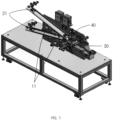
- Fig. 1 is a perspective view of a cylindrical battery winding apparatus according to the present invention, which comprises a pair of separator unwinding parts (10) that unwind separators from separator rolls (11) to separate a positive electrode material and a negative electrode material; a pair of alignment parts (20) including grippers (21) that pull and align one end of the positive electrode material and the negative electrode material respectively cut to a predetermined length; a winding part (30) that stacks the positive electrode material/separator/negative electrode material and winds the stacked materials to form a jelly roll; and a cutting part (40) that cuts the separator and cuts a fixing tape to secure the jelly roll.
- a pair of separator unwinding parts 10 that unwind separators from separator rolls (11) to separate a positive electrode material and a negative electrode material
- a pair of alignment parts (20) including grippers (21) that pull and align one end of the positive electrode material and the negative electrode material respectively cut to a predetermined length
- a winding part (30) that stacks the positive electrode
- the pair of alignment parts (20) is configured as a pair of upper and lower parts to supply the positive electrode material and the negative electrode material, respectively.
- the grippers are used to maintain tension while ensuring that the positive electrode material and the negative electrode material are wound on a mandrel (31) in a cylindrical manner.
- the positive electrode material and the negative electrode material are called electrode materials.
- the electrode materials, cut to a predetermined length, are manually loaded onto the seat plate, and one end is manually positioned against the gripper that has returned to its original position.
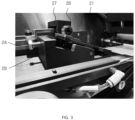
- the gripping is released by the grip releaser (28) shown in Fig. 3 .
- the gripping part of the gripper holds the electrode material due to the force of a compression spring (29), and pressing the push part releases the grip.
- the grip releaser is implemented as a rotating roller mounted on a bracket (27) at a predetermined allowable height, which causes the gripping part to open when the push part is pressed beyond the allowable height.
- a fixing tape is wound around it, and the tape cutter (45) operates vertically to cut the fixing tape. Subsequently, the air cylinders on both sides retract, allowing the mandrel to be removed, thus completing and discharging the jelly roll.
Landscapes
- Engineering & Computer Science (AREA)
- Manufacturing & Machinery (AREA)
- Chemical & Material Sciences (AREA)
- Chemical Kinetics & Catalysis (AREA)
- Electrochemistry (AREA)
- General Chemical & Material Sciences (AREA)
- Primary Cells (AREA)
- Secondary Cells (AREA)
Abstract
Description
- This invention relates to a winding apparatus for cylindrical batteries, and more specifically, to a winding apparatus that can manufacture high-quality cylindrical batteries by maintaining a constant tension required for alignment within the allowable tolerance.
- Cylindrical batteries are composed of jelly rolls. The jelly roll is an intermediate form of the battery fabricated through a winding process, where a separator is inserted between positive and negative electrodes, and then rolled up, or through a stacking process, where positive and negative electrodes are cut and stacked alternately. The jelly roll is then inserted into a cylindrical or rectangular aluminum can, and in the case of pouch-type batteries, it is wrapped in a pouch, sealed or welded to prevent electrolytes from leaking out, and then the electrolyte is injected to complete the assembly process. After injecting the electrolyte into the cylindrical can containing the jelly roll and allowing it to stabilize, it becomes a cylindrical battery.
- Defects in secondary ion batteries can lead to fires, necessitating strict quality control. The causes of defects in secondary ion batteries can include misalignment of the positive and negative electrodes, and repeated charging and discharging can cause material deformation, leading to issues such as swelling.
- Additionally, traditional winding apparatus require operators to manually position and guide the electrode materials, resulting in low productivity and frequent defects.
- To solve the above-mentioned problems, the present invention provides a semi-automatic cylindrical battery winding apparatus that can align within allowable tolerances while maintaining constant tension using grippers and servo motors.
- A cylindrical battery winding apparatus according to the present invention comprises a pair of separator unwinding parts that unwind separators from separator rolls to separate a positive electrode material and a negative electrode material; a pair of alignment parts including grippers that pull and align one end of the positive electrode material and the negative electrode material respectively cut to a predetermined length; a winding part that stacks the positive electrode material/separator/negative electrode material and winds the stacked materials to form a jelly roll; and a cutting part that cuts the separator and cuts a fixing tape to secure the jelly roll.
- The pair of separator unwinding parts is configured as a pair of upper and lower parts and a pair of tension rolls is used to adjust tension of the separator unwound from the separator rolls.
- The gripper is wire-connected to a wire shaft that rotates by a servo motor.
- When the positive electrode material and a negative electrode material are wound on a mandrel, the gripper is dragged by a rotational force of the mandrel and the wire of the servo motor is pulled to generate tension, and when winding is completed, the wire is wound around the wire shaft by rotation of the servo motor and returned to its original position.
- The gripper is guided by an LM guide and released by a grip releaser.
- The winding part includes the mandrel, which is a core rod, the servo motor providing rotational force to the mandrel, and a cylinder for contacting and separating the mandrel.
- The cutting part includes a clamp roll, a clamp holder holding the clamp roll, a separator cutter for cutting the separator, a tape cutter for cutting the fixing tape, and a plurality of cylinders for vertically operating the clamp holder, the separator cutter, and the tape cutter.
- The cylindrical battery winding apparatus according to the present invention uses grippers controlled by servo motors to maintain constant tension while keeping alignment within allowable tolerances, resulting in fewer defects.
- Additionally, the semi-automatic loading and seating guide operations for the electrode materials significantly enhance productivity.
-
-
FIG. 1 is a perspective view of a cylindrical battery winding apparatus according to the present invention. -
FIG. 2 is a perspective view of a separator unwinding parts and an alignment parts of the cylindrical battery winding apparatus according to the present invention. -
FIG. 3 is a photograph of a releaser of a gripper according to the present invention. -
FIG. 4 is a perspective view of a winding part according to the present invention. -
FIG. 5 is a perspective view of a cutting part according to the present invention. -
FIG. 6 is a photograph of a manufactured cylindrical battery winding apparatus according to the present invention. -
Fig. 1 is a perspective view of a cylindrical battery winding apparatus according to the present invention, which comprises a pair of separator unwinding parts (10) that unwind separators from separator rolls (11) to separate a positive electrode material and a negative electrode material; a pair of alignment parts (20) including grippers (21) that pull and align one end of the positive electrode material and the negative electrode material respectively cut to a predetermined length; a winding part (30) that stacks the positive electrode material/separator/negative electrode material and winds the stacked materials to form a jelly roll; and a cutting part (40) that cuts the separator and cuts a fixing tape to secure the jelly roll. -
Fig. 2 is a perspective view of the pair of separator unwinding parts (10) and the pair of alignment parts (20) of the cylindrical battery winding apparatus according to the present invention. The separator is a membrane that prevents short-circuiting by separating the positive electrode material and the negative electrode material while allowing lithium ions to pass through. - The pair of separator unwinding parts (10) is configured as a pair of upper and lower parts and a pair of tension rolls (12) is used to adjust tension of the separator unwound from the separator rolls (11) while the positive and negative electrode materials are stacked and wound at idle rolls (13), respectively.
- The pair of alignment parts (20) is configured as a pair of upper and lower parts to supply the positive electrode material and the negative electrode material, respectively. To prevent misalignment that could lead to defects, the grippers are used to maintain tension while ensuring that the positive electrode material and the negative electrode material are wound on a mandrel (31) in a cylindrical manner.
- The positive electrode material and the negative electrode material are called electrode materials.
- In a conventional winding apparatus, the electrode materials cut to a predetermined length are placed on a seat plate (25), and one end is inserted into the mandrel via the idle roll (13) and rotated for winding. At this time, the other end of the electrode materials remains free, which can cause it to flutter or misalign, resulting in defects in the jelly roll.
- In order to solve the above problems, the present invention ensures that one end of the electrode materials is held by a gripper while the other end is wound on the mandrel, creating tension.
- The gripper (21) that travels along the seat plate (25) is connected via a wire (24) to a wire shaft (23) that rotates under the control of a servo motor (22). When the electrode materials are being wound, it is pulled by the rotational force of the mandrel, causing the servo motor to consistently pull the wire, generating tension. Once the winding is complete, the gripper returns to its original position as the wire is wound back onto the wire shaft through the reverse rotation of the servo motor.
- The present invention utilizes an LM guide (26) to ensure that the gripper moves smoothly and without shaking. The gripper is mounted on an LM guide block.
- The electrode materials, cut to a predetermined length, are manually loaded onto the seat plate, and one end is manually positioned against the gripper that has returned to its original position. Once the winding is complete, the gripping is released by the grip releaser (28) shown in
Fig. 3 . The gripping part of the gripper holds the electrode material due to the force of a compression spring (29), and pressing the push part releases the grip. The grip releaser is implemented as a rotating roller mounted on a bracket (27) at a predetermined allowable height, which causes the gripping part to open when the push part is pressed beyond the allowable height. -
Fig. 4 is a perspective view of the winding part, which includes the mandrel (31) for winding, the servo motor (32) that provides rotational force to the mandrel, and an air cylinder (33) that removes the mandrel from the wound jelly roll. The rotational force from the servo motor is transmitted to the mandrel via a belt or chain. The mandrel is cut in the center part and comes into contact with air cylinders installed on both sides, and when the jelly roll is completed, it retreats to both sides, falls out of the jelly roll, and the jelly roll is discharged. -
Fig. 4 also shows a perspective view of the cutting part (40), wherein the cutting part includes a cylinder (41), a clamp holder (42), a clamp roll (43), a separator cutter (44), and a tape cutter (45). - When the jelly roll is wound to a specified circumference, the clamp holder (42) and clamp roll (43) secure the separator after the operation of the cylinder. The separator cutter (44) then operates vertically to cut the separator.
- To secure the jelly roll, a fixing tape is wound around it, and the tape cutter (45) operates vertically to cut the fixing tape. Subsequently, the air cylinders on both sides retract, allowing the mandrel to be removed, thus completing and discharging the jelly roll.
- The cylindrical battery winding apparatus according to the present invention can be used to manufacture the jelly roll utilized in cylindrical batteries.
- During the production of the jelly roll, the electrode materials loading and seating guide operations can be performed semi-automatically, thereby enhancing productivity.
Claims (8)
- A cylindrical battery winding apparatus, comprising:a pair of separator unwinding parts (10) that unwind separators from separator rolls (11) to separate a positive electrode material and a negative electrode material;a pair of alignment parts (20) including grippers (21) that pull and align one end of the positive electrode material and the negative electrode material respectively cut to a predetermined length;a winding part (30) that stacks the positive electrode material/separator/negative electrode material and winds the stacked materials to form a jelly roll; anda cutting part (40) that cuts the separator and cuts a fixing tape to secure the jelly roll.
- The cylindrical battery winding apparatus as claimed in claim 1, wherein the pair of separator unwinding parts is configured as a pair of upper and lower parts and a pair of tension rolls (12) is used to adjust tension of the separator unwound from the separator rolls.
- The cylindrical battery winding apparatus as claimed in claim 1, wherein the gripper is wire-connected to a wire shaft that rotates by a servo motor.
- As claimed in claim 1, when the positive electrode material and a negative electrode material are wound on a mandrel, the gripper is dragged by a rotational force of the mandrel and the wire of the servo motor is pulled to generate tension,
and when winding is completed, the wire is wound around the wire shaft by rotation of the servo motor and returned to its original position. - The cylindrical battery winding apparatus as claimed in claim 1, wherein the gripper is guided by an LM guide.
- The cylindrical battery winding apparatus as claimed in claim 1, wherein the gripper is released by a grip releaser.
- The cylindrical battery winding apparatus as claimed in claim 1, wherein the winding part includes the mandrel, which is a core rod, the servo motor providing rotational force to the mandrel, and a cylinder for contacting and separating the mandrel.
- The cylindrical battery winding apparatus as claimed in claim 1, wherein the cutting part includes a clamp roll, a clamp holder holding the clamp roll, a separator cutter for cutting the separator, a tape cutter for cutting the fixing tape, and a plurality of cylinders for vertically operating the clamp holder, the separator cutter, and the tape cutter.
Applications Claiming Priority (2)
| Application Number | Priority Date | Filing Date | Title |
|---|---|---|---|
| KR1020220067295A KR102458069B1 (en) | 2022-06-02 | 2022-06-02 | Winding apparatus for cylindrical battery |
| PCT/KR2022/012997 WO2023234480A1 (en) | 2022-06-02 | 2022-08-31 | Cylindrical battery winding apparatus |
Publications (2)
| Publication Number | Publication Date |
|---|---|
| EP4535470A1 true EP4535470A1 (en) | 2025-04-09 |
| EP4535470A4 EP4535470A4 (en) | 2025-10-29 |
Family
ID=83805992
Family Applications (1)
| Application Number | Title | Priority Date | Filing Date |
|---|---|---|---|
| EP22945018.4A Pending EP4535470A4 (en) | 2022-06-02 | 2022-08-31 | CYLINDRICAL BATTERY WINDING DEVICE |
Country Status (4)
| Country | Link |
|---|---|
| US (1) | US12424652B2 (en) |
| EP (1) | EP4535470A4 (en) |
| KR (1) | KR102458069B1 (en) |
| WO (1) | WO2023234480A1 (en) |
Family Cites Families (9)
| Publication number | Priority date | Publication date | Assignee | Title |
|---|---|---|---|---|
| US6534952B1 (en) * | 1999-11-08 | 2003-03-18 | Matsushita Electric Industrial Co., Ltd. | Spiral electrode group winding method and device and battery using them |
| KR20040079537A (en) * | 2003-03-07 | 2004-09-16 | 에프원 주식회사 | Winder for winding type cell stacking machine |
| KR100731452B1 (en) | 2005-12-29 | 2007-06-21 | 삼성에스디아이 주식회사 | Pole plate winding device and winding method of cylindrical battery |
| KR102084659B1 (en) * | 2010-10-15 | 2020-03-04 | 에이일이삼 시스템즈, 엘엘씨 | Integral battery tab |
| KR101429132B1 (en) * | 2013-03-06 | 2014-08-27 | 유일에너테크(주) | Apparatus for winding battery cell and battery cell |
| KR101649730B1 (en) * | 2015-02-10 | 2016-08-19 | 주식회사 디에이테크놀로지 | Apparatus for Rolling Electrode Film for 2nd Battery |
| KR102032814B1 (en) * | 2019-07-26 | 2019-10-17 | (주)대흥정밀산업 | Jelly roll end compression molding device of secondary cell |
| KR102821228B1 (en) * | 2020-06-19 | 2025-06-17 | 주식회사 엘지에너지솔루션 | Manufacturing method of unit cell |
| CN113241480B (en) * | 2021-05-11 | 2022-11-11 | 深圳吉阳智能科技有限公司 | Diaphragm non-stop constant speed high-efficiency winding machine |
-
2022
- 2022-06-02 KR KR1020220067295A patent/KR102458069B1/en active Active
- 2022-08-31 US US18/870,820 patent/US12424652B2/en active Active
- 2022-08-31 WO PCT/KR2022/012997 patent/WO2023234480A1/en not_active Ceased
- 2022-08-31 EP EP22945018.4A patent/EP4535470A4/en active Pending
Also Published As
| Publication number | Publication date |
|---|---|
| WO2023234480A1 (en) | 2023-12-07 |
| US20250174700A1 (en) | 2025-05-29 |
| KR102458069B1 (en) | 2022-10-24 |
| US12424652B2 (en) | 2025-09-23 |
| EP4535470A4 (en) | 2025-10-29 |
Similar Documents
| Publication | Publication Date | Title |
|---|---|---|
| US11101490B2 (en) | Apparatus and method for manufacturing electrode assembly and electrode assembly manufactured using the same | |
| JP5670973B2 (en) | Winding device | |
| KR101156831B1 (en) | Wound electrode body manufacturing method and apparatus, and electrode winding apparatus | |
| CN101569031B (en) | Electrode plate for battery, polar plate group for battery, lithium secondary battery, method for manufacturing electrode plate for battery, and apparatus for manufacturing electrode plate for battery | |
| CN216750029U (en) | Winding equipment | |
| US4975095A (en) | Method of winding an electrochemical cell and cell produced by the method | |
| KR101410036B1 (en) | Automated folding system for manufacturing electrode assembly of secondary battery | |
| JP3794261B2 (en) | Method and apparatus for winding spiral electrode group and battery using the same | |
| HK1049737B (en) | Spiral electrode group winding method and device and battery using them | |
| KR101623716B1 (en) | Guide Roll Device Having Pressing Arms | |
| CN103247826B (en) | Coiling device | |
| CN102270772A (en) | Manufacturing device for winding components | |
| CN103052582A (en) | Defective electrode winding device | |
| US12492095B2 (en) | Apparatus for manufacturing electrode assembly, electrode assembly manufactured therethrough, and secondary battery | |
| WO2010082256A1 (en) | Negative electrode plate for nonaqueous battery, electrode group for nonaqueous battery and method for producing same, and tubular nonaqueous secondary battery and method for manufacturing same | |
| US12519140B2 (en) | Method of manufacturing battery | |
| WO2024022540A2 (en) | Method for producing sodium-ion steel housing battery | |
| US12424652B2 (en) | Winding apparatus for cylindrical battery | |
| US20230048065A1 (en) | Method of manufacturing battery | |
| CN115692870A (en) | Winding equipment | |
| JP4204243B2 (en) | Battery manufacturing method | |
| CN111129607B (en) | Lithium-sulfur battery bag making and laminating method and device | |
| JPH11307132A (en) | Plate winder for secondary battery | |
| CN216698432U (en) | Pole piece feeding device | |
| JP2009064686A (en) | Method and apparatus for manufacturing wound electrode body |
Legal Events
| Date | Code | Title | Description |
|---|---|---|---|
| STAA | Information on the status of an ep patent application or granted ep patent |
Free format text: STATUS: THE INTERNATIONAL PUBLICATION HAS BEEN MADE |
|
| PUAI | Public reference made under article 153(3) epc to a published international application that has entered the european phase |
Free format text: ORIGINAL CODE: 0009012 |
|
| STAA | Information on the status of an ep patent application or granted ep patent |
Free format text: STATUS: REQUEST FOR EXAMINATION WAS MADE |
|
| 17P | Request for examination filed |
Effective date: 20241206 |
|
| AK | Designated contracting states |
Kind code of ref document: A1 Designated state(s): AL AT BE BG CH CY CZ DE DK EE ES FI FR GB GR HR HU IE IS IT LI LT LU LV MC MK MT NL NO PL PT RO RS SE SI SK SM TR |
|
| DAV | Request for validation of the european patent (deleted) | ||
| DAX | Request for extension of the european patent (deleted) | ||
| A4 | Supplementary search report drawn up and despatched |
Effective date: 20250930 |
|
| RIC1 | Information provided on ipc code assigned before grant |
Ipc: H01M 10/04 20060101AFI20250924BHEP |