EP4535238A2 - Hierarchisches rekonfigurierbares neuronales mehrsegment-spiking-netzwerk - Google Patents
Hierarchisches rekonfigurierbares neuronales mehrsegment-spiking-netzwerk Download PDFInfo
- Publication number
- EP4535238A2 EP4535238A2 EP25152215.7A EP25152215A EP4535238A2 EP 4535238 A2 EP4535238 A2 EP 4535238A2 EP 25152215 A EP25152215 A EP 25152215A EP 4535238 A2 EP4535238 A2 EP 4535238A2
- Authority
- EP
- European Patent Office
- Prior art keywords
- neuron
- array
- neurosynaptic
- synaptic
- switching circuit
- Prior art date
- Legal status (The legal status is an assumption and is not a legal conclusion. Google has not performed a legal analysis and makes no representation as to the accuracy of the status listed.)
- Pending
Links
Images



Classifications
-
- G—PHYSICS
- G06—COMPUTING OR CALCULATING; COUNTING
- G06N—COMPUTING ARRANGEMENTS BASED ON SPECIFIC COMPUTATIONAL MODELS
- G06N3/00—Computing arrangements based on biological models
- G06N3/02—Neural networks
- G06N3/04—Architecture, e.g. interconnection topology
- G06N3/049—Temporal neural networks, e.g. delay elements, oscillating neurons or pulsed inputs
-
- G—PHYSICS
- G06—COMPUTING OR CALCULATING; COUNTING
- G06N—COMPUTING ARRANGEMENTS BASED ON SPECIFIC COMPUTATIONAL MODELS
- G06N3/00—Computing arrangements based on biological models
- G06N3/02—Neural networks
- G06N3/06—Physical realisation, i.e. hardware implementation of neural networks, neurons or parts of neurons
- G06N3/063—Physical realisation, i.e. hardware implementation of neural networks, neurons or parts of neurons using electronic means
-
- G—PHYSICS
- G06—COMPUTING OR CALCULATING; COUNTING
- G06N—COMPUTING ARRANGEMENTS BASED ON SPECIFIC COMPUTATIONAL MODELS
- G06N3/00—Computing arrangements based on biological models
- G06N3/02—Neural networks
- G06N3/06—Physical realisation, i.e. hardware implementation of neural networks, neurons or parts of neurons
- G06N3/063—Physical realisation, i.e. hardware implementation of neural networks, neurons or parts of neurons using electronic means
- G06N3/065—Analogue means
Definitions
- both long-range and short-range interconnections exist between neurons of different neurosynaptic subarrays, and wherein denser connectivity exists in between proximal neurosynaptic subarrays than between more distant neurosynaptic subarrays.
- a neuron membrane potential of one of the neurons is implemented in the analog domain as a voltage across a capacitor or as a multibit variable stored in digital latches; or in the digital domain using CMOS logic circuits.
- a spiking neural processor comprises a data-to-spike encoder that encodes digital or analog data into spikes, a neurosynaptic array according to the first aspect of the disclosure, arranged to take the spikes outputted by the data-to spike encoder as input and arranged to output a spatio-temporal spike train as a result of the input, and a spike decoder arranged to decode the spatio-temporal spike trains originating from the neurosynaptic array.
- the subset of weight blocks to which an output block is electrically connected forms one or more multiple columns within the array of synaptic elements and/or wherein the synaptic elements comprised in a particular weight block are provided within the same row of the neurosynaptic array.
- Each of the synapses 101 in the synapse matrix 150 has a certain weight w i,j attributed to it, where i denotes the i th row of the synapse matrix 150, and j denotes the j th column of the synapse matrix 150.
- Each row of the synapse matrix 150 is driven by a respective input 102.
- the input 102 is an electrical signal and can be e.g. a voltage or current spike(train).
- Each column j of the synapse matrix 150 drives a respective output neuron 103 denoted N j .
- Each of the weights w i,j denote the strength or amplitude of the connection between the respective input 102 to the ith row of the synapse matrix 150 and the neuron N j connected to the jth column of the synapse matrix 150. In other words, if the weight w i,j increases, the connection is strengthened between the respective input 102 to the ith row and the neuron N j connected to the j th column of the synapse matrix 150.
- the neuron fires.
- This electrical signal is represented either as a voltage or current spike and is send to another part of the SNN via a spike out line 180.
- the neuron row 160 can be controlled in that e.g. the accumulation period and/or the integration constant of a particular neuron(s) 103 can be controlled via control signals 170 (although only one control signals 170 is shown, there may be one or more separate control signals for each neuron). In this way, the reaction of the neurons 103 to the signals from the synapse matrix 150 can be controlled.
- This square neurosynaptic array is an example of a spiking neural network hardware such as the one described in US 63/107,498 , which utilizes configurable arrays of spiking neurons, synapses, connected using a programmable interconnect structure that facilitates the implementation of any arbitrary connection topology.
- an efficient neurosynaptic array was described using distributed components that is composed of n inputs driving n 2 synapses and n neurons, i.e. the system incorporates the presence of electronic synapses at the junctions of the array, while the periphery of the array includes rows of the neuron circuits, which mimic the action of the soma and axon hillock of biological neurons.
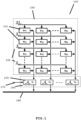
- FIGS. 2A-C show schematic representations of organization of the reconfigurable neurosynaptic array comprising n 2 synaptic elements and n neurons.
- the primary organizational units are weight blocks 201 and output blocks 202 that collect 1 ⁇ m synaptic elements and m neurons, respectively.
- the number of synapse columns (columns of synaptic elements) in a weight block 201 is thus equal to m as shown in Fig. 2B , and n / m is the total number of weight blocks 201 in each row of the neurosynaptic array 150, with n the total number of columns in the synapse matrix 150 (assuming a square array).
- a weight block can comprise multiple rows of synaptic elements as well as multiple columns of synaptic elements, however the number of rows in each weight block 201 is 1 in this example.
- Each weight block is indicated as W ij with i ⁇ [1, n ] and j ⁇ [ 1, n / m ] .
- Fig. 2A depicts a single input line for each row of weight blocks 201 for simplicity, each row of weight blocks 201 actually receives multiple inputs, e.g. a weight block 201 comprising m synaptic elements may have m inputs as shown in Fig. 2B , so that the weight blocks 201 in each row are connected to m input lines.
- Fig. 2A depicts a single line for transmitting the outputs of each column of weight blocks 201 for simplicity.
- each column of weight blocks 201 actually generates multiple outputs, e.g. a weight block 201 comprising m synaptic elements may generate m outputs as shown in Fig. 2B , so that the weight blocks 201 in each column are connected to m output lines.
- FIG. 2D an exemplary embodiment is shown of possible configurations of the neuron switching circuit 260 in the column/neuron decoder 250 when four synapse columns 270 serve as input to the column/neuron decoder 250.
- the column/neuron decoder 250 is arranged to provide each group of four adjacent synapse columns 270 with four possible output neuron configurations 280 as shown, i.e. the four synapse columns may have their outputs selectively directed to four different sets of neurons 254 of the output block 202.
- the switching signal paths 261 may comprise conducting paths implemented in the logic circuit of the switching circuit 260, and they can be switched between different configurations in a particular implementation by e.g. configurable or fixed transistor gates.
- the particular connection of the switching signal paths 261 can be set at the initial manufacture of the neurosynaptic array, e.g. in the factory, and/or can be set on the fly via programming or other configuration of the column/neuron decoder 250 and/or neuron switching circuit 260.
- the neuron switching circuit 260 can e.g. reconfigure the switching signal paths 261 dynamically during operation of the neurosynaptic array.
- Segmenting the array enables uniformity in terms of robustness and reliability of the performance, i.e. segmentation allows (i) a robust power distribution (vertical wide metal busses (for lower resistance) can be placed at the synapse row boundaries to alleviate IR drop concerns), (ii) if an interface for access to weight retention circuits requires a clock, segmentation creates hierarchy needed for a clock rebuffing strategy, (iii) segmentation improves signal integrity - instead of a single pre-synapse with large drive strength, segmentation allows for a distributed approach, since signals can be rebuffed/amplified after each segment, (iv) segmentation increases observability within the array and simplifies verification processes.
- the segments could be organized based on characteristics of the target signal processing function (for example gain, filtering, multiplication, addition), or frequency/time constants of operation.
- segments could be organized based on bio-physically/chemically-inspired definitions (for example spatio-temporal (long- and short-term) evaluation, aging artifacts, brain communication costs and regions/layers).
- bio-physically/chemically-inspired definitions for example spatio-temporal (long- and short-term) evaluation, aging artifacts, brain communication costs and regions/layers.
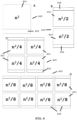
- FIGS. 4A-D schematically show an exemplary organization of the reconfigurable neuro-synaptic array 400: in FIG. 4A n 2 synapses 401 and n neurons 402, in FIG. 4B dividing the array 400 in FIG. 4A into two segments, each with n 2 /2 synapses and 2 ⁇ n neurons, in FIG. 4C dividing an array 400 into four segments, each with n 2 /4 synapses 401 and 4 ⁇ n neurons 402, and in FIG. 4D dividing an array 400 into eight segments, each with n 2 /8 synapses 401 and 8 ⁇ n neurons 402.
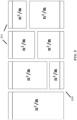
- FIG. 5 shows an exemplary representation of an organization of the reconfigurable neuro-synaptic array 500: each of the segments (subarrays) 501 can have a different synaptic count per neuron. On a segment 501 level, to benefit from increased accuracy of sensor outputs and/or increased discriminating feature selection and extraction capabilities, specialized segments, each devoted to processing a single modality, can be defined.
- neuroreceptors AMPA, NMDA, GABA
- neuron conductance-based Na, Ca, K
- Such neurons could use internal (neuroreceptors or conductance-based) circuits to perform functions, which usually require a circuit of several neurons.
- Each receptor represents a multi-(trans)conductance channel, which models associated nonlinear characteristics.
- NMDA receptors can provide activity-dependent modifications of synaptic weight, while AMPA receptors can enable a fast synaptic current to drive the soma.
- Fast receptor modifications can act as a control mechanism for activity-dependent changes in synaptic efficacy. If groups of dendritic spikes (bursts) are sufficient to exceed the threshold of a particular neuron, the axon will generate action potentials; ensuing spike is fed-back into the dendrite, and together with soma signals multiplied and added to NMDA receptor signals to, subsequently, generate the weight control.
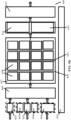
- FIG. 6A show an exemplary representation of a spiking neural processor 600 incorporating one or more data-to-spike encoders 606, multi-segmented analog/mixed-signal neurosynaptic array 607, and spike decoders 611.
- the large discrepancy in energy-efficiency and cognitive performance of biological nervous systems and conventional computing is profoundly exemplified with tasks related to real-time interactions with the physical surroundings, in particular in presence of uncontrolled or noisy sensory input.
- the neuromorphic event-based neuron network due to ability to learn by example, parallelism of the operation, associative memory, multifactorial optimization, and extensibility, is an inherent choice for compact and low power cognitive systems that learn and adapt to the changes in the statistics of the complex sensory signals.
- the present multi-segment reconfigurable architecture for the neuromorphic networks allows designs that offer energy-efficient solutions to applications ranging for detecting patterns of biomedical signals (e.g. spike sorting, seizure detection, etc.), classifying images (e.g. handwritten digits), speech commands, and can be applied in wide range of the devices, including smart sensors or wearable devices in cyber-physical systems and Internet-of-Things.
- biomedical signals e.g. spike sorting, seizure detection, etc.
- classifying images e.g. handwritten digits
- speech commands e.g. handwritten digits
Landscapes
- Engineering & Computer Science (AREA)
- Physics & Mathematics (AREA)
- Theoretical Computer Science (AREA)
- Health & Medical Sciences (AREA)
- Life Sciences & Earth Sciences (AREA)
- Biomedical Technology (AREA)
- Biophysics (AREA)
- Evolutionary Computation (AREA)
- General Engineering & Computer Science (AREA)
- Data Mining & Analysis (AREA)
- Artificial Intelligence (AREA)
- General Health & Medical Sciences (AREA)
- Molecular Biology (AREA)
- Computing Systems (AREA)
- Computational Linguistics (AREA)
- General Physics & Mathematics (AREA)
- Mathematical Physics (AREA)
- Software Systems (AREA)
- Neurology (AREA)
- Logic Circuits (AREA)
- Multi Processors (AREA)
- Data Exchanges In Wide-Area Networks (AREA)
- Image Analysis (AREA)
Applications Claiming Priority (3)
| Application Number | Priority Date | Filing Date | Title |
|---|---|---|---|
| US202163175570P | 2021-04-16 | 2021-04-16 | |
| EP22724651.9A EP4323923B1 (de) | 2021-04-16 | 2022-04-16 | Hierarchisches rekonfigurierbares neuronales mehrsegment-spiking-netzwerk |
| PCT/EP2022/060197 WO2022219195A1 (en) | 2021-04-16 | 2022-04-16 | Hierarchical reconfigurable multi-segment spiking neural network |
Related Parent Applications (1)
| Application Number | Title | Priority Date | Filing Date |
|---|---|---|---|
| EP22724651.9A Division EP4323923B1 (de) | 2021-04-16 | 2022-04-16 | Hierarchisches rekonfigurierbares neuronales mehrsegment-spiking-netzwerk |
Publications (2)
| Publication Number | Publication Date |
|---|---|
| EP4535238A2 true EP4535238A2 (de) | 2025-04-09 |
| EP4535238A3 EP4535238A3 (de) | 2025-06-25 |
Family
ID=81750577
Family Applications (2)
| Application Number | Title | Priority Date | Filing Date |
|---|---|---|---|
| EP25152215.7A Pending EP4535238A3 (de) | 2021-04-16 | 2022-04-16 | Hierarchisches rekonfigurierbares neuronales mehrsegment-spiking-netzwerk |
| EP22724651.9A Active EP4323923B1 (de) | 2021-04-16 | 2022-04-16 | Hierarchisches rekonfigurierbares neuronales mehrsegment-spiking-netzwerk |
Family Applications After (1)
| Application Number | Title | Priority Date | Filing Date |
|---|---|---|---|
| EP22724651.9A Active EP4323923B1 (de) | 2021-04-16 | 2022-04-16 | Hierarchisches rekonfigurierbares neuronales mehrsegment-spiking-netzwerk |
Country Status (8)
| Country | Link |
|---|---|
| US (1) | US20240185044A1 (de) |
| EP (2) | EP4535238A3 (de) |
| JP (1) | JP2024513998A (de) |
| KR (1) | KR20230170916A (de) |
| CN (1) | CN117178275A (de) |
| ES (1) | ES3015517T3 (de) |
| TW (1) | TW202247050A (de) |
| WO (1) | WO2022219195A1 (de) |
Families Citing this family (1)
| Publication number | Priority date | Publication date | Assignee | Title |
|---|---|---|---|---|
| TW202437241A (zh) | 2023-02-24 | 2024-09-16 | 荷蘭商因納特拉納米系統有限公司 | 始終開啟之神經形態音訊處理模組及方法 |
Family Cites Families (6)
| Publication number | Priority date | Publication date | Assignee | Title |
|---|---|---|---|---|
| US8856055B2 (en) * | 2011-04-08 | 2014-10-07 | International Business Machines Corporation | Reconfigurable and customizable general-purpose circuits for neural networks |
| US10824937B2 (en) * | 2016-12-20 | 2020-11-03 | Intel Corporation | Scalable neuromorphic core with shared synaptic memory and variable precision synaptic memory |
| US11763139B2 (en) * | 2018-01-19 | 2023-09-19 | International Business Machines Corporation | Neuromorphic chip for updating precise synaptic weight values |
| US12554961B2 (en) * | 2018-03-30 | 2026-02-17 | International Business Machines Corporation | Block transfer of neuron output values through data memory for neurosynaptic processors |
| EP3605401A1 (de) * | 2018-07-31 | 2020-02-05 | GrAl Matter Labs S.A.S. | Datenverarbeitungsmodul, datenverarbeitungssystem und datenverarbeitungsverfahren |
| JP7562522B2 (ja) * | 2018-11-18 | 2024-10-07 | インナテラ・ナノシステムズ・ビー.ブイ. | スパイキングニューラルネットワーク |
-
2022
- 2022-04-16 ES ES22724651T patent/ES3015517T3/es active Active
- 2022-04-16 KR KR1020237035636A patent/KR20230170916A/ko active Pending
- 2022-04-16 WO PCT/EP2022/060197 patent/WO2022219195A1/en not_active Ceased
- 2022-04-16 US US18/286,231 patent/US20240185044A1/en active Pending
- 2022-04-16 JP JP2023563057A patent/JP2024513998A/ja active Pending
- 2022-04-16 EP EP25152215.7A patent/EP4535238A3/de active Pending
- 2022-04-16 EP EP22724651.9A patent/EP4323923B1/de active Active
- 2022-04-16 CN CN202280028714.6A patent/CN117178275A/zh active Pending
- 2022-04-18 TW TW111114692A patent/TW202247050A/zh unknown
Non-Patent Citations (4)
| Title |
|---|
| E.R. WEIBEL: "Symmorphosis: On form and function in shaping life", 2000, HARVARD UNIVERSITY PRESS |
| K.L. SHEPARDV. NARAYANAN: "Noise in deep submicron digital design", IEEE INTERNATIONAL CONFERENCE ON COMPUTER-AIDED DESIGN, 1997, pages 524 - 531 |
| M.J.M. PELGROMA.C.J. DUINMAIJERA.P.G. WELBERS: "Matching properties of MOS transistors", IEEE JOURNAL OF SOLID-STATE CIRCUITS, vol. 24, no. 5, 1989, pages 1433 - 1439, XP008005501, DOI: 10.1109/JSSC.1989.572629 |
| T. O'LEARYA.H. WILIAMSA. FRANCEE. MARDER: "Cell types, network homeostasis, and pathological compensation from a biologically plausible ion channel expression model,", NEURON, vol. 82, 2014, pages 809 - 821, XP029027110, DOI: 10.1016/j.neuron.2014.04.002 |
Also Published As
| Publication number | Publication date |
|---|---|
| CN117178275A (zh) | 2023-12-05 |
| ES3015517T3 (en) | 2025-05-06 |
| US20240185044A1 (en) | 2024-06-06 |
| EP4323923B1 (de) | 2025-02-12 |
| JP2024513998A (ja) | 2024-03-27 |
| TW202247050A (zh) | 2022-12-01 |
| EP4323923C0 (de) | 2025-02-12 |
| EP4323923A1 (de) | 2024-02-21 |
| KR20230170916A (ko) | 2023-12-19 |
| EP4535238A3 (de) | 2025-06-25 |
| WO2022219195A1 (en) | 2022-10-20 |
Similar Documents
| Publication | Publication Date | Title |
|---|---|---|
| Moradi et al. | A scalable multicore architecture with heterogeneous memory structures for dynamic neuromorphic asynchronous processors (DYNAPs) | |
| US20260017500A1 (en) | Resilient neural network | |
| Indiveri et al. | Artificial cognitive systems: From VLSI networks of spiking neurons to neuromorphic cognition | |
| Neftci et al. | Synthesizing cognition in neuromorphic electronic systems | |
| De Salvo | Brain-inspired technologies: Towards chips that think? | |
| EP4557172A2 (de) | Verteilte synaptische mehrkomponenten-rechenstruktur | |
| Qiao et al. | Analog circuits for mixed-signal neuromorphic computing architectures in 28 nm FD-SOI technology | |
| Douglas et al. | Hybrid analog-digital architectures for neuromorphic systems | |
| EP4323923B1 (de) | Hierarchisches rekonfigurierbares neuronales mehrsegment-spiking-netzwerk | |
| Giulioni et al. | A VLSI network of spiking neurons with plastic fully configurable “stop-learning” synapses | |
| Volanis et al. | Toward silicon-based cognitive neuromorphic ICs—a survey | |
| HK40103848B (en) | Hierarchical reconfigurable multi-segment spiking neural network | |
| HK40103848A (en) | Hierarchical reconfigurable multi-segment spiking neural network | |
| Abderrahmane | Hardware design of spiking neural networks for energy efficient brain-inspired computing | |
| Sayyaparaju et al. | Circuit techniques for efficient implementation of memristor based reservoir computing | |
| Upegui et al. | A methodology for evolving spiking neural-network topologies on line using partial dynamic reconfiguration | |
| Zins et al. | Implementation of Associative Memory Learning in Mobile Robots using Neuromorphic Computing | |
| Upegui et al. | A hardware implementation of a network of functional spiking neurons with hebbian learning | |
| Pachideh et al. | Towards Hardware-Software Self-Adaptive Acceleration of Spiking Neural Networks on Reconfigurable Digital Hardware | |
| Smith | Research agenda: Spacetime computation and the neocortex | |
| George | Structural plasticity in neuromorphic systems | |
| Abdallah et al. | Neuromorphic System Design Fundamentals | |
| Abderrahmane | Impact du codage impulsionnel sur l’efficacité énergétique des architectures neuromorphiques | |
| Kim et al. | Dataflow-Driven Neuromorphic Architectures for Edge AI: Theory, Design, and Applications | |
| Clasca et al. | SECTION IV |
Legal Events
| Date | Code | Title | Description |
|---|---|---|---|
| PUAI | Public reference made under article 153(3) epc to a published international application that has entered the european phase |
Free format text: ORIGINAL CODE: 0009012 |
|
| STAA | Information on the status of an ep patent application or granted ep patent |
Free format text: STATUS: THE APPLICATION HAS BEEN PUBLISHED |
|
| AC | Divisional application: reference to earlier application |
Ref document number: 4323923 Country of ref document: EP Kind code of ref document: P |
|
| AK | Designated contracting states |
Kind code of ref document: A2 Designated state(s): AL AT BE BG CH CY CZ DE DK EE ES FI FR GB GR HR HU IE IS IT LI LT LU LV MC MK MT NL NO PL PT RO RS SE SI SK SM TR |
|
| REG | Reference to a national code |
Ref country code: DE Ref legal event code: R079 Free format text: PREVIOUS MAIN CLASS: G06N0003065000 Ipc: G06N0003049000 |
|
| PUAL | Search report despatched |
Free format text: ORIGINAL CODE: 0009013 |
|
| AK | Designated contracting states |
Kind code of ref document: A3 Designated state(s): AL AT BE BG CH CY CZ DE DK EE ES FI FR GB GR HR HU IE IS IT LI LT LU LV MC MK MT NL NO PL PT RO RS SE SI SK SM TR |
|
| RIC1 | Information provided on ipc code assigned before grant |
Ipc: G06F 15/78 20060101ALI20250519BHEP Ipc: G06N 3/065 20230101ALI20250519BHEP Ipc: G06N 3/049 20230101AFI20250519BHEP |
|
| STAA | Information on the status of an ep patent application or granted ep patent |
Free format text: STATUS: REQUEST FOR EXAMINATION WAS MADE |
|
| 17P | Request for examination filed |
Effective date: 20251223 |