EP4323923B1 - Hierarchisches rekonfigurierbares neuronales mehrsegment-spiking-netzwerk - Google Patents
Hierarchisches rekonfigurierbares neuronales mehrsegment-spiking-netzwerk Download PDFInfo
- Publication number
- EP4323923B1 EP4323923B1 EP22724651.9A EP22724651A EP4323923B1 EP 4323923 B1 EP4323923 B1 EP 4323923B1 EP 22724651 A EP22724651 A EP 22724651A EP 4323923 B1 EP4323923 B1 EP 4323923B1
- Authority
- EP
- European Patent Office
- Prior art keywords
- neurosynaptic
- array
- synaptic
- neuron
- output
- Prior art date
- Legal status (The legal status is an assumption and is not a legal conclusion. Google has not performed a legal analysis and makes no representation as to the accuracy of the status listed.)
- Active
Links
Images




Classifications
-
- G—PHYSICS
- G06—COMPUTING OR CALCULATING; COUNTING
- G06N—COMPUTING ARRANGEMENTS BASED ON SPECIFIC COMPUTATIONAL MODELS
- G06N3/00—Computing arrangements based on biological models
- G06N3/02—Neural networks
- G06N3/04—Architecture, e.g. interconnection topology
- G06N3/049—Temporal neural networks, e.g. delay elements, oscillating neurons or pulsed inputs
-
- G—PHYSICS
- G06—COMPUTING OR CALCULATING; COUNTING
- G06N—COMPUTING ARRANGEMENTS BASED ON SPECIFIC COMPUTATIONAL MODELS
- G06N3/00—Computing arrangements based on biological models
- G06N3/02—Neural networks
- G06N3/06—Physical realisation, i.e. hardware implementation of neural networks, neurons or parts of neurons
- G06N3/063—Physical realisation, i.e. hardware implementation of neural networks, neurons or parts of neurons using electronic means
-
- G—PHYSICS
- G06—COMPUTING OR CALCULATING; COUNTING
- G06N—COMPUTING ARRANGEMENTS BASED ON SPECIFIC COMPUTATIONAL MODELS
- G06N3/00—Computing arrangements based on biological models
- G06N3/02—Neural networks
- G06N3/06—Physical realisation, i.e. hardware implementation of neural networks, neurons or parts of neurons
- G06N3/063—Physical realisation, i.e. hardware implementation of neural networks, neurons or parts of neurons using electronic means
- G06N3/065—Analogue means
Definitions
- the present invention relates to automatic signal recognition techniques, and more particularly, to a system and method for a hierarchical, reconfigurable multi-segment network of spiking neurons.
- Deep neural networks form the basis for a large number of machine learning applications; starting with speech and image recognition, the number of applications that utilize DNNs has increased exponentially.
- hardware (deep-network) accelerators have been implemented on standard synchronous digital logic.
- the high level of parallelism of neural networks is not replicated in the (typically) serial and time-multiplexed processing in digital systems; conversely, computational primitives of hardware DNN emulator realized as analog computing nodes, where memory and processing elements are co-localized, offer significant improvements in terms of speed, size, and power consumption.
- each individual neuron communicates asynchronously and through sparse events, or spikes.
- SNN event-based spiking neural network
- only neurons who change the state generate spikes and may trigger signal processing in subsequent layers, consequently, saving computational resources.
- SNNs incorporate asynchronous distributed architectures that process sparse binary time series by means of local spike-driven computations, local or global feedback, and online learning.
- mixed-signal based SNN processors preserve two of their fundamental characteristics: the explicit representation of time and the explicit use of space, instantiating dedicated physical circuits for each neuron/synapse element.
- SNN implementations adopt a hybrid analog-digital signal representation, i.e. the trains of pulses/spikes transmit analog information in the timing of the events, which are converted back into analog signals in the dendrites (inputs) of the neuron.
- Information is encoded by patterns of activity occurring over populations of neurons, and the synapses (a connection to the subsequent neurons) can adapt their function depending on the pulses they receive, providing signal transmission energy-efficiency, and flexibility to store and recall information.
- SNNs can be directly applied to pattern recognition and sensor data fusion, relying on the principle that amplitude-domain, time-domain, and frequency domain features can be encoded into unique spatial- and temporal-coded spike sequences. The generation of these sequences relies on the use of one or more segments of spiking neurons.
- mapping SNNs onto a hardware substrate do not allow for great flexibility regarding e.g. the number of neurons used for a particular function within the SNN, the connectivity via the synapses, and the configuration of these neurons and synapses.
- the spiking neural network comprises a plurality of spiking neurons, and a plurality of synaptic elements interconnecting the spiking neurons to form the network.
- Each synaptic element is adapted to receive a synaptic input signal and apply a weight to the synaptic input signal to generate a synaptic output signal, the synaptic elements being configurable to adjust the weight applied by each synaptic element.
- each of the spiking neurons is adapted to receive one or more of the synaptic output signals from one or more of the synaptic elements, and generate a spatio-temporal spike train output signal in response to the received one or more synaptic output signals.
- the spiking neural network is partitioned into multiple sub-networks, wherein each sub-network comprises a sub-set of the spiking neurons connected to receive synaptic output signals from a sub-set of the synaptic elements.
- the sub-network is adapted to generate a sub-network output pattern signal in response to a sub-network input pattern signal applied to the sub-network.
- each sub-network forms part of one or multiple cores in an array of cores, each core consisting of a programmable network of spiking neurons implemented in hardware or a combination of hardware and software. Communication between cores in the core array is arranged through a programmable interconnect structure.
- Refigurable neural network circuit which comprises an electronic synapse array including multiple synapses interconnecting a plurality of digital electronic neurons. Each neuron comprises an integrator that integrates input spikes and generates a signal when the integrated inputs exceed a threshold.
- the circuit further comprises a control module for reconfiguring the synapse array.
- the control module comprises a global final state machine that controls timing for operation of the circuit, and a priority encoder that allows spiking neurons to sequentially access the synapse array.
- Document US 2019/303740 A1 discloses a neurosynaptic core which is adapted to apply a plurality of synaptic weights to a plurality of input activations to produce a plurality of output activations.
- Synaptic weights for one of a plurality of logical cores are read.
- the neurosynaptic core is configured to implement the one of the plurality of logical cores using the synaptic weights.
- At least one data block is provided as contiguous input activations to the neurosynaptic core.
- the input activations are processed by the neurosynaptic core to determine at least one contiguous block of output activations.
- the neuro-synaptic segment disclosed in the present invention is organized as repeating arrays of synaptic circuits and neuron units.
- the present invention encompasses modalities of how these arrays are partitioned and mapped to segments, and we describe the methods and mechanisms on which the neurosynaptic array and accompanying connections can be reconfigured and segmented, subsequently offering greater flexibility in mapping SNNs onto hardware substrate.
- the mapping methodology incorporates a constraint driven partitioning and mapping of segments (in terms of the size of each segment (the number of neurons), their connectivity (topology and number of synapses), and their configuration (weights and number of layers)), where the chosen definition and bounded constraint is a performance metric linked with the designated function of the network of segments.
- a neurosynaptic array comprising a plurality of spiking neurons, and a plurality of synaptic elements interconnecting the spiking neurons to form a spiking neural network at least partly implemented in hardware.
- Each synaptic element is arranged to receive a synaptic input signal from at least one of a multiple of inputs and is adapted to apply a weight to the synaptic input signal to generate a synaptic output signal, the synaptic elements being configurable to adjust the weight applied by each synaptic element.
- each of the spiking neurons is arranged to receive one or more of the synaptic output signals from one or more of the synaptic elements, and is adapted to generate a spatio-temporal spike train output signal in response to the received one or more synaptic output signals.
- the neurosynaptic array comprises weight blocks and output blocks, each weight block comprising one or more of the synaptic elements, and each output block comprising one or more of the neurons and a neuron switching circuit.
- Each output block is electrically connectable to a subset of weight blocks via the neuron switching circuit and wherein the neuron switching circuit is configured to selectively electrically connect at least one synaptic element comprised within the subset of weight blocks to at least one neuron comprised within the respective output block, to obtain a partitioning of the neurosynaptic array into sets of neurons electrically connected to selected synaptic elements.
- the subset of weight blocks to which an output block is electrically connected forms one or multiple columns within the array of synaptic elements and/or wherein the synaptic elements comprised in a particular weight block are provided within the same row of the neurosynaptic array and/or wherein each output block is connected to a column of weight blocks.
- each of the neuron switching circuits comprises switching signal paths which comprise conducting wires implemented in a logic circuit of the neuron switching circuit, wherein the switching signal paths are configured to be switchable between different configurations, preferably by using transistor gates, wherein each configuration determines which at least one synaptic element comprised within the subset of weight blocks is electrically connected to which at least one neuron comprised within the output block.
- the neuron switching circuit is configured to reconfigure the switching signal paths dynamically, preferably wherein the dynamic reconfiguration is based on a mapping methodology incorporating a constraint driven partitioning and segmentation of the neurosynaptic array, preferably wherein the segmentation is based on matching of the weight block and output block size to an input signal-to-noise ratio.
- the segmentation of the neurosynaptic array is performed based on one or more learning rules, learning rates and/or (post-)plasticity mechanisms such that at least two of the neurosynaptic subarrays are distinct in terms of on the one or more learning rules, learning rates and/or (post-)plasticity mechanisms.
- At least one of the weight blocks is organized as an interleaved structure, such as to facilitate the switching and/or combining of synaptic elements within the neurosynaptic array, and/or wherein for each output block the switching is independently controllable, such as to obtain a higher mapping flexibility, and/or wherein at least one of the output blocks are organized as an interleaved structure and/or wherein the neuron output of any of the output blocks is broadcasted to one or multiple neurosynaptic subarrays.
- each of the neurons within one of the output blocks conducts passively as graded analog changes in electrical potential.
- the neurosynaptic array is segmented into neurosynaptic subarrays which are separable and have their own requisite circuity, and/or are arranged to process, and be optimized for, a single modality.
- both long-range and short-range interconnections exist between neurons of different neurosynaptic subarrays, and wherein denser connectivity exists in between proximal neurosynaptic subarrays than between more distant neurosynaptic subarrays.
- At least one of the output blocks is controllable in that the accumulation period and/or the integration constant of a particular neuron within the at least one of the output blocks is controllable via control signals.
- a neuron membrane potential of one of the neurons is implemented in the analog domain as a voltage across a capacitor or as a multibit variable stored in digital latches; or in the digital domain using CMOS logic circuits.
- a spiking neural processor comprises a data-to-spike encoder that encodes digital or analog data into spikes, a neurosynaptic array according to the first aspect of the disclosure, arranged to take the spikes outputted by the data-to spike encoder as input and arranged to output a spatio-temporal spike train as a result of the input, and a spike decoder arranged to decode the spatio-temporal spike trains originating from the neurosynaptic array.
- a method for configuring a neurosynaptic array comprises a plurality of spiking neurons, and a plurality of synaptic elements interconnecting the spiking neurons to form the network at least partly implemented in hardware.
- Each synaptic element is adapted to receive a synaptic input signal from at least one of a multiple of inputs and apply a weight to the synaptic input signal to generate a synaptic output signal, the synaptic elements being configurable to adjust the weight applied by each synaptic element.
- each of the spiking neurons is adapted to receive one or more of the synaptic output signals from one or more of the synaptic elements, and generate a spatio-temporal spike train output signal in response to the received one or more synaptic output signals.
- the method comprises dividing the neurosynaptic array into weight blocks and output blocks, each weight block comprising one or more of the synaptic elements, and each output block comprising one or more of the neurons and a neuron switching circuit, making each output block electrically connectable to a subset of weight blocks via the neuron switching circuit, and configuring the neuron switching circuit to selectively electrically connect at least one synaptic element comprised within the subset of weight blocks to at least one neuron comprised within the respective output block, to obtain a partitioning of the neurosynaptic array into sets of neurons electrically connected to selected synaptic elements.
- the subset of weight blocks to which an output block is electrically connected forms one or more multiple columns within the array of synaptic elements and/or wherein the synaptic elements comprised in a particular weight block are provided within the same row of the neurosynaptic array.
- each of the neuron switching circuits comprises switching signal paths which comprise conducting wires implemented in a logic circuit of the neuron switching circuit, wherein the switching signal paths are configured to be switchable between different configurations, preferably by using transistor gates, wherein each configuration determines which at least one synaptic element comprised within the subset of weight blocks is electrically connected to which at least one neuron comprised within the output block.
- FIG. 1 shows a schematic representation of a square neurosynaptic array 100 with n 2 synapses and n neurons.
- the neurosynaptic array 100 comprises a synapse matrix 150 with synapses 101 and a neuron row 160 with neurons 103.
- the synapses and neurons can be partly of fully implemented in hardware.
- Each of the synapses 101 in the synapse matrix 150 has a certain weight w i,j attributed to it, where i denotes the ith row of the synapse matrix 150, and j denotes the j th column of the synapse matrix 150.
- Each row of the synapse matrix 150 is driven by a respective input 102.
- the input 102 is an electrical signal and can be e.g. a voltage or current spike(train).
- Each column j of the synapse matrix 150 drives a respective output neuron 103 denoted N j .
- Each of the weights w i,j denote the strength or amplitude of the connection between the respective input 102 to the ith row of the synapse matrix 150 and the neuron N j connected to the j th column of the synapse matrix 150. In other words, if the weight w i,j increases, the connection is strengthened between the respective input 102 to the ith row and the neuron N j connected to the j th column of the synapse matrix 150.
- the neuron fires.
- This electrical signal is represented either as a voltage or current spike and is send to another part of the SNN via a spike out line 180.
- the neuron row 160 can be controlled in that e.g. the accumulation period and/or the integration constant of a particular neuron(s) 103 can be controlled via control signals 170 (although only one control signals 170 is shown, there may be one or more separate control signals for each neuron). In this way, the reaction of the neurons 103 to the signals from the synapse matrix 150 can be controlled.
- This square neurosynaptic array is an example of a spiking neural network hardware such as the one described in US 63/107,498 , which utilizes configurable arrays of spiking neurons, synapses, connected using a programmable interconnect structure that facilitates the implementation of any arbitrary connection topology.
- an efficient neurosynaptic array was described using distributed components that is composed of n inputs driving n 2 synapses and n neurons, i.e. the system incorporates the presence of electronic synapses at the junctions of the array, while the periphery of the array includes rows of the neuron circuits, which mimic the action of the soma and axon hillock of biological neurons.
- Such an array can be partitioned and mapped onto an array of segments, each of which contains a programmable network of spiking neurons.
- FIGS. 2A-C show schematic representations of organization of the reconfigurable neurosynaptic array comprising n 2 synaptic elements and n neurons.
- the primary organizational units are weight blocks 201 and output blocks 202 that collect 1 ⁇ m synaptic elements and m neurons, respectively.
- Fig. 2B shows a single weight block 201 with input lines.
- the synaptic outputs of multiple synaptic elements spread over multiple synapse columns can be directed into a single neuron, effectively increasing the potential fan-in of a neuron to n ⁇ m unique inputs. This is achieved by collecting synapses into weight blocks.
- the organization of the reconfigurable neurosynaptic array describes a space of possible architectures controlled by the number m of synaptic elements within a weight block, with m ⁇ [1, n ], where maximum fan-in to a neuron is n ⁇ m , number of input ports is n ⁇ m , and number of neurons broadcast to via a single input spike is n / m.
- Increasing the number of W n,n / m weight blocks provides higher synapse utilization when an input is not shared among all mapped neurons.
- the number of synapse columns (columns of synaptic elements) in a weight block 201 is thus equal to m as shown in Fig. 2B , and n / m is the total number of weight blocks 201 in each row of the neurosynaptic array 150, with n the total number of columns in the synapse matrix 150 (assuming a square array).
- a weight block can comprise multiple rows of synaptic elements as well as multiple columns of synaptic elements, however the number of rows in each weight block 201 is 1 in this example.
- Each weight block is indicated as W ij with i ⁇ [1 , n ] and j ⁇ [ 1, n / m ] .
- Fig. 2A depicts a single input line for each row of weight blocks 201 for simplicity, each row of weight blocks 201 actually receives multiple inputs, e.g. a weight block 201 comprising m synaptic elements may have m inputs as shown in Fig. 2B , so that the weight blocks 201 in each row are connected to m input lines.
- Fig. 2A depicts a single line for transmitting the outputs of each column of weight blocks 201 for simplicity.
- each column of weight blocks 201 actually generates multiple outputs, e.g. a weight block 201 comprising m synaptic elements may generate m outputs as shown in Fig. 2B , so that the weight blocks 201 in each column are connected to m output lines.
- Fig. 2C shows a single output block 202.
- the number of neurons in each output block 202 driven by a column of the weight blocks 201 is m .
- Each output block is indicated as O i with i ⁇ [1, n / m].
- the square reconfigurable neurosynaptic array can thus be divided into n / m output blocks of size m , where m ⁇ n.
- a separable neurosynaptic array is thus formed that has n unique input ports and n / m output blocks comprising m neurons.
- the total number of unique inputs is thereby increased and may be used either to increase the fan-in to individual neurons and/or in order to provide more granularity in spike distribution.
- Feedback connections are gracefully scaled with the array for efficient mapping of recurrent and multi-layer networks.
- FIG. 2B the structure of a single weight block w i,j is represented for the organization of the reconfigurable neurosynaptic array.
- Each of W n,n / m weight blocks follow the array organization, i.e. a set of m inputs, denoted in i with i ⁇ [1, n ] , is broadcast along a row of weight blocks, that is a single input in x i with x ⁇ [1, m ] is distributed to n / m neurons directly.
- the xth synaptic element (with x ⁇ [1, m ]) of weight block w i,j (with i ⁇ [1, n ] and j ⁇ [1, n / m ]) is denoted as w i , j x .
- FIG. 2C the structure of an output block O j is shown for the organization of the reconfigurable neurosynaptic array.
- a column of weight blocks 201 comprises multiple synapse columns connectable to an output block 202 and passes the outputs 252 from the synapse columns into a column/neuron decoder 250.
- the column/neuron decoder 250 includes a switching circuit 260 for connecting the synapse column outputs 252 to one or more sets of neurons 254 of the output block 202, the switching circuit 260 controlled by one or more select signals 251.
- the switched signal that comes out of the column/neuron decoder 250 has been switched to one or more neurons 254 denoted by N x j with x ⁇ [1, m ] for the output block O j with j ⁇ [1, n / m ], enabling connection of the synapse column outputs 252 to different combinations of neurons or sets of neurons.
- the select signal 251 may be used to select how the column/neuron decoder 250 switches the synapse column outputs 252 from one set of neurons 254 to another set of neurons 254 of the output block 202.
- One or more neuron control signals 253 may be used to determine the operating properties of the neuron sets 254, or of individual neurons.
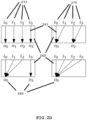
- FIG. 2D an exemplary embodiment is shown of possible configurations of the neuron switching circuit 260 in the column/neuron decoder 250 when four synapse columns 270 serve as input to the column/neuron decoder 250.
- the column/neuron decoder 250 is arranged to provide each group of four adjacent synapse columns 270 with four possible output neuron configurations 280 as shown, i.e. the four synapse columns may have their outputs selectively directed to four different sets of neurons 254 of the output block 202.
- the column/neuron decoder 250 can be connected with different numbers of synapse columns 270 and output neurons 254, and the number of synapse columns and output neurons can be different, and the number and arrangement of output neuron configurations 280 can be different.
- the four configurations 280 of the neuron switching circuit 260 are discussed next.
- the four synapse columns 270 serve as respective input to four output neurons via switching signal paths 261.
- two pairs out of the four synapse columns 270 serve as input to two sets of output neurons via switching signal paths 261, i.e. synapse columns i 0 and i 1 serve output neuron o 0 and synapse columns i 2 and i 3 serve output neuron o 2 .
- synapse columns i 0 , i 1 and i 2 serve one output neuron set o 0
- the remaining synapse column i 3 serves output neuron o 3 via switching signal paths 261.
- all four synapse columns serve a single output neuron set o 0 via switching signal paths 261.
- the switching signal paths 261 may comprise conducting paths implemented in the logic circuit of the switching circuit 260, and they can be switched between different configurations in a particular implementation by e.g. configurable or fixed transistor gates.
- the particular connection of the switching signal paths 261 can be set at the initial manufacture of the neurosynaptic array, e.g. in the factory, and/or can be set on the fly via programming or other configuration of the column/neuron decoder 250 and/or neuron switching circuit 260.
- the neuron switching circuit 260 can e.g. reconfigure the switching signal paths 261 dynamically during operation of the neurosynaptic array.
- one or more select signals 251 can be used to select how the column/neuron decoder 250 switches from one set of neurons 254 to another set of neurons 254.
- the dynamic reconfiguration can be based on a certain mapping methodology incorporating a constraint driven partitioning and mapping of segments, of which exemplary embodiments will be described further below.
- the dynamic reconfiguration can be done based on the signal-to-noise ratio S / N of a particular segment in the neurosynaptic array. This will be explained further below.
- the neuron switching circuit 260 thus determines which synapse columns 270 send outputs to which output neuron sets 280. In other words, the neuron switching circuit 260 thus implements - as a result of the currently active configuration of the neuron switching circuit 260 - a particular segmentation of the neurosynaptic array.
- the weight blocks W n,n / m can be organized as an interleaved structure to facilitate the switching/combining of m adjacent synapse columns.
- the configuration for each set of n / m neuron switches can be independently controlled for more mapping flexibility.
- several options can be considered, for example offering a direct path between output neuron i and selected inputs, utilizing interleaved organization of neuron groups or sets, such that an input can be quickly routed to any group, providing flexible injection of spikes into the array, where the neuron output can be broadcast to individual or multiple groups automatically.
- Segmenting the array enables uniformity in terms of robustness and reliability of the performance, i.e. segmentation allows (i) a robust power distribution (vertical wide metal busses (for lower resistance) can be placed at the synapse row boundaries to alleviate IR drop concerns), (ii) if an interface for access to weight retention circuits requires a clock, segmentation creates hierarchy needed for a clock rebuffing strategy, (iii) segmentation improves signal integrity - instead of a single pre-synapse with large drive strength, segmentation allows for a distributed approach, since signals can be rebuffed/amplified after each segment, (iv) segmentation increases observability within the array and simplifies verification processes.
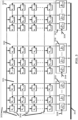
- FIG. 3 schematically shows how to divide an exemplary reconfigurable array (as e.g. shown in FIG. 2 ) into multiple segments/subarrays.
- a first subarray 301 comprises weight blocks W ij with i ⁇ [1, n ] and j ⁇ [1, x ].
- a second subarray 302 comprises weight blocks W ij with i ⁇ [1, n ] and j ⁇ [ x + 1, y ] .
- a final subarray 303 comprises weight blocks W ij with i ⁇ [1, n ] and j ⁇ [ z + 1, n / m ].
- x, y, z are natural numbers and x ⁇ y ⁇ z ⁇ n / m . More subarrays can exist.
- a number of n input lines 304 feed the different weight blocks.
- Each of the weight blocks w i,j is connected to an output block O j .
- Each subarray can comprise a number of output blocks segmented as output blocks 305, 306, 307 of subarrays 301, 302, 303 respectively.
- N j which is related to the neuron's membrane electrical charge
- This electrical signal is represented either as a voltage or current spike and is send to another part of the SNN via a spike out line 309.
- Each of the output blocks can be controlled in that e.g. the accumulation period and/or the integration constant of a particular neuron(s) can be controlled via control signals 308. In this way, the reaction of the neurons to the signals from the weight blocks in the subarrays 301, 302, 303 can be controlled.
- the segments could be organized based on characteristics of the target signal processing function (for example gain, filtering, multiplication, addition), or frequency/time constants of operation.
- different regions/segments of the neurosynaptic array can be configured based on target application case, number of channels in pre-processing signal chain/path, frequency band of interest, complexity and characteristics of the feature set, or target signal-to-noise ratio of the system.
- segments could be organized based on biophysically/chemically-inspired definitions (for example spatio-temporal (long- and shortterm) evaluation, aging artifacts, brain communication costs and regions/layers).
- segments can be defined based on learning rule, learning rate and associated cost-based mechanism or (post-) plasticity mechanisms, or based on predefined Figure of Merit performance-based definitions.
- segments within neurosynaptic array could be configured based on homeostatic regulation (local and global) requirements, or error propagation/calibration capabilities and mechanism limitations, or limiting mechanism such as excitatory/inhibitory ratio, cross-talk, or network saturation mechanism.
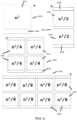
- FIGS. 4A-D schematically show an exemplary organization of the reconfigurable neuro-synaptic array 400: in FIG. 4A n 2 synapses 401 and n neurons 402, in FIG. 4B dividing the array 400 in FIG. 4A into two segments, each with n 2 /2 synapses and 2 ⁇ n neurons, in FIG. 4C dividing an array 400 into four segments, each with n 2 /4 synapses 401 and 4 ⁇ n neurons 402, and in FIG. 4D dividing an array 400 into eight segments, each with n 2 /8 synapses 401 and 8 ⁇ n neurons 402.
- the neurosynaptic segments can be composed of n inputs driving n 2 synapses and n neurons (as in FIG. 1-3 , FIG. 4A ).
- the array in FIG. 4A can be subdivided into two segments ( FIG. 4B ), each with n 2 /2 synapses and n neurons; hence, the total synaptic account across two segments remains the same, while the number of neurons doubles.
- FIG. 4C each with n 2 /4 synapses can quadruple total neuron count, or into eight segments ( FIG. 4D ), each with n 2 /8 synapses can increase neuron count by eight times, respectively.
- An array's information capacity depends on signal (S) to noise (N) ratio S / N and increases as log 2 (1 + S / N ).
- S signal
- N noise
- the energy cost of passing the signal through the array increases as ⁇ S / N .
- the array's efficiency falls, i.e. all components try to transmit the same signal, although information per unit fixed cost rises.
- An optimum occurs where these two competing tendencies balance. Consequently, a higher ratio of fixed cost to signalling cost gives a larger optimum array.
- the optimum array size also depends on the costs in other parts of the circuit in view of distributing allocated S/N among the components to maximize performance across the entire system.
- FIG. 5 shows an exemplary representation of an organization of the reconfigurable neuro-synaptic array 500: each of the segments (subarrays) 501 can have a different synaptic count per neuron. On a segment 501 level, to benefit from increased accuracy of sensor outputs and/or increased discriminating feature selection and extraction capabilities, specialized segments, each devoted to processing a single modality, can be defined.
- the S / N of an input profoundly affects the array's optimum size since input noise imposes a boundary to be approached by the array's S / N .
- the matching of array size to input S / N follows the principle of symmorphosis, to match capacities within a system in order to obtain an optimal solution. See E.R. Weibel, "Symmorphosis: On form and function in shaping life," Cambridge, MA: Harvard University Press, 2000 .
- neuroreceptors AMPA, NMDA, GABA
- neuron conductance-based Na, Ca, K
- Such neurons could use internal (neuroreceptors or conductance-based) circuits to perform functions, which usually require a circuit of several neurons.
- a neuromodulator can be broadcasted widely yet still act locally and specifically, affecting only neurons with an appropriate neuroreceptor.
- a neuromodulator's reach is further enhanced because its receptor diversifies into multiple subtypes that couple to different intra-segment signalling networks. Consequently, a small, targeted adjustment can retune and reconfigure a whole network, allowing efficient processing modularity, and task rescheduling if other signal processing functionality is required.
- Neuroreceptors alter the voltage dependence of currents, and subsequently affect the shape of the activation and inactivation curves.
- Each receptor represents a multi-(trans)conductance channel, which models associated nonlinear characteristics.
- NMDA receptors can provide activity-dependent modifications of synaptic weight, while AMPA receptors can enable a fast synaptic current to drive the soma.
- Fast receptor modifications can act as a control mechanism for activity-dependent changes in synaptic efficacy. If groups of dendritic spikes (bursts) are sufficient to exceed the threshold of a particular neuron, the axon will generate action potentials; ensuing spike is fed-back into the dendrite, and together with soma signals multiplied and added to NMDA receptor signals to, subsequently, generate the weight control.
- the feedback signals can be a subset of those available and may act on a subset of the systems parameters (i.e. preserving specific intrinsic properties when perturbations are compensated). See T. O'Leary, A.H. Wiliams, A. France, E. Marder, "Cell types, network homeostasis, and pathological compensation from a biologically plausible ion channel expression model," Neuron, vol. 82, pp. 809-821, 2014 .
- neuronal computational elements When network perturbations occur, neuronal computational elements generate a spike based on the perturbation's sign, intensity and phase. If a resonance response of a neuronal cluster is distorted or altered, each neuron adjusts the phases of spiking. Subsequently, neuronal computation elements can perform time-dependent computations.
- the network demonstrates a spatially disordered pattern of neural activity. If network activity profiles are narrow, the need for homogeneity in the distribution of spatial stimuli encoded by the network is increased.
- FIG. 6A show an exemplary representation of a spiking neural processor 600 incorporating one or more data-to-spike encoders 606, multi-segmented analog/mixed-signal neurosynaptic array 607, and spike decoders 611.
- Data is used as input for input modules such as an AER 601, interfaces such as e.g. an SPI 602, I 2 C 603 and/or I/O (input/output) 604 and/or a pre-processor DSP/CPU 605.
- input modules such as an AER 601
- interfaces such as e.g. an SPI 602, I 2 C 603 and/or I/O (input/output) 604 and/or a pre-processor DSP/CPU 605.
- the output of these input modules is send to one or more data-to-spike encoders 606.
- the one or more data-to-spike encoders 606 encode the data into spikes that are used as input for the analog/mixed-signal neurosynaptic array 607.
- the spikes that are outputted by the neurosynaptic array 607 can be decoded by a spike decoder 611.
- a pattern lookup module 612 can be used to interpret particular patterns within the spike output signal.
- the decoded spikes can then be send to one or more output interfaces and/or interrupt logic 613.
- a configuration and control module 614 allows for configuration and control of the different parts of the spiking neural processor, e.g. setting weights and configuration parameters of the synaptic elements and neurons within the neurosynaptic array 607.
- the neurosynaptic array 607 can be segmented according to any of the above mentioned embodiments. Neurons within a particular segment can conduct passively, as graded (analog) changes in electrical potential, and hence rely solely on analogue computations, which are direct and energy efficient. The brief, sharp, energy-intensive action potentials are reserved for larger-distance signalling, i.e. the interconnect within multi-segment analog/mixed-signal neurosynaptic array follows paradigm of the biological brain, i.e. dense connectivity in/between proximal segments, and less dense between distant segments. Thus, both long-range interconnects 610 and short-range interconnects 609 can exist between the neurons within the segmented neurosynaptic array 607.
- FIG. 6B shows an exemplary representation of an interconnect structure.
- long-range interconnect 610 and short range interconnect 609 can be present between the different segments 608 within the neurosynaptic array 607.
- Such (dual) interconnect structure is governed with distinctive design objectives: for short-range communication 609 low-latency between proximal segments is prioritized (obtained with high connection density), while with long-range communication 610 high-throughput between distant segments is targeted.
- segment-to-segment interconnect fabric can be implemented with digital CMOS logic
- the neurosynaptic arrays itself can be implemented by using for example analog/mixed-signal, digital, or non-volatile memory technologies.
- the neuron membrane potential can be implemented in the analog domain as a voltage across a capacitor or as a multibit variable stored in digital latches.
- digital neurons can be realized using CMOS logic circuits, such as adders, multipliers, and counters.
- the synapses modulate the input spikes and transform them into a charge that consequently creates postsynaptic currents that are integrated at the membrane capacitance of the postsynaptic neuron.
- the implementation of silicon synapses typically follows the mixed-signal methodology.
- Spatiotemporal coordination of different types of synaptic transmission is fundamental for the inference of sensory signals and associated learning performance.
- the network organizes itself into a dynamic state where neural firing is primarily driven by the input fluctuations, resembling an asynchronous-irregular state, i.e. temporal and pairwise spike count cross-correlations approach zero.
- Heterosynaptic depression among all input synapses generates stable activity sequences within network.
- the neurons generate time-locked patterns; due to the interaction between conductance delay (and plasticity rules), the network utilize a set of neuronal groups/segments, which form reproducible and precise firing sequences. As the conductance is increased (consequently, resulting in a net excitation to the network), the firing rates can increase and can become more uniform with a lower coefficient of variation.
- the network can generate spike-trains with regular timing relationships (inter-burst intervals and duty cycles) in different segments.
- Entrainment of low-frequency synchronized behaviour includes a reorganization of phase so that the optimal, i.e. the most excitable, phase aligns with temporal characteristics of the events in ongoing input stimulus.
- the sequence of synaptic current i.e. outward, inward
- the large discrepancy in energy-efficiency and cognitive performance of biological nervous systems and conventional computing is profoundly exemplified with tasks related to real-time interactions with the physical surroundings, in particular in presence of uncontrolled or noisy sensory input.
- the neuromorphic event-based neuron network due to ability to learn by example, parallelism of the operation, associative memory, multifactorial optimization, and extensibility, is an inherent choice for compact and low power cognitive systems that learn and adapt to the changes in the statistics of the complex sensory signals.
- the present multi-segment reconfigurable architecture for the neuromorphic networks allows designs that offer energy-efficient solutions to applications ranging for detecting patterns of biomedical signals (e.g. spike sorting, seizure detection, etc.), classifying images (e.g. handwritten digits), speech commands, and can be applied in wide range of the devices, including smart sensors or wearable devices in cyber-physical systems and Internet-of-Things.
- biomedical signals e.g. spike sorting, seizure detection, etc.
- classifying images e.g. handwritten digits
- speech commands e.g. handwritten digits
Landscapes
- Engineering & Computer Science (AREA)
- Physics & Mathematics (AREA)
- Theoretical Computer Science (AREA)
- Health & Medical Sciences (AREA)
- Life Sciences & Earth Sciences (AREA)
- Biomedical Technology (AREA)
- Biophysics (AREA)
- Evolutionary Computation (AREA)
- General Engineering & Computer Science (AREA)
- Data Mining & Analysis (AREA)
- Artificial Intelligence (AREA)
- General Health & Medical Sciences (AREA)
- Molecular Biology (AREA)
- Computing Systems (AREA)
- Computational Linguistics (AREA)
- General Physics & Mathematics (AREA)
- Mathematical Physics (AREA)
- Software Systems (AREA)
- Neurology (AREA)
- Logic Circuits (AREA)
- Multi Processors (AREA)
- Data Exchanges In Wide-Area Networks (AREA)
- Image Analysis (AREA)
Claims (15)
- Neurosynaptisches Array (100), umfassend eine Vielzahl von Spiking-Neuronen und eine Vielzahl von synaptischen Elementen, die die Spiking-Neuronen miteinander verbinden, um ein Spiking-Neuronales-Netzwerk auszubilden, wobei die synaptischen Elemente und die Spiking-Neuronen teilweise oder vollständig in Hardware implementiert sind;wobei jedes synaptische Element eingerichtet ist, um ein synaptisches Eingangssignal von mindestens einem von mehreren Eingängen zu empfangen, und angepasst ist, um eine Gewichtung auf das synaptische Eingangssignal anzuwenden, um ein synaptisches Ausgangssignal zu erzeugen, wobei die synaptischen Elemente konfigurierbar sind, um die Gewichtung anzupassen, die durch jedes synaptische Element angewendet wird;wobei jedes der Spiking-Neuronen eingerichtet ist, um ein oder mehrere der synaptischen Ausgangssignale von einem oder mehreren der synaptischen Elemente zu empfangen, und eingerichtet ist, um als Reaktion auf die empfangenen einen oder mehreren synaptischen Ausgangssignale ein räumlich-zeitliches Spike-Folge-Ausgangssignal zu erzeugen;und wobei das neurosynaptische Array (100) Gewichtungsblöcke (201) und Ausgangsblöcke (202) umfasst, jeder Gewichtungsblock (201) umfassend ein oder mehrere der synaptischen Elemente und jeder Ausgangsblock (202) umfassend ein oder mehrere der Neuronen und einen Neuronenschaltkreis (260);wobei jeder Gewichtungsblock in einer Spalte von Gewichtungsblöcken des neurosynaptischen Arrays enthalten ist;wobei jeder Ausgangsblock (202) mit einem Teilsatz von Gewichtungsblöcken (201) elektrisch verbindbar ist, wobei der Teilsatz von Gewichtungsblöcken (201) durch eine oder mehrere Spalten von Gewichtungsblöcken, mittels dem Neuronenschaltkreis (260) durch Verbinden eines Ausgangs der einen oder der mehreren Spalten von Gewichtungsblöcken mit einem oder mehreren Sätzen von Neuronen des Ausgangsblocks, ausgebildet wird; und wobei der Neuronenschaltkreis (260) konfiguriert ist, um selektiv mindestens ein synaptisches Element, das innerhalb des Teilsatzes von Gewichtungsblöcken (201) enthalten ist, mit mindestens einem Neuron, das innerhalb des jeweiligen Ausgangsblocks (202) enthalten ist, elektrisch zu verbinden, um eine Aufteilung des neurosynaptischen Arrays (100) in Sätze von Neuronen zu erhalten, die mit ausgewählten synaptischen Elementen elektrisch verbunden sind.
- Neurosynaptisches Array (100) nach Anspruch 1, wobei die synaptischen Elemente, die in einem festgelegten Gewichtungsblock (201) enthalten sind, innerhalb der gleichen Reihe des neurosynaptischen Arrays (100) bereitgestellt sind und/oder wobei jeder Ausgangsblock (202) mit einer Spalte von Gewichtungsblöcken (201) verbunden ist.
- Neurosynaptisches Array (100) nach Anspruch 1 oder 2, wobei jeder der Neuronenschaltkreise (260) Schaltsignalpfade (261) umfasst, die Leitungsdrähte umfassen, die in einem Logikschaltkreis des Neuronenschaltkreises (260) implementiert sind, wobei die Schaltsignalpfade (261) konfiguriert sind, um zwischen unterschiedlichen Konfigurationen schaltbar zu sein, vorzugsweise durch Verwenden von Transistorgattern, wobei jede Konfiguration bestimmt, welches mindestens eine synaptische Element, das innerhalb des Teilsatzes von Gewichtungsblöcken (201) enthalten ist, mit welchem mindestens einen Neuron elektrisch verbunden ist, das innerhalb des Ausgangsblocks (202) enthalten ist.
- Neurosynaptisches Array (100) nach Anspruch 3, wobei der Neuronenschaltkreis (260) konfiguriert ist, um die Schaltsignalpfade (261) dynamisch neu zu konfigurieren, wobei die dynamische Neukonfiguration auf einer Abbildungsmethodik basiert, die eine durch Einschränkungen gesteuerte Partitionierung und Segmentierung des neurosynaptischen Arrays (100) miteinbezieht, wobei das neurosynaptische Array (100) in ein oder mehrere Segmente partitioniert und segmentiert ist, wobei jedes Segment ein Signal(S)-Rausch(R)-Verhältnis S/N, eine Informationskapazität, gegeben durch log2 (1 + S/N) und einen Energieaufwand eines Übertragens eines Signals über das Segment aufweist, gegeben durch

- Neurosynaptisches Array (100) nach einem der vorstehenden Ansprüche, wobei die Segmentierung des neurosynaptischen Arrays (100) basierend auf einer/m oder mehreren Lernregeln, Lernraten und/oder (Post-)Plastizitätsmechanismen derart durchgeführt wird, dass sich mindestens zwei der neurosynaptischen Unterarrays hinsichtlich der/m einen oder den mehreren Lernregeln, Lernraten und/oder (Post-)Plastizitätsmechanismen unterscheiden.
- Neurosynaptisches Array (100) nach einem der vorstehenden Ansprüche, wobei mindestens einer der Gewichtungsblöcke (201) als eine verschachtelte Struktur organisiert ist, um das Schalten und/oder Kombinieren von synaptischen Elementen innerhalb des neurosynaptischen Arrays (100) zu erleichtern, und/oder wobei für jeden Ausgangsblock (202) das Schalten unabhängig steuerbar ist, um eine höhere Abbildungsflexibilität zu erreichen, und/oder wobei mindestens einer der Ausgangsblöcke (202) als eine verschachtelte Struktur organisiert ist und/oder wobei der Neuronenausgang eines beliebigen der Ausgangsblöcke (202) an ein oder mehrere neurosynaptische Unterarrays gesendet wird.
- Neurosynaptisches Array (100) nach einem der vorstehenden Ansprüche, wobei jedes der Neuronen innerhalb eines der Ausgangsblöcke (202) als abgestufte analoge Änderungen des elektrischen Potenzials passiv leitet.
- Neurosynaptisches Array (100) nach einem der vorstehenden Ansprüche, wobei das neurosynaptische Array (100) in neurosynaptische Unterarrays segmentiert ist, die trennbar sind und ihre eigenen erforderlichen Schaltkreise aufweisen und/oder eingerichtet sind, um eine einzige Modalität zu verarbeiten und für diese optimiert sind.
- Neurosynaptisches Array (100) nach Anspruch 8, wobei zwischen Neuronen unterschiedlicher neurosynaptischer Unterarrays sowohl Fern- als auch Nahbereichsverbindungen bestehen und wobei zwischen proximalen neurosynaptischen Unterarrays eine dichtere Konnektivität als zwischen weiter entfernten neurosynaptischen Unterarrays besteht.
- Neurosynaptisches Array (100) nach einem der vorstehenden Ansprüche, wobei mindestens einer der Ausgangsblöcke (202) dadurch steuerbar ist, dass die Akkumulationsperiode und/oder die Integrationskonstante eines festgelegten Neurons innerhalb des mindestens einen der Ausgangsblöcke (202) mittels Steuersignalen steuerbar ist.
- Neurosynaptisches Array (100) nach einem der vorstehenden Ansprüche, wobei ein Neuronenmembranpotential eines der Neuronen in dem analogen Bereich als eine Spannung über einem Kondensator oder als eine Mehrbitvariable, die in digitalen Latches gespeichert ist; oder in dem digitalen Bereich unter Verwendung von CMOS-Logikschaltungen implementiert ist.
- Spiking-Neural-Prozessor, umfassend:ein Daten-Spike-Encoder, der digitale oder analoge Daten in Spikes codiert;ein neurosynaptisches Array (100) nach einem der vorstehenden Ansprüche, das eingerichtet ist, um die Spikes, die durch den Daten-Spike-Encoder ausgegeben werden, als Eingang zu nehmen und eingerichtet ist, um als ein Ergebnis des Eingangs eine räumlichzeitliche Spike-Folge auszugeben; undeinen Spike-Decodierer, der eingerichtet ist, um die räumlich-zeitlichen Spike-Folgen zu decodieren, die aus dem neurosynaptischen Array (100) stammen.
- Verfahren zum Konfigurieren eines neurosynaptischen Arrays (100), wobei:das neurosynaptische Array (100) eine Vielzahl von Spiking-Neuronen und eine Vielzahl von synaptischen Elementen umfasst, die die Spiking-Neuronen miteinander verbinden, um ein Spiking-Neuronales-Netzwerk auszubilden, wobei die synaptischen Elemente und die Spiking-Neuronen teilweise oder vollständig in Hardware implementiert sind;wobei jedes synaptische Element eingerichtet ist, um ein synaptisches Eingangssignal von mindestens einem von mehreren Eingängen zu empfangen und eine Gewichtung auf das synaptische Eingangssignal anzuwenden, um ein synaptisches Ausgangssignal zu erzeugen, wobei die synaptischen Elemente konfigurierbar sind, um die Gewichtung anzupassen, die durch jedes synaptische Element angewendet wird;wobei jedes der Spiking-Neuronen eingerichtet ist, um ein oder mehrere der synaptischen Ausgangssignale von einem oder mehreren der synaptischen Elemente zu empfangen und als Reaktion auf die empfangenen einen oder mehreren synaptischen Ausgangssignale ein räumlich-zeitliches Spike-Folge-Ausgangssignal zu erzeugen; undwobei das Verfahren umfasstTeilen des neurosynaptischen Arrays (100) in Gewichtungsblöcke (201) und Ausgangsblöcke (202), jeder Gewichtungsblock (201) umfassend ein oder mehrere der synaptischen Elemente und jeder Ausgangsblock (202) umfassend ein oder mehrere der Neuronen und einen Neuronenschaltkreis (260),wobei jeder Gewichtungsblock in einer Spalte von Gewichtungsblöcken des neurosynaptischen Arrays enthalten ist;Machen jedes Ausgangsblocks (202) elektrisch verbindbar mit einem Teilsatz von Gewichtungsblöcken (201), wobei der Teilsatz von Gewichtungsblöcken (201) durch eine oder mehrere Spalten von Gewichtungsblöcken, mittels dem Neuronenschaltkreis (260) durch Verbinden eines Ausgangs der einen oder der mehreren Spalten von Gewichtungsblöcken mit einem oder mehreren Sätzen von Neuronen des Ausgangsblocks, ausgebildet ist;Konfigurieren des Neuronenschaltkreises (260), um selektiv mindestens ein synaptisches Element, das in dem Teilsatz von Gewichtungsblöcken (201) enthalten ist, mit mindestens einem Neuron elektrisch zu verbinden, das innerhalb des jeweiligen Ausgangsblock (202) enthalten ist, um eine Aufteilung des neurosynaptischen Arrays (100) in Sätzen von Neuronen zu erhalten, die mit ausgewählten synaptischen Elementen elektrisch verbunden sind.
- Verfahren nach Anspruch 14, wobei die synaptischen Elemente, die in einem festgelegten Gewichtungsblock (201) enthalten sind, innerhalb der gleichen Zeile des neurosynaptischen Arrays (100) bereitgestellt werden.
- Verfahren nach Anspruch 13 oder 14, wobei jeder der Neuronenschaltkreise (260) Schaltsignalpfade (261) umfasst, die Leitungsdrähte umfassen, die in einem Logikschaltkreis des Neuronenschaltkreises (260) implementiert sind, wobei die Schaltsignalpfade (261) konfiguriert sind, um zwischen unterschiedlichen Konfigurationen schaltbar zu sein, vorzugsweise durch Verwenden von Transistorgattern, wobei jede Konfiguration bestimmt, welches mindestens eine synaptische Element, das innerhalb des Teilsatzes von Gewichtungsblöcken (201) enthalten ist, mit welchem mindestens einen Neuron elektrisch verbunden ist, das innerhalb des Ausgangsblocks (202) enthalten ist.
Priority Applications (1)
| Application Number | Priority Date | Filing Date | Title |
|---|---|---|---|
| EP25152215.7A EP4535238A3 (de) | 2021-04-16 | 2022-04-16 | Hierarchisches rekonfigurierbares neuronales mehrsegment-spiking-netzwerk |
Applications Claiming Priority (2)
| Application Number | Priority Date | Filing Date | Title |
|---|---|---|---|
| US202163175570P | 2021-04-16 | 2021-04-16 | |
| PCT/EP2022/060197 WO2022219195A1 (en) | 2021-04-16 | 2022-04-16 | Hierarchical reconfigurable multi-segment spiking neural network |
Related Child Applications (1)
| Application Number | Title | Priority Date | Filing Date |
|---|---|---|---|
| EP25152215.7A Division EP4535238A3 (de) | 2021-04-16 | 2022-04-16 | Hierarchisches rekonfigurierbares neuronales mehrsegment-spiking-netzwerk |
Publications (3)
| Publication Number | Publication Date |
|---|---|
| EP4323923A1 EP4323923A1 (de) | 2024-02-21 |
| EP4323923B1 true EP4323923B1 (de) | 2025-02-12 |
| EP4323923C0 EP4323923C0 (de) | 2025-02-12 |
Family
ID=81750577
Family Applications (2)
| Application Number | Title | Priority Date | Filing Date |
|---|---|---|---|
| EP25152215.7A Pending EP4535238A3 (de) | 2021-04-16 | 2022-04-16 | Hierarchisches rekonfigurierbares neuronales mehrsegment-spiking-netzwerk |
| EP22724651.9A Active EP4323923B1 (de) | 2021-04-16 | 2022-04-16 | Hierarchisches rekonfigurierbares neuronales mehrsegment-spiking-netzwerk |
Family Applications Before (1)
| Application Number | Title | Priority Date | Filing Date |
|---|---|---|---|
| EP25152215.7A Pending EP4535238A3 (de) | 2021-04-16 | 2022-04-16 | Hierarchisches rekonfigurierbares neuronales mehrsegment-spiking-netzwerk |
Country Status (8)
| Country | Link |
|---|---|
| US (1) | US20240185044A1 (de) |
| EP (2) | EP4535238A3 (de) |
| JP (1) | JP2024513998A (de) |
| KR (1) | KR20230170916A (de) |
| CN (1) | CN117178275A (de) |
| ES (1) | ES3015517T3 (de) |
| TW (1) | TW202247050A (de) |
| WO (1) | WO2022219195A1 (de) |
Families Citing this family (1)
| Publication number | Priority date | Publication date | Assignee | Title |
|---|---|---|---|---|
| TW202437241A (zh) | 2023-02-24 | 2024-09-16 | 荷蘭商因納特拉納米系統有限公司 | 始終開啟之神經形態音訊處理模組及方法 |
Family Cites Families (6)
| Publication number | Priority date | Publication date | Assignee | Title |
|---|---|---|---|---|
| US8856055B2 (en) * | 2011-04-08 | 2014-10-07 | International Business Machines Corporation | Reconfigurable and customizable general-purpose circuits for neural networks |
| US10824937B2 (en) * | 2016-12-20 | 2020-11-03 | Intel Corporation | Scalable neuromorphic core with shared synaptic memory and variable precision synaptic memory |
| US11763139B2 (en) * | 2018-01-19 | 2023-09-19 | International Business Machines Corporation | Neuromorphic chip for updating precise synaptic weight values |
| US12554961B2 (en) * | 2018-03-30 | 2026-02-17 | International Business Machines Corporation | Block transfer of neuron output values through data memory for neurosynaptic processors |
| EP3605401A1 (de) * | 2018-07-31 | 2020-02-05 | GrAl Matter Labs S.A.S. | Datenverarbeitungsmodul, datenverarbeitungssystem und datenverarbeitungsverfahren |
| JP7562522B2 (ja) * | 2018-11-18 | 2024-10-07 | インナテラ・ナノシステムズ・ビー.ブイ. | スパイキングニューラルネットワーク |
-
2022
- 2022-04-16 ES ES22724651T patent/ES3015517T3/es active Active
- 2022-04-16 KR KR1020237035636A patent/KR20230170916A/ko active Pending
- 2022-04-16 WO PCT/EP2022/060197 patent/WO2022219195A1/en not_active Ceased
- 2022-04-16 US US18/286,231 patent/US20240185044A1/en active Pending
- 2022-04-16 JP JP2023563057A patent/JP2024513998A/ja active Pending
- 2022-04-16 EP EP25152215.7A patent/EP4535238A3/de active Pending
- 2022-04-16 EP EP22724651.9A patent/EP4323923B1/de active Active
- 2022-04-16 CN CN202280028714.6A patent/CN117178275A/zh active Pending
- 2022-04-18 TW TW111114692A patent/TW202247050A/zh unknown
Also Published As
| Publication number | Publication date |
|---|---|
| CN117178275A (zh) | 2023-12-05 |
| ES3015517T3 (en) | 2025-05-06 |
| EP4535238A2 (de) | 2025-04-09 |
| US20240185044A1 (en) | 2024-06-06 |
| JP2024513998A (ja) | 2024-03-27 |
| TW202247050A (zh) | 2022-12-01 |
| EP4323923C0 (de) | 2025-02-12 |
| EP4323923A1 (de) | 2024-02-21 |
| KR20230170916A (ko) | 2023-12-19 |
| EP4535238A3 (de) | 2025-06-25 |
| WO2022219195A1 (en) | 2022-10-20 |
Similar Documents
| Publication | Publication Date | Title |
|---|---|---|
| Moradi et al. | A scalable multicore architecture with heterogeneous memory structures for dynamic neuromorphic asynchronous processors (DYNAPs) | |
| US20260017500A1 (en) | Resilient neural network | |
| Indiveri et al. | Artificial cognitive systems: From VLSI networks of spiking neurons to neuromorphic cognition | |
| Neftci et al. | Synthesizing cognition in neuromorphic electronic systems | |
| De Salvo | Brain-inspired technologies: Towards chips that think? | |
| Qiao et al. | Analog circuits for mixed-signal neuromorphic computing architectures in 28 nm FD-SOI technology | |
| EP4323923B1 (de) | Hierarchisches rekonfigurierbares neuronales mehrsegment-spiking-netzwerk | |
| Giulioni et al. | A VLSI network of spiking neurons with plastic fully configurable “stop-learning” synapses | |
| Volanis et al. | Toward silicon-based cognitive neuromorphic ICs—a survey | |
| HK40103848A (en) | Hierarchical reconfigurable multi-segment spiking neural network | |
| HK40103848B (en) | Hierarchical reconfigurable multi-segment spiking neural network | |
| Abderrahmane | Hardware design of spiking neural networks for energy efficient brain-inspired computing | |
| Sayyaparaju et al. | Circuit techniques for efficient implementation of memristor based reservoir computing | |
| Upegui et al. | A methodology for evolving spiking neural-network topologies on line using partial dynamic reconfiguration | |
| Zins et al. | Implementation of Associative Memory Learning in Mobile Robots using Neuromorphic Computing | |
| Upegui et al. | A hardware implementation of a network of functional spiking neurons with hebbian learning | |
| Pachideh et al. | Towards Hardware-Software Self-Adaptive Acceleration of Spiking Neural Networks on Reconfigurable Digital Hardware | |
| Richter | Synaptic Circuits and Functions in Bio-inspired Integrated Architectures: Designing and advancing neurosynaptic physical-time systems-a practical introduction and survey | |
| Smith | Research agenda: Spacetime computation and the neocortex | |
| George | Structural plasticity in neuromorphic systems | |
| Abdallah et al. | Neuromorphic System Design Fundamentals | |
| Bhardwaj et al. | Analysis of neural network and neuromorphic computing with hardware: A survey | |
| Abderrahmane | Impact du codage impulsionnel sur l’efficacité énergétique des architectures neuromorphiques | |
| Ben Abdallah et al. | Neuromorphic System Design Fundamentals | |
| Kim et al. | Dataflow-Driven Neuromorphic Architectures for Edge AI: Theory, Design, and Applications |
Legal Events
| Date | Code | Title | Description |
|---|---|---|---|
| STAA | Information on the status of an ep patent application or granted ep patent |
Free format text: STATUS: UNKNOWN |
|
| STAA | Information on the status of an ep patent application or granted ep patent |
Free format text: STATUS: THE INTERNATIONAL PUBLICATION HAS BEEN MADE |
|
| PUAI | Public reference made under article 153(3) epc to a published international application that has entered the european phase |
Free format text: ORIGINAL CODE: 0009012 |
|
| STAA | Information on the status of an ep patent application or granted ep patent |
Free format text: STATUS: REQUEST FOR EXAMINATION WAS MADE |
|
| 17P | Request for examination filed |
Effective date: 20231102 |
|
| AK | Designated contracting states |
Kind code of ref document: A1 Designated state(s): AL AT BE BG CH CY CZ DE DK EE ES FI FR GB GR HR HU IE IS IT LI LT LU LV MC MK MT NL NO PL PT RO RS SE SI SK SM TR |
|
| REG | Reference to a national code |
Ref country code: HK Ref legal event code: DE Ref document number: 40103848 Country of ref document: HK |
|
| DAV | Request for validation of the european patent (deleted) | ||
| DAX | Request for extension of the european patent (deleted) | ||
| REG | Reference to a national code |
Ref country code: DE Ref legal event code: R079 Free format text: PREVIOUS MAIN CLASS: G06N0003040000 Ipc: G06N0003049000 Ref country code: DE Ref legal event code: R079 Ref document number: 602022010550 Country of ref document: DE Free format text: PREVIOUS MAIN CLASS: G06N0003040000 Ipc: G06N0003049000 |
|
| GRAP | Despatch of communication of intention to grant a patent |
Free format text: ORIGINAL CODE: EPIDOSNIGR1 |
|
| STAA | Information on the status of an ep patent application or granted ep patent |
Free format text: STATUS: GRANT OF PATENT IS INTENDED |
|
| RIC1 | Information provided on ipc code assigned before grant |
Ipc: G06N 3/065 20230101ALI20240801BHEP Ipc: G06N 3/049 20230101AFI20240801BHEP |
|
| INTG | Intention to grant announced |
Effective date: 20240904 |
|
| GRAS | Grant fee paid |
Free format text: ORIGINAL CODE: EPIDOSNIGR3 |
|
| GRAA | (expected) grant |
Free format text: ORIGINAL CODE: 0009210 |
|
| STAA | Information on the status of an ep patent application or granted ep patent |
Free format text: STATUS: THE PATENT HAS BEEN GRANTED |
|
| AK | Designated contracting states |
Kind code of ref document: B1 Designated state(s): AL AT BE BG CH CY CZ DE DK EE ES FI FR GB GR HR HU IE IS IT LI LT LU LV MC MK MT NL NO PL PT RO RS SE SI SK SM TR |
|
| REG | Reference to a national code |
Ref country code: GB Ref legal event code: FG4D |
|
| REG | Reference to a national code |
Ref country code: CH Ref legal event code: EP |
|
| REG | Reference to a national code |
Ref country code: DE Ref legal event code: R096 Ref document number: 602022010550 Country of ref document: DE |
|
| REG | Reference to a national code |
Ref country code: IE Ref legal event code: FG4D |
|
| U01 | Request for unitary effect filed |
Effective date: 20250228 |
|
| U07 | Unitary effect registered |
Designated state(s): AT BE BG DE DK EE FI FR IT LT LU LV MT NL PT RO SE SI Effective date: 20250310 |
|
| REG | Reference to a national code |
Ref country code: ES Ref legal event code: FG2A Ref document number: 3015517 Country of ref document: ES Kind code of ref document: T3 Effective date: 20250506 |
|
| U20 | Renewal fee for the european patent with unitary effect paid |
Year of fee payment: 4 Effective date: 20250428 |
|
| PG25 | Lapsed in a contracting state [announced via postgrant information from national office to epo] |
Ref country code: RS Free format text: LAPSE BECAUSE OF FAILURE TO SUBMIT A TRANSLATION OF THE DESCRIPTION OR TO PAY THE FEE WITHIN THE PRESCRIBED TIME-LIMIT Effective date: 20250512 |
|
| PG25 | Lapsed in a contracting state [announced via postgrant information from national office to epo] |
Ref country code: PL Free format text: LAPSE BECAUSE OF FAILURE TO SUBMIT A TRANSLATION OF THE DESCRIPTION OR TO PAY THE FEE WITHIN THE PRESCRIBED TIME-LIMIT Effective date: 20250212 |
|
| PGFP | Annual fee paid to national office [announced via postgrant information from national office to epo] |
Ref country code: ES Payment date: 20250505 Year of fee payment: 4 |
|
| PG25 | Lapsed in a contracting state [announced via postgrant information from national office to epo] |
Ref country code: IS Free format text: LAPSE BECAUSE OF FAILURE TO SUBMIT A TRANSLATION OF THE DESCRIPTION OR TO PAY THE FEE WITHIN THE PRESCRIBED TIME-LIMIT Effective date: 20250612 Ref country code: NO Free format text: LAPSE BECAUSE OF FAILURE TO SUBMIT A TRANSLATION OF THE DESCRIPTION OR TO PAY THE FEE WITHIN THE PRESCRIBED TIME-LIMIT Effective date: 20250512 |
|
| PG25 | Lapsed in a contracting state [announced via postgrant information from national office to epo] |
Ref country code: HR Free format text: LAPSE BECAUSE OF FAILURE TO SUBMIT A TRANSLATION OF THE DESCRIPTION OR TO PAY THE FEE WITHIN THE PRESCRIBED TIME-LIMIT Effective date: 20250212 |
|
| PG25 | Lapsed in a contracting state [announced via postgrant information from national office to epo] |
Ref country code: GR Free format text: LAPSE BECAUSE OF FAILURE TO SUBMIT A TRANSLATION OF THE DESCRIPTION OR TO PAY THE FEE WITHIN THE PRESCRIBED TIME-LIMIT Effective date: 20250513 |
|
| PGFP | Annual fee paid to national office [announced via postgrant information from national office to epo] |
Ref country code: CH Payment date: 20250501 Year of fee payment: 4 |
|
| PG25 | Lapsed in a contracting state [announced via postgrant information from national office to epo] |
Ref country code: SM Free format text: LAPSE BECAUSE OF FAILURE TO SUBMIT A TRANSLATION OF THE DESCRIPTION OR TO PAY THE FEE WITHIN THE PRESCRIBED TIME-LIMIT Effective date: 20250212 |
|
| PG25 | Lapsed in a contracting state [announced via postgrant information from national office to epo] |
Ref country code: CZ Free format text: LAPSE BECAUSE OF FAILURE TO SUBMIT A TRANSLATION OF THE DESCRIPTION OR TO PAY THE FEE WITHIN THE PRESCRIBED TIME-LIMIT Effective date: 20250212 |
|
| PG25 | Lapsed in a contracting state [announced via postgrant information from national office to epo] |
Ref country code: SK Free format text: LAPSE BECAUSE OF FAILURE TO SUBMIT A TRANSLATION OF THE DESCRIPTION OR TO PAY THE FEE WITHIN THE PRESCRIBED TIME-LIMIT Effective date: 20250212 |
|
| PLBE | No opposition filed within time limit |
Free format text: ORIGINAL CODE: 0009261 |
|
| STAA | Information on the status of an ep patent application or granted ep patent |
Free format text: STATUS: NO OPPOSITION FILED WITHIN TIME LIMIT |
|
| PG25 | Lapsed in a contracting state [announced via postgrant information from national office to epo] |
Ref country code: MC Free format text: LAPSE BECAUSE OF FAILURE TO SUBMIT A TRANSLATION OF THE DESCRIPTION OR TO PAY THE FEE WITHIN THE PRESCRIBED TIME-LIMIT Effective date: 20250212 |
|
| 26N | No opposition filed |
Effective date: 20251113 |