EP4531323A2 - Verfahren zum empfang von csi-rs und csi-rückkopplung in nr-u - Google Patents
Verfahren zum empfang von csi-rs und csi-rückkopplung in nr-u Download PDFInfo
- Publication number
- EP4531323A2 EP4531323A2 EP25157414.1A EP25157414A EP4531323A2 EP 4531323 A2 EP4531323 A2 EP 4531323A2 EP 25157414 A EP25157414 A EP 25157414A EP 4531323 A2 EP4531323 A2 EP 4531323A2
- Authority
- EP
- European Patent Office
- Prior art keywords
- csi
- wtru
- feedback
- resource
- transmission
- Prior art date
- Legal status (The legal status is an assumption and is not a legal conclusion. Google has not performed a legal analysis and makes no representation as to the accuracy of the status listed.)
- Pending
Links
Images




Classifications
-
- H—ELECTRICITY
- H04—ELECTRIC COMMUNICATION TECHNIQUE
- H04W—WIRELESS COMMUNICATION NETWORKS
- H04W74/00—Wireless channel access
- H04W74/08—Non-scheduled access, e.g. ALOHA
- H04W74/0808—Non-scheduled access, e.g. ALOHA using carrier sensing, e.g. carrier sense multiple access [CSMA]
- H04W74/0816—Non-scheduled access, e.g. ALOHA using carrier sensing, e.g. carrier sense multiple access [CSMA] with collision avoidance
-
- H—ELECTRICITY
- H04—ELECTRIC COMMUNICATION TECHNIQUE
- H04L—TRANSMISSION OF DIGITAL INFORMATION, e.g. TELEGRAPHIC COMMUNICATION
- H04L5/00—Arrangements affording multiple use of the transmission path
- H04L5/0001—Arrangements for dividing the transmission path
- H04L5/0003—Two-dimensional division
- H04L5/0005—Time-frequency
- H04L5/0007—Time-frequency the frequencies being orthogonal, e.g. OFDM(A) or DMT
-
- H—ELECTRICITY
- H04—ELECTRIC COMMUNICATION TECHNIQUE
- H04B—TRANSMISSION
- H04B7/00—Radio transmission systems, i.e. using radiation field
- H04B7/02—Diversity systems; Multi-antenna system, i.e. transmission or reception using multiple antennas
- H04B7/04—Diversity systems; Multi-antenna system, i.e. transmission or reception using multiple antennas using two or more spaced independent antennas
- H04B7/06—Diversity systems; Multi-antenna system, i.e. transmission or reception using multiple antennas using two or more spaced independent antennas at the transmitting station
- H04B7/0613—Diversity systems; Multi-antenna system, i.e. transmission or reception using multiple antennas using two or more spaced independent antennas at the transmitting station using simultaneous transmission
- H04B7/0615—Diversity systems; Multi-antenna system, i.e. transmission or reception using multiple antennas using two or more spaced independent antennas at the transmitting station using simultaneous transmission of weighted versions of same signal
- H04B7/0619—Diversity systems; Multi-antenna system, i.e. transmission or reception using multiple antennas using two or more spaced independent antennas at the transmitting station using simultaneous transmission of weighted versions of same signal using feedback from receiving side
- H04B7/0621—Feedback content
- H04B7/0626—Channel coefficients, e.g. channel state information [CSI]
-
- H—ELECTRICITY
- H04—ELECTRIC COMMUNICATION TECHNIQUE
- H04L—TRANSMISSION OF DIGITAL INFORMATION, e.g. TELEGRAPHIC COMMUNICATION
- H04L27/00—Modulated-carrier systems
- H04L27/0006—Assessment of spectral gaps suitable for allocating digitally modulated signals, e.g. for carrier allocation in cognitive radio
-
- H—ELECTRICITY
- H04—ELECTRIC COMMUNICATION TECHNIQUE
- H04L—TRANSMISSION OF DIGITAL INFORMATION, e.g. TELEGRAPHIC COMMUNICATION
- H04L5/00—Arrangements affording multiple use of the transmission path
- H04L5/0001—Arrangements for dividing the transmission path
- H04L5/0003—Two-dimensional division
- H04L5/0005—Time-frequency
- H04L5/0007—Time-frequency the frequencies being orthogonal, e.g. OFDM(A) or DMT
- H04L5/001—Time-frequency the frequencies being orthogonal, e.g. OFDM(A) or DMT the frequencies being arranged in component carriers
-
- H—ELECTRICITY
- H04—ELECTRIC COMMUNICATION TECHNIQUE
- H04L—TRANSMISSION OF DIGITAL INFORMATION, e.g. TELEGRAPHIC COMMUNICATION
- H04L5/00—Arrangements affording multiple use of the transmission path
- H04L5/003—Arrangements for allocating sub-channels of the transmission path
- H04L5/0032—Distributed allocation, i.e. involving a plurality of allocating devices, each making partial allocation
- H04L5/0035—Resource allocation in a cooperative multipoint environment
-
- H—ELECTRICITY
- H04—ELECTRIC COMMUNICATION TECHNIQUE
- H04L—TRANSMISSION OF DIGITAL INFORMATION, e.g. TELEGRAPHIC COMMUNICATION
- H04L5/00—Arrangements affording multiple use of the transmission path
- H04L5/003—Arrangements for allocating sub-channels of the transmission path
- H04L5/0048—Allocation of pilot signals, i.e. of signals known to the receiver
-
- H—ELECTRICITY
- H04—ELECTRIC COMMUNICATION TECHNIQUE
- H04L—TRANSMISSION OF DIGITAL INFORMATION, e.g. TELEGRAPHIC COMMUNICATION
- H04L5/00—Arrangements affording multiple use of the transmission path
- H04L5/003—Arrangements for allocating sub-channels of the transmission path
- H04L5/0048—Allocation of pilot signals, i.e. of signals known to the receiver
- H04L5/005—Allocation of pilot signals, i.e. of signals known to the receiver of common pilots, i.e. pilots destined for multiple users or terminals
-
- H—ELECTRICITY
- H04—ELECTRIC COMMUNICATION TECHNIQUE
- H04L—TRANSMISSION OF DIGITAL INFORMATION, e.g. TELEGRAPHIC COMMUNICATION
- H04L5/00—Arrangements affording multiple use of the transmission path
- H04L5/003—Arrangements for allocating sub-channels of the transmission path
- H04L5/0048—Allocation of pilot signals, i.e. of signals known to the receiver
- H04L5/0051—Allocation of pilot signals, i.e. of signals known to the receiver of dedicated pilots, i.e. pilots destined for a single user or terminal
-
- H—ELECTRICITY
- H04—ELECTRIC COMMUNICATION TECHNIQUE
- H04L—TRANSMISSION OF DIGITAL INFORMATION, e.g. TELEGRAPHIC COMMUNICATION
- H04L5/00—Arrangements affording multiple use of the transmission path
- H04L5/003—Arrangements for allocating sub-channels of the transmission path
- H04L5/0053—Allocation of signalling, i.e. of overhead other than pilot signals
- H04L5/0055—Physical resource allocation for ACK/NACK
-
- H—ELECTRICITY
- H04—ELECTRIC COMMUNICATION TECHNIQUE
- H04L—TRANSMISSION OF DIGITAL INFORMATION, e.g. TELEGRAPHIC COMMUNICATION
- H04L5/00—Arrangements affording multiple use of the transmission path
- H04L5/003—Arrangements for allocating sub-channels of the transmission path
- H04L5/0078—Timing of allocation
- H04L5/0082—Timing of allocation at predetermined intervals
-
- H—ELECTRICITY
- H04—ELECTRIC COMMUNICATION TECHNIQUE
- H04L—TRANSMISSION OF DIGITAL INFORMATION, e.g. TELEGRAPHIC COMMUNICATION
- H04L5/00—Arrangements affording multiple use of the transmission path
- H04L5/0091—Signalling for the administration of the divided path, e.g. signalling of configuration information
-
- H—ELECTRICITY
- H04—ELECTRIC COMMUNICATION TECHNIQUE
- H04L—TRANSMISSION OF DIGITAL INFORMATION, e.g. TELEGRAPHIC COMMUNICATION
- H04L5/00—Arrangements affording multiple use of the transmission path
- H04L5/0091—Signalling for the administration of the divided path, e.g. signalling of configuration information
- H04L5/0094—Indication of how sub-channels of the path are allocated
-
- H—ELECTRICITY
- H04—ELECTRIC COMMUNICATION TECHNIQUE
- H04W—WIRELESS COMMUNICATION NETWORKS
- H04W72/00—Local resource management
- H04W72/04—Wireless resource allocation
- H04W72/044—Wireless resource allocation based on the type of the allocated resource
- H04W72/0446—Resources in time domain, e.g. slots or frames
-
- H—ELECTRICITY
- H04—ELECTRIC COMMUNICATION TECHNIQUE
- H04W—WIRELESS COMMUNICATION NETWORKS
- H04W72/00—Local resource management
- H04W72/20—Control channels or signalling for resource management
- H04W72/23—Control channels or signalling for resource management in the downlink direction of a wireless link, i.e. towards a terminal
-
- H—ELECTRICITY
- H04—ELECTRIC COMMUNICATION TECHNIQUE
- H04W—WIRELESS COMMUNICATION NETWORKS
- H04W74/00—Wireless channel access
- H04W74/08—Non-scheduled access, e.g. ALOHA
- H04W74/0866—Non-scheduled access, e.g. ALOHA using a dedicated channel for access
Definitions
- the base stations 114a, 114b may communicate with one or more of the WTRUs 102a, 102b, 102c, 102d over an air interface 116, which may be any suitable wireless communication link (e.g., radio frequency (RF), microwave, centimeter wave, micrometer wave, infrared (IR), ultraviolet (UV), visible light, etc.).
- the air interface 116 may be established using any suitable radio access technology (RAT).
- RAT radio access technology
- the AP may transmit a beacon on a fixed channel, such as a primary channel.
- the primary channel may be a fixed width (e.g., 20 MHz wide bandwidth) or a dynamically set width.
- the primary channel may be the operating channel of the BSS and may be used by the STAs to establish a connection with the AP.
- Carrier Sense Multiple Access with Collision Avoidance (CSMA/CA) may be implemented, for example in 802.11 systems.
- the STAs e.g., every STA, including the AP, may sense the primary channel. If the primary channel is sensed/detected and/or determined to be busy by a particular STA, the particular STA may back off.
- One STA (e.g., only one station) may transmit at any given time in a given BSS.
- HT STAs may use a 40 MHz wide channel for communication, for example, via a combination of the primary 20 MHz channel with an adjacent or nonadjacent 20 MHz channel to form a 40 MHz wide channel.
- the streams may be mapped on to the two 80 MHz channels, and the data may be transmitted by a transmitting STA.
- the above described operation for the 80+80 configuration may be reversed, and the combined data may be sent to the Medium Access Control (MAC).
- MAC Medium Access Control
- Sub 1 GHz modes of operation are supported by 802.11 af and 802.11 ah.
- the channel operating bandwidths, and carriers, are reduced in 802.11af and 802.11ah relative to those used in 802.11n, and 802.11ac.
- 802.11af supports 5 MHz, 10 MHz, and 20 MHz bandwidths in the TV White Space (TVWS) spectrum
- 802.11ah supports 1 MHz, 2 MHz, 4 MHz, 8 MHz, and 16 MHz bandwidths using non-TVWS spectrum.
- 802.11ah may support Meter Type Control/Machine-Type Communications (MTC), such as MTC devices in a macro coverage area.
- MTC Meter Type Control/Machine-Type Communications
- MTC devices may have certain capabilities, for example, limited capabilities including support for (e.g., only support for) certain and/or limited bandwidths.
- the MTC devices may include a battery with a battery life above a threshold (e.g., to maintain a very long battery life).
- WLAN systems which may support multiple channels, and channel bandwidths, such as 802.11n, 802.11ac, 802.11af, and 802.11ah, include a channel which may be designated as the primary channel.
- the primary channel may have a bandwidth equal to the largest common operating bandwidth supported by all STAs in the BSS.
- the bandwidth of the primary channel may be set and/or limited by a STA, from among all STAs in operating in a BSS, which supports the smallest bandwidth operating mode.
- the primary channel may be 1 MHz wide for STAs (e.g., MTC type devices) that support (e.g., only support) a 1 MHz mode, even if the AP, and other STAs in the BSS support 2 MHz, 4 MHz, 8 MHz, 16 MHz, and/or other channel bandwidth operating modes.
- Carrier sensing and/or Network Allocation Vector (NAV) settings may depend on the status of the primary channel. If the primary channel is busy, for example, due to a STA (which supports only a 1 MHz operating mode) transmitting to the AP, all available frequency bands may be considered busy even though a majority of the available frequency bands remains idle.
- STAs e.g., MTC type devices
- NAV Network Allocation Vector
- the available frequency bands which may be used by 802.11ah, are from 902 MHz to 928 MHz. In Korea, the available frequency bands are from 917.5 MHz to 923.5 MHz. In Japan, the available frequency bands are from 916.5 MHz to 927.5 MHz. The total bandwidth available for 802.11ah is 6 MHz to 26 MHz depending on the country code.
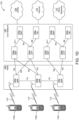
- FIG. 1D is a system diagram illustrating the RAN 104 and the CN 106 according to an embodiment.
- the RAN 104 may employ an NR radio technology to communicate with the WTRUs 102a, 102b, 102c over the air interface 116.
- the RAN 104 may also be in communication with the CN 106.
- the RAN 104 may include gNBs 180a, 180b, 180c, though it will be appreciated that the RAN 104 may include any number of gNBs while remaining consistent with an embodiment.
- the gNBs 180a, 180b, 180c may each include one or more transceivers for communicating with the WTRUs 102a, 102b, 102c over the air interface 116.
- the gNBs 180a, 180b, 180c may implement MIMO technology.
- gNBs 180a, 108b may utilize beamforming to transmit signals to and/or receive signals from the gNBs 180a, 180b, 180c.
- the gNB 180a may use multiple antennas to transmit wireless signals to, and/or receive wireless signals from, the WTRU 102a.
- the gNBs 180a, 180b, 180c may implement carrier aggregation technology.
- the gNB 180a may transmit multiple component carriers to the WTRU 102a (not shown). A subset of these component carriers may be on unlicensed spectrum while the remaining component carriers may be on licensed spectrum.
- the gNBs 180a, 180b, 180c may implement Coordinated Multi-Point (CoMP) technology.
- WTRU 102a may receive coordinated transmissions from gNB 180a and gNB 180b (and/or gNB 180c).
- CoMP Coordinated Multi-Point
- the WTRUs 102a, 102b, 102c may communicate with gNBs 180a, 180b, 180c using transmissions associated with a scalable numerology. For example, the OFDM symbol spacing and/or OFDM subcarrier spacing may vary for different transmissions, different cells, and/or different portions of the wireless transmission spectrum.
- the WTRUs 102a, 102b, 102c may communicate with gNBs 180a, 180b, 180c using subframe or transmission time intervals (TTIs) of various or scalable lengths (e.g., containing a varying number of OFDM symbols and/or lasting varying lengths of absolute time).
- TTIs subframe or transmission time intervals
- the gNBs 180a, 180b, 180c may be configured to communicate with the WTRUs 102a, 102b, 102c in a standalone configuration and/or a non-standalone configuration.
- WTRUs 102a, 102b, 102c may communicate with gNBs 180a, 180b, 180c without also accessing other RANs (e.g., such as eNode-Bs 160a, 160b, 160c).
- WTRUs 102a, 102b, 102c may utilize one or more of gNBs 180a, 180b, 180c as a mobility anchor point.
- WTRUs 102a, 102b, 102c may communicate with gNBs 180a, 180b, 180c using signals in an unlicensed band.
- WTRUs 102a, 102b, 102c may communicate with/connect to gNBs 180a, 180b, 180c while also communicating with/connecting to another RAN such as eNode-Bs 160a, 160b, 160c.
- WTRUs 102a, 102b, 102c may implement DC principles to communicate with one or more gNBs 180a, 180b, 180c and one or more eNode-Bs 160a, 160b, 160c substantially simultaneously.
- eNode-Bs 160a, 160b, 160c may serve as a mobility anchor for WTRUs 102a, 102b, 102c and gNBs 180a, 180b, 180c may provide additional coverage and/or throughput for servicing WTRUs 102a, 102b, 102c.
- Each of the gNBs 180a, 180b, 180c may be associated with a particular cell (not shown) and may be configured to handle radio resource management decisions, handover decisions, scheduling of users in the UL and/or DL, support of network slicing, DC, interworking between NR and E-UTRA, routing of user plane data towards User Plane Function (UPF) 184a, 184b, routing of control plane information towards Access and Mobility Management Function (AMF) 182a, 182b and the like. As shown in FIG. 1D , the gNBs 180a, 180b, 180c may communicate with one another over an Xn interface.
- UPF User Plane Function
- AMF Access and Mobility Management Function
- the CN 106 shown in FIG. 1D may include at least one AMF 182a, 182b, at least one UPF 184a,184b, at least one Session Management Function (SMF) 183a, 183b, and possibly a Data Network (DN) 185a, 185b. While the foregoing elements are depicted as part of the CN 106, it will be appreciated that any of these elements may be owned and/or operated by an entity other than the CN operator.
- AMF Session Management Function
- the AMF 182a, 182b may be connected to one or more of the gNBs 180a, 180b, 180c in the RAN 104 via an N2 interface and may serve as a control node.
- the AMF 182a, 182b may be responsible for authenticating users of the WTRUs 102a, 102b, 102c, support for network slicing (e.g., handling of different protocol data unit (PDU) sessions with different requirements), selecting a particular SMF 183a, 183b, management of the registration area, termination of non-access stratum (NAS) signaling, mobility management, and the like.
- PDU protocol data unit
- Network slicing may be used by the AMF 182a, 182b in order to customize CN support for WTRUs 102a, 102b, 102c based on the types of services being utilized WTRUs 102a, 102b, 102c.
- different network slices may be established for different use cases such as services relying on ultra-reliable low latency (URLLC) access, services relying on enhanced massive mobile broadband (eMBB) access, services for MTC access, and the like.
- URLLC ultra-reliable low latency
- eMBB enhanced massive mobile broadband
- the AMF 182a, 182b may provide a control plane function for switching between the RAN 104 and other RANs (not shown) that employ other radio technologies, such as LTE, LTE-A, LTE-A Pro, and/or non-3GPP access technologies such as WiFi.
- radio technologies such as LTE, LTE-A, LTE-A Pro, and/or non-3GPP access technologies such as WiFi.
- the SMF 183a, 183b may be connected to an AMF 182a, 182b in the CN 106 via an N11 interface.
- the SMF 183a, 183b may also be connected to a UPF 184a, 184b in the CN 106 via an N4 interface.
- the SMF 183a, 183b may select and control the UPF 184a, 184b and configure the routing of traffic through the UPF 184a, 184b.
- the SMF 183a, 183b may perform other functions, such as managing and allocating UE IP address, managing PDU sessions, controlling policy enforcement and QoS, providing DL data notifications, and the like.
- a PDU session type may be IP-based, non-IP based, Ethernet-based, and the like.
- the UPF 184a, 184b may be connected to one or more of the gNBs 180a, 180b, 180c in the RAN 104 via an N3 interface, which may provide the WTRUs 102a, 102b, 102c with access to packet-switched networks, such as the Internet 110, to facilitate communications between the WTRUs 102a, 102b, 102c and IP-enabled devices.
- the UPF 184, 184b may perform other functions, such as routing and forwarding packets, enforcing user plane policies, supporting multi-homed PDU sessions, handling user plane QoS, buffering DL packets, providing mobility anchoring, and the like.
- the CN 106 may facilitate communications with other networks.
- the CN 106 may include, or may communicate with, an IP gateway (e.g., an IP multimedia subsystem (IMS) server) that serves as an interface between the CN 106 and the PSTN 108.
- IP gateway e.g., an IP multimedia subsystem (IMS) server
- IMS IP multimedia subsystem
- the CN 106 may provide the WTRUs 102a, 102b, 102c with access to the other networks 112, which may include other wired and/or wireless networks that are owned and/or operated by other service providers.
- the WTRUs 102a, 102b, 102c may be connected to a local DN 185a, 185b through the UPF 184a, 184b via the N3 interface to the UPF 184a, 184b and an N6 interface between the UPF 184a, 184b and the ON 185a, 185b.
- one or more, or all, of the functions described herein with regard to one or more of: WTRU 102a-d, Base Station 114a-b, eNode-B 160a-c, MME 162, SGW 164, PGW 166, gNB 180a-c, AMF 182a-b, UPF 184a-b, SMF 183a-b, ON 185a-b, and/or any other device(s) described herein, may be performed by one or more emulation devices (not shown).
- the emulation devices may be one or more devices configured to emulate one or more, or all, of the functions described herein.
- the emulation devices may be used to test other devices and/or to simulate network and/or WTRU functions.
- the emulation devices may be designed to implement one or more tests of other devices in a lab environment and/or in an operator network environment.
- the one or more emulation devices may perform the one or more, or all, functions while being fully or partially implemented and/or deployed as part of a wired and/or wireless communication network in order to test other devices within the communication network.
- the one or more emulation devices may perform the one or more, or all, functions while being temporarily implemented/deployed as part of a wired and/or wireless communication network.
- the emulation device may be directly coupled to another device for purposes of testing and/or performing testing using over-the-air wireless communications.
- the one or more emulation devices may perform the one or more, including all, functions while not being implemented/deployed as part of a wired and/or wireless communication network.
- the emulation devices may be utilized in a testing scenario in a testing laboratory and/or a non-deployed (e.g., testing) wired and/or wireless communication network in order to implement testing of one or more components.
- the one or more emulation devices may be test equipment. Direct RF coupling and/or wireless communications via RF circuitry (e.g., which may include one or more antennas) may be used by the emulation devices to transmit and/or receive data.
- RF circuitry e.g., which may include one or more antennas
- Operation in an unlicensed frequency band may be subject to some limits on the Transmit Power Control (TPC), the Radio Front end (RF) output power, and power density given by the mean Effective Isotropic Radiated Power (EIRP) and the mean EIRP density at the highest power level. It may further be subject to requirements on the transmitter out of band emissions.
- TPC Transmit Power Control
- RF Radio Front end
- EIRP Effective Isotropic Radiated Power
- the foregoing may be specific to bands and/or geographical locations.
- Operation may be further subject to requirements on the Nominal Channel Bandwidth (NCB) and the Occupied Channel Bandwidth (OCB) defined for unlicensed spectrum in the 5 GHz region.
- NCB i.e., the widest band of frequencies inclusive of guard bands assigned to a single channel
- OCB i.e., the bandwidth containing 99% of the power of the signal
- a device may be allowed to operate temporarily in a mode where its OCB may be reduced to as low as 40% of its NCB with a minimum of 4 MHz.
- LBT Listen-Before-Talk
- LBT may be characterized by one or more of the following items: a Clear Channel Assessment (CCA) time (e.g., 20 ⁇ s), a Channel Occupancy time (e.g., minimum 1 ms, maximum 10 ms), an idle period (e.g., minimum 5% of the channel occupancy time), a fixed frame period (e.g., equal to the channel occupancy time + the idle period), a short control signaling transmission time (e.g., maximum duty cycle of 5% within an observation period of 50 ms), a CAA energy detection threshold, etc.
- a 50 ms observation period may be divided into multiple duty cycles (e.g., 5%, 10%, 20%, 40%, 60%, etc.).
- x% represents the percentage of time where the LTE network is transmitting signal.
- LBT may be characterized by a number N corresponding to the number of clear idle slots in extended CCA instead of the fixed time period.
- N may be selected randomly within a range.
- Deployment scenarios may include different standalone NR-based operation, different variants of dual connectivity operation, e.g., E-UTRAN New Radio - Dual Connectivity (EN-DC) with at least one carrier operating according to the LTE Radio Access Technology (RAT) or NR DC with at least two sets of one or more carriers operating according to the NR RAT, and/or different variants of Carrier Aggregation (CA), e.g., possibly also including different combinations of zero or more carriers of each of LTE and NR RATs.
- E-UTRAN New Radio - Dual Connectivity EN-DC
- RAT LTE Radio Access Technology
- NR DC with at least two sets of one or more carriers operating according to the NR RAT
- CA Carrier Aggregation
- LAA License Assisted Access
- TPC Transmit Power Control
- RRM Radio Resource Management
- CSI Channel-State Information
- the LBT procedure may be defined as a mechanism by which an equipment may apply a CAA check before using the channel.
- the CCA may at least utilize energy detection to determine the presence or absence of other signals on a channel in order to determine if this channel is occupied or clear, respectively.
- European and Japanese regulations mandate the usage of LBT in the unlicensed bands.
- carrier sensing via LBT may be one way for fair sharing of the unlicensed spectrum and hence it is considered to be a vital feature for fair and friendly operation in the unlicensed spectrum in a single global solution framework.
- discontinuous transmission with limited maximum transmission duration may be a required functionality for LAA.
- carrier selection may be required for LAA nodes to select the carriers with low interference and with that to achieve good coexistence with other unlicensed spectrum deployments.
- TPC is a regulatory requirement in some regions by which a transmitting device may be able to reduce its transmit power in proposed of 3 dB or 6 dB compared to its maximum nominal transmit power. This requirement may not need new specifications.
- RRM measurements including cell identification may enable mobility between SCells and robust operation in the unlicensed band.
- a WTRU operating in an unlicensed carrier may also support the necessary frequency/time estimation and synchronization to enable RRM measurements and successful reception of information on the unlicensed band.
- 3GPP has started a work item to support NR operation in unlicensed band.
- One of the objectives is to specify NR-based operation in unlicensed spectrum, including initial access, scheduling/Hybrid Automatic Repeat Request (HARQ), and mobility, along with coexistence methods with LTE-LAA and other incumbent RATs.
- Deployment scenarios may include different standalone NR-based operations, different variants of dual connectivity operation, e.g., EN-DC with at least one carrier operating according to the LTE RAT or NR DC with at least two sets of one or more carriers operating according to the NR RAT, and/or different variants of Carrier Aggregation (CA), possibility also including different combinations of zero or more carriers of each of LTE and NR RATs.
- CA Carrier Aggregation
- New Radio unlicensed may support four categories of channel access schemes for NR-U operations.
- Category 1 may comprise immediate transmission after a short switching gap.
- Category 2 may comprise LBT without random back-off.
- Category 3 may comprise LBT with random back-off with fixed contention widow size.
- Category 4 may comprise LBT with random back-off with variable contention widow size.
- a Bandwidth Part may be a single LBT subband or may be composed of multiple LBT subbands.
- the time during which a channel has been acquired for transmission may be deemed as a Channel Occupancy Time (COT).
- COT Channel Occupancy Time
- the COT may be acquired by a WTRU or by a base station and may be subsequently shared with the other node.
- the total COT duration, including any sharing, may not exceed maximum COT.
- a WTRU may determine presence of a CSI-RS resource. That is, the WTRU may be configured with a CSI-RS resource on which either a periodic or semi-persistent CSI-RS is expected, and the WTRU may determine the actual presence of the CSI-RS resource prior to performing measurements or prior to feeding back such measurements in order to determine whether a CSI-RS has been transmitted or not.
- the WTRU may determine presence of a CSI-RS through one or more of the following items: (1) explicit indication of presence of a CSI-RS resource, (2) implicit indication of presence of a CSI-RS resource, (3) determination of CSI-RS presence based on WTRU measurement, and (4) determination of CSI-RS presence based on a condition being met.
- the WTRU may receive an indication from the network. For example, the WTRU may receive an indication from the gNB providing an explicit list of CSI-RS resources that have been transmitted. Such an indication may represent all CSI-RS resources expected within a certain time period prior to the indication being received by the WTRU.
- the indication may be a bitmap of all expected CSI-RS or a toggled bit indicating the CSI-RS resource transmitted.
- the indication may provide a list of CSI-RS index values and/or a list of occasions where the CSI-RS has been actually transmitted.
- CSI-RS and “CSI-RS resource” may be used interchangeably. It will be appreciated that since the indication is provided from the network and thus it is explicit to the WTRU (i.e., the WTRU does not necessarily do too much to process the indication in order to obtain the information it needs), this indication may be considered to be an "explicit” indication as opposed to the "implicit” indication discussed below.
- the indication may provide a list of time resources (e.g., slots) where the based station (i.e., gNB) performed transmissions.
- the WTRU may use this indication as a mask over all possible CSI-RS transmissions and determine that CSI-RS was only ever transmitted in slots that the base station performed transmissions.
- Such an indication may be used as a post hoc slot blanking pattern.
- the WTRU may use the slot banking pattern to better determine the slots where CSI-RS has been transmitted or where an interference may be measured. This may enable the WTRU to report two steps of interference measurements: an interference measurement during an active COT and an interference measurement out of COT. Such values may help to determine the presence of hidden nodes and also the probability of acquiring the channel.
- FIG. 2 is a diagram illustrating an indication of presence of CSI-RS resources.
- a WTRU may be configured with CSI-RS and Channel State Information Interference Measurement (CSI-IM) every m slots.
- the WTRU may then receive an indication (e.g., in slot 2m+3) of the previous slots where CSI-RS was indeed transmitted by the network. Based on the indication, the WTRU may determine the appropriate reference slot for an upcoming CSI feedback report.
- CSI-IM Channel State Information Interference Measurement
- the WTRU may segregate the CSI-IM into two groups, those occurring when its serving cell had acquired the unlicensed channel (e.g., in slots 0 and m) and those occurring when the serving cell had not acquired the channel (e.g., in slot 2m).
- the WTRU may obtain different reports (e.g., different interference measurement reports) based on those two types of CSI-IM and may feedback multiple values.
- the indication of the actual transmission of CSI-RS may be received by the WTRU in a periodic CSI request.
- a request may point to a specific transmission occasion of a CSI-RS resource and the WTRU may assume that any transmission occasion of a CSI-RS resource indicated in a periodic CSI request was actually transmitted by the gNB.
- the implicit indication may be a parameter of a subsequent CSI-RS transmission. That is, the WTRU may determine the presence of a previous CSI-RS based on a parameter of a subsequent CSI-RS transmission, e.g., a subsequent CSI-RS. For example, a parameter of a CSI-RS may cycle through some configured values at each successful transmission. The WTRU may attempt to blindly decode a current CSI-RS using the different possible parameters. Upon detecting the appropriate parameter used for the current transmission (e.g., the current CSI-RS), the WTRU may determine whether previous CSI-RS resources have been actually transmitted or not.
- the CSI-RS parameters that may be cycled may include at least one of: sequence, CSI-RS resource mapping, antenna ports, orthogonal cover code, and the like.
- the implicit indication may be a sequence of consecutive CSI-RS resources, that is, the WTRU may be configured with CSI-RS resources with four possible seeds to generate the sequence. The seeds may be cycled over each four transmissions. The WTRU may be able to determine if up to three consecutive CSI-RS resources have not been transmitted (e.g., due to failed channel acquisition).
- FIG. 3 shows a WTRU determining the presence or absence of a previous CSI-RS based on a sequence of a currently received CSI-RS.
- the WTRU receives a CSI-RS in every configured occasion and the WTRU performs detection by cycling through 4 sequences.
- the WTRU does not detect a CSI-RS in slot m or slot 2m.
- the WTRU may then receive a CSI-RS in slot 3m with sequence 2. This may indicate to the WTRU that there was indeed no CSI-RS transmitted in slots m and 2m.
- the WTRU does not detect a CSI-RS in slot m or slot 2m.
- the WTRU may then receive a CSI-RS in slot 3m with sequence 3. This may indicate to the WTRU that it missed a transmitted CSI-RS (i.e., a CSI-RS that used sequence 2) in either slot m or slot 2m.
- a transmitted CSI-RS i.e., a CSI-RS that used sequence 2m.
- the WTRU may not be able to determine which slot had an undetected CSI-RS and may not be able to use that information to determine appropriate measurements based on the previously assumed non-transmitted CSI-RS.
- a parameter of the CSI-RS may be modified to enable the WTRU to determine a specific slot where the CSI-RS was missing. For example, the sequence of a subsequent CSI-RS may be determined based on whether one or more previous CSI-RS was skipped and the slot where it was skipped.
- the WTRU may determine that a CSI-RS is present based on a measurement taken on a resource where the WTRU expects the CSI-RS. For example, the WTRU may perform signal-to-interference-plus-noise ratio (SINR) measurements, and any value below a threshold may lead to the WTRU's assumption that the CSI-RS was not transmitted on the resource.
- SINR signal-to-interference-plus-noise ratio
- the threshold may be configurable.
- the WTRU may perform channel acquisition measurements (e.g., clear channel assessment) prior to a transmission of an expected CSI-RS resource.
- the WTRU may determine whether the channel is busy prior to the CSI-RS transmission. If the WTRU determines the channel is busy immediately preceding the transmission of the expected CSI-RS resource, it may assume the CSI-RS resource is not transmitted in that instance.
- the above-discussed determination may be performed by a processor in the WTRU.
- a process performed by the WTRU may typically be performed by its processor.
- the WTRU may assume that a CSI-RS resource is present only if a condition is met. In embodiments, if a transmission occasion of a CSI-RS resource coincides with at least one of other transmissions from the gNB and that one of other transmissions is present, then the WTRU may assume that the CSI-RS resource was also transmitted.
- the WTRU may be configured with a signal, such as a demodulation reference signal (DMRS), to be transmitted in conjunction with a CSI-RS. If the WTRU successfully detects the associated DMRS, the WTRU may assume that the CSI-RS was also transmitted.
- DMRS demodulation reference signal
- the WTRU may only assume a CSI-RS is present if it is transmitted on resources of an active COT. For example, a CSI-RS occasion occurring on LBT subbands of an active COT may be assumed present by the WTRU. Therefore, the WTRU may determine the presence of the CSI-RS resource based on an indication of the COT structure, possibly received prior to the transmission occasion of the CSI-RS.
- the second embodiment is directed to increase the robustness of CSI-RS transmission under a circumstance where a CSI-RS is missing due to a failure of channel acquisition.
- Increasing the robustness of CSI-RS transmission may be realized by increasing the probability that a periodic or semi-persistent CSI-RS is transmitted.
- a WTRU may be configured with multiple transmission occasions tied to a single CSI-RS transmission. In such a case, the WTRU may not expect a single CSI-RS transmission to be transmitted on more than one occasion.
- the WTRU may not need to continue monitoring other occasions (i.e., conditional occasions) tied to that CSI-RS transmission, and upon determining that the CSI-RS resource has not been transmitted in the transmission occasion, the WTRU may need to continue monitoring other occasions tied to that CSI-RS transmission.
- other occasions i.e., conditional occasions
- FIG. 4A is a flowchart illustrating method 400 according to the second embodiment.
- method 400 may comprise: at 401, obtaining a transmission occasion for a CSI-RS; at 402, obtaining at least one conditional transmission occasion for the CSI-RS; and at 403, determining whether the CSI-RS is transmitted in the transmission occasion, wherein on a condition that the CSI-RS is not transmitted in the transmission occasion, at 404, detecting if the CSI-RS is transmitted in one of the at least one conditional transmission occasion.
- the above-mentioned processes 401-404 will be described below with reference to detailed examples.
- the WTRU may comprise a processor.
- the processor is configured to obtain a transmission occasion for a channel state information reference signal (CSI-RS); to obtain at least one conditional transmission occasion for the CSI-RS; and to determine whether the CSI-RS is transmitted in the transmission occasion. On a condition that the CSI-RS is not transmitted in the transmission occasion, the processor is further configured to detect if the CSI-RS is transmitted in one of the at least one conditional transmission occasion.
- CSI-RS channel state information reference signal
- the method 400 may comprise obtaining a transmission occasion for a CSI-RS.
- the transmission occasion may be obtained without any further processing.
- the transmission occasion may be pre-stored in a memory of the WTRU, and the WTRU may retrieve the transmission occasion from the memory.
- the transmission occasion may be obtained from the network.
- the transmission occasion may be obtained from the base station or a 3rd-party device other than the base station. It will be appreciated that the above embodiments regarding different sources of the transmission occasion are not intended to be exclusive or be limiting to the present application.
- the transmission occasion may be obtained through additional processing.
- the transmission occasion may be obtained by processing one or more parameters.
- the parameters may comprise a reference slot or a default slot, a timing offset, a periodicity, etc. To process at least one of the parameters may obtain the transmission occasion.
- the process of determining the transmission occasion for the CSI-RS may further comprise: obtaining a transmission occasion configuration comprising a timing offset and a periodicity; and determining, based on the timing offset and the periodicity, a timing of the transmission occasion.
- the WTRU may be configured to obtain a CSI-RS transmission occasion configuration that comprises a timing offset and a periodicity, and to determine, based on the timing offset and the periodicity, a timing of the transmission occasion.
- offset and periodicity may enable the WTRU to determine the timing of each CSI-RS resource occasion for that CSI-RS configuration.
- the WTRU may report a feedback even when no CSI-RS was transmitted. This may enable AN indication of a hidden note at the WTRU. Such a feedback may indicate no valid measurements are available.
- the WTRU may report interference values without desired channel measurements applicable to the reference slot (or the set of reference slots) associated with the CSI-RS resources.
- a time domain behavior of the CSI-ReportConfig is indicated by a higher layer parameter reportConfigType and can be set to 'aperiodic', 'semiPersistentOnPUCCH', 'semiPersistentOnPUSCH', or 'periodic'.
- the WTRU may have an association of the report configuration type and the type of LBT where the WTRU may perform to acquire the resources for the CSI feedback. For example, if the WTRU is configured with periodic reporting on PUCCH, it may also be configured with a condition that the PUCCH is only used if it requires an LBT category 2 or lower.
Landscapes
- Engineering & Computer Science (AREA)
- Signal Processing (AREA)
- Computer Networks & Wireless Communication (AREA)
- Physics & Mathematics (AREA)
- Health & Medical Sciences (AREA)
- General Health & Medical Sciences (AREA)
- Spectroscopy & Molecular Physics (AREA)
- Mobile Radio Communication Systems (AREA)
Applications Claiming Priority (3)
| Application Number | Priority Date | Filing Date | Title |
|---|---|---|---|
| US201962886159P | 2019-08-13 | 2019-08-13 | |
| PCT/US2020/046192 WO2021030595A1 (en) | 2019-08-13 | 2020-08-13 | Methods for reception of csi-rs and csi feedback in nr-u |
| EP20764215.8A EP4014417A1 (de) | 2019-08-13 | 2020-08-13 | Verfahren zum empfang von csi-rs und csi-rückkopplung in nr-u |
Related Parent Applications (1)
| Application Number | Title | Priority Date | Filing Date |
|---|---|---|---|
| EP20764215.8A Division EP4014417A1 (de) | 2019-08-13 | 2020-08-13 | Verfahren zum empfang von csi-rs und csi-rückkopplung in nr-u |
Publications (2)
| Publication Number | Publication Date |
|---|---|
| EP4531323A2 true EP4531323A2 (de) | 2025-04-02 |
| EP4531323A3 EP4531323A3 (de) | 2025-07-09 |
Family
ID=72266841
Family Applications (2)
| Application Number | Title | Priority Date | Filing Date |
|---|---|---|---|
| EP25157414.1A Pending EP4531323A3 (de) | 2019-08-13 | 2020-08-13 | Verfahren zum empfang von csi-rs und csi-rückkopplung in nr-u |
| EP20764215.8A Pending EP4014417A1 (de) | 2019-08-13 | 2020-08-13 | Verfahren zum empfang von csi-rs und csi-rückkopplung in nr-u |
Family Applications After (1)
| Application Number | Title | Priority Date | Filing Date |
|---|---|---|---|
| EP20764215.8A Pending EP4014417A1 (de) | 2019-08-13 | 2020-08-13 | Verfahren zum empfang von csi-rs und csi-rückkopplung in nr-u |
Country Status (6)
| Country | Link |
|---|---|
| US (2) | US20220287094A1 (de) |
| EP (2) | EP4531323A3 (de) |
| KR (2) | KR20250024123A (de) |
| CN (3) | CN120200720A (de) |
| BR (1) | BR112022002696A2 (de) |
| WO (1) | WO2021030595A1 (de) |
Families Citing this family (9)
| Publication number | Priority date | Publication date | Assignee | Title |
|---|---|---|---|---|
| US11979348B2 (en) * | 2018-11-08 | 2024-05-07 | Lg Electronics Inc. | Method for reporting channel state information in unlicensed band and device for same |
| US12237895B2 (en) * | 2019-07-09 | 2025-02-25 | Qualcomm Incorporated | Channel state information (CSI) for unlicensed spectrum |
| CN114514788B (zh) * | 2019-10-15 | 2025-06-10 | 华为技术有限公司 | 资源配置方法及设备 |
| WO2021180052A1 (zh) * | 2020-03-11 | 2021-09-16 | 上海朗帛通信技术有限公司 | 一种被用于无线通信的节点中的方法和装置 |
| EP4195814A4 (de) * | 2020-08-06 | 2023-09-27 | Fujitsu Limited | Verfahren und vorrichtung zum senden und empfangen von uplink-signalen |
| US11895700B2 (en) * | 2020-11-24 | 2024-02-06 | Qualcomm Incorporated | Listen before talk based resource modification and reduced channel occupancy time sharing signaling for sidelink communication in unlicensed spectrum |
| WO2022212348A1 (en) * | 2021-03-30 | 2022-10-06 | Idac Holdings, Inc. | Methods and apparatuses for reference signal transmission |
| WO2024045164A1 (en) * | 2022-09-02 | 2024-03-07 | Qualcomm Incorporated | Techniques for artificial intelligence (ai) -based reference signal (rs) processing using multiple rs densities |
| CN117939513A (zh) * | 2022-10-26 | 2024-04-26 | 上海朗帛通信技术有限公司 | 一种被用于无线通信的方法和装置 |
Family Cites Families (49)
| Publication number | Priority date | Publication date | Assignee | Title |
|---|---|---|---|---|
| WO2014071638A1 (zh) * | 2012-11-12 | 2014-05-15 | 华为技术有限公司 | 上报信道状态信息的方法、用户设备及基站 |
| US9883404B2 (en) * | 2013-06-11 | 2018-01-30 | Qualcomm Incorporated | LTE/LTE—A uplink carrier aggregation using unlicensed spectrum |
| EP3050232B1 (de) * | 2013-09-27 | 2020-04-01 | Samsung Electronics Co., Ltd. | Verfahren und vorrichtung zur erkennung von signalen in einer erweiterten lte |
| KR20160075503A (ko) * | 2013-10-21 | 2016-06-29 | 엘지전자 주식회사 | 무선 통신 시스템에서 간섭 측정 자원 설정 방법 및 이를 위한 장치 |
| WO2016002855A1 (ja) * | 2014-07-03 | 2016-01-07 | シャープ株式会社 | 基地局装置および端末装置 |
| JP2017152752A (ja) * | 2014-07-03 | 2017-08-31 | シャープ株式会社 | 端末装置、および基地局装置 |
| CN105991220B (zh) * | 2015-01-30 | 2019-07-30 | 中兴通讯股份有限公司 | Ue上报csi及触发ue上报csi的方法和装置 |
| US9743392B2 (en) * | 2015-01-30 | 2017-08-22 | Motorola Mobility Llc | Method and apparatus for signaling aperiodic channel state indication reference signals for LTE operation |
| US10129782B2 (en) * | 2015-01-30 | 2018-11-13 | Samsung Electronics Co., Ltd. | Methods and apparatus for CSI measurement configuration and reporting on unlicensed spectrum |
| US9680617B2 (en) * | 2015-03-20 | 2017-06-13 | Acer Incorporated | Method of transmitting reference signal in unlicensed spectrum for LTE-LAA system and wireless device using the same |
| US10652753B2 (en) * | 2015-07-24 | 2020-05-12 | Samsung Electronics Co., Ltd. | Method for transmitting control signal and channel in mobile communication system using unlicensed band |
| WO2017173037A1 (en) | 2016-03-30 | 2017-10-05 | Idac Holdings, Inc. | Method and apparatus for performing physical layer mobility procedures |
| WO2017190273A1 (en) * | 2016-05-03 | 2017-11-09 | Qualcomm Incorporated | Dynamic csi-rs transmission for enhanced fd-mimo |
| CN109716856A (zh) * | 2016-08-10 | 2019-05-03 | Idac控股公司 | 轻连接和自主移动性 |
| US10405299B2 (en) * | 2016-09-14 | 2019-09-03 | Qualcomm Incorporated | Reference signal transmission based on received signal quality |
| WO2018064313A1 (en) | 2016-09-28 | 2018-04-05 | Idac Holdings, Inc. | Reference signal design for wireless communication systems |
| CN108235444B (zh) * | 2016-12-12 | 2021-09-10 | 北京三星通信技术研究有限公司 | 随机接入的方法及基站设备、用户设备 |
| CN108282280B (zh) * | 2017-01-05 | 2021-07-20 | 维沃软件技术有限公司 | 一种参考信号的指示方法、网络设备及终端设备 |
| US10560851B2 (en) * | 2017-01-13 | 2020-02-11 | Samsung Electronics Co., Ltd. | Method and apparatus for uplink beam management in next generation wireless systems |
| US10432441B2 (en) * | 2017-02-06 | 2019-10-01 | Samsung Electronics Co., Ltd. | Transmission structures and formats for DL control channels |
| US11723063B2 (en) * | 2017-08-11 | 2023-08-08 | Qualcomm Incorporated | Different configurations for message content and transmission in a random access procedure |
| CN111557078B (zh) * | 2017-11-14 | 2024-06-11 | 瑞典爱立信有限公司 | 无线电接入网的确认信令过程 |
| US11050478B2 (en) * | 2017-12-19 | 2021-06-29 | Samsung Electronics Co., Ltd. | Method and apparatus for beam reporting in next generation wireless systems |
| EP3512265B1 (de) * | 2018-01-10 | 2022-05-11 | Comcast Cable Communications LLC | Leistungsregelung für kanalzustandsinformationen |
| JP2019140512A (ja) * | 2018-02-09 | 2019-08-22 | シャープ株式会社 | 端末装置、基地局装置および通信方法 |
| CN110351813B (zh) * | 2018-04-03 | 2020-10-27 | 维沃移动通信有限公司 | 一种信息上报方法、终端及网络设备 |
| EP3694134B1 (de) * | 2018-08-09 | 2022-02-16 | LG Electronics Inc. | Verfahren und vorrichtung zum senden und empfangen eines drahtlossignals in einem drahtloskommunikationssystem |
| US12219443B2 (en) * | 2018-08-09 | 2025-02-04 | Interdigital Patent Holdings, Inc. | Broadcast, multicast, and unicast on sidelink for 5G eV2X |
| US11196514B2 (en) * | 2018-08-10 | 2021-12-07 | Qualcomm Incorporated | Hybrid automatic repeat request-acknowledgement (HARQ-ACK) history feedback channel |
| ES2942868T3 (es) * | 2018-08-21 | 2023-06-07 | Lg Electronics Inc | Método para transmitir y recibir información de estado de canal en sistema de comunicación inalámbrico, y dispositivo para el mismo |
| CN111183668A (zh) * | 2018-09-10 | 2020-05-19 | 联发科技(新加坡)私人有限公司 | 非连续接收中的信道状态信息参考资源的获取方法和装置 |
| US20200100197A1 (en) * | 2018-09-26 | 2020-03-26 | Idac Holdings, Inc. | Synchronization block association and system information reception |
| EP3648368A1 (de) * | 2018-10-31 | 2020-05-06 | Comcast Cable Communications, LLC | Strahlmanagement für zellen in der drahtlosen kommunikation |
| US12185310B2 (en) * | 2018-11-02 | 2024-12-31 | Telefonaktiebolaget Lm Ericsson (Publ) | Systems and methods for signaling PDSCH diversity by determining associations between DMRS ports and RV's |
| CN112997546A (zh) * | 2018-11-08 | 2021-06-18 | 康维达无线有限责任公司 | 用于新无线电v2x的侧行链路发射功率控制 |
| US11290226B2 (en) * | 2018-12-19 | 2022-03-29 | Ofinno, Llc | Transmission scheme for multiple transmission reception points in a radio system |
| CN114928886B (zh) * | 2019-01-10 | 2025-06-03 | 中兴通讯股份有限公司 | 在无线系统中用信号发送准同址信息 |
| EP3909305B1 (de) * | 2019-01-11 | 2025-08-06 | Lenovo (Singapore) Pte. Ltd. | Verfahren und vorrichtung mit einer konfiguration des diskontinuierlichen empfangs |
| US11405874B2 (en) * | 2019-02-11 | 2022-08-02 | Comcast Cable Communications, Llc | Power control and retransmission |
| US11202315B2 (en) * | 2019-02-14 | 2021-12-14 | Ofinno, Llc | Dynamic PRACH scheduling using slot formats |
| US11412422B2 (en) * | 2019-03-14 | 2022-08-09 | Ofinno, Llc | Handover in unlicensed band |
| US11456831B2 (en) * | 2019-03-22 | 2022-09-27 | Samsung Electronics Co., Ltd. | Method and apparatus for CSI-RS enhancement for NR unlicensed spectrum |
| US11696142B2 (en) * | 2019-04-04 | 2023-07-04 | Samsung Electronics Co., Ltd. | Method and apparatus for resource mapping of PDSCH on unlicensed spectrum |
| EP3965518A4 (de) * | 2019-04-30 | 2022-05-04 | Fujitsu Limited | Zufallszugriffsverfahren und vorrichtung sowie kommunikationssystem |
| WO2020227158A1 (en) * | 2019-05-03 | 2020-11-12 | Apple Inc. | Closed loop power control for pusch |
| KR20240128128A (ko) * | 2019-05-03 | 2024-08-23 | 텔레폰악티에볼라겟엘엠에릭슨(펍) | 다수의 전송/수신 포인트(trp)를 통해 운송 블록(tb)을 반복하기 위한 방법 |
| US11456793B2 (en) * | 2019-05-24 | 2022-09-27 | Qualcomm Incorporated | Beam failure recovery techniques |
| US11785543B2 (en) * | 2019-07-03 | 2023-10-10 | Qualcomm Incorporated | Methods and apparatus to facilitate sleep mechanisms for read-only mode devices in a dedicated carrier |
| CN117461275A (zh) * | 2022-03-14 | 2024-01-26 | 中兴通讯股份有限公司 | 信道状态信息报告 |
-
2020
- 2020-08-13 EP EP25157414.1A patent/EP4531323A3/de active Pending
- 2020-08-13 KR KR1020257003884A patent/KR20250024123A/ko active Pending
- 2020-08-13 CN CN202510340432.5A patent/CN120200720A/zh active Pending
- 2020-08-13 WO PCT/US2020/046192 patent/WO2021030595A1/en not_active Ceased
- 2020-08-13 CN CN202510100316.6A patent/CN119728068A/zh active Pending
- 2020-08-13 KR KR1020227007633A patent/KR20220046614A/ko active Pending
- 2020-08-13 CN CN202080062579.8A patent/CN114365448B/zh active Active
- 2020-08-13 BR BR112022002696A patent/BR112022002696A2/pt unknown
- 2020-08-13 US US17/634,710 patent/US20220287094A1/en active Pending
- 2020-08-13 EP EP20764215.8A patent/EP4014417A1/de active Pending
-
2024
- 2024-12-03 US US18/967,198 patent/US12284678B2/en active Active
Also Published As
| Publication number | Publication date |
|---|---|
| WO2021030595A1 (en) | 2021-02-18 |
| EP4014417A1 (de) | 2022-06-22 |
| CN119728068A (zh) | 2025-03-28 |
| US12284678B2 (en) | 2025-04-22 |
| KR20250024123A (ko) | 2025-02-18 |
| KR20220046614A (ko) | 2022-04-14 |
| BR112022002696A2 (pt) | 2022-05-24 |
| CN114365448B (zh) | 2025-04-08 |
| CN114365448A (zh) | 2022-04-15 |
| US20250097980A1 (en) | 2025-03-20 |
| EP4531323A3 (de) | 2025-07-09 |
| CN120200720A (zh) | 2025-06-24 |
| US20220287094A1 (en) | 2022-09-08 |
Similar Documents
| Publication | Publication Date | Title |
|---|---|---|
| JP7712249B2 (ja) | 送信適合およびグラントフリーアクセス | |
| US11388747B2 (en) | Methods for channel access management | |
| US12284678B2 (en) | Methods for reception of CSI-RS and CSI feedback | |
| US20250071775A1 (en) | Receiving control information in nr-u | |
| US20250344249A1 (en) | Shared channel occupancy time operation | |
| EP3949658B1 (de) | Verfahren für unlizenzierten breitbandkanalzugriff | |
| WO2021163411A1 (en) | Channel access in unlicensed spectrum | |
| US20220407663A1 (en) | Methods for using in-carrier guard bands | |
| US20230309142A1 (en) | Methods and apparatus for wireless transmit/receive unit (wtru) initiated channel occupancy time (cot) | |
| WO2020168039A1 (en) | Methods for contention window size adjustment in unlicensed spectrum | |
| EP4133882A1 (de) | Empfangsknotenkanalbeurteilung | |
| EP4193553A1 (de) | Pdcch-abdeckungsverbesserung | |
| WO2025207896A1 (en) | Methods for switching beam indication mode for ai/ml based beam management | |
| WO2025072771A1 (en) | Methods for two level low power wake up signal resource selection |
Legal Events
| Date | Code | Title | Description |
|---|---|---|---|
| PUAI | Public reference made under article 153(3) epc to a published international application that has entered the european phase |
Free format text: ORIGINAL CODE: 0009012 |
|
| STAA | Information on the status of an ep patent application or granted ep patent |
Free format text: STATUS: THE APPLICATION HAS BEEN PUBLISHED |
|
| AC | Divisional application: reference to earlier application |
Ref document number: 4014417 Country of ref document: EP Kind code of ref document: P |
|
| AK | Designated contracting states |
Kind code of ref document: A2 Designated state(s): AL AT BE BG CH CY CZ DE DK EE ES FI FR GB GR HR HU IE IS IT LI LT LU LV MC MK MT NL NO PL PT RO RS SE SI SK SM TR |
|
| PUAL | Search report despatched |
Free format text: ORIGINAL CODE: 0009013 |
|
| AK | Designated contracting states |
Kind code of ref document: A3 Designated state(s): AL AT BE BG CH CY CZ DE DK EE ES FI FR GB GR HR HU IE IS IT LI LT LU LV MC MK MT NL NO PL PT RO RS SE SI SK SM TR |
|
| RIC1 | Information provided on ipc code assigned before grant |
Ipc: H04L 27/00 20060101ALI20250604BHEP Ipc: H04L 5/00 20060101AFI20250604BHEP |