EP4530857A2 - Hohe verfügbarkeit für virtuelle maschinen - Google Patents
Hohe verfügbarkeit für virtuelle maschinen Download PDFInfo
- Publication number
- EP4530857A2 EP4530857A2 EP25151957.5A EP25151957A EP4530857A2 EP 4530857 A2 EP4530857 A2 EP 4530857A2 EP 25151957 A EP25151957 A EP 25151957A EP 4530857 A2 EP4530857 A2 EP 4530857A2
- Authority
- EP
- European Patent Office
- Prior art keywords
- virtual machine
- active
- standby
- virtual
- status
- Prior art date
- Legal status (The legal status is an assumption and is not a legal conclusion. Google has not performed a legal analysis and makes no representation as to the accuracy of the status listed.)
- Pending
Links
Images



Classifications
-
- G—PHYSICS
- G06—COMPUTING OR CALCULATING; COUNTING
- G06F—ELECTRIC DIGITAL DATA PROCESSING
- G06F9/00—Arrangements for program control, e.g. control units
- G06F9/06—Arrangements for program control, e.g. control units using stored programs, i.e. using an internal store of processing equipment to receive or retain programs
- G06F9/44—Arrangements for executing specific programs
- G06F9/455—Emulation; Interpretation; Software simulation, e.g. virtualisation or emulation of application or operating system execution engines
- G06F9/45533—Hypervisors; Virtual machine monitors
- G06F9/45558—Hypervisor-specific management and integration aspects
-
- G—PHYSICS
- G06—COMPUTING OR CALCULATING; COUNTING
- G06F—ELECTRIC DIGITAL DATA PROCESSING
- G06F11/00—Error detection; Error correction; Monitoring
- G06F11/07—Responding to the occurrence of a fault, e.g. fault tolerance
- G06F11/0703—Error or fault processing not based on redundancy, i.e. by taking additional measures to deal with the error or fault not making use of redundancy in operation, in hardware, or in data representation
- G06F11/0706—Error or fault processing not based on redundancy, i.e. by taking additional measures to deal with the error or fault not making use of redundancy in operation, in hardware, or in data representation the processing taking place on a specific hardware platform or in a specific software environment
- G06F11/0712—Error or fault processing not based on redundancy, i.e. by taking additional measures to deal with the error or fault not making use of redundancy in operation, in hardware, or in data representation the processing taking place on a specific hardware platform or in a specific software environment in a virtual computing platform, e.g. logically partitioned systems
-
- G—PHYSICS
- G06—COMPUTING OR CALCULATING; COUNTING
- G06F—ELECTRIC DIGITAL DATA PROCESSING
- G06F11/00—Error detection; Error correction; Monitoring
- G06F11/07—Responding to the occurrence of a fault, e.g. fault tolerance
- G06F11/0703—Error or fault processing not based on redundancy, i.e. by taking additional measures to deal with the error or fault not making use of redundancy in operation, in hardware, or in data representation
- G06F11/0751—Error or fault detection not based on redundancy
- G06F11/0754—Error or fault detection not based on redundancy by exceeding limits
- G06F11/0757—Error or fault detection not based on redundancy by exceeding limits by exceeding a time limit, i.e. time-out, e.g. watchdogs
-
- G—PHYSICS
- G06—COMPUTING OR CALCULATING; COUNTING
- G06F—ELECTRIC DIGITAL DATA PROCESSING
- G06F11/00—Error detection; Error correction; Monitoring
- G06F11/07—Responding to the occurrence of a fault, e.g. fault tolerance
- G06F11/14—Error detection or correction of the data by redundancy in operations
- G06F11/1479—Generic software techniques for error detection or fault masking
- G06F11/1482—Generic software techniques for error detection or fault masking using middleware or operating system [OS] functionalities
- G06F11/1484—Generic software techniques for error detection or fault masking using middleware or operating system [OS] functionalities involving virtual machines
-
- G—PHYSICS
- G06—COMPUTING OR CALCULATING; COUNTING
- G06F—ELECTRIC DIGITAL DATA PROCESSING
- G06F11/00—Error detection; Error correction; Monitoring
- G06F11/07—Responding to the occurrence of a fault, e.g. fault tolerance
- G06F11/16—Error detection or correction of the data by redundancy in hardware
- G06F11/20—Error detection or correction of the data by redundancy in hardware using active fault-masking, e.g. by switching out faulty elements or by switching in spare elements
- G06F11/202—Error detection or correction of the data by redundancy in hardware using active fault-masking, e.g. by switching out faulty elements or by switching in spare elements where processing functionality is redundant
- G06F11/2023—Failover techniques
-
- G—PHYSICS
- G06—COMPUTING OR CALCULATING; COUNTING
- G06F—ELECTRIC DIGITAL DATA PROCESSING
- G06F11/00—Error detection; Error correction; Monitoring
- G06F11/30—Monitoring
- G06F11/3055—Monitoring arrangements for monitoring the status of the computing system or of the computing system component, e.g. monitoring if the computing system is on, off, available, not available
-
- G—PHYSICS
- G06—COMPUTING OR CALCULATING; COUNTING
- G06F—ELECTRIC DIGITAL DATA PROCESSING
- G06F9/00—Arrangements for program control, e.g. control units
- G06F9/06—Arrangements for program control, e.g. control units using stored programs, i.e. using an internal store of processing equipment to receive or retain programs
- G06F9/46—Multiprogramming arrangements
- G06F9/50—Allocation of resources, e.g. of the central processing unit [CPU]
-
- G—PHYSICS
- G06—COMPUTING OR CALCULATING; COUNTING
- G06F—ELECTRIC DIGITAL DATA PROCESSING
- G06F9/00—Arrangements for program control, e.g. control units
- G06F9/06—Arrangements for program control, e.g. control units using stored programs, i.e. using an internal store of processing equipment to receive or retain programs
- G06F9/46—Multiprogramming arrangements
- G06F9/50—Allocation of resources, e.g. of the central processing unit [CPU]
- G06F9/5061—Partitioning or combining of resources
- G06F9/5077—Logical partitioning of resources; Management or configuration of virtualized resources
-
- G—PHYSICS
- G06—COMPUTING OR CALCULATING; COUNTING
- G06F—ELECTRIC DIGITAL DATA PROCESSING
- G06F9/00—Arrangements for program control, e.g. control units
- G06F9/06—Arrangements for program control, e.g. control units using stored programs, i.e. using an internal store of processing equipment to receive or retain programs
- G06F9/46—Multiprogramming arrangements
- G06F9/50—Allocation of resources, e.g. of the central processing unit [CPU]
- G06F9/5094—Allocation of resources, e.g. of the central processing unit [CPU] where the allocation takes into account power or heat criteria
-
- G—PHYSICS
- G06—COMPUTING OR CALCULATING; COUNTING
- G06F—ELECTRIC DIGITAL DATA PROCESSING
- G06F9/00—Arrangements for program control, e.g. control units
- G06F9/06—Arrangements for program control, e.g. control units using stored programs, i.e. using an internal store of processing equipment to receive or retain programs
- G06F9/44—Arrangements for executing specific programs
- G06F9/455—Emulation; Interpretation; Software simulation, e.g. virtualisation or emulation of application or operating system execution engines
- G06F9/45533—Hypervisors; Virtual machine monitors
- G06F9/45558—Hypervisor-specific management and integration aspects
- G06F2009/4557—Distribution of virtual machine instances; Migration and load balancing
-
- G—PHYSICS
- G06—COMPUTING OR CALCULATING; COUNTING
- G06F—ELECTRIC DIGITAL DATA PROCESSING
- G06F9/00—Arrangements for program control, e.g. control units
- G06F9/06—Arrangements for program control, e.g. control units using stored programs, i.e. using an internal store of processing equipment to receive or retain programs
- G06F9/44—Arrangements for executing specific programs
- G06F9/455—Emulation; Interpretation; Software simulation, e.g. virtualisation or emulation of application or operating system execution engines
- G06F9/45533—Hypervisors; Virtual machine monitors
- G06F9/45558—Hypervisor-specific management and integration aspects
- G06F2009/45575—Starting, stopping, suspending or resuming virtual machine instances
-
- G—PHYSICS
- G06—COMPUTING OR CALCULATING; COUNTING
- G06F—ELECTRIC DIGITAL DATA PROCESSING
- G06F9/00—Arrangements for program control, e.g. control units
- G06F9/06—Arrangements for program control, e.g. control units using stored programs, i.e. using an internal store of processing equipment to receive or retain programs
- G06F9/44—Arrangements for executing specific programs
- G06F9/455—Emulation; Interpretation; Software simulation, e.g. virtualisation or emulation of application or operating system execution engines
- G06F9/45533—Hypervisors; Virtual machine monitors
- G06F9/45558—Hypervisor-specific management and integration aspects
- G06F2009/45591—Monitoring or debugging support
-
- G—PHYSICS
- G06—COMPUTING OR CALCULATING; COUNTING
- G06F—ELECTRIC DIGITAL DATA PROCESSING
- G06F9/00—Arrangements for program control, e.g. control units
- G06F9/06—Arrangements for program control, e.g. control units using stored programs, i.e. using an internal store of processing equipment to receive or retain programs
- G06F9/44—Arrangements for executing specific programs
- G06F9/455—Emulation; Interpretation; Software simulation, e.g. virtualisation or emulation of application or operating system execution engines
- G06F9/45533—Hypervisors; Virtual machine monitors
- G06F9/45558—Hypervisor-specific management and integration aspects
- G06F2009/45595—Network integration; Enabling network access in virtual machine instances
-
- G—PHYSICS
- G06—COMPUTING OR CALCULATING; COUNTING
- G06F—ELECTRIC DIGITAL DATA PROCESSING
- G06F2201/00—Indexing scheme relating to error detection, to error correction, and to monitoring
- G06F2201/815—Virtual
-
- G—PHYSICS
- G06—COMPUTING OR CALCULATING; COUNTING
- G06F—ELECTRIC DIGITAL DATA PROCESSING
- G06F2209/00—Indexing scheme relating to G06F9/00
- G06F2209/50—Indexing scheme relating to G06F9/50
- G06F2209/503—Resource availability
-
- G—PHYSICS
- G06—COMPUTING OR CALCULATING; COUNTING
- G06F—ELECTRIC DIGITAL DATA PROCESSING
- G06F9/00—Arrangements for program control, e.g. control units
- G06F9/06—Arrangements for program control, e.g. control units using stored programs, i.e. using an internal store of processing equipment to receive or retain programs
- G06F9/46—Multiprogramming arrangements
- G06F9/54—Interprogram communication
- G06F9/545—Interprogram communication where tasks reside in different layers, e.g. user- and kernel-space
-
- Y—GENERAL TAGGING OF NEW TECHNOLOGICAL DEVELOPMENTS; GENERAL TAGGING OF CROSS-SECTIONAL TECHNOLOGIES SPANNING OVER SEVERAL SECTIONS OF THE IPC; TECHNICAL SUBJECTS COVERED BY FORMER USPC CROSS-REFERENCE ART COLLECTIONS [XRACs] AND DIGESTS
- Y02—TECHNOLOGIES OR APPLICATIONS FOR MITIGATION OR ADAPTATION AGAINST CLIMATE CHANGE
- Y02D—CLIMATE CHANGE MITIGATION TECHNOLOGIES IN INFORMATION AND COMMUNICATION TECHNOLOGIES [ICT], I.E. INFORMATION AND COMMUNICATION TECHNOLOGIES AIMING AT THE REDUCTION OF THEIR OWN ENERGY USE
- Y02D10/00—Energy efficient computing, e.g. low power processors, power management or thermal management
Definitions
- the present disclosure generally relates to computing devices and systems, and more specifically, improving high availability of network devices.
- the present disclosure relates generally to networking technologies, and more particularly to high availability of virtual machines for processing network packets.
- An example device may include an active guest (e.g., virtual machine) for performing a plurality of operations.
- the example device may be a network device and the active guest may process network packets.
- the device may also include a standby guest that does not perform the operations performed by the active guest.
- the active guest may process network packets, whereas the standby guest may not process network packets.
- the device may also include a monitor configured to receive an event from an active guest, determine based on the event to switch the standby guest to the active guest, and switch the standby guest to active guest.
- the monitor may be further configured to attach the hardware resources to the new active guest, such as networking resource and/or a display console.
- the event generated and monitored by the monitor may be a guest operating system panic event, guest process panic event, watchdog timer event, and/or a ping event.
- Systems, methods, apparatus, and computer-readable medium are described for generating receiving information regarding the current state of the active guest in the host and switching the standby device from standby to active in response to determining that the current active guest may no longer be able to service network packets.
- aspects disclose use of existing operating system panic and watchdog techniques and existing virtualization technology for providing robust mechanisms for detecting catastrophic events and/or non-responsiveness and performing a switchover/failover between the active-standby guests to resume processing of network packets at a robust pace relative to generally available technologies.
- FIG. 1 and FIG. 2 and their associated description disclose examples, but non-limiting embodiments for implementing systems, methods, apparatus, and computer-readable medium disclosed herein. Furthermore, FIG. 1 and FIG. 2 also describe in more non-limiting detail, aspects of a device, network device, router, switch, guest, virtual machine, active guest/virtual machine, standby guest/virtual machine, active/standby system and switchover/failover event.
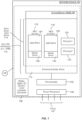
- FIG. 1 is a simplified block diagram of a network device 100 (also referred to as a "host system") that may incorporate teachings disclosed herein according to certain embodiments.
- Network device 100 may be any device that is capable of receiving and forwarding packets, which may be data packets or signaling or protocol-related packets (e.g., keep-alive packets). For example, network device 100 may receive one or more data packets and forward the data packets to facilitate delivery of the data packets to their intended destinations.
- network device 100 may be a router or switch such as various routers and switches provided by Brocade Communications Systems, Inc. of San Jose, California.
- the example network device 100 comprises multiple components including one or more processors 102, a system memory 104, a packet processor or traffic manager 106, and optionally other hardware resources or devices 108.
- Network device 100 depicted in FIG. 1 is merely an example and is not intended to unduly limit the scope of inventive embodiments recited in the claims.
- network device 100 may have more or fewer components than those shown in FIG. 1 , may combine two or more components, or may have a different configuration or arrangement of components.
- Network device 100 depicted in FIG. 1 may also include (not shown) one or more communication channels (e.g., an interconnect or a bus) for enabling multiple components of network device 100 to communicate with each other.
- communication channels e.g., an interconnect or a bus
- Network device 100 may include one or more processors 102.
- Processors 102 may include single or multicore processors.
- System memory 104 may provide memory resources for processors 102.
- System memory 104 is typically a form of random access memory (RAM) (e.g., dynamic random access memory (DRAM), Synchronous DRAM (SDRAM), Double Data Rate SDRAM (DDR SDRAM)).
- RAM random access memory
- DRAM dynamic random access memory
- SDRAM Synchronous DRAM
- DDR SDRAM Double Data Rate SDRAM
- Information related to an operating system and programs or processes executed by processors 102 may be stored in system memory 104.
- Processors 102 may include general purpose microprocessors such as ones provided by Intel ® , AMD ® , ARM ® , Freescale Semiconductor, Inc., and the like, that operate under the control of software stored in associated memory.
- a host operating system 110 may be loaded in system memory 104 and executed by one or more processors 102. Host operating system 110 may be loaded, for example, when network device 104 is powered on. In certain implementations, host operating system 110 may also function as a hypervisor and facilitate management of virtual machines and other programs that are executed by network device 100. Managing virtual machines may include partitioning resources of network device 100, including processor and memory resources, between the various programs.
- a hypervisor is a program that enables the creation and management of virtual machine environments including the partitioning and management of processor, memory, and other hardware resources of network device 100 between the virtual machine environments. A hypervisor enables multiple guest operating systems (GOSs) to run concurrently on network device 100.
- host operating system 110 may include a version of a KVM (Kernel-based Virtual Machine), which is an open source visualization infrastructure that supports various operating systems including Linux, Windows ® , and others.
- KVM Kernel-based Virtual Machine
- hypervisors include solutions provided by VMWare ® , Xen ® , and others.
- Linux KVM is a virtual memory system, meaning that addresses seen by programs loaded and executed in system memory are virtual memory addresses that have to be mapped or translated to physical memory addresses of the physical memory. This layer of indirection enables a program running on network device 100 to have an allocated virtual memory space that is larger than the system's physical memory.
- the memory space allocated to operating system 110 (operating as a hypervisor) is divided into a kernel space 112 and a user space 114 (also referred to as host user space or guest user space). Multiple virtual machines and host processes may be loaded into guest user space 114 and executed by processors 102.
- the memory allocated to a virtual machine (also sometimes referred to as a guest operating or OOS) may in turn include a kernel space portion and a user space portion.
- a virtual machine may have its own operating system loaded into the kernel space of the virtual machine.
- a virtual machine may operate independently of other virtual machines executed by network device 100 and may be unaware of the presence of the other virtual machines.
- a virtual machine's operating system may be the same as or different from the host operating system 110.
- the operating system for one virtual machine may be the same as or different from the operating system for another virtual machine.
- hypervisor 110 enables multiple guest operating systems to share the hardware resources (e.g., processor and memory resources) of network device 100.
- VM-1 116 and VM-2 118 have been loaded into guest user space 114 and are being executed by processors 102.
- VM-1 116 has a kernel space 126 and a user space 124.
- VM-2 118 has its own kernel space 130 and user space 128.
- each virtual machine has its own secure and private memory area that is accessible only to that virtual machine.
- hypervisor 110 which may be, for example, KVM. While only two virtual machines are shown in FIG. 1 , this is not intended to be limiting. In alternative embodiments, any number of virtual machines may be loaded and executed.
- FIG. 1 Various other host programs or processes may also be loaded into guest user space 114 and be executed by processors 102.
- two host processes 120 and 122 have been loaded into guest user space 114 and are being executed by processors 102. While only two host processes are shown in FIG. 1 , this is not intended to be limiting. In alternative embodiments, any number of host processes may be loaded and executed.
- a virtual machine may run a network operating system (NOS) (also sometimes referred to as a network protocol stack) and be configured to perform processing related to forwarding of packets from network device 100.
- NOS network operating system
- the virtual machine may be configured to maintain and manage routing information that is used to determine how a data packet received by network device 100 is forwarded from network device 100.
- the routing information may be stored in a routing database (not shown) stored by network device 100. The virtual machine may then use the routing information to program a packet processor 106, which then performs packet forwarding using the programmed information, as described below.
- the virtual machine running the NOS may also be configured to perform processing related to managing sessions for various networking protocols being executed by network device 100. These sessions may then be used to send signaling packets (e.g., keep-alive packets) from network device 100. Sending keep-alive packets enables session availability information to be exchanged between two ends of a forwarding or routing protocol.
- signaling packets e.g., keep-alive packets
- redundant virtual machines running network operating systems may be provided to ensure high availability of the network device.
- one of the virtual machines may be configured to operate in an "active" mode (this virtual machine is referred to as the active virtual machine) and perform a set of functions while the other virtual machine is configured to operate in a "standby" mode (this virtual machine is referred to as the standby virtual machine) in which the set of functions performed by the active virtual machine are not performed.
- the standby virtual machine remains ready to take over the functions performed by the active virtual machine.
- the virtual machine operating in active mode is configured to perform a set of functions that are not performed by the virtual machine operating in standby mode.
- the virtual machine operating in active mode may be configured to perform certain functions related to routing and forwarding of packets from network device 100, which are not performed by the virtual machine" operating in standby mode.
- the active virtual machine also takes ownership of and manages the hardware resources of network device 100.
- Certain events may cause the active virtual machine to stop operating in active mode and for the standby virtual machine to start operating in the active mode (i.e., become the active virtual machine) and take over performance of the set of functions related to network device 100 that are performed in active mode.
- the process of a standby virtual machine becoming the active virtual machine is referred to as a failover or switchover.
- the virtual machine that was previously operating in active mode prior to the failover may operate in the standby mode after the failover.
- a failover enables the set of functions performed in active mode to be continued to be performed without interruption. Redundant virtual machines used in this manner may reduce or even eliminates the downtime of network device 100's functionality, which may translate to higher availability of network device 100.
- the set of functions that are performed in active mode, and which are not performed by the active virtual machine and not performed by the standby virtual machine may differ from one network device to another.
- An involuntary failover typically occurs due to some critical failure in the active virtual machine. This may occur, for example, when some condition causes the active virtual machine to be rebooted or reset. This may happen, for example, due to a problem in the virtual machine kernel, critical failure of software executed by the active virtual machine, and the like. An involuntary failover causes the standby virtual machine to automatically become the active virtual machine.
- VM-1 116 is shown as operating in active mode and VM-2 118 is shown as operating in standby mode.
- the active-standby model enhances the availability of network device 100 by enabling the network device to support various high-availability functionalities such as graceful restart, non-stop routing (NSR), and the like.
- NSR non-stop routing
- the active virtual machine may use messaging to pass network state information to the standby virtual machine.
- the network state information may comprise information that enables the standby virtual machine to become the active virtual machine upon a failover or switchover in a non-disruptive manner.
- Various different schemes may be used for the messaging, including, but not restricted to, Ethernet-based messaging, Peripheral Component Interconnect (PCI)-based messaging, shared memory based messaging, and the like.
- PCI Peripheral Component Interconnect
- Hardware resources or devices 108 may include without restriction one or more field programmable gate arrays (FPGAs), application specific integrated circuits (ASICs), I/O devices, and the like. I/O devices may include devices such as Ethernet devices, PCI Express (PCIe) devices, and others. In certain implementations, some of hardware resources 108 may be partitioned between multiple virtual machines executed by network device 100 or, in some instances, may be shared by the virtual machines. One or more of hardware resources 108 may assist the active virtual machine in performing networking functions. For example, in certain implementations, one or more FPGAs may assist the active virtual machine in performing the set of functions performed in active mode.
- FPGAs field programmable gate arrays
- ASICs application specific integrated circuits
- I/O devices may include devices such as Ethernet devices, PCI Express (PCIe) devices, and others.
- some of hardware resources 108 may be partitioned between multiple virtual machines executed by network device 100 or, in some instances, may be shared by the virtual machines.
- One or more of hardware resources 108 may
- network device 100 may be configured to receive and forward packets to facilitate delivery of the packets to their intended destinations.
- the packets may include data packets and signal or protocol packets (e.g., keep-alive packets).
- the packets may be received and/or forwarded using one or more ports 107.
- Ports 107 represent the I/O plane for network device 100.
- a port within ports 107 may be classified as an input port or an output port depending upon whether network device 100 receives or transmits a packet using that port.
- a port over which a packet is received by network device 100 may be referred to as an input port.
- a port used for communicating or forwarding a packet from network device 100 may be referred to as an output port.
- a particular port may function both as an input port and an output port.
- a port may be connected by a link or interface to a neighboring network device or network.
- multiple ports of network device 100 may be logically grouped into one or more trunks.
- Ports 107 may be capable of receiving and/or transmitting different types of network traffic at different speeds, such as speeds of 1 Gigabits per second (Gbps), 10 Gbps, 100 Gbps, or more.
- Gbps gigabits per second
- Various different configurations of ports 107 may be provided in different implementations of network device 100.
- configurations may include 72 10 Gbps ports, 60 40 Gbps ports, 36 100 Gbps ports, 24 25 Gbps ports + 10 48 Gbps ports, 12 40 Gbps ports + 10 48 Gbps ports, 12 50 Gbps ports +, 10 48 Gbps ports, 6 100 Gbps ports + 10 48 Gbps ports, and various other combinations.
- network device 100 upon receiving a data packet via an input port, is configured to determine an output port to be used for transmitting the data packet from network device 100 to facilitate communication of the packet to its intended destination. Within network device 100, the packet is forwarded from the input port to the determined output port and then transmitted or forwarded from network device 100 using the output port.
- packet processor 106 may be configured to perform processing to determine how a packet is to be forwarded from network device 100.
- packet processor 106 may be configured to perform packet classification, modification, forwarding and Quality of Service (QoS) functions. As previously indicated, packet processor 106 may be programmed to perform forwarding of data packets based upon routing information maintained by the active virtual machine.
- QoS Quality of Service
- packet processor 106 upon receiving a packet, is configured to determine, based upon information extracted from the received packet (e.g., information extracted from a header of the received packet), an output port of network device 100 to be used for forwarding the packet from network device 100 such that delivery of the packet to its intended destination is facilitated. Packet processor 106 may then cause the packet to be forwarded within network device 100 from the input port to the determined output port. The packet may then be forwarded from network device 100 to the packet's next hop using the output port.
- information extracted from the received packet e.g., information extracted from a header of the received packet
- Packet processor 106 may then cause the packet to be forwarded within network device 100 from the input port to the determined output port.
- the packet may then be forwarded from network device 100 to the packet's next hop using the output port.
- packet processor 106 may be unable to determine how to forward a received packet. Packet processor 106 may then forward the packet to the active virtual machine, which may then determine how the packet is to be forwarded. The active virtual machine may then program packet processor 106 for forwarding that packet. The packet may then be forwarded by packet processor 106.
- packet processing chips or merchant ASICs provided by various 3rd-party vendors may be used for packet processor 106 depicted in FIG. 1 .
- Ethernet switching chips provided by Broadcom ® or other vendors may be used.
- Qumran ASICs may, for example, be used in a pizza-box implementation
- Jericho packet processor chips (BCM88670) (may, for example, be used in a chassis-based system)
- other ASICs provided by Broadcom ®
- chips from other vendors may be used as packet processor 106.
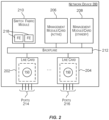
- FIG. 2 is a simplified block diagram of yet another example network device 200.
- Network device 200 depicted in FIG. 2 is commonly referred to as a chassis-based system (network device 100 depicted in FIG. 1 is sometimes referred to as a "pizza-box" system).
- Network device 200 may be configured to receive and forward packets, which may be data packets or signaling or protocol-related packets (e.g., keep-alive packets).
- Network device 200 comprises a chassis that includes multiple slots, where a card or blade or module can be inserted into each slot. This modular design allows for flexible configurations, with different combinations of cards in the various slots of the network device for supporting differing network topologies, switching needs, and performance requirements.
- network device 200 comprises multiple line cards (including first line card 202 and a second line card 204), two management cards/modules 206, 208, and one or more switch fabric modules (SFMs) 210.
- a backplane 212 is provided that enables the various cards/modules to communicate with each other.
- the cards may be hot swappable, meaning they can be inserted and/or removed while network device 200 is powered on.
- network device 200 may be a router or a switch such as various routers and switches provided by Brocade Communications Systems, Inc. of San Jose, California.
- Network device 200 depicted in FIG. 2 is merely an example and is not intended to unduly limit the scope of inventive embodiments recited in the claims.
- network device 200 may have more or fewer components than shown in FIG. 2 , may combine two or more components, or may have a different configuration or arrangement of components.
- network device 200 comprises two redundant management modules 206, 208.
- the redundancy enables the management modules to operate according to the active-standby model, where one of the management modules is configured to operate in standby mode (referred to as the standby management module) while the other operates in active mode (referred to as the active management module).
- the active management module may be configured to perform management and control functions for network device 200 and may represent the management plane for network device 200.
- the active management module may be configured to execute applications for performing management functions such as maintaining routing tables, programming the line cards (e.g., downloading information to a line card that enables the line card to perform data forwarding functions), and the like.
- both the management modules and the line cards act as a control plane that programs and makes programming decisions for packet processors in a network device.
- a management module may be configured as a coordinator of multiple control planes on the line cards.
- the standby management module may become the active management module and take over performance of the set of functions performed by a management module in active mode.
- the management module that was previously operating in active mode may then become the standby management module.
- the active-standby model in the management plane enhances the availability of network device 200, allowing the network device to support various high-availability functionality such as graceful restart, non-stop routing (NSR), and the like.
- management module 206 is shown as operating in active mode and management module 208 is shown as operating in standby mode.
- Management modules 206 and 208 are communicatively coupled to the line cards and switch fabric modules (SFMs) 210 via backplane 212.
- SFMs switch fabric modules
- Each management module may comprise one or more processors, which could be single or multicore processors and associated system memory.
- the processors may be general purpose microprocessors such as ones provided by Intel ® , AMD ® , ARM ® , Freescale Semiconductor, Inc., and the like, which operate under the control of software stored in associated memory.
- a switch fabric module (SFM) 210 may be configured to facilitate communications between the management modules 206, 208 and the line cards of network device 200.
- Each SFM 210 may include one or more fabric elements (FEs) 218.
- the fabric elements provide an SFM the ability to forward data from an input to the SFM to an output of the SFM.
- An SFM may facilitate and enable communications between any two modules/cards connected to backplane 212. For example, if data is to be communicated from one line card 202 to another line card 206 of network device 200, the data may be sent from the first line card to SFM 210, which then causes the data to be communicated to the second line card using backplane 212. Likewise, communications between management modules 206, 208 and the line cards of network device 200 are facilitated using SFMs 210.
- network device 200 comprises multiple line cards including line cards 202 and 204.
- Each line card may comprise a set of ports that may be used for receiving and forwarding packets.
- the ports of a line card may be capable of receiving and/or transmitting different types of network traffic at different speeds, such as speeds of 1 Gbps, 10 Gbps, 100 Gbps, or more.
- Various different configurations of line cards ports may be provided in network device 200. For example, configurations may include 72 10 Gbps ports, 60 40 Gbps ports, 36 100 Gbps ports, 24 25 Gbps ports + 10 48 Gbps ports, 12 40 Gbps ports + 10 48 Gbps ports, 12 50 Gbps ports + 10 48 Gbps ports, 6 100 Gbps ports + 10 48 Gbps ports, and various other combinations.
- Each line card may include one or more single or multicore processors, a system memory, a packet processor, and one or more hardware resources.
- the components on a line card may be configured similar to the components of network device 100 depicted in FIG. 1 (components collectively represented by reference 150 from FIG. 1 and also shown in line cards 202, 204 in FIG. 2 ).
- a packet may be received by network device 200 via a port on a particular line card.
- the port receiving the packet may be referred to as the input port and the line card as the source/input line card.
- the packet processor on the input line card may then determine, based upon information extracted from the received packet, an output port to be used for forwarding the received packet from network device 200.
- the output port may be on the same input line card or on a different line card. If the output port is on the same line card, the packet is forwarded by the packet processor on the input line card from the input port to the output port and then forwarded from network device 200 using the output port. If the output port is on a different line card, then the packet is forwarded from the input line card to the line card containing the output port using backplane 212. The packet is then forwarded from network device 200 by the packet processor on the output line card using the output port.
- the packet processor on the input line card may be unable to determine how to forward a received packet.
- the packet processor may then forward the packet to the active virtual machine on the line card, which then determines how the packet is to be forwarded.
- the active virtual machine may then program the packet processor on the line card for forwarding that packet.
- the packet may then be forwarded to the output port (which may be on input line card or some other line card) then by that packet processor and then forwarded from network device 200 via the output port.
- the active virtual machine on an input line card may be unable to determine how to forward a received packet.
- the packet may then be forwarded to the active management module, which then determines how the packet is to be forwarded.
- the active management module may then communicate the forwarding information from the line cards, which may then program their respective packet processors based upon the information.
- the packet may then be forwarded to the line card containing the output port (which may be on input line card or some other line card) and then forwarded from network device 200 via the output port.
- the active virtual machine on an input line card may be unable to determine how to forward a received packet.
- the packet may then be forwarded to the active management module, which then determines how the packet is to be forwarded.
- the active management module may then communicate the forwarding information from the line cards, which may then program their respective packet processors based upon the information.
- the packet may then be forwarded to the line card containing the output port (which may be on the input line card or some other line card) and then forwarded from network device 200 via the output port.
- FIG. 3 is an example block diagram for illustrating a high availability system, according to certain aspects of the disclosure.
- the system may be a network device.
- FIG. 3 illustrates a host device and two virtual machines (i.e., guests) hosted by the host device.
- the host represents a device executing host software 300.
- the host software 300 may include a hypervisor (also referred to as a virtual machine monitor) for hosting virtual machines.
- the host software 300 may be referred to a hypervisor and/or virtual machine monitor.
- One virtual machine is an active virtual machine 306, whereas the other virtual machine is a standby virtual machine 308.
- the active virtual machine 306 facilitates processing and/or forwarding of network packets from the network device to another network device.
- the standby virtual machine 308, while in standby, is configured to operate with minimal resources and does not forward network packets.
- the standby virtual machine 308 is switched to active in the event that the active virtual machine 306 can no longer process and forward network packets.
- the host device, the active virtual machine 306 (or active guest), the standby virtual machine 308 (or standby guest), the hypervisor 300, the VM monitor 302 and other aspects disclosed with respect to FIG. 3 may be implemented using one or more components or devices disclosed and discussed with reference to FIG. 1 and FIG. 2 above.
- the network device may start dropping network packets due to its inability to continue to service (e.g., process/forward) network packets, since switching the standby virtual machine 308 to active virtual machine may take a considerable amount of time, unacceptable in a high availability environment.
- the host may include a virtualization library for facilitating management of the virtual machines and a VM Monitor for monitoring the status of the virtual machines, and switching the standby virtual machine 308 to active virtual machine upon determining/detecting a catastrophic event in the active virtual machine 306.
- the active virtual machine 306 may be configured to indicate to the VM Monitor 302 via the virtualization library 304 the status of the active virtual machine 306.
- the active virtual machine 306 user space and kernel space may execute processes (e.g., panic modules 310a, 310b) for monitoring and reporting the health of the virtual machine.
- the virtualization library may provide a virtualized panic module (not shown) or virtualized resource.
- the VM Monitor 302 monitors the virtualized panic module in the virtualization library.
- the panic modules may provide an indication to the virtualized panic module in the virtualization library 304, resulting in a change in the status of the virtualized panic module in the virtualization library 304.
- the VM Monitor 302 may monitor the virtualized panic module in the virtualization library for such conditions and/or change of status of the virtualized panic module.
- the standby virtual machine 308 may also have panic modules (320a and 320b) that may be inactive (or in some instances not initialized) while the virtual machine is in standby mode.
- watchdog timers (312a, 312b) may be implemented for monitoring the health of the system.
- a software (312a) and emulated hardware in the guest operating system (312b) pairing may be used in the virtual machine for reporting non-responsiveness of a virtual machine to a virtualized watchdog timer (not shown) in the VM Monitor 304.
- the software watchdog 312a may periodically test accessibility of certain resources, such as file systems, disks, memory, I/O devices, etc., to determine responsiveness of the system.
- the software watchdog 312a may indicate to the emulated hardware watchdog in guest operating system 312b and the virtualized watchdog timer (not shown) in the virtualization library 304 that portions of the system are non-responsive.
- the VM Monitor 302 may monitor the virtualized watchdog timer for detecting indications of the non-responsiveness of the system.
- the standby virtual machine 308 may also have watchdog timers (322a and 322b) that may be inactive (or in some instances not initialized) while the virtual machine is in standby mode.
- an agent 314 for the virtual machine or a virtual machine agent 314 may be executed in the virtual machine for providing continuous pings/alerts to the VM Monitor through a low bandwidth, but highly reliable emulated input/output device 316.
- the virtualized I/O device resource (not shown) may be implemented in the host software that reflects changes to the emulated I/O device 316 in the active virtual machine 306.
- the VM monitor 302 may monitor the virtualized I/O device in the host software and if the virtualized I/O device in the host software does not observe a ping for a pre-determined amount of time, the VM Monitor 302 may assume that the active virtual machine 302 has become non-responsive and corrective, diagnostic, switchover, or other actions may be needed by the VM Monitor 302.
- the standby virtual machine 308 may also have an agent 324 and an emulated I/O device 326 that may be inactive (or in some instances not initialized) while the virtual machine is in standby mode.
- the virtual machines may also keep an indicator of their own active/standby status (318, 326) and may either periodically, on-demand or with an event, provide the virtual machines active/standby status to the VM Monitor 302 through the I/O driver interface.
- the VM Monitor 302 in some instances may either aggregate or act independently on each of the events received from the active virtual machine 306. In . the event that the VM Monitor 302 determines that the active virtual machine 306 may no longer be able to perform operations expected of the active virtual machine 306. such as process network packets, the VM Monitor 302 may instigate the process of switching the standby virtual machine 308 to the active virtual machine (i.e., switchover/failover).
- the VM Monitor 302 may start switching the standby virtual machine 308 to the active virtual machine by setting an indicator in the standby virtual machine 308 through the I/O driver interface coupled to the virtualization library 304. In certain instances, the VM Monitor 302 may switch the hardware resources 328 connected to the active virtual machine 306 to the standby virtual machine 308, so that the standby virtual machine 308 can have access to the hardware resources 328 once the standby virtual machine 308 switches to active mode. Hardware resources 328 may include, but are not limited to, networking resources and/or access to the display console.
- FIG. 4 illustrates a more detailed, but non-limiting view of the system disclosed in FIG. 3 .
- FIG. 4 is an example block diagram for illustrating a high availability system, according to certain aspects of the disclosure.
- the system disclosed in FIG. 4 may be a network device.
- FIG. 4 illustrates a host device and two virtual machines (i.e., guests) hosted by the host device.
- the system disclosed in FIG. 4 may be referred to a hosted guest system or a type 2 hypervisor system.
- the host represents a device executing host software 400.
- the host software 400 may execute from memory and include software executing from kernel space 412 and user space 414.
- a software thread executing from user space 414 may also be referred to as a thread that executes instructions in user mode with user mode privileges.
- instructions executing in user mode may have less privileges as compared to instructions executing in kernel mode.
- instructions associated with a process executing in user mode may have restrictions on access to portions of the hardware (e.g., memory, processor registers, peripheral devices, etc.).
- instructions associated with a process executing in user mode may not be trusted to interact with the system or other entities, processes, threads, agents, or users executing on the same system in a manner that is inconsistent with the integrity and security of such other actors in the system.
- threads/drivers/processes executing from kernel space 412 such as drivers, kernel modules, may have higher privileges to resources, such as hardware resources than the agents execute in user space.
- instructions executing from kernel space 304 may also be referred to as instructions in kernel mode with kernel mode privileges.
- instructions executing in kernel mode may have more privileges as compared to instructions executing in user mode.
- instructions associated with a process executing in kernel mode may have access to portions of the hardware (e.g., memory, processor registers, peripheral devices, etc.) that are not accessible to instructions executing in user mode.
- a kernel module executing from the kernel space 412 may have access to privileged instructions associated with accessing certain virtualization extensions associated with the processor.
- instructions associated with a process executing in kernel mode may be trusted to modify configuration of the system and information associated with other processes (e.g., paging structures) running on the system.
- the kernel space 412 of the host software 400 may include an operating system 408 operating in kernel mode.
- the operating system 408 performs the systems basic functions, such as managing memory, input-output devices, scheduling of execution (of tasks/threads/processes) on the processor and controlling peripherals and hardware resources. Examples of operating systems may include, but are not limited to, versions and variations of MacOS ® , Microsoft Windows ® , Unix and Linux.
- the host software 400 loads a kernel module in the operating system 408 for supporting virtualization using the virtualization extensions of the processor.
- the Kernel module may be a separately compiled loadable kernel module (or 1,KM) that is an object file that contains code to extend the running kernel, or so-called base kernel, of an operating system. LKMs are typically used to add support for new hardware (as device drivers) and/or filesystems, or for adding system calls.
- the kernel virtualization module 410 from FIG. 4 may be one such loadable kernel module that is a Kernel-based Virtual Machine (KVM)
- KVM 410 is a virtualization infrastructure for the Linux kernel that turns Linux kernel into a hypervisor.
- KVM 410 functions by utilizing virtualization extensions on processors.
- KVM 410 utilizes the processor and, via user mode driver based on QEMU library 406, KVM 410 emulates a hardware layer upon which virtual machines can be created and executed.
- the user space 414 may include several software components that enable initiation, initialization, management, and monitoring of the virtual machines, such as Libvirt 404, Qemu library 406 and the VM Monitor 402.
- the Libvirt 404 and Qemu library 406 together may be similar to the virtualization library 304 of FIG. 3 .
- the VM Monitor 402 may be similar in certain aspects to the VM Monitor 302 of FIG. 3 .
- LibVirt 404 and Qemu library 406 may be used together to initiate, initialize and manage virtual machines.
- the LibVirt 404 manages virtual machines for the host.
- LibVirt is used as a management layer between the host device and the virtual machines for managing operations associated with the virtual machines.
- LibVirt also provides a toolset for managing virtualization functions, such as starting, stopping, and managing guests.
- LibVirt may provide application programmable interfaces (APIs) into the Qemu (Quick Emulator).
- APIs application programmable interfaces
- LibVirt 404 calls the Qemu Library 406, which in turn initiates a Qemu process (416, 418).
- the Qemu process is initiated with memory and physical resources.
- the Qemu process initiates the virtual machine and spawns a (posix) thread.
- the thread calls the KVM 410 kernel module to switch to VM (i.e. guest) mode and proceeds to execute the code.
- the Qemu thread switches back to the KVM 410, which may again signal the Qemu thread to handle most of the hardware emulation.
- Multiple threads within the same virtual machine may be initiated by the Qemu process and each of these threads may be referred to as virtual CPUs or VCPUs.
- Each of these threads may be managed by the operating system 408 scheduler.
- the VCPUs may be pinned (using thread affinity) to each of the physical processor cores
- Qemu can also emulate resources that the processor/kernel does not virtualize.
- the Qemu can emulate the networking interface card (NIC) interfaces, disk, display and user interaction ports (e.g., USB, or serial/parallel ports).
- NIC networking interface card
- LibVirt 404 individually or in combination with Qemu may also virtualize resources for the virtual machines for interacting with the PVPanic, 16300esb watchdog and the VirtIO-serial.
- the host software 400 initializes the Qemu process 416 that instantiates the active virtual machine 420.
- the active virtual machine 420 facilitates processing and/or forwarding of network packets from the network device to another network device.
- the host software 400 also initializes the Qemu process 418 that instantiates the standby virtual machine 422.
- the standby virtual machine 422, while in standby, is configured to operate with minimal resources and does not forward network packets.
- the standby virtual machine 422 is switched to active in the event that the active virtual machine 420 can no longer process and forward network packets.
- Virtualizing a hardware resource for a virtual machine may include providing an interface to the virtual machine, such that instructions executing in the virtual machine perceive that they are directly interacting with the underlying hardware that is being virtualized,
- the virtualization of the hardware resource may also include calling kernel functions to facilitate the interaction with the underlying hardware or in some instances handling the stimulus from the virtual machine in software itself without any further interactions with the hardware.
- virtualization of the resource may include performing certain operations (such as translations of addresses, modifications of packets, handling of exceptions) before initiating interaction with the underlying hardware.
- the VM Monitor 402 monitors the status of the active virtual machine 420 by monitoring the virtualized hardware resources of the active virtual machine 420 and switching the standby virtual machine 422 to active virtual machine upon determining/detecting a catastrophic event in the active virtual machine 420 based on change in state of the virtualized hardware resources associated with the active virtual machine 420.
- the active virtual machine 420 may include panic modules for monitoring and reporting the health of the virtual machine. For example, if a network processing application aborts or if a kernel module becomes non-responsive, the panic modules may provide an indication to a virtualized panic module of the virtualized hardware resources 426. resulting in change in the status of the virtualized panic module.
- watchdog timers may be implemented for monitoring the health of the system.
- the watchdog timers may periodically test accessibility of certain resources, such as file systems, disks, memory, I/O devices, etc. to determine responsiveness of the system.
- the software watchdog may indicate to the virtualized hardware watchdog timer in the virtualized hardware resources 426 that portions of the system are non-responsive.
- the virtual machine may include agents for communicating the status of the virtual machine through continuous pings/alerts to the virtualized hardware resources 426 through a low bandwidth but highly reliable emulated input/output device.
- the VM Monitor 402 monitors the change in state of the virtualized hardware resources 426 associated with the active virtual machine 420, such as the virtualized panic modules, virtualized watchdog timers, and pings/alerts from agents executing in the active virtual machine 420.
- the virtual machines may also keep an indicator of their own active/standby status and may either periodically, ondemand or with an event, provide the virtual machines active/standby status to the VM Monitor 402 through the I/O driver interface.
- the LibVirt 404 and the Qemu processes may individually or in combination with each other provide such virtualized hardware resources 426, enabling the VM Monitor 402 to monitor the status/behavior of an emulated/virtualized device instead of mere events from the virtual machines.
- Monitoring such virtualized hardware resources 426 that are associated with traditional operating system health monitoring techniques, such as panic modules and watchdog timers, rather than just events originating from the virtual machine provides for more robust and earlier signs of decay in the health of the virtual machine, rather than a catastrophic shutdown event from a virtual machine.
- the VM Monitor 402 Upon determining/detecting a catastrophic event in the active virtual machine 420 based on change in state of these virtualized hardware resources associated with the active virtual machine 420 the VM Monitor 402, the VM Monitor 402 determines that the active virtual machine 420 may no longer be able to perform operations expected of the active virtual machine 420, such as process network packets. In such instances, the VM Monitor 402 may instigate the process of switching the standby virtual machine 422 to the active virtual machine (i.e., switchover/failover).
- the VM Monitor 402 may start switching the standby virtual machine 422 to the active virtual machine by setting an indicator in the standby virtual machine 422 through the I/O driver interface coupled to the VM Monitor 402.
- the VM Monitor 402 may switch portions of the hardware resources 424 connected to the active virtual machine 420 to the standby virtual machine 422. so that the standby virtual machine 422 can have access to the hardware resources 424 once the standby virtual machine 422 switches to active mode.
- Hardware resources 424 may include, but are not limited to, networking resources and/or access to the display console.
- FIG. 5 illustrates a more detailed, but non-limiting view of an example implementation of the VM Monitor, disclosed in FIG. 3 and FIG. 4 .
- the VM Monitor 500 may be implemented using instructions stored on a non-transitory computer readable medium.
- the VM Monitor 500 may maintain the status of each of the executing VM's or guests on the device, such as their active-standby status. It should be noted, that even though FIG. 3 and FIG. 4 only disclose two virtual machines, several virtual machines may be supported and may concurrently operate on the device. Furthermore, in certain configurations, multiple standby virtual machines may be provided.
- the VM Monitor 500 has a virtualized hardware resources status detection module 502 comprising logic for detecting the change in the status of the one or more virtualized hardware resources discussed in FIG. 3 and/or FIG. 4 .
- the virtualized hardware resource status detection module 502 may monitor the virtualized panic module, virtualized watchdog timer and/or the virtualized I/O device for ping/alerts from the active virtual machine.
- the switch determination module 508 based on the detected change in the status by the virtualized hardware resources status detection module 502 may determine whether to switch the standby virtual machine to the active virtual machine.
- the switch determination module 502 may be configurable to allow variability.
- the switch determination module 502 may be configured to allow a lapse in ping events for a pre-determined and/or configured time period before determining that the active virtual machine is non-responsive and a switchover of the standby virtual machine to the active virtual machine is needed.
- the hardware switch module 510 may take the hardware resources that are currently assigned to the active virtual machine and switch such resources to the standby virtual machine. Switching physical/hardware resources assigned to one virtual machine to another may entail disconnecting the physical resources (e.g., ports, addresses, interfaces) for the physical/hardware devices from the virtual ports, virtual addresses and/or virtual interfaces for the guest/VM and reconnecting such physical resources to the virtual ports, virtual addresses and/or virtual interfaces of the soon to be active virtual machine. Examples of such devices may include, but are not limited to, networking resources and/or display consoles.
- the switch trigger module 512 of the VM Monitor 500 may switch the standby virtual machine to the active virtual machine.
- the switch trigger module 512 may update the status of the VM/guest in the VM status module 504 and also trigger the input/output module 506 to communicate with the switch trigger module 512 to switch the standby virtual machine to the active virtual machine. In one implementation, this communication may be facilitated through a low bandwidth but reliable communication channel between the host software and the virtual machines.
- embodiments discussed above describe a standby virtual machine (or guest), aspects of the disclosure are not limited to such an embodiment.
- a single virtual machine may be supported and the VM Monitor may reboot the virtual machine experiencing the catastrophic event and/or notify the network device operator of the catastrophic event being experienced by the network device.
- FIG. 6 is an example block diagram for illustrating another high availability system, according to certain aspects of the disclosure.
- FIG. 6 illustrates a host 602 and a single guest 604 (also previously referred to as virtual machine).
- the host 602 represents a device executing a hypervisor for hosting multiple guests. Although, only one guest is shown in FIG. 6 , several guests may be executing at the same time.
- FIG. 6 depicts a high availability system with only an active guest 604, or an active guest 604 and a standby guest (not shown).
- the active guest 604 is responsible for processing and forwarding of network packets, whereas the standby guest is configured such that the standby guest can switch to being the active guest and resume operations close to where the active guest left off, in the event that the active guest 604 can no longer act as the active guest.
- the active guest 604 may experience a catastrophic event that requires a reboot of the active guest.
- the standby guest switches to active mode and starts processing the network packets.
- the host may execute LibVirt 608 and a VM Monitor module (also referred to as monitor) 606.
- the LibVirt 608 manages the guests for the hosts.
- LibVirt 608 is used as a management layer between the host device and the guests for managing operations associated with the guests.
- LibVirt 608 may provide application programmable interfaces (APIs) into the Qemu (Quick Emulator).
- APIs application programmable interfaces
- LibVirt 608 also provides a toolset for managing virtualization functions, such as starting, stopping, and managing guests.
- LibVirt 608 provides interfaces for interacting with the PVPanic 610, 16300esb watchdog 612 and the VirtIO-serial 614 (described in more detail below).
- host 602 and host device may be used interchangeably herein without deviating from the scope of the invention.
- the host 602 may have a hardware supported virtualized environment using a Kernel-based virtual machine (KVM) and/or Quick Emulator (Qemu).
- KVM Kernel-based virtual machine
- Qemu Quick Emulator
- KVM may allow virtualization of name spaces and virtualization of resources supported by the processor virtualization.
- Qemu can also emulate resources that the processor/kernel does not virtualize.
- the Qemu emulates the networking interface card (NIC) interfaces.
- NIC networking interface card
- the VM Monitor 606 upon detecting a catastrophic event from an active guest 604, alerts or indicates the standby guest to switch to active mode and start processing and forwarding packets.
- PVPanic 610 is a simulated device that monitors processes (block 616), through which a guest panic event is sent to LibVirt 608 (through QEMU). PVPanic 610 can indicate catastrophic or near catastrophic events in the kernel (aka, Kernel Panic) of the guest 604 and/or also monitor processes (via Process Monitor), such as applications in the user space for the guest and alert LibVirt 608 regarding failing applications in the guest 604. PVPanic 610 allows management apps (e.g. LibVirt) to be notified and respond to the PVPanic.
- management apps e.g. LibVirt
- the PVPanic feature is enabled in the guest operating system and the LibVirt 608 as a configuration
- the LibVirt 608 may be further configured to notify or interact with the VM Monitor 606 of any catastrophic events from the active guest 604.
- the guest 604 may also execute a software watchdog 618 that alerts the watchdog device (e.g., Intel 16300esb) if portions of the guest system are non-responsive, such as a file system.
- the QEMU emulates the Intel 16300esb 612 and provides a driver in the guest OS.
- the software watchdog periodically "tickles" the emulated 16300esb device 612. If the emulated 16300esb 612 does not receive a "tickle" or an indicator that the system is responsive for a pre-determined period of time, the emulated I6300esb may assume that the system is non-responsive and alerts the LibVirt of the non-responsiveness of the guest. In turn, again the LibVirt 608 notifies the VM Monitor 606 of the non-responsiveness of the current active guest 604.
- the active guest 604 may also include a QEMU_GA 620 (QEMU_guest Agent).
- the QEMU guest agent 620 may periodically respond to a ping sent by the VM Monitor 606 with a ping response through the VirtIO-serial interface 614 and the LibVirt 608.
- VirtIO-serial interface 614 is a low bandwidth but reliable interface between the guest 604 and the host 602. In some instances the VirtlO-serial interface 614 can transmit characters, similar to a TTY interface. If the VM Monitor 606 does not receive one or multiple ping responses, the VM Monitor 606 can initiate the switchover/failover process.
- the VM Monitor 606 may determine to alert or indicate to the standby guest to switch to active in response to or in anticipation that the current active guest will not be able to continue to service/process network packets.
- the VM Monitor 606 may also instigate the reboot of the current active guest, take its hardware resources and assign them to the soon to be active guest. Once the failed or failing guest is rebooted, it may reboot as a standby guest.
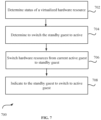
- FIG. 7 is an example flow diagram 700 for providing high availability, according to certain aspects of the disclosure. Steps disclosed herein may be performed by hardware, software, or any combination thereof and may be facilitated by components, modules, and techniques disclosed in FIGs. 1-6 .
- components of the host may monitor virtualized hardware resources of the host, wherein the virtualized hardware resources represent or indicate the health of the current active guest.
- the virtualized panic module of the host may receive a panic event that indicates that either the kernel or an application running in the active guest is experiencing a catastrophic event and may not be able to continue to perform functions of an active guest.
- components of the host may determine based on the status of the virtualized hardware resource for the active guest, if a switchover is needed, wherein a switchover switches the current standby guest to active mode and the current active guest to standby after a reboot.
- components of the host take the hardware resources from the current active guest and provide them to the current standby guest, such that the hardware resources are available for the soon to be active guest as soon as the switchover happens.
- hardware resources are networking resources and/or a display console.
- components of the host may indicate to the standby guest to switch to active mode by setting a status bit in the standby guest.
- Components of the host may communicate with the standby guest via a low bandwidth, but reliably interface for changing the status of the guest from standby to active.
- Steps and techniques described with respect to FIG. 7 may be implemented sequentially and/or concurrently with or without additional steps between them. Furthermore, certain steps may be performed out of order without deviating from the scope of the invention.
- Certain systems provide hardware level redundancy for the management card using dual management modules - one active and the other standby. In current systems, there is no such hardware level redundancy for the line card modules.
- the networking software is hosted in a virtualized environment.
- Two virtual machines are instantiated in the line card module to be able to provide control plane redundancy and in service software upgrade within the confines of a non-redundant hardware environment.
- An active and Standby relationship exists between these two Kernel Virtual Machine (KVM) guests to manage the underlying non-redundant hardware components - a notion that is not supported by KVM eco-system.
- KVM Kernel Virtual Machine
- Aspects of the disclosure provide, a virtual machine management and monitoring platform to support active and standby virtual machines that are completely transparent to the networking software hosted in the virtual machines.
- the monitoring platform provides fast failure indication for certain critical failure modes - less than 50 ms for kernel panic, and tunable 1 to 3 sec watchdog failure. This is an improvement from the 10 second heart-beat failure mechanism currently in place.
- VM Monitor process runs in the line card host environment and combines a number of KVM eco-system failure detection mechanisms, namely Para-virtual Panic (PVPanic), Emulated Intel i6300esb hardware watchdog mechanism and QEMU Guest Agent (QEMU-GA).
- PVPanic Para-virtual Panic
- QEMU-GA QEMU Guest Agent
- the failure detection mechanisms generate events that are propagated to Libvirt.
- VM Monitor uses the Libvirt C-language AP1 to register and process these events to provide guest management that is completely transparent to the networking system software.
- Failure monitoring configuration may include a combination of Linux Kernel Configuration and various XML tags in the Libvirt XML file describing the virtual machine features.
- Libvirt XML file describing the virtual machine features.
- PVPanic Linux Kernel may be built with CONFIG PVPANIC and Libvirt XML file may contain IO Port number, as shown below, to propagate the virtual machine kernel panic to Libvirt via QEMU.
- Watchdog may be implemented using Intel i6300esb hardware emulation.
- the XML file may specify this hardware model and associated reset action as shown below.
- QEMU-GA may be implemented as a daemon in the virtual machine which sends ping packets to the Host using virtio-serial transport mechanism. Libvirt XML file to configure QEMU-GA is shown below.
- the watchdog i6300esb may be tunable from 1 sec to 3 sec.
- QEMU-GA heart-beat may be tunable from 3 to 10 pings at 1 sec interval.
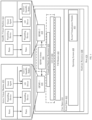
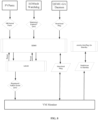
- FIG. 8 is a flow/block diagram illustrating a failure monitoring and switchover process, according to certain aspects of the disclosure.
- the VM Monitor may register for various Libvirt failure events, such as
- a non-transitory machine-readable or computer-readable medium for storing data and code (instructions) that can be executed by one or more processors
- Examples of non-transitory machine-readable or computer-readable medium include memory disk drives, Compact Disks (CDs), optical drives, removable media cartridges, memory devices, and the like.
- a non-transitory machine-readable or computer-readable medium may store the basic programming (e.g., instructions, code, program) and data constructs, which, when executed by one or more processors, provide the functionality described above.
- the non-transitory machine-readable or computer-readable medium may be included in a network device and the instructions or code stored by the medium may be executed by one or more processors of the network device causing the network device to perform certain functions described above.
- the non-transitory machine-readable or computer-readable medium may be separate from a network device, but can be accessible to the network device such that the instructions or code stored by the medium can be executed by one or more processors of the network device causing the network device to perform certain functions described above.
- the non-transitory computer-readable or machine-readable medium may be embodied in nonvolatile memory or volatile memory.
- Such configuration can be accomplished, for example, by designing electronic circuits to perform the operation, by programming programmable electronic circuits (such as microprocessors) to perform the operation such as by executing computer instructions or code, or processors or cores programmed to execute code or instructions stored on a non-transitory memory medium, or any combination thereof.
- Processes can communicate using a variety of techniques including, but not limited to, conventional techniques for inter-process communications, and different pairs of processes may use different techniques, or the same pair of processes may use different techniques at different times.
- a device configured to detect a change in a status of a virtual hardware resource associated with an active virtual machine, and determine, based on the change in the status of the virtual hardware resource, to switch a standby virtual machine to the active virtual machine.
- a network device comprising:
- the monitor is further configured to attach hardware resources to the active virtual machine after performing the switch of the standby virtual machine to the active virtual machine.
- the hardware resource is a network interface.
- the hardware resource is a display console.
- the change in the status of the virtual hardware resource is in response to a guest operating system panic event from a guest operating system executing in the virtual machine.
- the change in the status of the virtual hardware resource is in response to a guest process panic event from the virtual machine.
- the change in the status of the virtual hardware resource is in response to a watchdog timer event from the virtual machine.
- the change in the status of the virtual hardware resource is in response to a lack of receiving a ping event for a pre-determined amount of time.
- the kernel virtualization module is a kernel- based virtual machine (KVM).
- the one or more user virtualization processes are one or more of LibVirt or Qemu.
- a method comprising:
- the method further comprises attaching hardware resources to the active virtual machine after switching of the standby virtual machine to the active virtual machine.
- the hardware resource is a network interface.
- the hardware resource is a display console.
- the change in the status of the virtual hardware resource is in response to a guest operating system panic event from a guest operating system executing in the virtual machine.
- the change in the status of the virtual hardware resource is in response to a guest process panic event from the virtual machine.
- the change in the status of the virtual hardware resource is in response to a watchdog timer event from the virtual machine.
- the change in the status of the virtual hardware resource is in response to a lack of receiving a ping event for a pre-determined amount of time.
- the kernel virtualization module is a kernel-based virtual machine (KVM).
- the one or more user virtualization processes are one or more of LibVirt or Qemu.
Landscapes
- Engineering & Computer Science (AREA)
- Theoretical Computer Science (AREA)
- Physics & Mathematics (AREA)
- General Engineering & Computer Science (AREA)
- General Physics & Mathematics (AREA)
- Software Systems (AREA)
- Quality & Reliability (AREA)
- Mathematical Physics (AREA)
- Computing Systems (AREA)
- Hardware Redundancy (AREA)
- Data Exchanges In Wide-Area Networks (AREA)
- Debugging And Monitoring (AREA)
Applications Claiming Priority (3)
| Application Number | Priority Date | Filing Date | Title |
|---|---|---|---|
| US201662343744P | 2016-05-31 | 2016-05-31 | |
| EP17807216.1A EP3341838B1 (de) | 2016-05-31 | 2017-05-17 | Hohe verfügbarkeit für virtuelle maschinen |
| PCT/US2017/033142 WO2017209955A1 (en) | 2016-05-31 | 2017-05-17 | High availability for virtual machines |
Related Parent Applications (2)
| Application Number | Title | Priority Date | Filing Date |
|---|---|---|---|
| EP17807216.1A Division EP3341838B1 (de) | 2016-05-31 | 2017-05-17 | Hohe verfügbarkeit für virtuelle maschinen |
| EP17807216.1A Division-Into EP3341838B1 (de) | 2016-05-31 | 2017-05-17 | Hohe verfügbarkeit für virtuelle maschinen |
Publications (2)
| Publication Number | Publication Date |
|---|---|
| EP4530857A2 true EP4530857A2 (de) | 2025-04-02 |
| EP4530857A3 EP4530857A3 (de) | 2025-05-14 |
Family
ID=60477795
Family Applications (2)
| Application Number | Title | Priority Date | Filing Date |
|---|---|---|---|
| EP17807216.1A Active EP3341838B1 (de) | 2016-05-31 | 2017-05-17 | Hohe verfügbarkeit für virtuelle maschinen |
| EP25151957.5A Pending EP4530857A3 (de) | 2016-05-31 | 2017-05-17 | Hohe verfügbarkeit für virtuelle maschinen |
Family Applications Before (1)
| Application Number | Title | Priority Date | Filing Date |
|---|---|---|---|
| EP17807216.1A Active EP3341838B1 (de) | 2016-05-31 | 2017-05-17 | Hohe verfügbarkeit für virtuelle maschinen |
Country Status (4)
| Country | Link |
|---|---|
| US (1) | US10824457B2 (de) |
| EP (2) | EP3341838B1 (de) |
| CN (1) | CN108139925B (de) |
| WO (1) | WO2017209955A1 (de) |
Families Citing this family (39)
| Publication number | Priority date | Publication date | Assignee | Title |
|---|---|---|---|---|
| EP3341838B1 (de) | 2016-05-31 | 2025-03-19 | Avago Technologies International Sales Pte. Limited | Hohe verfügbarkeit für virtuelle maschinen |
| US10503237B2 (en) * | 2017-02-13 | 2019-12-10 | Gbs Laboratories, Llc | Mobile device virtualization solution based on bare-metal hypervisor with optimal resource usage and power consumption |
| JP2018165956A (ja) * | 2017-03-28 | 2018-10-25 | 富士通株式会社 | 情報処理装置、情報処理システム、および情報処理プログラム |
| US20180285217A1 (en) * | 2017-03-31 | 2018-10-04 | Intel Corporation | Failover response using a known good state from a distributed ledger |
| US11947489B2 (en) | 2017-09-05 | 2024-04-02 | Robin Systems, Inc. | Creating snapshots of a storage volume in a distributed storage system |
| US11582168B2 (en) | 2018-01-11 | 2023-02-14 | Robin Systems, Inc. | Fenced clone applications |
| US11748203B2 (en) | 2018-01-11 | 2023-09-05 | Robin Systems, Inc. | Multi-role application orchestration in a distributed storage system |
| US11392363B2 (en) | 2018-01-11 | 2022-07-19 | Robin Systems, Inc. | Implementing application entrypoints with containers of a bundled application |
| EP3759599B1 (de) * | 2018-03-01 | 2023-12-20 | Google LLC | Hochverfügbare mehrfach-einzel-mandanten-dienste |
| CN108880898B (zh) | 2018-06-29 | 2020-09-08 | 新华三技术有限公司 | 主备容器系统切换方法及装置 |
| CN109117341A (zh) * | 2018-08-14 | 2019-01-01 | 郑州云海信息技术有限公司 | 一种虚拟机的监控方法、装置、设备及介质 |
| JP7193722B2 (ja) * | 2019-02-05 | 2022-12-21 | 日本電信電話株式会社 | 障害通知システム、障害通知方法、障害通知装置および障害通知プログラム |
| DE102019203377B3 (de) | 2019-03-13 | 2020-08-13 | Continental Automotive Gmbh | Fahrzeugsystem, Fahrzeug und Verfahren zum Betreiben eines solchen Fahrzeugsystems |
| US11256434B2 (en) | 2019-04-17 | 2022-02-22 | Robin Systems, Inc. | Data de-duplication |
| CN110188002B (zh) * | 2019-05-31 | 2022-08-30 | 东北大学 | 一种支持可靠性保障的冷热操模式虚拟机数量评估方法 |
| US11249851B2 (en) | 2019-09-05 | 2022-02-15 | Robin Systems, Inc. | Creating snapshots of a storage volume in a distributed storage system |
| US11520650B2 (en) | 2019-09-05 | 2022-12-06 | Robin Systems, Inc. | Performing root cause analysis in a multi-role application |
| US11347684B2 (en) | 2019-10-04 | 2022-05-31 | Robin Systems, Inc. | Rolling back KUBERNETES applications including custom resources |
| US20210103476A1 (en) * | 2019-10-08 | 2021-04-08 | International Business Machines Corporation | Block storage virtualization manager |
| US11403188B2 (en) | 2019-12-04 | 2022-08-02 | Robin Systems, Inc. | Operation-level consistency points and rollback |
| CN111124535B (zh) * | 2019-12-06 | 2022-06-03 | 济南浪潮数据技术有限公司 | 云主机qga的功能扩展方法、装置、设备及存储介质 |
| US11108638B1 (en) * | 2020-06-08 | 2021-08-31 | Robin Systems, Inc. | Health monitoring of automatically deployed and managed network pipelines |
| US11528186B2 (en) | 2020-06-16 | 2022-12-13 | Robin Systems, Inc. | Automated initialization of bare metal servers |
| DE102020116959A1 (de) * | 2020-06-26 | 2021-12-30 | Infineon Technologies Ag | Watchdog-schaltung, schaltung, system-auf-chip, verfahren zum betrieb einer watchdog-schaltung, verfahren zum betrieb einer schaltung und verfahren zum betrieb eines systems-auf-chip |
| US11740980B2 (en) | 2020-09-22 | 2023-08-29 | Robin Systems, Inc. | Managing snapshot metadata following backup |
| US11743188B2 (en) | 2020-10-01 | 2023-08-29 | Robin Systems, Inc. | Check-in monitoring for workflows |
| US11271895B1 (en) | 2020-10-07 | 2022-03-08 | Robin Systems, Inc. | Implementing advanced networking capabilities using helm charts |
| US11456914B2 (en) | 2020-10-07 | 2022-09-27 | Robin Systems, Inc. | Implementing affinity and anti-affinity with KUBERNETES |
| US11750451B2 (en) | 2020-11-04 | 2023-09-05 | Robin Systems, Inc. | Batch manager for complex workflows |
| US11556361B2 (en) | 2020-12-09 | 2023-01-17 | Robin Systems, Inc. | Monitoring and managing of complex multi-role applications |
| WO2022172061A1 (ja) * | 2021-02-12 | 2022-08-18 | ラクテン・シンフォニー・シンガポール・プライベート・リミテッド | ネットワークサービス管理装置およびネットワークサービス管理方法 |
| US12375393B2 (en) * | 2021-04-16 | 2025-07-29 | Ruckus Ip Holdings Llc | Graceful switchover for multi-chassis trunking |
| US12118376B2 (en) | 2021-04-20 | 2024-10-15 | Stmicroelectronics International N.V. | Virtual mode execution manager |
| CN113626136B (zh) * | 2021-06-30 | 2023-12-22 | 济南浪潮数据技术有限公司 | 一种虚拟机故障检测方法和装置 |
| EP4167093A1 (de) * | 2021-10-15 | 2023-04-19 | Siemens Aktiengesellschaft | Ferngesteuertes system und verwendung des systems auf der basis einer kanten-cloud-infrastruktur |
| CN114924934A (zh) * | 2022-05-20 | 2022-08-19 | 济南浪潮数据技术有限公司 | 一种虚拟机状态监控的方法及相关组件 |
| US20240241728A1 (en) * | 2023-01-17 | 2024-07-18 | Vmware, Inc. | Host and dpu coordination for dpu maintenance events |
| CN116866154B (zh) * | 2023-09-05 | 2023-11-28 | 湖北华中电力科技开发有限责任公司 | 一种基于虚拟机集群的配电网通讯服务智能调度管理系统 |
| CN119520242B (zh) * | 2024-11-26 | 2025-11-04 | 天翼云科技有限公司 | 虚拟机的网络切换方法、装置、计算机设备和存储介质 |
Family Cites Families (41)
| Publication number | Priority date | Publication date | Assignee | Title |
|---|---|---|---|---|
| US4827411A (en) * | 1987-06-15 | 1989-05-02 | International Business Machines Corporation | Method of maintaining a topology database |
| JP2002041305A (ja) * | 2000-07-26 | 2002-02-08 | Hitachi Ltd | 仮想計算機システムにおける計算機資源の割当て方法および仮想計算機システム |
| US7139811B2 (en) * | 2001-08-01 | 2006-11-21 | Actona Technologies Ltd. | Double-proxy remote data access system |
| US7370324B2 (en) | 2003-09-30 | 2008-05-06 | Intel Corporation | Switching between a service virtual machine and a guest virtual machine in a virtual machine monitor environment |
| US20070094659A1 (en) | 2005-07-18 | 2007-04-26 | Dell Products L.P. | System and method for recovering from a failure of a virtual machine |
| US20070143686A1 (en) * | 2005-12-15 | 2007-06-21 | International Business Machines Corporation | System administration console that integrates manual and autonomic tasks |
| JP5262724B2 (ja) | 2007-01-11 | 2013-08-14 | 日本電気株式会社 | プロビジョニングシステム、方法、及び、プログラム |
| US8171483B2 (en) * | 2007-10-20 | 2012-05-01 | Citrix Systems, Inc. | Method and system for communicating between isolation environments |
| US8312468B2 (en) | 2009-06-09 | 2012-11-13 | Open Kernel Labs | Methods and apparatus for fast context switching in a virtualized system |
| US8201169B2 (en) | 2009-06-15 | 2012-06-12 | Vmware, Inc. | Virtual machine fault tolerance |
| US8135985B2 (en) | 2009-06-17 | 2012-03-13 | International Business Machines Corporation | High availability support for virtual machines |
| US8873375B2 (en) | 2009-07-22 | 2014-10-28 | Broadcom Corporation | Method and system for fault tolerance and resilience for virtualized machines in a network |
| US8769535B2 (en) | 2009-09-24 | 2014-07-01 | Avaya Inc. | Providing virtual machine high-availability and fault tolerance via solid-state backup drives |
| EP2513792B1 (de) * | 2009-12-17 | 2016-08-17 | Intel Corporation | Kooperierte unterbrechungsmoderation für eine virtualisierungsumgebung |
| US8145945B2 (en) | 2010-01-04 | 2012-03-27 | Avaya Inc. | Packet mirroring between primary and secondary virtualized software images for improved system failover performance |
| US20110191627A1 (en) | 2010-01-29 | 2011-08-04 | Maarten Koning | System And Method for Handling a Failover Event |
| CN102158386B (zh) | 2010-02-11 | 2015-06-03 | 威睿公司 | 系统管理程序级的分布式负载平衡 |
| US8495418B2 (en) * | 2010-07-23 | 2013-07-23 | Brocade Communications Systems, Inc. | Achieving ultra-high availability using a single CPU |
| US8650564B2 (en) | 2010-10-19 | 2014-02-11 | Vmware, Inc. | Method and system for synchronizing fault-tolerant virtual machines and adjusting CPU resource limit based on execution latency |
| TWI537828B (zh) | 2010-12-21 | 2016-06-11 | 萬國商業機器公司 | 虛擬機管理的方法及其電腦系統之裝置和電腦程式 |
| US9020895B1 (en) | 2010-12-27 | 2015-04-28 | Netapp, Inc. | Disaster recovery for virtual machines across primary and secondary sites |
| US8954645B2 (en) | 2011-01-25 | 2015-02-10 | International Business Machines Corporation | Storage writes in a mirrored virtual machine system |
| US8621274B1 (en) | 2011-05-18 | 2013-12-31 | Netapp Inc. | Virtual machine fault tolerance |
| US20130074065A1 (en) | 2011-09-21 | 2013-03-21 | Ibm Corporation | Maintaining Consistency of Storage in a Mirrored Virtual Environment |
| US9021459B1 (en) * | 2011-09-28 | 2015-04-28 | Juniper Networks, Inc. | High availability in-service software upgrade using virtual machine instances in dual control units of a network device |
| US8806266B1 (en) | 2011-09-28 | 2014-08-12 | Juniper Networks, Inc. | High availability using full memory replication between virtual machine instances on a network device |
| US20130275966A1 (en) | 2012-04-12 | 2013-10-17 | International Business Machines Corporation | Providing application based monitoring and recovery for a hypervisor of an ha cluster |
| US20140007097A1 (en) * | 2012-06-29 | 2014-01-02 | Brocade Communications Systems, Inc. | Dynamic resource allocation for virtual machines |
| CN102972010B (zh) | 2012-08-17 | 2015-03-25 | 华为技术有限公司 | 一种云环境下虚拟应用双机的切换方法、装置及系统 |
| JP5700009B2 (ja) | 2012-09-18 | 2015-04-15 | 横河電機株式会社 | フォールトトレラントシステム |
| US9110864B2 (en) | 2013-06-25 | 2015-08-18 | International Business Machines Corporation | Fault tolerance solution for stateful applications |
| US9286097B2 (en) | 2013-07-23 | 2016-03-15 | Intel Corporation | Switching a first OS in a foreground to a standby state in response to a system event and resuming a second OS from a background |
| JP2015103092A (ja) | 2013-11-26 | 2015-06-04 | 株式会社日立製作所 | 障害回復システム及び障害回復システムの構築方法 |
| WO2015176048A1 (en) * | 2014-05-15 | 2015-11-19 | Lynx Software Technologies, Inc. | Aspects of hardware virtualization, hypervisors, code detection |
| US9529680B2 (en) | 2014-06-17 | 2016-12-27 | Verizon Patent And Licensing Inc. | Virtual resource-based backup |
| KR101596325B1 (ko) * | 2014-06-30 | 2016-02-23 | 전자부품연구원 | 서버/스토리지 관리 시스템 |
| US9529661B1 (en) | 2015-06-18 | 2016-12-27 | Rockwell Collins, Inc. | Optimal multi-core health monitor architecture |
| CN105468434A (zh) * | 2015-12-11 | 2016-04-06 | 浪潮(北京)电子信息产业有限公司 | 一种处理虚拟机异常的方法及装置 |
| US10230785B1 (en) * | 2015-12-28 | 2019-03-12 | Amazon Technologies, Inc. | Post data synchronization for domain migration |
| CN109154888B (zh) * | 2016-05-23 | 2023-05-09 | W·特纳 | 配备协调器的超融合系统 |
| EP3341838B1 (de) | 2016-05-31 | 2025-03-19 | Avago Technologies International Sales Pte. Limited | Hohe verfügbarkeit für virtuelle maschinen |
-
2017
- 2017-05-17 EP EP17807216.1A patent/EP3341838B1/de active Active
- 2017-05-17 WO PCT/US2017/033142 patent/WO2017209955A1/en not_active Ceased
- 2017-05-17 EP EP25151957.5A patent/EP4530857A3/de active Pending
- 2017-05-17 CN CN201780003489.XA patent/CN108139925B/zh active Active
-
2018
- 2018-03-30 US US15/941,665 patent/US10824457B2/en active Active
Non-Patent Citations (1)
| Title |
|---|
| HU TAO: "[Qemu-devel] [PATCH vl6 4/6] pvpanic: add document of pvpanic", QEMU-DEVEL (ACCESSED VIA THE WAYBACK MACHINE), 25 April 2014 (2014-04-25), XP093353147 * |
Also Published As
| Publication number | Publication date |
|---|---|
| WO2017209955A1 (en) | 2017-12-07 |
| CN108139925A (zh) | 2018-06-08 |
| US10824457B2 (en) | 2020-11-03 |
| EP3341838B1 (de) | 2025-03-19 |
| CN108139925B (zh) | 2022-06-03 |
| EP3341838A4 (de) | 2019-05-08 |
| EP4530857A3 (de) | 2025-05-14 |
| US20180225140A1 (en) | 2018-08-09 |
| EP3341838A1 (de) | 2018-07-04 |
Similar Documents
| Publication | Publication Date | Title |
|---|---|---|
| US10824457B2 (en) | High availability for virtual machines | |
| US11895016B2 (en) | Methods and apparatus to configure and manage network resources for use in network-based computing | |
| US10671423B2 (en) | Hot-plug hardware and software implementation | |
| Yamato et al. | Fast and reliable restoration method of virtual resources on OpenStack | |
| US10754774B2 (en) | Buffer manager | |
| US9026848B2 (en) | Achieving ultra-high availability using a single CPU | |
| US8645755B2 (en) | Enhanced error handling for self-virtualizing input/output device in logically-partitioned data processing system | |
| US7840398B2 (en) | Techniques for unified management communication for virtualization systems | |
| JP4579298B2 (ja) | 仮想サーバー・ブレードを提供する方法および装置 | |
| US9176833B2 (en) | Tolerating failures using concurrency in a cluster | |
| EP3338194B1 (de) | Mehrkanalige eingabe-/ausgabevirtualisierung | |
| US20090125901A1 (en) | Providing virtualization of a server management controller | |
| US20100031258A1 (en) | Virtual machine system and control method of the virtual machine system | |
| US20140317437A1 (en) | Automatic cluster-based failover handling | |
| US20140204734A1 (en) | Node device, communication system, and method for switching virtual switch | |
| US11409621B2 (en) | High availability for a shared-memory-based firewall service virtual machine | |
| JP5601428B1 (ja) | 仮想化システム、制御方法、および制御プログラム | |
| WO2022066251A1 (en) | Firmware emulated watchdog timer controlled using native cpu operations | |
| US10203966B2 (en) | Application launcher and management framework for a network device | |
| US20220283834A1 (en) | System and method to monitor and manage a passthrough device | |
| Guay et al. | Early experiences with live migration of SR-IOV enabled InfiniBand | |
| US20200125434A1 (en) | Preventing corruption by blocking requests |
Legal Events
| Date | Code | Title | Description |
|---|---|---|---|
| PUAI | Public reference made under article 153(3) epc to a published international application that has entered the european phase |
Free format text: ORIGINAL CODE: 0009012 |
|
| STAA | Information on the status of an ep patent application or granted ep patent |
Free format text: STATUS: THE APPLICATION HAS BEEN PUBLISHED |
|
| AC | Divisional application: reference to earlier application |
Ref document number: 3341838 Country of ref document: EP Kind code of ref document: P |
|
| AK | Designated contracting states |
Kind code of ref document: A2 Designated state(s): AL AT BE BG CH CY CZ DE DK EE ES FI FR GB GR HR HU IE IS IT LI LT LU LV MC MK MT NL NO PL PT RO RS SE SI SK SM TR |
|
| REG | Reference to a national code |
Ref country code: DE Ref legal event code: R079 Free format text: PREVIOUS MAIN CLASS: G06F0011140000 Ipc: G06F0009455000 |
|
| PUAL | Search report despatched |
Free format text: ORIGINAL CODE: 0009013 |
|
| AK | Designated contracting states |
Kind code of ref document: A3 Designated state(s): AL AT BE BG CH CY CZ DE DK EE ES FI FR GB GR HR HU IE IS IT LI LT LU LV MC MK MT NL NO PL PT RO RS SE SI SK SM TR |
|
| RIC1 | Information provided on ipc code assigned before grant |
Ipc: G06F 11/30 20060101ALI20250404BHEP Ipc: G06F 9/54 20060101ALI20250404BHEP Ipc: G06F 11/14 20060101ALI20250404BHEP Ipc: G06F 11/07 20060101ALI20250404BHEP Ipc: G06F 9/50 20060101ALI20250404BHEP Ipc: G06F 9/455 20180101AFI20250404BHEP |
|
| STAA | Information on the status of an ep patent application or granted ep patent |
Free format text: STATUS: REQUEST FOR EXAMINATION WAS MADE |
|
| 17P | Request for examination filed |
Effective date: 20251111 |
|
| STAA | Information on the status of an ep patent application or granted ep patent |
Free format text: STATUS: EXAMINATION IS IN PROGRESS |
|
| 17Q | First examination report despatched |
Effective date: 20260324 |