EP4530759A1 - Motorsteuerungs- und überwachungssystem - Google Patents
Motorsteuerungs- und überwachungssystem Download PDFInfo
- Publication number
- EP4530759A1 EP4530759A1 EP24197826.1A EP24197826A EP4530759A1 EP 4530759 A1 EP4530759 A1 EP 4530759A1 EP 24197826 A EP24197826 A EP 24197826A EP 4530759 A1 EP4530759 A1 EP 4530759A1
- Authority
- EP
- European Patent Office
- Prior art keywords
- ecams
- processor
- node
- integrated circuit
- engine
- Prior art date
- Legal status (The legal status is an assumption and is not a legal conclusion. Google has not performed a legal analysis and makes no representation as to the accuracy of the status listed.)
- Pending
Links
Images

Classifications
-
- G—PHYSICS
- G05—CONTROLLING; REGULATING
- G05B—CONTROL OR REGULATING SYSTEMS IN GENERAL; FUNCTIONAL ELEMENTS OF SUCH SYSTEMS; MONITORING OR TESTING ARRANGEMENTS FOR SUCH SYSTEMS OR ELEMENTS
- G05B9/00—Safety arrangements
- G05B9/02—Safety arrangements electric
- G05B9/03—Safety arrangements electric with multiple-channel loop, i.e. redundant control systems
-
- H—ELECTRICITY
- H04—ELECTRIC COMMUNICATION TECHNIQUE
- H04L—TRANSMISSION OF DIGITAL INFORMATION, e.g. TELEGRAPHIC COMMUNICATION
- H04L12/00—Data switching networks
- H04L12/28—Data switching networks characterised by path configuration, e.g. LAN [Local Area Networks] or WAN [Wide Area Networks]
- H04L12/42—Loop networks
- H04L12/437—Ring fault isolation or reconfiguration
-
- G—PHYSICS
- G05—CONTROLLING; REGULATING
- G05B—CONTROL OR REGULATING SYSTEMS IN GENERAL; FUNCTIONAL ELEMENTS OF SUCH SYSTEMS; MONITORING OR TESTING ARRANGEMENTS FOR SUCH SYSTEMS OR ELEMENTS
- G05B19/00—Program-control systems
- G05B19/02—Program-control systems electric
- G05B19/04—Program control other than numerical control, i.e. in sequence controllers or logic controllers
- G05B19/042—Program control other than numerical control, i.e. in sequence controllers or logic controllers using digital processors
- G05B19/0421—Multiprocessor system
-
- H—ELECTRICITY
- H04—ELECTRIC COMMUNICATION TECHNIQUE
- H04L—TRANSMISSION OF DIGITAL INFORMATION, e.g. TELEGRAPHIC COMMUNICATION
- H04L12/00—Data switching networks
- H04L12/28—Data switching networks characterised by path configuration, e.g. LAN [Local Area Networks] or WAN [Wide Area Networks]
- H04L12/42—Loop networks
- H04L12/422—Synchronisation for ring networks
-
- F—MECHANICAL ENGINEERING; LIGHTING; HEATING; WEAPONS; BLASTING
- F02—COMBUSTION ENGINES; HOT-GAS OR COMBUSTION-PRODUCT ENGINE PLANTS
- F02C—GAS-TURBINE PLANTS; AIR INTAKES FOR JET-PROPULSION PLANTS; CONTROLLING FUEL SUPPLY IN AIR-BREATHING JET-PROPULSION PLANTS
- F02C9/00—Controlling gas-turbine plants; Controlling fuel supply in air- breathing jet-propulsion plants
-
- F—MECHANICAL ENGINEERING; LIGHTING; HEATING; WEAPONS; BLASTING
- F02—COMBUSTION ENGINES; HOT-GAS OR COMBUSTION-PRODUCT ENGINE PLANTS
- F02D—CONTROLLING COMBUSTION ENGINES
- F02D41/00—Electrical control of supply of combustible mixture or its constituents
- F02D41/22—Safety or indicating devices for abnormal conditions
-
- F—MECHANICAL ENGINEERING; LIGHTING; HEATING; WEAPONS; BLASTING
- F02—COMBUSTION ENGINES; HOT-GAS OR COMBUSTION-PRODUCT ENGINE PLANTS
- F02D—CONTROLLING COMBUSTION ENGINES
- F02D41/00—Electrical control of supply of combustible mixture or its constituents
- F02D41/24—Electrical control of supply of combustible mixture or its constituents characterised by the use of digital means
- F02D41/26—Electrical control of supply of combustible mixture or its constituents characterised by the use of digital means using computer, e.g. microprocessor
- F02D41/266—Electrical control of supply of combustible mixture or its constituents characterised by the use of digital means using computer, e.g. microprocessor the computer being backed-up or assisted by another circuit, e.g. analogue
-
- G—PHYSICS
- G05—CONTROLLING; REGULATING
- G05B—CONTROL OR REGULATING SYSTEMS IN GENERAL; FUNCTIONAL ELEMENTS OF SUCH SYSTEMS; MONITORING OR TESTING ARRANGEMENTS FOR SUCH SYSTEMS OR ELEMENTS
- G05B23/00—Testing or monitoring of control systems or parts thereof
- G05B23/02—Electric testing or monitoring
- G05B23/0205—Electric testing or monitoring by means of a monitoring system capable of detecting and responding to faults
- G05B23/0208—Electric testing or monitoring by means of a monitoring system capable of detecting and responding to faults characterized by the configuration of the monitoring system
- G05B23/0213—Modular or universal configuration of the monitoring system, e.g. monitoring system having modules that may be combined to build monitoring program; monitoring system that can be applied to legacy systems; adaptable monitoring system; using different communication protocols
Definitions
- the present disclosure relates to an Engine Control and Monitoring System (ECaMS) for an engine, in particular to an ECaMS comprising first and second processor nodes.
- ECaMS Engine Control and Monitoring System
- ECaMS systems are commonly referred to as ECaMS systems.
- ECaMS systems may be included in: aeronautical gas turbine engines; marine diesel engines; automotive petrol engines; marine gas turbine engines, and so on.
- the ECaMS may comprise a Control and Optimising System (CnOS) and a Monitoring and Optimisation System (MnOS).
- CnOS Control and Optimising System
- MnOS Monitoring and Optimisation System
- the CnOS may be used to control flight operations to regulate the engine performance in flight (by way of example, to adjust variable stator vanes angles or control fuel flow rates)
- the MnOS may be used to store data for improving engine performance after flights, including data used to guide maintenance operation (for example fan balancing which typically requires adjusting screws in an engine).
- the two systems may be effectively segregated from one another, such that engine control and engine protection functions do not interact and issues with (less critical) control systems are less likely to impact (more critical) protection systems. Segregation may include, for example, using separate physical sensors for the two systems, wherein the sensors may be located in similar locations.
- An embodiment provides an Engine Control and Monitoring System (ECaMS), for an engine.
- the ECaMS comprises a first processor node and a second processor node.
- the first processor node comprises a first acquisition integrated circuit (IC), a first output IC, and a first processor.
- the second processor node comprises a second acquisition IC, a second output IC, and a second processor.
- the first acquisition IC is connected directly to the second acquisition IC
- the ECaMS may further comprise a third processor node and a fourth processor node, wherein the third processor node comprises a third acquisition IC, a third output IC, and a third processor, and the fourth processor node comprises a fourth acquisition IC, a fourth output IC, and a fourth processor.
- the first acquisition IC, second acquisition IC, third acquisition IC and fourth acquisition IC may be connected via a ring network.
- the ring network may be a dual ring network comprising a clockwise ring and an anticlockwise ring.
- a first portion of the processor nodes comprising at least one processor node may provide control functionality, and a second portion of the processor nodes comprising at least one processor node may provide protection functionality. Further, the first portion of the processor nodes may be segregated from the second portion of the processor nodes
- the engines may be aeronautical gas turbine engines; marine diesel engines; automotive petrol engines; or naval gas turbine engines.
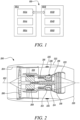
- FIG. 1 is a schematic diagram of an ECaMS 100 for an engine, in accordance with embodiments.
- the ECaMS includes a first processor node 101A and a second processor node 101B.
- the first processor node comprises a first acquisition integrated circuit (IC) 102A, a first output IC 104A and a first processor 106A.
- the second processor node 101B includes second acquisition IC 102B, output IC 104B and processor 106B.
- the first acquisition IC is connected directly to the second acquisition IC; this direct connection may comprise a wired connection, a wireless link or a combination of wired and wireless connection.
- output ICs of the first and second processor nodes may also be directly connected.
- the ECaMS 100 as shown in Figure 1 uses what may be referred to as a distributed ECaMS architecture, in which the functions of the ECaMS are split across the processor nodes.
- the processors within a given processor node may be connected directly only to components within that processor node, for example, the acquisition IC and/or output IC, and may not have direct connections to components outside the processor node.
- connection (which may be wired or wireless) does not include any further components other than those used to effect the connection such as wires, plugs, sockets, isolators, circuit conditioning components and lightning strike protection; that is, there are no further components located between the two given components that may receive, alter, and/or retransmit signals passing along the connection.
- the capabilities of the ECaMS as illustrated by Figure 1 may be altered (for example, expanded) as necessary depending on the requirements of the engine into which the ECaMS is installed.
- additional nodes can be added into the system to provide additional processing capability, I/O capability, and so on without requiring substantial software changes and with reduced rewiring.
- the ECaMS could be expanded by the addition of further node(s) providing additional I/O capability or specific I/O capabilities as required for a particular implementation.
- FIG. 2 is an example of an engine 200 in accordance with embodiments that comprises turbines, specifically an aeronautical gas turbine engine.
- An ECaMS 225 in accordance with embodiments is installed in the example engine 200; where installed in an aeronautical engine, the ECaMS may be an Electrical Engine Controller (EEC).
- EEC Electrical Engine Controller
- the ECaMS 225 shown in Figure 2 is connected to a sensor 226.
- the engine 200 may be associated with an aircraft (e.g. mounted thereon, or configured to be mounted thereon) and configured to generate propulsive thrust and/or electrical energy for the aircraft.
- the engine 200 has a principal rotational axis 202.
- the engine 200 comprises, in axial flow series, an air intake 204, a propulsive fan 206, an intermediate pressure compressor 208, a high-pressure compressor 210, combustion equipment 212, a high-pressure turbine 214, an intermediate pressure turbine 216, a low-pressure turbine 218 and an exhaust nozzle 220.
- a nacelle 222 generally surrounds the engine 200 and defines both the intake 204 and the exhaust nozzle 220.
- An internal support structure 223 surrounds the fan 206, compressors 207, 210, combustion equipment 212, and turbines 214, 216, 218.
- the engine 200 operates as follows: air entering the intake 204 is accelerated by the fan 206 to produce two air flows: a first air flow which passes into the intermediate pressure compressor 208 and a second air flow which passes through a bypass duct 224 to provide propulsive thrust.
- the intermediate pressure compressor 208 compresses the air flow directed into it before delivering that air to the high-pressure compressor 210 where further compression takes place.
- the compressed air exhausted from the high-pressure compressor 210 is directed into the combustion equipment 212 where it is mixed with fuel and the mixture combusted.
- the resultant hot combustion products then expand through, and thereby drive the high, intermediate and low-pressure turbines 214, 216, 218 before being exhausted through the nozzle 220 to provide additional propulsive thrust.
- the high 214, intermediate 216 and low 218 pressure turbines drive respectively the high-pressure compressor 210, intermediate pressure compressor 208 and fan 206, each by suitable interconnecting shaft.
- the ECaMS may be installed, for example, within the nacelle 222 and may be used to control and monitor various characteristics of the engine. Due to the relatively high complexity of the engine shown in Figure 2 , the ECaMS may comprise additional processor nodes beyond the two illustrated in Figure 1 . It will be appreciated that the engine 200 illustrated in Fig. 2 is by way of example only, and various alternatives are within the scope of the present disclosure. Some less complex engines, for example automotive engines, may include ECaMS comprising smaller numbers of processor nodes than may be included in the engine of Figure 2 .
- the acquisition ICs of the first and second processor nodes are connected directly to one another.
- additional processor nodes beyond the two processor nodes of the Figure 1 embodiment
- additional connections are required between the processor nodes.
- Various schemes may be used for connecting plural processor nodes, for example, hub and spoke connection schemes.
- the ECaMS may comprise a third processor node and a fourth processor node.
- the third processor node may comprise a third acquisition IC, a third output IC, and a third processor
- the fourth processor node may comprise a fourth acquisition IC, a fourth output IC, and a fourth processor.
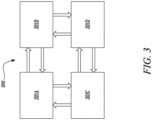
- FIG. 3 is a schematic diagram showing an example embodiment in which the ECaMS 300 includes a first processor node 301A, second processor node 301B, third processor node 301C and fourth processor node 301D.
- the first acquisition IC, second acquisition IC, third acquisition IC and fourth acquisition IC of the respective processor nodes may be connected via a ring network.
- Use of a ring network to connect plural processor nodes may be particularly well suited to embodiments, due to the ease with which modifications may be made to the ECaMS if desired to accommodate changes in requirements.
- additional processor nodes may be integrated into the ring network at any position in the ring.
- the ring network may be a dual ring network comprising a clockwise ring and an anticlockwise ring; use of a dual ring network may provide an additional level of robustness to connection failures, allowing communications between nodes to be switched from a ring experiencing an issue to the other ring. Further, if a node within the ring becomes available, communications may still be routed to every other node within the ring if a dual ring network is used.
- the example embodiment shown in Figure 3 includes a dual ring network, with a clockwise ring (illustrated by solid black arrows in Figure 3 ) and an anticlockwise ring (illustrated by white arrows with a black outline in Figure 3 ).
- At least one processor node of the ECaMS may be configured to receive sensor data generated by at least one sensor, and to transmit data packets via the ring network; in this way the sensor data may be made available throughout the processor nodes forming the ECaMS.
- the at least one sensor may form part of the ECaMS, may be separate from but connected to the ECaMS, or may be a mixture of sensors forming part of the ECaMS and separate sensors.
- the processor node that initially transmits the data packets using the ring network may be configured to include a node identifier in the data packets, wherein the node identifier may indicate that the packets have originated from (as in, have been initially transmitted into the ring network) by that processor node.
- node identifiers may indicate that the packets have originated from (as in, have been initially transmitted into the ring network) by that processor node.
- At least one processor node within the ECaMS may be configured, when receiving one or more data packets via the ring network, to determine whether the one or more data packets include the node identifier of that node. Where a processor node detects a node identifier for itself, the processor node may be further configured to delete the data packets including said node identifier. Alternatively, where a processor node determines that the one or more data packets do not include the node identifier, or include a node identifier for another processor node, the processor node may be further configured to retransmit the data packets. By selectively deleting data packets in this way, old data (that has already circled around the ring network) may be eliminated to avoid data packets endlessly looping through the ring network and band contention may thereby be avoided.
- the processor nodes of the ECaMS may be divided into at least a first portion and a second portion (each portion comprising at least one processor node); where the ECaMS comprises only two processor nodes, the portions may comprise a single one of these two processor nodes each. Where the ECaMS comprises more than two processor node, the processor nodes may be divided between the two portions. Typically, although not exclusively, the processor nodes may be divided approximately equally between the two portions, by way of example, where the ECaMS comprises four processor nodes, two of the processor nodes may be included in each of the two portions. A first portion of the processor nodes may be used to provide control functionality, while a second portion of the processor nodes may be used to provide protection functionality.
- Control functions may include, for example, VSV (variable stator vane) actuator control, engine igniter control, fuel control, and so on.
- Protection functions may include, for example, engine surge prevention, flame out prevention, and so on.
- the segregation between the two functions means that interactions between the two functions are kept to a minimum; by way of example, the only signals that may cross partitions between control and protection functions may be power and communication signals between processors (and these signals may be carefully regulated to avoid any error or failure propagation between systems).
- the output ICs of processor nodes within a portion may communicate with one another; however as discussed above the processors of the processor nodes may not communicate directly.
- the limited signalling that passes between portions may pass via the acquisition ICs.
- the ICs in the processor nodes may be Field Programmable Gate Arrays (FPGAs). FPGAs may be particularly well suited to use in the ECaMS units. Other forms of IC such as Application Specific Integrated Circuits (ASICs), System on a Chips (SoCs), Complex Programmable Logic Devices (CPLDs) and Application Specific Standard Products (ASSPs) may additionally or alternatively be used.
- ASICs Application Specific Integrated Circuits
- SoCs System on a Chips
- CPLDs Complex Programmable Logic Devices
- ASSPs Application Specific Standard Products
- different processor nodes within ECaMS may use different types of ICs; the choice of IC(s) used may be primarily determined based on the specific needs of the system.
- FIG 4 is a schematic diagram of connections within an ECaMS in accordance with embodiments.
- the ECaMS shown in Figure 4 includes 4 processor nodes, each of which has an acquisition IC, processor and output IC.
- the ECaMS includes processor nodes 401, 411, 421 and 431.
- the acquisition ICs in the Figure 4 ECaMS are 402, 412, 422 and 432.
- the processors in the Figure 4 ECaMS are 406, 416, 426 and 436.
- the output ICs in the Figure 4 ECaMS are 404, 414, 424 and 434. All of the ICs shown in Figure 4 are FPGAs.
- FIG. 4 shows an ECaMS (in this example, EEC), in accordance with embodiments.
- the processor nodes are divided into two portions, with processor nodes 401 and 411 used to provide control functionality (thereby defining the first, control, portion), and processor nodes 421 and 431 used to provide protection functionality (thereby defining a second, protection, portion).
- processor nodes 401 and 411 used to provide control functionality (thereby defining the first, control, portion)
- processor nodes 421 and 431 used to provide protection functionality (thereby defining a second, protection, portion).
- separate communication channels may be used for the two functions, with only power and communication signals between processors crossing the segregation between functions.
- the FPGAs may be used to acquire signals or provide sensor excitations or switching output states on demand from the processor.
- the connections between processor nodes are via the acquisition ICs, and there are also connections between output ICs within (rather than between) the two portions.
- the processors 406, 416, 426 and 436 are only connected to other components within the processor nodes; accordingly, configuration alterations for the ECaMS may not require significant software updates and the versatility of the system is improved. Where it is desired to increase in I/O provisions, which may result in an increase in the physical size of ECaMS; this may be effected by addition of units without exceeding a physical limit on how large ECaMS systems may be. Continuing with the example of aeronautical engines, the physical limit may be dictated by the diameter of the fan case, sizes of PCBs that can be efficiently manufactured, weight limits, and so on.
- embodiments may provide versatile and adaptable ECaMSs that can be used within a range of engine types.
- Embodiments may be configured to allow obtained sensor data to be efficiently shared throughout the processor nodes forming the ECaMS, and may support simple modification of the ECaMS where circumstances dictate with minimal or no software updating required to effect modifications.
- the adaptability and versatility of the ECaMS may be improved.
- use of a ring network to connect the processor nodes (via acquisition ICs) further improves the adaptability and versatility of the ECaMS, in particular by simplifying the process of modifying the ECaMS configuration where desired.
- use of dual ring networks may provide robustness, allowing communications between processor nodes to be routed around malfunctioning processor nodes.
- portioning and segmenting of the processor nodes may reduce the risk of errors or failures in the control functionality impacting the protection functionality, which may be of particular use in safety critical applications.
Landscapes
- Engineering & Computer Science (AREA)
- Computer Networks & Wireless Communication (AREA)
- Signal Processing (AREA)
- Physics & Mathematics (AREA)
- General Physics & Mathematics (AREA)
- Automation & Control Theory (AREA)
- Combined Controls Of Internal Combustion Engines (AREA)
Applications Claiming Priority (1)
| Application Number | Priority Date | Filing Date | Title |
|---|---|---|---|
| GBGB2314802.6A GB202314802D0 (en) | 2023-09-27 | 2023-09-27 | Engine control and monitoring system |
Publications (1)
| Publication Number | Publication Date |
|---|---|
| EP4530759A1 true EP4530759A1 (de) | 2025-04-02 |
Family
ID=88599051
Family Applications (1)
| Application Number | Title | Priority Date | Filing Date |
|---|---|---|---|
| EP24197826.1A Pending EP4530759A1 (de) | 2023-09-27 | 2024-09-02 | Motorsteuerungs- und überwachungssystem |
Country Status (3)
| Country | Link |
|---|---|
| US (1) | US20250106068A1 (de) |
| EP (1) | EP4530759A1 (de) |
| GB (1) | GB202314802D0 (de) |
Citations (4)
| Publication number | Priority date | Publication date | Assignee | Title |
|---|---|---|---|---|
| US20090312892A1 (en) * | 2007-07-13 | 2009-12-17 | Honeywell International, Inc. | Distributed engine control system |
| US20210194724A1 (en) * | 2019-08-01 | 2021-06-24 | Vulcan Technologies International Inc. | Intelligent controller and sensor network bus, system and method including a failover mechanism |
| US20220182262A1 (en) * | 2019-08-30 | 2022-06-09 | Huawei Technologies Co., Ltd. | Data transmission method and apparatus |
| CN114978804A (zh) * | 2021-02-26 | 2022-08-30 | 华为技术有限公司 | 传输数据的方法和通信装置 |
-
2023
- 2023-09-27 GB GBGB2314802.6A patent/GB202314802D0/en not_active Ceased
-
2024
- 2024-09-02 EP EP24197826.1A patent/EP4530759A1/de active Pending
- 2024-09-05 US US18/825,092 patent/US20250106068A1/en active Pending
Patent Citations (4)
| Publication number | Priority date | Publication date | Assignee | Title |
|---|---|---|---|---|
| US20090312892A1 (en) * | 2007-07-13 | 2009-12-17 | Honeywell International, Inc. | Distributed engine control system |
| US20210194724A1 (en) * | 2019-08-01 | 2021-06-24 | Vulcan Technologies International Inc. | Intelligent controller and sensor network bus, system and method including a failover mechanism |
| US20220182262A1 (en) * | 2019-08-30 | 2022-06-09 | Huawei Technologies Co., Ltd. | Data transmission method and apparatus |
| CN114978804A (zh) * | 2021-02-26 | 2022-08-30 | 华为技术有限公司 | 传输数据的方法和通信装置 |
Also Published As
| Publication number | Publication date |
|---|---|
| US20250106068A1 (en) | 2025-03-27 |
| GB202314802D0 (en) | 2023-11-08 |
Similar Documents
| Publication | Publication Date | Title |
|---|---|---|
| US3811273A (en) | Slaved fuel control for multi-engined aircraft | |
| US11139716B2 (en) | Gas turbine engine system with electrical power extraction | |
| US20130255220A1 (en) | Distributed gas turbine engine control system | |
| US20120119518A1 (en) | Auxiliary gas turbine engine assembly, aircraft component and controller | |
| KR102045131B1 (ko) | 대체 내연기관의 시험시 공기를 조정하기 위한 장치 및 방법과 상기 장치의 이용. | |
| JP2006336652A (ja) | ガスタービンエンジンを運転するための方法及び装置 | |
| US10309342B2 (en) | Actuator control system and method for gas turbine engine | |
| US10681132B2 (en) | Protocol for communicating engine data to wireless communication unit | |
| US20200217253A1 (en) | Systems and Methods of Controlling Load Share and Speed of Engines in Multiple-Engine Propulsion Systems | |
| EP1621943B1 (de) | Steuerung mehrerer Vorrichtungen | |
| CN112302987A (zh) | 一种应对温度畸变的航发动机压缩部件可调导叶调节方法 | |
| US11047251B2 (en) | Routing for electrical communication in gas turbine engines | |
| EP4530759A1 (de) | Motorsteuerungs- und überwachungssystem | |
| US11530646B2 (en) | Crossover cooling flow for multi-engine systems | |
| EP4530767A1 (de) | Verfahren zur motorsteuerung und überwachungssystem | |
| US20180006708A1 (en) | Aviation protocol conversion | |
| EP4531312A1 (de) | Verfahren zur motorsteuerung und überwachungssystem | |
| US10203023B2 (en) | Gear trains | |
| US20180007623A1 (en) | Wireless Network Selection | |
| US10712377B2 (en) | Antenna diagnostics for wireless communication unit for communicating engine data | |
| CN118881457A (zh) | 一种涡桨发动机承力传力系统及方法 | |
| US11003603B2 (en) | Management of data transfers | |
| CN111058958B (zh) | 一种活塞式航空发动机的控制方法 | |
| EP4556699A1 (de) | Hochleistungshilfsaggregat mit temperaturgesteuerter zapfluftvorrichtung | |
| CN118148776A (zh) | 带负载压气机的apu的引气控制方法 |
Legal Events
| Date | Code | Title | Description |
|---|---|---|---|
| PUAI | Public reference made under article 153(3) epc to a published international application that has entered the european phase |
Free format text: ORIGINAL CODE: 0009012 |
|
| STAA | Information on the status of an ep patent application or granted ep patent |
Free format text: STATUS: THE APPLICATION HAS BEEN PUBLISHED |
|
| AK | Designated contracting states |
Kind code of ref document: A1 Designated state(s): AL AT BE BG CH CY CZ DE DK EE ES FI FR GB GR HR HU IE IS IT LI LT LU LV MC ME MK MT NL NO PL PT RO RS SE SI SK SM TR |
|
| STAA | Information on the status of an ep patent application or granted ep patent |
Free format text: STATUS: REQUEST FOR EXAMINATION WAS MADE |
|
| 17P | Request for examination filed |
Effective date: 20250821 |