EP4530681A1 - Energy calibration determining method and apparatus for radioactive detector, device, and medium - Google Patents
Energy calibration determining method and apparatus for radioactive detector, device, and medium Download PDFInfo
- Publication number
- EP4530681A1 EP4530681A1 EP24752878.9A EP24752878A EP4530681A1 EP 4530681 A1 EP4530681 A1 EP 4530681A1 EP 24752878 A EP24752878 A EP 24752878A EP 4530681 A1 EP4530681 A1 EP 4530681A1
- Authority
- EP
- European Patent Office
- Prior art keywords
- energy
- target
- channel address
- coefficient
- initial
- Prior art date
- Legal status (The legal status is an assumption and is not a legal conclusion. Google has not performed a legal analysis and makes no representation as to the accuracy of the status listed.)
- Pending
Links
Images



Classifications
-
- G—PHYSICS
- G01—MEASURING; TESTING
- G01T—MEASUREMENT OF NUCLEAR OR X-RADIATION
- G01T7/00—Details of radiation-measuring instruments
- G01T7/005—Details of radiation-measuring instruments calibration techniques
-
- G—PHYSICS
- G01—MEASURING; TESTING
- G01T—MEASUREMENT OF NUCLEAR OR X-RADIATION
- G01T1/00—Measuring X-radiation, gamma radiation, corpuscular radiation, or cosmic radiation
- G01T1/36—Measuring spectral distribution of X-rays or of nuclear radiation spectrometry
-
- G—PHYSICS
- G01—MEASURING; TESTING
- G01T—MEASUREMENT OF NUCLEAR OR X-RADIATION
- G01T1/00—Measuring X-radiation, gamma radiation, corpuscular radiation, or cosmic radiation
- G01T1/36—Measuring spectral distribution of X-rays or of nuclear radiation spectrometry
- G01T1/40—Stabilisation of spectrometers
-
- Y—GENERAL TAGGING OF NEW TECHNOLOGICAL DEVELOPMENTS; GENERAL TAGGING OF CROSS-SECTIONAL TECHNOLOGIES SPANNING OVER SEVERAL SECTIONS OF THE IPC; TECHNICAL SUBJECTS COVERED BY FORMER USPC CROSS-REFERENCE ART COLLECTIONS [XRACs] AND DIGESTS
- Y02—TECHNOLOGIES OR APPLICATIONS FOR MITIGATION OR ADAPTATION AGAINST CLIMATE CHANGE
- Y02E—REDUCTION OF GREENHOUSE GAS [GHG] EMISSIONS, RELATED TO ENERGY GENERATION, TRANSMISSION OR DISTRIBUTION
- Y02E30/00—Energy generation of nuclear origin
- Y02E30/30—Nuclear fission reactors
Definitions
- the present disclosure relates to a field of environmental monitoring, in particular to a method and an apparatus for determining an energy calibration of a radiation detector, a device, a medium, and a program product.
- Environmental radiation monitoring is an important part of environmental monitoring, and also a basis of environmental radiation management.
- a prevention and control of environmental radioactive pollution is also one of hot spots of public concern.
- it is needed to periodically perform an energy calibration on a detector system.
- the energy calibration In a process of the energy calibration, it is generally to use a common detector device to detect and measure ⁇ radionuclides in an environmental sample to obtain ⁇ spectrum information of the sample, that is, a relationship between photon count and channel address, and then the energy calibration may be performed on the detector according to a quadratic non-linear relationship between energy and channel address.
- ⁇ spectrum information of the sample that is, a relationship between photon count and channel address
- the present disclosure provides a method and an apparatus for determining an energy calibration of a radiation detector, a device, a medium, and a program product for improving a correction speed of an energy calibration of a radiation detector.
- a method for determining an energy calibration of a radiation detector including: acquiring a background energy spectrum of a plurality of known nuclides, where the background energy spectrum is obtained by the radiation detector detecting the plurality of known nuclides; performing a differential processing on the background energy spectrum to obtain a channel address-difference diagram, where the channel address-difference diagram includes a plurality of valid peak information determined from a plurality of full-energy peak information; determining a target coefficient according to the channel address-difference diagram, where the target coefficient characterizes a calibration coefficient in an initial energy channel address function; and determining a target energy channel address function according to the channel address-difference diagram and the initial energy channel address function, where the target energy channel address function characterizes the energy calibration of the radiation detector.
- the determining a target coefficient according to the channel address-difference diagram includes: determining a plurality of target intervals of a target nuclide from the channel address-difference diagram, where the target intervals include a plurality of valid peak information of the target nuclide; and determining the target coefficient according to the plurality of target intervals.
- the determining the target coefficient according to the plurality of target intervals includes: obtaining, for each target interval, an initial weight according to a plurality of full-energy peak weighting coefficients and difference coefficients of the plurality of full-energy peak information; and determining the target coefficient according to a plurality of initial weights based on a predetermined filtering rule.
- the obtaining an initial weight according to a plurality of full-energy peak weighting coefficients and difference coefficients of the plurality of full-energy peak information includes: determining, for each valid peak information, a product value according to the full-energy peak weighting coefficient corresponding to the valid peak information and the difference coefficient at a full-energy peak energy channel address in the valid peak information; and summing a plurality of product values to obtain the initial weight of the target interval.
- the differential processing includes a second-order differential processing
- the difference coefficient includes a second-order difference coefficient
- the determining the target coefficient according to a plurality of initial weights based on a predetermined filtering rule includes: drawing a weight-coefficient relationship diagram according to the plurality of initial weights, where a horizontal ordinate in the weight-coefficient relationship diagram represents a coefficient scale, and a vertical ordinate in the weight-coefficient relationship diagram represents a weight scale; and determining the horizontal ordinate corresponding to a maximum weight value in the weight-coefficient relationship diagram as the target coefficient.
- the determining a target energy channel address function according to the channel address-difference diagram and the initial energy channel address function includes: constructing a plurality of coordinate points in a channel address-energy coordinate system according to a channel address corresponding to each full-energy peak information in each target interval and a known full-energy peak energy of the target nuclide; and solving, based on the target coefficient, the initial energy channel address function according to the plurality of coordinate points to obtain the target energy channel address function.
- the solving the initial energy channel address function according to the plurality of coordinate points to obtain the target energy channel address function includes: fitting the plurality of coordinate points in the channel address-energy coordinate system to obtain a target curve; solving the initial energy channel address function by using the target curve to obtain a constant term coefficient and a quadratic term coefficient, where the target coefficient characterizes a primary term coefficient; and obtaining, based on the initial energy channel address function, the target energy channel address function according to the constant term coefficient, the target coefficient and the quadratic term coefficient.
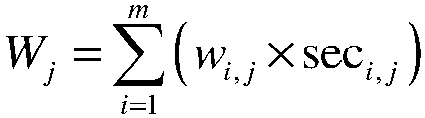
- the initial weight is expressed by a first equation
- the initial energy channel address function is expressed by a second equation.
- W j represents an initial weight of a j th target interval
- w i,j represents an i th full-energy peak weighting coefficient in the j th target interval
- sec i,j represents a difference coefficient at an i th full-energy peak energy channel address in the j th target interval
- E represents a full-energy peak energy of ⁇ -rays
- ch represents a channel address of a full-energy peak of the rays
- c 0 , c 1 and c 2 are a constant term coefficient, a target coefficient and a quadratic term coefficient to be calculated, respectively.
- an apparatus for determining an energy calibration of a radiation detector including: an acquisition module configured to acquire a background energy spectrum of a plurality of known nuclides, where the background energy spectrum is obtained by the radiation detector detecting the plurality of known nuclides; a differencing module configured to perform a differential processing on the background energy spectrum to obtain a channel address-difference diagram, where the channel address-difference diagram includes a plurality of valid peak information determined from a plurality of full-energy peak information; a first determination module configured to determine a target coefficient according to the channel address-difference diagram, where the target coefficient characterizes a calibration coefficient in an initial energy channel address function; and a second determination module configured to determine a target energy channel address function according to the channel address-difference diagram and the initial energy channel address function, where the target energy channel address function characterizes the energy calibration of the radiation detector.
- an electronic device including: one or more processors; a storage means for storing one or more programs, where the one or more programs are configured to, when executed by the one or more processors, cause the one or more processors to implement the method for determining the energy calibration of the radiation detector as described above.
- a computer readable storage medium having executable instructions thereon is provided, where the instructions are configured to, when executed by a processor, cause the processor to implement the method for determining the energy calibration of the radiation detector as described above.
- a computer program product containing a computer program where the computer program is configured to, when executed by a processor, cause the processor to implement the method for determining the energy calibration of the radiation detector as described above.
- a system including at least one of A, B and C should include but not be limited to a system including A alone, a system including B alone, a system including C alone, a system including A and B, a system including A and C, a system including B and C, and/or a system including A, B and C).
- the embodiments of the present disclosure provide a method and an apparatus for determining an energy calibration of a radiation detector, a device, and a medium.
- the method includes: acquiring a background energy spectrum of a plurality of known nuclides, where the background energy spectrum is obtained by the radiation detector detecting the plurality of known nuclides; performing a differential processing on the background energy spectrum to obtain a channel address-difference diagram, where the channel address-difference diagram includes a plurality of valid peak information determined from a plurality of full-energy peak information; determining a target coefficient according to the channel address-difference diagram, where the target coefficient characterizes a calibration coefficient in an initial energy channel address function; and determining a target energy channel address function according to the channel address-difference diagram and the initial energy channel address function, where the target energy channel address function characterizes the energy calibration of the radiation detector.
- FIG. 1 schematically shows a flowchart of a method for determining an energy calibration of a radiation detector according to the embodiments of the present disclosure.
- FIG. 2 schematically shows a schematic diagram of a background energy spectrum according to the embodiments of the present disclosure.
- FIG. 3 schematically shows a channel address-difference diagram according to the embodiments of the present disclosure.
- the method for determining the energy calibration of the radiation detector includes operations S110 to S140.
- a background energy spectrum of a plurality of known nuclides is acquired, where the background energy spectrum is obtained by the radiation detector detecting the plurality of known nuclides.
- a differential processing is performed on the background energy spectrum to obtain a channel address-difference diagram, where the channel address-difference diagram includes a plurality of valid peak information determined from a plurality of full-energy peak information.
- a target coefficient is determined according to the channel address-difference diagram, where the target coefficient characterizes a calibration coefficient in an initial energy channel address function.
- a target energy channel address function is determined according to the channel address-difference diagram and the initial energy channel address function, where the target energy channel address function characterizes the energy calibration of the radiation detector.
- the energy calibration refers to an experimental work for determining a correspondence relationship between an energy of incident particles in a radiation detector and a channel address of a multi-channel address analyzer.
- the radiation detector is generally installed in an outdoor environment to be detected. After the radiation detector works for a period of time, it is needed to correct the energy calibration of the radiation detector to ensure a detection accuracy of the radiation detector.
- the channel address refers to an energy interval, and a natural number label of the energy thereof is the channel address.
- the full-energy peak information refers to a spectrum peak formed by a pulse output by the detector when all the energy of incident rays is lost in a sensitive volume of the detector.
- the valid peak information refers to a full-energy peak information of a known nuclide determined from a plurality of full-energy peak information of a plurality of known nuclides.
- the known nuclides may include thorium (Th-232), radium (Ra-226), potassium (K-40), etc.
- the background energy spectrum of the plurality of known nuclides as shown in FIG. 2 by detecting the plurality of known nuclides using the radiation detector. It is possible to obtain the channel address-difference diagram as shown in FIG. 3 by performing a differential processing on the background energy spectrum, such as performing a second-order differential processing using Mariscotti method.
- the channel address-difference diagram clearly shows the valid peak information of the plurality of known nuclides.
- a target coefficient may be determined, which is a second-order coefficient of the initial energy channel address function.
- a target energy channel address function may be determined according to the target coefficient, the channel address-difference diagram and the initial energy channel address function, and an energy calibration of the radiation detector may be corrected based on the target energy channel address function.
- a channel address-difference diagram by performing a differential processing on the background energy spectrum obtained by detecting a plurality of known nuclides using the radiation detector to be corrected, determine a target coefficient in the initial energy channel address function based on the channel address-difference diagram, and determine a target energy channel address function by combining the channel address-difference diagram and the initial energy channel address function, so that the energy calibration of the radiation detector to be corrected may be corrected using the target energy channel address function, which may avoid a problem of an inaccurate detection result of the corrected radiation detector caused by manually performing an energy calibration using a radioactive source in the related art, and improve a correction efficiency and detection accuracy of the radiation detector.
- determining the target coefficient according to the channel address-difference diagram includes the following operations: determining a plurality of target intervals of a target nuclide from the channel address-difference diagram, where the target intervals include a plurality of valid peak information of the target nuclide; and determining the target coefficient according to the plurality of target intervals.
- the target interval is determined according to the valid peak information of a known nuclide, where the valid peak information is known before correction.
- the target intervals of thorium include [c 1 , c 2 ], [c 3 , c 4 ] and [c 5 , c 6 ], where c i represents a horizontal ordinate scale of the channel address-difference diagram, and a specific value is related to the specific full-energy peak information of the target nuclide.
- the target coefficient may be determined according to the channel address-difference diagram corresponding to the plurality of target intervals.
- determining the target coefficient according to the plurality of target intervals includes the following operations: obtaining, for each target interval, an initial weight according to a plurality of full-energy peak weighting coefficients and difference coefficients of the plurality of full-energy peak information; and determining the target coefficient according to a plurality of initial weights based on a predetermined filtering rule.
- an initial weight of the target interval may be obtained according to the plurality of valid peak information in the target interval, such as the full-energy peak weighting coefficient corresponding to each valid peak information and a difference coefficient at the valid peak information during the differential processing.
- the target coefficient is finally determined from a plurality of initial weights using a predetermined filtering rule.
- the full-energy peak weighting coefficient is a weighting coefficient of a full-energy peak energy, which may be specifically set by the staff according to actual needs.
- obtaining the initial weight according to the plurality of full-energy peak weighting coefficients and the difference coefficients of the plurality of full-energy peak information includes the following operations: determining, for each valid peak information, a product value according to the full-energy peak weighting coefficient corresponding to the valid peak information and the difference coefficient at a full-energy peak energy channel address in the valid peak information; and summing a plurality of product values to obtain the initial weight of the target interval.
- the full-energy peak weighting coefficient and the difference coefficient corresponding to the valid peak information may be multiplied to obtain a product value, then a plurality of product values corresponding to the plurality of valid peak information may be summed, and a summed result is determined as the initial weight of the target interval.
- the differential processing includes a second-order differential processing
- the difference coefficient includes a second-order difference coefficient
- the second-order differential processing method used in the present disclosure is Mariscotti method, but the present disclosure is not limited to using the method only.
- FIG. 4 schematically shows a weight-coefficient relationship diagram according to the embodiments of the present disclosure.
- determining the target coefficient according to the plurality of initial weights based on the predetermined filtering rule includes the following operations: drawing a weight-coefficient relationship diagram according to the plurality of initial weights, where a horizontal ordinate in the weight-coefficient relationship diagram represents a coefficient scale, and a vertical ordinate in the weight-coefficient relationship diagram represents a weight scale; and determining the horizontal ordinate corresponding to a maximum weight value in the weight-coefficient relationship diagram as the target coefficient.
- a weight-coefficient relationship diagram may be drawn based on the plurality of initial weights, as shown in FIG. 4 .
- each of the initial weights is drawn, and points are connected.
- a target energy channel address function may be determined according to the channel address-difference diagram and the initial energy channel address function.
- FIG. 5 schematically shows a schematic diagram of a channel address-energy coordinate system according to the embodiments of the present disclosure.
- determining a target energy channel address function according to the channel address-difference diagram and the initial energy channel address function includes the following operations: constructing a plurality of coordinate points in a channel address-energy coordinate system according to a channel address corresponding to each full-energy peak information in each target interval and a known full-energy peak energy of the target nuclide; and solving, based on the target coefficient, the initial energy channel address function according to the plurality of coordinate points to obtain the target energy channel address function.
- the known full-energy peak energy of the target nuclide is a value determined before the correction, it is possible to mark an energy coordinate of each full-energy peak in the channel address-energy coordinate system by combining the channel address corresponding to each full-energy peak information in the target interval, and thus a plurality of coordinate points with respect to the full-energy peak information may be obtained.
- the target coefficient since the target coefficient has been determined, other coefficients in the initial energy channel address function may be calculated according to the plurality of coordinate points drawn in the channel address-energy coordinate system as shown in FIG. 5 , and then the final target energy channel address function may be obtained, as shown in FIG. 5 .
- solving the initial energy channel address function according to the plurality of coordinate points to obtain the target energy channel address function includes the following operations: fitting the plurality of coordinate points in the channel address-energy coordinate system to obtain a target curve; solving the initial energy channel address function by using the target curve to obtain a constant term coefficient and a quadratic term coefficient, where the target coefficient characterizes a primary term coefficient; and obtaining, based on the initial energy channel address function, the target energy channel address function according to the constant term coefficient, the target coefficient and the quadratic term coefficient.
- the plurality of coordinate points are fitted in the channel address-energy coordinate system to obtain a target curve, where the purpose of fitting is to finally obtain a more accurate target energy channel address function, so as to ensure a detection accuracy of the finally-corrected radiation detector when in use.
- the target curve after obtaining the target curve, it is possible to calculate the constant term coefficient and the quadratic term coefficient in the initial energy channel address function by using the target curve, and finally construct a target energy channel address function according to the determined target coefficient, constant term coefficient and quadratic term coefficient.
- the initial weight is expressed by Equation (1) and the initial energy channel address function is expressed by Equation (2).
- W j represents an initial weight of a j th target interval
- w i , j represents an i th full-energy peak weighting coefficient in the j th target interval
- sec i , j represents a difference coefficient at an i th full-energy peak energy channel address in the j th target interval
- E represents a full-energy peak energy of ⁇ -rays
- ch represents a full-energy peak channel address of the rays
- c 0 , c 1 and c 2 are a constant term coefficient, a target coefficient and a quadratic term coefficient to be calculated, respectively.
- the constant term coefficient and the quadratic term coefficient in Equation (2) may be calculated by using the channel address-energy coordinate system, and the target energy channel address function may be obtained finally.
- FIG. 6 schematically shows a structure block diagram of an apparatus for determining an energy calibration of a radiation detector according to the embodiments of the present disclosure.
- an apparatus 600 for determining an energy calibration of a radiation detector includes an acquisition module 610, a differencing module 620, a first determination module 630, and a second determination module 640.
- the acquisition module 610 is used to acquire a background energy spectrum of a plurality of known nuclides, where the background energy spectrum is obtained by the radiation detector detecting the plurality of known nuclides.
- the differencing module 620 is used to perform a differential processing on the background energy spectrum to obtain a channel address-difference diagram, where the channel address-difference diagram includes a plurality of valid peak information determined from a plurality of full-energy peak information.
- the first determination module 630 is used to determine a target coefficient according to the channel address-difference diagram, where the target coefficient characterizes a calibration coefficient in an initial energy channel address function.
- the second determination module 640 is used to determine a target energy channel address function according to the channel address-difference diagram and the initial energy channel address function, where the target energy channel address function characterizes the energy calibration of the radiation detector.
- a channel address-difference diagram by performing a differential processing on the background energy spectrum obtained by detecting a plurality of known nuclides using the radiation detector to be corrected, determine a target coefficient in the initial energy channel address function based on the channel address-difference diagram, and determine the target energy channel address function by combining the channel address-difference diagram and the initial energy channel address function, so that the energy calibration of the radiation detector to be corrected may be corrected using the target energy channel address function, which may avoid a problem of an inaccurate detection result of the corrected radiation detector caused by manually performing an energy calibration using a radioactive source in the related art, and improve a correction efficiency and detection accuracy of the radiation detector.
- the first determination module 630 includes a first determination sub-module and a second determination sub-module.
- the first determination sub-module is used to determine a plurality of target intervals of a target nuclide from the channel address-difference diagram, where the target intervals include a plurality of valid peak information of the target nuclide.
- the second determination sub-module is used to determine the target coefficient according to the plurality of target intervals.
- the second determination sub-module includes a first obtaining unit and a determination unit.
- the first obtaining unit is used to obtain, for each target interval, an initial weight according to a plurality of full-energy peak weighting coefficients and difference coefficients of the plurality of full-energy peak information.
- the determination unit is used to determine the target coefficient according to a plurality of initial weights based on a predetermined filtering rule.
- the first obtaining unit includes a first determination sub-unit and an obtaining sub-unit.
- the first determination sub-unit is used to determine, for each valid peak information, a product value according to the full-energy peak weighting coefficient corresponding to the valid peak information and the difference coefficient at a full-energy peak energy channel address in the valid peak information.
- the obtaining sub-unit is used to sum a plurality of product values to obtain the initial weight of the target interval.
- the differential processing includes a second-order differential processing
- the difference coefficient includes a second-order difference coefficient
- the determination unit includes a drawing sub-unit and a second determination sub-unit.
- the drawing sub-unit is used to draw a weight-coefficient relationship diagram according to the plurality of initial weights, where a horizontal ordinate in the weight-coefficient relationship diagram represents a coefficient scale, and a vertical ordinate in the weight-coefficient relationship diagram represents a weight scale.
- the second determination sub-unit is used to determine the horizontal ordinate corresponding to a maximum weight value in the weight-coefficient relationship diagram as the target coefficient.
- the second determination module 640 includes a constructing sub-module and a solving sub-module.
- the constructing sub-module is used to construct a plurality of coordinate points in a channel address-energy coordinate system according to a channel address corresponding to each full-energy peak information in each target interval and a known full-energy peak energy of the target nuclide.
- the solving sub-module is used to solve, based on the target coefficient, the initial energy channel address function according to the plurality of coordinate points to obtain the target energy channel address function.
- the solving sub-module includes a fitting unit, a solving unit, and a second obtaining unit.
- the fitting unit is used to fit the plurality of coordinate points in the channel address-energy coordinate system to obtain a target curve.
- the solving unit is used to solve the initial energy channel address function by using the target curve to obtain a constant term coefficient and a quadratic term coefficient, where the target coefficient characterizes a primary term coefficient.
- the second obtaining unit is used to obtain, based on the initial energy channel address function, the target energy channel address function according to the constant term coefficient, the target coefficient and the quadratic term coefficient.
- any number of the acquisition module 610, the differencing module 620, the first determination module 630 and the second determination module 640 may be combined into one module for implementation, or any one of the modules may be divided into a plurality of modules. Alternatively, at least part of the functions of one or more of these modules may be combined with at least part of the functions of other modules and implemented in one module. According to the embodiments of the present disclosure, at least one of the acquisition module 610, the differencing module 620, the first determination module 630 and the second determination module 640 may be implemented at least partially as a hardware circuit, such as a field programmable gate array
- FPGA field-programmable gate array
- PLA programmable logic array
- ASIC application specific integrated circuit
- the acquisition module 610, the differencing module 620, the first determination module 630 and the second determination module 640 may be at least partially implemented as a computer program module that may perform corresponding functions when executed.
- FIG. 7 schematically shows a block diagram of an electronic device suitable for implementing the method for determining the energy calibration of the radiation detector according to the embodiments of the present disclosure.
- an electronic device 700 includes a processor 701, which may execute various appropriate actions and processes according to the program stored in a read-only memory (ROM) 702 or the program loaded into a random access memory (RAM) 703 from a storage part 708.
- the processor 701 may, for example, include a general-purpose microprocessor (for example, a CPU), an instruction set processor and/or a related chipset and/or a special-purpose microprocessor (for example, an application specific integrated circuit (ASIC)), and the like.
- the processor 701 may further include an on-board memory for caching purposes.
- the processor 701 may include a single processing unit or a plurality of processing units for executing different actions of the method flow according to the embodiments of the present disclosure.
- the processor 701, the ROM 702, and the RAM 703 are connected to each other through a bus 704.
- the processor 701 executes various operations of the method flow according to the embodiments of the present disclosure by executing the programs in the ROM 702 and/or the RAM 703. It should be noted that the program may also be stored in one or more memories other than ROM 702 and RAM 703.
- the processor 701 may also execute various operations of the method flow according to the embodiments of the present disclosure by executing programs stored in the one or more memories.
- the electronic device 700 may further include an input/output (I/O) interface 705 which is also connected to the bus 704.
- the electronic device 700 may further include one or more of the following components connected to the I/O interface 705: an input part 706 including a keyboard, mouse, etc.; an output part 707 including a cathode ray tube (CRT), a liquid crystal display (LCD), a speaker, etc.; a storage part 708 including a hard disk, etc.; and a communication part 709 including a network interface card, such as a LAN card, a modem, and the like.
- the communication part 709 performs communication processing via a network such as the Internet.
- a driver 710 is also connected to the I/O interface 705 as required.
- a removable medium 711 such as a magnetic disk, an optical disk, a magneto-optical disk, a semiconductor memory, and the like, is installed on the drive 710 as required, so that a computer program to be read therefrom is installed into the storage part 708 as required.
- the present disclosure further provides a computer-readable storage medium, which may be included in the device/apparatus/system described in the above embodiments; or exist alone without being assembled into the device/apparatus/system.
- the above-mentioned computer-readable storage medium carries one or more programs that when executed, perform the methods of the embodiments of the present disclosure.
- the computer-readable storage medium may be a non-volatile computer-readable storage medium, for example, may include but not limited to, a portable computer disk, a hard disk, a random access memory (RAM), a read-only memory (ROM), an erasable programmable read-only memory (EPROM or flash memory), a portable compact disk read-only memory (CD-ROM), an optical memory device, a magnetic memory device, or any suitable combination of the above.
- the computer-readable storage medium may be any tangible medium that contains or stores programs that may be used by or in combination with an instruction execution system, apparatus, or device.
- the computer-readable storage medium may include the above-mentioned ROM 702 and/or RAM 703 and/or one or more memories other than the ROM 702 and RAM 703.
- the embodiments of the present disclosure further include a computer program product, which contains a computer program.
- the computer program contains program code for performing the method shown in the flowchart.
- the program code causes the computer system to implement the method of the embodiments of the present disclosure.
- the computer program may rely on a tangible storage medium such as an optical storage device and a magnetic memory device.
- the computer program may also be transmitted and distributed in the form of signals on a network medium, downloaded and installed through the communication part 709, and/or installed from the removable medium 711.
- the program code contained in the computer program may be transmitted by any suitable medium, including but not limited to a wireless one, a wired one, or any suitable combination of the above.
- the computer program may be downloaded and installed from the network through the communication part 709, and/or installed from the removable medium 711.
- the computer program is executed by the processor 701
- the above-mentioned functions defined in the system of embodiments of the present disclosure are performed.
- the above-mentioned systems, devices, apparatuses, modules, units, etc. may be implemented by computer program modules.
- the program code for executing computer programs provided by the embodiments of the present disclosure may be written in any combination of one or more programming languages.
- these computing programs may be implemented using high-level procedures and/or object-oriented programming languages, and/or assembly/machine languages.
- Programming languages include, but are not limited to, Java, C + +, python, the "C" language, or similar programming languages.
- the program code may be completely executed on the user computing device, partially on the user device, partially on the remote computing device, or completely executed on the remote computing device or server.
- the remote computing device may be connected to a user computing device through any kind of network, including a local area network (LAN) or a wide area network (WAN), or may be connected to an external computing device (e.g., through the Internet using an Internet service provider).
- LAN local area network
- WAN wide area network
- each block in the flowcharts or block diagrams may represent a part of a module, a program segment, or a code, which part includes one or more executable instructions for implementing the specified logical function.
- the functions noted in the blocks may also occur in a different order from that noted in the accompanying drawings. For example, two blocks shown in succession may actually be executed substantially in parallel, or they may sometimes be executed in a reverse order, depending on the functions involved.
- each block in the block diagrams or flowcharts, and the combination of blocks in the block diagrams or flowcharts, may be implemented by a dedicated hardware-based system that performs the specified functions or operations, or may be performed by a combination of dedicated hardware and computer instructions.
Landscapes
- Physics & Mathematics (AREA)
- Spectroscopy & Molecular Physics (AREA)
- Health & Medical Sciences (AREA)
- Life Sciences & Earth Sciences (AREA)
- General Physics & Mathematics (AREA)
- High Energy & Nuclear Physics (AREA)
- Molecular Biology (AREA)
- Measurement Of Radiation (AREA)
Abstract
Provided are a method and an apparatus for determining an energy calibration of a radiation detector, a device, and a medium. The method includes: acquiring (S110) a background energy spectrum of a plurality of known nuclides, where the background energy spectrum is obtained by the radiation detector detecting the plurality of known nuclides; performing (S120) differential processing on the background energy spectrum to obtain a channel address-difference diagram, where the channel address-difference diagram includes a plurality of valid peak information determined from a plurality of full-energy peak information; determining (S130) a target coefficient according to the channel address-difference diagram, where the target coefficient characterizes a calibration coefficient in initial energy channel address function; and determining (S140) a target energy channel address function according to the channel address-difference diagram and the initial energy channel address function, where the target energy channel address function characterizes the energy calibration of the radiation detector. The apparatus for determining an energy calibration of a radiation detector includes an acquisition module (610), a differencing module (620), a first determination module (630), and a second determination module (640).
Description
- This application claims priority to
Chinese Patent Application No. 202310134373.7 filed on February 9, 2023 - The present disclosure relates to a field of environmental monitoring, in particular to a method and an apparatus for determining an energy calibration of a radiation detector, a device, a medium, and a program product.
- Environmental radiation monitoring is an important part of environmental monitoring, and also a basis of environmental radiation management. A prevention and control of environmental radioactive pollution is also one of hot spots of public concern. In order to ensure an accuracy of a detection result, it is needed to periodically perform an energy calibration on a detector system.
- In a process of the energy calibration, it is generally to use a common detector device to detect and measure γ radionuclides in an environmental sample to obtain γ spectrum information of the sample, that is, a relationship between photon count and channel address, and then the energy calibration may be performed on the detector according to a quadratic non-linear relationship between energy and channel address. However, due to an influence of changes in surrounding environmental conditions and of the system per se, it is needed to periodically perform an energy calibration on the detector system to ensure the accuracy of the detection result of the detector.
- The present disclosure provides a method and an apparatus for determining an energy calibration of a radiation detector, a device, a medium, and a program product for improving a correction speed of an energy calibration of a radiation detector.
- According to a first aspect of the present disclosure, a method for determining an energy calibration of a radiation detector is provided, including: acquiring a background energy spectrum of a plurality of known nuclides, where the background energy spectrum is obtained by the radiation detector detecting the plurality of known nuclides; performing a differential processing on the background energy spectrum to obtain a channel address-difference diagram, where the channel address-difference diagram includes a plurality of valid peak information determined from a plurality of full-energy peak information; determining a target coefficient according to the channel address-difference diagram, where the target coefficient characterizes a calibration coefficient in an initial energy channel address function; and determining a target energy channel address function according to the channel address-difference diagram and the initial energy channel address function, where the target energy channel address function characterizes the energy calibration of the radiation detector.
- According to the embodiments of the present disclosure, the determining a target coefficient according to the channel address-difference diagram includes: determining a plurality of target intervals of a target nuclide from the channel address-difference diagram, where the target intervals include a plurality of valid peak information of the target nuclide; and determining the target coefficient according to the plurality of target intervals.
- According to the embodiments of the present disclosure, the determining the target coefficient according to the plurality of target intervals includes: obtaining, for each target interval, an initial weight according to a plurality of full-energy peak weighting coefficients and difference coefficients of the plurality of full-energy peak information; and determining the target coefficient according to a plurality of initial weights based on a predetermined filtering rule.
- According to the embodiments of the present disclosure, the obtaining an initial weight according to a plurality of full-energy peak weighting coefficients and difference coefficients of the plurality of full-energy peak information includes: determining, for each valid peak information, a product value according to the full-energy peak weighting coefficient corresponding to the valid peak information and the difference coefficient at a full-energy peak energy channel address in the valid peak information; and summing a plurality of product values to obtain the initial weight of the target interval.
- According to the embodiments of the present disclosure, the differential processing includes a second-order differential processing, and the difference coefficient includes a second-order difference coefficient.
- According to the embodiments of the present disclosure, the determining the target coefficient according to a plurality of initial weights based on a predetermined filtering rule includes: drawing a weight-coefficient relationship diagram according to the plurality of initial weights, where a horizontal ordinate in the weight-coefficient relationship diagram represents a coefficient scale, and a vertical ordinate in the weight-coefficient relationship diagram represents a weight scale; and determining the horizontal ordinate corresponding to a maximum weight value in the weight-coefficient relationship diagram as the target coefficient.
- According to the embodiments of the present disclosure, the determining a target energy channel address function according to the channel address-difference diagram and the initial energy channel address function includes: constructing a plurality of coordinate points in a channel address-energy coordinate system according to a channel address corresponding to each full-energy peak information in each target interval and a known full-energy peak energy of the target nuclide; and solving, based on the target coefficient, the initial energy channel address function according to the plurality of coordinate points to obtain the target energy channel address function.
- According to the embodiments of the present disclosure, the solving the initial energy channel address function according to the plurality of coordinate points to obtain the target energy channel address function includes: fitting the plurality of coordinate points in the channel address-energy coordinate system to obtain a target curve; solving the initial energy channel address function by using the target curve to obtain a constant term coefficient and a quadratic term coefficient, where the target coefficient characterizes a primary term coefficient; and obtaining, based on the initial energy channel address function, the target energy channel address function according to the constant term coefficient, the target coefficient and the quadratic term coefficient.
- According to the embodiments of the present disclosure, the initial weight is expressed by a first equation, and the initial energy channel address function is expressed by a second equation.

- According to a second aspect of the present disclosure, an apparatus for determining an energy calibration of a radiation detector is provided, including: an acquisition module configured to acquire a background energy spectrum of a plurality of known nuclides, where the background energy spectrum is obtained by the radiation detector detecting the plurality of known nuclides; a differencing module configured to perform a differential processing on the background energy spectrum to obtain a channel address-difference diagram, where the channel address-difference diagram includes a plurality of valid peak information determined from a plurality of full-energy peak information; a first determination module configured to determine a target coefficient according to the channel address-difference diagram, where the target coefficient characterizes a calibration coefficient in an initial energy channel address function; and a second determination module configured to determine a target energy channel address function according to the channel address-difference diagram and the initial energy channel address function, where the target energy channel address function characterizes the energy calibration of the radiation detector.
- According to a third aspect of the present disclosure, an electronic device is provided, including: one or more processors; a storage means for storing one or more programs, where the one or more programs are configured to, when executed by the one or more processors, cause the one or more processors to implement the method for determining the energy calibration of the radiation detector as described above.
- According to a fourth aspect of the present disclosure, a computer readable storage medium having executable instructions thereon is provided, where the instructions are configured to, when executed by a processor, cause the processor to implement the method for determining the energy calibration of the radiation detector as described above.
- According to a fifth aspect of the present disclosure, a computer program product containing a computer program is provided, where the computer program is configured to, when executed by a processor, cause the processor to implement the method for determining the energy calibration of the radiation detector as described above.
- The above contents and other objectives, features and advantages of the present disclosure will be more apparent through the following descriptions of embodiments of the present disclosure with reference to the accompanying drawings. In the accompanying drawings:
-
FIG. 1 schematically shows a flowchart of a method for determining an energy calibration of a radiation detector according to the embodiments of the present disclosure; -
FIG. 2 schematically shows a schematic diagram of a background energy spectrum according to the embodiments of the present disclosure; -
FIG. 3 schematically shows a channel address-difference diagram according to the embodiments of the present disclosure; -
FIG. 4 schematically shows a weight-coefficient relationship diagram according to the embodiments of the present disclosure; -
FIG. 5 schematically shows a schematic diagram of a channel address-energy coordinate system according to the embodiments of the present disclosure; -
FIG. 6 schematically shows a structure block diagram of an apparatus for determining an energy calibration of a radiation detector according to the embodiments of the present disclosure; and -
FIG. 7 schematically shows a block diagram of an electronic device suitable for implementing the method for determining the energy calibration of the radiation detector according to the embodiments of the present disclosure. - Embodiments of the present disclosure will be described below with reference to the accompanying drawings. However, it should be understood that these descriptions are just exemplary and are not intended to limit the scope of the present disclosure. In the following detailed description, for ease of interpretation, many specific details are set forth to provide comprehensive understanding of the embodiments of the present disclosure. However, it is clear that one or more embodiments may also be implemented without these specific details. In addition, in the following description, descriptions of well-known structures and technologies are omitted to avoid unnecessarily obscuring concepts of the present disclosure.
- Terms are used herein for the purpose of describing specific embodiments only and are not intended to limit the present disclosure. The terms "including", "containing", etc. used herein indicate the presence of the feature, step, operation and/or component, but do not exclude the presence or addition of one or more other features, steps, operations or components.
- All terms used herein (including technical and scientific terms) have the meanings generally understood by those skilled in the art, unless otherwise defined. It should be noted that the terms used herein shall be interpreted to have meanings consistent with the context of this specification, and shall not be interpreted in an idealized or overly rigid manner.
- In a case of using the expression similar to "at least one of A, B and C", it should be explained according to the meaning of the expression generally understood by those skilled in the art (for example, "a system including at least one of A, B and C" should include but not be limited to a system including A alone, a system including B alone, a system including C alone, a system including A and B, a system including A and C, a system including B and C, and/or a system including A, B and C).
- The embodiments of the present disclosure provide a method and an apparatus for determining an energy calibration of a radiation detector, a device, and a medium. The method includes: acquiring a background energy spectrum of a plurality of known nuclides, where the background energy spectrum is obtained by the radiation detector detecting the plurality of known nuclides; performing a differential processing on the background energy spectrum to obtain a channel address-difference diagram, where the channel address-difference diagram includes a plurality of valid peak information determined from a plurality of full-energy peak information; determining a target coefficient according to the channel address-difference diagram, where the target coefficient characterizes a calibration coefficient in an initial energy channel address function; and determining a target energy channel address function according to the channel address-difference diagram and the initial energy channel address function, where the target energy channel address function characterizes the energy calibration of the radiation detector.
-
FIG. 1 schematically shows a flowchart of a method for determining an energy calibration of a radiation detector according to the embodiments of the present disclosure.FIG. 2 schematically shows a schematic diagram of a background energy spectrum according to the embodiments of the present disclosure.FIG. 3 schematically shows a channel address-difference diagram according to the embodiments of the present disclosure. - As shown in
FIG. 1 , the method for determining the energy calibration of the radiation detector includes operations S110 to S140. - In operation S110, a background energy spectrum of a plurality of known nuclides is acquired, where the background energy spectrum is obtained by the radiation detector detecting the plurality of known nuclides.
- In operation S120, a differential processing is performed on the background energy spectrum to obtain a channel address-difference diagram, where the channel address-difference diagram includes a plurality of valid peak information determined from a plurality of full-energy peak information.
- In operation S130, a target coefficient is determined according to the channel address-difference diagram, where the target coefficient characterizes a calibration coefficient in an initial energy channel address function.
- In operation S140, a target energy channel address function is determined according to the channel address-difference diagram and the initial energy channel address function, where the target energy channel address function characterizes the energy calibration of the radiation detector.
- According to the embodiments of the present disclosure, the energy calibration refers to an experimental work for determining a correspondence relationship between an energy of incident particles in a radiation detector and a channel address of a multi-channel address analyzer. The radiation detector is generally installed in an outdoor environment to be detected. After the radiation detector works for a period of time, it is needed to correct the energy calibration of the radiation detector to ensure a detection accuracy of the radiation detector.
- According to the embodiments of the present disclosure, the channel address refers to an energy interval, and a natural number label of the energy thereof is the channel address. The full-energy peak information refers to a spectrum peak formed by a pulse output by the detector when all the energy of incident rays is lost in a sensitive volume of the detector. The valid peak information refers to a full-energy peak information of a known nuclide determined from a plurality of full-energy peak information of a plurality of known nuclides. The known nuclides may include thorium (Th-232), radium (Ra-226), potassium (K-40), etc.
- According to the embodiments of the present disclosure, it is possible to obtain the background energy spectrum of the plurality of known nuclides as shown in
FIG. 2 by detecting the plurality of known nuclides using the radiation detector. It is possible to obtain the channel address-difference diagram as shown inFIG. 3 by performing a differential processing on the background energy spectrum, such as performing a second-order differential processing using Mariscotti method. The channel address-difference diagram clearly shows the valid peak information of the plurality of known nuclides. Based on the channel address-difference diagram, a target coefficient may be determined, which is a second-order coefficient of the initial energy channel address function. Then, a target energy channel address function may be determined according to the target coefficient, the channel address-difference diagram and the initial energy channel address function, and an energy calibration of the radiation detector may be corrected based on the target energy channel address function. - According to the embodiments of the present disclosure, it is possible to obtain a channel address-difference diagram by performing a differential processing on the background energy spectrum obtained by detecting a plurality of known nuclides using the radiation detector to be corrected, determine a target coefficient in the initial energy channel address function based on the channel address-difference diagram, and determine a target energy channel address function by combining the channel address-difference diagram and the initial energy channel address function, so that the energy calibration of the radiation detector to be corrected may be corrected using the target energy channel address function, which may avoid a problem of an inaccurate detection result of the corrected radiation detector caused by manually performing an energy calibration using a radioactive source in the related art, and improve a correction efficiency and detection accuracy of the radiation detector.
- According to the embodiments of the present disclosure, determining the target coefficient according to the channel address-difference diagram includes the following operations: determining a plurality of target intervals of a target nuclide from the channel address-difference diagram, where the target intervals include a plurality of valid peak information of the target nuclide; and determining the target coefficient according to the plurality of target intervals.
- According to the embodiments of the present disclosure, the target interval is determined according to the valid peak information of a known nuclide, where the valid peak information is known before correction. For example, it is known that the target intervals of thorium include [c1, c2], [c3, c4] and [c5, c6], where ci represents a horizontal ordinate scale of the channel address-difference diagram, and a specific value is related to the specific full-energy peak information of the target nuclide.
- According to the embodiments of the present disclosure, after the plurality of target intervals are determined, the target coefficient may be determined according to the channel address-difference diagram corresponding to the plurality of target intervals.
- According to the embodiments of the present disclosure, determining the target coefficient according to the plurality of target intervals includes the following operations: obtaining, for each target interval, an initial weight according to a plurality of full-energy peak weighting coefficients and difference coefficients of the plurality of full-energy peak information; and determining the target coefficient according to a plurality of initial weights based on a predetermined filtering rule.
- According to the embodiments of the present disclosure, for each target interval, an initial weight of the target interval may be obtained according to the plurality of valid peak information in the target interval, such as the full-energy peak weighting coefficient corresponding to each valid peak information and a difference coefficient at the valid peak information during the differential processing. The target coefficient is finally determined from a plurality of initial weights using a predetermined filtering rule.
- It should be noted that the full-energy peak weighting coefficient is a weighting coefficient of a full-energy peak energy, which may be specifically set by the staff according to actual needs.
- According to the embodiments of the present disclosure, obtaining the initial weight according to the plurality of full-energy peak weighting coefficients and the difference coefficients of the plurality of full-energy peak information includes the following operations: determining, for each valid peak information, a product value according to the full-energy peak weighting coefficient corresponding to the valid peak information and the difference coefficient at a full-energy peak energy channel address in the valid peak information; and summing a plurality of product values to obtain the initial weight of the target interval.
- According to the embodiments of the present disclosure, when calculating the initial weight of each target interval, for each valid peak information in the target interval, the full-energy peak weighting coefficient and the difference coefficient corresponding to the valid peak information may be multiplied to obtain a product value, then a plurality of product values corresponding to the plurality of valid peak information may be summed, and a summed result is determined as the initial weight of the target interval.
- According to the embodiments of the present disclosure, the differential processing includes a second-order differential processing, and the difference coefficient includes a second-order difference coefficient.
- It should be noted that the second-order differential processing method used in the present disclosure is Mariscotti method, but the present disclosure is not limited to using the method only.
-
FIG. 4 schematically shows a weight-coefficient relationship diagram according to the embodiments of the present disclosure. - According to the embodiments of the present disclosure, determining the target coefficient according to the plurality of initial weights based on the predetermined filtering rule includes the following operations: drawing a weight-coefficient relationship diagram according to the plurality of initial weights, where a horizontal ordinate in the weight-coefficient relationship diagram represents a coefficient scale, and a vertical ordinate in the weight-coefficient relationship diagram represents a weight scale; and determining the horizontal ordinate corresponding to a maximum weight value in the weight-coefficient relationship diagram as the target coefficient.
- According to the embodiments of the present disclosure, after the initial weight of each target interval is determined, a weight-coefficient relationship diagram may be drawn based on the plurality of initial weights, as shown in
FIG. 4 . In the weight-coefficient relationship diagram, each of the initial weights is drawn, and points are connected. A maximum weight value may be determined according to the drawn diagram, and the horizontal ordinate corresponding to the maximum weight value may be determined as the target coefficient. For example, as show inFIG. 4 , the horizontal ordinate X = 0.185 corresponding to Y = 26.0295 is determined as the target coefficient. Then, a target energy channel address function may be determined according to the channel address-difference diagram and the initial energy channel address function. -
FIG. 5 schematically shows a schematic diagram of a channel address-energy coordinate system according to the embodiments of the present disclosure. - According to the embodiments of the present disclosure, determining a target energy channel address function according to the channel address-difference diagram and the initial energy channel address function includes the following operations: constructing a plurality of coordinate points in a channel address-energy coordinate system according to a channel address corresponding to each full-energy peak information in each target interval and a known full-energy peak energy of the target nuclide; and solving, based on the target coefficient, the initial energy channel address function according to the plurality of coordinate points to obtain the target energy channel address function.
- According to the embodiments of the present disclosure, since the known full-energy peak energy of the target nuclide is a value determined before the correction, it is possible to mark an energy coordinate of each full-energy peak in the channel address-energy coordinate system by combining the channel address corresponding to each full-energy peak information in the target interval, and thus a plurality of coordinate points with respect to the full-energy peak information may be obtained.
- According to the embodiments of the present disclosure, since the target coefficient has been determined, other coefficients in the initial energy channel address function may be calculated according to the plurality of coordinate points drawn in the channel address-energy coordinate system as shown in
FIG. 5 , and then the final target energy channel address function may be obtained, as shown inFIG. 5 . - According to the embodiments of the present disclosure, solving the initial energy channel address function according to the plurality of coordinate points to obtain the target energy channel address function includes the following operations: fitting the plurality of coordinate points in the channel address-energy coordinate system to obtain a target curve; solving the initial energy channel address function by using the target curve to obtain a constant term coefficient and a quadratic term coefficient, where the target coefficient characterizes a primary term coefficient; and obtaining, based on the initial energy channel address function, the target energy channel address function according to the constant term coefficient, the target coefficient and the quadratic term coefficient.
- According to the embodiments of the present disclosure, the plurality of coordinate points are fitted in the channel address-energy coordinate system to obtain a target curve, where the purpose of fitting is to finally obtain a more accurate target energy channel address function, so as to ensure a detection accuracy of the finally-corrected radiation detector when in use.
- According to the embodiments of the present disclosure, after obtaining the target curve, it is possible to calculate the constant term coefficient and the quadratic term coefficient in the initial energy channel address function by using the target curve, and finally construct a target energy channel address function according to the determined target coefficient, constant term coefficient and quadratic term coefficient.
- According to the embodiments of the present disclosure, the initial weight is expressed by Equation (1) and the initial energy channel address function is expressed by Equation (2).


- In some embodiments, the quadratic term coefficient c 2 of the energy-channel address calibration function is generally close to 0, the value of the constant term coefficient c 0 is also around 0, and the two hardly change with external conditions. Therefore, in the process of calculating the target coefficient of the present disclosure, the energy calibration function may be approximately expressed as Equation (3).

- According to the embodiments of the present disclosure, after the target coefficient is determined, the constant term coefficient and the quadratic term coefficient in Equation (2) may be calculated by using the channel address-energy coordinate system, and the target energy channel address function may be obtained finally.
-
FIG. 6 schematically shows a structure block diagram of an apparatus for determining an energy calibration of a radiation detector according to the embodiments of the present disclosure. - As shown in
FIG. 6 , anapparatus 600 for determining an energy calibration of a radiation detector includes anacquisition module 610, adifferencing module 620, afirst determination module 630, and asecond determination module 640. - The
acquisition module 610 is used to acquire a background energy spectrum of a plurality of known nuclides, where the background energy spectrum is obtained by the radiation detector detecting the plurality of known nuclides. - The
differencing module 620 is used to perform a differential processing on the background energy spectrum to obtain a channel address-difference diagram, where the channel address-difference diagram includes a plurality of valid peak information determined from a plurality of full-energy peak information. - The
first determination module 630 is used to determine a target coefficient according to the channel address-difference diagram, where the target coefficient characterizes a calibration coefficient in an initial energy channel address function. - The
second determination module 640 is used to determine a target energy channel address function according to the channel address-difference diagram and the initial energy channel address function, where the target energy channel address function characterizes the energy calibration of the radiation detector. - According to the embodiments of the present disclosure, it is possible to obtain a channel address-difference diagram by performing a differential processing on the background energy spectrum obtained by detecting a plurality of known nuclides using the radiation detector to be corrected, determine a target coefficient in the initial energy channel address function based on the channel address-difference diagram, and determine the target energy channel address function by combining the channel address-difference diagram and the initial energy channel address function, so that the energy calibration of the radiation detector to be corrected may be corrected using the target energy channel address function, which may avoid a problem of an inaccurate detection result of the corrected radiation detector caused by manually performing an energy calibration using a radioactive source in the related art, and improve a correction efficiency and detection accuracy of the radiation detector.
- According to the embodiments of the present disclosure, the
first determination module 630 includes a first determination sub-module and a second determination sub-module. - The first determination sub-module is used to determine a plurality of target intervals of a target nuclide from the channel address-difference diagram, where the target intervals include a plurality of valid peak information of the target nuclide.
- The second determination sub-module is used to determine the target coefficient according to the plurality of target intervals.
- According to the embodiments of the present disclosure, the second determination sub-module includes a first obtaining unit and a determination unit.
- The first obtaining unit is used to obtain, for each target interval, an initial weight according to a plurality of full-energy peak weighting coefficients and difference coefficients of the plurality of full-energy peak information.
- The determination unit is used to determine the target coefficient according to a plurality of initial weights based on a predetermined filtering rule.
- According to the embodiments of the present disclosure, the first obtaining unit includes a first determination sub-unit and an obtaining sub-unit.
- The first determination sub-unit is used to determine, for each valid peak information, a product value according to the full-energy peak weighting coefficient corresponding to the valid peak information and the difference coefficient at a full-energy peak energy channel address in the valid peak information.
- The obtaining sub-unit is used to sum a plurality of product values to obtain the initial weight of the target interval.
- According to the embodiments of the present disclosure, the differential processing includes a second-order differential processing, and the difference coefficient includes a second-order difference coefficient.
- According to the embodiments of the present disclosure, the determination unit includes a drawing sub-unit and a second determination sub-unit.
- The drawing sub-unit is used to draw a weight-coefficient relationship diagram according to the plurality of initial weights, where a horizontal ordinate in the weight-coefficient relationship diagram represents a coefficient scale, and a vertical ordinate in the weight-coefficient relationship diagram represents a weight scale.
- The second determination sub-unit is used to determine the horizontal ordinate corresponding to a maximum weight value in the weight-coefficient relationship diagram as the target coefficient.
- According to the embodiments of the present disclosure, the
second determination module 640 includes a constructing sub-module and a solving sub-module. - The constructing sub-module is used to construct a plurality of coordinate points in a channel address-energy coordinate system according to a channel address corresponding to each full-energy peak information in each target interval and a known full-energy peak energy of the target nuclide.
- The solving sub-module is used to solve, based on the target coefficient, the initial energy channel address function according to the plurality of coordinate points to obtain the target energy channel address function.
- According to the embodiments of the present disclosure, the solving sub-module includes a fitting unit, a solving unit, and a second obtaining unit.
- The fitting unit is used to fit the plurality of coordinate points in the channel address-energy coordinate system to obtain a target curve.
- The solving unit is used to solve the initial energy channel address function by using the target curve to obtain a constant term coefficient and a quadratic term coefficient, where the target coefficient characterizes a primary term coefficient.
- The second obtaining unit is used to obtain, based on the initial energy channel address function, the target energy channel address function according to the constant term coefficient, the target coefficient and the quadratic term coefficient.
- According to the embodiments of the present disclosure, any number of the
acquisition module 610, thedifferencing module 620, thefirst determination module 630 and thesecond determination module 640 may be combined into one module for implementation, or any one of the modules may be divided into a plurality of modules. Alternatively, at least part of the functions of one or more of these modules may be combined with at least part of the functions of other modules and implemented in one module. According to the embodiments of the present disclosure, at least one of theacquisition module 610, thedifferencing module 620, thefirst determination module 630 and thesecond determination module 640 may be implemented at least partially as a hardware circuit, such as a field programmable gate array - (FPGA), a programmable logic array (PLA), a system on a chip, a system on a substrate, a system on a package, an application specific integrated circuit (ASIC), or may be implemented by hardware or firmware in any other reasonable manner of integrating or encapsulating the circuit, or may be implemented by any one of the three implementation modes of software, hardware, and firmware or an appropriate combination thereof. Alternatively, at least one of the
acquisition module 610, thedifferencing module 620, thefirst determination module 630 and thesecond determination module 640 may be at least partially implemented as a computer program module that may perform corresponding functions when executed. -
FIG. 7 schematically shows a block diagram of an electronic device suitable for implementing the method for determining the energy calibration of the radiation detector according to the embodiments of the present disclosure. - As shown in
FIG. 7 , anelectronic device 700 according to the embodiments of the present disclosure includes aprocessor 701, which may execute various appropriate actions and processes according to the program stored in a read-only memory (ROM) 702 or the program loaded into a random access memory (RAM) 703 from astorage part 708. Theprocessor 701 may, for example, include a general-purpose microprocessor (for example, a CPU), an instruction set processor and/or a related chipset and/or a special-purpose microprocessor (for example, an application specific integrated circuit (ASIC)), and the like. Theprocessor 701 may further include an on-board memory for caching purposes. Theprocessor 701 may include a single processing unit or a plurality of processing units for executing different actions of the method flow according to the embodiments of the present disclosure. - Various programs and data required for the operation of the
device 700 are stored in theRAM 703. Theprocessor 701, theROM 702, and theRAM 703 are connected to each other through abus 704. Theprocessor 701 executes various operations of the method flow according to the embodiments of the present disclosure by executing the programs in theROM 702 and/or theRAM 703. It should be noted that the program may also be stored in one or more memories other thanROM 702 andRAM 703. Theprocessor 701 may also execute various operations of the method flow according to the embodiments of the present disclosure by executing programs stored in the one or more memories. - According to the embodiments of the present disclosure, the
electronic device 700 may further include an input/output (I/O)interface 705 which is also connected to thebus 704. Theelectronic device 700 may further include one or more of the following components connected to the I/O interface 705: aninput part 706 including a keyboard, mouse, etc.; anoutput part 707 including a cathode ray tube (CRT), a liquid crystal display (LCD), a speaker, etc.; astorage part 708 including a hard disk, etc.; and acommunication part 709 including a network interface card, such as a LAN card, a modem, and the like. Thecommunication part 709 performs communication processing via a network such as the Internet. Adriver 710 is also connected to the I/O interface 705 as required. Aremovable medium 711, such as a magnetic disk, an optical disk, a magneto-optical disk, a semiconductor memory, and the like, is installed on thedrive 710 as required, so that a computer program to be read therefrom is installed into thestorage part 708 as required. - The present disclosure further provides a computer-readable storage medium, which may be included in the device/apparatus/system described in the above embodiments; or exist alone without being assembled into the device/apparatus/system. The above-mentioned computer-readable storage medium carries one or more programs that when executed, perform the methods of the embodiments of the present disclosure.
- According to the embodiments of the present disclosure, the computer-readable storage medium may be a non-volatile computer-readable storage medium, for example, may include but not limited to, a portable computer disk, a hard disk, a random access memory (RAM), a read-only memory (ROM), an erasable programmable read-only memory (EPROM or flash memory), a portable compact disk read-only memory (CD-ROM), an optical memory device, a magnetic memory device, or any suitable combination of the above. In the present disclosure, the computer-readable storage medium may be any tangible medium that contains or stores programs that may be used by or in combination with an instruction execution system, apparatus, or device. For example, according to the embodiments of the present disclosure, the computer-readable storage medium may include the above-mentioned
ROM 702 and/orRAM 703 and/or one or more memories other than theROM 702 andRAM 703. - The embodiments of the present disclosure further include a computer program product, which contains a computer program. The computer program contains program code for performing the method shown in the flowchart. When the computer program product runs in a computer system, the program code causes the computer system to implement the method of the embodiments of the present disclosure.
- When the computer program is executed by the
processor 701, the above-mentioned functions defined in the system/apparatus of embodiments of the present disclosure are performed. According to the embodiments of the present disclosure, the above-described systems, apparatuses, modules, units, etc. may be implemented by computer program modules. - In an embodiment, the computer program may rely on a tangible storage medium such as an optical storage device and a magnetic memory device. In another embodiment, the computer program may also be transmitted and distributed in the form of signals on a network medium, downloaded and installed through the
communication part 709, and/or installed from theremovable medium 711. The program code contained in the computer program may be transmitted by any suitable medium, including but not limited to a wireless one, a wired one, or any suitable combination of the above. - In such embodiments, the computer program may be downloaded and installed from the network through the
communication part 709, and/or installed from theremovable medium 711. When the computer program is executed by theprocessor 701, the above-mentioned functions defined in the system of embodiments of the present disclosure are performed. According to the embodiments of the present disclosure, the above-mentioned systems, devices, apparatuses, modules, units, etc. may be implemented by computer program modules. - According to the embodiments of the present disclosure, the program code for executing computer programs provided by the embodiments of the present disclosure may be written in any combination of one or more programming languages. In particular, these computing programs may be implemented using high-level procedures and/or object-oriented programming languages, and/or assembly/machine languages. Programming languages include, but are not limited to, Java, C + +, python, the "C" language, or similar programming languages. The program code may be completely executed on the user computing device, partially on the user device, partially on the remote computing device, or completely executed on the remote computing device or server. In a case of involving a remote computing device, the remote computing device may be connected to a user computing device through any kind of network, including a local area network (LAN) or a wide area network (WAN), or may be connected to an external computing device (e.g., through the Internet using an Internet service provider).
- The flowcharts and block diagrams in the accompanying drawings illustrate the possible architecture, functions, and operations of the system, method, and computer program product according to various embodiments of the present disclosure. In this regard, each block in the flowcharts or block diagrams may represent a part of a module, a program segment, or a code, which part includes one or more executable instructions for implementing the specified logical function. It should be further noted that, in some alternative implementations, the functions noted in the blocks may also occur in a different order from that noted in the accompanying drawings. For example, two blocks shown in succession may actually be executed substantially in parallel, or they may sometimes be executed in a reverse order, depending on the functions involved. It should be further noted that each block in the block diagrams or flowcharts, and the combination of blocks in the block diagrams or flowcharts, may be implemented by a dedicated hardware-based system that performs the specified functions or operations, or may be performed by a combination of dedicated hardware and computer instructions.
- Those skilled in the art may understand that the various embodiments of the present disclosure and/or the features described in the claims may be combined in various ways, even if such combinations are not explicitly described in the present disclosure. In particular, without departing from the spirit and teachings of the present disclosure, the various embodiments of the present disclosure and/or the features described in the claims may be combined in various ways. All these combinations fall within the scope of the present disclosure.
- The embodiments of the present disclosure have been described above. However, these embodiments are for illustrative purposes only and are not intended to limit the scope of the present disclosure. Although the various embodiments have been described separately above, this does not mean that the measures in the respective embodiments may not be used in combination advantageously. The scope of the present disclosure is defined by the attached claims and their equivalents. Those skilled in the art may make various substitutions and modifications without departing from the scope of the present disclosure, and these substitutions and modifications should all fall within the scope of the present disclosure.
Claims (13)
- A method for determining an energy calibration of a radiation detector, comprising:acquiring a background energy spectrum of a plurality of known nuclides, wherein the background energy spectrum is obtained by the radiation detector detecting the plurality of known nuclides;performing a differential processing on the background energy spectrum to obtain a channel address-difference diagram, wherein the channel address-difference diagram comprises a plurality of valid peak information determined from a plurality of full-energy peak information;determining a target coefficient according to the channel address-difference diagram, wherein the target coefficient characterizes a calibration coefficient in an initial energy channel address function; anddetermining a target energy channel address function according to the channel address-difference diagram and the initial energy channel address function, wherein the target energy channel address function characterizes the energy calibration of the radiation detector.
- The method according to claim 1, wherein the determining a target coefficient according to the channel address-difference diagram comprises:determining a plurality of target intervals of a target nuclide from the channel address-difference diagram, wherein the target intervals comprise a plurality of valid peak information of the target nuclide; anddetermining the target coefficient according to the plurality of target intervals.
- The method according to claim 2, wherein the determining the target coefficient according to the plurality of target intervals comprises:obtaining, for each target interval, an initial weight according to a plurality of full-energy peak weighting coefficients and difference coefficients of the plurality of full-energy peak information; anddetermining the target coefficient according to a plurality of initial weights based on a predetermined filtering rule.
- The method according to claim 3, wherein the obtaining an initial weight according to a plurality of full-energy peak weighting coefficients and difference coefficients of the plurality of full-energy peak information comprises:determining, for each valid peak information, a product value according to the full-energy peak weighting coefficient corresponding to the valid peak information and the difference coefficient at a full-energy peak energy channel address in the valid peak information; andsumming a plurality of product values to obtain the initial weight of the target interval.
- The method according to claim 4, wherein the differential processing comprises a second-order differential processing, and the difference coefficient comprises a second-order difference coefficient.
- The method according to claim 3, wherein the determining the target coefficient according to a plurality of initial weights based on a predetermined filtering rule comprises:drawing a weight-coefficient relationship diagram according to the plurality of initial weights, wherein a horizontal ordinate in the weight-coefficient relationship diagram represents a coefficient scale, and a vertical ordinate in the weight-coefficient relationship diagram represents a weight scale; anddetermining the horizontal ordinate corresponding to a maximum weight value in the weight-coefficient relationship diagram as the target coefficient.
- The method according to claim 2, wherein the determining a target energy channel address function according to the channel address-difference diagram and the initial energy channel address function comprises:constructing a plurality of coordinate points in a channel address-energy coordinate system according to a channel address corresponding to each full-energy peak information in each target interval and a known full-energy peak energy of the target nuclide; andsolving, based on the target coefficient, the initial energy channel address function according to the plurality of coordinate points to obtain the target energy channel address function.
- The method according to claim 7, wherein the solving the initial energy channel address function according to the plurality of coordinate points to obtain the target energy channel address function comprises:fitting the plurality of coordinate points in the channel address-energy coordinate system to obtain a target curve;solving the initial energy channel address function by using the target curve to obtain a constant term coefficient and a quadratic term coefficient, wherein the target coefficient characterizes a primary term coefficient; andobtaining, based on the initial energy channel address function, the target energy channel address function according to the constant term coefficient, the target coefficient and the quadratic term coefficient.
- The method according to claim 3, wherein the initial weight is expressed by Equation (1) and the initial energy channel address function is expressed by Equation (2):


- An apparatus for determining an energy calibration of a radiation detector, comprising:an acquisition module configured to acquire a background energy spectrum of a plurality of known nuclides, wherein the background energy spectrum is obtained by the radiation detector detecting the plurality of known nuclides;a differencing module configured to perform a differential processing on the background energy spectrum to obtain a channel address-difference diagram, wherein the channel address-difference diagram comprises a plurality of valid peak information determined from a plurality of full-energy peak information;a first determination module configured to determine a target coefficient according to the channel address-difference diagram, wherein the target coefficient characterizes a calibration coefficient in an initial energy channel address function; anda second determination module configured to determine a target energy channel address function according to the channel address-difference diagram and the initial energy channel address function, wherein the target energy channel address function characterizes the energy calibration of the radiation detector.
- An electronic device, comprising:one or more processors;a storage means for storing one or more programs,wherein the one or more programs are configured to, when executed by the one or more processors, cause the one or more processors to implement the method of any one of claims 1 to 9.
- A computer readable storage medium having executable instructions thereon, wherein the instructions are configured to, when executed by a processor, cause the processor to implement the method of any one of claims 1 to 9.
- A computer program product containing a computer program, wherein the computer program is configured to, when executed by a processor, cause the process to implement the method of any one of claims 1 to 9.
Applications Claiming Priority (2)
| Application Number | Priority Date | Filing Date | Title |
|---|---|---|---|
| CN202310134373.7A CN118501927B (en) | 2023-02-09 | 2023-02-09 | Method, device, equipment and medium for determining energy calibration of radioactive detector |
| PCT/CN2024/076343 WO2024165023A1 (en) | 2023-02-09 | 2024-02-06 | Energy calibration determining method and apparatus for radioactive detector, device, and medium |
Publications (1)
| Publication Number | Publication Date |
|---|---|
| EP4530681A1 true EP4530681A1 (en) | 2025-04-02 |
Family
ID=92227955
Family Applications (1)
| Application Number | Title | Priority Date | Filing Date |
|---|---|---|---|
| EP24752878.9A Pending EP4530681A1 (en) | 2023-02-09 | 2024-02-06 | Energy calibration determining method and apparatus for radioactive detector, device, and medium |
Country Status (4)
| Country | Link |
|---|---|
| US (1) | US20250216564A1 (en) |
| EP (1) | EP4530681A1 (en) |
| CN (1) | CN118501927B (en) |
| WO (1) | WO2024165023A1 (en) |
Family Cites Families (12)
| Publication number | Priority date | Publication date | Assignee | Title |
|---|---|---|---|---|
| RU2008703C1 (en) * | 1991-06-27 | 1994-02-28 | Всесоюзный научно-исследовательский институт разведочной геофизики | Method for gamma-spectrometer energy scale gage stabilizing |
| RU2034314C1 (en) * | 1992-06-18 | 1995-04-30 | Научно-производственное объединение "Тайфун" | Process of calibration of aviation gamma spectrometer |
| DE102007027460B4 (en) * | 2007-06-14 | 2017-03-23 | Siemens Healthcare Gmbh | Method for carrying out an imaging measurement with an energy-selective X-ray detector |
| CN108457644B (en) * | 2017-12-26 | 2020-04-10 | 中国石油天然气股份有限公司 | Gamma-ray energy spectrum unscrambling method and device for element capture energy spectrum logging |
| CN109239758B (en) * | 2018-07-27 | 2022-08-12 | 国家海洋局南海环境监测中心(中国海监南海区检验鉴定中心) | A kind of gamma-ray spectroscopy nuclide detection and analysis method in biological samples |
| CN109799541B (en) * | 2019-01-25 | 2020-12-11 | 中国自然资源航空物探遥感中心 | A Spectral Drift and Integral Nonlinear Correction Method for Gamma Spectrum Measurement |
| RU2704564C1 (en) * | 2019-03-11 | 2019-10-29 | Российская Федерация, от имени которой выступает Государственная корпорация по атомной энергии "Росатом" (Госкорпорация "Росатом") | METHOD OF CALIBRATION AND STABILIZATION OF γ-RADIATION SPECTROMETER PARAMETERS |
| KR102224603B1 (en) * | 2019-10-24 | 2021-03-08 | 한국원자력안전기술원 | Radiation detector and method for controlling the same |
| CN111538069A (en) * | 2020-06-17 | 2020-08-14 | 中国原子能科学研究院 | Energy spectrum analysis system, method and energy spectrum data analysis equipment |
| CN112684490B (en) * | 2020-12-22 | 2024-05-24 | 上海工物高技术产业发展有限公司 | Energy spectrum partitioning method, device, computer equipment and storage medium |
| CN115128661A (en) * | 2022-06-27 | 2022-09-30 | 中核立信(北京)科技有限公司 | Method suitable for analyzing and calculating gamma energy spectrum |
| CN115267881B (en) * | 2022-07-26 | 2025-12-02 | 黑龙江省原子能研究院 | A temperature compensation correction algorithm for nuclear detectors |
-
2023
- 2023-02-09 CN CN202310134373.7A patent/CN118501927B/en active Active
-
2024
- 2024-02-06 WO PCT/CN2024/076343 patent/WO2024165023A1/en not_active Ceased
- 2024-02-06 EP EP24752878.9A patent/EP4530681A1/en active Pending
- 2024-02-06 US US18/879,236 patent/US20250216564A1/en active Pending
Also Published As
| Publication number | Publication date |
|---|---|
| US20250216564A1 (en) | 2025-07-03 |
| CN118501927B (en) | 2025-09-05 |
| CN118501927A (en) | 2024-08-16 |
| WO2024165023A1 (en) | 2024-08-15 |
Similar Documents
| Publication | Publication Date | Title |
|---|---|---|
| Casanovas et al. | Implementation of gamma-ray spectrometry in two real-time water monitors using NaI (Tl) scintillation detectors | |
| CN109283568B (en) | System and method for measuring waste filter element of radioactive water filter | |
| CN110988967B (en) | Method for expanding dosage rate range of environment X and gamma radiation detector | |
| CN116381772A (en) | A real-time energy response correction method, system and terminal for dose rate meter | |
| EP3546986A1 (en) | Dual-energy detection apparatus and method thereof | |
| Mauring et al. | Implications for analysis of 226Ra in a low-level gamma spectrometry laboratory due to variations in radon background levels | |
| JP2013210317A (en) | Measuring method for radioactive substance and measuring device for the same | |
| Park et al. | Identification of radioactive isotopes in decommissioning of nuclear facilities using ensemble learning | |
| US20250216564A1 (en) | Method and apparatus for determining energy calibration of radiation detector, device, and medium | |
| KR20180031984A (en) | Disaster preventer trainning system, portable terminal for trainning disaster preventer and method for operating disaster preventer trainning system | |
| EP3719541B1 (en) | Guard efficiency compensation system | |
| CN108802792B (en) | Device and method for measuring radioactive inert gas | |
| Mitev et al. | Towards a radon-in-water primary standard at LNHB | |
| KR101197002B1 (en) | Unified Non-Destructive Assay System to measure a Given Nuclide Amount in the Mixed Nuclear Material Sample, Which is Composed of a Measurement Part and a Unified Analysis Part | |
| US20150177408A1 (en) | Method for measuring the activity of a photon emission source | |
| JP7121648B2 (en) | Radioactive waste level estimation method | |
| US3780289A (en) | Quench correction in liquid scintillation counting | |
| JP7079426B2 (en) | Gamma ray detector | |
| JPS62179684A (en) | System for evaluating and measuring radioactive nuclide contained in low level solid waste | |
| Park et al. | Uncertainty estimation of minimum detectable activity through sparse spectrum using kernel-based Gaussian process regression | |
| Agboraw et al. | Revisiting Currie’s Minimum Detectable Activity for Non-Destructive Assay By Gamma Detection Using Tolerance Intervals | |
| KR102875795B1 (en) | System for determination of Cerenkov counting efficiencies of Sr-89/90 mixed material using Bayesian Linear Regression and method therefor | |
| KR101308937B1 (en) | System and method for car-borne survey of radioactivity | |
| JP2019190993A (en) | Software program for radiation source detection facility for automatically correcting alarm set value and method for operating radiation source detection facility | |
| Creed et al. | Radiometric characterization process for locating radioactivity hold-up and measuring non-uniformly distributed sources-15342 |
Legal Events
| Date | Code | Title | Description |
|---|---|---|---|
| STAA | Information on the status of an ep patent application or granted ep patent |
Free format text: STATUS: THE INTERNATIONAL PUBLICATION HAS BEEN MADE |
|
| PUAI | Public reference made under article 153(3) epc to a published international application that has entered the european phase |
Free format text: ORIGINAL CODE: 0009012 |
|
| STAA | Information on the status of an ep patent application or granted ep patent |
Free format text: STATUS: REQUEST FOR EXAMINATION WAS MADE |
|
| 17P | Request for examination filed |
Effective date: 20241223 |
|
| AK | Designated contracting states |
Kind code of ref document: A1 Designated state(s): AL AT BE BG CH CY CZ DE DK EE ES FI FR GB GR HR HU IE IS IT LI LT LU LV MC ME MK MT NL NO PL PT RO RS SE SI SK SM TR |
|
| DAV | Request for validation of the european patent (deleted) | ||
| DAX | Request for extension of the european patent (deleted) |