EP4530451A1 - Flow scheme with pump and switch - Google Patents
Flow scheme with pump and switch Download PDFInfo
- Publication number
- EP4530451A1 EP4530451A1 EP24201744.0A EP24201744A EP4530451A1 EP 4530451 A1 EP4530451 A1 EP 4530451A1 EP 24201744 A EP24201744 A EP 24201744A EP 4530451 A1 EP4530451 A1 EP 4530451A1
- Authority
- EP
- European Patent Office
- Prior art keywords
- pump
- coolant
- switch
- absorbing device
- heat absorbing
- Prior art date
- Legal status (The legal status is an assumption and is not a legal conclusion. Google has not performed a legal analysis and makes no representation as to the accuracy of the status listed.)
- Pending
Links
Images


Classifications
-
- F—MECHANICAL ENGINEERING; LIGHTING; HEATING; WEAPONS; BLASTING
- F01—MACHINES OR ENGINES IN GENERAL; ENGINE PLANTS IN GENERAL; STEAM ENGINES
- F01P—COOLING OF MACHINES OR ENGINES IN GENERAL; COOLING OF INTERNAL-COMBUSTION ENGINES
- F01P7/00—Controlling of coolant flow
- F01P7/14—Controlling of coolant flow the coolant being liquid
- F01P7/16—Controlling of coolant flow the coolant being liquid by thermostatic control
- F01P7/165—Controlling of coolant flow the coolant being liquid by thermostatic control characterised by systems with two or more loops
-
- F—MECHANICAL ENGINEERING; LIGHTING; HEATING; WEAPONS; BLASTING
- F01—MACHINES OR ENGINES IN GENERAL; ENGINE PLANTS IN GENERAL; STEAM ENGINES
- F01P—COOLING OF MACHINES OR ENGINES IN GENERAL; COOLING OF INTERNAL-COMBUSTION ENGINES
- F01P5/00—Pumping cooling-air or liquid coolants
- F01P5/10—Pumping liquid coolant; Arrangements of coolant pumps
- F01P2005/105—Using two or more pumps
-
- F—MECHANICAL ENGINEERING; LIGHTING; HEATING; WEAPONS; BLASTING
- F01—MACHINES OR ENGINES IN GENERAL; ENGINE PLANTS IN GENERAL; STEAM ENGINES
- F01P—COOLING OF MACHINES OR ENGINES IN GENERAL; COOLING OF INTERNAL-COMBUSTION ENGINES
- F01P7/00—Controlling of coolant flow
- F01P7/14—Controlling of coolant flow the coolant being liquid
- F01P2007/146—Controlling of coolant flow the coolant being liquid using valves
-
- F—MECHANICAL ENGINEERING; LIGHTING; HEATING; WEAPONS; BLASTING
- F01—MACHINES OR ENGINES IN GENERAL; ENGINE PLANTS IN GENERAL; STEAM ENGINES
- F01P—COOLING OF MACHINES OR ENGINES IN GENERAL; COOLING OF INTERNAL-COMBUSTION ENGINES
- F01P2050/00—Applications
- F01P2050/22—Motor-cars
-
- F—MECHANICAL ENGINEERING; LIGHTING; HEATING; WEAPONS; BLASTING
- F01—MACHINES OR ENGINES IN GENERAL; ENGINE PLANTS IN GENERAL; STEAM ENGINES
- F01P—COOLING OF MACHINES OR ENGINES IN GENERAL; COOLING OF INTERNAL-COMBUSTION ENGINES
- F01P2060/00—Cooling circuits using auxiliaries
- F01P2060/04—Lubricant cooler
- F01P2060/045—Lubricant cooler for transmissions
-
- F—MECHANICAL ENGINEERING; LIGHTING; HEATING; WEAPONS; BLASTING
- F01—MACHINES OR ENGINES IN GENERAL; ENGINE PLANTS IN GENERAL; STEAM ENGINES
- F01P—COOLING OF MACHINES OR ENGINES IN GENERAL; COOLING OF INTERNAL-COMBUSTION ENGINES
- F01P2060/00—Cooling circuits using auxiliaries
- F01P2060/18—Heater
-
- F—MECHANICAL ENGINEERING; LIGHTING; HEATING; WEAPONS; BLASTING
- F01—MACHINES OR ENGINES IN GENERAL; ENGINE PLANTS IN GENERAL; STEAM ENGINES
- F01P—COOLING OF MACHINES OR ENGINES IN GENERAL; COOLING OF INTERNAL-COMBUSTION ENGINES
- F01P2070/00—Details
- F01P2070/10—Details using electrical or electromechanical means
Definitions
- This disclosure is generally directed to thermal management systems. More specifically, it relates to a flow scheme for a thermal management system that uses a pump and switch for switching flow to heat generating or absorbing components.
- coolant pumps In motor vehicles, in order to circulate coolant in a coolant circuit between the vehicle radiator and the internal combustion engine, mechanically driven coolant pumps are generally used.
- the coolant pumps are arranged between the vehicle radiator and the internal combustion engine driven by a belt using the drive power of the internal combustion engine.
- Current vehicle design in the automotive sector is directed towards increasing the fuel-efficiency of vehicles.
- start-stop systems which an internal combustion engine in the vehicle, for example when stopping at a red light, a railway barrier, etc., is temporarily switched off. As soon as the stop situation has ended, and the vehicle operator presses the gas pedal, the internal combustion engine is restarted. Due to the system-related shutdown of the internal combustion engine in such start-stop systems the operation of the coolant pump is also stopped.
- a heat exchanger such as the radiator, heater core or a transmission oil cooler.
- an engine and transmission may only require nominal coolant flow to maintain proper temperature of internal components.
- an engine may require an increased coolant flow to maintain proper component temperatures. If a high flow rate coolant pump is used to provide a high coolant flow rate under severe conditions to prevent overheating, the amount of coolant flow will be excessive under normal operating conditions, resulting in parasitic energy losses within the engine and transmission.
- an engine and transmission may also require increased coolant flow to achieve and maintain proper temperature of internal components.
- auxiliary pumps and inlet switching valves are used with branched cooling circuit lines to provide auxiliary fluid pump flow and to switch coolant flow to the heat absorbing components of the vehicle, which results in high component costs. Therefore, it is an object of the present disclosure to provide an integrated pump and switch wherein the pump acts as an auxiliary fluid pump that can be selectively energized to pump fluid through a vehicle's cooling circuit and switched to control the flow of coolant through branched cooling circuits.
- This disclosure relates to a process for cooling a heat generating component of a vehicle comprising pumping a coolant from a first pump to at least a first heat absorbing device when the heat generating component is operating.
- the process further comprises pumping the coolant from a second pump to at least the first heat absorbing device when the heat generating component is caused to stop operating.
- the disclosure also relates to an apparatus for cooling a heat generating component of a vehicle comprising a first pump operated to pump a coolant to at least a first heat absorbing device when the heat generating component is operating.
- a second pump is operated to pump the coolant to at least the first heat absorbing device when the heat generating component is caused to stop operating.
- a first inlet of a switch integrated with the second pump is connected to an outlet of a second heat absorbing device.
- the first inlet directly communicates the coolant received at the first inlet from the outlet of the second heat absorbing device to the second pump.
- a second inlet of the switch is connected to an outlet of a third heat absorbing device. The switch is arranged to selectively communicate the coolant received at the second inlet from the outlet of the third heat absorbing device to the second pump.
- communication means that fluid flow is operatively permitted between enumerated components, which may be characterized as “fluid communication.”
- communication may also mean that data or signals are transmitted between enumerated components which may be characterized as "informational communication.”
- downstream communication means that at least a portion of fluid flowing to the subject in downstream communication may operatively flow from the object with which it fluidly communicates.
- upstream communication means that at least a portion of the fluid flowing from the subject in upstream communication may operatively flow to the object with which it fluidly communicates.
- direct communication means that fluid flow from the upstream component enters the downstream component without passing through any other intervening vessel.
- bypass means that the object is out of downstream communication with a bypassing subject at least to the extent of bypassing.
- FIG. 1 depicts a system 10 for managing and regulating the temperature of the heat generating components of a vehicle such as its powertrain.
- the heat generating components of a vehicle powertrain typically includes an engine 12 and a transmission 71. Heat energy produced by the engine 12 is drawn from the engine by a coolant fluid circulating in the vehicle's engine through a series of coolant passageways including an engine inlet 13 and an engine outlet 15.
- the system 10 includes a pump 20 mechanically driven by the engine 12, a first valve 30, a pump and switch 60, a first heat absorbing device, such as for example a radiator 40, a second heat absorbing device, such as for example a heater core 50 installed in a passenger cabin 51, and a third heat absorbing device, such as a transmission oil heat exchanger 70 in direct communication with the transmission 71.
- a first heat absorbing device such as for example a radiator 40
- a second heat absorbing device such as for example a heater core 50 installed in a passenger cabin 51
- a third heat absorbing device such as a transmission oil heat exchanger 70 in direct communication with the transmission 71.
- a first coolant circuit 25 supplies coolant fluid to the engine 12 using the mechanical pump 20, which has a pump inlet 21 and a pump outlet 22.
- the pump outlet 22 is fluidically connected to a fluid junction 23.
- the mechanical pump 20 is driven by a belt attached to the engine that operates mechanical pump 20 to drive coolant fluid through the first coolant circuit 25 as long as the engine 12 is running.
- the fluid junction 23 is in upstream communication with a coolant pipeline 26 of the first coolant circuit 25 and connected to engine inlet 13.
- the flow of coolant to the radiator 40 is controlled by the first valve 30.
- the first valve 30 has a first valve inlet 31, a second valve inlet 32 and a first valve outlet A, and a second valve outlet B.
- the first valve inlet 31 is in downstream communication with engine outlet 15 via coolant pipeline 27.
- a second inlet 32 receives coolant from a return pipeline 69.
- the first valve 30 is arranged to have the coolant entering first valve inlets 31 and 32 switched to flow out of either first valve outlets A or B.
- the switching of the valve outlets may be made by an electrical actuator in any convenient manner, such as for example, an actuator.
- the actuator commanded by a control signal from a mode controller 90 via communication line 92.
- the mode controller 90 may also receive a sensor signal along communication line 93 from a temperature sensor 33.
- the sensor 33 is arranged to send signals representing the temperature of the coolant flowing through coolant pipeline 27 from engine 12.
- the first valve 30 may be operated by the mode controller 90 to either apply the heat energy absorbed by the coolant from engine 12 to the radiator 40, or bypass around the radiator 40 to reapply the heated coolant back to the engine 12.
- the first valve 30 may be selectively controlled to connect the downstream coolant line 27 to radiator inlet 41 through outlet A of the first valve 30. Heat energy is released from the coolant by passing the coolant through the radiator 40.
- the mode controller may provide a command to first valve 30 to connect coolant line 27 to outlet B to use bypass pipeline 43.
- the bypass pipeline 43 directs the coolant downstream from the engine outlet 15 around the radiator 40 to fluid junction 45 and the inlet 21 of mechanical pump 20.
- Heat energy may also be released from the coolant fluid by passing the coolant through a second coolant circuit 35.
- the second coolant circuit 35 comprises a heater core (HTC) 50 having an HTC inlet 52 and an HTC outlet 53 and a transmission oil cooler (TOC) 70 having a TOC inlet 72 and a TOC outlet 73.
- the HTC inlet 52 is in fluid communication with the fluid junction 23 on the upstream side of mechanical pump 20.
- Heat energy may further be exchanged between the coolant in the second coolant circuit 35 and a transmission oil using the TOC 70.
- the transmission oil lubricates and exchanges heat energy with the transmission 71.
- the TOC inlet 72 is in fluid communication with the fluid junction 23, upstream from mechanical pump 20. Coolant pumped though the outlet 22 of mechanical pump 20 flows into fluid junction 23 and through both a coolant pipeline 36 to the HTC inlet 52 and a coolant pipeline 76 to the TOC inlet 72.
- the return side of the second coolant circuit 35 is connected in downstream communication with the first coolant circuit 25 through the pump and switch 60.
- the pump and switch 60 comprises, as an integrated unit, an electrically driven auxiliary fluid pump 62 and a switch 64.
- a first inlet 63 of switch 64 is fluidically connected to HTC outlet 53.
- a second inlet 65 of the switch 64 is fluidically communicated to TOC outlet 73.
- Coolant flowing downstream from the HTC 50 returns to the first coolant circuit 25 through the first inlet 63 of valve switch 64.
- the first inlet 63 is unswitched and therefore passes all the coolant received through the switch 64 to auxiliary pump 62.
- the coolant flows through the auxiliary pump 62, where it exists from an outlet 68 to the second input 32 of the first valve 30 via return pipeline 69.
- Both the auxiliary pump 62 and the switch 64 are arranged to be energized by signals provided by the mode controller 90.
- the mode controller 90 outputs control signals via communication line 96 to pump and switch 60.
- the mode controller 90 provided power and control signals to place the pump and switch 60 into selected operational modes based on various vehicle operating conditions.
- the mode controller 90 may send control signals to the pump and switch 60 to place the switch 64 into a first operational mode.
- inlet 65 is moved to position B that blocks coolant from flowing through the switch 64.
- coolant from TOC outlet 73 is stopped from flowing through the TOC exchanger 70.
- the transmission 71 may require that heat energy built up in the transmission oil be cooled in order to maintain proper operating temperatures.
- the switch 64 may be placed into a second operational mode by mode controller 90 by sending control signals to switch 64 to place valve inlet 65 into position A.
- coolant frows out of TOC outlet 73, through switch 64 and out of auxiliary pump 62 through outlet 68 to second inlet 32 of the first valve 30 and to the first coolant circuit 25.
- start-stop systems In order to maximize fuel efficiency modern internal combustion engines, employ start-stop systems to temporarily switch off or stop the engine 12 when for example stopping at a red light, a railway barrier, etc. As soon as the stop situation has ended, and the vehicle operator presses the gas pedal, the engine 12 is restarted. Due to the system-related shutdown of the engine 12 in such start-stop systems, the operation of the mechanical coolant pump, such as mechanical pump 20, is also stopped. In particular, due to the stopping of the engine 12 no more drive power is transmitted by a belt drive that drives the mechanical pump 20, so that its operation is stopped, and therefore no coolant is circulated in the coolant circuits 25 and 35. During high outside temperatures and at correspondingly high engine or coolant temperatures, stopping the circulation of coolant flowing in the system 10 due to the stopped engine can cause the temperature of the engine 12 to rise beyond a safe permitted level.
- the mode controller 90 may send control signals to the pump and switch 60 to place it in a third operational mode.
- the mode controller 90 signals the auxiliary pump 62 through communication line 96 to turn-on the auxiliary pump 62.
- the auxiliary pump 62 With the auxiliary pump 62 energized coolant fluid is pumped through system 10 effectively replacing the pumping action provided by mechanical pump 20 which is in a stopped condition due to the engine 12 being shutdown.
- the auxiliary pump 62 is electrically driven using a vehicles battery or other source of stored electrical energy.
- the auxiliary pump 62 pumps the coolant fluid entering into switch inlet 63 from HTC outlet 53 and from switch inlet 65 from TOC outlet 73.
- the coolant fluid is pumped from switch inlet 65 only if switch inlet 65 is in valve position A.
- Auxiliary pump 62 pumps fluid from outlet 68 into coolant return pipeline 69 to the first valve 30 and into the engine 12 and radiator 40 of the first coolant circuit 25.
- the auxiliary pump 62 remains on until the engine 12 is restarted and the mechanical pump 20 takes over pumping coolant through system 10.
- the mode controller sends commands to the auxiliary pump 62 to cease operation which turns-off the auxiliary pump 62.
- the mechanical pump 20 again takes on the duty of circulating the fluid through the system 10 driven by the engine 12.
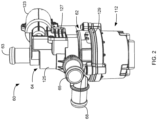
- FIGS. 2-4 illustrate an example pump and switch 60 of the present disclosure.
- the pump and switch 60 comprises, as an integrated unit, a motor section 112, a switch section 64, and a pump section 62.
- the first inlet 63 extends outward from the switch section 64 providing the non-switched inlet for coolant to flow to the pump section 62 through a passage 121.
- the second coolant inlet 65 includes a passage 126 that extends into the switch section 64 and to a rotatable valve switch 180.
- the valve switch 180 is arranged to be switched into an open or closed position to permit or to block fluid flow to the pump section 62 from the second inlet 65.
- An actuator 50 seen in FIG. 4 is housed in an actuator cover 23 mounted on the switch section 64.
- the actuator 150 is arranged to rotate the valve switch 180 to position the valve switch into the closed B position of the first operating mode to the open A position of the second operating mode when the actuator 50 is energized by the mode controller 90, as was explained above.
- the switch section 64, the first inlet 63, the second inlet 65, the pump section 62 and the outlet 68 are integrated into a singular upper housing 25 formed from a suitable glycol and temperature resistant thermoplastic material.
- the actuator cover 123 houses the actuator 150 therein.
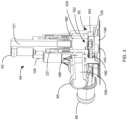
- the motor section 112 includes an intermediate cover member 129, shown in FIGS 3 and 4 .
- a top surface of the intermediate cover member 129 forms a floor for the pump section 62.
- An impeller 160 is rotationally mounted over the floor and is enclosed within a pump cavity 162 formed in the interior of the pump section 62.
- a chamber 148 extends from a bottom surface of the intermediate cover member 129. Chamber 148 houses an electrical motor (not shown) having a motor shaft 143 attached to the electrical motor.
- the electrical motor may be connected to electrical terminals (not shown) that electrically connect to communication line 96 from mode controller 90.
- Communication line 96 provides control signals as electrical pulses to the electrical motor to energize the electrical motor and control its rotation, speed, and torque.
- the auxiliary pump 62 comprises an impeller 160 rotating within a cylindrical pump cavity 162 formed by a circular wall 164. Rotation of the impeller 160 by motor shaft 143 causes fluid contained in pump cavity 162 to be discharged at an accelerated flow rate through outlet 68.
- the valve switch 180 is mounted in a cavity 221 of the valve switch section 64.
- the cavity 221 extends through the upper housing 125 parallel to passage 121.
- the valve switch 180 is mechanically connected to the actuator 50 via toothed gear set 206, shown in FIG. 4 .
- the actuator motor 150 when energized by mode controller 90 is arranged to rotate the valve switch 180 into position A or to a position B. In position A an opening 186 is aligned with passage 126. Coolant in passage 126 flows through opening 186 and into pump cavity 162. Rotation of the valve switch into position B moves opening 186 away from passage 126 blocking the flow of coolant from passage 126 to the pump cavity 162.
- a sealing member 325 is placed in a lower chamber of cavity 221 to prevent leaking of coolant from passage 126 when the valve switch 180 is placed into position B that moves opening 186 away from passage 126.
- the upper housing 125 of switch section 16 may further include an electronics section 127 that may house electronic components (not shown) for driving the actuator 50.
- Control signals to the actuator 50 may be coupled to the electronic components in the electronics section 127 using electrical conductors extending from the electrical terminals that also connect the electrical motor to communication line 96.
- the control signals coupled from communication line 96 to the electronic components in the electronic section 127 causing the actuator 150 to rotate the valve switch 180.
- the term "communicate,” as well as derivatives thereof, encompasses both direct and indirect communication.
- the term “or” is inclusive, meaning and/or.
- the phrase “associated with,” as well as derivatives thereof, may mean to include, be included within, interconnect with, contain, be contained within, connect to or with, couple to or with, be communicable with, cooperate with, interleave, juxtapose, be proximate to, be bound to or with, have, have a property of, have a relationship to or with, or the like.
- phrases "at least one of,” when used with a list of items, means that different combinations of one or more of the listed items may be used, and only one item in the list may be needed.
- “at least one of: A, B, and C” includes any of the following combinations: A, B, C, A and B, A and C, B and C, and A and B and C.
Landscapes
- Engineering & Computer Science (AREA)
- Chemical & Material Sciences (AREA)
- Combustion & Propulsion (AREA)
- Mechanical Engineering (AREA)
- General Engineering & Computer Science (AREA)
- Cooling, Air Intake And Gas Exhaust, And Fuel Tank Arrangements In Propulsion Units (AREA)
- Air-Conditioning For Vehicles (AREA)
Abstract
Description
- This disclosure is generally directed to thermal management systems. More specifically, it relates to a flow scheme for a thermal management system that uses a pump and switch for switching flow to heat generating or absorbing components.
- In motor vehicles, in order to circulate coolant in a coolant circuit between the vehicle radiator and the internal combustion engine, mechanically driven coolant pumps are generally used. The coolant pumps are arranged between the vehicle radiator and the internal combustion engine driven by a belt using the drive power of the internal combustion engine. Current vehicle design in the automotive sector is directed towards increasing the fuel-efficiency of vehicles. For this purpose, for example, start-stop systems are used, which an internal combustion engine in the vehicle, for example when stopping at a red light, a railway barrier, etc., is temporarily switched off. As soon as the stop situation has ended, and the vehicle operator presses the gas pedal, the internal combustion engine is restarted. Due to the system-related shutdown of the internal combustion engine in such start-stop systems the operation of the coolant pump is also stopped. In particular, due to the stopping of the internal combustion engine no more drive power is transmitted by the belt drive to the mechanical coolant pump, so that its operation is stopped, and therefore no coolant is circulated in the coolant circuit. During high outside temperatures and at correspondingly high engine or coolant temperatures, stopping the circulation of coolant flowing in the coolant circuit due to the stopped engine can cause the temperature of the engine to rise beyond a safe permitted level.
- Additionally, in conventional coolant circuits, much of the thermal energy in the circulating coolant is typically dissipated to the air by a heat exchanger, such as the radiator, heater core or a transmission oil cooler. Under normal operating conditions, an engine and transmission may only require nominal coolant flow to maintain proper temperature of internal components. However, under severe operating conditions an engine may require an increased coolant flow to maintain proper component temperatures. If a high flow rate coolant pump is used to provide a high coolant flow rate under severe conditions to prevent overheating, the amount of coolant flow will be excessive under normal operating conditions, resulting in parasitic energy losses within the engine and transmission. Under cold start conditions, an engine and transmission may also require increased coolant flow to achieve and maintain proper temperature of internal components.
- In currently known coolant circuits used in engine driven vehicles separate auxiliary pumps and inlet switching valves are used with branched cooling circuit lines to provide auxiliary fluid pump flow and to switch coolant flow to the heat absorbing components of the vehicle, which results in high component costs. Therefore, it is an object of the present disclosure to provide an integrated pump and switch wherein the pump acts as an auxiliary fluid pump that can be selectively energized to pump fluid through a vehicle's cooling circuit and switched to control the flow of coolant through branched cooling circuits.
- This disclosure relates to a process for cooling a heat generating component of a vehicle comprising pumping a coolant from a first pump to at least a first heat absorbing device when the heat generating component is operating. The process further comprises pumping the coolant from a second pump to at least the first heat absorbing device when the heat generating component is caused to stop operating.
- The disclosure also relates to an apparatus for cooling a heat generating component of a vehicle comprising a first pump operated to pump a coolant to at least a first heat absorbing device when the heat generating component is operating. A second pump is operated to pump the coolant to at least the first heat absorbing device when the heat generating component is caused to stop operating.
- In an embodiment a first inlet of a switch integrated with the second pump is connected to an outlet of a second heat absorbing device. The first inlet directly communicates the coolant received at the first inlet from the outlet of the second heat absorbing device to the second pump. A second inlet of the switch is connected to an outlet of a third heat absorbing device. The switch is arranged to selectively communicate the coolant received at the second inlet from the outlet of the third heat absorbing device to the second pump.
- Other technical features may be readily apparent to one skilled in the art from the following figures, descriptions, and claims.
- For a more complete understanding of this disclosure, reference is now made to the following description, taken in conjunction with the accompanying drawings, in which:
-
FIG. 1 illustrates a schematic view of a system of the present disclosure; -
FIG. 2 illustrates a perspective view of a pump and switch of the present disclosure; -
FIG. 3 illustrates a first cross-sectional perspective view through an upper housing of the pump and switch ofFIG. 1 of the present disclosure; and -
FIG. 4 illustrates a second cross-sectional perspective view of the upper housing of the pump and switch ofFIG. 1 of the present disclosure; - The term "communication" means that fluid flow is operatively permitted between enumerated components, which may be characterized as "fluid communication." The term "communication" may also mean that data or signals are transmitted between enumerated components which may be characterized as "informational communication."
- The term "downstream communication" means that at least a portion of fluid flowing to the subject in downstream communication may operatively flow from the object with which it fluidly communicates.
- The term "upstream communication" means that at least a portion of the fluid flowing from the subject in upstream communication may operatively flow to the object with which it fluidly communicates.
- The term "direct communication" means that fluid flow from the upstream component enters the downstream component without passing through any other intervening vessel.
- The term "bypass" means that the object is out of downstream communication with a bypassing subject at least to the extent of bypassing.
- The figures discussed below, and the various embodiments used to describe the principles of the present invention in this patent document are by way of illustration only and should not be construed in any way to limit the scope of the invention. Those skilled in the art will understand that the principles of the invention may be implemented in any type of suitably arranged device or system.
-
FIG. 1 depicts asystem 10 for managing and regulating the temperature of the heat generating components of a vehicle such as its powertrain. The heat generating components of a vehicle powertrain typically includes anengine 12 and atransmission 71. Heat energy produced by theengine 12 is drawn from the engine by a coolant fluid circulating in the vehicle's engine through a series of coolant passageways including anengine inlet 13 and anengine outlet 15. Thesystem 10 includes apump 20 mechanically driven by theengine 12, afirst valve 30, a pump andswitch 60, a first heat absorbing device, such as for example aradiator 40, a second heat absorbing device, such as for example aheater core 50 installed in apassenger cabin 51, and a third heat absorbing device, such as a transmissionoil heat exchanger 70 in direct communication with thetransmission 71. - A
first coolant circuit 25 supplies coolant fluid to theengine 12 using themechanical pump 20, which has apump inlet 21 and apump outlet 22. Thepump outlet 22 is fluidically connected to afluid junction 23. Themechanical pump 20 is driven by a belt attached to the engine that operatesmechanical pump 20 to drive coolant fluid through thefirst coolant circuit 25 as long as theengine 12 is running. Thefluid junction 23 is in upstream communication with acoolant pipeline 26 of thefirst coolant circuit 25 and connected toengine inlet 13. - The flow of coolant to the
radiator 40 is controlled by thefirst valve 30. Thefirst valve 30 has afirst valve inlet 31, asecond valve inlet 32 and a first valve outlet A, and a second valve outlet B. Thefirst valve inlet 31 is in downstream communication withengine outlet 15 viacoolant pipeline 27. Asecond inlet 32 receives coolant from areturn pipeline 69. Thefirst valve 30 is arranged to have the coolant enteringfirst valve inlets mode controller 90 viacommunication line 92. Themode controller 90 may also receive a sensor signal alongcommunication line 93 from atemperature sensor 33. Thesensor 33 is arranged to send signals representing the temperature of the coolant flowing throughcoolant pipeline 27 fromengine 12. - The
first valve 30 may be operated by themode controller 90 to either apply the heat energy absorbed by the coolant fromengine 12 to theradiator 40, or bypass around theradiator 40 to reapply the heated coolant back to theengine 12. For example, thefirst valve 30 may be selectively controlled to connect thedownstream coolant line 27 toradiator inlet 41 through outlet A of thefirst valve 30. Heat energy is released from the coolant by passing the coolant through theradiator 40. In a situation where theengine 12 has not reached its operating temperature, sensed, and reported bysensor 33 tomode controller 90 temperature the mode controller may provide a command tofirst valve 30 to connectcoolant line 27 to outlet B to usebypass pipeline 43. Thebypass pipeline 43 directs the coolant downstream from theengine outlet 15 around theradiator 40 tofluid junction 45 and theinlet 21 ofmechanical pump 20. - Heat energy may also be released from the coolant fluid by passing the coolant through a
second coolant circuit 35. Thesecond coolant circuit 35 comprises a heater core (HTC) 50 having anHTC inlet 52 and anHTC outlet 53 and a transmission oil cooler (TOC) 70 having aTOC inlet 72 and aTOC outlet 73. TheHTC inlet 52 is in fluid communication with thefluid junction 23 on the upstream side ofmechanical pump 20. Heat energy may further be exchanged between the coolant in thesecond coolant circuit 35 and a transmission oil using theTOC 70. The transmission oil lubricates and exchanges heat energy with thetransmission 71. TheTOC inlet 72 is in fluid communication with thefluid junction 23, upstream frommechanical pump 20. Coolant pumped though theoutlet 22 ofmechanical pump 20 flows intofluid junction 23 and through both acoolant pipeline 36 to theHTC inlet 52 and acoolant pipeline 76 to theTOC inlet 72. - The return side of the
second coolant circuit 35 is connected in downstream communication with thefirst coolant circuit 25 through the pump andswitch 60. The pump and switch 60 comprises, as an integrated unit, an electrically drivenauxiliary fluid pump 62 and aswitch 64. Afirst inlet 63 ofswitch 64 is fluidically connected toHTC outlet 53. Asecond inlet 65 of theswitch 64 is fluidically communicated toTOC outlet 73. Coolant flowing downstream from theHTC 50 returns to thefirst coolant circuit 25 through thefirst inlet 63 ofvalve switch 64. Thefirst inlet 63 is unswitched and therefore passes all the coolant received through theswitch 64 toauxiliary pump 62. The coolant flows through theauxiliary pump 62, where it exists from anoutlet 68 to thesecond input 32 of thefirst valve 30 viareturn pipeline 69. - Downstream coolant flows from the
TOC 70exits TOC outlet 73 and is connected to thesecond inlet 65 of theswitch 64. Withswitch 64 in position A, coolant from theTOC 70 passes throughswitch 64 toauxiliary pump 62 where it is mixed with the coolant from theHTC 50 to exit fromoutlet 68 and return to thesecond input 32 of thefirst valve 30 viareturn pipeline 69. - Both the
auxiliary pump 62 and theswitch 64 are arranged to be energized by signals provided by themode controller 90. Themode controller 90 outputs control signals viacommunication line 96 to pump andswitch 60. Themode controller 90 provided power and control signals to place the pump and switch 60 into selected operational modes based on various vehicle operating conditions. - Under normal driving conditions, the transmission oil may not require cooling, and therefore, the
mode controller 90 may send control signals to the pump and switch 60 to place theswitch 64 into a first operational mode. In the first operational mode,inlet 65 is moved to position B that blocks coolant from flowing through theswitch 64. In the first operational mode, coolant fromTOC outlet 73 is stopped from flowing through theTOC exchanger 70. - However, under severe operating conditions, such as when for example, driving in extremely hot air temperatures or when hauling a trailer, the
transmission 71 may require that heat energy built up in the transmission oil be cooled in order to maintain proper operating temperatures. In such operating conditions, theswitch 64 may be placed into a second operational mode bymode controller 90 by sending control signals to switch 64 to placevalve inlet 65 into position A. In this second operational mode, coolant frows out ofTOC outlet 73, throughswitch 64 and out ofauxiliary pump 62 throughoutlet 68 tosecond inlet 32 of thefirst valve 30 and to thefirst coolant circuit 25. - In order to maximize fuel efficiency modern internal combustion engines, employ start-stop systems to temporarily switch off or stop the
engine 12 when for example stopping at a red light, a railway barrier, etc. As soon as the stop situation has ended, and the vehicle operator presses the gas pedal, theengine 12 is restarted. Due to the system-related shutdown of theengine 12 in such start-stop systems, the operation of the mechanical coolant pump, such asmechanical pump 20, is also stopped. In particular, due to the stopping of theengine 12 no more drive power is transmitted by a belt drive that drives themechanical pump 20, so that its operation is stopped, and therefore no coolant is circulated in thecoolant circuits system 10 due to the stopped engine can cause the temperature of theengine 12 to rise beyond a safe permitted level. - The
mode controller 90 may send control signals to the pump and switch 60 to place it in a third operational mode. In the third operational mode, themode controller 90 signals theauxiliary pump 62 throughcommunication line 96 to turn-on theauxiliary pump 62. With theauxiliary pump 62 energized coolant fluid is pumped throughsystem 10 effectively replacing the pumping action provided bymechanical pump 20 which is in a stopped condition due to theengine 12 being shutdown. Theauxiliary pump 62 is electrically driven using a vehicles battery or other source of stored electrical energy. Theauxiliary pump 62 pumps the coolant fluid entering intoswitch inlet 63 fromHTC outlet 53 and fromswitch inlet 65 fromTOC outlet 73. The coolant fluid is pumped fromswitch inlet 65 only ifswitch inlet 65 is in valve positionA. Auxiliary pump 62 pumps fluid fromoutlet 68 intocoolant return pipeline 69 to thefirst valve 30 and into theengine 12 andradiator 40 of thefirst coolant circuit 25. Theauxiliary pump 62 remains on until theengine 12 is restarted and themechanical pump 20 takes over pumping coolant throughsystem 10. Upon restartingengine 12, the mode controller sends commands to theauxiliary pump 62 to cease operation which turns-off theauxiliary pump 62. Themechanical pump 20 again takes on the duty of circulating the fluid through thesystem 10 driven by theengine 12. -
FIGS. 2-4 illustrate an example pump and switch 60 of the present disclosure. The pump and switch 60 comprises, as an integrated unit, amotor section 112, aswitch section 64, and apump section 62. Thefirst inlet 63 extends outward from theswitch section 64 providing the non-switched inlet for coolant to flow to thepump section 62 through apassage 121. Thesecond coolant inlet 65 includes apassage 126 that extends into theswitch section 64 and to arotatable valve switch 180. Thevalve switch 180 is arranged to be switched into an open or closed position to permit or to block fluid flow to thepump section 62 from thesecond inlet 65. An actuator 50 seen inFIG. 4 , is housed in anactuator cover 23 mounted on theswitch section 64. Theactuator 150 is arranged to rotate thevalve switch 180 to position the valve switch into the closed B position of the first operating mode to the open A position of the second operating mode when theactuator 50 is energized by themode controller 90, as was explained above. - The
switch section 64, thefirst inlet 63, thesecond inlet 65, thepump section 62 and theoutlet 68 are integrated into a singularupper housing 25 formed from a suitable glycol and temperature resistant thermoplastic material. Theactuator cover 123 houses the actuator 150 therein. - The
motor section 112 includes anintermediate cover member 129, shown inFIGS 3 and4 . A top surface of theintermediate cover member 129 forms a floor for thepump section 62. Animpeller 160 is rotationally mounted over the floor and is enclosed within apump cavity 162 formed in the interior of thepump section 62. Achamber 148 extends from a bottom surface of theintermediate cover member 129.Chamber 148 houses an electrical motor (not shown) having amotor shaft 143 attached to the electrical motor. The electrical motor may be connected to electrical terminals (not shown) that electrically connect tocommunication line 96 frommode controller 90.Communication line 96 provides control signals as electrical pulses to the electrical motor to energize the electrical motor and control its rotation, speed, and torque. - The
auxiliary pump 62 comprises animpeller 160 rotating within acylindrical pump cavity 162 formed by acircular wall 164. Rotation of theimpeller 160 bymotor shaft 143 causes fluid contained inpump cavity 162 to be discharged at an accelerated flow rate throughoutlet 68. - The
valve switch 180 is mounted in acavity 221 of thevalve switch section 64. Thecavity 221 extends through theupper housing 125 parallel topassage 121. Thevalve switch 180 is mechanically connected to theactuator 50 via toothed gear set 206, shown inFIG. 4 . Theactuator motor 150, when energized bymode controller 90 is arranged to rotate thevalve switch 180 into position A or to a position B. In position A anopening 186 is aligned withpassage 126. Coolant inpassage 126 flows throughopening 186 and intopump cavity 162. Rotation of the valve switch into position B moves opening 186 away frompassage 126 blocking the flow of coolant frompassage 126 to thepump cavity 162. A sealingmember 325 is placed in a lower chamber ofcavity 221 to prevent leaking of coolant frompassage 126 when thevalve switch 180 is placed into position B that moves opening 186 away frompassage 126. - The
upper housing 125 of switch section 16 may further include anelectronics section 127 that may house electronic components (not shown) for driving theactuator 50. Control signals to theactuator 50 may be coupled to the electronic components in theelectronics section 127 using electrical conductors extending from the electrical terminals that also connect the electrical motor tocommunication line 96. The control signals coupled fromcommunication line 96 to the electronic components in theelectronic section 127 causing theactuator 150 to rotate thevalve switch 180. - It may be advantageous to set forth definitions of certain words and phrases used throughout this patent document. The term "communicate," as well as derivatives thereof, encompasses both direct and indirect communication. The terms "include" and "comprise," as well as derivatives thereof, mean inclusion without limitation. The term "or" is inclusive, meaning and/or. The phrase "associated with," as well as derivatives thereof, may mean to include, be included within, interconnect with, contain, be contained within, connect to or with, couple to or with, be communicable with, cooperate with, interleave, juxtapose, be proximate to, be bound to or with, have, have a property of, have a relationship to or with, or the like. The phrase "at least one of," when used with a list of items, means that different combinations of one or more of the listed items may be used, and only one item in the list may be needed. For example, "at least one of: A, B, and C" includes any of the following combinations: A, B, C, A and B, A and C, B and C, and A and B and C.
- The description in the present application should not be read as implying that any particular element, step, or function is an essential or critical element that must be included in the claim scope. The scope of patented subject matter is defined only by the allowed claims. Moreover, none of the claims is intended to invoke 35 U.S.C. § 112(f) with respect to any of the appended claims or claim elements unless the exact words "means for" or "step for" are explicitly used in the particular claim, followed by a participle phrase identifying a function. Use of terms such as (but not limited to) "mechanism," "module," "device," "unit," "component," "element," "member," "apparatus," "machine," "system," or "controller" within a claim is understood and intended to refer to structures known to those skilled in the relevant art, as further modified or enhanced by the features of the claims themselves and is not intended to invoke 35 U.S.C. § 112(f).
- While this disclosure has described certain embodiments and generally associated methods, alterations and permutations of these embodiments and methods will be apparent to those skilled in the art. Accordingly, the above description of example embodiments does not define or constrain this disclosure. Other changes, substitutions, and alterations are also possible without departing from the spirit and scope of this disclosure, as defined by the following claims.
- The present application also discloses the following numbered embodiments:
- Numbered embodiment 1 A process for cooling a heat generating component of a vehicle comprising:
- pumping a coolant from a first pump to at least a first heat absorbing device when the heat generating component is operating; and
- pumping the coolant from a second pump to at least the first heat absorbing device when the heat generating component is caused to stop operating.
- Numbered embodiment 2 The process of claim 1, wherein the heat generating component and the first heat absorbing device are connected to a first coolant circuit and the first coolant circuit is further connected to a second coolant circuit containing a second and a third heat absorbing device, the second coolant circuit receiving the coolant from the first coolant circuit.
- Numbered embodiment 3 The process of numbered embodiment 2, wherein a switch receives the coolant from the second heat absorbing device at a first inlet directing the coolant to the second pump, the first coolant circuit receiving the coolant from the second pump.
- Numbered embodiment 4 The process of numbered embodiment 3, wherein the switch receives coolant from the third heat absorbing device at a second inlet which selectively directs the coolant from the third heat absorbing device to the second pump.
- Numbered embodiment 5 The process of numbered embodiment 4, wherein the switch is selectively operated to direct the coolant received at the second inlet to the second pump.
- Numbered embodiment 6 The process of numbered embodiment 4, wherein the switch is selectively operated to block the coolant from reaching the second pump.
- Numbered embodiment 7 The process of numbered embodiment 4, wherein the second pump is energized to pump the coolant from the second pump to the first coolant circuit.
- Numbered embodiment 8 The process of numbered embodiment 7, wherein the switch and the second pump are electrically connected to a mode controller and the mode controller selectively operates the switch.
- Numbered embodiment 9 The process of numbered embodiment 8, wherein the mode controller energizes the second pump to pump the coolant from the second pump when the heat generating component is caused to stop operating.
- Numbered
embodiment 10 The process of numbered embodiment 4, wherein the second pump and switch are an integrated device housed in a unitary housing. - Numbered embodiment 11 An apparatus for cooling a heat generating component of a vehicle comprising:
- a first pump operated to pump a coolant to at least a first heat absorbing device when the heat generating component is operating; and
- a second pump operated to pump the coolant to at least the first heat absorbing device when the heat generating component is caused to stop operating.
- Numbered
embodiment 12 The apparatus of numbered embodiment 11, wherein a first coolant circuit is connected to the heat generating component and the first heat absorbing device, the first coolant circuit is connected to a second coolant circuit containing a second and a third heat absorbing device and the second and third heat absorbing devices each have an inlet for receiving the coolant from the second coolant circuit. - Numbered
embodiment 13 The apparatus of numberedembodiment 12, wherein a first inlet of a switch is connected to an outlet of the second heat absorbing device, the switch receiving the coolant from the outlet of the second heat absorbing device and directing the coolant to the second pump, the second pump including an outlet connected to the first coolant circuit. - Numbered embodiment 14 The apparatus of numbered
embodiment 13, wherein a second inlet of the switch is connected to an outlet of the third heat absorbing device, the switch selectively directing the coolant from the third heat absorbing device to the second pump. - Numbered
embodiment 15 The apparatus of numbered embodiment 14, wherein the switch is selectively operable into a first operating mode causing the switch to direct the coolant received at the second inlet of the switch to be directed to the second pump. - Numbered embodiment 16 The apparatus of numbered
embodiment 15, wherein the switch is selectively operable into a second operating mode causing the coolant received at the second inlet of the switch to be blocked from being directed to the second pump. - Numbered embodiment 17 The apparatus of numbered embodiment 16, wherein the second pump is operable into a third operating mode that energizes the second pump to pump the coolant to the first coolant circuit from the outlet of the second pump.
- Numbered embodiment 18 The apparatus of numbered embodiment 16, wherein the apparatus includes a mode controller electrically connected to the switch and the second pump, the mode controller arranged to send control signals to the switch to selectively operate the switch into the first or the second operating mode.
- Numbered embodiment 19 The apparatus of numbered embodiment 18, wherein the mode controller is further electrically connected to the second pump and the mode controller is arranged to send control signals to the second pump to energize the second pump to pump the coolant to the first coolant circuit when the heat generating component is caused to stop operating.
- Numbered
embodiment 20 The apparatus of numbered embodiment 4, wherein the second pump and switch are an integrated device housed in a unitary housing.
Claims (15)
- A process for cooling a heat generating component of a vehicle comprising:pumping a coolant from a first pump to at least a first heat absorbing device when the heat generating component is operating; andoperating a second pump to pump the coolant to at least the first heat absorbing device.
- The process of claim 1, wherein the heat generating component and the first heat absorbing device are connected to a first coolant circuit and the first coolant circuit is further connected to a second coolant circuit containing a second and a third heat absorbing device, the second coolant circuit receiving the coolant from the first coolant circuit.
- The process of claim 2, wherein a switch receives the coolant from the second heat absorbing device at a first inlet directing the coolant to the second pump, the first coolant circuit receiving the coolant from the second pump.
- The process of claim 3, wherein the switch receives coolant from the third heat absorbing device at a second inlet which selectively directs the coolant from the third heat absorbing device to the second pump.
- The process of claim 4, wherein the switch is selectively operated to direct the coolant received at the second inlet to the second pump.
- The process of claim 4, wherein the switch is selectively operated to block the coolant from reaching the second pump.
- The process of claim 4, wherein the second pump is selectively operated to pump the coolant from the second pump to the first coolant circuit.
- The process of claim 7, wherein the switch and the second pump are electrically connected to a mode controller and the mode controller selectively operates the switch.
- The process of claim 8, wherein the mode controller selectively operates the second pump to pump the coolant from the second pump when the heat generating component is caused to stop operating.
- The process of claim 4, wherein the second pump and switch are an integrated device housed in a unitary housing.
- An apparatus for cooling a heat generating component of a vehicle comprising:a first pump operated to pump a coolant to at least a first heat absorbing device when the heat generating component is operating; anda second pump operated to pump the coolant to at least the first heat absorbing device.
- The apparatus of claim 11, wherein a first coolant circuit is connected to the heat generating component and the first heat absorbing device, the first coolant circuit is connected to a second coolant circuit containing a second and a third heat absorbing device and the second and third heat absorbing devices each have an inlet for receiving the coolant from the second coolant circuit.
- The apparatus of claim 12, wherein a first inlet of a switch is connected to an outlet of the second heat absorbing device, the switch receiving the coolant from the outlet of the second heat absorbing device and directing the coolant to the second pump, the second pump including an outlet connected to the first coolant circuit and wherein a second inlet of the switch is connected to an outlet of the third heat absorbing device, the switch selectively directing the coolant from the third heat absorbing device to the second pump.
- The apparatus of claim 13, wherein the switch is selectively operable into a first operating mode causing the switch to direct the coolant received at the second inlet of the switch to be directed to the second pump, and wherein the switch is selectively operable into a second operating mode causing the coolant received at the second inlet of the switch to be blocked from being directed to the second pump.
- The apparatus of claim 14, wherein the second pump is operable into a third operating mode that energizes the second pump to pump the coolant to the first coolant circuit from the outlet of the second pump.
Applications Claiming Priority (1)
| Application Number | Priority Date | Filing Date | Title |
|---|---|---|---|
| US18/473,234 US12359606B2 (en) | 2023-09-23 | 2023-09-23 | Flow scheme with pump and switch |
Publications (1)
| Publication Number | Publication Date |
|---|---|
| EP4530451A1 true EP4530451A1 (en) | 2025-04-02 |
Family
ID=92894792
Family Applications (1)
| Application Number | Title | Priority Date | Filing Date |
|---|---|---|---|
| EP24201744.0A Pending EP4530451A1 (en) | 2023-09-23 | 2024-09-20 | Flow scheme with pump and switch |
Country Status (3)
| Country | Link |
|---|---|
| US (1) | US12359606B2 (en) |
| EP (1) | EP4530451A1 (en) |
| CN (1) | CN119686843A (en) |
Citations (3)
| Publication number | Priority date | Publication date | Assignee | Title |
|---|---|---|---|---|
| US20030127528A1 (en) * | 2002-01-04 | 2003-07-10 | Peri Sabhapathy | Hybrid vehicle powertrain thermal management system and method for cabin heating and engine warm up |
| US20160031288A1 (en) * | 2013-04-08 | 2016-02-04 | Denso Corporation | Thermal management system for vehicle |
| DE102019132962A1 (en) * | 2018-12-07 | 2020-06-10 | Suzuki Motor Corporation | Control device of a vehicle system |
Family Cites Families (19)
| Publication number | Priority date | Publication date | Assignee | Title |
|---|---|---|---|---|
| DE19809123B4 (en) * | 1998-03-04 | 2005-12-01 | Daimlerchrysler Ag | Water pump for the cooling circuit of an internal combustion engine |
| US8196553B2 (en) * | 2008-01-30 | 2012-06-12 | Chrysler Group Llc | Series electric-mechanical water pump system for engine cooling |
| JP6135256B2 (en) * | 2012-05-23 | 2017-05-31 | 株式会社デンソー | Thermal management system for vehicles |
| JP5962556B2 (en) * | 2013-03-19 | 2016-08-03 | 株式会社デンソー | Thermal management system for vehicles |
| JP6167892B2 (en) * | 2013-06-06 | 2017-07-26 | 株式会社デンソー | Air conditioner for vehicles |
| JP6233009B2 (en) * | 2013-12-26 | 2017-11-22 | 株式会社デンソー | Air conditioner for vehicles |
| JP6272094B2 (en) | 2014-03-12 | 2018-01-31 | 日立オートモティブシステムズ株式会社 | Cooling device for internal combustion engine |
| JP6266393B2 (en) * | 2014-03-19 | 2018-01-24 | 日立オートモティブシステムズ株式会社 | Cooling device for internal combustion engine |
| EP3147473B1 (en) * | 2014-05-23 | 2022-06-29 | Nissan Motor Co., Ltd. | Cooling circuit including an internal combustion engine |
| CN105201625B (en) * | 2015-10-16 | 2017-10-13 | 安徽江淮汽车集团股份有限公司 | A kind of engine-cooling system |
| JP6505613B2 (en) | 2016-01-06 | 2019-04-24 | 日立オートモティブシステムズ株式会社 | Cooling device for internal combustion engine for vehicle, control device for cooling device, flow control valve for cooling device, and control method for cooling device for internal combustion engine for vehicle |
| CN108506076B (en) | 2017-02-28 | 2020-01-07 | 长城汽车股份有限公司 | Turbine cooling system of engine, control method and vehicle |
| EP3376049A1 (en) * | 2017-03-14 | 2018-09-19 | Grundfos Holding A/S | Pump unit |
| EP3376038B1 (en) * | 2017-03-14 | 2021-07-28 | Grundfos Holding A/S | Pump unit |
| US10508587B2 (en) * | 2017-07-28 | 2019-12-17 | GM Global Technology Operations LLC | Controlling coolant fluid in a vehicle cooling system using a secondary coolant pump |
| CN112406494B (en) * | 2019-08-23 | 2022-08-09 | 华为技术有限公司 | Thermal management system for automobile and thermal management method based on system |
| US11654747B2 (en) * | 2020-02-07 | 2023-05-23 | GM Global Technology Operations LLC | System and method for controlling fluid temperature in a thermal system |
| US11359714B2 (en) * | 2020-03-05 | 2022-06-14 | Ford Global Technologies, Llc | Control system for opportunistic heating of transmission fluid |
| CN114905914A (en) * | 2021-02-09 | 2022-08-16 | 浙江三花汽车零部件有限公司 | Fluid control assembly and thermal management system |
-
2023
- 2023-09-23 US US18/473,234 patent/US12359606B2/en active Active
-
2024
- 2024-09-20 CN CN202411313293.9A patent/CN119686843A/en active Pending
- 2024-09-20 EP EP24201744.0A patent/EP4530451A1/en active Pending
Patent Citations (3)
| Publication number | Priority date | Publication date | Assignee | Title |
|---|---|---|---|---|
| US20030127528A1 (en) * | 2002-01-04 | 2003-07-10 | Peri Sabhapathy | Hybrid vehicle powertrain thermal management system and method for cabin heating and engine warm up |
| US20160031288A1 (en) * | 2013-04-08 | 2016-02-04 | Denso Corporation | Thermal management system for vehicle |
| DE102019132962A1 (en) * | 2018-12-07 | 2020-06-10 | Suzuki Motor Corporation | Control device of a vehicle system |
Also Published As
| Publication number | Publication date |
|---|---|
| US20250101901A1 (en) | 2025-03-27 |
| CN119686843A (en) | 2025-03-25 |
| US12359606B2 (en) | 2025-07-15 |
Similar Documents
| Publication | Publication Date | Title |
|---|---|---|
| CN101949322B (en) | For the operating method of the engine-cooling system of vehicle | |
| EP0298304A1 (en) | Waste heat recovery system for liquid-cooled internal combustion engine | |
| EP1431698A2 (en) | Automotive heat exchanging system | |
| SE501444C2 (en) | Cooling system for a retarded vehicle | |
| KR20170074795A (en) | Vehicular cooling system | |
| CN111016631A (en) | Cooling system for vehicle | |
| JPH06185361A (en) | Built-in type cooling device | |
| US11614022B2 (en) | Vehicle temperature adjustment system | |
| US7543695B2 (en) | Hydraulic system for an electro-mechanical transmission and method of providing fluid to transmission components | |
| KR101588769B1 (en) | Electric oil pump for automatic transmission | |
| KR910001521B1 (en) | Cooling apparatus for a starter motor and/or a generator for a car | |
| CN111063960A (en) | Battery cooling system | |
| EP0969189B1 (en) | Total cooling assembly for a vehicle having an internal combustion engine | |
| RU2633109C1 (en) | Device for liquid cooling of electric vehicle components | |
| JPS59155697A (en) | Lubricant temperature controller for speed change gear | |
| JPH07115581B2 (en) | Vehicle heating system | |
| US10012227B2 (en) | Fluid supply device | |
| EP4530451A1 (en) | Flow scheme with pump and switch | |
| US20040187505A1 (en) | Integrated cooling system | |
| EP4641050A1 (en) | Engineering vehicle cooling system, engineering vehicle and cooling method therefor | |
| US12085081B1 (en) | Fluid pump and valve switch | |
| EP0343785A2 (en) | Cooling systems | |
| CN217872997U (en) | Engine thermal management system and vehicle | |
| EP1404950B1 (en) | Cooling system for a motor vehicle engine | |
| US20260028110A1 (en) | Ship propulsion machine |
Legal Events
| Date | Code | Title | Description |
|---|---|---|---|
| PUAI | Public reference made under article 153(3) epc to a published international application that has entered the european phase |
Free format text: ORIGINAL CODE: 0009012 |
|
| STAA | Information on the status of an ep patent application or granted ep patent |
Free format text: STATUS: THE APPLICATION HAS BEEN PUBLISHED |
|
| AK | Designated contracting states |
Kind code of ref document: A1 Designated state(s): AL AT BE BG CH CY CZ DE DK EE ES FI FR GB GR HR HU IE IS IT LI LT LU LV MC ME MK MT NL NO PL PT RO RS SE SI SK SM TR |
|
| STAA | Information on the status of an ep patent application or granted ep patent |
Free format text: STATUS: REQUEST FOR EXAMINATION WAS MADE |
|
| 17P | Request for examination filed |
Effective date: 20250930 |
|
| STAA | Information on the status of an ep patent application or granted ep patent |
Free format text: STATUS: EXAMINATION IS IN PROGRESS |
|
| 17Q | First examination report despatched |
Effective date: 20251107 |