EP4530302A1 - Système catalytique à base de scandium et procédé de production d'un copolymère éthylène/butadiène - Google Patents
Système catalytique à base de scandium et procédé de production d'un copolymère éthylène/butadiène Download PDFInfo
- Publication number
- EP4530302A1 EP4530302A1 EP24202845.4A EP24202845A EP4530302A1 EP 4530302 A1 EP4530302 A1 EP 4530302A1 EP 24202845 A EP24202845 A EP 24202845A EP 4530302 A1 EP4530302 A1 EP 4530302A1
- Authority
- EP
- European Patent Office
- Prior art keywords
- activator
- aluminum
- ethylene
- borate
- butadiene
- Prior art date
- Legal status (The legal status is an assumption and is not a legal conclusion. Google has not performed a legal analysis and makes no representation as to the accuracy of the status listed.)
- Pending
Links
Images


Classifications
-
- C—CHEMISTRY; METALLURGY
- C08—ORGANIC MACROMOLECULAR COMPOUNDS; THEIR PREPARATION OR CHEMICAL WORKING-UP; COMPOSITIONS BASED THEREON
- C08F—MACROMOLECULAR COMPOUNDS OBTAINED BY REACTIONS ONLY INVOLVING CARBON-TO-CARBON UNSATURATED BONDS
- C08F236/00—Copolymers of compounds having one or more unsaturated aliphatic radicals, at least one having two or more carbon-to-carbon double bonds
- C08F236/02—Copolymers of compounds having one or more unsaturated aliphatic radicals, at least one having two or more carbon-to-carbon double bonds the radical having only two carbon-to-carbon double bonds
- C08F236/04—Copolymers of compounds having one or more unsaturated aliphatic radicals, at least one having two or more carbon-to-carbon double bonds the radical having only two carbon-to-carbon double bonds conjugated
- C08F236/06—Butadiene
-
- C—CHEMISTRY; METALLURGY
- C08—ORGANIC MACROMOLECULAR COMPOUNDS; THEIR PREPARATION OR CHEMICAL WORKING-UP; COMPOSITIONS BASED THEREON
- C08F—MACROMOLECULAR COMPOUNDS OBTAINED BY REACTIONS ONLY INVOLVING CARBON-TO-CARBON UNSATURATED BONDS
- C08F210/00—Copolymers of unsaturated aliphatic hydrocarbons having only one carbon-to-carbon double bond
- C08F210/02—Ethene
-
- C—CHEMISTRY; METALLURGY
- C08—ORGANIC MACROMOLECULAR COMPOUNDS; THEIR PREPARATION OR CHEMICAL WORKING-UP; COMPOSITIONS BASED THEREON
- C08F—MACROMOLECULAR COMPOUNDS OBTAINED BY REACTIONS ONLY INVOLVING CARBON-TO-CARBON UNSATURATED BONDS
- C08F4/00—Polymerisation catalysts
- C08F4/42—Metals; Metal hydrides; Metallo-organic compounds; Use thereof as catalyst precursors
- C08F4/44—Metals; Metal hydrides; Metallo-organic compounds; Use thereof as catalyst precursors selected from light metals, zinc, cadmium, mercury, copper, silver, gold, boron, gallium, indium, thallium, rare earths or actinides
- C08F4/54—Metals; Metal hydrides; Metallo-organic compounds; Use thereof as catalyst precursors selected from light metals, zinc, cadmium, mercury, copper, silver, gold, boron, gallium, indium, thallium, rare earths or actinides together with other compounds thereof
- C08F4/545—Metals; Metal hydrides; Metallo-organic compounds; Use thereof as catalyst precursors selected from light metals, zinc, cadmium, mercury, copper, silver, gold, boron, gallium, indium, thallium, rare earths or actinides together with other compounds thereof rare earths being present, e.g. triethylaluminium + neodymium octanoate
-
- C—CHEMISTRY; METALLURGY
- C08—ORGANIC MACROMOLECULAR COMPOUNDS; THEIR PREPARATION OR CHEMICAL WORKING-UP; COMPOSITIONS BASED THEREON
- C08F—MACROMOLECULAR COMPOUNDS OBTAINED BY REACTIONS ONLY INVOLVING CARBON-TO-CARBON UNSATURATED BONDS
- C08F2410/00—Features related to the catalyst preparation, the catalyst use or to the deactivation of the catalyst
- C08F2410/08—Presence of a deactivator
Definitions
- the invention relates to a process for producing an ethylene-butadiene copolymer in accordance with claim 1 or 11, respectively.
- the process includes copolymerizing butadiene with ethylene in the presence of a catalyst system.
- the catalyst system includes tris[(trimethylsilyl)methyl]scandium; and an aluminum-containing activator.
- the catalyst system may further include a borate coactivator.
- the borate coactivator comprises a salt of tetrakis(3,5-bis(trifluoromethyl)phenyl)borate and/or a salt of tetrakis(pentafluorophenyl)borate.
- the aluminum-containing activator may include an aluminoxane activator.
- the aluminoxane activator includes a modified aluminoxane activator.
- the aluminoxane activator may include a methylaluminoxane activator.
- the methylaluminoxane activator is a modified methylaluminoxane activator.
- the aluminum-containing activator may include MMAO-12.
- the aluminum-containing activator comprises a trialkyl aluminum activator; and the catalyst system further includes a borate coactivator.
- the trialkyl aluminum activator may include triisobutylaluminum.
- a molar ratio of the aluminum-containing activator to tris[(trimethylsilyl)methyl]scandium is in a range of 20 to 1000, 50 to 500, or 75 to 200.
- the process may further include quenching a reaction product of the copolymerization. In some embodiments, the process further includes drying the quenched reaction product. The reaction product may be quenched with a quenching composition containing isopropanol and butylated hydroxytoluene.
- the process includes providing a first composition containing butadiene and ethylene to a reactor; providing a second composition containing tris[(trimethylsilyl)methyl]scandium and a first aliquot of an aluminum-containing activator to the reactor; and copolymerizing the butadiene with the ethylene.
- the first composition may further include a second aliquot of the aluminum-containing activator.
- the process further includes quenching a reaction product of the copolymerization; and drying the quenched reaction product.
- the aluminum-containing activator may include a modified aluminoxane activator; or the aluminum-containing activator may include a trialkyl aluminum activator and at least one of the first composition and the second composition may further include a borate coactivator.
- the term “comprising” may include the embodiments “consisting of” and “consisting essentially of.”
- the terms “comprise(s),” “include(s),” “having,” “has,” “can,” “contain(s),” and variants thereof, as used herein, are intended to be open-ended transitional phrases that require the presence of the named ingredients/steps and permit the presence of other ingredients/steps.
- compositions, mixtures, or processes as “consisting of” and “consisting essentially of” the enumerated ingredients/steps, which allows the presence of only the named ingredients/steps, along with any impurities that might result therefrom, and excludes other ingredients/steps.
- each intervening number there between with the same degree of precision is explicitly contemplated.
- the numbers 7 and 8 are contemplated in addition to 6 and 9, and for the range 6.0-7.0, the number 6.0, 6.1, 6.2, 6.3, 6.4, 6.5, 6.6, 6.7, 6.8, 6.9, and 7.0 are explicitly contemplated.
- the present disclosure relates to a process for producing an ethylene-butadiene copolymer, a catalyst composition used in the production process, and articles formed from compositions including the copolymer.
- the catalyst composition when exposed to a mixture of butadiene and ethylene, was able to produce a copolymer with up to 6 mol% ethylene.
- the scandium catalyst system is a simpler and likely less expensive variation of catalysts reported in the literature.
- FIG. 1 is flow chart illustrating a non-limiting example of a process 100 for producing a catalyst composition in accordance with some embodiments of the present disclosure.
- the process 100 includes dissolving tris[(trimethylsilyl)methyl]scandium in a solvent 110.
- the solvent may be a hydrocarbon solvent.
- the solvent includes one or more aromatic, paraffinic, and/or cycloparaffinic compounds.
- the solvent may contain from 4 to 10 carbon atoms. Non-limiting examples include butane, pentane, isooctane, cyclohexane, n-hexane, benzene, toluene, xylene, ethylbenzene, and diethylbenzene. Mixtures of two or more hydrocarbon solvents may also be utilized.
- the aluminum-containing activator may be an aluminoxane activator.
- the aluminoxane activator may be an alkylaluminoxane activator, such as a methylaluminoxane activator.
- the aluminoxane activator may be a modified aluminoxane activator, such as a modified methylaluminoxane activator.
- the methylaluminoxane activator is modified by replacing a portion of the methyl groups with linear or branched alkyl groups having from 3 to 10 carbon atoms. In some embodiments, 40 mol% or less (e.g., 5 to 35 mol%) of the alkyl groups may be replaced.
- modified methylaluminoxane activators examples include MMAO-12, MMAO-3a, and MMAO-7.
- the aluminum-containing activator may include at least organoaluminum compound, such as a triorganoaluminum compound.
- the triorgano aluminum compound may be a trialkyl aluminum compound.
- Examples of aluminum-containing compounds include trimethylaluminum, triethylaluminum, tri-n-propylaluminum, triisopropylaluminum, tri-n-propylaluminum, triisopropylaluminim, tri-n-butylaluminum, triisobutylaluminum, tripentylaluminum, trihexylaluminum, tricyclohexylaluminum, trioctylaluminum, triphenylaluminum, tri-p-tolylaluminum, tribenzylaluminum, ethyldiphenylaluminum, ethyl-di-p-tolylaluminum, ethyldibenzylaluminum, diethylphenylaluminum, diethyl-p-tolylaluminum, and diethylbenzylaluminum.
- a molar ratio of the aluminum-containing activator to tris[(trimethylsilyl)methyl]scandium may be in a range of 20 to 1000, 50 to 500, or 75 to 200.
- the borate coactivator may include one or more of trimethylammonium tetraphenylborate, triethylammonium tetraphenylborate, tripropylammonium tetraphenylborate, tri(n-butyl)ammonium tetraphenylborate, tri(t-butyl)ammonium tetraphenylborate, N,N-dimethylanilinium tetraphenylborate, N,N-diethylanilinium tetraphenylborate, N,N-dimethylanilinium tetra-(3,5-bis(trifluoromethyl)phenyl)borate, N,N-dimethyl-(2,4,6-trimethylanilinium) tetraphenylborate, trimethylammonium tetrakis(pentafluorophenyl) borate, triethylammonium tetrakis(pentafluoroph
- N,N-dimethylanilinium tetrakis-(2,3,4,6-tetrafluorophenyl) borate di-(i-propyl)ammonium tetrakis(pentafluorophenyl) borate, dicyclohexylammonium tetrakis(pentafluorophenyl) borate; triphenylphospnonium tetrakis(pentafluorophenyl) borate, tri(o-tolyl)phosphonium tetrakis(pentafluorophenyl) borate, tri(2,6-dimethylphenyl)phosphonium tetrakis(pentafluorophenyl) borate; and/or N,N-dimethylanilinium tetrakis(3,5-bis(trifluoromethyl)phenyl)borate.
- a molar ratio of the aluminum-containing activator to the borate coactivator may be in a range of 20 to 1000, 50 to 500, or 75 to 200.
- the coactivator may be used stoichiometrically relative to the main metal catalyst.
- a molar ratio of the borate coactivator to tris[(trimethylsilyl)methyl]scandium may be 1 or about 1.
- FIG. 2 is a flow chart illustrating an example of a process 201 for producing an ethylene-butadiene copolymer in accordance with some embodiments of the present disclosure.
- the process 201 includes preparing a catalyst composition 200, copolymerizing ethylene and butadiene in the presence of the catalyst composition 230, quenching 240, and drying 250.
- the ethylene-butadiene copolymer may contain from 1 mol% to 20 mol%, 1 mol% to 10 mol%, or 1 mol% to 7 mol% ethylene.
- the catalyst composition 200 is prepared as discussed above for process 100.
- the catalyst composition includes tris[(trimethylsilyl)methyl]scandium, an aluminum-containing activator, and optionally a borate coactivator.
- the ethylene and butadiene reacted during the copolymerization 230 may be provided to a copolymerization reactor before the catalyst composition, concurrently with the catalyst composition, and/or after the catalyst composition.
- Copolymerization 230 may include providing ethylene to a polymerization vessel containing butadiene.
- the ethylene may be provided by flushing a solution containing butadiene in a solvent with ethylene.
- the ethylene gas may be provided to saturate the butadiene.
- the catalyst composition is provided to the polymerization vessel.
- the vessel may be heated to a temperature in the range of 30 °C to 150 °C, from 30 °C to 100 °C, or from 40 °C to 90 °C, for a time period in the range of 15 minutes to 36 hours, 20 minutes to 12 hours, or 20 minutes to 3 hours.
- the quenching 240 includes providing a quenching composition to the polymerization vessel.
- the quenching composition may contain an acidic proton source and/or a protic quench agent.
- An antioxidant may be included in the quenching composition and/or provided to the polymerization vessel concurrently or subsequently.
- the quenching composition contains isopropanol and butylated hydroxytoluene (BHT).
- BHT butylated hydroxytoluene
- an excess of isopropanol or other protic solvent is added along with 0.1 phr to 1.0 phr, 0.25 phr to 0.75 phr, or 0.5 phr of stabilizer (e.g., BHT).
- Drying 250 evaporates the solvent and may be passive or active.
- Articles produced using the ethylene/butadiene copolymer are also disclosed.
- the ethylene/butadiene copolymer may be useful in the production of tires.
- the rubber composition may be incorporated in a variety of rubber components of the tire.
- the rubber component may be a tread (including tread cap and tread base), sidewall, apex, chafer, sidewall insert, wirecoat or innerliner.
- the component is a tread.
- the pneumatic tire may be a race tire, passenger tire, aircraft tire, agricultural, earthmover, off-the-road, or truck tire. In one embodiment, the tire is a passenger or truck tire. The tire may also be a radial or bias.
- the rubber composition may also be used in other products, including non-pneumatic tires, belts, hoses, shoes, airsprings, and engine mounts.
- the rubber composition may optionally include, in addition to the ethylene-butadiene copolymer, one or more rubbers or elastomers containing olefinic unsaturation.
- the phrases "rubber or elastomer containing olefinic unsaturation” or “diene-based elastomer” are intended to include both natural rubber and its various raw and reclaim forms as well as various synthetic rubbers. In the description, the terms “rubber” and “elastomer” may be used interchangeably, unless otherwise prescribed.
- the terms “rubber composition,” “compounded rubber” and “rubber compound” are used interchangeably to refer to rubber which has been blended or mixed with various ingredients and materials and such terms are well known to those having skill in the rubber mixing or rubber compounding art.
- Representative synthetic polymers are the homopolymerization products of butadiene and its homologues and derivatives, for example, methylbutadiene, dimethylbutadiene and pentadiene as well as copolymers such as those formed from butadiene or its homologues or derivatives with other unsaturated monomers.
- acetylenes for example, vinyl acetylene
- olefins for example, isobutylene, which copolymerizes with isoprene to form butyl rubber
- vinyl compounds for example, acrylic acid, acrylonitrile (which polymerize with butadiene to form NBR), methacrylic acid and styrene, the latter compound polymerizing with butadiene to form SBR, as well as vinyl esters and various unsaturated aldehydes, ketones and ethers, e.g., acrolein, methyl isopropenyl ketone and vinylethyl ether.
- synthetic rubbers include neoprene (polychloroprene), polybutadiene (including cis-1,4-polybutadiene), polyisoprene (including cis-1,4-polyisoprene), butyl rubber, halobutyl rubber such as chlorobutyl rubber or bromobutyl rubber, styrene/isoprene/butadiene rubber, copolymers of 1,3-butadiene or isoprene with monomers such as styrene, acrylonitrile and methyl methacrylate, as well as ethylene/propylene terpolymers, also known as ethylene/propylene/diene monomer (EPDM), and in particular, ethylene/propylene/ dicyclopentadiene terpolymers.
- neoprene polychloroprene
- polybutadiene including cis-1,4-polybutadiene
- rubbers which may be used include alkoxy-silyl end functionalized solution polymerized polymers (SBR, PBR, IBR and SIBR), silicon-coupled and tin-coupled star-branched polymers.
- SBR alkoxy-silyl end functionalized solution polymerized polymers
- PBR polybutadiene
- SIBR silicon-coupled and tin-coupled star-branched polymers.
- the preferred rubber or elastomers are polyisoprene (natural or synthetic), polybutadiene and SBR.
- At least one additional rubber is preferably of at least two of diene-based rubbers.
- a combination of two or more rubbers is preferred such as cis 1,4-polyisoprene rubber (natural or synthetic, although natural is preferred), 3,4-polyisoprene rubber, styrene/isoprene/butadiene rubber, emulsion and solution polymerization derived styrene/butadiene rubbers, cis 1,4-polybutadiene rubbers and emulsion polymerization prepared butadiene/acrylonitrile copolymers.
- an emulsion polymerization derived styrene/butadiene might be used having a relatively conventional styrene content of 20 to 28 percent bound styrene or, for some applications, an E-SBR having a medium to relatively high bound styrene content, namely, a bound styrene content of 30 to 45 percent.
- E-SBR emulsion polymerization prepared E-SBR
- styrene and 1,3-butadiene are copolymerized as an aqueous emulsion.
- the bound styrene content can vary, for example, from 5 to 50 percent.
- the E-SBR may also contain acrylonitrile to form a terpolymer rubber, as E-SBAR, in amounts, for example, of 2 to 30 weight percent bound acrylonitrile in the terpolymer.
- Emulsion polymerization prepared styrene/butadiene/acrylonitrile copolymer rubbers containing 2 to 40 weight percent bound acrylonitrile in the copolymer are also contemplated as diene-based rubbers.
- S-SBR solution polymerization prepared SBR
- S-SBR typically has a bound styrene content in a range of 5 to 50, preferably 9 to 36, percent.
- the S-SBR can be conveniently prepared, for example, by organo lithium catalyzation in the presence of an organic hydrocarbon solvent.
- cis 1,4-polybutadiene rubber may be used.
- BR cis 1,4-polybutadiene rubber
- Such BR can be prepared, for example, by organic solution polymerization of 1,3-butadiene.
- the BR may be conveniently characterized, for example, by having at least a 90 percent cis 1,4-content.
- the rubber composition may also include up to 70 phr of processing oil.
- Processing oil may be included in the rubber composition as extending oil typically used to extend elastomers. Processing oil may also be included in the rubber composition by addition of the oil directly during rubber compounding.
- the processing oil used may include both extending oil present in the elastomers, and process oil added during compounding.
- Suitable process oils include various oils as are known in the art, including aromatic, paraffinic, naphthenic, vegetable oils, and low PCA oils, such as MES, TDAE, SRAE and heavy naphthenic oils.
- Suitable low PCA oils include those having a polycyclic aromatic content of less than 3 percent by weight as determined by the IP346 method. Procedures for the IP346 method may be found in Standard Methods for Analysis & Testing of Petroleum and Related Products and British Standard 2000 Parts, 2003, 62nd edition, published by the Institute of Petroleum, United Kingdom .
- the rubber composition may include from 10 to 150 phr of silica. In another embodiment, from 20 to 80 phr of silica may be used.
- the commonly employed siliceous pigments which may be used in the rubber compound include conventional pyrogenic and precipitated siliceous pigments (silica).
- precipitated silica is used.
- the conventional siliceous pigments employed are precipitated silicas such as, for example, those obtained by the acidification of a soluble silicate, e.g., sodium silicate.
- Such conventional silicas might be characterized, for example, by having a BET (Brunauer-Emmett-Teller) surface area, as measured using nitrogen gas.
- the BET surface area may be in the range of 40 to 600 square meters per gram. In another embodiment, the BET surface area may be in a range of 80 to 300 square meters per gram. The BET method of measuring surface area is described in the Journal of the American Chemical Society, Volume 60, Page 304 (1930 ).
- the conventional silica may also be characterized by having a dibutylphthalate (DBP) absorption value in a range of 100 to 400, alternatively 150 to 300.
- DBP dibutylphthalate
- silicas such as, only for example herein, and without limitation, silicas commercially available from PPG Industries under the Hi-Sil trademark with designations 210, 243; silicas available from Rhodia, with, for example, designations of Z1165MP and Z165GR, and silicas available from Degussa AG with, for example, designations VN2 and VN3.
- Commonly employed carbon blacks can be used as a conventional filler in an amount ranging from 10 to 150 phr. In another embodiment, from 20 to 80 phr of carbon black may be used.
- Representative examples of such carbon blacks include N110, N121, N134, N220, N231, N234, N242, N293, N299, N315, N326, N330, N332, N339, N343, N347, N351, N358, N375, N539, N550, N582, N630, N642, N650, N683, N754, N762, N765, N774, N787, N907, N908, N990 and N991.
- These carbon blacks have iodine absorptions ranging from 9 to 145 g/kg and DBP number ranging from 34 to 150 cm 3 /100 g.
- fillers may be used in the rubber composition including particulate fillers including ultra-high molecular weight polyethylene (UHMWPE), crosslinked particulate polymer gels including but not limited to those disclosed in U.S. Pat. Nos. 6,242,534 ; 6,207,757 ; 6,133,364 ; 6,372,857 ; 5,395,891 ; or 6,127,488 , and plasticized starch composite filler including that disclosed in U.S. Pat. No. 5,672,639 .
- Such other fillers may be used in an amount ranging from 1 to 30 phr.
- the rubber composition may contain a conventional sulfur containing organosilicon compound.
- the sulfur containing organosilicon compounds are the 3,3'-bis(trimethoxy or triethoxy silylpropyl) polysulfides.
- the sulfur containing organosilicon compounds are 3,3'-bis(triethoxysilylpropyl) disulfide and/or 3,3'-bis(triethoxysilylpropyl) tetrasulfide.
- suitable sulfur containing organosilicon compounds include compounds disclosed in U.S. Pat. No. 6,608,125 .
- suitable sulfur containing organosilicon compounds include those disclosed in U.S. Patent Publication No. 2003/0130535 .
- the sulfur containing organosilicon compound is Si-363 from Degussa.
- the amount of the sulfur containing organosilicon compound in a rubber composition will vary depending on the level of other additives that are used. Generally speaking, the amount of the compound will range from 0.5 to 20 phr. In one embodiment, the amount will range from 1 to 10 phr.
- the rubber composition would be compounded by methods generally known in the rubber compounding art, such as mixing the various sulfur-vulcanizable constituent rubbers with various commonly used additive materials such as, for example, sulfur donors, curing aids, such as activators and retarders and processing additives, such as oils, resins including tackifying resins and plasticizers, fillers, pigments, fatty acid, zinc oxide, waxes, antioxidants and antiozonants and peptizing agents.
- additives mentioned above are selected and commonly used in conventional amounts.
- sulfur donors include elemental sulfur (free sulfur), an amine disulfide, polymeric polysulfide and sulfur olefin adducts.
- the sulfur-vulcanizing agent is elemental sulfur.
- the sulfur-vulcanizing agent may be used in an amount ranging from 0.5 to 8 phr, alternatively with a range of from 1.5 to 6 phr.
- Typical amounts of tackifier resins, if used, comprise 0.5 to 10 phr, usually 1 to 5 phr.
- processing aids comprise 1 to 50 phr.
- Typical amounts of antioxidants comprise 1 to 5 phr.
- antioxidants may be, for example, diphenyl-p-phenylenediamine and others, such as, for example, those disclosed in The Vanderbilt Rubber Handbook (1978), Pages 344 through 346.
- Typical amounts of antiozonants comprise 1 to 5 phr.
- Typical amounts of fatty acids, if used, which can include stearic acid comprise 0.5 to 3 phr.
- Typical amounts of zinc oxide comprise 2 to 5 phr.
- waxes comprise 1 to 5 phr. Often microcrystalline waxes are used.
- peptizers comprise 0.1 to 1 phr.
- Typical peptizers may be, for example, pentachlorothiophenol and dibenzamidodiphenyl disulfide.
- Accelerators are used to control the time and/or temperature required for vulcanization and to improve the properties of the vulcanizate.
- a single accelerator system may be used, i.e., primary accelerator.
- the primary accelerator(s) may be used in total amounts ranging from 0.5 to 4, alternatively 0.8 to 1.5, phr.
- combinations of a primary and a secondary accelerator might be used with the secondary accelerator being used in smaller amounts, such as from 0.05 to 3 phr, in order to activate and to improve the properties of the vulcanizate. Combinations of these accelerators might be expected to produce a synergistic effect on the final properties and are somewhat better than those produced by use of either accelerator alone.
- delayed action accelerators may be used which are not affected by normal processing temperatures but produce a satisfactory cure at ordinary vulcanization temperatures.
- Vulcanization retarders might also be used. Suitable types of accelerators that may be used include amines, disulfides, guanidines, thioureas, thiazoles, thiurams, sulfenamides, dithiocarbamates and xanthates.
- the primary accelerator is a sulfenamide
- the secondary accelerator may be a guanidine, dithiocarbamate or thiuram compound.
- the mixing of the rubber composition can be accomplished by methods known to those having skill in the rubber mixing art.
- the ingredients are typically mixed in at least two stages, namely, at least one non-productive stage followed by a productive mix stage.
- the final curatives including sulfur-vulcanizing agents are typically mixed in the final stage which is conventionally called the "productive" mix stage in which the mixing typically occurs at a temperature, or ultimate temperature, lower than the mix temperature(s) than the preceding non-productive mix stage(s).
- the terms "non-productive" and “productive” mix stages are well known to those having skill in the rubber mixing art.
- the rubber composition may be subjected to a thermomechanical mixing step.
- the thermomechanical mixing step generally comprises a mechanical working in a mixer or extruder for a period of time suitable in order to produce a rubber temperature between 140° C. and 190° C.
- the appropriate duration of the thermomechanical working varies as a function of the operating conditions, and the volume and nature of the components.
- the thermomechanical working may be from 1 to 20 minutes.
- the rubber composition may be incorporated in a variety of rubber components of the tire.
- the rubber component may be a tread (including tread cap and tread base), sidewall, apex, chafer, sidewall insert, wirecoat or innerliner.
- the component is a tread.
- Vulcanization of the pneumatic tire may be carried out at conventional temperatures ranging from 100° C to 200° C. In one embodiment, the vulcanization is conducted at temperatures ranging from 110° C to 180° C. Any of the usual vulcanization processes may be used such as heating in a press or mold, heating with superheated steam or hot air. Such tires can be built, shaped, molded and cured by various methods which are known and will be readily apparent to those having skill in such art.
- FIG. 3 is a partial side view of an example of a tire 301 in accordance with some embodiments of the present disclosure.
- the tire 301 includes a tread portion 302, a bead portion 303, and a sidewall portion 304 located between the tread portion 302 and the bead portion 303.
- the tread portion 302, bead portion 303, and sidewall portion 304 of tires in accordance with the present disclosure are not limited to the particular configuration depicted in FIG. 3 .
- FIG. 3 is provided to illustrate one example of where a composition containing a copolymer produced according to the process of the present disclosure may be utilized.
- the copolymer may be utilized in one or more of the tread portion 302, bead portion 303, and sidewall portion 304.
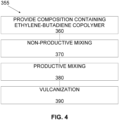
- FIG. 4 is a flow chart illustrating an example of a process 455 of forming an article (e.g., a tire) in accordance with some embodiments of the present disclosure.
- the process 455 includes providing the composition 460 containing an ethylene-butadiene copolymer, non-productive mixing 470, productive mixing 480, and vulcanization 490.
- Butadiene premix was prepared in toluene (15% by weight) and dried over a column of dried alumina/sieves. Premix was charged in a 4-oz boston round bottle. The solution was saturated with ethylene gas by flushing with a stream of ethylene for ⁇ 5 minutes. Catalyst solution was prepared under inert atmosphere in toluene by dissolving 7.4 mg (0.0164 mmol) of Tris[(trimethylsilyl)methyl]scandium ( CAS 872992-17-1 ) in 2 mL toluene, followed by the addition of MMAO-12 (100 eq, 1.64 mmol, 1.52 mL of 7% solution).
Landscapes
- Chemical & Material Sciences (AREA)
- Health & Medical Sciences (AREA)
- Chemical Kinetics & Catalysis (AREA)
- Medicinal Chemistry (AREA)
- Polymers & Plastics (AREA)
- Organic Chemistry (AREA)
- Engineering & Computer Science (AREA)
- Materials Engineering (AREA)
- Transition And Organic Metals Composition Catalysts For Addition Polymerization (AREA)
- Polymerization Catalysts (AREA)
- Addition Polymer Or Copolymer, Post-Treatments, Or Chemical Modifications (AREA)
- Compositions Of Macromolecular Compounds (AREA)
Applications Claiming Priority (1)
| Application Number | Priority Date | Filing Date | Title |
|---|---|---|---|
| US18/476,747 US20250109230A1 (en) | 2023-09-28 | 2023-09-28 | Scandium catalyst system and process for producing ethylene/butadiene copolymer |
Publications (1)
| Publication Number | Publication Date |
|---|---|
| EP4530302A1 true EP4530302A1 (fr) | 2025-04-02 |
Family
ID=92926158
Family Applications (1)
| Application Number | Title | Priority Date | Filing Date |
|---|---|---|---|
| EP24202845.4A Pending EP4530302A1 (fr) | 2023-09-28 | 2024-09-26 | Système catalytique à base de scandium et procédé de production d'un copolymère éthylène/butadiène |
Country Status (5)
| Country | Link |
|---|---|
| US (1) | US20250109230A1 (fr) |
| EP (1) | EP4530302A1 (fr) |
| JP (1) | JP2025059033A (fr) |
| KR (1) | KR20250047629A (fr) |
| CN (1) | CN119708354A (fr) |
Citations (12)
| Publication number | Priority date | Publication date | Assignee | Title |
|---|---|---|---|---|
| US5395891A (en) | 1992-06-24 | 1995-03-07 | Bayer Aktiengesellschaft | Rubber mixtures containing polybutadiene gel |
| US5672639A (en) | 1996-03-12 | 1997-09-30 | The Goodyear Tire & Rubber Company | Starch composite reinforced rubber composition and tire with at least one component thereof |
| US6127488A (en) | 1997-01-17 | 2000-10-03 | Bayer Ag | Rubber mixtures which contain SBR rubber gels |
| US6133364A (en) | 1998-08-01 | 2000-10-17 | Continental Aktiengesellschaft | Rubber composition, method of formulating the composition and vehicle tire made from the composition |
| US6207757B1 (en) | 1998-08-01 | 2001-03-27 | Continental Aktiengesellschaft | Rubber composition, method of adding and blending the composition and vehicle tire made from the composition |
| US6242534B1 (en) | 1998-08-01 | 2001-06-05 | Continental Aktiengesellschaft | Rubber composition, method of formulating and blending the same and article and tires made therefrom |
| US6372857B1 (en) | 1999-09-07 | 2002-04-16 | Bayer Aktiengesellschaft | Microgel-containing rubber mixtures with masked bi-functional mercaptans and vulcanization products produced therefrom |
| US20030130535A1 (en) | 2001-08-06 | 2003-07-10 | Degussa Ag, | Organosilicon compounds |
| US6608125B2 (en) | 1997-08-21 | 2003-08-19 | Crompton Corporation | Blocked mercaptosilane coupling agents for filled rubbers |
| WO2015051569A1 (fr) * | 2013-10-12 | 2015-04-16 | 中国科学院长春应用化学研究所 | Complexe métallocène, son procédé de préparation, et composition de catalyseur |
| JP5917809B2 (ja) * | 2010-11-30 | 2016-05-18 | 株式会社ブリヂストン | 共重合体及びその製造方法、並びに、ゴム組成物、架橋ゴム組成物、及びタイヤ |
| US20180291131A1 (en) * | 2017-04-11 | 2018-10-11 | Changchun Institute Of Applied Chemistry | Copolymer Of Ethylene And A Conjugated Diene, And Process For Its Production |
-
2023
- 2023-09-28 US US18/476,747 patent/US20250109230A1/en active Pending
-
2024
- 2024-09-25 JP JP2024166107A patent/JP2025059033A/ja active Pending
- 2024-09-26 EP EP24202845.4A patent/EP4530302A1/fr active Pending
- 2024-09-27 CN CN202411364244.8A patent/CN119708354A/zh active Pending
- 2024-09-27 KR KR1020240131487A patent/KR20250047629A/ko active Pending
Patent Citations (12)
| Publication number | Priority date | Publication date | Assignee | Title |
|---|---|---|---|---|
| US5395891A (en) | 1992-06-24 | 1995-03-07 | Bayer Aktiengesellschaft | Rubber mixtures containing polybutadiene gel |
| US5672639A (en) | 1996-03-12 | 1997-09-30 | The Goodyear Tire & Rubber Company | Starch composite reinforced rubber composition and tire with at least one component thereof |
| US6127488A (en) | 1997-01-17 | 2000-10-03 | Bayer Ag | Rubber mixtures which contain SBR rubber gels |
| US6608125B2 (en) | 1997-08-21 | 2003-08-19 | Crompton Corporation | Blocked mercaptosilane coupling agents for filled rubbers |
| US6133364A (en) | 1998-08-01 | 2000-10-17 | Continental Aktiengesellschaft | Rubber composition, method of formulating the composition and vehicle tire made from the composition |
| US6207757B1 (en) | 1998-08-01 | 2001-03-27 | Continental Aktiengesellschaft | Rubber composition, method of adding and blending the composition and vehicle tire made from the composition |
| US6242534B1 (en) | 1998-08-01 | 2001-06-05 | Continental Aktiengesellschaft | Rubber composition, method of formulating and blending the same and article and tires made therefrom |
| US6372857B1 (en) | 1999-09-07 | 2002-04-16 | Bayer Aktiengesellschaft | Microgel-containing rubber mixtures with masked bi-functional mercaptans and vulcanization products produced therefrom |
| US20030130535A1 (en) | 2001-08-06 | 2003-07-10 | Degussa Ag, | Organosilicon compounds |
| JP5917809B2 (ja) * | 2010-11-30 | 2016-05-18 | 株式会社ブリヂストン | 共重合体及びその製造方法、並びに、ゴム組成物、架橋ゴム組成物、及びタイヤ |
| WO2015051569A1 (fr) * | 2013-10-12 | 2015-04-16 | 中国科学院长春应用化学研究所 | Complexe métallocène, son procédé de préparation, et composition de catalyseur |
| US20180291131A1 (en) * | 2017-04-11 | 2018-10-11 | Changchun Institute Of Applied Chemistry | Copolymer Of Ethylene And A Conjugated Diene, And Process For Its Production |
Non-Patent Citations (2)
| Title |
|---|
| "Standard Methods for Analysis & Testing of Petroleum and Related Products and British Standard 2000 Parts", 2003, INSTITUTE OF PETROLEUM |
| JOURNAL OF THE AMERICAN CHEMICAL SOCIETY, vol. 60, 1930, pages 304 |
Also Published As
| Publication number | Publication date |
|---|---|
| KR20250047629A (ko) | 2025-04-04 |
| JP2025059033A (ja) | 2025-04-09 |
| CN119708354A (zh) | 2025-03-28 |
| US20250109230A1 (en) | 2025-04-03 |
Similar Documents
| Publication | Publication Date | Title |
|---|---|---|
| EP2194090B1 (fr) | Composition de caoutchouc et pneu avec contenu à faible teneur en zinc | |
| EP2028022B1 (fr) | Procédé de fabrication de pneu avec paroi latérale noire et pneu fabriqué à partir du procédé | |
| US9988479B2 (en) | Functionalized elastomer containing a boron group | |
| US20120083559A1 (en) | Pneumatic tire with thread | |
| EP2028021A1 (fr) | Pneu avec composant disposant d'une combinaison de plastifiants | |
| EP4035907B1 (fr) | Huiles végétales modifiées par des acides gras dans les compositions de caoutchouc et les pneus | |
| EP3290228A1 (fr) | Polymère fonctionnalisé, composition de caoutchouc et pneu | |
| EP2030809B1 (fr) | Pneu avec un composant contenant de l'asphaltène | |
| EP2371895A1 (fr) | Composition en caoutchouc et pneumatique avec un composant de caoutchouc contenant d'alkylalkoxysilane et de résine de silicone | |
| EP3181593B1 (fr) | Élastomère fonctionnalisé contenant un groupe d'azote | |
| KR102210778B1 (ko) | 공액 다이엔 및 1-비닐사이클로알켄의 공중합체 | |
| EP4530302A1 (fr) | Système catalytique à base de scandium et procédé de production d'un copolymère éthylène/butadiène | |
| EP4141062A1 (fr) | Composition de caoutchouc et pneumatique | |
| EP4035908B1 (fr) | Huiles végétales modifiées en résine dans des compositions en caoutchouc et des pneus | |
| US20230312784A1 (en) | Functionalized hydrogenated polymers | |
| US20190055335A1 (en) | Functionalized elastomer | |
| US20230312792A1 (en) | Hydrogenated polymers with siloxytrithiocarbanate termination | |
| EP2733167B1 (fr) | Composition de caoutchouc et pneu | |
| EP3444125B1 (fr) | Élastomères fonctionnalisés | |
| EP3181592B1 (fr) | Élastomère fonctionnalisé contenant un groupe soufre | |
| EP3733679B1 (fr) | Réactifs fonctionnalisés d'aluminium et son procédé de fabrication et procédé de fabrication d'un élastomère fonctionnalisé | |
| EP4095172B1 (fr) | Composition de caoutchouc comprenant un copolymère séquencé et copolymère séquencé | |
| US11208518B2 (en) | Functionalized polymer, rubber composition and pneumatic tire | |
| EP3181603B1 (fr) | Élastomère fonctionnalisé contenant un groupe bore | |
| US10081694B2 (en) | Functionalized elastomer containing a boron group |
Legal Events
| Date | Code | Title | Description |
|---|---|---|---|
| PUAI | Public reference made under article 153(3) epc to a published international application that has entered the european phase |
Free format text: ORIGINAL CODE: 0009012 |
|
| STAA | Information on the status of an ep patent application or granted ep patent |
Free format text: STATUS: THE APPLICATION HAS BEEN PUBLISHED |
|
| AK | Designated contracting states |
Kind code of ref document: A1 Designated state(s): AL AT BE BG CH CY CZ DE DK EE ES FI FR GB GR HR HU IE IS IT LI LT LU LV MC ME MK MT NL NO PL PT RO RS SE SI SK SM TR |
|
| STAA | Information on the status of an ep patent application or granted ep patent |
Free format text: STATUS: REQUEST FOR EXAMINATION WAS MADE |
|
| 17P | Request for examination filed |
Effective date: 20251002 |
|
| RAP1 | Party data changed (applicant data changed or rights of an application transferred) |
Owner name: G-3 CHICKADEE PURCHASER, LLC1485 E ARCHWOOD AVENUE |