EP4530267A1 - Hot forming tool for glass bottle necks - Google Patents
Hot forming tool for glass bottle necks Download PDFInfo
- Publication number
- EP4530267A1 EP4530267A1 EP24200466.1A EP24200466A EP4530267A1 EP 4530267 A1 EP4530267 A1 EP 4530267A1 EP 24200466 A EP24200466 A EP 24200466A EP 4530267 A1 EP4530267 A1 EP 4530267A1
- Authority
- EP
- European Patent Office
- Prior art keywords
- forming
- glass
- tool
- section
- angle
- Prior art date
- Legal status (The legal status is an assumption and is not a legal conclusion. Google has not performed a legal analysis and makes no representation as to the accuracy of the status listed.)
- Pending
Links
Images

Classifications
-
- C—CHEMISTRY; METALLURGY
- C03—GLASS; MINERAL OR SLAG WOOL
- C03B—MANUFACTURE, SHAPING, OR SUPPLEMENTARY PROCESSES
- C03B23/00—Re-forming shaped glass
- C03B23/04—Re-forming tubes or rods
- C03B23/09—Reshaping the ends, e.g. as grooves, threads or mouths
- C03B23/092—Reshaping the ends, e.g. as grooves, threads or mouths by pressing
-
- C—CHEMISTRY; METALLURGY
- C03—GLASS; MINERAL OR SLAG WOOL
- C03B—MANUFACTURE, SHAPING, OR SUPPLEMENTARY PROCESSES
- C03B23/00—Re-forming shaped glass
- C03B23/04—Re-forming tubes or rods
- C03B23/09—Reshaping the ends, e.g. as grooves, threads or mouths
- C03B23/095—Reshaping the ends, e.g. as grooves, threads or mouths by rolling
-
- C—CHEMISTRY; METALLURGY
- C03—GLASS; MINERAL OR SLAG WOOL
- C03B—MANUFACTURE, SHAPING, OR SUPPLEMENTARY PROCESSES
- C03B23/00—Re-forming shaped glass
- C03B23/04—Re-forming tubes or rods
- C03B23/09—Reshaping the ends, e.g. as grooves, threads or mouths
Definitions
- the invention relates to a hot forming tool for glass products in particular for medical use, such as a vial, bottle, cartridge and the like.
- the invention relates to forming glass products out of a cylindrical glass tube, where the invention further relates to the forming of one open end of the glass tube, for example the neck of a bottle, vial, or cartridge or the like.
- glass vials are produced for example for pharmaceutical applications from a glass tube, in that a short tubular section at one end is heated to the shaping temperature of the glass and is brought into the desired shape in one or more shaping steps by suitable forming tools.
- the internal geometry is usually formed with plugs that are introduced into the tube end.
- the workpiece rotates during the shaping process.
- the shape and dimensions of the plug define the internal geometry of the glass vial.
- the forming takes place by way of outer forming dies that press the glass tube against the plug and simultaneously shape the outer side of the glass tube. In the process, the glass tube and the outer forming die rotate or is indexed.
- the outer forming die comprises a shaping surface.
- An example of such methods and known tools are described in US patent application US 2020/0354255 and European patent application EP 3 677 554 .
- US 2021/0276912 A1 refers to a method for shaping the mouth of a hollow precursor made of glass, as well as glass produced thereby.
- the method includes heating the mouth of the hollow precursor; introducing a mandrel along a first direction into the mouth while the hollow precursor is rotating; and pressing shaping rollers along a second direction on an outside of the mouth while the hollow precursor is rotating with the mandrel in the mouth.
- the known tools, and in particular the plug limit the geometries that can be achieved reliably.
- the current tools are not adequate. It is therefore a goal of the invention to provide a tool that more reliably can form accurate geometries.
- the inventors found that by using a tool according to claim 1, it is possible to reduce the force acting on the glass, which leads to a gentler shaping of the vial collar contour.
- the slanted forming surface with an angle (X) between the forming surface and a surface perpendicular to the axial axis of the mounting section, wherein the angle (X) is between 5-15 degrees, and optionally the phases 64 and 63 ensure that the glass accumulates better in the middle of the inner contour of the collar surface and there are fewer defects and imbalances detectable in the obtained product.
- FIGs 1 and 2 schematically illustrate an apparatus 1, known from the prior art, for hot forming of glass containers.
- Figure 1 shows the side view
- Figure 2 shows a plan view.
- the apparatus has an inner forming tool 40 (also referred to in the art as plug), which forms the inner lateral surface of a glass tube 30.
- the forming tool 40 in Fig. 1 and 2 is a schematic representation.
- the outer shaping rollers 20 are mounted in a rotatable manner in the mounting suspension 60.
- the apparatus has a gas flame 70 for optionally heating the glass vial blank 30.
- the glass tube 30 is heated up to a temperature that makes the glass material formable. This heating up can be performed outside the forming tool and be optionally assisted by the gas flame 70 if desired.
- the temperature to which the glass is heated depends on the specific type of glass used and is typically in the range of T g + 200°C to T g + 600°C (wherein T g is the transition temperature of the glass).
- T g is the transition temperature of the glass.
- the glass tube 30 is rotated.
- the forming tools 40 and 20 move towards the glass tube blank 30 to be formed. Since the outer forming tools 20 are mounted in a rotatable manner, they are likewise set in rotation by the rotary movement of the glass tube 30. Note that the forming tool 40 can be either fixed in place or be rotatable along the axial directing. Furthermore, during the forming of the outer lateral surface of the glass tube 30, the entire lateral surface of the outer shaping roller 20 passes into contact with the hot glass tube 30.
- the interaction of the inner shaping tool 40 and the outer shaping rollers 20 with the glass tube form the final geometry of the glass tube 30. This results in the final geometry of the opening of the tube.
- the invention is not limited to this implementation of the apparatus 1, and the forming tool can be used in other suitable forming machines, where a relative rotation between the forming tool 40 and the container to be formed is realized.
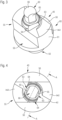
- FIG. 3 an example of a tool 40 according to the invention is shown.
- Fig. 3 shows a three-dimensional view
- Fig. 4 a top view is shown
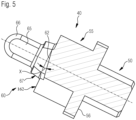
- Fig. 5 a cross section of the tool 40 is shown according to the section line A-A as indicated in Fig. 4 .
- the tool 40 has a base mounting shaft 50 that can engage with a production machine, like the one shown in Figs. 1 and 2 .
- the mounting shaft 50 mounts securely on the production machine 1 which has an according coupling system.
- Such mounting mechanisms are known in the art.
- On top of the mounting shaft is a mounting ring 55.
- the ring 55 is provided with cut outs.
- the ring 55 forms together with the mounting shaft 50 a mounting system 56 also known as mounting section.
- a forming section 60 is mounted, therefore on the distal end of the mounting system 56.
- the forming section 60 comprises the flange (61), which contacts the glass during forming.
- the flange (61) has two flat forming surfaces also described as planar end surfaces 162.
- the end surfaces 162 are perpendicular to the center axis of the tool 40.
- Adjacent to the end surfaces 162 are two forming ramps 62.
- the ramps 62 have preferably a slope X of 10 degrees compared to the planar end surfaces 162.
- a ring forming section 67 is located on top of the mounting ring 55 and starting at the level of the end surfaces 162.
- the ring forming section 67 is concentrical with the center axis of the tool 40.
- the ring forming section 67 has cut out sections 63 and 64.
- top forming section 66 located concentrically with the center axis of the tool 40.
- the topmost section of the top forming section 66 is dome shaped in this example.
- the top forming section 66 is provided with two cutouts 65, extending in axially in the wall section of the top forming section 66. The cutouts 65 are facing to the corresponding cut out sections 63.
- the glass vial 30 to be formed is heated up to the temperature that makes the glass formable, so that it is a semi liquid state and can be formed into a specific shape.
- the top section 60 is inserted coaxially into the glass vial 30.
- the planar forming surfaces 162 engage with the glass vial 30.
- the forming rollers 20 also engage the vial 30 at the outside.
- the surfaces that come into contact with the glass are coated or rinsed with a mold release agent before or during the forming process.
- the mold release agent is an oil. Such oils are known to experts and commercially available.
- the formable glass of the vial 30 is engaging with the ramps 62, as well as with the cutout sections 63 and 64, under the pressure generated between the forming tool 40 and the forming rollers.
- the ramps 62 push the now formable, semi liquid glass within the forming space formed by the forming tool 40 and the forming rollers to move the glass mass into the shape.
- the cutout sections 63 and 64 in addition engage with the flowing glass and further direct and push the glass material through the forming space. Due to the ramps 62 the glass can be moved around more efficiently throughout the forming space, with further assistance from the cutout sections 63 and 64 which further distribute the glass throughout the forming space.
- the angle of the surface 63 is about 60 - 70°.
- the surface 64 ends in the middle of the plug (angle 20-30°).
- the inclined position of the plug and the phases 63 and 64 reduces the contact area with the forming tools. This reduces the force acting on the glass. This leads to a gentler shaping of the vial collar contour.
- the phases 64 and 63 ensure that the glass accumulates better in the middle of the inner contour of the collar surface and there are fewer defects and imbalances.
- the slope X of the ramps 62 is 10 degrees.
- the invention can be implemented with slopes X between 5-15 degrees.
- the angle can be chosen depending on the flow characteristics of the specific glass used and the required geometry.
- the forming tool according to claim 1, and especially the specific geometry of the forming tool results in improved production method of the glass vials and might also result in improved glass vials. Due to the specific geometry, the moldable glass can be easily deformed and distributed within the form, resulting in glass geometries that have thin cross sections. The risk of prior art forming tools that the form is not being fill out fully can be reduced by the specific geometry of the forming tool according to claim 1. Therefore, the edge or contour of the produced object is better filled, resulting in fewer rejects.
- the inventors found that due to the slanted forming surface, with an angle (X) between the forming surface and a surface perpendicular to the axial axis of the mounting section, wherein the angle (X) is between 5-15 degrees, the mold release agent, especially the oil can drain off better. Therefore, no additional drain, for example in the form of a groove is necessary which is advantageous since such a drain can easily become clogged with glass or black carbon during production of the glass vials, which leads to expensive cleaning work and downtime.
- the ring forming section 67 is concentrical with the center axis of the tool 40 and does not contain the cut-out sections 63 and 64. In this case the ring forming section is cylindrical. In use, the ramps 62 still function as described before, with minor loss of the additional forming functions of the sections 63 and 64. The tool according to this example is easier to manufacture. In a further example of the invention, the ring forming section 67 is provided with the section 63 but leaves out the section 64. This has improved flow direction effects, while keeping the manufacturing costs lower.
- an additional heater for example a gas flame 70 as shown in Fig. 1 can be used to heat the glass before and/or during forming. This improves the temperature control of the glass during forming and provides additional ease of flow of the glass when being formed.
- the tool can be assembled from multiple parts, but preferably the tool is formed out of a single work piece to improve strength and reliability as no parts can come loose during use.
- a single piece construction also has the advantage to reduce vibrations in use.
- the plug can be made out of a hardened highspeed steel.
- a forming tool for glass forming s provided comprising an axial central mounting section (56), provided with a flange (61), with forming surfaces (62) on the flange (61) characterized in that the forming surfaces (62) are at an angle (X) with a surface perpendicular to the axial axis of the mounting section.
- a forming tool according to the first embodiment is provided, wherein the angle (X) is between 5-15 degrees.
- a forming tool according to the second embodiment is provided, wherein the angle (X) is 10 degrees.
- a forming tool according to any of the embodiments 1 to 3 is provided, further provided with a second forming surface (63).
- a forming tool according to embodiment four is provided, further provided with a third forming surface (64).
- a forming tool according to any of the preceding embodiment, wherein the tool is formed of a single work piece.
- a forming tool for forming the inner geometry of a glass container comprising a mounting section provided with a forming section where an outer surface is adapted to provide an inner geometry for the glass container when rotated along a vertical axis wherein the forming section is provided with ramping sections that are under an angle of between 85-75 with the vertical axis.
Landscapes
- Chemical & Material Sciences (AREA)
- Engineering & Computer Science (AREA)
- Materials Engineering (AREA)
- Organic Chemistry (AREA)
- Re-Forming, After-Treatment, Cutting And Transporting Of Glass Products (AREA)
- Containers Having Bodies Formed In One Piece (AREA)
Abstract
Description
- The invention relates to a hot forming tool for glass products in particular for medical use, such as a vial, bottle, cartridge and the like. In particular, the invention relates to forming glass products out of a cylindrical glass tube, where the invention further relates to the forming of one open end of the glass tube, for example the neck of a bottle, vial, or cartridge or the like.
- Methods are known from the prior art in which glass articles are produced by a forming process from a workpiece, also referred to as a semi-finished product. Thus, glass vials are produced for example for pharmaceutical applications from a glass tube, in that a short tubular section at one end is heated to the shaping temperature of the glass and is brought into the desired shape in one or more shaping steps by suitable forming tools. The internal geometry is usually formed with plugs that are introduced into the tube end. The workpiece rotates during the shaping process. The shape and dimensions of the plug define the internal geometry of the glass vial. The forming takes place by way of outer forming dies that press the glass tube against the plug and simultaneously shape the outer side of the glass tube. In the process, the glass tube and the outer forming die rotate or is indexed. The outer forming die comprises a shaping surface. An example of such methods and known tools are described in US patent application
US 2020/0354255 and European patent applicationEP 3 677 554 . - Furthermore, such methods and tools are described in
US 2021/0363045 A1 . In this document it is disclosed that a portion of the intermediate glass product is heated to a predetermined temperature. A tool and the heated portion of the intermediate glass product are brought into contact. Under a state that a tool contacts the heated portion, at least one of the tool and the intermediate glass product is rotated so that the tool and the intermediate glass product relatively rotate, wherein a part of the tool that contacts the heated portion comprises or is made of glassy carbon. -
US 2021/0276912 A1 refers to a method for shaping the mouth of a hollow precursor made of glass, as well as glass produced thereby. The method includes heating the mouth of the hollow precursor; introducing a mandrel along a first direction into the mouth while the hollow precursor is rotating; and pressing shaping rollers along a second direction on an outside of the mouth while the hollow precursor is rotating with the mandrel in the mouth. - However, the known tools, and in particular the plug, limit the geometries that can be achieved reliably. In particular for vial neck geometries that are required for high precision applications, like for containers used for medical purposes, the current tools are not adequate. It is therefore a goal of the invention to provide a tool that more reliably can form accurate geometries.
- By providing a tool according to claim 1, accurate geometries can be obtained. By having a slanted forming surface, with an angle (X) between the forming surface and a surface perpendicular to the axial axis of the mounting section, wherein the angle (X) is between 5-15 degrees, the moldable glass can be easily deformed and distributed within the form. In particular, glass geometries can be formed that have thin cross sections. Furthermore, by providing a tool according to claim 1, the inventors found that geometries with a narrow cross section, that is a thin glass wall, can be formed without risking the form not being fill out fully. Therefore, the edge or contour of the produced object is better filled, resulting in fewer rejects. Additionally, the inventors found that by using a tool according to claim 1, it is possible to reduce the force acting on the glass, which leads to a gentler shaping of the vial collar contour. Especially the slanted forming surface, with an angle (X) between the forming surface and a surface perpendicular to the axial axis of the mounting section, wherein the angle (X) is between 5-15 degrees, and optionally the
phases - Further aspects of the invention are described below with reference to the figures, in which
-
Fig. 1 shows an example of a hot forming glass apparatus, -
Fig. 2 shows an example of a hot forming glass apparatus, -
Fig. 3 shows an example of a forming tool according to the invention, -
Fig. 4 shows an example of a forming tool according to the invention in top view, and -
Fig. 5 shows an example of a forming tool according to the invention in section according to the line A-A infig 4 . -
Figures 1 and 2 schematically illustrate an apparatus 1, known from the prior art, for hot forming of glass containers. In this case,Figure 1 shows the side view andFigure 2 shows a plan view. The apparatus has an inner forming tool 40 (also referred to in the art as plug), which forms the inner lateral surface of aglass tube 30. The formingtool 40 inFig. 1 and 2 is a schematic representation. Theouter shaping rollers 20 are mounted in a rotatable manner in themounting suspension 60. Furthermore, the apparatus has agas flame 70 for optionally heating the glass vial blank 30. Theglass tube 30 is heated up to a temperature that makes the glass material formable. This heating up can be performed outside the forming tool and be optionally assisted by thegas flame 70 if desired. The temperature to which the glass is heated depends on the specific type of glass used and is typically in the range of Tg + 200°C to Tg + 600°C (wherein Tg is the transition temperature of the glass). During the forming process, theglass tube 30 is rotated. The formingtools tools 20 are mounted in a rotatable manner, they are likewise set in rotation by the rotary movement of theglass tube 30. Note that the formingtool 40 can be either fixed in place or be rotatable along the axial directing. Furthermore, during the forming of the outer lateral surface of theglass tube 30, the entire lateral surface of theouter shaping roller 20 passes into contact with thehot glass tube 30. The interaction of theinner shaping tool 40 and theouter shaping rollers 20 with the glass tube form the final geometry of theglass tube 30. This results in the final geometry of the opening of the tube. Note that the invention is not limited to this implementation of the apparatus 1, and the forming tool can be used in other suitable forming machines, where a relative rotation between the formingtool 40 and the container to be formed is realized. - In
Fig. 3 an example of atool 40 according to the invention is shown.Fig. 3 shows a three-dimensional view, inFig. 4 a top view is shown, and inFig. 5 a cross section of thetool 40 is shown according to the section line A-A as indicated inFig. 4 . - The
tool 40 has abase mounting shaft 50 that can engage with a production machine, like the one shown inFigs. 1 and 2 . Themounting shaft 50 mounts securely on the production machine 1 which has an according coupling system. Such mounting mechanisms are known in the art. On top of the mounting shaft is amounting ring 55. Thering 55 is provided with cut outs. Thering 55 forms together with the mounting shaft 50 amounting system 56 also known as mounting section. On top of themounting ring 55, a formingsection 60 is mounted, therefore on the distal end of themounting system 56. - The forming
section 60 comprises the flange (61), which contacts the glass during forming. The flange (61) has two flat forming surfaces also described asplanar end surfaces 162. Theend surfaces 162 are perpendicular to the center axis of thetool 40. Adjacent to theend surfaces 162 are two formingramps 62. Theramps 62 have preferably a slope X of 10 degrees compared to theplanar end surfaces 162. - On top of the mounting
ring 55 and starting at the level of the end surfaces 162, aring forming section 67 is located. Thering forming section 67 is concentrical with the center axis of thetool 40. Thering forming section 67 has cut outsections - On top of the
ring forming section 67 is located a top formingsection 66 located concentrically with the center axis of thetool 40. The topmost section of the top formingsection 66 is dome shaped in this example. The top formingsection 66 is provided with twocutouts 65, extending in axially in the wall section of the top formingsection 66. Thecutouts 65 are facing to the corresponding cut outsections 63. - In use, the
glass vial 30 to be formed is heated up to the temperature that makes the glass formable, so that it is a semi liquid state and can be formed into a specific shape. When thetool 40 is moved into position and engages with the opening of the glass vial, thetop section 60 is inserted coaxially into theglass vial 30. The planar formingsurfaces 162 engage with theglass vial 30. At the same time, the formingrollers 20 also engage thevial 30 at the outside. Preferably, the surfaces that come into contact with the glass are coated or rinsed with a mold release agent before or during the forming process. According to a preferred embodiment the mold release agent is an oil. Such oils are known to experts and commercially available. Due the rotation of theglass vial 30, the formable glass of thevial 30 is engaging with theramps 62, as well as with thecutout sections tool 40 and the forming rollers. Theramps 62 push the now formable, semi liquid glass within the forming space formed by the formingtool 40 and the forming rollers to move the glass mass into the shape. Thecutout sections ramps 62 the glass can be moved around more efficiently throughout the forming space, with further assistance from thecutout sections - The angle of the
surface 63 is about 60 - 70°. Thesurface 64 ends in the middle of the plug (angle 20-30°). The inclined position of the plug and thephases phases ramps 62 is 10 degrees. However, the invention can be implemented with slopes X between 5-15 degrees. The angle can be chosen depending on the flow characteristics of the specific glass used and the required geometry. The forming tool according to claim 1, and especially the specific geometry of the forming tool results in improved production method of the glass vials and might also result in improved glass vials. Due to the specific geometry, the moldable glass can be easily deformed and distributed within the form, resulting in glass geometries that have thin cross sections. The risk of prior art forming tools that the form is not being fill out fully can be reduced by the specific geometry of the forming tool according to claim 1. Therefore, the edge or contour of the produced object is better filled, resulting in fewer rejects. Additionally, the inventors found that due to the slanted forming surface, with an angle (X) between the forming surface and a surface perpendicular to the axial axis of the mounting section, wherein the angle (X) is between 5-15 degrees, the mold release agent, especially the oil can drain off better. Therefore, no additional drain, for example in the form of a groove is necessary which is advantageous since such a drain can easily become clogged with glass or black carbon during production of the glass vials, which leads to expensive cleaning work and downtime. - In a further example of the invention, the
ring forming section 67 is concentrical with the center axis of thetool 40 and does not contain the cut-outsections ramps 62 still function as described before, with minor loss of the additional forming functions of thesections ring forming section 67 is provided with thesection 63 but leaves out thesection 64. This has improved flow direction effects, while keeping the manufacturing costs lower. - In a further aspect of the invention, an additional heater, for example a
gas flame 70 as shown inFig. 1 can be used to heat the glass before and/or during forming. This improves the temperature control of the glass during forming and provides additional ease of flow of the glass when being formed. - The tool can be assembled from multiple parts, but preferably the tool is formed out of a single work piece to improve strength and reliability as no parts can come loose during use. Such a single piece construction also has the advantage to reduce vibrations in use. For example, the plug can be made out of a hardened highspeed steel.
- Additional embodiments of the present invention:
According to a first embodiment a forming tool for glass forming s provided comprising an axial central mounting section (56), provided with a flange (61), with forming surfaces (62) on the flange (61) characterized in that the forming surfaces (62) are at an angle (X) with a surface perpendicular to the axial axis of the mounting section. - According to a second embodiment a forming tool according to the first embodiment is provided, wherein the angle (X) is between 5-15 degrees.
- According to a third embodiment a forming tool according to the second embodiment is provided, wherein the angle (X) is 10 degrees.
- According to a fourth embodiment, a forming tool according to any of the embodiments 1 to 3 is provided, further provided with a second forming surface (63). According to a fifth embodiment, a forming tool according to embodiment four is provided, further provided with a third forming surface (64).
- According to a sixth embodiment, a forming tool according to any of the preceding embodiment is provided, wherein the tool is formed of a single work piece. According to a seventh embodiment, a forming tool for forming the inner geometry of a glass container comprising a mounting section provided with a forming section where an outer surface is adapted to provide an inner geometry for the glass container when rotated along a vertical axis wherein the forming section is provided with ramping sections that are under an angle of between 85-75 with the vertical axis.
Claims (6)
- Forming tool for glass forming comprisingan axial central mounting section (56), provided with a flange (61), with forming surfaces (62) on the flange (61) characterized in thatthe forming surfaces (62) are at an angle (X) with a surface perpendicular to the axial axis of the mounting section, wherein the angle (X) is between 5-15 degrees.
- Forming tool according to claim 1, wherein the angle (X) is 10 degrees.
- Forming tool according to any of the preceding claims, further provided with a second forming surface (63).
- Forming tool according to claim 3, further provided with a third forming surface (64).
- Forming tool according to any of the preceding claims, wherein the tool is formed of a single work piece.
- Forming tool for forming the inner geometry of a glass container comprising a mounting section provided with a forming section where an outer surface is adapted to provide an inner geometry for the glass container when rotated along a vertical axis wherein the forming section is provided with ramping sections that are under an angle of between 85-75 degrees with the vertical axis.
Applications Claiming Priority (1)
| Application Number | Priority Date | Filing Date | Title |
|---|---|---|---|
| EP23200284.0A EP4530266A1 (en) | 2023-09-28 | 2023-09-28 | Hot forming tool for glass bottle necks |
Publications (1)
| Publication Number | Publication Date |
|---|---|
| EP4530267A1 true EP4530267A1 (en) | 2025-04-02 |
Family
ID=88290924
Family Applications (2)
| Application Number | Title | Priority Date | Filing Date |
|---|---|---|---|
| EP23200284.0A Withdrawn EP4530266A1 (en) | 2023-09-28 | 2023-09-28 | Hot forming tool for glass bottle necks |
| EP24200466.1A Pending EP4530267A1 (en) | 2023-09-28 | 2024-09-16 | Hot forming tool for glass bottle necks |
Family Applications Before (1)
| Application Number | Title | Priority Date | Filing Date |
|---|---|---|---|
| EP23200284.0A Withdrawn EP4530266A1 (en) | 2023-09-28 | 2023-09-28 | Hot forming tool for glass bottle necks |
Country Status (3)
| Country | Link |
|---|---|
| US (1) | US20250109054A1 (en) |
| EP (2) | EP4530266A1 (en) |
| CN (1) | CN119707261A (en) |
Citations (5)
| Publication number | Priority date | Publication date | Assignee | Title |
|---|---|---|---|---|
| EP3677554A1 (en) | 2018-10-19 | 2020-07-08 | SCHOTT Schweiz AG | Method and device for thermoforming glass workpieces and thermoformed glass containers |
| US20200354255A1 (en) | 2018-01-26 | 2020-11-12 | Schott Schweiz Ag | Method and device for hot-shaping glass containers |
| US20210276912A1 (en) | 2020-03-03 | 2021-09-09 | Schott Ag | Installation, device, and method for shaping the mouth of a hollow-body-shaped precursor from glass |
| US20210363048A1 (en) * | 2017-12-22 | 2021-11-25 | Nipro Corporation | Method and apparatus of manufacturing glass products |
| US20210363045A1 (en) | 2020-05-21 | 2021-11-25 | Disco Corporation | Pure water production system and ultraviolet light irradiation unit |
Family Cites Families (2)
| Publication number | Priority date | Publication date | Assignee | Title |
|---|---|---|---|---|
| DE4028823C2 (en) * | 1990-09-11 | 1994-07-07 | Schott Glaswerke | Device and form finger for forming a mouth area on a glass vial |
| DE102020114880A1 (en) * | 2020-06-04 | 2021-12-09 | Gerresheimer Bünde Gmbh | Device for reshaping glassware |
-
2023
- 2023-09-28 EP EP23200284.0A patent/EP4530266A1/en not_active Withdrawn
-
2024
- 2024-09-16 US US18/885,863 patent/US20250109054A1/en active Pending
- 2024-09-16 EP EP24200466.1A patent/EP4530267A1/en active Pending
- 2024-09-18 CN CN202411298828.XA patent/CN119707261A/en active Pending
Patent Citations (5)
| Publication number | Priority date | Publication date | Assignee | Title |
|---|---|---|---|---|
| US20210363048A1 (en) * | 2017-12-22 | 2021-11-25 | Nipro Corporation | Method and apparatus of manufacturing glass products |
| US20200354255A1 (en) | 2018-01-26 | 2020-11-12 | Schott Schweiz Ag | Method and device for hot-shaping glass containers |
| EP3677554A1 (en) | 2018-10-19 | 2020-07-08 | SCHOTT Schweiz AG | Method and device for thermoforming glass workpieces and thermoformed glass containers |
| US20210276912A1 (en) | 2020-03-03 | 2021-09-09 | Schott Ag | Installation, device, and method for shaping the mouth of a hollow-body-shaped precursor from glass |
| US20210363045A1 (en) | 2020-05-21 | 2021-11-25 | Disco Corporation | Pure water production system and ultraviolet light irradiation unit |
Also Published As
| Publication number | Publication date |
|---|---|
| US20250109054A1 (en) | 2025-04-03 |
| EP4530266A1 (en) | 2025-04-02 |
| CN119707261A (en) | 2025-03-28 |
Similar Documents
| Publication | Publication Date | Title |
|---|---|---|
| US20220177347A1 (en) | Glass articles made from laminated glass tubing and systems and methods for converting laminated glass tubing into the glass articles | |
| DE2805321C2 (en) | ||
| KR20130100347A (en) | Method for forming a pipe section | |
| JPH0780025B2 (en) | Mold assembly for metal termination member and metal termination member molding method | |
| EP3652120B1 (en) | Hot forming tool for producing glass containers | |
| CN111072268A (en) | Method and apparatus for thermoforming glass workpieces and thermoformed glass containers | |
| JP5976153B2 (en) | Metal can manufacturing equipment | |
| JP2010517784A (en) | Metal powder forging, manufacturing apparatus and manufacturing method thereof | |
| US5732586A (en) | Cold extrusion for helical gear teeth | |
| US20250109054A1 (en) | Hot forming tool for glass bottle necks | |
| CN113415980B (en) | Device, apparatus and method for shaping an opening of a hollow-body preform made of glass | |
| CN117696723A (en) | Hydraulic forming method for large-size double-layer curved bus conical shell member | |
| EP0559178A1 (en) | Method of reforming a metal container to increase container strength | |
| EP4711344A1 (en) | Hot forming tool for glass bottle necks | |
| JP7261228B2 (en) | Method of forming roll edges | |
| JP2017513719A (en) | Method for producing fuel nozzle material with metal cladding | |
| EP3083112B1 (en) | A method for manufacturing a cladded component based on hip | |
| US4856176A (en) | Process and apparatus for assembling a tubular container | |
| JPH03501825A (en) | Method for machining an oblong work piece and apparatus therefor | |
| JPH0811261B2 (en) | Method and apparatus for bottoming a bottle-shaped metal container | |
| US1046138A (en) | Method of forming flanges on pipes. | |
| GB2092041A (en) | Upsetting and swaging hollow bodies | |
| JPS63120958A (en) | Speed change gear and manufacture thereof | |
| JP4110677B2 (en) | Upset forging equipment | |
| JP3973277B2 (en) | Method and apparatus for forming center ring for transmission |
Legal Events
| Date | Code | Title | Description |
|---|---|---|---|
| PUAI | Public reference made under article 153(3) epc to a published international application that has entered the european phase |
Free format text: ORIGINAL CODE: 0009012 |
|
| STAA | Information on the status of an ep patent application or granted ep patent |
Free format text: STATUS: THE APPLICATION HAS BEEN PUBLISHED |
|
| AK | Designated contracting states |
Kind code of ref document: A1 Designated state(s): AL AT BE BG CH CY CZ DE DK EE ES FI FR GB GR HR HU IE IS IT LI LT LU LV MC ME MK MT NL NO PL PT RO RS SE SI SK SM TR |
|
| STAA | Information on the status of an ep patent application or granted ep patent |
Free format text: STATUS: REQUEST FOR EXAMINATION WAS MADE |
|
| 17P | Request for examination filed |
Effective date: 20250611 |
|
| P01 | Opt-out of the competence of the unified patent court (upc) registered |
Free format text: CASE NUMBER: APP_31666/2025 Effective date: 20250701 |
|
| STAA | Information on the status of an ep patent application or granted ep patent |
Free format text: STATUS: EXAMINATION IS IN PROGRESS |
|
| 17Q | First examination report despatched |
Effective date: 20251110 |