EP4530243A1 - Vorrichtung zur erkennung der position eines plattenelements, verfahren zum transport eines plattenelements und verfahren zur herstellung eines plattenelements - Google Patents
Vorrichtung zur erkennung der position eines plattenelements, verfahren zum transport eines plattenelements und verfahren zur herstellung eines plattenelements Download PDFInfo
- Publication number
- EP4530243A1 EP4530243A1 EP23830928.0A EP23830928A EP4530243A1 EP 4530243 A1 EP4530243 A1 EP 4530243A1 EP 23830928 A EP23830928 A EP 23830928A EP 4530243 A1 EP4530243 A1 EP 4530243A1
- Authority
- EP
- European Patent Office
- Prior art keywords
- plate member
- uppermost
- steel sheet
- information
- image
- Prior art date
- Legal status (The legal status is an assumption and is not a legal conclusion. Google has not performed a legal analysis and makes no representation as to the accuracy of the status listed.)
- Pending
Links
Images



Classifications
-
- B—PERFORMING OPERATIONS; TRANSPORTING
- B66—HOISTING; LIFTING; HAULING
- B66C—CRANES; LOAD-ENGAGING ELEMENTS OR DEVICES FOR CRANES, CAPSTANS, WINCHES, OR TACKLES
- B66C13/00—Other constructional features or details
- B66C13/18—Control systems or devices
- B66C13/46—Position indicators for suspended loads or for crane elements
-
- B—PERFORMING OPERATIONS; TRANSPORTING
- B65—CONVEYING; PACKING; STORING; HANDLING THIN OR FILAMENTARY MATERIAL
- B65G—TRANSPORT OR STORAGE DEVICES, e.g. CONVEYORS FOR LOADING OR TIPPING, SHOP CONVEYOR SYSTEMS OR PNEUMATIC TUBE CONVEYORS
- B65G59/00—De-stacking of articles
- B65G59/02—De-stacking from the top of the stack
- B65G59/04—De-stacking from the top of the stack by suction or magnetic devices
-
- B—PERFORMING OPERATIONS; TRANSPORTING
- B66—HOISTING; LIFTING; HAULING
- B66C—CRANES; LOAD-ENGAGING ELEMENTS OR DEVICES FOR CRANES, CAPSTANS, WINCHES, OR TACKLES
- B66C13/00—Other constructional features or details
- B66C13/18—Control systems or devices
- B66C13/22—Control systems or devices for electric drives
-
- G—PHYSICS
- G01—MEASURING; TESTING
- G01B—MEASURING LENGTH, THICKNESS OR SIMILAR LINEAR DIMENSIONS; MEASURING ANGLES; MEASURING AREAS; MEASURING IRREGULARITIES OF SURFACES OR CONTOURS
- G01B11/00—Measuring arrangements characterised by the use of optical techniques
- G01B11/002—Measuring arrangements characterised by the use of optical techniques for measuring two or more coordinates
-
- G—PHYSICS
- G06—COMPUTING OR CALCULATING; COUNTING
- G06T—IMAGE DATA PROCESSING OR GENERATION, IN GENERAL
- G06T7/00—Image analysis
- G06T7/10—Segmentation; Edge detection
- G06T7/13—Edge detection
-
- G—PHYSICS
- G06—COMPUTING OR CALCULATING; COUNTING
- G06T—IMAGE DATA PROCESSING OR GENERATION, IN GENERAL
- G06T7/00—Image analysis
- G06T7/70—Determining position or orientation of objects or cameras
- G06T7/73—Determining position or orientation of objects or cameras using feature-based methods
- G06T7/74—Determining position or orientation of objects or cameras using feature-based methods involving reference images or patches
-
- B—PERFORMING OPERATIONS; TRANSPORTING
- B65—CONVEYING; PACKING; STORING; HANDLING THIN OR FILAMENTARY MATERIAL
- B65G—TRANSPORT OR STORAGE DEVICES, e.g. CONVEYORS FOR LOADING OR TIPPING, SHOP CONVEYOR SYSTEMS OR PNEUMATIC TUBE CONVEYORS
- B65G2201/00—Indexing codes relating to handling devices, e.g. conveyors, characterised by the type of product or load being conveyed or handled
- B65G2201/02—Articles
- B65G2201/0214—Articles of special size, shape or weigh
- B65G2201/022—Flat
-
- B—PERFORMING OPERATIONS; TRANSPORTING
- B65—CONVEYING; PACKING; STORING; HANDLING THIN OR FILAMENTARY MATERIAL
- B65G—TRANSPORT OR STORAGE DEVICES, e.g. CONVEYORS FOR LOADING OR TIPPING, SHOP CONVEYOR SYSTEMS OR PNEUMATIC TUBE CONVEYORS
- B65G2201/00—Indexing codes relating to handling devices, e.g. conveyors, characterised by the type of product or load being conveyed or handled
- B65G2201/02—Articles
- B65G2201/0214—Articles of special size, shape or weigh
- B65G2201/0223—Heavy
-
- B—PERFORMING OPERATIONS; TRANSPORTING
- B65—CONVEYING; PACKING; STORING; HANDLING THIN OR FILAMENTARY MATERIAL
- B65G—TRANSPORT OR STORAGE DEVICES, e.g. CONVEYORS FOR LOADING OR TIPPING, SHOP CONVEYOR SYSTEMS OR PNEUMATIC TUBE CONVEYORS
- B65G2203/00—Indexing code relating to control or detection of the articles or the load carriers during conveying
- B65G2203/02—Control or detection
- B65G2203/0208—Control or detection relating to the transported articles
- B65G2203/0233—Position of the article
-
- B—PERFORMING OPERATIONS; TRANSPORTING
- B65—CONVEYING; PACKING; STORING; HANDLING THIN OR FILAMENTARY MATERIAL
- B65G—TRANSPORT OR STORAGE DEVICES, e.g. CONVEYORS FOR LOADING OR TIPPING, SHOP CONVEYOR SYSTEMS OR PNEUMATIC TUBE CONVEYORS
- B65G2203/00—Indexing code relating to control or detection of the articles or the load carriers during conveying
- B65G2203/04—Detection means
- B65G2203/041—Camera
-
- G—PHYSICS
- G06—COMPUTING OR CALCULATING; COUNTING
- G06T—IMAGE DATA PROCESSING OR GENERATION, IN GENERAL
- G06T2207/00—Indexing scheme for image analysis or image enhancement
- G06T2207/30—Subject of image; Context of image processing
- G06T2207/30108—Industrial image inspection
Definitions
- the present invention relates to a plate member position detection device, a plate member transport method, and a plate member manufacturing method.
- a plate mill factory in a steel works includes rolling equipment for rolling a massive steel sheet into a desired thickness, finishing equipment for performing cutting of the rolled steel sheet into a shipment size, deburring in end portions, repairing of defects on surfaces, inspecting of internal defects, and the like, and a product warehouse in which steel sheets for shipping are stored.
- Steel sheets as products in process in the finishing equipment or the steel sheets for shipping in the product warehouse are stored in a state where several to a dozen steel sheets are stacked due to restriction of a storage space.
- one or several target steel sheets are lifted and moved by use of a crane (a lifting device) to which an electromagnetic lifting magnet (an adsorption mechanism, also referred to as a "lifting magnet”) or the like is attached, for example.
- a crane a lifting device
- an electromagnetic lifting magnet an adsorption mechanism, also referred to as a "lifting magnet”
- Patent Document 1 discloses a technology as a method for detecting the position of a target steel sheet to be lifted, for example.
- the technology disclosed in Patent Document 1 proposes a method for obtaining the shapes and the gravitational center positions of stacked steel sheets by image processing to separately extract a planar image and a side image of the steel sheets from an image captured by a camera from diagonally above the steel sheets.
- Patent Document 1 JP H7-330287 A
- Patent Document 1 is a method in which the installation position of each steel sheet is calculated by separating the stacked steel sheets at stepped portions by detecting step shapes in the stacked steel sheets by image processing.
- upper and lower steel sheets are detected in an integrated manner, and therefore, it is difficult to detect only the position of an uppermost steel sheet as a target to be lifted.
- the present invention is accomplished in view of the above problems, and an object of the present invention is to provide a plate member position detection device, a plate member transport method, and a plate member manufacturing method each of which can accurately detect the position of an uppermost plate member as a target to be lifted from among stacked plate members.
- a plate member position detection device for detecting a position of an uppermost plate member among stacked plate members when the uppermost plate member is lifted by a lifting device
- the plate member position detection device includes: an image acquisition unit configured to acquire an image of the stacked plate members including the whole uppermost plate member; and a computing unit configured to detect the position of the uppermost plate member by comparing template information created in advance for the uppermost plate member with the image.
- a plate member transport method is a plate member transport method for handling and transporting an uppermost plate member among stacked plate members with the uppermost plate member being adsorbed and lifted by an adsorption mechanism of a lifting device, and the plate member transport method includes: acquiring, by an image acquisition unit, an image of the stacked plate members including the whole uppermost plate member; detecting a position of the uppermost plate member by comparing template information created in advance for the uppermost plate member with the image; and handling and transporting the uppermost plate member such that the uppermost plate member is adsorbed by the adsorption mechanism and lifted by the lifting device after the adsorption mechanism is positioned based on the detected position of the uppermost plate member.
- a plate member manufacturing method includes handling and transporting the uppermost plate member with the uppermost plate member being lifted based on the detected position of the uppermost plate member which position is detected by the plate member position detection device.
- the plate member position detection device With the plate member position detection device, the plate member transport method, and the plate member manufacturing method according to the present invention, it is possible to accurately detect the position of an uppermost plate member as a target to be lifted from among stacked plate members.
- the following describes one embodiment of a plate member position detection device, a plate member transport method, and a plate member manufacturing method according to the present invention in detail with reference to the drawings.
- the embodiment described below deals with a device or a method to embody the technical idea of the present invention, and the technical idea of the present invention does not specify quality, shape, structure, arrangement, and the like of component parts to those of the embodiment described below.
- the drawings are schematic. Accordingly, it should be noted that the relationship, ratio, and the like between thickness and planar dimension are different from actual ones, and the drawings include parts having a different dimensional relationship or ratio.
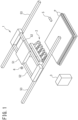
- FIG. 1 is a schematic configuration diagram of a crane (a lifting device) 1 to illustrate one embodiment of the plate member position detection device, the plate member transport method, and the plate member manufacturing method.
- handling and transportation of an uppermost steel sheet P among steel sheets (plate members) P stacked in a stockyard inside a crane building is performed with the uppermost steel sheet P being lifted by the crane 1.
- the crane 1 in this embodiment includes an electromagnetic lifting magnet 2 as an adsorption mechanism, and the lifting magnet 2 lifts the uppermost steel sheet P in such a manner as to hold the uppermost steel sheet P by adsorption (magnetic attraction).
- the electromagnetic lifting magnet 2 is desirable as a mechanism for holding the steel sheet P, but a holding mechanism such as a permanent-magnetic lifting magnet or a clamp is also usable.
- the crane 1 in this embodiment is a so-called overhead crane and is configured such that a trolley 51 from which the lifting magnet 2 is hung moves over a girder 52, and the girder 52 runs over traveling rails (runway) 53.
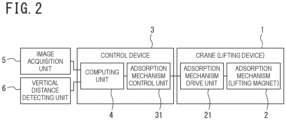
- the lifting and lowering of the lifting magnet 2, the movement of the trolley 51, and the running of the girder 52 are performed by drive units each including a drive source or a drive mechanism (not illustrated), and each of the drive units is driven by a control device 3 configured to control the overall operation of the crane 1.
- the lifting magnet 2 includes a lifting magnet drive unit (in the drawing, an adsorption mechanism drive unit) 21 configured to drive the lifting magnet 2.
- the operations of these mechanisms are stored as logics (programs) in an arithmetic processing unit, e.g., a programmable logic controller, provided in the control device 3, and the steel sheet P is automatically handled and transported in response to a command from a host computer (not illustrated).
- the arithmetic processing unit in the control device 3 is one of computer systems including a computing processing section that can perform an advanced computing process, a storage unit in which programs and data can be stored, and an input-output section that controls input and output with an external section.
- the mechanisms are also individually operable by an operator.
- the configuration of the crane 1 is not limited to the configuration described above.
- the lifting magnet 2 is lowered onto the steel sheet P with the central position of the lifting magnet 2 being aligned with the position of the detected steel sheet P, more specifically, the gravitational center position of the detected steel sheet P, and in that state, the lifting magnet 2 excites an electromagnet to adsorb (magnetically attract) the steel sheet P.
- the lifting magnet 2 includes a lifting magnet (adsorption mechanism) control unit 31 configured to control the driving state of the lifting magnet (adsorption mechanism) drive unit 21.
- the computing unit 4 configured to detect (calculate) the position (the gravitational center position) of the uppermost steel sheet P among the stacked steel sheets P is incorporated within the control device 3 for controlling the crane 1. Accordingly, the computing unit 4 is also constituted by a computing process performed by the arithmetic processing unit in the control device 3, e.g., the programmable logic controller. The computing unit 4 constitutes a main part of the steel sheet (plate member) position detection device configured to detect the position of the uppermost steel sheet P among the stacked steel sheets P. Note that the computing unit 4 may be built in the control device 3 of the crane 1 or may be constituted by use of a personal computer or the like, for example.
- the steel sheet position detection device includes an image acquisition unit 5 configured to acquire an image of the steel sheets P stacked in the stockyard, including the whole uppermost steel sheet P.
- the steel sheet position detection device also includes a vertical distance detecting unit 6 configured to detect a distance (vertical distance) h in the vertical direction between the image acquisition unit 5 and the uppermost steel sheet P.
- the image acquisition unit 5 is constituted by a 4K-camera (video camera), for example, and this camera is placed so that the steel sheets P are captured from a diagonally upper side in the stockyard in such a manner that all the steel sheets P stacked in the stockyard are captured but the lifting magnet 2 is hardly captured.
- the vertical distance detecting unit 6 is constituted by a laser range finder, for example, and detects the height of the uppermost steel sheet P (the top surface thereof) in the stacked steel sheets P from the height of the camera as the image acquisition unit 5 as the vertical distance h, for example.
- a well-known distance detecting unit such as an ultrasonic radar or a 3D-scanner can be also used as the vertical distance detecting unit 6.
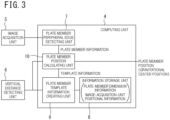
- FIG. 3 is a block diagram of the computing unit 4 of the steel sheet position detection device, and each block indicates a function to be implemented by a computing process or the like. That is, each block indicates a function step in the flowchart of a computing process. Details of each function block will be described later.
- the computing unit 4 includes a plate member peripheral edge detecting unit 7 configured to detect peripheral edges of the steel sheets (plate members) P from an image of the steel sheets P stacked in the stockyard, the image being acquired by the image acquisition unit 5, and to output information (plate member information) on the plate members, the information being detected as a result of the detection.
- the plate member information is information on a plurality of polygonal shapes constituted by a plurality of detected steel-sheet peripheral edges and includes vertex coordinates of each of the polygonal shapes in a coordinate system (hereinafter referred to as an image setting coordinate system) set in the image.
- the computing unit 4 includes an information storage unit 8 in which dimension information on a steel sheet (a plate member) P to be lifted and then handled and transported, or information on the orientation or the position of the image acquisition unit 5 (more accurately, the relative position between the image acquisition unit 5 and the uppermost steel sheet P) is stored.
- the dimension information on the steel sheet P to be lifted is selected based on steel sheet information from a host computer such as a process computer.
- the orientation or the position (the relative position with the uppermost steel sheet P) of the image acquisition unit 5 will be described later.
- the computing unit 4 also includes a plate member template information creating unit 9 configured to create template information for the uppermost steel sheet P based on the detected vertical distance h between the uppermost steel sheet P and the image acquisition unit 5, and steel-sheet dimension information or image-acquisition-unit positional information provided from the information storage unit 8.
- the template information is polygonal-shape information indicative of how the uppermost steel sheet P is captured, that is, a model for the image of the uppermost steel sheet P, and includes vertex coordinates of the polygonal shape in the image setting coordinate system.
- the computing unit 4 includes a plate member position calculating unit 10 configured to calculate the position of the uppermost steel sheet P, more specifically, the gravitational center position thereof by comparing the template information provided from the plate member template information creating unit 9 with the detected plate member information.
- the gravitational center position of the uppermost steel sheet P is output such that the gravitational center position is converted from the image setting coordinate system into a coordinate system in an actual space so that the lifting magnet 2 of the crane 1 is easily aligned with the uppermost steel sheet P.
- the plate member template information creating unit 9 is expressed as a "creating" section so that a creation procedure of the template information to be described later is easily understandable, but template information created in advance based on the dimension of each steel sheet P or a relative position with the image acquisition unit 5 may be stored therein.
- FIG. 4A illustrates an image of a plurality of steel sheets P1 to P3 which image is acquired by the image acquisition unit 5.
- the number of steel sheets P herein is three for convenience.
- Respective peripheral edges of the steel sheets P1 to P3 are detected from this image and are converted into polygonal line drawings Q1 to Q3 as illustrated in FIG. 4B , for example.
- the peripheral edges of the steel sheets P1 to P3 a portion where a shadow or a color detectable from the image greatly changes can be recognized as a peripheral edge.
- a peripheral edge of the steel sheet P is detected based on changes in shadow or color, but the peripheral edge of the steel sheet P may be directly detected with the use of machine learning using a so-called machine learning model for object detection.
- a plurality of pieces of polygonal-shape information obtained as such are extracted as pieces of plate member information R1 to R3 as illustrated in FIG. 4C .
- the pieces of polygonal plate member information R1 to R3 each have vertex coordinates in a coordinate system set in the image as will be described later. Pattern matching is performed on the plurality of pieces of plate member information R1 to R3 and the template information created for the uppermost steel sheet P1 so as to specify which one of the pieces of plate member information corresponds to the uppermost steel sheet P1.
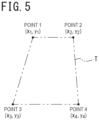
- FIG. 5 illustrates template information T for the uppermost steel sheet P which temperate information T is created by the plate member template information creating unit 9 for the stacked steel sheets P in FIG. 4A .
- the template information T is polygonal-shape (square-shape) information for the uppermost steel sheet P in the image and includes a point 1 (x1, y1) to a point 4 (x4, y4) as vertex coordinates of the square shape.
- This square shape changes depending on the dimension (vertical dimension, horizontal dimension) of the uppermost steel sheet P, a position where the uppermost steel sheet P is disposed, the vertical distance (height) h from the uppermost steel sheet P (the top surface thereof) to the image acquisition unit 5, and the orientation of the image acquisition unit (camera) 5. Accordingly, at the time when pattern matching with the plurality of pieces of plate member information R1 to R3 thus extracted is performed, it is necessary to create template information T corresponding to the actual uppermost steel sheet P.
- FIG. 6A is a front view illustrating the arrangement of the uppermost steel sheet P and the image acquisition unit (camera) 5, and FIG. 6B is a plan view of the arrangement.
- the up-down direction in FIG. 6B is defined as a vertical direction
- the lateral direction in FIG. 6B is defined as a lateral direction
- a view angle thereof in the lateral direction is defined as 2 ⁇ w.
- an angle between the view angle center of the image acquisition unit (camera) 5 and the vertical direction, that is, the orientation of the image acquisition unit 5 relative to the vertical direction is defined as ⁇ c. They are default values.
- the center of an acquired image is defined as the origin
- the lateral direction of a drawing based on the origin is set as an x-axis
- the vertical direction thereof is set as a y-axis
- the right direction in the x-axis is defined as a positive x-coordinate
- the upper direction in the y-axis is defined as a positive y-coordinate.
- the dimension of the uppermost steel sheet P in the vertical direction is defined as b
- the dimension thereof in the lateral direction is defined as a.
- a vertical distance from the uppermost steel sheet P (the top surface thereof) to the image acquisition unit (camera) 5 which vertical distance is detected by the vertical distance detecting unit 6 is defined as h. This is a detection value (a measurement value).
- a distance in the vertical direction (the y-axis direction) from the image acquisition unit (camera) 5 to the uppermost steel sheet P is defined as d1
- a distance in the lateral direction (the x-axis direction) from the origin (the center of the image) to the gravitational center position of the uppermost steel sheet P is defined as w1.
- the distances d1, w1 are described as fixed values. However, as will be described later, the distances d1, w1 may be variables, and pieces of template information T corresponding to a plurality of different distances d1, w1 may be created in advance and stored.
- ⁇ 1 and ⁇ 2 are expressed by Formula 1 and Formula 2 as follows.
- ⁇ 1 Arctan d 1 / h 1
- ⁇ 2 Arctan d 1 + b / h 2
- the y-coordinate of the far-side edge is expressed as tan( ⁇ 2 - ⁇ c), and the y-coordinate of the near-side edge is expressed as -tan( ⁇ c - ⁇ 1).
- the x-coordinate of a vertex which is on an x-axis negative-side edge (hereinafter, a left edge) and which is on the far-side edge is -(a/2 - w1)/(d1 + b).
- the x-coordinate of a vertex which is on an x-axis positive-side edge (hereinafter, a right edge) and which is on the far-side edge is (a/2 + w1)/(d1 + b)
- the x-coordinate of a vertex which is on the left edge and which is on the near-side edge is -(a/2 - w1)/(d1)
- the x-coordinate of a vertex which is on the right edge and which is on the near-side edge is (a/2 + w1)/(d1).
- the distances d1, w1 are fixed values indicates that at least a corresponding steel sheet P is disposed at generally the same position.
- pieces of template information T corresponding to a plurality of different distances d1, w1 may be individually created in advance and used at the time of pattern matching with the plurality of pieces of plate member information R1 to R3 (described later).
- a plurality of pieces of template information T for a plurality of different distances h may be created in advance and used at the time of pattern matching with the plurality of pieces of plate member information R1 to R3.
- the calculation should be performed with the angle ⁇ c between the center of the view angle and the vertical direction being set to zero and the distance d1 in the y-axis direction from the image acquisition unit 5 to the uppermost steel sheet P being set to a negative value.
- FIG. 7 is a conception diagram illustrating pattern matching between three pieces of plate member information R1 to R3 extracted by the plate member peripheral edge detecting unit 7 as illustrated in FIG. 4C , that is, pieces of polygonal-shape information of the steel sheets P, and the template information T created by the plate member template information creating unit 9 as illustrated in FIG. 5 .
- pattern matching is performed such that a lower-left vertex, in the figure, of the polygonal-shape information of each steel sheet P is positioned on the point 3 of the template information T.
- pattern matching between the plate member information R3 and the template information T in FIG. 7A only the coordinates of the point 3 are matched with its corresponding vertex coordinates of the plate member information R3.
- respective coordinates of the point 1, the point 3, and the point 4 are matched with their corresponding vertex coordinates of the plate member information R2, but the coordinate of the point 2 is not matched with its corresponding vertex.
- plate member information with the highest rate of matching in the pattern matching that is, the plate member information R1 in FIG. 7C is considered to be the uppermost steel sheet P that should be handled and transported.
- the gravitational center g of the plate member information R1 is found. Since a rolled steel sheet is uniform in thickness and quality of material, the gravitational center position of the steel sheet P is matched with the center of the figure. In this example, as illustrated in FIG. 8 the gravitational center g is at the intersection of diagonal lines of the square shape. Since the coordinates of the point 1 to the point 4 have been known, gravitational-center coordinates (xg, yg) can be also calculated.
- the gravitational-center coordinates (xg, yg) of the uppermost steel sheet P in the coordinate system set in the image is obtained as such, the gravitational-center coordinates (xg, yg) is converted into gravitational-center coordinates (Xg, Yg) of the uppermost steel sheet P in the actual space for setting the center of the lifting magnet 2, as described above.
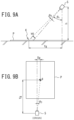
- the origin in the actual space is at the position of the image acquisition unit 5 on a horizontal plane.
- a view angle (a view-angle deviation angle) of the gravitational center g relative to the view angle center ⁇ c in the lateral direction (the x-axis direction) is defined as ⁇ 3, as illustrated in FIG.
- a view angle (a view-angle deviation angle) thereof in the vertical direction (the y-axis direction) is defined as ⁇ 4, as illustrated in FIG. 9A .
- the view-angle deviation angles ⁇ 3, ⁇ 4 are expressed by Formula 7 and Formula 8 as follows.
- ⁇ 3 Arctan xg 7
- ⁇ 4 Arctan yg 8
- the center of the lifting magnet 2 is set at the gravitational center of the steel sheet P, and then, the lifting magnet 2 is lowered on the steel sheet P, as described earlier.
- An electric current is applied to the lifting magnet 2 in this state such that the lifting magnet 2 magnetically attracts the uppermost steel sheet P, and while this state is maintained, the uppermost steel sheet P is lifted by the crane 1 and then handled and transported.
- the vertical distance h between the uppermost steel sheet P and the image acquisition unit 5 is detected, and the template information T is created based on the vertical distance h, dimension information on the uppermost steel sheet P, and positional information on the image acquisition unit 5.
- the template information T is created based on the vertical distance h, dimension information on the uppermost steel sheet P, and positional information on the image acquisition unit 5.
- the position of the uppermost plate member is calculated by comparing the pieces of plate member information R1 to R3 with the template information T.
- the plate member transport method In order to evaluate the plate member position detection device, the plate member transport method, and the plate member manufacturing method according to the present invention, the following examinations were performed.
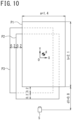
- the image acquisition unit (camera) 5 As the image acquisition unit (camera) 5, a 4K-camera having an about 10 million pixels (3648 ⁇ 2736) was used. Further, steel sheets P1 to P3 having a horizontal dimension of 1.4 m and a vertical dimension of 2.1 m were prepared with various plate thicknesses, and three steel sheets were put on top of each other as illustrated in FIG. 10 .
- the steel sheet position detection device according to the embodiment ( FIG. 3 ) was used, and in a comparative example, a plate member detected by the plate member peripheral edge detecting unit 7 in FIG. 3 was considered to be the uppermost steel sheet P1. That is, in the steel sheet position detection device in the example, the uppermost steel sheet P1 was specified by performing pattern matching between the template information T created based on the conditions in Table 1 and pieces of detected plate member information R1 to R3. First, three steel sheets having a plate thickness t20 were stacked as illustrated in FIG. 10 , and the gravitational center position of the uppermost steel sheet P1 was calculated by respective steel sheet position detection devices of the example and the comparative example. Calculation results of the example are shown in Table 2.
- the peripheral edges of the steel sheets P put on top of each other are detected based on changes in shadow or color on the steel sheets P in the image, and therefore, in a case where the steel sheet P has a small thicknesses, for example, in a case where the steel sheet P has a plate thickness of 10 mm or less, it is difficult to determine changes in shadow or color, and as a result, the peripheral edge of such a thin steel sheet P may not be detected.
- the uppermost steel sheet P1 and the steel sheets P2, P3 stacked under the uppermost steel sheet P1 are misrecognized as one steel sheet, thereby resulting in that the position of the uppermost steel sheet P1 cannot be detected with accuracy.
- the steel sheet position detection device of the comparative example cannot detect the uppermost steel sheet P1 by distinguishing it from the steel sheets P2, P3 stacked under the uppermost steel sheet P1, thereby resulting in that the uppermost steel sheet P1 cannot be specified.
- the template information T is created based on the specification of the uppermost steel sheet P1 or an installation condition for steel sheets. Consequently, it is found that the uppermost steel sheet P1 can be specified with accuracy by performing pattern matching between the template information T thus created and the pieces of plate member information R1 to R3.
- the plate member position detection device, the plate member transport method, and the plate member manufacturing method according to the embodiment have been described above, but the present invention is not limited to the configuration described in the above embodiment, and it is possible to make various modifications within the gist of the present invention.
- a coordinate system is set in an image, and the image of the steel sheet P is geometrically examined in the coordinate system, but which position the steel sheet P is at may be examined in a coordinate system set in the actual space, for example.
- any well-known technique can be also used to analyze the captured image of the steel sheet P.
Landscapes
- Engineering & Computer Science (AREA)
- Automation & Control Theory (AREA)
- Mechanical Engineering (AREA)
- Physics & Mathematics (AREA)
- General Physics & Mathematics (AREA)
- Computer Vision & Pattern Recognition (AREA)
- Theoretical Computer Science (AREA)
- Control And Safety Of Cranes (AREA)
- Load-Engaging Elements For Cranes (AREA)
Applications Claiming Priority (2)
| Application Number | Priority Date | Filing Date | Title |
|---|---|---|---|
| JP2022105680 | 2022-06-30 | ||
| PCT/JP2023/019848 WO2024004478A1 (ja) | 2022-06-30 | 2023-05-29 | 板部材位置検出装置、板部材運搬方法及び板部材の製造方法 |
Publications (2)
| Publication Number | Publication Date |
|---|---|
| EP4530243A1 true EP4530243A1 (de) | 2025-04-02 |
| EP4530243A4 EP4530243A4 (de) | 2025-09-24 |
Family
ID=89382747
Family Applications (1)
| Application Number | Title | Priority Date | Filing Date |
|---|---|---|---|
| EP23830928.0A Pending EP4530243A4 (de) | 2022-06-30 | 2023-05-29 | Vorrichtung zur erkennung der position eines plattenelements, verfahren zum transport eines plattenelements und verfahren zur herstellung eines plattenelements |
Country Status (6)
| Country | Link |
|---|---|
| US (1) | US20250388416A1 (de) |
| EP (1) | EP4530243A4 (de) |
| JP (1) | JP7473858B1 (de) |
| KR (1) | KR20250016329A (de) |
| CN (1) | CN119421852A (de) |
| WO (1) | WO2024004478A1 (de) |
Families Citing this family (1)
| Publication number | Priority date | Publication date | Assignee | Title |
|---|---|---|---|---|
| CN117831932B (zh) * | 2024-01-13 | 2024-08-16 | 江苏晨日环保科技有限公司 | 一种便于计数的硅钢片自动叠装生产设备及其生产方法 |
Family Cites Families (5)
| Publication number | Priority date | Publication date | Assignee | Title |
|---|---|---|---|---|
| JPH01242392A (ja) * | 1988-03-18 | 1989-09-27 | Kawasaki Steel Corp | スラブ荷姿の検出方法 |
| JPH07330287A (ja) | 1994-06-10 | 1995-12-19 | Nippon Steel Corp | 鋼片等の吊り荷の自動吊り上げ方法 |
| JP4138943B2 (ja) * | 1998-06-04 | 2008-08-27 | 株式会社アマダ | 板材の形状認識装置 |
| JP7051555B2 (ja) * | 2018-04-25 | 2022-04-11 | 株式会社日立プラントメカニクス | 鋼片搬送用天井クレーン |
| WO2021245136A1 (en) * | 2020-06-02 | 2021-12-09 | Onrobot A/S | Systems and methods for magnetic gripping |
-
2023
- 2023-05-29 KR KR1020247043268A patent/KR20250016329A/ko active Pending
- 2023-05-29 WO PCT/JP2023/019848 patent/WO2024004478A1/ja not_active Ceased
- 2023-05-29 CN CN202380049785.9A patent/CN119421852A/zh active Pending
- 2023-05-29 JP JP2023552179A patent/JP7473858B1/ja active Active
- 2023-05-29 US US18/879,298 patent/US20250388416A1/en active Pending
- 2023-05-29 EP EP23830928.0A patent/EP4530243A4/de active Pending
Also Published As
| Publication number | Publication date |
|---|---|
| JP7473858B1 (ja) | 2024-04-24 |
| WO2024004478A1 (ja) | 2024-01-04 |
| JPWO2024004478A1 (de) | 2024-01-04 |
| CN119421852A (zh) | 2025-02-11 |
| EP4530243A4 (de) | 2025-09-24 |
| US20250388416A1 (en) | 2025-12-25 |
| KR20250016329A (ko) | 2025-02-03 |
Similar Documents
| Publication | Publication Date | Title |
|---|---|---|
| CN111776762B (zh) | 具有自动化包裹扫描和登记机构的机器人系统及其操作方法 | |
| JP5808190B2 (ja) | 硬質脆性板の周縁加工装置 | |
| CN107324041B (zh) | 用于片盒夹持的机械手及自动片盒搬运装置 | |
| CN105514010B (zh) | 一种硅片安全运输方法 | |
| US20160229062A1 (en) | Workpiece taking out robot system having conversion-calculation function of position and orientation, and workpiece taking out method | |
| US20100193479A1 (en) | Laser processing apparatus, process control apparatus, and processing apparatus | |
| US20250388416A1 (en) | Plate member position detection device, plate member transport method, and plate member manufacturing method | |
| Boschetti | A picking strategy for circular conveyor tracking | |
| EP4446272A1 (de) | Kran, transportverfahren und plattenelementherstellungsverfahren | |
| TW202137387A (zh) | 對準裝置以及工件之位置偏差修正方法 | |
| KR20140086976A (ko) | 설비 내 객체의 픽업 지점의 위치 확인 방법 및 장치 | |
| EP4605151B1 (de) | Vorrichtung und verfahren zum automatisierten biegen von werkstücken | |
| CN119911707A (zh) | 一种基于视觉定位与测量的自动装车系统 | |
| KR101337563B1 (ko) | 감지유닛을 이용하여 매니퓰레이터의 위치를 조절하는 이송장치 | |
| CN111924479A (zh) | 用于自动化生产的载具和系统 | |
| TW202428478A (zh) | 有軌道台車系統 | |
| JP2025012371A (ja) | クレーン、運搬方法及び板部材の製造方法 | |
| JPH08304025A (ja) | 矩形荷物の位置計測方法 | |
| CN110044306B (zh) | 钢卷仓储系统及钢卷几何中心辨识方法 | |
| CN115256019B (zh) | 一种支护板自动拼装对齐装置 | |
| JP6607240B2 (ja) | 厚鋼板の切断方法 | |
| JP2622394B2 (ja) | 搬送台自動搬送装置 | |
| JP7295602B2 (ja) | 制御システムおよび位置ずれ検出方法 | |
| JPH07330286A (ja) | トングの掴み状況監視方法 | |
| CN119734267A (zh) | 一种基于视觉的轨道车辆车门安装方法及安装系统 |
Legal Events
| Date | Code | Title | Description |
|---|---|---|---|
| STAA | Information on the status of an ep patent application or granted ep patent |
Free format text: STATUS: THE INTERNATIONAL PUBLICATION HAS BEEN MADE |
|
| PUAI | Public reference made under article 153(3) epc to a published international application that has entered the european phase |
Free format text: ORIGINAL CODE: 0009012 |
|
| STAA | Information on the status of an ep patent application or granted ep patent |
Free format text: STATUS: REQUEST FOR EXAMINATION WAS MADE |
|
| 17P | Request for examination filed |
Effective date: 20241223 |
|
| AK | Designated contracting states |
Kind code of ref document: A1 Designated state(s): AL AT BE BG CH CY CZ DE DK EE ES FI FR GB GR HR HU IE IS IT LI LT LU LV MC ME MK MT NL NO PL PT RO RS SE SI SK SM TR |
|
| REG | Reference to a national code |
Ref country code: DE Ref legal event code: R079 Free format text: PREVIOUS MAIN CLASS: B66C0013220000 Ipc: G01B0011000000 |
|
| A4 | Supplementary search report drawn up and despatched |
Effective date: 20250822 |
|
| RIC1 | Information provided on ipc code assigned before grant |
Ipc: G01B 11/00 20060101AFI20250818BHEP |
|
| DAV | Request for validation of the european patent (deleted) | ||
| DAX | Request for extension of the european patent (deleted) |