EP4529113A2 - Verfahren zur übertragung eines steuerrahmens für mehrere stationen, zugangspunkt und system - Google Patents
Verfahren zur übertragung eines steuerrahmens für mehrere stationen, zugangspunkt und system Download PDFInfo
- Publication number
- EP4529113A2 EP4529113A2 EP24211554.1A EP24211554A EP4529113A2 EP 4529113 A2 EP4529113 A2 EP 4529113A2 EP 24211554 A EP24211554 A EP 24211554A EP 4529113 A2 EP4529113 A2 EP 4529113A2
- Authority
- EP
- European Patent Office
- Prior art keywords
- frame
- field
- signal field
- station
- ndp
- Prior art date
- Legal status (The legal status is an assumption and is not a legal conclusion. Google has not performed a legal analysis and makes no representation as to the accuracy of the status listed.)
- Pending
Links
Images




Classifications
-
- H—ELECTRICITY
- H04—ELECTRIC COMMUNICATION TECHNIQUE
- H04L—TRANSMISSION OF DIGITAL INFORMATION, e.g. TELEGRAPHIC COMMUNICATION
- H04L1/00—Arrangements for detecting or preventing errors in the information received
- H04L1/0001—Systems modifying transmission characteristics according to link quality, e.g. power backoff
- H04L1/0023—Systems modifying transmission characteristics according to link quality, e.g. power backoff characterised by the signalling
- H04L1/0028—Formatting
- H04L1/0031—Multiple signaling transmission
-
- H—ELECTRICITY
- H04—ELECTRIC COMMUNICATION TECHNIQUE
- H04L—TRANSMISSION OF DIGITAL INFORMATION, e.g. TELEGRAPHIC COMMUNICATION
- H04L1/00—Arrangements for detecting or preventing errors in the information received
- H04L1/0001—Systems modifying transmission characteristics according to link quality, e.g. power backoff
- H04L1/0023—Systems modifying transmission characteristics according to link quality, e.g. power backoff characterised by the signalling
- H04L1/0028—Formatting
- H04L1/0029—Reduction of the amount of signalling, e.g. retention of useful signalling or differential signalling
-
- H—ELECTRICITY
- H04—ELECTRIC COMMUNICATION TECHNIQUE
- H04L—TRANSMISSION OF DIGITAL INFORMATION, e.g. TELEGRAPHIC COMMUNICATION
- H04L1/00—Arrangements for detecting or preventing errors in the information received
- H04L1/12—Arrangements for detecting or preventing errors in the information received by using return channel
- H04L1/16—Arrangements for detecting or preventing errors in the information received by using return channel in which the return channel carries supervisory signals, e.g. repetition request signals
- H04L1/1607—Details of the supervisory signal
- H04L1/1621—Group acknowledgement, i.e. the acknowledgement message defining a range of identifiers, e.g. of sequence numbers
-
- H—ELECTRICITY
- H04—ELECTRIC COMMUNICATION TECHNIQUE
- H04W—WIRELESS COMMUNICATION NETWORKS
- H04W52/00—Power management, e.g. Transmission Power Control [TPC] or power classes
- H04W52/02—Power saving arrangements
- H04W52/0209—Power saving arrangements in terminal devices
-
- H—ELECTRICITY
- H04—ELECTRIC COMMUNICATION TECHNIQUE
- H04W—WIRELESS COMMUNICATION NETWORKS
- H04W88/00—Devices specially adapted for wireless communication networks, e.g. terminals, base stations or access point devices
- H04W88/08—Access point devices
-
- H—ELECTRICITY
- H04—ELECTRIC COMMUNICATION TECHNIQUE
- H04L—TRANSMISSION OF DIGITAL INFORMATION, e.g. TELEGRAPHIC COMMUNICATION
- H04L1/00—Arrangements for detecting or preventing errors in the information received
- H04L1/0001—Systems modifying transmission characteristics according to link quality, e.g. power backoff
- H04L1/0002—Systems modifying transmission characteristics according to link quality, e.g. power backoff by adapting the transmission rate
- H04L1/0003—Systems modifying transmission characteristics according to link quality, e.g. power backoff by adapting the transmission rate by switching between different modulation schemes
-
- H—ELECTRICITY
- H04—ELECTRIC COMMUNICATION TECHNIQUE
- H04L—TRANSMISSION OF DIGITAL INFORMATION, e.g. TELEGRAPHIC COMMUNICATION
- H04L1/00—Arrangements for detecting or preventing errors in the information received
- H04L1/0001—Systems modifying transmission characteristics according to link quality, e.g. power backoff
- H04L1/0006—Systems modifying transmission characteristics according to link quality, e.g. power backoff by adapting the transmission format
- H04L1/0007—Systems modifying transmission characteristics according to link quality, e.g. power backoff by adapting the transmission format by modifying the frame length
Definitions
- the present invention relates to the field of communications technologies, and in particular, to a method for transmitting a multi-station control frame, an access point, and a system.
- An orthogonal frequency division multiple access (Orthogonal Frequency Division Multiple Access, OFDMA for short) transmission technology is introduced in 802.11ax, so as to support simultaneous data sending and receiving for a plurality of stations, and increase a system throughput.
- a multi-station control frame such as a multi-station block acknowledgement (Multi-STA Block Ack, M-BA for short) frame is also introduced.
- Multi-STA Block Ack Multi-STA Block Ack
- an access point (Access Point, AP for short) replies, with a multi-station block acknowledgement frame in a unified manner in a specific time period, to stations that previously send data packets.
- an acknowledgement in an M-BA form means that: an AP broadcasts concatenated acknowledgement frames to a plurality of stations, and an M-BA frame is defined by using a multi-traffic identifier block acknowledgement (Multi-traffic identifier Block Ack, Multi-TID BA for short) frame structure.
- Multi-traffic identifier Block Ack Multi-traffic identifier Block Ack
- Multi-TID BA Multi-TID BA for short
- the MAC frame field includes a control frame field (occupying two bytes), a duration/ID field (occupying two bytes), a receiver address (occupying six bytes), a transmitter address (occupying six bytes), a BA control field (occupying two bytes), a BA/ACK information field (occupying a variable quantity of bytes), and a frame check sequence field (occupying four bytes).
- the BA control field includes a BA/ACK acknowledgement policy (occupying one bit), an indication (occupying one bit) indicating a plurality of TIDs, an indication (occupying one bit) indicating a compressed bitmap, a groupcast with retries (Groupcast with retries, GCR for short) field (occupying one bit), reserved bits (occupying eight bits), and TID information (occupying 14 bits).
- the TID information is used to indicate a priority of the data frame.
- Each piece of BA/ACK information is corresponding to one of the plurality of stations, and the information needs to be sent to the station corresponding to the information.
- Each piece of BA/ACK information includes per TID information (occupying two bytes).
- the BA/ACK information further includes start sequence control (occupying two bytes) and a BA bitmap (occupying eight bytes).
- the per TID information field includes association identifier (association identifier, AID for short) information (occupying 11 bits), a BA/ACK indication new message (occupying one bit), and a traffic identifier (occupying one bit) of the station.
- association identifier association identifier, AID for short
- the AID information is used to indicate an identifier of the station corresponding to the BA/ACK information.
- the MAC frame field in the multi-station block acknowledgement frame occupies an excessively large quantity of bytes (more than 22 bytes).
- narrowband low-rate transmission is used in the Internet of Things Wi-Fi protocol, finally causing an excessively long frame transmission time, and increasing power consumption of a terminal.
- an NDP multi-station control frame with no redundant information such as a MAC frame header is provided, so as to reduce a control frame transmission time and power consumption of a terminal.
- Embodiments of the present invention provide a method for transmitting a multi-station control frame, an access point, and a system.
- the present invention provides a method for transmitting a multi-station control frame, where the method includes: sending a multi-station control frame to each of a plurality of stations, where when the multi-station control frame is a request frame, the request frame is used to request each of the plurality of stations to send a first response frame corresponding to the multi-station control frame; and receiving the first response frame that is corresponding to the multi-station control frame and that is sent by each of the plurality of stations, where the multi-station control frame includes a legacy preamble field and a new preamble field, and does not include a service field, a Media Access Control frame field, a trailer, a padding bit, or a frame extension field.
- the new preamble field includes a first signal field and a second signal field;
- the first signal field includes first parameter information jointly owned by the plurality of stations, and second parameter information associated with the second signal field;
- the second signal field includes control information in a one-to-one correspondence with each of the plurality of stations.
- the multi-station control frame occupies much fewer bytes than an 802.11 ax multi-station control frame. Therefore, duration in which the multi-station control frame occupies a channel during transmission can be reduced.
- the present invention provides a method for transmitting a multi-station control frame, where the method includes: sending a multi-station control frame to each of a plurality of stations, where when the multi-station control frame is a second response frame, the second response frame is used to respond to data frames, management frames, or control frames that are transmitted by the plurality of stations, and the multi-station control frame includes a legacy preamble field and a new preamble field, and does not include a service field, a Media Access Control frame field, a trailer, a padding bit, or a frame extension field.
- the new preamble field includes a first signal field and a second signal field;
- the first signal field includes first parameter information jointly owned by the plurality of stations, and second parameter information associated with the second signal field;
- the second signal field includes control information in a one-to-one correspondence with each of the plurality of stations.
- the multi-station control frame occupies much fewer bytes than an 802.11 ax multi-station control frame. Therefore, duration in which the multi-station control frame occupies a channel during transmission can be reduced.
- the first parameter information jointly owned by the plurality of stations includes identification information of a transmit end that sends data to each of the plurality of stations.
- the first signal field further includes an overloading subfield, and the overloading subfield includes first indication information that identifies the multi-station control frame as a null data packet (Null data packet, NDP for short) multi-station control frame.
- NDP null data packet
- the first signal field further includes a type indication field of the NDP multi-station control frame; the type indication field is used to indicate a type of the NDP multi-station control frame; the type of the NDP multi-station control frame includes at least one of an NDP multi-station block acknowledgement frame, an NDP multi-station request-to-send frame, and an NDP multi-station block acknowledgement request frame; the NDP multi-station request-to-send frame and the NDP multi-station block acknowledgement request frame are request frames; and the NDP multi-station block acknowledgement frame is the first response frame or the second response frame.
- the first signal field further includes an overloading subfield
- the overloading subfield includes second indication information that identifies the multi-station control frame as an NDP multi-station block acknowledgement frame.
- the second parameter information associated with the second signal field includes a quantity of orthogonal frequency division multiplexing (Orthogonal Frequency Division Multiplexing, OFDM for short) symbols of the second signal field, and a modulation and coding scheme of the second signal field; or the second parameter information associated with the second signal field includes a quantity of stations, and a modulation and coding scheme of the second signal field.
- orthogonal frequency division multiplexing Orthogonal Frequency Division Multiplexing, OFDM for short
- the control information in a one-to-one correspondence with each of the plurality of stations includes acknowledgement information of each of the plurality of stations, where the acknowledgement information of each station includes a station identifier and an acknowledgement/block acknowledgement indication; or the acknowledgement information of each station includes an acknowledgement/block acknowledgement identifier and an acknowledgement/block acknowledgement indication.
- the station identifier may be an association identifier or a partial association identifier of the station.
- the association identifier herein represents identity information of the station.
- the acknowledgement/block acknowledgement identifier has a function that is the same as or similar to that of the station identifier, and is mainly used to determine a station that needs to receive (or send) the control frame.
- the acknowledgement/block acknowledgement indication is used to determine whether the multi-station block acknowledgement frame is sent in a form of an acknowledgement frame or a block acknowledgement frame.
- the acknowledgement information of each station when the acknowledgement information of each station includes the block acknowledgement indication, the acknowledgement information of each station further includes a start sequence value and a block acknowledgement bitmap.
- the acknowledgement/block acknowledgement identifier includes a combination of at least one bit of a scrambler initialization seed and/or at least one bit of association identifier information of a station.
- the acknowledgement/block acknowledgement identifier includes a combination of a scrambler initialization seed randomly generated based on one or more bits, and/or one or more bits of association identifier information of a station, so that the acknowledgement/block acknowledgement identifier can be a unique identifier. In this way, the NDP multi-station block acknowledgement frame can be sent to a corresponding station as accurately as possible.
- the first signal field further includes transmission duration of the NDP multi-station request-to-send frame
- the second parameter information associated with the second signal field includes a length of the second signal field or a quantity of orthogonal frequency division multiplexing OFDM symbols.
- the control information in a one-to-one correspondence with each of the plurality of stations includes NDP request-to-send frame information of each of the plurality of stations, where the NDP request-to-send frame information of each station includes one or a combination of the following information: a station identifier, a subchannel sequence number of a response frame of a clear-to-send frame, a coding type, a modulation and coding scheme, a dual-carrier modulation indication, and a flow allocation indication.
- the first signal field further includes transmission duration of the NDP multi-station block acknowledgement request frame; and the second parameter information associated with the second signal field includes a length of the second signal field or a quantity of orthogonal frequency division multiplexing OFDM symbols.
- the transmission duration of the NDP multi-station block acknowledgement request frame is used to determine duration in which the NDP multi-station block acknowledgement request frame occupies a channel.
- the length of the second signal field or the quantity of OFDM symbols is used to determine the length of the second signal field.
- the control information in a one-to-one correspondence with each of the plurality of stations includes: trigger information of each of the plurality of stations, a control field of the NDP multi-station block acknowledgement request frame, and an information field of the NDP multi-station block acknowledgement request frame, where the trigger information of each of the plurality of stations includes one or a combination of the following information: a station identifier, a resource allocation indication, a coding type, a modulation and coding scheme, a dual-carrier modulation indication, and a flow allocation indication.
- the first signal field is a high efficiency-signal field A in an 802.11ax packet; the second signal field is a high efficiency-signal field B in the 802.1 1ax packet; and the overloading subfield is a reserved bit in the high efficiency-signal field A, or is an unused value in a modulation and coding scheme included in the high efficiency-signal field A.
- the NDP multi-station control frame is a newly defined Internet of Things multi-station control frame
- the new preamble field is an Internet of Things preamble field
- the first signal field is a first Internet of Things field
- the second signal field is a second Internet of Things field
- the Internet of Things preamble field further includes an Internet of Things short training field and an Internet of Things long training field
- bandwidth occupied by the legacy preamble field is greater than or equal to bandwidth occupied by the Internet of Things preamble field.
- core content (including transmitter address information, identification information of each station, a block acknowledgement/acknowledgement indication, a start sequence control field, a block acknowledgement bitmap, and the like) of a MAC field in a legacy multi-station control frame is also added to a physical layer field, so as to greatly reduce a quantity of bytes occupied by the multi-station control frame, and reduce duration in which the multi-station control frame occupies a channel during transmission. An effect is especially significant when data is transmitted by using a narrowband.
- the present invention provides an access point, where the access point includes: a sending module, configured to send a multi-station control frame to a plurality of stations, where when the multi-station control frame is a request frame, the request frame is used to request each of the plurality of stations to send a first response frame corresponding to the multi-station control frame; and a receiving module, configured to receive the first response frame that is corresponding to the multi-station control frame and that is sent by each of the plurality of stations, where the multi-station control frame includes a legacy preamble field and a new preamble field, and does not include a service field, a Media Access Control frame field, a trailer, a padding bit, or a frame extension field; the new preamble field includes a first signal field and a second signal field; the first signal field includes first parameter information jointly owned by the plurality of stations, and second parameter information associated with the second signal field; and the second signal field includes control information in a one-to-one correspondence with each of the plurality of stations
- the multi-station control frame occupies much fewer bytes than an 802.11 ax multi-station control frame. Therefore, duration in which the multi-station control frame occupies a channel during transmission can be reduced.
- the present invention provides an access point, where the access point includes: a sending module, configured to send a multi-station control frame to a plurality of stations, where when the multi-station control frame is a second response frame, the second response frame is used to respond to data frames, management frames, or control frames that are transmitted by the plurality of stations;
- the multi-station control frame includes a legacy preamble field and a new preamble field, and does not include a service field, a Media Access Control frame field, a trailer, a padding bit, or a frame extension field;
- the new preamble field includes a first signal field and a second signal field;
- the first signal field includes first parameter information jointly owned by the plurality of stations, and second parameter information associated with the second signal field;
- the second signal field includes control information in a one-to-one correspondence with each of the plurality of stations.
- the multi-station control frame occupies much fewer bytes than an 802.11 ax multi-station control frame. Therefore, duration in which the multi-station control frame occupies a channel during transmission can be reduced.
- the first signal field further includes an overloading subfield
- the overloading subfield includes first indication information that identifies the multi-station control frame as an NDP multi-station control frame.
- the first signal field further includes a type indication field of the NDP multi-station control frame; the type indication field is used to indicate a type of the NDP multi-station control frame; the type of the NDP multi-station control frame includes at least one of an NDP multi-station block acknowledgement frame, an NDP multi-station request-to-send frame, and an NDP multi-station block acknowledgement request frame; the NDP multi-station request-to-send frame and the NDP multi-station block acknowledgement request frame are request frames; and the NDP multi-station block acknowledgement frame is the first response frame or the second response frame.
- the first signal field further includes an overloading subfield
- the overloading subfield includes second indication information that identifies the multi-station control frame as an NDP multi-station block acknowledgement frame.
- the second parameter information associated with the second signal field includes a quantity of orthogonal frequency division multiplexing (Orthogonal Frequency Division Multiplexing, OFDM for short) symbols of the second signal field, and a modulation and coding scheme of the second signal field; or the second parameter information associated with the second signal field includes a quantity of stations, and a modulation and coding scheme of the second signal field.
- orthogonal frequency division multiplexing Orthogonal Frequency Division Multiplexing, OFDM for short
- the control information in a one-to-one correspondence with each of the plurality of stations includes acknowledgement information of each of the plurality of stations, where the acknowledgement information of each station includes a station identifier and an acknowledgement/block acknowledgement indication; or the acknowledgement information of each station includes an acknowledgement/block acknowledgement identifier and an acknowledgement/block acknowledgement indication.
- the station identifier may be an association identifier or a partial association identifier of the station.
- the association identifier herein represents identity information of the station.
- the acknowledgement/block acknowledgement identifier has a function that is the same as or similar to that of the station identifier, and is mainly used to determine a station that needs to receive (or send) the control frame.
- the acknowledgement/block acknowledgement indication is used to determine whether the multi-station block acknowledgement frame is sent in a form of an acknowledgement frame or a block acknowledgement frame.
- the acknowledgement information of each station when the acknowledgement information of each station includes the block acknowledgement indication, the acknowledgement information of each station further includes a start sequence value and a block acknowledgement bitmap.
- the acknowledgement/block acknowledgement identifier includes a combination of at least one bit of a scrambler initialization seed and/or at least one bit of association identifier information of a station.
- the acknowledgement/block acknowledgement identifier includes a combination of a scrambler initialization seed randomly generated based on one or more bits, and/or one or more bits of association identifier information of a station, so that the acknowledgement/block acknowledgement identifier can be a unique identifier. In this way, the NDP multi-station block acknowledgement frame can be sent to a corresponding station as accurately as possible.
- the first signal field further includes transmission duration of the NDP multi-station request-to-send frame
- the second parameter information associated with the second signal field includes a length of the second signal field or a quantity of orthogonal frequency division multiplexing OFDM symbols.
- the control information in a one-to-one correspondence with each of the plurality of stations includes NDP request-to-send frame information of each of the plurality of stations, where the NDP request-to-send frame information of each station includes one or a combination of the following information: a station identifier, a subchannel sequence number of a response frame of a clear-to-send frame, a coding type, a modulation and coding scheme, a dual-carrier modulation indication, and a flow allocation indication.
- the first signal field further includes transmission duration of the NDP multi-station block acknowledgement request frame; and the second parameter information associated with the second signal field includes a length of the second signal field or a quantity of orthogonal frequency division multiplexing OFDM symbols.
- the transmission duration of the NDP multi-station block acknowledgement request frame is used to determine duration in which the NDP multi-station block acknowledgement request frame occupies a channel.
- the length of the second signal field or the quantity of OFDM symbols is used to determine the length of the second signal field.
- the control information in a one-to-one correspondence with each of the plurality of stations includes: trigger information of each of the plurality of stations, a control field of the NDP multi-station block acknowledgement request frame, and an information field of the NDP multi-station block acknowledgement request frame, where the trigger information of each of the plurality of stations includes one or a combination of the following information: a station identifier, a resource allocation indication, a coding type, a modulation and coding scheme, a dual-carrier modulation indication, and a flow allocation indication.
- the first signal field is a high efficiency-signal field A in an 802.11ax packet
- the second signal field is a high efficiency-signal field B in the 802.11 ax packet
- the overloading subfield is a reserved bit in the high efficiency-signal field A, or is an unused value in a modulation and coding scheme included in the high efficiency-signal field A.
- the NDP multi-station control frame is a newly defined Internet of Things multi-station control frame
- the new preamble field is an Internet of Things preamble field
- the first signal field is a first Internet of Things field
- the second signal field is a second Internet of Things field
- the Internet of Things preamble field further includes an Internet of Things short training field and an Internet of Things long training field
- bandwidth occupied by the legacy preamble field is greater than or equal to bandwidth occupied by the Internet of Things preamble field.
- core content (including transmitter address information, identification information of each station, a block acknowledgement/acknowledgement indication, a start sequence control field, a block acknowledgement bitmap, and the like) of a MAC field in a legacy multi-station control frame is also added to a physical layer field, so as to greatly reduce a quantity of bytes occupied by the multi-station control frame, and reduce duration in which the multi-station control frame occupies a channel during transmission. An effect is especially significant when data is transmitted by using a narrowband.
- the present invention further provides a transmission system, where the system includes the access point and the plurality of stations according to any one of the third aspect, the fourth aspect, or the optional implementations thereof.
- the sent or received multi-station control frame includes only the legacy preamble field and the new preamble field, and occupies much fewer bytes than the 802.11ax multi-station control frame. Therefore, duration in which the multi-station control frame occupies a channel during transmission can be reduced. The effect is more significant when data is transmitted by using a narrowband.
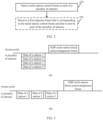
- An embodiment of the present invention provides a method for transmitting a null data packet multi-station control frame.
- the method includes the following step: Step 210: Send a multi-station control frame to a plurality of stations.
- the request frame is used to request each of the plurality of stations to send a first response frame corresponding to the multi-station control frame.
- the plurality of stations send, to an access point, the first response frame corresponding to the multi-station control frame. Therefore, the method performed by the access point further includes step 220: Receive the first response frame that is corresponding to the multi-station control frame and that is sent by each of the plurality of stations.
- the method includes: sending a multi-station control frame to each of a plurality of stations, where when the multi-station control frame is a second response frame, the second response frame is used to respond to data frames, management frames, or control frames that are transmitted by the plurality of stations.
- the plurality of stations may send any of the data frames, the management frames, and the control frames to the AP in an orthogonal frequency division multiple access (Orthogonal Frequency Division Multiple Access, OFDMA for short) form or a multi-user multiple-input multiple-output (Multi-User Multiple-Input Multiple-Output, MU-MIMO for short) form.
- OFDMA Orthogonal Frequency Division Multiple Access
- MU-MIMO Multi-User Multiple-Input Multiple-Output
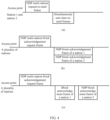
- the AP may immediately and simultaneously send the second response frame (for example, an NDP multi-station block acknowledgement frame) to each of the plurality of stations. If the plurality of stations successively send the data frames to the AP, after receiving the data frames sent by the plurality of stations, the AP sends the second response frame to each of the plurality of stations at a specified time.
- the foregoing two transmission modes are specifically corresponding to a schematic structural diagram of transmitting data frames and sending an NDP multi-station block acknowledgement frame between an AP and a plurality of stations in FIG. 3 .
- the first transmission mode is corresponding to FIG. 3(a)
- the second transmission mode is corresponding to FIG. 3(b) .
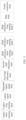
- FIG. 4 is a schematic structural diagram of transmitting a request frame and a first response frame between an AP and a plurality of stations in two manners.
- the request frame is an NDP multi-station block acknowledgement request frame
- the plurality of stations simultaneously send the first response frame to the AP.
- each of the plurality of stations may sequentially send the first response frame to the AP based on a sequence number that is corresponding to a station identifier of each of the plurality of stations and that is in the request frame sent by the AP.
- the first response frame is the NDP multi-station block acknowledgement frame.
- FIG. 4 is a schematic structural diagram of transmitting a request frame and a first response frame between an AP and a plurality of stations in two manners.
- the AP sends an NDP multi-station request-to-send frame to the plurality of stations (for example, a station 1 and a station 2), and the plurality of stations simultaneously send clear-to-send frames to the AP.
- the clear-to-send frames sent by the plurality of stations to the AP include same content and use a same scrambler seed.
- FIG. 4(b) is a schematic structural diagram of simultaneously sending, by each of a plurality of stations, an NDP block acknowledgement frame to an AP when the AP simultaneously sends an NDP multi-station block acknowledgement request frame to the plurality of stations.
- 4(c) is a schematic structural diagram of successively sending, by a plurality of stations, NDP block acknowledgement frames to an AP based on a sequence of station identifiers in an NDP multi-station request-to-send frame when the AP simultaneously sends an NDP multi-station block acknowledgement request frame to the plurality of stations.
- an NDP multi-station control frame is designed in the present invention, so that a transmission time and power consumption can be reduced in a transmission process of the multi-station control frame. The following first describes a frame structure of a legacy multi-station control frame. Details are as follows.
- FIG. 5 is a schematic diagram of a frame structure of an 802.11ax-based multi-station control frame.
- the multi-station control frame includes a legacy preamble field, a new preamble field, a service field, a Media Access Control (Media access, MAC for short) frame field, a trailer, a padding bit, a frame extension field, and the like.
- the service field, the Media Access Control frame field, the trailer, and the padding bit are collectively referred to as a data field.
- Subfields included in the Media Access Control frame field have been described in detail in the specification, and details are not described herein again.
- the legacy preamble field includes a legacy-short training field (legacy-short training field, L-STF for short), a legacy-long training field (legacy-long training field, L-LTF for short), and a legacy-signal field (Legacy-signal field, L-SIG for short).
- L-STF legacy-short training field
- L-LTF legacy-long training field
- L-signal field Legacy-signal field
- the new preamble field includes a repeated legacy-signal field (repeated legacy-signal field, RL-SIG), a high efficiency-signal field A (high efficient-signal field A, HE-SIGA for short), a high efficiency-signal field B (high efficient-signal field B, HE-SIGB for short), a high efficiency-short training field (high efficient-short training field, HE-STF for short), and high efficiency-long training fields (high efficient-long training field, HE-LTF) 1 to N (N is a positive integer greater than or equal to 1).
- the legacy preamble field and the new preamble field are physical layer fields.
- a research focus of the present invention is to design an NDP multi-station control frame. Compared with the multi-station control frame shown in FIG. 5 , the NDP multi-station control frame reduces a quantity of bytes occupied by a multi-station control frame, so as to reduce a transmission time of the multi-station control frame and power consumption of a terminal.
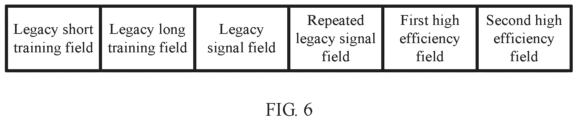
- a frame structure of the NDP multi-station control frame is specifically shown in FIG. 6 .
- FIG. 6 is a schematic diagram of a frame structure of an NDP multi-station control frame according to an embodiment of the present invention.
- the NDP control frame includes: a legacy preamble field and a new preamble field, and does not include the service field, the Media Access Control frame field, the trailer, the padding bit, the frame extension field, or the like in FIG. 2 .
- the new preamble field includes a first signal field and a second signal field.
- the legacy preamble field includes an L-STF field, an L-LTF field, an L-SIG field, and an RL-SIG field.
- the first signal field in the new preamble field includes first parameter information jointly owned by a plurality of stations, and second parameter information associated with the second signal field.
- the first parameter information jointly owned by the plurality of stations may include identification information of a transmit end that sends data to each of the plurality of stations.
- the identification information of the transmit end may be an AP identifier, an association identifier allocated by the AP to the AP, a partial association identifier, a MAC address of the AP, a partial MAC address of the AP, a basic service set (basic service set, BSS) color, or the like.
- the second signal field includes control information in a one-to-one correspondence with each of the plurality of stations.
- the first signal field may further include an overloading subfield.
- the overloading subfield is used to carry first identification information, so that when receiving the frame, a receive end may identify, based on the first identification information, a type of the frame as an NDP multi-station control frame, or a frame existing before overloading of a multi-station control frame.
- the first identification information is first indication information.
- the first indication information herein may be a field value of the overloading subfield.
- the overloading subfield is used to carry second identification information, so that when receiving the NDP multi-station control frame, a receive end can identify, based on the second identification information, a type of the frame as an NDP multi-station block acknowledgement frame, or a frame existing before overloading of a multi-station control frame.
- the second identification information is second indication information.
- the second indication information herein may be a field value of the overloading subfield.
- the frame existing before the overloading is an 802.11ax packet-multiple user physical layer convergence procedure protocol data unit (Multiple user PLCP (physical layer convergence procedure, MU PPDU for short) protocol data unite) structure, hereinafter referred to as an 802.11ax packet.
- 802.11ax packet-multiple user physical layer convergence procedure protocol data unit Multiple user PLCP (physical layer convergence procedure, MU PPDU for short) protocol data unite
- the field value of the overloading subfield when the field value of the overloading subfield is a first value (for example, 1), it indicates that the frame is the NDP multi-station block acknowledgement frame.
- the field value of the overloading subfield is a second value (for example, 0), it indicates that the frame is the frame existing before the overloading, for example, the 802.11ax packet (also referred to as an 802.11ax frame), that is, identification information carried in the overloading subfield is the second identification information corresponding to the NDP multi-station block acknowledgement frame.
- the receive end may determine whether the second identification information is the second indication information and identify that the frame is the NDP multi-station block acknowledgement frame.
- each value of the overloading subfield indicates a unique and fixed meaning.
- the frame when the frame is subsequently sent, if the value of the overloading subfield of the NDP multi-station control frame received by the receive end is the first value, it is considered that the frame is the NDP multi-station block acknowledgement frame; or if the value of the overloading subfield of the NDP multi-station control frame received by the receive end is the second value, it is considered that the frame is the frame existing before the overloading.
- the overloading subfield is used to carry first identification information.
- a field value of the overloading subfield is a first value (for example, 1), it merely indicates that the frame is an NDP multi-station control frame, and this indicates that the first identification information is first indication information.
- a field value of the overloading subfield is a second value (for example, 0)
- it indicates that the frame is a frame existing before overloading for example, an 802.11 ax packet (also referred to as an 802.11ax frame).
- the first signal field further includes a type indication field, used to determine which type of control frame the NDP multi-station control frame specifically is.
- a type of the NDP multi-station control frame includes at least one of an NDP multi-station block acknowledgement frame, an NDP multi-station request-to-send frame, and an NDP multi-station block acknowledgement request frame.
- the field value of the type indication field may be 01, 10, or 11.
- the field value of the type indication field is 01, it indicates that the NDP multi-station control frame is the NDP multi-station block acknowledgement frame, and the frame may be understood as a response frame; when the field value of the type indication field is 10, it indicates that the NDP multi-station control frame is the NDP multi-station request-to-send frame; or when the field value of the type indication field is 11, it indicates that the NDP multi-station control frame is the NDP multi-station block acknowledgement request frame.
- the NDP multi-station request-to-send frame and the NDP multi-station block acknowledgement request frame may be understood as request frames. Because the field value of the type indication field varies, the type of the NDP multi-station control frame also changes accordingly.
- the transmit end when the transmit end sends the NDP multi-station control frame for a first time, the transmit end may send the NDP multi-station block acknowledgement frame; and when the transmit end sends the NDP multi-station control frame for a second time, the NDP multi-station control frame may be the NDP multi-station block acknowledgement request frame.
- the frame existing before the overloading is the 802.11ax packet
- a frame obtained after the overloading is the NDP multi-station control frame or the NDP multi-station block acknowledgement frame, as described in the foregoing two implementations.
- the first signal field is an HE-SIGA in 802.11ax
- the second signal field is an HE-SIGB in 802.11ax. Fields included in the HE-SIGA and a quantity of bits occupied by each field are shown in Table 1.
- the HE-SIGA has one reserved bit that may be used as the overloading subfield in the foregoing descriptions; or the SIGB MCS field includes three bits (three binary numbers: 000 to 111), 0 to 5 have been used, and 6 and 7 are not used and may be used as the overloading subfield.
- the overloading subfield is the reserved bit in the HE-SIGA, or is an unused value in the modulation and coding scheme included in the HE-SIGA.
- the re-division includes: first defining that one subfield needs to be obtained through division in the HE-SIGA, to store the identification information of the transmit end that sends the data to each of the plurality of stations, where the identification information is specifically used to determine an identity of the transmit end.
- the identification information may be an identifier corresponding to the access point.
- the AP identifier may be a MAC address of the AP, a partial MAC address of the AP, a basic service set color (the basic service set color is a type of AP identifier), or the like.
- the AP identifier may include only last one or more bytes of the MAC address, so as to distinguish between different addresses. In other words, this field is equivalent to the transmitter address field in the MAC frame field described in the background.
- the transmitter address field in the MAC frame field needs to occupy six bytes. However, in this application, only one or more bits in the HE-SIGA may be occupied. Therefore, a quantity of bytes occupied by the multi-station control frame is greatly reduced.
- the second parameter information associated with the HE-SIGB may include: a quantity of OFDM symbols of the HE-SIGB, and a modulation and coding scheme of the HE-SIGB field.
- the second parameter information associated with the HE-SIGB may include: a quantity of stations, and a modulation and coding scheme of the HE-SIGB field.
- the quantity of OFDM symbols of the HE-SIGB field has a function that is similar to that of the quantity of stations, and both the quantity of OFDM symbols and the quantity of stations are used to determine a length of the HE-SIGB field.
- the modulation and coding scheme of the HE-SIGB field is used to determine a data transmission rate.
- a reason why the length of the HE-SIGB field can be determined based on the quantity of stations is that each piece of station information includes a same quantity of bits. Therefore, when the quantity of stations is determined, the HE-SIGB field may also be indirectly determined.
- the control information that is in a one-to-one correspondence with each of the plurality of stations and that is in the second signal field includes acknowledgement information of each of the plurality of stations, where the acknowledgement information of each station includes a station identifier and an acknowledgement/block acknowledgement indication, or the acknowledgement information of each station includes an acknowledgement/block acknowledgement identifier and an acknowledgement/block acknowledgement indication.
- the station identifier may be an association identifier or a partial association identifier of the station.
- the association identifier herein represents identity information of the station. For example, if the station is managed by an AP, the AP generates an internal management identifier for the station. The internal management identifier is used by the AP to identify the station.
- a function of the station identifier is to determine a station that receives a block acknowledgement frame sent by the AP, namely, determine an address for receiving information.
- the AP namely, determines an address for receiving information.
- one or more bits are occupied, to replace a receiver address field (the receiver address field occupies six bytes) in a MAC frame field in an original control frame.
- the acknowledgement/block acknowledgement identifier has a function that is the same as or similar to that of the station identifier, and is mainly used to determine a station that needs to receive (or send) the control frame.
- the acknowledgement/block acknowledgement identifier may include a combination of at least one bit of a scrambler initialization seed and at least one bit of an association identifier.
- acknowledgement identifier bits include a combination of five low-order bits of the scrambler initialization seed and four low-order bits of the association identifier.
- block acknowledgement identifier bits include a combination of seven low-order bits of the scrambler initialization seed and five low-order bits of the association identifier.
- the association identifier may occupy one or more bits of the scrambler initialization seed, for example, seven low-order bits of the scrambler initialization seed.
- the acknowledgement/block acknowledgement identifier may include only one or more bits of the scrambler initialization seed. In a case, if a preset length of the acknowledgement/block acknowledgement identifier exceeds a quantity of bits occupied by the scrambler initialization seed, 0 or 1 may be added to an end of the scrambler initialization seed, to satisfy the preset length of the acknowledgement/block acknowledgement identifier.
- the acknowledgement/block acknowledgement identifier may include only one or more bits of the association identifier.
- the acknowledgement/block acknowledgement indication is used to determine whether the multi-station block acknowledgement frame is sent in a form of an acknowledgement frame or a block acknowledgement frame.
- the acknowledgement information of each of the plurality of stations includes the block acknowledgement indication
- the acknowledgement information of each of the plurality of stations further includes a start sequence value and a block acknowledgement bitmap. It is determined that each piece of acknowledgement information in block acknowledgement information is corresponding to one sequence number in the block acknowledgement bitmap.
- the start sequence value indicates a start sequence number, in the block acknowledgement bitmap, of first acknowledgement information in the block acknowledgement information.
- the block acknowledgement information herein is used to determine whether a MAC protocol data unit data frame sent by a transmit end is successfully sent.
- the HE-SIGB has a variable length
- the HE-SIGA and the HE-SIGB field may be combined into one field.
- the field does not include information such as the quantity of symbols of the HE-SIGB and the modulation and coding scheme of the HE-SIGB.
- the length of the HE-SIGB field no longer needs to be determined, and a transmission rate of the HE-SIGB does not need to be determined either.
- the station replies with a clear-to-send frame based on a channel specified by the NDP multi-station request-to-send frame.
- a frame structure of the NDP multi-station request-to-send frame is similar to a frame structure of the NDP multi-station block acknowledgement frame described above. An only difference lies in that content stored in a first signal field and a second signal field is slightly different.
- the first signal field includes the first parameter information jointly owned by the plurality of stations, namely, the identification information of the transmit end that sends the data to each of the plurality of stations.
- the first signal field further includes transmission duration of the NDP multi-station request-to-send frame.
- Information that is associated with the second signal field and that is included in the first signal field may include a length of the second signal field or a quantity of orthogonal frequency division multiplexing symbols.
- the transmission duration of the NDP multi-station request-to-send frame is used to indicate duration in which the NDP multi-station request-to-send frame needs to occupy a channel.
- the quantity of orthogonal frequency division multiplexing symbols has a function that is the same as that of the length of the second signal field, and both the quantity of orthogonal frequency division multiplexing symbols and the length of the second signal field are used to indicate a quantity of bytes occupied by the second signal field.
- the control information that is in a one-to-one correspondence with each of the plurality of stations and that is in the second signal field includes NDP request-to-send frame information of each of the plurality of stations.
- the NDP request-to-send frame information of each station is trigger information of the station.
- the trigger information may include one or a combination of the following: a station identifier, a subchannel sequence number of a response frame of a clear-to-send frame, a coding type, a modulation and coding scheme, a dual-carrier modulation indication, a flow allocation indication, and the like. If 20 MHz is used as basic bandwidth for the SIGA and SIGB fields, subchannel sequence numbers of response frames of clear-to-send frames may be shown in Table 2. Table 2 00 Primary 20 MHz channel 01 Primary 40 MHz channel 10 Primary 80 MHz channel 11 Primary 160 MHz channel
- the station replies with an acknowledgement/block acknowledgement frame based on a frequency-domain resource block specified by the NDP multi-station block acknowledgement request frame.
- a frame structure of the NDP multi-station block acknowledgement request frame is similar to the frame structures of the foregoing two types of frames. An only difference lies in that content stored in a first signal field and a second signal field is slightly different. Specifically, frame structures of the first signal field and the second signal field of the NDP multi-station block acknowledgement request frame are shown in FIG. 7 .
- the first signal field includes the first parameter information jointly owned by the plurality of stations, namely, the identification information of the transmit end that sends the data to each of the plurality of stations.
- the first signal field further includes transmission duration of the NDP multi-station block acknowledgement request frame.
- the second parameter information associated with the second signal field includes a length of the second signal field or a quantity of orthogonal frequency division multiplexing symbols.
- the transmission duration of the NDP multi-station block acknowledgement request frame is used to indicate duration in which the NDP multi-station block acknowledgement request frame needs to occupy a channel.
- the quantity of orthogonal frequency division multiplexing symbols has a function that is the same as that of the length of the second signal field, and both the quantity of orthogonal frequency division multiplexing symbols and the length of the second signal field are used to indicate a quantity of bytes occupied by the second signal field.
- the control information that is in a one-to-one correspondence with each of the plurality of stations and that is in the second signal field includes: trigger information of each of the plurality of stations, a control field of the NDP multi-station block acknowledgement request frame, and an information field of the NDP multi-station block acknowledgement request frame.
- the trigger information of each of the plurality of stations may include one or a combination of the following information: a station identifier, a resource allocation indication, a coding type, a modulation and coding scheme, a dual-carrier modulation indication, a flow allocation indication, and the like.
- the information field of the NDP multi-station block acknowledgement request frame includes a start sequence control field.
- the first signal field may be a high efficiency-signal field A in an 802.11ax packet
- the second signal field may be a high efficiency-signal field B in the 802.11ax packet.
- the new NDP multi-station control frame shown in FIG. 6 may be understood as being obtained by simplifying the frame structure in FIG. 6 : adding core content (including transmitter address information, identification information of each station, a block acknowledgement/acknowledgement indication, a start sequence control field, a block acknowledgement bitmap, and the like) of the MAC frame field in the data field in FIG. 6 to a physical layer field; and then deleting the MAC frame field.
- core content including transmitter address information, identification information of each station, a block acknowledgement/acknowledgement indication, a start sequence control field, a block acknowledgement bitmap, and the like
- the data field in FIG. 6 includes the Media Access Control frame field and the service field, and the service field is a transitional field.
- the service field may also be deleted, and the trailer, the padding bit, and the frame extension field may also be deleted.
- the HE-STF field and the HE-LTF field in FIG. 6 serve the service field. If the service field is deleted, the HE-STF field and the HE-LTF field may also be omitted. Therefore, fields of an NDP frame structure include only an L-STF field, an L-LTF field, an L-SIG field, an RL-SIG field, a first signal field, a second signal field, and the like.
- NDP multi-station control fields may be understood as a frame structure designed based on control fields of the 802.11ax multi-station frame.
- a new frame structure of an NDP multi-station control frame may be further designed based on an Internet of Things Wi-Fi protocol.
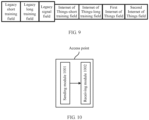
- the NDP multi-station control frame is an Internet of Things multi-station control frame, as shown in FIG. 9 .
- the Internet of Things multi-station control frame may operate at a free-of-charge frequency band of 2.4 GHz, 5 GHz, or 1 GHz.
- the Internet of Things multi-station control frame also includes a legacy preamble field and a new preamble field.
- the legacy preamble field herein and the legacy preamble field described above include same subfields, and the legacy preamble field needs to be used to transmit data at bandwidth at which a frequency is 20 MHz.
- the new preamble field is an Internet of Things preamble field.
- the first signal field is a first Internet of Things-field (Internet of things-signal field 1, IOT-SIG1 for short).
- the second signal field is a second Internet of Things-field (Internet of things-signal field 2, IOT-SIG2 for short).
- the Internet of Things preamble field further includes an Internet of Things-short training field (Internet of things-short training field, IOT-STF for short) and an Internet of Things-long training field (Internet of things-long training field, IOT-LTF for short).
- the Internet of Things preamble field may be used to transmit data at bandwidth less than 20 MHz, for example, 2 M, 4 M, 8 M, 16 M, 5 M, or 10 M, or may be used to transmit data at bandwidth of 20 MHz.
- bandwidth occupied by the legacy preamble field is greater than or equal to bandwidth occupied by the Internet of Things preamble field.
- the Internet of Things multi-station control frame is an NDP multi-station request-to-send frame
- a narrowband (less than 20 MHz) is used as basic bandwidth for the IOT-SIG1 and IOT-SIG2 fields, and there are a total of N portions of basic bandwidth, for example, the narrowband is 2 MHz, and there are a total of eight portions of 2 MHz
- subchannel sequence numbers of response frames of clear-to-send frames may be shown in Table 3.
- Table 3 00 Primary 2 MHz channel 01 Primary 4 MHz channel 10 Primary 8 MHz channel 11 Primary 16 MHz channel
- core content (including transmitter address information, identification information of each station, a block acknowledgement/acknowledgement indication, a start sequence control field, a block acknowledgement bitmap, and the like) of a MAC field in a legacy multi-station control frame is also added to a physical layer field, so as to greatly reduce a quantity of bytes occupied by the multi-station control frame, and reduce duration in which the multi-station control frame occupies a channel during transmission. An effect is especially significant when data is transmitted by using a narrowband.
- An embodiment of the present invention further provides an access point.
- the access point is corresponding to the method process shown in FIG. 2 .
- mutual reference may be made.
- a structure of the access point is specifically shown in FIG. 10.
- FIG. 10 is a schematic structural diagram of an access point according to an embodiment of the present invention.
- the access point includes a sending module 1001 and a receiving module 1002.
- the sending module 1001 is configured to send a multi-station control frame to a plurality of stations, where when the multi-station control frame is a request frame, the request frame is used to request each of the plurality of stations to send a first response frame corresponding to the multi-station control frame; and the receiving module 1002 is configured to receive the first response frame that is corresponding to the multi-station control frame and that is sent by each of the plurality of stations.
- the multi-station control frame includes a legacy preamble field and a new preamble field, and does not include a service field, a Media Access Control frame field, a trailer, a padding bit, or a frame extension field.
- the new preamble field includes a first signal field and a second signal field.
- the first signal field includes first parameter information jointly owned by the plurality of stations, and second parameter information associated with the second signal field.
- the first parameter information jointly owned by the plurality of stations includes identification information of a transmit end that sends data to each of the plurality of stations.
- the second signal field includes control information in a one-to-one correspondence with each of the plurality of stations.
- the access point includes a sending module 1001.
- the sending module 1001 is configured to send a multi-station control frame to a plurality of stations.
- the multi-station control frame is a second response frame
- the second response frame is used to respond to data frames, management frames, or control frames that are transmitted by the plurality of stations.
- the multi-station control frame includes a legacy preamble field and a new preamble field, and does not include a service field, a Media Access Control frame field, a trailer, a padding bit, or a frame extension field.
- the new preamble field includes a first signal field and a second signal field.
- the first signal field includes first parameter information jointly owned by the plurality of stations, and second parameter information associated with the second signal field.
- the first parameter information jointly owned by the plurality of stations includes identification information of a transmit end that sends data to each of the plurality of stations.
- the second signal field includes control information in a one-to-one correspondence with each of the plurality of stations.
- the first signal field may include an overloading subfield, and the overloading subfield includes first indication information that identifies the multi-station control frame as an NDP multi-station control frame.
- the first signal field may include an overloading subfield, and the overloading subfield includes second indication information that identifies the multi-station control frame as an NDP multi-station block acknowledgement frame.
- the overloading subfield includes the first indication information that identifies the multi-station control frame as the NDP multi-station control frame
- the first signal field further includes a type indication field of the NDP multi-station control frame.
- the type indication field is used to indicate a type of the NDP multi-station control frame.
- the type of the NDP multi-station control frame includes at least one of an NDP multi-station block acknowledgement frame, an NDP multi-station request-to-send frame, and an NDP multi-station block acknowledgement request frame.
- the NDP multi-station request-to-send frame and the NDP multi-station block acknowledgement request frame are request frames.
- the NDP multi-station block acknowledgement frame is the first response frame or the second response frame.
- the second parameter information associated with the second signal field includes a quantity of OFDM symbols of the second signal field, and a modulation and coding scheme of the second signal field; or the second parameter information associated with the second signal field includes a quantity of stations, and a modulation and coding scheme of the second signal field.
- the quantity of OFDM symbols of the second signal field has a function that is similar to that of the quantity of stations, and both the quantity of OFDM symbols and the quantity of stations are used to determine a length of the second signal field.
- the modulation and coding scheme of the second signal field is used to determine a data transmission rate.
- a reason why the length of the second signal field can be determined based on the quantity of stations is that each piece of station information includes a same quantity of bits. Therefore, when the quantity of stations is determined, the length of the second signal field may also be indirectly determined.
- the control information that is in a one-to-one correspondence with each of the plurality of stations and that is in the second signal field may include acknowledgement information of each of the plurality of stations.
- the acknowledgement information of each station includes a station identifier and an acknowledgement/block acknowledgement indication, or the acknowledgement information of each station includes an acknowledgement/block acknowledgement identifier and an acknowledgement/block acknowledgement indication.
- the station identifier may be an association identifier or a partial association identifier of the station.
- the association identifier herein represents identity information of the station. For example, if the station is managed by an AP, the AP generates an internal management identifier for the station. The internal management identifier is used by the AP to identify the station.
- the acknowledgement/block acknowledgement identifier has a function that is the same as or similar to that of the station identifier, and is mainly used to determine a station that needs to receive (or send) the control frame.
- the acknowledgement/block acknowledgement identifier may include a combination of at least one bit of a scrambler initialization seed and at least one bit of an association identifier.
- acknowledgement identifier bits include a combination of five low-order bits of the scrambler initialization seed and four low-order bits of the association identifier.
- block acknowledgement identifier bits include a combination of seven low-order bits of the scrambler initialization seed and five low-order bits of the association identifier.
- the association identifier may occupy one or more bits of the scrambler initialization seed, for example, seven low-order bits of the scrambler initialization seed.
- the acknowledgement/block acknowledgement identifier may include only one or more bits of the scrambler initialization seed. In a case, if a preset length of the acknowledgement/block acknowledgement identifier exceeds a quantity of bits occupied by the scrambler initialization seed, 0 or 1 may be added to an end of the scrambler initialization seed, to satisfy the preset length of the acknowledgement/block acknowledgement identifier.
- the acknowledgement/block acknowledgement identifier may include only one or more bits of the association identifier.
- the acknowledgement/block acknowledgement indication is used to determine whether the multi-station block acknowledgement frame is sent in a form of an acknowledgement frame or a block acknowledgement frame.
- the acknowledgement information of each of the plurality of stations includes the block acknowledgement indication
- the acknowledgement information of each of the plurality of stations further includes a start sequence value and a block acknowledgement bitmap. It is determined that each piece of acknowledgement information in block acknowledgement information is corresponding to one sequence number in the block acknowledgement bitmap.
- the start sequence value indicates a start sequence number, in the block acknowledgement bitmap, of first acknowledgement information in the block acknowledgement information.
- the block acknowledgement information herein is used to determine whether a MAC protocol data unit data frame sent by a transmit end is successfully sent.
- the first signal field further includes transmission duration of the NDP multi-station request-to-send frame
- the second parameter information associated with the second signal field includes a length of the second signal field or a quantity of OFDM symbols.
- the control information that is in a one-to-one correspondence with each of the plurality of stations and that is in the second signal field includes NDP request-to-send frame information of each of the plurality of stations.
- the NDP request-to-send frame information of each station includes one or a combination of the following information: a station identifier, a subchannel sequence number of a response frame of a clear-to-send frame, a coding type, a modulation and coding scheme, a dual-carrier modulation indication, and a flow allocation indication.
- the first signal field further includes transmission duration of the NDP multi-station block acknowledgement request frame
- the second parameter information associated with the second signal field includes a length of the second signal field or a quantity of OFDM symbols.
- the control information that is in a one-to-one correspondence with each of the plurality of stations and that is in the second signal field includes: trigger information of each of the plurality of stations, a control field of the NDP multi-station block acknowledgement request frame, and an information field of the NDP multi-station block acknowledgement request frame.
- the trigger information of each of the plurality of stations includes one or a combination of the following information: a station identifier, a resource allocation indication, a coding type, a modulation and coding scheme, a dual-carrier modulation indication, and a flow allocation indication.
- the first signal field may be a high efficiency-signal field A in an 802.11 ax packet
- the second signal field is a high efficiency-signal field B in the 802.11ax packet.
- the overloading subfield is a reserved bit in the high efficiency-signal field A, or is an unused value in a modulation and coding scheme included in the high efficiency-signal field A.
- the overloading subfield carries the first identification information or the second identification information, if it is determined, based on the identification information, that the frame is neither an NDP multi-station control frame nor an NDP multi-station block acknowledgement frame, it indicates that the control frame is not an NDP multi-station control frame, but is a frame existing before overloading, for example, an 802.11ax packet.
- NDP multi-station control fields may be considered as a frame structure designed based on control fields of an 802.11ax multi-station frame.
- a new frame structure of an NDP multi-station control frame may be further designed based on an Internet of Things Wi-Fi protocol.
- the NDP multi-station control frame is an Internet of Things multi-station control frame, as shown in FIG. 9 .
- the Internet of Things multi-station control frame may operate at a free-of-charge frequency band of 2.4 GHz, 5 GHz, or 1 GHz.
- the Internet of Things multi-station control frame also includes a legacy preamble field and a new preamble field.
- the legacy preamble field herein and the legacy preamble field described above include same subfields, and the legacy preamble field needs to be used to transmit data at bandwidth at which a frequency is 20 MHz.
- the new preamble field is an Internet of Things preamble field.
- the first signal field is a first Internet of Things-field (Internet of things-signal field 1, IOT-SIG1 for short).
- the second signal field is a second Internet of Things-field (Internet of things-signal field 2, IOT-SIG2 for short).
- the Internet of Things preamble field further includes an Internet of Things-short training field (Internet of things-short training field, IOT-STF for short) and an Internet of Things-long training field (Internet of things-long training field, IOT-LTF for short).
- the Internet of Things preamble field may be used to transmit data at bandwidth less than 20 MHz, for example, 2 M, 4 M, 8 M, 16 M, 5 M, or 10 M, or may be used to transmit data at bandwidth of 20 MHz.
- bandwidth occupied by the legacy preamble field is greater than or equal to bandwidth occupied by the Internet of Things preamble field.
- the access point When the modules in the access point provided in this embodiment of the present invention run, the access point performs steps in the method for transmitting a multi-station control frame that is provided in the embodiments of the present invention.
- the access point For operating details of the access point, refer to the method for transmitting a multi-station control frame that is provided in the embodiments of the present invention.
- the sent or received multi-station control frame includes only the legacy preamble field and the new preamble field, and occupies much fewer bytes than an 802.11ax multi-station control frame. Therefore, duration in which the multi-station control frame occupies a channel during transmission can be reduced. An effect is more significant when data is transmitted by using a narrowband.
- an embodiment of the present invention further provides a transmission system.
- a schematic structural diagram of the transmission system is shown in FIG. 11 .
- the transmission system includes the access point and the plurality of stations (for example, a station 1 to a station n shown in FIG. 11 , where both i and n are positive integers greater than or equal to 1, and i is less than or equal to n) in the foregoing descriptions.
- stations for example, a station 1 to a station n shown in FIG. 11 , where both i and n are positive integers greater than or equal to 1, and i is less than or equal to n.
- Steps of methods or algorithms described in the embodiments disclosed in this specification may be implemented by hardware, a software module executed by a processing module, or a combination thereof.
- the software module may be located in a random access memory (RAM), a memory, a read-only memory (ROM), an electrically programmable ROM, an electrically erasable programmable ROM, a register, a hard disk, a removable disk, a CD-ROM, or storage media in any other forms well-known in the art.
Landscapes
- Engineering & Computer Science (AREA)
- Computer Networks & Wireless Communication (AREA)
- Signal Processing (AREA)
- Quality & Reliability (AREA)
- Mobile Radio Communication Systems (AREA)
- Radio Relay Systems (AREA)
Applications Claiming Priority (3)
| Application Number | Priority Date | Filing Date | Title |
|---|---|---|---|
| CN201610942629.7A CN108011688B (zh) | 2016-11-01 | 2016-11-01 | 一种传输多站点控制帧的方法、接入点及系统 |
| EP17867030.3A EP3531593B1 (de) | 2016-11-01 | 2017-07-31 | Verfahren, zugangspunkt und system zur übertragung eines steuerungsrahmens für mehrere stationen |
| PCT/CN2017/095096 WO2018082358A1 (zh) | 2016-11-01 | 2017-07-31 | 一种传输多站点控制帧的方法、接入点及系统 |
Related Parent Applications (2)
| Application Number | Title | Priority Date | Filing Date |
|---|---|---|---|
| EP17867030.3A Division-Into EP3531593B1 (de) | 2016-11-01 | 2017-07-31 | Verfahren, zugangspunkt und system zur übertragung eines steuerungsrahmens für mehrere stationen |
| EP17867030.3A Division EP3531593B1 (de) | 2016-11-01 | 2017-07-31 | Verfahren, zugangspunkt und system zur übertragung eines steuerungsrahmens für mehrere stationen |
Publications (2)
| Publication Number | Publication Date |
|---|---|
| EP4529113A2 true EP4529113A2 (de) | 2025-03-26 |
| EP4529113A3 EP4529113A3 (de) | 2025-06-04 |
Family
ID=62047239
Family Applications (2)
| Application Number | Title | Priority Date | Filing Date |
|---|---|---|---|
| EP24211554.1A Pending EP4529113A3 (de) | 2016-11-01 | 2017-07-31 | Verfahren zur übertragung eines steuerrahmens für mehrere stationen, zugangspunkt und system |
| EP17867030.3A Active EP3531593B1 (de) | 2016-11-01 | 2017-07-31 | Verfahren, zugangspunkt und system zur übertragung eines steuerungsrahmens für mehrere stationen |
Family Applications After (1)
| Application Number | Title | Priority Date | Filing Date |
|---|---|---|---|
| EP17867030.3A Active EP3531593B1 (de) | 2016-11-01 | 2017-07-31 | Verfahren, zugangspunkt und system zur übertragung eines steuerungsrahmens für mehrere stationen |
Country Status (3)
| Country | Link |
|---|---|
| EP (2) | EP4529113A3 (de) |
| CN (1) | CN108011688B (de) |
| WO (1) | WO2018082358A1 (de) |
Families Citing this family (8)
| Publication number | Priority date | Publication date | Assignee | Title |
|---|---|---|---|---|
| CN116488773A (zh) | 2018-07-06 | 2023-07-25 | 华为技术有限公司 | 通信方法、装置及设备 |
| CN116582959B (zh) | 2019-07-05 | 2024-01-30 | 华为技术有限公司 | 一种多链路通信方法及相关设备 |
| CN116782420A (zh) * | 2019-07-12 | 2023-09-19 | 华为技术有限公司 | 一种多链路通信方法及相关装置 |
| US20230180321A1 (en) * | 2020-07-17 | 2023-06-08 | Beijing Xiaomi Mobile Software Co., Ltd. | Wireless communication method, communication device |
| CN114339778B (zh) * | 2020-09-30 | 2024-12-03 | 华为技术有限公司 | 网络管理方法以及相关装置 |
| CN116743333B (zh) | 2021-04-07 | 2024-12-10 | 华为技术有限公司 | 信息指示方法及通信装置 |
| CN116250201B (zh) * | 2021-10-08 | 2025-11-28 | 北京小米移动软件有限公司 | 通信方法和通信装置 |
| CN114337919A (zh) * | 2021-12-21 | 2022-04-12 | 航天科工通信技术研究院有限责任公司 | 一种面向高优先级实时接入的时分多址帧装置 |
Family Cites Families (6)
| Publication number | Priority date | Publication date | Assignee | Title |
|---|---|---|---|---|
| US20130155929A1 (en) * | 2011-12-15 | 2013-06-20 | Futurewei Technologies, Inc. | System and Method for Communicating Using Short-Header Frames |
| CN103298079B (zh) * | 2012-02-23 | 2017-02-08 | 华为技术有限公司 | 数据传输方法、接入点和站点 |
| CN103312466A (zh) * | 2012-03-16 | 2013-09-18 | 中兴通讯股份有限公司 | 空反馈帧的传输方法及接收站点 |
| US9602319B2 (en) * | 2014-08-04 | 2017-03-21 | Intel IP Corporation | Apparatus, method, and computer readable medium for high-efficiency wireless local-area network (HEW) signal field detection |
| US20160119933A1 (en) * | 2014-10-28 | 2016-04-28 | Qualcomm Incorporated | Null data packet frame structure for wireless communication |
| CN104853385A (zh) * | 2015-05-25 | 2015-08-19 | 电子科技大学 | 一种基于ofdma技术的wifi系统中高效传输信息的动态机制 |
-
2016
- 2016-11-01 CN CN201610942629.7A patent/CN108011688B/zh active Active
-
2017
- 2017-07-31 EP EP24211554.1A patent/EP4529113A3/de active Pending
- 2017-07-31 WO PCT/CN2017/095096 patent/WO2018082358A1/zh not_active Ceased
- 2017-07-31 EP EP17867030.3A patent/EP3531593B1/de active Active
Also Published As
| Publication number | Publication date |
|---|---|
| EP3531593B1 (de) | 2025-01-01 |
| WO2018082358A1 (zh) | 2018-05-11 |
| EP3531593A4 (de) | 2019-11-20 |
| CN108011688A (zh) | 2018-05-08 |
| EP3531593A1 (de) | 2019-08-28 |
| EP3531593C0 (de) | 2025-01-01 |
| CN108011688B (zh) | 2020-07-07 |
| EP4529113A3 (de) | 2025-06-04 |
Similar Documents
| Publication | Publication Date | Title |
|---|---|---|
| EP3531593B1 (de) | Verfahren, zugangspunkt und system zur übertragung eines steuerungsrahmens für mehrere stationen | |
| US11464059B2 (en) | Acknowledgment data unit for multiple uplink data units | |
| JP7606195B2 (ja) | 集合mpdu及びそれに対する応答フレームの伝送方法及びそれを利用した無線通信端末 | |
| US11399342B2 (en) | Method and apparatus for efficient addressing and power savings in wireless communications | |
| EP3713122B1 (de) | Verfahren zum antworten mit bestätigungsrahmen, vorrichtung und datenübertragungssystem | |
| US10917924B2 (en) | Association establishment method and apparatus | |
| AU2016316276B2 (en) | Wireless local area network information transmission method and apparatus | |
| US20200106489A1 (en) | Method and apparatus for uplink orthogonal frequency division multiple access | |
| KR101685073B1 (ko) | 매우 높은 스루풋 wlan 확인 응답 프레임들을 전송하기 위한 방법 및 장치 | |
| CN107078858B (zh) | 在无线lan系统中发送和接收多用户块确认帧的方法及其设备 | |
| EP4181413A1 (de) | Drahtloses kommunikationsverfahren und drahtloses kommunikationsendgerät zur signalisierung eines mehrbenutzerpakets | |
| CN106850140B (zh) | 数据通信的方法、装置及系统 | |
| US11463903B2 (en) | Resource request for uplink transmission | |
| EP4135399A1 (de) | Verfahren zur drahtlosen kommunikationsübertragung und zugehörige vorrichtung | |
| CN104852777B (zh) | 多目标聚合传输方法和相关设备及系统 | |
| WO2014005054A2 (en) | Unified beacon format | |
| CN101584229B (zh) | 无线系统中效率寻址及功率节省方法及系统 | |
| CN106817208B (zh) | 基于多用户的bar传输方法、资源调度方法、装置及系统 | |
| WO2022148234A1 (zh) | 组播反馈方法、装置及系统 |
Legal Events
| Date | Code | Title | Description |
|---|---|---|---|
| PUAI | Public reference made under article 153(3) epc to a published international application that has entered the european phase |
Free format text: ORIGINAL CODE: 0009012 |
|
| STAA | Information on the status of an ep patent application or granted ep patent |
Free format text: STATUS: THE APPLICATION HAS BEEN PUBLISHED |
|
| AC | Divisional application: reference to earlier application |
Ref document number: 3531593 Country of ref document: EP Kind code of ref document: P |
|
| AK | Designated contracting states |
Kind code of ref document: A2 Designated state(s): AL AT BE BG CH CY CZ DE DK EE ES FI FR GB GR HR HU IE IS IT LI LT LU LV MC MK MT NL NO PL PT RO RS SE SI SK SM TR |
|
| REG | Reference to a national code |
Ref country code: DE Ref legal event code: R079 Free format text: PREVIOUS MAIN CLASS: H04L0027260000 Ipc: H04L0001000000 |
|
| PUAL | Search report despatched |
Free format text: ORIGINAL CODE: 0009013 |
|
| AK | Designated contracting states |
Kind code of ref document: A3 Designated state(s): AL AT BE BG CH CY CZ DE DK EE ES FI FR GB GR HR HU IE IS IT LI LT LU LV MC MK MT NL NO PL PT RO RS SE SI SK SM TR |
|
| RIC1 | Information provided on ipc code assigned before grant |
Ipc: H04L 27/26 20060101ALI20250430BHEP Ipc: H04L 5/00 20060101ALI20250430BHEP Ipc: H04L 1/1607 20230101ALI20250430BHEP Ipc: H04L 1/00 20060101AFI20250430BHEP |
|
| STAA | Information on the status of an ep patent application or granted ep patent |
Free format text: STATUS: REQUEST FOR EXAMINATION WAS MADE |
|
| 17P | Request for examination filed |
Effective date: 20251204 |
|
| RAP1 | Party data changed (applicant data changed or rights of an application transferred) |
Owner name: KONINKLIJKE PHILIPS N.V. |