EP4528745A2 - Systeme und verfahren zur okklusionserkennung in infusionspumpen - Google Patents
Systeme und verfahren zur okklusionserkennung in infusionspumpen Download PDFInfo
- Publication number
- EP4528745A2 EP4528745A2 EP25156053.8A EP25156053A EP4528745A2 EP 4528745 A2 EP4528745 A2 EP 4528745A2 EP 25156053 A EP25156053 A EP 25156053A EP 4528745 A2 EP4528745 A2 EP 4528745A2
- Authority
- EP
- European Patent Office
- Prior art keywords
- physical force
- measurement
- infusion
- occlusion
- force
- Prior art date
- Legal status (The legal status is an assumption and is not a legal conclusion. Google has not performed a legal analysis and makes no representation as to the accuracy of the status listed.)
- Pending
Links
Images



Classifications
-
- A—HUMAN NECESSITIES
- A61—MEDICAL OR VETERINARY SCIENCE; HYGIENE
- A61M—DEVICES FOR INTRODUCING MEDIA INTO, OR ONTO, THE BODY; DEVICES FOR TRANSDUCING BODY MEDIA OR FOR TAKING MEDIA FROM THE BODY; DEVICES FOR PRODUCING OR ENDING SLEEP OR STUPOR
- A61M5/00—Devices for bringing media into the body in a subcutaneous, intra-vascular or intramuscular way; Accessories therefor, e.g. filling or cleaning devices, arm-rests
- A61M5/14—Infusion devices, e.g. infusing by gravity; Blood infusion; Accessories therefor
- A61M5/168—Means for controlling media flow to the body or for metering media to the body, e.g. drip meters, counters ; Monitoring media flow to the body
- A61M5/16831—Monitoring, detecting, signalling or eliminating infusion flow anomalies
-
- A—HUMAN NECESSITIES
- A61—MEDICAL OR VETERINARY SCIENCE; HYGIENE
- A61M—DEVICES FOR INTRODUCING MEDIA INTO, OR ONTO, THE BODY; DEVICES FOR TRANSDUCING BODY MEDIA OR FOR TAKING MEDIA FROM THE BODY; DEVICES FOR PRODUCING OR ENDING SLEEP OR STUPOR
- A61M5/00—Devices for bringing media into the body in a subcutaneous, intra-vascular or intramuscular way; Accessories therefor, e.g. filling or cleaning devices, arm-rests
- A61M5/14—Infusion devices, e.g. infusing by gravity; Blood infusion; Accessories therefor
- A61M5/142—Pressure infusion, e.g. using pumps
-
- G—PHYSICS
- G16—INFORMATION AND COMMUNICATION TECHNOLOGY [ICT] SPECIALLY ADAPTED FOR SPECIFIC APPLICATION FIELDS
- G16H—HEALTHCARE INFORMATICS, i.e. INFORMATION AND COMMUNICATION TECHNOLOGY [ICT] SPECIALLY ADAPTED FOR THE HANDLING OR PROCESSING OF MEDICAL OR HEALTHCARE DATA
- G16H20/00—ICT specially adapted for therapies or health-improving plans, e.g. for handling prescriptions, for steering therapy or for monitoring patient compliance
- G16H20/10—ICT specially adapted for therapies or health-improving plans, e.g. for handling prescriptions, for steering therapy or for monitoring patient compliance relating to drugs or medications, e.g. for ensuring correct administration to patients
- G16H20/17—ICT specially adapted for therapies or health-improving plans, e.g. for handling prescriptions, for steering therapy or for monitoring patient compliance relating to drugs or medications, e.g. for ensuring correct administration to patients delivered via infusion or injection
-
- G—PHYSICS
- G16—INFORMATION AND COMMUNICATION TECHNOLOGY [ICT] SPECIALLY ADAPTED FOR SPECIFIC APPLICATION FIELDS
- G16H—HEALTHCARE INFORMATICS, i.e. INFORMATION AND COMMUNICATION TECHNOLOGY [ICT] SPECIALLY ADAPTED FOR THE HANDLING OR PROCESSING OF MEDICAL OR HEALTHCARE DATA
- G16H40/00—ICT specially adapted for the management or administration of healthcare resources or facilities; ICT specially adapted for the management or operation of medical equipment or devices
- G16H40/40—ICT specially adapted for the management or administration of healthcare resources or facilities; ICT specially adapted for the management or operation of medical equipment or devices for the management of medical equipment or devices, e.g. scheduling maintenance or upgrades
-
- G—PHYSICS
- G16—INFORMATION AND COMMUNICATION TECHNOLOGY [ICT] SPECIALLY ADAPTED FOR SPECIFIC APPLICATION FIELDS
- G16H—HEALTHCARE INFORMATICS, i.e. INFORMATION AND COMMUNICATION TECHNOLOGY [ICT] SPECIALLY ADAPTED FOR THE HANDLING OR PROCESSING OF MEDICAL OR HEALTHCARE DATA
- G16H50/00—ICT specially adapted for medical diagnosis, medical simulation or medical data mining; ICT specially adapted for detecting, monitoring or modelling epidemics or pandemics
- G16H50/20—ICT specially adapted for medical diagnosis, medical simulation or medical data mining; ICT specially adapted for detecting, monitoring or modelling epidemics or pandemics for computer-aided diagnosis, e.g. based on medical expert systems
-
- A—HUMAN NECESSITIES
- A61—MEDICAL OR VETERINARY SCIENCE; HYGIENE
- A61M—DEVICES FOR INTRODUCING MEDIA INTO, OR ONTO, THE BODY; DEVICES FOR TRANSDUCING BODY MEDIA OR FOR TAKING MEDIA FROM THE BODY; DEVICES FOR PRODUCING OR ENDING SLEEP OR STUPOR
- A61M5/00—Devices for bringing media into the body in a subcutaneous, intra-vascular or intramuscular way; Accessories therefor, e.g. filling or cleaning devices, arm-rests
- A61M5/14—Infusion devices, e.g. infusing by gravity; Blood infusion; Accessories therefor
- A61M5/142—Pressure infusion, e.g. using pumps
- A61M2005/14208—Pressure infusion, e.g. using pumps with a programmable infusion control system, characterised by the infusion program
-
- A—HUMAN NECESSITIES
- A61—MEDICAL OR VETERINARY SCIENCE; HYGIENE
- A61M—DEVICES FOR INTRODUCING MEDIA INTO, OR ONTO, THE BODY; DEVICES FOR TRANSDUCING BODY MEDIA OR FOR TAKING MEDIA FROM THE BODY; DEVICES FOR PRODUCING OR ENDING SLEEP OR STUPOR
- A61M5/00—Devices for bringing media into the body in a subcutaneous, intra-vascular or intramuscular way; Accessories therefor, e.g. filling or cleaning devices, arm-rests
- A61M5/14—Infusion devices, e.g. infusing by gravity; Blood infusion; Accessories therefor
- A61M5/168—Means for controlling media flow to the body or for metering media to the body, e.g. drip meters, counters ; Monitoring media flow to the body
- A61M5/16831—Monitoring, detecting, signalling or eliminating infusion flow anomalies
- A61M2005/16863—Occlusion detection
-
- A—HUMAN NECESSITIES
- A61—MEDICAL OR VETERINARY SCIENCE; HYGIENE
- A61M—DEVICES FOR INTRODUCING MEDIA INTO, OR ONTO, THE BODY; DEVICES FOR TRANSDUCING BODY MEDIA OR FOR TAKING MEDIA FROM THE BODY; DEVICES FOR PRODUCING OR ENDING SLEEP OR STUPOR
- A61M2205/00—General characteristics of the apparatus
- A61M2205/18—General characteristics of the apparatus with alarm
-
- A—HUMAN NECESSITIES
- A61—MEDICAL OR VETERINARY SCIENCE; HYGIENE
- A61M—DEVICES FOR INTRODUCING MEDIA INTO, OR ONTO, THE BODY; DEVICES FOR TRANSDUCING BODY MEDIA OR FOR TAKING MEDIA FROM THE BODY; DEVICES FOR PRODUCING OR ENDING SLEEP OR STUPOR
- A61M2205/00—General characteristics of the apparatus
- A61M2205/33—Controlling, regulating or measuring
- A61M2205/332—Force measuring means
-
- A—HUMAN NECESSITIES
- A61—MEDICAL OR VETERINARY SCIENCE; HYGIENE
- A61M—DEVICES FOR INTRODUCING MEDIA INTO, OR ONTO, THE BODY; DEVICES FOR TRANSDUCING BODY MEDIA OR FOR TAKING MEDIA FROM THE BODY; DEVICES FOR PRODUCING OR ENDING SLEEP OR STUPOR
- A61M2205/00—General characteristics of the apparatus
- A61M2205/50—General characteristics of the apparatus with microprocessors or computers
- A61M2205/502—User interfaces, e.g. screens or keyboards
-
- A—HUMAN NECESSITIES
- A61—MEDICAL OR VETERINARY SCIENCE; HYGIENE
- A61M—DEVICES FOR INTRODUCING MEDIA INTO, OR ONTO, THE BODY; DEVICES FOR TRANSDUCING BODY MEDIA OR FOR TAKING MEDIA FROM THE BODY; DEVICES FOR PRODUCING OR ENDING SLEEP OR STUPOR
- A61M2205/00—General characteristics of the apparatus
- A61M2205/50—General characteristics of the apparatus with microprocessors or computers
- A61M2205/52—General characteristics of the apparatus with microprocessors or computers with memories providing a history of measured variating parameters of apparatus or patient
Definitions
- IV intravenous
- infusion pumps provide controlled fluid medication or drug infusion where the fluid can be administered at a precise rate that keeps a medication/drug concentration within a therapeutic margin and out of an unnecessary or possibly toxic range.
- the infusion pumps provide appropriate medication/drug delivery to a patient at a controllable rate, which does not require frequent attention.
- Infusion pumps may facilitate administration of intravenous therapy to patients both in and outside of a clinical setting.
- doctors have found that in many instances patients can return to substantially normal lives, provided that they receive periodic or continuous intravenous administration of medication, drugs, or other fluids such as saline.
- therapies requiring this kind of administration are antibiotic therapy, chemotherapy, pain control therapy, nutritional therapy, and several other types that are known by those skilled in the art.
- patients receive multiple daily therapies.
- Certain medical conditions require infusion of drugs in a solution over relatively short periods such as from thirty minutes to two hours. These conditions and others have collectively promoted the development of increasingly lightweight, portable or ambulatory infusion pumps that can be worn by a patient and are capable of administering a continuous supply of medication at a desired rate, or providing several doses of medication at scheduled intervals.
- infusion pumps include elastomeric pumps, which squeeze solution from flexible containers, such as balloons, into IV tubing for delivery to a patient.
- infusion pumps may include spring-loaded pumps that pressurize solution containers or reservoirs.
- Certain pump designs utilize cartridges containing flexible compartments that are squeezed by pressure rollers for discharging the solutions.
- known infusion pumps include peristaltic pumps having finger actuators or a roller actuator that apply pressure to IV tubing for delivering fluid from a fluid container to a patient.
- Infusion pumps utilizing syringes are also known. These syringe pumps use a drive mechanism to move a plunger of a syringe to deliver a fluid to a patient.
- these infusion pumps include a housing adapted to receive a syringe assembly, a drive mechanism adapted to move the syringe plunger, and a pump control unit having a variety of operating controls.
- IV tubing may be placed into a tube channel of an infusion pump.
- the IV tubing may be pressed up against a force sensor using a cover of the infusion pump.
- This compressive force from the cover may be similar in magnitude to a pressure caused by an occlusion, which may cause the force sensor to transmit force measurements that are incorrectly interpreted as an occlusion being present.
- the force applied by the cover must therefore be removed from the force sensor output to properly assess the fluid pressure within the IV tubing.
- a force baseline may be captured prior to or during the start of an infusion.
- the force baseline can be subtracted from the measured force to provide a more accurate reading of the forces within the tube itself.
- the problem with this approach is that these external factors can change over time, so the force baseline may also need to be adjusted to account for the changing external factors.
- adjustments to the force baseline may not be in synchronization with the changes in the external factors.
- the tools used to make these adjustments may often have difficulty distinguishing changes in the external factors from changes in pressure of the IV tubing. This lag in adjusting the force baseline often leads to false occlusion detection.
- the present disclosure provides a new and innovative method and system for occlusion detection using artificial intelligence.
- the device in which occlusion can be detected is an infusion pump.
- the infusion pump in various embodiments is a peristaltic pump, a syringe pump, or an ambulatory pump configured to deliver a medication to a patient.
- the device is, in various embodiments, any type of medical device, or any other suitable device where detecting any occlusion occurring within the device is crucial for its safe and effective operation.
- the disclosed method includes steps to precondition input data from infusion pump pressure samples, steps to train a machine learning model (e.g., a support vector machine) using preconditioned data from reference infusion pump pressure samples, and applying the trained machine learning model to preconditioned input data from an infusion session to detect occlusions in real-time.
- a machine learning model e.g., a support vector machine
- the preconditioning steps involve receiving one or more types of input data, including, but not limited to (1) a current measurement of a physical force (e.g., a force and/or a pressure detected by a force sensor) within a periodic infusion sample, (2) an initial measurement of the physical force at the start of an infusion (e.g., a reference or baseline force), (3) a metric to represent a long term history of the physical force (e.g., a slope value represented by the current measurement of the physical force over a measurement of the physical force at a distant past), and (4) a metric to represent a short term history of the physical force (e.g., a slope value represented by the current measurement of the physical force over a measurement of the physical force at a near past).
- a current measurement of a physical force e.g., a force and/or a pressure detected by a force sensor
- an initial measurement of the physical force at the start of an infusion e.g., a reference or baseline force
- the use of different types of input data enable the disclosed machine learning model to differentiate between slowly changing forces, such as tube settling and faster changing forces such as occlusions. Furthermore, the preconditioning steps enable the machine learning model to ideally find statistically significant differences that denote an occlusion scenario over a non-occlusion scenario.
- the training of the machine learning model may include receiving a training data set comprising the above described input data (e.g., (1) a current measurement of a physical force, (2) an initial measurement of the physical force at the start of an infusion, (3) a metric to represent a long term history of the physical force, and (4) a metric to represent the short term history of the physical force) for reference infusion events with a known output (e.g., an occlusion or an absence of an occlusion).
- the received input data set may be arranged as input vectors and associated with their corresponding outputs.
- a Support Vector Machine may be used to train the machine learning model.
- data sets may be classified into the two groups (e.g., occlusion and no occlusion) and a decision boundary with an optimal boundary may be determined (e.g., that optimizes the margin between occluded and un-occluded data).
- the parameters for the optimal decision boundary for the training data set may be stored for use during infusion treatments.
- the trained machine learning model may be subsequently utilized with a new sample dataset in order to detect when an occlusion occurs.
- new values for the above described types of input data are obtained (e.g., (1) a current measurement of a physical force, (2) an initial measurement of the physical force at the start of an infusion, (3) a metric to represent a long term history of the physical force, and (4) a metric to represent the short term history of the physical force).
- Input vectors may be formed using the input data, and then inputted into the trained machine learning algorithm to determine whether an occlusion has occurred.
- an infusion pump apparatus for detecting an occlusion includes intravenous (“IV") tubing having a first end that is fluidly coupled to a patient and a second end that is fluidly coupled to a container, a pumping mechanism operable with a portion of the IV tubing for providing controlled delivery of a fluid from the container to the patient, a force sensor coupled to the IV tubing to measure a physical force caused by the fluid, one or more processors, and a memory storing instructions.
- IV tubing having a first end that is fluidly coupled to a patient and a second end that is fluidly coupled to a container
- a pumping mechanism operable with a portion of the IV tubing for providing controlled delivery of a fluid from the container to the patient
- a force sensor coupled to the IV tubing to measure a physical force caused by the fluid
- processors one or more processors
- a memory storing instructions.
- the instructions When executed by the one or more processors, the instructions cause the one or more processors to receive, via the force sensor and during a start of an infusion session, an initial measurement of a physical force caused by fluid motion through the IV tubing, and identify, based on one or more parameters associated with the infusion session, a trained support vector machine for occlusion detection.
- the one or more processors are also configured to generate, during the infusion session at predetermined intervals, a feature vector comprising the initial measurement of the physical force measured by the force sensor, a current measurement of the physical force measured by the force sensor, a long term change in the measurement of the physical force, and a short term change in the measurement of the physical force.
- the one or more processors are further configured to input, during the infusion session at the predetermined intervals, the feature vector into the trained support vector machine to output a detection of a presence or an absence of an occlusion in the IV tubing and when the presence of the occlusion is detected, pause or terminate the infusion session.
- generating the feature vector further comprises receiving, via the force sensor, a current measurement of the physical force, determining, based on a first prior measurement of the physical force, a long term change in the measurement of the physical force, and determining, based on a second prior measurement of the physical force, a short term change in the measurement of the physical force.
- the instructions when executed, further cause the one or more processors to train the support vector machine using a training dataset from a plurality of reference infusion sessions sharing the one or more parameters of the infusion session.
- training the support vector machine further comprises receiving, for each of the plurality of reference infusion sessions one or more reference feature vectors corresponding to one or more times during the respective infusion session, wherein a given reference feature vector comprises a reference initial measurement of the physical force at the start of the respective reference infusion session, a reference current measurement of the physical force at a given time of the one or more times during the reference infusion session, a reference long term change in the measurement of the physical force, and a reference short term change in the measurement of the physical force.
- An indication of a presence or an absence of an occlusion at the one or more times during the respective infusion session is also received.
- Training the support vector machine also comprises associating, for each of the plurality of reference infusion sessions, the one or more feature vectors with either the indication of the presence of the occlusion or the indication of the absence of the occlusion, determining, based on an optimized margin, a decision boundary for the training dataset, wherein the decision boundary divides the reference feature vectors associated with the indication of the presence of the occlusion from the reference feature vectors associated with the indication of the absence of the occlusion, and generating, based on the decision boundary, the trained support vector machine.
- the long term change in the measurement of the physical force includes a slope value represented by the current measurement of the physical force over a measurement of the physical force at a distant past.
- the distant past includes one or more measurements of the physical force recorded at one to two minutes previously.
- the long term change in the measurement of the physical force includes a slope value that is equal to the current measurement of the physical force minus a measurement of the physical force at a distant past, divided by a number of measurements recorded between the current measurement of the physical force and the measurement of the physical force at the distant past.
- the distant past includes one or more measurements of the physical force recorded at one to two minutes previously.
- the short term change in the measurement of the physical force includes a slope value represented by the current measurement of the physical force over a measurement of the physical force at a near past.
- the near past includes one or more measurements of the physical force recorded at 50 milliseconds to 100 milliseconds previously.
- the short term change in the measurement of the physical force includes a slope value that is equal to the current measurement of the physical force minus a measurement of the physical force at a near past, divided by a number of measurements recorded between the current measurement of the physical force and the measurement of the physical force at the near past.
- the near past includes one or more measurements of the physical force recorded at 50 milliseconds to 100 milliseconds previously.
- the one or more processors are configured to cause an alert or an alarm to be displayed on a user interface when the presence of the occlusion is detected.
- an infusion system for detecting an occlusion includes a force sensor coupled to IV tubing to measure a physical force caused by a fluid within the IV tubing, the IV tubing having a first end that is fluidly coupled to a patient and a second end that is fluidly coupled to a container.
- the system also includes an infusion device communicatively coupled to the force sensor.
- the infusion device includes a pumping mechanism operable with a portion of the IV tubing for providing controlled delivery of a fluid from the container to the patient, a user interface, one or more processors, and a memory storing a plurality of trained support vector machines and instructions that, when executed by the one or more processors, cause the one or more processors to receive, via the force sensor and during a start of an infusion session, an initial measurement of a physical force caused by fluid motion through the IV tubing and identify, based on one or more parameters associated with the infusion session, a trained support vector machine for occlusion detection among the plurality of the trained support vector machines.
- the one or more processors are also configured to generate, during the infusion session at predetermined intervals, a feature vector comprising the initial measurement of the physical force measured by the force sensor, a current measurement of the physical force measured by the force sensor, a long term change in the measurement of the physical force, and a short term change in the measurement of the physical force.
- the one or more processors are further configured to input, during the infusion session at the predetermined intervals, the feature vector into the trained support vector machine to output a detection of a presence or an absence of an occlusion in the IV tubing and when the presence of the occlusion is detected, cause an alert or an alarm to be displayed on the user interface that is indicative of the occlusion.
- the one or more processors are configured to pause or terminate the infusion session when the presence of the occlusion is detected.
- the force sensor is integrally formed or fluidly connected to the IV tubing.
- generating the feature vector further comprises receiving, via the force sensor, a current measurement of the physical force, determining, based on a first prior measurement of the physical force, a long term change in the measurement of the physical force, and determining, based on a second prior measurement of the physical force, a short term change in the measurement of the physical force.
- the instructions when executed, further cause the one or more processors to train the support vector machine using a training dataset from a plurality of reference infusion sessions sharing the one or more parameters of the infusion session.
- training the support vector machine further comprises receiving, for each of the plurality of reference infusion sessions one or more reference feature vectors corresponding to one or more times during the respective infusion session, wherein a given reference feature vector comprises a reference initial measurement of the physical force at the start of the respective reference infusion session, a reference current measurement of the physical force at a given time of the one or more times during the reference infusion session, a reference long term change in the measurement of the physical force, and a reference short term change in the measurement of the physical force.
- An indication of a presence or an absence of an occlusion at the one or more times during the respective infusion session is also received.
- Training the support vector machine also comprises associating, for each of the plurality of reference infusion sessions, the one or more feature vectors with either the indication of the presence of the occlusion or the indication of the absence of the occlusion, determining, based on an optimized margin, a decision boundary for the training dataset, wherein the decision boundary divides the reference feature vectors associated with the indication of the presence of the occlusion from the reference feature vectors associated with the indication of the absence of the occlusion, and generating, based on the decision boundary, the trained support vector machine.
- an infusion pump method for detecting an occlusion includes receiving, in a processor of an infusion device from a force sensor and during a start of an infusion session, an initial measurement of a physical force caused by fluid motion through IV tubing having a first end that is fluidly coupled to a patient and a second end that is fluidly coupled to a container and identifying, via the processor based on one or more parameters associated with the infusion session, a trained support vector machine for occlusion detection.
- the method also includes generating, via the processor during the infusion session at predetermined intervals, a feature vector comprising the initial measurement of the physical force measured by the force sensor, a current measurement of the physical force measured by the force sensor, a long term change in the measurement of the physical force, and a short term change in the measurement of the physical force.
- the method further includes inputting, via the processor during the infusion session at the predetermined intervals, the feature vector into the trained support vector machine to output a detection of a presence or an absence of an occlusion in the IV tubing and when the presence of the occlusion is detected, pausing or terminating the infusion session via the processor.
- any of the structure, functionality, and alternatives disclosed in connection with any one or more of Figs. 1 to 9 may be combined with any other structure, functionality, and alternatives disclosed in connection with any other one or more of Figs. 1 to 9 .
- In-line occlusion detection is critical for the safe and effective operation of infusion systems.
- the most common method for occlusion detection utilizes a force sensor to detect in-line pressure (e.g., a pressure caused by fluid within a IV tubing coupled to an infusion device).
- the detected in-line pressure can indirectly indicate an occlusion status (e.g., a presence or an absence of an occlusion), based on whether or not the detected in-line pressure reaches or exceeds a preset threshold.
- occlusion status e.g., a presence or an absence of an occlusion
- false alarms of occlusion can occur for a variety of factors, including, but not limited to, variations in infusion systems and variations regarding the patient.
- the present disclosure provides more robust, accurate, and/or reliable systems and methods for occlusion detection in infusion systems.
- the present disclosure includes novel and nonobvious systems and methods for preconditioning data, and using particular artificial intelligence models (e.g., support
- Some embodiments for occlusion detection in infusion systems may include various parts, namely, preconditioning input data, training a machine learning model for occlusion detection, and applying the machine learning model. In the following paragraphs, these parts will be discussed with more detail.
- a method for preconditioning input data may begin by receiving data from a force sensor.
- a force sensor may be coupled to IV tubing of an infusion device to measure a physical force caused by fluid within the tubing.
- the fluid is delivered by an infusion device for infusion into a patient.
- measurements of physical forces from the force sensor may be periodically sampled (e.g., measurements may be obtained in predetermined intervals of time). These sampled measurement readings may be fed into the occlusion detection models that are further described herein.
- these samples may be buffered, averaged, accumulated, and/or counted (e.g., preconditioned) to determine a baseline measurement of the physical force and a threshold value for the physical force.
- data received from the force sensors may be preconditioned to represent:
- the input for "(A)" may be a measurement of the physical force as part of the periodic sampling in real time.
- the input for "(B)" may be a measurement of the physical force at the start of the infusion session.
- the inputs for "(C)" and “(D)” may comprise the slopes in the current measurement of the physical force and the measurement of the physical force sometime in the past. Slopes may be used, for example, to provide for easily calculated values, which minimize the amount of information that needs to be stored in the infusion system and/or infusion device (e.g., at the microcontroller, memory, and/or electronic storage device).
- a measurement of a physical force 1 - 2 minutes in the past may be held and used to calculate a slope with the current measurement of the physical force.
- the input for (C) may use a measurement of a physical force that is between thirty seconds to ten minutes in the past.
- the difference may be divided by a value (e.g., 12000) to represent the number of samples taken in 1 minute at a 5 millisecond ("ms") sample rate of the force sensors (e.g., an interval rate).
- the input for (D) may use a measurement of a physical force that is between 1ms to 5 seconds in the past.
- the preconditioned inputs representing a long-term and a short-term change in the physical force provides the machine learning model information which could help it differentiate between slowly changing forces, such as tube settling, and faster changing forces, such as occlusions.
- slowly changing forces such as tube settling
- faster changing forces such as occlusions.
- providing the machine learning model at least two such above described inputs that capture the changes in the physical force may allow the machine learning model to find statistically significant differences that denote an occlusion scenario over a non-occlusion scenario.
- the two above described inputs capturing changes in the physical force can also be used to detect a scenario where IV tubing (e.g., an infusion passageway) may be occluded prior to starting an infusion session or treatment.
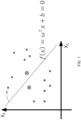
- FIG. 1 is a graph illustrating an example two-class classification for occlusion detection, according to an embodiment of the present disclosure.
- a support vector machine (“SVM”) is an example of a machine learning tool that can be customized and applied for occlusion detection, given the nature of occlusion detection in infusion systems.
- SVM support vector machine
- a decision boundary 100 is chosen to be the one for which the margin is maximized.
- the support vectors are the vectors having closest distance to the decision boundary 100 in FIG. 1 .
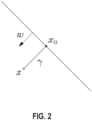
- FIG. 2 is a graph illustrating a maximum margin classifier.
- the aforementioned method may be used to solve a linear classification problem.
- a non-linear occlusion dataset may be assumed to be present.
- a kernel function can be introduced herein to map the current occlusion data to higher dimensions in order to determine the decision boundary.
- FIG. 3 is a matrix showing an example occlusion detection training dataset, according to an embodiment of the present disclosure.
- a support vector machine SVM
- the occlusion detection training dataset, x is a matrix that comprises N input vectors x 1 , ..., x N , and can represent occlusion related parameters, such as ADC counts, slopes, flowrates, current drain, temperature, etc.
- occlusion related parameters such as ADC counts, slopes, flowrates, current drain, temperature, etc.
- a five parameters have been chosen for vectors X for demonstration purposes: a current measurement of an ADC count, a load ADC count, a flow rate, a long term change in the measurement of a physical force (e.g., a one minute slope), and a long term change in the measurement of a physical force (e.g., a 50ms slope).
- a five-dimension dataset is chosen for the training.
- the five-dimensional dataset may also be used for the application of the trained model.
- parameters may also or alternatively include, for example, a current measurement of a physical force at periodic intervals, an initial measurement of the physical force (e.g., at the start of an infusion session), an indicator of a long term change in the measurement of the physical force, an indicator of a short term change in the measurement of the physical force, etc.
- a current measurement of a physical force at periodic intervals e.g., at the start of an infusion session
- an initial measurement of the physical force e.g., at the start of an infusion session
- an indicator of a long term change in the measurement of the physical force e.g., at the start of an infusion session
- an indicator of a short term change in the measurement of the physical force e.g., a short term change in the measurement of the physical force
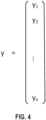
- FIG. 4 is a vector showing example target values for the example occlusion training dataset of FIG. 3 , according to an example embodiment of the present disclosure.
- a training dataset may have known target values indicating whether an occlusion was present.
- each target value in the vector shown in FIG. 4 corresponds to a five-dimensional feature vector in FIG. 3 .
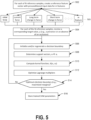
- FIG. 5 is a flow chart illustrating a method for training a model for occlusion detection, according to an embodiment of the present disclosure.
- the method may be performed by one or more processors associated with an infusion system.
- the method may be performed after preconditioning input data received from the force sensor associated with the input system.
- the training may involve an occlusion detection training dataset (e.g., as shown in FIGS. 3 and 4 ) obtained from a plurality of reference samples.
- the reference sample may be from various patients, past data, external libraries or databases, etc.
- the infusion system may create, for each of a plurality of reference samples (e.g., N reference samples), a reference feature vector with preconditioned input data for m features.
- a reference feature vector may be m-dimensional as a result of m features.
- the m features may include, but are not limited to, an initial measurement of a physical force at the start of the reference infusion session, a current measurement of a physical force during periodic intervals of the reference infusion session, a long term change in the physical force, a short term change in the physical force, etc., as shown in marker 503.
- the infusion system may receive, for each of the N reference samples, a corresponding target value, y, indicating either a presence or an absence of an occlusion.
- the target values in FIG. 4 indicated either a presence or an absence of an occlusion for the training dataset in FIG. 3
- the target values, y in step 504 may indicate whether each sample received in step 502 indicated a presence or an absence of an occlusion.
- the target value, y may comprise of N values corresponding to the N reference samples. Given the binary nature of the indication (e.g., a presence or an absence of an occlusion), the target value may comprise, for example, -1 to indicate an absence of an occlusion or 1, to indicate a presence of an occlusion.
- the infusion system may initialize and/or regenerate a decision boundary (e.g., the decision boundary 100 of Fig. 1 ).
- a decision boundary e.g., the decision boundary 100 of Fig. 1
- the infusion system may use the training method described in FIG. 5 to learn how to divide data points corresponding to those having an indication of an occlusion from those having an indication of no conclusion (e.g., via the decision boundary 100).
- the infusion system may initially create a decision boundary that may not necessarily be the most optimal.
- the infusion system may determine support vectors, x i ⁇ x j for each of the reference samples, N, at step 508.
- a kernel function, K(x 1 , x 2 ) may be computed.
- the infusion system may optimize Lagrange multipliers, e.g., to determining the optimal decision boundary.
- the infusion system may determine whether the decision boundary generated for the dataset is optimal (e.g., whether the decision boundary has the maximum margins from the binarily classified data points). If it is found that the decision boundary is not the most optimal, steps 506 through 514 may be repeated.
- the trained support vector machine with its learned parameters may be stored in step 516, e.g., in an electronic storage medium associated with the infusion system.
- the previously discussed decision boundary vectors ⁇ and b can be computed through the training method shown in FIG. 5 .
- the stored parameters for the trained support vector machine, ⁇ and b can then be utilized during an application of the trained support vector machine during a new infusion session for real-time occlusion detection, as will be shown in FIG. 6 .
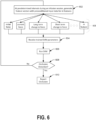
- FIG. 6 is a flow chart illustrating a method for occlusion detection in infusion systems using a trained model, according to an embodiment of the present disclosure.
- the infusion system may generate, at predetermined intervals during an infusion session, feature vectors with preconditioned input data for m features.
- the m features may include, for example, an initial measurement of a physical force at the start of the reference infusion session, a current measurement of a physical force during periodic intervals of the reference infusion session, a long term change in the physical force, a short term change in the physical force, etc., as shown in marker 603.
- the infusion system may receive the trained support vector machine (e.g., the trained parameters, ⁇ and b).
- the trained support vector machine e.g., the trained parameters, ⁇ and b
- An appropriate trained support vector machine may be identified and its trained parameters retrieved, using the parameters unique to the infusion system.
- the infusion system may run the support vector machine with its trained parameters, ⁇ and b, using the feature vector formed during the specific time interval from step 602.
- the support vector machine can thus detect in real-time, at step 608, whether there is an occlusion. If there is no indication of an occlusion, steps 602 through 608 may be repeated, e.g., based on preconditioned input data at the next time interval of the infusion session. Otherwise, at step 610, the infusion system may report the occlusion. For example, the infusion system may display an indication of the occlusion on a display device. Also or alternatively, the infusion system may terminate the infusion session upon detecting the occlusion.
- Fig. 7 is a diagram of an infusion device 700 that is configured to use a trained support vector machine 702 to perform the method of Fig. 6 , according to an example embodiment of the present disclosure.
- the infusion device 700 is an infusion pump, such as a syringe pump, an ambulatory pump, or a peristaltic pump.
- the infusion device 700 is connected to a rack 704 for support.
- the infusion device 700 is configured to receive IV tubing 706.
- a cover 708 of the infusion device 700 opens, enabling the IV tubing 706 to be inserted.
- a first end of the IV tubing 706a is fluidly coupled to a fluid container that holds a drug, medication, or other fluid for an infusion treatment.
- a second end of the IV tubing 706b is fluidly coupled to a patient via an intravenous connection.
- the infusion device 700 includes a user interface 710 for receiving operator inputs (e.g., a flow rate) such as the one or more parameters discussed above.
- the user interface 710 also displays information including a status of an infusion treatment and alarms/alerts indicative of an occlusion.
- the user interface 710 includes a touchscreen and a keypad. In other embodiments, the user interface 710 may include only a touchscreen or a keypad.
- the infusion device 700 of Fig. 7 also includes a processor 712, a memory 714, and a communication module 716. While one processor 712 is shown, the infusion device 700 may include a plurality of processors.
- the processor 712 includes a controller, a logic device, etc. configured to execute the trained support vector machine 702 (e.g., an algorithm) stored in the memory 714.
- the processor 712 is also configured to execute one or more instructions stored in the memory 714 that, when executed by the processor 712, cause the processor 712 to perform the operations described herein to provide an infusion treatment.
- the memory 714 includes any memory device including read only memory, flash memory, random access memory, a hard disk drive, a solid state drive, etc.
- the communication module 716 is configured for wireless and/or wired communication with a network, such as the Internet, a cellular network, and/or a local hospital network.
- the communication module 716 may be configured, for example, for Wi-Fi or Ethernet communication.
- the communication module 716 is configured to receive the trained support vector machine 702 (including trained parameters, ⁇ and b) from a server or clinician computer via a network.
- the processor 712 may perform the method of Fig. 5 to train the support vector machine 702.
- the communication module 716 may also receive the one or more parameters specifying an infusion treatment to be performed. Further, the communication module 716 may transmit alert or alarm messages to a server when an occlusion is detected.
- the infusion device 700 of Fig. 7 further includes a drive mechanism 718, a motor 720, a battery/power regulator 722, and a sensor 724. Together, the drive mechanism 718 and the motor 720 comprise a pumping mechanism.
- the processor 712 is configured to transmit signals or commands to the motor 720, which cause the motor 720 to rotate or otherwise operate in a certain direction and speed. The movement or rotation of a drive shaft of the motor 720 causes the drive mechanism 718 to actuate or otherwise provide force on the IV tubing 706 (or a fluid container in alternative embodiments where a fluid container is placed inside the infusion device).
- the drive mechanism 718 may include finger actuators or a rotary actuator that apply pressure on the IV tubing 706 to deliver fluid from the fluid container to a patient for an infusion treatment.
- the drive mechanism 718 and the motor 720 are collectively configured to provide precise control of fluid delivery between 0.1 milliliters/hour up to 1000 milliliters/hour.
- the drive mechanism 718 may include a piston or other actuator that pushes on a plunger of a syringe.
- the motor 720 may rotate a drive screw, which causes the drive mechanism 718 to apply force on the plunger.
- the battery/power regulator 722 is configured to provide electrical power for the infusion device 700.
- a power regulator converts outlet based AC power into DC power.
- a battery provides constant DC power.
- the force sensor 724 is configured to measure a pressure exerted by the IV tubing 706.
- the force sensor 724 may include a piezo-resistive sensor, a capacitance-based force sensor, a membrane sensor, a strain gauge, etc.
- the force sensor 724 is located within the infusion device 700.
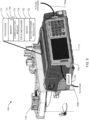
- Fig. 8 shows an alternative embodiment where the force sensor 724 is located external to the infusion device 700.
- the force sensor 724 may be connected via a wire (e.g., a universal serial bus or a serial connection) to the infusion device 700.
- the force sensor 724 may be connected via a Bluetooth ® , Zigbee ® , or other wireless connection to the infusion device 700.
- the force sensor 724 may include a pressure pod that is integrated with the IV tubing.
- the processor 712 of Figs. 7 and 8 is configured to perform the method described in connection with Fig. 6 .
- the processor 712 receives measurements from the force sensor 724 of a physical force imparted by the IV tubing 706 that is caused by pumped fluid from the fluid container.
- the processor 712 selects the trained support vector machine 702 based on the programmed infusion treatment.
- the processor 712 then records sampled force or pressure measurements from the force sensor 724 and calculates slopes for long-term and short-term changes in the physical force within the IV tubing 706 (e.g., (A), (B), (C), and (D) discussed above).
- the processor 712 uses (A), (B), (C), and (D) to create a feature vector that is input into the selected trained support vector machine 702.
- the processor 712 receives an output from the trained support vector machine 702 to indicate whether an occlusion is detected.
- the processor 712 may cause an alert and/or an alarm to be displayed on the user interface 710.
- the processor 712 may also cause a message indicative of the occlusion to be transmitted to a network via the communication module 716.
- the processor 712 may perform the method described in connection with Fig. 6 for every new force measurement. Alternatively, the processor 712 may perform the method at programmed periodic intervals, such as every 50 milliseconds, 100 milliseconds, 500 milliseconds, 1 second, 2 seconds, etc.
- Fig. 9 is a diagram of an infusion system 900 configured to perform the operations described in connection with Fig. 5 , according to an example embodiment of the present disclosure.
- the infusion system 900 includes the infusion device 700 of Figs. 7 and 8 .
- the infusion system 900 also includes a server 902 that is connected to the infusion device 700 via a network 904, which may include any cellular, wide area, and/or local area network.
- the server 902 may be part of a heath information system and include a clinician computer.
- the server 902 receives training data 906, such as the N reference samples discussed above.
- the training data 906 may be input into the server 902 from manually obtained data. Additionally or alternatively, the training data 906 may be received from one or more infusion devices including the infusion device 700.
- the server 902 is configured to create one or more trained support vector machines 702 for specific parameters of infusion treatments using the training data 906.
- the server 902 may transmit the trained support vector machines 702 to the infusion device 700 via the network 904.
- the server 902 may receive one or more parameters (e.g., a flow rate) from the infusion device 700 before a treatment is to be begin.
- the server 902 selects the trained support vector machine 702 that matches or corresponds to the received infusion parameters and transmits the selected trained support vector machine 702 to the infusion device 700 for occlusion detection.
Landscapes
- Health & Medical Sciences (AREA)
- Engineering & Computer Science (AREA)
- Biomedical Technology (AREA)
- Public Health (AREA)
- General Health & Medical Sciences (AREA)
- Medical Informatics (AREA)
- Primary Health Care (AREA)
- Epidemiology (AREA)
- Hematology (AREA)
- Animal Behavior & Ethology (AREA)
- Life Sciences & Earth Sciences (AREA)
- Veterinary Medicine (AREA)
- Vascular Medicine (AREA)
- Anesthesiology (AREA)
- Heart & Thoracic Surgery (AREA)
- General Business, Economics & Management (AREA)
- Business, Economics & Management (AREA)
- Chemical & Material Sciences (AREA)
- Data Mining & Analysis (AREA)
- Databases & Information Systems (AREA)
- Pathology (AREA)
- Medicinal Chemistry (AREA)
- Bioinformatics & Cheminformatics (AREA)
- Infusion, Injection, And Reservoir Apparatuses (AREA)
Applications Claiming Priority (3)
| Application Number | Priority Date | Filing Date | Title |
|---|---|---|---|
| US202063132183P | 2020-12-30 | 2020-12-30 | |
| PCT/US2021/065607 WO2022147194A1 (en) | 2020-12-30 | 2021-12-30 | Systems and methods for occlusion detection in infusion pumps |
| EP21840386.3A EP4271444B1 (de) | 2020-12-30 | 2021-12-30 | Systeme und methoden zur occlusionsdetektion in infusionspumpen |
Related Parent Applications (1)
| Application Number | Title | Priority Date | Filing Date |
|---|---|---|---|
| EP21840386.3A Division EP4271444B1 (de) | 2020-12-30 | 2021-12-30 | Systeme und methoden zur occlusionsdetektion in infusionspumpen |
Publications (2)
| Publication Number | Publication Date |
|---|---|
| EP4528745A2 true EP4528745A2 (de) | 2025-03-26 |
| EP4528745A3 EP4528745A3 (de) | 2025-05-21 |
Family
ID=79287858
Family Applications (2)
| Application Number | Title | Priority Date | Filing Date |
|---|---|---|---|
| EP21840386.3A Active EP4271444B1 (de) | 2020-12-30 | 2021-12-30 | Systeme und methoden zur occlusionsdetektion in infusionspumpen |
| EP25156053.8A Pending EP4528745A3 (de) | 2020-12-30 | 2021-12-30 | Systeme und verfahren zur okklusionserkennung in infusionspumpen |
Family Applications Before (1)
| Application Number | Title | Priority Date | Filing Date |
|---|---|---|---|
| EP21840386.3A Active EP4271444B1 (de) | 2020-12-30 | 2021-12-30 | Systeme und methoden zur occlusionsdetektion in infusionspumpen |
Country Status (11)
| Country | Link |
|---|---|
| US (2) | US12496394B2 (de) |
| EP (2) | EP4271444B1 (de) |
| JP (1) | JP2024502317A (de) |
| KR (1) | KR20230127267A (de) |
| CN (1) | CN116670775A (de) |
| AU (1) | AU2021413112A1 (de) |
| CA (1) | CA3205956A1 (de) |
| CO (1) | CO2023009282A2 (de) |
| ES (1) | ES3030135T3 (de) |
| MX (1) | MX2023007904A (de) |
| WO (1) | WO2022147194A1 (de) |
Families Citing this family (3)
| Publication number | Priority date | Publication date | Assignee | Title |
|---|---|---|---|---|
| US11860324B2 (en) * | 2020-07-16 | 2024-01-02 | Chevron U.S.A. Inc. | System and method for 3D seismic velocity estimation |
| CN115880268B (zh) * | 2022-12-28 | 2024-01-30 | 南京航空航天大学 | 一种塑料软管生产中检测次品的方法、系统、设备及介质 |
| US20250205416A1 (en) * | 2023-12-20 | 2025-06-26 | Baxter International Inc. | Infusion therapy device with occlusion detection |
Family Cites Families (9)
| Publication number | Priority date | Publication date | Assignee | Title |
|---|---|---|---|---|
| JP5207174B2 (ja) * | 2008-03-31 | 2013-06-12 | 国立大学法人山口大学 | 心音周波数解析装置 |
| US8603027B2 (en) * | 2012-03-20 | 2013-12-10 | Medtronic Minimed, Inc. | Occlusion detection using pulse-width modulation and medical device incorporating same |
| EP2767919B1 (de) * | 2013-02-15 | 2019-01-30 | Micrel Medical Devices S.A. | Verfahren und Gerät zur Verarbeitung von Infusionsdaten |
| CA2913915C (en) * | 2013-05-29 | 2022-03-29 | Hospira, Inc. | Infusion system which utilizes one or more sensors and additional information to make an air determination regarding the infusion system |
| EP3167923A1 (de) * | 2015-11-13 | 2017-05-17 | Fresenius Vial SAS | Verfahren zur detektion einer verstopfung in einer infusionsleitung |
| US10792420B2 (en) * | 2017-10-24 | 2020-10-06 | Carefusion 383, Inc. | Occlusion detection for infusion pumps |
| WO2019222366A1 (en) * | 2018-05-15 | 2019-11-21 | Baxter International Inc. | Syringe pump with syringe position guiding features and occlusion detection |
| CN110841143B (zh) * | 2019-10-22 | 2022-03-08 | 江苏爱朋医疗科技股份有限公司 | 一种用于预测输液管路状态的方法及系统 |
| CN110841142B (zh) * | 2019-10-22 | 2022-03-08 | 江苏爱朋医疗科技股份有限公司 | 一种用于预测输液管路堵塞的方法及系统 |
-
2021
- 2021-12-30 ES ES21840386T patent/ES3030135T3/es active Active
- 2021-12-30 WO PCT/US2021/065607 patent/WO2022147194A1/en not_active Ceased
- 2021-12-30 US US17/565,812 patent/US12496394B2/en active Active
- 2021-12-30 EP EP21840386.3A patent/EP4271444B1/de active Active
- 2021-12-30 JP JP2023539806A patent/JP2024502317A/ja active Pending
- 2021-12-30 AU AU2021413112A patent/AU2021413112A1/en not_active Abandoned
- 2021-12-30 CN CN202180087785.9A patent/CN116670775A/zh active Pending
- 2021-12-30 EP EP25156053.8A patent/EP4528745A3/de active Pending
- 2021-12-30 MX MX2023007904A patent/MX2023007904A/es unknown
- 2021-12-30 CA CA3205956A patent/CA3205956A1/en active Pending
- 2021-12-30 KR KR1020237025383A patent/KR20230127267A/ko active Pending
-
2023
- 2023-07-13 CO CONC2023/0009282A patent/CO2023009282A2/es unknown
-
2025
- 2025-12-15 US US19/420,002 patent/US20260102562A1/en active Pending
Also Published As
| Publication number | Publication date |
|---|---|
| KR20230127267A (ko) | 2023-08-31 |
| EP4528745A3 (de) | 2025-05-21 |
| US12496394B2 (en) | 2025-12-16 |
| US20260102562A1 (en) | 2026-04-16 |
| CA3205956A1 (en) | 2022-07-07 |
| EP4271444A1 (de) | 2023-11-08 |
| ES3030135T3 (en) | 2025-06-26 |
| AU2021413112A9 (en) | 2025-01-09 |
| US20220203026A1 (en) | 2022-06-30 |
| AU2021413112A1 (en) | 2023-07-06 |
| JP2024502317A (ja) | 2024-01-18 |
| CN116670775A (zh) | 2023-08-29 |
| EP4271444B1 (de) | 2025-03-05 |
| CO2023009282A2 (es) | 2023-07-21 |
| MX2023007904A (es) | 2023-07-11 |
| WO2022147194A1 (en) | 2022-07-07 |
Similar Documents
| Publication | Publication Date | Title |
|---|---|---|
| US20260102562A1 (en) | Systems and methods for occlusion detection in infusion pumps | |
| CN105848694B (zh) | 流体控制系统和一次性组件 | |
| EP4582638A2 (de) | Systeme zur bestimmung und vorrichtungen zur anzeige der lebensdauer von austauschbaren komponenten davon und verfahren dafür | |
| EP4272008B1 (de) | System und verfahren zur erzeugung von batteriealarmen in infusionsvorrichtungen | |
| EP4142830B1 (de) | Schnelle okklusionsdetektion in infusionsvorrichtungen | |
| US20260069775A1 (en) | Infusion volume detection system and method | |
| US20260108673A1 (en) | Infusion volume detection system and method | |
| Dondelinger | Intravenous pumps | |
| US20250135110A1 (en) | System and method for detection and control of a syringe pump empty condition | |
| US20240009390A1 (en) | System and method for detecting occlusions in a fluid path | |
| EP4701681A1 (de) | Vorrichtung, verfahren und system zur automatisierten vorbehandlung einer spritze während einer bolus-verabreichung einer flüssigkeit | |
| CN122003260A (zh) | 输注体积检测系统及方法 | |
| CN121490180A (zh) | 胰岛素贮存器设置期间的无传感器柱塞检测的方法 | |
| CN121490181A (zh) | 用于提高能量效率和可预测性的基础、临时基础和方波大剂量输送的方法 | |
| CN121490186A (zh) | 胰岛素疗法期间补偿胰岛素贮存器摩擦的方法 |
Legal Events
| Date | Code | Title | Description |
|---|---|---|---|
| PUAI | Public reference made under article 153(3) epc to a published international application that has entered the european phase |
Free format text: ORIGINAL CODE: 0009012 |
|
| STAA | Information on the status of an ep patent application or granted ep patent |
Free format text: STATUS: REQUEST FOR EXAMINATION WAS MADE |
|
| 17P | Request for examination filed |
Effective date: 20250205 |
|
| AC | Divisional application: reference to earlier application |
Ref document number: 4271444 Country of ref document: EP Kind code of ref document: P |
|
| AK | Designated contracting states |
Kind code of ref document: A2 Designated state(s): AL AT BE BG CH CY CZ DE DK EE ES FI FR GB GR HR HU IE IS IT LI LT LU LV MC MK MT NL NO PL PT RO RS SE SI SK SM TR |
|
| REG | Reference to a national code |
Ref country code: DE Ref legal event code: R079 Free format text: PREVIOUS MAIN CLASS: G16H0020170000 Ipc: A61M0005142000 |
|
| PUAL | Search report despatched |
Free format text: ORIGINAL CODE: 0009013 |
|
| AK | Designated contracting states |
Kind code of ref document: A3 Designated state(s): AL AT BE BG CH CY CZ DE DK EE ES FI FR GB GR HR HU IE IS IT LI LT LU LV MC MK MT NL NO PL PT RO RS SE SI SK SM TR |
|
| RIC1 | Information provided on ipc code assigned before grant |
Ipc: G16H 20/17 20180101ALI20250415BHEP Ipc: A61M 5/142 20060101AFI20250415BHEP |