EP4528638A1 - Inspektionssysteme und -verfahren zur schadensmessung - Google Patents
Inspektionssysteme und -verfahren zur schadensmessung Download PDFInfo
- Publication number
- EP4528638A1 EP4528638A1 EP24200424.0A EP24200424A EP4528638A1 EP 4528638 A1 EP4528638 A1 EP 4528638A1 EP 24200424 A EP24200424 A EP 24200424A EP 4528638 A1 EP4528638 A1 EP 4528638A1
- Authority
- EP
- European Patent Office
- Prior art keywords
- engine
- area
- nonplanar
- sensor
- reference surface
- Prior art date
- Legal status (The legal status is an assumption and is not a legal conclusion. Google has not performed a legal analysis and makes no representation as to the accuracy of the status listed.)
- Pending
Links
Images



Classifications
-
- G—PHYSICS
- G06—COMPUTING OR CALCULATING; COUNTING
- G06T—IMAGE DATA PROCESSING OR GENERATION, IN GENERAL
- G06T7/00—Image analysis
- G06T7/0002—Inspection of images, e.g. flaw detection
- G06T7/0004—Industrial image inspection
- G06T7/001—Industrial image inspection using an image reference approach
-
- F—MECHANICAL ENGINEERING; LIGHTING; HEATING; WEAPONS; BLASTING
- F01—MACHINES OR ENGINES IN GENERAL; ENGINE PLANTS IN GENERAL; STEAM ENGINES
- F01D—NON-POSITIVE DISPLACEMENT MACHINES OR ENGINES, e.g. STEAM TURBINES
- F01D21/00—Shutting-down of machines or engines, e.g. in emergency; Regulating, controlling, or safety means not otherwise provided for
- F01D21/003—Arrangements for testing or measuring
-
- G—PHYSICS
- G06—COMPUTING OR CALCULATING; COUNTING
- G06T—IMAGE DATA PROCESSING OR GENERATION, IN GENERAL
- G06T17/00—Three-dimensional [3D] modelling for computer graphics
-
- G—PHYSICS
- G06—COMPUTING OR CALCULATING; COUNTING
- G06T—IMAGE DATA PROCESSING OR GENERATION, IN GENERAL
- G06T7/00—Image analysis
- G06T7/0002—Inspection of images, e.g. flaw detection
- G06T7/0004—Industrial image inspection
-
- F—MECHANICAL ENGINEERING; LIGHTING; HEATING; WEAPONS; BLASTING
- F05—INDEXING SCHEMES RELATING TO ENGINES OR PUMPS IN VARIOUS SUBCLASSES OF CLASSES F01-F04
- F05D—INDEXING SCHEME FOR ASPECTS RELATING TO NON-POSITIVE-DISPLACEMENT MACHINES OR ENGINES, GAS-TURBINES OR JET-PROPULSION PLANTS
- F05D2260/00—Function
- F05D2260/80—Diagnostics
-
- F—MECHANICAL ENGINEERING; LIGHTING; HEATING; WEAPONS; BLASTING
- F05—INDEXING SCHEMES RELATING TO ENGINES OR PUMPS IN VARIOUS SUBCLASSES OF CLASSES F01-F04
- F05D—INDEXING SCHEME FOR ASPECTS RELATING TO NON-POSITIVE-DISPLACEMENT MACHINES OR ENGINES, GAS-TURBINES OR JET-PROPULSION PLANTS
- F05D2260/00—Function
- F05D2260/81—Modelling or simulation
-
- G—PHYSICS
- G06—COMPUTING OR CALCULATING; COUNTING
- G06T—IMAGE DATA PROCESSING OR GENERATION, IN GENERAL
- G06T2207/00—Indexing scheme for image analysis or image enhancement
- G06T2207/10—Image acquisition modality
- G06T2207/10028—Range image; Depth image; 3D point clouds
-
- G—PHYSICS
- G06—COMPUTING OR CALCULATING; COUNTING
- G06T—IMAGE DATA PROCESSING OR GENERATION, IN GENERAL
- G06T2207/00—Indexing scheme for image analysis or image enhancement
- G06T2207/20—Special algorithmic details
- G06T2207/20084—Artificial neural networks [ANN]
-
- G—PHYSICS
- G06—COMPUTING OR CALCULATING; COUNTING
- G06T—IMAGE DATA PROCESSING OR GENERATION, IN GENERAL
- G06T2207/00—Indexing scheme for image analysis or image enhancement
- G06T2207/30—Subject of image; Context of image processing
- G06T2207/30108—Industrial image inspection
- G06T2207/30164—Workpiece; Machine component
Definitions
- the present subject matter relates generally to an imaging tool, and specifically to a three-dimensional (3D) imaging tool for inspection.
- Insertion imaging systems such as borescopes can be inserted through inspection ports to perform inspections of the interior of a jet engine. Conventionally, measurements of abnormalities are taken based on manually selected reference points in the captured images.
- first,” “second,” “third,” etc. may be used interchangeably to distinguish one component from another and are not intended to signify location or importance of the individual components.
- Coupled refers to both direct coupling, fixing, or attaching, as well as indirect coupling, fixing, or attaching through one or more intermediate components or features, unless otherwise specified herein.
- Approximating language may be applied to modify any quantitative representation that could permissibly vary without resulting in a change in the basic function to which it is related. Accordingly, a value modified by a term or terms, such as “about,” “approximately,” “almost,” and “substantially” are not to be limited to the precise value specified. In some instances, the approximating language may correspond to the precision of an instrument for measuring the value. For example, the approximating language may refer to being within a 1, 2, 4, 10, 15, or 20 percent margin. These approximating margins may apply to a single value, either or both endpoints defining numerical ranges, and/or the margin for ranges between endpoints.
- Techniques for engine inspection can include a variety of profilometry technologies (e.g., structured light, depth from focus or phase, time of flight, LiDAR, etc.). These techniques are used to detect and/or measure defects or damage to a part, such as a portion of a fan blade, vane, casing, etc. Defects or damage can include a crack, a dent, a tear, an abrasion, an erosion, a bend, a creep, a thermal fatigue, a spallation, a nick, a gas corrosion, an oxidation, a fretting, a pitting, etc.
- profilometry technologies e.g., structured light, depth from focus or phase, time of flight, LiDAR, etc.
- Measurement of a damage, including wear, tear, and defects, identified during an inspection can be based on estimating where the undamaged surface would have been.
- the operator may manually establish reference points in a three-dimensional (3D) image to estimate the undamaged surface and make defect measurements. For example, an operator may manually select three points to create a planar/flat reference surface over a damaged area.
- the conventional process requires skilled operators who can select suitable reference points.
- a planar reference surface also does not provide an accurate measurement for damages on a curved surface. As such, the measurements can differ between inspections and between operators due to the variability of human interpretation.
- the variability of the conventional process drives more conservative limits to allow for sufficient safety margins in view of the potentially higher measurement error.
- an undamaged surface topography is reconstructed as a nonplanar reference surface based on automated surface approximation methods, such as CAD geometry, interpolation or extrapolation of a surface using the surrounding undamaged regions, utilizing adjacent part surfaces as references, utilizing "as-built” or previously measured surfaces topographies from the part under inspection, and/or utilizing similar part topographies.
- a standardized set of rules may be utilized to determine the standardized measurement technique to establish a repeatable measurement of the defect that is independent of operator interpretation using nonplanar reference surface estimation.
- measurements that involve the characterization of the defect at its maximum or minimum extent, statistically quantified topography, or volumetric constraints can be accomplished through enumeration or algorithmically optimized set calculations using the measured surface topography and the reconstructed estimate of the undamaged surface.
- knowledge of the part, sensor characteristics, measured topography variation, and surface estimation technique may be used to establish error bounds on the computed measurements.
- the technique described herein may be applicable to devices, such as engine product lines, that have service maintenance requirements involving visual inspection and evaluation of defect measurements against serviceable limits.
- FIG. 1 is a schematic cross-sectional diagram of a conventional gas turbine engine 10 for an aircraft in which an imaging and inspection system described herein can operate.
- the engine 10 has a generally longitudinally extending axis or centerline 12 extending forward 14 to aft 16.
- the engine 10 includes, in downstream serial flow relationship, a fan section 18 including a fan 20, a compressor section 22 including a booster or low pressure (LP) compressor 24 and a high pressure (HP) compressor 26, a combustion section 28 including a combustor 30, a turbine section 32 including a HP turbine 34 and a LP turbine 36, and an exhaust section 38.
- LP booster or low pressure
- HP high pressure
- the fan section 18 includes a fan casing 40 surrounding the fan 20.
- the fan 20 includes a plurality of fan blades 42 disposed radially about the centerline 12.
- the HP compressor 26, the combustor 30, and the HP turbine 34 form a core 44 of the engine 10 which generates combustion gases.
- the core 44 is surrounded by core casing 46 which can be coupled with the fan casing 40.
- a LP shaft or spool 50 which is disposed coaxially about the centerline 12 of the engine 10 within the larger diameter annular HP spool 48, drivingly connects the LP turbine 36 to the LP compressor 24 and fan 20.
- the LP compressor 24 and the HP compressor 26 respectively include a plurality of compressor stages 52, 54, in which a set of compressor blades 56, 58 rotate relative to a corresponding set of static compressor vanes 60, 62 (also called a nozzle) to compress or pressurize the stream of fluid passing through the stage.
- a single compressor stage 52, 54 multiple compressor blades 56, 58 can be provided in a ring and extend radially outwardly relative to the centerline 12, from a blade platform to a blade tip, while the corresponding static compressor vanes 60, 62 are positioned downstream of and adjacent to the rotating blades 56, 58. It is noted that the number of blades, vanes, and compressor stages shown in FIG. 1 were selected for illustrative purposes only, and that other numbers are possible.
- the HP turbine 34 and the LP turbine 36 respectively include a plurality of turbine stages 64, 66, in which a set of turbine blades 68, 70 are rotated relative to a corresponding set of static turbine vanes 72, 74 (also called a nozzle) to extract energy from the stream of fluid passing through the stage.
- a single turbine stage 64, 66 multiple turbine blades 68, 70 can be provided in a ring and extend radially outwardly relative to the centerline 12, from a blade platform to a blade tip, while the corresponding static turbine vanes 72, 74 are positioned upstream of and adjacent to the rotating blades 68, 70. It is noted that the number of blades, vanes, and turbine stages shown in FIG. 1 were selected for illustrative purposes only, and that other numbers are possible.
- the rotating fan 20 supplies ambient air to the LP compressor 24, which then supplies pressurized ambient air to the HP compressor 26, which further pressurizes the ambient air.
- the pressurized air from the HP compressor 26 is mixed with fuel in the combustor 30 and ignited, thereby generating combustion gases. Some work is extracted from these gases by the HP turbine 34, which drives the HP compressor 26.
- the combustion gases are discharged into the LP turbine 36, which extracts additional work to drive the LP compressor 24, and the exhaust gas is ultimately discharged from the engine 10 via the exhaust section 38.
- the driving of the LP turbine 36 drives the LP spool 50 to rotate the fan 20 and the LP compressor 24.
- the engine 10 may further define a plurality of openings allowing for inspection of various components within the engine 10.
- the engine 10 may define a plurality of insertion tool openings at various axial positions within the compressor section, combustion section 28, and turbine section 32.
- the engine 10 may include one or more igniter ports within, e.g., the combustion section 28 of the engine 10, that may allow for inspection of the combustion section 28.
- the exemplary engine 10 depicted in FIG. 1 is by way of example only, and that in other exemplary embodiments, the engine 10 may have any other suitable configuration, including, for example, any other suitable number of shafts or spools, turbines, compressors, etc. Additionally, or alternatively, in other exemplary embodiments, any other suitable turbine engine may be inspected with the systems and methods described herein.
- the engine may not be a turbofan engine, and instead may be configured as a turboshaft engine, a turboprop engine, turbojet engine, etc., or may be an industrial gas turbine engine for electricity generation, fluid pumping, etc.
- the systems and methods described herein may be used for the inspection of other aircraft or vehicle components.
- An engine 10 may be an example of a device referred to herein.
- the systems and methods described herein may be used in the inspection of any type of devices suspectable to external or internal surface damages such as cracks, dents, scratches, corrosions, abrasions, oxidations, etc.
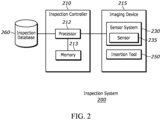
- the inspection system 200 includes an inspection controller 210, an imaging device 215, and an inspection database 260.
- the imaging device 215 includes a sensor system 230 and in some embodiments, an insertion tool 250.
- the inspection controller 210 includes a processor 212 coupled to a computer-readable storage memory 213.
- the inspection controller 210 may further include a data and/or network interface device for communicating with the imaging device 215 and/or one or more databases and services for image processing and data storage as discussed herein.
- the inspection controller 210 may include one or more of a control circuit, a microprocessor, a central processing unit (CPU), a graphics processing unit (GPU), an application-specific integrated circuit (ASIC), and the like and may be configured to execute computer-readable instructions stored on the computer-readable storage memory 213.
- the computer-readable storage memory 213 may include volatile and/or non-volatile memory and have stored upon it, computer-readable codes which, when executed by the processor, cause the inspection controller 210 to receive and process the data received from the sensor system 230 for damage characteristics measurement based on nonplanar reference surface determination.
- the processor 212 may further be configured to control the capture parameters/configurations (e.g., sensor selection, image resolution, focal length, sweep speed, cycle time, etc.).
- the inspection controller 210 may further be configured to control the motion of one or more automated or semi-automated insertion tools 250 of the imaging device 215, such as a snake arm robot or robotic arm.
- the inspection controller 210 is configured to perform one or more steps described with reference to FIG.
- the inspection controller 210 may be local or remote from the engine being inspected and communicate with the imaging device via a wired connection, a wireless local area network connection, and/or over a wide area network. In some embodiments, the inspection controller 210 may communicate with the imaging devices 215 in one or more inspection spaces for the inspection of one or more devices such as aircraft components. In some embodiments, the inspection controller 210 may be implemented on a plurality of geographically distributed devices such as a handheld device local to the device being inspected and a remote or cloud-based server.
- the sensor system 230 may include one or more sensors 235 configured to capture 3D data.
- the sensor 235 is configured to capture depth images or data that may be processed by the inspection controller 210 to generate a depth image such as a 3D point cloud.
- data captured by the sensors 235 may be used to form point clouds, depth maps, and/or stereo maps that can be converted to a 3D surface model.
- the sensor 235 may include a 2D optical sensor, stereo-optical sensor, a structured light projection scanner, a laser scanner, a touch probe, an Eddy current imager, a scanning electron microscope (SEM), and/or an ultrasound imager.
- depth data may be determined based on 2D images using shape from shading, shaping from motion, or other 3D estimation techniques.
- the sensor system 230 may include sensors of different types.
- the insertion tool 250 generally refers to a tool configured to insert one or more sensors of the sensor system 230 into a confined or narrow space to perform inspections.
- the insertion tool 250 may be a borescope tool configured to be inserted through a port on the casing of an assembled engine to capture images of the interior of the engine, such as the engine 10.
- the insertion tool 250 may include a flexible insertion tool, a rigidizable insertion tool, a robotic arm, or a snake arm robot.
- the insertion tool 250 may be a manually operated tool, a semi-automated tool, or an automated tool.
- the insertion tool 250 may be configured to position a sensor at a predefined location and orientation within the engine interior upon insertion.
- the insertion tool 250 may include one or more channels for routing wires for transmitting signals between the inspection controller 210 and the sensor system 230.
- the imaging device 215 may include an insertion tool 250 configured to be interchangeably coupled with a number of different types of sensors, an insertion tool 250 coupled to a plurality of sensors of different types, or a plurality of insertion tools 250 each coupled to one or more types of sensors of the sensor system 230.
- the inspection database 260 includes one or more computer readable memory storage devices.
- the inspection database 260 is generally configured to store inspection data generated by the inspection controller 210 based on communications with the imaging device 215.
- the inspection database 260 may device inspection histories for any number of devices.
- the inspection database 260 may further store reference data from manufacturers and third parties such as maintenance requirements, service manuals, serviceability metrics, etc.
- the inspection database 260 may further store inspection rules for different devices, components, parts, and/or damage types.
- the inspection rules may specify inspection configurations such as sensor selection, capture parameters, reference surface reconstruction rules, and characteristics measurement rules.
- inspection rules may be defined for LE abrasion on a LP compressor airfoil, LE crack on a LP compressor airfoil, TE crack on a LP compressor airfoil, LE abrasion on a HP compression airfoil, dent on LP compressor casing, etc.
- the inspection rules may further specify tolerances for part disposition (e.g., no action, repair, replace, etc.).
- the inspection rule may specify the depths that trigger a repair task or a replacement task for a LE abrasion on a LP compression airfoil.
- the data in the inspection database 260 may be implemented as one or more database structures.
- the inspection database 260 may be implemented on one or more physical devices such as a local storage memory, a server storage memory, a cloud-based storage memory. In some embodiments, the inspection database 260 may be implemented at least partially on the computer-readable storage memory 213 of the inspection controller 210. In some embodiments, the inspection controller 210 may access the inspection database 260 through a network such as the Internet.
- FIG. 3 a method for performing inspection is shown. In some embodiments, one or more steps of FIG. 3 may be performed with the inspection system 200 described with reference to FIG. 2 .
- an insertion tool such as the insertion tool 250
- a confined space such as an engine interior cavity (e.g., the combustion section 28).
- the insertion tool may be manually operated, semi-automated, or automated.
- the insertion tool may include a rigidizable tool that is inserted and rigidized to position the sensor 235 of the imaging device 215 at a predefined location and/or orientation.
- the insertion tool 250 may be mechanically driven by signals from a controller into position.
- the inspection system 200 determines a device component or device area associated with the data captured in step 310.
- the device component or the device area is identified based on a capture location of the sensor 235, machine vision feature recognition, artificial intelligence image recognition, and/or a computer model of the device.
- the device component or the device area is identified based on a sensor different from the sensor 235.
- the sensor system 230 may include a camera for capturing 2D colored images and a 3D camera for capturing 3D data. The device component or device area may be determined based on the image captured by the 2D camera prior to the 3D scan being initiated.
- the device component or device area may be determined based on the insertion location of the insertion tool and/or the sensor of the imaging device. In some embodiments, the device component or device area may be received as an operator input. For example, a user interface may be provided for the operator to select from among a plurality of parts or areas. In some embodiments, the device area includes a zone of a component, wherein the zone includes a leading edge, a trailing edge, a tip, a root fillet, a platform, a suction side, a pressure side, or a component area identifier. In some embodiments, step 305 may occur after step 310 and be based on the data captured in step 310.
- the inspection system 200 may further identify a damage type.
- the damage type may be identified based on sensor data captured from the part, device maintenance history, device usage history, or operator input.
- the damage type may be determined based on a color image, a hyperspectral image, a thermal image, a radiology image, and/or a device history.
- a machine learning computer vision algorithm may be used to identify the damage type based on a 2D or 3D image.
- the damage type may be inputted by an operator through a user interface provided on the inspection system 200.
- the damage type includes a crack, a dent, an abrasion, an erosion, a bend, a creep, a thermal fatigue, a spallation, a nick, a gas corrosion, an oxidation, a fretting, and/or a pitting.
- the damage type may be determined based on the data captured in 310 or by a different sensor.
- the damage type determined in step 308 and/or the device component/area determined in step 305 may be used to determine and configure the parameters for data capture in step 310, select the reconstruction method and/or parameters in step 320, and/or set the characteristics measurement rules in step 330.
- the inspection system 200 is configured to select a sensor 235 from among different types of sensors of the sensor system 230 to capture data from the part based on the device area/component and/or damage type. In some embodiments, the inspection system 200 is configured to determine the capture parameters of the sensor 235 based on the device area/component and/or damage type.
- the capture resolution or focal length of the sensor may be set based on the part (e.g., engine LP compressor blades, inlet channel, etc.) being inspected and/or the damage type.
- the damage type determined in step 308 and/or the device component/area determined in step 305 may further be used to determine the subsequent tasks in step 350.
- the disposition thresholds and/or the methods of repair may be determined based on damage type and/or location.
- the damage type determined in step 308 and/or the device component/area determined in step 305 may be used to select from among the inspection rules stored in the inspection database 260.
- a sensor of the sensor system 200 captures data from a part being inspected to form a 3D surface model of the surface.
- the data may be captured by a stereo-optical sensor, a structured light projection scanner, a laser scanner, a touch probe, an Eddy current imager, a scanning electron microscope (SEM), or an ultrasound imager.
- the data may include data captured by multiple sensors and combined into a 3D surface model.
- the data may be captured while the part is rotating.
- the part being inspected may be on a rotating airfoil of an engine.
- the sensor may be configured to generate a 3D point cloud.
- the processor 212 of the inspection system 200 may be configured to process the captured data (e.g., stereo 2D images) to form the 3D surface model.
- the inspection controller 210 of the inspection system 200 determines a nonplanar reference surface based on the 3D surface model formed in step 310.
- the nonplanar reference surface corresponds to an estimation of an undamaged surface and/or the original condition of the part.
- the nonplanar reference surface may be determined based on segmenting a damaged area from an undamaged area on the part of the device in step 315.
- the damaged area is segmented based on the 3D surface model and/or another image captured by a different sensor of the sensor system 230.
- the damaged area is segmented based on an image-based computer vision identification algorithm.
- the damaged area is segmented by classifying a minimum radius of curvature limit for an undamaged surface and identifying an area with surfacing exceeding the minimum radius of curvature limits as the damaged area. In some embodiments, the damaged area is identified based on comparing color, reflectiveness, surface texture, thermal properties, or electrical properties of areas of the part. In some embodiments, the damaged area is identified based on comparing the 3D surface model with a computer-aided design (CAD) model of the part or a previously captured surface model of the part. In some embodiments, the damaged area may be segmented based at least partially on an operator input/selection in an image of the part.
- CAD computer-aided design
- the nonplanar reference surface is determined based on performing polynomial interpolation, spline interpolation, bilinear interpolation, and/or bicubic interpolation over the 3D surface model. In some embodiments, the nonplanar reference surface is determined based on applying a series of interpolation methods to the 3D surface model until a fit threshold is met. In some embodiments, the fit of the reference surface may be determined based on an error or outlier detection algorithm such as the mean square error estimation, R-square fit analysis, regression analysis, L1 or L2 principal component analysis, random sample consensus (RANSAC) analysis, least median squire analysis, and the like.
- R-square fit analysis such as the mean square error estimation, R-square fit analysis, regression analysis, L1 or L2 principal component analysis, random sample consensus (RANSAC) analysis, least median squire analysis, and the like.
- the nonplanar reference surface is determined based on fitting the 3D surface model to a plurality of candidate geometries associated with a device component or a device area associated with the part.
- the 3D surface model may be selected based on Minimum Description Length, Akaike Information Criterion, Bayesian Information Criterion, and the like.
- the nonplanar reference surface is determined based on fitting an idealized surface model over the undamaged area to interpolate the nonplanar reference surface over the damaged area.
- the undamaged area segmented in step 315 may serve as reference data points for the interpolations.
- the nonplanar reference surface is determined based on an objective function used to determine a sampled average surface estimation of an undamaged part from a plurality of similar parts.
- the part of the device being inspected includes a portion of an airfoil and the plurality of similar parts includes other airfoils of the device, wherein the surface estimation is based on data from the plurality of similar parts captured with the sensor at a same location.
- the measurement data from the plurality of similar parts and the data from the sensor are captured while a component on which the airfoils are mounted is rotating.
- the airfoils may be rotating blades and /or stator vanes.
- similar parts may be surface sections of a rotating component such as a shaft or a blade.
- the part the device inspected may generally a rotating (e.g., rotating blades) or a stationary (e.g., nozzle and vanes) part of a device.
- the method of nonplanar reference surface reconstruction may be selected from a plurality of above-described methods based on the component/area determined in step 305 and/or the damage type determined in step 308.
- the parameters of methods e.g., interpolation parameters/factors
- the parameters of methods may be selected based on the component/area and/or damage type.
- the inspection controller 210 of the inspection system 200 measures a characteristic of the damage based on the 3D surface model determined in step 330 and the nonplanar reference surface determined in step 320.
- the characteristics may be measured based on the difference between the damaged area of the 3D surface model and the nonplanar reference surface.
- the characteristics of the damaged portion include a defect depth, a defect size, a defect sharpness, a defect aspect ratio, a defect orientation relative to a component, a damaged portion volume, and/or a spatial relationship to another damaged area.
- the depth of defect may be measured based on a distance from the reference surface to the damaged surface, along the reference surface normal.
- the depth of the defect may be measured based on measuring the minimum distance from all points on the damaged surface of the 3D surface model to any point of the reference/undamaged surface. In some embodiments, the depth of the defect may be measured based on determining the largest sphere that will fit between the reference surface and the measured damaged surface. In some embodiments, the defect size may be measured based on the length, width, and depth. In some embodiments, the defect size may be measured based on the total area, circumference, and/or connection to another feature (e.g., row x, row 6 of cooling holes). In some embodiments, defect sharpness may be based on deriving stress concentration factor (Kt) to determine high cycle fatigue (HCF) effects.
- Kt stress concentration factor
- HCF high cycle fatigue
- the defect orientation may be measured based on determining the major axis of the defect.
- the measurement may be used to identify the damage type such as a crack, a dent, a tear, an abrasion, an erosion, a bend, a creep, a thermal fatigue, a spallation, a nick, a gas corrosion, an oxidation, a fretting, and/or a pitting.
- the measured characteristics may be selected based on the damage type.
- a crack may further be characterized by its connection to one or more features such as an edge of a component, one or more cooling holes, etc.
- abrasion/erosion may further be characterized by the part, such as leading-edge, tip, and coatings.
- a bend may further be characteristic by shape, such as tip curl or gross bends.
- pitting may further be characterized by pit size, spacing, and density on or portion of a surface.
- the linearity and the tortuosity of the damage may be characterized based on the nonplanar reference surface.
- the characteristics of the damage measured in step 330 may be used to determined a part disposition and/or the subsequent task in step 350.
- step 330 may include receiving a user input or a predefined rule of the characteristics to measure and outputting a numerical measurement.
- the measurement rules may be part of the inspection rule selected based on device component/area and/or damage type.
- a user interface may be provided for an operator to select points on the 3D surface model and/or the nonplanar reference surface for measurement.
- step 330 may include determining the on-device/component location of the damaged portion.
- the location of the damaged portion includes a distance to a device feature, wherein the device feature includes a cooling hole, a root fillet, a tip, an airfoil leading edge, an airfoil trailing edge, a proportion of an airfoil chord, or a platform.
- the measured characteristics are stored in an inspection database 260 as part of the inspection record of the device.
- the captured data, 3D surface model, and/or the nonplanar reference surface may also be stored as part of the record.
- multiple nonplanar reference surfaces may be determined for a part by repeating one or more of 310, 305, 320, and 315.
- a part may include multiple damaged areas and/or damage types.
- Discrete and/or connected nonplanar reference surfaces may be determined for different portions of the part. For example, for an airfoil, a first nonplanar reference surface may be determined for a damage on the leading edge and a second nonplanar reference surface may be determined for a damage on the suction side near the tip.
- the system may further determine a subsequent task based on the measured characteristics in step 330.
- the measured characteristic in step 330 may be used to determine the disposition (e.g., no action, serviceable, repairable, unserviceable, etc.) of the device or the component associated with the part.
- the disposition may be determined based on comparing the measured characteristics with disposition thresholds associated with the device component/area and/or damage type.
- the device or component may be categorized as confirming or nonconforming based on comparing the measured characteristics with damage type and device or component-specific limits.
- the subsequent task may be a reinspection task.
- the inspection system may select a new sensor and/or captured parameter based on the measured characteristics.
- the damage type determined in step 308 may be preliminary, and a different damage type may be identified based on the measured characteristics in step 300. In such cases, a new set of inspection rules may be selected for the reinspection task based on the updated damage type.
- the process may return to step 310 to perform the reinspection ask.
- the subsequent task may be a servicing or repair task such as performing a cleaning operation, a welding operation, a resurfacing operation, a coating application operation, etc.
- the servicing or repair task type may be determined based on the part's component/area and/or the damage type. For example, a recoating task may be performed in response to the detection of coating lost.
- the material or method selected for filling the damaged area may be selected based on the specific component or component area.
- step 355 the servicing or repair operation is performed.
- step 335 may be performed via the insertion tool or another tool for accessing the part inspected.
- the subsequent task may be based on the nonplanar reference surface determined in step 320.
- the repair operation may be configured to fill-in/restore the damaged area to match the nonplanar reference surface.
- FIGS. 4A-D include illustrations of an example of reference surface determination.
- FIG. 4A shows a captured 3D surface model 410 of a part.
- FIG. 4B illustrates the segmentation of the 3D surface model 410 into a damaged area 425 and an undamaged area 420. In some embodiments, the segmentation may be performed according to step 315.
- a nonplanar reference surface 430 is formed. In some embodiments, the nonplanar reference surface 430 may be formed according to step 320. In the example shown FIG. 4C , the nonplanar reference surface 430 is formed based on spline interpolation using lines and/or points in the undamaged areas 420 of the 3D surface model 410.
- FIG. 4D is an illustration of computed characteristics 440 based on the nonplanar reference surface 430 and the 3D surface model 410.
- the measured characteristics may be the distance between the 3D surface model 410 and the nonplanar reference surface 430, corresponding to the depth of the damaged area.
- the damaged area 425 segmentation in FIG. 4B may be preliminary. Characteristics of the damaged area such as width, length, and radius may be measured with higher precision after the reconstruction of the nonplanar reference surface 430.
- a system for engine inspection including: a sensor configured to capture data from a part of an engine; memory including instructions; and a processor to execute the instructions to: form a three-dimensional (3D) surface model of the part of the engine based on signals received from the sensor; determine a nonplanar reference surface based on the 3D surface model of the part; and measure a characteristic of a damaged portion of the part of the engine based on the 3D surface model and the nonplanar reference surface.
- 3D three-dimensional
- the engine is an assembled gas turbine engine and the sensor is mounted on a borescope tool inserted into a cavity of the assembled gas turbine engine to capture the data from an interior of the engine.
- processor executes the instructions to: identify an engine component or an engine area in which the part of the engine is located.
- processor executes the instructions to identify the engine component or the engine area based on a capture location of the sensor, machine vision feature recognition, artificial intelligence image recognition, and/or a computer model of the engine.
- the damaged area is segmented by classifying a minimum radius of curvature limit for an undamaged surface and identifying an area with surfacing exceeding the minimum radius of curvature limits as the damaged area.
- the damaged area is identified based on comparing color, reflectiveness, surface texture, or thermal property of areas of the part.
- nonplanar reference surface is determined based on fitting an idealized surface model over the undamaged area to interpolate the nonplanar reference surface over the damaged area.
- nonplanar reference surface is determined based on an objective function used to determine a sampled average surface estimation of an undamaged part from a plurality of similar parts.
- the part of the engine includes a portion of an airfoil of the engine
- the plurality of similar parts includes other airfoils of the engine
- surface estimation is based on data from the plurality of similar parts captured with the sensor at a same location.
- nonplanar reference surface is determined based on performing polynomial interpolation, spline interpolation, bilinear interpolation, and/or bicubic interpolation over the 3D surface model.
- nonplanar reference surface is determined based on applying a series of interpolation methods to the 3D surface model until a fit threshold is met.
- nonplanar reference surface is determined based on fitting the 3D surface model to a plurality of candidate geometries associated with an engine component or an engine area associated with the part.
- processor is further configured to determine a location of the damaged portion.
- the characteristics of the damaged portion include a defect depth, a defect size, a defect sharpness, a defect aspect ratio, a defect orientation relative to a component, a damaged portion volume, or a spatial relationship to another damaged area.
- processor is further configured to: identify a damage type associated with the damaged portion; and wherein the characteristics of the damaged portion are measured based on the damage type.
- processor is further configured to identify a subsequent task based on the characteristic of the damaged portion.
- the subsequent task includes a reinspection task
- the system is configured to select a different sensor or a different capture setting of the sensor to perform the reinspection task based on the characteristic or a damage type of the damaged portion.
- a method for engine inspection including: capturing, with a sensor, data from a part of an engine; forming, by a processor executing instructions, a three-dimensional (3D) surface model of the part of the engine based on signals received from the sensor; determining, with the processor, a nonplanar reference surface based on the 3D surface model of the part; and measuring, with the processor, a characteristic of a damaged portion of the part of the engine based on the 3D surface model and the nonplanar reference surface.
- 3D three-dimensional
- An system for device inspection including: a sensor system including a sensor configured to capture data from a part of a device; and a processor receiving data from the sensor, the processor being configured to: form a three-dimensional (3D) surface model of the part of the device based on signals received from the sensor system; determine a nonplanar reference surface based on the 3D surface model of the part; and measure a characteristic of a damaged portion of the part of the device based on the 3D surface model and the nonplanar reference surface.
- 3D three-dimensional
- the senor includes a stereo-optical sensor, a structured light projection scanner, a laser scanner, a touch probe, an Eddy current imager, a scanning electron microscope (SEM), or an ultrasound imager.
- the device includes an assembled gas turbine engine
- the sensor is mounted on a borescope tool inserted into a cavity of the assembled gas turbine engine to capture the data from an interior of the assembled gas turbine engine.
- processor is further configured to: identify a device component or a device area in which the part of the device is located.
- the senor system includes sensors of different types
- the processor is further configured to select the sensor from among sensors the sensor system to capture data from the part based on the device component or the device area.
- processor is further configured to determine capture parameters of the sensor based on the device component or the device area.
- processor is further configured to measure the characteristic of the damaged portion based on the device component or the device area.
- the device component or the device area is identified based on a capture location of the sensor, machine vision feature recognition, artificial intelligence image recognition, and/or a computer-model of the device.
- the device area includes a zone of a component, wherein the zone includes a leading edge, a trailing edge, a tip, a root fillet, a platform, a suction side, a pressure side, or a component area identifier.
- the 3D surface model is segmented into a damaged area from an undamaged area on the part of the device; wherein the nonplanar reference surface is determined based on the undamaged area of the 3D surface model.
- the damaged area is segmented by classifying a minimum radius of curvature limit for an undamaged surface and identifying an area with surfacing exceeding the minimum radius of curvature limits as the damaged area.
- the damaged area is identified based on comparing color, reflectiveness, surface texture, or thermal property of areas of the part.
- the damaged area is identified based on comparing the 3D surface model with a computer-aided design (CAD) model of the part or a previously captured surface model of the part.
- CAD computer-aided design
- nonplanar reference surface is determined based on fitting an idealized surface model over the undamaged area to interpolate the nonplanar reference surface over the damaged area.
- nonplanar reference surface is determined based on an objective function used to determine a sampled average surface estimation of an undamaged part from a plurality of similar parts.
- the part of the device includes a portion of an airfoil
- the plurality of similar parts includes other airfoils of the device
- surface estimation is based on data from the plurality of similar parts captured with the sensor at a same location.
- nonplanar reference surface is determined based on performing polynomial interpolation, spline interpolation, bilinear interpolation, and/or bicubic interpolation over the 3D surface model.
- nonplanar reference surface is determined based on applying a series of interpolation methods to the 3D surface model until a fit threshold is met.
- nonplanar reference surface is determined based on fitting the 3D surface model to a plurality of candidate geometries associated with a device component or a device area associated with the part.
- processor is further configured to determine a location of the damaged portion.
- the location of the damaged portion includes a distance to a device feature, wherein the device feature includes a cooling hole, a root fillet, a tip, an airfoil leading edge, an airfoil trailing edge, a proportion of an airfoil chord, or a platform.
- the characteristics of the damaged portion include a defect depth, a defect size, a defect sharpness, a defect aspect ratio, a defect orientation relative to a component, a damaged portion volume, or a spatial relationship to another damaged area.
- processor is further configured to identify a damage type based on the characteristic of the damaged portion and a component or a device region associated with the part of the device.
- processor is further configured to: identify a damage type associated with the damaged portion; and cause the sensor system to capture the data based on the damage type.
- processor is further configured to: identify a damage type associated with the damaged portion; and measure the characteristics based on the damage type.
- the damage type includes a crack, a dent, a tear, an abrasion, an erosion, a bend, a creep, a thermal fatigue, a spallation, a nick, a gas corrosion, an oxidation, a fretting, and/or a pitting.
- the damage type is further determined based on a color image, a hyperspectral image, a thermal image, a radiology image, and/or a device history.
- processor is further configured to identify a subsequent task based on the characteristic of the damaged portion.
- the subsequent task is determined based on: determining a threshold value based on a component associated with the damaged portion, a location of the damaged portion, a damage type, and/or device usage information; and comparing the characteristic with the threshold value.
- the subsequent task includes a repair task, a service task, or a replacement task.
- the subsequent task includes a reinspection task
- the system is configured to select a different sensor or a different capture setting of the sensor to perform the reinspection task based on the characteristic or a damage type of the damaged portion.
- processor is further configured to store the 3D surface model and/or the nonplanar reference surface in a reference database for future inspections.
- a method for device inspection including: capturing, with a sensor system, data from a part of a device; forming, with a processor, a three-dimensional (3D) surface model of the part of the device based on signals received from the sensor system; determining, with the processor, a nonplanar reference surface based on the 3D surface model of the part; and measuring, with the processor, a characteristic of a damaged portion of the part of the device based on the 3D surface model and the nonplanar reference surface.
- 3D three-dimensional
- the senor includes a stereo-optical sensor, a structured light projection scanner, a laser scanner, a touch probe, an Eddy current imager, a scanning electron microscope (SEM), or an ultrasound imager.
- the sensor includes a stereo-optical sensor, a structured light projection scanner, a laser scanner, a touch probe, an Eddy current imager, a scanning electron microscope (SEM), or an ultrasound imager.
- the device is an assembled gas turbine engine and the sensor is mounted on a borescope tool inserted into a cavity of the assembled gas turbine engine to capture the data from an interior of the gas turbine engine.
- the method of any preceding clause further includes: identifying a device component or a device area in which the part of the device is located.
- the method of any preceding clause further includes: selecting the sensor from among a plurality of types of sensors of the sensor system to capture data from the part based on the device component or the device area.
- the method of any preceding clause further includes: determining capture parameters of the sensor based on the device component or the device area.
- the device component or the device area is identified based on a capture location of the sensor, machine vision feature recognition, artificial intelligence image recognition, and/or a computer-model of the device.
- the device area includes a zone of a component, wherein the zone includes a leading edge, a trailing edge, a tip, a root fillet, a platform, a suction side, a pressure side, or a component area identifier.
- the 3D surface model is segmented into a damaged area from an undamaged area on the part of the device; wherein the nonplanar reference surface is determined based on the undamaged area of the 3D surface model.
- the damaged area is segmented by classifying a minimum radius of curvature limit for an undamaged surface and identifying an area with surfacing exceeding the minimum radius of curvature limits as the damaged area.
- the damaged area is identified based on comparing color, reflectiveness, surface texture, or thermal property of areas of the part.
- the damaged area is identified based on comparing the 3D surface model with a computer-aided design (CAD) model of the part or a previously captured surface model of the part.
- CAD computer-aided design
- nonplanar reference surface is determined based on fitting an idealized surface model over the undamaged area to interpolate the nonplanar reference surface over the damaged area.
- nonplanar reference surface is determined based on an objective function used to determine a sampled average surface estimation of an undamaged part from a plurality of similar parts.
- the part of the device includes a portion of an airfoil
- the plurality of similar parts includes other airfoils of the device
- surface estimation is based on data from the plurality of similar parts captured with the sensor at a same location.
- nonplanar reference surface is determined based on performing polynomial interpolation, spline interpolation, bilinear interpolation, and/or bicubic interpolation over the 3D surface model.
- nonplanar reference surface is determined based on applying a series of interpolation methods to the 3D surface model until a fit threshold is met.
- nonplanar reference surface is determined based on fitting the 3D surface model to a plurality of candidate geometries associated with a device component or a device area associated with the part.
- processor is further configured to determine a location of the damaged portion.
- the location of the damaged portion includes a distance to a device feature, wherein the device feature includes a cooling hole, a root fillet, a tip, an airfoil leading edge, an airfoil trailing edge, a proportion of an airfoil chord, or a platform.
- the characteristics of the damaged portion include a defect depth, a defect size, a defect sharpness, a defect aspect ratio, a defect orientation relative to a component, a damaged portion volume, or a spatial relationship to another damaged area.
- the processor is further configured to identify a damage type based on the characteristic of the damaged portion and a component or a device region associated with the part of the device.
- processor is further configured to: identify a damage type associated with the damaged portion; and cause the sensor method to capture the data based on the damage type.
- processor is further configured to: identify a damage type associated with the damaged portion; and measure the characteristics based on the damage type.
- the damage type includes a crack, a dent, a tear, an abrasion, an erosion, a bend, a creep, a thermal fatigue, a spallation, a nick, a gas corrosion, an oxidation, a fretting, and/or a pitting.
- the damage type is further determined based on a color image, a hyperspectral image, a thermal image, a radiology image, and/or a device history.
- processor is further configured to identify a subsequent task based on the characteristic of the damaged portion.
- the subsequent task is determined based on: determining a threshold value based on a component associated with the damaged portion, a location of the damaged portion, a damage type, and/or device usage information; and comparing the characteristic with the threshold value.
- the subsequent task includes a repair task, a service task, or a replacement task.
- the subsequent task includes a reinspection task
- the system is configured to select a different sensor or a different capture setting of the sensor to perform the reinspection task based on the characteristic or a damage type of the damaged portion.
- processor is further configured to store the 3D surface model and/or the nonplanar reference surface in a reference database for future inspections.
- a system for engine inspection including: a sensor system including a sensor configured to capture data from a part of an engine; and a processor receiving data from the sensor, the processor being configured to: form a three-dimensional (3D) surface model of the part of the engine based on signals received from the sensor system; determine a nonplanar reference surface based on the 3D surface model of the part; and measure a characteristic of a damaged portion of the part of the engine based on the 3D surface model and the nonplanar reference surface.
- 3D three-dimensional
- the senor includes a stereo-optical sensor, a structured light projection scanner, a laser scanner, a touch probe, an Eddy current imager, a scanning electron microscope (SEM), or an ultrasound imager.
- the engine is an assembled gas turbine engine and the sensor is mounted on a borescope tool inserted into a cavity of the assembled gas turbine engine to capture the data from an interior of the engine.
- processor is further configured to: identify an engine component or an engine area in which the part of the engine is located.
- the senor system includes sensors of different types
- the processor is further configured to select the sensor from among sensors the sensor system to capture data from the part based on the engine component or the engine area.
- processor is further configured to determine capture parameters of the sensor based on the engine component or the engine area.
- processor is further configured to measure the characteristic of the damaged portion based on the engine component or the engine area.
- the engine component or the engine area is identified based on a capture location of the sensor, machine vision feature recognition, artificial intelligence image recognition, and/or a computer model of the engine.
- the engine area includes a zone of a component, wherein the zone includes a leading edge, a trailing edge, a tip, a root fillet, a platform, a suction side, a pressure side, or a component area identifier.
- the 3D surface model is segmented into a damaged area from an undamaged area on the part of the engine; wherein the nonplanar reference surface is determined based on the undamaged area of the 3D surface model.
- the damaged area is segmented by classifying a minimum radius of curvature limit for an undamaged surface and identifying an area with surfacing exceeding the minimum radius of curvature limits as the damaged area.
- the damaged area is identified based on comparing color, reflectiveness, surface texture, or thermal property of areas of the part.
- the damaged area is identified based on comparing the 3D surface model with a computer-aided design (CAD) model of the part or a previously captured surface model of the part.
- CAD computer-aided design
- nonplanar reference surface is determined based on fitting an idealized surface model over the undamaged area to interpolate the nonplanar reference surface over the damaged area.
- nonplanar reference surface is determined based on an objective function used to determine a sampled average surface estimation of an undamaged part from a plurality of similar parts .
- the part of the engine includes a portion of an airfoil of the engine
- the plurality of similar parts includes other airfoils of the engine
- surface estimation is based on data from the plurality of similar parts captured with the sensor at a same location.
- nonplanar reference surface is determined based on performing polynomial interpolation, spline interpolation, bilinear interpolation, and/or bicubic interpolation over the 3D surface model.
- nonplanar reference surface is determined based on applying a series of interpolation methods to the 3D surface model until a fit threshold is met.
- nonplanar reference surface is determined based on fitting the 3D surface model to a plurality of candidate geometries associated with an engine component or an engine area associated with the part.
- processor is further configured to determine a location of the damaged portion.
- the location of the damaged portion includes a distance to an engine feature, wherein the engine feature includes a cooling hole, a root fillet, a tip, an airfoil leading edge, an airfoil trailing edge, a proportion of an airfoil chord, or a platform.
- the characteristics of the damaged portion include a defect depth, a defect size, a defect sharpness, a defect aspect ratio, a defect orientation relative to a component, a damaged portion volume, or a spatial relationship to another damaged area.
- processor is further configured to identify a damage type based on the characteristic of the damaged portion and a component or an engine region associated with the part of the engine.
- processor is further configured to: identify a damage type associated with the damaged portion; and determine the nonplanar reference surface based on the damage type.
- processor is further configured to: identify a damage type associated with the damaged portion; and measure the characteristics based on the damage type.
- the damage type includes a crack, a dent, a tear, an abrasion, an erosion, a bend, a creep, a thermal fatigue, a spallation, a nick, a gas corrosion, an oxidation, a fretting, and/or a pitting.
- the damage type is further determined based on a color image, a hyperspectral image, a thermal image, a radiology image, and/or an engine history.
- the subsequent task is determined based on: determining a threshold value based on a component associated with the damaged portion, a location of the damaged portion, a damage type, and/or engine usage information; and comparing the characteristic with the threshold value.
- the subsequent task includes a repair task, a service task, or a replacement task.
- the subsequent task includes a reinspection task
- the system is configured to select a different sensor or a different capture setting of the sensor to perform the reinspection task based on the characteristic or a damage type of the damaged portion.
- processor is further configured to store the 3D surface model and/or the nonplanar reference surface in a reference database for future inspections.
- a method for engine inspection including: capturing, with a sensor system, data from a part of an engine; forming, with a processor, a three-dimensional (3D) surface model of the part of the engine based on signals received from the sensor system; determining, with the processor, a nonplanar reference surface based on the 3D surface model of the part; and measuring, with the processor, a characteristic of a damaged portion of the part of the engine based on the 3D surface model and the nonplanar reference surface.
- 3D three-dimensional
- the senor includes a stereo-optical sensor, a structured light projection scanner, a laser scanner, a touch probe, an Eddy current imager, a scanning electron microscope (SEM), or an ultrasound imager.
- the sensor includes a stereo-optical sensor, a structured light projection scanner, a laser scanner, a touch probe, an Eddy current imager, a scanning electron microscope (SEM), or an ultrasound imager.
- the engine is an assembled gas turbine engine and the sensor is mounted on a borescope tool inserted into a cavity of the assembled gas turbine engine to capture the data from an interior of the engine.
- the method of any preceding clause further includes: identifying an engine component or an engine area in which the part of the engine is located.
- the method of any preceding clause further includes: selecting the sensor from among a plurality of types of sensors of the sensor system to capture data from the part based on the engine component or the engine area.
- the method of any preceding clause further includes: determining capture parameters of the sensor based on the engine component or the engine area.
- the engine component or the engine area is identified based on a capture location of the sensor, machine vision feature recognition, artificial intelligence image recognition, and/or a computer-model of the engine.
- the engine area includes a zone of a component, wherein the zone includes a leading edge, a trailing edge, a tip, a root fillet, a platform, a suction side, a pressure side, or a component area identifier.
- the 3D surface model is segmented into a damaged area from an undamaged area on the part of the engine; wherein the nonplanar reference surface is determined based on the undamaged area of the 3D surface model.
- the damaged area is segmented based on the 3D surface model and/or another image captured by a different sensor of the sensor system.
- the damaged area is segmented by classifying a minimum radius of curvature limit for an undamaged surface and identifying an area with surfacing exceeding the minimum radius of curvature limits as the damaged area.
- the damaged area is identified based on comparing color, reflectiveness, surface texture, or thermal property of areas of the part.
- the damaged area is identified based on comparing the 3D surface model with a computer-aided design (CAD) model of the part or a previously captured surface model of the part.
- CAD computer-aided design
- nonplanar reference surface is determined based on fitting an idealized surface model over the undamaged area to interpolate the nonplanar reference surface over the damaged area.
- nonplanar reference surface is determined based on an objective function used to determine a sampled average surface estimation of an undamaged part from a plurality of similar parts .
- part of the engine includes a portion of an airfoil of the engine
- the plurality of similar parts includes other airfoils of the engine
- surface estimation is based on data from the plurality of similar parts captured with the sensor at a same location.
- nonplanar reference surface is determined based on performing polynomial interpolation, spline interpolation, bilinear interpolation, and/or bicubic interpolation over the 3D surface model.
- nonplanar reference surface is determined based on applying a series of interpolation methods to the 3D surface model until a fit threshold is met.
- nonplanar reference surface is determined based on fitting the 3D surface model to a plurality of candidate geometries associated with an engine component or an engine area associated with the part.
- processor is further configured to determine a location of the damaged portion.
- the location of the damaged portion includes a distance to an engine feature, wherein the engine feature includes a cooling hole, a root fillet, a tip, an airfoil leading edge, an airfoil trailing edge, a proportion of an airfoil chord, or a platform.
- the characteristics of the damaged portion include a defect depth, a defect size, a defect sharpness, a defect aspect ratio, a defect orientation relative to a component, a damaged portion volume, or a spatial relationship to another damaged area.
- processor is further configured to identify a damage type based on the characteristic of the damaged portion and a component or an engine region associated with the part of the engine.
- processor is further configured to: identify a damage type associated with the damaged portion; and determine the nonplanar reference surface based on the damage type.
- processor is further configured to: identify a damage type associated with the damaged portion; and measure the characteristics based on the damage type.
- the damage type includes a crack, a dent, a tear, an abrasion, an erosion, a bend, a creep, a thermal fatigue, a spallation, a nick, a gas corrosion, an oxidation, a fretting, and/or a pitting.
- the damage type is further determined based on a color image, a hyperspectral image, a thermal image, a radiology image, and/or an engine history.
- processor is further configured to identify a subsequent task based on the characteristic of the damaged portion.
- the subsequent task is determined based on: determining a threshold value based on a component associated with the damaged portion, a location of the damaged portion, a damage type, and/or engine usage information; and comparing the characteristic with the threshold value.
- the subsequent task includes a repair task, a service task, or a replacement task.
- the processor is configured to select a different sensor or a different capture setting of the sensor to perform the reinspection task based on the characteristic or a damage type of the damaged portion.
- processor is further configured to store the 3D surface model and/or the nonplanar reference surface in a reference database for future inspections.
- the device component or the device area is identified based on a capture location of the sensor, machine vision feature recognition, artificial intelligence image recognition, and/or a computer model of the device.
Landscapes
- Engineering & Computer Science (AREA)
- Physics & Mathematics (AREA)
- General Physics & Mathematics (AREA)
- Theoretical Computer Science (AREA)
- Quality & Reliability (AREA)
- Computer Vision & Pattern Recognition (AREA)
- Computer Graphics (AREA)
- Geometry (AREA)
- Software Systems (AREA)
- Mechanical Engineering (AREA)
- General Engineering & Computer Science (AREA)
- Investigating Materials By The Use Of Optical Means Adapted For Particular Applications (AREA)
Applications Claiming Priority (1)
| Application Number | Priority Date | Filing Date | Title |
|---|---|---|---|
| US18/372,592 US20250101878A1 (en) | 2023-09-25 | 2023-09-25 | Inspection systems and methods for damage measurement |
Publications (1)
| Publication Number | Publication Date |
|---|---|
| EP4528638A1 true EP4528638A1 (de) | 2025-03-26 |
Family
ID=92801227
Family Applications (1)
| Application Number | Title | Priority Date | Filing Date |
|---|---|---|---|
| EP24200424.0A Pending EP4528638A1 (de) | 2023-09-25 | 2024-09-13 | Inspektionssysteme und -verfahren zur schadensmessung |
Country Status (3)
| Country | Link |
|---|---|
| US (1) | US20250101878A1 (de) |
| EP (1) | EP4528638A1 (de) |
| CN (1) | CN119688684A (de) |
Citations (2)
| Publication number | Priority date | Publication date | Assignee | Title |
|---|---|---|---|---|
| US20190338666A1 (en) * | 2018-05-04 | 2019-11-07 | United Technologies Corporation | System and method for in situ airfoil inspection |
| EP3353490B1 (de) * | 2015-09-25 | 2023-03-01 | General Electric Company | Verfahren und vorrichtung zur messung der eigenschaften bei einem objekt oder in der nahen eines objekts |
-
2023
- 2023-09-25 US US18/372,592 patent/US20250101878A1/en active Pending
-
2024
- 2024-09-13 EP EP24200424.0A patent/EP4528638A1/de active Pending
- 2024-09-24 CN CN202411332038.9A patent/CN119688684A/zh active Pending
Patent Citations (2)
| Publication number | Priority date | Publication date | Assignee | Title |
|---|---|---|---|---|
| EP3353490B1 (de) * | 2015-09-25 | 2023-03-01 | General Electric Company | Verfahren und vorrichtung zur messung der eigenschaften bei einem objekt oder in der nahen eines objekts |
| US20190338666A1 (en) * | 2018-05-04 | 2019-11-07 | United Technologies Corporation | System and method for in situ airfoil inspection |
Non-Patent Citations (1)
| Title |
|---|
| TIAN CHEN ET AL: "Application of optical inspection and metrology in quality control for aircraft components", COMPUTER ENGINEERING AND TECHNOLOGY (ICCET), 2010 2ND INTERNATIONAL CONFERENCE ON, IEEE, PISCATAWAY, NJ, USA, 16 April 2010 (2010-04-16), pages V5 - 294, XP031690243, ISBN: 978-1-4244-6347-3 * |
Also Published As
| Publication number | Publication date |
|---|---|
| US20250101878A1 (en) | 2025-03-27 |
| CN119688684A (zh) | 2025-03-25 |
Similar Documents
| Publication | Publication Date | Title |
|---|---|---|
| JP7455814B2 (ja) | 冷却孔の自動識別及びツールパスの生成 | |
| EP3330692A1 (de) | Systeme und verfahren zur beurteilung von komponentenbeanspruchung | |
| EP3182102A1 (de) | System und verfahren zum prüfen von turbinenschaufeln | |
| EP3617994A1 (de) | Schaufelbeurteilung | |
| EP3623788B1 (de) | Automatisiertes notrangordnungssystem | |
| US20230315948A1 (en) | Systems and methods for generating blend repair models | |
| EP4124822B1 (de) | System und verfahren zur verwendung einer werkzeuganordnung | |
| EP4257803A1 (de) | Datenübertragungssysteme und verfahren zur bereitstellung von reparatur-analyse-eingaben | |
| EP1760427B1 (de) | Verfahren zur Messung des durchströmten Querschnitts zwischen den Leitschaufeln von Gasturbinen | |
| US12318877B2 (en) | Blend approach based inspection and analysis systems and methods | |
| EP4257802A1 (de) | Strukturelles reparaturanalyse- system und verfahren für untersuchte beschaufelte rotoren | |
| US12410711B2 (en) | Bladed rotor inspection, analysis and repair systems and methods | |
| EP4257801A1 (de) | Reparatur-analyse- systeme und verfahren für untersuchte beschaufelte rotoren | |
| EP4528638A1 (de) | Inspektionssysteme und -verfahren zur schadensmessung | |
| EP4258073A1 (de) | Teilreparatursysteme und -verfahren für integral beschaufelte rotoren | |
| EP4083377B1 (de) | Verfahren und system zur kriechüberwachung einer turbinenschaufel | |
| EP4249845B1 (de) | Inspektionssysteme und -verfahren mit tragflächenhüllen | |
| EP4257800A1 (de) | Inspektionsdatenverwaltungssysteme und -verfahren | |
| US20260093235A1 (en) | Systems and methods for repairing a stack of integrally bladed rotors | |
| Dammann et al. | Maintenance of Jet Engines: Robust Parametrisation and Reconstruction of Compressor and Turbine Blades | |
| KR20250169986A (ko) | 컴포넌트의 예상 수명을 결정하기 위한 시스템 및 방법 |
Legal Events
| Date | Code | Title | Description |
|---|---|---|---|
| PUAI | Public reference made under article 153(3) epc to a published international application that has entered the european phase |
Free format text: ORIGINAL CODE: 0009012 |
|
| STAA | Information on the status of an ep patent application or granted ep patent |
Free format text: STATUS: THE APPLICATION HAS BEEN PUBLISHED |
|
| AK | Designated contracting states |
Kind code of ref document: A1 Designated state(s): AL AT BE BG CH CY CZ DE DK EE ES FI FR GB GR HR HU IE IS IT LI LT LU LV MC ME MK MT NL NO PL PT RO RS SE SI SK SM TR |
|
| STAA | Information on the status of an ep patent application or granted ep patent |
Free format text: STATUS: REQUEST FOR EXAMINATION WAS MADE |
|
| 17P | Request for examination filed |
Effective date: 20250918 |