EP4528554A1 - Computerlesbares aufzeichnungsmedium mit darauf gespeichertem programm, datenverarbeitungsvorrichtung und datenverarbeitungsverfahren - Google Patents
Computerlesbares aufzeichnungsmedium mit darauf gespeichertem programm, datenverarbeitungsvorrichtung und datenverarbeitungsverfahren Download PDFInfo
- Publication number
- EP4528554A1 EP4528554A1 EP24188859.3A EP24188859A EP4528554A1 EP 4528554 A1 EP4528554 A1 EP 4528554A1 EP 24188859 A EP24188859 A EP 24188859A EP 4528554 A1 EP4528554 A1 EP 4528554A1
- Authority
- EP
- European Patent Office
- Prior art keywords
- matrix
- value
- elements
- product
- data processing
- Prior art date
- Legal status (The legal status is an assumption and is not a legal conclusion. Google has not performed a legal analysis and makes no representation as to the accuracy of the status listed.)
- Pending
Links
Images


Classifications
-
- G—PHYSICS
- G06—COMPUTING OR CALCULATING; COUNTING
- G06F—ELECTRIC DIGITAL DATA PROCESSING
- G06F17/00—Digital computing or data processing equipment or methods, specially adapted for specific functions
- G06F17/10—Complex mathematical operations
- G06F17/16—Matrix or vector computation, e.g. matrix-matrix or matrix-vector multiplication, matrix factorization
Definitions
- the embodiments discussed herein are related to a program, a data processing device, and a data processing method.
- a matrix decomposition problem representing a known binary matrix by a matrix product of a plurality of matrices is known. Calculation of the matrix decomposition problem may be performed in a case where properties of collected matrix data are analyzed, and the like.
- the search takes time.
- a first matrix that is a binary matrix is represented by a matrix product of a second matrix and a third matrix
- calculation of a sum is an operation of a logical sum in which an answer is 1 when any one element is 1 or more. Accordingly, a shape of the evaluation function becomes a flat shape, and it becomes difficult to perform the local search.
- an object is to search for a solution of a matrix decomposition problem at high speed.
- a data processing program including instructions which, when executed by a computer, cause the computer to execute processing including: acquiring values of a plurality of first matrix elements that are problem information of a matrix decomposition problem that represents a binary first matrix represented by the plurality of first matrix elements by a matrix product of a second matrix and a third matrix, and initial values of a plurality of second matrix elements of the second matrix and a plurality of third matrix elements of the third matrix; determining whether to adopt a change in a value of a fourth matrix element of any one of the plurality of second matrix elements and the plurality of third matrix elements, based on a change amount of a value of an evaluation function represented by a sum of inequality constraint terms set for the plurality of first matrix elements, the change amount being occurred in association with a change in the value of the fourth matrix element; and searching for values of the plurality of second matrix elements and the plurality of third matrix elements by repeating processing of updating the value of the fourth matrix element while the fourth matrix element is changed
- a data processing device of each of the following embodiments searches for, by a local search such as a Markov Chain Monte Carlo (MCMC) method, a solution of a matrix decomposition problem that represents a binary first matrix (binary matrix) represented by a plurality of matrix elements by a matrix product of a second matrix and a third matrix.
- a local search such as a Markov Chain Monte Carlo (MCMC) method
- a solution of a matrix decomposition problem that represents a binary first matrix (binary matrix) represented by a plurality of matrix elements by a matrix product of a second matrix and a third matrix.
- the first matrix is referred to as a matrix V
- the second matrix is referred to as a matrix W
- the third matrix is referred to as a matrix H.
- the matrix W may be referred to as a coefficient matrix
- the matrix H may be referred to as a base matrix.
- V ⁇ ⁇ 0, 1 ⁇ MN , W ⁇ ⁇ 0, 1 ⁇ MK , and H ⁇ ⁇ 0, 1 ⁇ KN are satisfied.
- M represents the number of rows
- N represents the number of columns
- K represents the number of ranks (a rank of a matrix).
- a white circle means a matrix product according to a Boolean operation (logical operation) rule. Note that values of matrix elements of the binary matrix may be represented by numerical values 0 and 1 as described above, or may be represented by true, false, or the like.
- the matrix V is obtained by, for example, arranging collected data in a matrix. For example, whether or not a customer i has purchased a product j may be used as a matrix element V ij in an i-th row and a j-th column of the matrix V. In this case, the matrix V represents a purchase history of the product of the customer.
- the matrix W which is the coefficient matrix
- the matrix H which is the base matrix, may be used for data analysis or the like, where the matrix W is a matrix representing a purchase pattern for each customer and the matrix H is a matrix representing a purchase pattern for each product.
- information represented by various binary values such as whether or not a word j is used in a document i and whether or not a gene j exists in a gene sequence i may be used as the matrix element V ij in the matrix V.
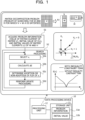
- FIG. 1 is a diagram illustrating an example of a data processing device of a first embodiment.
- a data processing device 10 of the first embodiment may be a client device, or may be a server device.
- the data processing device 10 may be referred to as a computer.
- the data processing device 10 of the first embodiment includes a storage unit 11 and a processing unit 12.
- the storage unit 11 may include a volatile semiconductor memory such as a random access memory (RAM), or may include a nonvolatile storage such as a hard disk drive (HDD) or a flash memory. Furthermore, the storage unit 11 may include both the volatile semiconductor memory and the nonvolatile storage.
- RAM random access memory
- HDD hard disk drive
- the storage unit 11 stores a value of each matrix element of the matrix V, which is problem information 11a of the matrix decomposition problem, and an initial value 11b of each matrix element of the matrices W and H.
- the storage unit 11 may store an initial value of an evaluation function (E(x)) of the matrix decomposition problem.
- an inequality constraint term is set for each matrix element (V ij ) in the matrix V.
- the E(x) is represented by a sum of the inequality constraint term for each V ij .
- an inequality constraint term (P ij ) may be represented by the following Expression (2).
- ⁇ is a weight value of the inequality constraint term.
- the ⁇ may be a different value for each V ij or the same value. Note that the description will be made assuming that the value of the ⁇ is fixed in the first embodiment. An example in which the value of the ⁇ is changed during the solution search will be described in a second embodiment.
- FIG. 1 a relationship between a value of the product-sum operation of the matrix element of the i-th row of the matrix W and the matrix element of the j-th column of the matrix H and a value of the P ij .
- the value of the V ij is often 0.
- the V ij represents whether or not the word j is used in the document i
- V ij represents whether or not the customer i has purchased the product j
- the total number of products is assumed to be much greater than the number of purchased products
- each matrix element of the matrix V, the initial value of the E(x), and the initial value of each matrix element of the matrices W and H are input by a user, for example, and stored in the storage unit 11. These values may be received by the data processing device 10 from an information processing device (not illustrated) via a network. As described above, since the values of the matrix elements of the matrices W and H tend to be 0, the initial values are all set to 0, for example.
- the storage unit 11 may further store calculation conditions of the solution search by the local search. For example, in a case where simulated annealing or a replica-exchange method, which is one type of the MCMC method, is applied to the solution search, the storage unit 11 may store calculation conditions for these.
- the calculation conditions include, for example, a maximum temperature, a temperature parameter change schedule, a minimum temperature, a search end condition, and the like.
- the calculation conditions include, for example, the number of replicas, a value of a temperature parameter to be set in each replica, a replica exchange frequency, a search end condition, and the like.
- the processing unit 12 may be implemented by, for example, an electronic circuit such as an application specific integrated circuit (ASIC) or a field programmable gate array (FPGA). Note that the processing unit 12 may also be implemented by a processor such as a central processing unit (CPU), a graphics processing unit (GPU), or a digital signal processor (DSP). The processor executes, for example, a program stored in a memory such as a RAM (which may be the storage unit 11). A set of processors may be referred to as a multiprocessor or simply a "processor". Furthermore, the processing unit 12 may include a processor and an electronic circuit such as an ASIC or an FPGA. The processing unit 12 searches for a combination of values of W ik and H jk (each binary value) that minimizes a value of the evaluation function (E(x)), and thus may also be referred to as an Ising machine.
- ASIC application specific integrated circuit
- FPGA field programmable gate array
- the processing unit 12 may also be implemented by a processor such as
- FIG. 1 an example of a procedure of processing performed by the processing unit 12 is illustrated.
- Step S1 The processing unit 12 acquires, from the storage unit 11, the value of each matrix element of the matrix V, which is the problem information 11a of the matrix decomposition problem, the initial value of the E(x), and the initial value 11b of each matrix element of the matrices W and H.
- Step S2 The processing unit 12 performs search processing of a solution by the local search.
- the search processing includes the following steps.
- Step S2a The processing unit 12 selects x i that is a matrix element of the matrix W or the matrix H.
- the x i is selected randomly or in predetermined order.
- the x i may be arranged one-dimensionally as follows and stored in the storage unit 11.
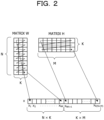
- FIG. 2 is a diagram illustrating a storage example of the matrix elements of the matrix W and the matrix H.
- the matrix elements of the matrix W are stored in the storage unit 11 as x i , x 2 ,..., x NK in order of raster scanning from an upper left to a lower right.
- the matrix elements of the matrix H are stored in the storage unit 11 as x NK+1 ,..., x K(N+M) in order of raster scanning from the upper left to the lower right.
- Step S2b The processing unit 12 calculates a change amount ( ⁇ E) of the value of the E(x) associated with a change in a value of the selected x i .
- the processing unit 12 calculates a value (E'(x)) of the evaluation function when the value of the x i changes from 0 to 1 or from 1 to 0 (hereinafter referred to as flip).
- the processing unit 12 calculates the ⁇ E which is a difference between the E'(x) and the E(x).
- Step S2c The processing unit 12 determines whether to adopt the flip of the x i .
- the adoption or non-adoption of the flip is determined based on the ⁇ E. For example, in a case where max(0, ⁇ E) is smaller than a threshold obtained based on a random number value and a value of a temperature parameter, the processing unit 12 adopts the flip of the x i .
- -log(rand) ⁇ T is used as the threshold.
- the rand represents a uniform random number value in a range of 0 to 1, and the T represents the value of the temperature parameter.
- Step S2d In a case where it is determined that the flip of the x i is adopted, the processing unit 12 performs update processing.
- the processing unit 12 flips the x i .
- the processing unit 12 may update the value of the E(x).
- step S2d After the processing in step S2d, the processing unit 12 repeats the processing from step S2a.
- the processing unit 12 decreases the value of the temperature parameter described above in accordance with a predetermined temperature parameter change schedule while the processing in steps S2a to S2d is repeated. Then, the processing unit 12 outputs, for example, values of the x 1 to x K(N+M) when a predetermined search end condition is satisfied, as a search result for the solution of the matrix decomposition problem. For example, the processing unit 12 displays the solution on a display device (not illustrated). Note that the processing unit 12 may update, for example, the value of the E(x) every time the flip is adopted and hold a minimum value until then and the values of the x 1 to x K(N+M) when the minimum value is obtained. In that case, the processing unit 12 may output, as the search result, the values of the x 1 to x K(N+M) corresponding to the minimum value stored when the search end condition is satisfied.
- the processing unit 12 performs the processing in steps S2a to S2d indicated in FIG. 1 for the respective plurality of replicas set with values of the temperature parameter different from each other. Then, the processing unit 12 performs replica exchange each time the processing in steps S2a to S2d is repeated a predetermined number of times. For example, the processing unit 12 randomly selects two of the plurality of replicas. Then, the processing unit 12 exchanges the values of the temperature parameter or the values of S2a to S2d between the two selected replicas with a predetermined exchange probability based on a difference in the values of the evaluation function or a difference in the values of the temperature parameter between the replicas.
- the processing unit 12 updates the value of the E(x) every time a transition is accepted in each replica and holds the minimum value until then and the values of the x 1 to x K(N+M) when the minimum value is obtained. Then, for example, when a predetermined search end condition is satisfied, the processing unit 12 outputs, as a search result, the values of the x 1 to x K(N+M) corresponding to a smallest minimum value in all the replicas among the minimum values stored in the respective replicas.
- the processing unit 12 of the data processing device 10 of the first embodiment uses the evaluation function (E(x)) represented by the sum of the inequality constraint term set for each matrix element (V ij ) in the matrix V. Then, the processing unit 12 determines the adoption or non-adoption the flip of the x i based on the change amount ( ⁇ E) of the value of the E(x) associated with the flip of the matrix element (x i ) of the matrix W or the matrix H. In a case where the flip of the x i is adopted, the processing unit 12 updates the value of the x i . The processing unit 12 repeats the above processing while changing the x i .
- E(x) the evaluation function represented by the sum of the inequality constraint term set for each matrix element (V ij ) in the matrix V. Then, the processing unit 12 determines the adoption or non-adoption the flip of the x i based on the change amount ( ⁇ E) of the value of the E(x) associated with the flip of the matrix
- FIG. 1 a schematic diagram of E(x) with an inequality constraint term and E(x) without an inequality constraint term is illustrated.
- FIG. 3 is a diagram illustrating an example of the logical function.
- a horizontal axis represents the value (actual value) of the product-sum operation of the i-th row of the matrix W and the j-th column of the matrix H, and a vertical axis represents a logical value of the product-sum operation.
- the logical value is 1. That is, the logical function is a step function, and the logical value takes only a value of 0 or 1.
- a distribution of the E(x) without the inequality constraint term is a similar distribution regardless of the number of W ik H kj being 1.
- the distribution of the E(x) without the inequality constraint term has a golf hole shape, and is a distribution in which it is difficult to find a state transition in which the value of the E(x) becomes small and it is difficult to perform the solution search.
- the shape of the E(x) without the inequality constraint term tends to be a flatter shape, and it is difficult to perform the solution search.
- a distribution of the E(x) with the inequality constraint term used in the present embodiment is a distribution including a gentle inclination as illustrated in FIG. 1 .
- the logical operation has been described as the operation in which the product-sum operation of the matrix element of the i-th row of the matrix W and the matrix element of the j-th column of the matrix H is performed by the logical product and the logical sum, but the present disclosure is not limited to this.
- the logical operation may be an operation in which the product-sum operation of the matrix element of the i-th row of the matrix W and the matrix element of the j-th column of the matrix H is performed by the logical product and exclusive OR.
- the exclusive OR may also be referred to as XOR.
- the E(x) without the inequality constraint term includes a mod function as indicated below instead of the logical function of Expression (3).
- FIG. 4 is a diagram illustrating an example of the mod function.
- a horizontal axis represents the value (actual value) of the product-sum operation of the i-th row of the matrix W and the j-th column of the matrix H, and a vertical axis represents a value of the mod function indicating a remainder when the value of the product-sum operation is divided by 2.
- Such a mod function is a periodic function unlike the logical function illustrated in FIG. 3 .
- the value of the mod function takes only a value of 0 or 1.
- the distribution of the E(x) indicates a tendency that there are some deep valleys (local solutions) that are not flat at E(x) ⁇ 0.
- some of the local solutions are separated from a correct answer by a Hamming distance, and may not escape from the local solutions, or even when they escape from the local solutions, they may fall into other local solutions, and it may be difficult to obtain the correct answer.
- the E(x) in which the inequality constraint term is set for each matrix element (V ij ) of the matrix V may be used, similarly to the case where the product-sum operation is represented by the logical product and the logical sum.
- the product-sum operation of the matrix element of the i-th row of the matrix W and the matrix element of the j-th column of the matrix H in a case where it is assumed that the V ij is obtained by performing the product by the logical product and the sum by the exclusive OR, an inequality constraint term (G ij ) may be represented by the following Expression (4).
- ⁇ is a weight value of the inequality constraint term.
- FIG. 5 is a diagram illustrating an example of a relationship between the value of the product-sum operation of the matrix element of the i-th row of the matrix W and the matrix element of the j-th column of the matrix H and a value of the G ij .
- a horizontal axis represents the value (actual value) of the product-sum operation, and a vertical axis represents the value of the G ij .
- the G ij changes periodically.
- Such G ij also becomes 0 when a result of the logical operation in which the product-sum operation is represented by the logical product and the exclusive OR matches the value of the V ij , and becomes a value greater than 0 when the result does not match the V ij .
- the processing unit 12 performs the search processing in step S2 of FIG. 1 by using the E(x) obtained by integrating such G ij for each V ij , thereby obtaining an effect similar to that of the case where the E(x) obtained by integrating the P ij for each V ij is used.
- the logical operation may be an operation in which the product-sum operation of the matrix element of the i-th row of the matrix W and the matrix element of the j-th column of the matrix H is performed by exclusive NOR and a majority decision of the exclusive NOR.
- the exclusive NOR is also referred to as an equivalence logic or a match logic, and may also be referred to as XNOR or ENOR.
- FIG. 6 is a diagram illustrating a truth table of the exclusive NOR.
- a value of the ENOR is 1 when A and B are equal (the same), otherwise it is 0.
- a value of the majority decision is 1 when the number of 1 is greater than the number of 0 for the value of the ENOR, and 0 when the number of 0 is greater than the number of 1.
- the majority decision may also be referred to as Bitcount.
- Such an operation may be used for calculation of input/output of a neuron of a neural network.
- a logical function in a case where the product of the product-sum operation is performed by the exclusive NOR and the sum is performed by the majority decision of the exclusive NOR is a step function as in FIG. 3 .
- the value of the product-sum operation rising to 1 is a value greater than K/2.
- a distribution of the E(x) without the inequality constraint term is similar to the distribution of the E(x) without the inequality constraint term illustrated in FIG. 1 .
- the E(x) in which the inequality constraint term is set for each matrix element (V ij ) of the matrix V may be used, similarly to the case where the product-sum operation is performed by the logical product and the logical sum.
- an inequality constraint term (Q ij ) may be represented by the following Expression (5).
- Expression (5) is substantially similar to Expression (2), but one of two arguments of a max function is not 0 but a predetermined threshold (expressed by a floor function) that is a maximum integer of K/2 or less.
- FIG. 7 is a diagram illustrating an example of a relationship between the value of the sum of products of the i-th row of the matrix W and the j-th column of the matrix H and a value of the Q ij .
- a horizontal axis represents the value (actual value) of the product-sum operation of the i-th row of the matrix W and the j-th column of the matrix H, and a vertical axis represents the value of the Q ij .
- V ij 0 is satisfied, when the value of the product-sum operation is greater than the threshold, a result of the logical operation by the ENOR and the majority decision thereof does not match the value of the V ij , and thus the Q ij is a value greater than the threshold.
- the value of the product-sum operation is the threshold or less, the result of the logical operation by the ENOR and the majority decision thereof matches the value of the V ij , and thus the value of the Q ij is the threshold.
- V ij 1
- the value of the product-sum operation is the threshold + 1 or more
- the result of the logical operation by the ENOR and the majority decision thereof matches the value of the V ij
- the value of the Q ij is the threshold.
- the value of the product-sum operation is smaller than the threshold + 1
- the result of the logical operation by the ENOR and the majority decision thereof does not match the value of the V ij
- the Q ij is a value greater than the threshold.
- the processing unit 12 performs the search processing in step S2 of FIG. 1 by using the E(x) obtained by integrating such Q ij for each V ij , thereby obtaining an effect similar to that of the case where the E(x) obtained by integrating the P ij for each V ij is used.
- a data processing device 20 of the second embodiment may be a client device, or may be a server device.
- the data processing device 20 may be referred to as a computer.
- FIG. 8 is a block diagram illustrating a hardware example of the data processing device of the second embodiment.
- the data processing device 20 is, for example, a computer, and includes a processor 21, a RAM 22, an HDD 23, a GPU 24, an input interface 25, a medium reader 26, and a communication interface 27.
- the units described above are coupled to a bus.
- the processor 21 is a processor such as a GPU or a CPU including an arithmetic circuit that executes a program command.
- the processor 21 loads at least a part of a program and data stored in the HDD 23 into the RAM 22, and executes the program.
- the processor 21 may include a plurality of processor cores.
- the data processing device 20 may include a plurality of processors. Note that a set of the plurality of processors (multiprocessor) may be referred to as a "processor".
- the RAM 22 is a volatile semiconductor memory that temporarily stores a program to be executed by the processor 21 and data to be used by the processor 21 for arithmetic operations.
- the data processing device 20 may include a memory of a type different from the RAM 22, or may include a plurality of memories.
- the HDD 23 is a nonvolatile storage device that stores programs of software such as an operating system (OS), middleware, and application software, and data.
- the programs include, for example, a program for causing the data processing device 20 to execute processing of searching for a solution of the matrix decomposition problem.
- the data processing device 20 may include another type of storage device such as a flash memory or a solid state drive (SSD), or may include a plurality of nonvolatile storage devices.
- the GPU 24 outputs an image to a display 24a coupled to the data processing device 20 in accordance with a command from the processor 21.
- a display 24a a cathode ray tube (CRT) display, a liquid crystal display (LCD), a plasma display panel (PDP), an organic electro-luminescence (OEL) display, or the like may be used.
- CTR cathode ray tube
- LCD liquid crystal display
- PDP plasma display panel
- OEL organic electro-luminescence
- the input interface 25 acquires input signals from an input device 25a coupled to the data processing device 20, and outputs the input signals to the processor 21.
- a pointing device such as a mouse, a touch panel, a touch pad, or a trackball, a keyboard, a remote controller, a button switch, or the like may be used.
- a plurality of types of input devices may be coupled to the data processing device 20.
- the medium reader 26 is a reading device that reads a program and data recorded on a recording medium 26a.
- a recording medium 26a for example, a magnetic disk, an optical disk, a magneto-optical disk (MO), a semiconductor memory, or the like may be used.
- the magnetic disk includes a flexible disk (FD) and an HDD.
- the optical disk includes a compact disc (CD) and a digital versatile disc (DVD).
- the medium reader 26 copies, for example, a program and data read from the recording medium 26a to another recording medium such as the RAM 22 or the HDD 23.
- the read program is executed by, for example, the processor 21.
- the recording medium 26a may be a portable recording medium, and may be used for distribution of the program and data.
- the recording medium 26a and the HDD 23 may be referred to as computer-readable recording media.
- the communication interface 27 is an interface that is coupled to a network 27a and communicates with another information processing device via the network 27a.
- the communication interface 27 may be a wired communication interface coupled to a communication device such as a switch by a cable, or may be a wireless communication interface coupled to a base station via a wireless link.
- FIG. 9 is a block diagram illustrating a functional example of the data processing device.
- the data processing device 20 includes an input unit 31, a storage unit 32, an initialization processing unit 33, a search unit 34, and an output unit 35.
- the storage unit 32 is equipped using, for example, the RAM 22 or the HDD 23.
- the input unit 31, the initialization processing unit 33, the search unit 34, and the output unit 35 are equipped using, for example, the processor 21 and a program.
- the storage unit 32 is a functional block as an example of the storage unit 11 illustrated in FIG. 1 , and other functional blocks are functional blocks as an example of the processing unit 12 illustrated in FIG. 1 .
- the input unit 31 acquires a value of a matrix element of the matrix V, which is problem information of the matrix decomposition problem, an initial value of an evaluation function (E(x)) of the matrix decomposition problem, and initial values of matrix elements in the matrices W and H. These values are input by, for example, a user operating the input device 25a. Alternatively, the input unit 31 may receive these values from another information processing device via the network 27a.
- the input unit 31 may further acquire calculation conditions of the solution search.
- the input unit 31 acquires calculation conditions for these.
- the calculation conditions include, for example, a maximum temperature, a temperature parameter change schedule, a minimum temperature, a search end condition, and the like.
- the calculation conditions include, for example, the number of replicas, a value of a temperature parameter to be set in each replica, a replica exchange frequency, a search end condition, and the like.
- the storage unit 32 stores the problem information, the initial values, and the like acquired by the input unit 31.
- the storage unit 32 may store an initial value of the ⁇ indicated in Expressions (2), (4), and (5).
- the initialization processing unit 33 performs initialization processing of the search unit 34 by acquiring the problem information and various initial values stored in the storage unit 32 and setting these in the search unit 34.
- the search unit 34 includes a flip candidate selection unit 34a, a ⁇ calculation unit 34b, an E' calculation unit 34c, a flip acceptability determination unit 34d, an x update unit 34e, and an E update unit 34f.
- the flip candidate selection unit 34a selects x i , which is a matrix element of the matrix W or the matrix H, as a flip candidate.
- the x i is selected randomly or in predetermined order.
- the flip candidate selection unit 34a outputs a flipped value (x' i ) of the selected x i .
- the ⁇ calculation unit 34b increases the value of the ⁇ of the inequality constraint term set to the matrix element of the matrix V by a predetermined ratio.
- the ⁇ calculation unit 34b may decrease the value of the ⁇ or return the value of the ⁇ to the initial value.
- the ⁇ calculation unit 34b may not be provided.
- the E' calculation unit 34c calculates the inequality constraint term represented by Expression (2), Expression (4), or Expression (5) based on the values of the x' i and the ⁇ . Then, the E' calculation unit 34c calculates E'(x), which is a total sum of the inequality constraint terms for each V ij .
- the E' calculation unit 34c calculates the value (V') of the product-sum operation of the matrix element of the i-th row of the matrix W and the matrix element of the j-th column of the matrix H using the x' i , and supplies the value (V') to the ⁇ calculation unit 34b. In a case where a value of the ⁇ ij is changed by the ⁇ calculation unit 34b, the E' calculation unit 34c recalculates the E'(x) using the value.
- the flip acceptability determination unit 34d calculates ⁇ E, which is a difference between the E(x) before the flip of the x i and the E'(x), and determines acceptability of the flip of the x i based on the ⁇ E. For example, in a case where max(0, ⁇ E) is smaller than a threshold obtained based on a random number value and a value of a temperature parameter, the flip acceptability determination unit 34d adopts, for example, the flip of the x i . For example, -log(rand) ⁇ T is used as the threshold.
- the rand represents a uniform random number value in a range of 0 to 1, and the T represents the value of the temperature parameter.
- the x update unit 34e holds, for example, as illustrated in FIG. 2 , N ⁇ K + K ⁇ M matrix elements of the matrix W and the matrix H as x 1 to x K(N+M) in a one-dimensional array. In a case where it is determined that the flip of the x i is acceptable, the x update unit 34e flips (updates) the x i to the x' i .
- the E update unit 34f holds a value of the E(x). In a case where it is determined that the flip of the x i is acceptable, the E update unit 34f updates the E(x) before the flip to the E'(x).
- the output unit 35 outputs a search result (for example, values of the x 1 to x K(N+M) corresponding to a minimum value of the E(x) obtained until then) when a search end condition is satisfied.
- a search result for example, values of the x 1 to x K(N+M) corresponding to a minimum value of the E(x) obtained until then
- the output unit 35 may output the search result to the display 24a to be displayed, transmit the search result to another information processing device via the network 27a, or store the search result in an external storage device.
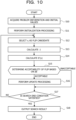
- FIG. 10 is a flowchart illustrating an example of a processing procedure of the data processing device of the second embodiment.
- Step S10 The input unit 31 acquires the value of the matrix element of the matrix V, which is the problem information of the matrix decomposition problem, the initial value of the evaluation function (E(x)) of the matrix decomposition problem, and the initial values of the matrix elements in the matrices W and H.
- the acquired problem information and various initial values are stored in the storage unit 32.
- Step S11 The initialization processing of the search unit 34 is performed by acquiring the problem information and various initial values stored in the storage unit 32 and setting these in the search unit 34.
- Step S12 The flip candidate selection unit 34a selects the x i , which is the matrix element of the matrix W or the matrix H, as the flip candidate.
- Step S13 The ⁇ calculation unit 34b calculates the ⁇ that is the weight value of the inequality constraint term. For example, as described above, in a case where a value of a certain matrix element of the matrix V and the result (V') of the logical operation are different values by the flip of the x i , the ⁇ calculation unit 34b increases the value of the ⁇ of the inequality constraint term set to the matrix element of the matrix V by the predetermined ratio. In a case where the V' and the value of the matrix element of the corresponding matrix V match while the solution search is repeated, the ⁇ calculation unit 34b may decrease the value of the ⁇ or return the value of the ⁇ to the initial value.
- Step S14 The E' calculation unit 34c calculates an inequality constraint term based on the values of the x' i and the ⁇ , and calculates the E'(x) that is the total sum of the inequality constraint terms for each V ij .
- Step S15 The flip acceptability determination unit 34d determines acceptability of the flip of the x i based on the ⁇ E. In a case where it is determined that the flip is acceptable, processing in step S16 is performed, and in a case where it is determined that the flip is unacceptable, processing of step S17 is performed.
- Step S16 Update processing is performed.
- the x update unit 34e flips (updates) the x i selected in the processing in step S12 to the x' i .
- the E update unit 34f updates the E(x) before the flip to the E'(x).
- Step S17 A determination unit (not illustrated) of the search unit 34 determines whether or not the search end condition is satisfied. For example, in a case where the processing in step S12 has been repeated a predetermined number of times, or in a case where the value of the evaluation function smaller than a predetermined value has been obtained, it is determined that the search end condition is satisfied. In a case where it is determined that the search end condition is satisfied, processing in step S18 is performed. In a case where it is determined that the search end condition is not satisfied, the processing from step S12 is repeated.
- the value of the temperature parameter for generating a threshold to be used by the flip acceptability determination unit 34d is decreased in accordance with a predetermined temperature parameter change schedule.
- the processing in steps S12 to S17 by the function of each unit of the search unit 34 illustrated in FIG. 9 is executed for each replica.
- the values of the temperature parameter different from each other are set to a plurality of replicas.
- replica exchange is performed each time the processing in steps S12 to S17 is repeated a predetermined number of times. For example, two of the plurality of replicas are randomly selected, and the values of the temperature parameter or the values of the x 1 to x K(N+M) are exchanged between the two selected replicas with a predetermined exchange probability based on a difference in the values of the evaluation function or a difference in the values of the temperature parameter between the replicas.
- the value of the ⁇ is also exchanged between the replicas. Note that the processing of each replica may be performed in a time division manner or may be performed in parallel using a plurality of processor cores.
- Step S18 The output unit 35 outputs the search result. As a result, the processing by the data processing device 20 ends.
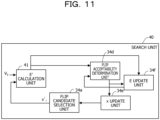
- FIG. 11 is a diagram illustrating a search unit of a comparative example.
- the same elements as those of the search unit 34 of the data processing device 20 illustrated in FIG. 9 are given the same reference signs.
- a search unit 40 of the comparative example does not include the ⁇ calculation unit 34b. Then, an E' calculation unit 41 of the search unit 40 calculates the E'(x), which is the value of the evaluation function (E(x)) when the x i , which is the matrix element of the matrix W or the matrix H, is flipped to the x' i , in accordance with Expression (3).
- the other elements are the same as those of the search unit 34 illustrated in FIG. 9 .
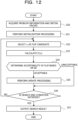
- FIG. 12 is a flowchart illustrating a processing procedure of a data processing device including the search unit of the comparative example.
- Processing in steps S20 to S22 is the same as the processing in steps S10 to S12 indicated in FIG. 10 .
- the processing procedure of the data processing device including the search unit 40 of the comparative example does not include the processing in step S13 indicated in FIG. 10 , in other words, the processing of calculating the ⁇ that is the weight value of the inequality constraint term.
- Step S23 The E' calculation unit 41 calculates the E'(x), which is the value of the evaluation function (E(x)) when the x i , which is the matrix element of the matrix W or the matrix H, is flipped to the x' i , in accordance with Expression (3).
- steps S24 to S27 is the same as the processing in steps S15 to S18 indicated in FIG. 10 .
- the E(x) without the inequality constraint term is used.
- a distribution of the E(x) without the inequality constraint term is a similar distribution regardless of the number of W ik H kj being 1, and is a distribution in which it is difficult to perform the solution search.
- a distribution of the E(x) with the inequality constraint term used in the present second embodiment is a distribution including a gentle inclination.
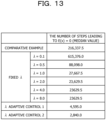
- the solution search was performed in a case where the ⁇ , which is the weight value of the inequality constraint term, was fixed in six patterns of 0.1, 0.5, 1.0, 2.0, 4.0, and 8.0, and further in a case where the ⁇ was adaptively controlled by two methods.
- First adaptive control is to perform control to increase the value of the ⁇ by 10% in a case where the initial value of the ⁇ is set to 4 and the constraint is not satisfied (in a case where the value of the V ij does not match the V'), and to return the value of the ⁇ to the initial value in a case where the constraint is satisfied.
- Second adaptive control is to perform control to increase the value of the ⁇ by 10% in a case where the initial value of the ⁇ is set to 4 and the constraint is not satisfied, and not to return the value of the ⁇ to the initial value even in a case where the constraint is satisfied.
- FIG. 13 is a diagram illustrating an example of an experimental result.
- the number of steps is the number of times of determination as to acceptability of a flip for all the matrix elements of the matrix W and the matrix H.
- the correct answer is obtained with a smaller number of steps than in a case where the solution search is performed using the search unit 40 of the comparative example. That is, a speed of the solution search is increased. In a case where the solution search is performed by the ⁇ adaptive control 2, the speed may be increased by about 76 times as compared with the case where the solution search is performed using the search unit 40 of the comparative example.
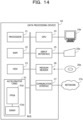
- FIG. 14 is a diagram illustrating another hardware example of the data processing device.
- the same elements as the elements illustrated in FIG. 8 are given the same reference signs.
- a data processing device 50 includes an accelerator card 51 coupled to a bus.
- the accelerator card 51 is a hardware accelerator that locally searches for the solution of the matrix decomposition problem using the simulated annealing, the replica-exchange method, or the like.
- the accelerator card 51 includes an FPGA 51a and a dynamic random access memory (DRAM) 51b.
- DRAM dynamic random access memory
- the storage unit 32 illustrated in FIG. 9 may be implemented by the DRAM 51b.
- the search unit 34 illustrated in FIG. 9 may be implemented by the FPGA 51a.
- the storage unit 11 and the processing unit 12 of the data processing device 10 illustrated in FIG. 1 may also be implemented by the FPGA 51a and the DRAM 51b.
- processing contents described above may be implemented by causing the data processing devices 10, 20, and 50 to execute a program.
- the program may be recorded in a computer-readable recording medium (for example, the recording medium 26a).
- a computer-readable recording medium for example, the recording medium 26a.
- the recording medium for example, a magnetic disk, an optical disk, a magneto-optical disk, a semiconductor memory, or the like may be used.
- the magnetic disk include an FD and an HDD.
- the optical disk include a CD, a CD-recordable (R)/rewritable (RW), a DVD, and a DVD-R/RW.
- the program may be recorded in a portable recording medium and distributed. In that case, the program may be copied from the portable recording medium to another recording medium (for example, the HDD 23) and executed.
- the E'(x) is calculated and the ⁇ E is calculated by E(x) - E'(x), but the present disclosure is not limited to this.
Landscapes
- Engineering & Computer Science (AREA)
- Physics & Mathematics (AREA)
- General Physics & Mathematics (AREA)
- Mathematical Physics (AREA)
- Pure & Applied Mathematics (AREA)
- Mathematical Analysis (AREA)
- Mathematical Optimization (AREA)
- Computational Mathematics (AREA)
- Data Mining & Analysis (AREA)
- Theoretical Computer Science (AREA)
- Computing Systems (AREA)
- Algebra (AREA)
- Databases & Information Systems (AREA)
- Software Systems (AREA)
- General Engineering & Computer Science (AREA)
- Complex Calculations (AREA)
Applications Claiming Priority (1)
| Application Number | Priority Date | Filing Date | Title |
|---|---|---|---|
| JP2023152287A JP2025044605A (ja) | 2023-09-20 | 2023-09-20 | プログラム、データ処理装置及びデータ処理方法 |
Publications (1)
| Publication Number | Publication Date |
|---|---|
| EP4528554A1 true EP4528554A1 (de) | 2025-03-26 |
Family
ID=91953705
Family Applications (1)
| Application Number | Title | Priority Date | Filing Date |
|---|---|---|---|
| EP24188859.3A Pending EP4528554A1 (de) | 2023-09-20 | 2024-07-16 | Computerlesbares aufzeichnungsmedium mit darauf gespeichertem programm, datenverarbeitungsvorrichtung und datenverarbeitungsverfahren |
Country Status (4)
| Country | Link |
|---|---|
| US (1) | US20250094532A1 (de) |
| EP (1) | EP4528554A1 (de) |
| JP (1) | JP2025044605A (de) |
| CN (1) | CN119669624A (de) |
Citations (3)
| Publication number | Priority date | Publication date | Assignee | Title |
|---|---|---|---|---|
| US20190042543A1 (en) * | 2017-08-02 | 2019-02-07 | Fujitsu Limited | Matrix decomposition device and matrix decomposition method |
| JP2021111097A (ja) | 2020-01-09 | 2021-08-02 | 富士通株式会社 | ノイズ推定方法、ノイズ推定プログラム及びノイズ推定装置 |
| JP2023000462A (ja) | 2021-06-18 | 2023-01-04 | 富士通株式会社 | データ処理装置、プログラム及びデータ処理方法 |
-
2023
- 2023-09-20 JP JP2023152287A patent/JP2025044605A/ja active Pending
-
2024
- 2024-07-12 US US18/770,888 patent/US20250094532A1/en active Pending
- 2024-07-16 EP EP24188859.3A patent/EP4528554A1/de active Pending
- 2024-07-30 CN CN202411030889.8A patent/CN119669624A/zh active Pending
Patent Citations (3)
| Publication number | Priority date | Publication date | Assignee | Title |
|---|---|---|---|---|
| US20190042543A1 (en) * | 2017-08-02 | 2019-02-07 | Fujitsu Limited | Matrix decomposition device and matrix decomposition method |
| JP2021111097A (ja) | 2020-01-09 | 2021-08-02 | 富士通株式会社 | ノイズ推定方法、ノイズ推定プログラム及びノイズ推定装置 |
| JP2023000462A (ja) | 2021-06-18 | 2023-01-04 | 富士通株式会社 | データ処理装置、プログラム及びデータ処理方法 |
Non-Patent Citations (4)
| Title |
|---|
| F. CAMILLI ET AL.: "Matrix factorization with neural networks", ARXIV:2212.02105V1, 2022 |
| MAKIKO KONOSHIMA ET AL: "Generating gradients in the energy landscape using rectified linear type cost functions for efficiently solving 0/1 matrix factorization in Simulated Annealing", ARXIV.ORG, CORNELL UNIVERSITY LIBRARY, 201 OLIN LIBRARY CORNELL UNIVERSITY ITHACA, NY 14853, 27 December 2023 (2023-12-27), XP091706854, DOI: 10.7566/JPSJ.93.044002 * |
| OSMAN ASIF MALIK ET AL: "Binary matrix factorization on special purpose hardware", ARXIV.ORG, CORNELL UNIVERSITY LIBRARY, 201 OLIN LIBRARY CORNELL UNIVERSITY ITHACA, NY 14853, 7 January 2022 (2022-01-07), XP091124805, DOI: 10.1371/JOURNAL.PONE.0261250 * |
| Z. ZHANG ET AL.: "Binary matrix factorization for analyzing gene expression data", 2 September 2009, SPRINGER |
Also Published As
| Publication number | Publication date |
|---|---|
| CN119669624A (zh) | 2025-03-21 |
| JP2025044605A (ja) | 2025-04-02 |
| US20250094532A1 (en) | 2025-03-20 |
Similar Documents
| Publication | Publication Date | Title |
|---|---|---|
| US11494639B2 (en) | Bayesian-optimization-based query-efficient black-box adversarial attacks | |
| US8924315B2 (en) | Multi-task learning using bayesian model with enforced sparsity and leveraging of task correlations | |
| US20200334557A1 (en) | Chained influence scores for improving synthetic data generation | |
| EP3869362A1 (de) | Informationsverarbeitungsverfahren, informationsverarbeitungssystem und programm | |
| EP3937090A1 (de) | Informationsverarbeitungssystem, informationsverarbeitungsverfahren und programm | |
| US11514135B2 (en) | Optimization apparatus, temperature setting method, and non-transitory computer-readable storage medium | |
| EP4105843A1 (de) | Datenverarbeitungsvorrichtung, computerlesbares aufzeichnungsmedium mit darauf gespeichertem programm und verfahren zur datenverarbeitung | |
| US20210365605A1 (en) | Optimization device, optimization method, and non-transitory computer-readable storage medium for storing optimization program | |
| CN111858947B (zh) | 自动知识图谱嵌入方法和系统 | |
| EP4080417A1 (de) | Programm, datenverarbeitungsverfahren und datenverarbeitungsvorrichtung | |
| Hajihashemi et al. | Multi-model ensemble conformal prediction in dynamic environments | |
| EP4254271A1 (de) | Datenverarbeitungsvorrichtung, programm und datenverarbeitungsverfahren | |
| US20220366011A1 (en) | Non-transitory computer-readable storage medium and information processing apparatus | |
| US20250094532A1 (en) | Computer-readable recording medium storing program, data processing device, and data processing method | |
| US11868885B2 (en) | Learning device, inference device, learning method, and inference method using a transformation matrix generated from learning data | |
| US20210397923A1 (en) | Information processing device, regression model generation method, and regression model generation program product | |
| EP3869419A1 (de) | Informationsverarbeitungsverfahren, informationsverarbeitungsvorrichtung und informationsverarbeitungsprogramm | |
| EP4068167A1 (de) | Optimierungsprogramm, optimierungsverfahren und optimierungsgerät | |
| EP4345696A1 (de) | Datenverarbeitungsvorrichtung, programm und datenverarbeitungsverfahren | |
| JP2022161128A (ja) | プログラム、データ処理方法及びデータ処理装置 | |
| EP4131084A1 (de) | Programm, datenverarbeitungsverfahren und datenverarbeitungsvorrichtung | |
| EP4592905A1 (de) | Arithmetisches programm, arithmetisches verfahren und informationsverarbeitungsvorrichtung | |
| US20250131060A1 (en) | Computer-readable recording medium storing program, data processing device, and data processing method | |
| EP4517601A1 (de) | Betriebsprogramm, betriebsverfahren und informationsverarbeitungsvorrichtung | |
| US20220382932A1 (en) | Data processing apparatus, data processing method, and non-transitory computer-readable storage medium |
Legal Events
| Date | Code | Title | Description |
|---|---|---|---|
| PUAI | Public reference made under article 153(3) epc to a published international application that has entered the european phase |
Free format text: ORIGINAL CODE: 0009012 |
|
| STAA | Information on the status of an ep patent application or granted ep patent |
Free format text: STATUS: THE APPLICATION HAS BEEN PUBLISHED |
|
| AK | Designated contracting states |
Kind code of ref document: A1 Designated state(s): AL AT BE BG CH CY CZ DE DK EE ES FI FR GB GR HR HU IE IS IT LI LT LU LV MC ME MK MT NL NO PL PT RO RS SE SI SK SM TR |
|
| STAA | Information on the status of an ep patent application or granted ep patent |
Free format text: STATUS: REQUEST FOR EXAMINATION WAS MADE |
|
| 17P | Request for examination filed |
Effective date: 20250618 |