EP4527965A1 - High-strength and high-plasticity hot-rolled strip steel with high weather resistance and manufacturing method therefor - Google Patents
High-strength and high-plasticity hot-rolled strip steel with high weather resistance and manufacturing method therefor Download PDFInfo
- Publication number
- EP4527965A1 EP4527965A1 EP23823231.8A EP23823231A EP4527965A1 EP 4527965 A1 EP4527965 A1 EP 4527965A1 EP 23823231 A EP23823231 A EP 23823231A EP 4527965 A1 EP4527965 A1 EP 4527965A1
- Authority
- EP
- European Patent Office
- Prior art keywords
- hot
- strip steel
- rolled strip
- steel
- temperature
- Prior art date
- Legal status (The legal status is an assumption and is not a legal conclusion. Google has not performed a legal analysis and makes no representation as to the accuracy of the status listed.)
- Pending
Links
Images


Classifications
-
- C—CHEMISTRY; METALLURGY
- C22—METALLURGY; FERROUS OR NON-FERROUS ALLOYS; TREATMENT OF ALLOYS OR NON-FERROUS METALS
- C22C—ALLOYS
- C22C38/00—Ferrous alloys, e.g. steel alloys
- C22C38/18—Ferrous alloys, e.g. steel alloys containing chromium
- C22C38/38—Ferrous alloys, e.g. steel alloys containing chromium with more than 1.5% by weight of manganese
-
- C—CHEMISTRY; METALLURGY
- C22—METALLURGY; FERROUS OR NON-FERROUS ALLOYS; TREATMENT OF ALLOYS OR NON-FERROUS METALS
- C22C—ALLOYS
- C22C38/00—Ferrous alloys, e.g. steel alloys
- C22C38/02—Ferrous alloys, e.g. steel alloys containing silicon
-
- C—CHEMISTRY; METALLURGY
- C21—METALLURGY OF IRON
- C21D—MODIFYING THE PHYSICAL STRUCTURE OF FERROUS METALS; GENERAL DEVICES FOR HEAT TREATMENT OF FERROUS OR NON-FERROUS METALS OR ALLOYS; MAKING METAL MALLEABLE, e.g. BY DECARBURISATION OR TEMPERING
- C21D8/00—Modifying the physical properties of ferrous metals or ferrous alloys by deformation combined with, or followed by, heat treatment
- C21D8/02—Modifying the physical properties of ferrous metals or ferrous alloys by deformation combined with, or followed by, heat treatment during manufacturing of plates or strips
-
- C—CHEMISTRY; METALLURGY
- C21—METALLURGY OF IRON
- C21D—MODIFYING THE PHYSICAL STRUCTURE OF FERROUS METALS; GENERAL DEVICES FOR HEAT TREATMENT OF FERROUS OR NON-FERROUS METALS OR ALLOYS; MAKING METAL MALLEABLE, e.g. BY DECARBURISATION OR TEMPERING
- C21D8/00—Modifying the physical properties of ferrous metals or ferrous alloys by deformation combined with, or followed by, heat treatment
- C21D8/02—Modifying the physical properties of ferrous metals or ferrous alloys by deformation combined with, or followed by, heat treatment during manufacturing of plates or strips
- C21D8/021—Modifying the physical properties of ferrous metals or ferrous alloys by deformation combined with, or followed by, heat treatment during manufacturing of plates or strips involving particular fabrication steps or treatments of ingots or slabs
-
- C—CHEMISTRY; METALLURGY
- C21—METALLURGY OF IRON
- C21D—MODIFYING THE PHYSICAL STRUCTURE OF FERROUS METALS; GENERAL DEVICES FOR HEAT TREATMENT OF FERROUS OR NON-FERROUS METALS OR ALLOYS; MAKING METAL MALLEABLE, e.g. BY DECARBURISATION OR TEMPERING
- C21D8/00—Modifying the physical properties of ferrous metals or ferrous alloys by deformation combined with, or followed by, heat treatment
- C21D8/02—Modifying the physical properties of ferrous metals or ferrous alloys by deformation combined with, or followed by, heat treatment during manufacturing of plates or strips
- C21D8/0221—Modifying the physical properties of ferrous metals or ferrous alloys by deformation combined with, or followed by, heat treatment during manufacturing of plates or strips characterised by the working steps
- C21D8/0226—Hot rolling
-
- C—CHEMISTRY; METALLURGY
- C21—METALLURGY OF IRON
- C21D—MODIFYING THE PHYSICAL STRUCTURE OF FERROUS METALS; GENERAL DEVICES FOR HEAT TREATMENT OF FERROUS OR NON-FERROUS METALS OR ALLOYS; MAKING METAL MALLEABLE, e.g. BY DECARBURISATION OR TEMPERING
- C21D8/00—Modifying the physical properties of ferrous metals or ferrous alloys by deformation combined with, or followed by, heat treatment
- C21D8/02—Modifying the physical properties of ferrous metals or ferrous alloys by deformation combined with, or followed by, heat treatment during manufacturing of plates or strips
- C21D8/0247—Modifying the physical properties of ferrous metals or ferrous alloys by deformation combined with, or followed by, heat treatment during manufacturing of plates or strips characterised by the heat treatment
- C21D8/0263—Modifying the physical properties of ferrous metals or ferrous alloys by deformation combined with, or followed by, heat treatment during manufacturing of plates or strips characterised by the heat treatment following hot rolling
-
- C—CHEMISTRY; METALLURGY
- C21—METALLURGY OF IRON
- C21D—MODIFYING THE PHYSICAL STRUCTURE OF FERROUS METALS; GENERAL DEVICES FOR HEAT TREATMENT OF FERROUS OR NON-FERROUS METALS OR ALLOYS; MAKING METAL MALLEABLE, e.g. BY DECARBURISATION OR TEMPERING
- C21D9/00—Heat treatment, e.g. annealing, hardening, quenching or tempering, adapted for particular articles; Furnaces therefor
- C21D9/46—Heat treatment, e.g. annealing, hardening, quenching or tempering, adapted for particular articles; Furnaces therefor for sheet metals
-
- C—CHEMISTRY; METALLURGY
- C22—METALLURGY; FERROUS OR NON-FERROUS ALLOYS; TREATMENT OF ALLOYS OR NON-FERROUS METALS
- C22C—ALLOYS
- C22C38/00—Ferrous alloys, e.g. steel alloys
- C22C38/002—Ferrous alloys, e.g. steel alloys containing In, Mg, or other elements not provided for in one single group C22C38/001 - C22C38/60
-
- C—CHEMISTRY; METALLURGY
- C22—METALLURGY; FERROUS OR NON-FERROUS ALLOYS; TREATMENT OF ALLOYS OR NON-FERROUS METALS
- C22C—ALLOYS
- C22C38/00—Ferrous alloys, e.g. steel alloys
- C22C38/04—Ferrous alloys, e.g. steel alloys containing manganese
-
- C—CHEMISTRY; METALLURGY
- C22—METALLURGY; FERROUS OR NON-FERROUS ALLOYS; TREATMENT OF ALLOYS OR NON-FERROUS METALS
- C22C—ALLOYS
- C22C38/00—Ferrous alloys, e.g. steel alloys
- C22C38/06—Ferrous alloys, e.g. steel alloys containing aluminium
-
- C—CHEMISTRY; METALLURGY
- C22—METALLURGY; FERROUS OR NON-FERROUS ALLOYS; TREATMENT OF ALLOYS OR NON-FERROUS METALS
- C22C—ALLOYS
- C22C38/00—Ferrous alloys, e.g. steel alloys
- C22C38/18—Ferrous alloys, e.g. steel alloys containing chromium
- C22C38/20—Ferrous alloys, e.g. steel alloys containing chromium with copper
-
- C—CHEMISTRY; METALLURGY
- C22—METALLURGY; FERROUS OR NON-FERROUS ALLOYS; TREATMENT OF ALLOYS OR NON-FERROUS METALS
- C22C—ALLOYS
- C22C38/00—Ferrous alloys, e.g. steel alloys
- C22C38/18—Ferrous alloys, e.g. steel alloys containing chromium
- C22C38/22—Ferrous alloys, e.g. steel alloys containing chromium with molybdenum or tungsten
-
- C—CHEMISTRY; METALLURGY
- C22—METALLURGY; FERROUS OR NON-FERROUS ALLOYS; TREATMENT OF ALLOYS OR NON-FERROUS METALS
- C22C—ALLOYS
- C22C38/00—Ferrous alloys, e.g. steel alloys
- C22C38/18—Ferrous alloys, e.g. steel alloys containing chromium
- C22C38/24—Ferrous alloys, e.g. steel alloys containing chromium with vanadium
-
- C—CHEMISTRY; METALLURGY
- C22—METALLURGY; FERROUS OR NON-FERROUS ALLOYS; TREATMENT OF ALLOYS OR NON-FERROUS METALS
- C22C—ALLOYS
- C22C38/00—Ferrous alloys, e.g. steel alloys
- C22C38/18—Ferrous alloys, e.g. steel alloys containing chromium
- C22C38/26—Ferrous alloys, e.g. steel alloys containing chromium with niobium or tantalum
-
- C—CHEMISTRY; METALLURGY
- C22—METALLURGY; FERROUS OR NON-FERROUS ALLOYS; TREATMENT OF ALLOYS OR NON-FERROUS METALS
- C22C—ALLOYS
- C22C38/00—Ferrous alloys, e.g. steel alloys
- C22C38/18—Ferrous alloys, e.g. steel alloys containing chromium
- C22C38/28—Ferrous alloys, e.g. steel alloys containing chromium with titanium or zirconium
-
- C—CHEMISTRY; METALLURGY
- C22—METALLURGY; FERROUS OR NON-FERROUS ALLOYS; TREATMENT OF ALLOYS OR NON-FERROUS METALS
- C22C—ALLOYS
- C22C38/00—Ferrous alloys, e.g. steel alloys
- C22C38/18—Ferrous alloys, e.g. steel alloys containing chromium
- C22C38/32—Ferrous alloys, e.g. steel alloys containing chromium with boron
-
- C—CHEMISTRY; METALLURGY
- C22—METALLURGY; FERROUS OR NON-FERROUS ALLOYS; TREATMENT OF ALLOYS OR NON-FERROUS METALS
- C22C—ALLOYS
- C22C38/00—Ferrous alloys, e.g. steel alloys
- C22C38/18—Ferrous alloys, e.g. steel alloys containing chromium
- C22C38/40—Ferrous alloys, e.g. steel alloys containing chromium with nickel
- C22C38/42—Ferrous alloys, e.g. steel alloys containing chromium with nickel with copper
-
- C—CHEMISTRY; METALLURGY
- C22—METALLURGY; FERROUS OR NON-FERROUS ALLOYS; TREATMENT OF ALLOYS OR NON-FERROUS METALS
- C22C—ALLOYS
- C22C38/00—Ferrous alloys, e.g. steel alloys
- C22C38/18—Ferrous alloys, e.g. steel alloys containing chromium
- C22C38/40—Ferrous alloys, e.g. steel alloys containing chromium with nickel
- C22C38/44—Ferrous alloys, e.g. steel alloys containing chromium with nickel with molybdenum or tungsten
-
- C—CHEMISTRY; METALLURGY
- C22—METALLURGY; FERROUS OR NON-FERROUS ALLOYS; TREATMENT OF ALLOYS OR NON-FERROUS METALS
- C22C—ALLOYS
- C22C38/00—Ferrous alloys, e.g. steel alloys
- C22C38/18—Ferrous alloys, e.g. steel alloys containing chromium
- C22C38/40—Ferrous alloys, e.g. steel alloys containing chromium with nickel
- C22C38/46—Ferrous alloys, e.g. steel alloys containing chromium with nickel with vanadium
-
- C—CHEMISTRY; METALLURGY
- C22—METALLURGY; FERROUS OR NON-FERROUS ALLOYS; TREATMENT OF ALLOYS OR NON-FERROUS METALS
- C22C—ALLOYS
- C22C38/00—Ferrous alloys, e.g. steel alloys
- C22C38/18—Ferrous alloys, e.g. steel alloys containing chromium
- C22C38/40—Ferrous alloys, e.g. steel alloys containing chromium with nickel
- C22C38/48—Ferrous alloys, e.g. steel alloys containing chromium with nickel with niobium or tantalum
-
- C—CHEMISTRY; METALLURGY
- C22—METALLURGY; FERROUS OR NON-FERROUS ALLOYS; TREATMENT OF ALLOYS OR NON-FERROUS METALS
- C22C—ALLOYS
- C22C38/00—Ferrous alloys, e.g. steel alloys
- C22C38/18—Ferrous alloys, e.g. steel alloys containing chromium
- C22C38/40—Ferrous alloys, e.g. steel alloys containing chromium with nickel
- C22C38/50—Ferrous alloys, e.g. steel alloys containing chromium with nickel with titanium or zirconium
-
- C—CHEMISTRY; METALLURGY
- C22—METALLURGY; FERROUS OR NON-FERROUS ALLOYS; TREATMENT OF ALLOYS OR NON-FERROUS METALS
- C22C—ALLOYS
- C22C38/00—Ferrous alloys, e.g. steel alloys
- C22C38/18—Ferrous alloys, e.g. steel alloys containing chromium
- C22C38/40—Ferrous alloys, e.g. steel alloys containing chromium with nickel
- C22C38/54—Ferrous alloys, e.g. steel alloys containing chromium with nickel with boron
-
- C—CHEMISTRY; METALLURGY
- C21—METALLURGY OF IRON
- C21D—MODIFYING THE PHYSICAL STRUCTURE OF FERROUS METALS; GENERAL DEVICES FOR HEAT TREATMENT OF FERROUS OR NON-FERROUS METALS OR ALLOYS; MAKING METAL MALLEABLE, e.g. BY DECARBURISATION OR TEMPERING
- C21D2211/00—Microstructure comprising significant phases
- C21D2211/002—Bainite
-
- C—CHEMISTRY; METALLURGY
- C21—METALLURGY OF IRON
- C21D—MODIFYING THE PHYSICAL STRUCTURE OF FERROUS METALS; GENERAL DEVICES FOR HEAT TREATMENT OF FERROUS OR NON-FERROUS METALS OR ALLOYS; MAKING METAL MALLEABLE, e.g. BY DECARBURISATION OR TEMPERING
- C21D2211/00—Microstructure comprising significant phases
- C21D2211/004—Dispersions; Precipitations
-
- C—CHEMISTRY; METALLURGY
- C21—METALLURGY OF IRON
- C21D—MODIFYING THE PHYSICAL STRUCTURE OF FERROUS METALS; GENERAL DEVICES FOR HEAT TREATMENT OF FERROUS OR NON-FERROUS METALS OR ALLOYS; MAKING METAL MALLEABLE, e.g. BY DECARBURISATION OR TEMPERING
- C21D2211/00—Microstructure comprising significant phases
- C21D2211/005—Ferrite
-
- C—CHEMISTRY; METALLURGY
- C21—METALLURGY OF IRON
- C21D—MODIFYING THE PHYSICAL STRUCTURE OF FERROUS METALS; GENERAL DEVICES FOR HEAT TREATMENT OF FERROUS OR NON-FERROUS METALS OR ALLOYS; MAKING METAL MALLEABLE, e.g. BY DECARBURISATION OR TEMPERING
- C21D2211/00—Microstructure comprising significant phases
- C21D2211/008—Martensite
-
- C—CHEMISTRY; METALLURGY
- C21—METALLURGY OF IRON
- C21D—MODIFYING THE PHYSICAL STRUCTURE OF FERROUS METALS; GENERAL DEVICES FOR HEAT TREATMENT OF FERROUS OR NON-FERROUS METALS OR ALLOYS; MAKING METAL MALLEABLE, e.g. BY DECARBURISATION OR TEMPERING
- C21D2211/00—Microstructure comprising significant phases
- C21D2211/009—Pearlite
Definitions
- the present invention relates to the technical field of the production of low alloy steel, in particular to a high-strength and high-plasticity hot-rolled strip steel with high weather resistance and manufacturing method therefor.
- Atmospheric corrosion-resistant steel is widely used in the production of outdoor steel structures with atmospheric corrosion-resistance requirements such as containers, railway vehicles, bridges, etc.
- atmospheric corrosion-resistant steel With the increasing demand for green, low-carbon and environmentally friendly materials, the application scenarios of atmospheric corrosion-resistant steel are also expanding.
- These steel structures can be used directly naked, or the surfaces thereof can be lightly coated before use, which can achieve very high weather resistance, and thus some traditional steel surface anticorrosive processes for steel, such as pre galvanizing, pre plating with zinc aluminum magnesium coating, post galvanizing, etc., can be replaced.
- the use of atmospheric corrosion-resistant steel can not only reduce the energy consumption and pollution caused by the metal coating process, but also improve the service life of steel structures and reduce the cost of anti-corrosion maintenance at a later stage.
- An objective of the present invention is to provide a high-strength and high-plasticity hot-rolled strip steel with high weather resistance and manufacturing method therefor.
- the atmospheric corrosion resistance of the material is significantly improved for the hot-rolled strip steel of the present invention, which has a corrosion rate of 30% or less of that of the ordinary structural steel Q355B, i.e., a weather resistance 3 or more times that of the steel Q355B, and its weather resistance is also one or more times higher than that of ordinary weathering steel (such as Q450NQR1 steel).
- the hot-rolled strip steel of the present invention can replace post-galvanized anti-corrosion protection, and can be used barely for guardrails, mast towers, photovoltaics and other support structural parts without coating on the surface.
- the present invention realizes the technical objective by optimizing the chemical composition of the hot-rolled strip steel.
- a high Cr content of 1.5-4.5% is used to promote the formation of a uniform dense rust layer on the surface of hot-rolled strip steel during use, and Cr can be rapidly enriched in the thin rust layer.
- the Cr concentration at the interface between the rust layer and the substrate can be 12% or more, which significantly improves the corrosion potential and electrochemical impedance, and stops the corrosion from continuing to occur, thereby obtaining super high atmospheric corrosion resistance.
- a microstructure mainly comprising 70% or more by volume of fine ferrite can be obtained at a high Cr content, and there is a large amount of nanoscale precipitated phase of TiC with a diameter of 10 nm or less in the ferrite, so hot-rolled strip steel with high strength, high plasticity, high weather resistance and excellent formability can be obtained economically.
- the hot-rolled strip steel of the present invention comprises the following components in mass percentage: C: 0.04-0.09%, Si ⁇ 0.50%, Mn: 0.10-1.50%, P ⁇ 0.03%, S ⁇ 0.01%, Al ⁇ 0.60%, Cr: 1.5-4.5%, Cu: 0.10-0.60%, Ti: 0.05-0.18%, Ni ⁇ 0.30%, Nb ⁇ 0.06%, N ⁇ 0.008%, and the balance being Fe and inevitable impurities, and the hot-rolled strip steel further satisfies: 2Mn+Cr ⁇ 6%, with element symbols being substituted with mass percentages of corresponding chemical elements in the hot-rolled strip steel for calculation. For example, when the content of Mn in steel is 0.10%, the numerical value 0.10% is substituted for calculation.
- the composition of the hot-rolled strip steel satisfies Ti-3N ⁇ 0.04%, with element symbols being substituted with mass percentages of corresponding chemical elements in the hot-rolled strip steel for calculation, in which case the strengthening effect of Ti can be fully exerted.
- the composition of the hot-rolled strip steel satisfies Si+2Ni ⁇ 0.10%, with element symbols being substituted with mass percentages of corresponding chemical elements in the hot-rolled strip steel for calculation, in which case the effect of copper brittleness can be reduced.
- the hot-rolled strip steel of the present invention further comprises at least one selected from the following: Ca ⁇ 0.015%, Mg ⁇ 0.015%, B ⁇ 0.003%, Mo ⁇ 0.30%, V ⁇ 0.15%, and Re ⁇ 0.015%.
- the hot-rolled strip steel of the present invention has a microstructure of polygonal ferrite + a small amount of pearlite + bainite mainly in the form of MA, and the ferrite has a grain size of grade 8 or more, preferably grade 9 or more.
- the content of polygonal ferrite is 70-90%, and the content of pearlite is 5-30%.
- the content of pearlite is more preferably 15% or more and 25% or less.
- the content of bainite is 5-15%, wherein the MA structure accounts for about 20-70% of bainite, preferably 30-70%.
- the ferrite contains a large amount of nanoscale precipitated phase of TiC with a diameter of 10 nm or less, and the content of nanoscale precipitated phase of TiC in ferrite is about 0.005%-0.03%.
- the content of the steel microstructure in the present invention refers to the volume fraction.
- the hot-rolled strip steel of the present invention has very high weather resistance, and the corrosion rate of the hot-rolled strip steel is 30% or less of that of the Q355B steel, that is, its weather resistance is 3 or more times that of Q355B steel and 2 or more times that of ordinary weathering steel (such as Q450NQR1 steel).
- the corrosion rate of the hot-rolled strip steel of the invention decreases rapidly with the increase of corrosion depth, and the simulation corrosion test results show that the corrosion depth of the hot-rolled strip steel is ⁇ 0.1 mm during a simulated service cycle of 25 years.
- C is an effective strengthening element in steel.
- C can also form nanoscale second-phase precipitated particles with Ti, Nb and other microalloying elements to play the role of precipitation strengthening and refining the structure.
- the C content of the present invention is ⁇ 0.04%; However, too much C will form too much carbide or bainite hard phase structure in the steel, which will not only reduce the toughness and formability of the material, but also generate a galvanic cell effect to reduce the corrosion resistance of the steel, and reduce the welding performance of the steel. Therefore, the C content is ⁇ 0.09%.
- the content of elements in the hot-rolled strip steel of the present invention refers to the mass fraction.
- Si is a commonly used deoxidizing element in steel and also has a solid solution strengthening effect on the steel. It can also improve the corrosion resistance of the material, and has a certain effect on reducing the copper brittleness.
- a high content of Si will lead to scale defects on the surface of hot-rolled strip steel, seriously affect the surface quality of the strip steel, and deteriorate the welding performance of the material, resulting in the deterioration of the toughness in the welding heat affected zone. Therefore, the content of Si of the present invention is ⁇ 0.50%s, preferably 0.06% ⁇ Si ⁇ 0.50%.
- Cr is an important element in improving the weather resistance of steel sheet.
- the main mechanism of improving the weather-resistance of weathering resistant steel is as follows: on one hand, the corrosion potential of the substrate is increased by adding corrosion-resistant elements, to reduce the corrosion rate by increasing the electrochemical impedance.
- Cr enables a physical barrier to the corrosive medium by promoting the formation of a dense rust layer on the surface and changing the corrosion environment at the substrate, and the corrosion gradually slows down as the corrosion depth increases.
- the hot-rolled strip steel of the present invention will produce an effect similar to stainless steel, that is, the corrosion potential at the interface between the corrosion front rust layer and the substrate is very high, as well as the blocking effect of the low corrosive medium of the dense rust layer, which makes the electrochemical impedance of the strip surface very high, and the corrosion reaction is basically interrupted.
- the content of Cr in the substrate should not be too high. With the increase of the content of Cr in the substrate, the corrosion potential of the substrate will increase.
- the content of Cr in the present invention is 1.5%-4.5%, preferably 2.27%-3.68%.
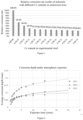
- Figure 1 shows the influence of the content of Cr in steel on the relative corrosion rate of hot-rolled strip steel in alternate immersion tests; and Figure 2 shows the effect of the content of Cr in steel on the long-period corrosion depth of hot-rolled strip steel.
- the corrosion rate of the hot-rolled strip steel of the present invention decreases rapidly with time, for example, when the content of Cr in the steel is 2%, the estimated value of the corrosion depth may be 0.1 mm or less during a simulated cycle of 25 years. However, when the content of Cr in steel is 5%, the estimated value of corrosion depth is about 0.12 mm during a simulated cycle of 25 years, indicating a decrease in corrosion resistance.
- Cr is also an element that increases the hardenability of steel, and a higher content of Cr can make the steel form air-cooled bainite or air-cooled martensite at a lower air-cooling rate, thus significantly improving the tensile strength of the material and reducing the yield-to-tensile ratio of the material, which is conducive to reducing the forming rebound and improving the stability of the forming size.
- the present invention further improves the strength of steel by adopting the design of a high content of Cr, making full use of this function of Cr, and combining the strengthening effect of C, Mn and other elements.
- Cu is also one of the important corrosion-resistant elements, and the effect is more obvious when it is added with Cr.
- Cu can promote the formation of a dense rust layer on the steel surface. Adding 0.10% or more of Cu can significantly improve the atmospheric corrosion resistance of steel.
- Cu is a metal with a low melting point, and the strip steel containing more Cu is prone to copper brittle mesh cracks and warping defects on the surface during the hot rolling process, which deteriorates the surface quality of the steel.
- Cu is also an expensive element.
- the content of Cu in the present invention is 0.10-0.60%, preferably 0.2-0.5%, more preferably 0.25-0.38%.
- P is often added as a corrosion-resistant element in traditional atmospheric corrosion-resistant steel, which can promote the formation of a protective rust layer on the surface, so as to effectively improve the atmospheric corrosion resistance of steel.
- P is also a harmful impurity element in steel, which tends to segregate in the center of thickness during continuous casting of slab.
- P is easy to produce segregation at the grain boundary, reducing the grain boundary binding energy, thus reducing the toughness and plasticity of steel.
- P is also very unfavorable to the welding performance of steel. Therefore, the present invention does not adopt atmospheric corrosion-resistant steel with a high content of P, but minimizes the content of P in the steel, requiring the content of P to be 0.03% or less.
- S is a common harmful impurity element in steel, which has adverse effects on low temperature toughness, welding performance, cold forming performance, etc.
- the content of S in the steel of the present invention is 0.01% or less.
- Al is a very effective deoxidizing element, and Al is conducive to refining grain and improving the strength and toughness of the steel. At the same time, Al can also promote the formation of the ferrite, inhibit the pearlite transition, and facilitate the transition of ferrite bainite dual phase structure.
- a high content of Al is not conducive to smooth pouring, which tends to block the water outlet, so the present invention requires that the content of Al in the steel is ⁇ 0.60%, preferably 0.011-0.56%, more preferably 0.02-0.30%.
- Ti is a strong carbonitride forming element, which can be precipitated in the form of extremely fine TiC or Ti(C, N) as second phase particles, thus significantly improving the strength of the material, and it is a very effective strengthening element.
- the content of Ti is 0.05% or more, it will play a strong precipitation-strengthening role.
- the precipitation of TiC significantly reduces the free C to form larger carbides or pearlite, thereby reducing the galvanic effect of heterogeneous phases in the corrosion process, improving the ability of the material to resist intergranular corrosion, so as to improve the strength of the material, and at the same time to improve the corrosion resistance of the material.
- the content of Ti of the present invention is 0.05-0.18%, preferably 0.072-0.160%.
- Ni can improve the corrosion resistance of the steel and improve the surface copper brittleness caused by Cu.
- the price of Ni is very expensive, and too much addition will greatly increase the alloy cost of the material. Therefore, the content of the Ni in the present invention is ⁇ 0.30%, preferably 0.1% or more and 0.25% or less, more preferably 0.20% or less.
- Nb is also a strong nitrogen carbide forming element, and it can also be precipitated in the form of NbC and Nb(CN) carbide particles as second phase, resulting in precipitation strengthening.
- the cost of Nb is much higher than Ti, so it is not economical to increase strength by adding Nb compared to Ti.
- the content of Nb being too high will also affect the quality of the slab during the cooling process for casting of strip steel, resulting in surface cracks, angle cracks and other defects. Therefore, the content of the Nb in the present invention is ⁇ 0.06%.
- N is an impurity element in steel.
- N is easy to combine with Ti and precipitate to form coarse TiN inclusion during smelting.
- TiN inclusion will damage the toughness of the steel; on the other hand, it also reduces the effective content of Ti in the steel. Therefore, the content of N in the present invention is ⁇ 0.008%.
- the compositional design of the hot-rolled strip steel of the present invention also needs to meet: 2Mn+Cr ⁇ 6%.
- Mn and Cr can shift the C curve of ferrite transition to the right, significantly inhibit the ferrite transition and make the transition time longer.
- the thermal simulation and CCT calculation it is difficult for the strip steel to have sufficient ferritic transformation during laminar flow cooling and post-coiling cooling when 2Mn+Cr>6%, and sufficient ferritic transformation is very important for the properties of the steel.
- the amount of ferrite transformation will directly affect the elongation of the steel of the present invention, that is, the plasticity of the material. Insufficient elongation makes it difficult for the material to meet the molding requirements for parts of complex cross sections.
- the transformation of ferrite also has an important impact on the precipitation of nanoscale phase of TiC.
- the diffusion coefficient of Ti in the ⁇ -ferrite phase is high, while the solubility of C in the ⁇ -ferrite phase is very low, so with the occurrence of ⁇ phase ⁇ ⁇ phase transition, TiC can be precipitated rapidly in the form of interphase precipitation or dispersion precipitation, forming a nanoscale precipitated phase, thus significantly improving the strength.
- the ferritic phase does not undergo transformation, TiC is difficult to precipitate quickly; as the temperature decreases, a large number of structures are transformed into bainite, and the free C element in the steel will be precipitated in the form of carbide, which will no longer have a chance to combine with Ti to form TiC, and cannot produce enough strengthening effect. Therefore, the full transformation of ferrite has an important effect on the strength and plasticity of the steel. Therefore, in the present invention, it is required to satisfy 2Mn+Cr ⁇ 6%, with element symbols being substituted with mass percentages of corresponding chemical elements in the hot-rolled strip steel for calculation. Preferably, 3% ⁇ 2Mn+Cr ⁇ 5%.
- the composition of the hot-rolled strip steel of the present invention satisfies Ti-3N ⁇ 0.04%, with element symbols being substituted with mass percentages of corresponding chemical elements in the hot-rolled strip steel for calculation. If N in the steel preferentially combines with Ti to form TiN inclusion, the contribution of Ti to the strength of the steel will be weakened.
- Ti-3N is defined as the effective content of Ti. When Ti-3N ⁇ 0.04%, it can be ensured that there is sufficient Ti to combine with C to form TiC precipitated particles for precipitation strengthening.
- the composition of the hot-rolled strip steel of the present invention satisfies Si+2Ni ⁇ 0.10%, with element symbols being substituted with mass percentages of corresponding chemical elements in the hot-rolled strip steel for calculation.
- Cu is easy to form copper brittleness defects on the surface of strip steel, while Si and Ni have the effect of improving copper brittleness defects, and they can complement each other. Compared with Si, Ni has a better effect on copper brittleness improvement, but the cost is also higher.
- the hot-rolled strip steel of the present invention can contain one or two elements of Si and Ni.
- Si ⁇ 0.50%, Ni ⁇ 0.30% and Si+2Ni ⁇ 0.10% in the steel the balance among material design economy, material surface quality and copper brittleness can be adjusted by taking advantage of the complementary relationship between the two elements, which makes the problem of copper brittleness can be controlled economically.
- Si+2Ni ⁇ 0.30% the Si+2Ni ⁇ 0.30%.
- Another aspect of the present invention provides a method for manufacturing the above hot-rolled strip steel, comprising the following steps:
- the temperature at the outlet of rough rolling is 1040 to 1080 °C.
- the final rolling temperature is 860 to 880 °C; if the thickness of the finished hot-rolled strip steel is 3 to 5 mm, the final rolling temperature is 840 to 860 °C; and if the thickness of the finished hot-rolled strip steel is 5 mm or more, the final rolling temperature is 820 to 840 °C.
- the hot-rolled strip steel of the present invention In the method for manufacturing the hot-rolled strip steel of the present invention: For Cu-containing steel, low temperature heating is usually used to avoid copper embrittlement. However, for Ti-containing steel, high temperature heating is usually required to fully dissolve Ti in solid solution and provide conditions for the precipitation strengthening of TiC. Due to the hot-rolled strip steel of the present invention containing both Cu and Ti, there is a contradiction in the heating system.
- the manufacturing process of the present invention optimizes the heating curve of the slab during the heating process.
- the surface temperature of the slab can quickly cross the sensitive temperature range of 1050-1150 °C for producing copper brittleness, and the heating time is controlled within 15 minutes, so that the molten Cu can be absorbed by the newly formed oxide skin on the surface of the substrate, and it can avoid the Cu penetration into the slab substrate, thus it can inhibit the generation of copper brittleness.
- the temperature is kept at 1230 to 1290 °C, and the soaking time is controlled to 30 to 90 min to ensure sufficient solid solution of Ti.
- the tapping temperature is also controlled to 1230 to 1290 °C.
- the slab is taken out of the heating furnace and sized, rough rolling is carried out.
- the rough rolling stage should ensure a high enough descaling pressure to obtain a good descaling effect. It is demonstrated by practical production that high pressure water of 15 MPa or more, preferably 20 MPa or more, has a better crushing and removal effect on the dense primary oxide skin on the surface of the slab with a high Cr content. The removal of oxide skin has a significant improvement effect on reducing the copper embrittlement caused by surface Cu enrichment. Therefore, in the manufacturing process of the present invention, the high-pressure water used for descaling is required to be 15 MPa or more.
- the temperature at the roughing rolling outlet should be 1080 °C or less, preferably 1040 to 1080 °C.
- the strip steel is subjected to finish rolling, which adopts a process of multi-stand continuous rolling.
- the final rolling temperature is controlled to 820 to 880 °C.
- the steel of the present invention needs to adopt a lower final rolling temperature, for example, when the thickness of the finished hot-rolled strip steel is 3 mm or less, the final rolling temperature is 860 to 880 °C; when the thickness of the finished hot rolled strip is 3 to 5 mm , the final rolling temperature is 840 to 860 °C; and when the thickness of the finished hot rolled strip is 5 mm or more, the final rolling temperature is 820 to 840 °C.
- the hot-rolled strip steel of the present invention has a structure mainly composed of polygonal ferrite, in which the ferrite has a grain size of grade 8 or more or even up to grade 11.
- the polygonal ferrite content in the microstructure of hot-rolled strip steel is 70-90%, and a large amount of precipitated phase of TiC with a diameter of 10 nm or less is dispersed in the ferrite, which has a significant contribution to the high strength of the material.
- Figure 5 shows the dark field morphology observed by transmission electron microscopy (TEM) of the hot-rolled strip steel of Example 2.
- TEM transmission electron microscopy
Landscapes
- Chemical & Material Sciences (AREA)
- Engineering & Computer Science (AREA)
- Mechanical Engineering (AREA)
- Materials Engineering (AREA)
- Metallurgy (AREA)
- Organic Chemistry (AREA)
- Physics & Mathematics (AREA)
- Thermal Sciences (AREA)
- Crystallography & Structural Chemistry (AREA)
- Heat Treatment Of Sheet Steel (AREA)
- Heat Treatment Of Steel (AREA)
Abstract
Description
- The present invention relates to the technical field of the production of low alloy steel, in particular to a high-strength and high-plasticity hot-rolled strip steel with high weather resistance and manufacturing method therefor.
- Atmospheric corrosion-resistant steel is widely used in the production of outdoor steel structures with atmospheric corrosion-resistance requirements such as containers, railway vehicles, bridges, etc. With the increasing demand for green, low-carbon and environmentally friendly materials, the application scenarios of atmospheric corrosion-resistant steel are also expanding. People use the weather resistance of atmospheric corrosion-resistant steel to make some structural profiles serving in the atmospheric environment, such as guardrails, mast towers, support brackets, photovoltaic brackets and so on. These steel structures can be used directly naked, or the surfaces thereof can be lightly coated before use, which can achieve very high weather resistance, and thus some traditional steel surface anticorrosive processes for steel, such as pre galvanizing, pre plating with zinc aluminum magnesium coating, post galvanizing, etc., can be replaced. The use of atmospheric corrosion-resistant steel can not only reduce the energy consumption and pollution caused by the metal coating process, but also improve the service life of steel structures and reduce the cost of anti-corrosion maintenance at a later stage.
- Solutions involving high-strength weathering steel are provided in the prior art, for example:
- Chinese patent
CN202011384068.6 - Chinese patent
CN202010116991.5 - Chinese patent
CN201810154871.7 CN202110398903.X - An objective of the present invention is to provide a high-strength and high-plasticity hot-rolled strip steel with high weather resistance and manufacturing method therefor. On the basis of the high-strength weathering steel, the atmospheric corrosion resistance of the material is significantly improved for the hot-rolled strip steel of the present invention, which has a corrosion rate of 30% or less of that of the ordinary structural steel Q355B, i.e., a weather resistance 3 or more times that of the steel Q355B, and its weather resistance is also one or more times higher than that of ordinary weathering steel (such as Q450NQR1 steel). The hot-rolled strip steel of the present invention can replace post-galvanized anti-corrosion protection, and can be used barely for guardrails, mast towers, photovoltaics and other support structural parts without coating on the surface. Moreover, the steel of the invention has high strength, with a yield strength of ≥ 600 MPa and a tensile strength of ≥ 700 MPa, while retaining high plasticity, with an elongation of ≥ 24%; and it has a cold bending performance that meets qualification under the conditions of bending at 180° and D=0.5t, preferably a cold bending performance that meets qualification under the conditions of bending at 180°and D=0t, which has extremely high cold working forming performance, can be completely folded without cracking, and can meet the requirements for roll forming of profile components with complex cross-sections.
- The present invention realizes the technical objective by optimizing the chemical composition of the hot-rolled strip steel.
- Specifically, a high Cr content of 1.5-4.5% is used to promote the formation of a uniform dense rust layer on the surface of hot-rolled strip steel during use, and Cr can be rapidly enriched in the thin rust layer. The Cr concentration at the interface between the rust layer and the substrate can be 12% or more, which significantly improves the corrosion potential and electrochemical impedance, and stops the corrosion from continuing to occur, thereby obtaining super high atmospheric corrosion resistance. On the other hand, a microstructure mainly comprising 70% or more by volume of fine ferrite can be obtained at a high Cr content, and there is a large amount of nanoscale precipitated phase of TiC with a diameter of 10 nm or less in the ferrite, so hot-rolled strip steel with high strength, high plasticity, high weather resistance and excellent formability can be obtained economically.
- Specifically, the hot-rolled strip steel of the present invention comprises the following components in mass percentage: C: 0.04-0.09%, Si≤0.50%, Mn: 0.10-1.50%, P≤0.03%, S≤0.01%, Al≤0.60%, Cr: 1.5-4.5%, Cu: 0.10-0.60%, Ti: 0.05-0.18%, Ni≤0.30%, Nb≤0.06%, N≤0.008%, and the balance being Fe and inevitable impurities, and the hot-rolled strip steel further satisfies: 2Mn+Cr≤6%, with element symbols being substituted with mass percentages of corresponding chemical elements in the hot-rolled strip steel for calculation. For example, when the content of Mn in steel is 0.10%, the numerical value 0.10% is substituted for calculation. Preferably, the composition of the hot-rolled strip steel satisfies Ti-3N≥0.04%, with element symbols being substituted with mass percentages of corresponding chemical elements in the hot-rolled strip steel for calculation, in which case the strengthening effect of Ti can be fully exerted.
- Preferably, the composition of the hot-rolled strip steel satisfies Si+2Ni≥0.10%, with element symbols being substituted with mass percentages of corresponding chemical elements in the hot-rolled strip steel for calculation, in which case the effect of copper brittleness can be reduced.
- Preferably, the hot-rolled strip steel of the present invention further comprises at least one selected from the following: Ca≤0.015%, Mg≤0.015%, B≤0.003%, Mo≤0.30%, V≤0.15%, and Re≤0.015%.
- Preferably, the hot-rolled strip steel of the present invention has a microstructure of polygonal ferrite + a small amount of pearlite + bainite mainly in the form of MA, and the ferrite has a grain size of grade 8 or more, preferably grade 9 or more. The content of polygonal ferrite is 70-90%, and the content of pearlite is 5-30%. In the steel of the present invention, the content of pearlite is more preferably 15% or more and 25% or less. The content of bainite is 5-15%, wherein the MA structure accounts for about 20-70% of bainite, preferably 30-70%. The ferrite contains a large amount of nanoscale precipitated phase of TiC with a diameter of 10 nm or less, and the content of nanoscale precipitated phase of TiC in ferrite is about 0.005%-0.03%. Unless otherwise specified, the content of the steel microstructure in the present invention refers to the volume fraction.
- The hot-rolled strip steel of the present invention has very high weather resistance, and the corrosion rate of the hot-rolled strip steel is 30% or less of that of the Q355B steel, that is, its weather resistance is 3 or more times that of Q355B steel and 2 or more times that of ordinary weathering steel (such as Q450NQR1 steel). In addition, the corrosion rate of the hot-rolled strip steel of the invention decreases rapidly with the increase of corrosion depth, and the simulation corrosion test results show that the corrosion depth of the hot-rolled strip steel is ≤ 0.1 mm during a simulated service cycle of 25 years.
- The hot-rolled strip steel of the present invention has a yield strength of ≥ 600 MPa, preferably 650 to 800 MPa; a tensile strength of ≥ 700 MPa, preferably 750 to 850 MPa; an elongation at break of ≥ 20%, preferably 24% or more, more preferably 26% or more; and a cold bending performance that meets qualification under the conditions of bending at 180° and D=0.5t, preferably a cold bending performance that meets qualification under the conditions of bending at 180° and D=0t (D is bending diameter, t is thickness of steel sheet); It has excellent formability, which can be completely folded without cracking, and can meet the requirements for the roll forming processing of profile components with complex cross-sections.
- In the composition of the hot-rolled strip steel of the present invention, the functions of each element are as follows:
C is an effective strengthening element in steel. In addition to solid solution strengthening, C can also form nanoscale second-phase precipitated particles with Ti, Nb and other microalloying elements to play the role of precipitation strengthening and refining the structure. As the most economical strengthening element, the C content of the present invention is ≥ 0.04%; However, too much C will form too much carbide or bainite hard phase structure in the steel, which will not only reduce the toughness and formability of the material, but also generate a galvanic cell effect to reduce the corrosion resistance of the steel, and reduce the welding performance of the steel. Therefore, the C content is ≤ 0.09%. Unless otherwise specified, the content of elements in the hot-rolled strip steel of the present invention refers to the mass fraction. - Si is a commonly used deoxidizing element in steel and also has a solid solution strengthening effect on the steel. It can also improve the corrosion resistance of the material, and has a certain effect on reducing the copper brittleness. However, a high content of Si will lead to scale defects on the surface of hot-rolled strip steel, seriously affect the surface quality of the strip steel, and deteriorate the welding performance of the material, resulting in the deterioration of the toughness in the welding heat affected zone. Therefore, the content of Si of the present invention is ≤ 0.50%s, preferably 0.06%≤Si≤0.50%.
- Mn is an important strongly toughening element in steel, which has the effect of solid solution strengthening, and can also reduce the transition temperature of supercooled austenite and reduce the transition temperature of ferritic phase, which is conducive to microstructure refinement, thus improving the strength and toughness of the material. However, the excessive content of Mn can significantly inhibit the transformation of ferrite into bainite, resulting in a decline in plasticity and cold forming properties of the material. Therefore, the content of Mn in the present invention is 0.1-1.5%, preferably 0.3-1.2%, and more preferably 0.5-1.0%.
- Cr is an important element in improving the weather resistance of steel sheet. The main mechanism of improving the weather-resistance of weathering resistant steel is as follows: on one hand, the corrosion potential of the substrate is increased by adding corrosion-resistant elements, to reduce the corrosion rate by increasing the electrochemical impedance. On the other hand, Cr enables a physical barrier to the corrosive medium by promoting the formation of a dense rust layer on the surface and changing the corrosion environment at the substrate, and the corrosion gradually slows down as the corrosion depth increases. When the content of Cr in the steel exceeds 1.5%, under the combined action of Cr, Cu and other elements, a uniform and dense rust layer can be formed on the surface of the substrate; a higher content of Cr, in combination with Cu and other elements, makes the α-FeOOH in the rust layer very fine, which is conducive to blocking the further penetration of electrochemical corrosion media such as water and improve the electrochemical impedance. At the same time, due to the high concentration of Cr, with the increase of the thickness of the rust layer, Cr is enriched in the front of the rust layer, so that the concentration of Cr in the rust layer rapidly increases. Before the thickness of the rust layer reaches 0.1 mm, the concentration of Cr at the interface between the rust layer and the substrate can reach 12% or more. When the enriched concentration of Cr reaches 12% or more, the hot-rolled strip steel of the present invention will produce an effect similar to stainless steel, that is, the corrosion potential at the interface between the corrosion front rust layer and the substrate is very high, as well as the blocking effect of the low corrosive medium of the dense rust layer, which makes the electrochemical impedance of the strip surface very high, and the corrosion reaction is basically interrupted. However, the content of Cr in the substrate should not be too high. With the increase of the content of Cr in the substrate, the corrosion potential of the substrate will increase. For example, when the content of Cr exceeds 4.5%, the selective corrosion during the initial stage of the rust layer formation will be enhanced, and the uniformity of the thickness of the rust layer will be worsened; that is, the concentration of Cr at the front of the rust layer and the corrosion environment will cause the chemical impedance to be uneven, increasing the corrosion potential difference at the corrosion front, intensifying the galvanic effect, and thus worsening the effect of inhibiting corrosion. In such cases, although the relative corrosion rate may be reduced under limited test conditions, the depth of corrosion will not be reduced in the long period, and the effect of improving weather resistance can not be achieved in long-term use. Therefore, the content of Cr in the present invention is 1.5%-4.5%, preferably 2.27%-3.68%.
- Referring to
Figures 1 and 2, Figure 1 shows the influence of the content of Cr in steel on the relative corrosion rate of hot-rolled strip steel in alternate immersion tests; andFigure 2 shows the effect of the content of Cr in steel on the long-period corrosion depth of hot-rolled strip steel. - It can be seen from
Figure 2 that the corrosion rate of the hot-rolled strip steel of the present invention decreases rapidly with time, for example, when the content of Cr in the steel is 2%, the estimated value of the corrosion depth may be 0.1 mm or less during a simulated cycle of 25 years. However, when the content of Cr in steel is 5%, the estimated value of corrosion depth is about 0.12 mm during a simulated cycle of 25 years, indicating a decrease in corrosion resistance. In addition, Cr is also an element that increases the hardenability of steel, and a higher content of Cr can make the steel form air-cooled bainite or air-cooled martensite at a lower air-cooling rate, thus significantly improving the tensile strength of the material and reducing the yield-to-tensile ratio of the material, which is conducive to reducing the forming rebound and improving the stability of the forming size. The present invention further improves the strength of steel by adopting the design of a high content of Cr, making full use of this function of Cr, and combining the strengthening effect of C, Mn and other elements. - Cu is also one of the important corrosion-resistant elements, and the effect is more obvious when it is added with Cr. Cu can promote the formation of a dense rust layer on the steel surface. Adding 0.10% or more of Cu can significantly improve the atmospheric corrosion resistance of steel. However, Cu is a metal with a low melting point, and the strip steel containing more Cu is prone to copper brittle mesh cracks and warping defects on the surface during the hot rolling process, which deteriorates the surface quality of the steel. At the same time, Cu is also an expensive element. For the above reasons, the content of Cu in the present invention is 0.10-0.60%, preferably 0.2-0.5%, more preferably 0.25-0.38%.
- P is often added as a corrosion-resistant element in traditional atmospheric corrosion-resistant steel, which can promote the formation of a protective rust layer on the surface, so as to effectively improve the atmospheric corrosion resistance of steel. However, P is also a harmful impurity element in steel, which tends to segregate in the center of thickness during continuous casting of slab. At the same time, P is easy to produce segregation at the grain boundary, reducing the grain boundary binding energy, thus reducing the toughness and plasticity of steel. Based on similar principles, P is also very unfavorable to the welding performance of steel. Therefore, the present invention does not adopt atmospheric corrosion-resistant steel with a high content of P, but minimizes the content of P in the steel, requiring the content of P to be 0.03% or less.
- S is a common harmful impurity element in steel, which has adverse effects on low temperature toughness, welding performance, cold forming performance, etc. The content of S in the steel of the present invention is 0.01% or less.
- Al is a very effective deoxidizing element, and Al is conducive to refining grain and improving the strength and toughness of the steel. At the same time, Al can also promote the formation of the ferrite, inhibit the pearlite transition, and facilitate the transition of ferrite bainite dual phase structure. However, a high content of Al is not conducive to smooth pouring, which tends to block the water outlet, so the present invention requires that the content of Al in the steel is ≤ 0.60%, preferably 0.011-0.56%, more preferably 0.02-0.30%.
- Ti is a strong carbonitride forming element, which can be precipitated in the form of extremely fine TiC or Ti(C, N) as second phase particles, thus significantly improving the strength of the material, and it is a very effective strengthening element. When the content of Ti is 0.05% or more, it will play a strong precipitation-strengthening role. At the same time, the precipitation of TiC significantly reduces the free C to form larger carbides or pearlite, thereby reducing the galvanic effect of heterogeneous phases in the corrosion process, improving the ability of the material to resist intergranular corrosion, so as to improve the strength of the material, and at the same time to improve the corrosion resistance of the material. However, when added content of Ti is too high, the precipitation-strengthening effect of Ti will gradually weaken, and begin to affect the low temperature toughness of the steel. Therefore, the content of Ti of the present invention is 0.05-0.18%, preferably 0.072-0.160%.
- Ni can improve the corrosion resistance of the steel and improve the surface copper brittleness caused by Cu. However, the price of Ni is very expensive, and too much addition will greatly increase the alloy cost of the material. Therefore, the content of the Ni in the present invention is ≤ 0.30%, preferably 0.1% or more and 0.25% or less, more preferably 0.20% or less.
- Nb is also a strong nitrogen carbide forming element, and it can also be precipitated in the form of NbC and Nb(CN) carbide particles as second phase, resulting in precipitation strengthening. However, the cost of Nb is much higher than Ti, so it is not economical to increase strength by adding Nb compared to Ti. At the same time, the content of Nb being too high will also affect the quality of the slab during the cooling process for casting of strip steel, resulting in surface cracks, angle cracks and other defects. Therefore, the content of the Nb in the present invention is ≤ 0.06%.
- N is an impurity element in steel. In Ti-containing steel, N is easy to combine with Ti and precipitate to form coarse TiN inclusion during smelting. On one hand, TiN inclusion will damage the toughness of the steel; on the other hand, it also reduces the effective content of Ti in the steel. Therefore, the content of N in the present invention is ≤ 0.008%.
- In addition, the compositional design of the hot-rolled strip steel of the present invention also needs to meet: 2Mn+Cr≤6%. Mn and Cr can shift the C curve of ferrite transition to the right, significantly inhibit the ferrite transition and make the transition time longer. According to the thermal simulation and CCT calculation, it is difficult for the strip steel to have sufficient ferritic transformation during laminar flow cooling and post-coiling cooling when 2Mn+Cr>6%, and sufficient ferritic transformation is very important for the properties of the steel. Firstly, the amount of ferrite transformation will directly affect the elongation of the steel of the present invention, that is, the plasticity of the material. Insufficient elongation makes it difficult for the material to meet the molding requirements for parts of complex cross sections. Secondly, the transformation of ferrite also has an important impact on the precipitation of nanoscale phase of TiC. The diffusion coefficient of Ti in the α-ferrite phase is high, while the solubility of C in the α-ferrite phase is very low, so with the occurrence of γ phase → α phase transition, TiC can be precipitated rapidly in the form of interphase precipitation or dispersion precipitation, forming a nanoscale precipitated phase, thus significantly improving the strength. If the content of Mn and Cr is too high, the ferritic phase does not undergo transformation, TiC is difficult to precipitate quickly; as the temperature decreases, a large number of structures are transformed into bainite, and the free C element in the steel will be precipitated in the form of carbide, which will no longer have a chance to combine with Ti to form TiC, and cannot produce enough strengthening effect. Therefore, the full transformation of ferrite has an important effect on the strength and plasticity of the steel. Therefore, in the present invention, it is required to satisfy 2Mn+Cr ≤6%, with element symbols being substituted with mass percentages of corresponding chemical elements in the hot-rolled strip steel for calculation. Preferably, 3%≤2Mn+Cr≤5%.
- Preferably, the composition of the hot-rolled strip steel of the present invention satisfies Ti-3N≥0.04%, with element symbols being substituted with mass percentages of corresponding chemical elements in the hot-rolled strip steel for calculation. If N in the steel preferentially combines with Ti to form TiN inclusion, the contribution of Ti to the strength of the steel will be weakened. In the present invention, Ti-3N is defined as the effective content of Ti. When Ti-3N≥0.04%, it can be ensured that there is sufficient Ti to combine with C to form TiC precipitated particles for precipitation strengthening. Preferably, Ti-3N≥0.06%, more preferably, Ti-3N≥0.09%.
- Preferably, the composition of the hot-rolled strip steel of the present invention satisfies Si+2Ni≥0.10%, with element symbols being substituted with mass percentages of corresponding chemical elements in the hot-rolled strip steel for calculation. Cu is easy to form copper brittleness defects on the surface of strip steel, while Si and Ni have the effect of improving copper brittleness defects, and they can complement each other. Compared with Si, Ni has a better effect on copper brittleness improvement, but the cost is also higher. When the content of Si+2Ni is 0.10% or more, the effect of improving copper brittleness defect can be achieved. Therefore, the hot-rolled strip steel of the present invention can contain one or two elements of Si and Ni. When Si≤0.50%, Ni≤0.30% and Si+2Ni≥0.10% in the steel, the balance among material design economy, material surface quality and copper brittleness can be adjusted by taking advantage of the complementary relationship between the two elements, which makes the problem of copper brittleness can be controlled economically. Preferably, Si+2Ni≥0.30%.
- Another aspect of the present invention provides a method for manufacturing the above hot-rolled strip steel, comprising the following steps:
- 1) smelting and casting
smelting molten steel according to the above composition, and then casting into a slab; - 2) heating the slab
rapidly heating up the slab such that the slab is heated for not more than 15 minutes crossing a slab temperature range of 1050 to 1150 °C; keeping a furnace temperature in soaking section to be 1230 to 1290 °C, and soaking the slab for a time of 30 to 90 min; and tapping at a temperature of 1230 to 1290 °C; - 3) rolling
performing rough rolling after the slab leaving a heating furnace and sizing, wherein during the rough rolling stage, high-pressure water of 15 MPa or more, preferably 20 MPa or more, is used for descaling, and a temperature at rough rolling outlet is 1080 °C or less; performing a finish rolling to the rough-rolled strip steel, wherein multi-stand continuous rolling is used for the finish rolling, and a final rolling temperature is controlled to 820 to 880 °C; - 4) cooling and coiling
adopting laminar flow cooling for cooling, and coiling the strip steel at a temperature of 630 to 680 °C; wherein after the laminar flow cooling is finished, a steel coil is cooled slowly through hot coil stacking, slow cooling wall or insulation cover, and a steel coil at a temperature of 530 °C or more is cooled at a cooling rate of ≤ 1 °C/min. - Preferably, the temperature at the outlet of rough rolling is 1040 to 1080 °C.
- Preferably, in the finish rolling stage of step 3), if the thickness of the finished hot-rolled strip steel is 3mm or less, the final rolling temperature is 860 to 880 °C; if the thickness of the finished hot-rolled strip steel is 3 to 5 mm, the final rolling temperature is 840 to 860 °C; and if the thickness of the finished hot-rolled strip steel is 5 mm or more, the final rolling temperature is 820 to 840 °C.
- In the method for manufacturing the hot-rolled strip steel of the present invention:
For Cu-containing steel, low temperature heating is usually used to avoid copper embrittlement. However, for Ti-containing steel, high temperature heating is usually required to fully dissolve Ti in solid solution and provide conditions for the precipitation strengthening of TiC. Due to the hot-rolled strip steel of the present invention containing both Cu and Ti, there is a contradiction in the heating system. - The manufacturing process of the present invention optimizes the heating curve of the slab during the heating process. By fast burning at high temperature, the surface temperature of the slab can quickly cross the sensitive temperature range of 1050-1150 °C for producing copper brittleness, and the heating time is controlled within 15 minutes, so that the molten Cu can be absorbed by the newly formed oxide skin on the surface of the substrate, and it can avoid the Cu penetration into the slab substrate, thus it can inhibit the generation of copper brittleness.
- In the soaking stage, the temperature is kept at 1230 to 1290 °C, and the soaking time is controlled to 30 to 90 min to ensure sufficient solid solution of Ti. The tapping temperature is also controlled to 1230 to 1290 °C. The technical scheme of the present invention overcomes the contradiction that Cu-containing steel needs to be heated at low temperature to inhibit the occurrence of copper brittleness and high Ti content steel needs to be heated at high temperature for a sufficient solid solution, which can not only ensure sufficient solid solution of Ti and provide conditions for subsequent Ti precipitation strengthening, but also reduce the occurrence of copper brittleness and improve the surface quality of the hot-rolled strip steel.
- After the slab is taken out of the heating furnace and sized, rough rolling is carried out. The rough rolling stage should ensure a high enough descaling pressure to obtain a good descaling effect. It is demonstrated by practical production that high pressure water of 15 MPa or more, preferably 20 MPa or more, has a better crushing and removal effect on the dense primary oxide skin on the surface of the slab with a high Cr content. The removal of oxide skin has a significant improvement effect on reducing the copper embrittlement caused by surface Cu enrichment. Therefore, in the manufacturing process of the present invention, the high-pressure water used for descaling is required to be 15 MPa or more.
- In addition, in order to reduce the occurrence of surface copper brittleness and taking into account the effect of the precipitation strengthening of Ti, the temperature at the roughing rolling outlet should be 1080 °C or less, preferably 1040 to 1080 °C.
- After rough rolling, the strip steel is subjected to finish rolling, which adopts a process of multi-stand continuous rolling. Depending on the thickness of the rolled strip steel, the final rolling temperature is controlled to 820 to 880 °C. Compared with the general steel rolling process, the steel of the present invention needs to adopt a lower final rolling temperature, for example, when the thickness of the finished hot-rolled strip steel is 3 mm or less, the final rolling temperature is 860 to 880 °C; when the thickness of the finished hot rolled strip is 3 to 5 mm , the final rolling temperature is 840 to 860 °C; and when the thickness of the finished hot rolled strip is 5 mm or more, the final rolling temperature is 820 to 840 °C. The purpose of controlling the temperature of final rolling is to increase the rolling deformation energy and promote the fine-grained ferrite transformation after laminar flow cooling of the strip steel. The precipitation of ferrite can also promote the precipitation of TiC, which can significantly improve the precipitation-strengthening effect. Therefore, the use of final rolling at low temperature is very important to improve the plasticity and strength of the hot-rolled strip steel of the present invention.
- Due to the high content of Mn and Cr in the steel of the present invention, the ferritic phase transition will be inhibited. However, the ferritic phase transition plays an important role in improving the plasticity and formability of the material and promoting the precipitation of TiC to improve the strength of steel. Therefore, in addition to obtaining more transformation power by reducing the final rolling temperature during the hot rolling stage, higher phase transition temperature and more sufficient phase transition time should be given to the ferrite by increasing the coiling temperature after laminar flow cooling. Therefore, in the present invention, the coiling temperature for strip steel is 630 to 680 °C. After the laminar flow cooling is finished, it is also required for the strip steel to slowly cool the steel coil through hot coil stacking, slow cooling wall or insulation cover, etc., such that the steel coil at a temperature of 530 °C or more is cooled at a cooling rate of ≤ 1 °C/min, which ensure the sufficient occurrence of ferrite phase transformation and sufficient precipitation of TiC particles, so as to improve the plasticity and strength of the material. The higher coiling temperature in the manufacturing process of strip steel is also conducive to the shape control of strip steel.
- Through the control of the above hot rolling process, the hot-rolled strip steel of the present invention has a structure mainly composed of polygonal ferrite, in which the ferrite has a grain size of grade 8 or more or even up to grade 11. The polygonal ferrite content in the microstructure of hot-rolled strip steel is 70-90%, and a large amount of precipitated phase of TiC with a diameter of 10 nm or less is dispersed in the ferrite, which has a significant contribution to the high strength of the material. In addition, the hot-rolled strip steel also contains 5-30%, preferably 15-30%, more preferably 15-25% of pearlite, and a small amount, i.e., 5-15%, of bainite mainly in the form of MA, which can further improve the strength of the steel. Preferably, the bainite contains 30-70% of MA structure. There is a large amount of nanoscale precipitated phase of TiC in the steel, which makes the material have a high strength; specifically, it has a yield strength of ≥ 600 MPa, and a tensile strength of ≥ 700 MPa. The hot-rolled strip steel of the present invention has high plasticity due to its microstructure mainly composed of ferrite; in particular, it has an elongation at break of ≥ 24%, and a cold bending performance that meets qualification under the conditions of bending at 180° and D=0.5t, preferably a cold bending performance that meets qualification under the conditions of bending at 180° and D=0t. That is, the hot-rolled strip steel of the present invention has high strength and high plasticity.
- Compared with the prior arts, the advantages of the present invention are as follows:
- Firstly, the present invention utilizes a high content of Cr addition of 1.5 to 4.5%, together with the addition of Cu and other components, to promote the formation of a uniform dense rust layer on the surface of the hot-rolled strip steel of the present invention when it is used in the atmosphere, and to enable the rapid enrichment of the Cr concentration to 12% or more at the interface between the thin rust layer of ≤ 0.1 mm and the substrate of strip steel. Through the formation of a uniform dense rust layer on the surface of the strip steel and the high concentration of Cr brought about by Cr enrichment in the rust layer, a significant increase in the corrosion potential and electrochemical impedance of the strip steel substrate surface is realized, and surface corrosion is impeded from continuing to occur, so as to make the hot-rolled strip steel of the present invention have ultra-high atmospheric corrosion resistance (the hot-rolled strip steel of the present invention is used in environments with corrosion levels of C1-C3 as specified in GB/T 19292.1-2018). Alternate immersion tests were conducted on the Q355B steel and the hot-rolled strip steel of the present invention respectively. The results showed that the corrosion rate of the hot-rolled strip steel of the present invention was 30% or less of that of the Q355B steel, that is, its weathering resistance was 3 or more times that of the steel Q355B, and 2 or more times that of the common weathering steel (Q450NQR1); and its corrosion rate in the atmosphere decreased rapidly with the increase in the corrosion depth of the strip steel surface. The strip steel of the present invention is simulated to corrode for 25 years, and the results show that its corrosion depth in the atmosphere for 25 years is ≤ 0.1 mm.
- Secondly, the hot-rolled strip steel of the present invention utilizes the precipitation strengthening of Ti which is relatively economical, and by controlling the content of Mn and Cr in the steel and requiring 2Mn+Cr ≤6%, the strip steel can obtain good corrosion resistance. Further, with a specific high-temperature coiling and post-coiling cooling process, the hot-rolled strip steel contains 70-90%, preferably 75-90% by volume of ferrite, as well as a large number of nanoscale precipitation phases of TiC distributed in the ferrite, so that the material has high strength and high plasticity. Specifically, it has a yield strength of ≥ 600 MPa, a tensile strength of ≥ 700 MPa, an elongation at break of ≥ 24%, and a cold bending performance that meets qualification under the conditions of bending at 180° and D = 0.5t, preferably a cold bending performance that meets qualification under the conditions of bending at 180° and D = 0t (the cold bending performance is evaluated with the standard GB/T 232-2010 "Metallic materials - Bend test", where D is the bending diameter, t is the thickness of the steel sheet). It has excellent forming performance, and can be completely folded without cracking, which can meet the requirements for roll forming processing of profile components with complex cross-sections.
- In addition, the composition design that satisfies Si+2Ni ≥0.10% is preferred in the present invention, thereby achieving a balance among material design economy, material surface quality and copper brittleness problems.
- At the same time, in terms of the heating system, the manufacturing method of the present invention overcomes the contradiction between the Cu-containing steel requiring to be heated at low temperature to inhibit copper brittleness and the high-Ti-content steel requiring to be heated at high temperature for sufficient solid solution. Through the control of the rate for heating up the slab, fast burning at high temperature enables the surface temperature of the slab to quickly cross the copper brittleness sensitive interval of 1050-1150 °C. Then, through the control of the heating time and heating temperature in the soaking section, the sufficient solid solution of Ti at high temperature is ensured, which provides conditions for the precipitation strengthening of Ti. On the other hand, in combination with the high-pressure water descaling at 15 MPa or more for the rough rolling section, the occurrence of copper brittleness of the steel is reduced, and the surface quality of the strip steel is guaranteed.
-
-
Figure 1 shows the influence of Cr content in hot-rolled strip steel on the relative corrosion rate in alternate immersion tests; -
Figure 2 shows the corrosion depth of the test hot-rolled strip steel with different Cr contents during long period atmospheric exposure; -
Figure 3 is a photograph of the microstructure of the hot-rolled strip steel of Example 2 of the present invention; -
Figure 4 is a photograph of the microstructure of the hot-rolled strip steel of Example 6 of the present invention; and -
Figure 5 is a TEM dark field photograph of the thin film of the hot-rolled strip steel of Example 2 of the present invention, where the bright part is the precipitated phase with a diameter of 10 nm or less. - The present invention is further described below with reference to examples and the accompanying drawings.
- The main processes for manufacturing the hot-rolled strip steel in Examples 1-8 of the present invention were as follows:
- 1) According to the chemical composition shown in Table 1, converter smelting and refining were performed, followed by continuous casting, to give a slab.
- 2) The slab was heated in a heating furnace. In the heating process, the process of heating up the slab was controlled, such that the slab was heated for not more than 15 minutes crossing a range of 1050 to 1150 °C; the furnace temperature in the soaking section was kept at 1230 to 1290 °C, and the slab was soaked for 30 to 90 min; and the slab was tapped at a temperature of 1230 to 1290 °C.
- 3) The slab was subjected to descaling for rough rolling, sizing, rough rolling, flying shear, finish rolling descaling, and finish rolling to give strip steel, wherein during the rough rolling stage, high-pressure water of 15 MPa or more was used for descaling, and a temperature at the roughing outlet was 1080 °C or less. Finish rolling was performed to the rough-rolled strip steel, wherein multi-stand continuous rolling process was adopted for the finish rolling, and a final rolling temperature was controlled to 820 to 880 °C.
- 4) Laminar flow cooling and coiling were performed after the finish rolling of strip steel to obtain the hot-rolled strip steel of the present invention. The coiling of the strip steel was performed at a temperature of 630 to 680 °C. After laminar flow cooling was finished, the steel coil was cooled slowly through hot coil stacking, slow cooling wall or insulation cover, and the steel coil at a temperature of 530 °C or more was cooled at a cooling rate of ≤ 1 °C/min.
- The specific process parameters adopted in the production process of Examples 1-8 were listed in Table 2. After obtaining the hot-rolled strip steel according to steps 1-4 above, the performance of hot-rolled strip steel was tested, and the specific performance parameters of the strip steel were shown in Table 3. The microstructures of Examples 1-8 were also listed in Table 3.
- The corrosion resistance of the hot-rolled strip steel in Examples 1-8 and the steel in Comparative Examples1-2 were tested according to TB/T2375 "Alternate Immersion Corrosion Test Method of Weathering Steel for Railway", the "relative corrosion rate" in Table 3 was the corrosion rate of the hot-rolled strip steel in Examples 1-8 and the Q450NQR1 steel relative to the Q345B steel.
- The yield strength, tensile strength and elongation at break of the steel in Examples 1-8 were tested in accordance with GB/T 228.1-2021 "Metallic materials - Tensile testing - Part 1: Method of test at room temperature", and the cold bending performance was tested in accordance with GB/T 232-2010 "Metallic materials - Bend test".
- The grain size of ferrite in Examples 1-8 was measured according to GB/T 6394-2017 "Determination of estimating the average grain size of metal".
-
Figures 3-4 respectively show the metallographic structure of hot-rolled strip steel in Examples 2 and 6 of the present invention. It can be seen fromFigure 3-4 that the hot-rolled strip steel of Examples 2 and 6 of the present invention had a microstructure mainly comprising ferrite, with the ferrite accounting for 80% or more; there was also a small amount of atypical pearlite structure in the steel; and there was in fact some bainite mixed in the pearlite structure, with MA structure observed in the bainite. -
Figure 5 shows the dark field morphology observed by transmission electron microscopy (TEM) of the hot-rolled strip steel of Example 2. A large amount of TiC precipitates of 10 nm or less can be found distributed at the grain boundaries and within the grains of ferrite in the steel, and these extremely fine TiC particles have a strong contribution to the strength of the material. - In the present invention, the existing Q355B steel and Q450NQR1 steel were taken as Comparative Examples. It can be seen from the results in Table 3 that the hot-rolled strip steel of the present invention exhibited excellent corrosion resistance.
Table 1 (unit: mass percentage) C Si Mn P S Al Cu Cr Ni Ti Nb N Ca Mg Re B Mo V Ti-3N 2Mn+Cr Si+2Ni Example 1 0.086 0.34 0.34 0.018 0.003 0.043 0.55 1.98 0.053 0.058 0.004 0.001 0.07 0.041 2.66 0.34 Example 2 0.073 0.23 0.66 0.008 0.003 0.022 0.23 2.49 0.11 0.072 0.035 0.006 0.044 3.81 0.45 Example 3 0.082 0.12 0.18 0.012 0.005 0.023 0.37 3.45 0.05 0.079 0.006 0.061 3.81 0.22 Example 4 0.074 0.06 0.25 0.009 0.004 0.011 0.26 4.44 0.16 0.094 0.015 0.003 0.085 4.94 0.38 Example 5 0.057 0.18 0.49 0.024 0.006 0.056 0.28 3.68 0.105 0.004 0.19 0.093 4.66 0.18 Example 6 0.064 0.45 1.26 0.016 0.005 0.350 0.38 2.27 0.26 0.122 0.010 0.005 0.003 0.107 4.79 0.97 Example 7 0.072 0.23 1.46 0.007 0.007 0.090 0.33 1.59 0.141 0.007 0.002 0.12 4.51 0.23 Example 8 0.044 0.36 1.18 0.015 0.009 0.560 0.14 2.79 0.18 0.160 0.008 0.006 0.136 5.15 0.72 Comparative Example 1 (Q355B) 0.176 0.19 0.45 0.018 0.008 0.022 0.006 Comparative Example 2 (Q450NQR1) 0.074 0.33 1.39 0.018 0.005 0.03 0.30 0.49 0.16 0.015 0.025 0.005 Table 2 No. Time for heating at 1050-1150 °C [min] Time for soaking [s] End temperature of soaking section [°C] Tapping temperature [°C] Temperature at rough rolling Outlet [°C] Final temperature of finish rolling [°C] Coiling temperature [°C] Example 1 12 63 1286 1280 1077 880 630 Example 2 9 42 1264 1267 1062 865 636 Example 3 11 35 1240 1242 1044 855 643 Example 4 13 38 1233 1239 1042 850 662 Example 5 14 49 1255 1257 1067 852 676 Example 6 7 78 1256 1249 1046 840 668 Example 7 10 69 1245 1243 1043 845 652 Example 8 8 50 1263 1260 1080 830 648 Table 3 No. Thickness [mm] Ferrite [vol%] Grain size grade of ferrite Pearlite [vol%] Bainite [vol%] Yield strength [MPa] Tensile strength [MPa] Elongation at break [%] 180° d=0t Cold bending test Relative corrosion rate [%] Example 1 1.5 83 10 12 5 732 788 25.1 Qualified 28.1 Example 2 2.5 88 9 7 5 698 756 26.3 Qualified 27.9 Example 3 3.5 72 11 13 15 652 723 21.2 Qualified 26.5 Example 4 4 80 9 11 9 698 760 25.9 Qualified 23.2 Example 5 3.5 90 10 5 5 633 712 27.4 Qualified 22.3 Example 6 5 90 9 5 5 682 845 24.3 Qualified 25.6 Example 7 5 73 10 22 5 756 859 24.1 Qualified 29.9 Example 8 6 79 9 13 8 638 746 26.9 Qualified 28.7 Comparative Example 1 (Q355B) 100.0 Comparative Example 2 (Q450NQR1) 55.3
Claims (10)
- A hot-rolled strip steel, comprising the following components in mass percentage: C: 0.04-0.09%, Si≤0.50%, Mn: 0.10-1.50%, P≤0.03%, S≤0.01%, Al≤0.60%, Cr: 1.5-4.5%, Cu: 0.10-0.60%, Ti: 0.05-0.18%, Ni≤0.30%, Nb≤0.06%, N≤0.008%, and the balance being Fe and inevitable impurities; the hot-rolled strip steel further satisfying: 2Mn+Cr≤6%, with element symbols being substituted with mass percentages of corresponding chemical elements in the hot-rolled strip steel for calculation.
- The hot-rolled strip steel as claimed in claim 1, wherein Ti-3N≥0.04%, with element symbols being substituted with mass percentages of corresponding chemical elements in the hot-rolled strip steel for calculation.
- The hot-rolled strip steel as claimed in claim 1 or 2, wherein Si+2Ni≥0.10%, with element symbols being substituted with mass percentages of corresponding chemical elements in the hot-rolled strip steel for calculation.
- The hot-rolled strip steel as claimed in any one of claims 1-3, wherein the hot-rolled strip steel further comprises at least one selected from the following: Ca≤0.015%, Mg≤0.015%, B≤0.003%, Mo≤0.30%, V≤0.15%, and Re≤0.015%.
- The hot-rolled strip steel as claimed in any one of claims 1-4, wherein the hot-rolled strip steel has a microstructure of polygonal ferrite + a small amount of pearlite + bainite mainly in the form of MA, and the ferrite has a grain size of grade 8 or more, preferably grade 9 or more; wherein the hot-rolled strip steel has a polygonal ferrite content of 70-90%, a pearlite content of 5-30% and a bainite content of 5-15%, in volume percentage; and wherein the ferrite contains 0.005%-0.03% by volume of nanoscale precipitated phase of TiC with a diameter of 10 nm or less.
- The hot-rolled strip steel as claimed in any one of claims 1-5, wherein the hot-rolled strip steel has a corrosion rate of 30% or less of that of Q355B steel; the hot-rolled strip steel has a corrosion depth of ≤ 0.1 mm during a simulated service cycle of 25 years; and/or, the hot-rolled strip steel has a yield strength of ≥ 600 MPa, a tensile strength of ≥ 700 MPa, an elongation at break of ≥ 20%, and a cold bending performance that meets qualification under the conditions of bending at 180° and D=0.5t, preferably a cold bending performance that meets qualification under the conditions of bending at 180° and D=0t.
- A method for manufacturing the hot-rolled strip steel as claimed in any one of claims 1-6, comprising the following steps:1) smelting and casting
smelting molten steel according to the composition as claimed in any one of claims 1-4, and then casting into a slab;2) heating the slab
heating up the slab such that the slab is heated for not more than 15 minutes crossing a slab surface temperature range of 1050 to 1150 °C; keeping a furnace temperature in soaking section to be 1230 to 1290 °C, and soaking the slab for a time of 30 to 90 min; and tapping at a temperature of 1230 to 1290 °C;3) rolling
performing rough rolling after the slab leaving a heating furnace and sizing, wherein during the rough rolling stage, high-pressure water of 15 MPa or more, preferably 20 MPa or more, is used for descaling, and a temperature at rough rolling outlet is 1080 °C or less; performing a finish rolling to the rough-rolled strip steel, wherein multi-stand continuous rolling is used for the finish rolling, and a final rolling temperature is controlled to 820 to 880 °C;4) cooling and coilingadopting laminar flow cooling for cooling, and coiling the strip steel at a temperature of 630 to 680 °C; wherein after the laminar flow cooling is finished, a steel coil is cooled slowly through hot coil stacking, slow cooling wall or insulation cover, and a steel coil at a temperature of 530 °C or more is cooled at a cooling rate of ≤ 1 °C/min. - The method for manufacturing the hot-rolled strip steel as claimed in claim 7, wherein the temperature at rough rolling outlet is 1040 to 1080 °C.
- The method for manufacturing the hot-rolled strip steel as claimed in claim 7, wherein in the finish rolling stage of step 3), if the finished hot-rolled strip steel has a thickness of 3mm or less, the final rolling temperature is 860 to 880 °C; if the finished hot-rolled strip steel has a thickness of 3 to 5 mm, the final rolling temperature is 840 to 860 °C; and if the finished hot-rolled strip steel has a thickness of 5 mm or more, the final rolling temperature is 820 to 840 °C.
- The method for manufacturing the hot-rolled strip steel as claimed in claim 7, wherein in step 2), the slab is heated in a heating furnace or a soaking furnace for soaking.
Applications Claiming Priority (2)
| Application Number | Priority Date | Filing Date | Title |
|---|---|---|---|
| CN202210677558.8A CN115141974B (en) | 2022-06-15 | 2022-06-15 | High-strength high-plasticity hot rolled strip steel with high weather resistance and manufacturing method thereof |
| PCT/CN2023/100513 WO2023241665A1 (en) | 2022-06-15 | 2023-06-15 | High-strength and high-plasticity hot-rolled strip steel with high weather resistance and manufacturing method therefor |
Publications (2)
| Publication Number | Publication Date |
|---|---|
| EP4527965A1 true EP4527965A1 (en) | 2025-03-26 |
| EP4527965A4 EP4527965A4 (en) | 2025-09-03 |
Family
ID=83408255
Family Applications (1)
| Application Number | Title | Priority Date | Filing Date |
|---|---|---|---|
| EP23823231.8A Pending EP4527965A4 (en) | 2022-06-15 | 2023-06-15 | HIGH-STRENGTH AND HIGH-PLASTIC HOT-ROLLED STRIP STEEL WITH HIGH WEATHER RESISTANCE AND MANUFACTURING PROCESS THEREFOR |
Country Status (6)
| Country | Link |
|---|---|
| EP (1) | EP4527965A4 (en) |
| JP (1) | JP2025522450A (en) |
| KR (1) | KR20250021573A (en) |
| CN (1) | CN115141974B (en) |
| CA (1) | CA3259394A1 (en) |
| WO (1) | WO2023241665A1 (en) |
Families Citing this family (20)
| Publication number | Priority date | Publication date | Assignee | Title |
|---|---|---|---|---|
| CN115141974B (en) * | 2022-06-15 | 2024-05-14 | 宝山钢铁股份有限公司 | High-strength high-plasticity hot rolled strip steel with high weather resistance and manufacturing method thereof |
| CN115161552B (en) * | 2022-06-15 | 2023-07-07 | 宝山钢铁股份有限公司 | A high-strength hot-rolled steel strip with high weather resistance and its manufacturing method |
| TWI813491B (en) * | 2022-11-04 | 2023-08-21 | 中國鋼鐵股份有限公司 | Corrosion resistant steel and method for producing the same |
| CN116020996A (en) * | 2022-12-22 | 2023-04-28 | 武汉钢铁有限公司 | A continuous casting billet method for producing high-quality high-chromium steel by using a CSP production line |
| CN116288050B (en) * | 2023-02-17 | 2026-03-24 | 首钢集团有限公司 | Weathering steel and its preparation method |
| CN116770167B (en) * | 2023-03-27 | 2024-07-12 | 武汉钢铁有限公司 | A high-strength weather-resistant wire rod for photovoltaic support tie rods and production method |
| CN116516253B (en) * | 2023-04-28 | 2025-02-18 | 首钢集团有限公司 | A 550MPa grade hot-rolled high-strength high-weathering steel and its preparation method and application |
| CN116497280B (en) * | 2023-04-28 | 2025-05-13 | 首钢集团有限公司 | 700 MPa-grade hot-rolled high-strength high-weather-resistance steel and preparation method and application thereof |
| CN116623079A (en) * | 2023-05-08 | 2023-08-22 | 武汉钢铁有限公司 | Using CSP to produce acid-washed weather-resistant steel plates for photovoltaic supports with Rm≥1500MPa and production methods |
| CN116623099B (en) * | 2023-05-15 | 2025-07-01 | 武汉钢铁有限公司 | High-strength high-weather-resistance steel for photovoltaic bracket and manufacturing method thereof |
| CN119020687B (en) * | 2023-05-26 | 2025-10-17 | 宝山钢铁股份有限公司 | 500 MPa-grade hot-rolled strip steel for building structure with sea wave splashing zone corrosion resistance and manufacturing method thereof |
| CN117230388B (en) * | 2023-08-03 | 2025-04-01 | 武汉科技大学 | A medium-chromium high-strength steel with excellent oil-resistance and hydrogen-induced crack resistance, and a preparation method and application thereof |
| CN116987975B (en) * | 2023-08-28 | 2025-11-18 | 鞍钢股份有限公司 | A 420MPa grade heavy industrial atmospheric corrosion resistant bridge steel plate and its production method |
| CN117488209A (en) * | 2023-11-20 | 2024-02-02 | 攀钢集团攀枝花钢铁研究院有限公司 | A hot-rolled weather-resistant steel plate with high corrosion resistance of 670MPa for photovoltaic brackets and its preparation method |
| CN118147523A (en) * | 2024-01-10 | 2024-06-07 | 湖南华菱涟源钢铁有限公司 | Low-carbon high-titanium high-chromium steel thin plate blank and production method thereof |
| CN117888033B (en) * | 2024-01-17 | 2024-12-13 | 福建科宝金属制品有限公司 | SPA-H strip steel for hot-rolled container and preparation method thereof |
| CN118814089B (en) * | 2024-09-19 | 2024-12-27 | 江苏省沙钢钢铁研究院有限公司 | Steel plate with excellent HIC resistance for large-wall-thickness pipeline and manufacturing method thereof |
| CN119194287B (en) * | 2024-09-20 | 2026-01-27 | 山西太钢不锈钢股份有限公司 | Steel coil for photovoltaic bracket and preparation method thereof |
| CN119320912B (en) * | 2024-09-20 | 2026-03-27 | 山西太钢不锈钢股份有限公司 | Steel coils for photovoltaic brackets and their manufacturing methods |
| CN119794738B (en) * | 2025-01-07 | 2025-11-11 | 中国铁道科学研究院集团有限公司金属及化学研究所 | Novel composite steel plate for rail wagon and preparation method thereof |
Family Cites Families (30)
| Publication number | Priority date | Publication date | Assignee | Title |
|---|---|---|---|---|
| JPS5447816A (en) * | 1977-09-26 | 1979-04-14 | Kawasaki Steel Co | Anticorrosive* wearrresistant steel plate |
| JPH09290212A (en) * | 1996-04-25 | 1997-11-11 | Sumitomo Metal Ind Ltd | Corrosion resistant coated steel |
| JPH11140586A (en) * | 1997-11-05 | 1999-05-25 | Kawasaki Steel Corp | Steel for chimneys and chimneys of boilers exclusively for LNG firing |
| JP3996727B2 (en) * | 2000-01-31 | 2007-10-24 | 新日本製鐵株式会社 | Corrosion resistant steel for double hull oil tanker storage |
| JP2006037201A (en) * | 2004-07-29 | 2006-02-09 | Kobe Steel Ltd | Marine steel material superior in corrosion resistance |
| JP4790423B2 (en) * | 2006-01-17 | 2011-10-12 | 新日本製鐵株式会社 | Welded structural steel excellent in seawater corrosion resistance and ship ballast tank anticorrosion method using the same |
| JP5058574B2 (en) * | 2006-12-07 | 2012-10-24 | 新日本製鐵株式会社 | Anti-corrosion steel plate for ship ballast tanks to be anticorrosive and rust prevention method for ship ballast tanks |
| KR101038826B1 (en) * | 2008-09-09 | 2011-06-03 | 주식회사 포스코 | High strength hot rolled steel sheet with excellent weather resistance and impact resistance and its manufacturing method |
| CN101994063A (en) * | 2009-08-18 | 2011-03-30 | 宝山钢铁股份有限公司 | Weathering steel with yield strength of more than 700MPa and manufacturing method thereof |
| CN101994064A (en) * | 2009-08-18 | 2011-03-30 | 宝山钢铁股份有限公司 | Weathering steel with yield strength of 550MPa level and manufacturing method thereof |
| JP5655358B2 (en) * | 2010-04-16 | 2015-01-21 | Jfeスチール株式会社 | Steel material with excellent seawater corrosion resistance |
| CN102409253A (en) * | 2010-09-21 | 2012-04-11 | 鞍钢股份有限公司 | A weathering steel for high-corrosion-resistant and high-strength railway vehicles and its manufacturing method |
| FI20125063L (en) * | 2012-01-19 | 2013-07-20 | Rautaruukki Oyj | METHOD FOR MANUFACTURING A WEATHER-RESISTANT HOT-ROLLED ULTRA-STRONG STRUCTURAL STEEL PRODUCT AND A WEATHER-RESISTANT HOT-ROLLED ULTRA-STRENGTH STRUCTURAL STEEL PRODUCT |
| US20150232971A1 (en) * | 2012-09-19 | 2015-08-20 | Jfe Steel Corporation | Abrasion resistant steel plate having excellent low-temperature toughness and excellent corrosive wear resistance |
| CN103074548B (en) * | 2013-01-24 | 2016-02-24 | 宝山钢铁股份有限公司 | A kind of high corrosion resistant type high strength is containing Al weather-resistant steel plate and manufacture method thereof |
| CN103290331B (en) * | 2013-05-21 | 2016-03-23 | 马钢(集团)控股有限公司 | The high strength high-corrosion resistance steel board of a kind of yield strength 450MPa and production method thereof |
| CN103290335B (en) * | 2013-05-21 | 2015-05-13 | 马钢(集团)控股有限公司 | High-strength and high-corrosion-resistance steel plate material with yield strength of 900 MPa and production method thereof |
| CN103343295B (en) * | 2013-05-21 | 2016-08-10 | 马钢(集团)控股有限公司 | The high intensity high-corrosion resistance steel board of a kind of yield strength 700MPa and production method thereof |
| JP7348463B2 (en) * | 2019-01-11 | 2023-09-21 | 日本製鉄株式会社 | steel material |
| JP7269467B2 (en) * | 2019-01-11 | 2023-05-09 | 日本製鉄株式会社 | steel |
| CN109628843B (en) * | 2019-02-12 | 2020-05-29 | 鞍钢股份有限公司 | Corrosion-resistant steel with yield strength of 450MPa for coal transportation truck and manufacturing method thereof |
| JP7667404B2 (en) * | 2020-07-28 | 2025-04-23 | 日本製鉄株式会社 | Wear-resistant steel plate |
| CN111945065A (en) * | 2020-08-03 | 2020-11-17 | 攀钢集团研究院有限公司 | A 500MPa grade high chromium weathering steel and its preparation method and application |
| CN114107786A (en) * | 2020-08-27 | 2022-03-01 | 宝山钢铁股份有限公司 | Cold-rolled high-corrosion-resistance high-strength weathering steel and manufacturing method thereof |
| CN112301276B (en) * | 2020-10-12 | 2021-10-22 | 马鞍山钢铁股份有限公司 | A kind of manufacturing method of high-strength, high-weathering cold-rolled dual-phase weathering steel |
| CN112251674A (en) * | 2020-10-16 | 2021-01-22 | 马鞍山钢铁股份有限公司 | A kind of hot-rolled low yield ratio high weathering steel for railway passenger car and its manufacturing method |
| CN113234994A (en) * | 2021-04-14 | 2021-08-10 | 马鞍山钢铁股份有限公司 | Hot-rolled high-strength weather-resistant steel plate with yield strength of 600MPa and production method thereof |
| CN113846269B (en) * | 2021-09-29 | 2022-10-11 | 马鞍山钢铁股份有限公司 | Cold-rolled high-weather-resistance steel plate with high strength and plasticity and preparation method thereof |
| CN115161552B (en) * | 2022-06-15 | 2023-07-07 | 宝山钢铁股份有限公司 | A high-strength hot-rolled steel strip with high weather resistance and its manufacturing method |
| CN115141974B (en) * | 2022-06-15 | 2024-05-14 | 宝山钢铁股份有限公司 | High-strength high-plasticity hot rolled strip steel with high weather resistance and manufacturing method thereof |
-
2022
- 2022-06-15 CN CN202210677558.8A patent/CN115141974B/en active Active
-
2023
- 2023-06-15 KR KR1020257001036A patent/KR20250021573A/en active Pending
- 2023-06-15 EP EP23823231.8A patent/EP4527965A4/en active Pending
- 2023-06-15 WO PCT/CN2023/100513 patent/WO2023241665A1/en not_active Ceased
- 2023-06-15 CA CA3259394A patent/CA3259394A1/en active Pending
- 2023-06-15 JP JP2024573641A patent/JP2025522450A/en active Pending
Also Published As
| Publication number | Publication date |
|---|---|
| CA3259394A1 (en) | 2025-04-01 |
| KR20250021573A (en) | 2025-02-13 |
| CN115141974B (en) | 2024-05-14 |
| EP4527965A4 (en) | 2025-09-03 |
| WO2023241665A1 (en) | 2023-12-21 |
| JP2025522450A (en) | 2025-07-15 |
| CN115141974A (en) | 2022-10-04 |
Similar Documents
| Publication | Publication Date | Title |
|---|---|---|
| EP4527966A1 (en) | High-strength hot-rolled strip steel with high weather resistance, and manufacturing method therefor | |
| CA3259394A1 (en) | HIGH-STRENGTH, HIGH-PLASTICITY HOT-ROLL STEEL STRIP WITH HIGH WEATHER RESISTANCE AND ITS MANUFACTURING PROCESS | |
| CN115161551B (en) | High-strength high-formability super-atmospheric corrosion-resistant steel and manufacturing method thereof | |
| WO2023212972A1 (en) | Low-yield-ratio, easy-to-weld and weather-proof bridge steel and manufacturing method therefor | |
| KR102818967B1 (en) | Ferritic stainless steel sheet | |
| KR101657822B1 (en) | Hot dip galvanized and galvannealed steel sheet having excellent elongation property, and method for the same | |
| JP2016511326A (en) | High corrosion resistance high strength Al-containing weathering steel sheet and method for producing the same | |
| CN113637905B (en) | Low-cost weathering steel for 310MPa cold-rolled automobile and preparation method thereof | |
| CN109628840B (en) | A kind of 550MPa grade cold-rolled corrosion-resistant dual-phase steel and its manufacturing method | |
| CN117089769A (en) | A short-process, high-strength, super atmospheric corrosion-resistant hot-rolled strip steel and its production method | |
| CN110578085A (en) | Hot-rolled steel plate with yield strength of 500MPa and atmospheric corrosion resistance | |
| EP4541916A1 (en) | 800mpa-grade high-hole-expansion hot-dip galvanized steel plate and manufacturing method therefor | |
| CN115386801A (en) | 400 MPa-grade Ni-free hot-rolled weather-resistant steel plate and production method thereof | |
| WO2026045887A1 (en) | Coating-free super weathering steel and manufacturing method therefor | |
| CN118241117B (en) | High corrosion resistance weather-resistant steel, preparation method and application thereof | |
| CN117265411B (en) | Easy-to-weld, paint-free 420MPa grade marine atmospheric corrosion resistant steel plate and its manufacturing method | |
| CN111235464A (en) | A kind of titanium microalloyed economical high-strength weathering steel and production method thereof | |
| CN117488209A (en) | A hot-rolled weather-resistant steel plate with high corrosion resistance of 670MPa for photovoltaic brackets and its preparation method | |
| CN116179952A (en) | A thick-gauge phosphorus-containing hot-rolled weather-resistant steel plate and its manufacturing method | |
| CN117286412B (en) | Low yield strength ratio, uncoated 370MPa grade marine atmospheric corrosion resistant extra-thick steel plate and its manufacturing method | |
| EP4435133A1 (en) | Hot-rolled steel for enameling having enameling and firing strengthening property, and manufacturing method therefor | |
| CN115976406B (en) | Weather-resistant steel, preparation method thereof and product thereof | |
| CN117089770A (en) | A short-process, high-hardness, super-weather-resistant hot-rolled strip steel and its production method | |
| AU2023266433A1 (en) | Ultralow-carbon cold-rolled high-strength steel applicable to electrostatic dry powder enamel, and manufacturing method therefor | |
| CN119194290B (en) | High-strength and high-toughness low-alloy corrosion-resistant steel for photovoltaic bracket and manufacturing method thereof |
Legal Events
| Date | Code | Title | Description |
|---|---|---|---|
| STAA | Information on the status of an ep patent application or granted ep patent |
Free format text: STATUS: THE INTERNATIONAL PUBLICATION HAS BEEN MADE |
|
| PUAI | Public reference made under article 153(3) epc to a published international application that has entered the european phase |
Free format text: ORIGINAL CODE: 0009012 |
|
| STAA | Information on the status of an ep patent application or granted ep patent |
Free format text: STATUS: REQUEST FOR EXAMINATION WAS MADE |
|
| 17P | Request for examination filed |
Effective date: 20241219 |
|
| AK | Designated contracting states |
Kind code of ref document: A1 Designated state(s): AL AT BE BG CH CY CZ DE DK EE ES FI FR GB GR HR HU IE IS IT LI LT LU LV MC ME MK MT NL NO PL PT RO RS SE SI SK SM TR |
|
| A4 | Supplementary search report drawn up and despatched |
Effective date: 20250805 |
|
| RIC1 | Information provided on ipc code assigned before grant |
Ipc: C22C 38/02 20060101AFI20250730BHEP Ipc: C22C 38/04 20060101ALI20250730BHEP Ipc: C22C 38/06 20060101ALI20250730BHEP Ipc: C22C 38/20 20060101ALI20250730BHEP Ipc: C21D 8/02 20060101ALI20250730BHEP Ipc: C22C 38/28 20060101ALI20250730BHEP Ipc: C22C 38/26 20060101ALI20250730BHEP Ipc: C22C 38/32 20060101ALI20250730BHEP Ipc: C22C 33/04 20060101ALI20250730BHEP Ipc: C22C 38/22 20060101ALI20250730BHEP Ipc: C22C 38/00 20060101ALI20250730BHEP Ipc: C21D 9/46 20060101ALI20250730BHEP Ipc: C22C 38/42 20060101ALI20250730BHEP Ipc: C22C 38/24 20060101ALI20250730BHEP Ipc: C22C 38/48 20060101ALI20250730BHEP Ipc: C22C 38/50 20060101ALI20250730BHEP |
|
| DAV | Request for validation of the european patent (deleted) | ||
| DAX | Request for extension of the european patent (deleted) |