EP4527508A1 - Antimicrobial film-coated substrate and manufacturing method therefor - Google Patents
Antimicrobial film-coated substrate and manufacturing method therefor Download PDFInfo
- Publication number
- EP4527508A1 EP4527508A1 EP22951231.4A EP22951231A EP4527508A1 EP 4527508 A1 EP4527508 A1 EP 4527508A1 EP 22951231 A EP22951231 A EP 22951231A EP 4527508 A1 EP4527508 A1 EP 4527508A1
- Authority
- EP
- European Patent Office
- Prior art keywords
- antimicrobial
- metal salt
- concentration
- plastic
- metal
- Prior art date
- Legal status (The legal status is an assumption and is not a legal conclusion. Google has not performed a legal analysis and makes no representation as to the accuracy of the status listed.)
- Pending
Links
Images




Classifications
-
- C—CHEMISTRY; METALLURGY
- C08—ORGANIC MACROMOLECULAR COMPOUNDS; THEIR PREPARATION OR CHEMICAL WORKING-UP; COMPOSITIONS BASED THEREON
- C08J—WORKING-UP; GENERAL PROCESSES OF COMPOUNDING; AFTER-TREATMENT NOT COVERED BY SUBCLASSES C08B, C08C, C08F, C08G or C08H
- C08J7/00—Chemical treatment or coating of shaped articles made of macromolecular substances
- C08J7/04—Coating
-
- B—PERFORMING OPERATIONS; TRANSPORTING
- B05—SPRAYING OR ATOMISING IN GENERAL; APPLYING FLUENT MATERIALS TO SURFACES, IN GENERAL
- B05D—PROCESSES FOR APPLYING FLUENT MATERIALS TO SURFACES, IN GENERAL
- B05D3/00—Pretreatment of surfaces to which liquids or other fluent materials are to be applied; After-treatment of applied coatings, e.g. intermediate treating of an applied coating preparatory to subsequent applications of liquids or other fluent materials
- B05D3/02—Pretreatment of surfaces to which liquids or other fluent materials are to be applied; After-treatment of applied coatings, e.g. intermediate treating of an applied coating preparatory to subsequent applications of liquids or other fluent materials by baking
-
- A—HUMAN NECESSITIES
- A01—AGRICULTURE; FORESTRY; ANIMAL HUSBANDRY; HUNTING; TRAPPING; FISHING
- A01N—PRESERVATION OF BODIES OF HUMANS OR ANIMALS OR PLANTS OR PARTS THEREOF; BIOCIDES, e.g. AS DISINFECTANTS, AS PESTICIDES OR AS HERBICIDES; PEST REPELLANTS OR ATTRACTANTS; PLANT GROWTH REGULATORS
- A01N59/00—Biocides, pest repellants or attractants, or plant growth regulators containing elements or inorganic compounds
- A01N59/16—Heavy metals; Compounds thereof
- A01N59/20—Copper
-
- A—HUMAN NECESSITIES
- A01—AGRICULTURE; FORESTRY; ANIMAL HUSBANDRY; HUNTING; TRAPPING; FISHING
- A01P—BIOCIDAL, PEST REPELLANT, PEST ATTRACTANT OR PLANT GROWTH REGULATORY ACTIVITY OF CHEMICAL COMPOUNDS OR PREPARATIONS
- A01P1/00—Disinfectants; Antimicrobial compounds or mixtures thereof
-
- B—PERFORMING OPERATIONS; TRANSPORTING
- B05—SPRAYING OR ATOMISING IN GENERAL; APPLYING FLUENT MATERIALS TO SURFACES, IN GENERAL
- B05D—PROCESSES FOR APPLYING FLUENT MATERIALS TO SURFACES, IN GENERAL
- B05D3/00—Pretreatment of surfaces to which liquids or other fluent materials are to be applied; After-treatment of applied coatings, e.g. intermediate treating of an applied coating preparatory to subsequent applications of liquids or other fluent materials
- B05D3/02—Pretreatment of surfaces to which liquids or other fluent materials are to be applied; After-treatment of applied coatings, e.g. intermediate treating of an applied coating preparatory to subsequent applications of liquids or other fluent materials by baking
- B05D3/0254—After-treatment
-
- B—PERFORMING OPERATIONS; TRANSPORTING
- B05—SPRAYING OR ATOMISING IN GENERAL; APPLYING FLUENT MATERIALS TO SURFACES, IN GENERAL
- B05D—PROCESSES FOR APPLYING FLUENT MATERIALS TO SURFACES, IN GENERAL
- B05D7/00—Processes, other than flocking, specially adapted for applying liquids or other fluent materials to particular surfaces or for applying particular liquids or other fluent materials
- B05D7/24—Processes, other than flocking, specially adapted for applying liquids or other fluent materials to particular surfaces or for applying particular liquids or other fluent materials for applying particular liquids or other fluent materials
-
- C—CHEMISTRY; METALLURGY
- C09—DYES; PAINTS; POLISHES; NATURAL RESINS; ADHESIVES; COMPOSITIONS NOT OTHERWISE PROVIDED FOR; APPLICATIONS OF MATERIALS NOT OTHERWISE PROVIDED FOR
- C09D—COATING COMPOSITIONS, e.g. PAINTS, VARNISHES OR LACQUERS; FILLING PASTES; CHEMICAL PAINT OR INK REMOVERS; INKS; CORRECTING FLUIDS; WOODSTAINS; PASTES OR SOLIDS FOR COLOURING OR PRINTING; USE OF MATERIALS THEREFOR
- C09D1/00—Coating compositions, e.g. paints, varnishes or lacquers, based on inorganic substances
-
- C—CHEMISTRY; METALLURGY
- C09—DYES; PAINTS; POLISHES; NATURAL RESINS; ADHESIVES; COMPOSITIONS NOT OTHERWISE PROVIDED FOR; APPLICATIONS OF MATERIALS NOT OTHERWISE PROVIDED FOR
- C09D—COATING COMPOSITIONS, e.g. PAINTS, VARNISHES OR LACQUERS; FILLING PASTES; CHEMICAL PAINT OR INK REMOVERS; INKS; CORRECTING FLUIDS; WOODSTAINS; PASTES OR SOLIDS FOR COLOURING OR PRINTING; USE OF MATERIALS THEREFOR
- C09D5/00—Coating compositions, e.g. paints, varnishes or lacquers, characterised by their physical nature or the effects produced; Filling pastes
- C09D5/14—Paints containing biocides, e.g. fungicides, insecticides or pesticides
-
- C—CHEMISTRY; METALLURGY
- C23—COATING METALLIC MATERIAL; COATING MATERIAL WITH METALLIC MATERIAL; CHEMICAL SURFACE TREATMENT; DIFFUSION TREATMENT OF METALLIC MATERIAL; COATING BY VACUUM EVAPORATION, BY SPUTTERING, BY ION IMPLANTATION OR BY CHEMICAL VAPOUR DEPOSITION, IN GENERAL; INHIBITING CORROSION OF METALLIC MATERIAL OR INCRUSTATION IN GENERAL
- C23C—COATING METALLIC MATERIAL; COATING MATERIAL WITH METALLIC MATERIAL; SURFACE TREATMENT OF METALLIC MATERIAL BY DIFFUSION INTO THE SURFACE, BY CHEMICAL CONVERSION OR SUBSTITUTION; COATING BY VACUUM EVAPORATION, BY SPUTTERING, BY ION IMPLANTATION OR BY CHEMICAL VAPOUR DEPOSITION, IN GENERAL
- C23C18/00—Chemical coating by decomposition of either liquid compounds or solutions of the coating forming compounds, without leaving reaction products of surface material in the coating; Contact plating
- C23C18/02—Chemical coating by decomposition of either liquid compounds or solutions of the coating forming compounds, without leaving reaction products of surface material in the coating; Contact plating by thermal decomposition
- C23C18/12—Chemical coating by decomposition of either liquid compounds or solutions of the coating forming compounds, without leaving reaction products of surface material in the coating; Contact plating by thermal decomposition characterised by the deposition of inorganic material other than metallic material
- C23C18/1204—Chemical coating by decomposition of either liquid compounds or solutions of the coating forming compounds, without leaving reaction products of surface material in the coating; Contact plating by thermal decomposition characterised by the deposition of inorganic material other than metallic material inorganic material, e.g. non-oxide and non-metallic such as sulfides, nitrides based compounds
- C23C18/1208—Oxides, e.g. ceramics
- C23C18/1216—Metal oxides
-
- C—CHEMISTRY; METALLURGY
- C23—COATING METALLIC MATERIAL; COATING MATERIAL WITH METALLIC MATERIAL; CHEMICAL SURFACE TREATMENT; DIFFUSION TREATMENT OF METALLIC MATERIAL; COATING BY VACUUM EVAPORATION, BY SPUTTERING, BY ION IMPLANTATION OR BY CHEMICAL VAPOUR DEPOSITION, IN GENERAL; INHIBITING CORROSION OF METALLIC MATERIAL OR INCRUSTATION IN GENERAL
- C23C—COATING METALLIC MATERIAL; COATING MATERIAL WITH METALLIC MATERIAL; SURFACE TREATMENT OF METALLIC MATERIAL BY DIFFUSION INTO THE SURFACE, BY CHEMICAL CONVERSION OR SUBSTITUTION; COATING BY VACUUM EVAPORATION, BY SPUTTERING, BY ION IMPLANTATION OR BY CHEMICAL VAPOUR DEPOSITION, IN GENERAL
- C23C18/00—Chemical coating by decomposition of either liquid compounds or solutions of the coating forming compounds, without leaving reaction products of surface material in the coating; Contact plating
- C23C18/02—Chemical coating by decomposition of either liquid compounds or solutions of the coating forming compounds, without leaving reaction products of surface material in the coating; Contact plating by thermal decomposition
- C23C18/12—Chemical coating by decomposition of either liquid compounds or solutions of the coating forming compounds, without leaving reaction products of surface material in the coating; Contact plating by thermal decomposition characterised by the deposition of inorganic material other than metallic material
- C23C18/1229—Composition of the substrate
- C23C18/1233—Organic substrates
-
- B—PERFORMING OPERATIONS; TRANSPORTING
- B05—SPRAYING OR ATOMISING IN GENERAL; APPLYING FLUENT MATERIALS TO SURFACES, IN GENERAL
- B05D—PROCESSES FOR APPLYING FLUENT MATERIALS TO SURFACES, IN GENERAL
- B05D2201/00—Polymeric substrate or laminate
- B05D2201/02—Polymeric substrate
-
- B—PERFORMING OPERATIONS; TRANSPORTING
- B05—SPRAYING OR ATOMISING IN GENERAL; APPLYING FLUENT MATERIALS TO SURFACES, IN GENERAL
- B05D—PROCESSES FOR APPLYING FLUENT MATERIALS TO SURFACES, IN GENERAL
- B05D2401/00—Form of the coating product, e.g. solution, water dispersion, powders or the like
- B05D2401/10—Organic solvent
-
- B—PERFORMING OPERATIONS; TRANSPORTING
- B05—SPRAYING OR ATOMISING IN GENERAL; APPLYING FLUENT MATERIALS TO SURFACES, IN GENERAL
- B05D—PROCESSES FOR APPLYING FLUENT MATERIALS TO SURFACES, IN GENERAL
- B05D2518/00—Other type of polymers
-
- C—CHEMISTRY; METALLURGY
- C08—ORGANIC MACROMOLECULAR COMPOUNDS; THEIR PREPARATION OR CHEMICAL WORKING-UP; COMPOSITIONS BASED THEREON
- C08J—WORKING-UP; GENERAL PROCESSES OF COMPOUNDING; AFTER-TREATMENT NOT COVERED BY SUBCLASSES C08B, C08C, C08F, C08G or C08H
- C08J2300/00—Characterised by the use of unspecified polymers
- C08J2300/22—Thermoplastic resins
Definitions
- the present disclosure relates to an antimicrobial coating. More specifically, the present disclosure relates to an antimicrobial film-coated substrate and a method of manufacturing the same.
- plastic products require antimicrobial coating because they may come into contact with human hands or be exposed to various environments.
- antimicrobial coatings have been formed by separately synthesizing antimicrobial particles, mixing the antimicrobial particles with polymers for attachment to the desired substrate, and then coating the substrate with the mixture. Therefore, processes such as raw material synthesis, stirring, coating, and heat treatment are required for antimicrobial coating, and there are limitations such as increased process time at each process step and the need for high-concentration antimicrobial agents.
- the antimicrobial performance is actually driven by only a small number of antimicrobial particles exposed to the surface because direct contact with strains is required in terms of the antimicrobial mechanism.
- One technical task of the present disclosure is to provide an antimicrobial film-coated substrate and a method of manufacturing the same, which enable direct formation of an antimicrobial particle layer on the surface of a target substrate without using a polymer.
- Another technical task of the present disclosure is to provide an antimicrobial film-coated substrate and a method of manufacturing the same, which enable formation of an antimicrobial film using a small quantity of antimicrobial particles.
- Another technical task of the present disclosure is to provide an antimicrobial film-coated substrate and a method of manufacturing the same, which enable formation of an antimicrobial film with high light transmittance.
- Another technical task of the present disclosure is to provide an antimicrobial film-coated substrate and a method of manufacturing the same, which maintain or increase the degree of design freedom of the parts to which the antimicrobial film is applied.
- an antimicrobial film-coated substrate configured to directly form antimicrobial particles
- the method including mixing a metal salt with a hydrophobic solvent to prepare a coating solution, coating a surface of a plastic or polymer substrate with the coating solution, and heat-treating the coated plastic or polymer substrate to form an antimicrobial particle layer on the surface of the plastic or polymer substrate.
- the hydrophobic solvent may include at least one of ethanol, isopropanol, or methanol.
- the plastic may be a thermoplastic plastic.
- the metal salt may include at least one of a metal acetate-based material, a metal chloride-based material, or a metal nitrate-based material.
- the metal may include copper (Cu).
- the heat-treating may include inducing an oxidation reaction and an aggregation reaction to fix the antimicrobial particles to the surface of the plastic or polymer substrate.
- a concentration of the metal salt may be 0.001 M (molar concentration) to 0.1 M.
- a size of the antimicrobial particles may increase as the concentration of the metal salt increases.
- transmittance of the antimicrobial particle layer may increase as the concentration of the metal salt decreases.
- the metal salt may include one of copper (II) acetate (Cu(CH 3 COO) 2 ), copper (II) nitrate (Cu(NO 3 ) 2 ), or copper(I) chloride (CuCl 2 ).
- a method of manufacturing an antimicrobial film-coated substrate including mixing a metal salt including at least one of a metal acetate-based material, a metal chloride-based material, or a metal nitrate-based material with an alcohol-based solvent to prepare a coating solution, coating a surface of a plastic or polymer substrate with the coating solution, and heat-treating the coated plastic or polymer substrate to form an antimicrobial particle layer on the surface of the plastic or polymer substrate.
- an antimicrobial film-coated substrate including a metal salt including at least one of metal acetate, metal chloride, or metal nitrate directly formed on a surface thereof through an oxidation reaction and an aggregation reaction.
- the embodiment of the present disclosure has an advantage of more efficiently forming an antimicrobial particle coating.
- the embodiment of the present disclosure eliminates the necessity of a high concentration of antimicrobial agent or polymer to attach the antimicrobial particles to a desired substrate, and an additional process such as a stirring process, thus greatly reducing the material cost and the number of processes, and minimizing the process time.
- the antimicrobial particle layer is formed on the surface of a thermoplastic plastic or polymer substrate, thus advantageously inducing a rapid antimicrobial reaction upon contact with a strain and maintaining surface antimicrobial performance even with a low concentration of antimicrobial particles.
- a copper (I) oxide particle layer with excellent antimicrobial performance is directly formed on the surface of a plastic or polymer substrate without using a polymer, thereby improving the antimicrobial performance of the applied part.
- the cost of raw materials may be reduced because a small quantity of antimicrobial particles is used to form an antimicrobial film.
- transparency may be controlled by adjusting the concentration of the coating solution to form an antimicrobial film, thereby maintaining or increasing the design freedom of the applied part.
- FIG. 1 is a flowchart illustrating a method of manufacturing an antimicrobial film-coated substrate according to one embodiment of the present disclosure.
- a method of manufacturing an antimicrobial film-coated substrate may include preparing a metal salt-based coating solution (metal salt-based solution) (S10), coating a surface of a substrate with the prepared coating solution (S20), and heat-treating the substrate coated with the coating solution (S30).
- metal salt-based solution metal salt-based solution
- the preparing a metal salt-based coating solution (metal salt-based solution) (S10) may be carried out by mixing a metal salt with a hydrophobic solvent.
- the hydrophobic solvent may contain at least one of ethanol, isopropanol, or methanol.
- embodiments of the present disclosure may be applied to various plastics and complicated structures having hydrophobic properties using an alcohol solution as a hydrophobic solvent.
- the substrate coated with the coating solution may be a plastic or polymer substrate.
- the plastic may be a thermoplastic plastic such as polyethylene, polyethylene terephthalate, polyvinyl chloride, polyvinylidene chloride, polystyrene, or polypropylene.
- the polymer substrate may be a polymer film such as a PE, PET, or PMMA film.
- the metal salt may include at least one of a metal acetate-based material, a metal chloride-based material, or a metal nitrate-based material.
- the metal of the metal salt may include copper (Cu). That is, the metal salt may include one of copper (II) acetate (Cu(CH 3 COO) 2 ), copper (II) nitrate (Cu(NO 3 ) 2 ), and copper (I) chloride (CuCl 2 ).
- the metal salt including copper may be readily oxidized by low-temperature heat treatment and may be converted into antimicrobial particles on the surface of the substrate.
- Such a metal salt may be mixed with an alcohol-based solvent to prepare a coating solution.
- the coating solution may be coated on the surface of a plastic or polymer substrate by a coating method such as spray coating, dip coating, or spin coating.
- an antimicrobial particle layer may be formed on the surface of the plastic or polymer substrate.
- This heat-treating process may induce oxidation and aggregation reactions to fix the antimicrobial particles to the surface of the plastic or polymer substrate.
- the metal salt can act as an antimicrobial particle.
- the antimicrobial material i.e., metal oxide
- the agglomerated antimicrobial particles may be fixed to the surface of the thermoplastic plastic or polymer substrate using surface melting.
- the heat-treating is possible at low temperatures.
- various heat treatment methods based on plasma or heat-resistant wire may be used to generate antimicrobial particles on the surface of thermoplastic plastics or polymer substrates at low temperatures.
- the bond between the antimicrobial particles and the substrate surface can be strengthened by this heat-treating process.
- antimicrobial coatings have been formed by separately synthesizing antimicrobial particles, mixing the antimicrobial particles with polymers for attachment to the desired substrate and coating the substrate with the mixture. Therefore, processes such as raw material synthesis, stirring, coating, and heat treatment are required for antimicrobial coatings and there are limitations such as increased process time at each process step and the need for high concentrations of antimicrobial agents.
- the antimicrobial performance is actually obtained by only a small number of antimicrobial particles exposed to the surface because direct contact with strains is required in terms of the antimicrobial mechanism.
- antimicrobial particles were randomly mixed and coated on a substrate, but the actual antimicrobial performance depended only on the particles exposed to the surface and the rest were inherent in the polymer.
- an embodiment of the present disclosure has an advantage of more efficiently forming an antimicrobial particle coating.
- the material cost and the number of processes can be greatly reduced, and the process time can be minimized.
- the antimicrobial particle layer is formed on the surface of the thermoplastic plastic or polymer substrate, thus advantageously inducing a rapid antimicrobial reaction upon contact with the strain and maintaining surface antimicrobial performance even with a low concentration of antimicrobial particles.
- a copper (I) oxide particle layer with excellent antimicrobial performance may be directly formed on the surface of the plastic or polymer substrate without using a polymer, thereby improving the antimicrobial performance of the applied part.
- the concentration of the coating solution for forming the antimicrobial film may be controlled and thus the freedom of design of the applied part may be maintained or increased.
- FIG. 2 is a graph showing the distribution of the diameter of antimicrobial particles depending on the concentration of a metal salt in the method of manufacturing an antimicrobial film-coated substrate according to one embodiment of the present disclosure.
- a metal salt-based coating solution for coating a thermoplastic plastic or polymer substrate may be prepared by mixing a metal salt with a hydrophobic solvent (alcohol-based solution).
- the hydrophobic solvent may include at least one of ethanol, isopropanol, or methanol.
- the metal salt may include one of copper (II) acetate (Cu(CH 3 COO) 2 ), copper (II) nitrate (Cu(NO 3 ) 2 ), and copper (I) chloride (CuCl 2 ). Accordingly, a graph showing an example in which Cu 2 O antimicrobial particles are formed on the surface of a thermoplastic plastic or polymer substrate is shown.
- FIG. 2 shows the size (diameter) of antimicrobial particles depending on the concentration of the coating solution, that is, the concentration of the metal salt, containing copper as a metal salt.
- the size of the antimicrobial particles formed on the surface of the thermoplastic plastic or polymer substrate may vary depending on the concentration of the metal salt.
- the size of these antimicrobial particles can be controlled by adjusting the concentration of the metal salt-based solution (coating solution).
- the concentration of the metal salt may be adjusted from 0.001 M (molar concentration) to 0.1 M. Accordingly, for example, the size of the antimicrobial particles formed on the surface of the thermoplastic plastic or polymer substrate may be controlled between about 0.3 ⁇ m and about 5.3 ⁇ m.
- FIG. 2 shows a tendency for the size of the antimicrobial particles to increase as the concentration of the metal salt increases.
- an antimicrobial film-coated substrate may be manufactured in which a metal salt including at least one of a metal acetate-based material, a metal chloride-based material, or a metal nitrate-based material is directly formed on the surface through an oxidation reaction and an aggregation reaction.
- a Cu 2 O particle layer may be directly formed on the surface of a thermoplastic plastic or polymer substrate.
- FIG. 3 is an image showing antimicrobial particles formed by a method of manufacturing an antimicrobial film-coated substrate according to an embodiment of the present disclosure.
- the change in the size and density of the antimicrobial particles is shown in a FE-SEM (field emission scanning electron microscope) image.
- the size and density of the antimicrobial particles formed on the surface of the thermoplastic plastic or polymer substrate are changed by controlling the concentration of the metal salt coating solution.
- FIG. 3A is an image showing antimicrobial particles when the concentration of the metal salt, i.e., the concentration of the metal salt-based solution (coating solution), is 0.001 M (molar concentration). An enlarged image is shown in the upper right and it can be seen that this image shows the same tendency as the graph shown in FIG. 2 .
- FIG. 3B is an image showing bacterial particles when the concentration of the metal salt, i.e., the concentration of the metal salt-based solution (coating solution), is 0.05 M (molar concentration). It can be seen from FIG. 3B that, the size of the antimicrobial particles increases as the concentration of the metal salt-based solution (coating solution) increases compared to the case illustrated in FIG. 3A .
- FIG. 3C is an image showing antimicrobial particles when the concentration of the metal salt, i.e., the concentration of the metal salt-based solution (coating solution), is 0.1 M (molar concentration). Like the case shown in FIG. 3B , FIG. 3C shows that, the size of the antimicrobial particles increases, compared to the case illustrated in FIG. 3B , as the concentration of the metal salt-based solution (coating solution) increases.
- FIG. 3 also shows an example where the metal salt includes copper. That is, the image shows an example where Cu 2 O antimicrobial particles are formed using a metal salt including one of copper (II) acetate (Cu(CH 3 COO) 2 ), copper (II) nitrate (Cu(NO 3 ) 2 ), and copper (I) chloride (CuCl 2 ).
- a metal salt including one of copper (II) acetate (Cu(CH 3 COO) 2 ), copper (II) nitrate (Cu(NO 3 ) 2 ), and copper (I) chloride (CuCl 2 ).
- the size and density of the antimicrobial particles increase as the concentration of the metal salt-based solution (coating solution) increases. That is, the size and density of antimicrobial particles may be controlled by adjusting the concentration of the metal salt-based solution (coating solution).
- FIGS. 4 and 5 are XPS graphs showing formation of antimicrobial particles using the method of manufacturing an antimicrobial film-coated substrate according to one embodiment of the present disclosure.
- FIG. 4 is an X-ray photoelectron spectroscopy (XPS) graph of antimicrobial particles formed by an embodiment of the present disclosure.
- XPS X-ray photoelectron spectroscopy
- the XPS graph shows an example where Cu 2 O antimicrobial particles are formed on a plastic or polymer substrate using a metal salt including one of copper (II) acetate (Cu(CH 3 COO) 2 ), copper (II) nitrate (Cu(NO 3 ) 2 ), and copper (I) chloride (CuCl 2 ).
- FIG. 5 is a reference graph showing the chemical structure of Cu.
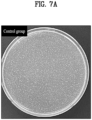
- FIGS. 6 and 7 are images showing the antimicrobial performance of the antimicrobial film-coated substrate according to one embodiment of the present disclosure.
- FIGS. 6 and 7 show comparison in the antimicrobial performance between the case in which Cu 2 O antimicrobial particles are formed on a thermoplastic plastic or polymer substrate, and a control group.
- the antimicrobial film-coated substrate (b) according to one embodiment of the present disclosure has excellent antimicrobial performance against Staphylococcus aureus.
- FIG. 7 shows the antimicrobial performance against E. coli.
- the antimicrobial film-coated substrate (b) according to one embodiment of the present disclosure has excellent antimicrobial performance against E. coli.
- Table 1 shows the results of a certified test report demonstrating the antimicrobial performance of a Cu 2 O antimicrobial particle layer coated on a plastic surface according to one embodiment of the present disclosure.
- the test report results show that the antimicrobial film-coated substrate has an antimicrobial performance of 99.9% against Staphylococcus aureus and E. coli.
- Test item Test results Control Sample Staphylococcus aureus Bacteria count after 24 hours 4.9 ⁇ 10 6 ⁇ 10 Staphylococcus aureus Antimicrobial activity (log) 5.7 Bacterial reduction (%) 99.9 Concentration of inoculated strain solution 8.0 ⁇ 10 5 CFU/mL Escherichia coli Bacteria count after 24 hours 1.9 ⁇ 10 7 ⁇ 10 Escherichia coli Antimicrobial activity (log) 6.3 Bacterial reduction (%) 99.9 Concentration of inoculated strain solution 4.0 ⁇ 10 5 CFU/mL
- FIG. 8 is a graph showing transparency according to the concentration of the metal salt coating solution in the method of manufacturing an antimicrobial film-coated substrate according to one embodiment of the present disclosure.
- the concentration of the metal salt coating solution As described above, by controlling the concentration of the metal salt coating solution, the size and density of antimicrobial particles formed on the surface of a thermoplastic plastic or polymer substrate may be controlled.
- the transmittance of the antimicrobial particle layer formed on the surface of a thermoplastic plastic or polymer substrate may be controlled.
- the transmittance for light in the range of a short wavelength may be slightly reduced.
- the transmittance increases slightly depending on the wavelength, but is generally uniform.
- the transmittance according to the concentration of the metal salt coating solution is measured based on the light with a wavelength of 550 nm, which has the highest sensitivity within the visible light range.
- the transparency is 90.82%, and when the concentration of the metal salt coating solution is 0.05 M, the transparency decreases slightly to 90.14%. In addition, when the concentration of the metal salt coating solution is 0.1 M, the transparency decreases to 82.91%. In other words, as the concentration of the metal salt decreases, the transmittance of the antimicrobial particle layer may increase.
- the transmittance of the antimicrobial particle layer formed by the metal salt coating solution may be controlled by adjusting the concentration of the metal salt coating solution.
- the present disclosure may provide an antimicrobial film-coated substrate applicable to plastic products or polymer substrates and a method of manufacturing the same.
Landscapes
- Chemical & Material Sciences (AREA)
- Life Sciences & Earth Sciences (AREA)
- Engineering & Computer Science (AREA)
- Wood Science & Technology (AREA)
- Organic Chemistry (AREA)
- Plant Pathology (AREA)
- Inorganic Chemistry (AREA)
- Materials Engineering (AREA)
- Chemical Kinetics & Catalysis (AREA)
- Environmental Sciences (AREA)
- Zoology (AREA)
- Pest Control & Pesticides (AREA)
- General Chemical & Material Sciences (AREA)
- Health & Medical Sciences (AREA)
- General Health & Medical Sciences (AREA)
- Dentistry (AREA)
- Agronomy & Crop Science (AREA)
- Thermal Sciences (AREA)
- Physics & Mathematics (AREA)
- Mechanical Engineering (AREA)
- Metallurgy (AREA)
- Medicinal Chemistry (AREA)
- Polymers & Plastics (AREA)
- Ceramic Engineering (AREA)
- Agricultural Chemicals And Associated Chemicals (AREA)
- Laminated Bodies (AREA)
- Application Of Or Painting With Fluid Materials (AREA)
Abstract
Description
- The present disclosure relates to an antimicrobial coating. More specifically, the present disclosure relates to an antimicrobial film-coated substrate and a method of manufacturing the same.
- In general, plastic products require antimicrobial coating because they may come into contact with human hands or be exposed to various environments.
- Conventional antimicrobial coatings have been formed by separately synthesizing antimicrobial particles, mixing the antimicrobial particles with polymers for attachment to the desired substrate, and then coating the substrate with the mixture. Therefore, processes such as raw material synthesis, stirring, coating, and heat treatment are required for antimicrobial coating, and there are limitations such as increased process time at each process step and the need for high-concentration antimicrobial agents.
- In addition, the antimicrobial performance is actually driven by only a small number of antimicrobial particles exposed to the surface because direct contact with strains is required in terms of the antimicrobial mechanism.
- Ultimately, it is impossible to control the distribution of antimicrobial particles in a polymer since a high concentration of antimicrobial particles mixed with the polymer to provide antimicrobial performance is required. Furthermore, there are problems such as reduced product transparency and uneven antimicrobial performance that limit the application of parts in addition to the increase in raw material costs.
- Therefore, a solution to these problems is required.
- One technical task of the present disclosure is to provide an antimicrobial film-coated substrate and a method of manufacturing the same, which enable direct formation of an antimicrobial particle layer on the surface of a target substrate without using a polymer.
- Another technical task of the present disclosure is to provide an antimicrobial film-coated substrate and a method of manufacturing the same, which enable formation of an antimicrobial film using a small quantity of antimicrobial particles.
- Another technical task of the present disclosure is to provide an antimicrobial film-coated substrate and a method of manufacturing the same, which enable formation of an antimicrobial film with high light transmittance.
- Another technical task of the present disclosure is to provide an antimicrobial film-coated substrate and a method of manufacturing the same, which maintain or increase the degree of design freedom of the parts to which the antimicrobial film is applied.
- In one technical aspect of the present disclosure, provided is a method of manufacturing an antimicrobial film-coated substrate configured to directly form antimicrobial particles, the method including mixing a metal salt with a hydrophobic solvent to prepare a coating solution, coating a surface of a plastic or polymer substrate with the coating solution, and heat-treating the coated plastic or polymer substrate to form an antimicrobial particle layer on the surface of the plastic or polymer substrate.
- In an exemplary embodiment, the hydrophobic solvent may include at least one of ethanol, isopropanol, or methanol.
- In an exemplary embodiment, the plastic may be a thermoplastic plastic.
- In an exemplary embodiment, the metal salt may include at least one of a metal acetate-based material, a metal chloride-based material, or a metal nitrate-based material.
- In an exemplary embodiment, the metal may include copper (Cu).
- In an exemplary embodiment, the heat-treating may include inducing an oxidation reaction and an aggregation reaction to fix the antimicrobial particles to the surface of the plastic or polymer substrate.
- In an exemplary embodiment, a concentration of the metal salt may be 0.001 M (molar concentration) to 0.1 M.
- In an exemplary embodiment, a size of the antimicrobial particles may increase as the concentration of the metal salt increases.
- In an exemplary embodiment, transmittance of the antimicrobial particle layer may increase as the concentration of the metal salt decreases.
- In an exemplary embodiment, the metal salt may include one of copper (II) acetate (Cu(CH3COO)2), copper (II) nitrate (Cu(NO3)2), or copper(I) chloride (CuCl2).
- In another technical aspect of the present disclosure, provided is a method of manufacturing an antimicrobial film-coated substrate, the method including mixing a metal salt including at least one of a metal acetate-based material, a metal chloride-based material, or a metal nitrate-based material with an alcohol-based solvent to prepare a coating solution, coating a surface of a plastic or polymer substrate with the coating solution, and heat-treating the coated plastic or polymer substrate to form an antimicrobial particle layer on the surface of the plastic or polymer substrate.
- In another technical aspect of the present disclosure, provided is an antimicrobial film-coated substrate including a metal salt including at least one of metal acetate, metal chloride, or metal nitrate directly formed on a surface thereof through an oxidation reaction and an aggregation reaction.
- According to one embodiment of the present disclosure, the following effects are provided.
- First, according to the embodiment of the present disclosure, it is possible to achieve better performance even with a small quantity of antimicrobial particles.
- Therefore, the embodiment of the present disclosure has an advantage of more efficiently forming an antimicrobial particle coating.
- In addition, the embodiment of the present disclosure eliminates the necessity of a high concentration of antimicrobial agent or polymer to attach the antimicrobial particles to a desired substrate, and an additional process such as a stirring process, thus greatly reducing the material cost and the number of processes, and minimizing the process time.
- In addition, according to the embodiment of the present disclosure, the antimicrobial particle layer is formed on the surface of a thermoplastic plastic or polymer substrate, thus advantageously inducing a rapid antimicrobial reaction upon contact with a strain and maintaining surface antimicrobial performance even with a low concentration of antimicrobial particles.
- As such, according to the embodiment of the present disclosure, a copper (I) oxide particle layer with excellent antimicrobial performance is directly formed on the surface of a plastic or polymer substrate without using a polymer, thereby improving the antimicrobial performance of the applied part.
- Accordingly, the cost of raw materials may be reduced because a small quantity of antimicrobial particles is used to form an antimicrobial film.
- In addition, transparency may be controlled by adjusting the concentration of the coating solution to form an antimicrobial film, thereby maintaining or increasing the design freedom of the applied part.
- Furthermore, according to another embodiment of the present disclosure, there are additional effects not mentioned herein. This can be understood by those skilled in the art from the overall disclosure and drawings.
-
-
FIG. 1 is a flowchart illustrating a method of manufacturing an antimicrobial film-coated substrate according to one embodiment of the present disclosure; -
FIG. 2 is a graph showing the distribution of the diameter of antimicrobial particles depending on the concentration of a metal salt in the method of manufacturing an antimicrobial film-coated substrate according to one embodiment of the present disclosure; -
FIG. 3 is an image showing antimicrobial particles formed using the method of manufacturing an antimicrobial film-coated substrate according to an embodiment of the present disclosure; -
FIGS. 4 and5 are XPS graphs showing formation of antimicrobial particles using the method of manufacturing an antimicrobial film-coated substrate according to one embodiment of the present disclosure; -
FIGS. 6 and7 are images showing the antimicrobial performance of the antimicrobial film-coated substrate according to one embodiment of the present disclosure; and -
FIG. 8 is a graph showing transparency depending on the concentration of the metal salt coating solution in the method of manufacturing an antimicrobial film-coated substrate according to one embodiment of the present disclosure. - Reference will now be made in detail to embodiments of the present disclosure, examples of which are illustrated in the accompanying drawings. Wherever possible, the same reference numbers will be used throughout the drawings to refer to the same or like parts, and redundant description thereof will be omitted. As used herein, the suffixes "module" and "unit" are added or used interchangeably to facilitate preparation of this specification and are not intended to suggest distinct meanings or functions.
- In describing embodiments disclosed in this specification, relevant well-known technologies may not be described in detail in order not to obscure the subject matter of the embodiments disclosed in this specification. In addition, it should be noted that the accompanying drawings are only for easy understanding of the embodiments disclosed in the present specification, and should not be construed as limiting the technical spirit disclosed in the present specification.
- Furthermore, although the drawings are separately described for simplicity, embodiments implemented by combining at least two or more drawings are also within the scope of the present disclosure.
- In addition, when an element such as a layer, region or module is described as being "on" another element, it is to be understood that the element may be directly on the other element or there may be an intermediate element between them.
-
FIG. 1 is a flowchart illustrating a method of manufacturing an antimicrobial film-coated substrate according to one embodiment of the present disclosure. - Referring to
FIG. 1 , a method of manufacturing an antimicrobial film-coated substrate according to one embodiment of the present disclosure may include preparing a metal salt-based coating solution (metal salt-based solution) (S10), coating a surface of a substrate with the prepared coating solution (S20), and heat-treating the substrate coated with the coating solution (S30). - The preparing a metal salt-based coating solution (metal salt-based solution) (S10) may be carried out by mixing a metal salt with a hydrophobic solvent.
- Here, the hydrophobic solvent may contain at least one of ethanol, isopropanol, or methanol.
- As such, embodiments of the present disclosure may be applied to various plastics and complicated structures having hydrophobic properties using an alcohol solution as a hydrophobic solvent.
- The substrate coated with the coating solution may be a plastic or polymer substrate. For example, the plastic may be a thermoplastic plastic such as polyethylene, polyethylene terephthalate, polyvinyl chloride, polyvinylidene chloride, polystyrene, or polypropylene.
- In addition, the polymer substrate may be a polymer film such as a PE, PET, or PMMA film.
- As an exemplary embodiment, the metal salt may include at least one of a metal acetate-based material, a metal chloride-based material, or a metal nitrate-based material.
- As an exemplary embodiment, the metal of the metal salt may include copper (Cu). That is, the metal salt may include one of copper (II) acetate (Cu(CH3COO)2), copper (II) nitrate (Cu(NO3)2), and copper (I) chloride (CuCl2).
- The metal salt including copper may be readily oxidized by low-temperature heat treatment and may be converted into antimicrobial particles on the surface of the substrate.
- Such a metal salt may be mixed with an alcohol-based solvent to prepare a coating solution. The coating solution may be coated on the surface of a plastic or polymer substrate by a coating method such as spray coating, dip coating, or spin coating.
- Meanwhile, by the heat-treating the substrate coated with the coating solution (S30), an antimicrobial particle layer may be formed on the surface of the plastic or polymer substrate.
- This heat-treating process may induce oxidation and aggregation reactions to fix the antimicrobial particles to the surface of the plastic or polymer substrate. In other words, the metal salt can act as an antimicrobial particle.
- After coating the thermoplastic plastic or polymer substrate with the metal salt by the above process, the antimicrobial material, i.e., metal oxide, may be formed, and at the same time, the agglomerated antimicrobial particles may be fixed to the surface of the thermoplastic plastic or polymer substrate using surface melting.
- The heat-treating is possible at low temperatures. In addition, various heat treatment methods based on plasma or heat-resistant wire may be used to generate antimicrobial particles on the surface of thermoplastic plastics or polymer substrates at low temperatures. In addition, the bond between the antimicrobial particles and the substrate surface can be strengthened by this heat-treating process.
- Conventional antimicrobial coatings have been formed by separately synthesizing antimicrobial particles, mixing the antimicrobial particles with polymers for attachment to the desired substrate and coating the substrate with the mixture. Therefore, processes such as raw material synthesis, stirring, coating, and heat treatment are required for antimicrobial coatings and there are limitations such as increased process time at each process step and the need for high concentrations of antimicrobial agents.
- In addition, the antimicrobial performance is actually obtained by only a small number of antimicrobial particles exposed to the surface because direct contact with strains is required in terms of the antimicrobial mechanism.
- Ultimately, it is impossible to control the distribution of antimicrobial particles in a polymer since a high concentration of antimicrobial particles mixed with the polymer to provide antimicrobial performance is required. Furthermore, there is a problem of limited application to parts due to reduced product transparency and uneven antimicrobial performance in addition to the increase in raw material costs.
- However, according to an embodiment of the present disclosure, it is possible to obtain better performance using even a small amount of antimicrobial particles.
- For example, according to conventional methods, antimicrobial particles were randomly mixed and coated on a substrate, but the actual antimicrobial performance depended only on the particles exposed to the surface and the rest were inherent in the polymer.
- Therefore, an embodiment of the present disclosure has an advantage of more efficiently forming an antimicrobial particle coating.
- In addition, according to the embodiment of the present disclosure, since a high concentration of antimicrobial agent or polymer is not required to attach the antimicrobial particles to the desired substrate, and an additional process such as a stirring process is not required, the material cost and the number of processes can be greatly reduced, and the process time can be minimized.
- In addition, according to the embodiment of the present disclosure, the antimicrobial particle layer is formed on the surface of the thermoplastic plastic or polymer substrate, thus advantageously inducing a rapid antimicrobial reaction upon contact with the strain and maintaining surface antimicrobial performance even with a low concentration of antimicrobial particles.
- As such, according to the embodiment of the present disclosure, a copper (I) oxide particle layer with excellent antimicrobial performance may be directly formed on the surface of the plastic or polymer substrate without using a polymer, thereby improving the antimicrobial performance of the applied part.
- Accordingly, a small amount of antimicrobial particles is used to form the antimicrobial film, thus reducing the raw material cost. In addition, by controlling the concentration of the coating solution for forming the antimicrobial film, transparency may be controlled and thus the freedom of design of the applied part may be maintained or increased.
-
FIG. 2 is a graph showing the distribution of the diameter of antimicrobial particles depending on the concentration of a metal salt in the method of manufacturing an antimicrobial film-coated substrate according to one embodiment of the present disclosure. - As described above, a metal salt-based coating solution (metal salt-based solution) for coating a thermoplastic plastic or polymer substrate may be prepared by mixing a metal salt with a hydrophobic solvent (alcohol-based solution).
- Here, the hydrophobic solvent may include at least one of ethanol, isopropanol, or methanol.
- As a specific example, the metal salt may include one of copper (II) acetate (Cu(CH3COO)2), copper (II) nitrate (Cu(NO3)2), and copper (I) chloride (CuCl2). Accordingly, a graph showing an example in which Cu2O antimicrobial particles are formed on the surface of a thermoplastic plastic or polymer substrate is shown.
-
FIG. 2 shows the size (diameter) of antimicrobial particles depending on the concentration of the coating solution, that is, the concentration of the metal salt, containing copper as a metal salt. - In other words, the size of the antimicrobial particles formed on the surface of the thermoplastic plastic or polymer substrate may vary depending on the concentration of the metal salt.
- In addition, it can be seen that the size of these antimicrobial particles can be controlled by adjusting the concentration of the metal salt-based solution (coating solution).
- Referring to
FIG. 2 , the concentration of the metal salt may be adjusted from 0.001 M (molar concentration) to 0.1 M. Accordingly, for example, the size of the antimicrobial particles formed on the surface of the thermoplastic plastic or polymer substrate may be controlled between about 0.3 µm and about 5.3 µm. - In addition,
FIG. 2 shows a tendency for the size of the antimicrobial particles to increase as the concentration of the metal salt increases. - As such, referring to
FIG. 2 , according to an embodiment of the present disclosure, an antimicrobial film-coated substrate may be manufactured in which a metal salt including at least one of a metal acetate-based material, a metal chloride-based material, or a metal nitrate-based material is directly formed on the surface through an oxidation reaction and an aggregation reaction. - According to this embodiment of the present disclosure, a Cu2O particle layer may be directly formed on the surface of a thermoplastic plastic or polymer substrate.
-
FIG. 3 is an image showing antimicrobial particles formed by a method of manufacturing an antimicrobial film-coated substrate according to an embodiment of the present disclosure. - Referring to
FIG. 3 , the change in the size and density of the antimicrobial particles is shown in a FE-SEM (field emission scanning electron microscope) image. - As such, it can be seen that the size and density of the antimicrobial particles formed on the surface of the thermoplastic plastic or polymer substrate are changed by controlling the concentration of the metal salt coating solution.
-
FIG. 3A is an image showing antimicrobial particles when the concentration of the metal salt, i.e., the concentration of the metal salt-based solution (coating solution), is 0.001 M (molar concentration). An enlarged image is shown in the upper right and it can be seen that this image shows the same tendency as the graph shown inFIG. 2 . - In addition,
FIG. 3B is an image showing bacterial particles when the concentration of the metal salt, i.e., the concentration of the metal salt-based solution (coating solution), is 0.05 M (molar concentration). It can be seen fromFIG. 3B that, the size of the antimicrobial particles increases as the concentration of the metal salt-based solution (coating solution) increases compared to the case illustrated inFIG. 3A . -
FIG. 3C is an image showing antimicrobial particles when the concentration of the metal salt, i.e., the concentration of the metal salt-based solution (coating solution), is 0.1 M (molar concentration). Like the case shown inFIG. 3B ,FIG. 3C shows that, the size of the antimicrobial particles increases, compared to the case illustrated inFIG. 3B , as the concentration of the metal salt-based solution (coating solution) increases. -
FIG. 3 also shows an example where the metal salt includes copper. That is, the image shows an example where Cu2O antimicrobial particles are formed using a metal salt including one of copper (II) acetate (Cu(CH3COO)2), copper (II) nitrate (Cu(NO3)2), and copper (I) chloride (CuCl2). - As such, the size and density of the antimicrobial particles increase as the concentration of the metal salt-based solution (coating solution) increases. That is, the size and density of antimicrobial particles may be controlled by adjusting the concentration of the metal salt-based solution (coating solution).
-
FIGS. 4 and5 are XPS graphs showing formation of antimicrobial particles using the method of manufacturing an antimicrobial film-coated substrate according to one embodiment of the present disclosure. -
FIG. 4 is an X-ray photoelectron spectroscopy (XPS) graph of antimicrobial particles formed by an embodiment of the present disclosure. - That is, the XPS graph shows an example where Cu2O antimicrobial particles are formed on a plastic or polymer substrate using a metal salt including one of copper (II) acetate (Cu(CH3COO)2), copper (II) nitrate (Cu(NO3)2), and copper (I) chloride (CuCl2).
-
FIG. 5 is a reference graph showing the chemical structure of Cu. - Comparing
FIG. 4 withFIG. 5 , it can be seen that chemical bond of Cu2O is formed on the surface of the thermoplastic plastic or polymer substrate by detection of photoelectrons emitted from X-rays. In addition, the composition of the antimicrobial particles can be determined. -
FIGS. 6 and7 are images showing the antimicrobial performance of the antimicrobial film-coated substrate according to one embodiment of the present disclosure. -
FIGS. 6 and7 show comparison in the antimicrobial performance between the case in which Cu2O antimicrobial particles are formed on a thermoplastic plastic or polymer substrate, and a control group. -
FIG. 6 shows the antimicrobial performance against Staphylococcus aureus. - It can be seen that, compared to the control group (a) that is not coated with an antimicrobial film, the antimicrobial film-coated substrate (b) according to one embodiment of the present disclosure has excellent antimicrobial performance against Staphylococcus aureus.
-
FIG. 7 shows the antimicrobial performance against E. coli. - It can be seen that, compared to the control group (a) that is not coated with an antimicrobial film, the antimicrobial film-coated substrate (b) according to one embodiment of the present disclosure has excellent antimicrobial performance against E. coli.
- Table 1 shows the results of a certified test report demonstrating the antimicrobial performance of a Cu2O antimicrobial particle layer coated on a plastic surface according to one embodiment of the present disclosure.
- The test report results show that the antimicrobial film-coated substrate has an antimicrobial performance of 99.9% against Staphylococcus aureus and E. coli.
- This test is conducted by the Korea Analysis Test Researcher (KATR) in accordance with the test standard JIS Z201. In addition, the sample for the test was a plastic specimen coated with 0.001 M antimicrobial particles.
- 24 hours before the treatment of the sample for the test, 0.4 mL of a culture solution was placed on the sample and then covered with a standard film.
[Table 1] Test item Test results Control Sample Staphylococcus aureus Bacteria count after 24 hours 4.9×10⁶ <10 Staphylococcus aureus Antimicrobial activity (log) 5.7 Bacterial reduction (%) 99.9 Concentration of inoculated strain solution 8.0×10⁵ CFU/mL Escherichia coli Bacteria count after 24 hours 1.9×10⁷ <10 Escherichia coli Antimicrobial activity (log) 6.3 Bacterial reduction (%) 99.9 Concentration of inoculated strain solution 4.0×10⁵ CFU/mL -
FIG. 8 is a graph showing transparency according to the concentration of the metal salt coating solution in the method of manufacturing an antimicrobial film-coated substrate according to one embodiment of the present disclosure. - As described above, by controlling the concentration of the metal salt coating solution, the size and density of antimicrobial particles formed on the surface of a thermoplastic plastic or polymer substrate may be controlled.
- In addition, by controlling the concentration of the metal salt coating solution, the transmittance of the antimicrobial particle layer formed on the surface of a thermoplastic plastic or polymer substrate may be controlled.
- It can be seen from the graph of
FIG. 8 that, when the concentration of the metal salt coating solution is 0.001M and 0.05M, the transmittance is approximately uniform depending on the wavelength. - On the other hand, it can be seen that, when the concentration of the metal salt coating solution is 0.1 M, the transmittance for light in the range of a short wavelength may be slightly reduced. However, it can be seen that, within the visible light range, the transmittance increases slightly depending on the wavelength, but is generally uniform.
- As can be seen from the table inside the graph of
FIG. 8 , the transmittance according to the concentration of the metal salt coating solution is measured based on the light with a wavelength of 550 nm, which has the highest sensitivity within the visible light range. - As such, at the 550 nm wavelength, when the concentration of the metal salt coating solution is 0.001 M, the transparency is 90.82%, and when the concentration of the metal salt coating solution is 0.05 M, the transparency decreases slightly to 90.14%. In addition, when the concentration of the metal salt coating solution is 0.1 M, the transparency decreases to 82.91%. In other words, as the concentration of the metal salt decreases, the transmittance of the antimicrobial particle layer may increase.
- As such, it can be seen that the transmittance of the antimicrobial particle layer formed by the metal salt coating solution may be controlled by adjusting the concentration of the metal salt coating solution.
- The above description is merely illustrative of the technical concept of the present disclosure, and various modifications and variations can be made by those skilled in the art, to which the present disclosure pertains, without departing from the essential characteristics of the present disclosure.
- Therefore, the embodiments disclosed in the present disclosure are not intended to limit the technical concept of the present disclosure, but are for the purpose of explanation, and the scope of the technical concept of the present disclosure is non-limited by this embodiment.
- The scope of protection of the present disclosure should be construed based on the following claims, and all technical ideas within the equivalent scope thereof should be construed as being included in the scope of the rights of the present disclosure.
- The present disclosure may provide an antimicrobial film-coated substrate applicable to plastic products or polymer substrates and a method of manufacturing the same.
Claims (20)
- A method of manufacturing an antimicrobial film-coated substrate configured to directly form antimicrobial particles, the method comprising:mixing a metal salt with a hydrophobic solvent to prepare a coating solution;coating a surface of a plastic or polymer substrate with the coating solution; andheat-treating the coated plastic or polymer substrate to form an antimicrobial particle layer on the surface of the plastic or polymer substrate.
- The method according to claim 1, wherein the hydrophobic solvent comprises at least one of ethanol, isopropanol, or methanol.
- The method according to claim 1, wherein the plastic is a thermoplastic plastic.
- The method according to claim 1, wherein the metal salt comprises at least one of a metal acetate-based material, a metal chloride-based material, or a metal nitrate-based material.
- The method according to claim 4, wherein the metal comprises copper (Cu).
- The method according to claim 1, wherein the heat-treating comprises inducing an oxidation reaction and an aggregation reaction to fix the antimicrobial particles to the surface of the plastic or polymer substrate.
- The method according to claim 1, wherein a concentration of the metal salt is 0.001 M (molar concentration) to 0.1 M.
- The method according to claim 7, wherein a size of the antimicrobial particles increases as the concentration of the metal salt increases.
- The method according to claim 7, wherein transmittance of the antimicrobial particle layer increases as the concentration of the metal salt decreases.
- The method according to claim 1, wherein the metal salt comprises one of copper (II) acetate (Cu(CH3COO)2), copper (II) nitrate (Cu(NO3)2), or copper(I) chloride (CuCl2).
- A method of manufacturing an antimicrobial film-coated substrate, the method comprising:mixing a metal salt including at least one of a metal acetate-based material, a metal chloride-based material, or a metal nitrate-based material with an alcohol-based solvent to prepare a coating solution;coating a surface of a plastic or polymer substrate with the coating solution; andheat-treating the coated plastic or polymer substrate to form an antimicrobial particle layer on the surface of the plastic or polymer substrate.
- The method according to claim 11, wherein the heat-treating comprises inducing an oxidation reaction and an aggregation reaction to fix the antimicrobial particles to the surface of the plastic or polymer substrate.
- The method according to claim 11, wherein the concentration of the metal salt is 0.001 M (molar concentration) to 0.1 M.
- The method according to claim 13, wherein a size of the antimicrobial particles increases as the concentration of the metal salt increases.
- The method according to claim 13, wherein transmittance of the antimicrobial particle layer increases as the concentration of the metal salt decreases.
- The method according to claim 11, wherein the metal salt comprises one of copper (II) acetate (Cu(CH3COO)2), copper (II) nitrate (Cu(NO3)2), or copper(I) chloride (CuCl2).
- An antimicrobial film-coated substrate comprising a metal salt including at least one of metal acetate, metal chloride, or metal nitrate directly formed on a surface thereof through an oxidation reaction and an aggregation reaction.
- The antimicrobial film-coated substrate according to claim 17, wherein a concentration of the metal salt is 0.001 M (molar concentration) to 0.1 M.
- The antimicrobial film-coated substrate according to claim 18, wherein a size of the antimicrobial particles increases as the concentration of the metal salt increases.
- The antimicrobial film-coated substrate according to claim 17, wherein the metal salt comprises one of copper (II) acetate (Cu(CH3COO)2), copper (II) nitrate (Cu(NO3)2), or copper(I) chloride (CuCl2).
Applications Claiming Priority (1)
| Application Number | Priority Date | Filing Date | Title |
|---|---|---|---|
| PCT/KR2022/010294 WO2024014576A1 (en) | 2022-07-14 | 2022-07-14 | Antimicrobial film-coated substrate and manufacturing method therefor |
Publications (2)
| Publication Number | Publication Date |
|---|---|
| EP4527508A1 true EP4527508A1 (en) | 2025-03-26 |
| EP4527508A4 EP4527508A4 (en) | 2025-05-28 |
Family
ID=89536894
Family Applications (1)
| Application Number | Title | Priority Date | Filing Date |
|---|---|---|---|
| EP22951231.4A Pending EP4527508A4 (en) | 2022-07-14 | 2022-07-14 | Antimicrobial film-coated substrate and manufacturing method therefor |
Country Status (4)
| Country | Link |
|---|---|
| US (1) | US20250353983A1 (en) |
| EP (1) | EP4527508A4 (en) |
| KR (1) | KR20250036725A (en) |
| WO (1) | WO2024014576A1 (en) |
Family Cites Families (8)
| Publication number | Priority date | Publication date | Assignee | Title |
|---|---|---|---|---|
| CN1218634C (en) * | 2002-04-30 | 2005-09-14 | 香港中文大学 | Preparation method of mesoporous titanium dioxide film with high bactericidal photoactivity |
| US10370789B2 (en) * | 2008-06-30 | 2019-08-06 | Bar Ilan University | Sonochemical coating of textiles with metal oxide nanoparticles for antimicrobial fabrics |
| KR101622366B1 (en) * | 2013-07-18 | 2016-05-19 | 주식회사 엘지화학 | coating composition for treating surface of solid substrate and method for treating surface of solid substrate using the same |
| GB2521405B (en) * | 2013-12-18 | 2015-12-02 | Dublin Inst Of Technology | A surface coating |
| JP7084914B2 (en) * | 2016-09-20 | 2022-06-15 | エージェンシー フォー サイエンス,テクノロジー アンド リサーチ | Cell rupture-based antimicrobial surface coated with metal oxide nanoarrays |
| KR101841970B1 (en) * | 2017-06-16 | 2018-03-26 | 노승환 | Method for producing ceramic composition for coating, ceramic composition by the method and coating mehtod using by it |
| US20230115585A1 (en) * | 2020-03-27 | 2023-04-13 | Mitsubishi Materials Corporation | Antimicrobial member |
| KR102486333B1 (en) * | 2020-08-10 | 2023-01-10 | 주식회사 코프라 | Antiviral biodegradable sheets and uses thereof |
-
2022
- 2022-07-14 WO PCT/KR2022/010294 patent/WO2024014576A1/en not_active Ceased
- 2022-07-14 US US18/871,464 patent/US20250353983A1/en active Pending
- 2022-07-14 EP EP22951231.4A patent/EP4527508A4/en active Pending
- 2022-07-14 KR KR1020247039978A patent/KR20250036725A/en active Pending
Also Published As
| Publication number | Publication date |
|---|---|
| WO2024014576A1 (en) | 2024-01-18 |
| US20250353983A1 (en) | 2025-11-20 |
| EP4527508A4 (en) | 2025-05-28 |
| KR20250036725A (en) | 2025-03-14 |
Similar Documents
| Publication | Publication Date | Title |
|---|---|---|
| US10433541B2 (en) | Antibacterial liquid, antibacterial film, and wet wipe | |
| CN104487511B (en) | Polycarbonate resin composition in which composite tungsten oxide fine particles are dispersed, and heat ray shielding molded body and heat ray shielding laminate using the same | |
| KR101532100B1 (en) | Micro protein inactivated metal ultra-fine particles | |
| KR102003884B1 (en) | Packaging film coated with zinc oxide nanoparticles and preparation method thereof | |
| US8022011B2 (en) | Photocatalyst element, method and device for preparing the same | |
| KR20150138275A (en) | Antibacterial polymers and method for obtaining the same | |
| EP0732052A2 (en) | An antimicrobial polymer composition | |
| EP3124237B1 (en) | Substrate with antibacterial layer, and antibacterial sheet, radiography device, and touch panel | |
| EP4527508A1 (en) | Antimicrobial film-coated substrate and manufacturing method therefor | |
| Choi et al. | Water-resistant and antibacterial zinc aluminate films: Application of antibacterial thin film capacitors | |
| CN108884340A (en) | Monomers, polymers, and coating formulations comprising at least one N-halamine precursor, a cationic center, and a coating-integrating group | |
| KR102776496B1 (en) | Hard coating composition and Method of manufacturing thereof | |
| CA2627522A1 (en) | Antimicrobial films | |
| DE112011103971B4 (en) | Thermoplastic resin composition, production method of thermoplastic resin composition, molding material and light-emitting body | |
| CN116322988A (en) | Coating Composition | |
| JP2020045454A (en) | Curable composition, cured coat, article including cured coat and antibacterial method | |
| TW201538319A (en) | Substrate with antibacterial layer, antibacterial sheet, radiation photographing apparatus, touch panel | |
| JP2985973B2 (en) | Zeolite antibacterial agent and resin composition | |
| JPH1119520A (en) | Method for producing functional material having photocatalytic activity | |
| EP1559752A2 (en) | Antimicrobial-containing coating powder | |
| JP2002179514A (en) | Antifungal agent, method of producing the same and antifungal resin composition | |
| Choi et al. | Investigations on the ZnO-and Cr-doped ZnO powders | |
| JP2022136734A (en) | Antibacterial film, and optical film and image display device including the same | |
| EP1655325A2 (en) | Method of applying a mixture of resin and thermoplastic material with added nano-silver powder | |
| CN115477801B (en) | Ethylene-vinyl alcohol copolymer resin composition, ethylene-vinyl alcohol copolymer film formed therefrom, and multilayer structure comprising the same |
Legal Events
| Date | Code | Title | Description |
|---|---|---|---|
| STAA | Information on the status of an ep patent application or granted ep patent |
Free format text: STATUS: THE INTERNATIONAL PUBLICATION HAS BEEN MADE |
|
| PUAI | Public reference made under article 153(3) epc to a published international application that has entered the european phase |
Free format text: ORIGINAL CODE: 0009012 |
|
| STAA | Information on the status of an ep patent application or granted ep patent |
Free format text: STATUS: REQUEST FOR EXAMINATION WAS MADE |
|
| 17P | Request for examination filed |
Effective date: 20241214 |
|
| AK | Designated contracting states |
Kind code of ref document: A1 Designated state(s): AL AT BE BG CH CY CZ DE DK EE ES FI FR GB GR HR HU IE IS IT LI LT LU LV MC MK MT NL NO PL PT RO RS SE SI SK SM TR |
|
| REG | Reference to a national code |
Ref country code: DE Ref legal event code: R079 Free format text: PREVIOUS MAIN CLASS: B05D0007240000 Ipc: A01N0059200000 |
|
| A4 | Supplementary search report drawn up and despatched |
Effective date: 20250429 |
|
| RIC1 | Information provided on ipc code assigned before grant |
Ipc: C23C 20/06 20060101ALI20250424BHEP Ipc: B05D 3/02 20060101ALI20250424BHEP Ipc: C09D 1/00 20060101ALI20250424BHEP Ipc: C09D 5/14 20060101ALI20250424BHEP Ipc: B05D 7/24 20060101ALI20250424BHEP Ipc: A01P 1/00 20060101ALI20250424BHEP Ipc: A01N 59/20 20060101AFI20250424BHEP |
|
| DAV | Request for validation of the european patent (deleted) | ||
| DAX | Request for extension of the european patent (deleted) |