EP4527394A1 - Novel method for preserving platelets - Google Patents
Novel method for preserving platelets Download PDFInfo
- Publication number
- EP4527394A1 EP4527394A1 EP23807586.5A EP23807586A EP4527394A1 EP 4527394 A1 EP4527394 A1 EP 4527394A1 EP 23807586 A EP23807586 A EP 23807586A EP 4527394 A1 EP4527394 A1 EP 4527394A1
- Authority
- EP
- European Patent Office
- Prior art keywords
- platelet
- preservation
- prp
- solution
- present
- Prior art date
- Legal status (The legal status is an assumption and is not a legal conclusion. Google has not performed a legal analysis and makes no representation as to the accuracy of the status listed.)
- Pending
Links
Images


Classifications
-
- A—HUMAN NECESSITIES
- A61—MEDICAL OR VETERINARY SCIENCE; HYGIENE
- A61P—SPECIFIC THERAPEUTIC ACTIVITY OF CHEMICAL COMPOUNDS OR MEDICINAL PREPARATIONS
- A61P17/00—Drugs for dermatological disorders
- A61P17/02—Drugs for dermatological disorders for treating wounds, ulcers, burns, scars, keloids, or the like
-
- C—CHEMISTRY; METALLURGY
- C12—BIOCHEMISTRY; BEER; SPIRITS; WINE; VINEGAR; MICROBIOLOGY; ENZYMOLOGY; MUTATION OR GENETIC ENGINEERING
- C12N—MICROORGANISMS OR ENZYMES; COMPOSITIONS THEREOF; PROPAGATING, PRESERVING, OR MAINTAINING MICROORGANISMS; MUTATION OR GENETIC ENGINEERING; CULTURE MEDIA
- C12N5/00—Undifferentiated human, animal or plant cells, e.g. cell lines; Tissues; Cultivation or maintenance thereof; Culture media therefor
- C12N5/52—Chemical aspects of preservation of animal cells or human cells
- C12N5/522—Preservation media
- C12N5/526—Physiologically active agents, e.g. antioxidants or nutrients
-
- A—HUMAN NECESSITIES
- A01—AGRICULTURE; FORESTRY; ANIMAL HUSBANDRY; HUNTING; TRAPPING; FISHING
- A01N—PRESERVATION OF BODIES OF HUMANS OR ANIMALS OR PLANTS OR PARTS THEREOF; BIOCIDES, e.g. AS DISINFECTANTS, AS PESTICIDES OR AS HERBICIDES; PEST REPELLANTS OR ATTRACTANTS; PLANT GROWTH REGULATORS
- A01N1/00—Preservation of bodies of humans or animals, or parts thereof
- A01N1/10—Preservation of living parts
- A01N1/12—Chemical aspects of preservation
- A01N1/122—Preservation or perfusion media
- A01N1/126—Physiologically active agents, e.g. antioxidants or nutrients
-
- A—HUMAN NECESSITIES
- A61—MEDICAL OR VETERINARY SCIENCE; HYGIENE
- A61K—PREPARATIONS FOR MEDICAL, DENTAL OR TOILETRY PURPOSES
- A61K35/00—Medicinal preparations containing materials or reaction products thereof with undetermined constitution
- A61K35/12—Materials from mammals; Compositions comprising non-specified tissues or cells; Compositions comprising non-embryonic stem cells; Genetically modified cells
- A61K35/14—Blood; Artificial blood
- A61K35/19—Platelets; Megacaryocytes
-
- A—HUMAN NECESSITIES
- A61—MEDICAL OR VETERINARY SCIENCE; HYGIENE
- A61P—SPECIFIC THERAPEUTIC ACTIVITY OF CHEMICAL COMPOUNDS OR MEDICINAL PREPARATIONS
- A61P19/00—Drugs for skeletal disorders
- A61P19/02—Drugs for skeletal disorders for joint disorders, e.g. arthritis, arthrosis
-
- A—HUMAN NECESSITIES
- A61—MEDICAL OR VETERINARY SCIENCE; HYGIENE
- A61P—SPECIFIC THERAPEUTIC ACTIVITY OF CHEMICAL COMPOUNDS OR MEDICINAL PREPARATIONS
- A61P7/00—Drugs for disorders of the blood or the extracellular fluid
- A61P7/08—Plasma substitutes; Perfusion solutions; Dialytics or haemodialytics; Drugs for electrolytic or acid-base disorders, e.g. hypovolemic shock
-
- C—CHEMISTRY; METALLURGY
- C12—BIOCHEMISTRY; BEER; SPIRITS; WINE; VINEGAR; MICROBIOLOGY; ENZYMOLOGY; MUTATION OR GENETIC ENGINEERING
- C12N—MICROORGANISMS OR ENZYMES; COMPOSITIONS THEREOF; PROPAGATING, PRESERVING, OR MAINTAINING MICROORGANISMS; MUTATION OR GENETIC ENGINEERING; CULTURE MEDIA
- C12N5/00—Undifferentiated human, animal or plant cells, e.g. cell lines; Tissues; Cultivation or maintenance thereof; Culture media therefor
- C12N5/56—Physical preservation processes for animal cells or human cells
- C12N5/562—Temperature processes, e.g. following predefined temperature changes over time
-
- A—HUMAN NECESSITIES
- A01—AGRICULTURE; FORESTRY; ANIMAL HUSBANDRY; HUNTING; TRAPPING; FISHING
- A01N—PRESERVATION OF BODIES OF HUMANS OR ANIMALS OR PLANTS OR PARTS THEREOF; BIOCIDES, e.g. AS DISINFECTANTS, AS PESTICIDES OR AS HERBICIDES; PEST REPELLANTS OR ATTRACTANTS; PLANT GROWTH REGULATORS
- A01N1/00—Preservation of bodies of humans or animals, or parts thereof
- A01N1/10—Preservation of living parts
- A01N1/12—Chemical aspects of preservation
- A01N1/122—Preservation or perfusion media
- A01N1/125—Freeze protecting agents, e.g. cryoprotectants or osmolarity regulators
-
- A—HUMAN NECESSITIES
- A61—MEDICAL OR VETERINARY SCIENCE; HYGIENE
- A61M—DEVICES FOR INTRODUCING MEDIA INTO, OR ONTO, THE BODY; DEVICES FOR TRANSDUCING BODY MEDIA OR FOR TAKING MEDIA FROM THE BODY; DEVICES FOR PRODUCING OR ENDING SLEEP OR STUPOR
- A61M1/00—Suction or pumping devices for medical purposes; Devices for carrying-off, for treatment of, or for carrying-over, body-liquids; Drainage systems
- A61M1/02—Blood transfusion apparatus
- A61M1/0272—Apparatus for treatment of blood or blood constituents prior to or for conservation, e.g. freezing, drying or centrifuging
-
- A—HUMAN NECESSITIES
- A61—MEDICAL OR VETERINARY SCIENCE; HYGIENE
- A61M—DEVICES FOR INTRODUCING MEDIA INTO, OR ONTO, THE BODY; DEVICES FOR TRANSDUCING BODY MEDIA OR FOR TAKING MEDIA FROM THE BODY; DEVICES FOR PRODUCING OR ENDING SLEEP OR STUPOR
- A61M2202/00—Special media to be introduced, removed or treated
- A61M2202/04—Liquids
- A61M2202/0413—Blood
- A61M2202/0427—Platelets; Thrombocytes
Definitions
- the present invention relates to a novel method for preserving a platelet, a platelet preservation solution, and the like. More specifically, the present invention relates to a method for preserving a platelet in a refrigerated or frozen state while retaining more platelet functions, a platelet preservation solution for use in such a method, and the like.
- PRP blood transfusion and platelet-rich plasma
- PRP is prepared by concentrating only platelets among three types of blood cells (red blood cells, white blood cells, and platelets) contained in blood to a high concentration, for example, through centrifugation of the blood of a subject.
- PRP contains, for example, cytokines such as epidermal growth factor (EGF), platelet-derived growth factor (PDGF), vascular endothelial growth factor (VEGF), insulin-like growth factor (IGF), fibroblast growth factor (FGF), hepatocyte growth factor (HGF), and transforming growth factor (TGF).
- EGF epidermal growth factor
- PDGF platelet-derived growth factor
- VEGF vascular endothelial growth factor
- IGF insulin-like growth factor
- FGF fibroblast growth factor
- HGF hepatocyte growth factor
- TGF transforming growth factor
- PRP is used in treatment of many diseases such as knee osteoarthritis and intractable skin ulcer (for example, Patent Document 1) and in cosmetic surgery.
- PRP therapy PRP is injected into an affected area. Platelets injected into the affected area produce cytokines in the affected area, and these cytokines stimulate regeneration of cells in the affected area and play an effective role in wound healing and tissue regeneration. Thus, it is extremely important to ensure that the cytokine-producing function of the platelets to be injected into the affected area is definitely retained in the PRP therapy.
- PRP therapy there has been a problem in that platelet functions decrease with time after blood collection (Patent Document 2).
- a platelet formulation for blood transfusion is handled with a preservation period of about 4 days at room temperature from the date of manufacture. From the viewpoint of preserving platelet functions such as platelet aggregability, it needs to be preserved at room temperature.
- An object of the present invention is to provide a method for preserving a platelet in a refrigerated or frozen state while retaining more platelet functions, a platelet preservation solution for use in such a method, and the like.
- platelets can be preserved while retaining platelet functions by suspending the platelets in a platelet preservation solution containing an electrolyte and an anticoagulant and then preserving the suspension by refrigeration or freezing at 10°C or lower, thus completing the present invention.
- the present invention relates, for example, to:
- the present invention it is possible to provide a method for preserving a platelet in a refrigerated or frozen state while retaining more platelet functions, a platelet preservation solution for use in such a method, and the like.
- the "platelet” in the present specification includes a mammalian platelet, more specifically, a platelet of, for example, a human, a mouse, a rat, a hamster, a guinea pig, a rabbit, a dog, a cat, a horse, a cow, a sheep, a pig, a goat, and a monkey, of which a human platelet is preferred.
- the platelet in the present specification may be a platelet for blood transfusion but is preferably a platelet for promoting tissue repair, such as a platelet for PRP therapy, from the viewpoint of enjoying more of the significance of the present invention.
- a method of platelet preparation is not particularly limited, and a platelet may be obtained by being isolated or concentrated from mammalian blood, or for example, obtained by inducing differentiation of a mammalian pluripotent stem cell and the like.
- Examples of the platelet obtained by being isolated or concentrated from mammalian blood include platelet-rich plasma (PRP) and a washed platelet, and from the viewpoint of ease of preparation, platelet-rich plasma is preferred.
- the platelet may not be a platelet derived from a subject to be administered, but from the viewpoint of a lower risk of rejection, is preferably a platelet derived from the subject to be administered.
- the method of preparing a platelet from the blood of a mammal such as a human is not particularly limited, and any known method can be used. Specific examples thereof include a method of centrifuging the blood to obtain platelet-rich plasma. Examples of the centrifugation treatment include a method of performing centrifugation once (one step centrifugation) and a method of performing centrifugation twice (two step centrifugation). Examples of the one step centrifugation include a method of centrifugation at 100 to 300 G for 5 to 20 minutes, and examples of the two step centrifugation include a method of centrifugation at 100 to 300 G for 5 to 20 minutes followed by centrifugation at 200 to 300 G for 5 to 20 minutes.
- the blood may have been collected from a mammal and then stored.
- the storage period include 120 hours or less, 96 hours or less, 72 hours or less, and 48 hours or less.
- the storage temperature is not particularly limited as long as it is 10°C or lower regardless of whether the blood is preserved by refrigeration or freezing, but from the viewpoint of retaining more platelet functions, it is preferably higher than 0°C and 5°C or lower, or 0°C or lower, Examples of temperatures of 0°C or lower include -80°C or higher and 0°C or lower, -60°C or higher and -5°C or lower, -40°C or higher and -10°C or lower, and -30°C or higher and -15°C or lower.
- the platelet preservation solution of the present invention is not particularly limited as long as it contains an electrolyte and an anticoagulant.
- electrolyte is not particularly limited as long as an aqueous solution containing the electrolyte can be administered to any mammal for use, and examples thereof include one or more selected from the group consisting of sodium chloride, potassium chloride, calcium chloride, magnesium chloride, sodium hydrogencarbonate, sodium lactate, and sodium acetate.
- the concentration of the electrolyte contained in the platelet preservation solution of the present invention is not particularly limited as long as the effects of the present invention are achieved, but is, for example, 160 to 400 mEq/L, preferably 180 to 360 mEq/L, and more preferably 180 to 320 mEq/L in terms of milliequivalent (mEq/L) of the total electrolyte.
- a powdered electrolyte may be used, or a commercially available electrolyte infusion solution or the like may be used.
- electrolyte infusion solution examples include physiological saline, Ringer's solution, Ringer's lactate solution (including sugar added Ringer's lactate solution), Ringer's acetate solution (including sugar added Ringer's acetate solution), and Ringer's bicarbonate solution (including those with sugar), of which Ringer's bicarbonate solution is preferred. These solutions may be used singly or in combinations of two or more thereof.
- anticoagulant examples include a chelating agent that prevents blood coagulation by coordinating calcium ions, which cause blood coagulation, and an antithrombin agent containing heparin that suppresses thrombin activity, which causes blood coagulation, among which a chelating agent is preferred.
- anticoagulant as a chelating agent examples include one or more selected from the group consisting of citric acid, ethylenediaminetetraacetic acid (EDTA), diethylenetriaminepentaacetic acid (DTPA), 1,2-diaminocyclohexanetetraacetic acid (DCTA), ethylene glycol bis(2-aminoethylether)tetraacetic acid (EGTA), oxalic acid, or salts thereof; of which citric acid or a salt thereof is preferred.
- the salt is preferably an alkali metal salt, and more preferably a sodium salt.
- an aqueous solution containing the anticoagulant examples include ACD-A solution (an aqueous solution containing sodium citrate hydrate, citric acid hydrate, and dextrose), CPD solution (an aqueous solution containing sodium citrate hydrate, citric acid hydrate, dextrose, and sodium dihydrogen phosphate hydrate), and CPDA-1 solution (an aqueous solution containing sodium citrate hydrate, citric acid hydrate, dextrose, sodium dihydrogen phosphate hydrate, and adenine), of which ACD-A solution is preferred.
- ACD-A solution an aqueous solution containing sodium citrate hydrate, citric acid hydrate, and dextrose
- CPD solution an aqueous solution containing sodium citrate hydrate, citric acid hydrate, dextrose, and sodium dihydrogen phosphate hydrate
- CPDA-1 solution an aqueous solution containing sodium citrate hydrate, citric acid hydrate, dextrose, sodium dihydrogen phosphat
- the anticoagulants may be used singly or in combinations of two or more thereof.
- a commercially available anticoagulant and anticoagulant solution can be used.
- the concentration of the anticoagulant in the preservation solution is not particularly limited as long as the effects of the present invention are achieved, and for example, when the anticoagulant is citric acid or a salt thereof, the concentration in terms of citric acid in the platelet preservation solution of the present invention is, for example, 0.2 to 3% w/v, preferably 0.5 to 2% w/v.
- the concentration in terms of EDTA is, for example, 0.2 to 3% w/v, preferably 0.5 to 2% w/v; when the anticoagulant is DTPA or a salt thereof, the concentration in terms of DTPA is, for example, 0.2 to 3% w/v, and preferably 0.5 to 2% w/v; when the anticoagulant is DCTA or a salt thereof, the concentration in terms of DCTA is, for example, 0.2 to 3% w/v, and preferably 0.5 to 2% w/v; when the anticoagulant is EGTA or a salt thereof, the concentration in terms of EGTA is, for example, 0.2 to 3% w/v, and preferably 0.5 to 2% w/v; and when the anticoagulant is oxalic acid or a salt thereof, the concentration in terms of oxalic acid is, for example, 0.2 to 3% w/v, and preferably 0.5 to
- a powdered anticoagulant may be used, or a commercially available anticoagulant solution (an aqueous solution containing an anticoagulant) or the like may be used.
- the method of preparing the platelet preservation solution of the present invention is not particularly limited, and the platelet preservation solution may be prepared by mixing an electrolyte, an anticoagulant, and water, or may be prepared by mixing an electrolyte infusion solution with an anticoagulant solution.
- the volume ratio of the electrolyte infusion solution to the anticoagulant solution is, for example, 0.5:1 to 10:1, preferably 1:1 to 5:1, more preferably 1.5:1 to 3.5:1, and even more preferably 1.8:1 to 3:1.
- the concentration of the electrolyte infusion solution in the preservation solution is, for example, 20 to 90% v/v, preferably 40 to 90% v/v, more preferably 60 to 80% v/v, and even more preferably 65 to 75% v/v.
- the osmotic pressure of the platelet preservation solution of the present invention is not particularly limited as long as the effects of the present invention are achieved, but is, for example, 230 to 400 mOsm/L, preferably 250 to 380 mOsm/L, more preferably 265 to 350 mOsm/L, even more preferably 270 to 330 mOsm/L, still more preferably 275 to 310 mOsm/L, and further preferably 280 to 300 mOsm/L.
- the platelet preservation solution of the present invention may contain only an electrolyte, an anticoagulant, and water, or may contain other optional ingredients.
- examples of such an optional ingredient include sugar such as glucose and maltose.
- the concentration of the sugar contained in the platelet preservation solution of the present invention is not particularly limited as long as the effects of the present invention are achieved, but examples of the total concentration of the sugar in the platelet preservation solution include 0.1 to 25% w/v, 0.5 to 20% w/v, 1 to 10% w/v, and 2 to 5% w/v.
- the platelet preservation solution of the present invention may be contained in a container.
- a container examples include a bag, a syringe, an ampoule, and a vial.
- the method for preserving a platelet of the present invention is not particularly limited as long as it comprising:
- sustained a platelet in the platelet preservation solution of the present invention is not particularly limited as long as it is a step of bringing the platelet into a suspended state in the platelet preservation solution of the present invention.
- a platelet may be added to and suspended in a platelet preservation solution; a platelet preservation solution may be added to a platelet for suspension; an electrolyte infusion solution may be added to a platelet, followed by addition of an anticoagulant to suspend the platelet; a platelet may be added to an electrolyte infusion solution, followed by addition of an anticoagulant to suspend the platelet; an electrolyte infusion solution and an anticoagulant may be added to a platelet for suspension; an anticoagulant may be added to a platelet, followed by addition of an electrolyte infusion solution to suspend the platelet; or a platelet may be added to an anticoagulant, followed by addition of an electrolyte infusion solution to suspend the platelet.
- the amount of the platelet preservation solution of the present invention to be used in the suspension step is not particularly limited as long as the effects of the present invention are achieved, and for example, the platelet preservation solution has a volume of 0.1 times or more, preferably 0.3 times or more, more preferably 0.5 times or more, even more preferably 0.8 times or more, and still more preferably 1 time or more with respect to the volume of plasma in platelets, from the viewpoint of retaining more platelet functions.
- the upper limit of the amount of the platelet preservation solution of the present invention to be used is not particularly limited, and examples thereof include 1000 times or less, 500 times or less, and 200 times or less with respect to the volume of plasma in platelets.
- preserving the suspension by refrigeration or freezing at 10°C or lower is not particularly limited as long as it is a step of preserving the suspension obtained in the suspension step by refrigeration or freezing.
- the preservation temperature in the preservation step is not particularly limited as long as it is 10°C or lower regardless of whether the blood is preserved by refrigeration or freezing, but from the viewpoint of retaining more platelet functions, it is preferably higher than 0°C and 5°C or lower, or 0°C or lower.
- temperatures of 0°C or lower include -80°C or higher and 0°C or lower, -60°C or higher and -5°C or lower, -40°C or higher and -10°C or lower, and -30°C or higher and -15°C or lower.
- the preservation period of the preservation step is not particularly limited but is, for example, 3 hours or more, preferably 1 day or more, more preferably 3 days or more, even more preferably 7 days or more, and still more preferably 10 days or more, 15 days or more, or 25 days or more, from the viewpoint of enjoying more of the significance of the present invention.
- the upper limit of the preservation period is, for example, 6 months or less, 3 months or less, 2 months or less, or 1 month or less.
- the method for producing a platelet-containing composition of the present invention is not particularly limited as long as it includes a step of suspending a platelet (preferably PRP) in the platelet preservation solution of the present invention.
- the suspension step is as described above in the method for preserving a platelet of the present invention.
- the method for producing a platelet-containing composition of the present invention preferably further includes a step of preparing a platelet (preferably PRP) before the suspending step.
- Examples of the method of preparing a platelet include a method of isolating or concentrating a platelet from mammalian blood and a method of inducing differentiation of a mammalian pluripotent stem cell and the like into a platelet as described above, and from the viewpoint of simplicity, the method of isolating or concentrating a platelet from mammalian blood is preferred.
- Examples of the method of isolating or concentrating a platelet from mammalian blood include a method of centrifuging the blood, Examples of the centrifugation treatment include a method of performing centrifugation once (one step centrifugation) and a method of performing centrifugation twice (two step centrifugation).
- Examples of the one step centrifugation include a method of centrifugation at 100 to 300 G for 5 to 20 minutes, and examples of the two step centrifugation include a method of centrifugation at 100 to 300 G for 5 to 20 minutes followed by centrifugation at 200 to 300 G for 5 to 20 minutes.
- the platelet-containing composition of the present invention is not particularly limited as long as it contains the platelet preservation solution of the present invention and a platelet.
- the platelet-containing composition of the present invention may be a platelet formulation.
- the concentration of platelets in the platelet-containing composition of the present invention is not particularly limited, and is, for example, 1 ⁇ 10 3 to 1 ⁇ 10 30 cells/mL, preferably 1 ⁇ 10 5 to 1 ⁇ 10 25 cells/mL, and more preferably 1 ⁇ 10 7 to 1 ⁇ 10 20 cells/mL.
- the platelet-containing composition of the present invention may contain only the platelet preservation solution of the present invention and platelets or may contain other optional ingredients.
- the platelet-containing composition of the present invention can be produced by mixing platelets with the platelet preservation solution of the present invention.
- the expression “retaining more platelet functions” means that more platelet functions are retained when platelets are preserved using the platelet preservation solution of the present invention than when the same platelets are preserved under the same preservation conditions without the platelet preservation solution of the present invention.
- the "platelet functions” means cytokine secretory capacity and/or platelet aggregability.
- a preferred example of the cytokine secretory capacity is VEGF secretory capacity.
- PRP was placed in a syringe, sealed, and then preserved under a condition of 4 °C or -20°C for one month.
- VEGF vascular endothelial growth factor
- Ringer's bicarbonate solution (“BICANATE” manufactured by Otsuka Pharmaceutical Factory, Inc. or “BICARBON” manufactured by AY Pharmaceuticals Co., Ltd.) and ACD-A solution (manufactured by Terumo Corporation) were provided and mixed so that the volume ratio of the Ringer's bicarbonate solution to the ACD-A solution was 2.3:1 to prepare the platelet preservation solution of the present invention.
- Ringer's bicarbonate solution (“BICARBON”) is as shown in Table 1, and the composition of the ACD-A solution is as shown in Table 2.
- Ringer's bicarbonate solution Ingredient Name in 500 mL Concentration Sodium chloride 3.07 g 0.614 w/v% Potassium chloride 0.15 g 0.03 w/v% Calcium chloride hydrate 0.11 g 0.022 w/v% Magnesium chloride 0.051 g 0.0102 w/v% Sodium hydrogencarbonate 1.05 g 0.21 w/v% Sodium citrate hydrate 0.245 g 0.049 w/v%
- ACD-A solution Ingredient Name Concentration Sodium citrate hydrate 2.20 w/v% Citric acid hydrate 0.80 w/v% Dextrose 2.20 w/v%
- the ACD-A solution contained 2.2% w/v sodium citrate hydrate (C 6 H 5 Na 3 O 7 ⁇ 2H 2 O), 0.8% w/v citric acid hydrate (C 6 H 8 O 7 ⁇ H 2 O), and the Ringer's bicarbonate solution contained 0.049% w/v sodium citrate hydrate (C 6 H 5 Na 3 O 7 ⁇ 2H 2 O). Therefore, the citric acid concentration (concentration in terms of citric acid) in the platelet preservation solution of the present invention, obtained by mixing the Ringer's bicarbonate solution and the ACD-A solution at a volume ratio of 2.3:1, was about 0.75% w/v.
- the electrolyte in the Ringer's bicarbonate solution was 286 mEq/L, and the electrolyte in the ACD-A solution was 57 mEq/L. Therefore, the electrolyte in the platelet preservation solution of the present invention, obtained by mixing the Ringer's bicarbonate solution and the ACD-A solution at a volume ratio of 2.3:1, was approximately 217 mEq/L.
- PRP was placed in a syringe, sealed, and then preserved under a condition of 4°C or -20°C for 10 days or 17 days.
- PRP and the platelet preservation solution of the present invention were placed in a syringe and sealed so that the volume ratio of plasma in the PRP to the platelet preservation solution of the present invention was 50:50, and then preserved under a condition of 4°C or -20°C for 10 days or 17 days.
- PRP and the platelet preservation solution of the present invention were placed in a syringe and sealed so that the volume ratio of plasma in the PRP to the platelet preservation solution of the present invention was 65:35, and then preserved under a condition of 4°C for 10 days or 17 days.
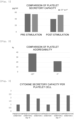
- the VEGF secretory capacity of each PRP after preservation was evaluated in the same manner as described in Test 1 above. Note that the cytokine secretory capacity (VEGF secretory capacity) was evaluated per platelet cell fragment. The cytokine secretory capacity (VEGF secretory capacity) was expressed as a ratio based on the concentration of VEGF in the case of stimulation with CaCl 2 after the PRP was preserved under preservation condition 1. The results are shown in Figure 3 .
- the platelet aggregability of each PRP after preservation was evaluated in the same manner as described in Test 1 above. Note that the platelet aggregability was expressed as a ratio based on the percent platelet aggregation (%) after preservation under preservation condition 1. The results are shown in Figure 4 .
- Test 1 and Test 2 PRP prepared from blood immediately after collection from a donor was used. The following test was then performed in the case of using PRP prepared from blood collected from a donor and stored for a long time.
- Blood was collected from blood donors. This blood was stored under a condition of 4°C for a predetermined period of time (48 hours, 72 hours, 96 hours, or 120 hours). Thereafter, each blood was centrifuged at 100 to 300 G for 10 minutes (one step centrifugation) or done at 100 to 300 G for 10 minutes followed by centrifugation at 200 to 2500 G for 10 to 20 minutes (two step centrifugation) to obtain initial PRP.
- the platelet preservation solution of the present invention was produced by the method described in Test 2 above.
- Figure 5 shows the results of evaluating the fold increase in the platelet concentration of the initial PRP. As can be seen from Figure 5 , even in the case where the storage time of the blood (whole blood) of the donor was 120 hours, the fold increase in the platelet concentration of the initial PRP was retained at approximately the same level as in the case where the storage time was 48 hours or the like.
- the platelet aggregability of the initial PRP was evaluated in the same manner as described in Test 1 above. The results are shown in Figure 6 . As can be seen from Figure 6 , even in the case where the storage time of the blood (whole blood) of the donor was 120 hours, the percent maximum aggregation of the initial PRP was retained at approximately the same level as in the case where the storage time was 48 hours or the like.
- Blood was collected from blood donors. This blood was stored under a condition of 4°C for 120 hours. Thereafter, each blood was centrifuged at 100 to 300 G for 10 minutes (one step centrifugation) or done at 100 to 300 G for 10 minutes followed by centrifugation at 200 to 2500 G for 10 to 20 minutes (two step centrifugation) to obtain initial PRP.
- the platelet preservation solution of the present invention was produced by the method described in Test 2 above.
- the initial PRP and the platelet preservation solution of the present invention were placed in a syringe and sealed so that the volume ratio of plasma in the PRP to the platelet preservation solution of the present invention was 20:7, and then preserved under a condition of 4°C for 3 weeks.
- Figure 7 shows the results of evaluating the fold increase in the platelet concentration of the initial PRP and the fold increase in the platelet concentration of the initial PRP preserved in the platelet preservation solution of the present invention for 3 weeks.
- the fold increase in the platelet concentration of the PRP preserved in the platelet preservation solution of the present invention was retained at approximately the same level as that of the initial PRP.
- Figure 8 shows the results of measuring the platelet concentration before and after the initial PRP was preserved for 3 weeks in the section of (3. Preservation of PRP) above.
- the platelet concentration was retained at a sufficiently high level even after long-term preservation for as long as 3 weeks.
- Figure 9 shows the ratio of the maximum aggregability of platelets after preservation to the maximum aggregability of platelets before preservation (i.e., the "change in percent maximum aggregation").
- the percent maximum aggregation was relatively sufficiently retained even after long-term preservation for as long as 3 weeks.
- the results are shown in Figure 10 .
- the results in Figure 10 indicated that when PRP was preserved in the platelet preservation solution of the present invention, the VEGF secretory capacity was twice or more as high as that before preservation.
- the present invention it is possible to provide a method for preserving a platelet in a refrigerated or frozen state while retaining more platelet functions, a platelet preservation solution for use in such a method, and the like.
Landscapes
- Health & Medical Sciences (AREA)
- Life Sciences & Earth Sciences (AREA)
- Engineering & Computer Science (AREA)
- Chemical & Material Sciences (AREA)
- Organic Chemistry (AREA)
- Bioinformatics & Cheminformatics (AREA)
- General Health & Medical Sciences (AREA)
- Zoology (AREA)
- Wood Science & Technology (AREA)
- Biomedical Technology (AREA)
- Biotechnology (AREA)
- Genetics & Genomics (AREA)
- Veterinary Medicine (AREA)
- Medicinal Chemistry (AREA)
- Public Health (AREA)
- Animal Behavior & Ethology (AREA)
- Pharmacology & Pharmacy (AREA)
- Cell Biology (AREA)
- Nuclear Medicine, Radiotherapy & Molecular Imaging (AREA)
- Hematology (AREA)
- General Chemical & Material Sciences (AREA)
- Chemical Kinetics & Catalysis (AREA)
- Biochemistry (AREA)
- Microbiology (AREA)
- General Engineering & Computer Science (AREA)
- Immunology (AREA)
- Environmental Sciences (AREA)
- Dentistry (AREA)
- Diabetes (AREA)
- Epidemiology (AREA)
- Developmental Biology & Embryology (AREA)
- Virology (AREA)
- Orthopedic Medicine & Surgery (AREA)
- Rheumatology (AREA)
- Physical Education & Sports Medicine (AREA)
- Dermatology (AREA)
- Medicines Containing Material From Animals Or Micro-Organisms (AREA)
- Agricultural Chemicals And Associated Chemicals (AREA)
Applications Claiming Priority (2)
| Application Number | Priority Date | Filing Date | Title |
|---|---|---|---|
| JP2022080038 | 2022-05-16 | ||
| PCT/JP2023/018026 WO2023223984A1 (ja) | 2022-05-16 | 2023-05-15 | 血小板の新規保存方法 |
Publications (1)
| Publication Number | Publication Date |
|---|---|
| EP4527394A1 true EP4527394A1 (en) | 2025-03-26 |
Family
ID=88835520
Family Applications (1)
| Application Number | Title | Priority Date | Filing Date |
|---|---|---|---|
| EP23807586.5A Pending EP4527394A1 (en) | 2022-05-16 | 2023-05-15 | Novel method for preserving platelets |
Country Status (5)
| Country | Link |
|---|---|
| US (1) | US20250313810A1 (https=) |
| EP (1) | EP4527394A1 (https=) |
| JP (1) | JPWO2023223984A1 (https=) |
| TW (1) | TW202408551A (https=) |
| WO (1) | WO2023223984A1 (https=) |
Cited By (1)
| Publication number | Priority date | Publication date | Assignee | Title |
|---|---|---|---|---|
| CN120052333A (zh) * | 2025-04-29 | 2025-05-30 | 血霁生物科技(上海)有限公司 | 一种用于血小板常温保存的方法 |
Family Cites Families (4)
| Publication number | Priority date | Publication date | Assignee | Title |
|---|---|---|---|---|
| US7473678B2 (en) | 2004-10-14 | 2009-01-06 | Biomimetic Therapeutics, Inc. | Platelet-derived growth factor compositions and methods of use thereof |
| US20190045776A1 (en) * | 2015-06-09 | 2019-02-14 | President And Fellows Of Harvard College | Long term storage and preservation of platelets |
| US20190048365A1 (en) * | 2015-12-28 | 2019-02-14 | Eastern Virginia Medical School | Mitochondrial microinjection of oocytes |
| JP2021147333A (ja) | 2020-03-17 | 2021-09-27 | 東洋紡株式会社 | 多血小板血漿の製造方法 |
-
2023
- 2023-05-15 JP JP2024521916A patent/JPWO2023223984A1/ja active Pending
- 2023-05-15 TW TW112117922A patent/TW202408551A/zh unknown
- 2023-05-15 WO PCT/JP2023/018026 patent/WO2023223984A1/ja not_active Ceased
- 2023-05-15 US US18/865,121 patent/US20250313810A1/en active Pending
- 2023-05-15 EP EP23807586.5A patent/EP4527394A1/en active Pending
Cited By (2)
| Publication number | Priority date | Publication date | Assignee | Title |
|---|---|---|---|---|
| CN120052333A (zh) * | 2025-04-29 | 2025-05-30 | 血霁生物科技(上海)有限公司 | 一种用于血小板常温保存的方法 |
| CN120052333B (zh) * | 2025-04-29 | 2025-08-15 | 血霁生物科技(上海)有限公司 | 一种用于血小板常温保存的方法 |
Also Published As
| Publication number | Publication date |
|---|---|
| TW202408551A (zh) | 2024-03-01 |
| US20250313810A1 (en) | 2025-10-09 |
| JPWO2023223984A1 (https=) | 2023-11-23 |
| WO2023223984A1 (ja) | 2023-11-23 |
Similar Documents
| Publication | Publication Date | Title |
|---|---|---|
| EP0281621B1 (en) | Glucose free media for storing blood platelets | |
| US4994367A (en) | Extended shelf life platelet preparations and process for preparing the same | |
| EP0108588B1 (en) | Plasma-free medium for platelet storage and its production | |
| EP1773452B1 (en) | Lysis / resealing process for incorporating an active ingredient in erythrocytes | |
| US7811558B2 (en) | Use of stabilized platelets as hemostatic agent | |
| Chi et al. | Effect of superoxide dismutase on myocardial infarct size in the canine heart after 6 hours of regional ischemia and reperfusion: a demonstration of myocardial salvage. | |
| US4992363A (en) | Method for preparing glucose free media for storing blood platelets | |
| Simon et al. | Effects of AS‐3 nutrient‐additive solution on 42 and 49 days of storage of red cells | |
| EP4527394A1 (en) | Novel method for preserving platelets | |
| JPS6363616A (ja) | 赤血球濃厚液の保存剤及び保存方法 | |
| CN101247720B (zh) | 细胞贮藏介质 | |
| Owens et al. | Cryopreserved platelets have decreased adhesive capacity | |
| BOYAN et al. | Problems related to massive blood replacement | |
| Troha et al. | Storage of platelet-rich products | |
| US4838861A (en) | Blood preservation by ultrahemodilution | |
| De Vries et al. | Studies on the coagulation of the blood in patients treated with extra-corporeal circulation | |
| JP2016505014A (ja) | 自己骨髄由来の幹細胞の迅速な注入 | |
| JP2007501255A (ja) | 血液細胞の保存 | |
| US20040229205A1 (en) | Compositions for the storage of platelets | |
| ELLIOTT et al. | Role of Fluosol-DA 20% in prehospital resuscitation | |
| NL1037672C2 (nl) | Werkwijze voor het bepalen van de betrouwbaarheid van een inrichting voor het meten van de concentratie van een stof in volledig bloed, werkwijze voor het behandelen van volledig bloed, houder en kit. | |
| DeVIVO et al. | Influence of human cerebrospinal fluid on blood coagulation in vitro | |
| Gulliksson | Storage of platelets for transfusion in additive solutions: effects of different factors and compounds | |
| Wright et al. | Autotransfusion in the subhuman primate | |
| WO2000033853A1 (en) | Anti-coagulation with calcium containing citrate solution |
Legal Events
| Date | Code | Title | Description |
|---|---|---|---|
| STAA | Information on the status of an ep patent application or granted ep patent |
Free format text: STATUS: THE INTERNATIONAL PUBLICATION HAS BEEN MADE |
|
| PUAI | Public reference made under article 153(3) epc to a published international application that has entered the european phase |
Free format text: ORIGINAL CODE: 0009012 |
|
| STAA | Information on the status of an ep patent application or granted ep patent |
Free format text: STATUS: REQUEST FOR EXAMINATION WAS MADE |
|
| 17P | Request for examination filed |
Effective date: 20241108 |
|
| AK | Designated contracting states |
Kind code of ref document: A1 Designated state(s): AL AT BE BG CH CY CZ DE DK EE ES FI FR GB GR HR HU IE IS IT LI LT LU LV MC ME MK MT NL NO PL PT RO RS SE SI SK SM TR |
|
| DAV | Request for validation of the european patent (deleted) | ||
| DAX | Request for extension of the european patent (deleted) |