EP4525486A1 - Informationsverarbeitungsvorrichtung, informationsverarbeitungsverfahren und programm - Google Patents
Informationsverarbeitungsvorrichtung, informationsverarbeitungsverfahren und programm Download PDFInfo
- Publication number
- EP4525486A1 EP4525486A1 EP23803399.7A EP23803399A EP4525486A1 EP 4525486 A1 EP4525486 A1 EP 4525486A1 EP 23803399 A EP23803399 A EP 23803399A EP 4525486 A1 EP4525486 A1 EP 4525486A1
- Authority
- EP
- European Patent Office
- Prior art keywords
- signal
- harmonic distortion
- information processing
- harmonic
- processing device
- Prior art date
- Legal status (The legal status is an assumption and is not a legal conclusion. Google has not performed a legal analysis and makes no representation as to the accuracy of the status listed.)
- Pending
Links
Images




Classifications
-
- H—ELECTRICITY
- H04—ELECTRIC COMMUNICATION TECHNIQUE
- H04S—STEREOPHONIC SYSTEMS
- H04S7/00—Indicating arrangements; Control arrangements, e.g. balance control
- H04S7/30—Control circuits for electronic adaptation of the sound field
- H04S7/305—Electronic adaptation of stereophonic audio signals to reverberation of the listening space
- H04S7/306—For headphones
-
- H—ELECTRICITY
- H04—ELECTRIC COMMUNICATION TECHNIQUE
- H04S—STEREOPHONIC SYSTEMS
- H04S7/00—Indicating arrangements; Control arrangements, e.g. balance control
- H04S7/30—Control circuits for electronic adaptation of the sound field
- H04S7/302—Electronic adaptation of stereophonic sound system to listener position or orientation
-
- H—ELECTRICITY
- H04—ELECTRIC COMMUNICATION TECHNIQUE
- H04R—LOUDSPEAKERS, MICROPHONES, GRAMOPHONE PICK-UPS OR LIKE ACOUSTIC ELECTROMECHANICAL TRANSDUCERS; ELECTRIC HEARING AIDS; PUBLIC ADDRESS SYSTEMS
- H04R3/00—Circuits for transducers
-
- H—ELECTRICITY
- H04—ELECTRIC COMMUNICATION TECHNIQUE
- H04R—LOUDSPEAKERS, MICROPHONES, GRAMOPHONE PICK-UPS OR LIKE ACOUSTIC ELECTROMECHANICAL TRANSDUCERS; ELECTRIC HEARING AIDS; PUBLIC ADDRESS SYSTEMS
- H04R3/00—Circuits for transducers
- H04R3/04—Circuits for transducers for correcting frequency response
-
- H—ELECTRICITY
- H04—ELECTRIC COMMUNICATION TECHNIQUE
- H04S—STEREOPHONIC SYSTEMS
- H04S7/00—Indicating arrangements; Control arrangements, e.g. balance control
- H04S7/30—Control circuits for electronic adaptation of the sound field
- H04S7/305—Electronic adaptation of stereophonic audio signals to reverberation of the listening space
-
- H—ELECTRICITY
- H04—ELECTRIC COMMUNICATION TECHNIQUE
- H04S—STEREOPHONIC SYSTEMS
- H04S2400/00—Details of stereophonic systems covered by H04S but not provided for in its groups
- H04S2400/01—Multi-channel, i.e. more than two input channels, sound reproduction with two speakers wherein the multi-channel information is substantially preserved
-
- H—ELECTRICITY
- H04—ELECTRIC COMMUNICATION TECHNIQUE
- H04S—STEREOPHONIC SYSTEMS
- H04S2420/00—Techniques used stereophonic systems covered by H04S but not provided for in its groups
- H04S2420/01—Enhancing the perception of the sound image or of the spatial distribution using head related transfer functions [HRTF's] or equivalents thereof, e.g. interaural time difference [ITD] or interaural level difference [ILD]
Definitions
- the present technology relates to an information processing device, an information processing method, and a program, and more particularly, to an information processing device, an information processing method, and a program capable of accurately reproducing a reproduced sound in an acoustic space.
- Localization of a sound image at a predetermined position and stereoscopic reproduction of a sound heard from headphones can be achieved by convoluting a head related transfer function (HRTF), which indicates sound transfer characteristics in an acoustic space such as a movie theater or a studio, to an audio signal.
- HRTF head related transfer function
- Patent Document 1 describes that a sound pressure from an audio source at a certain position is actually reproduced by forming and using an HRTF for each individual.
- a sound reproducing a sound from an audio source such as a speaker in a movie theater or a studio, can thus be heard from a headphone.
- Patent Document 1 Japanese Patent Application Laid-Open No. 2015-19360
- Harmonic distortion occurs in actual movie theaters and studios due to reverberation caused by walls and characteristics of a speaker. Harmonic distortion in movie theaters and studios, however, cannot be reproduced in the reproduced sound using the HRTF.
- the present technology has been made in view of such a circumstance, and enables accurate reproduction of a reproduced sound in an acoustic space.
- an information processing device includes: a harmonic signal generation unit configured to generate a first signal by convolving, to an input signal, transfer characteristics of harmonic distortion in an acoustic space; and a combining unit configured to combine together the first signal and a second signal, in which sound transmission characteristics excluding the harmonic distortion in the acoustic space is convolved to the input signal.
- an information processing method includes causing an information processing device to perform processing including: generating a first signal by convolving, to an input signal, transfer characteristics of harmonic distortion in an acoustic space; and combining together the first signal and a second signal, in which sound transmission characteristics excluding the harmonic distortion in the acoustic space is convolved to the input signal.
- a program causes a computer to execute processing including: generating a first signal by convolving, to an input signal, transfer characteristics of harmonic distortion in an acoustic space; and combining together the first signal and a second signal, in which sound transmission characteristics excluding the harmonic distortion in the acoustic space is convolved to the input signal.
- a first signal is generated by convolving, to an input signal, transfer characteristics of harmonic distortion in an acoustic space, and the first signal and a second signal, in which sound transmission characteristics excluding the harmonic distortion in the acoustic space is convolved to the input signal, are combined together.
- Sound images can be stereoscopically reproduced in headphones by using a head related transfer function (HRTF), which indicates sound transfer characteristics from an audio source to both ears in a certain acoustic space.
- HRTF head related transfer function
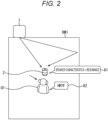
- harmonic distortion occurs due to reverberation caused by walls of the studio RM1 or the characteristics of the speaker 1 in a case where, for example, the studio RM1 is wide or the speaker 1 is large.
- Fig. 3 is a diagram illustrating a configuration example of a sound production system according to the embodiment of the present technology.
- the sound production system of Fig. 3 is a system that mixes audio of a content, such as a movie.
- the user uses the sound production system to produce, for example, a sound of a movie.
- the information processing device 21, which is a device used for editing the sounds of the movie, is provided in the reproduction environment.
- the information processing device 21 is also constituted by, for example, a PC.
- the producer uses a headphone 22 in the reproduction environment, such as home, to edit the sound of the movie.
- the headphone 22 is an output device prepared in the reproduction environment.
- one HRTF includes the HRTF of the harmonic distortion and the HRTF of the sound other than the harmonic distortion, so that the HRTF of the harmonic distortion cannot be separated.
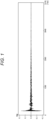
- a Log-TSP signal is, on the other hand, a signal whose frequency increases as an exponential function of time.
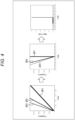
- An example of the time-frequency characteristic of the response of the Log-TSP signal is illustrated in the left side of Fig. 5 .
- SP1 indicates the main signal response also in the example of Fig. 5 .
- SP2 indicates the response of the second-order harmonic distortion and SP3 indicates the response of the third-order harmonic distortion.
- the frequency of the response of the Log-TSP signal increases as an exponential function of time, as illustrated in the left side of Fig. 5 .
- time intervals of the first-order harmonic and the fundamental wave are equal at all frequencies in the Log-TSP signal. Furthermore, in the Log-TSP signal, time intervals of each of harmonics other than the first-order harmonic and the fundamental wave are also equal at all frequencies for each order of the harmonic.
- Fig. 6 is a diagram illustrating an example of the impulse response measured by the measuring device 11.
- Fig. 7 is a block diagram illustrating a configuration example of a conventional information processing device 21A.
- the conventional information processing device 21A includes an input signal acquisition unit 31A, an HRTF acquisition unit 32A, a convolution unit 33A, and a reproduction control unit 34A.
- the input signal acquisition unit 31A acquires, for example, the audio signal of the sound of the movie to be edited as an input signal x and supplies the input signal x to the convolution unit 33A.
- the HRTF acquisition unit 32A acquires a personalized HRTF file provided from a device that measures the HRTF, reads the personalized HRTF with reference to the personalized HRTF file, and supplies the personalized HRTF to the convolution unit 33A.
- the convolution unit 33A loads the personalized HRTF supplied from the HRTF acquisition unit 32A, as the FIR coefficient of a FIR filter (a finite impulse response), into a memory.
- the convolution unit 33A generates a reproduction signal, by convolving the FIR filter to the input signal x supplied from the input signal acquisition unit 31A, and supplies the reproduction signal to the reproduction control unit 34A.
- the reproduction control unit 34A causes a headphone to output the reproduced sound based on the reproduction signal supplied from the convolution unit 33A.
- the personalized HRTF is loaded into the memory of the convolution unit 33A, as the FIR coefficient, at the start of the reproduction processing of Fig. 8 .
- step S1 the input signal acquisition unit 31A acquires an input signal.
- step S2 the convolution unit 33A performs FIR filter convolving processing on the input signal, so that the reproduction signal is generated.
- step S3 the reproduction control unit 34A causes the headphone to output the reproduced sound based on the reproduction signal.
- Fig. 9 is a block diagram illustrating a configuration example of the information processing device 21 of the present technology.
- one personalized HRTF is convolved to the input signal.
- the personalized HRTF of the harmonic distortion is loaded into the memory as the FIR coefficient, for each order of the harmonic distortion, and each personalized HRTF is convolved to the input signal.
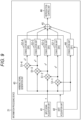
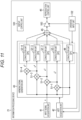
- the information processing device 21 of the present technology includes, as illustrated in Fig. 9 , an input signal acquisition unit 41, an HRTF acquisition unit 42, a harmonic signal generation unit 43, a convolution unit 44, an addition unit 45, and a reproduction control unit 46.
- the input signal acquisition unit 41 acquires, for example, the audio signal of a sound of a movie to be edited as an input signal x, and supplies the input signal x to the harmonic signal generation unit 43 and the convolution unit 44.
- the HRTF acquisition unit 42 acquires the personalized HRTF file provided from the measuring device 11, reads HRTF SP1 which is the personalized HRTF of the sounds other than the harmonic distortion with reference to the personalized HRTF file, and supplies the HRTF SP1 to the convolution unit 44.
- the HRTF acquisition unit 42 also reads the HRTF SP2 to HRTF SP5 which are the personalized HRTFs of the harmonic distortion for each order with reference to the personalized HRTF file, and supplies the HRTF SP2 to HRTF SP5 to the harmonic signal generation unit 43.
- the harmonic signal generation unit 43 includes multiplication units 51-1 to 51-4 and convolution units 52-1 to 52-4.
- the multiplication unit 51-1 multiplies the input signal x by the input signal x to generate a harmonic signal x 2 corresponding to the second-order harmonic distortion, and supplies the harmonic signal x 2 to the multiplication unit 51-2 and the convolution unit 52-1.
- the multiplication unit 51-4 multiplies the input signal x by the harmonic signal x 4 to generate a harmonic signal x 5 corresponding to a fifth-order harmonic distortion, and supplies the harmonic signal x 5 to the convolution unit 52-4.
- the convolution units 52-1 to 52-4 convolve the HRTF of the harmonic distortion to the harmonic signal, which is generated by multiplying the input signal by the same number as the order of the harmonic distortion.
- the convolution unit 52-1 loads the HRTF SP2 which is the HRTF of the second-order harmonic distortion, as the FIR coefficient, into a memory.
- the convolution unit 52-1 convolves the FIR filter to the harmonic signal x 2 to generate a convolution signal and supplies the convolution signal to the addition unit 45.
- the convolution unit 52-2 loads the HRTF SP3 which is the HRTF of the third-order harmonic distortion, as the FIR coefficient, into a memory.
- the convolution unit 52-2 convolves the FIR filter to the harmonic signal x 3 to generate a convolution signal and supplies the convolution signal to the addition unit 45.
- the convolution unit 52-3 loads the HRTF SP4 which is the HRTF of the fourth-order harmonic distortion, as the FIR coefficient, into a memory.
- the convolution unit 52-3 convolves the FIR filter to the harmonic signal x 4 to generate a convolution signal and supplies the convolution signal to the addition unit 45.
- the convolution unit 44 loads the HRTF SP1 which is provided from the HRTF acquisition unit 32A, as the FIR coefficient, into a memory.
- the convolution unit 44 convolves the FIR filter to the convolution signal x, supplied from the input signal acquisition unit 41, to generate the input signal and supplies the convolution signal to the addition unit 45.
- the reproduction control unit 46 causes the headphone 22 to output the reproduced sound based on the reproduction signal supplied from the addition unit 45.
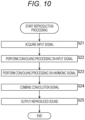
- the personalized HRTF is loaded, as the FIR coefficient, into the memory of each of the convolution unit 44 and the convolution units 52-1 to 52-4 at the start of the reproduction processing of Fig. 10 .
- step S21 the input signal acquisition unit 41 acquires the input signal.
- the multiplication units 51-1 to 51-4 generate harmonic signals respectively corresponding to the orders of the harmonic distortions.
- step S22 the convolution unit 44 performs FIR filter convolving processing on the input signal, so that the convolution signal is generated.
- step S23 the convolution units 52-1 to 52-4 perform FIR filter convolving processing on the harmonic signals, respectively corresponding to the orders of the harmonic distortions, so that the convolution signals are generated.
- step S24 the addition unit 45 combines the convolution signals generated in steps S22 and S23, so that the reproduction signal is generated.
- the information processing device 21 combines together the convolution signal in which the HRTF of the harmonic distortion is convolved to the input signal and the convolution signal in which the HRTF other than the harmonic distortion is convolved to the input signal, so that the reproduction signal is generated.
- the HRTF of the harmonic distortion for each order is convolved to the input signal respectively processed corresponding to the order of the harmonic distortions, such that the HRTF of the second-order harmonic distortion is convolved to the harmonic signal x 2 and the HRTF of the third-order harmonic distortion is convolved to the harmonic signal x 3 .
- Causing output, from an output device such as the headphone 22, of the reproduced sound based on the reproduction signal generated in this manner enables the sound production system to accurately reproduce the reproduced sound in the acoustic space including the harmonic distortion.
- Behavior of the harmonic distortion changes in accordance with a sound pressure of the reproduced sound output from the speaker in the measurement environment.
- the FIR coefficient may be adjusted in accordance with the sound pressure of the reproduced sound output from the headphone 22 in the reproduction environment.
- Fig. 11 is a block diagram illustrating another configuration example of the information processing device 21.
- the same components as the components described with reference to Fig. 9 are denoted by the same reference signs. Redundant description will be omitted as appropriate.
- the configuration of the information processing device 21 illustrated in Fig. 11 is different from that of the information processing device 21 in Fig. 9 in that a display control unit 101, an operation input unit 102, and an amplifier 103 are provided.
- the display control unit 101 causes a display device, such as a display connected to the information processing device 21 in the reproduction environment, to display a setting screen serving as a graphical user interface (GUI) that receives an input of operation to set a target sound pressure, volume, and the like.
- a display device such as a display connected to the information processing device 21 in the reproduction environment
- GUI graphical user interface
- Fig. 12 is a diagram illustrating a display example of the setting screen.
- a form F1 for inputting the target sound pressure is displayed on the upper left side of the setting screen.
- the user sets the sound pressure (a sound pressure level) of the reproduced sound by, for example, selecting a desired target sound pressure from a plurality of options.
- 85dBSPL is input as the target sound pressure.
- a form F2 for inputting a file name of the personalized HRTF file (an FIR file) used for reproducing the input signal is displayed on the lower side of the form F1.
- the user selects a desired file from the personalized HRTF files that can be read by the information processing device 21.
- a bar B1 for adjusting the volume is displayed on the lower left side of the setting screen. Furthermore, a button B11 for outputting the reproduced sound and a button B12 for stopping the output of the reproduced sound are displayed on the lower right side of the setting screen.
- the user controls, by operating these displays or the like, reproduction of the input signal by the information processing device 21.
- the operation input unit 102 receives an input of an user's operation on the setting screen.
- the operation input unit 102 supplies information indicating content of the operation performed by the user to the HRTF acquisition unit 42, the convolution unit 44, the convolution units 52-1 to 52-4, and the amplifier 103.
- the target sound pressure and the volume may be set by a method other than the operating on the setting screen.
- the HRTF acquisition unit 42 reads the personalized HRTF with reference to the personalized HRTF file set by the user.
- the personalized HRTF file is recorded with a set of HRTF SP1 to HRTF SP5 for each sound pressure of the reproduced sound.
- the convolution unit 44 and the convolution units 52-1 to 52-4 load the personalized HRTF in accordance with the sound pressure set by the user, as the FIR coefficient, into the memory. Specifically, the convolution unit 44 and the convolution units 52-1 to 52-4 use the personalized HRTF read from the personalized HRTF file as it is or adjust the personalized HRTF read from the personalized HRTF file with a gain or the like, in accordance with the sound pressure set by the user.
- the information processing device 21 can also reproduce the reproduced sound in an acoustic space without the harmonic distortion by adjusting the HRTF SP2 to the HRTF SP5 to 0.
- the amplifier 103 adjusts, in accordance with the volume set by the user, the reproduction signal supplied from the addition unit 45 and supplies the adjusted reproduction signal to the reproduction control unit 46.
- the reproduction control unit 46 causes the headphone 22 to output the reproduced sound based on the adjusted reproduction signal supplied from the reproduction control unit 46.
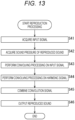
- step S41 the input signal acquisition unit 41 acquires an input signal.
- the multiplication units 51-1 to 51-4 generate harmonic signals respectively corresponding to the orders of the harmonic distortions.
- step S42 the operation input unit 102 receives an input of an user's operation to set the sound pressure of the reproduced sound and acquires the sound pressure of the reproduced sound.
- the convolution unit 44 and the convolution units 52-1 to 52-4 load the personalized HRTF in accordance with the sound pressure set by the user, as the FIR coefficient, into the memory.
- step S43 the convolution unit 44 performs FIR filter convolving processing on the input signal, so that the convolution signal is generated.
- step S44 the convolution units 52-1 to 52-4 performs FIR filter convolving processing on the harmonic signals respectively corresponding to the orders of the harmonic distortions, so that the convolution signal is generated.
- step S45 the addition unit 45 combines the convolution signals generated in steps S43 and S44, so that the reproduction signal is generated.
- the amplifier 103 adjusts, in accordance with the volume set by the user, the reproduction signal.
- step S46 the reproduction control unit 46 causes the headphone to output the reproduced sound based on the reproduction signal.
- the sound production system is capable of reproducing the difference in behavior of the harmonic distortion, in accordance with the sound pressure of the reproduced sound in the measurement environment, and accurately reproducing the reproduced sound in the acoustic space including the harmonic distortion.
- HRTF of the harmonic distortion and the HRTF of the sound other than the harmonic distortion are measured in the acoustic space serving as the measurement environment.
- these HRTFs may be acquired using a method other than measuring, such as acoustic simulation.
- the series of processing described above can be executed by hardware or by software.
- the software is installed on a computer built into dedicated hardware or a general-purpose personal computer from a program recording medium.
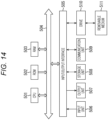
- Fig. 14 is a block diagram illustrating a configuration example of hardware of a computer that executes the series of processing described above in accordance with a program.
- the measuring device 11 and the information processing device 21 is constituted by, for example, a PC having a similar configuration to the configuration illustrated in Fig. 14 .
- a central processing unit (CPU) 501, a read only memory (ROM) 502, and a random access memory (RAM) 503 are mutually connected via a bus 504.
- An input/output interface 505 is also connected to the bus 504.
- An input unit 506 including a keyboard, a mouse, and the like, and an output unit 507 including a display, a speaker, and the like are connected to the input/output interface 505.
- a storage unit 508 including a hard disk, a nonvolatile memory, or the like, a communication unit 509 including a network interface or the like, and a drive 510 that drives a removable medium 511 are connected to the input/output interface 505.
- the CPU 501 loads a program stored in the storage unit 508 into the RAM 503 via the input/output interface 505 and the bus 504 and executes the program to execute the above-described series of processing.
- the program executed by the CPU 501 is recorded in the removable medium 511, or provided via a wired or wireless transmission medium such as a local area network, the Internet, or digital broadcasting, and then installed in the storage unit 508.
- a wired or wireless transmission medium such as a local area network, the Internet, or digital broadcasting
- the program executed by the computer may be a program in which the processing is performed in time series in the order described in the present description, or may be a program in which the processing is performed in parallel or at a necessary timing such as when a call is made.
- a system means an assembly of a plurality of components (devices, modules (parts), and the like), and it does not matter whether or not all the components are located in the same housing. Therefore, a plurality of devices housed in separate housings and connected to each other via a network and one device in which a plurality of modules is housed in one housing are both systems.
- the present technology may be embodied in cloud computing in which a function is shared and executed by a plurality of devices via a network.
- each step described in the flowchart described above can be performed by one device or can be shared and performed by a plurality of devices.
- the plurality of pieces of processing included in the one step can be executed by one device or executed by a plurality of devices in a shared manner.
- the present technology can also be embodied as follows.
Landscapes
- Engineering & Computer Science (AREA)
- Physics & Mathematics (AREA)
- Acoustics & Sound (AREA)
- Signal Processing (AREA)
- Multimedia (AREA)
- Stereophonic System (AREA)
- Circuit For Audible Band Transducer (AREA)
Applications Claiming Priority (2)
| Application Number | Priority Date | Filing Date | Title |
|---|---|---|---|
| JP2022077864 | 2022-05-11 | ||
| PCT/JP2023/016040 WO2023218917A1 (ja) | 2022-05-11 | 2023-04-24 | 情報処理装置、情報処理方法、およびプログラム |
Publications (2)
| Publication Number | Publication Date |
|---|---|
| EP4525486A1 true EP4525486A1 (de) | 2025-03-19 |
| EP4525486A4 EP4525486A4 (de) | 2025-08-27 |
Family
ID=88730317
Family Applications (1)
| Application Number | Title | Priority Date | Filing Date |
|---|---|---|---|
| EP23803399.7A Pending EP4525486A4 (de) | 2022-05-11 | 2023-04-24 | Informationsverarbeitungsvorrichtung, informationsverarbeitungsverfahren und programm |
Country Status (5)
| Country | Link |
|---|---|
| US (1) | US20250350900A1 (de) |
| EP (1) | EP4525486A4 (de) |
| JP (1) | JPWO2023218917A1 (de) |
| CN (1) | CN119054304A (de) |
| WO (1) | WO2023218917A1 (de) |
Cited By (1)
| Publication number | Priority date | Publication date | Assignee | Title |
|---|---|---|---|---|
| EP4727174A1 (de) * | 2024-10-09 | 2026-04-15 | Alps Alpine Co., Ltd. | Audiosignalprozessor |
Family Cites Families (7)
| Publication number | Priority date | Publication date | Assignee | Title |
|---|---|---|---|---|
| JP2006180302A (ja) * | 2004-12-24 | 2006-07-06 | Yokogawa Electric Corp | 三次元音声提示装置および三次元音声提示方法 |
| JP2008312096A (ja) * | 2007-06-18 | 2008-12-25 | Victor Co Of Japan Ltd | 音響再生装置及びテレビ受像機 |
| US9426589B2 (en) | 2013-07-04 | 2016-08-23 | Gn Resound A/S | Determination of individual HRTFs |
| JP2015079131A (ja) * | 2013-10-17 | 2015-04-23 | ヤマハ株式会社 | 音響信号処理装置および音響信号処理プログラム |
| DE102013223201B3 (de) * | 2013-11-14 | 2015-05-13 | Fraunhofer-Gesellschaft zur Förderung der angewandten Forschung e.V. | Verfahren und Vorrichtung zum Komprimieren und Dekomprimieren von Schallfelddaten eines Gebietes |
| WO2020127836A1 (en) * | 2018-12-21 | 2020-06-25 | Fraunhofer-Gesellschaft zur Förderung der angewandten Forschung e.V. | Sound reproduction/simulation system and method for simulating a sound reproduction |
| US11076257B1 (en) * | 2019-06-14 | 2021-07-27 | EmbodyVR, Inc. | Converting ambisonic audio to binaural audio |
-
2023
- 2023-04-24 US US18/862,607 patent/US20250350900A1/en active Pending
- 2023-04-24 CN CN202380034793.6A patent/CN119054304A/zh active Pending
- 2023-04-24 EP EP23803399.7A patent/EP4525486A4/de active Pending
- 2023-04-24 WO PCT/JP2023/016040 patent/WO2023218917A1/ja not_active Ceased
- 2023-04-24 JP JP2024520351A patent/JPWO2023218917A1/ja active Pending
Cited By (1)
| Publication number | Priority date | Publication date | Assignee | Title |
|---|---|---|---|---|
| EP4727174A1 (de) * | 2024-10-09 | 2026-04-15 | Alps Alpine Co., Ltd. | Audiosignalprozessor |
Also Published As
| Publication number | Publication date |
|---|---|
| WO2023218917A1 (ja) | 2023-11-16 |
| CN119054304A (zh) | 2024-11-29 |
| JPWO2023218917A1 (de) | 2023-11-16 |
| EP4525486A4 (de) | 2025-08-27 |
| US20250350900A1 (en) | 2025-11-13 |
Similar Documents
| Publication | Publication Date | Title |
|---|---|---|
| CA2785743C (en) | System and method for digital signal processing | |
| JP4255031B2 (ja) | 低周波チャネルを生成する装置および方法 | |
| US8082051B2 (en) | Audio tuning system | |
| US20170373656A1 (en) | Loudspeaker-room equalization with perceptual correction of spectral dips | |
| CN102625671A (zh) | 听觉测试和补偿方法 | |
| US9913036B2 (en) | Apparatus and method and computer program for generating a stereo output signal for providing additional output channels | |
| JP2012509632A5 (ja) | オーディオ信号を変換するためのコンバータ及び方法 | |
| Ooi et al. | Automation of binaural headphone audio calibration on an artificial head | |
| EP4525486A1 (de) | Informationsverarbeitungsvorrichtung, informationsverarbeitungsverfahren und programm | |
| JP2005157278A (ja) | 全周囲音場創生装置、全周囲音場創生方法、及び全周囲音場創生プログラム | |
| CN117882394A (zh) | 通过使用线性化和/或带宽扩展产生第一控制信号和第二控制信号的装置和方法 | |
| JP5651813B1 (ja) | 音声信号処理装置、および音声信号処理方法 | |
| WO2021154211A1 (en) | Multi-channel decomposition and harmonic synthesis | |
| JP7736010B2 (ja) | 情報処理装置、情報処理方法、およびプログラム | |
| WO2020036077A1 (ja) | 信号処理装置、信号処理方法、およびプログラム | |
| JP2019050445A (ja) | バイノーラル再生用の係数行列算出装置及びプログラム | |
| Lindau et al. | Perceptual evaluation of discretization and interpolation for motion-tracked binaural (MTB) recordings (Perzeptive Evaluation von Diskretisierungs-und Interpolationsansätzen | |
| JP7835165B2 (ja) | 情報処理装置、情報処理方法、およびプログラム | |
| Harker et al. | Rethinking the box: Approaches to the reality of electronic music performance | |
| US20160080882A1 (en) | Method for Playing Back the Sound of a Digital Audio Signal | |
| JP2007336080A (ja) | 音響補正装置 | |
| JPWO2020008889A1 (ja) | オーディオ信号処理装置および方法、インパルス応答生成装置および方法、並びにプログラム | |
| Piazza et al. | Industry-oriented software-based system for quality evaluation of vehicle audio environments | |
| Elblaus et al. | utruchirp: an impulse response measurement and auralisation tool developed for artistic practice | |
| Johnson et al. | The Effect of the Grid Resolution of Binaural Room Acoustic Auralization on Spatial and Timbral Fidelity |
Legal Events
| Date | Code | Title | Description |
|---|---|---|---|
| STAA | Information on the status of an ep patent application or granted ep patent |
Free format text: STATUS: THE INTERNATIONAL PUBLICATION HAS BEEN MADE |
|
| PUAI | Public reference made under article 153(3) epc to a published international application that has entered the european phase |
Free format text: ORIGINAL CODE: 0009012 |
|
| STAA | Information on the status of an ep patent application or granted ep patent |
Free format text: STATUS: REQUEST FOR EXAMINATION WAS MADE |
|
| 17P | Request for examination filed |
Effective date: 20241211 |
|
| AK | Designated contracting states |
Kind code of ref document: A1 Designated state(s): AL AT BE BG CH CY CZ DE DK EE ES FI FR GB GR HR HU IE IS IT LI LT LU LV MC ME MK MT NL NO PL PT RO RS SE SI SK SM TR |
|
| REG | Reference to a national code |
Ref country code: DE Ref legal event code: R079 Free format text: PREVIOUS MAIN CLASS: H04S0001000000 Ipc: H04R0003000000 |
|
| RAP3 | Party data changed (applicant data changed or rights of an application transferred) |
Owner name: SONY GROUP CORPORATION |
|
| DAV | Request for validation of the european patent (deleted) | ||
| DAX | Request for extension of the european patent (deleted) | ||
| A4 | Supplementary search report drawn up and despatched |
Effective date: 20250724 |
|
| RIC1 | Information provided on ipc code assigned before grant |
Ipc: H04R 3/00 20060101AFI20250718BHEP Ipc: H04S 7/00 20060101ALI20250718BHEP |