EP4524031A1 - Flugzeuginnenverkleidungsanordnung, längsspaltabdeckung, innenverkleidung und installationsverfahren - Google Patents
Flugzeuginnenverkleidungsanordnung, längsspaltabdeckung, innenverkleidung und installationsverfahren Download PDFInfo
- Publication number
- EP4524031A1 EP4524031A1 EP23196823.1A EP23196823A EP4524031A1 EP 4524031 A1 EP4524031 A1 EP 4524031A1 EP 23196823 A EP23196823 A EP 23196823A EP 4524031 A1 EP4524031 A1 EP 4524031A1
- Authority
- EP
- European Patent Office
- Prior art keywords
- gap
- panels
- interior
- aircraft
- retaining
- Prior art date
- Legal status (The legal status is an assumption and is not a legal conclusion. Google has not performed a legal analysis and makes no representation as to the accuracy of the status listed.)
- Pending
Links
Images




Classifications
-
- B—PERFORMING OPERATIONS; TRANSPORTING
- B64—AIRCRAFT; AVIATION; COSMONAUTICS
- B64C—AEROPLANES; HELICOPTERS
- B64C1/00—Fuselages; Constructional features common to fuselages, wings, stabilising surfaces or the like
- B64C1/06—Frames; Stringers; Longerons ; Fuselage sections
- B64C1/066—Interior liners
-
- F—MECHANICAL ENGINEERING; LIGHTING; HEATING; WEAPONS; BLASTING
- F16—ENGINEERING ELEMENTS AND UNITS; GENERAL MEASURES FOR PRODUCING AND MAINTAINING EFFECTIVE FUNCTIONING OF MACHINES OR INSTALLATIONS; THERMAL INSULATION IN GENERAL
- F16B—DEVICES FOR FASTENING OR SECURING CONSTRUCTIONAL ELEMENTS OR MACHINE PARTS TOGETHER, e.g. NAILS, BOLTS, CIRCLIPS, CLAMPS, CLIPS OR WEDGES; JOINTS OR JOINTING
- F16B5/00—Joining sheets or plates, e.g. panels, to one another or to strips or bars parallel to them
- F16B5/0004—Joining sheets, plates or panels in abutting relationship
- F16B5/0032—Joining sheets, plates or panels in abutting relationship by moving the sheets, plates, or panels or the interlocking key parallel to the abutting edge
- F16B5/0036—Joining sheets, plates or panels in abutting relationship by moving the sheets, plates, or panels or the interlocking key parallel to the abutting edge and using hook and slot or keyhole-type connections
Definitions
- the present invention refers to an aircraft interior lining arrangement, a longitudinal gap cover, an interior panel and a method to install an aircraft interior lining arrangement.
- An aircraft interior lining arrangement of an aircraft cabin comprises a plurality of individual interior panels, such as side panels, ceiling panels or dado panels.
- the arrangement serves for a visual design of the aircraft cabin.
- the arrangement forms a cabin-side boundary of a space present between the interior lining arrangement and an aircraft structure.
- the space is used as an installation space for a large number of components, such as thermal insulation, electrical lines, air or water-conducting lines or other components of the aircraft. Due to installation reasons, a longitudinal gap is formed between mutually adjacent interior panels. As the gap extends from the cabin interior to the installation space, a gap cover is provided adapted to close the gap.
- a strip is provided in guiding means on the backside of the panels.
- the stripe is pushed over its entire length in the guiding means. Finally, the gap is closed, but still visible from the cabin-side.
- pushing the strip forward in guiding means on the backside of the panels is difficult from an installation point of view and time consuming. Further on, in order to create a uniform visual design, the gaps need to be adjusted to a single width.
- an aircraft interior lining arrangement comprises two mutually adjacent interior panels lining an interior of an aircraft, wherein the interior panels including edges facing one another to define a longitudinal gap.
- the arrangement further comprises a longitudinal gap covering device which has a visible portion facing towards the interior of the aircraft after installation and at least one retaining portion which is connected to the visible portion via at least one intermediate portion and extends opposite the visible portion.
- the at least one retaining portion is sized to abut and get into engagement backside of the interior panels.
- At least one recess is provided in the edges of the interior panel.
- the at least one recess is adapted to receive the at least one retaining portion during installation.
- the visible portion has a width which is adapted to cover the recesses after installation.
- the edges of the interior panels are inclined to each other such that the gap has a tapered shape from its bottom end to its top end or vice versa.
- the visible portion has a width which is adapted to cover the gap at its area with the broadest extension in transversal direction after installation.
- the cover need not to be pushed over its entire length on the backside of the interior panels. Due to the recesses, the cover can be positioned directly on the interior side of the panels and then need to be pushed only over a small distance in longitudinal direction in order to get the retaining portions in engagement with the backside of the panels. Thus, the installation is simplified. Further on, tolerance variations of the gaps are eliminated, as the visible portion is on the cabin-side of the panels, thus the gap is closed at its front and not at its back.
- the at least one recess is such designed that even in the case of negative tolerances the gap cover can be installed. This means, the at least one recess has an inner contour that is slightly bigger than an outer contour of the retaining portions.
- the alternative solution has the advantage, that no recesses are necessary in the panel edges. This, simplifying the manufacturing.
- a plurality of retaining portions and a plurality of recesses is provided which are spaced apart from each other in a uniform distance.
- each recess has only to receive one half of the retaining portions. By means of this, the retaining portions abut against both panels backside in the same manner, thus improving the engagement.
- the retaining portions are provided alternating on the intermediate portion and the recesses are provided correspondingly.
- the retaining portions have a circular shape and the recesses have a semi-circular shape.
- the retaining portions nor the recesses are limited to a circular shape.
- Alternative shapes are rectangular ellipsoidal shapes, triangular shapes, rectangular shapes, square shapes etc.
- the single retaining portion can be divided up into multiple tapered sections which are spaced apart from another in longitudinal direction.
- the engagement of the at least one retaining portion can be further improved, if it is inclined on its contact surface facing the panel.
- these retaining portions have a wedge-like contact surface.
- spring elements are provided laterally on opposite sides of the intermediate portion.
- the spring elements cause a self-alignment of the intermediate portion in the gap in transverse direction and thus a self-alignment of the gap.
- Exemplary spring elements are spring tongue (spring clips).
- spring elements are positioned between at least some of the retaining portions and the visible portion. Due to this position, the spring element does not prevent the insertion of the retaining portions in the recesses.
- the spring elements are positioned between at least some of the or multiple tapered sections and the visible portion (14).
- the spring elements are adapted to the width of the gap such that the spring elements have different sizes.
- a longitudinal gap cover for an aircraft interior arrangement comprises a visible portion facing towards the interior of the aircraft after installation.
- it has at least one retaining portion connected to the visible portion via at least one intermediate portion.
- the at least one retaining portion extend opposite the visible portion and is sized to abut and get into engagement backside of mutual adjacent interior panels of the aircraft interior arrangement.
- the inventive gap cover is easy to install and to manufacture.
- it is an injection moulding part, for instance made from Polyamide 66 or PEEK.
- an interior panel for an aircraft interior arrangement has an edge defining one side of a longitudinal gap to a mutual adjacent interior panel.
- edge recesses are provided adapted to receive retaining portions of an inventive gap cover during installation.
- the edge is inclined in longitudinal direction adapted to form one side of a tapered shaped gap to receive at least one retaining portion of a gap cover after installation.
- the panel can be made of a foam material. It can also be made as a sandwich part, for instance a honey comb structure, wherein in order to simplify the introduction of the recesses a foam edge region is preferred surrounding a sandwich core. If no recesses are provided in the panel edges, the entire panel can be made as a sandwich element having a honey comb structure, for instance.
- a method for installing an aircraft interior arrangement comprises the steps:
- FIGs 1 and 2 a preferred embodiment of an inventive aircraft interior lining arrangement 1 is shown.
- the exemplary arrangement comprises mutual adjacent side panels 2a, 2b which are spaced apart from each other by a longitudinal gap 4.
- mutual adjacent dado panels 6a, 6b are shown which are overlapped at their top by the side panels 2a, 2b.
- the dado panels 6a, 6b are also space apart from each other by a gap 8, which is in alignment with the side panel gap 4.
- the side panels 2a, 2b and dado panels 6a, 6b lining an aircraft interior and forms a cabin-side boundary of a space present between the interior lining arrangement and an aircraft structure.
- Beside side panels 2a, 2b and dado panels 6a, 6b, the interior lining may also comprises ceiling panels.
- the gaps 4, 8 extend over the entire height of the panels 2a, 2b, 6a, 6b and are extending from the cabin-side (frontside of the panels) to the installation space (backside of the panels).
- gap covers 10, 12 are provided.
- One gap cover 10 is provided to close the gap 4 between the side panels 2a, 2b and the other gap cover 12 is provided to close the gap 8 between the dado panels 6a, 6b.
- Both gap covers 10, 12 are designed and manufactured in the same manner. Preferably, they are manufactured via injection moulding.
- each gap cover 10, 12 has a visible portion 14 and a plurality of retaining portions 16.
- the retaining portions 16 are connected to the visible portion 14 via an intermediate portion 18 and extend opposite the visible portion 14. They are such sized that they abut and get into engagement backside 20 of the side panels 2a, 2b and dado panels 6a, 6b.
- the visible portion 14 has a strip-like shape. Its frontside is directed to the cabin-side, wherein after installation its underside 22 is drawn against the frontside 24 of the panels 2a, 2b, 6a, 6b via the retaining portions 18.
- the retaining portions 16 have a disc-like shape with a circular contour. They are positioned centrally on the intermediate portions 18 in a uniform distance to each other over the entire length of the gap covers 10, 12.
- the intermediate portion 18 has a web-like shape. It extends over the entire length or nearly over the entire length of the visible portion 14 and has a width (extension in transverse direction) which is smaller than a width of the gaps 4, 6.
- the main difference between the side panel gap cover 10 and the dado panel gap cover 12 is the length which is adapted to the height of the side panels 2a, 2b and the dado panels 6a, 6b.
- the side panel gap cover 10 has an end portion 25 which is angled backwards and overlaps the dado gap cover 12 at its top.
- recesses 28a, 28b are provided in order to install the gap covers 10 in edges 26a, 26b of the side panels 2a, 2b (and also of the dado panels 6a, 6b) forming the respective gap 4.
- the recesses 28a, 28b are adapted to receive (put through) the retaining portions 16 during installation.
- the recesses 28a, 28b are distributed over the edges 26a, 26b in a distance that corresponds to the distance of the retaining portions 16 in longitudinal direction of the gap cover 10. If installed, the opposite recesses of the adjacent side panels 2a, 2b are aligned to each other. Further on, opposite recesses 28a, 28b have a shape that correspondence to the shape of the retaining portions 16.
- each recess 28a, 28b has a semi-circular shape.
- the recesses 28a, 28b are such designed that even if a distance of the panels 2a, 2b, 4a, 4b in transversal direction of the gap 4, 8 is smaller than reference distance and/or an offset of the panels 2a, 2b, 6a, 6b in longitudinal direction of the gap 4, 8 exceeds a reference value, the gap covers 10, 12 can be installed.
- the inner semicircular shape of the recesses 28a, 28b in the shown embodiment is slightly bigger than the outer circular contour of the retaining portions 16a, 16b.
- At least their edge regions are made of a foam material.
- the recesses 28a, 28b are also closed by the visible portion 14 of the gap cover 10.
- the visible portion 14 have a width which is greater than the width of opposed recesses 28a, 28b of adjacent side panels 2a, 2b.
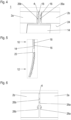
- lateral spring elements 30a, 30b of the gap covers 10, 12 is shown.
- the spring elements 30a, 30b are positioned opposite on the intermediate portion 18 between a retaining portion 16 and the visible portion 14. Thus, they are positioned after (behind, below) the respective retaining portion 16 in a first direction Y (inserting direction).
- the spring elements 30a, 30b can be provided only after some of the retaining portions 16.
- the spring elements 30a, 30b are spring tongues, which are aligning the intermediate portion 18 in the gap 4 and thus the gap cover 10.
- the spring elements 30a, 30b equalise tolerance variations of the gaps 4.
- the spring elements 30a, 30b press against opposite sides of the edges 32a, 32b, and as a consequence, the intermediate portion 18 is positioned centrally in the gap 4, thus the gap cover 4 is positioned aligned to the gap 4 in transversal direction.
- inventive panels 2a, 2b, 6a, 6b are mounted to an aircraft fuselage structure, wherein longitudinal gaps are formed between mutual adjacent interior panels 2a, 2b and 6a, 6b.
- inventive longitudinal gap covers 10, 12 are provided. Each gap cover 10, 12 is moved in a first direction Y bringing the retaining portions 16 backwards the panels 2a, 2b and 6a, 6b ( Figure 10 ).
- the gap covers 10, 12 are positioned on the cabin-side of the panels 2a, 2b and 6a, 6b and then, secondly, the retaining portions 16 are put through (inserted into) the opposed recesses 28a, 28b of the adjacent panels 2a, 2b and 6a, 6b until the visible portion 14 abuts against the frontside 24 of the panels 2a, 2b and 6a, 6b. Then the gap covers 10, 12 are pushed in a second direction X upwards or downwards the gaps 4, 8 until the retaining portions 16 abut and get in engagement with the backside 20 of the panels 2a, 2b and 6a, 6b ( Figure 11 and Figure 12 ).
- the gap covers 10, 12 are pushed so far along the gaps 4, 8 that the retaining portions 16 are positioned in the middle of adjacent recesses 28a, 28b in longitudinal direction.
- the installation is done from the cabin-side, wherein the retaining portions 16 are put through the recesses 28a, 28b in first direction Y which is perpendicular to the panels 2a, 2b, 6a, 6b.
- the gap covers 10, 12 are moved shortly in a second direction x in longitudinal direction of the gaps 4, 8 and thus orthogonally to the first direction Y.
- the intermediate portion 18 is aligned automatically between the edges 26a, 26b by the spring elements 30a, 30b.
- the gap covers 10, 12 are clamped on the panels 2a, 2b, 6a, 6b and the gaps 10, 12 are closed from the cabin side.
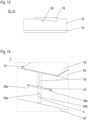
- FIG 13 a gap cover 10, 12 having an alternative retaining portion 16 is shown.
- at least some retaining portions 16 can have a contact surface 32 (underside) which is inclined in the second direction X (pushing direction).
- these retaining portions 16 have a wedge-like shape which can improve the clamping of the gap covers 10, 12 on the panels 2a, 2b, 6a, 6b.
- FIG 14 a section-view of an alternative of an aircraft interior lining arrangement 1 is shown.
- the retaining portions 16 of a gap cover 10 are also positioned backside to the panels here exemplary side panels 2a, 2b, but being positioned in longitudinal grooves 34a, 34b of the side panels 2a, 2b.
- the groves 34a, 34b are opened to the gap 4 over their entire length.
- the advantage of this embodiment is that a backside 20 of the side panels 2a, 2b is free of any retaining portions 16.
- no recesses 28a, 28b for receiving a retaining portion 14 of a gap cover 10 are provided in edges 26a, 26b of the side panels 2a, 2b.
- the edges 26a, 26b forming the gap 4 are inclined such that the gap 4 has a tapered shape in its longitudinal direction.
- the gap 10 has its broadest area 36 at its bottom end and its narrowest area 38 at its top end.
- the inclination can be opposite, such that the broadest area 36 is at the top end of the gap 4 and the narrowest area 38 is at the bottom end of the gap 4. It is further noted that also only one edge, for instance 26a of panel 2a, can be inclined in longitudinal direction, whereas the facing edge 26b of the other panel 2b is not inclined in longitudinal direction, but runs straight.
- the retaining portion 14 of the gap cover 10 is tapered correspondingly.
- the retaining portion 14 extends over the entire or almost over the entire length of the gap cover 10 (intermediate section 18).
- a single retaining portion 14 is shown.
- the single retaining portion 14 can also be divided up into several individual segments, each of them having an increasing tapered shape (or decreasing tapered shape which depends on the viewing direction).
- a visible portion 12 of the gap cover is broader than the broadest area 36 of the gap 10 in order to close the gap 4 and in order to equalise tolerance variations.
- the spring elements 30a, 30b, 30c, 30d are provided on opposite sides of the intermediate portion 18.
- the spring elements 30a, 30b and 30d, 30e vary. This means, the spring elements 30a, 30b, which align the gap cover 10 in a smaller gap area does not have such an extension in transversal direction of the gap 4 as those spring elements 30c, 30d, which align the gap cover 10 in a larger gap area.
- the gap cover 10 In order to install the gap cover 10, it is positioned with its retaining portion 14 facing the front side 24 of the panels 2a, 2b and then inserted into the gap 4 with an offset in vertical direction to the panels 2a, 2b (putting through the retaining portion 14 in a first direction Y). Then, the gap cover 10 is moved in s second direction X until the gap 4 is closed by the visible portion 12 and the retaining portion 14 abuts and is in engagement with the backside 20 of the panels 2a, 2b. In the illustrated embodiment, the gap cover 10 is moved upwards in the second direction y. The intermediate portion 18 is aligned automatically between the edges 26a, 26b by the spring elements 30a, 30b and 30c, 30d.
- its contact surface 32 can be inclined (not shown) as explained to the embodiment shown in Figure 13 .
- a gap cover having a visible portion and at least one rear retaining portions is installed from the frontside of lining panels in a first direction and then pushed in a second direction which is different to the first direction in order to get the gap cover in backside engagement with the panels, a gap cover, a panel and an installation method.
Landscapes
- Engineering & Computer Science (AREA)
- General Engineering & Computer Science (AREA)
- Mechanical Engineering (AREA)
- Aviation & Aerospace Engineering (AREA)
- Vehicle Interior And Exterior Ornaments, Soundproofing, And Insulation (AREA)
Priority Applications (1)
| Application Number | Priority Date | Filing Date | Title |
|---|---|---|---|
| EP23196823.1A EP4524031A1 (de) | 2023-09-12 | 2023-09-12 | Flugzeuginnenverkleidungsanordnung, längsspaltabdeckung, innenverkleidung und installationsverfahren |
Applications Claiming Priority (1)
| Application Number | Priority Date | Filing Date | Title |
|---|---|---|---|
| EP23196823.1A EP4524031A1 (de) | 2023-09-12 | 2023-09-12 | Flugzeuginnenverkleidungsanordnung, längsspaltabdeckung, innenverkleidung und installationsverfahren |
Publications (1)
| Publication Number | Publication Date |
|---|---|
| EP4524031A1 true EP4524031A1 (de) | 2025-03-19 |
Family
ID=88018074
Family Applications (1)
| Application Number | Title | Priority Date | Filing Date |
|---|---|---|---|
| EP23196823.1A Pending EP4524031A1 (de) | 2023-09-12 | 2023-09-12 | Flugzeuginnenverkleidungsanordnung, längsspaltabdeckung, innenverkleidung und installationsverfahren |
Country Status (1)
| Country | Link |
|---|---|
| EP (1) | EP4524031A1 (de) |
Citations (5)
| Publication number | Priority date | Publication date | Assignee | Title |
|---|---|---|---|---|
| EP1468907A2 (de) * | 2003-04-18 | 2004-10-20 | The Boeing Company | Vorrichtung und Verfahren zur Verbindung von Paneelen zu Tragstrukturen |
| DE102004049893A1 (de) * | 2004-10-13 | 2006-04-27 | Airbus Deutschland Gmbh | Fugenabdeckung in Flugzeugen |
| US20060102786A1 (en) * | 2004-10-13 | 2006-05-18 | Airbus Deutschland Gmbh | Joint cover in aircraft |
| US20080282636A1 (en) * | 2006-04-12 | 2008-11-20 | Airbus Deutschland Gmbh | Gap Covering for Cabin Panels |
| US20190225320A1 (en) * | 2016-05-05 | 2019-07-25 | The Boeing Company | Mechanical Fastening System and Associated Structural Assembly and Method |
-
2023
- 2023-09-12 EP EP23196823.1A patent/EP4524031A1/de active Pending
Patent Citations (5)
| Publication number | Priority date | Publication date | Assignee | Title |
|---|---|---|---|---|
| EP1468907A2 (de) * | 2003-04-18 | 2004-10-20 | The Boeing Company | Vorrichtung und Verfahren zur Verbindung von Paneelen zu Tragstrukturen |
| DE102004049893A1 (de) * | 2004-10-13 | 2006-04-27 | Airbus Deutschland Gmbh | Fugenabdeckung in Flugzeugen |
| US20060102786A1 (en) * | 2004-10-13 | 2006-05-18 | Airbus Deutschland Gmbh | Joint cover in aircraft |
| US20080282636A1 (en) * | 2006-04-12 | 2008-11-20 | Airbus Deutschland Gmbh | Gap Covering for Cabin Panels |
| US20190225320A1 (en) * | 2016-05-05 | 2019-07-25 | The Boeing Company | Mechanical Fastening System and Associated Structural Assembly and Method |
Similar Documents
| Publication | Publication Date | Title |
|---|---|---|
| US8573881B2 (en) | Device for securing an add-on to a support | |
| US10530090B2 (en) | Holding frame for a plug connector and methods of populating same | |
| US8398161B2 (en) | Sunroof headliner attachment system | |
| US9869096B2 (en) | Modular surface covering assembly to cover a bearing surface | |
| US8006948B2 (en) | Corner accesory for ducts | |
| US7608786B2 (en) | Splice plate for a wire cable tray | |
| US20110083871A1 (en) | Electrical box | |
| CN101388512A (zh) | 中间电气连接器 | |
| EP4524031A1 (de) | Flugzeuginnenverkleidungsanordnung, längsspaltabdeckung, innenverkleidung und installationsverfahren | |
| US7365807B2 (en) | LCD television, flat panel television, and television cabinet | |
| CN112127572B (zh) | 一种墙面板拼接组件 | |
| US3665837A (en) | Lineal air diffuser bar | |
| JPH01253130A (ja) | 電気機器用のケーシング | |
| US11548453B2 (en) | Split roof lining and datum scheme | |
| US4644723A (en) | Wallboard clip | |
| US6524126B1 (en) | Module support | |
| US3290848A (en) | Ceiling and wall tile and suspension system for same | |
| US20020106940A1 (en) | Substrate connector | |
| CN210536211U (zh) | 一种基于科研办公场所便于安装的防护型通线槽 | |
| EP1494327B1 (de) | Kanal für elektrische Installationen | |
| US20240120677A1 (en) | Connector | |
| CN110068125B (zh) | 一种空调器 | |
| US20100000782A1 (en) | Fitting divider wall for a multi-channel metal raceway | |
| US12294207B2 (en) | Splice clip for cable trays | |
| JP7582723B1 (ja) | ケーブルダクト |
Legal Events
| Date | Code | Title | Description |
|---|---|---|---|
| PUAI | Public reference made under article 153(3) epc to a published international application that has entered the european phase |
Free format text: ORIGINAL CODE: 0009012 |
|
| STAA | Information on the status of an ep patent application or granted ep patent |
Free format text: STATUS: THE APPLICATION HAS BEEN PUBLISHED |
|
| AK | Designated contracting states |
Kind code of ref document: A1 Designated state(s): AL AT BE BG CH CY CZ DE DK EE ES FI FR GB GR HR HU IE IS IT LI LT LU LV MC ME MK MT NL NO PL PT RO RS SE SI SK SM TR |
|
| STAA | Information on the status of an ep patent application or granted ep patent |
Free format text: STATUS: REQUEST FOR EXAMINATION WAS MADE |
|
| 17P | Request for examination filed |
Effective date: 20250919 |