EP4518005A1 - Anschlussstrukturanordnung mit integralem schienenanschluss - Google Patents
Anschlussstrukturanordnung mit integralem schienenanschluss Download PDFInfo
- Publication number
- EP4518005A1 EP4518005A1 EP23883083.0A EP23883083A EP4518005A1 EP 4518005 A1 EP4518005 A1 EP 4518005A1 EP 23883083 A EP23883083 A EP 23883083A EP 4518005 A1 EP4518005 A1 EP 4518005A1
- Authority
- EP
- European Patent Office
- Prior art keywords
- terminal
- secondary batteries
- structure assembly
- terminal structure
- busbar
- Prior art date
- Legal status (The legal status is an assumption and is not a legal conclusion. Google has not performed a legal analysis and makes no representation as to the accuracy of the status listed.)
- Pending
Links
Images


Classifications
-
- H—ELECTRICITY
- H01—ELECTRIC ELEMENTS
- H01M—PROCESSES OR MEANS, e.g. BATTERIES, FOR THE DIRECT CONVERSION OF CHEMICAL ENERGY INTO ELECTRICAL ENERGY
- H01M50/00—Constructional details or processes of manufacture of the non-active parts of electrochemical cells other than fuel cells, e.g. hybrid cells
- H01M50/50—Current conducting connections for cells or batteries
- H01M50/502—Interconnectors for connecting terminals of adjacent batteries; Interconnectors for connecting cells outside a battery casing
- H01M50/509—Interconnectors for connecting terminals of adjacent batteries; Interconnectors for connecting cells outside a battery casing characterised by the type of connection, e.g. mixed connections
- H01M50/51—Connection only in series
-
- H—ELECTRICITY
- H01—ELECTRIC ELEMENTS
- H01M—PROCESSES OR MEANS, e.g. BATTERIES, FOR THE DIRECT CONVERSION OF CHEMICAL ENERGY INTO ELECTRICAL ENERGY
- H01M50/00—Constructional details or processes of manufacture of the non-active parts of electrochemical cells other than fuel cells, e.g. hybrid cells
- H01M50/20—Mountings; Secondary casings or frames; Racks, modules or packs; Suspension devices; Shock absorbers; Transport or carrying devices; Holders
- H01M50/204—Racks, modules or packs for multiple batteries or multiple cells
- H01M50/207—Racks, modules or packs for multiple batteries or multiple cells characterised by their shape
- H01M50/209—Racks, modules or packs for multiple batteries or multiple cells characterised by their shape adapted for prismatic or rectangular cells
-
- H—ELECTRICITY
- H01—ELECTRIC ELEMENTS
- H01M—PROCESSES OR MEANS, e.g. BATTERIES, FOR THE DIRECT CONVERSION OF CHEMICAL ENERGY INTO ELECTRICAL ENERGY
- H01M50/00—Constructional details or processes of manufacture of the non-active parts of electrochemical cells other than fuel cells, e.g. hybrid cells
- H01M50/50—Current conducting connections for cells or batteries
-
- H—ELECTRICITY
- H01—ELECTRIC ELEMENTS
- H01M—PROCESSES OR MEANS, e.g. BATTERIES, FOR THE DIRECT CONVERSION OF CHEMICAL ENERGY INTO ELECTRICAL ENERGY
- H01M50/00—Constructional details or processes of manufacture of the non-active parts of electrochemical cells other than fuel cells, e.g. hybrid cells
- H01M50/50—Current conducting connections for cells or batteries
- H01M50/502—Interconnectors for connecting terminals of adjacent batteries; Interconnectors for connecting cells outside a battery casing
-
- H—ELECTRICITY
- H01—ELECTRIC ELEMENTS
- H01M—PROCESSES OR MEANS, e.g. BATTERIES, FOR THE DIRECT CONVERSION OF CHEMICAL ENERGY INTO ELECTRICAL ENERGY
- H01M50/00—Constructional details or processes of manufacture of the non-active parts of electrochemical cells other than fuel cells, e.g. hybrid cells
- H01M50/50—Current conducting connections for cells or batteries
- H01M50/502—Interconnectors for connecting terminals of adjacent batteries; Interconnectors for connecting cells outside a battery casing
- H01M50/503—Interconnectors for connecting terminals of adjacent batteries; Interconnectors for connecting cells outside a battery casing characterised by the shape of the interconnectors
-
- H—ELECTRICITY
- H01—ELECTRIC ELEMENTS
- H01M—PROCESSES OR MEANS, e.g. BATTERIES, FOR THE DIRECT CONVERSION OF CHEMICAL ENERGY INTO ELECTRICAL ENERGY
- H01M50/00—Constructional details or processes of manufacture of the non-active parts of electrochemical cells other than fuel cells, e.g. hybrid cells
- H01M50/50—Current conducting connections for cells or batteries
- H01M50/502—Interconnectors for connecting terminals of adjacent batteries; Interconnectors for connecting cells outside a battery casing
- H01M50/505—Interconnectors for connecting terminals of adjacent batteries; Interconnectors for connecting cells outside a battery casing comprising a single busbar
-
- H—ELECTRICITY
- H01—ELECTRIC ELEMENTS
- H01M—PROCESSES OR MEANS, e.g. BATTERIES, FOR THE DIRECT CONVERSION OF CHEMICAL ENERGY INTO ELECTRICAL ENERGY
- H01M50/00—Constructional details or processes of manufacture of the non-active parts of electrochemical cells other than fuel cells, e.g. hybrid cells
- H01M50/50—Current conducting connections for cells or batteries
- H01M50/502—Interconnectors for connecting terminals of adjacent batteries; Interconnectors for connecting cells outside a battery casing
- H01M50/507—Interconnectors for connecting terminals of adjacent batteries; Interconnectors for connecting cells outside a battery casing comprising an arrangement of two or more busbars within a container structure, e.g. busbar modules
-
- H—ELECTRICITY
- H01—ELECTRIC ELEMENTS
- H01M—PROCESSES OR MEANS, e.g. BATTERIES, FOR THE DIRECT CONVERSION OF CHEMICAL ENERGY INTO ELECTRICAL ENERGY
- H01M50/00—Constructional details or processes of manufacture of the non-active parts of electrochemical cells other than fuel cells, e.g. hybrid cells
- H01M50/50—Current conducting connections for cells or batteries
- H01M50/502—Interconnectors for connecting terminals of adjacent batteries; Interconnectors for connecting cells outside a battery casing
- H01M50/509—Interconnectors for connecting terminals of adjacent batteries; Interconnectors for connecting cells outside a battery casing characterised by the type of connection, e.g. mixed connections
- H01M50/512—Connection only in parallel
-
- H—ELECTRICITY
- H01—ELECTRIC ELEMENTS
- H01M—PROCESSES OR MEANS, e.g. BATTERIES, FOR THE DIRECT CONVERSION OF CHEMICAL ENERGY INTO ELECTRICAL ENERGY
- H01M50/00—Constructional details or processes of manufacture of the non-active parts of electrochemical cells other than fuel cells, e.g. hybrid cells
- H01M50/50—Current conducting connections for cells or batteries
- H01M50/502—Interconnectors for connecting terminals of adjacent batteries; Interconnectors for connecting cells outside a battery casing
- H01M50/514—Methods for interconnecting adjacent batteries or cells
- H01M50/516—Methods for interconnecting adjacent batteries or cells by welding, soldering or brazing
-
- H—ELECTRICITY
- H01—ELECTRIC ELEMENTS
- H01M—PROCESSES OR MEANS, e.g. BATTERIES, FOR THE DIRECT CONVERSION OF CHEMICAL ENERGY INTO ELECTRICAL ENERGY
- H01M50/00—Constructional details or processes of manufacture of the non-active parts of electrochemical cells other than fuel cells, e.g. hybrid cells
- H01M50/50—Current conducting connections for cells or batteries
- H01M50/502—Interconnectors for connecting terminals of adjacent batteries; Interconnectors for connecting cells outside a battery casing
- H01M50/514—Methods for interconnecting adjacent batteries or cells
- H01M50/517—Methods for interconnecting adjacent batteries or cells by fixing means, e.g. screws, rivets or bolts
-
- H—ELECTRICITY
- H01—ELECTRIC ELEMENTS
- H01M—PROCESSES OR MEANS, e.g. BATTERIES, FOR THE DIRECT CONVERSION OF CHEMICAL ENERGY INTO ELECTRICAL ENERGY
- H01M50/00—Constructional details or processes of manufacture of the non-active parts of electrochemical cells other than fuel cells, e.g. hybrid cells
- H01M50/50—Current conducting connections for cells or batteries
- H01M50/543—Terminals
- H01M50/547—Terminals characterised by the disposition of the terminals on the cells
- H01M50/55—Terminals characterised by the disposition of the terminals on the cells on the same side of the cell
-
- H—ELECTRICITY
- H01—ELECTRIC ELEMENTS
- H01M—PROCESSES OR MEANS, e.g. BATTERIES, FOR THE DIRECT CONVERSION OF CHEMICAL ENERGY INTO ELECTRICAL ENERGY
- H01M50/00—Constructional details or processes of manufacture of the non-active parts of electrochemical cells other than fuel cells, e.g. hybrid cells
- H01M50/50—Current conducting connections for cells or batteries
- H01M50/543—Terminals
- H01M50/552—Terminals characterised by their shape
- H01M50/553—Terminals adapted for prismatic, pouch or rectangular cells
-
- H—ELECTRICITY
- H01—ELECTRIC ELEMENTS
- H01M—PROCESSES OR MEANS, e.g. BATTERIES, FOR THE DIRECT CONVERSION OF CHEMICAL ENERGY INTO ELECTRICAL ENERGY
- H01M50/00—Constructional details or processes of manufacture of the non-active parts of electrochemical cells other than fuel cells, e.g. hybrid cells
- H01M50/50—Current conducting connections for cells or batteries
- H01M50/543—Terminals
- H01M50/552—Terminals characterised by their shape
- H01M50/553—Terminals adapted for prismatic, pouch or rectangular cells
- H01M50/557—Plate-shaped terminals
-
- H—ELECTRICITY
- H01—ELECTRIC ELEMENTS
- H01R—ELECTRICALLY-CONDUCTIVE CONNECTIONS; STRUCTURAL ASSOCIATIONS OF A PLURALITY OF MUTUALLY-INSULATED ELECTRICAL CONNECTING ELEMENTS; COUPLING DEVICES; CURRENT COLLECTORS
- H01R13/00—Details of coupling devices of the kinds covered by groups H01R12/70 or H01R24/00 - H01R33/00
- H01R13/02—Contact members
- H01R13/10—Sockets for co-operation with pins or blades
- H01R13/11—Resilient sockets
- H01R13/113—Resilient sockets co-operating with pins or blades having a rectangular transverse section
-
- H—ELECTRICITY
- H01—ELECTRIC ELEMENTS
- H01R—ELECTRICALLY-CONDUCTIVE CONNECTIONS; STRUCTURAL ASSOCIATIONS OF A PLURALITY OF MUTUALLY-INSULATED ELECTRICAL CONNECTING ELEMENTS; COUPLING DEVICES; CURRENT COLLECTORS
- H01R25/00—Coupling parts adapted for simultaneous co-operation with two or more identical counterparts, e.g. for distributing energy to two or more circuits
- H01R25/14—Rails or bus-bars constructed so that the counterparts can be connected thereto at any point along their length
-
- Y—GENERAL TAGGING OF NEW TECHNOLOGICAL DEVELOPMENTS; GENERAL TAGGING OF CROSS-SECTIONAL TECHNOLOGIES SPANNING OVER SEVERAL SECTIONS OF THE IPC; TECHNICAL SUBJECTS COVERED BY FORMER USPC CROSS-REFERENCE ART COLLECTIONS [XRACs] AND DIGESTS
- Y02—TECHNOLOGIES OR APPLICATIONS FOR MITIGATION OR ADAPTATION AGAINST CLIMATE CHANGE
- Y02E—REDUCTION OF GREENHOUSE GAS [GHG] EMISSIONS, RELATED TO ENERGY GENERATION, TRANSMISSION OR DISTRIBUTION
- Y02E60/00—Enabling technologies; Technologies with a potential or indirect contribution to GHG emissions mitigation
- Y02E60/10—Energy storage using batteries
Definitions
- the present invention relates to a terminal structure assembly integrally provided with a busbar, which is capable of converting an arrangement structure of a positive electrode terminal and/or a negative electrode terminal from unidirectional to bidirectional and at the same time completing an electrical connection between a plurality of secondary batteries.
- secondary batteries can be recharged and have been researched and developed in recent years due to their potential for miniaturization and large capacity.
- the demand for the secondary battery as an energy source is increasing rapidly due to the technological development and increasing demand for mobile devices, electric vehicles, and energy storage systems, which are emerging in response to the need for environmental protection.
- Secondary batteries are categorized into coin batteries, cylindrical batteries, prismatic batteries, and pouch batteries based on the shape of the battery case.
- the electrode assembly mounted inside the battery case is a charging and discharging power generation element consisting of a stacked structure of electrodes and separators.
- prismatic secondary batteries are mostly composed of positive and negative electrode terminals arranged together on one side, or one on each of the two opposing sides.
- the arrangement of the positive and negative electrode terminals is determined by the design specifications of various devices containing prismatic secondary batteries, and it is difficult to design the arrangement structure of the positive and negative electrode terminals separately in the same form factor according to these design specifications.
- the present invention relates to a terminal structure assembly, in one example including a terminal body providing an upper face and side face connected in a bent form with respect to the upper face, a plurality of terminal structures providing an extension terminal exposed on the side face of the terminal body, and a busbar of conductive material coupled to all of the extension terminals provided on the plurality of terminal structures.
- the busbar may be welded to the extension terminals.
- a side end of the terminal structure is provided with a fastening part into which the busbar is inserted.
- connection socket may form a spring structure that elastically secures the busbar, and the free end of the connection socket may form a winding curved surface.
- connection socket may be welded to the extension terminal.
- the present invention provides a secondary battery comprising a plurality of secondary batteries having positive and negative electrode terminals spaced apart on an upper face of a battery case having a hexahedral shape, and a terminal structure assembly having the above configuration, wherein the terminal structure assembly is coupled to the plurality of secondary batteries arranged in a row, and the busbar electrically connects the plurality of secondary batteries.
- the terminal structure assembly provides two terminal structures, wherein the plurality of secondary batteries is aligned along a thickness direction with electrode terminals of different polarities facing electrode terminals of adjacent other secondary batteries, and the plurality of secondary batteries may be connected in series by alternately coupled to both sides of the plurality of secondary batteries.
- the terminal structure assembly provides a number of terminal structures corresponding to a number of the plurality of secondary batteries, wherein the plurality of secondary batteries are aligned along a thickness direction such that electrode terminals of the plurality of secondary batteries face electrode terminals of the same polarity as electrode terminals of other adjacent secondary batteries, and the plurality of secondary batteries may be connected in parallel by coupling each of both sides of the plurality of secondary batteries.
- the present invention relates to a terminal structure assembly, in one example, includes a terminal body providing an upper face and side face connected in a bent form with respect to the upper face, a plurality of terminal structures providing extension terminals exposed on the side face of the terminal body, and a busbar of conductive material coupled to all of the extension terminals provided on the plurality of terminal structures.
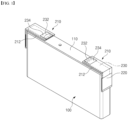
- FIG. 1 is an attached drawing to illustrate a configuration for converting a secondary battery 10 already manufactured with a unidirectional terminal arrangement to a bidirectional terminal arrangement, using a terminal structure 210 included in the terminal structure assembly 200 of the present invention.
- the terminal body 212 refers to a body of the terminal structure 210, including an upper face 213 that encloses either the positive electrode terminal 122 or the negative electrode terminal 124 from being exposed to the outside, and a side face 214 that is coupled to a side extending from the upper face of the battery case 100. While the drawings show an example where the terminal structure 210 is coupled to both the positive electrode terminal 122 and the negative electrode terminal 124, respectively, according to an embodiment, the terminal structure 210 may optionally be coupled to only one of the positive electrode terminal 122 and the negative electrode terminal 124.
- the position of the positive electrode terminal 122 and the negative electrode terminal 124, which are disposed together on the upper face of the battery case 100, can be freely changed without a separate design change simply by applying the terminal structure 210.
- the present invention including the terminal structure 210 enables the position of the positive electrode terminal 122 and/or the negative electrode terminal 124 to be changed freely and easily for a secondary battery of the same form factor, thereby reducing the production cost of various types of prismatic secondary batteries.
- a curable insulating layer refers to an insulating layer formed by curing after a flowable insulating resin is applied to the joint part 232, and in FIG. 1 , a configuration in which a film form of insulation tape 234 having an adhesive layer insulates the joint part 232 is shown.
- the plurality of terminal structures 210 are aligned in a row with terminal body 212 facing the same direction, and busbars 240 are coupled to the aligned extension terminals 220 at once.
- the busbars 240 are made of a conductive material, so that the extension terminals 220 of each terminal structure 210 connected by the busbars 240 are electrically connected to each other.
- the busbars 240 may be welded to the extension terminals 220.
- FIG. 5 illustrates one embodiment of bending an extension terminal 220, which is made of metal material, to form a fastening part 216, wherein the fastening part 216 has a connection socket 222 into which the extension terminal 220 is bent.
- the connection socket 222 is a connection groove deep enough to be inserted into substantially all of the busbar 240 and may form a spring structure that elastically secures the busbar 240.
- the connection socket 222 may form a curved, deformable cross-section that is elastic with respect to the busbar 240.
- the support structure of the busbar 240 is enhanced by the connection socket 222 forming a spring structure.
- connection socket 222 may be formed a winding curved surface. This is to prevent the busbar 240 from being scratched by the entrance edge of the connection socket 222 as it is inserted into the connection socket 222, and to prevent the busbar 240 with a damaged surface from being easily corroded.
- the busbar 240 inserted into the connection socket 222 may be welded to the extension terminal 220 for more rigid support of the busbar 240.
- FIGS. 6 and 7 are exemplary drawings of an application of the terminal structure assembly 200 described in detail in the first embodiment to a plurality of secondary batteries 10, and the advantages of the terminal structure assembly 200 of the present invention will be more clearly understood with reference to FIGS. 6 and 7 .
- the depicted secondary battery 10 relates to a unidirectional secondary battery 10 having a positive electrode terminal 122 and a negative electrode terminal 124 spaced apart on an upper face of a battery case 100 forming a hexahedral shape.
- a plurality of such secondary batteries 10 are arranged in a row along a thickness direction.
- the terminal structure assembly 200 is coupled to a plurality of secondary batteries 10 arranged in a row.
- the terminal body 212 of each terminal structure 210 is coupled to wrap around the positive electrode terminal 122 or negative electrode terminal 124 of the upper face of the secondary battery 10 corresponding to itself, and accordingly, the plurality of secondary batteries 10 coupled to the terminal structure assembly 200 are collectively switched in terminal arrangement to a bidirectional secondary battery 10.
- busbar 240 coupled to the extension terminal 220 of each terminal structure 210, all of the terminal structures 210 of the terminal structure assembly 200 are in an electrically connected state, thereby automatically electrically connecting the plurality of secondary batteries 10 by the terminal structure assembly 200.
- the terminal structure assembly 200 provides two terminal structures 210. Further, the plurality of secondary batteries 10 are aligned along a thickness direction such that electrode terminals 120 of different polarities face electrode terminals 120 of other neighboring secondary batteries 10, the terminal structure assembly 200 having two terminal structures 210 are alternately coupled to both sides of the plurality of secondary batteries 10 (alternately coupled one to each side while skipping one secondary battery), thereby the plurality of secondary batteries 10 are connected in series.
- the individual secondary batteries 10 are converted from unidirectional secondary batteries 10 to bidirectional secondary batteries 10 at once, and the electrical connection to the plurality of secondary batteries 10 to which the terminal structure assembly 200 is applied is completed.
- the terminal structure assembly 200 of the present invention is applied to a battery module or pack having a plurality of unidirectional secondary batteries 10, the battery module/pack can reduce manufacturing costs and time, etc.
- connection structures of FIGS. 6 and 7 it is easy to implement a variety of series and parallel connections in addition to series and parallel connections.
Landscapes
- Chemical & Material Sciences (AREA)
- Chemical Kinetics & Catalysis (AREA)
- Electrochemistry (AREA)
- General Chemical & Material Sciences (AREA)
- Connection Of Batteries Or Terminals (AREA)
- Battery Mounting, Suspending (AREA)
Applications Claiming Priority (2)
| Application Number | Priority Date | Filing Date | Title |
|---|---|---|---|
| KR1020220140666A KR20240059428A (ko) | 2022-10-27 | 2022-10-27 | 버스바를 일체로 구비하는 단자 구조체 어셈블리 |
| PCT/KR2023/016615 WO2024090978A1 (ko) | 2022-10-27 | 2023-10-25 | 버스바를 일체로 구비하는 단자 구조체 어셈블리 |
Publications (2)
| Publication Number | Publication Date |
|---|---|
| EP4518005A1 true EP4518005A1 (de) | 2025-03-05 |
| EP4518005A4 EP4518005A4 (de) | 2025-03-05 |
Family
ID=90831338
Family Applications (1)
| Application Number | Title | Priority Date | Filing Date |
|---|---|---|---|
| EP23883083.0A Pending EP4518005A4 (de) | 2022-10-27 | 2023-10-25 | Anschlussstrukturanordnung mit integralem schienenanschluss |
Country Status (5)
| Country | Link |
|---|---|
| EP (1) | EP4518005A4 (de) |
| JP (1) | JP2025519247A (de) |
| KR (1) | KR20240059428A (de) |
| CN (1) | CN119318071A (de) |
| WO (1) | WO2024090978A1 (de) |
Families Citing this family (1)
| Publication number | Priority date | Publication date | Assignee | Title |
|---|---|---|---|---|
| KR20250177748A (ko) * | 2024-06-17 | 2025-12-24 | 주식회사 엘지에너지솔루션 | 배터리 셀 어셈블리 |
Family Cites Families (15)
| Publication number | Priority date | Publication date | Assignee | Title |
|---|---|---|---|---|
| JPS6074473U (ja) * | 1983-10-28 | 1985-05-25 | 新神戸電機株式会社 | 蓄電池 |
| KR101627631B1 (ko) * | 2012-04-12 | 2016-06-07 | 삼성에스디아이 주식회사 | 이차 전지 및 그 모듈 |
| JP2014107201A (ja) * | 2012-11-29 | 2014-06-09 | Yazaki Corp | 導通部材及び導通部材の製造方法 |
| KR20140094207A (ko) * | 2013-01-21 | 2014-07-30 | 삼성에스디아이 주식회사 | 전지 모듈 |
| DE202013103444U1 (de) * | 2013-07-31 | 2014-11-04 | Weidmüller Interface GmbH & Co. KG | Kontaktelement für eine Steckanordnung eines insbesondere außen geführten Bussystems |
| JP2015179578A (ja) * | 2014-03-18 | 2015-10-08 | 株式会社リチウムエナジージャパン | 蓄電素子及び電源モジュール |
| KR102408824B1 (ko) * | 2015-06-22 | 2022-06-13 | 삼성에스디아이 주식회사 | 이차 전지 및 이차 전지 모듈 |
| DE102016116842B3 (de) * | 2016-09-08 | 2018-02-15 | Lisa Dräxlmaier GmbH | Steckverbinder zum elektrischen Verbinden von zwei elektrischen Baugruppen |
| KR102425799B1 (ko) * | 2017-09-07 | 2022-07-28 | 삼성에스디아이 주식회사 | 이차 전지 |
| KR102578860B1 (ko) | 2018-02-27 | 2023-09-13 | 삼성에스디아이 주식회사 | 이차 전지 |
| CN112771635B (zh) * | 2018-11-20 | 2023-02-17 | 松下知识产权经营株式会社 | 蓄电模块 |
| KR102789863B1 (ko) * | 2019-09-02 | 2025-03-31 | 주식회사 엘지에너지솔루션 | 커넥터 |
| KR102672499B1 (ko) * | 2020-12-21 | 2024-06-07 | 에스케이온 주식회사 | 버스바 |
| KR20220134301A (ko) * | 2021-03-26 | 2022-10-05 | 에스케이온 주식회사 | 배터리 팩 |
| KR20220140666A (ko) | 2021-04-10 | 2022-10-18 | 이동진 | 교체식 수소연료 플랫폼 |
-
2022
- 2022-10-27 KR KR1020220140666A patent/KR20240059428A/ko active Pending
-
2023
- 2023-10-25 JP JP2024571388A patent/JP2025519247A/ja active Pending
- 2023-10-25 EP EP23883083.0A patent/EP4518005A4/de active Pending
- 2023-10-25 CN CN202380045155.4A patent/CN119318071A/zh active Pending
- 2023-10-25 WO PCT/KR2023/016615 patent/WO2024090978A1/ko not_active Ceased
Also Published As
| Publication number | Publication date |
|---|---|
| CN119318071A (zh) | 2025-01-14 |
| WO2024090978A1 (ko) | 2024-05-02 |
| EP4518005A4 (de) | 2025-03-05 |
| KR20240059428A (ko) | 2024-05-07 |
| JP2025519247A (ja) | 2025-06-24 |
Similar Documents
| Publication | Publication Date | Title |
|---|---|---|
| KR102461833B1 (ko) | 배터리 모듈 | |
| US11380955B2 (en) | Battery module, and battery pack and vehicle comprising the same | |
| JP7258278B2 (ja) | 移動可能なバスバー組立体を備えたバッテリーパック及びこれを含む二次電池 | |
| JP5319165B2 (ja) | 電池パック及び電池ケース | |
| US10236485B2 (en) | Battery module | |
| US11456502B2 (en) | Battery module, battery pack comprising same battery module, and vehicle comprising same battery pack | |
| KR20050121907A (ko) | 이차 전지와 이에 사용되는 전극 조립체 | |
| US20110104572A1 (en) | Electrode assembly for secondary battery and method of making the electrode assembly | |
| WO2019031702A1 (ko) | 배터리 셀 프레임 및 이를 포함하는 배터리 모듈 | |
| EP3154108A1 (de) | Batteriemodul und batteriepack damit | |
| KR102214538B1 (ko) | 단위전지모듈 및 이를 포함하는 전지모듈 | |
| JP2019512863A (ja) | バッテリーモジュール及びこれを含むバッテリーパック | |
| KR20210011641A (ko) | 배터리 모듈 및 이를 포함하는 배터리 팩 | |
| EP4518005A1 (de) | Anschlussstrukturanordnung mit integralem schienenanschluss | |
| KR20190128812A (ko) | 배터리 모듈 | |
| EP3671941B1 (de) | Sekundärbatterie und batteriepack diese enthaltend | |
| EP4044348A1 (de) | Batteriepack | |
| EP4376207B1 (de) | Sekundärbatterie mit verbesserter anschlussstruktur | |
| KR20230058852A (ko) | 배터리 모듈 및 이를 구비하는 배터리 팩 | |
| US20250070423A1 (en) | Secondary Battery with Improved Terminal Structure | |
| KR101826862B1 (ko) | 보호 모듈을 포함하는 전지팩 | |
| US20230378620A1 (en) | Pouch-type battery cell, and battery cell assembly and battery pack having the same | |
| KR102785764B1 (ko) | 이차 전지 | |
| EP4421969A1 (de) | Sekundärbatterie mit verbesserter anschlussstruktur | |
| EP4425685A1 (de) | Sekundärbatterie mit verbesserter anschlussstruktur |
Legal Events
| Date | Code | Title | Description |
|---|---|---|---|
| STAA | Information on the status of an ep patent application or granted ep patent |
Free format text: STATUS: THE INTERNATIONAL PUBLICATION HAS BEEN MADE |
|
| PUAI | Public reference made under article 153(3) epc to a published international application that has entered the european phase |
Free format text: ORIGINAL CODE: 0009012 |
|
| STAA | Information on the status of an ep patent application or granted ep patent |
Free format text: STATUS: REQUEST FOR EXAMINATION WAS MADE |
|
| 17P | Request for examination filed |
Effective date: 20241127 |
|
| A4 | Supplementary search report drawn up and despatched |
Effective date: 20250128 |
|
| AK | Designated contracting states |
Kind code of ref document: A1 Designated state(s): AL AT BE BG CH CY CZ DE DK EE ES FI FR GB GR HR HU IE IS IT LI LT LU LV MC ME MK MT NL NO PL PT RO RS SE SI SK SM TR |
|
| STAA | Information on the status of an ep patent application or granted ep patent |
Free format text: STATUS: EXAMINATION IS IN PROGRESS |
|
| DAV | Request for validation of the european patent (deleted) | ||
| DAX | Request for extension of the european patent (deleted) |