EP4516698A1 - Servicefahrzeug zur verwendung in einem lagersystem zur dreidimensionalen anordnung von lagerbehältern - Google Patents
Servicefahrzeug zur verwendung in einem lagersystem zur dreidimensionalen anordnung von lagerbehältern Download PDFInfo
- Publication number
- EP4516698A1 EP4516698A1 EP23194707.8A EP23194707A EP4516698A1 EP 4516698 A1 EP4516698 A1 EP 4516698A1 EP 23194707 A EP23194707 A EP 23194707A EP 4516698 A1 EP4516698 A1 EP 4516698A1
- Authority
- EP
- European Patent Office
- Prior art keywords
- platform
- service vehicle
- top level
- vehicle
- operator
- Prior art date
- Legal status (The legal status is an assumption and is not a legal conclusion. Google has not performed a legal analysis and makes no representation as to the accuracy of the status listed.)
- Pending
Links
Images



Classifications
-
- B—PERFORMING OPERATIONS; TRANSPORTING
- B65—CONVEYING; PACKING; STORING; HANDLING THIN OR FILAMENTARY MATERIAL
- B65G—TRANSPORT OR STORAGE DEVICES, e.g. CONVEYORS FOR LOADING OR TIPPING, SHOP CONVEYOR SYSTEMS OR PNEUMATIC TUBE CONVEYORS
- B65G1/00—Storing articles, individually or in orderly arrangement, in warehouses or magazines
- B65G1/02—Storage devices
- B65G1/04—Storage devices mechanical
- B65G1/0464—Storage devices mechanical with access from above
-
- B—PERFORMING OPERATIONS; TRANSPORTING
- B65—CONVEYING; PACKING; STORING; HANDLING THIN OR FILAMENTARY MATERIAL
- B65G—TRANSPORT OR STORAGE DEVICES, e.g. CONVEYORS FOR LOADING OR TIPPING, SHOP CONVEYOR SYSTEMS OR PNEUMATIC TUBE CONVEYORS
- B65G1/00—Storing articles, individually or in orderly arrangement, in warehouses or magazines
- B65G1/02—Storage devices
- B65G1/04—Storage devices mechanical
- B65G1/0492—Storage devices mechanical with cars adapted to travel in storage aisles
Definitions
- the present disclosure generally relates to the field of maintenance and troubleshooting means for compact warehouse systems. More particularly, the present disclosure relates to a service vehicle usable by an operator for maintenance and/or troubleshooting tasks and/or actions in a compact warehouse system providing space for a three-dimensional arrangement of storage bins, and a compact warehouse system including such service vehicle.
- the service vehicle may comprise a vehicle control (or "control system") for controlling movement and/or operation of the vehicle.
- the service vehicle can comprise at least one sensor adapted to determine a position of the service vehicle within the warehouse system and especially a position on the rail grid of the top level. At least one sensor of the service vehicle may also be adapted to detect the environment around the service vehicle. At least one of the at least one sensor may be a camera.
- the vehicle control may also communicate with a main control of the warehouse system and, thus, receive signals of sensors present within the warehouse system.
- the vehicle control may cause blocking of at least an area in which the service vehicle is present in the warehouse system and/or a movement path of the service vehicle in the warehouse system for other vehicles, irrespective of being another service vehicle or a vehicle for retrieving bins from and storing bins in the warehouse system.
- presence of a service vehicle within a top level of a storage module of the warehouse system may cause blockage of the whole storage module top level at least for all bin retrieving and storing vehicles in the warehouse system.
- the vehicle control can be designed to selectively allow manually operated or drive controlled movement of the vehicle.
- drive control is not active but, when drive control is active, the service vehicle does not allow manual operation, and, in case of the user manually interacting with the system to move the service vehicle, it is conceivable that the service vehicle stops drive control so as to allow the operator to take over manual operation of the service vehicle or that an acoustic or visual alarm is output to remind the operator of drive control being active.
- movement of the service vehicle at the storage module top level can be caused manually by the operator pushing and/or pulling him-/herself and, thus, the service vehicle carrying the operator along the top level rails by grasping sections or components of the top level and/or of a bottom of an upper module if present.
- movement of the service vehicle may be drive controlled.
- at least one roller can be a motor-driven roller, wherein preferably at least one pair of rollers is motor-driven.
- a handheld control device to be controlled by the operator when carried by the platform and/or there may be a remote control device to be controlled from outside the warehouse system.
- the warehouse system control may especially comprise an automatic retrieval control for the service vehicle, which may be sensor-based or remoted controlled.
- the service vehicle may comprise sensors for detecting one or more emergency situations, e.g., when the operator fainted and/or is motionless and can no longer control the service vehicle and/or in case of fire in the warehouse system. The control then is adapted to communicate with these sensors.
- control may communicate with a main control (or "control system") of the warehouse system, wherein the latter may communicate with sensors present within the warehouse system, such as fire detection sensors and/or low oxygen level detection sensors.
- sensors present within the warehouse system such as fire detection sensors and/or low oxygen level detection sensors.
- the service vehicle control may be adapted to rely on sensor signals from within the warehouse system.
- the control allows remote control, there may be an emergency button outside the warehouse system which can be pressed by a person when detecting an emergency situation.
- a service vehicle is emergency retrieved from the warehouse system, its movement speed is preferably reduced compared to a movement speed the service vehicle moves at during drive control when there is no emergency situation.
- the service vehicle further comprises a base, wherein the rollers are mounted to the base so as to movably support the base especially on the top level rails and wherein the platform is mounted to the base such that the base supports the platform.
- the platform may be movably and especially rotatably mounted to the base.
- the platform has a length extension along a first axis extending between a first end and an opposite second end thereof and a width extension along a second axis extending between a first side and an opposite second side thereof.
- Rotation of the platform may then be defined as rotation about a platform rotation axis perpendicular to a plane defined by the first and second axis of the platform, especially, a surface of the platform, such as the surface for carrying the operator, and may especially extend through a center point of the surface of the platform.
- the platform plane is parallel to a plane defined by the top level grid and/or rails and, in case of a stacked arrangement of storage modules, parallel to a bottom of an upper level storage module. It is especially conceivable to define first and second engagement positions of the platform relative to the base, with unintended rotation of the platform being inhibited when the platform is in either one of its first and second engagement positions.
- the first and second engagement positions can be 90° apart from one another.
- the first axis of the platform when in the first engagement position is perpendicular to the first axis of the platform when in the second engagement position.
- the platform in the first engagement position, can either be oriented with the first end thereof at 0° or 180° and, in the second engagement position, the platform can either be oriented with the first end thereof at 90° or 270°.
- rotation of the platform allows a broader operation range for an operator carried on the platform.
- Fixation of the platform against rotation in each of the first and second engagement positions is releasable, wherein it is conceivable that the platform can be released to allow rotation either by an automated control or also manually by the operator carried on the platform.
- the service vehicle can, for example, comprise release means, such as a lever or button, manually actuatable by the operator.
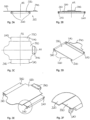
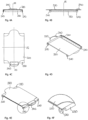
- the platform is adapted to support the operator in a lying position, wherein the term "lying position" shall cover a person's position when lying on the back, stomach or side.
- the platform can be ergonomically designed to support a lying person, and, for example, may be provided with a head support, such as a cushion.
- the head support may especially be designed to support a person's back of the head, a side of the head or even a person's face, wherein, especially in the latter case, the head support may be an O- or U-shaped cushion.
- the head support of the platform only is a head support for the operator when lying on his/her back or side but is a breast support for the operator when lying on his/her stomach.
- the operator's face When lying on his/her stomach, the operator's face may then preferably be at a position beyond a first or second end edge of the platform so that the operator has sight into a lower section of the storage module.
- the platform may have a cutout or viewing window in a section faced by the operator's face when the operator is lying on his/her stomach, such as, for example, within the interior of the O- or U-shaped cushion.
- the platform may have a corresponding shape and/or width dimension in a section adjacent each of the first and second ends of the platform.
- the rails of the storage module top level preferably extend in a grid-like manner in perpendicular directions.
- the rollers are preferably pivotable relative to the base so as to allow selective movement of the service vehicle in either said perpendicular directions.
- rotation of the platform relative to the base is operatively connected to pivoting of the rollers, i.e., in other words, a platform rotation mechanism provided for rotational coupling of the platform to the base and a roller pivoting mechanism provided for pivotal coupling of the rollers to the base are operatively connected such that rotation of the platform relative to the base causes the rollers to pivot relative to the base and/or pivoting of the rollers relative to the base causes rotation of the platform relative to the base.
- the operative connection of the platform and the rollers such that rotation of the platform relative to the base causes the rollers to pivot relative to the base is especially conceivable for a manual operation of the service vehicle by the operator.
- the operator can manually cause rotation of the platform by pushing and/or pulling him-/herself and, thus, the platform carrying the operator around the platform rotation axis by grasping sections or components of the top level and/or of a bottom of an upper module if present.
- the operator may either have to overcome a rotational force threshold to rotate the platform out of its present engagement position or may have to manually actuate the release means. Due to the operative connection of the platform and the rollers, by rotating the platform the operator can easily change movement direction of the rollers and, thus, of the service vehicle.
- the operative connection of the platform and the rollers such that pivoting of the rollers relative to the base causes rotation of the platform relative to the base is especially conceivable for the service vehicle being drive controlled.
- the platform carrying the operator automatically performs a corresponding rotation.
- Such rotation may provide an indication to the operator carried on the platform that movement will continue in a perpendicular direction. Fixation of the platform against rotation out of its first or second engagement position may be automatically released by the drive control.
- the service vehicle may further comprise limbs securing means.
- These limbs securing means may be actuatable, preferably pneumatically actuatable, to move from a non-securing position to a securing position relative to the platform. In the non-securing position, the limbs securing means may not limit the operating range of an operator carried by the platform.
- the limbs securing means are adapted to limit an operating range of the operator carried by the platform, preferably especially in lateral directions, i.e., limit the width extension of the operator range and/or a space occupiable by the operator on the platform, by causing limbs of the operator positioned outside the limits of the limited operating range set by the limbs securing means when in securing position to be led into said limits.
- the limbs securing means are especially useful in an emergency situation, for example, when the operator is motionless with his/her limbs in a position ("outside" the service vehicle and/or in interaction with the warehouse system prior to becoming motionless and still resting in this position) where automatic service vehicle retrieval would cause harm on the limbs.
- the limbs securing means may be movably mounted to the platform. It may comprise at least one barrier selectively positionable to laterally limit the space occupiable by the operator on the platform, i.e., selectively movable into the securing position.
- at least one limbs securing barrier can be pivotably mounted to a surface of the platform in a first lateral region of the platform extending in a direction parallel to a longitudinal axis of the platform and at least one limbs securing barrier can be pivotably mounted to the surface of the platform in a second lateral region opposite the first lateral region and extending in a direction parallel to the longitudinal axis of the platform, the surface carrying the operator when present on the vehicle.
- an (e.g., compact) warehouse system comprising at least one above-described service vehicle.
- the warehouse system may comprise the above-described features.
- it comprises at least one storage module having a storage area adapted to accommodate a plurality of stacks of storage bins, and a top level arranged above the storage area as well as the at least one above-described service vehicle.
- an operator can, for example, fix a defect of a bin storing and retrieving vehicle within the warehouse system, free a stuck bin storing and retrieving vehicle within the warehouse system, perform maintenance work on structural and functional components of the warehouse system and/or free a bin stuck in the warehouse system.
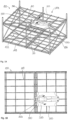
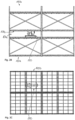
- Figure 1A shows a single storage module 100 of a warehouse system providing space for a three-dimensional arrangement of storage bins, wherein the warehouse system may comprise additional storage modules 100 interconnected with the one shown in a common level and/or in a stacked arrangement in at least two levels one above the other in an individual room.
Landscapes
- Engineering & Computer Science (AREA)
- Mechanical Engineering (AREA)
- Warehouses Or Storage Devices (AREA)
Priority Applications (2)
| Application Number | Priority Date | Filing Date | Title |
|---|---|---|---|
| EP23194707.8A EP4516698A1 (de) | 2023-08-31 | 2023-08-31 | Servicefahrzeug zur verwendung in einem lagersystem zur dreidimensionalen anordnung von lagerbehältern |
| PCT/EP2024/074180 WO2025046005A1 (en) | 2023-08-31 | 2024-08-29 | Service vehicle for use in a warehouse system for three-dimensional arrangement of storage bins |
Applications Claiming Priority (1)
| Application Number | Priority Date | Filing Date | Title |
|---|---|---|---|
| EP23194707.8A EP4516698A1 (de) | 2023-08-31 | 2023-08-31 | Servicefahrzeug zur verwendung in einem lagersystem zur dreidimensionalen anordnung von lagerbehältern |
Publications (1)
| Publication Number | Publication Date |
|---|---|
| EP4516698A1 true EP4516698A1 (de) | 2025-03-05 |
Family
ID=87889402
Family Applications (1)
| Application Number | Title | Priority Date | Filing Date |
|---|---|---|---|
| EP23194707.8A Pending EP4516698A1 (de) | 2023-08-31 | 2023-08-31 | Servicefahrzeug zur verwendung in einem lagersystem zur dreidimensionalen anordnung von lagerbehältern |
Country Status (2)
| Country | Link |
|---|---|
| EP (1) | EP4516698A1 (de) |
| WO (1) | WO2025046005A1 (de) |
Citations (10)
| Publication number | Priority date | Publication date | Assignee | Title |
|---|---|---|---|---|
| US20070013154A1 (en) * | 2005-07-15 | 2007-01-18 | International Specialty Services, Inc. | Adjustable creeper apparatus |
| US20090095190A1 (en) * | 2007-10-11 | 2009-04-16 | Gordon Jonathan I | Roller Coaster Maintenance Vehicle |
| WO2014075937A1 (en) | 2012-11-13 | 2014-05-22 | Jakob Hatteland Logistics As | Storage system |
| WO2015140216A1 (en) | 2014-03-18 | 2015-09-24 | Ocado Innovation Limited | Robotic service device |
| US20190337548A1 (en) * | 2018-05-01 | 2019-11-07 | Stanley Black & Decker Inc. | Steerable platform cart |
| CN110509245A (zh) * | 2019-08-06 | 2019-11-29 | 南通理工学院 | 一种用于汽修领域的修车躺板 |
| WO2020151866A1 (en) | 2019-01-23 | 2020-07-30 | Autostore Technology AS | Service vehicle |
| WO2021078582A1 (en) | 2019-10-23 | 2021-04-29 | Autostore Technology AS | System, method and main control system for handling malfunctioning vehicles in an automated storage and retrieval system comprising a rail system |
| WO2022106346A2 (en) | 2020-11-23 | 2022-05-27 | Autostore Technology AS | A service vehicle with a vehicle pen |
| WO2022148720A1 (en) * | 2021-01-05 | 2022-07-14 | Autostore Technology AS | Vehicle with non-motorized guiding wheels and motorized belt drive and methods of operating the vehicle |
-
2023
- 2023-08-31 EP EP23194707.8A patent/EP4516698A1/de active Pending
-
2024
- 2024-08-29 WO PCT/EP2024/074180 patent/WO2025046005A1/en active Pending
Patent Citations (11)
| Publication number | Priority date | Publication date | Assignee | Title |
|---|---|---|---|---|
| US20070013154A1 (en) * | 2005-07-15 | 2007-01-18 | International Specialty Services, Inc. | Adjustable creeper apparatus |
| US20090095190A1 (en) * | 2007-10-11 | 2009-04-16 | Gordon Jonathan I | Roller Coaster Maintenance Vehicle |
| WO2014075937A1 (en) | 2012-11-13 | 2014-05-22 | Jakob Hatteland Logistics As | Storage system |
| WO2015140216A1 (en) | 2014-03-18 | 2015-09-24 | Ocado Innovation Limited | Robotic service device |
| US20190337548A1 (en) * | 2018-05-01 | 2019-11-07 | Stanley Black & Decker Inc. | Steerable platform cart |
| WO2020151866A1 (en) | 2019-01-23 | 2020-07-30 | Autostore Technology AS | Service vehicle |
| US20220097967A1 (en) * | 2019-01-23 | 2022-03-31 | Autostore Technology AS | Service vehicle |
| CN110509245A (zh) * | 2019-08-06 | 2019-11-29 | 南通理工学院 | 一种用于汽修领域的修车躺板 |
| WO2021078582A1 (en) | 2019-10-23 | 2021-04-29 | Autostore Technology AS | System, method and main control system for handling malfunctioning vehicles in an automated storage and retrieval system comprising a rail system |
| WO2022106346A2 (en) | 2020-11-23 | 2022-05-27 | Autostore Technology AS | A service vehicle with a vehicle pen |
| WO2022148720A1 (en) * | 2021-01-05 | 2022-07-14 | Autostore Technology AS | Vehicle with non-motorized guiding wheels and motorized belt drive and methods of operating the vehicle |
Also Published As
| Publication number | Publication date |
|---|---|
| WO2025046005A1 (en) | 2025-03-06 |
Similar Documents
| Publication | Publication Date | Title |
|---|---|---|
| US12145012B2 (en) | Service vehicle for a storage system | |
| US6579053B1 (en) | Robotic containerization and palletizing system | |
| US20250243002A1 (en) | Fork apparatus and warehousing robot | |
| TWI380938B (zh) | Items storage equipment | |
| ES3040271T3 (en) | Commissioning station for the automatic commissioning of goods | |
| EP1211198B1 (de) | Verfahren und Vorrichtung zur Handhabung von Paletten | |
| US11801874B2 (en) | Vehicle tilting device, an access station, a delivery system and a method of accessing a storage, etc | |
| EP4363353B1 (de) | Zugangsstation für ein automatisiertes regalbedienungssystem | |
| JP2024544893A (ja) | 第1及び第2のシャッタを伴う車両ゲート配列、配列を備えるシステム、及び動作方法 | |
| EP3868518A1 (de) | Roboter und verfahren zur lagerautomatisierung | |
| EP4516698A1 (de) | Servicefahrzeug zur verwendung in einem lagersystem zur dreidimensionalen anordnung von lagerbehältern | |
| US20230398704A1 (en) | Pick and Place Robot with Inventory Drop Guard | |
| US20230415790A1 (en) | Vehicle tilting device, an access station, a delivery system and a method of accessing a storage container | |
| EP4512745A1 (de) | Fahrzeug zum transport eines lagerbehälters | |
| JP2025536800A (ja) | 中心駆動付きのサービス車両、その方法およびシステム | |
| US20250187828A1 (en) | Service trolley, an automated storage and retrieval system comprising the trolley, and method of operating the trolley | |
| EP4543783A1 (de) | Zugangsstation für ein automatisiertes regalbedienungssystem | |
| WO2024133389A1 (en) | A service vehicle for an automated storage and retrieval system | |
| TR2022017908A1 (tr) | Bi̇r depolama si̇stemi̇ | |
| HK40044805A (en) | Service vehicle for a storage system |
Legal Events
| Date | Code | Title | Description |
|---|---|---|---|
| PUAI | Public reference made under article 153(3) epc to a published international application that has entered the european phase |
Free format text: ORIGINAL CODE: 0009012 |
|
| STAA | Information on the status of an ep patent application or granted ep patent |
Free format text: STATUS: THE APPLICATION HAS BEEN PUBLISHED |
|
| AK | Designated contracting states |
Kind code of ref document: A1 Designated state(s): AL AT BE BG CH CY CZ DE DK EE ES FI FR GB GR HR HU IE IS IT LI LT LU LV MC ME MK MT NL NO PL PT RO RS SE SI SK SM TR |
|
| STAA | Information on the status of an ep patent application or granted ep patent |
Free format text: STATUS: REQUEST FOR EXAMINATION WAS MADE |
|
| 17P | Request for examination filed |
Effective date: 20250716 |