EP4516450A1 - Absaugvorrichtung für die späne in einer werkzeugmaschine - Google Patents
Absaugvorrichtung für die späne in einer werkzeugmaschine Download PDFInfo
- Publication number
- EP4516450A1 EP4516450A1 EP24195937.8A EP24195937A EP4516450A1 EP 4516450 A1 EP4516450 A1 EP 4516450A1 EP 24195937 A EP24195937 A EP 24195937A EP 4516450 A1 EP4516450 A1 EP 4516450A1
- Authority
- EP
- European Patent Office
- Prior art keywords
- main
- bottom opening
- hood
- suction
- machine
- Prior art date
- Legal status (The legal status is an assumption and is not a legal conclusion. Google has not performed a legal analysis and makes no representation as to the accuracy of the status listed.)
- Pending
Links
Images



Classifications
-
- B—PERFORMING OPERATIONS; TRANSPORTING
- B23—MACHINE TOOLS; METAL-WORKING NOT OTHERWISE PROVIDED FOR
- B23Q—DETAILS, COMPONENTS, OR ACCESSORIES FOR MACHINE TOOLS, e.g. ARRANGEMENTS FOR COPYING OR CONTROLLING; MACHINE TOOLS IN GENERAL CHARACTERISED BY THE CONSTRUCTION OF PARTICULAR DETAILS OR COMPONENTS; COMBINATIONS OR ASSOCIATIONS OF METAL-WORKING MACHINES, NOT DIRECTED TO A PARTICULAR RESULT
- B23Q11/00—Accessories fitted to machine tools for keeping tools or parts of the machine in good working condition or for cooling work; Safety devices specially combined with or arranged in, or specially adapted for use in connection with, machine tools
- B23Q11/0042—Devices for removing chips
- B23Q11/0046—Devices for removing chips by sucking
-
- B—PERFORMING OPERATIONS; TRANSPORTING
- B27—WORKING OR PRESERVING WOOD OR SIMILAR MATERIAL; NAILING OR STAPLING MACHINES IN GENERAL
- B27M—WORKING OF WOOD NOT PROVIDED FOR IN SUBCLASSES B27B - B27L; MANUFACTURE OF SPECIFIC WOODEN ARTICLES
- B27M1/00—Working of wood not provided for in subclasses B27B - B27L, e.g. by stretching
- B27M1/08—Working of wood not provided for in subclasses B27B - B27L, e.g. by stretching by multi-step processes
Definitions
- This invention relates to a machine for machining wood or comparable materials, such as, for example, wood by-products, aluminium, plastic and composites and a suction system for extracting the shavings produced by the machine itself.
- this invention relates to a Computer Numerical Control (CNC) machining centre, hereinafter abbreviated MC, in particular for nesting processes, and a suction system for extracting the shavings produced by the nesting MC during the machining of a panel (or workpiece).
- CNC Computer Numerical Control
- MC Computer Numerical Control
- suction system for extracting the shavings produced by the nesting MC during the machining of a panel (or workpiece).
- a machine for machining wood in particular a nesting MC having an uninterrupted work table for supporting the panel to be machined, a vacuum pump fluid-dynamically connected to the work table to hold the panel on the work table, and a sacrificial panel placed between the work table and the panel to be machined.
- the machine for machining wood according to this invention might have an interrupted work table, typical of nesting MCs, while remaining within the scope of protection defined by the appended claims.
- the machine for machining wood according to this invention might, for example, have a work table comprising bars with a system for holding down the workpiece to be machined using, for example, clamps or suction cups, a multi-stage work table, a work table with a conveyor belt or a work table with a movement chain.
- the suction system which is also an object of this invention, might be applied to machines for machining wood having different types of worktables, while remaining within the scope of protection defined by the appended claims.
- Nesting is a method of organizing machining processes to allow obtaining the highest number of parts from a single large template. Thanks to suitable software, this machining method thus allows placing as many parts as possible, the final parts required, in a limited space represented by the starting panel, with the aim of minimizing the amount of scrap (or waste) of raw material, that is, of the starting panel, or of reducing the time needed to make the final parts. Typically, these two aims represent a technological compromise.
- nesting machining may be likened to panel sawing, where a single large panel is cut into a multiplicity of rectangular parts, widely used in the furniture industry to make what are known as "cabinets", which are the basic blocks used for the manufacture of kitchen furniture, or other pieces of furniture.
- nesting MCs have a work table, also called “multifunction table”, i.e. an uninterrupted supporting table, typically made of aluminium, designed to support the panel to be machined.
- a panel placed between the panel to be machined and the multifunction table there is a panel, known as “sacrificial” panel, typically made of medium density fibreboard (MDF), whose purpose is to protect the multifunction table during machining which involves cutting through the panel to be machined.
- MDF medium density fibreboard
- the multifunction table has a series of openings or holes which allow the top surface of the multifunction table to be placed in fluid-dynamic communication with one or more vacuum pumps, or volumetric pumps.
- the sacrificial panel is permeable to air, so the negative pressure generated by the volumetric pump acts on the panel to be machined to hold it firmly against the multifunction table.
- shavings suction hoods of nesting MCs are typically large in size, so they can adapt to all kinds of machining processes, that is to say, to all types of tools and to the possible configurations that these can adopt during machining.
- this disclosure has for an aim to provide a shavings extraction system which is more efficient under equal conditions of energy consumption, while at the same time offering maximum flexibility in terms of the machining processes which can be performed by the nesting MC.
- the suction system may comprise an internal suction hood having an inside wall which defines a secondary suction chamber of reduced size, particularly efficient when the chuck supports small tools such as, for example, milling cutters for nesting or panel sawing processes.
- the outside wall and the inside wall both surround the chuck, and the main bottom opening of the external hood surrounds the secondary bottom opening of the internal hood.
- the internal hood thus ensures reduced energy consumption for the same efficiency during machining with tools of small size.
- the internal hood offers higher efficiency for the same energy consumption during machining with tools of small size.
- the external hood may be at the operating position while the internal hood is at the non-operating position, and vice versa, working alternately.
- the external hood and the internal hood may be at the operating position simultaneously so as to create a joint suction effect around the tool.
- the two suction chambers, respectively of the external hood and of the internal hood can work jointly on the work table, around the chuck and the tool, optimally distributing the flow generated by the negative pressure source.
- the extraction system may comprise a flow regulator (comprising, for example, one or more valves, one or more deviators, one or more chokes), configured to vary the flow inside the external hood and/or the internal hood, in particular inside the duct of the external hood and/or of the internal hood.
- the regulator may, for example, comprise a valve located at the duct of the external hood and/or a valve located at the duct of the internal hood, so as to regulate the flow inside the external hood and/or inside the internal hood, and in particular inside the duct of the external hood and/or the internal hood.
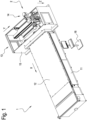
- Figure 1 shows a machine 1 for machining wood, in particular, a nesting MC.
- the machine 1 has a bed 11 whose purpose is to support all the fixed and movable parts of the machine 1 itself.
- the work table 12 is horizontal, that is to say, substantially parallel to the supporting surface of the bed 11, and extends along a longitudinal axis X and along a transverse axis Y.
- the work table 12 might also be vertical or inclined (again with reference to the supporting surface of the bed 11), without departing from the scope of protection defined by the appended claims.
- the work table 12 has the purpose of supporting the panel to be machined.
- the work table 12 also has the purpose of firmly holding the panel P during machining operations carried out on the panel P itself.
- the work table 12 may be provided with holes, which may be open or closed, and which are fluid-dynamically connected, or coupled, to a vacuum pump, more specifically, a volumetric pump.
- the work table 12 may also be provided with grooves for inserting suitable gaskets acting in conjunction with the holes to define the areas of the work table 12 to which negative pressure is applied.
- the sacrificial panel may be made, for example, of MDF and is thus air permeable. The panel P is therefore held in place by the negative pressure which is generated by the vacuum pump and which passes through the sacrificial panel.
- a movement system 13 whose purpose is to move a tool for machining the panel P along a triplet of orthogonal axes (Cartesian axes).
- the movement system 13 may comprise a crossbar 131 which extends along the transverse axis Y and is slidably coupled to the bed 11 so that it can be moved by a first actuator (for example, a synchronous brushless motor, or other type of actuator not shown in the drawings) along the longitudinal axis X, above the work table 12.
- a first actuator for example, a synchronous brushless motor, or other type of actuator not shown in the drawings
- the movement system 13 also comprises a transverse carriage 132 slidably coupled to the crossbar 131 so that it can be moved by a second actuator 133 (for example, a synchronous brushless motor, or other type of actuator not shown in the drawings) along the transverse axis Y, orthogonal to the longitudinal axis X. Furthermore, the movement system 13 comprises a vertical carriage 134 slidably coupled to the transverse carriage 132 so that it can be moved by a third actuator 135 (for example, a synchronous brushless motor, or other type of actuator not shown in the drawings) along the vertical axis Z, orthogonal to the longitudinal axis X and to the transverse axis Y.
- a second actuator 133 for example, a synchronous brushless motor, or other type of actuator not shown in the drawings
- a third actuator 135 for example, a synchronous brushless motor, or other type of actuator not shown in the drawings
- the machine 1 comprises a machining unit 14 coupled to the vertical carriage 134.
- the machining unit comprises a chuck 5, in particular an electric chuck to support and rotationally drive a tool for machining the panel P.
- the tool therefore, may be moved, in use, on the work table 12 along three Cartesian axes, in particular along the longitudinal axis X, the transverse axis Y and the vertical axis Z.
- the machining unit 14 might also have one or more rotation axes, for example, a first rotation axis and a second rotation axis, so that the tool can be moved along a total of five axes, three linear axes and two rotary axes, while remaining within the scope of protection defined by the appended claims.
- the movement system 13 and the machining unit 14 may be enclosed within a side panel 15, as shown for example in Figure 1 .
- the side panel 15 has a safety function.
- the side panel 15 may incorporate safety systems (for example, comprising contact sensors or contactless sensors) to detect possible impacts between the movable parts of the machine 1 and an operator.
- the side panel has the purpose of preventing the operator from coming too close to the moving parts of the machine 1 or to dangerous parts, such as the chuck 5 or the tool.
- the side panel also has the purpose of intercepting parts of the machine 1, such as, for example, tool plates, which might accidentally come loose and be propelled at high speed towards an operator.
- the side panel 15 may be coupled to the movement system and moved as one therewith.
- the tool By moving along the vertical axis Z, the tool can move towards or away from the work table 12, hence from the panel to be machined. That way, it is also possible to define the depth the tools cut into the panel P to be machined. For nesting or panel sawing machining processes, the tool will be positioned at a predefined height over the panel P so that it cuts through the panel P itself. By so doing, the parts resulting from the machining process will be separated completely from the starting panel P.
- Figure 2 shows an example of a cutting pattern of a panel P to be machined.
- the specific example represented in Figure 2 is characterized by cuts which are orthogonal to each other and thus, we can also say that the panel P is sawn into a multiplicity of desired parts.
- the machine 1 has an operator position 16 which may comprise a workstation from where an operator can program and control the machine 1. Through the operator position 16, therefore, it is possible to program or load a machine program containing, for example, the cutting pattern shown in Figure 2 , so that the machine 1 can automatically make the cuts in the panel P needed to obtain the desired parts using the tool driven in rotation by the chuck 5.
- the machining unit 14 may comprise an extraction suction system 2, associated with the chuck 5, to extract the shavings produced by the tool during machining of the panel P.
- the extraction suction system 2 may move as one with the chuck and is therefore movable along the three orthogonal axes, in particular the longitudinal axis X, the transverse axis Y and the vertical axis Z.
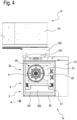
- the extraction suction system 2 may comprise an external suction hood 3.
- the external suction hood 3 may comprise a main duct 33 for extracting the shavings.
- the main duct 33 may be fluid-dynamically connected or coupled at one end of it to a negative pressure source, in particular, a vacuum pump, and more particularly, a centrifugal pump (or impeller).
- a centrifugal pump or impeller
- the centrifugal pump does not form part of the machine 1 but may form part of an external extraction system.
- the main duct 33 may comprise a valve 332 positioned and configured to regulate the flow inside the main duct 33.
- the valve 332 may, for example, be what is known as a "butterfly valve" having a rotating rod 331.
- the valve 332 may be driven, for example, by an actuator which may be, for example, a piston and related crank or an electric motor, for example coupled to the rod 331.
- the other end of the main duct 33 may be fluid-dynamically connected or coupled to a main top opening of the external hood 3.
- the main top opening may be an opening present in a plate 21 of the extraction suction system 2.
- the main top opening may have different shapes, for example rectangular or circular, and may be parallel to the work table 12. However, the top opening might also be, for example, orthogonal to the work table 12 or have different inclination angles, without thereby departing from the scope of protection afforded by the appended claims. Therefore, the plate 21 might also not be flat and not parallel to the work table 12.
- the external hood 3 comprises an outside wall 31 which extends between the main top opening and a main bottom opening 30, in particular between the plate 21 and the main bottom opening 30.
- the main bottom opening 30 may also have different shapes, for example rectangular or circular, and may or may not be parallel to the work table 12.
- the main bottom opening 30 allows the tool, which is surrounded by the outside wall 31, to freely access the panel P to be machined.
- the shape and size of the outside wall 31 are such as to be able to surround the chuck 5, or at least part of it, and, if necessary, the tool, or at least part of it, so as to intercept, and extract the shavings by suction.
- the term “surround” is used generically to mean to "encircle” an object or “limit it all around”.
- the outside wall 31, the main top opening and the main bottom opening 30, or the outside wall 31, the plate 21, the main top opening and the main bottom opening 30 define a main suction chamber.
- the main suction chamber may, therefore, be in fluid-dynamic connection with the negative pressure source and for that reason, may contain a negative pressure whose purpose is to capture the shavings produced by the tool during machining of the panel P, and to extract the shavings by suction through the main duct 33 towards the outside of the machine 1 into a zone where the shavings are collected and stored.
- top and bottom are not intended to be limited to the geometric-spatial interpretation suggested by the examples shown in the drawings appended hereto.
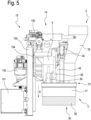
- the outside wall 31 is movable relative to the machining unit 14, along an operating axis A, towards and away from the work table 12, that is, from the panel P to be machined, as shown, for example, in Figures 5 and 6 .
- the operating axis A may, for example, be parallel to the vertical axis Z and may, in particular, be perpendicular to the work table 12.
- the outside wall 31, when raised relative to the work table 12, is at a non-operating position, and when lowered relative to the work table 12, is at an operating position.
- the outside wall 31 may, for example, comprise a concertinaed portion.
- Figure 5 shows the outside wall 31 at the operating position with the concertinaed portion extended
- Figure 6 shows the outside wall 31 at the non-operating position with the concertinaed portion retracted.
- a concertina system other solutions are imaginable to make the outside wall 31 movable along the operating axis A: for example, a system of telescopic elements or elastic elements might be used.
- the movement of the outside wall 31 along the operating axis A is accomplished via a main actuator 34.
- the main actuator 34 may be, for example, an electric motor or a piston.
- the extraction system 2 may comprise a main guide 35, such as, for example, a cylinder associated with a bushing, or an idle piston.
- the external hood 3 may be operatively in contact with the panel P to be machined, closing the bottom of the main suction chamber with the panel P itself.
- the tool can machine the panel P and the external hood 3 can intercept and extract by suction the shavings produced during machining.
- the outside wall 31 may comprise external brushes 32 (also called bristles) disposed along the perimeter of the main bottom opening 30.
- the external brushes 32 are configured to come into operative contact with the work table 12, that is, with the panel P to be machined.
- the external brushes 32 are preferably very long, so as to maximize the flexibility of the external hood 3.
- the internal hood 4 comprises an inside wall 41 which extends between the secondary top opening and a secondary bottom opening 40, in particular between the plate 21 and the secondary bottom opening 40.
- the secondary bottom opening 40 may also have different shapes, for example rectangular or circular, and may or may not be parallel to the work table 12.
- the secondary bottom opening 40 allows the tool, which is surrounded by the inside wall 41, to freely access the panel P to be machined.
- the shape and size of the inside wall 41 are such as to be able to surround the chuck 5, or at least part of it, and, if necessary, the tool, or at least part of it, so as to intercept, and extract the shavings by suction.
- the inside wall 41, the secondary top opening and the secondary bottom opening 40 that is, the inside wall 41, the plate 21, the secondary top opening and the secondary bottom opening 40 define a secondary suction chamber.
- the secondary suction chamber may, therefore, be in fluid-dynamic connection with the negative pressure source and for that reason, may contain a negative pressure whose purpose is to capture the shavings produced by the tool during machining of the panel P, and to extract the shavings by suction through the secondary duct 43 towards the outside of the machine 1 into a zone where the shavings are collected and stored.
- the inside wall 41 is movable relative to the machining unit 14, along the operating axis A, towards and away from the work table 12, that is, from the panel P to be machined, as shown, for example, in Figures 5 and 6 .
- the inside wall 41 when raised relative to the work table 12, is at a non-operating position, and when lowered relative to the work table 12, is at an operating position.
- the inside wall 41 may, for example, comprise a concertinaed portion.
- Figure 6 shows the inside wall 41 at the operating position with the concertinaed portion extended
- Figure 5 shows the inside wall 41 at the non-operating position with the concertinaed portion retracted.
- a system of telescopic elements or elastic elements might be used.
- the movement of the inside wall 41 along the operating axis A is accomplished via a secondary actuator 44.
- the secondary actuator 44 may be, for example, an electric motor or a piston.
- the extraction system 2 may comprise a secondary guide 45, such as, for example, a cylinder associated with a bushing, or an idle piston.
- the internal hood 4 may be operatively in contact with the panel P to be machined, closing the bottom of the secondary suction chamber with the panel P itself.
- the tool can machine the panel P and the internal hood 4 can intercept and extract by suction the shavings produced during machining.
- the inside wall 41 may comprise internal brushes 42 (also called bristles) disposed along the perimeter of the secondary bottom opening 40.
- the internal brushes 42 are configured to come into operative contact with the work table 12, that is, with the panel P to be machined.
- the internal brushes 42 are preferably very short compared to the external brushes 32, so as to maximize the efficiency of the internal hood 4.
- the outside wall 31 and the inside wall 41 may both surround the chuck 5.
- the main bottom opening 30 of the external hood 3 may surround the secondary bottom opening 40 of the internal hood 4.
- the ratio between the area of the main bottom opening 30 and the area of the secondary bottom opening 40 may be, for example, greater than or equal to 3, in particular greater than or equal to 6.
- the external hood 3 may be configured to be able to surround at least a portion of the chuck and, if necessary, a tool of large size (where "large” is understood as being large compared to the tools normally used for boring or nesting, such as, for example, vertical milling cutters), with the result that it is particularly versatile but not very efficient.
- the internal hood 4 may be configured to be able to surround at least a portion of the chuck and, if necessary, a tool of reduced size (as, for example, the tools normally used for boring or nesting, such as vertical milling cutters), with the result that it is particularly efficient under equal conditions of energy consumption.
- the internal hood 4 may have a secondary bottom opening 40 which is, for example, less than or equal to 200 mm in size, in particular, less than or equal to 150 mm, and more particularly, less than or equal to 65 mm (which substantially coincides with the standard diameter of 63 mm tool tapers).
- size is used to mean a linear geometrical dimension of the secondary bottom opening 40 itself, such as, for example, a diameter (if it is circular in shape) or a length (width, or depth, if it is rectangular in shape).
- the size less than or equal to 200 mm, in particular, less than or equal to 150 mm, and more particularly, less than or equal to 65 mm may have the advantage of making it easier to approach the tool holder during tool changing operations.
- the external hood 3 and/or the internal hood 4 can move either coordinatedly (for example, via a single actuator or via two distinct, but coordinated, actuators) or independently (for example, via two distinct actuators), along an operating axis A, which may be, for example, parallel to the axis of rotation of the chuck, to the vertical axis Z of the machine 1 or perpendicular to the work table 12, between a non-operating position, where they are raised relative to the work table 12, and an operating position, where they are lowered.
- the external hood 3 and/or the internal hood 4 may be configured to be operatively in contact with, or supported by, the work table 12.
- the external hood 3 and the internal hood 4 may be at the non-operating position simultaneously so that an operator, for example, can easily carry out operations (for example, maintenance work) on the chuck 5 or on the tool.
- the external hood 3 may be at the operating position while the internal hood 4 is at the non-operating position, and vice versa, working alternately. Furthermore, the external hood 3 and the internal hood 4 may be at the operating position simultaneously so as to create a joint suction effect around the tool.
- the two suction chambers, respectively of the external hood 3 and of the internal hood 4 can work jointly on the work table 12, around the chuck 5 and the tool, optimally distributing the flow generated by the negative pressure source.
- the extraction system 2 may use, for example, the valve 332 or the additional valve, disposed and configured, where present, to vary the flow inside the main duct 33 and the secondary duct 43.
- the secondary duct 43 may be fluid-dynamically coupled to the main duct 33 so as to be a deviation therefrom.
- the fluid-dynamic (or even mechanical) coupling point between the secondary duct 43 and the main duct 33 may be upstream of the valve 332, with reference to the negative pressure source.
- the opening of the valve 332 and/or of the additional valve it is possible, for example, to divide the suction between the external hood and the internal hood, to apply the suction entirely in the internal hood or in the external hood, or implement other suction logics to optimize the extraction of shavings by the suction system as a function, for example, of machining or other parameters.
Landscapes
- Engineering & Computer Science (AREA)
- Mechanical Engineering (AREA)
- Life Sciences & Earth Sciences (AREA)
- Wood Science & Technology (AREA)
- Forests & Forestry (AREA)
- Auxiliary Devices For Machine Tools (AREA)
Applications Claiming Priority (1)
| Application Number | Priority Date | Filing Date | Title |
|---|---|---|---|
| IT102023000017832A IT202300017832A1 (it) | 2023-08-30 | 2023-08-30 | Sistema di aspirazione del truciolo |
Publications (1)
| Publication Number | Publication Date |
|---|---|
| EP4516450A1 true EP4516450A1 (de) | 2025-03-05 |
Family
ID=88505117
Family Applications (1)
| Application Number | Title | Priority Date | Filing Date |
|---|---|---|---|
| EP24195937.8A Pending EP4516450A1 (de) | 2023-08-30 | 2024-08-22 | Absaugvorrichtung für die späne in einer werkzeugmaschine |
Country Status (2)
| Country | Link |
|---|---|
| EP (1) | EP4516450A1 (de) |
| IT (1) | IT202300017832A1 (de) |
Citations (4)
| Publication number | Priority date | Publication date | Assignee | Title |
|---|---|---|---|---|
| EP1066916A2 (de) * | 1999-07-07 | 2001-01-10 | Jobs S.p.A. | Werkzeughaltereinheit von Köpfen zur Spannfutterhalterung |
| EP3427895A2 (de) | 2017-07-13 | 2019-01-16 | SCM Group S.p.A. | Späneabsaugungskopfteil für ein werkzeug |
| US20190366575A1 (en) * | 2018-06-04 | 2019-12-05 | Uwm Research Foundation, Inc. | Dust collection for cutting machine |
| IT201900017954A1 (it) * | 2019-10-04 | 2021-04-04 | Cms Spa | Apparato per lavorare pezzi |
-
2023
- 2023-08-30 IT IT102023000017832A patent/IT202300017832A1/it unknown
-
2024
- 2024-08-22 EP EP24195937.8A patent/EP4516450A1/de active Pending
Patent Citations (4)
| Publication number | Priority date | Publication date | Assignee | Title |
|---|---|---|---|---|
| EP1066916A2 (de) * | 1999-07-07 | 2001-01-10 | Jobs S.p.A. | Werkzeughaltereinheit von Köpfen zur Spannfutterhalterung |
| EP3427895A2 (de) | 2017-07-13 | 2019-01-16 | SCM Group S.p.A. | Späneabsaugungskopfteil für ein werkzeug |
| US20190366575A1 (en) * | 2018-06-04 | 2019-12-05 | Uwm Research Foundation, Inc. | Dust collection for cutting machine |
| IT201900017954A1 (it) * | 2019-10-04 | 2021-04-04 | Cms Spa | Apparato per lavorare pezzi |
Also Published As
| Publication number | Publication date |
|---|---|
| IT202300017832A1 (it) | 2025-03-02 |
Similar Documents
| Publication | Publication Date | Title |
|---|---|---|
| JP3092776B2 (ja) | ワークピース、特に木製ワークピースを機械加工するためのユニット | |
| EP2998088B1 (de) | Arbeitsstation einer Maschine für Steinplatten, Marmor, Kunststoff, oder dergleichen, mit einer Opfermaterialarbeitsebene | |
| KR101894234B1 (ko) | 칩 제거용 툴이 구비된 밀링 머신 | |
| CN201669757U (zh) | 一种木材复合加工中心 | |
| CN203401346U (zh) | 一种立式金属加工中心机 | |
| US7035707B2 (en) | System and method for securing workpieces to a worktable of a CNC machining system utilizing a low level vacuum source | |
| CN212761380U (zh) | 一种多功能的金属铣削装置 | |
| EP4516450A1 (de) | Absaugvorrichtung für die späne in einer werkzeugmaschine | |
| KR100977837B1 (ko) | 정밀절삭유니트가 구비되는 다목적 조각기 | |
| EP1872919B1 (de) | Bearbeitungszentrum zur Bearbeitung von Platten aus Holz oder dergleichen | |
| EP4516471A1 (de) | Méthode de régulation d'un débit de pression négative dans une machine à travailler le bois | |
| WO2020115599A1 (en) | A method of machining longitudinal wood-like components and a workstand to perform thereof | |
| KR100930640B1 (ko) | 다양한 작업이 동시 수행되는 멀티 가공기 | |
| CN110039131B (zh) | 自动吹气装置及吹气攻牙机 | |
| CN213858211U (zh) | 一种新型多功能型材雕铣机 | |
| CN216502561U (zh) | 汽车控制拉索接头铣削机床 | |
| CN212825920U (zh) | 数控木工弧形槽口切削装置及铣床 | |
| CN219444570U (zh) | 一种可调式修边机 | |
| CN110434399B (zh) | 一种具有收集切屑功能的全自动铝材切割机 | |
| EP4606516A1 (de) | Maschine zur bearbeitung vom holz | |
| CN217393943U (zh) | 高压清洗机枪托枪阀自动割槽机 | |
| CN216371073U (zh) | 一种鼓风机轴承座加工用机床夹刀装置 | |
| CN209812564U (zh) | 一种外圆弧切割成型机 | |
| CN221560610U (zh) | 一种方便上料的密封数控机床 | |
| CN223114233U (zh) | 一种散热器斜面开槽装置 |
Legal Events
| Date | Code | Title | Description |
|---|---|---|---|
| PUAI | Public reference made under article 153(3) epc to a published international application that has entered the european phase |
Free format text: ORIGINAL CODE: 0009012 |
|
| STAA | Information on the status of an ep patent application or granted ep patent |
Free format text: STATUS: THE APPLICATION HAS BEEN PUBLISHED |
|
| AK | Designated contracting states |
Kind code of ref document: A1 Designated state(s): AL AT BE BG CH CY CZ DE DK EE ES FI FR GB GR HR HU IE IS IT LI LT LU LV MC ME MK MT NL NO PL PT RO RS SE SI SK SM TR |
|
| STAA | Information on the status of an ep patent application or granted ep patent |
Free format text: STATUS: REQUEST FOR EXAMINATION WAS MADE |
|
| 17P | Request for examination filed |
Effective date: 20250828 |