EP4516393A1 - Fertigungseinrichtung - Google Patents
Fertigungseinrichtung Download PDFInfo
- Publication number
- EP4516393A1 EP4516393A1 EP23796372.3A EP23796372A EP4516393A1 EP 4516393 A1 EP4516393 A1 EP 4516393A1 EP 23796372 A EP23796372 A EP 23796372A EP 4516393 A1 EP4516393 A1 EP 4516393A1
- Authority
- EP
- European Patent Office
- Prior art keywords
- target product
- production device
- variable
- mechanical apparatus
- production
- Prior art date
- Legal status (The legal status is an assumption and is not a legal conclusion. Google has not performed a legal analysis and makes no representation as to the accuracy of the status listed.)
- Pending
Links
Images






Classifications
-
- G—PHYSICS
- G05—CONTROLLING; REGULATING
- G05B—CONTROL OR REGULATING SYSTEMS IN GENERAL; FUNCTIONAL ELEMENTS OF SUCH SYSTEMS; MONITORING OR TESTING ARRANGEMENTS FOR SUCH SYSTEMS OR ELEMENTS
- G05B15/00—Systems controlled by a computer
- G05B15/02—Systems controlled by a computer electric
-
- G—PHYSICS
- G05—CONTROLLING; REGULATING
- G05B—CONTROL OR REGULATING SYSTEMS IN GENERAL; FUNCTIONAL ELEMENTS OF SUCH SYSTEMS; MONITORING OR TESTING ARRANGEMENTS FOR SUCH SYSTEMS OR ELEMENTS
- G05B23/00—Testing or monitoring of control systems or parts thereof
- G05B23/02—Electric testing or monitoring
- G05B23/0205—Electric testing or monitoring by means of a monitoring system capable of detecting and responding to faults
- G05B23/0259—Electric testing or monitoring by means of a monitoring system capable of detecting and responding to faults characterized by the response to fault detection
- G05B23/0283—Predictive maintenance, e.g. involving the monitoring of a system and, based on the monitoring results, taking decisions on the maintenance schedule of the monitored system; Estimating remaining useful life [RUL]
-
- B—PERFORMING OPERATIONS; TRANSPORTING
- B01—PHYSICAL OR CHEMICAL PROCESSES OR APPARATUS IN GENERAL
- B01J—CHEMICAL OR PHYSICAL PROCESSES, e.g. CATALYSIS OR COLLOID CHEMISTRY; THEIR RELEVANT APPARATUS
- B01J19/00—Chemical, physical or physico-chemical processes in general; Their relevant apparatus
- B01J19/0006—Controlling or regulating processes
-
- B—PERFORMING OPERATIONS; TRANSPORTING
- B01—PHYSICAL OR CHEMICAL PROCESSES OR APPARATUS IN GENERAL
- B01J—CHEMICAL OR PHYSICAL PROCESSES, e.g. CATALYSIS OR COLLOID CHEMISTRY; THEIR RELEVANT APPARATUS
- B01J19/00—Chemical, physical or physico-chemical processes in general; Their relevant apparatus
- B01J19/0006—Controlling or regulating processes
- B01J19/0033—Optimalisation processes, i.e. processes with adaptive control systems
-
- C—CHEMISTRY; METALLURGY
- C07—ORGANIC CHEMISTRY
- C07C—ACYCLIC OR CARBOCYCLIC COMPOUNDS
- C07C1/00—Preparation of hydrocarbons from one or more compounds, none of them being a hydrocarbon
- C07C1/02—Preparation of hydrocarbons from one or more compounds, none of them being a hydrocarbon from oxides of a carbon
- C07C1/04—Preparation of hydrocarbons from one or more compounds, none of them being a hydrocarbon from oxides of a carbon from carbon monoxide with hydrogen
-
- C—CHEMISTRY; METALLURGY
- C07—ORGANIC CHEMISTRY
- C07C—ACYCLIC OR CARBOCYCLIC COMPOUNDS
- C07C1/00—Preparation of hydrocarbons from one or more compounds, none of them being a hydrocarbon
- C07C1/02—Preparation of hydrocarbons from one or more compounds, none of them being a hydrocarbon from oxides of a carbon
- C07C1/12—Preparation of hydrocarbons from one or more compounds, none of them being a hydrocarbon from oxides of a carbon from carbon dioxide with hydrogen
-
- C—CHEMISTRY; METALLURGY
- C07—ORGANIC CHEMISTRY
- C07C—ACYCLIC OR CARBOCYCLIC COMPOUNDS
- C07C29/00—Preparation of compounds having hydroxy or O-metal groups bound to a carbon atom not belonging to a six-membered aromatic ring
- C07C29/15—Preparation of compounds having hydroxy or O-metal groups bound to a carbon atom not belonging to a six-membered aromatic ring by reduction of oxides of carbon exclusively
- C07C29/151—Preparation of compounds having hydroxy or O-metal groups bound to a carbon atom not belonging to a six-membered aromatic ring by reduction of oxides of carbon exclusively with hydrogen or hydrogen-containing gases
- C07C29/152—Preparation of compounds having hydroxy or O-metal groups bound to a carbon atom not belonging to a six-membered aromatic ring by reduction of oxides of carbon exclusively with hydrogen or hydrogen-containing gases characterised by the reactor used
-
- C—CHEMISTRY; METALLURGY
- C07—ORGANIC CHEMISTRY
- C07C—ACYCLIC OR CARBOCYCLIC COMPOUNDS
- C07C41/00—Preparation of ethers; Preparation of compounds having groups, groups or groups
- C07C41/01—Preparation of ethers
- C07C41/05—Preparation of ethers by addition of compounds to unsaturated compounds
-
- B—PERFORMING OPERATIONS; TRANSPORTING
- B01—PHYSICAL OR CHEMICAL PROCESSES OR APPARATUS IN GENERAL
- B01J—CHEMICAL OR PHYSICAL PROCESSES, e.g. CATALYSIS OR COLLOID CHEMISTRY; THEIR RELEVANT APPARATUS
- B01J2208/00—Processes carried out in the presence of solid particles; Reactors therefor
- B01J2208/00008—Controlling the process
- B01J2208/00017—Controlling the temperature
-
- B—PERFORMING OPERATIONS; TRANSPORTING
- B01—PHYSICAL OR CHEMICAL PROCESSES OR APPARATUS IN GENERAL
- B01J—CHEMICAL OR PHYSICAL PROCESSES, e.g. CATALYSIS OR COLLOID CHEMISTRY; THEIR RELEVANT APPARATUS
- B01J2208/00—Processes carried out in the presence of solid particles; Reactors therefor
- B01J2208/00008—Controlling the process
- B01J2208/00017—Controlling the temperature
- B01J2208/00026—Controlling or regulating the heat exchange system
- B01J2208/00035—Controlling or regulating the heat exchange system involving measured parameters
- B01J2208/00044—Temperature measurement
-
- B—PERFORMING OPERATIONS; TRANSPORTING
- B01—PHYSICAL OR CHEMICAL PROCESSES OR APPARATUS IN GENERAL
- B01J—CHEMICAL OR PHYSICAL PROCESSES, e.g. CATALYSIS OR COLLOID CHEMISTRY; THEIR RELEVANT APPARATUS
- B01J2208/00—Processes carried out in the presence of solid particles; Reactors therefor
- B01J2208/00008—Controlling the process
- B01J2208/00017—Controlling the temperature
- B01J2208/00026—Controlling or regulating the heat exchange system
- B01J2208/00035—Controlling or regulating the heat exchange system involving measured parameters
- B01J2208/0007—Pressure measurement
-
- B—PERFORMING OPERATIONS; TRANSPORTING
- B01—PHYSICAL OR CHEMICAL PROCESSES OR APPARATUS IN GENERAL
- B01J—CHEMICAL OR PHYSICAL PROCESSES, e.g. CATALYSIS OR COLLOID CHEMISTRY; THEIR RELEVANT APPARATUS
- B01J2208/00—Processes carried out in the presence of solid particles; Reactors therefor
- B01J2208/00008—Controlling the process
- B01J2208/00017—Controlling the temperature
- B01J2208/00026—Controlling or regulating the heat exchange system
- B01J2208/00035—Controlling or regulating the heat exchange system involving measured parameters
- B01J2208/00079—Fluid level measurement
-
- B—PERFORMING OPERATIONS; TRANSPORTING
- B01—PHYSICAL OR CHEMICAL PROCESSES OR APPARATUS IN GENERAL
- B01J—CHEMICAL OR PHYSICAL PROCESSES, e.g. CATALYSIS OR COLLOID CHEMISTRY; THEIR RELEVANT APPARATUS
- B01J2208/00—Processes carried out in the presence of solid particles; Reactors therefor
- B01J2208/00008—Controlling the process
- B01J2208/00539—Pressure
-
- B—PERFORMING OPERATIONS; TRANSPORTING
- B01—PHYSICAL OR CHEMICAL PROCESSES OR APPARATUS IN GENERAL
- B01J—CHEMICAL OR PHYSICAL PROCESSES, e.g. CATALYSIS OR COLLOID CHEMISTRY; THEIR RELEVANT APPARATUS
- B01J2219/00—Chemical, physical or physico-chemical processes in general; Their relevant apparatus
- B01J2219/00049—Controlling or regulating processes
- B01J2219/00051—Controlling the temperature
-
- B—PERFORMING OPERATIONS; TRANSPORTING
- B01—PHYSICAL OR CHEMICAL PROCESSES OR APPARATUS IN GENERAL
- B01J—CHEMICAL OR PHYSICAL PROCESSES, e.g. CATALYSIS OR COLLOID CHEMISTRY; THEIR RELEVANT APPARATUS
- B01J2219/00—Chemical, physical or physico-chemical processes in general; Their relevant apparatus
- B01J2219/00049—Controlling or regulating processes
- B01J2219/00051—Controlling the temperature
- B01J2219/00054—Controlling or regulating the heat exchange system
- B01J2219/00056—Controlling or regulating the heat exchange system involving measured parameters
- B01J2219/00058—Temperature measurement
-
- B—PERFORMING OPERATIONS; TRANSPORTING
- B01—PHYSICAL OR CHEMICAL PROCESSES OR APPARATUS IN GENERAL
- B01J—CHEMICAL OR PHYSICAL PROCESSES, e.g. CATALYSIS OR COLLOID CHEMISTRY; THEIR RELEVANT APPARATUS
- B01J2219/00—Chemical, physical or physico-chemical processes in general; Their relevant apparatus
- B01J2219/00049—Controlling or regulating processes
- B01J2219/00051—Controlling the temperature
- B01J2219/00054—Controlling or regulating the heat exchange system
- B01J2219/00056—Controlling or regulating the heat exchange system involving measured parameters
- B01J2219/00065—Pressure measurement
-
- B—PERFORMING OPERATIONS; TRANSPORTING
- B01—PHYSICAL OR CHEMICAL PROCESSES OR APPARATUS IN GENERAL
- B01J—CHEMICAL OR PHYSICAL PROCESSES, e.g. CATALYSIS OR COLLOID CHEMISTRY; THEIR RELEVANT APPARATUS
- B01J2219/00—Chemical, physical or physico-chemical processes in general; Their relevant apparatus
- B01J2219/00049—Controlling or regulating processes
- B01J2219/00051—Controlling the temperature
- B01J2219/00054—Controlling or regulating the heat exchange system
- B01J2219/00056—Controlling or regulating the heat exchange system involving measured parameters
- B01J2219/00067—Liquid level measurement
-
- B—PERFORMING OPERATIONS; TRANSPORTING
- B01—PHYSICAL OR CHEMICAL PROCESSES OR APPARATUS IN GENERAL
- B01J—CHEMICAL OR PHYSICAL PROCESSES, e.g. CATALYSIS OR COLLOID CHEMISTRY; THEIR RELEVANT APPARATUS
- B01J2219/00—Chemical, physical or physico-chemical processes in general; Their relevant apparatus
- B01J2219/00049—Controlling or regulating processes
- B01J2219/00162—Controlling or regulating processes controlling the pressure
-
- B—PERFORMING OPERATIONS; TRANSPORTING
- B01—PHYSICAL OR CHEMICAL PROCESSES OR APPARATUS IN GENERAL
- B01J—CHEMICAL OR PHYSICAL PROCESSES, e.g. CATALYSIS OR COLLOID CHEMISTRY; THEIR RELEVANT APPARATUS
- B01J2219/00—Chemical, physical or physico-chemical processes in general; Their relevant apparatus
- B01J2219/00049—Controlling or regulating processes
- B01J2219/00191—Control algorithm
- B01J2219/00193—Sensing a parameter
- B01J2219/00195—Sensing a parameter of the reaction system
-
- B—PERFORMING OPERATIONS; TRANSPORTING
- B01—PHYSICAL OR CHEMICAL PROCESSES OR APPARATUS IN GENERAL
- B01J—CHEMICAL OR PHYSICAL PROCESSES, e.g. CATALYSIS OR COLLOID CHEMISTRY; THEIR RELEVANT APPARATUS
- B01J2219/00—Chemical, physical or physico-chemical processes in general; Their relevant apparatus
- B01J2219/00049—Controlling or regulating processes
- B01J2219/00191—Control algorithm
- B01J2219/00222—Control algorithm taking actions
-
- B—PERFORMING OPERATIONS; TRANSPORTING
- B01—PHYSICAL OR CHEMICAL PROCESSES OR APPARATUS IN GENERAL
- B01J—CHEMICAL OR PHYSICAL PROCESSES, e.g. CATALYSIS OR COLLOID CHEMISTRY; THEIR RELEVANT APPARATUS
- B01J2219/00—Chemical, physical or physico-chemical processes in general; Their relevant apparatus
- B01J2219/00049—Controlling or regulating processes
- B01J2219/00191—Control algorithm
- B01J2219/00222—Control algorithm taking actions
- B01J2219/00227—Control algorithm taking actions modifying the operating conditions
Definitions
- the present invention relates to a production device for obtaining a target product through a chemical reaction or purification.
- Patent Literature 1 discloses a prior art pertaining to a production device for obtaining a target product, from at least one type of raw material selected from liquid and gaseous materials, through a chemical reaction or purification. Specifically, Patent Literature 1 discloses a prior art pertaining to a production device which manufactures fuel using hydrogen and carbon dioxide separated and recovered from exhaust gas.
- Patent Literature 1 JP2009-77457A
- the prior art has a problem of inability to monitor the state of the production device in real time.
- the present invention has been made to solve this problem, and an object of the present invention is to provide a production device that can monitor its state in real time.
- the present invention provides a production device for obtaining a target product from at least one type of raw material selected from liquid and gaseous materials through a chemical reaction or purification, the production device comprising:
- the first variable inputted to the production device and the second variables including at least one state variable related to the target product and an intermediate produced in a process of obtaining the target product from the raw material are acquired by the variable acquisition section.
- the estimation section estimates the state of the production device on the basis of the first variable and the second variables acquired by the variable acquisition section. Therefore, the state can be monitored in real time.
- the estimation section includes a life estimation section which estimates a life of a part which constitutes the production device. It is possible to prepare parts to be replaced (e.g., consumable parts) in accordance with the estimated lives of the parts.
- the second variables include at least one particular variable selected from the load factor of a compressor for compressing a gas, the concentration of the intermediate, the production amount of the intermediate, the concentration of the target product, the production amount of the target product, and the amount of water produced in a process of obtaining the target product.
- the life estimation section estimates the life of the part on the basis of the first variable and the particular variable. Thus, it is possible to improve the accuracy of estimating the life of the part.
- the life estimation section includes a pre-learned neural network which has undergone machine learning for relating the particular variable to the life of the part. It is possible to optimize the timing of replacement of the part, thereby increasing the operation rate of the production device.
- an order section orders a replacement part for the part that reaches the end of its life on the basis of an output of the life estimation section. Therefore, it is possible to easily manage parts to be replaced such as consumable parts.
- a changing section changes the first variable inputted to the production device on the basis of an output of the estimation section. Therefore, it is possible to increase the operation rate of the production device while extending the lives of the parts.
- FIG. 1 is a block diagram of a mechanical apparatus 11 in one embodiment.
- the mechanical apparatus 11 includes a mechanical apparatus 11 which obtains a target product from a raw material through a chemical reaction or purification, and a monitoring device 12 which monitors the mechanical apparatus 11.
- the mechanical apparatus 11 and the monitoring device 12 are connected to each other via a network 13. Examples of the network 13 include mobile phone networks, wireless LANs, wired LANs, fixed-line telephone networks, Internet, intranets, and Ethernet (registered trademark).
- the monitoring device 12 is independent from the mechanical apparatus 11 in FIG. 1 , a portion or the entirety of the monitoring device 12 may be contained in the mechanical apparatus 11.
- the monitoring device 12 is illustrated as a single device in FIG. 1 , the monitoring device 12 may be composed of a plurality of devices which operate in cooperation with one another. In this case as well, a portion or the entirety of the monitoring device 12 may be contained in the mechanical apparatus 11.
- the mechanical apparatus 11 may be remotely monitored by using a monitoring device 12 disposed away from the mechanical apparatus 11.
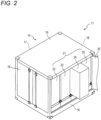
- FIG. 2 is a perspective view of the mechanical apparatus 11.
- the mechanical apparatus 11 includes a transport container 15 and a plurality of functional units 21 accommodated in a transport container 15. In the present embodiment, four functional units 21 are disposed in the transport container 15.
- the transport container 15 is a large rectangular parallelepipedic container which is formed mainly of steel material and is used for freight transport. Since the functional units 21 are accommodated in the transport container 15, it is possible to assemble the mechanical apparatus 11 at a plant, transport the assembled mechanical apparatus 11 to a site as it is, and install it at the site. Therefore, it becomes possible to eliminate the necessity of a large scale construction for installing the mechanical apparatus 11 at the site. Also, the capacity of a facility can be increased easily by stacking the mechanical apparatuses 11 or arraying them laterally.
- the transport container 15 includes a base 16 having a rectangular shape as viewed from above, a rear wall 17 provided along a longer side of the base 16, two side walls 18 provided along shorter sides of the base 16, a roof 19 which connects the rear wall 17 and the side walls 18, a front door (double doors) 20 provided along a longer side of the base 16 located opposite the rear wall 17. A portion of the front door 20 is not shown.
- the mechanical apparatus 11 is usually operated in a state in which the front door 20 is closed.
- each of the rear wall 17 and the side walls 18 is composed of double doors.
- each of the rear wall 17 and the side walls 18 can be formed of a plate which cannot be opened and closed.
- the functional unit 21 is a unit of an apparatus which plays a specific role.
- the mechanical apparatus 11 produces a target product from a raw material through combined use of a plurality of functional units 21.
- the plurality of functional units 21 are arrayed laterally in a row from one side wall 18 of the transport container 15 toward the other side wall 18 of the transport container 15.
- the functional units 21 are elongated cuboids whose sizes are approximately equal to one another.
- the functional units 21 include a power supply unit 22, an electrolysis unit 23, a recovery unit 24, and a production unit 25.
- FIG. 3 is a block diagram of the mechanical apparatus 11.
- the mechanical apparatus 11 which recovers carbon dioxide contained in exhaust gas generated by an exhaust gas source 26 and obtains a target product by recycling the carbon dioxide as a carbon compound will be described below as one example.
- No particular limitation is imposed on the exhaust gas source 26 so long as the exhaust gas source 26 generates exhaust gas containing carbon dioxide.
- Examples of the exhaust gas source 26 include an electric power plant, a factory, a waste treatment facility, a natural gas field, and an oil field.
- the power supply unit 22 (see FIG. 2 ) provided in the mechanical apparatus 11 supplies electric power to respective devices.
- the electrolysis unit 23 includes an electrolysis device for producing hydrogen and oxygen by electrolysis of water.
- the recovery unit 24 includes a removal device for removing water from the exhaust gas, a separation device for separating nitrogen oxides contained in the exhaust gas, a recovery device for separating carbon dioxide contained in the exhaust gas and condensing the separated carbon dioxide, and a compressor for compressing the gas so as to increase its pressure.
- the production unit 25 includes a production device for producing a target product by reducing carbon dioxide with hydrogen. Examples of the combustible product produced by the mechanical apparatus 11 include methane, carbon monoxide, methanol, and formaldehyde.
- Examples of the method for removing water (water vapor) from the exhaust gas in the removal device of the recovery unit 24 include condensation, physical absorption, and chemical reaction.
- Examples of common methods for removing nitrogen oxides from the exhaust gas in the separation device are a wet method using caustic soda or the like and a dry method using an NOx removal catalyst and a reducing agent to reduce nitrogen oxides to nitrogen. Removal of water of the exhaust gas by the removal device and removal of nitrogen oxides from the exhaust gas make it possible to secure an efficiency of condensation of carbon dioxide by the recovery device.
- a first mixture gas containing carbon dioxide separated and recovered from the exhaust gas in the recovery device is supplied to the production unit 25 (the production device).
- the production device for example, a catalyst is used to reduce the activation energy, thereby proceeding a chemical reaction from carbon dioxide to the target product.
- the first mixture gas may contain impurities other than carbon dioxide in an amount of 10 vol% or more of the first mixture gas. It is preferred that the amount of impurities contained in the first mixture gas is small because the purity of the target product contained in a second mixture gas discharged from the production device increases. However, this requires a complex device for separating impurities from the first mixture gas. Accordingly, from the viewpoint of simplification of the mechanical apparatus 11, a certain degree of mixing of impurities is permissible.
- Examples of the method for electrolyzing water in the electrolysis unit 23 include electrolysis of alkaline water, electrolysis of water by the mediation of a solid polymer electrolyte, and electrolysis of high-temperature steam by the mediation of a solid oxide electrolysis cell (SOEC).
- High-temperature steam electrolysis is preferable to alkaline water electrolysis and solid polymer electrolyte water electrolysis because it can produce a large amount of hydrogen with less power.
- the electrolysis device performs high-temperature steam electrolysis using SOEC and heat of chemical reaction generated by the production device is used to generate steam for the high-temperature steam electrolysis, the energy efficiency of the mechanical apparatus 11 increases. Therefore, high-temperature steam electrolysis is preferred.
- the amount of gases which are contained in the second mixture gas and are other than the target product is preferably equal to or less than 45 vol% of the amount of the second mixture gas.
- the second mixture gas produced by the mechanical apparatus 11 is utilized by a facility in the site which contains the exhaust gas source 26, because the cost associated with transport of the gas can be reduced. Since the size of the mechanical apparatus 11 can be reduced by simplifying it, a space necessary for installing the mechanical apparatus 11 can be reduced. Since the mechanical apparatus 11 can be individually installed for each exhaust gas source 26, carbon dioxide discharged from each exhaust gas source 26 can be individually recycled for the exhaust gas source 26 as a carbon source. The mechanical apparatus 11 can reduce emission of carbon dioxide, while producing a combustible product of the minimum quality required for the use of the combustible product by facilities in the site containing the exhaust gas source 26, rather than producing a combustible product for sale.
- the mechanical apparatus 11 may be configured in such a manner that several reactions shown as examples below occur.
- methanol synthesis through hydrocarbon production and synthesis gas production carbon dioxide and hydrogen are raw materials, methane and synthesis gas (CO + H 2 ) are intermediates, and methanol is a target product.
- carbon dioxide and hydrogen are raw materials, methane and synthesis gas are intermediate products, and linear-chain hydrocarbon is a target products.
- DME synthesis through hydrocarbon production and synthesis gas production carbon dioxide and hydrogen are raw materials, methane and synthesis gas are intermediate products, and DME is a target product.
- the mechanical apparatus 11 can use, as the raw materials for the production of methane and synthesis gas, carbon dioxide purified from exhaust gas and oxygen purified from air.
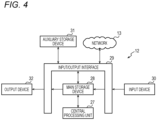
- FIG. 4 is a block diagram showing the hardware of the monitoring device 12.
- the monitoring device 12 includes a central processing unit 27, a main storage device 28, an input/output interface 29, an input device 30, an auxiliary storage device 31, and an output device 32. These are connected by a data bus and a control bus.
- the central processing unit 27 can perform operation for instructions and data stored in the main storage device 28 and store the results of the operation in the main storage device 28.
- the central processing unit 27 can control the input device 30, the auxiliary storage device 31, and the output device 32 via the input/output interface 29.
- the main storage device 28 can store instructions and data which are received from the input device 30, the auxiliary storage device 31, and the network 13 via the input/output interface 29 and the results of operation by the central processing unit 27.
- Examples of the main storage device 28 include random-access memory (RAM), read-only memory (ROM), and flash memory.
- the auxiliary storage device 31 is a storage device whose capacity is larger than that of the main storage device 28.
- the auxiliary storage device 31 can store instructions and data constituting a particular application and an operating system.
- Various pieces of information regarding parts which constitute the mechanical apparatus 11 are stored in the auxiliary storage device 31.
- Examples of the auxiliary storage device 31 include a magnetic disk device, and an optical disk device.
- the input device 30 is a device for providing data, pieces of information, instructions to the central processing unit 27. Examples of the input device 30 include a touch panel, a button, a keyboard, and a mouse.
- the output apparatus 32 is a device for physically showing data to the outside. Examples of the output device 32 include a display, a touch panel, and a printer.
- the central processing unit 27 can write the instructions and data, which are stored in the auxiliary storage device 31 and constitute the particular application, into the main storage device 28, and perform execution of the instructions, operation, etc.
- the central processing unit 27 controls the output device 32 via the input/output interface 29 and exchanges (transmits and receives) various pieces of information between the central processing unit 27 and the mechanical apparatus 11 via the input/output interface 29 and the network 13.
- the mechanical apparatus 11 includes a controller (not shown) composed of hardware similar to that of the monitoring device 12.
- the controller exchanges (transmits and receives) various pieces of information between the controller and the monitoring device 12.
- the controller coordinates the control instructions of the functional units 21 and controls the functional units 21. Since the controller of the mechanical apparatus 11 is composed of hardware similar to that of the monitoring device 12, description of the controller will be omitted.
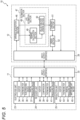
- FIG. 5 is a block diagram of the production device 10.
- the electrolysis unit 23, the recovery unit 24, and the production unit 25 of the mechanical apparatus 11 are connected to the monitoring device 12 via the input/output interface 33.
- the electrolysis unit 23 performs electrolysis of high-temperature steam by the mediation of an SOEC.
- the recovery unit 24 captures carbon dioxide in exhaust gas into an absorbing solution by a so-called chemical absorbing method, then heats the absorbing solution to separate the carbon dioxide, cools and compresses the carbon dioxide, and recovers the carbon dioxide.
- the production unit 25 produces water in the process of obtaining methane by methanation using a catalyst.
- the electrolysis unit 23 includes a heater 34 for heating water, thereby producing water vapor, a thermometer 35 for detecting the temperature of the heater 34, an electrolysis device 36 for electrolyzing water vapor, and a partial pressure gauge 37 for detecting the gas partial pressures of hydrogen and oxygen obtained by steam electrolysis.
- the recovery unit 24 includes a heater 38 for heating the absorbing solution, a compressor 39 for compressing the carbon dioxide separated from the absorbing solution, a thermometer 40 for detecting the temperature of the absorbing solution, and a partial pressure gauge 41 for detecting the gas partial pressure of the carbon dioxide.
- the production unit 25 includes a heater 42 for heating a reaction vessel containing a catalyst, a thermometer 43 for detecting the temperature of the reaction vessel, a partial pressure gauge 44 for detecting the partial pressure of the produced methane, and water amount meter 45 for detecting the amount of water produced in the process of obtaining methane.
- the monitoring device 12 includes a variable acquisition section 46 for acquiring various variables (hereinafter referred to as “first variables”) inputted to the mechanical apparatus 11 and various variables outputted from the mechanical apparatus 11 (hereinafter referred to as “second variables"), and an estimation section 47 for estimating the state of mechanical apparatus 11 on the basis of the first and second variables acquired by the variable acquisition section 46.
- the monitoring device 12 further includes a changing section 51 for changing the first variables inputted to the mechanical apparatus 11 on the basis of the output of the estimation section 47.
- Examples of the first variables include the amount of water (raw material) supplied to the electrolysis unit 23, the amount of gas (raw material) supplied to the production unit 25, the electric power supplied to the heaters 34, 38, and 42, the electrolysis device 36, and the compressor 39, which are necessary to achieve a target operation rate of the mechanical apparatus 11.
- the operation rate of the mechanical apparatus 11 is an index representing the ratio of the amount of a target product (methane in the present embodiment) actually produced to the production capacity of the mechanical apparatus 11.
- the first variables changed by the changing section 51 are inputted to the controller (not shown) of the mechanical apparatus 11 via the input/output interfaces 29 and 33.
- the controller controls the functional units 21 of the mechanical apparatus 11 so as to produce the target product.
- Examples of the second variables include the power consumptions of the heaters 34, 38, and 42, the electrolysis device 36, and the compressor 39, the temperatures of the object heated by the heaters 34, 38, and 42, which are detected by the thermometers 35, 40, and 43, the amount and pressure of the gas used by the compressor 39, the gas partial pressures (concentrations) detected by the partial pressure gauges 37, 41, and 44, the amount of methane produced, and the amount of water detected by the water amount meter 45.
- the operation rate of the mechanical apparatus 11 and the load factor of the compressor 39, which are computed by using these variables, are also the second variables.
- the load factor of the compressor 39 is the ratio of the amount of gas discharged by the compressor 39 to the amount of gas used by the compressor 39.
- the monitoring device 12 causes the changing section 51 to change the first variables inputted to the mechanical apparatus 11, thereby feedback-controlling the mechanical apparatus 11.
- the estimation section 47 of the monitoring device 12 includes a life estimation section 48 for estimating the lives of parts which constitute the mechanical apparatus 11.
- the life estimation section 48 can estimate the life of the compressor 39 on the basis of the load factor and power consumption of the compressor 39. Also, as the heaters 34, 38, and 42 deteriorate, their heating performances decrease, and the power consumption required to heat the object to be heated to a certain temperature increases. Thus, the life estimation section 48 can estimate the lives of the heaters 34, 38, and 42 on the basis of the relationship between the temperature of the object to be heated and the power consumptions (e.g., watt densities) of the heaters 34, 38, and 42. Watt density is the power per unit surface area of the heaters 34, 38, and 42.
- the life estimation section 48 can estimate the lives of the catalyst and the absorbing solution on the basis of the concentration of gas, the amount of water, and the amount of methane produced, and can estimate the life of the piping on the basis of the amount of water.
- the life estimation section 48 outputs a piece of information about a part reaching the end of its life to the changing section 51, and the order section 52 orders a part which replaces the part reaching the end of its life, on the basis of the output of the changing section 51.
- parts to be replaced such as consumable parts constituting the production device 10.
- the absorbing solution used in the recovery unit 24 of the mechanical apparatus 11 and the catalyst used in the production unit 25 are also contained in the parts constituting the production device 10.
- FIG. 6 is a table showing one example of the information (part table 53) stored in the auxiliary storage device 31.
- the part table 53 may be stored in the main storage device 28.
- the order section 52 can refer to the part table 53 and automatically place an order with a center for the parts recorded in the part table 53 via the network 13 (see FIG. 1 ).
- the center is a retailer or wholesaler which sells parts and with which orders for parts are placed.
- the part table 53 includes a piece of information for identifying each part (part ID), a piece of information for identifying each center from which the part is ordered (center ID), a piece of information about the center (hereinafter referred to as the "center information"), and a piece of information about a maker which manufacture the part (hereinafter referred to as the "maker information").
- the maker information is a piece of information about a manufacturer which manufactures the part specified by the part ID, and contains pieces of information about lead time (the time needed for the center to receive the part after having placed an order for the part with that maker) and days on which the maker does not deliver the part (hereinafter referred to as "no delivery days").
- the center information contains a piece of information about the no delivery days of the center and a piece of information about the number of parts in stock, which is the quantity of parts in the warehouse of the center.
- the maker and the center can input the maker information and the center information of the part table 53.
- the order section 52 places an order for the part with the center, in consideration of the center's stock and the lead time recorded in the part table 53 (see FIG. 6 ), so that the part is shipped to a location where the mechanical apparatus 11 is installed by the time the part is replaced.
- the order section 52 may cause the output device 32 (see FIG. 4 ) to provide an output (e.g., generation of a sound or display of an image) for prompting an operator to place an order.
- the operator who has confirmed the output can place an order for the part with the center.
- the life estimation section 48 includes a reward calculation section 49 for calculating a reward on the basis of the first variables and the second variables acquired by the variable acquisition section 46, and a value function update section 50 for updating a function that determines the optimal value of the interval of part replacement due to deterioration, on the basis of the reward calculated by the reward calculation section 49.
- the reward calculation section 49 gives a small reward on the basis of, for example, shortening of the part replacement interval, an increase in the difference between the actual temperature of the object to be heated and its predicted value, an increase in the difference between the actual power consumption of the heaters and its predicted value, an increase in the difference between the actual density of the gas and its predicted value, an increase in the difference between the actual load factor of the compressor and its predicted value, an increase in the difference between the actual amount of water and its predicted value, an increase in the difference between the actual production amount of the target product and its predicted value, and a decrease in the operation rate of the mechanical apparatus 11.
- the reward calculation section 49 gives a large reward on the basis of extension of the part replacement interval, a decrease in the difference between the actual temperature of the object to be heated and its predicted value, a decrease in the difference between the actual power consumption of the heaters and its predicted value, a decrease in the difference between the actual density of the gas and its predicted value, a decrease in the difference between the actual load factor of the compressor and its predicted value, a decrease in the difference between the actual amount of water and its predicted value, a decrease in the difference between the actual production amount of the target product and its predicted value, and an increase in the operation rate of the mechanical apparatus 11.
- the value function update section 50 updates a part replacement action value table (value function) on the basis of the reward calculated by the reward calculation section 49.
- the value function is stored in the main storage device 28 or the auxiliary storage device 31.
- the estimation section 47 may have a function of extracting useful rules, knowledge expressions, judgment criteria, etc. from a set of data inputted to the monitoring device 12 by analysis, and outputting judgment results, and perform knowledge learning (machine learning).
- machine learning There are various methods of machine learning, but they can be broadly divided into supervised learning, unsupervised learning, and reinforcement learning. Furthermore, there is a method called deep learning that learns extraction of features themselves in order to realize these methods.
- Machine learning can be achieved by applying a GPGPU (General Purpose computing with Graphic Processing Unit), a large-scale PC cluster, or the like. Reinforcement learning will be described below as an example, but the machine learning is not limited to this.
- Reinforcement learning sets up a problem as follows.
- the production device 10 detects the state of the environment and determines an action (replacement of parts).
- the environment changes according to some rules, and its own action can also change the environment. Every time the production device 10 acts, a reward signal is fed back to the production device 10.
- What we want to maximize is the sum of rewards over the future.
- Learning begins with no knowledge of the consequences of an action, or an incomplete knowledge of the consequences.
- the production device 10 can obtain the result as data only after actually taking an action. Namely, the production device 10 searches for the best action through trial and error.
- the production device 10 may start learning from a good starting point by using, as an initial state, the state in which pre-learning (supervised learning, inverse reinforcement learning, etc.) has been performed.
- FIG. 7 is a diagram schematically showing the model of a neuron.
- a neuron outputs an output (result) y for a plurality of inputs x.
- Each input x (x1, x2, x3) is multiplied by a weight w (w1, w2, w3) corresponding to the input x.
- the inputs x, the result y, and the weights w are all vectors.
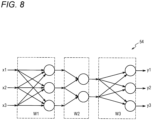
- FIG. 8 is a diagram schematically showing a neural network 54 configured by combining neurons.
- the neural network 54 includes an arithmetic unit which imitates the model of a neuron, a memory, etc.
- the neural network 54 has three layers.
- the number of layers is not limited to three. It is naturally possible to increase the number of layers to 3 or more.
- the neural network 54 multiplies weights W1, W2, and W3 corresponding to a plurality of inputs x (x1, x2, and x3 in the present embodiment) in order, and outputs the results y (y1, y2, and y3 in the present embodiment).
- the weights W1, W2, and W3 can be learned by the error backpropagation method.
- Operation of the neural network 54 includes a learning mode and a prediction mode.
- the weights W are learned by using a training data set, and action judgment is made in the prediction mode using its parameters.
- the predictive mode a variety of tasks such as detection, classification, and inference are possible.
- the neural network 54 can learn in real time the data obtained by actually operating the production device 10 in the prediction mode, and reflect them on the next action (online learning).
- learning may be performed collectively by using a data group collected in advance, and then the prediction mode may be executed by using the parameters (batch learning).
- FIG. 9A to FIG. 9E are graphs used for describing one example of operation of the estimation section 47.
- the horizontal axis shows part replacement interval
- the vertical axis shows the parameter of each part.
- the horizontal axis means that the larger the value (the farther to the right), the longer the part replacement interval.
- the vertical axis means that the smaller the value (the lower the coordinate position in the vertical axis), the lower the operation rate, or the greater the degree of deterioration of the part.
- FIG. 9A is a graph schematically showing a correlation between the part replacement interval and the operation rate of the mechanical apparatus 11.
- FIG. 9B is a graph schematically showing a correlation between heater replacement interval (the replacement interval of each of the heaters 34, 38, and 42) and the watt density of each heater.
- heater replacement interval the replacement interval of each of the heaters 34, 38, 42
- the watt density of each heater When the replacement interval of each of the heaters 34, 38, 42 is extended, each of the heaters 34, 38, and 42 deteriorates with time. Meanwhile, when the replacement interval of each of the heaters 34, 38, 42 is shortened, a state in which the power consumption of each of the heaters 34, 38, and 42 is approximately equal to its predicted value is maintained.
- FIG. 9C is a graph schematically showing a correlation between the replacement interval of parts of the compressor 39 and the load factor of the compressor 39.
- the replacement interval of parts of the compressor 39 When the replacement interval of parts of the compressor 39 is extended, the compressor 39 deteriorates with time. Meanwhile, the replacement interval of parts of the compressor 39 is shortened, a state in which the load factor of the compressor 39 is approximately equal to its predicted value is maintained.
- FIG. 9D is a graph schematically showing a correlation between the part replacement interval and the gas partial pressure (concentration) of the target product.
- the gas partial pressure of the target product decreases with time (the difference between the actual gas partial pressure of the target product and its predicted value increases gradually). Meanwhile, the part replacement interval is shortened, a state in which the gas partial pressure of the target product is approximately equal to its predicted value is maintained.
- FIG. 9E is a graph schematically showing a correlation between the part replacement interval and the amount of water produced in the process of obtaining the target product.
- the part replacement interval When the part replacement interval is extended, the difference between the amount of water produced in the process of obtaining the target product and its predicted value increases. Meanwhile, when the part replacement interval is shortened, a state in which the amount of water is approximately equal to its predicted value is maintained.
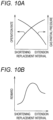
- FIG. 10A shows the relation between the operation rate of the mechanical apparatus 11 and the gas partial pressure (concentration) of the target product.
- the intersection between two curves in FIG. 10A shows a proper part replacement interval obtained by the estimation section 47.
- FIG. 10B is a schematic graph showing the reward converted from that relation.
- the estimation section 47 cumulatively adds various rewards, learns to maximize the total of cumulatively added rewards, and finds the optimal replacement intervals of various parts. The point at which a part is replaced is when the life of the part is exhausted.
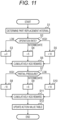
- FIG. 11 is a flowchart showing one example of operation of the monitoring device 12.
- the monitoring device 12 first determines the part replacement interval on the basis of an action value table 55 (see FIG. 12 ) (S1), judges the operation rate of the mechanical apparatus 11 (S2), and determines a reward (S3 to S5). For example, when the operation rate of the mechanical apparatus 11 is low, the monitoring device 12 outputs no reward (reward is 0) (S3). When the operation rate of the mechanical apparatus 11 is at an intermediate level, the monitoring device 12 outputs a reward of +5 (S4). When the operation rate of mechanical apparatus 11 is high, the monitoring device 12 outputs a reward of +10 (S5). The monitoring device 12 cumulatively adds the outputted reward to a previous reward(s) (S6).
- S1 action value table 55
- S2 judges the operation rate of the mechanical apparatus 11
- S3 to S5 For example, when the operation rate of the mechanical apparatus 11 is low, the monitoring device 12 outputs no reward (reward is 0) (S
- the monitoring device 12 compares the actual gas partial pressure of the target product with its predicted value (S7), and determines a reward (S8 to S10). For example, when the difference between the actual gas partial pressure of the target product and its predicted value is large, the monitoring device 12 outputs a reward of -10 (S8). When the difference between the actual gas partial pressure and its predicted value is at an intermediate level, the monitoring device 12 outputs a reward of -6 (S9). When the difference between the actual gas partial pressure and its predicted value is small, the monitoring device 12 outputs a reward of +10 (S10). The monitoring device 12 cumulatively adds the outputted reward to the previous reward(s) (S11), and updates the action value table 55 on the basis of the total of the rewards (S12).
- the processing of S1 to S12 is performed repeatedly while the power supply of the monitoring device 12 is on.
- the reward values of S3 to S5 and S8 to S10 are examples and can be changed as appropriate. Of course, it is possible to execute the processing of S2 to S6 and the processing of S7 to S11 in parallel.
- FIG. 12 is a table showing one example of the action value table 55. Patterns No. 1 to No. 18 are recorded in the action value table 55. Patterns No. 1 to No. 6 are for the case where the operation rate of the mechanical apparatus 11 is high (reward is +10), patterns No. 7 to No. 12 are for the case where the operation rate of the mechanical apparatus 11 is at an intermediate level (reward is +5), and patterns No. 13 to No. 18 are for the case where the operation rate of the mechanical apparatus 11 is low (reward is 0). In patterns No. 1 to No.
- the reward related to the operation rate of the mechanical apparatus 11 is decreased to a value of a lower next rank, and the reward related to the gas partial pressure of the target product is increased to a value of a higher next rank.
- the reward related to the operation rate of the mechanical apparatus 11 is increased to a value of a higher next rank, and the reward related to the gas partial pressure of the target product is not changed.
- the patterns No. 9 and No. 10 are for the case where the operation rate of the mechanical apparatus 11 is at an intermediate level (reward is +5) and the difference between the actual gas partial pressure of the target product and its predicted value is at an intermediate level (reward is +6). In both patterns, the total of the rewards in the current state is +11.
- the reward related to the operation rate is decreased to a value of a lower next rank, so that 0 is outputted as a reward, and the reward related to the gas partial pressure of the target product is increased to a value of a higher next rank, so that +10 is outputted as a reward. Therefore, +10 is outputted as the reward of the next state.
- the reward related to the operation rate is increased to a value of a higher next rank, so that +10 is outputted as a reward, and the reward related to the gas partial pressure of the target product does not change, so that +6 is outputted as a reward. Therefore, +16 is outputted as the reward of the next state.
- the production device 10 choses extension of the part replacement interval. Since the production device 10 can obtain proper timings of replacement of the parts which constitutes the mechanical apparatus 11 in the above-described manner and can maintain the mechanical apparatus 11 properly, the operation rate of the mechanical apparatus 11 can be optimized.
- the action value table 55 is also one example, and various modifications and changes are possible.
- the estimation section 47 estimates the state of the mechanical apparatus 11 on the basis of the first variables and the second variables acquired by the variable acquisition section 46, the state of the mechanical apparatus 11 can be monitored in real time. Furthermore, since the estimation section 47 includes the life estimation section 48 which estimates the lives of the parts which constitute the mechanical apparatus 11, parts to be replaced, such as consumable parts, can be prepared in accordance with the estimated lives of the parts. Since the parts can be replaced properly, it is possible to prevent occurrence of a problem that, due to deterioration of parts, the operation rate of the mechanical apparatus 11 abnormally decreases, or the mechanical apparatus 11 becomes inoperable.
- the second variables acquired by the variable acquisition section 46 of the production device 10 include at least one particular variable selected from the load factor of the compressor 39, the concentration (gas partial pressure) of the target product, the production amount of the target product, and the amount of water produced in the process of obtaining the target product. Since the life estimation section 48 estimates the lives of parts on the basis of the first variables and the particular variable, it is possible to improve the accuracy of estimating the lives of the parts. Notably, in the case where the production device 10 produces the target product through an intermediate such as methane or synthetic gas, at least one of the concentration of the intermediate and the production amount of the intermediate may be contained in the particular variable.
- the life estimation section 48 includes the pre-learned neural network 54 which has undergone machine learning for relating the particular variable to the lives of the parts, the timings of replacement of the parts can be optimized, whereby the operation rate of the production device 10 can be increased.
- the changing section 51 changes the first variables inputted to the mechanical apparatus 11 on the basis of the output of the estimation section 47, it is possible to increase the operation rate of the mechanical apparatus 11 while extending the lives of the parts which constitute the mechanical apparatus 11.
- the mechanical apparatus 11 which includes the functional units 21 composed of the electrolysis unit 23, the recovery unit 24, and the production unit 25, in addition to the power supply unit 22.
- the present invention is not limited thereto. It is of course possible to dispose various functional units 21 in accordance with the role which the mechanical apparatus 11 plays, thereby enabling the mechanical apparatus 11 to play other roles.
- mechanical apparatuses 11 which play other roles include a module for producing hydrogen and oxygen by using water as a raw material, a module for purifying carbon dioxide from exhaust gas, a module for producing an intermediate, such as synthetic gas, methanol, or ethanol, from carbon dioxide and hydrogen, and producing fuels (e.g., diesel oil and gasoline), BTX, DME, butadiene, chemical products, etc. from the intermediate.
- the present invention is not limited thereto. It is of course possible to give a reward(s) to one or more differences in place of or in addition to the operation rate of the mechanical apparatus 11 and the difference between the actual gas partial pressure of the target product and its predicted value, and feed the reward(s) back to the production device 10.
- the one or more differences are selected from the difference between the actual temperature of the object to be heated and its predicted value, the difference between the actual power consumption of the heaters and its predicted value, the difference between the actual density (gas partial pressure) of the intermediate and its predicted value, the difference between the actual production amount of the target product and its predicted value, the difference between the actual production amount of the intermediate and its predicted value, the difference between the actual load factor of the compressor and its predicted value, and the difference between the amount of water produced as a result of production of the target product and its predicted value, etc.
- the estimation section 47 uses an algorithm (machine learning) that automatically improves by learning from experience.
- the present invention is not limited thereto. It is of course possible to obtain the correlation between one or more factors and changing of the part replacement interval, and control the mechanical apparatus 11 or estimate the lives of the parts which constitute the mechanical apparatus 11 on the basis of the correlation.
- the one ore more factors are selected from the operation rate of the mechanical apparatus 11, the difference between the actual gas partial pressure of the target product and its predicted value, the difference between the actual production amount of the target product and its predicted value, the difference between the actual gas partial pressure of the intermediate and its predicted value, the difference between the actual production amount of the intermediate and its predicted value, the difference between the actual temperature of the object to be heated and its predicted value, the difference between the actual power consumption of the heaters and its predicted value, the difference between the actual load factor of the compressor and its predicted value, and the difference between the amount of water produced as a result of production of the target product and its predicted value, etc.
- the transport container 15 which allows installation of up to four functional units 21.
- the present invention is not limited thereto.
- the number of the functional units 21 installed in the transport container 15 is freely set in accordance with the purpose of the mechanical apparatus 11.
- the transport container 15 may be configured to allow installation of five or more functional units 21 or may have vacancies therein.
- the present disclosure can be realized as the following modes.
- a production device for obtaining a target product from at least one type of raw material selected from liquid and gas through a chemical reaction or purification comprising;
- the estimation section includes a life estimation section which estimates a life of a part which constitutes the production device.
- the second variables include at least one particular variable selected from the load factor of a compressor for compressing the gas, the concentration of the intermediate, the production amount of the intermediate, the concentration of the target product, the production amount of the target product, and the amount of water produced in a process of obtaining the target product, and the life estimation section estimates the life of the part on the basis of the first variable and the particular variable.
- life estimation section includes a pre-learned neural network which has undergone machine learning for relating the particular variable to the life of the part.
Landscapes
- Chemical & Material Sciences (AREA)
- Organic Chemistry (AREA)
- Engineering & Computer Science (AREA)
- Chemical Kinetics & Catalysis (AREA)
- Automation & Control Theory (AREA)
- General Physics & Mathematics (AREA)
- Physics & Mathematics (AREA)
- Oil, Petroleum & Natural Gas (AREA)
- General Chemical & Material Sciences (AREA)
- General Engineering & Computer Science (AREA)
- Management, Administration, Business Operations System, And Electronic Commerce (AREA)
- Separation By Low-Temperature Treatments (AREA)
- Testing And Monitoring For Control Systems (AREA)
- Physical Or Chemical Processes And Apparatus (AREA)
- Organic Low-Molecular-Weight Compounds And Preparation Thereof (AREA)
Applications Claiming Priority (2)
| Application Number | Priority Date | Filing Date | Title |
|---|---|---|---|
| JP2022075611A JP2023164204A (ja) | 2022-04-29 | 2022-04-29 | 生成装置 |
| PCT/JP2023/016262 WO2023210632A1 (ja) | 2022-04-29 | 2023-04-25 | 生成装置 |
Publications (2)
| Publication Number | Publication Date |
|---|---|
| EP4516393A1 true EP4516393A1 (de) | 2025-03-05 |
| EP4516393A4 EP4516393A4 (de) | 2026-04-08 |
Family
ID=88518998
Family Applications (1)
| Application Number | Title | Priority Date | Filing Date |
|---|---|---|---|
| EP23796372.3A Pending EP4516393A4 (de) | 2022-04-29 | 2023-04-25 | Fertigungseinrichtung |
Country Status (5)
| Country | Link |
|---|---|
| US (1) | US20250224702A1 (de) |
| EP (1) | EP4516393A4 (de) |
| JP (1) | JP2023164204A (de) |
| CN (1) | CN118871193A (de) |
| WO (1) | WO2023210632A1 (de) |
Families Citing this family (2)
| Publication number | Priority date | Publication date | Assignee | Title |
|---|---|---|---|---|
| US12325674B1 (en) * | 2024-03-15 | 2025-06-10 | General Galactic Technologies Corporation | Modular system for renewable fuel generation |
| WO2026062806A1 (ja) * | 2024-09-18 | 2026-03-26 | 株式会社日立製作所 | 二酸化炭素固定化システム、及び、二酸化炭素固定化方法 |
Family Cites Families (12)
| Publication number | Priority date | Publication date | Assignee | Title |
|---|---|---|---|---|
| US3926738A (en) * | 1972-05-10 | 1975-12-16 | Wilson John D | Method and apparatus for control of biochemical processes |
| JP3612032B2 (ja) * | 2001-04-04 | 2005-01-19 | 轟産業株式会社 | 化学反応装置における異常反応の制御システム |
| JP2003058206A (ja) * | 2001-08-10 | 2003-02-28 | Kanegafuchi Chem Ind Co Ltd | 触媒利用支援方法及びそのシステム |
| JP4057472B2 (ja) * | 2003-06-12 | 2008-03-05 | 日本電信電話株式会社 | 電力制御・管理システム、サーバ、サーバの処理方法および処理プログラムと該プログラムを記録した記録媒体 |
| JP2009077457A (ja) | 2007-09-18 | 2009-04-09 | Tokyo Gas Co Ltd | 分散型電源の運転システムおよびその運転方法 |
| CN105659176A (zh) * | 2013-08-22 | 2016-06-08 | 乔治洛德方法研究和开发液化空气有限公司 | 确定蒸馏塔中的化学成分的浓度时检测故障 |
| US11396002B2 (en) * | 2017-03-28 | 2022-07-26 | Uop Llc | Detecting and correcting problems in liquid lifting in heat exchangers |
| CA3072045A1 (en) * | 2017-08-02 | 2019-02-07 | Strong Force Iot Portfolio 2016, Llc | Methods and systems for detection in an industrial internet of things data collection environment with large data sets |
| EP3858474A4 (de) * | 2018-09-28 | 2021-12-22 | FUJIFILM Corporation | Fliessreaktionsausrüstung und -verfahren |
| EP3696619A1 (de) * | 2019-02-15 | 2020-08-19 | Basf Se | Bestimmung der betriebsbedingungen in chemischen produktionsanlagen |
| JP7460657B2 (ja) * | 2019-05-09 | 2024-04-02 | アスペンテック・コーポレーション | 機械学習を専門知識及び第一原理と組み合わせて行うプロセス産業のモデリング |
| WO2021002108A1 (ja) * | 2019-07-03 | 2021-01-07 | 富士フイルム株式会社 | 最適化支援装置、方法およびプログラム |
-
2022
- 2022-04-29 JP JP2022075611A patent/JP2023164204A/ja active Pending
-
2023
- 2023-04-25 CN CN202380030645.7A patent/CN118871193A/zh active Pending
- 2023-04-25 EP EP23796372.3A patent/EP4516393A4/de active Pending
- 2023-04-25 WO PCT/JP2023/016262 patent/WO2023210632A1/ja not_active Ceased
- 2023-04-25 US US18/851,449 patent/US20250224702A1/en active Pending
Also Published As
| Publication number | Publication date |
|---|---|
| US20250224702A1 (en) | 2025-07-10 |
| JP2023164204A (ja) | 2023-11-10 |
| CN118871193A (zh) | 2024-10-29 |
| WO2023210632A1 (ja) | 2023-11-02 |
| EP4516393A4 (de) | 2026-04-08 |
Similar Documents
| Publication | Publication Date | Title |
|---|---|---|
| EP4516393A1 (de) | Fertigungseinrichtung | |
| Roh et al. | Early-stage evaluation of emerging CO 2 utilization technologies at low technology readiness levels | |
| CN110009152B (zh) | 一种考虑电转气和不确定性的区域综合能源系统运行鲁棒优化方法 | |
| Fu et al. | Understanding the product selectivity of syngas conversion on ZnO surfaces with complex reaction network and structural evolution | |
| Devasahayam et al. | Predicting hydrogen production from co-gasification of biomass and plastics using tree based machine learning algorithms | |
| Taghdisian et al. | Multi-objective optimization approach for green design of methanol plant based on CO2-efficeincy indicator | |
| Farsi et al. | Multi-objective optimization of an experimental integrated thermochemical cycle of hydrogen production with an artificial neural network | |
| Shabbir et al. | A hybrid optimisation model for the synthesis of sustainable gasification-based integrated biorefinery | |
| WO2022140558A2 (en) | Computer-implemented monitoring methods and systems for a plant producing chemicals and fuels utilizing carbon capture | |
| Liu et al. | A machine learning proxy based multi-objective optimization method for low-carbon hydrogen production | |
| Kim et al. | Early-stage evaluation of catalyst using machine learning based modeling and simulation of catalytic systems: Hydrogen production via water–gas shift over pt catalysts | |
| Bao et al. | An interpretable machine learning-based optimization framework for the optimal design of carbon dioxide to methane process | |
| Andres-Martinez et al. | Optimal operation of a reaction-absorption process for ammonia production at low pressure | |
| Huang et al. | Smart reforming for hydrogen production via machine learning | |
| Rahmanifard et al. | On improving the hydrogen and methanol production using an auto-thermal double-membrane reactor: Model prediction and optimisation | |
| Jewlal et al. | Go with CO: a case for targeting carbon monoxide as a reactive carbon capture product | |
| Syauqi et al. | Advancement in power-to-methanol integration with steel industry waste gas utilization through solid oxide electrolyzer cells: Surrogate model-based approach for optimization | |
| Guler et al. | Syngas production through forest waste gasification and prediction of its species using advanced novel metaheuristic driven hybrid machine learning algorithms | |
| Zhong et al. | A hybrid knowledge-and data-driven method for diagnosing abnormal energy efficiency in blast furnaces | |
| KR20260007229A (ko) | 에틸렌 옥사이드 반응기 내 촉매의 선택성 및/또는 활성 추정 방법 | |
| Shahriari et al. | Simultaneous opex and carbon footprint reduction with hydrogen enhancement in autothermal reforming: A machine learning–based surrogate modeling and optimization framework | |
| Etezadi et al. | Digital Twin Approach toward the Design, Optimization, and Control of a Catalytic System for High-Purity Hydrogen Production from Biogas | |
| WO2024252122A1 (en) | A method of monitoring a chemical plant | |
| Kashanian et al. | Design of a supply chain network for chemicals from biomass using green electrochemistry | |
| Greppi et al. | A steady-state simulation tool for MCFC systems suitable for on-line applications |
Legal Events
| Date | Code | Title | Description |
|---|---|---|---|
| STAA | Information on the status of an ep patent application or granted ep patent |
Free format text: STATUS: THE INTERNATIONAL PUBLICATION HAS BEEN MADE |
|
| PUAI | Public reference made under article 153(3) epc to a published international application that has entered the european phase |
Free format text: ORIGINAL CODE: 0009012 |
|
| STAA | Information on the status of an ep patent application or granted ep patent |
Free format text: STATUS: REQUEST FOR EXAMINATION WAS MADE |
|
| 17P | Request for examination filed |
Effective date: 20240925 |
|
| AK | Designated contracting states |
Kind code of ref document: A1 Designated state(s): AL AT BE BG CH CY CZ DE DK EE ES FI FR GB GR HR HU IE IS IT LI LT LU LV MC ME MK MT NL NO PL PT RO RS SE SI SK SM TR |
|
| DAV | Request for validation of the european patent (deleted) | ||
| DAX | Request for extension of the european patent (deleted) | ||
| A4 | Supplementary search report drawn up and despatched |
Effective date: 20260305 |
|
| RIC1 | Information provided on ipc code assigned before grant |
Ipc: B01J 19/00 20060101AFI20260227BHEP Ipc: B01D 3/42 20060101ALI20260227BHEP Ipc: C07C 1/04 20060101ALI20260227BHEP Ipc: C07C 1/12 20060101ALI20260227BHEP Ipc: C07C 9/04 20060101ALI20260227BHEP Ipc: C07C 29/152 20060101ALI20260227BHEP Ipc: C07C 31/04 20060101ALI20260227BHEP Ipc: C07C 41/05 20060101ALI20260227BHEP Ipc: C07C 43/04 20060101ALI20260227BHEP Ipc: C10L 3/08 20060101ALI20260227BHEP Ipc: G05B 23/02 20060101ALI20260227BHEP |