EP4513799A2 - Downlink-planung und hybride automatische wiederholungsanfragerückkopplung - Google Patents
Downlink-planung und hybride automatische wiederholungsanfragerückkopplung Download PDFInfo
- Publication number
- EP4513799A2 EP4513799A2 EP24210664.9A EP24210664A EP4513799A2 EP 4513799 A2 EP4513799 A2 EP 4513799A2 EP 24210664 A EP24210664 A EP 24210664A EP 4513799 A2 EP4513799 A2 EP 4513799A2
- Authority
- EP
- European Patent Office
- Prior art keywords
- dci
- pdsch
- harq
- wireless device
- pdschs
- Prior art date
- Legal status (The legal status is an assumption and is not a legal conclusion. Google has not performed a legal analysis and makes no representation as to the accuracy of the status listed.)
- Pending
Links
Images









Classifications
-
- H—ELECTRICITY
- H04—ELECTRIC COMMUNICATION TECHNIQUE
- H04W—WIRELESS COMMUNICATION NETWORKS
- H04W72/00—Local resource management
- H04W72/12—Wireless traffic scheduling
- H04W72/1263—Mapping of traffic onto schedule, e.g. scheduled allocation or multiplexing of flows
- H04W72/1273—Mapping of traffic onto schedule, e.g. scheduled allocation or multiplexing of flows of downlink data flows
-
- H—ELECTRICITY
- H04—ELECTRIC COMMUNICATION TECHNIQUE
- H04L—TRANSMISSION OF DIGITAL INFORMATION, e.g. TELEGRAPHIC COMMUNICATION
- H04L1/00—Arrangements for detecting or preventing errors in the information received
- H04L1/12—Arrangements for detecting or preventing errors in the information received by using return channel
- H04L1/16—Arrangements for detecting or preventing errors in the information received by using return channel in which the return channel carries supervisory signals, e.g. repetition request signals
- H04L1/18—Automatic repetition systems, e.g. Van Duuren systems
- H04L1/1867—Arrangements specially adapted for the transmitter end
- H04L1/1896—ARQ related signaling
-
- H—ELECTRICITY
- H04—ELECTRIC COMMUNICATION TECHNIQUE
- H04L—TRANSMISSION OF DIGITAL INFORMATION, e.g. TELEGRAPHIC COMMUNICATION
- H04L1/00—Arrangements for detecting or preventing errors in the information received
- H04L1/12—Arrangements for detecting or preventing errors in the information received by using return channel
- H04L1/16—Arrangements for detecting or preventing errors in the information received by using return channel in which the return channel carries supervisory signals, e.g. repetition request signals
- H04L1/18—Automatic repetition systems, e.g. Van Duuren systems
- H04L1/1812—Hybrid protocols; Hybrid automatic repeat request [HARQ]
-
- H—ELECTRICITY
- H04—ELECTRIC COMMUNICATION TECHNIQUE
- H04L—TRANSMISSION OF DIGITAL INFORMATION, e.g. TELEGRAPHIC COMMUNICATION
- H04L1/00—Arrangements for detecting or preventing errors in the information received
- H04L1/12—Arrangements for detecting or preventing errors in the information received by using return channel
- H04L1/16—Arrangements for detecting or preventing errors in the information received by using return channel in which the return channel carries supervisory signals, e.g. repetition request signals
- H04L1/18—Automatic repetition systems, e.g. Van Duuren systems
- H04L1/1822—Automatic repetition systems, e.g. Van Duuren systems involving configuration of automatic repeat request [ARQ] with parallel processes
-
- H—ELECTRICITY
- H04—ELECTRIC COMMUNICATION TECHNIQUE
- H04L—TRANSMISSION OF DIGITAL INFORMATION, e.g. TELEGRAPHIC COMMUNICATION
- H04L1/00—Arrangements for detecting or preventing errors in the information received
- H04L1/12—Arrangements for detecting or preventing errors in the information received by using return channel
- H04L1/16—Arrangements for detecting or preventing errors in the information received by using return channel in which the return channel carries supervisory signals, e.g. repetition request signals
- H04L1/18—Automatic repetition systems, e.g. Van Duuren systems
- H04L1/1829—Arrangements specially adapted for the receiver end
- H04L1/1854—Scheduling and prioritising arrangements
-
- H—ELECTRICITY
- H04—ELECTRIC COMMUNICATION TECHNIQUE
- H04L—TRANSMISSION OF DIGITAL INFORMATION, e.g. TELEGRAPHIC COMMUNICATION
- H04L27/00—Modulated-carrier systems
- H04L27/26—Systems using multi-frequency codes
- H04L27/2601—Multicarrier modulation systems
- H04L27/2602—Signal structure
-
- H—ELECTRICITY
- H04—ELECTRIC COMMUNICATION TECHNIQUE
- H04L—TRANSMISSION OF DIGITAL INFORMATION, e.g. TELEGRAPHIC COMMUNICATION
- H04L5/00—Arrangements affording multiple use of the transmission path
- H04L5/003—Arrangements for allocating sub-channels of the transmission path
- H04L5/0044—Allocation of payload; Allocation of data channels, e.g. PDSCH or PUSCH
-
- H—ELECTRICITY
- H04—ELECTRIC COMMUNICATION TECHNIQUE
- H04L—TRANSMISSION OF DIGITAL INFORMATION, e.g. TELEGRAPHIC COMMUNICATION
- H04L5/00—Arrangements affording multiple use of the transmission path
- H04L5/003—Arrangements for allocating sub-channels of the transmission path
- H04L5/0053—Allocation of signalling, i.e. of overhead other than pilot signals
- H04L5/0055—Physical resource allocation for ACK/NACK
-
- H—ELECTRICITY
- H04—ELECTRIC COMMUNICATION TECHNIQUE
- H04L—TRANSMISSION OF DIGITAL INFORMATION, e.g. TELEGRAPHIC COMMUNICATION
- H04L5/00—Arrangements affording multiple use of the transmission path
- H04L5/003—Arrangements for allocating sub-channels of the transmission path
- H04L5/0078—Timing of allocation
- H04L5/0082—Timing of allocation at predetermined intervals
- H04L5/0083—Timing of allocation at predetermined intervals symbol-by-symbol
-
- H—ELECTRICITY
- H04—ELECTRIC COMMUNICATION TECHNIQUE
- H04L—TRANSMISSION OF DIGITAL INFORMATION, e.g. TELEGRAPHIC COMMUNICATION
- H04L5/00—Arrangements affording multiple use of the transmission path
- H04L5/0091—Signalling for the administration of the divided path, e.g. signalling of configuration information
-
- H—ELECTRICITY
- H04—ELECTRIC COMMUNICATION TECHNIQUE
- H04W—WIRELESS COMMUNICATION NETWORKS
- H04W72/00—Local resource management
- H04W72/20—Control channels or signalling for resource management
- H04W72/23—Control channels or signalling for resource management in the downlink direction of a wireless link, i.e. towards a terminal
- H04W72/232—Control channels or signalling for resource management in the downlink direction of a wireless link, i.e. towards a terminal the control data signalling from the physical layer, e.g. DCI signalling
-
- H—ELECTRICITY
- H04—ELECTRIC COMMUNICATION TECHNIQUE
- H04L—TRANSMISSION OF DIGITAL INFORMATION, e.g. TELEGRAPHIC COMMUNICATION
- H04L1/00—Arrangements for detecting or preventing errors in the information received
- H04L1/004—Arrangements for detecting or preventing errors in the information received by using forward error control
- H04L1/0041—Arrangements at the transmitter end
-
- H—ELECTRICITY
- H04—ELECTRIC COMMUNICATION TECHNIQUE
- H04L—TRANSMISSION OF DIGITAL INFORMATION, e.g. TELEGRAPHIC COMMUNICATION
- H04L1/00—Arrangements for detecting or preventing errors in the information received
- H04L1/004—Arrangements for detecting or preventing errors in the information received by using forward error control
- H04L1/0072—Error control for data other than payload data, e.g. control data
-
- H—ELECTRICITY
- H04—ELECTRIC COMMUNICATION TECHNIQUE
- H04L—TRANSMISSION OF DIGITAL INFORMATION, e.g. TELEGRAPHIC COMMUNICATION
- H04L5/00—Arrangements affording multiple use of the transmission path
- H04L5/0001—Arrangements for dividing the transmission path
- H04L5/0003—Two-dimensional division
- H04L5/0005—Time-frequency
- H04L5/0007—Time-frequency the frequencies being orthogonal, e.g. OFDM(A) or DMT
- H04L5/001—Time-frequency the frequencies being orthogonal, e.g. OFDM(A) or DMT the frequencies being arranged in component carriers
-
- H—ELECTRICITY
- H04—ELECTRIC COMMUNICATION TECHNIQUE
- H04L—TRANSMISSION OF DIGITAL INFORMATION, e.g. TELEGRAPHIC COMMUNICATION
- H04L5/00—Arrangements affording multiple use of the transmission path
- H04L5/0001—Arrangements for dividing the transmission path
- H04L5/0026—Division using four or more dimensions, e.g. beam steering or quasi-co-location [QCL]
-
- H—ELECTRICITY
- H04—ELECTRIC COMMUNICATION TECHNIQUE
- H04L—TRANSMISSION OF DIGITAL INFORMATION, e.g. TELEGRAPHIC COMMUNICATION
- H04L5/00—Arrangements affording multiple use of the transmission path
- H04L5/003—Arrangements for allocating sub-channels of the transmission path
- H04L5/0048—Allocation of pilot signals, i.e. of signals known to the receiver
Definitions
- This application relates to the field of wireless communication systems such as 4G communication systems (e.g., LTE), 5G communication systems, other communication systems compatible with 4G and/or 5G communication systems, and related methods, systems and apparatuses.
- Embodiments may be configured to operate as needed.
- the disclosed mechanism may be performed when certain criteria are met, for example, in a wireless device, a base station, a radio environment, a network, a combination of the above, and/or the like.
- Example criteria may be based, at least in part, on for example, wireless device or network node configurations, traffic load, initial system set up, packet sizes, traffic characteristics, a combination of the above, and/or the like.
- various example embodiments may be applied. Therefore, it may be possible to implement example embodiments that selectively implement disclosed protocols.
- a base station may communicate with a mix of wireless devices.
- Wireless devices and/or base stations may support multiple technologies, and/or multiple releases of the same technology.
- Wireless devices may have some specific capability(ies) depending on wireless device category and/or capability(ies).
- this disclosure may refer to a subset of the total wireless devices in a coverage area.
- This disclosure may refer to, for example, a plurality of wireless devices of a given LTE or 5G release with a given capability and in a given sector of the base station.
- the plurality of wireless devices in this disclosure may refer to a selected plurality of wireless devices, and/or a subset of total wireless devices in a coverage area which perform according to disclosed methods, and/or the like.
- There may be a plurality of base stations or a plurality of wireless devices in a coverage area that may not comply with the disclosed methods, for example, those wireless devices or base stations may perform based on older releases of LTE or 5G technology.
- a and B are sets and every element of A is an element of B, A is called a subset of B.
- A is called a subset of B.
- possible subsets of B ⁇ cell 1, cell2 ⁇ are: ⁇ cell1 ⁇ , ⁇ cell2 ⁇ , and ⁇ cell 1, cell2 ⁇ .
- the phrase "based on” is indicative that the phrase following the term "based on” is an example of one of a multitude of suitable possibilities that may, or may not, be employed to one or more of the various embodiments.
- the phrase "in response to” is indicative that the phrase following the phrase “in response to” is an example of one of a multitude of suitable possibilities that may, or may not, be employed to one or more of the various embodiments.
- the phrase “depending on” is indicative that the phrase following the phrase “depending on” is an example of one of a multitude of suitable possibilities that may, or may not, be employed to one or more of the various embodiments.
- the phrase “employing/using” (or equally “employing/using at least”) is indicative that the phrase following the phrase “employing/using” is an example of one of a multitude of suitable possibilities that may, or may not, be employed to one or more of the various embodiments.
- the term configured may relate to the capacity of a device whether the device is in an operational or non-operational state.
- Configured may refer to specific settings in a device that effect the operational characteristics of the device whether the device is in an operational or non-operational state.
- the hardware, software, firmware, registers, memory values, and/or the like may be "configured” within a device, whether the device is in an operational or nonoperational state, to provide the device with specific characteristics.
- Terms such as "a control message to cause in a device” may mean that a control message has parameters that may be used to configure specific characteristics or may be used to implement certain actions in the device, whether the device is in an operational or non-operational state.
- parameters may comprise one or more information objects, and an information object may comprise one or more other objects.
- an information object may comprise one or more other objects.
- parameter (IE) N comprises parameter (IE) M
- parameter (IE) M comprises parameter (IE) K
- parameter (IE) K comprises parameter (information element) J.
- N comprises K
- N comprises J.
- one or more messages comprise a plurality of parameters
- modules may be implemented as modules.
- a module is defined here as an element that performs a defined function and has a defined interface to other elements.
- the modules described in this disclosure may be implemented in hardware, software in combination with hardware, firmware, wetware (e.g. hardware with a biological element) or a combination thereof, which may be behaviorally equivalent.
- modules may be implemented as a software routine written in a computer language configured to be executed by a hardware machine (such as C, C++, Fortran, Java, Basic, Matlab or the like) or a modeling/simulation program such as Simulink, Stateflow, GNU Script, or LabVIEWMathScript.
- modules may be possible to implement modules using physical hardware that incorporates discrete or programmable analog, digital and/or quantum hardware.
- programmable hardware comprise: computers, microcontrollers, microprocessors, application-specific integrated circuits (ASICs); field programmable gate arrays (FPGAs); and complex programmable logic devices (CPLDs).
- Computers, microcontrollers and microprocessors are programmed using languages such as assembly, C, C++ or the like.
- FPGAs, ASICs and CPLDs are often programmed using hardware description languages (HDL) such as VHSIC hardware description language (VHDL) or Verilog that configure connections between internal hardware modules with lesser functionality on a programmable device.
- HDL hardware description languages
- VHDL VHSIC hardware description language
- Verilog Verilog
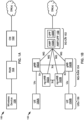
- FIG. 1A illustrates an example of a mobile communication network 100 in which embodiments of the present disclosure may be implemented.
- the mobile communication network 100 may be, for example, a public land mobile network (PLMN) run by a network operator.
- PLMN public land mobile network
- the mobile communication network 100 includes a core network (CN) 102, a radio access network (RAN) 104, and a wireless device 106.
- CN core network
- RAN radio access network
- wireless device 106 wireless device
- the CN 102 may provide the wireless device 106 with an interface to one or more data networks (DNs), such as public DNs (e.g., the Internet), private DNs, and/or intra-operator DNs.
- DNs data networks
- the CN 102 may set up end-to-end connections between the wireless device 106 and the one or more DNs, authenticate the wireless device 106, and provide charging functionality.
- the RAN 104 may connect the CN 102 to the wireless device 106 through radio communications over an air interface. As part of the radio communications, the RAN 104 may provide scheduling, radio resource management, and retransmission protocols.
- the communication direction from the RAN 104 to the wireless device 106 over the air interface is known as the downlink and the communication direction from the wireless device 106 to the RAN 104 over the air interface is known as the uplink.
- Downlink transmissions may be separated from uplink transmissions using frequency division duplexing (FDD), time-division duplexing (TDD), and/or some combination of the two duplexing techniques.
- FDD frequency division duplexing
- TDD time-division duplexing
- wireless device may be used throughout this disclosure to refer to and encompass any mobile device or fixed (non-mobile) device for which wireless communication is needed or usable.
- a wireless device may be a telephone, smart phone, tablet, computer, laptop, sensor, meter, wearable device, Internet of Things (IoT) device, vehicle road side unit (RSU), relay node, automobile, and/or any combination thereof.
- IoT Internet of Things
- RSU vehicle road side unit
- the term wireless device encompasses other terminology, including user equipment (UE), user terminal (UT), access terminal (AT), mobile station, handset, wireless transmit and receive unit (WTRU), and/or wireless communication device.
- UE user equipment
- UT user terminal
- AT access terminal
- WTRU wireless transmit and receive unit
- the RAN 104 may include one or more base stations (not shown).
- the term base station may be used throughout this disclosure to refer to and encompass a Node B (associated with UMTS and/or 3G standards), an Evolved Node B (eNB, associated with E-UTRA and/or 4G standards), a remote radio head (RRH), a baseband processing unit coupled to one or more RRHs, a repeater node or relay node used to extend the coverage area of a donor node, a Next Generation Evolved Node B (ng-eNB), a Generation Node B (gNB, associated with NR and/or 5G standards), an access point (AP, associated with, for example, WiFi or any other suitable wireless communication standard), and/or any combination thereof.
- a base station may comprise at least one gNB Central Unit (gNB-CU) and at least one a gNB Distributed Unit (gNB-DU).
- a base station included in the RAN 104 may include one or more sets of antennas for communicating with the wireless device 106 over the air interface.
- one or more of the base stations may include three sets of antennas to respectively control three cells (or sectors).
- the size of a cell may be determined by a range at which a receiver (e.g., a base station receiver) can successfully receive the transmissions from a transmitter (e.g., a wireless device transmitter) operating in the cell.
- the cells of the base stations may provide radio coverage to the wireless device 106 over a wide geographic area to support wireless device mobility.
- one or more of the base stations in the RAN 104 may be implemented as a sectored site with more or less than three sectors.
- One or more of the base stations in the RAN 104 may be implemented as an access point, as a baseband processing unit coupled to several remote radio heads (RRHs), and/or as a repeater or relay node used to extend the coverage area of a donor node.
- RRHs remote radio heads
- a baseband processing unit coupled to RRHs may be part of a centralized or cloud RAN architecture, where the baseband processing unit may be either centralized in a pool of baseband processing units or virtualized.
- a repeater node may amplify and rebroadcast a radio signal received from a donor node.
- a relay node may perform the same/similar functions as a repeater node but may decode the radio signal received from the donor node to remove noise before amplifying and rebroadcasting the radio signal.
- the RAN 104 may be deployed as a homogenous network of macrocell base stations that have similar antenna patterns and similar high-level transmit powers.
- the RAN 104 may be deployed as a heterogeneous network.
- small cell base stations may be used to provide small coverage areas, for example, coverage areas that overlap with the comparatively larger coverage areas provided by macrocell base stations.
- the small coverage areas may be provided in areas with high data traffic (or so-called "hotspots") or in areas with weak macrocell coverage.
- Examples of small cell base stations include, in order of decreasing coverage area, microcell base stations, picocell base stations, and femtocell base stations or home base stations.
- 3GPP The Third-Generation Partnership Project (3GPP) was formed in 1998 to provide global standardization of specifications for mobile communication networks similar to the mobile communication network 100 in FIG. 1A .
- 3GPP has produced specifications for three generations of mobile networks: a third generation (3G) network known as Universal Mobile Telecommunications System (UMTS), a fourth generation (4G) network known as Long-Term Evolution (LTE), and a fifth generation (5G) network known as 5G System (5GS).
- UMTS Universal Mobile Telecommunications System
- 4G fourth generation
- LTE Long-Term Evolution
- 5G 5G System
- Embodiments of the present disclosure are described with reference to the RAN of a 3GPP 5G network, referred to as next-generation RAN (NG-RAN).
- NG-RAN next-generation RAN
- Embodiments may be applicable to RANs of other mobile communication networks, such as the RAN 104 in FIG.
- NG-RAN implements 5G radio access technology known as New Radio (NR) and may be provisioned to implement 4G radio access technology or other radio access technologies, including non-3GPP radio access technologies.
- NR New Radio
- FIG. 1B illustrates another example mobile communication network 150 in which embodiments of the present disclosure may be implemented.
- Mobile communication network 150 may be, for example, a PLMN run by a network operator.
- mobile communication network 150 includes a 5G core network (5G-CN) 152, an NG-RAN 154, and UEs 156A and 156B (collectively UEs 156). These components may be implemented and operate in the same or similar manner as corresponding components described with respect to FIG. 1A .
- 5G-CN 5G core network
- NG-RAN 154 a 5G core network
- UEs 156A and 156B collectively UEs 156
- the 5G-CN 152 provides the UEs 156 with an interface to one or more DNs, such as public DNs (e.g., the Internet), private DNs, and/or intra-operator DNs.
- the 5G-CN 152 may set up end-to-end connections between the UEs 156 and the one or more DNs, authenticate the UEs 156, and provide charging functionality.
- the basis of the 5G-CN 152 may be a service-based architecture. This means that the architecture of the nodes making up the 5G-CN 152 may be defined as network functions that offer services via interfaces to other network functions.
- the network functions of the 5G-CN 152 may be implemented in several ways, including as network elements on dedicated or shared hardware, as software instances running on dedicated or shared hardware, or as virtualized functions instantiated on a platform (e.g., a cloud-based platform).
- the 5G-CN 152 includes an Access and Mobility Management Function (AMF) 158A and a User Plane Function (UPF) 158B, which are shown as one component AMF/UPF 158 in FIG. 1B for ease of illustration.
- AMF Access and Mobility Management Function
- UPF User Plane Function
- the UPF 158B may serve as a gateway between the NG-RAN 154 and the one or more DNs.
- the UPF 158B may perform functions such as packet routing and forwarding, packet inspection and user plane policy rule enforcement, traffic usage reporting, uplink classification to support routing of traffic flows to the one or more DNs, quality of service (QoS) handling for the user plane (e.g., packet filtering, gating, uplink/downlink rate enforcement, and uplink traffic verification), downlink packet buffering, and downlink data notification triggering.
- QoS quality of service
- the UPF 158B may serve as an anchor point for intra-/inter-Radio Access Technology (RAT) mobility, an external protocol (or packet) data unit (PDU) session point of interconnect to the one or more DNs, and/or a branching point to support a multi-homed PDU session.
- the UEs 156 may be configured to receive services through a PDU session, which is a logical connection between a UE and a DN.
- the AMF 158A may perform functions such as Non-Access Stratum (NAS) signaling termination, NAS signaling security, Access Stratum (AS) security control, inter-CN node signaling for mobility between 3GPP access networks, idle mode UE reachability (e.g., control and execution of paging retransmission), registration area management, intra-system and intersystem mobility support, access authentication, access authorization including checking of roaming rights, mobility management control (subscription and policies), network slicing support, and/or session management function (SMF) selection.
- NAS may refer to the functionality operating between a CN and a UE
- AS may refer to the functionality operating between the UE and a RAN.
- the 5G-CN 152 may include one or more additional network functions that are not shown in FIG. 1B for the sake of clarity.
- the 5G-CN 152 may include one or more of a Session Management Function (SMF), an NR Repository Function (NRF), a Policy Control Function (PCF), a Network Exposure Function (NEF), a Unified Data Management (UDM), an Application Function (AF), and/or an Authentication Server Function (AUSF).
- SMF Session Management Function
- NRF NR Repository Function
- PCF Policy Control Function
- NEF Network Exposure Function
- UDM Unified Data Management
- AF Application Function
- AUSF Authentication Server Function
- the NG-RAN 154 may connect the 5G-CN 152 to the UEs 156 through radio communications over the air interface.
- the NG-RAN 154 may include one or more gNBs, illustrated as gNB 160A and gNB 160B (collectively gNBs 160) and/or one or more ng-eNBs, illustrated as ng-eNB 162A and ng-eNB 162B (collectively ng-eNBs 162).
- the gNBs 160 and ng-eNBs 162 may be more generically referred to as base stations.
- the gNBs 160 and ng-eNBs 162 may include one or more sets of antennas for communicating with the UEs 156 over an air interface.
- the gNBs 160 and/or the ng-eNBs 162 may be connected to one or more AMF/UPF functions of the 5G-CN 152, such as the AMF/UPF 158, by means of one or more NG interfaces.
- the gNB 160A may be connected to the UPF 158B of the AMF/UPF 158 by means of an NG-User plane (NG-U) interface.
- the NG-U interface may provide delivery (e.g., non-guaranteed delivery) of user plane PDUs between the gNB 160A and the UPF 158B.
- the gNB 160A may be connected to the AMF 158A by means of an NG-Control plane (NG-C) interface.
- the NG-C interface may provide, for example, NG interface management, UE context management, UE mobility management, transport of NAS messages, paging, PDU session management, and configuration transfer and/or warning message transmission.
- the gNBs 160 may provide NR user plane and control plane protocol terminations towards the UEs 156 over the Uu interface.
- the gNB 160A may provide NR user plane and control plane protocol terminations toward the UE 156A over a Uu interface associated with a first protocol stack.
- the ng-eNBs 162 may provide Evolved UMTS Terrestrial Radio Access (E-UTRA) user plane and control plane protocol terminations towards the UEs 156 over a Uu interface, where E-UTRA refers to the 3GPP 4G radio-access technology.
- E-UTRA refers to the 3GPP 4G radio-access technology.
- the ng-eNB 162B may provide E-UTRA user plane and control plane protocol terminations towards the UE 156B over a Uu interface associated with a second protocol stack.
- the 5G-CN 152 was described as being configured to handle NR and 4G radio accesses. It will be appreciated by one of ordinary skill in the art that it may be possible for NR to connect to a 4G core network in a mode known as "non-standalone operation.” In non-standalone operation, a 4G core network is used to provide (or at least support) control-plane functionality (e.g., initial access, mobility, and paging). Although only one AMF/UPF 158 is shown in FIG. 1B , one gNB or ng-eNB may be connected to multiple AMF/UPF nodes to provide redundancy and/or to load share across the multiple AMF/UPF nodes.
- an interface (e.g., Uu, Xn, and NG interfaces) between the network elements in FIG. 1B may be associated with a protocol stack that the network elements use to exchange data and signaling messages.
- a protocol stack may include two planes: a user plane and a control plane. The user plane may handle data of interest to a user, and the control plane may handle signaling messages of interest to the network elements.
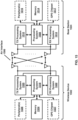
- FIG. 2A and FIG. 2B respectively illustrate examples of NR user plane and NR control plane protocol stacks for the Uu interface that lies between a UE 210 and a gNB 220.
- the protocol stacks illustrated in FIG. 2A and FIG. 2B may be the same or similar to those used for the Uu interface between, for example, the UE 156A and the gNB 160A shown in FIG. 1B .
- the PDCPs 214 and 224 may perform header compression/decompression to reduce the amount of data that needs to be transmitted over the air interface, ciphering/deciphering to prevent unauthorized decoding of data transmitted over the air interface, and integrity protection (to ensure control messages originate from intended sources.
- the PDCPs 214 and 224 may perform retransmissions of undelivered packets, in-sequence delivery and reordering of packets, and removal of packets received in duplicate due to, for example, an intra-gNB handover.
- the PDCPs 214 and 224 may perform packet duplication to improve the likelihood of the packet being received and, at the receiver, remove any duplicate packets. Packet duplication may be useful for services that require high reliability.
- the MACs 212 and 222 may be configured to perform error correction through Hybrid Automatic Repeat Request (HARQ) (e.g., one HARQ entity per carrier in case of Carrier Aggregation (CA)), priority handling between logical channels of the UE 210 by means of logical channel prioritization, and/or padding.
- HARQ Hybrid Automatic Repeat Request
- the MACs 212 and 222 may support one or more numerologies and/or transmission timings. In an example, mapping restrictions in a logical channel prioritization may control which numerology and/or transmission timing a logical channel may use.
- the MACs 212 and 222 may provide logical channels as a service to the RLCs 213 and 223.
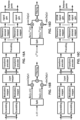
- FIG. 4A illustrates an example downlink data flow through the NR user plane protocol stack.
- FIG. 4A illustrates a downlink data flow of three IP packets ( n, n+1, and m ) through the NR user plane protocol stack to generate two TBs at the gNB 220.
- An uplink data flow through the NR user plane protocol stack may be similar to the downlink data flow depicted in FIG. 4A .
- the remaining protocol layers in FIG. 4A may perform their associated functionality (e.g., with respect to FIG. 3 ), add corresponding headers, and forward their respective outputs to the next lower layer.
- the PDCP 224 may perform IP-header compression and ciphering and forward its output to the RLC 223.
- the RLC 223 may optionally perform segmentation (e.g., as shown for IP packet m in FIG. 4A ) and forward its output to the MAC 222.
- the MAC 222 may multiplex a number of RLC PDUs and may attach a MAC subheader to an RLC PDU to form a transport block.
- the MAC subheaders may be distributed across the MAC PDU, as illustrated in FIG. 4A .
- the MAC subheaders may be entirely located at the beginning of the MAC PDU.
- the NR MAC PDU structure may reduce processing time and associated latency because the MAC PDU subheaders may be computed before the full MAC PDU is assembled.
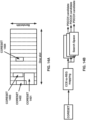
- FIG. 4B illustrates an example format of a MAC subheader in a MAC PDU.
- the MAC subheader includes: an SDU length field for indicating the length (e.g., in bytes) of the MAC SDU to which the MAC subheader corresponds; a logical channel identifier (LCID) field for identifying the logical channel from which the MAC SDU originated to aid in the demultiplexing process; a flag (F) for indicating the size of the SDU length field; and a reserved bit (R) field for future use.
- SDU length field for indicating the length (e.g., in bytes) of the MAC SDU to which the MAC subheader corresponds
- LCID logical channel identifier
- F flag
- R reserved bit
- Example MAC CEs include: scheduling-related MAC CEs, such as buffer status reports and power headroom reports; activation/deactivation MAC CEs, such as those for activation/deactivation of PDCP duplication detection, channel state information (CSI) reporting, sounding reference signal (SRS) transmission, and prior configured components; discontinuous reception (DRX) related MAC CEs; timing advance MAC CEs; and random access related MAC CEs.
- a MAC CE may be preceded by a MAC subheader with a similar format as described for MAC SDUs and may be identified with a reserved value in the LCID field that indicates the type of control information included in the MAC CE.
- logical channels, transport channels, and physical channels are first described as well as a mapping between the channel types.
- One or more of the channels may be used to carry out functions associated with the NR control plane protocol stack described later below.
- FIG. 5A and FIG. 5B illustrate, for downlink and uplink respectively, a mapping between logical channels, transport channels, and physical channels.
- Information is passed through channels between the RLC, the MAC, and the PHY of the NR protocol stack.
- a logical channel may be used between the RLC and the MAC and may be classified as a control channel that carries control and configuration information in the NR control plane or as a traffic channel that carries data in the NR user plane.
- a logical channel may be classified as a dedicated logical channel that is dedicated to a specific UE or as a common logical channel that may be used by more than one UE.
- a logical channel may also be defined by the type of information it carries.
- the set of logical channels defined by NR include, for example:
- Transport channels are used between the MAC and PHY layers and may be defined by how the information they carry is transmitted over the air interface.
- the set of transport channels defined by NR include, for example:
- the PHY may use physical channels to pass information between processing levels of the PHY.
- a physical channel may have an associated set of time-frequency resources for carrying the information of one or more transport channels.
- the PHY may generate control information to support the low-level operation of the PHY and provide the control information to the lower levels of the PHY via physical control channels, known as L1/L2 control channels.
- the set of physical channels and physical control channels defined by NR include, for example:
- the physical layer Similar to the physical control channels, the physical layer generates physical signals to support the low-level operation of the physical layer.
- the physical layer signals defined by NR include: primary synchronization signals (PSS), secondary synchronization signals (SSS), channel state information reference signals (CSI-RS), demodulation reference signals (DMRS), sounding reference signals (SRS), and phase-tracking reference signals (PT-RS). These physical layer signals will be described in greater detail below.
- FIG. 2B illustrates an example NR control plane protocol stack.
- the NR control plane protocol stack may use the same/similar first four protocol layers as the example NR user plane protocol stack. These four protocol layers include the PHYs 211 and 221, the MACs 212 and 222, the RLCs 213 and 223, and the PDCPs 214 and 224.
- the NR control plane stack has radio resource controls (RRCs) 216 and 226 and NAS protocols 217 and 237 at the top of the NR control plane protocol stack.
- RRCs radio resource controls
- the NAS protocols 217 and 237 may provide control plane functionality between the UE 210 and the AMF 230 (e.g., the AMF 158A) or, more generally, between the UE 210 and the CN.
- the NAS protocols 217 and 237 may provide control plane functionality between the UE 210 and the AMF 230 via signaling messages, referred to as NAS messages. There is no direct path between the UE 210 and the AMF 230 through which the NAS messages can be transported.
- the NAS messages may be transported using the AS of the Uu and NG interfaces.
- NAS protocols 217 and 237 may provide control plane functionality such as authentication, security, connection setup, mobility management, and session management.
- the RRCs 216 and 226 may provide control plane functionality between the UE 210 and the gNB 220 or, more generally, between the UE 210 and the RAN.
- the RRCs 216 and 226 may provide control plane functionality between the UE 210 and the gNB 220 via signaling messages, referred to as RRC messages.
- RRC messages may be transmitted between the UE 210 and the RAN using signaling radio bearers and the same/similar PDCP, RLC, MAC, and PHY protocol layers.
- the MAC may multiplex control-plane and user-plane data into the same transport block (TB).
- the RRCs 216 and 226 may provide control plane functionality such as: broadcast of system information related to AS and NAS; paging initiated by the CN or the RAN; establishment, maintenance and release of an RRC connection between the UE 210 and the RAN; security functions including key management; establishment, configuration, maintenance and release of signaling radio bearers and data radio bearers; mobility functions; QoS management functions; the UE measurement reporting and control of the reporting; detection of and recovery from radio link failure (RLF); and/or NAS message transfer.
- RRCs 216 and 226 may establish an RRC context, which may involve configuring parameters for communication between the UE 210 and the RAN.
- FIG. 6 is an example diagram showing RRC state transitions of a UE.
- the UE may be the same or similar to the wireless device 106 depicted in FIG. 1A , the UE 210 depicted in FIG. 2A and FIG. 2B , or any other wireless device described in the present disclosure.
- a UE may be in at least one of three RRC states: RRC connected 602 (e.g., RRC_CONNECTED), RRC idle 604 (e.g., RRC IDLE), and RRC inactive 606 (e.g., RRC_INACTIVE).
- RRC connected 602 e.g., RRC_CONNECTED
- RRC idle 604 e.g., RRC IDLE
- RRC inactive 606 e.g., RRC_INACTIVE
- the UE has an established RRC context and may have at least one RRC connection with a base station.
- the base station may be similar to one of the one or more base stations included in the RAN 104 depicted in FIG. 1A , one of the gNBs 160 or ng-eNBs 162 depicted in FIG. 1B , the gNB 220 depicted in FIG. 2A and FIG. 2B , or any other base station described in the present disclosure.
- the base station with which the UE is connected may have the RRC context for the UE.
- the RRC context referred to as the UE context, may comprise parameters for communication between the UE and the base station.
- These parameters may include, for example: one or more AS contexts; one or more radio link configuration parameters; bearer configuration information (e.g., relating to a data radio bearer, signaling radio bearer, logical channel, QoS flow, and/or PDU session); security information; and/or PHY, MAC, RLC, PDCP, and/or SDAP layer configuration information.
- bearer configuration information e.g., relating to a data radio bearer, signaling radio bearer, logical channel, QoS flow, and/or PDU session
- security information e.g., relating to a data radio bearer, signaling radio bearer, logical channel, QoS flow, and/or PDU session
- PHY e.g., MAC, RLC, PDCP, and/or SDAP layer configuration information
- the RAN e.g., the RAN 104 or the NG-RAN 154
- the UE may measure the signal levels (e.g., reference signal levels) from a serving cell
- the UE's serving base station may request a handover to a cell of one of the neighboring base stations based on the reported measurements.
- the RRC state may transition from RRC connected 602 to RRC idle 604 through a connection release procedure 608 or to RRC inactive 606 through a connection inactivation procedure 610.
- RRC idle 604 an RRC context may not be established for the UE.
- the UE may not have an RRC connection with the base station.
- the UE may be in a sleep state for the majority of the time (e.g., to conserve battery power).
- the UE may wake up periodically (e.g., once in every discontinuous reception cycle) to monitor for paging messages from the RAN.
- Mobility of the UE may be managed by the UE through a procedure known as cell reselection.
- the RRC state may transition from RRC idle 604 to RRC connected 602 through a connection establishment procedure 612, which may involve a random access procedure as discussed in greater detail below.
- RRC inactive 606 the RRC context previously established is maintained in the UE and the base station. This allows for a fast transition to RRC connected 602 with reduced signaling overhead as compared to the transition from RRC idle 604 to RRC connected 602.
- the UE While in RRC inactive 606, the UE may be in a sleep state and mobility of the UE may be managed by the UE through cell reselection.
- the RRC state may transition from RRC inactive 606 to RRC connected 602 through a connection resume procedure 614 or to RRC idle 604 though a connection release procedure 616 that may be the same as or similar to connection release procedure 608.
- An RRC state may be associated with a mobility management mechanism.
- RRC idle 604 and RRC inactive 606 mobility is managed by the UE through cell reselection.
- the purpose of mobility management in RRC idle 604 and RRC inactive 606 is to allow the network to be able to notify the UE of an event via a paging message without having to broadcast the paging message over the entire mobile communications network.
- the mobility management mechanism used in RRC idle 604 and RRC inactive 606 may allow the network to track the UE on a cell-group level so that the paging message may be broadcast over the cells of the cell group that the UE currently resides within instead of the entire mobile communication network.
- the mobility management mechanisms for RRC idle 604 and RRC inactive 606 track the UE on a cell-group level. They may do so using different granularities of grouping. For example, there may be three levels of cell-grouping granularity: individual cells; cells within a RAN area identified by a RAN area identifier (RAI); and cells within a group of RAN areas, referred to as a tracking area and identified by a tracking area identifier (TAI).
- RAI RAN area identifier
- TAI tracking area and identified by a tracking area identifier
- Tracking areas may be used to track the UE at the CN level.
- the CN e.g., the CN 102 or the 5G-CN 152 may provide the UE with a list of TAIs associated with a UE registration area. If the UE moves, through cell reselection, to a cell associated with a TAI not included in the list of TAIs associated with the UE registration area, the UE may perform a registration update with the CN to allow the CN to update the UE's location and provide the UE with a new the UE registration area.
- RAN areas may be used to track the UE at the RAN level.
- the UE may be assigned a RAN notification area.
- a RAN notification area may comprise one or more cell identities, a list of RAIs, or a list of TAIs.
- a base station may belong to one or more RAN notification areas.
- a cell may belong to one or more RAN notification areas. If the UE moves, through cell reselection, to a cell not included in the RAN notification area assigned to the UE, the UE may perform a notification area update with the RAN to update the UE's RAN notification area.
- a base station storing an RRC context for a UE or a last serving base station of the UE may be referred to as an anchor base station.
- An anchor base station may maintain an RRC context for the UE at least during a period of time that the UE stays in a RAN notification area of the anchor base station and/or during a period of time that the UE stays in RRC inactive 606.
- a gNB such as gNBs 160 in FIG. 1B , may be split in two parts: a central unit (gNB-CU), and one or more distributed units (gNB-DU).
- a gNB-CU may be coupled to one or more gNB-DUs using an F1 interface.
- the gNB-CU may comprise the RRC, the PDCP, and the SDAP.
- a gNB-DU may comprise the RLC, the MAC, and the PHY.
- OFDM orthogonal frequency divisional multiplexing
- FAM frequency divisional multiplexing
- F-QAM M-quadrature amplitude modulation
- M-PSK M-phase shift keying
- source symbols e.g., M-quadrature amplitude modulation (M-QAM) or M-phase shift keying (M-PSK) symbols
- source symbols e.g., M-quadrature amplitude modulation (M-QAM) or M-phase shift keying (M-PSK) symbols
- source symbols e.g., M-quadrature amplitude modulation (M-QAM) or M-phase shift keying (M-PSK) symbols
- source symbols e.g., M-quadrature amplitude modulation (M-QAM) or M-phase shift keying (M-PSK) symbols
- source symbols e.g., M-quadrature amplitude modulation (M-QAM) or M-phase shift keying (M-PSK) symbols
- source symbols
- the IFFT block may take in F source symbols at a time, one from each of the F parallel symbol streams, and use each source symbol to modulate the amplitude and phase of one of F sinusoidal basis functions that correspond to the F orthogonal subcarriers.
- the output of the IFFT block may be F time-domain samples that represent the summation of the F orthogonal subcarriers.
- the F time-domain samples may form a single OFDM symbol.
- an OFDM symbol provided by the IFFT block may be transmitted over the air interface on a carrier frequency.
- the F parallel symbol streams may be mixed using an FFT block before being processed by the IFFT block.
- This operation produces Discrete Fourier Transform (DFT)-precoded OFDM symbols and may be used by UEs in the uplink to reduce the peak to average power ratio (PAPR).
- DFT Discrete Fourier Transform
- PAPR peak to average power ratio
- Inverse processing may be performed on the OFDM symbol at a receiver using an FFT block to recover the data mapped to the source symbols.
- FIG. 7 illustrates an example configuration of an NR frame into which OFDM symbols are grouped.
- An NR frame may be identified by a system frame number (SFN).
- the SFN may repeat with a period of 1024 frames.
- one NR frame may be 10 milliseconds (ms) in duration and may include 10 subframes that are 1 ms in duration.
- a subframe may be divided into slots that include, for example, 14 OFDM symbols per slot.
- the duration of a slot may depend on the numerology used for the OFDM symbols of the slot.
- a flexible numerology is supported to accommodate different cell deployments (e.g., cells with carrier frequencies below 1 GHz up to cells with carrier frequencies in the mm-wave range).
- a numerology may be defined in terms of subcarrier spacing and cyclic prefix duration.
- subcarrier spacings may be scaled up by powers of two from a baseline subcarrier spacing of 15 kHz
- cyclic prefix durations may be scaled down by powers of two from a baseline cyclic prefix duration of 4.7 ⁇ s.
- NR defines numerologies with the following subcarrier spacing/cyclic prefix duration combinations: 15 kHz/4.7 ⁇ s; 30 kHz/2.3 ⁇ s; 60 kHz/1.2 ⁇ s; 120 kHz/0.59 ⁇ s; and 240 kHz/0.29 ⁇ s.
- a slot may have a fixed number of OFDM symbols (e.g., 14 OFDM symbols).
- a numerology with a higher subcarrier spacing has a shorter slot duration and, correspondingly, more slots per subframe.
- FIG. 7 illustrates this numerology-dependent slot duration and slots-per-subframe transmission structure (the numerology with a subcarrier spacing of 240 kHz is not shown in FIG. 7 for ease of illustration).
- a subframe in NR may be used as a numerology-independent time reference, while a slot may be used as the unit upon which uplink and downlink transmissions are scheduled.
- scheduling in NR may be decoupled from the slot duration and start at any OFDM symbol and last for as many symbols as needed for a transmission. These partial slot transmissions may be referred to as mini-slot or subslot transmissions.
- FIG. 8 illustrates an example configuration of a slot in the time and frequency domain for an NR carrier.
- the slot includes resource elements (REs) and resource blocks (RBs).
- An RE is the smallest physical resource in NR.
- An RE spans one OFDM symbol in the time domain by one subcarrier in the frequency domain as shown in FIG. 8 .
- An RB spans twelve consecutive REs in the frequency domain as shown in FIG. 8 .
- Such a limitation may limit the NR carrier to 50, 100, 200, and 400 MHz for subcarrier spacings of 15, 30, 60, and 120 kHz, respectively, where the 400 MHz bandwidth may be set based on a 400 MHz per carrier bandwidth limit.
- FIG. 8 illustrates a single numerology being used across the entire bandwidth of the NR carrier.
- multiple numerologies may be supported on the same carrier.
- NR may support wide carrier bandwidths (e.g., up to 400 MHz for a subcarrier spacing of 120 kHz). Not all UEs may be able to receive the full carrier bandwidth (e.g., due to hardware limitations). Also, receiving the full carrier bandwidth may be prohibitive in terms of UE power consumption. In an example, to reduce power consumption and/or for other purposes, a UE may adapt the size of the UE's receive bandwidth based on the amount of traffic the UE is scheduled to receive. This is referred to as bandwidth adaptation.
- NR defines bandwidth parts (BWPs) to support UEs not capable of receiving the full carrier bandwidth and to support bandwidth adaptation.
- BWP may be defined by a subset of contiguous RBs on a carrier.
- a UE may be configured (e.g., via RRC layer) with one or more downlink BWPs and one or more uplink BWPs per serving cell (e.g., up to four downlink BWPs and up to four uplink BWPs per serving cell).
- one or more of the configured BWPs for a serving cell may be active. These one or more BWPs may be referred to as active BWPs of the serving cell.
- the serving cell When a serving cell is configured with a secondary uplink carrier, the serving cell may have one or more first active BWPs in the uplink carrier and one or more second active BWPs in the secondary uplink carrier.
- One or more BWP indicator fields may be provided in Downlink Control Information (DCI).
- DCI Downlink Control Information
- a value of a BWP indicator field may indicate which BWP in a set of configured BWPs is an active downlink BWP for one or more downlink receptions.
- the value of the one or more BWP indicator fields may indicate an active uplink BWP for one or more uplink transmissions.
- a base station may configure a UE with a BWP inactivity timer value for a PCell.
- the UE may start or restart a BWP inactivity timer at any appropriate time.
- the UE may start or restart the BWP inactivity timer ( a ) when the UE detects a DCI indicating an active downlink BWP other than a default downlink BWP for a paired spectra operation; or ( b ) when a UE detects a DCI indicating an active downlink BWP or active uplink BWP other than a default downlink BWP or uplink BWP for an unpaired spectra operation.
- the SIB1 may contain information needed by the UE to access the cell.
- the UE may use one or more parameters of the MIB to monitor PDCCH, which may be used to schedule PDSCH.
- the PDSCH may include the SIB1.
- the SIB1 may be decoded using parameters provided in the MIB.
- the PBCH may indicate an absence of SIB 1. Based on the PBCH indicating the absence of SIB1, the UE may be pointed to a frequency. The UE may search for an SS/PBCH block at the frequency to which the UE is pointed.
- a MAC SDU may be a bit string that is byte aligned (e.g., aligned to a multiple of eight bits) in length.
- a MAC SDU may be included in a MAC PDU from the first bit onward.
- a MAC CE may be a bit string that is byte aligned (e.g., aligned to a multiple of eight bits) in length.
- a MAC subheader may be a bit string that is byte aligned (e.g., aligned to a multiple of eight bits) in length.
- a MAC subheader may be placed immediately in front of a corresponding MAC SDU, MAC CE, or padding.
- a MAC entity may ignore a value of reserved bits in a DL MAC PDU.
- a MAC entity of a base station may transmit one or more MAC CEs to a MAC entity of a wireless device.
- FIG. 19 shows an example of multiple LCIDs that may be associated with the one or more MAC CEs.
- the one or more MAC CEs comprise at least one of: a SP ZP CSI-RS Resource Set Activation/Deactivation MAC CE, a PUCCH spatial relation Activation/Deactivation MAC CE, a SP SRS Activation/Deactivation MAC CE, a SP CSI reporting on PUCCH Activation/Deactivation MAC CE, a TCI State Indication for UE-specific PDCCH MAC CE, a TCI State Indication for UE-specific PDSCH MAC CE, an Aperiodic CSI Trigger State Subselection MAC CE, a SP CSI-RS/CSI-IM Resource Set Activation/Deactivation MAC CE, a UE contention resolution identity MAC CE, a timing advance command MAC CE, a
- the MAC entity of the wireless device may transmit to the MAC entity of the base station one or more MAC CEs.
- FIG. 20 shows an example of the one or more MAC CEs.
- the one or more MAC CEs may comprise at least one of: a short buffer status report (BSR) MAC CE, a long BSR MAC CE, a C-RNTI MAC CE, a configured grant confirmation MAC CE, a single entry PHR MAC CE, a multiple entry PHR MAC CE, a short truncated BSR, and/or a long truncated BSR.
- a MAC CE may have an LCID in the MAC subheader corresponding to the MAC CE.
- Different MAC CE may have different LCID in the MAC subheader corresponding to the MAC CE.
- an LCID given by 111011 in a MAC subheader may indicate that a MAC CE associated with the MAC subheader is a short-truncated command MAC CE.
- CCs component carriers
- a wireless device may simultaneously receive or transmit on one or more CCs, depending on capabilities of the wireless device, using the technique of CA.
- a wireless device may support CA for contiguous CCs and/or for non-contiguous CCs.
- CCs may be organized into cells. For example, CCs may be organized into one primary cell (PCell) and one or more secondary cells (SCells).
- PCell primary cell
- SCells secondary cells
- a wireless device may have one RRC connection with a network. During an RRC connection establishment/reestablishment/handover, a cell providing NAS mobility information may be a serving cell.
- a base station and/or a wireless device may employ an activation/deactivation mechanism of an SCell to improve battery or power consumption of the wireless device.
- a base station may activate or deactivate at least one of the one or more SCells.
- the SCell may be deactivated unless an SCell state associated with the SCell is set to "activated" or "dormant".
- a wireless device may activate/deactivate an SCell in response to receiving an SCell Activation/Deactivation MAC CE.
- a base station may transmit, to a wireless device, one or more messages comprising an SCell timer (e.g., sCellDeactivationTimer).
- an SCell timer e.g., sCellDeactivationTimer.
- a wireless device may deactivate an SCell in response to an expiry of the SCell timer.
- the wireless device may activate the SCell.
- the wireless device may perform operations comprising SRS transmissions on the SCell; CQI/PMI/RI/CRI reporting for the SCell; PDCCH monitoring on the SCell; PDCCH monitoring for the SCell; and/or PUCCH transmissions on the SCell.
- the wireless device may start or restart a first SCell timer (e.g., sCellDeactivationTimer) associated with the SCell.
- a first SCell timer e.g., sCellDeactivationTimer
- the wireless device may start or restart the first SCell timer in the slot when the SCell Activation/Deactivation MAC CE activating the SCell has been received.
- the wireless device in response to the activating the SCell, may (re-)initialize one or more suspended configured uplink grants of a configured grant Type 1 associated with the SCell according to a stored configuration.
- the wireless device in response to the activating the SCell, may trigger PHR.
- the wireless device may deactivate the activated SCell.
- a first SCell timer e.g., sCellDeactivationTimer
- the wireless device may deactivate the activated SCell.
- the wireless device may stop the first SCell timer associated with the activated SCell.
- the wireless device may clear one or more configured downlink assignments and/or one or more configured uplink grants of a configured uplink grant Type 2 associated with the activated SCell.
- the wireless device may: suspend one or more configured uplink grants of a configured uplink grant Type 1 associated with the activated SCell; and/or flush HARQ buffers associated with the activated SCell.
- a wireless device may restart the first SCell timer (e.g., sCellDeactivationTimer ) associated with the activated SCell.
- sCellDeactivationTimer e.g., sCellDeactivationTimer
- FIG. 21A shows an example of an SCell Activation/Deactivation MAC CE of one octet.
- a first MAC PDU subheader with a first LCID (e.g., '111010' as shown in FIG. 19 ) may identify the SCell Activation/Deactivation MAC CE of one octet.
- the SCell Activation/Deactivation MAC CE of one octet may have a fixed size.
- the SCell Activation/Deactivation MAC CE of one octet may comprise a single octet.
- the single octet may comprise a first number of C-fields (e.g.
- FIG. 21B shows an example of an SCell Activation/Deactivation MAC CE of four octets.
- a second MAC PDU subheader with a second LCID (e.g., ⁇ 111001' as shown in FIG. 19 ) may identify the SCell Activation/Deactivation MAC CE of four octets.
- the SCell Activation/Deactivation MAC CE of four octets may have a fixed size.
- the SCell Activation/Deactivation MAC CE of four octets may comprise four octets.
- the four octets may comprise a third number of C-fields (e.g., 31) and a fourth number of R-fields (e.g., 1).
- a base station may configure a wireless device with uplink (UL) bandwidth parts (BWPs) and downlink (DL) BWPs to enable bandwidth adaptation (BA) on a PCell. If carrier aggregation is configured, the base station may further configure the wireless device with at least DL BWP(s) (i.e., there may be no UL BWPs in the UL) to enable BA on an SCell.
- BWPs bandwidth parts
- DL BWPs bandwidth adaptation
- the base station may further configure the wireless device with at least DL BWP(s) (i.e., there may be no UL BWPs in the UL) to enable BA on an SCell.
- an initial active BWP may be a first BWP used for initial access.
- a first active BWP may be a second BWP configured for the wireless device to operate on the SCell upon the SCell being activated.
- paired spectrum e.g.
- a base station and/or a wireless device may independently switch a DL BWP and an UL BWP.
- a base station and/or a wireless device may simultaneously switch a DL BWP and an UL BWP.
- a base station and/or a wireless device may switch a BWP between configured BWPs by means of a DCI or a BWP inactivity timer.
- the base station and/or the wireless device may switch an active BWP to a default BWP in response to an expiry of the BWP inactivity timer associated with the serving cell.
- the default BWP may be configured by the network.
- one UL BWP for each uplink carrier and one DL BWP may be active at a time in an active serving cell.
- one DL/UL BWP pair may be active at a time in an active serving cell. Operating on the one UL BWP and the one DL BWP (or the one DL/UL pair) may improve wireless device battery consumption. BWPs other than the one active UL BWP and the one active DL BWP that the wireless device may work on may be deactivated. On deactivated BWPs, the wireless device may: not monitor PDCCH; and/or not transmit on PUCCH, PRACH, and UL-SCH.
- a serving cell may be configured with at most a first number (e.g., four) of BWPs.
- a BWP switching for a serving cell may be used to activate an inactive BWP and deactivate an active BWP at a time.
- the BWP switching may be controlled by a PDCCH indicating a downlink assignment or an uplink grant.
- the BWP switching may be controlled by a BWP inactivity timer (e.g., bwp-InactivityTimer ) .
- the BWP switching may be controlled by a MAC entity in response to initiating a Random Access procedure.
- one BWP may be initially active without receiving a PDCCH indicating a downlink assignment or an uplink grant.
- the active BWP for a serving cell may be indicated by RRC and/or PDCCH.
- a DL BWP may be paired with a UL BWP, and BWP switching may be common for both UL and DL.
- FIG. 22 shows an example of BWP switching on a cell (e.g., PCell or SCell).
- a wireless device may receive from a base station at least one RRC message comprising parameters of a cell and one or more BWPs associated with the cell.
- the RRC message may comprise: RRC connection reconfiguration message (e.g., RRCReconfiguration ); RRC connection reestablishment message (e.g., RRCRestablishment ); and/or RRC connection setup message (e.g., RRCSetup ) .
- At least one BWP may be configured as the first active BWP (e.g., BWP 1), one BWP as the default BWP (e.g., BWP 0).
- the wireless device may receive a command (e.g., RRC message, MAC CE or DCI) to activate the cell at an n th slot.
- the wireless device may start a cell deactivation timer (e.g., sCellDeactivationTimer ), and start CSI related actions for the cell, and/or start CSI related actions for the first active BWP of the cell.
- the wireless device may start monitoring a PDCCH on BWP 1 in response to activating the cell.
- the wireless device may start restart a BWP inactivity timer (e.g., bwp-InactivityTimer ) at an m th slot in response to receiving a DCI indicating DL assignment on BWP 1.
- the wireless device may switch back to the default BWP (e.g., BWP 0) as an active BWP when the BWP inactivity timer expires, at s th slot.
- the wireless device may deactivate the cell and/or stop the BWP inactivity timer when the sCellDeactivationTimer expires.
- a MAC entity may apply normal operations on an active BWP for an activated serving cell configured with a BWP comprising: transmitting on UL-SCH; transmitting on RACH; monitoring a PDCCH; transmitting PUCCH; receiving DL-SCH; and/or (re-) initializing any suspended configured uplink grants of configured grant Type 1 according to a stored configuration, if any.
- a MAC entity may: not transmit on UL-SCH; not transmit on RACH; not monitor a PDCCH; not transmit PUCCH; not transmit SRS, not receive DL-SCH; clear any configured downlink assignment and configured uplink grant of configured grant Type 2; and/or suspend any configured uplink grant of configured Type 1.
- a wireless device may perform the BWP switching to a BWP indicated by the PDCCH.
- the bandwidth part indicator field value may indicate the active DL BWP, from the configured DL BWP set, for DL receptions.
- the bandwidth part indicator field value may indicate the active UL BWP, from the configured UL BWP set, for UL transmissions.
- a wireless device may be provided by a higher layer parameter Default-DL-BWP a default DL BWP among the configured DL BWPs. If a wireless device is not provided a default DL BWP by the higher layer parameter Default-DL-BWP, the default DL BWP is the initial active DL BWP. In an example, a wireless device may be provided by higher layer parameter bwp-InactivityTimer, a timer value for the primary cell.
- the wireless device may increment the timer, if running, every interval of 1 millisecond for frequency range 1 or every 0.5 milliseconds for frequency range 2 if the wireless device may not detect a DCI format 1_1 for paired spectrum operation or if the wireless device may not detect a DCI format 1_1 or DCI format 0_1 for unpaired spectrum operation during the interval.
- the wireless device procedures on the secondary cell may be same as on the primary cell using the timer value for the secondary cell and the default DL BWP for the secondary cell.
- a wireless device may use the indicated DL BWP and the indicated UL BWP on the secondary cell as the respective first active DL BWP and first active UL BWP on the secondary cell or carrier.
- a set of PDCCH candidates for a wireless device to monitor is defined in terms of PDCCH search space sets.
- a search space set comprises a CSS set or a USS set.
- a wireless device monitors PDCCH candidates in one or more of the following search spaces sets: a Type0-PDCCH CSS set configured by pdcch-ConfigSIB1 inMIB or by searchSpaceSIB1 in PDCCH-ConfigCommon or by searchSpaceZero in PDCCH-ConfigCommon for a DCI format with CRC scrambled by a SI-RNTI on the primary cell of the MCG, a Type0A-PDCCH CSS set configured by searchSpaceOtherSystemInformation in PDCCH-ConfigCommon for a DCI format with CRC scrambled by a SI-RNTI on the primary cell of the MCG, a Type1-PDCCH CSS set configured by ra-SearchSpace in PDCCH-ConfigCommon for a DCI format with CRC scrambled
- a wireless device determines a PDCCH monitoring occasion on an active DL BWP based on one or more PDCCH configuration parameters comprising: a PDCCH monitoring periodicity, a PDCCH monitoring offset, and a PDCCH monitoring pattern within a slot.
- N slot frame , ⁇ is a number of slots in a frame when numerology ⁇ is configured.
- o s is a slot offset indicated in the PDCCH configuration parameters.
- k s is a PDCCH monitoring periodicity indicated in the PDCCH configuration parameters.
- the wireless device monitors PDCCH candidates for the search space set for T s consecutive slots, starting from slot n s , f ⁇ , and does not monitor PDCCH candidates for search space set s for the next k s - T s consecutive slots.
- a USS at CCE aggregation level L ⁇ ⁇ 1, 2, 4, 8, 16 ⁇ is defined by a set of PDCCH candidates for CCE aggregation level L .
- a wireless device may monitor a set of PDCCH candidates according to configuration parameters of a search space set comprising a plurality of search spaces (SSs).
- the wireless device may monitor a set of PDCCH candidates in one or more CORESETs for detecting one or more DCIs.
- Monitoring may comprise decoding one or more PDCCH candidates of the set of the PDCCH candidates according to the monitored DCI formats.
- Monitoring may comprise decoding a DCI content of one or more PDCCH candidates with possible (or configured) PDCCH locations, possible (or configured) PDCCH formats (e.g., number of CCEs, number of PDCCH candidates in common SSs, and/or number of PDCCH candidates in the UE-specific SSs) and possible (or configured) DCI formats.
- the decoding may be referred to as blind decoding.
- FIG. 23A shows an example of configuration parameters of a master information block (MIB) of a cell (e.g., PCell).
- a wireless device based on receiving primary synchronization signal (PSS) and/or secondary synchronization signal (SSS), may receive a MIB via a PBCH.
- PSS primary synchronization signal
- SSS secondary synchronization signal
- the configuration parameters of a MIB may comprise six bits ( systemFrameNumber ) of system frame number (SFN), subcarrier spacing indication ( subCarrierSpacingCommon ), a frequency domain offset ( ssb-SubcarrierOffset ) between SSB and overall resource block grid in number of subcarriers, an indication ( cellBarred ) indicating whether the cell is bared, a DMRS position indication ( dmrs-TypeA-Position ) indicating position of DMRS, parameters of CORESET and SS of a PDCCH ( pdcch-ConfigSIB1 ) comprising a common CORESET, a common search space and necessary PDCCH parameters.
- a pdcch-ConfigSIB1 may comprise a first parameter (e.g., controlResourceSetZero ) indicating a common ControlResourceSet (CORESET) with ID #0 (e.g., CORESET#0) of an initial BWP of the cell.
- controlResourceSetZero may be an integer between 0 and 15. Each integer between 0 and 15 may identify a configuration of CORESET#0.
- FIG. 23B shows an example of a configuration of CORESET#0. As shown in FIG.
- a wireless device may determine a SSB and CORESET#0 multiplexing pattern, a number of RBs for CORESET#0, a number of symbols for CORESET#0, a RB offset for CORESET#0.
- a pdcch-ConfigSIB1 may comprise a second parameter (e.g., searchSpaceZero ) common search space with ID #0 (e.g., SS#0) of the initial BWP of the cell.
- searchSpaceZero may be an integer between 0 and 15. Each integer between 0 and 15 may identify a configuration of SS#0.
- FIG. 23C shows an example of a configuration of SS#0.
- a wireless device may determine one or more parameters (e.g., O , M ) for slot determination of PDCCH monitoring, a first symbol index for PDCCH monitoring and/or a number of search spaces per slot.
- a wireless device may monitor PDCCH via SS#0 of CORESET#0 for receiving a DCI scheduling a system information block 1 (SIB1).
- the wireless device may receive the DCI with CRC scrambled with a system information radio network temporary identifier (SI-RNTI) dedicated for receiving the SIB1.
- SI-RNTI system information radio network temporary identifier
- FIG. 24 shows an example of RRC configuration parameters of system information block (SIB).
- SIB e.g., SIB1
- a SIB may contain information relevant when evaluating if a wireless device is allowed to access a cell and may define scheduling of other system information.
- a SIB may contain radio resource configuration information that is common for all wireless devices and barring information applied to a unified access control.
- a base station may transmit to a wireless device (or a plurality of wireless devices) one or more SIB information. As shown in FIG.
- parameters of the one or more SIB information may comprise: one or more parameters (e.g., cellSelectionInfo ) for cell selection related to a serving cell, one or more configuration parameters of a serving cell (e.g., in ServingCellConfigCommonSIB IE ), and one or more other parameters.
- the ServingCellConfigCommonSIB IE may comprise at least one of: common downlink parameters (e.g., in DownlinkConfigCommonSIB IE) of the serving cell, common uplink parameters (e.g., in UplinkConfigCommonSIB IE) of the serving cell, and other parameters.
- a DownlinkConfigCommonSIB IE may comprise parameters of an initial downlink BWP of the serving cell (e.g., SpCell).
- the parameters of the initial downlink BWP may be comprised in a BWP-DownlinkCommon IE (as shown in FIG. 25 ).
- the BWP-DownlinkCommon IE may be used to configure common parameters of a downlink BWP of the serving cell.
- the base station may configure the locationAndBandwidth so that the initial downlink BWP contains the entire CORESET#0 of this serving cell in the frequency domain.
- the wireless device may apply the locationAndBandwidth upon reception of this field (e.g. to determine the frequency position of signals described in relation to this locationAndBandwidth ) but it keeps CORESET#0 until after reception of RRCSetup / RRCResume / RRCReestablishment.
- an UplinkConfigCommonSIB IE may comprise parameters of an initial uplink BWP of the serving cell (e.g., SpCell).
- the parameters of the initial uplink BWP may be comprised in a BWP-UplinkCommon IE.
- the BWP-UplinkCommon IE may be used to configure common parameters of an uplink BWP.
- the common parameters of an uplink BWP are "cell specific".
- the base station may ensure the necessary alignment with corresponding parameters of other wireless devices.
- the common parameters of the initial bandwidth part of the PCell may be provided via system information. For all other serving cells, the base station may provide the common parameters via dedicated signaling.
- FIG. 25 shows an example of RRC configuration parameters (e.g., BWP-DownlinkCommon IE) in a of a downlink BWP of a serving cell.
- a base station may transmit to a wireless device (or a plurality of wireless devices) one or more configuration parameters of a downlink BWP (e.g., initial downlink BWP) of a serving cell.
- a wireless device or a plurality of wireless devices
- configuration parameters of a downlink BWP e.g., initial downlink BWP
- the one or more configuration parameters of the downlink BWP may comprise: one or more generic BWP parameters of the downlink BWP, one or more cell specific parameters for PDCCH of the downlink BWP (e.g., in pdcch-ConfigCommon IE), one or more cell specific parameters for the PDSCH of this BWP (e.g., in pdsch-ConfigCommon IE), and one or mor other parameters.
- a pdcch-ConfigCommon IE may comprise parameters of COESET #0 (e.g., controlResourceSetZero ) which can be used in any common or UE-specific search spaces.
- a value of the controlResourceSetZero may be interpreted like the corresponding bits in MIB pdcch-ConfigSIB1.
- Apdcch-ConfigCommon IE may comprise parameters (e.g., in commonControlResourceSet ) of an additional common control resource set which may be configured and used for any common or UE-specific search space. If the network configures this field, it uses a ControlResourceSetId other than 0 for this ControlResourceSet. Parameters of a control resource set may be implemented as shown in FIG. 25 . The network configures the commonControlResourceSet in SIB1 so that it is contained in the bandwidth of CORESET#0.
- Apdcch-ConfigCommon IE may comprise parameters (e.g., in commonSearchSpaceList ) of a list of additional common search spaces. Parameters of a search space may be implemented based on example of FIG. 26 .
- a pdcch-ConfigCommon IE may indicate, from a list of search spaces, a search space for paging (e.g., pagingSearchSpace ), a search space for random access procedure (e.g., ra-SearchSpace ), a search space for SIB1 message (e.g., searchSpaceSIB1 ), a common search space#0 (e.g., searchSpaceZero ), and one or more other search spaces.
- a control resource set may be associated with a CORESET index (e.g., ControlResourceSetId ) .
- the CORESET index with a value of 0 may identify a common CORESET configured in MIB and in ServingCellConfigCommon ( controlResourceSetZero ) and may not be used in the ControlResourceSet IE.
- the CORESET index with other values may identify CORESETs configured by dedicated signaling or in SIB1.
- the controlResourceSetId is unique among the BWPs of a serving cell.
- a CORESET may be associated with coresetPoolIndex indicating an index of a CORESET pool for the CORESET.
- a CORESET may be associated with a time duration parameter (e.g., duration ) indicating contiguous time duration of the CORESET in number of symbols.
- configuration parameters of a CORESET may comprise at least one of: frequency resource indication (e.g., frequencyDomainResources ), a CCE-REG mapping type indicator (e.g., cce-REG-MappingType ), a plurality of TCI states, an indicator indicating whether a TCI is present in a DCI, and the like.
- the frequency resource indication comprising a number of bits (e.g., 45 bits), indicates frequency domain resources, each bit of the indication corresponding to a group of 6 RBs, with grouping starting from the first RB group in a BWP of a cell (e.g., SpCell, SCell).
- the first (left-most / most significant) bit corresponds to the first RB group in the BWP, and so on.
- a bit that is set to 1 indicates that an RB group, corresponding to the bit, belongs to the frequency domain resource of this CORESET. Bits corresponding to a group of RBs not fully contained in the BWP within which the CORESET is configured are set to zero.
- FIG. 26 shows an example of configuration of a search space (e.g., SearchSpace IE).
- one or more search space configuration parameters of a search space may comprise at least one of: a search space ID ( searchSpaceId ), a control resource set ID ( controlResourceSetId ), a monitoring slot periodicity and offset parameter ( monitoringSlotPeriodicityAndOffset ), a search space time duration value ( duration ), a monitoring symbol indication ( monitoringSymbolsWithinSlot ), a number of candidates for an aggregation level ( nrofCandidates ), and/or a SS type indicator indicating a common SS type or a UE-specific SS type ( searchSpaceType ).
- the monitoring slot periodicity and offset parameter may indicate slots (e.g., within a radio frame) and slot offset (e.g., related to a starting of a radio frame) for periodic PDCCH monitoring.
- the monitoring symbol indication may indicate on which symbol(s) of a slot a wireless device may monitor PDCCH on the SS.
- the control resource set ID may identify a control resource set on which a SS may be located.
- the search space time duration value may indicate a number of (consecutive) slots that the SS lasts in every occasion, e.g., upon every period as given in the monitoringSlotPeriodicityAndOffset. If the search space time duration value is absent, the wireless device may apply the value 1 slot, except for DCI format 2_0.
- the wireless device may ignore this field for DCI format 2_0.
- the maximum valid duration may be periodicity-1 (periodicity as given in the monitoringSlotPeriodicityAndOffset ).
- the SS type indicator may indicate whether the SS is a common search space (present) or a UE specific search space as well as DCI formats to monitor for.
- the DCI formats configured by searchSpaceType of SearchSpace may comprise at least one of: DCI format 0_0, DCI format 0_1, DCI format 1_0, DCI format 1_1, DCI format 2_0, DCI format 2_1, DCI format 2_2, DCI format 2_3, DCI format 1_2, DCI format 0_2, DCI format 3_0, DCI format 3_1, etc. Variety of DCI formats may be implemented based on FIG. 29 .
- FIG. 27 shows an example of configuration of a search space (e.g., SearchSpaceExt-r16 ) .
- configuration parameters configured by SearchSpaceExt-r16 may be second parameters for a SS, in addition to first parameters configured by SearchSpace as shown above based on FIG. 26 .
- the configuration parameters configured by SearchSpaceExt-r16 may comprise a CORESET ID identifying a corresponding CORESET for the SS. When the CORESET ID is present in SearchSpaceExt-r16, the wireless device may ignore the controlResourceSetld configured in SearchSpace for the SS.
- the configuration parameters of a SS configured by SearchSpaceExt-r16 may comprise a SS type indication (e.g., searchSpaceType-r16 ) indicating whether the SS is a common search space (present) or a UE specific search space as well as DCI formats to monitor for.
- the DCI formats configured by searchSpaceType-r16 may comprise DCI format 2_4, DCI format 2_5, DCI format 2_6, etc. Variety of DCI formats may be implemented based on FIG. 29 .
- the configuration parameters of a SS configured by SearchSpaceExt-r16 may comprise a search space group list (e.g., searchSpaceGroupIdList ) indicating a list of search space group IDs which the SS is associated with.
- the configuration parameters of a SS configured by SearchSpaceExt-r16 may comprise a frequency monitor location indication bitmap (e.g., freqMonitorLocations ).
- Value 1 of a bit of the bitmap may indicate that a frequency domain resource allocation replicated from the pattern configured in the associated CORESET is mapped to a corresponding resource block (RB) set.
- LSB of the bitmap may correspond to lowest RB set in the BWP. For an RB set indicated in the bitmap, the first PRB of the frequency domain monitoring location confined within the RB set is aligned with ⁇ the first PRB of the RB set + rb-Offset ⁇ provided by the associated CORESET.
- FIG. 28 shows example of DCI fields of a DCI format 1_1.
- a base station may transmit to a wireless device a DCI with DCI format 1_1, indicating scheduling information of a TB via a PDSCH in a slot.
- DCI format 1_1 may comprise a plurality of DCI fields. One or more DCI field(s) of the plurality of DCI fields may be present or absent based on configuration parameters comprised in RRC messages transmitted form the base station.
- Each DCI field of the DCI format may have a fixed bit length or a configurable bit length.
- Each DCI field may indicate different control information related to PDSCH transmission, if the DCI format is DCI format 1_1.
- DCI format 1_1 may comprise at least one of: a DCI format identifier (e.g., 1 bit with value 1 indicating a downlink DCI format), a carrier indicator (e.g., 3 bits, if present, indicating a carrier of a PDSCH being scheduled), a bandwidth part indicator (e.g., 0, 1, or 2 bits, indicating a BWP of a cell identified by the carrier indicator), a frequency domain resource assignment (FDRA) (e.g., a number of bits indicating frequency resource allocation for the PDSCH with the BWP), a time domain resource assignment (TDRA) field (e.g., 0, 1, 2, 3 or 4 bits indicating time domain resource allocation for the PDSCH in one or more slots, a virtual resource block (VRB)-to physical resource block (PRB) mapping (e.g., 0 or 1 bit indicating whether resource allocation type 0 or type 1 is applied for the PDSCH), a PRB bundling size indicator (e.g., 1 bit with value 1
- FIG. 29A shows an example of PDSCH scheduling based on DCI.
- a wireless device may monitor PDCCHs via one or more SSs on a BWP of a cell.
- the one or more SSs may be configured based on example embodiments described above with respect to FIG. 26 and/or FIG. 27 .
- the wireless device may monitor the PDCCHs in one or more slots based on PDCCH monitoring periodicity and PDCCH monitoring duration configured for the one or more SSs.
- the wireless device may receive a DCI during the PDCCH monitoring in a slot.
- the DCI may comprise downlink assignment (or uplink grant) indicating PDSCH resources (or PUSCH resources) for transmission of a TB.
- Each DCI may schedule a TB corresponding to a HARQ process.
- the TB may comprise a single code word (e.g., in response to the wireless device not supporting spatial multiplexing).
- the TB may comprise two codewords (e.g., in response to the wireless device supporting spatial multiplexing), each codeword being associated with corresponding MCS indication, NDI indication and/or RV indication.
- the downlink assignment for the TB(s) may comprise one or more symbols of a slot.
- different DCIs may indicate downlink assignments corresponding to different PDSCHs (for different TBs).
- DCI1 in a first slot may indicate downlink assignment for PDSCH1.
- DCI2 in a second slot may indicate downlink assignment for PDSCH2.
- DCI3 in a second slot may indicate downlink assignment for PDSCH3, etc.
- Each PDSCH (e.g., PDSCH1, PDSCH2, PDSCH3) may be used for transmission of a TB corresponding to a HARQ process.
- a slot may comprise resources for PDCCHs and/or PDSCHs.
- a slot may be configured based on example embodiments described above with respect to FIG. 7 .
- the resources for PDCCHs/PDSCHs may be configured based on example embodiments described above with respect to FIG. 14A, FIG. 14B , FIG. 25 , FIG. 26 and/or FIG. 27 .
- a DCI may indicate PDSCH resources for a TB corresponding to a HARQ process.
- Scheduling a TB based on a DCI may be referred to as a single-PDSCH scheduling scheme.
- a DCI scheduling multiple PDSCHs may be referred to as a multiple-PDSCH (or multi-PDSCH) scheduling scheme.
- Scheduling multiple PDSCHs e.g.., each PDSCH being associated with a corresponding TB) based on a single DCI may reduce signaling overhead and/or reduce power consumption of PDCCH monitoring.
- the multiple-PDSCH scheduling scheme may be beneficial for a wireless system deployed in high frequency (e.g., above 50GHz), where a slot length may be 15.6 us, for 960KHz subcarrier spacing, compared to 1ms for 15KHz subcarrier spacing in low frequency (e.g., 2GHz).
- FIG. 29B shows an example of multi-PDSCH scheduling scheme.
- a wireless device may receive a DCI during the PDCCH monitoring in a slot.
- the DCI may comprise a set of downlink assignments (or uplink grants) indicating a plurality PDSCH resources (or PUSCH resources) for transmission of a plurality of TBs.
- the DCI may schedule the plurality of TBs, each TB being associated with a corresponding HARQ process.
- Each for the plurality of TBs may be transmitted in a corresponding slot indicated by one of the PDSCH resources associated with the TB.
- DCI 1 in a first slot may indicate downlink assignments for PDSCH1, PDSCH2, PDSCH3 and PDSCH4.
- PDSCH1 may be in slot x and be used for transmission of TB 1.
- PDSCH2 may be in slot x+1 and be used for transmission of TB 2.
- PDSCH3 may be in slot x+2 and may be used for transmission of TB 3.
- PDSCH4 may be in slot x+3 and may be used for transmission of TB 4.
- Scheduling multiple PDSCHs in a DCI may reduce signaling overhead and/or reduce power consumption of a wireless device.
- FIG. 30 shows an example embodiment of single-PDSCH scheduling scheme.
- a base station may transmit to a wireless device RRC message(s) comprising configuration parameters of a PDSCH on a BWP of a cell.
- the configuration parameters may comprise a list of PDSCH resource allocation configurations for single-PDSCH scheduling on the BWP.
- the list may comprise a number of entries indicating PDSCH time domain resource allocation in a slot.
- Each entry of the list may comprise a K0 value indicating a slot offset, for a second slot on which a PDSCH is transmitted, from a first slot on which a DCI corresponding to the PDSCH is transmitted.
- Each entry of the list may further comprise one or more starting symbol and length indications indicating a starting symbol (S) of the slot of the PDSCH and a length (L) of a number of symbols of the PDSCH in the slot.
- the total number of the entries in the list may be 4, 8, 16, 32, 64, etc.
- a TDRA field of the DCI may indicate an entry of the list for PDSCH time domain resource indication.
- the TDRA field may have 2 bits if the total number of the entries is 4, 3 bits if the total number is 8, 4 bits if the total number is 16, etc.
- DCI1 may comprise the TDRA field indicating the second entry of the list.
- the wireless device may receive a TB via the PDSCH resources.
- FIG. 31 shows an example of multi-PDSCH scheduling scheme.
- a base station may transmit to a wireless device RRC message(s) comprising configuration parameters of PDSCH on a BWP of a cell.
- the configuration parameters may comprise a list of PDSCH resource allocation configurations for multi-PDSCH scheduling on the BWP.
- the list may comprise a first number of entries indicating PDSCH time domain resource allocation in a second number of (consecutive) slots.
- the total (the first) number of the entries in the list may be 4, 8, 16, 32, 64, etc.
- Each entry of the list may comprise a K0 value indicating a slot offset, for a starting slot on which a starting PDSCH of the multiple PDSCHs is transmitted, from a first slot on which a DCI scheduling the multiple PDSCHs is transmitted.
- Each entry of the list may further comprise the second number of starting symbol and length indications, each starting symbol and length indication being associated with a corresponding PDSCH of the multiple PDSCHs.
- the second number may indicate how many PDSCHs a DCI may schedule.
- the second number may be configured in the RRC messages (or predefined as a fixed value) for PDSCH configuration.
- Each starting symbol and length indication may indicate a starting symbol (S) of a slot of a corresponding PDSCH and a length (L) of a number of symbols of the PDSCH in the slot.
- a TDRA field of the DCI (e.g., DCI1 in FIG. 31 ) scheduling multi-PDSCH may indicate an entry of the list for PDSCH time domain resource indication.
- the TDRA field may have 2 bits if the total number of the entries is 4, 3 bits if the total number is 8, 4 bits if the total number is 16, etc.
- DCI1 may comprise the TDRA field indicating the second entry of the list.
- the wireless device may receive a plurality of TBs via the multiple PDSCHs, each TB being received in a corresponding PDSCH of the multiple PDSCHs.
- the wireless device may receive a first TB in PDSCH 1 in slot x+1, a second TB in PDSCH 2 in slot x+2, a third TB in PDSCH 3 in slot x+3, etc.
- FIG. 32 shows an example of HARQ-ACK (or ACK in short in this specification) feedback scheme for PDSCH reception.
- a wireless device may receive a first DCI (1 st DCI in FIG. 32 ) scheduling a TB via a PDSCH resource.
- the first DCI may be with DCI format 1_1.
- DCI format 1_1 may be implemented based on example embodiments described above with respect to FIG. 28 .
- the first DCI may indicate a transmission of a first TB (e.g., 1 st TB) via a PDSCH in a slot.
- the first DCI may comprise a one-shot HARQ-ACK request field (1 st one-shot ACK request in FIG.
- the one-shot HARQ-ACK request field may be present in the first DCI, e.g., when a parameter (e.g., pdsch-HARQ-ACK-OneShotFeedback r16 ) being set to a first value (e.g., "true") indicates that one-shot HARQ-ACK feedback is supported for PDSCH transmissions on one or more cells.
- the first DCI may indicate a PUCCH resource (e.g., by PUCCH resource indicator) for the HARQ-ACK feedback for the reception of the first TB.
- the first DCI may indicate a HARQ-FACK feedback timing (e.g., by PDSCH-to-HARQ_feedback timing indicator) for the HARQ-ACK feedback for the reception of the first TB.
- the wireless device may receive the first TB.
- the wireless device may generate HARQ-ACK information for the first TB.
- the HARQ-ACK information may comprise a positive acknowledgement in response to the first TB being successfully received (or decoded).
- the HARQ-ACK information may comprise a negative acknowledgement in response to the first TB being unsuccessfully received (or decoded).
- the wireless device may hold (or skip) HARQ-ACK feedback for the first TB.
- a first value e.g., 0
- the base station may determine that a HARQ-ACK feedback is requested based on setting the one-shot HARQ-ACK request field to a second value (e.g., 1).
- the wireless device may receive a second DCI (e.g., 2 nd DCI), after receiving the first TB.
- the second DCI may comprise downlink assignment for a second TB (e.g., 2 nd TB) via a second PDSCH in a second slot.
- the second DCI may comprise a second one-shot HARQ-ACK request field (e.g., 2 nd one-shot ACK request in FIG. 32 ).
- the wireless device may receive the second TB and generate a second HARQ-ACK information for the second TB.
- the second one-shot HARQ-ACK request may be set to a second value (e.g., 1) indicating that HARQ-ACK feedback is requested for the first TB and/or the second TB.
- the wireless device may transmit the first HARQ-ACK information for the first TB and/or the second HARQ-ACK information for the second TB in a third slot determined based on a second PDSCH-to-HARQ_feedback timing indictor of the second DCI.
- the wireless device may transmit the first HARQ-ACK information and/or the second HARQ-ACK information in a HARQ-ACK codebook (e.g., a type 3 HARQ-ACK codebook).
- a base station may set a DCI field (e.g., one-shot HARQ-ACK request field), of a downlink scheduling DCI (e.g., DCI format 1_1), to a first value indicating that a wireless device holds/postpones a HARQ-ACK information transmission for a TB scheduled by the downlink scheduling DCI.
- the base station may set the DCI field to a second value indicating that the wireless device transmit the HARQ-ACK information for the TB.
- Example embodiments may enable a base station to flexibly control uplink HARQ-ACK transmission, e.g., in an unlicensed band.
- the base station may indicate to the wireless device to hold/postpone HARQ-ACK information transmission.
- the base station may indicate to the wireless device to transmit the HARQ-ACK information.
- Example embodiment may increase signaling transmission spectrum efficiency, e.g., for the unlicensed band deployment.
- a wireless device when a wireless device receive a DCI (e.g., based on example embodiments described above with respect to FIG. 29A ) scheduling a single PDSCH in a slot, the wireless device may generate HARQ-ACK bit(s) for a TB received via the single PDSCH in the slot.
- the wireless device may transmit the HARQ-ACK bit via a PUCCH at a second slot determined based on a PDSCH-to-HARQ feedback timing indicator of the DCI.
- the wireless device may determine whether to hold the HARQ-ACK transmission for the TB.
- the wireless device may determine which PDSCH group the single PDSCH belongs to. In existing technologies, the wireless device may determine each DCI field of the DCI is applied for the single PDSCH.
- a wireless device may receive a DCI (e.g., based on example embodiments described above with respect to FIG. 29B ) scheduling multiple PDSCHs in multiple slots, wherein the DCI may comprise a plurality of DCI fields comprising a PDSCH-to-HARQ feedback timing indicator, one-shot HARQ-ACK request filed, a PDSCH group indication field, a rate match indication field.
- a DCI e.g., based on example embodiments described above with respect to FIG. 29B
- the DCI may comprise a plurality of DCI fields comprising a PDSCH-to-HARQ feedback timing indicator, one-shot HARQ-ACK request filed, a PDSCH group indication field, a rate match indication field.
- the wireless device may misunderstand one or more of the plurality of DCI fields of the DCI, e.g., regarding when to transmit HARQ-ACK feedback for a plurality of TBs received in the multiple PDSCHs based on the PDSCH-to-HARQ feedback timing indicator, the one-shot HARQ-ACK request field and/or the PDSCH group indication field.
- Existing technologies may increase power consumption of the wireless device and/or reduce data transmission efficiency. There is a need to reduce latency of data transmission, uplink interference to other wireless devices and power consumption of the wireless device for HARQ-ACK feedback when multi-PDSCH scheduling based on a DCI is supported.
- a wireless device may receive a DCI scheduling a plurality of TBs via a plurality of PDSCHs in multiple slots, wherein the DCI comprises a PDSCH-to-HARQ feedback timing indicator indicating a value of K1 and the multiple slots start in slot x+1 and end in slot x+N.
- the wireless device may transmit, via a first PUCCH resource, a first HARQ-ACK for a first TB of the plurality of TBs at a first slot (slot x+1+K1) determined based on a value of K1 and slot x+1 on which the first TB is received.
- the wireless device may transmit, via a second PUCCH resource, a second HARQ-ACK for a second TB of the plurality of TBs at a second slot (slot x+2+K1) determined based on K1 and slot x+2 on which the second TB is received, etc.
- a second PUCCH resource may transmit, via a second PUCCH resource, a second HARQ-ACK for a second TB of the plurality of TBs at a second slot (slot x+2+K1) determined based on K1 and slot x+2 on which the second TB is received, etc.
- Existing technologies may result in inefficient HARQ-ACK feedback for a plurality of PDSCHs.
- FIG. 33 shows an example embodiment of HARQ-ACK feedback for multi-PDSCH scheduling.
- a wireless device may receive, from a base station, one or more RRC messages comprising configuration parameters of PDSCH in a BWP of a cell.
- the configuration parameters may comprise a list of PDSCH time domain resource allocation configurations, each entry of the list of PDSCH time domain resource allocation configurations being associated with a corresponding PDSCH of a plurality of PDSCHs scheduled by a DCI.
- Each entry of the list may indicate a slot offset (K0), a plurality of starting symbol (S) and length (L) indications, each of the starting symbol and length indications being associated with a corresponding PDSCH of the plurality of PDSCHs.
- a DCI received in a PDCCH may comprise a TDRA field indicating an entry of the list, indicating PDSCH resource assignments for the plurality of PDSCHs.
- the list of PDSCH time domain resource allocation configurations may be implemented based on example embodiments described above with respect to FIG. 31 .
- the wireless device may receive, e.g., in slot x, a DCI (DCI1) scheduling a plurality of TBs via a plurality of PDSCHs.
- the DCI may be a DCI format 1_1 or any DCI format used/designed for multi-PDSCH scheduling.
- a DCI format may be implemented based on example embodiment described above with respect to FIG. 28 .
- the DCI may comprise a TDRA field indicating time domain resources for the plurality of PDSCHs in a plurality of slots, each PDSCH being transmitted in a corresponding slot.
- the slot offset (K0) of the first PDSCH, from the slot of the reception of the DCI is 1.
- K0 may be any number based on base station's indication.
- the wireless device may receive the plurality of TBs via the plurality of PDSCHs, based on the DCI.
- the first slot and the second slot may be consecutive slots.
- the first slot and the second slot may be non-consecutive slots.
- the number of TBs or the number of PDSCHs scheduled by the DCI may be configured by the base station. Different TBs are associated with different HARQ processes.
- the wireless device may generate a plurality of HARQ-ACK information for the plurality of TBs, each one of the plurality of HARQ-ACK information corresponding to a respective one of the plurality of TBs.
- a HARQ-ACK information may comprise a positive acknowledgement in response to a corresponding TB being successfully received (or decoded).
- a HARQ-ACK information may comprise a negative acknowledgement in response to a corresponding TB being unsuccessfully received (or decoded).
- the wireless device may generate 1 st HARQ information for a first TB in response to receiving the first TB in a first slot of the plurality of slots.
- the wireless device may generate 2 nd HARQ information for a second TB in response to receiving the second TB in a second slot of the plurality of slots, etc.
- the DCI may further comprise a PUCCH resource indicator and/or a PDSCH-to-HARQ_feedback timing indicator.
- the PUCCH resource indicator may indicate a PUCCH resource for HARQ-ACK feedback.
- the PDSCH-to-HARQ_feedback timing indicator may indicate a number of slots (e.g., K1) for the HARQ-ACK feedback.
- the wireless device may determine a slot, for transmitting the HARQ-ACK feedback, is K1 slots after the last slot, of the plurality of slots, in which the wireless device receives the last PDSCH of the plurality of PDSCHs. In the example of FIG.
- the wireless device may determine the last PDSCH of the plurality of PDSCHs ends in slot x+N, wherein the last PDSCH carries the last TB, of the plurality of TBs, associated with the last HARQ process of the plurality of HARQ processes. Based on the determined last slot (slot x+N) and the value of K1, the wireless device may determine a slot, for PUCCH transmission carrying the HARQ-ACK feedbacks for the plurality of TBs, as x+N+K1. The wireless device may transmit, via the PUCCH resource, the HARQ-ACKs for the plurality of TBs at slot x+N+K1.
- the wireless device determines HARQ-ACK feedback timing based on a PDSCH-to-HARQ feedback timing indicator of a DCI and a slot of the last PDSCH (or latest PDSCH) of the plurality of PDSCHs scheduled by the DCI.
- Example embodiment may enable the wireless device to transmit a plurality of HARQ-ACK information, corresponding to a plurality of PDSCHs scheduling by a single DCI, in a single transmission occasion for reducing uplink transmission power and/or overhead, or improving uplink transmission efficiency.
- Example embodiments may enable a base station to timely obtain all HARQ-ACK information for the plurality of TBs so that the base station can arrange efficient retransmission for one or more TBs of the plurality of TBs, e.g., if the HARQ-ACK information corresponding to the one or more TBs indicate a failure of decoding of the one or more TBs.
- a wireless device may receive a DCI scheduling a single TB repeated via a plurality of PDSCHs in a plurality of slots.
- the single TB being repeated in a plurality of PDSCHs is used to improve transmission robustness, e.g., in bad channel quality or when the wireless device is a reduced capability type.
- the wireless device may transmit HARQ-ACK corresponding to the single TB via a PUCCH resource after receiving the single TB in the plurality of PDSCHs in the plurality of slots.
- the wireless device may combine data symbols received in the plurality of PDSCHs to decode the single TB.
- the wireless device may generate the HARQ-ACK information after the wireless device decodes the single TB based on combining the data symbols received in the plurality of slots.
- the wireless device does not generate the HARQ-ACK information until receiving the last symbols of the last slot carrying the data symbols of the single TB, e.g., if decoding data symbols of the TB received in a slot before the last slot is not successful.
- the HARQ-ACK information for the single TB is not available before receiving the last data symbol of the last slot of the plurality of slots.
- the wireless device different from the single TB repetition over a plurality of PDSCHs, the wireless device generates a HARQ-ACK information for a respective TB of a plurality of TBs, once the wireless device receives data symbols of the TB in a slot of a plurality of slots and decodes the TB based on the data symbols.
- the wireless device does not wait, unit receiving the last slot of the plurality of slots, to generate a HARQ-ACK information for a respective TB of a plurality of TBs, if the TB has already been received in a slot of the plurality of slots.
- example embodiment enables the wireless device to transmit a batch of HARQ-ACK formation for the plurality of TBs at a right time so that the base station timely obtain all HARQ-ACK information for the plurality of TBs.
- a wireless device may receive a DCI scheduling a plurality of TBs via a plurality of PDSCHs in a number of (consecutive) slots.
- a total number of the plurality of PDSCHs (or the total number of the slots used for the transmissions) may be 4, 8, 16, or 32, e.g., depending on a length of a slot and/or PDCCH monitoring capability of the wireless device.
- the wireless device may generate a plurality of HARQ-ACK information, each corresponding to a TB of the plurality of TBs.
- the wireless device may determine that a first HARQ-ACK information, corresponding to a first TB (e.g., the earliest one of the plurality of TBs), is postponed based on the one-shot HARQ-ACK request field being set to a first value (e.g., 0).
- the wireless device may determine that the rest HARQ-ACK information, other than the first HARQ-ACK information, of the plurality of HARQ-ACK information will be transmitted, even the uplink channel is not available.
- Existing technologies may increase uplink interference to other wireless devices and increase power consumption of the wireless device.
- a wireless device may autonomously determine which HARQ-ACK information of the plurality of HARQ-ACK information is held/postponed if the DCI, scheduling the plurality of TBs, comprises a one-shot HARQ-ACK request field being set to a first value (e.g., 0).
- the autonomously determined HARQ-ACK information feedback may cause misalignment between the base station and the wireless device regarding which HARQ-ACK feedback is transmitted/postponed.
- Existing technologies may increase latency of data transmission due to wrongly interpreted HARQ-ACK feedback by the base station. There is a need to reduce latency of data transmission, uplink interference to other wireless devices and power consumption of the wireless device for HARQ-ACK feedback when multi-PDSCH scheduling based on a DCI is supported.
- a wireless device by receiving a list of one-shot HARQ-ACK request configurations and receiving a DCI comprising a one-shot HARQ-ACK request field indicating an entry of the list, may determine to transmit a first number of HARQ-ACK information for a first number of PDSCHs and/or postpone a second number of HARQ-ACK information for a second number of PDSCHs, wherein the first number of PDSCHs and the second number of PDSCHs are scheduled by the DCI.
- Example embodiments may enable the base station and/or the wireless device flexibly transmit HARQ-ACK information for a plurality of PDSCHs scheduled by a DCI.
- Example embodiments may improve system throughput and/or reduce power consumption of the wireless device.
- FIG. 34 shows an example embodiment of HARQ-ACK request scheme for multi-PDSCH scheduling, based on example embodiments described above with respect to FIG. 33 .
- a wireless device may receive, from a base station, one or more RRC messages comprising configuration parameters of PDSCH in a BWP of a cell.
- the configuration parameters may comprise a list of PDSCH time domain resource allocation configurations, each entry of the list of PDSCH time domain resource allocation configurations being associated with a corresponding PDSCH of a plurality of PDSCHs scheduled by a DCI.
- Each entry of the list may indicate a slot offset (K0), a plurality of starting symbol (S) and length (L) indications, each of the starting symbol and length indications being associated with a corresponding PDSCH of the plurality of PDSCHs.
- a DCI received in a PDCCH may comprise a TDRA field indicating an entry of the list, indicating PDSCH resource assignments for the plurality of PDSCHs.
- the list of PDSCH time domain resource allocation configurations may be implemented based on example embodiments described above with respect to FIG. 31 .
- the configuration parameters may further comprise a list of one-shot HARQ-ACK request configurations for the plurality of PDSCHs scheduled by a DCI (e.g., multi-PDSCH scheduling in FIG. 34 ).
- the list of one-shot HARQ-ACK request configurations may be implemented based on example embodiments as shown in FIG. 35 and will be explained below.
- Each entry of the one-shot HARQ-ACK request configurations may indicate a plurality of one-shot HARQ-ACK requests, each one of the plurality of one-shot HARQ-ACK requests corresponding to a respective one of the plurality of PDSCHs and indicating whether HARQ-ACK for the corresponding PDSCH is requested or postponed by the base station (or whether the wireless device shall transmit or hold the HARQ-ACK for the PDSCH).
- Different PDSCHs of the plurality of PDSCHs may be associated with separate and/or different one-shot HARQ-ACK request.
- Example embodiments by configuring a list of one-shot HARQ-ACK request configurations and transmitting a DCI comprising a one-shot HARQ-ACK request field indicating one of the list, may enable the base station to flexibly request HARQ-ACK information for one or more of the plurality of PDSCHs scheduled by a DCI.
- the base station when uplink channel is partially available (e.g., with resources not enough to transmit all HARQ-ACK information), the base station, by implementing example embodiments, may determine to request a subset of a plurality of HARQ-ACK information for the plurality of PDSCHs scheduled by the DCI. Otherwise, the base station, based on existing technologies, may postpone all HARQ-ACK information.
- Example embodiments may improve uplink HARQ-ACK transmission efficiency and/or reduce uplink HARQ-ACK transmission latency.
- the wireless device may receive a DCI scheduling a plurality of TBs via a plurality of PDSCHs.
- the DCI may be a DCI format 1_1 or any DCI format used/designed for multi-PDSCH scheduling.
- a DCI format may be implemented based on example embodiment described above with respect to FIG. 28 .
- the DCI may comprise a TDRA field indicating time domain resources for the plurality of PDSCHs in a plurality of slots, each PDSCH being transmitted in a corresponding slot.
- the DCI may comprise a one-shot HARQ-ACK request field indicating one of the list of one-shot HARQ-ACK request configurations.
- the wireless device may receive the plurality of TBs via the plurality of PDSCHs, based on the DCI.
- the wireless device may receive a first TB (e.g., 1 st TB) via a first PDSCH (e.g., 1 st PDSCH) in a first slot (e.g., 1 st slot), wherein the first TB is associated with a first HARQ process.
- the wireless device may receive a second TB (e.g., 2 nd TB) via a second PDSCH (e.g., 2 nd PDSCH) in a second slot (e.g., 2 nd slot), wherein the first TB is associated with a first HARQ process, etc.
- the first slot and the second slot may be consecutive slots.
- the first slot and the second slot may be non-consecutive slots.
- the number of TBs or the number of PDSCHs scheduled by the DCI may be configured by the base station. Different TBs are associated with different HARQ processes.
- the wireless device may generate a plurality of HARQ-ACK information for the plurality of TBs, each one of the plurality of HARQ-ACK information corresponding to a respective one of the plurality of TBs.
- a HARQ-ACK information may comprise a positive acknowledgement in response to a corresponding TB being successfully received (or decoded).
- a HARQ-ACK information may comprise a negative acknowledgement in response to a corresponding TB being unsuccessfully received (or decoded).
- the DCI may further comprise a PUCCH resource indicator and a PDSCH-to-HARQ_feedback timing indicator.
- the PUCCH resource indicator may indicate a PUCCH resource for HARQ-ACK feedback.
- the PDSCH-to-HARQ_feedback timing indicator may indicate a number of slots (e.g., K1) for the HARQ-ACK feedback.
- the wireless device may determine a slot, for transmitting the HARQ-ACK feedback, is K1 slots after the last slot, of the plurality of slots, in which the wireless device receives the last PDSCH of the plurality of PDSCHs.
- the wireless device may determine a slot and a PUCCH resource for HARQ-ACK feedback. Based on the one-shot HARQ-ACK request field, the wireless device determine a HARQ-ACK information for a TB is requested in response to a one-shot HARQ-ACK request indication, associated with the PDSCH for the TB, indicating that the HARQ-ACK information is requested.
- the wireless device determine a HARQ-ACK information for a TB is postponed (or held) in response to a one-shot HARQ-ACK request indication, associated with the PDSCH for the TB, indicating that the HARQ-ACK information is postponed. Based on the determination, the wireless device may determine to transmit (in the slot and/or via the PUCCH resource) or postpone one or more HARQ-ACK formation of the plurality of HARQ-ACK information associated with the plurality of TBs.
- the wireless device may skip/hold HARQ-ACK feedback for a first TB (e.g., 1 st TB) in response to a first one-shot HARQ-ACK request value for the first TB being set to a first value (e.g., 0).
- the wireless device may transmit HARQ feedback for a second TB (e.g., 2 nd TB) in response to a second one-shot HARQ-ACK request value for the second TB being set to a second value (e.g., 1), etc.
- the wireless device by receiving a list of one-shot HARQ-ACK request configurations and receiving a DCI comprising a one-shot HARQ-ACK request field indicating an entry of the list, may determine to transmit a first number of HARQ-ACK information for a first number of PDSCHs and/or postpone a second number of HARQ-ACK information for a second number of PDSCHs, wherein the first number of PDSCHs and the second number of PDSCHs are scheduled by the DCI.
- Example embodiments may enable the base station and/or the wireless device flexibly transmit HARQ-ACK information for a plurality of PDSCHs scheduled by a DCI.
- Example embodiments may improve system throughput and/or reduce power consumption of the wireless device.
- FIG. 35 shows an example of one-shot HARQ-ACK request configurations for multi-PDSCH scheduling.
- a wireless device may receive from a base station one or more RRC messages comprising a list of one-shot HARQ-ACK request configurations.
- the RRC messages may be implemented based on example embodiments described above with respect to FIG. 34 .
- the list of one-shot HARQ-ACK request configurations may comprise a plurality of entries, each entry indicating a plurality of one-shot HARQ-ACK request values for a plurality of PDSCHs scheduled by a DCI.
- the length of the list may be 2,4, 8, 16, 32, 64, etc.
- Each one of the plurality of one-shot HARQ-ACK request values, corresponding to a respective one of the plurality of PDSCHs may indicate that HARQ-ACK information is requested in response to the value being set to 1, or may indicate that HARQ-ACK information is held/postponed in response to the value being set to 0.
- the first entry of the list may indicate that HARQ-ACK information is held/postponed for PDSCH 1 based on first one-shot HARQ-ACK request value being set to 0, HARQ-ACK information is held/postponed for PDSCH 2 based on second one-shot HARQ-ACK request value being set to 0, HARQ-ACK information is held/postponed for PDSCH 3 based on third one-shot HARQ-ACK request value being set to 0, etc.
- the second entry of the list may indicate that HARQ-ACK information is transmitted for PDSCH 1 based on first one-shot HARQ-ACK request value being set to 1, HARQ-ACK information is held/postponed for PDSCH 2 based on second one-shot HARQ-ACK request value being set to 0, HARQ-ACK information is held/postponed for PDSCH 3 based on third one-shot HARQ-ACK request value being set to 0, etc.
- the wireless device may receive a DCI scheduling a plurality of PDSCHs in a plurality of slots.
- the DCI may comprise a TDRA field indicating time domain resources of the plurality of PDSCHs in the plurality of slots.
- the wireless device may receive the DCI based on example embodiments described above with respect to FIG. 34 .
- the DCI may comprise a one-shot request field.
- the one-shot request field may indicate one entry of the list.
- a bit length of the one-shot request field may be determined based on the total number of entries of the list.
- the one-shot request field may have 2 bits if the total number of the entries is 4, 3 bits if the total number is 8, 4 bits if the total number is 16, or 5 bits if the total number is 32, etc.
- the wireless device may determine which HARQ-ACK information is requested or postponed.
- the wireless device in response to the one-shot HARQ-ACK request field indicating the second entry of the list, the wireless device may determine that HARQ-ACK information (of the second entry) is requested for PDSCH 1 based on first one-shot HARQ-ACK request value (of the second entry) being set to 1, HARQ-ACK information is held/postponed for PDSCH 2 based on second one-shot HARQ-ACK request value being set to 0, HARQ-ACK information is held/postponed for PDSCH 3 based on third one-shot HARQ-ACK request value (of the second entry) being set to 0, etc.
- the wireless device may transmit HARQ-ACK information for PDSCH 1, and hold/postpone HARQ-ACK feedback for PDSCH 2 and PDSCH 3, etc.
- the wireless device may transmit HARQ-ACK information based on example embodiments describe above with respect to FIG. 34 .
- configuring a list of one-shot HARQ-ACK request configurations and/or a one-shot request field having multiple bits and indicating one entry of the list may increase signal overhead. Keeping a same bit length of the one-shot request field as a legacy DCI format may maintain backward compatibility and/or reduce implementation cost of a wireless device.
- Example embodiment may comprise using a single-bit one-shot request field indicating HARQ-ACK request for a plurality of PDSCHs scheduled by a DCI.
- FIG. 36A shows an example embodiment of HARQ-ACK feedback for multiple PDSCHs scheduled by a DCI.
- a wireless device may receive a DCI scheduling a plurality of PDSCHs in a plurality of slots.
- the DCI may comprise a TDRA field indicating time domain resources for the plurality of PDSCHs.
- the TDRA field may be implemented based on example embodiments described above with respect to FIG. 31 .
- the DCI may comprise a one-shot HARQ-ACK request field.
- the one-shot HARQ-ACK request field may have one bit.
- the wireless device determine the one-shot HARQ-ACK request field is applied for all PDSCHs scheduled by the DCI.
- the wireless device may transmit HARQ-ACK information for all PDSCHs scheduled by the DCI.
- the wireless device may hold (or postpone) HARQ-ACK information feedback for all PDSCHs scheduled by the DCI.
- applying the one-shot HARQ-ACK request field for all PDSCHs scheduled by the DCI may improve signaling overhead, maintain backward compatibility and/or reduce implementation complexity of the wireless device.
- FIG. 36B shows an example embodiment of HARQ-ACK feedback for multiple PDSCH scheduled by a DCI.
- a wireless device may receive a DCI scheduling a plurality of TBs via a plurality of PDSCHs in a plurality of slots.
- the DCI may comprise a one-shot HARQ-ACK request field.
- the one-shot HARQ-ACK request field may have one bit.
- the wireless device may receive the plurality of TBs (e.g., 1 st TB, 2 nd TB, etc.). Each TB of the plurality of TBs may be associated with different HARQ process of a plurality of HARQ processes.
- the wireless device may generate a plurality of HARQ-ACK information for the plurality of TBs, each one of the plurality of HARQ-ACK information corresponding to a respective one of the plurality of TBs.
- a HARQ-ACK information may comprise a positive acknowledgement in response to a corresponding TB being successfully received (or decoded).
- a HARQ-ACK information may comprise a negative acknowledgement in response to a corresponding TB being unsuccessfully received (or decoded).
- the wireless device may determine whether to transit the plurality of HARQ-ACK information or hold the transmission based on a value of the one-shot HARQ-ACK request field.
- the wireless device may transmit HARQ-ACK information for all PDSCHs scheduled by the DCI.
- the wireless device may hold (or postpone) HARQ-ACK information feedback for all PDSCHs scheduled by the DCI.
- applying the one-shot HARQ-ACK request field for all PDSCHs scheduled by the DCI may improve signaling overhead, maintain backward compatibility and/or reduce implementation complexity of the wireless device.
- Example embodiments of FIG. 32 , FIG. 33 , FIG. 34 , FIG. 35 , FIG. 36A and/or FIG. 36B may be combined for improving flexibility of HARQ-ACK feedback.
- a base station in a first time, may configure a list of one-shot HARQ-ACK request configurations and transmit a one-shot HARQ request indication indicating an entry of the list, by implementing example embodiments of FIG. 34 and/or FIG. 35 .
- the base station in a second time, may remove the list of the one-shot HARQ-ACK request configurations in the RRC message and transmit the one-shot HARQ request indication indicating HARQ-ACK feedback is requested or postponed for all PDSCHs scheduled by a DCI, based on example embodiments of FIG. 35 , FIG. 36A and/or FIG. 36B .
- the wireless device may implement HARQ-ACK feedback based on FIG. 34 and/or FIG. 35 .
- the wireless device may implement HARQ-ACK feedback based on FIG. 35 , FIG. 36A and/or FIG. 36B .
- Example embodiments of FIG. 32 , FIG. 33 , FIG. 34 , FIG. 35 , FIG. 36A and/or FIG. 36B may be modified for improving flexibility of HARQ-ACK feedback.
- a one-shot HARQ-ACK request value, of an entry of a list of one-shot HARQ request configurations may correspond to a number of PDSCHs, in contrast to a single PDSCH.
- a one-shot HARQ-ACK request value may correspond to a number of PDSCHs, which reduces signaling overhead of a base station.
- a total number of PDSCHs scheduled by a DCI may be 8.
- a total number of the plurality of request values of an entry of the list of one-shot HARQ request configurations may be less than 8, based on a request value indicating HARQ-ACK feedback for more than one PDSCH.
- a first request value, of the plurality of request values may correspond to first two PDSCHs of the 8 PDSCHs scheduled by the DCI.
- the wireless device may apply the first request value for the first two PDSCHs (e.g., transmit HARQ feedback for the first two PDSCHs if the value is 1 or hold the HARQ feedback if the value is 0).
- a second request value, of the plurality of request values may correspond to second two PDSCHs of the 8 PDSCHs.
- 4 request values may be required in the list of one-shot HARQ request configurations, based on indicating HARQ-ACK feedback for 2 PDSCHs by a request value.
- 2 request values may be required in the list by indicating HARQ-ACK feedback request for 4 PDSCHs by a request value.
- Example embodiments may reduce signaling overhead and increase flexibility of HARQ-ACK feedback configuration.
- FIG. 37 shows an example embodiment of PDSCH grouping based HARQ-ACK feedback for single-PDSCH scheduling via a single DCI.
- a wireless device may receive a first DCI (1 st DCI in FIG. 37 ) scheduling a TB via a PDSCH resource.
- the first DCI may be with DCI format 1_1.
- DCI format 1_1 may be implemented based on example embodiments described above with respect to FIG. 28 .
- the first DCI may indicate a transmission of a first TB (e.g., 1 st TB) via a PDSCH in a slot.
- the first DCI may comprise a first PDSCH group indication field (indicating 1 st PDSCH group index in FIG.
- the PDSCH group indication field may be present in the first DCI, e.g., when a parameter (e.g., pdsch-HARQ-ACK-Codebook ) being set to a first value (e.g., "enhancedDynamic-r16 )").
- the first DCI may indicate a PUCCH resource (e.g., by PUCCH resource indicator) for the HARQ-ACK feedback for the reception of the first TB.
- the first DCI may indicate a HARQ-FACK feedback timing (e.g., by PDSCH-to-HARQ_feedback timing indicator) for the HARQ-ACK feedback for the reception of the first TB.
- the wireless device may receive the first TB.
- the wireless device may determine a PDSCH group index associated with the first TB based on the first PDSCH group indication field of the first DCI.
- the wireless device may generate HARQ-ACK information for the first TB.
- the HARQ-ACK information may comprise a positive acknowledgement in response to the first TB being successfully received (or decoded).
- the HARQ-ACK information may comprise a negative acknowledgement in response to the first TB being unsuccessfully received (or decoded).
- the wireless device may disable the HARQ-ACK feedback for the first TB based on the first DCI, e.g., when the PDSCH-to-HARQ_feedback timing indicator, of the first DCI, indicates an inapplicable value (e.g., -1).
- the wireless device may hold (or skip) HARQ-ACK feedback for the first TB in response to the PDSCH-to-HARQ _feedback timing indicator, of the first DCI, indicating the inapplicable value.
- the wireless device may receive a second DCI (e.g., 2 nd DCI), after receiving the first TB.
- the second DCI may comprise a second PDSCH group indication field.
- the second DCI may comprise downlink assignment for a second TB (e.g., 2 nd TB) via a second PDSCH in a second slot.
- the wireless device may receive the second TB and generate a second HARQ-ACK information for the second TB.
- the second PDSCH group indication, of the second DCI may indicate a same PDSCH group index (e.g., 1 st PDSCH group index) as the first PDSCH group index of the first DCI.
- the second PDSCH group indication when indicating 1 st PDSCH group index, may indicate the second PDSCH belongs to the same PDSCH group as the first PDSCH.
- the second DCI may comprise an applicable (e.g., a number other than -1) PDSCH-to-HARQ_feedback timing value indicated by a second PDSCH-to-HARQ_feedback timing indicator.
- the wireless device may transmit the first HARQ-ACK information for the first TB and/or the second HARQ-ACK information for the second TB in a third slot determined based on the second PDSCH-to-HARQ_feedback timing indictor.
- the wireless device may transmit the first HARQ-ACK information and/or the second HARQ-ACK information in a HARQ-ACK codebook (e.g., a type 2 HARQ-ACK codebook).
- a base station may use a first PDSCH group indication field, of a first DCI (e.g., DCI format 1_1), indicating a PDSCH group associated with a TB (via the PDSCH) scheduled by the DCI.
- the base station may later transmit a second DCI to request HARQ feedback for the TB in response to a second PDSCH group indication field indicating the PDSCH group associated with the TB.
- Example embodiments, by grouping PDSCHs into different PDSCH groups for HARQ-ACK feedback, may enable a base station to flexibly control uplink HARQ-ACK transmission in an unlicensed band.
- the base station may indicate to the wireless device to hold/postpone HARQ-ACK information transmission.
- the base station may indicate to the wireless device to transmit the HARQ-ACK information for TBs associated with the PDSCH group.
- Example embodiment may increase signaling transmission spectrum efficiency, e.g., for the unlicensed band deployment.
- a wireless device may receive a DCI scheduling a plurality of TBs via a plurality of PDSCHs in a number of (consecutive) slots.
- a total number of the plurality of PDSCHs (or the total number of the slots used for the transmissions) may be 4, 8, 16, or 32, e.g., depending on a length of a slot and/or PDCCH monitoring capability of the wireless device.
- the wireless device may generate a plurality of HARQ-ACK information, each corresponding to a TB of the plurality of TBs.
- the wireless device may determine that a first PDSCH, corresponding to a first TB (e.g., the earliest one of the plurality of TBs), belongs to a first PDSCH group indicated by a PDSCH group indication field of the DCI.
- the wireless device may determine that the rest PDSCHs, of the plurality of PDSCHs, other than the first PDSCH, belong to a PDSCH group different from the first PDSCH group.
- Existing technologies may cause uplink HARQ transmission outage.
- a wireless device may autonomously determine which PDSCH group the plurality of PDSCHs belong to if the DCI comprises a PDSCH group indication field.
- the autonomously determined PDSCH groups may cause misalignment between the base station and the wireless device regarding which HARQ-ACK feedback is transmitted/postponed.
- Existing technologies may increase latency of data transmission due to wrongly interpreted HARQ-ACK feedback by the base station.
- a wireless device by grouping a plurality of PDSCHs scheduled by a DCI into different PDSCH groups for HARQ-ACK feedback, may balance HARQ feedback payload for multiple PUCCH transmissions, e.g., when each PUCCH transmission comprises HARQ feedback for a PDSCH group.
- Example embodiments may enable the base station and/or the wireless device flexibly transmit HARQ-ACK information for a plurality of PDSCHs scheduled by a DCI.
- Example embodiments may improve system throughput and/or reduce power consumption of the wireless device.
- the wireless device may determine which PDSCH group all PDSCHs, scheduled by the DCI, belong to. Based on example embodiments, applying the PDSCH group indicator field for all PDSCHs scheduled by the DCI may improve signaling overhead, maintain backward compatibility and/or reduce implementation complexity of the wireless device.
- FIG. 38 shows an example embodiment of PDSCH grouping based HARQ-ACK feedback for multi-PDSCH scheduling via a single DCI, based on example embodiments described above with respect to FIG. 33 , FIG. 34 , FIG. 35 , FIG. 36A, FIG. 36B and/or FIG. 37 .
- a wireless device may receive, from a base station, one or more RRC messages comprising configuration parameters of PDSCH in a BWP of a cell.
- the configuration parameters may comprise a list of PDSCH time domain resource allocation configurations, each entry of the list of PDSCH time domain resource allocation configurations being associated with a corresponding PDSCH of a plurality of PDSCHs scheduled by a DCI.
- Each entry of the list may indicate a slot offset (K0), a plurality of starting symbol (S) and length (L) indications, each of the starting symbol and length indications being associated with a corresponding PDSCH of the plurality of PDSCHs.
- a DCI received in a PDCCH may comprise a TDRA field indicating an entry of the list, indicating PDSCH resource assignments for the plurality of PDSCHs.
- the list of PDSCH time domain resource allocation configurations may be implemented based on example embodiments described above with respect to FIG. 31 .
- the configuration parameters may further comprise a list of PDSCH group configurations for the plurality of PDSCHs scheduled by a DCI (e.g., multi-PDSCH scheduling in FIG. 38 ).
- the list of PDSCH group configurations may be implemented based on example embodiments as shown in FIG. 39 and will be explained below.
- Each entry of the PDSCH group configurations may indicate a plurality of PDSCH group indexes, each one of the plurality of PDSCH group indexes corresponding to a respective one of the plurality of PDSCHs and indicating a PDSCH group associated with the corresponding PDSCH.
- Different PDSCHs of the plurality of PDSCHs may be associated with separate and/or different PDSCH group indexes.
- Example embodiments by configuring a list of PDSCH group configurations and transmitting a DCI comprising a PDSCH group indication field indicating one of the list, may enable the base station to flexibly request HARQ-ACK information for one or more of the plurality of PDSCHs scheduled by a DCI.
- the base station when uplink channel is partially available (e.g., with resources not enough to transmit all HARQ-ACK information), the base station, by implementing example embodiments, may determine to request a subset of a plurality of HARQ-ACK information for the plurality of PDSCHs scheduled by the DCI. Otherwise, the base station, based on existing technologies, may postpone all HARQ-ACK information.
- Example embodiments may improve uplink HARQ-ACK transmission efficiency and/or reduce uplink HARQ-ACK transmission latency.
- the wireless device may receive a DCI scheduling a plurality of TBs via a plurality of PDSCHs.
- the DCI may be a DCI format 1_1 or any DCI format used/designed for multi-PDSCH scheduling.
- a DCI format may be implemented based on example embodiment described above with respect to FIG. 28 .
- the DCI may comprise a TDRA field indicating time domain resources for the plurality of PDSCHs in a plurality of slots, each PDSCH being transmitted in a corresponding slot.
- the DCI may comprise a PDSCH group indication field indicating an entry of the list of the plurality of PDSCH group indexes.
- the wireless device may receive the plurality of TBs via the plurality of PDSCHs, based on the DCI.
- the wireless device may receive a first TB (e.g., 1 st TB) via a first PDSCH (e.g., 1 st PDSCH) in a first slot (e.g., 1 st slot), wherein the first TB is associated with a first HARQ process.
- the wireless device may receive a second TB (e.g., 2 nd TB) via a second PDSCH (e.g., 2 nd PDSCH) in a second slot (e.g., 2 nd slot), wherein the second TB is associated with a second HARQ process, etc.
- the first slot and the second slot may be consecutive slots.
- the first slot and the second slot may be non-consecutive slots.
- the number of TBs or the number of PDSCHs scheduled by the DCI may be configured by the base station.
- the wireless device may determine, for each PDSCH of the plurality of PDSCHs scheduled by the DCI, a PDSCH group based on a corresponding PDSCH group index associated with the each PDSCH.
- the wireless device may generate a plurality of HARQ-ACK information for the plurality of TBs, each one of the plurality of HARQ-ACK information corresponding to a respective one of the plurality of TBs.
- a HARQ-ACK information may comprise a positive acknowledgement in response to a corresponding TB being successfully received (or decoded).
- a HARQ-ACK information may comprise a negative acknowledgement in response to a corresponding TB being unsuccessfully received (or decoded).
- the first DCI may comprise a PDSCH-to-HARQ_feedback timing indicator indicating an inapplicable value (e.g., -1).
- the wireless device may hold HARQ-ACK feedback for all PDSCHs scheduled by the first DCI, e.g., regardless which PDSCH groups the PDSCHs belong to.
- the wireless device may receive a second DCI (e.g., 2 nd DCI) comprise a second PDSCH group indicator field indicating a PDSCH group index.
- the second DCI may comprise a second PDSCH-to-HARQ_feedback timing indicator indicating an applicable value (e.g., any number other than -1).
- the wireless device may transmit HARQ-ACK feedback for one or more TBs, of the plurality of TBs, with a same PDSCH group index as the PDSCH group index.
- the wireless device by grouping a plurality of PDSCHs scheduled by a DCI into different PDSCH groups for HARQ-ACK feedback, may balance HARQ feedback payload for multiple PUCCH transmissions, e.g., when each PUCCH transmission comprises HARQ feedback for a PDSCH group.
- Example embodiments may enable the base station and/or the wireless device flexibly transmit HARQ-ACK information for a plurality of PDSCHs scheduled by a DCI.
- Example embodiments may improve system throughput and/or reduce power consumption of the wireless device.
- FIG. 39 shows an example of PDSCH group configurations for multi-PDSCH scheduling.
- a wireless device may receive from a base station one or more RRC messages comprising a list of PDSCH group configurations.
- the RRC messages may be implemented based on example embodiments described above with respect to FIG. 38 .
- the list of PDSCH group configurations may comprise a plurality of entries, each entry indicating a plurality of PDSCH group indexes for a plurality of PDSCHs scheduled by a DCI.
- the length of the list may be 2,4, 8, 16, 32, 64, etc.
- Each one of the plurality of PDSCH group indexes, corresponding to a respective one of the plurality of PDSCHs, may indicate a PDSCH group associated with the PDSCH.
- the first entry of the list may indicate that PDSCH 1 belongs to PDSCH group 0, PDSCH 2 belongs to PDSCH group 0, PDSCH 3 belongs to PDSCH group 1, etc.
- the second entry of the list may indicate that PDSCH 1 belongs to PDSCH group 1, PDSCH 2 belongs to PDSCH group 1, PDSCH 3 belongs to PDSCH group 0, etc.
- the wireless device may receive a DCI scheduling a plurality of PDSCHs in a plurality of slots.
- the DCI may comprise a TDRA field indicating time domain resources of the plurality of PDSCHs in the plurality of slots.
- the wireless device may receive the DCI based on example embodiments described above with respect to FIG. 34 .
- the DCI may comprise a PDSCH group indication field.
- the PDSCH group indication field may indicate one entry of the list.
- a bit length of the PDSCH group indication field may be determined based on the total number of entries of the list.
- the PDSCH group indication field may have 2 bits if the total number of the entries is 4, 3 bits if the total number is 8, 4 bits if the total number is 16, or 5 bits if the total number is 32, etc.
- the wireless device may determine which PDSCH groups the plurality of PDSCHs belong to. In the example of FIG. 39 , in response to the PDSCH group indication field indicating the second entry of the list, the wireless device may determine that PDSCH 1 belongs to PDSCH group 1, PDSCH 2 belongs to PDSCH group 1, PDSCH 3 belongs to PDSCH group 0, etc. Based on the determination, the wireless device may transmit HARQ-ACK information for PDSCH 1/2/3 based on a PDSCH group index indicated later by a second DCI. The wireless device may transmit HARQ-ACK information based on example embodiments describe above with respect to FIG. 38 .
- configuring a list of PDSCH group configurations may increase signal overhead and may increase implementation complexity of a wireless device.
- FIG. 40A shows an example embodiment of HARQ-ACK feedback for multiple PDSCHs scheduled by a DCI.
- a wireless device may receive a DCI scheduling a plurality of PDSCHs in a plurality of slots.
- the DCI may comprise a TDRA field indicating time domain resources for the plurality of PDSCHs.
- the TDRA field may be implemented based on example embodiments described above with respect to FIG. 31 .
- the DCI may comprise a PDSCH group indication field.
- the PDSCH group indication field may have one bit if at most two PDSCH groups are configured.
- the PDSCH group indication field may have two bits if at most four PDSCH groups are configured, etc.
- the wireless device determine the PDSCH group indication field is applied for all PDSCHs scheduled by the DCI.
- the wireless device may determine all PDSCHs belong to the same first PDSCH group. Based on example embodiments, applying the PDSCH group indication field for all PDSCHs scheduled by the DCI may improve signaling overhead, maintain backward compatibility and/or reduce implementation complexity of the wireless device.
- FIG. 40B shows an example of PDSCH group configurations for multi-PDSCH scheduling.
- a wireless device may receive from a base station one or more RRC messages comprising a list of PDSCH group configurations.
- the RRC messages may be implemented based on example embodiments described above with respect to FIG. 38 .
- the wireless device may receive a first DCI scheduling a plurality of PDSCHs in a plurality of slots.
- the first DCI may comprise a TDRA field indicating time domain resources of the plurality of PDSCHs in the plurality of slots.
- the wireless device may receive the first DCI based on example embodiments described above with respect to FIG. 34 .
- the first DCI may comprise a PDSCH group indication field.
- the PDSCH group indication field may indicate a PDSCH group index, of a plurality of PDSCH group indexes.
- the PDSCH group indication field may have 1 bit if the total number of the PDSCH groups is 2, 2 bits if the total number is 4, 3 bits if the total number is 8, or 4 bits if the total number is 16, etc.
- the wireless device may determine which PDSCH group the plurality of PDSCHs belong to.
- the wireless device may receive the plurality of TBs via the plurality of PDSCHs, based on the first DCI.
- the wireless device may receive a first TB (e.g., 1 st TB) via a first PDSCH (e.g., 1 st PDSCH) in a first slot (e.g., 1 st slot), wherein the first TB is associated with a first HARQ process.
- the wireless device may receive a second TB (e.g., 2 nd TB) via a second PDSCH (e.g., 2 nd PDSCH) in a second slot (e.g., 2 nd slot), wherein the second TB is associated with a second HARQ process, etc.
- the first slot and the second slot may be consecutive slots.
- the first slot and the second slot may be non-consecutive slots.
- the number of TBs or the number of PDSCHs scheduled by the first DCI may be configured by the base station.
- the wireless device may generate a plurality of HARQ-ACK information for the plurality of TBs, each one of the plurality of HARQ-ACK information corresponding to a respective one of the plurality of TBs.
- a HARQ-ACK information may comprise a positive acknowledgement in response to a corresponding TB being successfully received (or decoded).
- a HARQ-ACK information may comprise a negative acknowledgement in response to a corresponding TB being unsuccessfully received (or decoded).
- the first DCI may comprise a PDSCH-to-HARQ_feedback timing indicator indicating an inapplicable value (e.g., -1).
- the wireless device may hold HARQ-ACK feedback for all PDSCHs scheduled by the first DCI.
- the wireless device may receive a second DCI (e.g., 2 nd DCI) comprise a second PDSCH group indicator field indicating a PDSCH group index.
- the second DCI may comprise a second PDSCH-to-HARQ_feedback timing indicator indicating an applicable value (e.g., any number other than -1).
- the wireless device may transmit HARQ-ACK feedback for all TBs scheduled by the first DCI.
- the wireless device may transmit HARQ-ACK feedback, together with the HARQ-ACK feedback for all TBs scheduled by the first DCI, for one or TBs scheduled by the second DCI.
- the wireless device may determine which PDSCH group all PDSCHs, scheduled by the DCI, belong to. Based on example embodiments, applying the PDSCH group indicator field for all PDSCHs scheduled by the DCI may improve signaling overhead, maintain backward compatibility and/or reduce implementation complexity of the wireless device.
- a wireless device may receive a DCI (e.g., based on example embodiments described above with respect to FIG. 29B ) scheduling multiple PDSCHs in multiple slots, wherein the DCI may comprise a plurality of DCI fields a rate match indication field.
- the wireless device may misunderstand the rate match indication field, regarding which REs of a plurality RE the wireless device should apply rate matching around for receiving multiple TBs via the multiple PDSCHs in the multiple slots.
- Existing technologies may reduce data transmission efficiency. Misalignment, between the base station and the wireless device regarding availability of REs for rate matching on multiple PDSCHs, may result in increased data reception errors over the multiple PDSCHs. There is a need to improve rate matching indication for multiple PDSCHs scheduled by a single DCI.
- Example embodiments of FIG. 33 , FIG. 34 , FIG. 35 , FIG. 36A , FIG. 36B , FIG. 37 , FIG. 38 , FIG., 39 , FIG. 40A and/or FIG. 40B may be modified and/or extended for indicating rate matching patterns for multi-PDSCH scheduling.
- FIG. 41 shows an example embodiment of rate matching pattern indications for multiple PDSCH scheduling.
- a wireless device may receive, from a base station, configuration parameters of PDSCH transmission on a BWP of a cell.
- the configuration parameters may comprise a first list of rate match pattern indexes for a plurality of PDSCHs scheduled by a DCI.
- Each entry of the list of rate match pattern indexes, corresponding to a respective one of the plurality of PDSCHs, may indicate a rate match pattern index for the PDSCH.
- a rate match pattern index may indicate frequency/time resource mapping pattern for a PDSCH in a slot.
- a PDSCH may be associated with two rate match pattern indexes, each associated with a rate match pattern group.
- a rate match pattern, identified by a rate match pattern index may be associated with a pattern type, a subcarrier spacing indicator, etc.
- the pattern type may comprise a first PDSCH rate matching pattern determined based on a CORESET, e.g., where PDSCH reception rate matches around REs of the CORESET.
- the resource for the PDSCH is determined by the frequency domain resource of the CORESET with the corresponding CORESET ID.
- Time domain resource of the PDSCH is determined by the parameters of the associated search space of the CORESET.
- the pattern type may comprise a second PDSCH rate matching pattern based on a number of bitmaps, e.g., comprising a pair of bitmaps resourceBlocks and symbolsInResourceBlock defining the rate match pattern within one or two slots and a third bitmap periodicityAndPattern to define the repetition pattern with which the pattern defined by the above bitmap pair occurs.
- the resourceBlocks bitmap may indicate a resource block level bitmap in the frequency domain. A bit in the bitmap set to 1 indicates that the wireless device shall apply rate matching in the corresponding resource block in accordance with the symbolsInResourceBlock bitmap.
- the symbolsInResourceBlock bitmap may indicate a symbol level bitmap in time domain.
- the periodicityAndPattern bitmap may indicate a time domain repetition pattern at which the pattern defined by symbolsInResourceBlock and resourceBlocks recurs.
- the wireless device may determine that PDSCH 1 is associated with 1 st rate match pattern, PDSCH 2 is associated with 2 nd rate match pattern, PDSCH 3 is associated with 3 rd rate match pattern, etc.
- Different PDSCHs may be associated with a same rate match pattern, e.g., in response to each rate match pattern configured for different PDSCHs being with a same rate match pattern index.
- the configuration parameters may comprise a second list of rate match pattern enabling/disabling indicators associated with the plurality of PDSCHs.
- the second list may comprise a plurality of entries, each entry indicating enabling/disabling indicators for the plurality of PDSCHs.
- a first entry of the second list (wherein, the first list is not present in FIG. 41 ) may indicate that 1 st rate match pattern configured for PDSCH 1 is enabled, 2 nd rate match pattern configured for PDSCH 2 is disabled, 3 rd rate match pattern configured for PDSCH 3 is disabled.
- the second entry of the second list may indicate that 1 st rate match pattern configured for PDSCH 1 is disabled, 2 nd rate match pattern configured for PDSCH 2 is enabled, 3 rd rate match pattern configured for PDSCH 3 is disabled.
- the wireless device may receive the DCI scheduling the plurality of TBs via the plurality of PDSCHs, based on example embodiments described above with respect to FIG. 31 .
- the DCI may comprise a rate match indication field indicating an entry (e.g., 2 nd entry in FIG. 41 ) of the second list of rate match pattern enabling/disabling indicators associated with the plurality of PDSCHs.
- the wireless device may determine that 1 st rate match pattern is disabled for PDSCH 1, 2 nd rate match pattern is enabled for PDSCH 2, 3 rd rate match pattern is disabled for PDSCH 3. Based on the determined enabled/disabled rate match patterns for the plurality of PDSCHs, the wireless device may determine one or more REs, of one or more RBs determined based on a FDRA field of the DCI, for data symbols (e.g., coded and modulated symbols) mapping of the plurality of PDSCHs.
- data symbols e.g., coded and modulated symbols
- the wireless device may determine one or more REs indicated by the rate match pattern, of the one or more RBs, is available for data symbol mapping. In an example, in response to a rate match pattern associated with a corresponding PDSCH being enabled, the wireless device may determine one or more REs indicated by the rate match pattern, of the one or more RBs, is unavailable for data symbol mapping (e.g., in which case the wireless device may conduct rate matching for the data symbols before mapping to the one or more RBs considering the one or more REs unavailable).
- different PDSCHs of a plurality of PDSCHs scheduled by a DCI may be associated with different rate match patterns.
- the embodiments may allow the base station to flexibly allocate PDSCH resources in different slots, e.g., when different slots have different number of SSBs/CSI-RSs, and/or control channel resources.
- a base station may further configure a list of rate match enabling/disabling indicators for the plurality of PDSCHs.
- the base station may transmit a DCI indicating an entry of the list of rate match enabling/disabling indicators, the entry indicating whether the configured rate match pattern associated with each PDSCH is disabled or enabled.
- Example embodiment may flexibly enable/disable rate match pattern for each PDSCH of a plurality of PDSCHs scheduled by a DCI.
- Example embodiment may improve system throughput.
- FIG. 41 may be modified to reduce signaling overhead, e.g., of RRC signaling.
- the base station may determine a same rate match pattern configured for all PDSCHs scheduled by a DCI.
- the first list of rate match patterns indexes for the plurality of PDSCHs may be absent in the RRC message.
- the base station may transmit to the wireless device RR messages comprise one or more two rate match patterns applied for all PDSCHs.
- the modified example embodiments may reduce signaling overhead for configuring PDSCH specific rate match pattern for each PDSCH of the plurality of PDSCHs, with reduced flexibility of rate match configuration.
- FIG. 41 may be modified to reduce signaling overhead, e.g., of DCI payload.
- the DCI scheduling the plurality of PDSCHs may comprise a rate match indication field indicating enabling or disabling all rate match patterns configured for the plurality of PDSCHs.
- the wireless device in response to the rate match indicator field being set to a first value, may enable all rate match patterns configured for the plurality of PDSCHs. In case when a same rate match pattern configured for all PDSCHs, the wireless device may enable the rate match pattern for all PDSCHs. The wireless device may enable a rate match pattern for a PDSCH based on example embodiments described above with respect to FIG. 41 .
- the wireless device may disable all rate match patterns configured for the plurality of PDSCHs. In case when a same rate match pattern configured for all PDSCHs, the wireless device may disable the rate match pattern for all PDSCHs. The wireless device may disable a rate match pattern for a PDSCH based on example embodiments described above with respect to FIG. 41 .
- Example embodiment may comprise configuring, in RRC message, a list of per PDSCH specific rate match patterns for multi-PDSCH scheduling and/or a rate match pattern indicator of DCI indicating enabling/disabling the list for a plurality of PDSCHs scheduled by the DCI.
- Example embodiment may comprise configuring, in RRC message, a same rate match pattern for multi-PDSCH scheduling and/or a rate match pattern indicator of DCI indicating for each PDSCH, an enabling/disabling indicator indicating whether the rate match pattern is enabled or disabled for the PDSCH.
- the wireless device may apply (automatically without further indication) the list of per PDSCH specific rate match patterns for the plurality of PDSCHs if configured with the list or may apply the same rate match pattern for the plurality of PDSCHs if configured with the rate match pattern.
- the cell comprises a plurality of BWPs comprising the BWP.
- the first feedback comprises a positive acknowledgement for the first TB in response to the first TB being successfully decoded.
- the first feedback comprises a negative acknowledgement for the first TB in response to the first TB being unsuccessfully decoded.
- the first TB is received in a first slot.
- the DCI comprises a PUCCH resource indicator.
- the wireless device transmits the first feedback via a PUCCH resource determined based on the PUCCH resource indicator.
- the DCI comprises a feedback timing indicator.
- the wireless device transmits the first feedback in a slot determined based on the feedback timing indicator.
- the wireless device determines the slot, for the first feedback, a number of slots after a last PDSCH of the PDSCHs scheduled by the DCI, wherein the number is indicated by the feedback timing indicator.
- the feedback timing indicator indicates an applicable value.
- the applicable value is an integer other than -1.
- the wireless device postpones second feedback for a second TB, in response to a second feedback request indication, corresponding to a second PDSCH for the second TB, of the feedback request combination, indicating acknowledgement is postponed for the second PDSCH.
- the second TB is associated with a second HARQ process.
- the second TB is received in a second slot.
- the configuration parameters indicate a PDSCH resource allocation configuration list.
- Each entry of the PDSCH resource allocation configuration list comprises at least one of: a slot offset for a second slot of a starting PDSCH of the plurality of PDSCHs, from a first slot on which the wireless device receives the DCI, a plurality of starting symbol and length indications, wherein each of the plurality of starting symbol and length indications, associated with a corresponding PDSCH of the plurality of PDSCHs, indicates: a starting symbol of the corresponding PDSCH in a slot associated with the corresponding PDSCH and a number of symbols of the corresponding PDSCH in the slot and from the starting symbol.
- the DCI comprises a TDRA field indicating an entry of the PDSCH resource allocation configuration list, the entry indicating: a slot offset for a second slot of the starting PDSCH, from a first slot on which the wireless device receives the DCI and a plurality of starting symbol and length indications for the plurality of PDSCHs.
- the wireless device receives a plurality of TBs comprising the first TB and the second TB via the plurality of PDSCHs based on the slot offset and the plurality of starting symbol and length indications for the plurality of PDSCHs.
Landscapes
- Engineering & Computer Science (AREA)
- Signal Processing (AREA)
- Computer Networks & Wireless Communication (AREA)
- Mobile Radio Communication Systems (AREA)
Applications Claiming Priority (3)
| Application Number | Priority Date | Filing Date | Title |
|---|---|---|---|
| US202163138700P | 2021-01-18 | 2021-01-18 | |
| PCT/US2022/012798 WO2022155600A2 (en) | 2021-01-18 | 2022-01-18 | Downlink scheduling and hybrid automatic repeat request feedback |
| EP22703202.6A EP4256736B1 (de) | 2021-01-18 | 2022-01-18 | Downlink-planung und hybrid automatic repeat request feedback |
Related Parent Applications (1)
| Application Number | Title | Priority Date | Filing Date |
|---|---|---|---|
| EP22703202.6A Division EP4256736B1 (de) | 2021-01-18 | 2022-01-18 | Downlink-planung und hybrid automatic repeat request feedback |
Publications (2)
| Publication Number | Publication Date |
|---|---|
| EP4513799A2 true EP4513799A2 (de) | 2025-02-26 |
| EP4513799A3 EP4513799A3 (de) | 2025-04-30 |
Family
ID=80222134
Family Applications (2)
| Application Number | Title | Priority Date | Filing Date |
|---|---|---|---|
| EP22703202.6A Active EP4256736B1 (de) | 2021-01-18 | 2022-01-18 | Downlink-planung und hybrid automatic repeat request feedback |
| EP24210664.9A Pending EP4513799A3 (de) | 2021-01-18 | 2022-01-18 | Downlink-planung und hybride automatische wiederholungsanfragerückkopplung |
Family Applications Before (1)
| Application Number | Title | Priority Date | Filing Date |
|---|---|---|---|
| EP22703202.6A Active EP4256736B1 (de) | 2021-01-18 | 2022-01-18 | Downlink-planung und hybrid automatic repeat request feedback |
Country Status (4)
| Country | Link |
|---|---|
| US (2) | US12143992B2 (de) |
| EP (2) | EP4256736B1 (de) |
| CN (1) | CN117581495A (de) |
| WO (1) | WO2022155600A2 (de) |
Families Citing this family (12)
| Publication number | Priority date | Publication date | Assignee | Title |
|---|---|---|---|---|
| CN114979965B (zh) * | 2021-02-26 | 2023-10-27 | 中国移动通信有限公司研究院 | 多播和/或广播业务的harq反馈方法、终端及基站 |
| US11997185B2 (en) * | 2021-06-23 | 2024-05-28 | Qualcomm Incorporated | Demodulator configuration based on user equipment signaling |
| EP4531299A3 (de) * | 2021-08-06 | 2025-04-09 | Ofinno, LLC | Leistungssteuerungseinstellung für pucch mit multi-pdsch-planung |
| US12413359B2 (en) * | 2022-05-31 | 2025-09-09 | Qualcomm Incorporated | Unequal precoding resource block group sizes for multiple-codeword downlink data transmissions |
| US20240064771A1 (en) * | 2022-08-11 | 2024-02-22 | Apple Inc. | Pdsch processing time consideration for multi-cell pdsch scheduling with a single dci |
| CN115516797B (zh) * | 2022-08-12 | 2025-07-29 | 北京小米移动软件有限公司 | 一种harq反馈方法及其装置 |
| US12484066B2 (en) * | 2022-08-24 | 2025-11-25 | Qualcomm Incorporated | Scheduling downlink control information (DCI) in sub-band full-duplex (SBFD) slots |
| CN117749335A (zh) * | 2022-09-22 | 2024-03-22 | 华为技术有限公司 | 通信方法及装置 |
| CN116192337B (zh) * | 2022-11-17 | 2025-09-30 | 合肥移瑞通信技术有限公司 | 无线通信的方法及装置 |
| US20240267912A1 (en) * | 2023-02-02 | 2024-08-08 | Qualcomm Incorporated | Phase tracking reference signal configuration for user equipment in reduced capability state |
| US20250096945A1 (en) * | 2023-09-20 | 2025-03-20 | Qualcomm Incorporated | Two part hybrid automatic repeat request acknowledgement (harq-ack) for compressing a harq-ack payload |
| WO2025183246A1 (ko) * | 2024-02-29 | 2025-09-04 | 엘지전자 주식회사 | 무선통신 시스템에서 단말의 데이터 블록 수신 방법 및 장치 |
Citations (2)
| Publication number | Priority date | Publication date | Assignee | Title |
|---|---|---|---|---|
| WO2020204561A1 (ko) | 2019-03-29 | 2020-10-08 | 엘지전자 주식회사 | 무선 통신 시스템에서 무선 신호 송수신 방법 및 장치 |
| WO2020235884A1 (en) | 2019-05-17 | 2020-11-26 | Samsung Electronics Co., Ltd. | Method and apparatus for transmitting and receiving data in a wireless communication system |
Family Cites Families (16)
| Publication number | Priority date | Publication date | Assignee | Title |
|---|---|---|---|---|
| US11297677B2 (en) * | 2019-03-26 | 2022-04-05 | Ofinno, Llc | Discontinuous reception |
| WO2020212747A1 (en) * | 2019-04-19 | 2020-10-22 | Telefonaktiebolaget Lm Ericsson (Publ) | Setting harq timing for pdsch with pending pdsch-to-harq-timing-indicator |
| US11349614B2 (en) * | 2019-04-24 | 2022-05-31 | Telefonaktiebolaget Lm Ericsson (Publ) | HARQ-ACK reporting with PDSCH grouping |
| KR102478144B1 (ko) * | 2019-10-15 | 2022-12-14 | 엘지전자 주식회사 | 무선 통신 시스템에서 무선 신호 송수신 방법 및 장치 |
| KR102477129B1 (ko) | 2019-11-06 | 2022-12-13 | 엘지전자 주식회사 | 무선 통신 시스템에서 신호 송수신 방법 및 장치 |
| EP4057536B1 (de) | 2019-11-06 | 2025-04-09 | LG Electronics Inc. | Verfahren und vorrichtung zum senden und empfangen eines drahtlossignals in einem drahtloskommunikationssystem |
| CN118509147A (zh) * | 2019-11-19 | 2024-08-16 | 联想(北京)有限公司 | 用于确定增强型动态harq-ack码本的方法及设备 |
| CN115088213B (zh) * | 2020-02-14 | 2025-03-28 | 联想(北京)有限公司 | 用于基于帧的装备操作的harq-ack码本确定的方法及设备 |
| US11974284B2 (en) | 2020-05-01 | 2024-04-30 | Qualcomm Incorporated | Handling of non-numeric data to flow control feedback timing |
| CN115668831B (zh) * | 2020-05-22 | 2025-09-26 | 中兴通讯股份有限公司 | 用于配置harq-ack反馈的方法和设备 |
| JP2023126999A (ja) | 2020-08-06 | 2023-09-13 | シャープ株式会社 | 端末装置、および、通信方法 |
| US20230269033A1 (en) * | 2020-08-07 | 2023-08-24 | Telefonaktiebolaget Lm Ericsson (Publ) | Methods for operating hybrid automatic repeat request with disabling per hybrid automatic repeat request process |
| US11985660B2 (en) * | 2020-10-08 | 2024-05-14 | Electronics And Telecommunications Research Institute | Method and apparatus for transmitting and receiving feedback information in communication system |
| JP7498282B2 (ja) | 2020-10-16 | 2024-06-11 | 中興通訊股▲ふん▼有限公司 | 単一のdciによってスケジューリングされた複数のpdschのharq-ackフィードバックを発生させるための方法およびデバイス |
| CN114765884A (zh) | 2021-01-13 | 2022-07-19 | 北京三星通信技术研究有限公司 | 一种信号的传输方法和设备 |
| US12309797B2 (en) * | 2021-04-05 | 2025-05-20 | Ofinno, Llc | Requesting feedback information in multi-downlink scheduling |
-
2022
- 2022-01-18 CN CN202280010663.4A patent/CN117581495A/zh active Pending
- 2022-01-18 EP EP22703202.6A patent/EP4256736B1/de active Active
- 2022-01-18 WO PCT/US2022/012798 patent/WO2022155600A2/en not_active Ceased
- 2022-01-18 EP EP24210664.9A patent/EP4513799A3/de active Pending
-
2023
- 2023-06-19 US US18/211,320 patent/US12143992B2/en active Active
-
2024
- 2024-11-11 US US18/943,166 patent/US20250071761A1/en active Pending
Patent Citations (2)
| Publication number | Priority date | Publication date | Assignee | Title |
|---|---|---|---|---|
| WO2020204561A1 (ko) | 2019-03-29 | 2020-10-08 | 엘지전자 주식회사 | 무선 통신 시스템에서 무선 신호 송수신 방법 및 장치 |
| WO2020235884A1 (en) | 2019-05-17 | 2020-11-26 | Samsung Electronics Co., Ltd. | Method and apparatus for transmitting and receiving data in a wireless communication system |
Also Published As
| Publication number | Publication date |
|---|---|
| US12143992B2 (en) | 2024-11-12 |
| EP4256736B1 (de) | 2024-11-06 |
| WO2022155600A2 (en) | 2022-07-21 |
| WO2022155600A3 (en) | 2022-09-01 |
| EP4513799A3 (de) | 2025-04-30 |
| EP4256736A2 (de) | 2023-10-11 |
| US20250071761A1 (en) | 2025-02-27 |
| US20230337233A1 (en) | 2023-10-19 |
| CN117581495A (zh) | 2024-02-20 |
Similar Documents
| Publication | Publication Date | Title |
|---|---|---|
| US12237930B2 (en) | Feedback indicator for semi-persistent scheduling in multicast and broadcast service | |
| US12010695B2 (en) | Uplink beam indication with activated beams | |
| EP4151012B1 (de) | Direktzugriffsverfahren mit abdeckungsverbesserung | |
| US12170575B2 (en) | Hybrid automatic repeat request feedback control by base station | |
| US20230422227A1 (en) | Common Frequency Resources for Multicast and Broadcast Services | |
| US11963198B2 (en) | Semi-persistent scheduling of multicast and broadcast services | |
| US12160799B2 (en) | Initialization of scrambling sequence for data in multicast and broadcast services | |
| US12143992B2 (en) | Downlink scheduling and hybrid automatic repeat request feedback | |
| EP4238361B1 (de) | Energiesparbetrieb bei der trägeraggregation | |
| EP4208975B1 (de) | Downlink-steuerkanalüberspringen | |
| US12075447B2 (en) | Multiple physical downlink shared channel transmissions | |
| US11943059B2 (en) | Periodic resource activation and/or release | |
| US12363726B2 (en) | Application delay of downlink control channel skipping | |
| EP4623617B1 (de) | Direktzugriffsverfahren für schicht-1- und 2-ausgelöste mobilität |
Legal Events
| Date | Code | Title | Description |
|---|---|---|---|
| PUAI | Public reference made under article 153(3) epc to a published international application that has entered the european phase |
Free format text: ORIGINAL CODE: 0009012 |
|
| STAA | Information on the status of an ep patent application or granted ep patent |
Free format text: STATUS: THE APPLICATION HAS BEEN PUBLISHED |
|
| AC | Divisional application: reference to earlier application |
Ref document number: 4256736 Country of ref document: EP Kind code of ref document: P |
|
| AK | Designated contracting states |
Kind code of ref document: A2 Designated state(s): AL AT BE BG CH CY CZ DE DK EE ES FI FR GB GR HR HU IE IS IT LI LT LU LV MC MK MT NL NO PL PT RO RS SE SI SK SM TR |
|
| PUAL | Search report despatched |
Free format text: ORIGINAL CODE: 0009013 |
|
| AK | Designated contracting states |
Kind code of ref document: A3 Designated state(s): AL AT BE BG CH CY CZ DE DK EE ES FI FR GB GR HR HU IE IS IT LI LT LU LV MC MK MT NL NO PL PT RO RS SE SI SK SM TR |
|
| RIC1 | Information provided on ipc code assigned before grant |
Ipc: H04L 1/00 20060101AFI20250327BHEP |
|
| STAA | Information on the status of an ep patent application or granted ep patent |
Free format text: STATUS: REQUEST FOR EXAMINATION WAS MADE |
|
| 17P | Request for examination filed |
Effective date: 20251030 |