EP4512833A2 - Method for preparing liquid rubber and liquid rubber prepared therefrom - Google Patents
Method for preparing liquid rubber and liquid rubber prepared therefrom Download PDFInfo
- Publication number
- EP4512833A2 EP4512833A2 EP25151162.2A EP25151162A EP4512833A2 EP 4512833 A2 EP4512833 A2 EP 4512833A2 EP 25151162 A EP25151162 A EP 25151162A EP 4512833 A2 EP4512833 A2 EP 4512833A2
- Authority
- EP
- European Patent Office
- Prior art keywords
- mol
- liquid rubber
- molecular weight
- present
- based monomer
- Prior art date
- Legal status (The legal status is an assumption and is not a legal conclusion. Google has not performed a legal analysis and makes no representation as to the accuracy of the status listed.)
- Pending
Links
- 229920001971 elastomer Polymers 0.000 title claims abstract description 94
- 239000005060 rubber Substances 0.000 title claims abstract description 94
- 239000007788 liquid Substances 0.000 title claims abstract description 85
- 238000000034 method Methods 0.000 title abstract description 16
- 239000000178 monomer Substances 0.000 claims abstract description 77
- 150000001993 dienes Chemical class 0.000 claims abstract description 52
- 229920002554 vinyl polymer Polymers 0.000 claims description 23
- 229920000642 polymer Polymers 0.000 claims description 19
- 229920001400 block copolymer Polymers 0.000 claims description 9
- 229920005604 random copolymer Polymers 0.000 claims description 7
- 239000003054 catalyst Substances 0.000 abstract description 60
- 239000000203 mixture Substances 0.000 abstract description 27
- 238000006116 polymerization reaction Methods 0.000 abstract description 26
- 239000003960 organic solvent Substances 0.000 abstract description 13
- 150000001875 compounds Chemical class 0.000 abstract description 12
- RRHGJUQNOFWUDK-UHFFFAOYSA-N Isoprene Chemical compound CC(=C)C=C RRHGJUQNOFWUDK-UHFFFAOYSA-N 0.000 description 36
- 239000002904 solvent Substances 0.000 description 34
- 125000004432 carbon atom Chemical group C* 0.000 description 27
- YMWUJEATGCHHMB-UHFFFAOYSA-N Dichloromethane Chemical compound ClCCl YMWUJEATGCHHMB-UHFFFAOYSA-N 0.000 description 24
- 238000002360 preparation method Methods 0.000 description 21
- 238000006243 chemical reaction Methods 0.000 description 19
- YXFVVABEGXRONW-UHFFFAOYSA-N Toluene Chemical compound CC1=CC=CC=C1 YXFVVABEGXRONW-UHFFFAOYSA-N 0.000 description 18
- 125000000217 alkyl group Chemical group 0.000 description 17
- OKKJLVBELUTLKV-UHFFFAOYSA-N Methanol Chemical compound OC OKKJLVBELUTLKV-UHFFFAOYSA-N 0.000 description 15
- KAKZBPTYRLMSJV-UHFFFAOYSA-N Butadiene Chemical compound C=CC=C KAKZBPTYRLMSJV-UHFFFAOYSA-N 0.000 description 13
- RTZKZFJDLAIYFH-UHFFFAOYSA-N Diethyl ether Chemical compound CCOCC RTZKZFJDLAIYFH-UHFFFAOYSA-N 0.000 description 13
- 238000009826 distribution Methods 0.000 description 11
- 150000002430 hydrocarbons Chemical group 0.000 description 11
- CPOFMOWDMVWCLF-UHFFFAOYSA-N methyl(oxo)alumane Chemical compound C[Al]=O CPOFMOWDMVWCLF-UHFFFAOYSA-N 0.000 description 10
- 229920001195 polyisoprene Polymers 0.000 description 10
- 238000010538 cationic polymerization reaction Methods 0.000 description 9
- VLKZOEOYAKHREP-UHFFFAOYSA-N n-Hexane Chemical compound CCCCCC VLKZOEOYAKHREP-UHFFFAOYSA-N 0.000 description 9
- PPBRXRYQALVLMV-UHFFFAOYSA-N Styrene Chemical compound C=CC1=CC=CC=C1 PPBRXRYQALVLMV-UHFFFAOYSA-N 0.000 description 8
- 230000000052 comparative effect Effects 0.000 description 8
- MZRVEZGGRBJDDB-UHFFFAOYSA-N N-Butyllithium Chemical compound [Li]CCCC MZRVEZGGRBJDDB-UHFFFAOYSA-N 0.000 description 7
- XAGFODPZIPBFFR-UHFFFAOYSA-N aluminium Chemical compound [Al] XAGFODPZIPBFFR-UHFFFAOYSA-N 0.000 description 7
- 229910052782 aluminium Inorganic materials 0.000 description 7
- 229910052739 hydrogen Inorganic materials 0.000 description 7
- 239000001257 hydrogen Substances 0.000 description 7
- OFBQJSOFQDEBGM-UHFFFAOYSA-N n-pentane Natural products CCCCC OFBQJSOFQDEBGM-UHFFFAOYSA-N 0.000 description 7
- 238000003756 stirring Methods 0.000 description 7
- IMNFDUFMRHMDMM-UHFFFAOYSA-N N-Heptane Chemical compound CCCCCCC IMNFDUFMRHMDMM-UHFFFAOYSA-N 0.000 description 6
- VYPSYNLAJGMNEJ-UHFFFAOYSA-N Silicium dioxide Chemical compound O=[Si]=O VYPSYNLAJGMNEJ-UHFFFAOYSA-N 0.000 description 6
- 125000004122 cyclic group Chemical group 0.000 description 6
- 125000001424 substituent group Chemical group 0.000 description 6
- -1 tetrakis(phenyl)borate Chemical compound 0.000 description 6
- 125000003118 aryl group Chemical group 0.000 description 5
- 125000005843 halogen group Chemical group 0.000 description 5
- 238000002347 injection Methods 0.000 description 5
- 239000007924 injection Substances 0.000 description 5
- 125000002496 methyl group Chemical group [H]C([H])([H])* 0.000 description 5
- 230000000704 physical effect Effects 0.000 description 5
- VZSRBBMJRBPUNF-UHFFFAOYSA-N 2-(2,3-dihydro-1H-inden-2-ylamino)-N-[3-oxo-3-(2,4,6,7-tetrahydrotriazolo[4,5-c]pyridin-5-yl)propyl]pyrimidine-5-carboxamide Chemical compound C1C(CC2=CC=CC=C12)NC1=NC=C(C=N1)C(=O)NCCC(N1CC2=C(CC1)NN=N2)=O VZSRBBMJRBPUNF-UHFFFAOYSA-N 0.000 description 4
- 239000004215 Carbon black (E152) Substances 0.000 description 4
- RGSFGYAAUTVSQA-UHFFFAOYSA-N Cyclopentane Chemical compound C1CCCC1 RGSFGYAAUTVSQA-UHFFFAOYSA-N 0.000 description 4
- MVPPADPHJFYWMZ-UHFFFAOYSA-N chlorobenzene Chemical compound ClC1=CC=CC=C1 MVPPADPHJFYWMZ-UHFFFAOYSA-N 0.000 description 4
- NEHMKBQYUWJMIP-UHFFFAOYSA-N chloromethane Chemical compound ClC NEHMKBQYUWJMIP-UHFFFAOYSA-N 0.000 description 4
- 125000000753 cycloalkyl group Chemical group 0.000 description 4
- 125000001495 ethyl group Chemical group [H]C([H])([H])C([H])([H])* 0.000 description 4
- 238000001914 filtration Methods 0.000 description 4
- 238000005227 gel permeation chromatography Methods 0.000 description 4
- 150000008282 halocarbons Chemical class 0.000 description 4
- 229930195733 hydrocarbon Natural products 0.000 description 4
- 150000002431 hydrogen Chemical group 0.000 description 4
- 230000000379 polymerizing effect Effects 0.000 description 4
- 238000000425 proton nuclear magnetic resonance spectrum Methods 0.000 description 4
- HMUNWXXNJPVALC-UHFFFAOYSA-N 1-[4-[2-(2,3-dihydro-1H-inden-2-ylamino)pyrimidin-5-yl]piperazin-1-yl]-2-(2,4,6,7-tetrahydrotriazolo[4,5-c]pyridin-5-yl)ethanone Chemical compound C1C(CC2=CC=CC=C12)NC1=NC=C(C=N1)N1CCN(CC1)C(CN1CC2=C(CC1)NN=N2)=O HMUNWXXNJPVALC-UHFFFAOYSA-N 0.000 description 3
- UHOVQNZJYSORNB-UHFFFAOYSA-N Benzene Chemical compound C1=CC=CC=C1 UHOVQNZJYSORNB-UHFFFAOYSA-N 0.000 description 3
- XDTMQSROBMDMFD-UHFFFAOYSA-N Cyclohexane Chemical compound C1CCCCC1 XDTMQSROBMDMFD-UHFFFAOYSA-N 0.000 description 3
- UFHFLCQGNIYNRP-UHFFFAOYSA-N Hydrogen Chemical compound [H][H] UFHFLCQGNIYNRP-UHFFFAOYSA-N 0.000 description 3
- 229910052799 carbon Inorganic materials 0.000 description 3
- 125000002091 cationic group Chemical group 0.000 description 3
- 229910052801 chlorine Inorganic materials 0.000 description 3
- 238000013329 compounding Methods 0.000 description 3
- 229920001577 copolymer Polymers 0.000 description 3
- 230000000694 effects Effects 0.000 description 3
- 125000000524 functional group Chemical group 0.000 description 3
- 125000000959 isobutyl group Chemical group [H]C([H])([H])C([H])(C([H])([H])[H])C([H])([H])* 0.000 description 3
- DLEDOFVPSDKWEF-UHFFFAOYSA-N lithium butane Chemical compound [Li+].CCC[CH2-] DLEDOFVPSDKWEF-UHFFFAOYSA-N 0.000 description 3
- TVMXDCGIABBOFY-UHFFFAOYSA-N octane Chemical compound CCCCCCCC TVMXDCGIABBOFY-UHFFFAOYSA-N 0.000 description 3
- 239000003208 petroleum Substances 0.000 description 3
- 239000007787 solid Substances 0.000 description 3
- JLTRXTDYQLMHGR-UHFFFAOYSA-N trimethylaluminium Chemical compound C[Al](C)C JLTRXTDYQLMHGR-UHFFFAOYSA-N 0.000 description 3
- 238000011925 1,2-addition Methods 0.000 description 2
- VFWCMGCRMGJXDK-UHFFFAOYSA-N 1-chlorobutane Chemical compound CCCCCl VFWCMGCRMGJXDK-UHFFFAOYSA-N 0.000 description 2
- SDJHPPZKZZWAKF-UHFFFAOYSA-N 2,3-dimethylbuta-1,3-diene Chemical compound CC(=C)C(C)=C SDJHPPZKZZWAKF-UHFFFAOYSA-N 0.000 description 2
- WKBOTKDWSSQWDR-UHFFFAOYSA-N Bromine atom Chemical compound [Br] WKBOTKDWSSQWDR-UHFFFAOYSA-N 0.000 description 2
- OKTJSMMVPCPJKN-UHFFFAOYSA-N Carbon Chemical compound [C] OKTJSMMVPCPJKN-UHFFFAOYSA-N 0.000 description 2
- HEDRZPFGACZZDS-UHFFFAOYSA-N Chloroform Chemical compound ClC(Cl)Cl HEDRZPFGACZZDS-UHFFFAOYSA-N 0.000 description 2
- YNQLUTRBYVCPMQ-UHFFFAOYSA-N Ethylbenzene Chemical compound CCC1=CC=CC=C1 YNQLUTRBYVCPMQ-UHFFFAOYSA-N 0.000 description 2
- 239000002841 Lewis acid Substances 0.000 description 2
- 238000005481 NMR spectroscopy Methods 0.000 description 2
- 239000004793 Polystyrene Substances 0.000 description 2
- HEDRZPFGACZZDS-MICDWDOJSA-N Trichloro(2H)methane Chemical compound [2H]C(Cl)(Cl)Cl HEDRZPFGACZZDS-MICDWDOJSA-N 0.000 description 2
- 229910021536 Zeolite Inorganic materials 0.000 description 2
- 150000001338 aliphatic hydrocarbons Chemical class 0.000 description 2
- 125000005234 alkyl aluminium group Chemical group 0.000 description 2
- 125000000304 alkynyl group Chemical group 0.000 description 2
- VSCWAEJMTAWNJL-UHFFFAOYSA-K aluminium trichloride Chemical compound Cl[Al](Cl)Cl VSCWAEJMTAWNJL-UHFFFAOYSA-K 0.000 description 2
- 238000010539 anionic addition polymerization reaction Methods 0.000 description 2
- 150000004945 aromatic hydrocarbons Chemical class 0.000 description 2
- 125000001309 chloro group Chemical group Cl* 0.000 description 2
- 229960001701 chloroform Drugs 0.000 description 2
- 239000002131 composite material Substances 0.000 description 2
- 238000007796 conventional method Methods 0.000 description 2
- 238000012718 coordination polymerization Methods 0.000 description 2
- HNPSIPDUKPIQMN-UHFFFAOYSA-N dioxosilane;oxo(oxoalumanyloxy)alumane Chemical compound O=[Si]=O.O=[Al]O[Al]=O HNPSIPDUKPIQMN-UHFFFAOYSA-N 0.000 description 2
- 238000001035 drying Methods 0.000 description 2
- 239000011521 glass Substances 0.000 description 2
- DMEGYFMYUHOHGS-UHFFFAOYSA-N heptamethylene Natural products C1CCCCCC1 DMEGYFMYUHOHGS-UHFFFAOYSA-N 0.000 description 2
- 125000004435 hydrogen atom Chemical group [H]* 0.000 description 2
- 125000001449 isopropyl group Chemical group [H]C([H])([H])C([H])(*)C([H])([H])[H] 0.000 description 2
- 150000007517 lewis acids Chemical class 0.000 description 2
- 239000007791 liquid phase Substances 0.000 description 2
- UAEPNZWRGJTJPN-UHFFFAOYSA-N methylcyclohexane Chemical compound CC1CCCCC1 UAEPNZWRGJTJPN-UHFFFAOYSA-N 0.000 description 2
- CRSOQBOWXPBRES-UHFFFAOYSA-N neopentane Chemical compound CC(C)(C)C CRSOQBOWXPBRES-UHFFFAOYSA-N 0.000 description 2
- 239000003921 oil Substances 0.000 description 2
- 239000004014 plasticizer Substances 0.000 description 2
- 229920002223 polystyrene Polymers 0.000 description 2
- 125000001436 propyl group Chemical group [H]C([*])([H])C([H])([H])C([H])([H])[H] 0.000 description 2
- 229930195734 saturated hydrocarbon Natural products 0.000 description 2
- 239000000377 silicon dioxide Substances 0.000 description 2
- 238000001179 sorption measurement Methods 0.000 description 2
- 238000001228 spectrum Methods 0.000 description 2
- 125000000999 tert-butyl group Chemical group [H]C([H])([H])C(*)(C([H])([H])[H])C([H])([H])[H] 0.000 description 2
- VOITXYVAKOUIBA-UHFFFAOYSA-N triethylaluminium Chemical compound CC[Al](CC)CC VOITXYVAKOUIBA-UHFFFAOYSA-N 0.000 description 2
- ORYGRKHDLWYTKX-UHFFFAOYSA-N trihexylalumane Chemical compound CCCCCC[Al](CCCCCC)CCCCCC ORYGRKHDLWYTKX-UHFFFAOYSA-N 0.000 description 2
- MCULRUJILOGHCJ-UHFFFAOYSA-N triisobutylaluminium Chemical compound CC(C)C[Al](CC(C)C)CC(C)C MCULRUJILOGHCJ-UHFFFAOYSA-N 0.000 description 2
- LFXVBWRMVZPLFK-UHFFFAOYSA-N trioctylalumane Chemical compound CCCCCCCC[Al](CCCCCCCC)CCCCCCCC LFXVBWRMVZPLFK-UHFFFAOYSA-N 0.000 description 2
- 239000010457 zeolite Substances 0.000 description 2
- WCFQIFDACWBNJT-UHFFFAOYSA-N $l^{1}-alumanyloxy(2-methylpropyl)aluminum Chemical compound CC(C)C[Al]O[Al] WCFQIFDACWBNJT-UHFFFAOYSA-N 0.000 description 1
- PMJHHCWVYXUKFD-SNAWJCMRSA-N (E)-1,3-pentadiene Chemical group C\C=C\C=C PMJHHCWVYXUKFD-SNAWJCMRSA-N 0.000 description 1
- DURPTKYDGMDSBL-UHFFFAOYSA-N 1-butoxybutane Chemical compound CCCCOCCCC DURPTKYDGMDSBL-UHFFFAOYSA-N 0.000 description 1
- VDNSZPNSUQRUMS-UHFFFAOYSA-N 1-cyclohexyl-4-ethenylbenzene Chemical compound C1=CC(C=C)=CC=C1C1CCCCC1 VDNSZPNSUQRUMS-UHFFFAOYSA-N 0.000 description 1
- JZHGRUMIRATHIU-UHFFFAOYSA-N 1-ethenyl-3-methylbenzene Chemical compound CC1=CC=CC(C=C)=C1 JZHGRUMIRATHIU-UHFFFAOYSA-N 0.000 description 1
- RRRXUCMQOPNVAT-UHFFFAOYSA-N 1-ethenyl-4-(4-methylphenyl)benzene Chemical compound C1=CC(C)=CC=C1C1=CC=C(C=C)C=C1 RRRXUCMQOPNVAT-UHFFFAOYSA-N 0.000 description 1
- VVTGQMLRTKFKAM-UHFFFAOYSA-N 1-ethenyl-4-propylbenzene Chemical compound CCCC1=CC=C(C=C)C=C1 VVTGQMLRTKFKAM-UHFFFAOYSA-N 0.000 description 1
- OIEANVCCDIRIDJ-UHFFFAOYSA-N 1-ethenyl-5-hexylnaphthalene Chemical compound C1=CC=C2C(CCCCCC)=CC=CC2=C1C=C OIEANVCCDIRIDJ-UHFFFAOYSA-N 0.000 description 1
- IGGDKDTUCAWDAN-UHFFFAOYSA-N 1-vinylnaphthalene Chemical compound C1=CC=C2C(C=C)=CC=CC2=C1 IGGDKDTUCAWDAN-UHFFFAOYSA-N 0.000 description 1
- 238000005160 1H NMR spectroscopy Methods 0.000 description 1
- YVSMQHYREUQGRX-UHFFFAOYSA-N 2-ethyloxaluminane Chemical compound CC[Al]1CCCCO1 YVSMQHYREUQGRX-UHFFFAOYSA-N 0.000 description 1
- 125000003903 2-propenyl group Chemical group [H]C([*])([H])C([H])=C([H])[H] 0.000 description 1
- JLBJTVDPSNHSKJ-UHFFFAOYSA-N 4-Methylstyrene Chemical compound CC1=CC=C(C=C)C=C1 JLBJTVDPSNHSKJ-UHFFFAOYSA-N 0.000 description 1
- UGWOAPBVIGCNOV-UHFFFAOYSA-N 5-ethenyldec-5-ene Chemical compound CCCCC=C(C=C)CCCC UGWOAPBVIGCNOV-UHFFFAOYSA-N 0.000 description 1
- ZCYVEMRRCGMTRW-UHFFFAOYSA-N 7553-56-2 Chemical compound [I] ZCYVEMRRCGMTRW-UHFFFAOYSA-N 0.000 description 1
- BTBUEUYNUDRHOZ-UHFFFAOYSA-N Borate Chemical compound [O-]B([O-])[O-] BTBUEUYNUDRHOZ-UHFFFAOYSA-N 0.000 description 1
- ZAMOUSCENKQFHK-UHFFFAOYSA-N Chlorine atom Chemical compound [Cl] ZAMOUSCENKQFHK-UHFFFAOYSA-N 0.000 description 1
- PXGOKWXKJXAPGV-UHFFFAOYSA-N Fluorine Chemical compound FF PXGOKWXKJXAPGV-UHFFFAOYSA-N 0.000 description 1
- NIPNSKYNPDTRPC-UHFFFAOYSA-N N-[2-oxo-2-(2,4,6,7-tetrahydrotriazolo[4,5-c]pyridin-5-yl)ethyl]-2-[[3-(trifluoromethoxy)phenyl]methylamino]pyrimidine-5-carboxamide Chemical compound O=C(CNC(=O)C=1C=NC(=NC=1)NCC1=CC(=CC=C1)OC(F)(F)F)N1CC2=C(CC1)NN=N2 NIPNSKYNPDTRPC-UHFFFAOYSA-N 0.000 description 1
- CTQNGGLPUBDAKN-UHFFFAOYSA-N O-Xylene Chemical compound CC1=CC=CC=C1C CTQNGGLPUBDAKN-UHFFFAOYSA-N 0.000 description 1
- 238000005299 abrasion Methods 0.000 description 1
- 230000004913 activation Effects 0.000 description 1
- 230000002411 adverse Effects 0.000 description 1
- 125000001931 aliphatic group Chemical group 0.000 description 1
- 125000003342 alkenyl group Chemical group 0.000 description 1
- 125000002877 alkyl aryl group Chemical group 0.000 description 1
- 125000002947 alkylene group Chemical group 0.000 description 1
- XYLMUPLGERFSHI-UHFFFAOYSA-N alpha-Methylstyrene Chemical compound CC(=C)C1=CC=CC=C1 XYLMUPLGERFSHI-UHFFFAOYSA-N 0.000 description 1
- 238000004458 analytical method Methods 0.000 description 1
- 125000003710 aryl alkyl group Chemical group 0.000 description 1
- HQMRIBYCTLBDAK-UHFFFAOYSA-M bis(2-methylpropyl)alumanylium;chloride Chemical compound CC(C)C[Al](Cl)CC(C)C HQMRIBYCTLBDAK-UHFFFAOYSA-M 0.000 description 1
- 230000000740 bleeding effect Effects 0.000 description 1
- 238000010504 bond cleavage reaction Methods 0.000 description 1
- GDTBXPJZTBHREO-UHFFFAOYSA-N bromine Substances BrBr GDTBXPJZTBHREO-UHFFFAOYSA-N 0.000 description 1
- 229910052794 bromium Inorganic materials 0.000 description 1
- IMJGQTCMUZMLRZ-UHFFFAOYSA-N buta-1,3-dien-2-ylbenzene Chemical compound C=CC(=C)C1=CC=CC=C1 IMJGQTCMUZMLRZ-UHFFFAOYSA-N 0.000 description 1
- 239000001273 butane Substances 0.000 description 1
- 125000000484 butyl group Chemical group [H]C([*])([H])C([H])([H])C([H])([H])C([H])([H])[H] 0.000 description 1
- 150000001768 cations Chemical class 0.000 description 1
- 239000000460 chlorine Substances 0.000 description 1
- LKRBKNPREDAJJQ-UHFFFAOYSA-M chloro-di(propan-2-yl)alumane Chemical compound [Cl-].CC(C)[Al+]C(C)C LKRBKNPREDAJJQ-UHFFFAOYSA-M 0.000 description 1
- 238000012888 cubic function Methods 0.000 description 1
- 125000000392 cycloalkenyl group Chemical group 0.000 description 1
- 230000007547 defect Effects 0.000 description 1
- 230000000593 degrading effect Effects 0.000 description 1
- FLFGMNFGOKXUQY-UHFFFAOYSA-L dichloro(propan-2-yl)alumane Chemical compound [Cl-].[Cl-].CC(C)[Al+2] FLFGMNFGOKXUQY-UHFFFAOYSA-L 0.000 description 1
- YNLAOSYQHBDIKW-UHFFFAOYSA-M diethylaluminium chloride Chemical compound CC[Al](Cl)CC YNLAOSYQHBDIKW-UHFFFAOYSA-M 0.000 description 1
- ZGMHEOLLTWPGQX-UHFFFAOYSA-M dimethylalumanylium;bromide Chemical compound C[Al](C)Br ZGMHEOLLTWPGQX-UHFFFAOYSA-M 0.000 description 1
- JGHYBJVUQGTEEB-UHFFFAOYSA-M dimethylalumanylium;chloride Chemical compound C[Al](C)Cl JGHYBJVUQGTEEB-UHFFFAOYSA-M 0.000 description 1
- JFICPAADTOQAMU-UHFFFAOYSA-L ethylaluminum(2+);dibromide Chemical compound CC[Al](Br)Br JFICPAADTOQAMU-UHFFFAOYSA-L 0.000 description 1
- UAIZDWNSWGTKFZ-UHFFFAOYSA-L ethylaluminum(2+);dichloride Chemical compound CC[Al](Cl)Cl UAIZDWNSWGTKFZ-UHFFFAOYSA-L 0.000 description 1
- 230000002349 favourable effect Effects 0.000 description 1
- 229910052731 fluorine Inorganic materials 0.000 description 1
- 239000011737 fluorine Substances 0.000 description 1
- 238000010438 heat treatment Methods 0.000 description 1
- RBBOWEDMXHTEPA-UHFFFAOYSA-N hexane;toluene Chemical compound CCCCCC.CC1=CC=CC=C1 RBBOWEDMXHTEPA-UHFFFAOYSA-N 0.000 description 1
- 125000004051 hexyl group Chemical group [H]C([H])([H])C([H])([H])C([H])([H])C([H])([H])C([H])([H])C([H])([H])* 0.000 description 1
- 239000002198 insoluble material Substances 0.000 description 1
- 229910052740 iodine Inorganic materials 0.000 description 1
- 239000011630 iodine Substances 0.000 description 1
- 150000002500 ions Chemical class 0.000 description 1
- 239000011968 lewis acid catalyst Substances 0.000 description 1
- 238000004519 manufacturing process Methods 0.000 description 1
- 239000000463 material Substances 0.000 description 1
- 238000005259 measurement Methods 0.000 description 1
- GYNNXHKOJHMOHS-UHFFFAOYSA-N methyl-cycloheptane Natural products CC1CCCCCC1 GYNNXHKOJHMOHS-UHFFFAOYSA-N 0.000 description 1
- YSTQWZZQKCCBAY-UHFFFAOYSA-L methylaluminum(2+);dichloride Chemical compound C[Al](Cl)Cl YSTQWZZQKCCBAY-UHFFFAOYSA-L 0.000 description 1
- 238000002156 mixing Methods 0.000 description 1
- 239000003607 modifier Substances 0.000 description 1
- IJDNQMDRQITEOD-UHFFFAOYSA-N n-butane Chemical compound CCCC IJDNQMDRQITEOD-UHFFFAOYSA-N 0.000 description 1
- 125000004108 n-butyl group Chemical group [H]C([H])([H])C([H])([H])C([H])([H])C([H])([H])* 0.000 description 1
- 125000001971 neopentyl group Chemical group [H]C([*])([H])C(C([H])([H])[H])(C([H])([H])[H])C([H])([H])[H] 0.000 description 1
- 125000002347 octyl group Chemical group [H]C([*])([H])C([H])([H])C([H])([H])C([H])([H])C([H])([H])C([H])([H])C([H])([H])C([H])([H])[H] 0.000 description 1
- 230000003647 oxidation Effects 0.000 description 1
- 238000007254 oxidation reaction Methods 0.000 description 1
- 239000012071 phase Substances 0.000 description 1
- XNGIFLGASWRNHJ-UHFFFAOYSA-L phthalate(2-) Chemical group [O-]C(=O)C1=CC=CC=C1C([O-])=O XNGIFLGASWRNHJ-UHFFFAOYSA-L 0.000 description 1
- PMJHHCWVYXUKFD-UHFFFAOYSA-N piperylene Natural products CC=CC=C PMJHHCWVYXUKFD-UHFFFAOYSA-N 0.000 description 1
- 239000003880 polar aprotic solvent Substances 0.000 description 1
- 239000010734 process oil Substances 0.000 description 1
- 238000010526 radical polymerization reaction Methods 0.000 description 1
- 230000009257 reactivity Effects 0.000 description 1
- 239000013557 residual solvent Substances 0.000 description 1
- 230000007017 scission Effects 0.000 description 1
- 125000002914 sec-butyl group Chemical group [H]C([H])([H])C([H])([H])C([H])(*)C([H])([H])[H] 0.000 description 1
- 239000000243 solution Substances 0.000 description 1
- 230000000087 stabilizing effect Effects 0.000 description 1
- SQBBHCOIQXKPHL-UHFFFAOYSA-N tributylalumane Chemical compound CCCC[Al](CCCC)CCCC SQBBHCOIQXKPHL-UHFFFAOYSA-N 0.000 description 1
- ZIYNWDQDHKSRCE-UHFFFAOYSA-N tricyclohexylalumane Chemical compound C1CCCCC1[Al](C1CCCCC1)C1CCCCC1 ZIYNWDQDHKSRCE-UHFFFAOYSA-N 0.000 description 1
- 125000002023 trifluoromethyl group Chemical group FC(F)(F)* 0.000 description 1
- JOJQVUCWSDRWJE-UHFFFAOYSA-N tripentylalumane Chemical compound CCCCC[Al](CCCCC)CCCCC JOJQVUCWSDRWJE-UHFFFAOYSA-N 0.000 description 1
- CNWZYDSEVLFSMS-UHFFFAOYSA-N tripropylalumane Chemical compound CCC[Al](CCC)CCC CNWZYDSEVLFSMS-UHFFFAOYSA-N 0.000 description 1
- RTAKQLTYPVIOBZ-UHFFFAOYSA-N tritert-butylalumane Chemical compound CC(C)(C)[Al](C(C)(C)C)C(C)(C)C RTAKQLTYPVIOBZ-UHFFFAOYSA-N 0.000 description 1
- 229930195735 unsaturated hydrocarbon Natural products 0.000 description 1
- 238000004073 vulcanization Methods 0.000 description 1
- 238000005406 washing Methods 0.000 description 1
- 239000008096 xylene Substances 0.000 description 1
Images


Classifications
-
- C—CHEMISTRY; METALLURGY
- C08—ORGANIC MACROMOLECULAR COMPOUNDS; THEIR PREPARATION OR CHEMICAL WORKING-UP; COMPOSITIONS BASED THEREON
- C08F—MACROMOLECULAR COMPOUNDS OBTAINED BY REACTIONS ONLY INVOLVING CARBON-TO-CARBON UNSATURATED BONDS
- C08F297/00—Macromolecular compounds obtained by successively polymerising different monomer systems using a catalyst of the ionic or coordination type without deactivating the intermediate polymer
-
- C—CHEMISTRY; METALLURGY
- C08—ORGANIC MACROMOLECULAR COMPOUNDS; THEIR PREPARATION OR CHEMICAL WORKING-UP; COMPOSITIONS BASED THEREON
- C08F—MACROMOLECULAR COMPOUNDS OBTAINED BY REACTIONS ONLY INVOLVING CARBON-TO-CARBON UNSATURATED BONDS
- C08F36/00—Homopolymers and copolymers of compounds having one or more unsaturated aliphatic radicals, at least one having two or more carbon-to-carbon double bonds
- C08F36/02—Homopolymers and copolymers of compounds having one or more unsaturated aliphatic radicals, at least one having two or more carbon-to-carbon double bonds the radical having only two carbon-to-carbon double bonds
- C08F36/04—Homopolymers and copolymers of compounds having one or more unsaturated aliphatic radicals, at least one having two or more carbon-to-carbon double bonds the radical having only two carbon-to-carbon double bonds conjugated
-
- C—CHEMISTRY; METALLURGY
- C08—ORGANIC MACROMOLECULAR COMPOUNDS; THEIR PREPARATION OR CHEMICAL WORKING-UP; COMPOSITIONS BASED THEREON
- C08F—MACROMOLECULAR COMPOUNDS OBTAINED BY REACTIONS ONLY INVOLVING CARBON-TO-CARBON UNSATURATED BONDS
- C08F4/00—Polymerisation catalysts
- C08F4/42—Metals; Metal hydrides; Metallo-organic compounds; Use thereof as catalyst precursors
- C08F4/44—Metals; Metal hydrides; Metallo-organic compounds; Use thereof as catalyst precursors selected from light metals, zinc, cadmium, mercury, copper, silver, gold, boron, gallium, indium, thallium, rare earths or actinides
- C08F4/60—Metals; Metal hydrides; Metallo-organic compounds; Use thereof as catalyst precursors selected from light metals, zinc, cadmium, mercury, copper, silver, gold, boron, gallium, indium, thallium, rare earths or actinides together with refractory metals, iron group metals, platinum group metals, manganese, rhenium technetium or compounds thereof
- C08F4/602—Component covered by group C08F4/60 with an organo-aluminium compound
- C08F4/6028—Component covered by group C08F4/60 with an organo-aluminium compound with an alumoxane, i.e. a compound containing an -Al-O-Al-group
-
- C—CHEMISTRY; METALLURGY
- C08—ORGANIC MACROMOLECULAR COMPOUNDS; THEIR PREPARATION OR CHEMICAL WORKING-UP; COMPOSITIONS BASED THEREON
- C08F—MACROMOLECULAR COMPOUNDS OBTAINED BY REACTIONS ONLY INVOLVING CARBON-TO-CARBON UNSATURATED BONDS
- C08F136/00—Homopolymers of compounds having one or more unsaturated aliphatic radicals, at least one having two or more carbon-to-carbon double bonds
- C08F136/02—Homopolymers of compounds having one or more unsaturated aliphatic radicals, at least one having two or more carbon-to-carbon double bonds the radical having only two carbon-to-carbon double bonds
- C08F136/04—Homopolymers of compounds having one or more unsaturated aliphatic radicals, at least one having two or more carbon-to-carbon double bonds the radical having only two carbon-to-carbon double bonds conjugated
-
- C—CHEMISTRY; METALLURGY
- C08—ORGANIC MACROMOLECULAR COMPOUNDS; THEIR PREPARATION OR CHEMICAL WORKING-UP; COMPOSITIONS BASED THEREON
- C08F—MACROMOLECULAR COMPOUNDS OBTAINED BY REACTIONS ONLY INVOLVING CARBON-TO-CARBON UNSATURATED BONDS
- C08F136/00—Homopolymers of compounds having one or more unsaturated aliphatic radicals, at least one having two or more carbon-to-carbon double bonds
- C08F136/02—Homopolymers of compounds having one or more unsaturated aliphatic radicals, at least one having two or more carbon-to-carbon double bonds the radical having only two carbon-to-carbon double bonds
- C08F136/04—Homopolymers of compounds having one or more unsaturated aliphatic radicals, at least one having two or more carbon-to-carbon double bonds the radical having only two carbon-to-carbon double bonds conjugated
- C08F136/06—Butadiene
-
- C—CHEMISTRY; METALLURGY
- C08—ORGANIC MACROMOLECULAR COMPOUNDS; THEIR PREPARATION OR CHEMICAL WORKING-UP; COMPOSITIONS BASED THEREON
- C08F—MACROMOLECULAR COMPOUNDS OBTAINED BY REACTIONS ONLY INVOLVING CARBON-TO-CARBON UNSATURATED BONDS
- C08F136/00—Homopolymers of compounds having one or more unsaturated aliphatic radicals, at least one having two or more carbon-to-carbon double bonds
- C08F136/02—Homopolymers of compounds having one or more unsaturated aliphatic radicals, at least one having two or more carbon-to-carbon double bonds the radical having only two carbon-to-carbon double bonds
- C08F136/04—Homopolymers of compounds having one or more unsaturated aliphatic radicals, at least one having two or more carbon-to-carbon double bonds the radical having only two carbon-to-carbon double bonds conjugated
- C08F136/08—Isoprene
-
- C—CHEMISTRY; METALLURGY
- C08—ORGANIC MACROMOLECULAR COMPOUNDS; THEIR PREPARATION OR CHEMICAL WORKING-UP; COMPOSITIONS BASED THEREON
- C08F—MACROMOLECULAR COMPOUNDS OBTAINED BY REACTIONS ONLY INVOLVING CARBON-TO-CARBON UNSATURATED BONDS
- C08F236/00—Copolymers of compounds having one or more unsaturated aliphatic radicals, at least one having two or more carbon-to-carbon double bonds
- C08F236/02—Copolymers of compounds having one or more unsaturated aliphatic radicals, at least one having two or more carbon-to-carbon double bonds the radical having only two carbon-to-carbon double bonds
- C08F236/04—Copolymers of compounds having one or more unsaturated aliphatic radicals, at least one having two or more carbon-to-carbon double bonds the radical having only two carbon-to-carbon double bonds conjugated
- C08F236/10—Copolymers of compounds having one or more unsaturated aliphatic radicals, at least one having two or more carbon-to-carbon double bonds the radical having only two carbon-to-carbon double bonds conjugated with vinyl-aromatic monomers
-
- C—CHEMISTRY; METALLURGY
- C08—ORGANIC MACROMOLECULAR COMPOUNDS; THEIR PREPARATION OR CHEMICAL WORKING-UP; COMPOSITIONS BASED THEREON
- C08F—MACROMOLECULAR COMPOUNDS OBTAINED BY REACTIONS ONLY INVOLVING CARBON-TO-CARBON UNSATURATED BONDS
- C08F4/00—Polymerisation catalysts
- C08F4/42—Metals; Metal hydrides; Metallo-organic compounds; Use thereof as catalyst precursors
- C08F4/44—Metals; Metal hydrides; Metallo-organic compounds; Use thereof as catalyst precursors selected from light metals, zinc, cadmium, mercury, copper, silver, gold, boron, gallium, indium, thallium, rare earths or actinides
- C08F4/54—Metals; Metal hydrides; Metallo-organic compounds; Use thereof as catalyst precursors selected from light metals, zinc, cadmium, mercury, copper, silver, gold, boron, gallium, indium, thallium, rare earths or actinides together with other compounds thereof
-
- C—CHEMISTRY; METALLURGY
- C08—ORGANIC MACROMOLECULAR COMPOUNDS; THEIR PREPARATION OR CHEMICAL WORKING-UP; COMPOSITIONS BASED THEREON
- C08L—COMPOSITIONS OF MACROMOLECULAR COMPOUNDS
- C08L9/00—Compositions of homopolymers or copolymers of conjugated diene hydrocarbons
- C08L9/06—Copolymers with styrene
- C08L9/08—Latex
-
- C—CHEMISTRY; METALLURGY
- C08—ORGANIC MACROMOLECULAR COMPOUNDS; THEIR PREPARATION OR CHEMICAL WORKING-UP; COMPOSITIONS BASED THEREON
- C08L—COMPOSITIONS OF MACROMOLECULAR COMPOUNDS
- C08L9/00—Compositions of homopolymers or copolymers of conjugated diene hydrocarbons
- C08L9/10—Latex
Definitions
- the present invention relates to a method for preparing liquid rubber using cationic polymerization, and liquid rubber prepared therefrom.
- Oils which are conventionally used petroleum-based plasticizers have a phthalate or aromatic structure, a small molecular weight and volatility, and accordingly, may be evaporated during compounding of rubber or discharged by bleeding or blooming phenomenon from rubber products during storing for a long time after compounding, and thus, the physical properties of rubber products may be changed.
- the oils are discharged together with the rubber due to the abrasion of the tires, and there are problems adversely affecting environments.
- liquid rubber receives attention as a plasticizer.
- This is used as a substitute for a process oil for compounding rubber, and improves the processability of the rubber while being present in a stable state through vulcanization with solid rubber.
- the liquid rubber added like this is known to assist the enhancement of the physical properties of the rubber, together with the solid rubber.
- Such liquid rubber may be generally prepared through ion polymerization, radical polymerization or coordination polymerization. Recently, as a method for preparing solid rubber, anionic polymerization and coordination polymerization are mostly used, and in order to prepare liquid rubber having a low molecular weight, a method of using an excessive amount of a catalyst when compared to the conventional polymerization is mostly used.
- a method for preparing solid rubber anionic polymerization and coordination polymerization are mostly used, and in order to prepare liquid rubber having a low molecular weight, a method of using an excessive amount of a catalyst when compared to the conventional polymerization is mostly used.
- the control of heat generated at an initial stage of polymerization reaction is difficult due to the excessive amount of the catalyst, and there are problems of degrading the physical properties of the liquid rubber prepared.
- continuous polymerization is difficult to perform, and batch polymerization or semi-batch polymerization is mostly used, and it is difficult to increase the productivity.
- a large amount of the catalyst is required, and catalyst cost might
- Patent Document 1 KR10-2017-0068486A
- the present invention is devised to solve the problems of the conventional technique and an object is to provide a method for preparing a liquid rubber of a low molecular weight, having a high 1,4-trans bond ratio, from a very small amount of a catalyst composition by using cationic polymerization.
- another object of the present invention is to provide a liquid rubber of a low molecular weight, prepared by the preparation method of a liquid rubber and having a high 1,4-trans bond ratio.
- the present invention provides a method for preparing a liquid rubber, including performing polymerization reaction of a conjugated diene-based monomer in the presence of an organic solvent and a catalyst composition (S10), wherein the catalyst composition includes a catalyst including a compound represented by the following Formula 1:
- R is an alkyl group of 1 to 12 carbon atoms
- R 1 to R 4 are each independently hydrogen, a halogen group, or a substituted or unsubstituted alkyl group of 1 to 20 carbon atoms
- o, p, q and r are each independently an integer of 1 to 5.
- a liquid rubber of a low molecular weight, having a high 1,4-trans bond ratio may be prepared from a very small amount of a catalyst composition.
- liquid rubber in the present invention may mean a polymer of a low molecular weight, showing a rubber phase, or may be a rubber which has a number average molecular weight of less than 100,000 g/mol and is present in a liquid phase at room temperature (23°C ⁇ 3°C).
- the liquid phase means that a rubber shows fluidity as a rubber itself from which a solvent is removed.
- substituted in the present invention may mean that the hydrogen of a functional group, an atomic group or a compound is substituted with a specific substituent, and in case where the hydrogen of a functional group, an atomic group or a compound is substituted with a specific substituent, one or multiple substituents of two or more may be present according to the number of hydrogen present in the functional group, atomic group or compound, and in case where multiple substituents are present, each substituent may be the same or different.
- alkyl group in the present invention may mean a monovalent aliphatic saturated hydrocarbon group, and may have meaning including all of a linear alkyl group such as methyl, ethyl, propyl and butyl; a branch type alkyl group such as isopropyl, sec-butyl, tert-butyl and neo-pentyl; and a cyclic saturated hydrocarbon group, or a cyclic unsaturated hydrocarbon group including one or two or more unsaturated bonds.
- the method for preparing a liquid rubber includes performing polymerization reaction of a conjugated diene-based monomer in the presence of an organic solvent and a catalyst composition (S10), wherein the catalyst composition may include a catalyst including a compound represented by Formula 1 below.
- R may be an alkyl group of 1 to 12 carbon atoms
- R 1 to R 4 may be each independently hydrogen, a halogen group, or a substituted or unsubstituted alkyl group of 1 to 20 carbon atoms
- o, p, q and r may be each independently an integer of 1 to 5.
- R may be an alkyl group of 1 to 10 carbon atoms
- R 1 to R 4 may be each independently hydrogen, a halogen group, or a halogen-substituted alkyl group of 1 to 10 carbon atoms.
- the catalyst composition may include an aluminum-based cocatalyst.
- the catalyst composition of the present invention is suitable to use for the preparation of a conjugated diene-based polymer by cationic polymerization.
- the catalyst may, by the sole catalyst or by forming a composite such as a strong Lewis acid through the combination with an aluminum-based cocatalyst, play the role of effectively stabilizing a cationic moiety, and the preparation of a conjugated diene-based polymer of a low molecular weight may be possible.
- the aluminum-based cocatalyst may be one or more selected from aluminum-based compounds represented by Formula 2 to Formula 4 below. [Formula 2] (R a ) m Al(Z) 3-m
- R a , R 5 and R 6 may be each independently a monovalent hydrocarbon group of 1 to 20 carbon atoms, Z may be a halogen group, m may be an integer of 0 to 3, and a and b may be each independently an integer of 1 to 100.
- R a , R 5 and R 6 may be each independently a monovalent hydrocarbon group of 1 to 10 carbon atoms, Z may be a halogen group, m may be an integer of 1 to 3, and a and b may be each independently an integer of 2 to 50.
- R 5 and R 6 may be each independently an alkyl group of 1 to 12 carbon atoms, a cycloalkyl group of 3 to 12 carbon atoms or an aryl group of 6 to 12 carbon atoms.
- the modified methylaluminoxane is methylaluminoxane of which methyl group is substituted with a modifier group (R 7 ), particularly, a hydrocarbon group of 2 to 20 carbon atoms, and may particularly be a compound represented by Formula 5 below.
- the modified methylaluminoxane in the modified methylaluminoxane, about 50 mol% to 90 mol% of the methyl group of the methylaluminoxane may be substituted with the hydrocarbon group.
- the modified methylaluminoxane may be prepared by a common method, particularly, using an alkylaluminum other than trimethylaluminum and trimethylaluminum.
- the alkylaluminum may be triisobutylaluminum, triethylaluminum, trihexylaluminum, trioctylaluminum, or the like, and among them, any one or a mixture of two or more thereof may be used.
- the isoprene monomer when polymerizing a conjugated diene-based monomer, particularly, an isoprene monomer, the isoprene monomer may be bonded to a cationic chain under polymerizing to form a resonance structure, and the additional reaction of cations may be degraded, and it is apprehended that additional polymerization may be performed very slowly, or termination reaction may occur.
- a catalyst, or a catalyst and a cocatalyst, having high reactivity is selected and used so as to block early termination.
- the catalyst and cotatalyst, used in the present invention form a composite such as a strong Lewis acid due to the catalyst solely, or the combination of the catalyst and the cocatalyst, and a catalyst system may show high activity during polymerizing the conjugated diene-based monomer, and accordingly, a liquid rubber of a low molecular weight, having a high 1,4-trans bond ratio may be prepared from a very small amount of a catalyst composition.
- a weight ratio of the catalyst including the compound represented by Formula 1 and the aluminum-based cocatalyst may be 1:0.1 to 1:50, 1:0.2 to 1:30, 1:0.5 to 1:8, or 1:1 to 1:10, and within this range, catalyst activation through the cocatalyst may be sufficiently carried out, and cationic polymerization may be efficiently performed.
- the catalyst composition may include a solvent.
- the solvent may be a halogenated hydrocarbon solvent, in a more particular embodiment, may be one or more selected from the group consisting of chloromethane, dichloromethane, trichloromethane, 1-chlorobutane and chlorobenzene.
- step (S10) is a step for performing cationic polymerization of a conjugated diene-based monomer from the catalyst composition
- the conjugated diene-based monomer may be one or more selected from the group consisting of 1,3-butadiene, 2,3-dimethyl-1,3-butadiene, piperylene, 3-butyl-1,3-octadiene, isoprene and 2-phenyl-1,3-butadiene.
- the conjugated diene-based monomer may be 1,3-butadiene or isoprene, in a more particular embodiment, may be isoprene.
- the organic solvent may be a nonpolar organic solvent, a polar aprotic solvent, or a mixture thereof.
- the organic solvent may be a hydrocarbon solvent, a halogenated hydrocarbon solvent or a mixture thereof.
- the hydrocarbon solvent may be an aliphatic hydrocarbon solvent or an aromatic hydrocarbon solvent
- the aliphatic hydrocarbon solvent may be one or more selected from the group consisting of butane, pentane, neopentane, hexane, cyclohexane, methylcyclohexane, heptane, and octane.
- the aromatic hydrocarbon solvent may be one or more selected from the group consisting of benzene, toluene, xylene and ethylbenzene.
- the halogenated hydrocarbon solvent may be one or more selected from the group consisting of chloromethane, dichloromethane, trichloromethane, 1-chlorobutane and chlorobenzene.
- a mixing ratio may be 10:1 to 1:10 in a weight ratio, particularly, 5:1 to 1:5 in a weight ratio.
- the catalyst composition may be 0.1 parts by weight or less, 0.05 parts by weight or less, 0.01 parts by weight to 0.05 parts by weight, or 0.01 parts by weight to 0.02 parts by weight based on 100 parts by weight of the organic solvent and the conjugated diene-based monomer, and within this range, cationic polymerization reaction may be efficiently performed even with a very small amount.
- the polymerization in step (S10) may be performed at 0°C to 50°C, 10°C to 30°C, 20°C to 30°C, or at room temperature (23 ⁇ 3°C), and within this range, the activity of the catalyst may be excellent, and a molecular weight for preparing a liquid rubber may be secured.
- the polymerization in step (S10) may be performed for 10 minutes to 3 hours, 10 minutes to 1 hour, or 20 minutes to 40 minutes.
- the polymerization in step (S10) may be performed by including an aromatic vinyl-based monomer.
- the preparation method of the liquid rubber may include a step of performing polymerization reaction of an aromatic vinyl-based monomer in the presence of an organic solvent and a catalyst composition (S1), prior to step (S10).
- the aromatic vinyl-based monomer may be one or more selected from the group consisting of styrene, ⁇ -methylstyrene, 3-methylstyrene, 4-methylstyrene, 4-propylstyrene, 1-vinylnaphthalene, 4-cyclohexylstyrene, 4-(p-methylphenyl)styrene and 1-vinyl-5-hexylnaphthalene.
- the liquid rubber thus prepared in case of performing the polymerization in step (S10) by including the aromatic vinyl-based monomer, may be a random copolymer including a conjugated diene-based monomer unit and an aromatic vinyl-based monomer unit.
- the liquid rubber thus prepared may be a block copolymer including a poly conjugated diene block and a poly aromatic vinyl-based block.
- each copolymer may include 10 wt% to 90 wt%, 20 wt% to 80 wt%, or 30 wt% to 70 wt% of the conjugated diene-based monomer unit, and 10 wt% to 90 wt%, 20 wt% to 80 wt%, or 30 wt% to 70 wt% of the aromatic vinyl-based monomer unit.
- the preparation method of the liquid rubber according to an embodiment of the present invention may include a step of removing the catalyst (S20) after step (S10).
- the catalyst composition may be efficiently removed physically through a step of simple filtering and adsorption, and the use and removal thereof is more favorable when compared to the Lewis acid catalyst of the conventional technique.
- step (S20) after polymerizing a liquid rubber, the organic solvent may be removed, and the organic solvent may be controlled to 40 wt% or less, 20 wt% or less, or 5 wt% or less of an oligomer or polymer. Then, in case of a polymer having fluidity, a step of filtering and adsorbing an insoluble material may be performed by using a glass filter having 80 mesh or more, 100 mesh or more, or 200 mesh or more. Otherwise, the catalyst may be removed by passing through the polymer having fluidity using a silica, celite or zeolite filter.
- fluidity is provided using one or more selected from the group consisting of a linear alkyl solvent, for example, pentane, cyclopentane, hexane, cyclohexane, heptane and octane, and an ether solvent, for example, diethyl ether and petroleum ether, and then, a step of filtering and adsorbing through the glass filter, a silica filter, a celite filter or a zeolite filter may be performed.
- a linear alkyl solvent for example, pentane, cyclopentane, hexane, cyclohexane, heptane and octane
- ether solvent for example, diethyl ether and petroleum ether
- the polymer polymerized in step (S10) may be dissolved in an organic solvent including pentane, cyclopentane, hexane, cyclohexane, heptane, octane, diethyl ether or petroleum ether, and washed to remove the catalyst.
- an organic solvent including pentane, cyclopentane, hexane, cyclohexane, heptane, octane, diethyl ether or petroleum ether
- the catalyst including the compound represented by Formula 1 may be efficiently removed through a simple filtering and adsorption step, and a separate washing step may not be performed.
- the preparation method of the liquid rubber may further include a step of drying residual solvents (S30) after step (S20).
- the drying temperature in step (S30) may be 30°C to 200°C, or 40°C to 150°C, and a vacuum degree may be 300 torr or less, 200 torr or less, or 100 torr or less.
- the present invention provides a liquid rubber which is prepared according to the preparation method of a liquid rubber and includes a conjugated diene-based monomer unit.
- the liquid rubber includes a conjugated diene-based monomer unit solely, or a conjugated diene-based monomer unit and an aromatic vinyl-based monomer unit, has a number average molecular weight of less than 100,000 g/mol, and is present in a liquid state at room temperature (23°C ⁇ 3°C).
- a trans-1,4 bond ratio of the conjugated diene-based monomer unit may be 75% or more, a cis-1,4 bond ratio may be 1% or less, and other bonds may be 1,2-bonds.
- the liquid rubber may include a diene-based polymer including a conjugated diene-based monomer unit solely, or a copolymer including a conjugated diene-based monomer unit and an aromatic vinyl-based monomer unit.
- the conjugated diene-based monomer may be the same as the above-described conjugated diene-based monomer.
- a trans-1,4 bond ratio of the conjugated diene-based monomer unit may be 75 mol% or more, a cis-1,4 bond ratio may be 1 mol% or less, and other bonds may be 1,2-bonds.
- a trans-1,4 bond ratio of the isoprene unit may be 90 mol% or more, 95 mol% or more, 98 mol% or more, or 98 mol% to 100 mol%.
- a cis-1,4 bond may not be present in an isoprene unit. This could be confirmed from 13 C spectrum as shown in FIG. 1 .
- a structure by 1,2-addition reaction may be partially formed in addition to the trans-1,4 bond, and in this case, as shown in Reaction 1 below, due to tertiary carbocation formed during polymerization, a cyclic structure may be formed between 1,2-added monomer units.
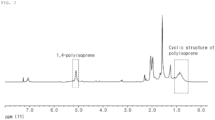
- a polyisoprene polymerized by the preparation method of a liquid rubber of the present invention may include a cyclic structure, and thus, the physical properties such as thermal properties and viscosity properties of the polyisoprene may be changed. This could be confirmed from 1 H NMR spectrum as shown in FIG. 2 .
- a trans-1,4 bond ratio of a 1,3-butadiene unit may be 75% or more, 75% to 90%, or 78% to 90%, a cis-1,4 bond ratio may be 1% or less, and other bonds may be 1,2-bonds.
- the liquid rubber may include a diene-based polymer having a weight average molecular weight of 1,000 g/mol to 20,000 g/mol, and a number average molecular weight of 1,000 g/mol to 6,000 g/mol.
- a weight average molecular weight may be 1,000 g/mol to 20,000 g/mol, 2,000 g/mol to 18,000 g/mol, or 3,000 g/mol to 16,000 g/mol
- a number average molecular weight may be 1,000 g/mol to 6,000 g/mol, 1,500 g/mol to 6,000 g/mol, or 2,000 g/mol to 6,000 g/mol
- molecular weight distribution may be 1.00 to 5.00, 1.20 to 4.50, or 1.50 to 4.20.
- a weight average molecular weight may be 1,000 g/mol to 20,000 g/mol, 3,000 g/mol to 10,000 g/mol, or 5,000 g/mol to 7,000 g/mol
- a number average molecular weight may be 1,000 g/mol to 6,000 g/mol, 1,500 g/mol to 5,000 g/mol, or 2,000 g/mol to 3,000 g/mol
- molecular weight distribution may be 1.00 to 5.00, 2.00 to 4.00, or 2.30 to 3.00.
- the weight average molecular weight and the number average molecular weight are polystyrene converted molecular weights analyzed by gel permeation chromatography (GPC), and the molecular weight distribution is calculated from the ratio of (weight average molecular weight)/(number average molecular weight).
- the liquid rubber may be a random copolymer including a conjugated diene-based monomer unit and an aromatic vinyl-based monomer unit, or a block copolymer including a poly conjugated diene block and a poly aromatic vinyl-based block.
- the aromatic vinyl-based monomer may be the same as the above-described aromatic vinyl-based monomer.
- the random copolymer including the conjugated diene-based monomer unit and the aromatic vinyl-based monomer unit may be a polystyrene-rand-polyisoprene copolymer, and in this case, a weight average molecular weight may be 1,000 g/mol to 20,000 g/mol, 3,000 g/mol to 10,000 g/mol, or 5,000 g/mol to 7,000 g/mol, a number average molecular weight may be 1,000 g/mol to 6,000 g/mol, 1,500 g/mol to 5,000 g/mol, or 2,000 g/mol to 3,000 g/mol, and molecular weight distribution may be 1.00 to 5.00, 2.00 to 4.00, or 2.30 to 3.00.
- the block copolymer including the poly conjugated diene block and the poly aromatic vinyl-based block may be a polystyrene-b-polyisoprene block copolymer, and in this case, a weight average molecular weight may be 1,000 g/mol to 20,000 g/mol, 2,000 g/mol to 20,000 g/mol, or 2,400 g/mol to 20,000 g/mol, a number average molecular weight may be 1,000 g/mol to 6,000 g/mol, 1,000 g/mol to 5,000 g/mol, or 1,100 g/mol to 2,700 g/mol, and molecular weight distribution may be 1.00 to 5.00, 2.00 to 4.00, or 2.00 to 2.50.
- a structure by 1,2-addition reaction may be partially formed in addition to a trans-1,4 bond in the conjugated diene-based monomer unit, and in this case, as shown in Reaction 1, a cyclic structure may be formed between 1,2-added monomer units due to tertiary carbocation formed during polymerization, and accordingly, the polystyrene-rand-polyisoprene copolymer and polystyrene-b-polyisoprene block copolymer, polymerized by the preparation method of a liquid rubber of the present invention may include a cyclic structure. This could be confirmed in 1 H NMR spectrum as shown in FIG. 3 .
- Trans-1,4 bond content (mol%) (trans-1,4 bond content (mol))/(total content of conjugated diene bond produced (mol)) x 100 [Table 5] Division Example 1-1 1-2 1-3 1-4 1-5 Molecu lar weight Mn (g/mol) 2, 146 5, 622 2, 632 2,562 3,784 Mw (g/mol) 3,377 14,566 8,592 7,293 15,727 PDI 1.57 2.59 3.26 2.84 4.15 Bond type trans-1,4 bond content (mol%) >98 >98 >98 >98 >98 cis-1,4 bond content (mol%) ⁇ 1 ⁇ 1 ⁇ 1 ⁇ 1 1,2-unit bond content (mol%) ⁇ 1 ⁇ 1 ⁇ 1 ⁇ 1 ⁇ 1 Polymer state at room temperature Liquid Liquid Liquid Liquid Liquid [Table 6] Division Comparative Example 1-1 1-2 1-3 Molecular weight Mn (g/mol) 42, 940 21, 944 - Mw (g/mol) 48,310 31,
Landscapes
- Chemical & Material Sciences (AREA)
- Health & Medical Sciences (AREA)
- Chemical Kinetics & Catalysis (AREA)
- Medicinal Chemistry (AREA)
- Polymers & Plastics (AREA)
- Organic Chemistry (AREA)
- Engineering & Computer Science (AREA)
- Materials Engineering (AREA)
- Inorganic Chemistry (AREA)
- Addition Polymer Or Copolymer, Post-Treatments, Or Chemical Modifications (AREA)
- Polymerization Catalysts (AREA)
- Graft Or Block Polymers (AREA)
Abstract
Description
- The present application claims the benefit of priority based on
Korean Patent Application No. 10-2020-0061492, filed on May 22, 2020 - The present invention relates to a method for preparing liquid rubber using cationic polymerization, and liquid rubber prepared therefrom.
- Oils which are conventionally used petroleum-based plasticizers, have a phthalate or aromatic structure, a small molecular weight and volatility, and accordingly, may be evaporated during compounding of rubber or discharged by bleeding or blooming phenomenon from rubber products during storing for a long time after compounding, and thus, the physical properties of rubber products may be changed. Particularly, in case of using a corresponding rubber in tires, etc., the oils are discharged together with the rubber due to the abrasion of the tires, and there are problems adversely affecting environments.
- In this regard, recently, liquid rubber receives attention as a plasticizer. This is used as a substitute for a process oil for compounding rubber, and improves the processability of the rubber while being present in a stable state through vulcanization with solid rubber. In addition, the liquid rubber added like this is known to assist the enhancement of the physical properties of the rubber, together with the solid rubber.
- Such liquid rubber may be generally prepared through ion polymerization, radical polymerization or coordination polymerization. Recently, as a method for preparing solid rubber, anionic polymerization and coordination polymerization are mostly used, and in order to prepare liquid rubber having a low molecular weight, a method of using an excessive amount of a catalyst when compared to the conventional polymerization is mostly used. However, when preparing liquid rubber, the control of heat generated at an initial stage of polymerization reaction is difficult due to the excessive amount of the catalyst, and there are problems of degrading the physical properties of the liquid rubber prepared. In addition, when preparing the liquid rubber, continuous polymerization is difficult to perform, and batch polymerization or semi-batch polymerization is mostly used, and it is difficult to increase the productivity. In addition, when preparing the liquid rubber, a large amount of the catalyst is required, and catalyst cost might increase, production cost might increase, and a large amount of the catalyst might remain in the liquid rubber prepared, resulting in difficult problems of insufficient removal of the catalyst.
- Meanwhile, to solve such problems, a method of preparing rubber having a low molecular weight through scission by oxidation of rubber has been suggested, but it is not each to reduce the molecular weight to a constant molecular weight, and rubber prepared thereby mostly showed high molecular weight distribution (PDI), and accordingly, there are difficult issues in expressing desired physical properties.
- (Patent Document 1)
KR10-2017-0068486A - The present invention is devised to solve the problems of the conventional technique and an object is to provide a method for preparing a liquid rubber of a low molecular weight, having a high 1,4-trans bond ratio, from a very small amount of a catalyst composition by using cationic polymerization.
- In addition, another object of the present invention is to provide a liquid rubber of a low molecular weight, prepared by the preparation method of a liquid rubber and having a high 1,4-trans bond ratio.
- In order to solve the above-described tasks, the present invention provides a method for preparing a liquid rubber, including performing polymerization reaction of a conjugated diene-based monomer in the presence of an organic solvent and a catalyst composition (S10), wherein the catalyst composition includes a catalyst including a compound represented by the following Formula 1:

- in Formula 1, R is an alkyl group of 1 to 12 carbon atoms, R1 to R4 are each independently hydrogen, a halogen group, or a substituted or unsubstituted alkyl group of 1 to 20 carbon atoms, and o, p, q and r are each independently an integer of 1 to 5.
- In addition, the present invention provides a liquid rubber including a conjugated diene-based monomer unit solely, or a conjugated diene-based monomer unit and an aromatic vinyl-based monomer unit, wherein a number average molecular weight is less than 100,000 g/mol, the liquid rubber is present in a liquid state at room temperature (23°C ± 3°C), and in case of comprising the conjugated diene-based monomer unit solely, a trans-1,4 bond ratio of the conjugated diene-based monomer unit is 75% or more, a cis-1,4 bond ratio is 1% or less, and other bonds are 1,2-bonds.
- In case of preparing a liquid rubber using cationic polymerization according to the preparation method of a liquid rubber of the present invention, a liquid rubber of a low molecular weight, having a high 1,4-trans bond ratio may be prepared from a very small amount of a catalyst composition.
-
-
FIG. 1 is a 13C spectrum of a liquid rubber including a polyisoprene polymer according to an embodiment of the present invention. -
FIG. 2 is a 1H NMR spectrum of a liquid rubber including a polyisoprene polymer according to an embodiment of the present invention. -
FIG. 3 is a 1H NMR spectrum of a liquid rubber including a polystyrene-b-polyisoprene copolymer and a polystyrene-rand-polyisoprene copolymer according to an embodiment of the present invention. - Hereinafter, the present invention will be described in more detail in order to assist the understanding of the present invention.
- It will be understood that words or terms used in the description and claims of the present invention shall not be interpreted as the meaning defined in commonly used dictionaries. It will be further understood that the words or terms should be interpreted as having a meaning that is consistent with their meaning of the technical idea of the invention, based on the principle that an inventor may properly define the meaning of the words or terms to best explain the invention.
- The terms used in the present invention may be defined as follows unless otherwise separately defined.
- The term "liquid rubber" in the present invention may mean a polymer of a low molecular weight, showing a rubber phase, or may be a rubber which has a number average molecular weight of less than 100,000 g/mol and is present in a liquid phase at room temperature (23°C ± 3°C). Here, the liquid phase means that a rubber shows fluidity as a rubber itself from which a solvent is removed.
- The term "substituted" in the present invention may mean that the hydrogen of a functional group, an atomic group or a compound is substituted with a specific substituent, and in case where the hydrogen of a functional group, an atomic group or a compound is substituted with a specific substituent, one or multiple substituents of two or more may be present according to the number of hydrogen present in the functional group, atomic group or compound, and in case where multiple substituents are present, each substituent may be the same or different.
- The term "monovalent hydrocarbon group" in the present invention may mean a substituent which is monosubstituted with an atomic group including carbon and hydrogen atoms, and in a particular embodiment, may meaning including all of an alkyl group, an alkylene group, an alkynyl group, a cycloalkyl group and an aryl group including carbon and hydrogen atoms.
- The term "alkyl group" in the present invention may mean a monovalent aliphatic saturated hydrocarbon group, and may have meaning including all of a linear alkyl group such as methyl, ethyl, propyl and butyl; a branch type alkyl group such as isopropyl, sec-butyl, tert-butyl and neo-pentyl; and a cyclic saturated hydrocarbon group, or a cyclic unsaturated hydrocarbon group including one or two or more unsaturated bonds.
- The term "monomer unit" used in the present invention may mean a repeating unit formed through the participation of a compound used as a monomer in polymerization reaction, a structure derived therefrom, or the material itself.
- The present invention provides a method for preparing a liquid rubber.
- According to an embodiment of the present invention, the method for preparing a liquid rubber includes performing polymerization reaction of a conjugated diene-based monomer in the presence of an organic solvent and a catalyst composition (S10), wherein the catalyst composition may include a catalyst including a compound represented by Formula 1 below.


- In Formula 1, R may be an alkyl group of 1 to 12 carbon atoms, R1 to R4 may be each independently hydrogen, a halogen group, or a substituted or unsubstituted alkyl group of 1 to 20 carbon atoms, and o, p, q and r may be each independently an integer of 1 to 5.
- According to an embodiment of the present invention, R may be an alkyl group of 1 to 10 carbon atoms, and R1 to R4 may be each independently hydrogen, a halogen group, or a halogen-substituted alkyl group of 1 to 10 carbon atoms.
- In addition, according to an embodiment of the present invention, R may be a methyl group, an ethyl group, a propyl group, an iso-propyl group, a n-butyl group, an isobutyl group or a t-butyl group, and R1 to R4 may be each independently hydrogen, chlorine, bromine, fluorine, iodine or trifluoromethyl.
- In addition, according to an embodiment of the present invention, an organic borate in the compound represented by Formula 1 may be one or more selected from the group consisting of tetrakis(phenyl)borate, tetrakis(pentafluorophenyl)borate, tetrakis[3,5-bis(trifluoromethyl)phenyl]borate and derivatives thereof, and in this case, cationic polymerization of a conjugated diene-based polymer from a very small amount of a catalyst composition is possible, position selectivity on a trans-1,4 bond is high, and the preparation of a liquid rubber having a high trans-1,4 bond ratio is possible.
- In addition, according to an embodiment of the present invention, the catalyst composition may include an aluminum-based cocatalyst.
- The catalyst composition of the present invention is suitable to use for the preparation of a conjugated diene-based polymer by cationic polymerization. In case of the cationic polymerization, it may be important to stabilize a cationic moiety formed during polymerization reaction, the catalyst may, by the sole catalyst or by forming a composite such as a strong Lewis acid through the combination with an aluminum-based cocatalyst, play the role of effectively stabilizing a cationic moiety, and the preparation of a conjugated diene-based polymer of a low molecular weight may be possible.
- According to an embodiment of the present invention, the aluminum-based cocatalyst may be one or more selected from aluminum-based compounds represented by Formula 2 to Formula 4 below.
[Formula 2] (Ra)mAl(Z)3-m


- In Formulae 2 to 4, Ra, R5 and R6 may be each independently a monovalent hydrocarbon group of 1 to 20 carbon atoms, Z may be a halogen group, m may be an integer of 0 to 3, and a and b may be each independently an integer of 1 to 100.
- According to an embodiment of the present invention, in Formulae 2 to 4, Ra, R5 and R6 may be each independently a monovalent hydrocarbon group of 1 to 10 carbon atoms, Z may be a halogen group, m may be an integer of 1 to 3, and a and b may be each independently an integer of 2 to 50.
- In a particular embodiment, in Formula 2, each Ra may be an alkyl group of 1 to 12 carbon atoms, a cycloalkyl group of 3 to 12 carbon atoms or an aryl group of 6 to 12 carbon atoms, preferably, an alkyl group of 1 to 12 carbon atoms, an alkyl group of 1 to 6 carbon atoms, an alkyl group of 1 to 3 carbon atoms, or an ethyl group, Z may preferably be a chlorine atom or a bromine atom, preferably, a chlorine atom, and m may be an integer of 2 or 3, preferably, 3.
- In addition, in a particular embodiment, in Formulae 3 and 4, R5 and R6 may be each independently an alkyl group of 1 to 12 carbon atoms, a cycloalkyl group of 3 to 12 carbon atoms or an aryl group of 6 to 12 carbon atoms.
- According to an embodiment of the present invention, the aluminum-based cocatalyst may be one or more selected from the group consisting of methylaluminoxane, modified methylaluminoxane, trimethylaluminum, triethylaluminum, tri-n-propylaluminum, triisopropylaluminum, tri-n-butylaluminum, triisobutylaluminum, tri-t-butylaluminum, tripentylaluminum, trihexylaluminum, tricyclohexylaluminum, trioctylaluminum, tri-2-ethylhexylaluminum, dimethylaluminum chloride, diethylaluminum chloride, diisopropylaluminum chloride, diisobutylaluminum chloride, dimethylaluminum bromide, methylaluminum dichloride, ethylaluminum dichloride, isopropylaluminum dichloride, aluminum chloride and ethylaluminum dibromide.
- In addition, according to an embodiment of the present invention, the aluminum-based cocatalyst may be one or more aluminoxanes selected from the group consisting of methylaluminoxane (MAO), modified methylaluminoxane (MMAO), ethylaluminoxane, n-propylaluminoxane, isopropylaluminoxane, butylaluminoxane, isobutylaluminoxane, n-pentylaluminoxane, neopentylaluminoxane, n-hexylaluminoxane, n-octylaluminoxane, 2-ethylhexylaluminoxane, cyclohexylaluminoxane, 1-methylcyclopentylaluminoxane, phenylaluminoxane and 2,6-dimethylphenyl aluminoxane.
- In addition, according to an embodiment of the present invention, the modified methylaluminoxane is methylaluminoxane of which methyl group is substituted with a modifier group (R7), particularly, a hydrocarbon group of 2 to 20 carbon atoms, and may particularly be a compound represented by Formula 5 below.

- In Formula 5, R7 is the same as the above-defined R5, c and d may be each independently an integer of 2 or more, and Me represents a methyl group.
- In a particular embodiment, in Formula 5, R7 may be an alkyl group of 2 to 20 carbon atoms, a cycloalkyl group of 3 to 20 carbon atoms, an alkenyl group of 2 to 20 carbon atoms, a cycloalkenyl group of 3 to 20 carbon atoms, an aryl group of 6 to 20 carbon atoms, an arylalkyl group of 7 to 20 carbon atoms, an alkylaryl group of 7 to 20 carbon atoms, an allyl group or an alkynyl group of 2 to 20 carbon atoms, more particularly, an alkyl group of 2 to 10 carbon atoms such as an ethyl group, an isobutyl group, a hexyl group and an octyl group, more particularly, an isobutyl group.
- In a more particular embodiment, in the modified methylaluminoxane, about 50 mol% to 90 mol% of the methyl group of the methylaluminoxane may be substituted with the hydrocarbon group. The modified methylaluminoxane may be prepared by a common method, particularly, using an alkylaluminum other than trimethylaluminum and trimethylaluminum. In this case, the alkylaluminum may be triisobutylaluminum, triethylaluminum, trihexylaluminum, trioctylaluminum, or the like, and among them, any one or a mixture of two or more thereof may be used.
- According to an embodiment of the present invention, when polymerizing a conjugated diene-based monomer, particularly, an isoprene monomer, the isoprene monomer may be bonded to a cationic chain under polymerizing to form a resonance structure, and the additional reaction of cations may be degraded, and it is apprehended that additional polymerization may be performed very slowly, or termination reaction may occur. In view of this, it is important that a catalyst, or a catalyst and a cocatalyst, having high reactivity is selected and used so as to block early termination. The catalyst and cotatalyst, used in the present invention form a composite such as a strong Lewis acid due to the catalyst solely, or the combination of the catalyst and the cocatalyst, and a catalyst system may show high activity during polymerizing the conjugated diene-based monomer, and accordingly, a liquid rubber of a low molecular weight, having a high 1,4-trans bond ratio may be prepared from a very small amount of a catalyst composition.
- According to an embodiment of the present invention, a weight ratio of the catalyst including the compound represented by Formula 1 and the aluminum-based cocatalyst may be 1:0.1 to 1:50, 1:0.2 to 1:30, 1:0.5 to 1:8, or 1:1 to 1:10, and within this range, catalyst activation through the cocatalyst may be sufficiently carried out, and cationic polymerization may be efficiently performed.
- In addition, according to an embodiment of the present invention, the catalyst composition may include a solvent. In a particular embodiment, the solvent may be a halogenated hydrocarbon solvent, in a more particular embodiment, may be one or more selected from the group consisting of chloromethane, dichloromethane, trichloromethane, 1-chlorobutane and chlorobenzene.
- According to an embodiment of the present invention, step (S10) is a step for performing cationic polymerization of a conjugated diene-based monomer from the catalyst composition, and the conjugated diene-based monomer may be one or more selected from the group consisting of 1,3-butadiene, 2,3-dimethyl-1,3-butadiene, piperylene, 3-butyl-1,3-octadiene, isoprene and 2-phenyl-1,3-butadiene. In a particular embodiment, the conjugated diene-based monomer may be 1,3-butadiene or isoprene, in a more particular embodiment, may be isoprene.
- According to an embodiment of the present invention, the organic solvent may be a nonpolar organic solvent, a polar aprotic solvent, or a mixture thereof. In another embodiment, the organic solvent may be a hydrocarbon solvent, a halogenated hydrocarbon solvent or a mixture thereof.
- According to an embodiment of the present invention, the hydrocarbon solvent may be an aliphatic hydrocarbon solvent or an aromatic hydrocarbon solvent, in a particular embodiment, the aliphatic hydrocarbon solvent may be one or more selected from the group consisting of butane, pentane, neopentane, hexane, cyclohexane, methylcyclohexane, heptane, and octane. The aromatic hydrocarbon solvent may be one or more selected from the group consisting of benzene, toluene, xylene and ethylbenzene.
- In addition, according to an embodiment of the present invention, the halogenated hydrocarbon solvent may be one or more selected from the group consisting of chloromethane, dichloromethane, trichloromethane, 1-chlorobutane and chlorobenzene.
- In case of using a mixture of a hydrocarbon solvent and a halogenated hydrocarbon solvent as an organic solvent in the present invention, a mixing ratio may be 10:1 to 1:10 in a weight ratio, particularly, 5:1 to 1:5 in a weight ratio.
- According to an embodiment of the present invention, the catalyst composition may be 0.1 parts by weight or less, 0.05 parts by weight or less, 0.01 parts by weight to 0.05 parts by weight, or 0.01 parts by weight to 0.02 parts by weight based on 100 parts by weight of the organic solvent and the conjugated diene-based monomer, and within this range, cationic polymerization reaction may be efficiently performed even with a very small amount.
- According to an embodiment of the present invention, the polymerization in step (S10) may be performed at 0°C to 50°C, 10°C to 30°C, 20°C to 30°C, or at room temperature (23±3°C), and within this range, the activity of the catalyst may be excellent, and a molecular weight for preparing a liquid rubber may be secured. In addition, the polymerization in step (S10) may be performed for 10 minutes to 3 hours, 10 minutes to 1 hour, or 20 minutes to 40 minutes.
- In addition, according to an embodiment of the present invention, the polymerization in step (S10) may be performed by including an aromatic vinyl-based monomer. In another embodiment, the preparation method of the liquid rubber may include a step of performing polymerization reaction of an aromatic vinyl-based monomer in the presence of an organic solvent and a catalyst composition (S1), prior to step (S10). The aromatic vinyl-based monomer may be one or more selected from the group consisting of styrene, α-methylstyrene, 3-methylstyrene, 4-methylstyrene, 4-propylstyrene, 1-vinylnaphthalene, 4-cyclohexylstyrene, 4-(p-methylphenyl)styrene and 1-vinyl-5-hexylnaphthalene.
- According to an embodiment of the present invention, in case of performing the polymerization in step (S10) by including the aromatic vinyl-based monomer, the liquid rubber thus prepared may be a random copolymer including a conjugated diene-based monomer unit and an aromatic vinyl-based monomer unit. In case of including the step of performing polymerization reaction of the aromatic vinyl-based monomer in the presence of an organic solvent and a catalyst composition (S1) prior to step (S10), the liquid rubber thus prepared may be a block copolymer including a poly conjugated diene block and a poly aromatic vinyl-based block.
- According to an embodiment of the present invention, in case where the liquid rubber includes the random copolymer or the block copolymer, including the aromatic vinyl-based monomer unit, each copolymer may include 10 wt% to 90 wt%, 20 wt% to 80 wt%, or 30 wt% to 70 wt% of the conjugated diene-based monomer unit, and 10 wt% to 90 wt%, 20 wt% to 80 wt%, or 30 wt% to 70 wt% of the aromatic vinyl-based monomer unit.
- The preparation method of the liquid rubber according to an embodiment of the present invention may include a step of removing the catalyst (S20) after step (S10). According to an embodiment of the present invention, the catalyst composition may be efficiently removed physically through a step of simple filtering and adsorption, and the use and removal thereof is more favorable when compared to the Lewis acid catalyst of the conventional technique.
- According to an embodiment of the present invention, in step (S20), after polymerizing a liquid rubber, the organic solvent may be removed, and the organic solvent may be controlled to 40 wt% or less, 20 wt% or less, or 5 wt% or less of an oligomer or polymer. Then, in case of a polymer having fluidity, a step of filtering and adsorbing an insoluble material may be performed by using a glass filter having 80 mesh or more, 100 mesh or more, or 200 mesh or more. Otherwise, the catalyst may be removed by passing through the polymer having fluidity using a silica, celite or zeolite filter.
- In addition, according to an embodiment of the present invention, in case of a polymer having low fluidity, fluidity is provided using one or more selected from the group consisting of a linear alkyl solvent, for example, pentane, cyclopentane, hexane, cyclohexane, heptane and octane, and an ether solvent, for example, diethyl ether and petroleum ether, and then, a step of filtering and adsorbing through the glass filter, a silica filter, a celite filter or a zeolite filter may be performed.
- In addition, according to an embodiment of the present invention, the polymer polymerized in step (S10) may be dissolved in an organic solvent including pentane, cyclopentane, hexane, cyclohexane, heptane, octane, diethyl ether or petroleum ether, and washed to remove the catalyst.
- In addition, according to an embodiment of the present invention, from the polymer polymerized in step (S10), the catalyst including the compound represented by Formula 1 may be efficiently removed through a simple filtering and adsorption step, and a separate washing step may not be performed.
- In addition, according to an embodiment of the present invention, the preparation method of the liquid rubber may further include a step of drying residual solvents (S30) after step (S20). In a particular embodiment, the drying temperature in step (S30) may be 30°C to 200°C, or 40°C to 150°C, and a vacuum degree may be 300 torr or less, 200 torr or less, or 100 torr or less. Through this, a target liquid rubber may be efficiently obtained.
- In addition, the present invention provides a liquid rubber which is prepared according to the preparation method of a liquid rubber and includes a conjugated diene-based monomer unit. The liquid rubber includes a conjugated diene-based monomer unit solely, or a conjugated diene-based monomer unit and an aromatic vinyl-based monomer unit, has a number average molecular weight of less than 100,000 g/mol, and is present in a liquid state at room temperature (23°C ± 3°C). In case of including the conjugated diene-based monomer unit solely, a trans-1,4 bond ratio of the conjugated diene-based monomer unit may be 75% or more, a cis-1,4 bond ratio may be 1% or less, and other bonds may be 1,2-bonds.
- According to an embodiment of the present invention, the liquid rubber may include a diene-based polymer including a conjugated diene-based monomer unit solely, or a copolymer including a conjugated diene-based monomer unit and an aromatic vinyl-based monomer unit. According to an embodiment of the present invention, the conjugated diene-based monomer may be the same as the above-described conjugated diene-based monomer.
- According to an embodiment of the present invention, a trans-1,4 bond ratio of the conjugated diene-based monomer unit may be 75 mol% or more, a cis-1,4 bond ratio may be 1 mol% or less, and other bonds may be 1,2-bonds.
- According to an embodiment of the present invention, if the conjugated diene-based monomer is isoprene, a trans-1,4 bond ratio of the isoprene unit may be 90 mol% or more, 95 mol% or more, 98 mol% or more, or 98 mol% to 100 mol%. Particularly, if the conjugated diene-based monomer is isoprene, a cis-1,4 bond may not be present in an isoprene unit. This could be confirmed from 13C spectrum as shown in
FIG. 1 . - In addition, according to an embodiment of the present invention, if the conjugated diene-based monomer is isoprene, a structure by 1,2-addition reaction may be partially formed in addition to the trans-1,4 bond, and in this case, as shown in Reaction 1 below, due to tertiary carbocation formed during polymerization, a cyclic structure may be formed between 1,2-added monomer units. Accordingly, a polyisoprene polymerized by the preparation method of a liquid rubber of the present invention may include a cyclic structure, and thus, the physical properties such as thermal properties and viscosity properties of the polyisoprene may be changed. This could be confirmed from 1H NMR spectrum as shown in
FIG. 2 .

- In addition, according to an embodiment of the present invention, if the conjugated diene-based monomer is 1,3-butadiene, a trans-1,4 bond ratio of a 1,3-butadiene unit may be 75% or more, 75% to 90%, or 78% to 90%, a cis-1,4 bond ratio may be 1% or less, and other bonds may be 1,2-bonds.
- In addition, according to an embodiment of the present invention, the liquid rubber may include a diene-based polymer having a weight average molecular weight of 1,000 g/mol to 20,000 g/mol, and a number average molecular weight of 1,000 g/mol to 6,000 g/mol.
- In a particular embodiment, if the conjugated diene-based monomer of the diene-based polymer is isoprene, a weight average molecular weight may be 1,000 g/mol to 20,000 g/mol, 2,000 g/mol to 18,000 g/mol, or 3,000 g/mol to 16,000 g/mol, a number average molecular weight may be 1,000 g/mol to 6,000 g/mol, 1,500 g/mol to 6,000 g/mol, or 2,000 g/mol to 6,000 g/mol, and molecular weight distribution may be 1.00 to 5.00, 1.20 to 4.50, or 1.50 to 4.20.
- In addition, in a particular embodiment, if the conjugated diene-based monomer of the diene-based polymer is 1,3-butadiene, a weight average molecular weight may be 1,000 g/mol to 20,000 g/mol, 3,000 g/mol to 10,000 g/mol, or 5,000 g/mol to 7,000 g/mol, a number average molecular weight may be 1,000 g/mol to 6,000 g/mol, 1,500 g/mol to 5,000 g/mol, or 2,000 g/mol to 3,000 g/mol, and molecular weight distribution may be 1.00 to 5.00, 2.00 to 4.00, or 2.30 to 3.00.
- Here, the weight average molecular weight and the number average molecular weight are polystyrene converted molecular weights analyzed by gel permeation chromatography (GPC), and the molecular weight distribution is calculated from the ratio of (weight average molecular weight)/(number average molecular weight).
- In addition, according to an embodiment of the present invention, if the liquid rubber includes the aromatic vinyl-based unit, the liquid rubber may be a random copolymer including a conjugated diene-based monomer unit and an aromatic vinyl-based monomer unit, or a block copolymer including a poly conjugated diene block and a poly aromatic vinyl-based block. According to an embodiment of the present inventio, the aromatic vinyl-based monomer may be the same as the above-described aromatic vinyl-based monomer.
- In a particular embodiment, the random copolymer including the conjugated diene-based monomer unit and the aromatic vinyl-based monomer unit may be a polystyrene-rand-polyisoprene copolymer, and in this case, a weight average molecular weight may be 1,000 g/mol to 20,000 g/mol, 3,000 g/mol to 10,000 g/mol, or 5,000 g/mol to 7,000 g/mol, a number average molecular weight may be 1,000 g/mol to 6,000 g/mol, 1,500 g/mol to 5,000 g/mol, or 2,000 g/mol to 3,000 g/mol, and molecular weight distribution may be 1.00 to 5.00, 2.00 to 4.00, or 2.30 to 3.00.
- In addition, in a particular embodiment, the block copolymer including the poly conjugated diene block and the poly aromatic vinyl-based block may be a polystyrene-b-polyisoprene block copolymer, and in this case, a weight average molecular weight may be 1,000 g/mol to 20,000 g/mol, 2,000 g/mol to 20,000 g/mol, or 2,400 g/mol to 20,000 g/mol, a number average molecular weight may be 1,000 g/mol to 6,000 g/mol, 1,000 g/mol to 5,000 g/mol, or 1,100 g/mol to 2,700 g/mol, and molecular weight distribution may be 1.00 to 5.00, 2.00 to 4.00, or 2.00 to 2.50.
- In addition, according to an embodiment of the present invention, in the random copolymer and block copolymer, including the aromatic vinyl-based monomer, if the conjugated diene-based monomer is isoprene, a structure by 1,2-addition reaction may be partially formed in addition to a trans-1,4 bond in the conjugated diene-based monomer unit, and in this case, as shown in Reaction 1, a cyclic structure may be formed between 1,2-added monomer units due to tertiary carbocation formed during polymerization, and accordingly, the polystyrene-rand-polyisoprene copolymer and polystyrene-b-polyisoprene block copolymer, polymerized by the preparation method of a liquid rubber of the present invention may include a cyclic structure. This could be confirmed in 1H NMR spectrum as shown in
FIG. 3 . - Hereinafter, the present invention will be described in detail so that a person skilled in the art could easily perform. However, the present invention may be embodied in various different types, and the invention is not limited to the embodiments explained herein.
- In a glove box, 100 mg of [H(Et2O)2][B(C6F5)4] (Ashai Glass Co.) was put together with a magnetic bar in a vial and dissolved in 2 mL of dichloromethane. Then, 3 equivalents of dibutyl ether (purchased from Aldrich) were injected thereto, followed by stirring in vacuum conditions for 30 minutes to prepare a catalyst composition.
- To a 0.5 L, reaction flask dried in a glove box, a magnetic bar was put, and a solvent was injected in an amount described in Table 1 below. Then, isoprene was injected in an amount described in Table 1 below using a syringe, followed by stirring for 10 minutes. Then, the catalyst composition prepared in the Preparation Example was injected into the reaction flask, polymerization reaction was performed at 23°C for 30 minutes, 1 g of methanol was injected to terminate the reaction, and the solvent was removed to obtain a liquid rubber. The yield was calculated from the amount of the liquid rubber obtained in contrast to the amount of the monomer injected.
- To a 0.5 L, reaction flask dried in a glove box, a magnetic bar was put, and a solvent was injected in an amount described in Table 2 below. Then, isoprene was injected in an amount described in Table 2 below using a syringe, followed by stirring for 10 minutes. Then, n-butyllithium as a catalyst was dissolved in the same solvent injected above and injected into the reaction flask, polymerization reaction was performed for 1 hour, 1 g of methanol was injected to terminate the reaction, and the solvent was removed to obtain a liquid rubber. The yield was calculated from the amount of the liquid rubber obtained in contrast to the amount of the monomer injected.
[Table 1] Division Example 1-1 1-2 1-3 1-4 1-53) Solv ent Type Toluen e MC2) Toluen e Toluen e MC2) / Toluene Amount (wt%) 80 80 60 60 60 Mono mer Type IP1) IP1) IP1) IP1) IP1) Amount (wt%) 20 20 40 40 40 Cata lyst Type Prepar ation Exampl e Prepar ation Exampl e Prepar ation Exampl e Prepar ation Exampl e Prepara tion Example Catalyst injection amount (parts by weight) in contrast to 100 parts by weight of monomer 0.01 0.01 0.01 0.02 0.01 Yield (%) >99 >99 >99 >99 >99 1) IP: Isoprene 2) MC: Dichloromethane 3) MC:toluene weight ratio = 1:1 [Table 2] Division Comparative Example 1-1 1-2 1-3 Solvent Type Toluene Hexane MC2) Amount (wt%) 80 80 80 Monomer Type IP1) IP1) IP1) Amount (wt%) 20 20 20 Catalys t Type n-BuLi n-BuLi n-BuLi Catalyst injection amount (parts by 0.01 0.01 0.01 weight) in contrast to 100 parts by weight of monomer Yield (%) 97 15 - 1) IP: Isoprene 2) MC: Dichloromethane - To a 0.5 L, Andrew flask dried in a glove box, a magnetic bar was put, and 1,3-butadiene was injected in an amount described in Table 3 below, followed by condensing at -20°C. Then, a solvent was injected into the Andrew flask in an amount described in Table 3 below using a syringe, followed by stirring while raising the temperature to 23°C. Then, the catalyst composition prepared in the Preparation Example was injected into the Andrew flask, polymerization reaction was performed at 23°C for 60 minutes, 1 g of methanol was injected to terminate the reaction, and the solvent was removed to obtain a liquid rubber. The yield was calculated from the amount of the liquid rubber obtained in contrast to the amount of the monomer injected.
[Table 3] Division Example 2 Solvent Type MC2) Amount (wt%) 80 Monomer Type BD4) Amount (wt%) 20 Catalyst injection amount (parts by weight) in contrast to 100 parts by weight of monomer 0.05 Yield (%) 75 2) MC: Dichloromethane 4) BD: 1,3-butadiene - To a 0.5 L, reaction flask dried in a glove box, a magnetic bar was put, and a solvent was injected in an amount described in Table 4 below. Then, styrene and isoprene were injected in amounts described in Table 4 below using a syringe, followed by stirring for 10 minutes. Then, the catalyst composition prepared in the Preparation Example was injected into the reaction flask, polymerization reaction was performed at 23°C for 10 minutes, 1 g of methanol was injected to terminate the reaction, and the solvent was removed to obtain a liquid rubber. The yield was calculated from the amount of the liquid rubber obtained in contrast to the amount of the monomer injected.
- To a 0.5 L, reaction flask dried in a glove box, a magnetic bar was put, and a solvent was injected in an amount described in Table 4 below. Then, styrene was injected in an amount described in Table 4 below using a syringe, followed by stirring for 10 minutes. Then, the catalyst composition prepared in the Preparation Example was injected into the reaction flask, polymerization reaction was performed at 23°C for 10 minutes, and isoprene was injected in an amount described in Table 4 below using a syringe, followed by stirring for 10 minutes. After that, 1 g of methanol was injected to terminate the reaction, and the solvent was removed to obtain a liquid rubber. The yield was calculated from the amount of the liquid rubber obtained in contrast to the amount of the monomer injected.
[Table 4] Division Example 3-1 3-2 3-3 Solvent Type Toluene MC2) Toluene Amount (wt%) 80 80 80 Monomer Type SM5) SM5) SM5) Amount (wt%) 10 10 10 Type IP1) IP1) IP1) Amount (wt%) 10 10 10 Catalyst injection amount (parts by weight) in contrast to 100 parts by weight of monomer 0.05 0.05 0.05 Yield (%) >99 >99 >99 Copolymer structure6) PS-rand-PIP PS-b-PIP PS-b-PIP 1) IP: Isoprene 2) MC: Dichloromethane 5) SM: Styrene 6) rand is random copolymer, and b is block copolymer - The number average molecular weight, the weight average molecular weight, the molecular weight distribution and the trans-1,4 bond content of each of the liquid rubbers obtained in Examples 1-1 to 1-5 and Comparative Examples 1-1 to 1-3 were measured by the methods below and are shown in Tables 5 and 6.
- Measurement was conducted under gel permeation chromatography (GPC) analysis conditions below, a number average molecular weight (Mn), a weight average molecular weight (Mw), and a peak molecular weight (Mp) were measured, and molecular weight distribution was calculated from the value of (weight average molecular weight)/(number average molecular weight).
- Column: PL MiniMixed B x 2
- Solvent: THF
- Flow rate: 0.3 ml/min
- Specimen concentration: 2.0 mg/ml
- Injection amount: 10 µL
- Column temperature: 40°C
- Detector: Agilent RI detector
- Standard: polystyrene (corrected by a cubic function)
- Data processing: ChemStation
- Each of the liquid rubbers obtained in the Examples and Comparative Examples was dissolved in CDCl3 which is a solvent for measuring NMR, 1H NMR was measured using 500 MHz NMR of Varian Co., and according to the bonding position, a trans-1,4 bond and a cis-1,4 bond were confirmed. According to mathematical Equation 1 below, the trans-1,4 bond content (mol%) was calculated. The cis-1,4 bond content and 1,2-unit bond content of the Comparative Examples were calculated by the same method.
Trans-1,4 bond content (mol%) = (trans-1,4 bond content (mol))/(total content of conjugated diene bond produced (mol)) x 100 [Table 5] Division Example 1-1 1-2 1-3 1-4 1-5 Molecu lar weight Mn (g/mol) 2, 146 5, 622 2, 632 2,562 3,784 Mw (g/mol) 3,377 14,566 8,592 7,293 15,727 PDI 1.57 2.59 3.26 2.84 4.15 Bond type trans-1,4 bond content (mol%) >98 >98 >98 >98 >98 cis-1,4 bond content (mol%) <1 <1 <1 <1 <1 1,2-unit bond content (mol%) <1 <1 <1 <1 <1 Polymer state at room temperature Liquid Liquid Liquid Liquid Liquid [Table 6] Division Comparative Example 1-1 1-2 1-3 Molecular weight Mn (g/mol) 42, 940 21, 944 - Mw (g/mol) 48,310 31,185 - PDI 1.1 1.4 - Bond type trans-1,4 bond content (mol%) 5 4 - cis-1,4 bond content (mol%) 75 76 - 1,2-unit bond content (mol%) 20 20 - Polymer state at room temperature Liquid Liquid - - As shown in Tables 5 and 6, according to the present invention, it could be confirmed that a liquid rubber having high selectivity on a trans-1,4 bond was obtained in a high yield by using a small amount of a catalyst.
- Meanwhile, in case of anionic polymerization using n-butyllithium as in Comparative Examples 1-1 and 1-2, it could be confirmed that the cis-1,4 bond content was very high, and the trans-1,4 bond selectivity was extremely low. In addition, though the same amount of the catalyst was injected in contrast to the Examples, rubbers having a molecular weight of four to twenty times were prepared, and it could be confirmed that in order to prepare a liquid rubber having a similar degree of molecular weight, ten or more times the catalyst is required. Further, in case of injecting ten or more times the catalyst, it is expected that defects on controlling heating due to the catalyst might be generated. In addition, in case of Comparative Example 1-3, polymerization could not be performed on a dichloromethane solvent.
- With respect to the liquid rubber obtained in Example 2, the number average molecular weight, the weight average molecular weight, the molecular weight distribution, the trans-1,4 bond content and the 1,2-unit bond content were measured by the same methods as in Experimental Example 1, and are shown in Table 7 below. Here, the 1,2-unit bond content was calculated from the remaining amount excluding the trans-1,4 bond content and the cis-1,4 bond content from the total content of the conjugated diene bond produced.
[Table 7] Division Example 2 Molecular weight Mn (g/mol) 2,576 Mw (g/mol) 6,678 PDI 2.59 Bond type trans-1,4 bond content (mol%) 78 cis-1,4 bond content (mol%) 0 1,2-unit bond content (mol%) 22 - As shown in Table 7 above, it could be confirmed that a liquid rubber having high selectivity on a trans-1,4 bond could be obtained in a high yield by using a small amount of the catalyst according to the present invention.
- With respect to the liquid rubbers obtained in Examples 3-1 to 3-3, the number average molecular weight, the weight average molecular weight, the molecular weight distribution, and the trans-1,4 bond content were measured by the same methods as in Experimental Example 1, and are shown in Table 8 below.
[Table 8] Division Example 3-1 3-2 3-3 Molecular weight Mn (g/mol) 2,576 2,685 1,195 Mw (g/mol) 6,678 19,544 2,499 PDI 2.59 7.2 2.09 Bond type trans-1,4 bond content (mol%) >98 >98 >98 cis-1,4 bond content (mol%) <1 <1 <1 1,2-unit bond content (mol%) <1 <1 <1 - As shown in Table 8, it could be confirmed that a liquid rubber could be prepared using a small amount of the catalyst according to the present invention.
Claims (3)
- A liquid rubber comprising a conjugated diene-based monomer unit solely, or a conjugated diene-based monomer unit and an aromatic vinyl-based monomer unit, whereina number average molecular weight is less than 100,000 g/mol,the liquid rubber is present in a liquid state at room temperature (23°C ± 3°C), andin case of comprising the conjugated diene-based monomer unit solely, a trans-1,4 bond ratio of the conjugated diene-based monomer unit is 75% or more, a cis-1,4 bond ratio is 1% or less, and other bonds are 1,2-bonds.
- The liquid rubber according to claim 1, wherein the liquid rubber comprises a diene-based polymer having a weight average molecular weight of 1,000 g/mol to 20,000 g/mol, and a number average molecular weight of 1,000 g/mol to 6,000 g/mol.
- The liquid rubber according to claim 1, wherein the liquid rubber is a random copolymer comprising a conjugated diene-based monomer unit and an aromatic vinyl-based monomer unit, or a block copolymer comprising a poly conjugated diene block and a poly aromatic vinyl-based block.
Applications Claiming Priority (3)
| Application Number | Priority Date | Filing Date | Title |
|---|---|---|---|
| KR20200061492 | 2020-05-22 | ||
| PCT/KR2021/004074 WO2021235678A1 (en) | 2020-05-22 | 2021-04-01 | Liquid rubber preparation method and liquid rubber prepared thereby |
| EP21809322.7A EP3981803B1 (en) | 2020-05-22 | 2021-04-01 | Method for preparing liquid rubber |
Related Parent Applications (2)
| Application Number | Title | Priority Date | Filing Date |
|---|---|---|---|
| EP21809322.7A Division EP3981803B1 (en) | 2020-05-22 | 2021-04-01 | Method for preparing liquid rubber |
| EP21809322.7A Division-Into EP3981803B1 (en) | 2020-05-22 | 2021-04-01 | Method for preparing liquid rubber |
Publications (2)
| Publication Number | Publication Date |
|---|---|
| EP4512833A2 true EP4512833A2 (en) | 2025-02-26 |
| EP4512833A3 EP4512833A3 (en) | 2025-05-14 |
Family
ID=78707967
Family Applications (2)
| Application Number | Title | Priority Date | Filing Date |
|---|---|---|---|
| EP25151162.2A Pending EP4512833A3 (en) | 2020-05-22 | 2021-04-01 | Method for preparing liquid rubber and liquid rubber prepared therefrom |
| EP21809322.7A Active EP3981803B1 (en) | 2020-05-22 | 2021-04-01 | Method for preparing liquid rubber |
Family Applications After (1)
| Application Number | Title | Priority Date | Filing Date |
|---|---|---|---|
| EP21809322.7A Active EP3981803B1 (en) | 2020-05-22 | 2021-04-01 | Method for preparing liquid rubber |
Country Status (6)
| Country | Link |
|---|---|
| US (2) | US12415873B2 (en) |
| EP (2) | EP4512833A3 (en) |
| JP (1) | JP7324877B2 (en) |
| KR (1) | KR102682765B1 (en) |
| CN (1) | CN114127143B (en) |
| WO (1) | WO2021235678A1 (en) |
Families Citing this family (1)
| Publication number | Priority date | Publication date | Assignee | Title |
|---|---|---|---|---|
| US11987651B2 (en) * | 2019-08-26 | 2024-05-21 | Lg Chem, Ltd. | Catalyst composition and method for preparing hydrocarbon resin using the same |
Citations (2)
| Publication number | Priority date | Publication date | Assignee | Title |
|---|---|---|---|---|
| KR20170068486A (en) | 2014-10-06 | 2017-06-19 | 스미토모 고무 고교 가부시키가이샤 | Rubber composition for tires, pneumatic tire, and an airless tire |
| KR20200061492A (en) | 2018-11-24 | 2020-06-03 | 최환석 | Smart Accident System |
Family Cites Families (24)
| Publication number | Priority date | Publication date | Assignee | Title |
|---|---|---|---|---|
| JPS61136507A (en) * | 1984-12-07 | 1986-06-24 | Kuraray Co Ltd | Production of trans-conjugated diene oligomer |
| JP3746339B2 (en) * | 1996-11-07 | 2006-02-15 | 三井化学株式会社 | Liquid rubber, liquid rubber composition thereof and vulcanized rubber comprising the composition |
| KR20000037531A (en) | 1998-12-01 | 2000-07-05 | 정몽혁 | Process for preparing cis-1,4-polybutadiene |
| JP4040792B2 (en) | 1999-06-01 | 2008-01-30 | 株式会社日本触媒 | Cationic polymerization method and catalyst used therefor |
| US6417270B1 (en) * | 2001-01-09 | 2002-07-09 | Firestone Polymers, Llc | Means of producing high diblock content thermoplastic elastomers with functional termination |
| WO2003064484A1 (en) * | 2002-01-28 | 2003-08-07 | Dow Global Technologies Inc. | Metal complex compositions based on cobalt and their use as polymerization catalyst for olefins and dienes |
| JP4389646B2 (en) | 2003-04-28 | 2009-12-24 | 宇部興産株式会社 | Method for adjusting molecular weight of trans-1,4-polybutadiene |
| DE102005055819A1 (en) | 2005-11-21 | 2007-05-24 | Basf Ag | Process for the preparation of highly reactive Isobutenhomo- or copolymers from technical C4 hydrocarbon streams using proton acid catalyst complexes |
| DE102005055817A1 (en) | 2005-11-21 | 2007-05-24 | Basf Ag | Process for the preparation of highly reactive isobutene homo- or copolymers by means of boron-containing catalyst complexes |
| US7932316B2 (en) * | 2006-12-30 | 2011-04-26 | Bridgestone Corporation | Processable rubber composition |
| JP5237565B2 (en) * | 2007-02-09 | 2013-07-17 | 株式会社ブリヂストン | Photo-curable liquid rubber composition |
| US8865841B2 (en) | 2009-04-16 | 2014-10-21 | Bridgestone Corporation | Thiol-containing liquid rubber composition |
| CN101812151A (en) * | 2010-05-26 | 2010-08-25 | 中国科学院长春应用化学研究所 | A kind of preparation method of polybutadiene |
| CN103059368A (en) * | 2011-10-21 | 2013-04-24 | 黄宝琛 | Application of low molecule trans-1, 4-polyisoprene wax |
| CN103204973B (en) | 2012-01-12 | 2017-07-25 | 青岛科技大学 | A kind of trans 1,4 polydiene copolymer thing of low molecule amount and its production and use |
| CN102887966B (en) * | 2012-10-30 | 2014-09-03 | 中国科学院长春应用化学研究所 | Rare earth catalysis system and application thereof in preparation of conjugated diene liquid rubber |
| JP6619923B2 (en) | 2013-06-11 | 2019-12-11 | 宇部興産株式会社 | Conjugated diene polymerization catalyst, method for producing conjugated diene polymer using the same, and conjugated diene polymer |
| CN107805288A (en) | 2017-11-06 | 2018-03-16 | 山东玉皇化工有限公司 | A kind of preparation method of low-molecular-weight liquid polydiene |
| CN107915797B (en) | 2017-11-22 | 2019-12-31 | 山东玉皇化工有限公司 | Liquid polybutadiene rubber, epoxidized liquid polybutadiene rubber and preparation method thereof |
| CN108690156A (en) * | 2018-04-28 | 2018-10-23 | 青岛科技大学 | A kind of new method of high monomer conversion ratio synthesis of trans -1,4- polyisoprene |
| CN108440698B (en) * | 2018-04-28 | 2020-10-16 | 中国科学院青岛生物能源与过程研究所 | Preparation method of high trans-1, 4-polyisoprene |
| CN110563861B (en) * | 2018-06-05 | 2022-02-01 | 中国石油天然气股份有限公司 | Epoxy-terminated polydiene hydrocarbon liquid rubber and preparation method thereof |
| US11987651B2 (en) | 2019-08-26 | 2024-05-21 | Lg Chem, Ltd. | Catalyst composition and method for preparing hydrocarbon resin using the same |
| WO2021112617A1 (en) | 2019-12-06 | 2021-06-10 | 주식회사 엘지화학 | Catalyst composition and method for preparing polyisobutene by using same |
-
2021
- 2021-04-01 CN CN202180004448.9A patent/CN114127143B/en active Active
- 2021-04-01 EP EP25151162.2A patent/EP4512833A3/en active Pending
- 2021-04-01 US US17/625,576 patent/US12415873B2/en active Active
- 2021-04-01 JP JP2021571694A patent/JP7324877B2/en active Active
- 2021-04-01 KR KR1020210042782A patent/KR102682765B1/en active Active
- 2021-04-01 EP EP21809322.7A patent/EP3981803B1/en active Active
- 2021-04-01 WO PCT/KR2021/004074 patent/WO2021235678A1/en not_active Ceased
-
2025
- 2025-07-25 US US19/280,883 patent/US20250353937A1/en active Pending
Patent Citations (2)
| Publication number | Priority date | Publication date | Assignee | Title |
|---|---|---|---|---|
| KR20170068486A (en) | 2014-10-06 | 2017-06-19 | 스미토모 고무 고교 가부시키가이샤 | Rubber composition for tires, pneumatic tire, and an airless tire |
| KR20200061492A (en) | 2018-11-24 | 2020-06-03 | 최환석 | Smart Accident System |
Also Published As
| Publication number | Publication date |
|---|---|
| JP2022537911A (en) | 2022-08-31 |
| US20250353937A1 (en) | 2025-11-20 |
| EP3981803A1 (en) | 2022-04-13 |
| EP3981803A4 (en) | 2023-04-19 |
| KR20210144566A (en) | 2021-11-30 |
| EP3981803B1 (en) | 2025-03-05 |
| EP4512833A3 (en) | 2025-05-14 |
| CN114127143A (en) | 2022-03-01 |
| US12415873B2 (en) | 2025-09-16 |
| US20220289875A1 (en) | 2022-09-15 |
| CN114127143B (en) | 2024-02-23 |
| WO2021235678A1 (en) | 2021-11-25 |
| KR102682765B1 (en) | 2024-08-06 |
| JP7324877B2 (en) | 2023-08-10 |
Similar Documents
| Publication | Publication Date | Title |
|---|---|---|
| EP2258730B1 (en) | Catalyst composition | |
| JP5363515B2 (en) | Homopolymerization or copolymerization method of conjugated olefin | |
| RU2658913C1 (en) | Method of manufacturing polymer of conjugated diene, polymer of conjugated diene, rubber mixture and tire | |
| US5610228A (en) | Anionic polymerization initiators containing adducts of cyclic secondary amines and conjugated dienes, and products therefrom | |
| US20250353937A1 (en) | Method for Preparing Liquid Rubber and Liquid Rubber Prepared Therefrom | |
| US6706830B2 (en) | Copolymerization of conjugated dienes with non-conjugated olefins by means of rare earth catalysts | |
| CN101400707B (en) | Polymerization catalyst composition for polymerization of isoprene compound | |
| JP7317840B2 (en) | Process for preparing polyisoprene having predominantly alternating cis-1,4-ALT-3,4 structure in the presence of a catalyst system containing a pyridyl iron complex | |
| JP2000313710A (en) | Catalyst composition | |
| EP3988586B1 (en) | Catalyst composition and method for preparing isobutene-based polymer using same | |
| KR102080427B1 (en) | Bis-imine pyridine complex of lanthanides, catalytic system comprising said bis-imine pyridine complex and process for the (co)polymerization of conjugated dienes | |
| WO2017081638A1 (en) | Vanadium pyridine-imine complex, catalytic system comprising said vanadium pyridine-immine complex and a (co) polymerization process of conjugated dienes | |
| US7056994B2 (en) | Catalyst composition | |
| RU2569674C2 (en) | Heterogeneous catalyst composition for polymerisation of isoprene, method for production and use thereof | |
| CN105683230A (en) | Stereoregular diblock polybutadienes having a 1,4-cis/syndiotactic 1,2 structure from stereospecific polymerization | |
| KR101944141B1 (en) | Oxo-nitrogenated complex of lanthanides, catalytic system comprising said oxo-nitrogenated complex and process for the (co)polymerization of conjugated dienes | |
| US20060058179A1 (en) | Catalyst composition | |
| JP2002187908A (en) | Conjugated diene polymerization catalyst and method for producing conjugated diene polymer | |
| HK1039786A1 (en) | Method for polymerizing conjugated diolefins (dienes) with catalysts based on vanadium compounds in the presence of vinylaromatic solvents | |
| JP2001081143A (en) | Alternating copolymer of conjugated diene monomer and polar vinyl monomer and method for producing alternating copolymer | |
| JPH05194657A (en) | Method for producing butadiene-based polymer | |
| JPH09202813A (en) | Polybutadiene |
Legal Events
| Date | Code | Title | Description |
|---|---|---|---|
| PUAI | Public reference made under article 153(3) epc to a published international application that has entered the european phase |
Free format text: ORIGINAL CODE: 0009012 |
|
| STAA | Information on the status of an ep patent application or granted ep patent |
Free format text: STATUS: REQUEST FOR EXAMINATION WAS MADE |
|
| 17P | Request for examination filed |
Effective date: 20250110 |
|
| AC | Divisional application: reference to earlier application |
Ref document number: 3981803 Country of ref document: EP Kind code of ref document: P |
|
| AK | Designated contracting states |
Kind code of ref document: A2 Designated state(s): AL AT BE BG CH CY CZ DE DK EE ES FI FR GB GR HR HU IE IS IT LI LT LU LV MC MK MT NL NO PL PT RO RS SE SI SK SM TR |
|
| REG | Reference to a national code |
Ref country code: DE Ref legal event code: R079 Free format text: PREVIOUS MAIN CLASS: C08F0004520000 Ipc: C08F0036040000 |
|
| PUAL | Search report despatched |
Free format text: ORIGINAL CODE: 0009013 |
|
| AK | Designated contracting states |
Kind code of ref document: A3 Designated state(s): AL AT BE BG CH CY CZ DE DK EE ES FI FR GB GR HR HU IE IS IT LI LT LU LV MC MK MT NL NO PL PT RO RS SE SI SK SM TR |
|
| RIC1 | Information provided on ipc code assigned before grant |
Ipc: C08F 4/52 20060101ALI20250404BHEP Ipc: C08F 236/10 20060101ALI20250404BHEP Ipc: C08F 136/08 20060101ALI20250404BHEP Ipc: C08F 136/06 20060101ALI20250404BHEP Ipc: C08F 36/04 20060101AFI20250404BHEP |