EP4512780A2 - Wassersparendes adiabatisches sprühsystem - Google Patents
Wassersparendes adiabatisches sprühsystem Download PDFInfo
- Publication number
- EP4512780A2 EP4512780A2 EP24223114.0A EP24223114A EP4512780A2 EP 4512780 A2 EP4512780 A2 EP 4512780A2 EP 24223114 A EP24223114 A EP 24223114A EP 4512780 A2 EP4512780 A2 EP 4512780A2
- Authority
- EP
- European Patent Office
- Prior art keywords
- water
- reverse osmosis
- reject
- storage tank
- osmosis device
- Prior art date
- Legal status (The legal status is an assumption and is not a legal conclusion. Google has not performed a legal analysis and makes no representation as to the accuracy of the status listed.)
- Pending
Links
Images


Classifications
-
- C—CHEMISTRY; METALLURGY
- C02—TREATMENT OF WATER, WASTE WATER, SEWAGE, OR SLUDGE
- C02F—TREATMENT OF WATER, WASTE WATER, SEWAGE, OR SLUDGE
- C02F1/00—Treatment of water, waste water, or sewage
- C02F1/44—Treatment of water, waste water, or sewage by dialysis, osmosis or reverse osmosis
- C02F1/441—Treatment of water, waste water, or sewage by dialysis, osmosis or reverse osmosis by reverse osmosis
-
- B—PERFORMING OPERATIONS; TRANSPORTING
- B67—OPENING, CLOSING OR CLEANING BOTTLES, JARS OR SIMILAR CONTAINERS; LIQUID HANDLING
- B67D—DISPENSING, DELIVERING OR TRANSFERRING LIQUIDS, NOT OTHERWISE PROVIDED FOR
- B67D7/00—Apparatus or devices for transferring liquids from bulk storage containers or reservoirs into vehicles or into portable containers, e.g. for retail sale purposes
- B67D7/06—Details or accessories
- B67D7/80—Arrangements of heating or cooling devices for liquids to be transferred
-
- C—CHEMISTRY; METALLURGY
- C02—TREATMENT OF WATER, WASTE WATER, SEWAGE, OR SLUDGE
- C02F—TREATMENT OF WATER, WASTE WATER, SEWAGE, OR SLUDGE
- C02F1/00—Treatment of water, waste water, or sewage
- C02F1/42—Treatment of water, waste water, or sewage by ion-exchange
-
- C—CHEMISTRY; METALLURGY
- C02—TREATMENT OF WATER, WASTE WATER, SEWAGE, OR SLUDGE
- C02F—TREATMENT OF WATER, WASTE WATER, SEWAGE, OR SLUDGE
- C02F5/00—Softening water; Preventing scale; Adding scale preventatives or scale removers to water, e.g. adding sequestering agents
-
- C—CHEMISTRY; METALLURGY
- C02—TREATMENT OF WATER, WASTE WATER, SEWAGE, OR SLUDGE
- C02F—TREATMENT OF WATER, WASTE WATER, SEWAGE, OR SLUDGE
- C02F9/00—Multistage treatment of water, waste water or sewage
-
- C—CHEMISTRY; METALLURGY
- C02—TREATMENT OF WATER, WASTE WATER, SEWAGE, OR SLUDGE
- C02F—TREATMENT OF WATER, WASTE WATER, SEWAGE, OR SLUDGE
- C02F1/00—Treatment of water, waste water, or sewage
- C02F1/30—Treatment of water, waste water, or sewage by irradiation
- C02F1/32—Treatment of water, waste water, or sewage by irradiation with ultraviolet light
-
- C—CHEMISTRY; METALLURGY
- C02—TREATMENT OF WATER, WASTE WATER, SEWAGE, OR SLUDGE
- C02F—TREATMENT OF WATER, WASTE WATER, SEWAGE, OR SLUDGE
- C02F1/00—Treatment of water, waste water, or sewage
- C02F1/66—Treatment of water, waste water, or sewage by neutralisation; pH adjustment
-
- C—CHEMISTRY; METALLURGY
- C02—TREATMENT OF WATER, WASTE WATER, SEWAGE, OR SLUDGE
- C02F—TREATMENT OF WATER, WASTE WATER, SEWAGE, OR SLUDGE
- C02F2103/00—Nature of the water, waste water, sewage or sludge to be treated
- C02F2103/02—Non-contaminated water, e.g. for industrial water supply
- C02F2103/023—Water in cooling circuits
Definitions
- This invention air-cooled fluid coolers and condensers.
- Air-cooled heat exchangers such as fluid coolers and condensers reject heat to the atmosphere. These devices reject heat by sensible heating of the ambient air; therefore the lowest temperature they can achieve is some temperature above the ambient dry bulb temperature.
- adiabatic cooling the ambient air can be cooled to a temperature approaching the wet bulb temperature. This pre-cooled air is then used to reject heat.
- a dry-cooling heat exchanger can be made smaller (less expensive) or can cool to a lower temperature (more energy efficient) or some combination of the two.
- adiabatic cooling There are two typical ways that adiabatic cooling is performed.
- One way is to cool the air with saturated pads. Thick pads are placed at the inlet to the air-cooled heat exchanger. These pads are saturated with water. When incoming air is drawn across these pads, some of the water is evaporated and the air is cooled. Although these pads are in widespread use, they have several drawbacks. To full saturate the pads, a heavy stream of water needs to be run over the pads. Most of this water is not evaporated and is either sent to drain or recirculated. Sending this water to drain is very inefficient, while recirculation requires another system to treat and periodically drain the water.
- these pads are made of a material that absorbs water and they have a life expectancy of only a few years before needing to be replaced. Furthermore, the pads are left in place year round, even when adiabatic cooling is not used. The pads cause a resistance to air flow and require higher fan horsepower all year round.
- misting nozzles generate small droplets of water that quickly evaporate thus cooling the air. Misting nozzles spray water at a lower rate than water is streamed over the saturated pads, thus there is no need for a recirculation system and less water is used. The nozzles do not cause any resistance to air flow, so fan horsepower is kept at a minimum.
- misting nozzles One issue with misting nozzles is that the minerals that are contained in the spray must pass through the coils and these minerals can cause issues. In a pad system these minerals stay with the excess water that is sent over the pads or is trapped on the pads themselves.
- soft water or softened water must be used with misting nozzles. If hard water is sprayed, scale can form at the nozzles and on the coils. To minimize this problem many manufacturers severely limit the number of hours that the adiabatic sprays can be run each year. Scaling can be avoided by using softened water. Softening replaces the +2 valance cations in the water with sodium. Sodium salts are highly soluble and thus will not form a scale. The concern with softened water is that all of the anions that were present in the hard water are still present in the softened waters. These anions, particularly chloride, sulfate, and hydroxide, can be very corrosive to the coils and fins. This is particularly true if the salts are allowed to stay on the coils for extended period of time. To minimize these corrosion effects many manufacturers limit the number of hours that the adiabatic sprays can be run each year with softened water.
- RO reverse osmosis
- This invention provides a method to use softened water for adiabatic cooling without severely limiting the hours of operation each year.
- softened water may be used to provide adiabatic cooling over extended hours, with a periodic reverse osmosis "RO" flush of the coils.
- the RO-reject stream from generating the pure water for the RO flush may be combined with softened water and used for adiabatic cooling thus using the RO-reject water for cooling instead of discarding.
- no softened water is used directly.
- the cooling system operates with RO-reject water for the spray, while storing the RO-purified water ("RO-permeate"). The system then switches to RO-pure with additional flow added to flush the coil while RO-reject is stored. In both of these embodiments no RO-reject is discarded.
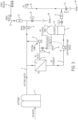
- FIG. 1 illustrates one embodiment of the invention.
- tap water or different source water is sent to a softener 3.
- the softener is only necessary if the source water is moderately hard or harder.
- the softener operates by ion exchange to replace calcium and magnesium ions in the source water with sodium ions.
- the softened water 5 is then fed to a reverse osmosis device 7 ("RO").
- the RO 7 shown in Figure 1 is a standard commercially available device that operates on source-water pressure. A more complex RO system with a high pressure pump may be used, but this type of RO system is usually too expensive for an adiabatic system.
- the RO reject water 9 with concentrated minerals is directed to the RO-Reject storage tank 11; the RO permeate 13 is directed to the RO-Permeate storage tank 15.
- a spray pump 17 is connected to receive water from either the RO-Reject storage tank 11 or the RO-Permeate storage tank 15 depending on the position of valves 14 and 16. The spray pump 17 provides flow to the misting nozzles 19 for cooling.
- the nozzles 19 will mist high mineral containing water but not scale-forming water since the scale forming minerals have been removed by softening. Some of the minerals may deposit on the coil and fins and if left could result in corrosion.
- pure mineral free water (RO-Permeate) 13 is periodically used to flush the coil via flush pump 21 removing any minerals that may have deposited on the fins and coils.
- some of this RO permeate water 13 could be sent to the nozzles for additional cooling by opening valve 14 and closing valve 16.
- Both the spray nozzle line 23 and the coil flush line 25 could be configured with a UV system 27 to minimize the potential for the growth of pathogenic bacteria such as Legionellae.
- the system also is configured to allow complete drainage when not in use to eliminate the risk of biological growth in stagnant water or freezing. In this design 100% of the water sent to the RO 7 is utilized either for cooling or flushing the coil.
- the system also is configured to allow complete drainage via valves 14, 16, and 37 and drain 39 when not in use to eliminate the risk of biological growth in stagnant water or freezing.
- FIG 2 illustrates another embodiment of the invention.
- tap water or different source water is sent to a softener 3.
- the softener 3 is only necessary if the source water is moderately hard or harder.
- the softener 3 operates by ion exchange to replace calcium and magnesium ions in the source water with sodium ions.
- the softened water 5 is then fed to a reverse osmosis device 7 ("RO").
- the RO 7 shown in Figure 2 is a standard commercially available device that operates on source-water pressure. A more complex RO system with a high pressure pump may be used, but this type of RO system is usually too expensive for an adiabatic system.
- the RO-Reject water 9 is sent to a storage tank 29 where it combines with additional softened water 5.
- This combined softened/RO reject water 31 is used for cooling by sending to the spray pump 17. Since all of the water has been softened, this water will not result in scaling on the fins.
- the nozzles 19 When operating from the RO-Reject/softened-water tank 29, the nozzles 19 will mist high mineral containing water but not scale-forming water since the scale forming minerals have been removed by softening. Some of the minerals may deposit on the coil and fins and if left could result in corrosion. To prevent this corrosion, pure mineral free water (RO-Permeate) 13 is periodically used to flush the coil.
- RO-Permeate pure mineral free water
- the RO-Permeate water 13 is sent to a pressurized storage tank 33 via low pressure pump 35.
- the pressure in the storage tank 33 may be maintained and/or adjusted via bladder 41, pressure switch 43 and low pressure pump 35. Because storage tank 33 is pressurized, a smaller RO unit can be used and run at night or other times that adiabatic cooling is unnecessary. Periodically this RO-permeate water 13 is used to flush the coils removing any minerals that may have deposited on the fins and coils.
- Both the spray nozzle line 23 and the coil flush line 25 may be configured with a UV system 27 to minimize the potential for the growth of pathogenic bacteria such as Legionella.
- the system also is configured to allow complete drainage via valves 37 and 38 and drains 39 when not in use to eliminate the risk of biological growth in stagnant water or freezing. In this design not only is 100% of the water sent to the RO used either cooling or flushing, but fewer systems or smaller RO units are needed as the RO-permeate water 13 is used only to flush the coils.
- FIG 3 illustrates another embodiment of the invention. This embodiment is similar to the one in Figure 2 except that the RO-reject water 9 is sent to drain 39.
- the system can be greatly simplified as the RO-reject/softened-water storage tank 29 and float control valve 32 ( Fig. 2 ) can be eliminated.
- the disadvantage is that the RO-reject water is discarded. Some of the reject water can be recovered if the RO is operated when the spray pump 17 is energized.
- an auxiliary pump 47 or aspiration and additional drain valve 40 the RO-reject water 9 could be combined with the softened water 5 and used for cooling.
- the fundamental problem that is corrected by this invention is the corrosion of fins and coils caused by extensive use of softened water.
- aluminum and aluminum alloys are extensively used in air-cooled heat exchangers.
- Aluminum is very sensitive to pH both high and low (amphoteric).
- For corrosion protection often the aluminum is coated which adds cost, reduces heat transfer, and is still subject to corrosion at the inevitable holidays in the coating.
- Aluminum is very resilient to aqueous corrosion at near neutral pH. If the water leaving the softener is not near neutral (5 to 8.5) then that water must be pH adjusted before use. Fortunately most water used for adiabatic cooling will fall within this pH guideline.
- Aluminum is also subject to corrosion by salts that have dried on the surface. Most of these salts are hygroscopic and will absorb sufficient moisture from the atmosphere when the relative humidity is greater than 60%. Thus corrosion can occur even in seemingly dry conditions.
- Another embodiment of this invention is a method for determining how often to flush the coil.
Landscapes
- Engineering & Computer Science (AREA)
- Life Sciences & Earth Sciences (AREA)
- Hydrology & Water Resources (AREA)
- Environmental & Geological Engineering (AREA)
- Water Supply & Treatment (AREA)
- Chemical & Material Sciences (AREA)
- Organic Chemistry (AREA)
- Mechanical Engineering (AREA)
- Separation Using Semi-Permeable Membranes (AREA)
- Preventing Corrosion Or Incrustation Of Metals (AREA)
Applications Claiming Priority (3)
| Application Number | Priority Date | Filing Date | Title |
|---|---|---|---|
| US201662342717P | 2016-05-27 | 2016-05-27 | |
| PCT/US2017/034989 WO2017205869A1 (en) | 2016-05-27 | 2017-05-30 | Water-savings adiabatic spray system |
| EP17803751.1A EP3464166B1 (de) | 2016-05-27 | 2017-05-30 | Wassersparendes adiabatisches sprühsystem |
Related Parent Applications (1)
| Application Number | Title | Priority Date | Filing Date |
|---|---|---|---|
| EP17803751.1A Division EP3464166B1 (de) | 2016-05-27 | 2017-05-30 | Wassersparendes adiabatisches sprühsystem |
Publications (2)
| Publication Number | Publication Date |
|---|---|
| EP4512780A2 true EP4512780A2 (de) | 2025-02-26 |
| EP4512780A3 EP4512780A3 (de) | 2025-04-09 |
Family
ID=65205327
Family Applications (2)
| Application Number | Title | Priority Date | Filing Date |
|---|---|---|---|
| EP17803751.1A Active EP3464166B1 (de) | 2016-05-27 | 2017-05-30 | Wassersparendes adiabatisches sprühsystem |
| EP24223114.0A Pending EP4512780A3 (de) | 2016-05-27 | 2017-05-30 | Wassersparendes adiabatisches sprühsystem |
Family Applications Before (1)
| Application Number | Title | Priority Date | Filing Date |
|---|---|---|---|
| EP17803751.1A Active EP3464166B1 (de) | 2016-05-27 | 2017-05-30 | Wassersparendes adiabatisches sprühsystem |
Country Status (5)
| Country | Link |
|---|---|
| EP (2) | EP3464166B1 (de) |
| CN (1) | CN109311655B (de) |
| DK (1) | DK3464166T3 (de) |
| ES (1) | ES3014659T3 (de) |
| PL (1) | PL3464166T3 (de) |
Family Cites Families (9)
| Publication number | Priority date | Publication date | Assignee | Title |
|---|---|---|---|---|
| US4160727A (en) * | 1976-02-21 | 1979-07-10 | Foremost-Mckesson, Inc. | Method and apparatus utilizing staged reverse osmosis units for purifying and dispensing water |
| US5536411A (en) * | 1994-11-10 | 1996-07-16 | Bassai Limited | Water and energy recovery process for an ice rink |
| CN102159898B (zh) * | 2009-12-10 | 2015-07-01 | 达纤膜系统株式会社 | 热交换器的冷却方法 |
| US20110192179A1 (en) * | 2010-02-05 | 2011-08-11 | Freije Iii William F | Evaporative heat transfer system and method |
| US8206581B2 (en) * | 2010-04-05 | 2012-06-26 | Thomas E. Richetti | High efficiency reverse osmosis system |
| CN202254522U (zh) * | 2011-09-06 | 2012-05-30 | 湖北东橙新能源科技有限公司 | 中央空调热泵机组风冷式冷凝器软化水喷淋降温装置 |
| US9475717B2 (en) * | 2012-08-23 | 2016-10-25 | Total Water Treatment Systems, Inc. | Water purification system engineered for legionella control in industrial and commercial water systems |
| CN203550645U (zh) * | 2013-09-18 | 2014-04-16 | 宁波大学 | 蒸发冷却器 |
| JP5896331B1 (ja) * | 2014-09-05 | 2016-03-30 | クリタ・ケミカル関東株式会社 | 冷房補助装置及び冷房補助方法 |
-
2017
- 2017-05-30 EP EP17803751.1A patent/EP3464166B1/de active Active
- 2017-05-30 EP EP24223114.0A patent/EP4512780A3/de active Pending
- 2017-05-30 CN CN201780032610.1A patent/CN109311655B/zh active Active
- 2017-05-30 PL PL17803751.1T patent/PL3464166T3/pl unknown
- 2017-05-30 DK DK17803751.1T patent/DK3464166T3/da active
- 2017-05-30 ES ES17803751T patent/ES3014659T3/es active Active
Also Published As
| Publication number | Publication date |
|---|---|
| EP4512780A3 (de) | 2025-04-09 |
| CN109311655A (zh) | 2019-02-05 |
| PL3464166T3 (pl) | 2025-04-28 |
| CN109311655B (zh) | 2022-06-21 |
| EP3464166A1 (de) | 2019-04-10 |
| EP3464166A4 (de) | 2020-01-01 |
| DK3464166T3 (da) | 2025-03-24 |
| ES3014659T3 (en) | 2025-04-23 |
| EP3464166B1 (de) | 2024-12-25 |
Similar Documents
| Publication | Publication Date | Title |
|---|---|---|
| US12264088B2 (en) | Water-savings adiabatic spray system | |
| US20220333868A1 (en) | Evaporative cooling system with liquid-to-air membrane energy exchanger | |
| ES2707605T3 (es) | Tratamiento de agua usando una membrana bipolar | |
| JP5918110B2 (ja) | 取水装置及び取水方法 | |
| JP5959135B2 (ja) | 取水装置及び取水方法 | |
| US20090235954A1 (en) | Method and a washing system for washing turbines | |
| EP2754644A1 (de) | Dampfrezirkulations-Kühlwassersystem, Verfahren zum Betrieb eines Dampfrezirkulations-Kühlwassersystems und Verfahren zum Betrieb eines Wasserentionisierungssystems | |
| US20130105406A1 (en) | Evaporative recirculation cooling water system, method of operating an evaporative recirculation cooling water system | |
| JP5896331B1 (ja) | 冷房補助装置及び冷房補助方法 | |
| CN211595337U (zh) | 零排污增容的开路循环冷却水系统 | |
| TWI533924B (zh) | 水處理系統以及水處理方法 | |
| CN202193694U (zh) | 复合式海水淡化装置 | |
| KR102010998B1 (ko) | 항온항습기의 에너지 절감을 위한 전극봉 가습기 스케일 방지 장치 및 그 방법 | |
| EP3464166B1 (de) | Wassersparendes adiabatisches sprühsystem | |
| CN104496069A (zh) | 锅炉补给水纯化系统 | |
| JP6986846B2 (ja) | 冷却システム及び冷却方法 | |
| CN108159868B (zh) | 一种脱硫废水与烟囱白烟羽协同处理系统 | |
| CN202133050U (zh) | 闭式蒸发制冷冷水机组 | |
| JP2013029289A (ja) | 熱交換器の冷却装置および熱交換器の冷却方法 | |
| CN102786175B (zh) | 船舶潮流能自供给循环系统 | |
| CN201031156Y (zh) | 一种海水淡化装置 | |
| JP2004132664A (ja) | 水蒸気圧縮冷凍機の用水処理システム | |
| CN204384988U (zh) | 锅炉补给水纯化系统 | |
| JP2020134045A (ja) | 室外機冷却補助装置 | |
| CN116444061A (zh) | 一种用于冷却水循环系统的清洁近零排放组件 |
Legal Events
| Date | Code | Title | Description |
|---|---|---|---|
| PUAI | Public reference made under article 153(3) epc to a published international application that has entered the european phase |
Free format text: ORIGINAL CODE: 0009012 |
|
| STAA | Information on the status of an ep patent application or granted ep patent |
Free format text: STATUS: THE APPLICATION HAS BEEN PUBLISHED |
|
| AC | Divisional application: reference to earlier application |
Ref document number: 3464166 Country of ref document: EP Kind code of ref document: P |
|
| AK | Designated contracting states |
Kind code of ref document: A2 Designated state(s): AL AT BE BG CH CY CZ DE DK EE ES FI FR GB GR HR HU IE IS IT LI LT LU LV MC MK MT NL NO PL PT RO RS SE SI SK SM TR |
|
| REG | Reference to a national code |
Ref country code: DE Ref legal event code: R079 Free format text: PREVIOUS MAIN CLASS: C02F0001440000 Ipc: B67D0007800000 |
|
| PUAL | Search report despatched |
Free format text: ORIGINAL CODE: 0009013 |
|
| AK | Designated contracting states |
Kind code of ref document: A3 Designated state(s): AL AT BE BG CH CY CZ DE DK EE ES FI FR GB GR HR HU IE IS IT LI LT LU LV MC MK MT NL NO PL PT RO RS SE SI SK SM TR |
|
| RIC1 | Information provided on ipc code assigned before grant |
Ipc: C02F 1/42 20230101ALN20250305BHEP Ipc: C02F 1/66 20230101ALN20250305BHEP Ipc: C02F 1/32 20230101ALN20250305BHEP Ipc: F28C 3/08 20060101ALN20250305BHEP Ipc: C02F 1/44 20230101ALI20250305BHEP Ipc: F25D 3/00 20060101ALI20250305BHEP Ipc: B67D 7/80 20100101AFI20250305BHEP |
|
| STAA | Information on the status of an ep patent application or granted ep patent |
Free format text: STATUS: REQUEST FOR EXAMINATION WAS MADE |
|
| 17P | Request for examination filed |
Effective date: 20251009 |