EP4510184A1 - Anschlusselement und leistungshalbleitermodulanordnung mit einem anschlusselement - Google Patents
Anschlusselement und leistungshalbleitermodulanordnung mit einem anschlusselement Download PDFInfo
- Publication number
- EP4510184A1 EP4510184A1 EP23192162.8A EP23192162A EP4510184A1 EP 4510184 A1 EP4510184 A1 EP 4510184A1 EP 23192162 A EP23192162 A EP 23192162A EP 4510184 A1 EP4510184 A1 EP 4510184A1
- Authority
- EP
- European Patent Office
- Prior art keywords
- section
- terminal element
- width
- substrate
- power semiconductor
- Prior art date
- Legal status (The legal status is an assumption and is not a legal conclusion. Google has not performed a legal analysis and makes no representation as to the accuracy of the status listed.)
- Pending
Links
- 239000004065 semiconductor Substances 0.000 title claims abstract description 62
- 239000000758 substrate Substances 0.000 claims description 60
- 238000005452 bending Methods 0.000 claims description 15
- 238000001465 metallisation Methods 0.000 description 21
- 238000009413 insulation Methods 0.000 description 10
- 239000000919 ceramic Substances 0.000 description 9
- 229910052751 metal Inorganic materials 0.000 description 9
- 239000002184 metal Substances 0.000 description 9
- 239000000463 material Substances 0.000 description 8
- 238000003466 welding Methods 0.000 description 4
- 230000000694 effects Effects 0.000 description 3
- 238000000034 method Methods 0.000 description 3
- 239000000843 powder Substances 0.000 description 3
- 230000000930 thermomechanical effect Effects 0.000 description 3
- 229910017083 AlN Inorganic materials 0.000 description 2
- 229910052581 Si3N4 Inorganic materials 0.000 description 2
- VYPSYNLAJGMNEJ-UHFFFAOYSA-N Silicium dioxide Chemical compound O=[Si]=O VYPSYNLAJGMNEJ-UHFFFAOYSA-N 0.000 description 2
- BQCADISMDOOEFD-UHFFFAOYSA-N Silver Chemical compound [Ag] BQCADISMDOOEFD-UHFFFAOYSA-N 0.000 description 2
- 239000000853 adhesive Substances 0.000 description 2
- 230000001070 adhesive effect Effects 0.000 description 2
- 229910052782 aluminium Inorganic materials 0.000 description 2
- PNEYBMLMFCGWSK-UHFFFAOYSA-N aluminium oxide Inorganic materials [O-2].[O-2].[O-2].[Al+3].[Al+3] PNEYBMLMFCGWSK-UHFFFAOYSA-N 0.000 description 2
- 229910052802 copper Inorganic materials 0.000 description 2
- 239000010949 copper Substances 0.000 description 2
- 229910052593 corundum Inorganic materials 0.000 description 2
- 230000007423 decrease Effects 0.000 description 2
- 230000003292 diminished effect Effects 0.000 description 2
- 230000005669 field effect Effects 0.000 description 2
- 239000002245 particle Substances 0.000 description 2
- 229910000679 solder Inorganic materials 0.000 description 2
- 229910001845 yogo sapphire Inorganic materials 0.000 description 2
- 229910000838 Al alloy Inorganic materials 0.000 description 1
- 229910052582 BN Inorganic materials 0.000 description 1
- PZNSFCLAULLKQX-UHFFFAOYSA-N Boron nitride Chemical compound N#B PZNSFCLAULLKQX-UHFFFAOYSA-N 0.000 description 1
- RYGMFSIKBFXOCR-UHFFFAOYSA-N Copper Chemical compound [Cu] RYGMFSIKBFXOCR-UHFFFAOYSA-N 0.000 description 1
- 229910000881 Cu alloy Inorganic materials 0.000 description 1
- 239000004642 Polyimide Substances 0.000 description 1
- 229910045601 alloy Inorganic materials 0.000 description 1
- 239000000956 alloy Substances 0.000 description 1
- XAGFODPZIPBFFR-UHFFFAOYSA-N aluminium Chemical compound [Al] XAGFODPZIPBFFR-UHFFFAOYSA-N 0.000 description 1
- LTPBRCUWZOMYOC-UHFFFAOYSA-N beryllium oxide Inorganic materials O=[Be] LTPBRCUWZOMYOC-UHFFFAOYSA-N 0.000 description 1
- 238000005219 brazing Methods 0.000 description 1
- 229910052681 coesite Inorganic materials 0.000 description 1
- 239000004020 conductor Substances 0.000 description 1
- PMHQVHHXPFUNSP-UHFFFAOYSA-M copper(1+);methylsulfanylmethane;bromide Chemical compound Br[Cu].CSC PMHQVHHXPFUNSP-UHFFFAOYSA-M 0.000 description 1
- 229910052906 cristobalite Inorganic materials 0.000 description 1
- 230000003247 decreasing effect Effects 0.000 description 1
- 230000032798 delamination Effects 0.000 description 1
- 239000003822 epoxy resin Substances 0.000 description 1
- 229910003465 moissanite Inorganic materials 0.000 description 1
- TWNQGVIAIRXVLR-UHFFFAOYSA-N oxo(oxoalumanyloxy)alumane Chemical compound O=[Al]O[Al]=O TWNQGVIAIRXVLR-UHFFFAOYSA-N 0.000 description 1
- RVTZCBVAJQQJTK-UHFFFAOYSA-N oxygen(2-);zirconium(4+) Chemical compound [O-2].[O-2].[Zr+4] RVTZCBVAJQQJTK-UHFFFAOYSA-N 0.000 description 1
- 229920000647 polyepoxide Polymers 0.000 description 1
- 229920001721 polyimide Polymers 0.000 description 1
- 229920005989 resin Polymers 0.000 description 1
- 239000011347 resin Substances 0.000 description 1
- 229910010271 silicon carbide Inorganic materials 0.000 description 1
- 239000000377 silicon dioxide Substances 0.000 description 1
- HQVNEWCFYHHQES-UHFFFAOYSA-N silicon nitride Chemical compound N12[Si]34N5[Si]62N3[Si]51N64 HQVNEWCFYHHQES-UHFFFAOYSA-N 0.000 description 1
- 229910052709 silver Inorganic materials 0.000 description 1
- 239000004332 silver Substances 0.000 description 1
- 239000007787 solid Substances 0.000 description 1
- 229910052682 stishovite Inorganic materials 0.000 description 1
- 230000007704 transition Effects 0.000 description 1
- 229910052905 tridymite Inorganic materials 0.000 description 1
- 229910001928 zirconium oxide Inorganic materials 0.000 description 1
Images

Classifications
-
- H—ELECTRICITY
- H01—ELECTRIC ELEMENTS
- H01L—SEMICONDUCTOR DEVICES NOT COVERED BY CLASS H10
- H01L23/00—Details of semiconductor or other solid state devices
- H01L23/48—Arrangements for conducting electric current to or from the solid state body in operation, e.g. leads, terminal arrangements ; Selection of materials therefor
- H01L23/488—Arrangements for conducting electric current to or from the solid state body in operation, e.g. leads, terminal arrangements ; Selection of materials therefor consisting of soldered or bonded constructions
- H01L23/498—Leads, i.e. metallisations or lead-frames on insulating substrates, e.g. chip carriers
- H01L23/49811—Additional leads joined to the metallisation on the insulating substrate, e.g. pins, bumps, wires, flat leads
Definitions
- the instant disclosure relates to a terminal element for a power semiconductor module arrangement, and to a semiconductor module arrangement comprising a terminal element.
- Power semiconductor module arrangements often include at least one semiconductor substrate arranged in a housing.
- a semiconductor arrangement including a plurality of controllable semiconductor elements e.g., two IGBTs in a half-bridge configuration
- Each substrate usually comprises a substrate layer (e.g., a ceramic layer), a first metallization layer deposited on a first side of the substrate layer and an optional second metallization layer deposited on a second side of the substrate layer.
- the controllable semiconductor elements are mounted, for example, on the first metallization layer.
- the second metallization layer may optionally be attached to a base plate.
- Electrically conducting elements are usually provided that allow to electrically contact the semiconductor elements from outside of the housing.
- Such electrically conducting elements may include simple terminal elements, for example.
- Terminal elements are generally configured to provide control signals to the substrate and the components mounted thereon.
- the terminal elements are generally soldered, sintered or welded to the substrate.
- the terminal elements and the connections that are formed between the terminal elements and the substrate may be exposed to high thermo-mechanical stress during the operation of the power semiconductor module arrangement. There is a risk that, due to the thermo-mechanical stress, the connections between the terminal elements and the substrate are damaged or even destroyed before the end of the intended lifetime of the power semiconductor module arrangement such that the electrical connection between the terminal elements and the substrate can be diminished or interrupted entirely.
- the lifetime of the power semiconductor module arrangement therefore, may be significantly reduced.
- a terminal element for a power semiconductor module arrangement includes a first end configured to be arranged inside a housing of the power semiconductor module arrangement, a second end configured to be arranged outside of the housing of the power semiconductor module arrangement, a first section and a second section arranged successively between the first end and the second end along a length of the terminal element, and a third section arranged between the first section and the second section, wherein the first section has a first width, the second section extends in a first direction and has a second width that is greater than the first width, and the third section has a width greater than the first width, and extends in a second direction which is angled relative to the first direction.
- a power semiconductor module arrangement includes a housing, a substrate arranged inside the housing, and at least one terminal element, wherein the first end of each of the at least one terminal element is arranged inside the housing and electrically and mechanically coupled to the substrate, and the second end of each of the at least one terminal element extends to the outside of the housing.
- An electrical line or electrical connection as described herein may be a single electrically conductive element, or include at least two individual electrically conductive elements connected in series and/or parallel. Electrical lines and electrical connections may include metal and/or semiconductor material, and may be permanently electrically conductive (i.e., non-switchable).
- a semiconductor body as described herein may be made from (doped) semiconductor material and may be a semiconductor chip or be included in a semiconductor chip. A semiconductor body has electrically connecting pads and includes at least one semiconductor element with electrodes.
- the power semiconductor module arrangement 100 includes a housing 7 and a substrate 10.
- the substrate 10 includes a dielectric insulation layer 11, a (structured) first metallization layer 111 attached to the dielectric insulation layer 11, and a (structured) second metallization layer 112 attached to the dielectric insulation layer 11.
- the dielectric insulation layer 11 is disposed between the first and second metallization layers 111, 112.
- Each of the first and second metallization layers 111, 112 may consist of or include one of the following materials: copper; a copper alloy; aluminum; an aluminum alloy; any other metal or alloy that remains solid during the operation of the power semiconductor module arrangement.
- the substrate 10 may be a ceramic substrate, that is, a substrate in which the dielectric insulation layer 11 is a ceramic, e.g., a thin ceramic layer.
- the ceramic may consist of or include one of the following materials: aluminum oxide; aluminum nitride; zirconium oxide; silicon nitride; boron nitride; or any other dielectric ceramic.
- the dielectric insulation layer 11 may consist of or include one of the following materials: Al 2 O 3 , AlN, SiC, BeO or Si 3 N 4 .
- the substrate 10 may, e.g., be a Direct Copper Bonding (DCB) substrate, a Direct Aluminum Bonding (DAB) substrate, or an Active Metal Brazing (AMB) substrate.
- the substrate 10 may be an Insulated Metal Substrate (IMS).
- An Insulated Metal Substrate generally comprises a dielectric insulation layer 11 comprising (filled) materials such as epoxy resin or polyimide, for example.
- the material of the dielectric insulation layer 11 may be filled with ceramic particles, for example. Such particles may comprise, e.g., SiO 2 , Al 2 O 3 , AlN, or BN and may have a diameter of between about 1 ⁇ m and about 50 ⁇ m.
- the substrate 10 may also be a conventional printed circuit board (PCB) having a non-ceramic dielectric insulation layer 11.
- a non-ceramic dielectric insulation layer 11 may consist of or include a cured resin.
- the substrate 10 is arranged in a housing 7.
- the substrate 10 is arranged on a base plate 12 which forms a ground surface of the housing 7, while the housing 7 itself solely comprises sidewalls and a cover.
- the housing 7 further comprises a ground surface and the substrate 10 and the base plate 12 be arranged inside the housing 7.
- more than one substrate 10 is arranged on a single base plate 12 or on the ground surface of a housing 7.
- the base plate 12 is omitted and the substrate 10 itself forms a ground surface of the housing 7.
- One or more semiconductor bodies 20 may be arranged on the at least one substrate 10.
- Each of the semiconductor bodies 20 arranged on the at least one substrate 10 may include a diode, an IGBT (Insulated-Gate Bipolar Transistor), a MOSFET (Metal-Oxide-Semiconductor Field-Effect Transistor), a JFET (Junction Field-Effect Transistor), a HEMT (High-Electron-Mobility Transistor), and/or any other suitable semiconductor element.
- IGBT Insulated-Gate Bipolar Transistor
- MOSFET Metal-Oxide-Semiconductor Field-Effect Transistor
- JFET Joint Field-Effect Transistor
- HEMT High-Electron-Mobility Transistor
- the one or more semiconductor bodies 20 may form a semiconductor arrangement on the substrate 10.
- the second metallization layer 112 of the substrate 10 in Figure 1 is a continuous layer.
- the first metallization layer 111 is a structured layer in the example illustrated in Figure 1 .
- "Structured layer” means that the first metallization layer 111 is not a continuous layer, but includes recesses between different sections of the layer. Such recesses are schematically illustrated in Figure 1 .
- the first metallization layer 111 in this example includes three different sections. This, however, is only an example. Any other number of sections is possible. Different semiconductor bodies 20 may be mounted to the same or to different sections of the first metallization layer 111.
- Different sections of the first metallization layer 111 may have no electrical connection or may be electrically connected to one or more other sections using electrical connections 3 such as, e.g., bonding wires. Electrical connections 3 may also include connection plates or conductor rails, for example, to name just a few examples.
- the one or more semiconductor bodies 20 may be electrically and mechanically connected to the substrate 10 by an electrically conductive connection layer 30.
- Such an electrically conductive connection layer 30 may be a solder layer, a layer of an electrically conductive adhesive, or a layer of a sintered metal powder, e.g., a sintered silver powder, for example.
- the second metallization layer 112 is a structured layer. It is further possible to omit the second metallization layer 112 altogether. It is generally also possible that the first metallization layer 111 is a continuous layer, for example.
- the power semiconductor module arrangement 100 further includes terminal elements 4. Only two terminal elements 4 are schematically illustrated in Figure 1 .
- a power semiconductor module arrangement 100 generally may include only one or more than two terminal elements 4.
- the terminal elements 4 are electrically connected to the first metallization layer 111 and provide an electrical connection between the inside and the outside of the housing 7.
- the terminal elements 4 may be electrically connected to the first metallization layer 111 with a first end 41, while a second end 42 of each of the at least one terminal element 4 protrudes out of the housing 7.
- Terminal elements 4 may be electrically contacted from the outside at their respective second ends 42.
- a first part of a terminal element 4 may extend through the inside of the housing 7 in a vertical direction y.
- the vertical direction y is a direction perpendicular to a top surface of the substrate 10, wherein the top surface of the substrate 10 is a surface on which the at least one semiconductor body 20 is mounted.
- Terminal elements 4 illustrated in Figure 1 are only examples. Terminal elements 4, for example, may be arranged anywhere within the housing 7. For example, one or more terminal elements 4 may be arranged close to or adjacent to the sidewalls of the housing 7. Terminal elements 4 could also be bent at least once and protrude through the sidewalls of the housing 7 instead of through the cover.
- the first end 41 of a terminal element 4 may be electrically and mechanically connected to the substrate 10 by means of an electrically conductive connection layer, for example (not explicitly illustrated in Figure 1 ).
- an electrically conductive connection layer may be a solder layer, a layer of an electrically conductive adhesive, or a layer of a sintered metal powder, e.g., a sintered silver (Ag) powder, for example.
- a connection between the first end 41 of a terminal element 4 and the substrate 10 may be formed by means of ultrasonic welding.
- the first end 41 of a terminal element 4 may additionally be electrically coupled to the substrate 10 via one or more electrical connections 3, for example.
- the second ends 42 of a terminal element 4 may be connected to a printed circuit board, for example (not illustrated in Figure 1 ).
- a length l4 of a terminal element 4 between its first end 41 and its second end 42 is generally significantly larger than its width w4 and its thickness d4.
- Terminal elements 4 often have a rectangular cross-sectional area, for example.
- each of the at least one terminal element 4 has a length l4 between its first and second end 41, 42 that is at least ten times, at least twenty times, or at least thirty times its width w4.
- a thickness d4 of a terminal element 4 is between 0.2 and 1.8mm (millimeters), e.g., 1mm.
- the terminal elements 4 are comparably thin and have a comparably small width w4, they may still be stiff to a certain degree. That is, the terminal elements 4 may not be bent without effort.
- typical thermo-mechanical stress during the operation of the power semiconductor module arrangement 100 caused in part by varying coefficients of thermal expansion among various power semiconductor module components, there is a risk that the connections formed between the terminal elements 4 and the substrate 10, e.g., due to a non-negligible amount of tensile stress, are damaged or even destroyed during the intended lifetime of the power semiconductor module arrangement 100 such that the electrical connections between the terminal elements 4 and the substrate 10 can be diminished or interrupted entirely.
- This effect may also be referred to as delamination. That is, the lifetime of the power semiconductor module arrangement 100 may be significantly decreased.
- a terminal element 4 comprises a first section 410 and a second section 420 arranged successively between the first end 41 and the second end 42 along a length l4 of the terminal element 4.
- the first section 410 has a first width w410
- the second section 420 has a second width w420 that is greater than the first width w410.
- d4 a uniform thickness of the first section 410 equals a thickness of the second section 420.
- the thickness may vary at different points along the terminal element 4, and/or that the first and second sections 410, 420 have different thicknesses.
- the second section 420 due to its greater width w420, may be comparably stiff as compared to the first section 410 having a smaller width w410. Or, in other words, the first section 410 is somewhat flexible as compared to the second section 420. In this way, less force is introduced into the second section 420 by means of the first section 410 when subject to typical thermos-mechanical stress during the operation of the power semiconductor module arrangement 100.
- the second section 420 may be electrically and mechanically connected to the substrate 10 with a first end, and may be electrically and mechanically connected to the first section 410 with a second end, opposite the first end. That is, the second section 420 may form a connecting element between the first section 410 and the substrate 10.
- the narrower first section 410 is able to somewhat elastically deform and compensate the force to a certain degree. Therefore, the force is not, or at least not entirely transferred to the connection formed between the second section 420 and the substrate 10.
- the effective connection area between the terminal element 4 and the substrate 10, on the other hand, is increased to a certain degree by the increased width w420 of the second section 420.
- This expanded effective connection area decreases the load placed on the connection between the second section 420 and the substrate 10 during operation of the power semiconductor module arrangement 100, which decreases the likelihood that the terminal element 4 will separate from the substrate 10.
- the lifetime of the power semiconductor module arrangement 100 therefore, may be significantly increased, as the larger connection is less likely to fail.
- the width of the terminal element 4 increases rapidly between the first section 410 and the second section 420.
- a sharp step is formed between the first section 410 and the second section 420 such that the width increases abruptly between the first section 410 and the second section 420.
- the second width w420 may be between 1.05 and 3.00 times greater than the first width w410 in order to prevent excessive load on the connection area between the second section 420 and the substrate 10.
- the first width w410 may be between 0.8mm and 6.0mm, depending on module size and/or voltage and current requirements.
- the first width w410 of the first section 410 may be as small as possible.
- the first width w410 may be chosen large enough in order to prevent the first section 410 from breaking or being disrupted during the use of the power semiconductor module arrangement as well as during the process of mounting the terminal element 4 to the substrate 10.
- a length l410 of the first section 410 from the first end 41 towards the second end 42 may be larger than a length l420 of the second section 420 from the second end 42 towards the first end 41.
- the length l410 of the first section 410 may be between two and ten times the length l420 of the second section 420.
- the terminal element 4 further comprises a third section 430 arranged between the first section 410 and the second section 420.
- the third section 430 adjoins the second section 420 via a bending interface 402 (bending interface 402 arranged between second section 420 and third section 430).
- the bending interface 402 and at least a first segment 432 of the third section 430 adjoining the bending interface 402 have the same width w420 as the second section 420, and it therefore follows that the bending interface 402 and at least the first segment 432 of the third section 430 adjoining the bending interface 402 are significantly wider than the width w410 of the first section 410.
- the third section 430 protects the terminal element 4 during the ultrasonic welding process.
- a sonotrode vibrating at high frequency is pressed down upon the upper surface of the second section 420 with a great deal of force, rapidly moving the second section 420 relative to the substrate 10, such that the friction between them causes them to fuse together.
- the pressure from the sonotrode causes the second section 420 to laterally expand relative to the third section 430. This expansion, especially in combination with the rapid vibration imparted to second section 420 by the sonotrode, places a great deal of stress on the bending interface 402 between the second section 420 and the third section 430.
- This bending interface 402 could fracture during the ultrasonic welding process if the bending interface 402 and the first segment 432 of the third section 430 were of a reduced width, for example, the width w410 of the first section 410.
- the same danger is greatly reduced at the interface between third section 430 and first section 410, as this interface is farther away from the second section 420 where the sonotrode-induced expansion and vibration is taking place.
- a second segment 434 of the third section 430 that is arranged between the first segment 432 of the third section 430 and the first section 410 may meander from its interface with the first segment 432 of the third section 430 and its interface with the first section 410.
- the second segment 434 of the third section 430 may curve inwardly at its interface with the first section 410, for example. This, however, is only an example.
- the second segment 434 of the third section 430 may have any other suitable shapes.
- the width of the second segment 434 of the third section 430 may linearly increase from its interface with the first section 410 to its interface with the first segment 432 of the third section 430.
- the third section 430 has a width greater than the first width w410.
- Terminal elements 4 comprising a first section 410, a second section 420, and a third section 430 may be easily stamped out of a large metal sheet, for example.
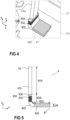
- a terminal element 4 arranged on a substrate 10 is schematically illustrated.
- the terminal element 4 is bent at least once along its length l4.
- the terminal element 4 is bent at the bending interface 402 between the second section 420 and the third section 430 such that the second section 420 adjoining or forming the first end 41 of the terminal element 4 extends in a first direction z, and the third section 430 extends in a second direction y.
- the second direction y is seen to be perpendicular to the first direction z, but of course it is contemplated that the second direction y could also extend at any number of different angles relative to the first direction z, depending upon design requirements of a given power semiconductor module 100.
- the second section 420 may form a connection area of the terminal element 4 that may be connected to the first metal layer 111 of the substrate 10.
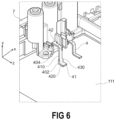
- FIG. 6 a three-dimensional view of a section of a power semiconductor module arrangement 100 is schematically illustrated.
- a terminal element 4 according to embodiments of the disclosure (left side) is schematically illustrated in comparison to a conventional terminal element 4 having a uniform width (right side).
- the connection area between the terminal element 4 illustrated on the left side and the first metallization layer 111 is increased as compared to the connection area between the terminal element 4 illustrated on the right side and the first metallization layer 111, while the first section 410 of the terminal element remains somewhat flexible, thereby reducing the stress introduced into the larger connection area.
- the terminal element 4 may be further bent once along the length l410 of the first section 410 such that a first segment of the first section 410 facing towards the second section 420 extends in the second direction y, and a second segment of the first section 410 adjoining or forming the second end 42 of the terminal element 4 extends in a third direction which is different than the second direction y.
- this third section is seen to extend in the first direction z in parallel to the second section 420, but of course it is contemplated that this third direction could extend in other directions depending upon design requirements of a given power semiconductor module 100.
Landscapes
- Physics & Mathematics (AREA)
- Condensed Matter Physics & Semiconductors (AREA)
- General Physics & Mathematics (AREA)
- Engineering & Computer Science (AREA)
- Computer Hardware Design (AREA)
- Microelectronics & Electronic Packaging (AREA)
- Power Engineering (AREA)
- Structures Or Materials For Encapsulating Or Coating Semiconductor Devices Or Solid State Devices (AREA)
Priority Applications (1)
| Application Number | Priority Date | Filing Date | Title |
|---|---|---|---|
| EP23192162.8A EP4510184A1 (de) | 2023-08-18 | 2023-08-18 | Anschlusselement und leistungshalbleitermodulanordnung mit einem anschlusselement |
Applications Claiming Priority (1)
| Application Number | Priority Date | Filing Date | Title |
|---|---|---|---|
| EP23192162.8A EP4510184A1 (de) | 2023-08-18 | 2023-08-18 | Anschlusselement und leistungshalbleitermodulanordnung mit einem anschlusselement |
Publications (1)
| Publication Number | Publication Date |
|---|---|
| EP4510184A1 true EP4510184A1 (de) | 2025-02-19 |
Family
ID=87760482
Family Applications (1)
| Application Number | Title | Priority Date | Filing Date |
|---|---|---|---|
| EP23192162.8A Pending EP4510184A1 (de) | 2023-08-18 | 2023-08-18 | Anschlusselement und leistungshalbleitermodulanordnung mit einem anschlusselement |
Country Status (1)
| Country | Link |
|---|---|
| EP (1) | EP4510184A1 (de) |
Citations (3)
| Publication number | Priority date | Publication date | Assignee | Title |
|---|---|---|---|---|
| JPH04167378A (ja) * | 1990-10-30 | 1992-06-15 | Matsushita Electric Ind Co Ltd | モールドパワーモジュールの製造方法 |
| US20190304857A1 (en) * | 2016-04-30 | 2019-10-03 | Littelfuse, Inc. | Power Semiconductor Device Module Having Mechanical Corner Press-Fit Anchors |
| JP2021182487A (ja) * | 2020-05-18 | 2021-11-25 | 矢崎総業株式会社 | 基板実装型のコネクタ、及び、コネクタ付き基板 |
-
2023
- 2023-08-18 EP EP23192162.8A patent/EP4510184A1/de active Pending
Patent Citations (3)
| Publication number | Priority date | Publication date | Assignee | Title |
|---|---|---|---|---|
| JPH04167378A (ja) * | 1990-10-30 | 1992-06-15 | Matsushita Electric Ind Co Ltd | モールドパワーモジュールの製造方法 |
| US20190304857A1 (en) * | 2016-04-30 | 2019-10-03 | Littelfuse, Inc. | Power Semiconductor Device Module Having Mechanical Corner Press-Fit Anchors |
| JP2021182487A (ja) * | 2020-05-18 | 2021-11-25 | 矢崎総業株式会社 | 基板実装型のコネクタ、及び、コネクタ付き基板 |
Similar Documents
| Publication | Publication Date | Title |
|---|---|---|
| US11942449B2 (en) | Semiconductor arrangement and method for producing the same | |
| US8405200B2 (en) | Electronic-component-housing package and electronic device | |
| US20190356098A1 (en) | Method for Bonding an Electrically Conductive Element to a Bonding Partner | |
| EP3863045B1 (de) | Leistungshalbleitermodulanordnung und verfahren zur herstellung davon | |
| US11935811B2 (en) | Baseplate for a semiconductor module and method for producing a baseplate | |
| US11282774B2 (en) | Power semiconductor module arrangement | |
| EP4084062A1 (de) | Leistungshalbleitermodulanordnung | |
| EP4510184A1 (de) | Anschlusselement und leistungshalbleitermodulanordnung mit einem anschlusselement | |
| US20230170286A1 (en) | Terminal Element or Bus Bar, and Power Semiconductor Module Arrangement Comprising a Terminal Element or Bus Bar | |
| US11955450B2 (en) | Method for producing a semiconductor arrangement | |
| US12374648B2 (en) | Connecting strip for discrete and power electronic devices | |
| EP4307359A1 (de) | Leistungshalbleitermodulanordnung und verfahren zur herstellung davon | |
| US12463057B2 (en) | Method for producing a base plate | |
| EP4607586A1 (de) | Verfahren und system zum verbinden eines anschlusselements mit einem substrat | |
| EP4345884A1 (de) | Leistungshalbleitermodulanordnung und leiterplatte für eine leistungshalbleitermodulanordnung | |
| EP4372807B1 (de) | Substratanordnung und verfahren zur herstellung einer substratanordnung | |
| EP4421868A1 (de) | Halbleitermodulanordnung | |
| EP4607584A1 (de) | Halbleitermodulanordnung | |
| EP4601000B1 (de) | Leistungshalbleitermodulanordnung und verfahren zu deren herstellung | |
| EP4422358A1 (de) | Substrat | |
| EP4376074A1 (de) | Stromschiene und leistungshalbleitermodulanordnung mit einer stromschiene | |
| EP4411995A1 (de) | Verfahren zur bildung eines anschlusselements, anschlusselement und leistungshalbleitermodulanordnung mit einem anschlusselement | |
| EP4113605A1 (de) | Leistungshalbleitermodulanordnung | |
| CN118299359A (zh) | 半导体装置 |
Legal Events
| Date | Code | Title | Description |
|---|---|---|---|
| PUAI | Public reference made under article 153(3) epc to a published international application that has entered the european phase |
Free format text: ORIGINAL CODE: 0009012 |
|
| STAA | Information on the status of an ep patent application or granted ep patent |
Free format text: STATUS: REQUEST FOR EXAMINATION WAS MADE |
|
| 17P | Request for examination filed |
Effective date: 20240708 |
|
| AK | Designated contracting states |
Kind code of ref document: A1 Designated state(s): AL AT BE BG CH CY CZ DE DK EE ES FI FR GB GR HR HU IE IS IT LI LT LU LV MC ME MK MT NL NO PL PT RO RS SE SI SK SM TR |