EP4509373A2 - System and method for improving windshield glare - Google Patents
System and method for improving windshield glare Download PDFInfo
- Publication number
- EP4509373A2 EP4509373A2 EP24192457.0A EP24192457A EP4509373A2 EP 4509373 A2 EP4509373 A2 EP 4509373A2 EP 24192457 A EP24192457 A EP 24192457A EP 4509373 A2 EP4509373 A2 EP 4509373A2
- Authority
- EP
- European Patent Office
- Prior art keywords
- windshield
- reparative
- wiper blade
- reparative material
- wiping lip
- Prior art date
- Legal status (The legal status is an assumption and is not a legal conclusion. Google has not performed a legal analysis and makes no representation as to the accuracy of the status listed.)
- Pending
Links
Images




Classifications
-
- B—PERFORMING OPERATIONS; TRANSPORTING
- B60—VEHICLES IN GENERAL
- B60J—WINDOWS, WINDSCREENS, NON-FIXED ROOFS, DOORS, OR SIMILAR DEVICES FOR VEHICLES; REMOVABLE EXTERNAL PROTECTIVE COVERINGS SPECIALLY ADAPTED FOR VEHICLES
- B60J3/00—Antiglare equipment associated with windows or windscreens; Sun visors for vehicles
-
- B—PERFORMING OPERATIONS; TRANSPORTING
- B60—VEHICLES IN GENERAL
- B60S—SERVICING, CLEANING, REPAIRING, SUPPORTING, LIFTING, OR MANOEUVRING OF VEHICLES, NOT OTHERWISE PROVIDED FOR
- B60S1/00—Cleaning of vehicles
- B60S1/02—Cleaning windscreens, windows or optical devices
- B60S1/04—Wipers or the like, e.g. scrapers
- B60S1/32—Wipers or the like, e.g. scrapers characterised by constructional features of wiper blade arms or blades
- B60S1/34—Wiper arms; Mountings therefor
- B60S1/3415—Wiper arms; Mountings therefor with means for supplying cleaning fluid to windscreen cleaners, e.g. washers
-
- B—PERFORMING OPERATIONS; TRANSPORTING
- B60—VEHICLES IN GENERAL
- B60S—SERVICING, CLEANING, REPAIRING, SUPPORTING, LIFTING, OR MANOEUVRING OF VEHICLES, NOT OTHERWISE PROVIDED FOR
- B60S1/00—Cleaning of vehicles
- B60S1/02—Cleaning windscreens, windows or optical devices
- B60S1/46—Cleaning windscreens, windows or optical devices using liquid; Windscreen washers
- B60S1/48—Liquid supply therefor
- B60S1/52—Arrangement of nozzles; Liquid spreading means
- B60S1/522—Arrangement of nozzles; Liquid spreading means moving liquid spreading means, e.g. arranged in wiper arms
- B60S1/524—Arrangement of nozzles; Liquid spreading means moving liquid spreading means, e.g. arranged in wiper arms arranged in wiper blades
-
- C—CHEMISTRY; METALLURGY
- C03—GLASS; MINERAL OR SLAG WOOL
- C03C—CHEMICAL COMPOSITION OF GLASSES, GLAZES OR VITREOUS ENAMELS; SURFACE TREATMENT OF GLASS; SURFACE TREATMENT OF FIBRES OR FILAMENTS MADE FROM GLASS, MINERALS OR SLAGS; JOINING GLASS TO GLASS OR OTHER MATERIALS
- C03C17/00—Surface treatment of glass, not in the form of fibres or filaments, by coating
- C03C17/001—General methods for coating; Devices therefor
- C03C17/002—General methods for coating; Devices therefor for flat glass, e.g. float glass
-
- B—PERFORMING OPERATIONS; TRANSPORTING
- B05—SPRAYING OR ATOMISING IN GENERAL; APPLYING FLUENT MATERIALS TO SURFACES, IN GENERAL
- B05D—PROCESSES FOR APPLYING FLUENT MATERIALS TO SURFACES, IN GENERAL
- B05D3/00—Pretreatment of surfaces to which liquids or other fluent materials are to be applied; After-treatment of applied coatings, e.g. intermediate treating of an applied coating preparatory to subsequent applications of liquids or other fluent materials
- B05D3/06—Pretreatment of surfaces to which liquids or other fluent materials are to be applied; After-treatment of applied coatings, e.g. intermediate treating of an applied coating preparatory to subsequent applications of liquids or other fluent materials by exposure to radiation
- B05D3/061—Pretreatment of surfaces to which liquids or other fluent materials are to be applied; After-treatment of applied coatings, e.g. intermediate treating of an applied coating preparatory to subsequent applications of liquids or other fluent materials by exposure to radiation using U.V.
- B05D3/065—After-treatment
- B05D3/067—Curing or cross-linking the coating
-
- B—PERFORMING OPERATIONS; TRANSPORTING
- B05—SPRAYING OR ATOMISING IN GENERAL; APPLYING FLUENT MATERIALS TO SURFACES, IN GENERAL
- B05D—PROCESSES FOR APPLYING FLUENT MATERIALS TO SURFACES, IN GENERAL
- B05D5/00—Processes for applying liquids or other fluent materials to surfaces to obtain special surface effects, finishes or structures
- B05D5/005—Repairing damaged coatings
-
- B—PERFORMING OPERATIONS; TRANSPORTING
- B60—VEHICLES IN GENERAL
- B60S—SERVICING, CLEANING, REPAIRING, SUPPORTING, LIFTING, OR MANOEUVRING OF VEHICLES, NOT OTHERWISE PROVIDED FOR
- B60S1/00—Cleaning of vehicles
- B60S1/02—Cleaning windscreens, windows or optical devices
- B60S1/04—Wipers or the like, e.g. scrapers
- B60S1/0408—Means for influencing the aerodynamic quality of wipers, e.g. clip-on wind deflectors
-
- B—PERFORMING OPERATIONS; TRANSPORTING
- B60—VEHICLES IN GENERAL
- B60S—SERVICING, CLEANING, REPAIRING, SUPPORTING, LIFTING, OR MANOEUVRING OF VEHICLES, NOT OTHERWISE PROVIDED FOR
- B60S1/00—Cleaning of vehicles
- B60S1/02—Cleaning windscreens, windows or optical devices
- B60S1/04—Wipers or the like, e.g. scrapers
- B60S1/32—Wipers or the like, e.g. scrapers characterised by constructional features of wiper blade arms or blades
- B60S1/38—Wiper blades
-
- B—PERFORMING OPERATIONS; TRANSPORTING
- B60—VEHICLES IN GENERAL
- B60S—SERVICING, CLEANING, REPAIRING, SUPPORTING, LIFTING, OR MANOEUVRING OF VEHICLES, NOT OTHERWISE PROVIDED FOR
- B60S1/00—Cleaning of vehicles
- B60S1/02—Cleaning windscreens, windows or optical devices
- B60S1/04—Wipers or the like, e.g. scrapers
- B60S1/32—Wipers or the like, e.g. scrapers characterised by constructional features of wiper blade arms or blades
- B60S1/38—Wiper blades
- B60S1/3806—Means, or measures taken, for influencing the aerodynamic quality of the wiper blades
- B60S1/381—Spoilers mounted on the squeegee or on the vertebra
-
- B—PERFORMING OPERATIONS; TRANSPORTING
- B60—VEHICLES IN GENERAL
- B60S—SERVICING, CLEANING, REPAIRING, SUPPORTING, LIFTING, OR MANOEUVRING OF VEHICLES, NOT OTHERWISE PROVIDED FOR
- B60S5/00—Servicing, maintaining, repairing, or refitting of vehicles
-
- C—CHEMISTRY; METALLURGY
- C03—GLASS; MINERAL OR SLAG WOOL
- C03C—CHEMICAL COMPOSITION OF GLASSES, GLAZES OR VITREOUS ENAMELS; SURFACE TREATMENT OF GLASS; SURFACE TREATMENT OF FIBRES OR FILAMENTS MADE FROM GLASS, MINERALS OR SLAGS; JOINING GLASS TO GLASS OR OTHER MATERIALS
- C03C17/00—Surface treatment of glass, not in the form of fibres or filaments, by coating
- C03C17/28—Surface treatment of glass, not in the form of fibres or filaments, by coating with organic material
- C03C17/32—Surface treatment of glass, not in the form of fibres or filaments, by coating with organic material with synthetic or natural resins
-
- B—PERFORMING OPERATIONS; TRANSPORTING
- B60—VEHICLES IN GENERAL
- B60S—SERVICING, CLEANING, REPAIRING, SUPPORTING, LIFTING, OR MANOEUVRING OF VEHICLES, NOT OTHERWISE PROVIDED FOR
- B60S1/00—Cleaning of vehicles
- B60S1/02—Cleaning windscreens, windows or optical devices
- B60S1/04—Wipers or the like, e.g. scrapers
- B60S1/0491—Additional elements being fixed on wipers or parts of wipers not otherwise provided for, e.g. covers, antennae or lights
-
- B—PERFORMING OPERATIONS; TRANSPORTING
- B60—VEHICLES IN GENERAL
- B60S—SERVICING, CLEANING, REPAIRING, SUPPORTING, LIFTING, OR MANOEUVRING OF VEHICLES, NOT OTHERWISE PROVIDED FOR
- B60S1/00—Cleaning of vehicles
- B60S1/02—Cleaning windscreens, windows or optical devices
- B60S1/04—Wipers or the like, e.g. scrapers
- B60S1/32—Wipers or the like, e.g. scrapers characterised by constructional features of wiper blade arms or blades
- B60S1/38—Wiper blades
- B60S2001/3827—Wiper blades characterised by the squeegee or blade rubber or wiping element
-
- B—PERFORMING OPERATIONS; TRANSPORTING
- B60—VEHICLES IN GENERAL
- B60S—SERVICING, CLEANING, REPAIRING, SUPPORTING, LIFTING, OR MANOEUVRING OF VEHICLES, NOT OTHERWISE PROVIDED FOR
- B60S1/00—Cleaning of vehicles
- B60S1/02—Cleaning windscreens, windows or optical devices
- B60S1/04—Wipers or the like, e.g. scrapers
- B60S1/32—Wipers or the like, e.g. scrapers characterised by constructional features of wiper blade arms or blades
- B60S1/38—Wiper blades
- B60S2001/3827—Wiper blades characterised by the squeegee or blade rubber or wiping element
- B60S2001/3829—Wiper blades characterised by the squeegee or blade rubber or wiping element characterised by the material of the squeegee or coating thereof
-
- C—CHEMISTRY; METALLURGY
- C03—GLASS; MINERAL OR SLAG WOOL
- C03C—CHEMICAL COMPOSITION OF GLASSES, GLAZES OR VITREOUS ENAMELS; SURFACE TREATMENT OF GLASS; SURFACE TREATMENT OF FIBRES OR FILAMENTS MADE FROM GLASS, MINERALS OR SLAGS; JOINING GLASS TO GLASS OR OTHER MATERIALS
- C03C2218/00—Methods for coating glass
- C03C2218/10—Deposition methods
- C03C2218/11—Deposition methods from solutions or suspensions
- C03C2218/114—Deposition methods from solutions or suspensions by brushing, pouring or doctorblading
Definitions
- Windshield wipers are used to remove rain, snow, ice, washer fluid, water, and/or other debris from a vehicle's front or rear windshield. Almost all vehicles are equipped with one or more windshield wipers, including cars, trucks, buses, train locomotives, watercraft (e.g., those with a cabin) and even some aircraft. In many jurisdictions, windshield wipers are a legal requirement. Windshield glare is typically caused by light reflecting off a surface of a windshield. Scratches in the surface of the windshield exacerbate this effect. In order to reduce windshield glare, scratches in the surface of the windshield can be repaired; thus, causing the light to have fewer surfaces off of which to reflect.
- a system and method for applying an even coating of reparative material that is configured to cure directly on the surface of the windshield thus effectively filling smaller scratches over a large area of the windshield to thereby reduce glare from the windshield.
- the present disclosure relates generally to an improved wiper blade, system, and method, substantially as illustrated by and described in connection with at least one of the figures, as set forth more completely in the claims. More specifically, the present disclosure relates to an improved wiper blade and wiper blade system that can effectively apply a reparative material to a surface of a windshield in an uncured state.
- first,” “second,” “top,” “bottom,” “side,” “front,” “back,” and the like are words of convenience and are not to be construed as limiting terms.
- first side is located adjacent or near a second side
- second side do not imply any specific order in which the sides are ordered.
- x and/or y means any element of the three-element set ⁇ (x), (y), (x, y) ⁇ . In other words, “x and/or y” means “one or both of x and y”.
- x, y, and/or z means any element of the seven-element set ⁇ (x), (y), (z), (x, y), (x, z), (y, z), (x, y, z) ⁇ . In other words, "x, y, and/or z” means “one or more of x, y, and z.”
- Wiper blades used in vehicles vary in size and shape. In some cases, wiper blades can be the same shape, but will vary in size. While wiper blades are most often associated with automobiles (e.g., cars, trucks, etc.), they are likewise employed in numerous other vehicles, such as trains, watercraft, and aircraft. Therefore, the following disclosure should not be limited to wiper blades and wiper arms used in automobiles, but rather would be applicable to wiper blades and wiper arms used in any type of vehicle.
- the present disclosure relates to an improved wiper blade, wiper blade system, and method that can effectively reduce glare from a windshield by filling minor scratches with an uncured reparative material using, for example, a wiper blade. Scratches in a windshield can be repaired by applying an uncured reparative material, which then cures on the surface of the windshield. The reparative material fills these minor scratches, thus repairing the surface of the windshield and reducing glare upon cure.
- a wiper blade for reducing glare on a windshield of a vehicle comprises: a squeegee, wherein the squeegee is configured to transfer a reparative material to a surface of the windshield in an uncured state; and a wiping lip coupled to the squeegee, wherein the wiping lip includes a coating comprising the reparative material.
- a wiper blade for reducing refraction on a windshield of a vehicle comprises: a spoiler having a reservoir configured to hold a reparative material; a squeegee coupled to the spoiler, wherein the squeegee comprises a wiping lip; and a plurality of dispensing ports distributed along a length of the wiper blade, wherein the plurality of dispensing ports is fluidly coupled to the reservoir and configured to dispense the reparative material onto a surface of the windshield or the wiping lip.
- the spoiler may further comprise one or more filler ports fluidly coupled to the reservoir.
- the wiper blade further comprises a seal to mitigate premature curing of the reparative material prior to application.
- the seal may comprise an ultraviolet (UV) light filter.
- the reparative material is configured to fill scratches on the surface of the windshield to reduce refraction from a surface of the windshield, for example, when the reparative material is configured to cure when exposed to one or more of water, oxygen, and/or ultraviolet (UV) light.
- a method for reducing refraction from a windshield of a vehicle comprising: applying a coating of a reparative material in an uncured state to a wiping lip of a wiper blade, wherein the reparative material is configured to fill scratches in a surface of the windshield and to cure on a surface of the windshield, and wherein the wiping lip is configured to apply the reparative material to a surface of the windshield by wiping the windshield; and sealing, via a seal, the reparative material prior to application.
- the method further comprises a step of applying the coating of the reparative material to the wiping lip through a reservoir coupled to the squeegee.
- the method further comprises a step of applying the coating of the reparative material to the wiping lip prior to coupling the squeegee to the wiping blade. In some examples, the method further comprises a step of configuring the reparative material to cure when exposed to ultraviolet (UV) light.
- UV ultraviolet
- FIG 1a illustrates an example vehicle 100 having a windshield 102 and a pair of wiper blades 104.
- each wiper blade 104 is removably coupled to a wiper arm 106 of the vehicle 100 via a coupling 108.
- the wiper arms 106 (and, therefore, the wiper blades 104) are configured to translate back and forth across the windshield 102 to clear the windshield 102 of rain, snow, and debris via one or more electric motors and mechanical linkages associated with the vehicle 100.
- FIG. 1b illustrates an assembly view of an example coupling 108 between the wiper blade 104 and the wiper arm 106.
- each wiper arm 106 includes or otherwise defines, at its distal end, an arm-side connector 110.
- the arm-side connector 110 is configured to engage and secure the wiper blade 104 via a complimentary blade-side connector 112 positioned on or otherwise associated with the wiper blade 104.
- the arm-side connector 110 is inserted into a J-shaped slot 114 of the blade-side connector 112 as indicated by arrow 116.
- a locking cap 118 can be folded as indicated by arrow 120 (e.g., pivoted about a hinge) and positioned to cover, secure, and protect the connected arm-side connector 110 and blade-side connector 112.
- the wiper arm 106 includes an arm-side connector 110 configured a J-Hook connector 122, but other connector types are contemplated.
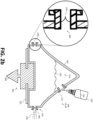
- Figures 2a and 2b illustrate perspective side and cross-sectional views of a wiper blade 104 in accordance with an aspect of the present disclosure. Specifically, Figure 2b illustrates a cross-sectional view of the wiper blade 104 taken along cut line A-A.
- the wiper blade 104 generally comprises a spoiler 202, a squeegee retainer 222, and a squeegee 206 having a wiping lip 208.
- the wiper blade 104 is configured to couple to the wiper arm 106 via the blade-side connector 112 of the coupling 108.
- the blade-side connector 112 may be integral with a portion of the wiper blade 104, such as the spoiler 202 or to the squeegee retainer 222, or attached thereto via one or more fasteners, adhesives, etc.
- the squeegee retainer 222 can be a spring steel component shaped to define a groove along its length to receive and/or otherwise retain the squeegee 206.
- the squeegee retainer 222 may default or spring to a curved shape, thus causing the squeegee 206 to match the contour of the windshield 102.
- the spoiler 202 can be over molded (in part) or attached to the squeegee retainer 222 via one or more adhesive clips, ribs, retainers, or otherwise.
- the wiper blade 104 comprises an embedded manifold system to dispense a reparative material 216 in an uncured state (e.g., an uncured reparative material 216 - a liquid state) onto a surface of the windshield 102 and/or the wiping lip 208 (or other components of the wiper blade 104, such as the squeegee 206).
- the reparative material 216 can be applied in a metered or regulated fashion via a plurality of dispensing ports 204.
- the wiper blade 104 comprises an embedded manifold system having a reservoir 214 that can be refilled with the reparative material 216, for example, using a bottle 218, to prolong the useful life of the wiper blade 104.
- the wiper blade 104 can be refilled with reparative material 216 once depleted.
- the reparative material 216 is configured to transition from an uncured state to a cured state upon application to the surface of a windshield 102. For example, the reparative material 216 flows by capillary action into a scratch or crack. In one example, the reparative material 216 remains liquid over a temperature range of -40° F to 200° F. In most applications, the windshield 102 will not be exposed to temperatures outside this range, ensuring the reparative material 216 remains liquid during use.
- the reparative material 216 is configured to fill scratches and cure on the surface of the windshield 102, transforming into a cured state (e.g., a cured reparative material 216 - a solid state).
- a cured state e.g., a cured reparative material 216 - a solid state
- the reparative material 216 can transition from the uncured state to the cured state when exposed to ambient conditions for a period of time.
- curing of the reparative material 216 is accomplished through exposure to ultraviolet (UV) light, humidity, oxygen, carbon dioxide, etc.
- the reparative material 216 is a silicone- or epoxy-based polymer.
- “-based” refers to the composition of the reparative material 216 having silicone or epoxy polymer in a greater amount than any other constituent.
- Example resins include, for example, polyester resins, phenolic resins, alkyd resins, polycarbonate resins, polyamide resins, polyurethane resins, silicone resins, epoxy resins, polyethylene resins, acrylic resins, polystyrene resins, polypropylene resins, etc.
- Further examples of the reparative material 216 may include, but are not limited to, one-component epoxies.
- the reservoir 214 itself may be replaced with a new full reservoir 214.
- the spoiler 202 can be provided as a replaceable consumable that, once the reservoir 214 is empty, can be replaced with a spoiler 202 having a new full reservoir 214.
- the spoiler 202 is at least partially hollow and shaped to define or otherwise contain the reservoir 214 or other components of the manifold system.
- the reservoir 214 is configured to house the reparative material 216.
- the reparative material 216 is sealed prior to application to prevent premature curing.
- a seal e.g., a sheet, film, foil, etc.
- the seal comprises a UV filter.
- the volume of the reservoir 214 is dictated (or limited) by the length and cross-sectional area of the spoiler 202.
- the length of the spoiler 202 will depend on the vehicle 100, as the length of a wiper blade 104 (and thus the size of the reservoir 214 and the quantity of dispensing ports 204) will vary depending on the type of vehicle 100.
- the spoiler 202 comprises or defines the plurality of dispensing ports 204 through which the reparative material 216 can be dispensed onto the windshield 102, the wiping lip 208, and/or other components of the wiper blade 104.
- the plurality of dispensing ports 204 is distributed along the length of the spoiler 202 and fluidly coupled to the reservoir 214.
- the proposed wiper blade 104 comprises a plurality of dispensing ports 204 distributed along the length of the spoiler 202 to dispense the reparative material 216 in a substantially even fashion.
- the dispensing ports 204 can be positioned and distributed on each side of the spoiler 202. Alternatively, the dispensing ports 204 can be distributed along the length of another component of the wiper blade 104, such as the squeegee 206 or a frame structure.
- the dispensing ports 204 can be molded into the spoiler 202 (e.g., during manufacture) or machined (e.g., cut or drilled) into the spoiler 202 (e.g., after manufacture, whether mechanically or via a laser).
- the dispensing ports 204 are provided in the form of generally circular ports. While illustrated as generally circular, other shapes are contemplated for the dispensing ports 204, including slits and slots.
- the plurality of dispensing ports 204 is illustrated as being arranged in the side wall 210 in a linear pattern (e.g., a row), but other patterns are contemplated, such as a grid pattern.
- the windshield wiper blade 104 and its components can be fabricated from one or more elastomeric materials.
- Example elastomeric materials include, without limitation, thermoplastic polyurethane (TPU), thermoplastic vulcanizates (TPV), thermoplastic elastomers (TPE), flexible polyurethane (FPU), silicone, etc.
- TPU thermoplastic polyurethane
- TPV thermoplastic vulcanizates
- TPE thermoplastic elastomers
- FPU flexible polyurethane
- silicone silicone, etc.
- two or more components of the wiper blade 104 can be formed from the same material and/or as a single, integrated component.
- the squeegee 206 and the wiping lip 208 could be fabricated as a single component.
- the windshield wiper blade 104 (or a portion thereof) can be a printed plastic material component (e.g., thermoplastic, TPU, FPU, etc.).
- Printed plastic material components can be printed with great accuracy and numerous details, which is particularly advantageous for creating components requiring complex and/or precise features.
- additive manufacturing techniques obviate the need for mold tooling, thereby lowering up-front manufacturing costs, which is particularly advantageous in low-volume productions.
- the wiper blade 104 may be fabricated using material extrusion (e.g., fused deposition modeling (FDM)), stereolithography (SLA), selective laser sintering (SLS), material jetting, binder jetting, powder bed fusion, directed energy deposition, VAT photopolymerization, and/or any other suitable type of additive manufacturing/3D printing process.
- material extrusion e.g., fused deposition modeling (FDM)
- SLA stereolithography
- SLS selective laser sintering
- material jetting material jetting
- binder jetting binder jetting
- powder bed fusion powder bed fusion
- directed energy deposition e.g., directed energy deposition
- VAT photopolymerization e.g., directed energy deposition, VAT photopolymerization, and/or any other suitable type of additive manufacturing/3D printing process.
- an external reservoir e.g., one that is external to the wiper blade 104 / spoiler 202
- an external reservoir e.g., one that is external to the wiper blade 104 / spoiler 202
- Using an external reservoir enables storage of a large volume of reparative material 216 that would otherwise be prohibited due to the size constraints imposed by the size of the spoiler 202.
- the wiper blade 104 allows for the reparative material 216 to be stored within the wiper blade 104 and applied slowly to the wiping lip 208 over time as the wiper blade 104 is used.
- the wiper blade 104 further comprises a valve 220 to control (e.g., meter or otherwise regulate) the release of the reparative material 216.
- the valve 220 may be fluidly coupled to or integrated with each of the plurality of dispensing ports 204.
- the valve 220 is a check valve designed to allow the reparative material 216 to flow out of the reservoir 214 and prevent liquid from flowing into the reservoir 214.
- Other example valves 220 include weighted valves, pressure valves, etc.
- the back-and-forth motion of the wiper blade 104 can cause the valves 220 to open and close as the reparative material 216 sloshes back and forth within the reservoir 214.
- the movement of the wiper blade 104 and the reparative material 216 contained therein causes pressure against the valve 220, achieving a cracking pressure that forces a stopper off the seat (e.g., as is the case with a ball check valve), thus opening the valve 220.
- a stopper off the seat e.g., as is the case with a ball check valve
- the reparative material 216 is permitted to exit the reservoir 214 through the dispensing port 204 and onto the wiping lip 208 or otherwise (e.g., onto the squeegee 206).
- a wicking material can be used to pass or otherwise convey the reparative material 216 from the reservoir 214, through an opening (whether a dispensing port 204 or otherwise) in a wall of the spoiler 202, and onto the wiping lip 208.
- the wicking material operates using the principles of capillary action to move the reparative material 216 through the wicking material.
- wicking material When a wicking material is used, care should be taken to ensure that exposure of the external end of the wicking material (the output end) to conditions that could lead to unwanted curing of the reparative material 216 is mitigated. For example, when the reparative material 216 is cured via UV light, the wicking material should be positioned such that it is not exposed to UV light and/or positioned behind a UV filter or lens. Unwanted and/or premature curing could result in flow blockage.
- the fluid reservoir 214 can be replenished, allowing for continued application of the reparative material 216 using the same wiper blade 104.
- the reservoir 214 will have one or more access filler ports 212, which allow the reservoir 214 to be replenished with reparative material 216 after consumption.
- the access filler ports 212 can include a lid or cap, such as a threaded cap.
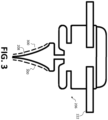
- Figure 3 illustrates another embodiment of a wiper blade 104 having a squeegee 206 with a wiping lip 208.
- the wiping lip 208 includes a coating 300 of reparative material 216.
- a coating 300 of the reparative material 216 is applied to the sides of the wiping lip 208 coupled to the squeegee 206.
- the reparative material 216 is sealed prior to application to prevent premature curing.
- a seal e.g., a sheet, film, foil, etc.
- the seal comprises a UV filter.
- the wiping lip 208 may apply the reparative material 216 to a surface of the windshield 102 by wiping the windshield 102 with the coating 300 of reparative material 216.
- the reparative material 216 used in the coating 300 can be substantially the same as the reparative materials 216 described in connection with Figures 2a and 2b , except provided in a different format. That is, while the reparative materials 216 described in connection with Figures 2a and 2b are delivered as a liquid via a reservoir, the reparative materials 216 described in connection with Figure 3 are delivered as a solid (or semi-solid) via the coating 300.
- the reparative material 216 is applied to (e.g., wiped onto) a surface of the windshield 102 as the wiper blade 104 moves back and forth across the windshield 102. Once applied to a surface of the windshield 102, the reparative material 216 fills and cures within any scratches formed on the windshield 102 as described in connection with Figures 2a and 2b .
- Figure 4 is a diagram of a wiper blade 104 applying the uncured reparative material 216 to fill scratches in a windshield 102.
- Figure 4 illustrates the reparative material 216 filling scratches 400 and then curing on the surface of the windshield 102.
- the reparative material 216 is configured to fill scratches 400 in the surface of the windshield 102 as it is applied via a wiping motion. After filling scratches 400, the reparative material 216 is configured to cure on the surface of the windshield 102, becoming a reparative material in a cured state - a cured reparative material 402.
- the cured reparative material 402 is configured to integrate with the surface of the windshield 102, filling scratches 400 in the windshield 102.
- a crack or break in a windshield 102 is visible because as light rays pass the boundary between the glass and the air in the crack, they are refracted or bent. Light that is reflected back from such boundaries comes at a different angle than if there were no crack, and hence the eyes and brain of the observer sense the discontinuity. If two materials have the same index of refraction, there will be no bending of the light rays at a boundary between the materials, and an observer will not sense the discontinuity. Thus, a scratch filled with a reparative material 216 that has the same index of refraction as the glass will essentially seem to disappear. Therefore, the reparative material 216 is also optically transparent. To enhance optics, the glass of the windshield 102 and the reparative material 216 have substantially equivalent indices of refraction. For instance, the index of refraction of the reparative material 216 is within 10% of the index of refraction of the windshield 102.
- Figures 5a and 5b illustrate a reduction in refraction 502 (i.e., glare) from the surface of a windshield 102 after the reparative material 216 has become a cured reparative material 402 and filled scratches 400 in the surface of the windshield 102.
- Figure 5a illustrates refraction 502 emitting from the surface of the windshield 102 as rays 500 of light are directed to the windshield 102. The rays 500 of light are shown reflecting off the scratches 400 in the windshield 102.
- Figure 5b illustrates the surface of the windshield 102 with the cured reparative material 402.
- Figure 5b illustrates the rays 500 of light reaching the surface of the windshield 102 but not reflecting off the now filled scratches 400.
- the scratch is filled with a reparative material 216 that, when cured, has the same index of refraction as the windshield 102 to make the scratch effectively invisible to the human eye, thus reducing glare.
Landscapes
- Engineering & Computer Science (AREA)
- Mechanical Engineering (AREA)
- Chemical & Material Sciences (AREA)
- Physics & Mathematics (AREA)
- Fluid Mechanics (AREA)
- Quality & Reliability (AREA)
- Chemical Kinetics & Catalysis (AREA)
- Life Sciences & Earth Sciences (AREA)
- General Chemical & Material Sciences (AREA)
- Geochemistry & Mineralogy (AREA)
- Materials Engineering (AREA)
- Organic Chemistry (AREA)
- Plasma & Fusion (AREA)
- Water Supply & Treatment (AREA)
- Application Of Or Painting With Fluid Materials (AREA)
- Coating Apparatus (AREA)
Abstract
Description
- The present application claims priority to
United States Provisional Patent Application No. 63/532,774, filed August 15, 2023 - Windshield wipers are used to remove rain, snow, ice, washer fluid, water, and/or other debris from a vehicle's front or rear windshield. Almost all vehicles are equipped with one or more windshield wipers, including cars, trucks, buses, train locomotives, watercraft (e.g., those with a cabin) and even some aircraft. In many jurisdictions, windshield wipers are a legal requirement. Windshield glare is typically caused by light reflecting off a surface of a windshield. Scratches in the surface of the windshield exacerbate this effect. In order to reduce windshield glare, scratches in the surface of the windshield can be repaired; thus, causing the light to have fewer surfaces off of which to reflect.
- Various techniques are known for repairing scratches in a surface of a windshield. Existing solutions are designed to fill larger chips and scratches in a small area of a surface of the windshield. The current technologies can be inadequate at reducing windshield glare because they fail to fill smaller scratches over a larger area. For example, a reparative material can be applied directly to large scratches in a windshield; however, this method of spot treatment does not reduce glare over the larger surface of the windshield.
- Despite advancements to date, a need exists for a system that can effectively apply a layer of reparative material to fill shallow scratches in a windshield, thus reducing windshield glare. For example, a system and method for applying an even coating of reparative material that is configured to cure directly on the surface of the windshield; thus effectively filling smaller scratches over a large area of the windshield to thereby reduce glare from the windshield.
- The present disclosure relates generally to an improved wiper blade, system, and method, substantially as illustrated by and described in connection with at least one of the figures, as set forth more completely in the claims. More specifically, the present disclosure relates to an improved wiper blade and wiper blade system that can effectively apply a reparative material to a surface of a windshield in an uncured state.
- The foregoing and other objects, features, and advantages of the devices, systems, and methods described herein will be apparent from the following description of particular examples thereof, as illustrated in the accompanying figures; where like or similar reference numbers refer to like or similar structures. The figures are not necessarily to scale, emphasis instead being placed upon illustrating the principles of the devices, systems, and methods described herein.
-
Figure 1a illustrates an example vehicle having a windshield and a pair of wiper blades. -
Figure 1b illustrates an assembly view of an example connection point between the wiper blade and the wiper arm. -
Figures 2a and2b illustrate perspective side and cross-sectional views of a wiper blade in accordance with an aspect of the present disclosure. -
Figure 3 illustrates a wiper blade with a coating of uncured reparative material in accordance with another aspect of the present disclosure. -
Figure 4 is a diagram of a wiper blade applying the uncured reparative material to fill scratches in a windshield. -
Figures 5a and 5b are diagrams application and resulting reduction in glare from applying a reparative material on a surface of a windshield. - References to items in the singular should be understood to include items in the plural, and vice versa, unless explicitly stated otherwise or clear from the text. Grammatical conjunctions are intended to express any and all disjunctive and conjunctive combinations of conjoined clauses, sentences, words, and the like, unless otherwise stated or clear from the context. Recitation of ranges of values herein are not intended to be limiting, referring instead individually to any and all values falling within and/or including the range, unless otherwise indicated herein, and each separate value within such a range is incorporated into the specification as if it were individually recited herein. In the following description, it is understood that terms such as "first," "second," "top," "bottom," "side," "front," "back," and the like are words of convenience and are not to be construed as limiting terms. For example, while in some examples a first side is located adjacent or near a second side, the terms "first side" and "second side" do not imply any specific order in which the sides are ordered.
- The terms "about," "approximately," "substantially," or the like, when accompanying a numerical value, are to be construed as indicating a deviation as would be appreciated by one of ordinary skill in the art to operate satisfactorily for an intended purpose. Ranges of values and/or numeric values are provided herein as examples only, and do not constitute a limitation on the scope of the disclosure. The use of any and all examples, or exemplary language ("e.g.," "such as," or the like) provided herein, is intended merely to better illuminate the disclosed examples and does not pose a limitation on the scope of the disclosure. The terms "e.g.," and "for example" set off lists of one or more non-limiting examples, instances, or illustrations. No language in the specification should be construed as indicating any unclaimed element as essential to the practice of the disclosed examples.
- The term "and/or" means any one or more of the items in the list joined by "and/or." As an example, "x and/or y" means any element of the three-element set {(x), (y), (x, y)}. In other words, "x and/or y" means "one or both of x and y". As another example, "x, y, and/or z" means any element of the seven-element set {(x), (y), (z), (x, y), (x, z), (y, z), (x, y, z)}. In other words, "x, y, and/or z" means "one or more of x, y, and z."
- Wiper blades used in vehicles vary in size and shape. In some cases, wiper blades can be the same shape, but will vary in size. While wiper blades are most often associated with automobiles (e.g., cars, trucks, etc.), they are likewise employed in numerous other vehicles, such as trains, watercraft, and aircraft. Therefore, the following disclosure should not be limited to wiper blades and wiper arms used in automobiles, but rather would be applicable to wiper blades and wiper arms used in any type of vehicle.
- The present disclosure relates to an improved wiper blade, wiper blade system, and method that can effectively reduce glare from a windshield by filling minor scratches with an uncured reparative material using, for example, a wiper blade. Scratches in a windshield can be repaired by applying an uncured reparative material, which then cures on the surface of the windshield. The reparative material fills these minor scratches, thus repairing the surface of the windshield and reducing glare upon cure.
- In one example, a wiper blade for reducing glare on a windshield of a vehicle comprises: a squeegee, wherein the squeegee is configured to transfer a reparative material to a surface of the windshield in an uncured state; and a wiping lip coupled to the squeegee, wherein the wiping lip includes a coating comprising the reparative material.
- In another example, a wiper blade for reducing refraction on a windshield of a vehicle comprises: a spoiler having a reservoir configured to hold a reparative material; a squeegee coupled to the spoiler, wherein the squeegee comprises a wiping lip; and a plurality of dispensing ports distributed along a length of the wiper blade, wherein the plurality of dispensing ports is fluidly coupled to the reservoir and configured to dispense the reparative material onto a surface of the windshield or the wiping lip. The spoiler may further comprise one or more filler ports fluidly coupled to the reservoir.
- In some examples, the wiper blade further comprises a seal to mitigate premature curing of the reparative material prior to application. The seal may comprise an ultraviolet (UV) light filter. The reparative material is configured to fill scratches on the surface of the windshield to reduce refraction from a surface of the windshield, for example, when the reparative material is configured to cure when exposed to one or more of water, oxygen, and/or ultraviolet (UV) light.
- In another example, a method for reducing refraction from a windshield of a vehicle comprising: applying a coating of a reparative material in an uncured state to a wiping lip of a wiper blade, wherein the reparative material is configured to fill scratches in a surface of the windshield and to cure on a surface of the windshield, and wherein the wiping lip is configured to apply the reparative material to a surface of the windshield by wiping the windshield; and sealing, via a seal, the reparative material prior to application. In some examples, the method further comprises a step of applying the coating of the reparative material to the wiping lip through a reservoir coupled to the squeegee. In some examples, the method further comprises a step of applying the coating of the reparative material to the wiping lip prior to coupling the squeegee to the wiping blade. In some examples, the method further comprises a step of configuring the reparative material to cure when exposed to ultraviolet (UV) light.
-
Figure 1a illustrates anexample vehicle 100 having awindshield 102 and a pair ofwiper blades 104. As illustrated, eachwiper blade 104 is removably coupled to awiper arm 106 of thevehicle 100 via acoupling 108. As is known in the art, the wiper arms 106 (and, therefore, the wiper blades 104) are configured to translate back and forth across thewindshield 102 to clear thewindshield 102 of rain, snow, and debris via one or more electric motors and mechanical linkages associated with thevehicle 100. -
Figure 1b illustrates an assembly view of anexample coupling 108 between thewiper blade 104 and thewiper arm 106. As illustrated, eachwiper arm 106 includes or otherwise defines, at its distal end, an arm-side connector 110. The arm-side connector 110 is configured to engage and secure thewiper blade 104 via a complimentary blade-side connector 112 positioned on or otherwise associated with thewiper blade 104. In the illustrated example, the arm-side connector 110 is inserted into a J-shapedslot 114 of the blade-side connector 112 as indicated byarrow 116. Once assembled, alocking cap 118 can be folded as indicated by arrow 120 (e.g., pivoted about a hinge) and positioned to cover, secure, and protect the connected arm-side connector 110 and blade-side connector 112. In the illustrated example, thewiper arm 106 includes an arm-side connector 110 configured a J-Hook connector 122, but other connector types are contemplated. -
Figures 2a and2b illustrate perspective side and cross-sectional views of awiper blade 104 in accordance with an aspect of the present disclosure. Specifically,Figure 2b illustrates a cross-sectional view of thewiper blade 104 taken along cut line A-A. Thewiper blade 104 generally comprises aspoiler 202, asqueegee retainer 222, and asqueegee 206 having a wipinglip 208. Thewiper blade 104 is configured to couple to thewiper arm 106 via the blade-side connector 112 of thecoupling 108. The blade-side connector 112 may be integral with a portion of thewiper blade 104, such as thespoiler 202 or to thesqueegee retainer 222, or attached thereto via one or more fasteners, adhesives, etc. In some examples, as illustrated inFigures 2b and3 , thesqueegee retainer 222 can be a spring steel component shaped to define a groove along its length to receive and/or otherwise retain thesqueegee 206. Thesqueegee retainer 222 may default or spring to a curved shape, thus causing thesqueegee 206 to match the contour of thewindshield 102. Thespoiler 202 can be over molded (in part) or attached to thesqueegee retainer 222 via one or more adhesive clips, ribs, retainers, or otherwise. - As illustrated, in one example, the
wiper blade 104 comprises an embedded manifold system to dispense areparative material 216 in an uncured state (e.g., an uncured reparative material 216 - a liquid state) onto a surface of thewindshield 102 and/or the wiping lip 208 (or other components of thewiper blade 104, such as the squeegee 206). Thereparative material 216 can be applied in a metered or regulated fashion via a plurality of dispensingports 204. Thewiper blade 104 comprises an embedded manifold system having areservoir 214 that can be refilled with thereparative material 216, for example, using abottle 218, to prolong the useful life of thewiper blade 104. Unlike a one-time-use coated wiper blade, as described in connection withFigure 3 , thewiper blade 104 can be refilled withreparative material 216 once depleted. - The
reparative material 216 is configured to transition from an uncured state to a cured state upon application to the surface of awindshield 102. For example, thereparative material 216 flows by capillary action into a scratch or crack. In one example, thereparative material 216 remains liquid over a temperature range of -40° F to 200° F. In most applications, thewindshield 102 will not be exposed to temperatures outside this range, ensuring thereparative material 216 remains liquid during use. - The
reparative material 216 is configured to fill scratches and cure on the surface of thewindshield 102, transforming into a cured state (e.g., a cured reparative material 216 - a solid state). For example, thereparative material 216 can transition from the uncured state to the cured state when exposed to ambient conditions for a period of time. In some examples, curing of thereparative material 216 is accomplished through exposure to ultraviolet (UV) light, humidity, oxygen, carbon dioxide, etc. - In some examples, the
reparative material 216 is a silicone- or epoxy-based polymer. As used herein, "-based" refers to the composition of thereparative material 216 having silicone or epoxy polymer in a greater amount than any other constituent. Example resins include, for example, polyester resins, phenolic resins, alkyd resins, polycarbonate resins, polyamide resins, polyurethane resins, silicone resins, epoxy resins, polyethylene resins, acrylic resins, polystyrene resins, polypropylene resins, etc. Further examples of thereparative material 216 may include, but are not limited to, one-component epoxies. - While a
bottle 218 is illustrated, in some examples, thereservoir 214 itself may be replaced with a newfull reservoir 214. For example, thespoiler 202 can be provided as a replaceable consumable that, once thereservoir 214 is empty, can be replaced with aspoiler 202 having a newfull reservoir 214. In the illustrated example, thespoiler 202 is at least partially hollow and shaped to define or otherwise contain thereservoir 214 or other components of the manifold system. Thereservoir 214 is configured to house thereparative material 216. Thereparative material 216 is sealed prior to application to prevent premature curing. For example, a seal (e.g., a sheet, film, foil, etc.) can be used to prevent exposure of thereparative material 216 to the ambient environment, thus preventing exposure to UV, oxygen, etc. In one example, the seal comprises a UV filter. - The volume of the
reservoir 214 is dictated (or limited) by the length and cross-sectional area of thespoiler 202. The length of thespoiler 202 will depend on thevehicle 100, as the length of a wiper blade 104 (and thus the size of thereservoir 214 and the quantity of dispensing ports 204) will vary depending on the type ofvehicle 100. - The
spoiler 202 comprises or defines the plurality of dispensingports 204 through which thereparative material 216 can be dispensed onto thewindshield 102, the wipinglip 208, and/or other components of thewiper blade 104. The plurality of dispensingports 204 is distributed along the length of thespoiler 202 and fluidly coupled to thereservoir 214. The proposedwiper blade 104 comprises a plurality of dispensingports 204 distributed along the length of thespoiler 202 to dispense thereparative material 216 in a substantially even fashion. The dispensingports 204 can be positioned and distributed on each side of thespoiler 202. Alternatively, the dispensingports 204 can be distributed along the length of another component of thewiper blade 104, such as thesqueegee 206 or a frame structure. - The dispensing
ports 204 can be molded into the spoiler 202 (e.g., during manufacture) or machined (e.g., cut or drilled) into the spoiler 202 (e.g., after manufacture, whether mechanically or via a laser). In the illustrated example, the dispensingports 204 are provided in the form of generally circular ports. While illustrated as generally circular, other shapes are contemplated for the dispensingports 204, including slits and slots. Similarly, the plurality of dispensingports 204 is illustrated as being arranged in theside wall 210 in a linear pattern (e.g., a row), but other patterns are contemplated, such as a grid pattern. - The
windshield wiper blade 104 and its components (e.g., thespoiler 202, thesqueegee 206, and/or the wiping lip 208) can be fabricated from one or more elastomeric materials. Example elastomeric materials include, without limitation, thermoplastic polyurethane (TPU), thermoplastic vulcanizates (TPV), thermoplastic elastomers (TPE), flexible polyurethane (FPU), silicone, etc. In some examples, two or more components of thewiper blade 104 can be formed from the same material and/or as a single, integrated component. For example, thesqueegee 206 and the wipinglip 208 could be fabricated as a single component. - In some examples, the windshield wiper blade 104 (or a portion thereof) can be a printed plastic material component (e.g., thermoplastic, TPU, FPU, etc.). Printed plastic material components can be printed with great accuracy and numerous details, which is particularly advantageous for creating components requiring complex and/or precise features. In addition, additive manufacturing techniques obviate the need for mold tooling, thereby lowering up-front manufacturing costs, which is particularly advantageous in low-volume productions. The
wiper blade 104 may be fabricated using material extrusion (e.g., fused deposition modeling (FDM)), stereolithography (SLA), selective laser sintering (SLS), material jetting, binder jetting, powder bed fusion, directed energy deposition, VAT photopolymerization, and/or any other suitable type of additive manufacturing/3D printing process. - While illustrated as an
internal reservoir 214, additionally or alternatively, an external reservoir (e.g., one that is external to thewiper blade 104 / spoiler 202) can be used. Using an external reservoir enables storage of a large volume ofreparative material 216 that would otherwise be prohibited due to the size constraints imposed by the size of thespoiler 202. - The
wiper blade 104 allows for thereparative material 216 to be stored within thewiper blade 104 and applied slowly to the wipinglip 208 over time as thewiper blade 104 is used. To dispense thereparative material 216 in a metered or regulated fashion, thewiper blade 104 further comprises avalve 220 to control (e.g., meter or otherwise regulate) the release of thereparative material 216. Thevalve 220 may be fluidly coupled to or integrated with each of the plurality of dispensingports 204. In one example, thevalve 220 is a check valve designed to allow thereparative material 216 to flow out of thereservoir 214 and prevent liquid from flowing into thereservoir 214.Other example valves 220 include weighted valves, pressure valves, etc. - During operation, the back-and-forth motion of the
wiper blade 104 can cause thevalves 220 to open and close as thereparative material 216 sloshes back and forth within thereservoir 214. The movement of thewiper blade 104 and thereparative material 216 contained therein causes pressure against thevalve 220, achieving a cracking pressure that forces a stopper off the seat (e.g., as is the case with a ball check valve), thus opening thevalve 220. Once the stopper is off the seat, thereparative material 216 is permitted to exit thereservoir 214 through the dispensingport 204 and onto the wipinglip 208 or otherwise (e.g., onto the squeegee 206). - While a
valve 220 is described, additionally or alternatively, a wicking material can be used to pass or otherwise convey thereparative material 216 from thereservoir 214, through an opening (whether a dispensingport 204 or otherwise) in a wall of thespoiler 202, and onto the wipinglip 208. The wicking material operates using the principles of capillary action to move thereparative material 216 through the wicking material. Once the uncuredreparative material 216 is applied to the wiping lip 208 (or another portion of the wiper blade), thewiper blade 104 may apply thereparative material 216 to a surface of thewindshield 102 by wiping thewindshield 102. - When a wicking material is used, care should be taken to ensure that exposure of the external end of the wicking material (the output end) to conditions that could lead to unwanted curing of the
reparative material 216 is mitigated. For example, when thereparative material 216 is cured via UV light, the wicking material should be positioned such that it is not exposed to UV light and/or positioned behind a UV filter or lens. Unwanted and/or premature curing could result in flow blockage. - Once the
reparative material 216 is consumed, thefluid reservoir 214 can be replenished, allowing for continued application of thereparative material 216 using thesame wiper blade 104. To that end, thereservoir 214 will have one or moreaccess filler ports 212, which allow thereservoir 214 to be replenished withreparative material 216 after consumption. To mitigate evaporation and spillage, theaccess filler ports 212 can include a lid or cap, such as a threaded cap. -
Figure 3 illustrates another embodiment of awiper blade 104 having asqueegee 206 with a wipinglip 208. In this example, rather than a reservoir, the wipinglip 208 includes acoating 300 ofreparative material 216. Acoating 300 of thereparative material 216 is applied to the sides of the wipinglip 208 coupled to thesqueegee 206. Thereparative material 216 is sealed prior to application to prevent premature curing. For example, a seal (e.g., a sheet, film, foil, etc.) can be used to prevent exposure of thereparative material 216 to the ambient environment, thus prohibiting exposure to UV, oxygen, etc. In one example, the seal comprises a UV filter. The wipinglip 208 may apply thereparative material 216 to a surface of thewindshield 102 by wiping thewindshield 102 with thecoating 300 ofreparative material 216. - The
reparative material 216 used in thecoating 300 can be substantially the same as thereparative materials 216 described in connection withFigures 2a and2b , except provided in a different format. That is, while thereparative materials 216 described in connection withFigures 2a and2b are delivered as a liquid via a reservoir, thereparative materials 216 described in connection withFigure 3 are delivered as a solid (or semi-solid) via thecoating 300. Thereparative material 216 is applied to (e.g., wiped onto) a surface of thewindshield 102 as thewiper blade 104 moves back and forth across thewindshield 102. Once applied to a surface of thewindshield 102, thereparative material 216 fills and cures within any scratches formed on thewindshield 102 as described in connection withFigures 2a and2b . -
Figure 4 is a diagram of awiper blade 104 applying the uncuredreparative material 216 to fill scratches in awindshield 102. Specifically,Figure 4 illustrates thereparative material 216 fillingscratches 400 and then curing on the surface of thewindshield 102. Thereparative material 216 is configured to fillscratches 400 in the surface of thewindshield 102 as it is applied via a wiping motion. After fillingscratches 400, thereparative material 216 is configured to cure on the surface of thewindshield 102, becoming a reparative material in a cured state - a curedreparative material 402. In one embodiment, the curedreparative material 402 is configured to integrate with the surface of thewindshield 102, fillingscratches 400 in thewindshield 102. - A crack or break in a
windshield 102 is visible because as light rays pass the boundary between the glass and the air in the crack, they are refracted or bent. Light that is reflected back from such boundaries comes at a different angle than if there were no crack, and hence the eyes and brain of the observer sense the discontinuity. If two materials have the same index of refraction, there will be no bending of the light rays at a boundary between the materials, and an observer will not sense the discontinuity. Thus, a scratch filled with areparative material 216 that has the same index of refraction as the glass will essentially seem to disappear. Therefore, thereparative material 216 is also optically transparent. To enhance optics, the glass of thewindshield 102 and thereparative material 216 have substantially equivalent indices of refraction. For instance, the index of refraction of thereparative material 216 is within 10% of the index of refraction of thewindshield 102. -
Figures 5a and 5b illustrate a reduction in refraction 502 (i.e., glare) from the surface of awindshield 102 after thereparative material 216 has become a curedreparative material 402 and filledscratches 400 in the surface of thewindshield 102. Specifically,Figure 5a illustratesrefraction 502 emitting from the surface of thewindshield 102 asrays 500 of light are directed to thewindshield 102. Therays 500 of light are shown reflecting off thescratches 400 in thewindshield 102.Figure 5b illustrates the surface of thewindshield 102 with the curedreparative material 402.Figure 5b illustrates therays 500 of light reaching the surface of thewindshield 102 but not reflecting off the now filled scratches 400. As can be appreciated, the scratch is filled with areparative material 216 that, when cured, has the same index of refraction as thewindshield 102 to make the scratch effectively invisible to the human eye, thus reducing glare. - While the present method and/or system has been described with reference to certain implementations, it will be understood by those skilled in the art that various changes may be made and equivalents may be substituted without departing from the scope of the present method and/or system. In addition, many modifications may be made to adapt a particular situation or material to the teachings of the present disclosure without departing from its scope. For example, block and/or components of disclosed examples may be combined, divided, re-arranged, and/or otherwise modified. Therefore, the present method and/or system are not limited to the particular implementations disclosed. Instead, the present method and/or system will include all implementations falling within the scope of the appended claims, both literally and under the doctrine of equivalents.
- Aspects of the disclosure are provided in the following numbered clauses:
- Clause 1. A wiper blade for reducing glare on a windshield of a vehicle, the wiper blade comprising:
- a squeegee configured to transfer a reparative material to a surface of the windshield in an uncured state; and
- a wiping lip coupled to the squeegee, wherein the wiping lip includes a coating comprising the reparative material.
- Clause 2. The wiper blade of clause 1, further comprising a seal to mitigate premature curing of the reparative material prior to application.
- Clause 3. The wiper blade of clause 2, wherein the seal comprises an ultraviolet (UV) light filter.
- Clause 4. The wiper blade of clause 1, wherein the reparative material is configured to fill scratches on the surface of the windshield.
- Clause 5. The wiper blade of clause 1, wherein the reparative material is configured to cure when exposed to oxygen.
- Clause 6. The wiper blade of clause 1, wherein the reparative material is configured to cure when exposed to ultraviolet (UV) light.
- Clause 7. The wiper blade of clause 1, wherein the cured reparative material is configured to reduce refraction from a surface of the windshield.
- Clause 8. A wiper blade for reducing refraction on a windshield of a vehicle, the wiper blade comprising:
- a spoiler having a reservoir configured to hold a reparative material;
- a squeegee coupled to the spoiler, wherein the squeegee comprises a wiping lip; and
- a plurality of dispensing ports distributed along a length of the wiper blade,
wherein the plurality of dispensing ports is fluidly coupled to the reservoir and configured to dispense the reparative material onto a surface of the windshield or the wiping lip.
- Clause 9. The wiper blade of clause 8, wherein the reparative material is configured to fill scratches on a surface of the windshield.
- Clause 10. The wiper blade of clause 8, wherein the reparative material is configured to cure on a surface of the windshield.
- Clause 11. The wiper blade of clause 8, wherein the reparative material is configured to cure when exposed to ultraviolet (UV) light.
- Clause 12. The wiper blade of clause 8, further comprising a seal to mitigate premature curing of the reparative material prior to application.
- Clause 13. The wiper blade of clause 12, wherein the seal comprises an ultraviolet (UV) light filter.
- Clause 14. The wiper blade of clause 8, wherein the spoiler further comprises one or more filler ports fluidly coupled to the reservoir.
- Clause 15. The wiper blade of clause 8, wherein the reparative material is configured to cure when exposed to oxygen.
- Clause 16. The wiper blade of clause 8, wherein the reparative material, when cured, is configured to reduce refraction from a surface of the windshield.
- Clause 17. A method for reducing refraction from a windshield of a vehicle, the method comprising:
- applying a coating of a reparative material in an uncured state to a wiping lip of a wiper blade,
- wherein the reparative material is configured to fill scratches in a surface of the windshield and to cure on a surface of the windshield, and
- wherein the wiping lip is configured to apply the reparative material to a surface of the windshield by wiping the windshield; and
- sealing the reparative material prior to application via a seal.
- Clause 18. The method of clause 17, further comprising applying the reparative material to the wiping lip via a reservoir.
- Clause 19. The method of clause 17, further comprising applying a coating of the reparative material to the wiping lip.
- Clause 20. The method of clause 17, further comprising curing the reparative material through exposure to ultraviolet (UV) light.
Claims (15)
- A wiper blade for reducing glare on a windshield of a vehicle, the wiper blade comprising:a squeegee configured to transfer a reparative material to a surface of the windshield in an uncured state; anda wiping lip coupled to the squeegee, wherein the wiping lip includes a coating comprising the reparative material.
- The wiper blade of claim 1, further comprising a seal to mitigate premature curing of the reparative material prior to application, optionally wherein the seal comprises an ultraviolet (UV) light filter.
- The wiper blade of claim 1, wherein the reparative material is configured to fill scratches on the surface of the windshield.
- The wiper blade of claim 1, wherein the reparative material is configured to cure when exposed to oxygen.
- The wiper blade of claim 1, wherein the reparative material is configured to cure when exposed to ultraviolet (UV) light.
- The wiper blade of claim 1, wherein the cured reparative material is configured to reduce refraction from a surface of the windshield.
- A wiper blade for reducing refraction on a windshield of a vehicle, the wiper blade comprising:a spoiler having a reservoir configured to hold a reparative material;a squeegee coupled to the spoiler, wherein the squeegee comprises a wiping lip; anda plurality of dispensing ports distributed along a length of the wiper blade,
wherein the plurality of dispensing ports is fluidly coupled to the reservoir and configured to dispense the reparative material onto a surface of the windshield or the wiping lip. - The wiper blade of claim 7, wherein the reparative material is configured to fill scratches on a surface of the windshield.
- The wiper blade of claim 7, wherein the reparative material is configured to cure on a surface of the windshield, for example the reparative material is configured to cure when exposed to ultraviolet (UV) light, and optionally wherein the wiper blade further comprises a seal to mitigate premature curing of the reparative material prior to application, optionally wherein the seal comprises an ultraviolet (UV) light filter.
- The wiper blade of claim 7, wherein the spoiler further comprises one or more filler ports fluidly coupled to the reservoir.
- The wiper blade of claim 7, wherein the reparative material is configured to cure when exposed to oxygen, optionally wherein the reparative material, when cured, is configured to reduce refraction from a surface of the windshield.
- A method for reducing refraction from a windshield of a vehicle, the method comprising:applying a coating of a reparative material in an uncured state to a wiping lip of a wiper blade,wherein the reparative material is configured to fill scratches in a surface of the windshield and to cure on a surface of the windshield, andwherein the wiping lip is configured to apply the reparative material to a surface of the windshield by wiping the windshield; andsealing the reparative material prior to application via a seal.
- The method of claim 12, further comprising applying the reparative material to the wiping lip via a reservoir.
- The method of claim 12, further comprising applying a coating of the reparative material to the wiping lip.
- The method of claim 12, further comprising curing the reparative material through exposure to ultraviolet (UV) light.
Applications Claiming Priority (2)
| Application Number | Priority Date | Filing Date | Title |
|---|---|---|---|
| US202363532774P | 2023-08-15 | 2023-08-15 | |
| US18/785,152 US20250058745A1 (en) | 2023-08-15 | 2024-07-26 | System and Method for Improving Windshield Glare |
Publications (2)
| Publication Number | Publication Date |
|---|---|
| EP4509373A2 true EP4509373A2 (en) | 2025-02-19 |
| EP4509373A3 EP4509373A3 (en) | 2025-07-23 |
Family
ID=92209121
Family Applications (1)
| Application Number | Title | Priority Date | Filing Date |
|---|---|---|---|
| EP24192457.0A Pending EP4509373A3 (en) | 2023-08-15 | 2024-08-01 | System and method for improving windshield glare |
Country Status (6)
| Country | Link |
|---|---|
| US (1) | US20250058745A1 (en) |
| EP (1) | EP4509373A3 (en) |
| KR (1) | KR20250025582A (en) |
| CN (1) | CN119489791A (en) |
| CA (1) | CA3251265A1 (en) |
| MX (1) | MX2024009933A (en) |
Family Cites Families (7)
| Publication number | Priority date | Publication date | Assignee | Title |
|---|---|---|---|---|
| FR1544875A (en) * | 1967-09-29 | 1968-11-08 | Windshield wipers for repolishing windshields | |
| KR100507438B1 (en) * | 2004-11-06 | 2005-08-10 | (주)에이치 에스 티 | A wipe blade for the vehicle |
| DE102009000320A1 (en) * | 2009-01-20 | 2010-07-22 | Robert Bosch Gmbh | Wiper blade and manufacturing process |
| US9540552B2 (en) * | 2012-10-29 | 2017-01-10 | Illinois Tool Works, Inc. | Applicator with hydrophobic coating transferable to contacting surface |
| DE102016207365A1 (en) * | 2016-04-29 | 2017-11-02 | Ford Global Technologies, Llc | Water-repellent coating of a vehicle window |
| EP3969519A1 (en) * | 2019-05-15 | 2022-03-23 | Illinois Tool Works Inc. | Low-absorption water repellent coating composition for windshield wiper blade insert |
| US11904354B2 (en) * | 2019-08-06 | 2024-02-20 | Llinois Tool Works Inc. | Devices and methods of formulation application to wiper blade and windshield |
-
2024
- 2024-07-26 US US18/785,152 patent/US20250058745A1/en active Pending
- 2024-08-01 EP EP24192457.0A patent/EP4509373A3/en active Pending
- 2024-08-08 CA CA3251265A patent/CA3251265A1/en active Pending
- 2024-08-13 MX MX2024009933A patent/MX2024009933A/en unknown
- 2024-08-14 KR KR1020240109210A patent/KR20250025582A/en active Pending
- 2024-08-15 CN CN202411122904.1A patent/CN119489791A/en active Pending
Also Published As
| Publication number | Publication date |
|---|---|
| EP4509373A3 (en) | 2025-07-23 |
| US20250058745A1 (en) | 2025-02-20 |
| CN119489791A (en) | 2025-02-21 |
| MX2024009933A (en) | 2025-03-07 |
| CA3251265A1 (en) | 2025-06-05 |
| KR20250025582A (en) | 2025-02-24 |
Similar Documents
| Publication | Publication Date | Title |
|---|---|---|
| US20200338810A1 (en) | Techniques for surface preparation during additive fabrication and related systems and methods | |
| EP4399125B1 (en) | Vehicle window panel with a illumination device | |
| EP2569190B1 (en) | Beam blade windshield wiper assembly | |
| CN102574501B (en) | Windshield wiper assembly with optimized wings | |
| US20140101883A1 (en) | Method for manufacturing a windshield wiper blade | |
| US20250058745A1 (en) | System and Method for Improving Windshield Glare | |
| CN106945641A (en) | Windscreen wiper arm assembly | |
| JPH0365429A (en) | Waterdrop adhesion preventing device for vehicle window | |
| FI120968B (en) | Windscreen wiper | |
| US20240308476A1 (en) | Wiper Blade with Fluid Reservoir | |
| US11034333B2 (en) | Wiper unit for a windshield wiper system and method for producing a wiper unit | |
| EP3126197B1 (en) | Winter wiper assembly | |
| US20250001978A1 (en) | Mechanical Windshield Wiper Blade Wear System | |
| DE102019128217B3 (en) | Optical device for a motor vehicle | |
| JP5894038B2 (en) | Wiper blade and manufacturing method thereof | |
| JP2020179756A (en) | Wiper blade | |
| US20240308471A1 (en) | Wiper Blade Assembly | |
| DE202019105713U1 (en) | Expansion system for a windscreen washer system of a vehicle | |
| WO1993003942A1 (en) | Wiper assembly and method of producing same | |
| US20250340184A1 (en) | Reusable Wiper Blade Assembly | |
| US20240308474A1 (en) | Dual-Blade Wiper Blade | |
| US20250178570A1 (en) | Device for wiping an optical surface of at least one optical element of a vehicle | |
| JP6173594B2 (en) | Glass wiper device for vehicle | |
| EP2731814B1 (en) | Windscreen seal with rinse water function | |
| JP2015214037A (en) | Method for producing holder, molding die and wiper blade |
Legal Events
| Date | Code | Title | Description |
|---|---|---|---|
| PUAI | Public reference made under article 153(3) epc to a published international application that has entered the european phase |
Free format text: ORIGINAL CODE: 0009012 |
|
| STAA | Information on the status of an ep patent application or granted ep patent |
Free format text: STATUS: THE APPLICATION HAS BEEN PUBLISHED |
|
| AK | Designated contracting states |
Kind code of ref document: A2 Designated state(s): AL AT BE BG CH CY CZ DE DK EE ES FI FR GB GR HR HU IE IS IT LI LT LU LV MC ME MK MT NL NO PL PT RO RS SE SI SK SM TR |
|
| PUAL | Search report despatched |
Free format text: ORIGINAL CODE: 0009013 |
|
| AK | Designated contracting states |
Kind code of ref document: A3 Designated state(s): AL AT BE BG CH CY CZ DE DK EE ES FI FR GB GR HR HU IE IS IT LI LT LU LV MC ME MK MT NL NO PL PT RO RS SE SI SK SM TR |
|
| RIC1 | Information provided on ipc code assigned before grant |
Ipc: B60S 1/38 20060101AFI20250617BHEP Ipc: B60S 1/52 20060101ALI20250617BHEP Ipc: C03C 23/00 20060101ALI20250617BHEP |
|
| STAA | Information on the status of an ep patent application or granted ep patent |
Free format text: STATUS: REQUEST FOR EXAMINATION WAS MADE |
|
| 17P | Request for examination filed |
Effective date: 20260106 |