EP4507045A1 - Adhesive application apparatus, adhesive application method and battery machining device - Google Patents
Adhesive application apparatus, adhesive application method and battery machining device Download PDFInfo
- Publication number
- EP4507045A1 EP4507045A1 EP23833563.2A EP23833563A EP4507045A1 EP 4507045 A1 EP4507045 A1 EP 4507045A1 EP 23833563 A EP23833563 A EP 23833563A EP 4507045 A1 EP4507045 A1 EP 4507045A1
- Authority
- EP
- European Patent Office
- Prior art keywords
- adhesive
- adhesive applying
- paper
- deviation value
- battery cell
- Prior art date
- Legal status (The legal status is an assumption and is not a legal conclusion. Google has not performed a legal analysis and makes no representation as to the accuracy of the status listed.)
- Pending
Links
- 239000000853 adhesive Substances 0.000 title claims abstract description 521
- 230000001070 adhesive effect Effects 0.000 title claims abstract description 521
- 238000000034 method Methods 0.000 title claims abstract description 35
- 238000003754 machining Methods 0.000 title description 4
- 230000007246 mechanism Effects 0.000 claims abstract description 138
- 238000001514 detection method Methods 0.000 claims abstract description 58
- 230000000007 visual effect Effects 0.000 claims abstract description 55
- 238000012545 processing Methods 0.000 claims abstract description 7
- 238000004891 communication Methods 0.000 claims description 6
- 230000008569 process Effects 0.000 description 11
- 230000008901 benefit Effects 0.000 description 3
- 238000010586 diagram Methods 0.000 description 3
- 230000000670 limiting effect Effects 0.000 description 3
- 238000012937 correction Methods 0.000 description 1
- 238000011161 development Methods 0.000 description 1
- 238000004146 energy storage Methods 0.000 description 1
- 230000003993 interaction Effects 0.000 description 1
- 238000012986 modification Methods 0.000 description 1
- 230000004048 modification Effects 0.000 description 1
- 238000006467 substitution reaction Methods 0.000 description 1
Images

Classifications
-
- H—ELECTRICITY
- H01—ELECTRIC ELEMENTS
- H01M—PROCESSES OR MEANS, e.g. BATTERIES, FOR THE DIRECT CONVERSION OF CHEMICAL ENERGY INTO ELECTRICAL ENERGY
- H01M10/00—Secondary cells; Manufacture thereof
- H01M10/04—Construction or manufacture in general
- H01M10/0404—Machines for assembling batteries
-
- C—CHEMISTRY; METALLURGY
- C09—DYES; PAINTS; POLISHES; NATURAL RESINS; ADHESIVES; COMPOSITIONS NOT OTHERWISE PROVIDED FOR; APPLICATIONS OF MATERIALS NOT OTHERWISE PROVIDED FOR
- C09J—ADHESIVES; NON-MECHANICAL ASPECTS OF ADHESIVE PROCESSES IN GENERAL; ADHESIVE PROCESSES NOT PROVIDED FOR ELSEWHERE; USE OF MATERIALS AS ADHESIVES
- C09J2203/00—Applications of adhesives in processes or use of adhesives in the form of films or foils
- C09J2203/33—Applications of adhesives in processes or use of adhesives in the form of films or foils for batteries or fuel cells
-
- Y—GENERAL TAGGING OF NEW TECHNOLOGICAL DEVELOPMENTS; GENERAL TAGGING OF CROSS-SECTIONAL TECHNOLOGIES SPANNING OVER SEVERAL SECTIONS OF THE IPC; TECHNICAL SUBJECTS COVERED BY FORMER USPC CROSS-REFERENCE ART COLLECTIONS [XRACs] AND DIGESTS
- Y02—TECHNOLOGIES OR APPLICATIONS FOR MITIGATION OR ADAPTATION AGAINST CLIMATE CHANGE
- Y02E—REDUCTION OF GREENHOUSE GAS [GHG] EMISSIONS, RELATED TO ENERGY GENERATION, TRANSMISSION OR DISTRIBUTION
- Y02E60/00—Enabling technologies; Technologies with a potential or indirect contribution to GHG emissions mitigation
- Y02E60/10—Energy storage using batteries
-
- Y—GENERAL TAGGING OF NEW TECHNOLOGICAL DEVELOPMENTS; GENERAL TAGGING OF CROSS-SECTIONAL TECHNOLOGIES SPANNING OVER SEVERAL SECTIONS OF THE IPC; TECHNICAL SUBJECTS COVERED BY FORMER USPC CROSS-REFERENCE ART COLLECTIONS [XRACs] AND DIGESTS
- Y02—TECHNOLOGIES OR APPLICATIONS FOR MITIGATION OR ADAPTATION AGAINST CLIMATE CHANGE
- Y02P—CLIMATE CHANGE MITIGATION TECHNOLOGIES IN THE PRODUCTION OR PROCESSING OF GOODS
- Y02P70/00—Climate change mitigation technologies in the production process for final industrial or consumer products
- Y02P70/50—Manufacturing or production processes characterised by the final manufactured product
Definitions
- the present application relates to the technical field of batteries, and in particular to an adhesive applying apparatus, an adhesive applying method, and a battery processing device.
- the current adhesive applying process usually uses a mechanical positioning method, which makes precision of applying the adhesive paper on the battery cells lower, affects assembly precision of the battery cells, and accordingly affects structural precision of the finally assembled battery module or battery.
- the present application provides an adhesive applying apparatus, an adhesive applying method, and a battery processing device.
- an adhesive applying apparatus including:
- the detection assembly can detect to obtain current positions of a battery cell and adhesive paper respectively; the visual compensation module can obtain a total deviation value based on a deviation value between the current position of the battery cell and its target position and a deviation value between the current position of the adhesive paper and its target position, and then correct an adhesive applying position of the adhesive applying mechanism based on the total deviation value, so that the adhesive applying mechanism can apply adhesive on the battery cell at the corrected adhesive applying position.
- precision of adhesive applying of the traditional adhesive applying method is usually less than or equal to 1.5 mm, and after correction is performed by means of visual compensation described above, the precision of adhesive applying can be increased to less than or equal to 0.8 mm, and accordingly the precision of adhesive applying for the battery cell is effectively improved.
- the detection assembly includes a first detection member and a second detection member respectively connected in communication with the visual compensation module, the first detection member is configured to detect a first current position of the battery cell in the first accommodating station, the second detection member is configured to detect a second current position of the adhesive paper on the adhesive applying mechanism; and the target position of the battery cell in the first accommodating station is defined as a first target position, and the target position of the adhesive paper on the adhesive applying mechanism is defined as a second target position; where the visual compensation module is configured to compare the first current position with the first target position to obtain a first deviation value, and is further configured to compare the second current position with the second target position to obtain a second deviation value, and to obtain the total deviation value based on the first deviation value and the second deviation value.
- the first detection member and the second detection member detect and position the battery cell and the adhesive paper respectively, so that current positions of the battery cell and the adhesive paper can be quickly obtained; and after comparison is performed by means of the visual compensation module, the total deviation value between the battery cell and the adhesive paper can be obtained quickly and accurately. Therefore, accurate visual compensation can be carried out for an adhesive applying process based on the total deviation value, thereby improving the precision of adhesive applying effectively.
- the adhesive applying apparatus further includes a positioning platform and a positioning member arranged on the workbench, the positioning platform has a second accommodating station for accommodating the adhesive paper, and the positioning member is configured to initially position the adhesive paper in the second accommodating station.
- the adhesive paper is initially positioned in the second accommodating station by the positioning platform and the positioning member, so that the position of the adhesive paper on the adhesive applying mechanism is more accurate after the adhesive applying mechanism picks the adhesive paper from the second accommodating station, thus reducing the second deviation value between the second current position of the adhesive paper and the second target position on the adhesive applying mechanism, and facilitating the high-precision positioning based adhesive applying between the battery cell and the adhesive paper by means of visual compensation.
- the adhesive applying mechanism is movably arranged between the second accommodating station and the first accommodating station, and the adhesive applying mechanism is configured to be capable of picking the adhesive paper from the second accommodating station and to apply the adhesive paper on the battery cell.
- the adhesive applying mechanism is movably arranged between the second accommodating station and the first accommodating station, so that the adhesive paper can be smoothly moved from the second accommodating station to the first accommodating station for adhesive applying.
- the adhesive applying mechanism includes a moving member and an adhesive picking member arranged on the moving member, the adhesive picking member is configured to pick or release the adhesive paper, and the moving member is movably arranged on the workbench and configured to drive the adhesive picking member to move between the second accommodating station and the first accommodating station.
- the moving member can smoothly drive the adhesive picking member and the adhesive paper thereon to move between the second accommodating station and the first accommodating station.
- the adhesive picking member can pick or release the adhesive paper smoothly to realize smooth applying of the adhesive paper finally.
- the adhesive applying mechanism further includes an adjusting member connected between the moving member and the adhesive picking member, and the adjusting member is configured to adjust a distance between the adhesive picking member and the moving member.
- the adjusting member can flexibly adjust the distance between the adhesive picking member and the moving member based on different specifications of battery cells to be applied with adhesive paper during adhesive applying, so that the adhesive picking member can stably apply the adhesive paper to the battery cells more smoothly, thereby improving stability in adhesive applying.
- the adhesive applying apparatus further includes a feed bin and a loading mechanism, the feed bin is arranged on at least one side of the workbench, and the loading mechanism is arranged between the feed bin and the workbench and configured to move the adhesive paper in the feed bin to the workbench.
- the adhesive applying mechanism further includes a tearing member, the tearing member being configured to tear off release paper on the adhesive paper;
- the adhesive paper can be smoothly adhered on the battery cell by means of the tearing member.
- the detection assembly further includes a third detection member arranged on the workbench, and the third detection member is configured to detect the state of the release paper on the adhesive paper.
- the third detection member can take a picture of the adhesive paper, so as to detect whether or not the release paper on the adhesive paper has been cleanly torn off, helping the adhesive paper to be more firmly adhered on the battery cell.
- the present application provides a battery processing device, including an adhesive applying apparatus described above, the adhesive applying apparatus being configured to apply adhesive paper on a largest side of a battery cell.
- the present application provides an adhesive applying method, including the following steps:
- the step of obtaining a total deviation value based on a deviation value between the current position of the battery cell and its target position and a deviation value between the current position of the adhesive paper and its target position, to correct an adhesive applying position of the adhesive applying mechanism further includes steps of:
- the method before the step of detecting and obtaining a current position of adhesive paper on an adhesive applying mechanism, the method further includes steps of:
- the method before the step of placing the adhesive paper on the positioning platform, the method further includes steps of:
- the method further includes a step of: tearing off release paper on a side of the adhesive paper facing away from the battery cell.
- 100 adhesive applying apparatus; 10, workbench; 20, adhesive applying mechanism; 30, detection assembly; 40, positioning platform; 50, feed bin; 60, loading mechanism; 11, first accommodating station; 21, moving member; 22, adhesive picking member; 23, adjusting member; 24, tearing member; 31, first detection member; 32, second detection member; 33, third detection member; 41, second accommodating station.
- an embodiment means that a particular feature, structure, or characteristic described in connection with the embodiment can be included in at least one embodiment of the present application.
- the appearance of this phrase in various places in the specification does not necessarily refer to the same embodiment, nor is it a separate or alternative embodiment that is mutually exclusive with other embodiments. It is explicitly and implicitly understood by those skilled in the art that the embodiments described herein may be combined with other embodiments.
- a plurality of refers to two or more (including two), and similarly, “multiple groups” refers to two or more (including two) groups, and “multiple sheets” refers to two or more (including two) sheets.
- the technical terms “mount,” “join,” “connect,” “fix,” etc. should be understood in a broad sense, such as, a fixed connection, a detachable connection, or an integral connection; a mechanical connection, or an electrical connection; a direct connection, an indirect connection through an intermediate medium, an internal connection of two elements, or interaction between two elements.
- the specific meanings of the above terms in the embodiments of the present application can be understood according to specific situations.
- the power batteries are used in energy storage power source systems such as hydraulic, thermal, wind and solar power stations as well as in electric vehicles such as electric bicycles, electric motorcycles and electric cars, and other fields. With the continuous expansion of the application field of the power batteries, the market demand is also constantly expanding.
- a battery cell is the smallest unit that forms a battery, specifically, a plurality of battery cells may be connected in series or parallel or series-parallel to form a battery module, and then one or more battery modules are connected and assembled to form a battery.
- the plurality of battery cells may also be directly assembled to form a battery. Connection in series-parallel means that the plurality of battery cells are connected in both series and parallel.
- the precision of adhesive applying will affect the assembly precision of the battery cell, and even affect the structural precision of the finally assembled battery module or battery.
- an adhesive applying apparatus in one or more embodiments of the present application, in which a battery cell and adhesive paper are positioned on a workbench and an adhesive applying mechanism, respectively.
- a detection assembly detects current positions of the battery cell and the adhesive paper; the visual compensation module can obtain a total deviation value based on a deviation value between the current position of the battery cell and its target position and a deviation value between the current position of the adhesive paper and its target position, and then correct an adhesive applying position of the adhesive applying mechanism based on the total deviation value, so that the adhesive applying mechanism can apply adhesive on the battery cell at the corrected adhesive applying position finally.
- mechanical errors between the adhesive paper and the battery cell or errors caused by other external factors can be compensated by means of visual compensation, thereby improving the precision of adhesive applying.
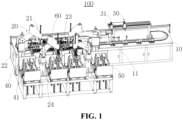
- an adhesive applying apparatus 100 including a workbench 10, an adhesive applying mechanism 20, a detection assembly 30, and a visual compensation module (not shown in the figure).
- the workbench 10 is provided with a first accommodating station 11 for holding a battery cell.
- the adhesive applying mechanism 20 is configured to apply adhesive paper on the battery cell.
- the detection assembly 30 is arranged on the workbench 10 and configured to detect a current position of the battery cell in the first accommodating station 11 and a current position of the adhesive paper on the adhesive applying mechanism 20.
- the visual compensation module is connected in communication with the adhesive applying mechanism 20 and the detection assembly 30 respectively.
- the visual compensation module is configured to obtain a total deviation value based on a deviation value between the current position of the battery cell and its target position and a deviation value between the current position of the adhesive paper and its target position, to correct an adhesive applying position of the adhesive applying mechanism 20.
- the workbench 10 refers to a structure capable of providing a carrying and supporting base for the battery cell to facilitate the adhesive applying on the battery cell.
- the first accommodating station 11 refers to a position that can be used for placing of the battery cell and performing an adhesive applying operation to the battery cell.
- the first accommodating station 11 may be provided as one or as a plurality spaced apart from each other. When a plurality of first accommodating stations 11 are provided, each of the first accommodating station 11 can hold one battery cell. The battery cells on the different first accommodating stations 11 are then applied with adhesive respectively, so that the adhesive applying efficiency is improved.
- the target position of the battery cell in the first accommodating station 11 refers to a theoretically preset adhesive applying position of the battery cell. However, in practice, due to the machining errors or other external factors, the actual position of the battery cell in the first accommodating station 11 is not the same as the target position, and the actual position here is a current position of the battery cell in the first accommodating station 11.
- the target position of the adhesive paper on the adhesive applying mechanism 20 refers to a theoretically preset position of the adhesive paper on the adhesive applying mechanism 20.
- the actual position of the adhesive paper on the adhesive applying mechanism 20 is not the same as the target position, and the actual position here is a current position of the adhesive paper on the adhesive applying mechanism 20.
- a certain deviation value is formed between the current position and the target position of the battery cell in the first accommodating station 11.
- a certain deviation value is also formed between the current position and the target position of the adhesive paper on the adhesive applying mechanism 20. The sum of the two deviation values is the total deviation value between the battery cell and the adhesive paper.
- the visual compensation module compares the current position of the battery cell with its target position and compares the current position of the adhesive paper with its target position respectively to obtain a deviation value of the battery cell and a deviation value of the adhesive paper respectively.
- the same visual compensation module compares the current position of the battery cell with its target position and the current position of the adhesive paper with its target position sequentially, or two or more visual compensation modules can be provided for simultaneous comparison of the battery cell and the adhesive paper.
- an internal algorithm of the visual compensation module combines the deviation values of the two to obtain the total deviation value. Specifically, when the deviation value of the battery cell and the deviation value of the adhesive paper are in the same direction, the two deviation values are subjected to subtraction by the visual compensation module to obtain the total deviation value. When the deviation value of the battery cell and the deviation value of the adhesive paper are in opposite directions, the two deviation values are subjected to addition by the visual compensation module to obtain the total deviation value.
- the visual compensation module controls the adhesive applying mechanism 20 to move based on the total deviation value, so that the moving amount of the adhesive applying mechanism 20 can compensate for the total deviation value, thereby correcting the adhesive applying position of the adhesive applying mechanism 20. Finally, the adhesive applying mechanism 20 is controlled to apply adhesive at the adhesive applying position. Thus, the precision of adhesive applying can be improved effectively.
- the detection assembly 30 can detect to obtain current positions of a battery cell and adhesive paper respectively; the visual compensation module can obtain a total deviation value based on a deviation value between the current position of the battery cell and its target position and a deviation value between the current position of the adhesive paper and its target position, and then correct an adhesive applying position of the adhesive applying mechanism 20 based on the total deviation value, so that the adhesive applying mechanism 20 can apply the adhesive on the battery cell at the corrected adhesive applying position.
- the way of correcting by means of visual compensation can effectively improve the precision of adhesive applying for the battery cell.
- the detection assembly 30 includes a first detection member 31 and a second detection member 32 respectively connected in communication with the visual compensation module, the first detection member 31 is configured to detect a first current position of the battery cell in the first accommodating station 11, and the second detection member 32 is configured to detect a second current position of the adhesive paper on the adhesive applying mechanism 20.
- the first target position is defined as a first target position of the battery cell in the first accommodating station 11 and the second target position is a second target position of the adhesive paper on the adhesive applying mechanism 20.
- the visual compensation module is configured to compare the first current position with the first target position to obtain a first deviation value, and is further configured to compare the second current position with the second target position to obtain a second deviation value, and to obtain the total deviation value based on the first deviation value and the second deviation value.
- the first detection member 31 may be, but is not limited to, a first positioning camera.
- the first detection member 31 takes a picture of the battery cell on the first accommodating station 11, to obtain a first current position of the battery cell on the first accommodating station 11.
- the visual compensation module acquires the first current position and compares the first current position with the preset first target position to obtain a first deviation value, which is an offset of the battery cell on the first accommodating station 11.
- the second detection member 32 may be, but is not limited to, a second positioning camera.
- the second detection member 32 takes a picture of the adhesive paper on the adhesive applying mechanism 20, to obtain a second current position of the adhesive paper on the adhesive applying mechanism 20.
- the visual compensation module acquires the second current position and compares the second current position with the preset second target position to obtain a second deviation value, which is an offset of the adhesive paper on the adhesive applying mechanism 20.
- the visual compensation module combines the first deviation value and the second deviation value through its internal algorithm to obtain a total deviation value, which is a total offset between the battery cell and the adhesive paper. Specifically, when the first deviation value and the second deviation value have the same offset direction, the first deviation value and the second deviation value are subjected to subtraction by the visual compensation module to obtain the total deviation value. When the first deviation value and the second deviation value are opposite in offset directions, the first deviation value and the second deviation value are subjected to addition by the visual compensation module to obtain the total deviation value.
- the visual compensation module controls the adhesive applying mechanism 20 to move the adhesive paper thereon based on the total deviation value, so that the adhesive applying position of the adhesive applying mechanism 20 can be corrected, thereby visually compensating for the total deviation value. Finally, the visual compensation module controls the adhesive applying mechanism 20 to apply adhesive at the corrected adhesive applying position to achieve high precision of adhesive applying.
- the first detection member 31 and the second detection member 32 detect and position the battery cell and the adhesive paper respectively, so that current positions of the battery cell and the adhesive paper can be quickly obtained; and after comparison is performed by means of the visual compensation module, the total deviation value between the battery cell and the adhesive paper can be obtained quickly and accurately. Therefore, accurate visual compensation can be carried out for an adhesive applying process based on the total deviation value, thereby improving the precision of adhesive applying effectively.
- the adhesive applying apparatus 100 further includes a positioning platform 40 and a positioning member (not shown in the figure) arranged on the workbench 10, the positioning platform 40 has a second accommodating station 41 for accommodating the adhesive paper, and the positioning member is configured to initially position the adhesive paper in the second accommodating station 41.
- the adhesive paper is first placed on the positioning platform 40, and then initially positioned in the second accommodating station 41 on the positioning platform 40 by the positioning member. Then, the adhesive applying mechanism 20 picks the adhesive paper from the second accommodating station 41, and the second detection member 32 detects the second current position of the adhesive paper on the adhesive applying mechanism 20. The second deviation value of the adhesive paper is then obtained by comparing the second current position with the preset second target position through the visual compensation module.
- the second deviation value of the adhesive paper on the adhesive applying mechanism 20 can be reduced, thereby reducing the scope of visual compensation.
- the positioning platform 40 may be, but is not limited to, a positioning plate with a positioning hole running through the positioning plate.
- the positioning member may be, but is not limited to, a third positioning camera, and the positioning member is arranged under the positioning platform 40 and disposed opposite the positioning hole.
- the positioning member When the adhesive paper is placed on the positioning platform 40, the positioning member passes through the positioning hole from bottom to top to take a picture of the adhesive paper, so as to obtain the actual position of the adhesive paper on the positioning platform 40.
- the adhesive paper is then moved and positioned in the second accommodating station 41, so that initial positioning of the adhesive paper is completed.
- the adhesive paper can be positioned in the second accommodating station 41 by other ways, for example, the positioning member is configured as a limiting member on the positioning platform 40 and encloses to form the second accommodating station 41, so that the adhesive paper is initially positioned in the second accommodating station 41 by a limiting effect of the positioning member.
- the adhesive paper is initially positioned in the second accommodating station 41 by the positioning platform 40 and the positioning member, so that the position of the adhesive paper on the adhesive applying mechanism 20 is more accurate after the adhesive applying mechanism 20 picks the adhesive paper from the second accommodating station 41, thus reducing the second deviation value between the second current position of the adhesive paper and the second target position on the adhesive applying mechanism 20, and facilitating the high-precision positioning based adhesive applying between the battery cell and the adhesive paper by means of visual compensation.
- the adhesive applying mechanism 20 is movably arranged between the second accommodating station 41 and the first accommodating station 11, and the adhesive applying mechanism 20 is configured to be capable of picking the adhesive paper from the second accommodating station 41 and to apply the adhesive paper on the battery cell. In this way, the adhesive paper can be smoothly moved from the second accommodating station 41 to the first accommodating station 11 for adhesive applying.
- the adhesive applying mechanism 20 includes a moving member 21 and an adhesive picking member 22 arranged on the moving member 21, and the adhesive picking member 22 is configured to pick or release the adhesive paper.
- the moving member 21 is movably arranged on the workbench 10 and is configured to drive the adhesive picking member 22 to move between the second accommodating station 41 and the first accommodating station 11.
- the moving member 21 may be, but is not limited to, a manipulator, and the manipulator drives the adhesive picking member 22 to move so as to realize the picking and releasing of the adhesive paper.
- the adhesive picking member 22 may be, but is not limited to, a suction cup, and the suction cup may suck or release the adhesive paper.
- the manipulator drives the suction cup to move to a position right above the second accommodating station 41, the suction cup sucks the adhesive paper on the second accommodating station 41, and then the second detection member 32 detects the second current position of the adhesive paper on the suction cup.
- the manipulator drives the suction cup and the adhesive paper to move from the second accommodating station 41 to be right above the first accommodating station 11.
- the visual compensation module acquires the second current position, and obtains the second deviation value, the second deviation value is combined with the first deviation value of the battery cell to obtain the total deviation value.
- the visual compensation module controls the adhesive applying mechanism 20 to move based on the total deviation value, corrects the adhesive applying position of the adhesive applying mechanism 20, and finally the adhesive applying mechanism 20 applies the adhesive paper on a largest side of the battery cell at the adhesive applying position, thus realizing the high-precision adhesive applying.
- battery cells are usually stacked along their thickness direction, and largest sides of adjacent battery cells are adhered to each other. Accordingly, the adhesive paper is adhered on the largest sides of the battery cells, so that the battery cells can be adhered and fixed by the adhesive paper.
- the largest side is a surface with the largest area on the battery cell.
- a plurality of suction cups spaced apart from each other may be provided, thereby expanding the suction area of the suction cups for the adhesive paper and making the force on the adhesive paper more uniform.
- the adhesive picking member 22 and the adhesive paper thereon can be smoothly driven to move between the second accommodating station 41 and the first accommodating station 11.
- the adhesive picking member 22 can pick or release the adhesive paper smoothly to realize smooth applying of the adhesive paper finally.
- the adhesive applying mechanism 20 further includes an adjusting member 23 connected between the moving member 21 and the adhesive picking member 22, and the adjusting member 23 is configured to adjust a distance between the adhesive picking member 22 and the moving member 21.
- battery cells to be applied with adhesive may have different specifications and may be different in thickness, height, and width.
- the battery cells of different specifications have different thicknesses, when the battery cells are placed on the first accommodating stations 11, largest sides of the battery cells to be applied with adhesive are upwards, and the battery cells are different in height.
- the adjusting member 23 is arranged between the moving member 21 and the adhesive picking member 22.
- the moving member 21 drives the adhesive picking member 22 to move to a position right above the first accommodating station 11
- the moving member 21 drives the adhesive picking member 22 and the adhesive paper thereon to move downwardly by a certain distance, so as to help the adhesive picking member 22 to apply the adhesive paper on the largest side of the battery cell.
- the distance between the adhesive picking member 22 and the moving member 21 can be adjusted by the adjusting member 23, enabling the adhesive picking member 22 to be adapted to battery cells with different thicknesses more smoothly, so as to smoothly and stably adhere the adhesive paper on the largest sides of the battery cells.
- the adjusting member 23 may be, but is not limited to, a telescopic cylinder. Through telescopic movement of the telescopic cylinder, the adhesive picking member 22 is driven closer to or farther away from the moving member 21, so that the adhesive picking member 22 can better apply the adhesive paper on the largest side of the battery cell.
- the purpose of adjusting the distance between the adhesive picking member 22 and the moving member 21 can also be achieved by providing a bolt connection between the moving member 21 and the adhesive picking member 22 and adjusting the distance between the adhesive picking member 22 and the moving member 21 by rotating a bolt, or by other connection ways, which will not be repeated herein.
- the distance between the adhesive picking member 22 and the moving member 21 can be adjusted flexibly based on different specifications of battery cells to be applied with adhesive during adhesive applying, so that the adhesive picking member 22 can stably apply the adhesive paper on the battery cells more smoothly, thereby improving stability in adhesive applying.
- the adhesive applying apparatus 100 further includes a feed bin 50 and a loading mechanism 60, the feed bin 50 is arranged on at least one side of the workbench 10, and the loading mechanism 60 is arranged between the feed bin 50 and the workbench 10 and configured to move the adhesive paper in the feed bin 50 to the workbench 10.
- the feed bin 50 is arranged on one side of the workbench 10 to help the loading mechanism 60 to pick the adhesive paper from the feed bin 50, and then place the adhesive paper on the positioning platform 40 and initially position the adhesive paper on the second accommodating station 41.
- the loading mechanism 60 may be, but is not limited to, a loading manipulator, and is provided with a suction cup.
- the suction cup realizes picking and releasing of the adhesive paper.
- the loading manipulator drives the suction cup to move to a position right above the feed bin 50, and the suction cup descends and sucks the adhesive paper in the feed bin 50.
- the loading manipulator drives the suction cup to move from the position of the feed bin 50 to the positioning platform 40, so that the adhesive paper is positioned in the second accommodating station 41 on the positioning platform 40. At this time, the initial positioning of the adhesive paper is completed.
- the moving member 21 of the adhesive applying mechanism 20 drives the suction cup thereon to move to a position right above the second accommodating station 41 and sucks the adhesive paper.
- the second detection member 32 detects the second current position of the adhesive paper on the suction cup, and then the visual compensation module obtains the second deviation value of the adhesive paper based on the second current position and the second target position.
- the visual compensation module combines the first deviation value and the second deviation value to finally obtain the total deviation value.
- the adhesive applying position of the adhesive applying mechanism 20 is corrected, so that the adhesive applying mechanism 20 can carry out high-precision adhesive applying to the battery cell at the adhesive applying position.
- the feed bin 50 and the loading mechanism 60 With the arrangement of the feed bin 50 and the loading mechanism 60, it is possible to realize feeding of the adhesive paper and smoothly move the adhesive paper to the workbench 10 so as to facilitate the adhesive applying operation. Thus, the adhesive applying efficiency can be improved.
- the adhesive applying mechanism 20 further includes a tearing member 24, the tearing member 24 being configured to tear off release paper on the adhesive paper.
- the tearing member 24 is arranged on the workbench 10; or the tearing member 24 is arranged on the adhesive applying mechanism 20; or the tearing member 24 is arranged on both the workbench 10 and the adhesive applying mechanism 20.
- both sides of the adhesive paper are provided with release paper, so there will have two adhesive tearing operations during the entire adhesive applying process.
- the loading mechanism 60 picks the adhesive paper from the feed bin 50 and moves it to the position of the tearing member 24. At this time, the release paper on a bottom surface of the adhesive paper is torn off by the tearing member 24, and then the adhesive paper is placed in the second accommodating station 41. Further, the moving member 21 drives the adhesive picking member 22 to pick the adhesive paper from the second accommodating station 41 and then move the adhesive paper to the adhesive applying position so as to facilitate applying the adhesive paper on the battery cell.
- the release paper on a surface of a side of the adhesive paper facing away from the battery cell is torn off by the tearing member 24.
- the adhesive paper having adhesive paper on the surface of the side facing away from the battery cell can be adhered on a largest side of an adjacent battery cell, thereby fixing the battery cells by adhesion.
- one or more tearing members 24 may be provided according to actual needs, and the tearing member 24 may be arranged at a suitable position to tear off the release paper on the adhesive paper smoothly.
- a first tearing member 24 may be arranged beside the positioning platform 40. After the loading mechanism 60 picks the adhesive paper from the feed bin 50, the release paper on the bottom surface of the adhesive paper can be torn off by the first tearing member 24 before the adhesive paper is placed on the positioning platform 40.
- a second tearing member 24 may be arranged on the adhesive applying mechanism 20. In this way, after the adhesive paper is adhered on the largest side of the battery cell, the release paper on the surface of the side of the adhesive paper facing away from the battery cell can be torn off by the second tearing member 24 on the adhesive applying mechanism 20.
- the adhesive paper can be smoothly adhered on the battery cell by means of the tearing member 24.
- the detection assembly 30 further includes a third detection member 33 arranged on the workbench 10, and the third detection member 33 is configured to detect the state of the release paper on the adhesive paper.
- the third detection member 33 may be, but is not limited to, a positioning camera.
- the third detection member 33 and the second detection member 32 may share the same positioning camera, that is, the third detection member 33 may also be a second positioning camera.
- the third detection member 33 can take a picture of the adhesive paper, so as to detect whether or not the release paper on the adhesive paper has been cleanly torn off, helping the adhesive paper to be more firmly adhered on the battery cell.
- the present application provides a battery processing device, including an adhesive applying apparatus 100 described above, the adhesive applying apparatus 100 being configured to apply adhesive paper on a largest side of a battery cell.
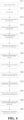
- the present application further provides an adhesive applying method including the following steps: S20: Detect and obtain a current position of a battery cell in a first accommodating station 11 on a workbench 10.
- S40 Obtain a total deviation value based on a deviation value between the current position of the battery cell and its target position and a deviation value between the current position of the adhesive paper and its target position, to correct an adhesive applying position of the adhesive applying mechanism 20.
- the target positions are theoretical preset positions of the battery cell and the adhesive paper.
- the visual compensation module compares a current position of the battery cell with its target position, and compares a current position of the adhesive paper with its target position, so as to obtain a total deviation value.
- the adhesive applying position of the adhesive applying mechanism 20 is corrected based on the total deviation value.
- S50 Control the adhesive applying mechanism 20 to apply adhesive on the battery cell at the adhesive applying position.
- the visual compensation module controls the adhesive applying mechanism 20 to move the adhesive paper thereon to the adhesive applying position based on the total deviation value, and then controls the adhesive applying mechanism 20 to apply adhesive on the battery cell at the adhesive applying position.
- the visual compensation module corrects the adhesive applying position of the adhesive applying mechanism 20 based on the total deviation value, so that the adhesive applying mechanism 20 applies adhesive on the battery cell more precisely, thus realizing high-precision adhesive applying.
- the step S40 of obtaining a total deviation value based on a deviation value between the current position of the battery cell and its target position and a deviation value between the current position of the adhesive paper and its target position, to correct an adhesive applying position of the adhesive applying mechanism 20 further includes steps: S41: Preset a first target position and a second target position, where the first target position is a target position of the battery cell in the first accommodating station 11 and the second target position is a target position of the adhesive paper on the adhesive applying mechanism 20.
- the first target position and the second target position are preset in the visual compensation module.
- the visual compensation module compares the first current position with the first target position to obtain the first deviation value; Moreover, the second current position is compared with the second target position to obtain the second deviation value. The total deviation value is obtained by combining the first deviation value and the second deviation value. Based on the total deviation value, the adhesive applying mechanism 20 can be controlled to carry out visual compensation, so that the adhesive applying position of the adhesive applying mechanism 20 is corrected, realizing high-precision adhesive applying.
- the method before the step S30 of detecting and obtaining, by the detection assembly 30, a current position of adhesive paper on an adhesive applying mechanism 20, the method further includes steps: S14: Initially position the adhesive paper in a second accommodating station 41 on a positioning platform 40. Before visual compensation carried out by means of the visual compensation module, the adhesive paper is initially positioned in the second accommodating station 41, which can reduce the second deviation value of the adhesive paper on the adhesive applying mechanism 20.
- S15 Control the adhesive applying mechanism 20 to pick the adhesive paper from the second accommodating station 41. After the adhesive paper is initially positioned in the second accommodating station 41, the adhesive applying mechanism 20 is then controlled to pick the adhesive paper from the second accommodating station 41, and then the second current position of the adhesive paper is detected to obtain the second deviation value, and accordingly the precision of adhesive applying is further improved.
- the method before the step S14 of initially positioning the adhesive paper in a second accommodating station 41 on a positioning platform 40, the method further includes steps: S11: Control a loading mechanism 60 to pick the adhesive paper from a feed bin 50.
- the method further includes a step: S60: Tear off release paper on a side of the adhesive paper facing away from the battery cell.
- the high-precision adhesive applying of battery cells is completed, thereby smoothening the subsequent process of stacking the battery cells to form the battery module or battery, and improving the structural precision of the battery module or battery.
- steps in the flowchart of Fig. 4 are sequentially connected to each other by arrows, these steps are not necessarily executed sequentially in the order indicated by the arrows. Unless explicitly stated herein, the execution of these steps is not strictly limited to the order, and the steps may be executed in other orders. Moreover, at least a part of the steps in Fig. 4 may include a plurality of steps or a plurality of stages, and these steps or stages are not necessarily executed and completed at the same time, but may be performed at different times. The steps or stages are not necessarily executed in sequence, but may be executed alternately or in turn with other steps or at least a part of steps or stages in other steps.
Landscapes
- Engineering & Computer Science (AREA)
- Manufacturing & Machinery (AREA)
- Chemical & Material Sciences (AREA)
- Chemical Kinetics & Catalysis (AREA)
- Electrochemistry (AREA)
- General Chemical & Material Sciences (AREA)
- Battery Mounting, Suspending (AREA)
- Secondary Cells (AREA)
Abstract
Description
- The present application relates to the technical field of batteries, and in particular to an adhesive applying apparatus, an adhesive applying method, and a battery processing device.
- During processing of a battery, it is necessary to apply adhesive to battery cells, and then fix two or more battery cells with adhesive paper, so that a plurality of battery cells can be stacked in a thickness direction of the battery cells, and then assembled to form a battery module or directly assembled to form a battery.
- However, the current adhesive applying process usually uses a mechanical positioning method, which makes precision of applying the adhesive paper on the battery cells lower, affects assembly precision of the battery cells, and accordingly affects structural precision of the finally assembled battery module or battery.
- In view of this, the present application provides an adhesive applying apparatus, an adhesive applying method, and a battery processing device.
- In a first aspect, the present application provides an adhesive applying apparatus, including:
- a workbench, including a first accommodating station for holding a battery cell;
- an adhesive applying mechanism, configured to apply adhesive paper on the battery cell;
- a detection assembly, arranged on the workbench and configured to detect a current position of the battery cell in the first accommodating station and a current position of the adhesive paper on the adhesive applying mechanism; and
- a visual compensation module, connected in communication with the adhesive applying mechanism and the detection assembly respectively, the visual compensation module being configured to obtain a total deviation value based on a deviation value between the current position of the battery cell and its target position and a deviation value between the current position of the adhesive paper and its target position, to correct an adhesive applying position of the adhesive applying mechanism.
- In a technical solution of embodiments of the present application, the detection assembly can detect to obtain current positions of a battery cell and adhesive paper respectively; the visual compensation module can obtain a total deviation value based on a deviation value between the current position of the battery cell and its target position and a deviation value between the current position of the adhesive paper and its target position, and then correct an adhesive applying position of the adhesive applying mechanism based on the total deviation value, so that the adhesive applying mechanism can apply adhesive on the battery cell at the corrected adhesive applying position. It is obtained through practice that precision of adhesive applying of the traditional adhesive applying method is usually less than or equal to 1.5 mm, and after correction is performed by means of visual compensation described above, the precision of adhesive applying can be increased to less than or equal to 0.8 mm, and accordingly the precision of adhesive applying for the battery cell is effectively improved.
- In some embodiments, the detection assembly includes a first detection member and a second detection member respectively connected in communication with the visual compensation module, the first detection member is configured to detect a first current position of the battery cell in the first accommodating station, the second detection member is configured to detect a second current position of the adhesive paper on the adhesive applying mechanism; and the target position of the battery cell in the first accommodating station is defined as a first target position, and the target position of the adhesive paper on the adhesive applying mechanism is defined as a second target position;
where the visual compensation module is configured to compare the first current position with the first target position to obtain a first deviation value, and is further configured to compare the second current position with the second target position to obtain a second deviation value, and to obtain the total deviation value based on the first deviation value and the second deviation value. - In a technical solution of the embodiments of the present application, the first detection member and the second detection member detect and position the battery cell and the adhesive paper respectively, so that current positions of the battery cell and the adhesive paper can be quickly obtained; and after comparison is performed by means of the visual compensation module, the total deviation value between the battery cell and the adhesive paper can be obtained quickly and accurately. Therefore, accurate visual compensation can be carried out for an adhesive applying process based on the total deviation value, thereby improving the precision of adhesive applying effectively.
- In some embodiments, the adhesive applying apparatus further includes a positioning platform and a positioning member arranged on the workbench, the positioning platform has a second accommodating station for accommodating the adhesive paper, and the positioning member is configured to initially position the adhesive paper in the second accommodating station.
- In a technical solution of the embodiments of the present application, the adhesive paper is initially positioned in the second accommodating station by the positioning platform and the positioning member, so that the position of the adhesive paper on the adhesive applying mechanism is more accurate after the adhesive applying mechanism picks the adhesive paper from the second accommodating station, thus reducing the second deviation value between the second current position of the adhesive paper and the second target position on the adhesive applying mechanism, and facilitating the high-precision positioning based adhesive applying between the battery cell and the adhesive paper by means of visual compensation.
- In some embodiments, the adhesive applying mechanism is movably arranged between the second accommodating station and the first accommodating station, and the adhesive applying mechanism is configured to be capable of picking the adhesive paper from the second accommodating station and to apply the adhesive paper on the battery cell.
- In a technical solution of the embodiments of the present application, the adhesive applying mechanism is movably arranged between the second accommodating station and the first accommodating station, so that the adhesive paper can be smoothly moved from the second accommodating station to the first accommodating station for adhesive applying.
- In some embodiments, the adhesive applying mechanism includes a moving member and an adhesive picking member arranged on the moving member, the adhesive picking member is configured to pick or release the adhesive paper, and the moving member is movably arranged on the workbench and configured to drive the adhesive picking member to move between the second accommodating station and the first accommodating station.
- In a technical solution of the embodiments of the present application, the moving member can smoothly drive the adhesive picking member and the adhesive paper thereon to move between the second accommodating station and the first accommodating station. The adhesive picking member can pick or release the adhesive paper smoothly to realize smooth applying of the adhesive paper finally.
- In some embodiments, the adhesive applying mechanism further includes an adjusting member connected between the moving member and the adhesive picking member, and the adjusting member is configured to adjust a distance between the adhesive picking member and the moving member.
- In a technical solution of the embodiments of the present application, the adjusting member can flexibly adjust the distance between the adhesive picking member and the moving member based on different specifications of battery cells to be applied with adhesive paper during adhesive applying, so that the adhesive picking member can stably apply the adhesive paper to the battery cells more smoothly, thereby improving stability in adhesive applying.
- In some embodiments, the adhesive applying apparatus further includes a feed bin and a loading mechanism, the feed bin is arranged on at least one side of the workbench, and the loading mechanism is arranged between the feed bin and the workbench and configured to move the adhesive paper in the feed bin to the workbench.
- In a technical solution of the embodiments of the present application, with the arrangement of the feed bin and the loading mechanism, it is possible to realize feeding of the adhesive paper and smoothly move the adhesive paper to the workbench so as to facilitate the adhesive applying operation. Thus, the adhesive applying efficiency can be improved.
- In some embodiments, the adhesive applying mechanism further includes a tearing member, the tearing member being configured to tear off release paper on the adhesive paper;
- where the tearing member is arranged on the workbench; or
- the tearing member is arranged on the adhesive applying mechanism; or
- the tearing member is arranged on both the workbench and the adhesive applying mechanism.
- In a technical solution of the embodiments of the present application, the adhesive paper can be smoothly adhered on the battery cell by means of the tearing member.
- In some embodiments, the detection assembly further includes a third detection member arranged on the workbench, and the third detection member is configured to detect the state of the release paper on the adhesive paper.
- In a technical solution of the embodiments of the present application, after the release paper on the adhesive paper is torn off by the tearing member, the third detection member can take a picture of the adhesive paper, so as to detect whether or not the release paper on the adhesive paper has been cleanly torn off, helping the adhesive paper to be more firmly adhered on the battery cell.
- In a second aspect, the present application provides a battery processing device, including an adhesive applying apparatus described above, the adhesive applying apparatus being configured to apply adhesive paper on a largest side of a battery cell.
- In a third aspect, the present application provides an adhesive applying method, including the following steps:
- detecting and obtaining a current position of a battery cell in a first accommodating station on a workbench;
- detecting and obtaining a current position of adhesive paper on an adhesive applying mechanism;
- obtaining a total deviation value based on a deviation value between the current position of the battery cell and its target position and a deviation value between the current position of the adhesive paper and its target position, to correct an adhesive applying position of the adhesive applying mechanism; and
- controlling the adhesive applying mechanism to apply adhesive on the battery cell at the adhesive applying position.
- In some embodiments, the step of obtaining a total deviation value based on a deviation value between the current position of the battery cell and its target position and a deviation value between the current position of the adhesive paper and its target position, to correct an adhesive applying position of the adhesive applying mechanism further includes steps of:
- presetting a first target position and a second target position, where the first target position is a target position of the battery cell in the first accommodating station and the second target position is a target position of the adhesive paper on the adhesive applying mechanism;
- comparing a first current position with the first target position to obtain a first deviation value;
- comparing a second current position with the second target position to obtain a second deviation value; and
- obtaining the total deviation value based on the first deviation value and the second deviation value.
- In some embodiments, before the step of detecting and obtaining a current position of adhesive paper on an adhesive applying mechanism, the method further includes steps of:
- initially positioning the adhesive paper in a second accommodating station on a positioning platform; and
- controlling the adhesive applying mechanism to pick the adhesive paper from the second accommodating station.
- In some embodiments, before the step of placing the adhesive paper on the positioning platform, the method further includes steps of:
- controlling a loading mechanism to pick the adhesive paper from a feed bin;
- tearing off release paper on a side of the adhesive paper facing away from the loading mechanism; and
- detecting whether the release paper on the adhesive paper is cleanly torn off.
- In some embodiments, after the step of controlling the adhesive applying mechanism to apply adhesive on the battery cell at the adhesive applying position, the method further includes a step of:
tearing off release paper on a side of the adhesive paper facing away from the battery cell. - The above description is only a summary of the technical solutions of the present application. In order to be able to understand the technical means of the present application more clearly, the technical means can be implemented according to the content of the specification. Furthermore, to make the above and other objectives, features and advantages of the present application more comprehensible, specific implementations of the present application are exemplified below.
- Various other advantages and benefits will become apparent to those of ordinary skill in the art upon reading the following detailed description of the embodiments. The drawings are for the purpose of illustrating the embodiments only and are not to be considered a limitation to the present application. In addition, the like components are denoted by the like reference numerals throughout the drawings. In the drawings:
-
Fig. 1 is a schematic diagram of the overall structure of an adhesive applying apparatus according to one or more embodiments. -
Fig. 2 is a partial schematic diagram of a positioning platform in an adhesive applying apparatus according to one or more embodiments. -
Fig. 3 is a schematic structural diagram of an adhesive applying mechanism in an adhesive applying apparatus according to one or more embodiments. -
Fig. 4 is a flowchart of an adhesive applying method according to one or more embodiments. - 100, adhesive applying apparatus; 10, workbench; 20, adhesive applying mechanism; 30, detection assembly; 40, positioning platform; 50, feed bin; 60, loading mechanism; 11, first accommodating station; 21, moving member; 22, adhesive picking member; 23, adjusting member; 24, tearing member; 31, first detection member; 32, second detection member; 33, third detection member; 41, second accommodating station.
- Embodiments of the technical solutions of the present application will be described in detail below in conjunction with the drawings. The following embodiments are only used to more clearly illustrate the technical solutions of the present application, and therefore are only used as examples and cannot be used to limit the scope of protection of the present application.
- Unless otherwise defined, all technical and scientific terms used herein have the same meaning as commonly understood by those skilled in the art belonging to the technical field of the present application; the terms used herein are intended only for the purpose of describing specific embodiments and are not intended to limit the present application; the terms "including" and "having" and any variations thereof in the Specification and the Claims of the present application and in the description of drawings above are intended to cover non-exclusive inclusion.
- In the description of the embodiments of the present application, the technical terms "first", "second", and the like are used only to distinguish between different objects, and are not to be understood as indicating or implying a relative importance or implicitly specifying the number, particular order, or primary and secondary relation of the technical features indicated. In the description of the embodiments of the present application, the meaning of "a plurality of" is two or more, unless otherwise explicitly and specifically defined.
- Reference herein to "an embodiment" means that a particular feature, structure, or characteristic described in connection with the embodiment can be included in at least one embodiment of the present application. The appearance of this phrase in various places in the specification does not necessarily refer to the same embodiment, nor is it a separate or alternative embodiment that is mutually exclusive with other embodiments. It is explicitly and implicitly understood by those skilled in the art that the embodiments described herein may be combined with other embodiments.
- In the description of the embodiments of the present application, the term "and/or" is only an association relationship for describing associated objects, indicating that there may be three relationships, for example A and/or B may represent three situations: A exists alone, both A and B exist, and B exists alone. In addition, the character "/" herein generally represents that previous and next associated objects form an "or" relationship.
- In the description of the embodiments of the present application, the term "a plurality of" refers to two or more (including two), and similarly, "multiple groups" refers to two or more (including two) groups, and "multiple sheets" refers to two or more (including two) sheets.
- In the description of the embodiments of the present application, the orientation or position relationship indicated by the technical terms "center", "longitudinal", "transverse", "length", "width", "thickness", "upper," "lower," "front," "back," "left," "right," "vertical," "horizontal," "top," "bottom," "inner," "outer," "clockwise," "counterclockwise," "axial", "radial", "circumferential", etc. are based on the orientation or position relationship shown in the drawings and are intended to facilitate the description of the embodiments of the present application and simplify the description only, rather than indicating or implying that the device or element referred to must have a particular orientation or be constructed and operated in a particular orientation, and therefore are not to be interpreted as limitations on the embodiments of the present application.
- In the description of the embodiments of the present application, unless otherwise expressly specified and limited, the technical terms "mount," "join," "connect," "fix," etc. should be understood in a broad sense, such as, a fixed connection, a detachable connection, or an integral connection; a mechanical connection, or an electrical connection; a direct connection, an indirect connection through an intermediate medium, an internal connection of two elements, or interaction between two elements. For those of ordinary skill in the art, the specific meanings of the above terms in the embodiments of the present application can be understood according to specific situations.
- Currently, from a perspective of market development, application of power batteries is becoming more and more extensive. The power batteries are used in energy storage power source systems such as hydraulic, thermal, wind and solar power stations as well as in electric vehicles such as electric bicycles, electric motorcycles and electric cars, and other fields. With the continuous expansion of the application field of the power batteries, the market demand is also constantly expanding.
- A battery cell is the smallest unit that forms a battery, specifically, a plurality of battery cells may be connected in series or parallel or series-parallel to form a battery module, and then one or more battery modules are connected and assembled to form a battery. Of course, the plurality of battery cells may also be directly assembled to form a battery. Connection in series-parallel means that the plurality of battery cells are connected in both series and parallel.
- In the process of forming a battery module or a battery from battery cells, it is usually necessary to apply adhesive on surfaces of the battery cells respectively, and then a plurality of battery cells are stacked along a thickness direction and are adhered and fixed by means of adhesive paper on surfaces of the adjacent battery cells.
- In the above process, the precision of adhesive applying will affect the assembly precision of the battery cell, and even affect the structural precision of the finally assembled battery module or battery.
- At present, when a battery cell is applied with adhesive, mechanical positioning is usually used. However, due to the problem of machining errors, it is not possible to ensure the consistency of the position of each procedure in an adhesive applying process, which ultimately limits the precision of adhesive applying and fails to improve the precision of adhesive applying.
- Based on the above considerations, in order to solve the problem of low precision of adhesive applying in the adhesive applying process at present, an adhesive applying apparatus is provided in one or more embodiments of the present application, in which a battery cell and adhesive paper are positioned on a workbench and an adhesive applying mechanism, respectively. A detection assembly detects current positions of the battery cell and the adhesive paper; the visual compensation module can obtain a total deviation value based on a deviation value between the current position of the battery cell and its target position and a deviation value between the current position of the adhesive paper and its target position, and then correct an adhesive applying position of the adhesive applying mechanism based on the total deviation value, so that the adhesive applying mechanism can apply adhesive on the battery cell at the corrected adhesive applying position finally. As a result, mechanical errors between the adhesive paper and the battery cell or errors caused by other external factors can be compensated by means of visual compensation, thereby improving the precision of adhesive applying.
- Referring to
Fig. 1 , according to one or more embodiments, provided is an adhesive applyingapparatus 100 including aworkbench 10, an adhesive applyingmechanism 20, adetection assembly 30, and a visual compensation module (not shown in the figure). Theworkbench 10 is provided with a firstaccommodating station 11 for holding a battery cell. The adhesive applyingmechanism 20 is configured to apply adhesive paper on the battery cell. Thedetection assembly 30 is arranged on theworkbench 10 and configured to detect a current position of the battery cell in the firstaccommodating station 11 and a current position of the adhesive paper on the adhesive applyingmechanism 20. The visual compensation module is connected in communication with the adhesive applyingmechanism 20 and thedetection assembly 30 respectively. The visual compensation module is configured to obtain a total deviation value based on a deviation value between the current position of the battery cell and its target position and a deviation value between the current position of the adhesive paper and its target position, to correct an adhesive applying position of the adhesive applyingmechanism 20. - It is to be noted that the
workbench 10 refers to a structure capable of providing a carrying and supporting base for the battery cell to facilitate the adhesive applying on the battery cell. The firstaccommodating station 11 refers to a position that can be used for placing of the battery cell and performing an adhesive applying operation to the battery cell. Herein, the firstaccommodating station 11 may be provided as one or as a plurality spaced apart from each other. When a plurality of firstaccommodating stations 11 are provided, each of the firstaccommodating station 11 can hold one battery cell. The battery cells on the different firstaccommodating stations 11 are then applied with adhesive respectively, so that the adhesive applying efficiency is improved. - The target position of the battery cell in the first
accommodating station 11 refers to a theoretically preset adhesive applying position of the battery cell. However, in practice, due to the machining errors or other external factors, the actual position of the battery cell in the firstaccommodating station 11 is not the same as the target position, and the actual position here is a current position of the battery cell in the firstaccommodating station 11. - Similarly, the target position of the adhesive paper on the adhesive applying
mechanism 20 refers to a theoretically preset position of the adhesive paper on the adhesive applyingmechanism 20. However, in practice, due to the machining errors or other external factors, the actual position of the adhesive paper on the adhesive applyingmechanism 20 is not the same as the target position, and the actual position here is a current position of the adhesive paper on the adhesive applyingmechanism 20. - A certain deviation value is formed between the current position and the target position of the battery cell in the first
accommodating station 11. A certain deviation value is also formed between the current position and the target position of the adhesive paper on the adhesive applyingmechanism 20. The sum of the two deviation values is the total deviation value between the battery cell and the adhesive paper. - The visual compensation module compares the current position of the battery cell with its target position and compares the current position of the adhesive paper with its target position respectively to obtain a deviation value of the battery cell and a deviation value of the adhesive paper respectively. The same visual compensation module compares the current position of the battery cell with its target position and the current position of the adhesive paper with its target position sequentially, or two or more visual compensation modules can be provided for simultaneous comparison of the battery cell and the adhesive paper.
- Further, an internal algorithm of the visual compensation module combines the deviation values of the two to obtain the total deviation value. Specifically, when the deviation value of the battery cell and the deviation value of the adhesive paper are in the same direction, the two deviation values are subjected to subtraction by the visual compensation module to obtain the total deviation value. When the deviation value of the battery cell and the deviation value of the adhesive paper are in opposite directions, the two deviation values are subjected to addition by the visual compensation module to obtain the total deviation value. The visual compensation module controls the adhesive applying
mechanism 20 to move based on the total deviation value, so that the moving amount of the adhesive applyingmechanism 20 can compensate for the total deviation value, thereby correcting the adhesive applying position of the adhesive applyingmechanism 20. Finally, the adhesive applyingmechanism 20 is controlled to apply adhesive at the adhesive applying position. Thus, the precision of adhesive applying can be improved effectively. - With the above structure, the
detection assembly 30 can detect to obtain current positions of a battery cell and adhesive paper respectively; the visual compensation module can obtain a total deviation value based on a deviation value between the current position of the battery cell and its target position and a deviation value between the current position of the adhesive paper and its target position, and then correct an adhesive applying position of the adhesive applyingmechanism 20 based on the total deviation value, so that the adhesive applyingmechanism 20 can apply the adhesive on the battery cell at the corrected adhesive applying position. According to the present application, the way of correcting by means of visual compensation can effectively improve the precision of adhesive applying for the battery cell. - As shown in
Fig. 1 andFig. 2 , in some embodiments, thedetection assembly 30 includes afirst detection member 31 and asecond detection member 32 respectively connected in communication with the visual compensation module, thefirst detection member 31 is configured to detect a first current position of the battery cell in the firstaccommodating station 11, and thesecond detection member 32 is configured to detect a second current position of the adhesive paper on the adhesive applyingmechanism 20. The first target position is defined as a first target position of the battery cell in the firstaccommodating station 11 and the second target position is a second target position of the adhesive paper on the adhesive applyingmechanism 20. Herein, the visual compensation module is configured to compare the first current position with the first target position to obtain a first deviation value, and is further configured to compare the second current position with the second target position to obtain a second deviation value, and to obtain the total deviation value based on the first deviation value and the second deviation value. - Specifically, the
first detection member 31 may be, but is not limited to, a first positioning camera. When the battery cell is placed in the firstaccommodating station 11, thefirst detection member 31 takes a picture of the battery cell on the firstaccommodating station 11, to obtain a first current position of the battery cell on the firstaccommodating station 11. The visual compensation module acquires the first current position and compares the first current position with the preset first target position to obtain a first deviation value, which is an offset of the battery cell on the firstaccommodating station 11. - The
second detection member 32 may be, but is not limited to, a second positioning camera. When the adhesive paper is fixed to the adhesive applyingmechanism 20, thesecond detection member 32 takes a picture of the adhesive paper on the adhesive applyingmechanism 20, to obtain a second current position of the adhesive paper on the adhesive applyingmechanism 20. The visual compensation module acquires the second current position and compares the second current position with the preset second target position to obtain a second deviation value, which is an offset of the adhesive paper on the adhesive applyingmechanism 20. - The visual compensation module combines the first deviation value and the second deviation value through its internal algorithm to obtain a total deviation value, which is a total offset between the battery cell and the adhesive paper. Specifically, when the first deviation value and the second deviation value have the same offset direction, the first deviation value and the second deviation value are subjected to subtraction by the visual compensation module to obtain the total deviation value. When the first deviation value and the second deviation value are opposite in offset directions, the first deviation value and the second deviation value are subjected to addition by the visual compensation module to obtain the total deviation value.
- The visual compensation module controls the adhesive applying
mechanism 20 to move the adhesive paper thereon based on the total deviation value, so that the adhesive applying position of the adhesive applyingmechanism 20 can be corrected, thereby visually compensating for the total deviation value. Finally, the visual compensation module controls the adhesive applyingmechanism 20 to apply adhesive at the corrected adhesive applying position to achieve high precision of adhesive applying. - The
first detection member 31 and thesecond detection member 32 detect and position the battery cell and the adhesive paper respectively, so that current positions of the battery cell and the adhesive paper can be quickly obtained; and after comparison is performed by means of the visual compensation module, the total deviation value between the battery cell and the adhesive paper can be obtained quickly and accurately. Therefore, accurate visual compensation can be carried out for an adhesive applying process based on the total deviation value, thereby improving the precision of adhesive applying effectively. - In some embodiments, the adhesive applying
apparatus 100 further includes apositioning platform 40 and a positioning member (not shown in the figure) arranged on theworkbench 10, thepositioning platform 40 has a secondaccommodating station 41 for accommodating the adhesive paper, and the positioning member is configured to initially position the adhesive paper in the secondaccommodating station 41. - Specifically, the adhesive paper is first placed on the
positioning platform 40, and then initially positioned in the secondaccommodating station 41 on thepositioning platform 40 by the positioning member. Then, the adhesive applyingmechanism 20 picks the adhesive paper from the secondaccommodating station 41, and thesecond detection member 32 detects the second current position of the adhesive paper on the adhesive applyingmechanism 20. The second deviation value of the adhesive paper is then obtained by comparing the second current position with the preset second target position through the visual compensation module. - Since the adhesive paper is initially positioned in the second
accommodating station 41 by means of the positioning member, the second deviation value of the adhesive paper on the adhesive applyingmechanism 20 can be reduced, thereby reducing the scope of visual compensation. - Furthermore, the
positioning platform 40 may be, but is not limited to, a positioning plate with a positioning hole running through the positioning plate. The positioning member may be, but is not limited to, a third positioning camera, and the positioning member is arranged under thepositioning platform 40 and disposed opposite the positioning hole. - When the adhesive paper is placed on the
positioning platform 40, the positioning member passes through the positioning hole from bottom to top to take a picture of the adhesive paper, so as to obtain the actual position of the adhesive paper on thepositioning platform 40. The adhesive paper is then moved and positioned in the secondaccommodating station 41, so that initial positioning of the adhesive paper is completed. - It is to be understood that the adhesive paper can be positioned in the second
accommodating station 41 by other ways, for example, the positioning member is configured as a limiting member on thepositioning platform 40 and encloses to form the secondaccommodating station 41, so that the adhesive paper is initially positioned in the secondaccommodating station 41 by a limiting effect of the positioning member. - The adhesive paper is initially positioned in the second
accommodating station 41 by thepositioning platform 40 and the positioning member, so that the position of the adhesive paper on the adhesive applyingmechanism 20 is more accurate after the adhesive applyingmechanism 20 picks the adhesive paper from the secondaccommodating station 41, thus reducing the second deviation value between the second current position of the adhesive paper and the second target position on the adhesive applyingmechanism 20, and facilitating the high-precision positioning based adhesive applying between the battery cell and the adhesive paper by means of visual compensation. - Referring to
Figs. 1 ,2 and 3 together, in some embodiments, the adhesive applyingmechanism 20 is movably arranged between the secondaccommodating station 41 and the firstaccommodating station 11, and the adhesive applyingmechanism 20 is configured to be capable of picking the adhesive paper from the secondaccommodating station 41 and to apply the adhesive paper on the battery cell. In this way, the adhesive paper can be smoothly moved from the secondaccommodating station 41 to the firstaccommodating station 11 for adhesive applying. - In some embodiments, the adhesive applying
mechanism 20 includes a movingmember 21 and an adhesive pickingmember 22 arranged on the movingmember 21, and the adhesive pickingmember 22 is configured to pick or release the adhesive paper. The movingmember 21 is movably arranged on theworkbench 10 and is configured to drive the adhesive pickingmember 22 to move between the secondaccommodating station 41 and the firstaccommodating station 11. - Specifically, the moving
member 21 may be, but is not limited to, a manipulator, and the manipulator drives the adhesive pickingmember 22 to move so as to realize the picking and releasing of the adhesive paper. - The adhesive picking
member 22 may be, but is not limited to, a suction cup, and the suction cup may suck or release the adhesive paper. First, the manipulator drives the suction cup to move to a position right above the secondaccommodating station 41, the suction cup sucks the adhesive paper on the secondaccommodating station 41, and then thesecond detection member 32 detects the second current position of the adhesive paper on the suction cup. The manipulator drives the suction cup and the adhesive paper to move from the secondaccommodating station 41 to be right above the firstaccommodating station 11. At the same time, the visual compensation module acquires the second current position, and obtains the second deviation value, the second deviation value is combined with the first deviation value of the battery cell to obtain the total deviation value. At this time, the visual compensation module controls the adhesive applyingmechanism 20 to move based on the total deviation value, corrects the adhesive applying position of the adhesive applyingmechanism 20, and finally the adhesive applyingmechanism 20 applies the adhesive paper on a largest side of the battery cell at the adhesive applying position, thus realizing the high-precision adhesive applying. - It is to be noted that battery cells are usually stacked along their thickness direction, and largest sides of adjacent battery cells are adhered to each other. Accordingly, the adhesive paper is adhered on the largest sides of the battery cells, so that the battery cells can be adhered and fixed by the adhesive paper. Herein, the largest side is a surface with the largest area on the battery cell.
- Further, in order to make the adhesive paper more stable to be sucked by the suction cup, a plurality of suction cups spaced apart from each other may be provided, thereby expanding the suction area of the suction cups for the adhesive paper and making the force on the adhesive paper more uniform.
- With the moving
member 21, the adhesive pickingmember 22 and the adhesive paper thereon can be smoothly driven to move between the secondaccommodating station 41 and the firstaccommodating station 11. The adhesive pickingmember 22 can pick or release the adhesive paper smoothly to realize smooth applying of the adhesive paper finally. - In some embodiments, the adhesive applying
mechanism 20 further includes an adjustingmember 23 connected between the movingmember 21 and the adhesive pickingmember 22, and the adjustingmember 23 is configured to adjust a distance between the adhesive pickingmember 22 and the movingmember 21. - It is to be noted that in the adhesive applying process, battery cells to be applied with adhesive may have different specifications and may be different in thickness, height, and width. In the case where the battery cells of different specifications have different thicknesses, when the battery cells are placed on the first
accommodating stations 11, largest sides of the battery cells to be applied with adhesive are upwards, and the battery cells are different in height. - Based on this, the adjusting
member 23 is arranged between the movingmember 21 and the adhesive pickingmember 22. When the movingmember 21 drives the adhesive pickingmember 22 to move to a position right above the firstaccommodating station 11, the movingmember 21 drives the adhesive pickingmember 22 and the adhesive paper thereon to move downwardly by a certain distance, so as to help the adhesive pickingmember 22 to apply the adhesive paper on the largest side of the battery cell. - At this time, the distance between the adhesive picking
member 22 and the movingmember 21 can be adjusted by the adjustingmember 23, enabling the adhesive pickingmember 22 to be adapted to battery cells with different thicknesses more smoothly, so as to smoothly and stably adhere the adhesive paper on the largest sides of the battery cells. - Specifically, the adjusting
member 23 may be, but is not limited to, a telescopic cylinder. Through telescopic movement of the telescopic cylinder, the adhesive pickingmember 22 is driven closer to or farther away from the movingmember 21, so that the adhesive pickingmember 22 can better apply the adhesive paper on the largest side of the battery cell. - In some embodiments, the purpose of adjusting the distance between the adhesive picking
member 22 and the movingmember 21 can also be achieved by providing a bolt connection between the movingmember 21 and the adhesive pickingmember 22 and adjusting the distance between the adhesive pickingmember 22 and the movingmember 21 by rotating a bolt, or by other connection ways, which will not be repeated herein. - With the adjusting
member 23, the distance between the adhesive pickingmember 22 and the movingmember 21 can be adjusted flexibly based on different specifications of battery cells to be applied with adhesive during adhesive applying, so that the adhesive pickingmember 22 can stably apply the adhesive paper on the battery cells more smoothly, thereby improving stability in adhesive applying. - In some embodiments, the adhesive applying
apparatus 100 further includes afeed bin 50 and aloading mechanism 60, thefeed bin 50 is arranged on at least one side of theworkbench 10, and theloading mechanism 60 is arranged between thefeed bin 50 and theworkbench 10 and configured to move the adhesive paper in thefeed bin 50 to theworkbench 10. - Specifically, the
feed bin 50 is arranged on one side of theworkbench 10 to help theloading mechanism 60 to pick the adhesive paper from thefeed bin 50, and then place the adhesive paper on thepositioning platform 40 and initially position the adhesive paper on the secondaccommodating station 41. - Further, the
loading mechanism 60 may be, but is not limited to, a loading manipulator, and is provided with a suction cup. The suction cup realizes picking and releasing of the adhesive paper. - The loading manipulator drives the suction cup to move to a position right above the
feed bin 50, and the suction cup descends and sucks the adhesive paper in thefeed bin 50. The loading manipulator drives the suction cup to move from the position of thefeed bin 50 to thepositioning platform 40, so that the adhesive paper is positioned in the secondaccommodating station 41 on thepositioning platform 40. At this time, the initial positioning of the adhesive paper is completed. - Then, the moving
member 21 of the adhesive applyingmechanism 20 drives the suction cup thereon to move to a position right above the secondaccommodating station 41 and sucks the adhesive paper. Thesecond detection member 32 detects the second current position of the adhesive paper on the suction cup, and then the visual compensation module obtains the second deviation value of the adhesive paper based on the second current position and the second target position. The visual compensation module combines the first deviation value and the second deviation value to finally obtain the total deviation value. The adhesive applying position of the adhesive applyingmechanism 20 is corrected, so that the adhesive applyingmechanism 20 can carry out high-precision adhesive applying to the battery cell at the adhesive applying position. - With the arrangement of the
feed bin 50 and theloading mechanism 60, it is possible to realize feeding of the adhesive paper and smoothly move the adhesive paper to theworkbench 10 so as to facilitate the adhesive applying operation. Thus, the adhesive applying efficiency can be improved. - In some embodiments, the adhesive applying
mechanism 20 further includes a tearingmember 24, the tearingmember 24 being configured to tear off release paper on the adhesive paper. Herein, the tearingmember 24 is arranged on theworkbench 10; or the tearingmember 24 is arranged on the adhesive applyingmechanism 20; or the tearingmember 24 is arranged on both theworkbench 10 and the adhesive applyingmechanism 20. - Specifically, in the initial state, both sides of the adhesive paper are provided with release paper, so there will have two adhesive tearing operations during the entire adhesive applying process.
- First, the
loading mechanism 60 picks the adhesive paper from thefeed bin 50 and moves it to the position of the tearingmember 24. At this time, the release paper on a bottom surface of the adhesive paper is torn off by the tearingmember 24, and then the adhesive paper is placed in the secondaccommodating station 41. Further, the movingmember 21 drives the adhesive pickingmember 22 to pick the adhesive paper from the secondaccommodating station 41 and then move the adhesive paper to the adhesive applying position so as to facilitate applying the adhesive paper on the battery cell. - After the adhesive paper is adhered on the largest side of the battery cell, the release paper on a surface of a side of the adhesive paper facing away from the battery cell is torn off by the tearing
member 24. Thus, when the battery cells are stacked, the adhesive paper having adhesive paper on the surface of the side facing away from the battery cell can be adhered on a largest side of an adjacent battery cell, thereby fixing the battery cells by adhesion. - Therefore, in the above process, one or
more tearing members 24 may be provided according to actual needs, and the tearingmember 24 may be arranged at a suitable position to tear off the release paper on the adhesive paper smoothly. - For example, a first tearing
member 24 may be arranged beside thepositioning platform 40. After theloading mechanism 60 picks the adhesive paper from thefeed bin 50, the release paper on the bottom surface of the adhesive paper can be torn off by the first tearingmember 24 before the adhesive paper is placed on thepositioning platform 40. In addition, a second tearingmember 24 may be arranged on the adhesive applyingmechanism 20. In this way, after the adhesive paper is adhered on the largest side of the battery cell, the release paper on the surface of the side of the adhesive paper facing away from the battery cell can be torn off by the second tearingmember 24 on the adhesive applyingmechanism 20. - Thus, the adhesive paper can be smoothly adhered on the battery cell by means of the tearing
member 24. - In some embodiments, the
detection assembly 30 further includes athird detection member 33 arranged on theworkbench 10, and thethird detection member 33 is configured to detect the state of the release paper on the adhesive paper. - Specifically, the
third detection member 33 may be, but is not limited to, a positioning camera. In addition, thethird detection member 33 and thesecond detection member 32 may share the same positioning camera, that is, thethird detection member 33 may also be a second positioning camera. After the release paper on the adhesive paper is torn off by the tearingmember 24, thethird detection member 33 can take a picture of the adhesive paper, so as to detect whether or not the release paper on the adhesive paper has been cleanly torn off, helping the adhesive paper to be more firmly adhered on the battery cell. - Based on the same conception as the adhesive applying
apparatus 100, the present application provides a battery processing device, including an adhesive applyingapparatus 100 described above, the adhesive applyingapparatus 100 being configured to apply adhesive paper on a largest side of a battery cell. - As shown in
Fig. 4 , based on the same conception as the adhesive applyingapparatus 100, the present application further provides an adhesive applying method including the following steps:
S20: Detect and obtain a current position of a battery cell in a firstaccommodating station 11 on aworkbench 10. - S30: Detect and obtain a current position of adhesive paper on an adhesive applying
mechanism 20. - S40: Obtain a total deviation value based on a deviation value between the current position of the battery cell and its target position and a deviation value between the current position of the adhesive paper and its target position, to correct an adhesive applying position of the adhesive applying
mechanism 20. - Herein, the target positions are theoretical preset positions of the battery cell and the adhesive paper. However, in practice, there is usually a certain deviation between the actual positions of the battery cell and the adhesive paper and their target positions. Accordingly, the visual compensation module compares a current position of the battery cell with its target position, and compares a current position of the adhesive paper with its target position, so as to obtain a total deviation value. The adhesive applying position of the adhesive applying
mechanism 20 is corrected based on the total deviation value. - S50: Control the adhesive applying
mechanism 20 to apply adhesive on the battery cell at the adhesive applying position. The visual compensation module controls the adhesive applyingmechanism 20 to move the adhesive paper thereon to the adhesive applying position based on the total deviation value, and then controls the adhesive applyingmechanism 20 to apply adhesive on the battery cell at the adhesive applying position. - The visual compensation module corrects the adhesive applying position of the adhesive applying
mechanism 20 based on the total deviation value, so that the adhesive applyingmechanism 20 applies adhesive on the battery cell more precisely, thus realizing high-precision adhesive applying. - In some embodiments, the step S40 of obtaining a total deviation value based on a deviation value between the current position of the battery cell and its target position and a deviation value between the current position of the adhesive paper and its target position, to correct an adhesive applying position of the adhesive applying
mechanism 20 further includes steps:
S41: Preset a first target position and a second target position, where the first target position is a target position of the battery cell in the firstaccommodating station 11 and the second target position is a target position of the adhesive paper on the adhesive applyingmechanism 20. The first target position and the second target position are preset in the visual compensation module. - S42: Compare a first current position with the first target position to obtain a first deviation value.
- S43: Compare a second current position with the second target position to obtain a second deviation value.
- S44: Obtain the total deviation value based on the first deviation value and the second deviation value.
- The visual compensation module compares the first current position with the first target position to obtain the first deviation value; Moreover, the second current position is compared with the second target position to obtain the second deviation value. The total deviation value is obtained by combining the first deviation value and the second deviation value. Based on the total deviation value, the adhesive applying
mechanism 20 can be controlled to carry out visual compensation, so that the adhesive applying position of the adhesive applyingmechanism 20 is corrected, realizing high-precision adhesive applying. - In some embodiments, before the step S30 of detecting and obtaining, by the
detection assembly 30, a current position of adhesive paper on an adhesive applyingmechanism 20, the method further includes steps:
S14: Initially position the adhesive paper in a secondaccommodating station 41 on apositioning platform 40. Before visual compensation carried out by means of the visual compensation module, the adhesive paper is initially positioned in the secondaccommodating station 41, which can reduce the second deviation value of the adhesive paper on the adhesive applyingmechanism 20. - S15: Control the adhesive applying
mechanism 20 to pick the adhesive paper from the secondaccommodating station 41. After the adhesive paper is initially positioned in the secondaccommodating station 41, the adhesive applyingmechanism 20 is then controlled to pick the adhesive paper from the secondaccommodating station 41, and then the second current position of the adhesive paper is detected to obtain the second deviation value, and accordingly the precision of adhesive applying is further improved. - In some embodiments, before the step S14 of initially positioning the adhesive paper in a second
accommodating station 41 on apositioning platform 40, the method further includes steps:
S11: Control aloading mechanism 60 to pick the adhesive paper from afeed bin 50. - S12: Tear off release paper on a side of the adhesive paper facing away from the
loading mechanism 60. - S13: Detect whether the release paper on the adhesive paper is cleanly torn off.
- In some embodiments, after the step S40 of controlling the adhesive applying
mechanism 20 to apply adhesive on the battery cell at the adhesive applying position, the method further includes a step:
S60: Tear off release paper on a side of the adhesive paper facing away from the battery cell. - Through the above steps, the high-precision adhesive applying of battery cells is completed, thereby smoothening the subsequent process of stacking the battery cells to form the battery module or battery, and improving the structural precision of the battery module or battery.
- It is to be noted that although the steps in the flowchart of
Fig. 4 are sequentially connected to each other by arrows, these steps are not necessarily executed sequentially in the order indicated by the arrows. Unless explicitly stated herein, the execution of these steps is not strictly limited to the order, and the steps may be executed in other orders. Moreover, at least a part of the steps inFig. 4 may include a plurality of steps or a plurality of stages, and these steps or stages are not necessarily executed and completed at the same time, but may be performed at different times. The steps or stages are not necessarily executed in sequence, but may be executed alternately or in turn with other steps or at least a part of steps or stages in other steps. - Finally, it should be noted that the above embodiments are merely used for illustrating rather than limiting the technical solutions of the present application. Although the present application has been described in detail with reference to the above various embodiments, those of ordinary skill in the art should understand that the technical solutions specified in the above various embodiments can still be modified, or some or all of the technical features therein can be equivalently substituted; and such modifications or substitutions do not make the essence of the corresponding technical solutions depart from the scope of the technical solutions of the various embodiments of the present application, which shall fall within the scope of the claims and the specification of the present application. In particular, the technical features mentioned in the various embodiments can be combined in any manner as long as there is no structural conflict. The present application is not limited to the specific embodiments disclosed herein, but rather includes all technical solutions falling within the scope of the claims.
Claims (15)
- An adhesive applying apparatus, comprising:a workbench, comprising a first accommodating station for holding a battery cell;an adhesive applying mechanism, configured to apply adhesive paper on the battery cell;a detection assembly, arranged on the workbench and configured to detect a current position of the battery cell in the first accommodating station and a current position of the adhesive paper on the adhesive applying mechanism; anda visual compensation module, connected in communication with the adhesive applying mechanism and the detection assembly respectively, the visual compensation module being configured to obtain a total deviation value based on a deviation value between the current position of the battery cell and its target position and a deviation value between the current position of the adhesive paper and its target position, to correct an adhesive applying position of the adhesive applying mechanism.
- The adhesive applying apparatus according to claim 1, wherein the detection assembly comprises a first detection member and a second detection member respectively connected in communication with the visual compensation module, the first detection member is configured to detect a first current position of the battery cell in the first accommodating station, the second detection member is configured to detect a second current position of the adhesive paper on the adhesive applying mechanism; and the target position of the battery cell in the first accommodating station is defined as a first target position, and the target position of the adhesive paper on the adhesive applying mechanism is defined as a second target position;
wherein the visual compensation module is configured to compare the first current position with the first target position to obtain a first deviation value, and is further configured to compare the second current position with the second target position to obtain a second deviation value, and to obtain the total deviation value based on the first deviation value and the second deviation value. - The adhesive applying apparatus according to claim 1 or 2, wherein the adhesive applying apparatus further comprises a positioning platform and a positioning member arranged on the workbench, the positioning platform has a second accommodating station for accommodating the adhesive paper, and the positioning member is configured to initially position the adhesive paper in the second accommodating station.
- The adhesive applying apparatus according to claim 3, wherein the adhesive applying mechanism is movably arranged between the second accommodating station and the first accommodating station, and the adhesive applying mechanism is configured to be capable of picking the adhesive paper from the second accommodating station and to apply the adhesive paper on the battery cell.
- The adhesive applying apparatus according to claim 3 or 4, wherein the adhesive applying mechanism comprises a moving member and an adhesive picking member arranged on the moving member, the adhesive picking member is configured to pick or release the adhesive paper, and the moving member is movably arranged on the workbench and configured to drive the adhesive picking member to move between the second accommodating station and the first accommodating station.
- The adhesive applying apparatus according to claim 5, wherein the adhesive applying mechanism further comprises an adjusting member connected between the moving member and the adhesive picking member, and the adjusting member is configured to adjust a distance between the adhesive picking member and the moving member.
- The adhesive applying apparatus according to any one of claims 1-6, wherein the adhesive applying apparatus further comprises a feed bin and a loading mechanism, the feed bin is arranged on at least one side of the workbench, and the loading mechanism is arranged between the feed bin and the workbench and configured to move the adhesive paper in the feed bin to the workbench.
- The adhesive applying apparatus according to any one of claims 1-7, wherein the adhesive applying mechanism further comprises a tearing member, the tearing member being configured to tear off release paper from the adhesive paper;wherein the tearing member is arranged on the workbench; orthe tearing member is arranged on the adhesive applying mechanism; orthe tearing member is arranged on both the adhesive applying mechanism and the workbench.
- The adhesive applying apparatus according to any one of claims 1-8, wherein the detection assembly further comprises a third detection member arranged on the workbench, and the third detection member is configured to detect the state of the release paper on the adhesive paper.
- A battery processing device, comprising the adhesive applying apparatus of any one of claims 1-9, wherein the adhesive applying apparatus is configured to apply adhesive paper on a largest side of a battery cell.
- An adhesive applying method, comprising the following steps:detecting and obtaining a current position of a battery cell in a first accommodating station on a workbench;detecting and obtaining a current position of adhesive paper on an adhesive applying mechanism;obtaining a total deviation value based on a deviation value between the current position of the battery cell and its target position and a deviation value between the current position of the adhesive paper and its target position, to correct an adhesive applying position of the adhesive applying mechanism; andcontrolling the adhesive applying mechanism to apply adhesive on the battery cell at the adhesive applying position.
- The adhesive applying method according to claim 11, wherein the step of obtaining a total deviation value based on a deviation value between the current position of the battery cell and its target position and a deviation value between the current position of the adhesive paper and its target position, to correct an adhesive applying position of the adhesive applying mechanism further comprises steps of:presetting a first target position and a second target position, wherein the first target position is a target position of the battery cell in the first accommodating station and the second target position is a target position of the adhesive paper on the adhesive applying mechanism;comparing the first current position with the first target position to obtain a first deviation value;comparing the second current position with the second target position to obtain a second deviation value; andobtaining the total deviation value based on the first deviation value and the second deviation value.
- The adhesive applying method according to claim 11 or 12, wherein before the step of detecting and obtaining a current position of adhesive paper on an adhesive applying mechanism, the method further comprises steps of:initially positioning the adhesive paper in a second accommodating station on the positioning platform; andcontrolling the adhesive applying mechanism to pick the adhesive paper from the second accommodating station.
- The adhesive applying method according to claim 13, wherein before the step of placing the adhesive paper on the positioning platform, the method further comprises steps of:controlling a loading mechanism to pick the adhesive paper from a feed bin;tearing off release paper on a side of the adhesive paper facing away from the loading mechanism; anddetecting whether the release paper on the adhesive paper is cleanly torn off.
- The adhesive applying method according to claim 14, wherein after the step of controlling the adhesive applying mechanism to apply adhesive on the battery cell at the adhesive applying position, the method further comprises a step of:
tearing off release paper on a side of the adhesive paper facing away from the battery cell.
Applications Claiming Priority (1)
| Application Number | Priority Date | Filing Date | Title |
|---|---|---|---|
| PCT/CN2023/101773 WO2024259649A1 (en) | 2023-06-21 | 2023-06-21 | Adhesive application apparatus, adhesive application method and battery machining device |
Publications (2)
| Publication Number | Publication Date |
|---|---|
| EP4507045A1 true EP4507045A1 (en) | 2025-02-12 |
| EP4507045A4 EP4507045A4 (en) | 2025-03-12 |
Family
ID=93929238
Family Applications (1)
| Application Number | Title | Priority Date | Filing Date |
|---|---|---|---|
| EP23833563.2A Pending EP4507045A4 (en) | 2023-06-21 | 2023-06-21 | ADHESIVE APPLICATION APPARATUS, ADHESIVE APPLICATION METHOD, AND BATTERY MACHINING DEVICE |
Country Status (3)
| Country | Link |
|---|---|
| EP (1) | EP4507045A4 (en) |
| CN (1) | CN119856316A (en) |
| WO (1) | WO2024259649A1 (en) |
Family Cites Families (5)
| Publication number | Priority date | Publication date | Assignee | Title |
|---|---|---|---|---|
| CN112875404B (en) * | 2021-01-13 | 2023-05-02 | 福建江夏学院 | Adhesive tape rubberizing, mechanism of rectifying |
| CN215771243U (en) * | 2021-08-11 | 2022-02-08 | 惠州市德赛电池有限公司 | Battery core adhesive tape pasting device |
| CN216958129U (en) * | 2021-10-08 | 2022-07-12 | 惠州市德赛电池有限公司 | Gummed paper pasting equipment based on visual guidance |
| CN114824418B (en) * | 2022-04-06 | 2025-09-16 | 福建星云电子股份有限公司 | Automatic rubberizing equipment of sheet stock film |
| CN114700225B (en) * | 2022-04-14 | 2023-11-17 | 广州得尔塔影像技术有限公司 | Adhesive dispensing device |
-
2023
- 2023-06-21 EP EP23833563.2A patent/EP4507045A4/en active Pending
- 2023-06-21 CN CN202380066253.6A patent/CN119856316A/en active Pending
- 2023-06-21 WO PCT/CN2023/101773 patent/WO2024259649A1/en not_active Ceased
Also Published As
| Publication number | Publication date |
|---|---|
| EP4507045A4 (en) | 2025-03-12 |
| WO2024259649A1 (en) | 2024-12-26 |
| US20240429424A1 (en) | 2024-12-26 |
| CN119856316A (en) | 2025-04-18 |
Similar Documents
| Publication | Publication Date | Title |
|---|---|---|
| CN110808420B (en) | Electrode laminate manufacturing device | |
| US20200354178A1 (en) | Placement method | |
| CN110010952B (en) | Battery cell stacking equipment | |
| KR20210058130A (en) | Electrode automatic supply device for secondary battery manufacturing and electrode automatic supply method using the same | |
| EP4372872A1 (en) | Cell packaging device | |
| CN209786095U (en) | Battery cell stacking equipment | |
| KR101280068B1 (en) | System for Stacking Electrodes | |
| CN116394509A (en) | Automatic laminating device of PSA | |
| CN118387596B (en) | Automatic feeding and discharging equipment for soft-package cylindrical lithium battery and production line of automatic feeding and discharging equipment | |
| EP4621898A1 (en) | Assembly apparatus, assembly method, and battery processing device | |
| JPWO2020110207A1 (en) | Positioning transfer device and positioning transfer method | |
| CN209374599U (en) | A high-efficiency lamination equipment for lithium battery pole pieces | |
| US20240429424A1 (en) | Adhesive applying apparatus, adhesive applying method, and battery processing device | |
| JP7536180B2 (en) | Cell installation jig, cell alignment device, and cell installation method for preventing damage to the appearance of battery cells | |
| CN217412750U (en) | Tab folding device and welding equipment | |
| CN119361848B (en) | A multi-station automated electrode stacking system and stacking method | |
| US20250256424A1 (en) | Tearing apparatus, battery manufacturing device, and tearing method | |
| CN215008307U (en) | Battery manufacturing apparatus | |
| EP4507046A1 (en) | Pre-stacking device, battery processing apparatus and pre-stacking method | |
| US20250140889A1 (en) | Sheet connection device and method for secondary battery | |
| EP4340084B1 (en) | Electrode assembly folding device and electrode assembly folding method | |
| US20250233188A1 (en) | Device for manufacturing power storage module and method for manufacturing power storage module | |
| KR102858164B1 (en) | Battery cell stacking system | |
| CN119864465B (en) | A high-precision stacking device and method for fuel cell stacks | |
| US20240425302A1 (en) | Pre-stacking device, pre-stacking method, and battery processing equipment |
Legal Events
| Date | Code | Title | Description |
|---|---|---|---|
| STAA | Information on the status of an ep patent application or granted ep patent |
Free format text: STATUS: UNKNOWN |
|
| STAA | Information on the status of an ep patent application or granted ep patent |
Free format text: STATUS: THE INTERNATIONAL PUBLICATION HAS BEEN MADE |
|
| PUAI | Public reference made under article 153(3) epc to a published international application that has entered the european phase |
Free format text: ORIGINAL CODE: 0009012 |
|
| STAA | Information on the status of an ep patent application or granted ep patent |
Free format text: STATUS: REQUEST FOR EXAMINATION WAS MADE |
|
| 17P | Request for examination filed |
Effective date: 20240130 |
|
| AK | Designated contracting states |
Kind code of ref document: A1 Designated state(s): AL AT BE BG CH CY CZ DE DK EE ES FI FR GB GR HR HU IE IS IT LI LT LU LV MC ME MK MT NL NO PL PT RO RS SE SI SK SM TR |
|
| A4 | Supplementary search report drawn up and despatched |
Effective date: 20250206 |
|
| RIC1 | Information provided on ipc code assigned before grant |
Ipc: H01M 10/04 20060101AFI20250131BHEP |